EP0107583B1 - Procédé et installation de traitement en continu des eaux de piscine, réduisant leur teneur en haloformes - Google Patents
Procédé et installation de traitement en continu des eaux de piscine, réduisant leur teneur en haloformes Download PDFInfo
- Publication number
- EP0107583B1 EP0107583B1 EP83402007A EP83402007A EP0107583B1 EP 0107583 B1 EP0107583 B1 EP 0107583B1 EP 83402007 A EP83402007 A EP 83402007A EP 83402007 A EP83402007 A EP 83402007A EP 0107583 B1 EP0107583 B1 EP 0107583B1
- Authority
- EP
- European Patent Office
- Prior art keywords
- swimming pool
- water
- content
- pool water
- plant
- Prior art date
- Legal status (The legal status is an assumption and is not a legal conclusion. Google has not performed a legal analysis and makes no representation as to the accuracy of the status listed.)
- Expired
Links
- XLYOFNOQVPJJNP-UHFFFAOYSA-N water Substances O XLYOFNOQVPJJNP-UHFFFAOYSA-N 0.000 title claims description 22
- 230000009182 swimming Effects 0.000 title claims description 11
- 238000000034 method Methods 0.000 title claims description 7
- 150000002366 halogen compounds Chemical class 0.000 title 1
- 238000004659 sterilization and disinfection Methods 0.000 claims description 7
- 229910052736 halogen Inorganic materials 0.000 claims description 6
- 150000002367 halogens Chemical class 0.000 claims description 6
- 230000008030 elimination Effects 0.000 claims description 4
- 238000003379 elimination reaction Methods 0.000 claims description 4
- 238000005273 aeration Methods 0.000 claims description 3
- 238000007872 degassing Methods 0.000 claims description 3
- 238000012423 maintenance Methods 0.000 claims description 2
- 239000003643 water by type Substances 0.000 claims description 2
- 239000000203 mixture Substances 0.000 claims 1
- 238000001914 filtration Methods 0.000 description 8
- OKTJSMMVPCPJKN-UHFFFAOYSA-N Carbon Chemical compound [C] OKTJSMMVPCPJKN-UHFFFAOYSA-N 0.000 description 5
- 238000009434 installation Methods 0.000 description 5
- ZAMOUSCENKQFHK-UHFFFAOYSA-N Chlorine atom Chemical compound [Cl] ZAMOUSCENKQFHK-UHFFFAOYSA-N 0.000 description 4
- 229910052801 chlorine Inorganic materials 0.000 description 4
- 239000000460 chlorine Substances 0.000 description 4
- 239000000463 material Substances 0.000 description 4
- 206010015946 Eye irritation Diseases 0.000 description 3
- 150000001875 compounds Chemical class 0.000 description 3
- 239000003651 drinking water Substances 0.000 description 3
- 235000020188 drinking water Nutrition 0.000 description 3
- 231100000013 eye irritation Toxicity 0.000 description 3
- HEDRZPFGACZZDS-UHFFFAOYSA-N Chloroform Chemical compound ClC(Cl)Cl HEDRZPFGACZZDS-UHFFFAOYSA-N 0.000 description 2
- DIKBFYAXUHHXCS-UHFFFAOYSA-N bromoform Chemical compound BrC(Br)Br DIKBFYAXUHHXCS-UHFFFAOYSA-N 0.000 description 2
- 229910052731 fluorine Inorganic materials 0.000 description 2
- 235000019645 odor Nutrition 0.000 description 2
- 239000005416 organic matter Substances 0.000 description 2
- 239000004033 plastic Substances 0.000 description 2
- 239000004576 sand Substances 0.000 description 2
- WKBOTKDWSSQWDR-UHFFFAOYSA-N Bromine atom Chemical compound [Br] WKBOTKDWSSQWDR-UHFFFAOYSA-N 0.000 description 1
- KZBUYRJDOAKODT-UHFFFAOYSA-N Chlorine Chemical compound ClCl KZBUYRJDOAKODT-UHFFFAOYSA-N 0.000 description 1
- GATVIKZLVQHOMN-UHFFFAOYSA-N Chlorodibromomethane Chemical compound ClC(Br)Br GATVIKZLVQHOMN-UHFFFAOYSA-N 0.000 description 1
- 241000238814 Orthoptera Species 0.000 description 1
- 238000005276 aerator Methods 0.000 description 1
- 230000015572 biosynthetic process Effects 0.000 description 1
- 239000007844 bleaching agent Substances 0.000 description 1
- GDTBXPJZTBHREO-UHFFFAOYSA-N bromine Substances BrBr GDTBXPJZTBHREO-UHFFFAOYSA-N 0.000 description 1
- 229910052794 bromium Inorganic materials 0.000 description 1
- 229950005228 bromoform Drugs 0.000 description 1
- 229910052799 carbon Inorganic materials 0.000 description 1
- 238000006243 chemical reaction Methods 0.000 description 1
- 238000005660 chlorination reaction Methods 0.000 description 1
- 238000004040 coloring Methods 0.000 description 1
- 239000000356 contaminant Substances 0.000 description 1
- 238000013461 design Methods 0.000 description 1
- 230000000249 desinfective effect Effects 0.000 description 1
- 238000011161 development Methods 0.000 description 1
- 238000005516 engineering process Methods 0.000 description 1
- 239000011521 glass Substances 0.000 description 1
- 239000002184 metal Substances 0.000 description 1
- 230000002906 microbiologic effect Effects 0.000 description 1
- 239000011368 organic material Substances 0.000 description 1
- 229910052573 porcelain Inorganic materials 0.000 description 1
- 238000011045 prefiltration Methods 0.000 description 1
- 230000002035 prolonged effect Effects 0.000 description 1
- 238000012552 review Methods 0.000 description 1
- 238000009287 sand filtration Methods 0.000 description 1
- 230000001954 sterilising effect Effects 0.000 description 1
- 238000012549 training Methods 0.000 description 1
- 238000011144 upstream manufacturing Methods 0.000 description 1
Images
Classifications
-
- C—CHEMISTRY; METALLURGY
- C02—TREATMENT OF WATER, WASTE WATER, SEWAGE, OR SLUDGE
- C02F—TREATMENT OF WATER, WASTE WATER, SEWAGE, OR SLUDGE
- C02F1/00—Treatment of water, waste water, or sewage
- C02F1/72—Treatment of water, waste water, or sewage by oxidation
- C02F1/76—Treatment of water, waste water, or sewage by oxidation with halogens or compounds of halogens
-
- C—CHEMISTRY; METALLURGY
- C02—TREATMENT OF WATER, WASTE WATER, SEWAGE, OR SLUDGE
- C02F—TREATMENT OF WATER, WASTE WATER, SEWAGE, OR SLUDGE
- C02F1/00—Treatment of water, waste water, or sewage
- C02F1/20—Treatment of water, waste water, or sewage by degassing, i.e. liberation of dissolved gases
-
- C—CHEMISTRY; METALLURGY
- C02—TREATMENT OF WATER, WASTE WATER, SEWAGE, OR SLUDGE
- C02F—TREATMENT OF WATER, WASTE WATER, SEWAGE, OR SLUDGE
- C02F1/00—Treatment of water, waste water, or sewage
- C02F1/28—Treatment of water, waste water, or sewage by sorption
- C02F1/283—Treatment of water, waste water, or sewage by sorption using coal, charred products, or inorganic mixtures containing them
-
- C—CHEMISTRY; METALLURGY
- C02—TREATMENT OF WATER, WASTE WATER, SEWAGE, OR SLUDGE
- C02F—TREATMENT OF WATER, WASTE WATER, SEWAGE, OR SLUDGE
- C02F2103/00—Nature of the water, waste water, sewage or sludge to be treated
- C02F2103/42—Nature of the water, waste water, sewage or sludge to be treated from bathing facilities, e.g. swimming pools
Definitions
- the invention relates to the treatment of swimming pool water using halogens.
- the known treatment methods generally combine, in order to obtain a disinfection of the water and the elimination of its turbidity, filtration and maintenance in the water of residual doses of free chlorine or free bromine of between 1, 5 and 3.0 mg / 1, with a pH close to 7.5.
- drinking water can contain volatile organo-chlorinated or organo-brominated compounds, such as: chloroform, monochlorodibromomethane, dichloromonobio-momethane, bromoform and others. These volatile compounds are commonly referred to as haloforms, or halomethanes, which will be used in this description and the appended claims.
- the subject of the invention is a treatment method based on the discovery of the link which exists between the halomethane content and the abovementioned drawbacks.
- the presence of haloforms in some natural waters with coloring was mentioned in an article by Johannes J. Rook entitled 'Water Technology ", p. 168 to 172 of the" Journal of the American Water Works Association ", March 1976 and their elimination by air degassing in a stripping tower was suggested in an article in the same review, entitled “Design of aeration towers to strip volatile contaminants from drinking water", published in 1980, pages 684 to 692, by Michael C. Kavanaugh and R. Rhodes Trussel.
- French patent FR A-572 545 also describes a continuous treatment of swimming pool water, comprising sterilization with bleach or liquid chlorine, and the elimination of certain volatile foreign bodies by means of an aerator.
- the method according to the invention which comprises the disinfection of swimming pool water by maintaining an appropriate residual dose of free halogen and their aeration in order to eliminate the volatile bodies which they contain, is characterized by an operation of continuous reduction in the halomethane content of the treated water, carried out by air degassing in a stripping tower, so as to permanently maintain the halomethane content at 100 ug / t and, preferably, less 50 ug / I.
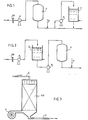
- the installation comprises, in a manner well known per se, a PF pre-filter, a pump P, a main filter F and a device for introducing the disinfecting halogen, simply symbolized by a arrow H.
- a stripping tower 8 is connected in bypass on the line, downstream of the devices F and H.
- a pump P ensures the supply of water to be treated to the tower S. It should be understood that the pump P and the tower S could, as a variant, be connected in series in the line, downstream of F and H.
- the pump P and the tower S are in series, between PF and F. They could, as a variant, be connected in bypass, between PF and F. It must be well understood that the choice of the connection mode will depend solely on practical considerations and that the invention applies even in the case where the stripping tower is connected directly to the basin, without any relation to the disinfection and existing filtration.
- Filtration is carried out conventionally on sand. It will be advantageous either to replace this sand filtration with a granular activated carbon filtration, or to carry out the two filtrations in series, or else to inject powdered activated carbon upstream of the sand filter. These improvements to filtration are combined with stripping to reduce the halomethane content of water, by eliminating part of the organic matter which contributes to their formation.
- the stripping tower shown in FIG. 3, of a type known per se, comprises an upper inlet for rainwater E, a lower outlet D for the treated water and a central unit V for injecting air at the base of the filling material MR.
- This material can be made of plastic, metal, glass, porcelain or other elements, having a shape which gives the material a high vacuum index. There is thus a runoff of water inside the material and a good contact between water and air, which will cause the halomethanes to pass from the dissolved form to the gaseous form to be entrained with 1, air, according to a process for training light and volatile fractions well known in itself.
- the height of the tower can be between 2 and 10 meters and preferably between 4 and 5 meters.
- Table 1 below shows the development over time of the haloform concentration in a swimming pool water, with an initial content of 131 ⁇ g / l, after 30 days (column T + 30); 60 days (column T + 60); 90 days (column T + 90) and 120 days (column T + 120).
- the first line relates to water taken from a swimming pool basin with stripping treatment; the second line relates to water taken from another basin of the same pool, without stripping treatment.
- the Applicants have been able to observe, in certain swimming pools, in certain cases, after 60 days of chlorination, contents reaching an order of magnitude of 1.400 ⁇ g / l. These contents depend on the halogenated product used for the treatment, but also, on the content in organic matter, especially those measured as total organic carbon (TOC).
- TOC total organic carbon
- the TOC varies from 2 to 15 mg / I in drinking water, but the amount provided by bathers is generally much greater.
Landscapes
- Life Sciences & Earth Sciences (AREA)
- Hydrology & Water Resources (AREA)
- Engineering & Computer Science (AREA)
- Environmental & Geological Engineering (AREA)
- Water Supply & Treatment (AREA)
- Chemical & Material Sciences (AREA)
- Organic Chemistry (AREA)
- Water Treatment By Sorption (AREA)
- Physical Water Treatments (AREA)
- Treatment Of Water By Oxidation Or Reduction (AREA)
Description
- L'invention se rapporte au traitement des eaux de piscine au moyen d'halogènes.
- Les procédés de traitement connus associent généralement, en vue d'obtenir une désinfection de l'eau et l'elimination de sa turbidite, une filtration et le maintien dans l'eau de doses résiduelles de chlore libre ou de brome libre comprises entre 1,5 et 3,0 mg/1, avec un pH proche de 7,5.
- Depuis quelques années les concentrations residuelles d'halogène libre autorisées sont de plus en plus élevées, ce qui permet de maitriser parfaitement la qualité microbiologique de l'eau. On a malheureusement noté une augmentation parallèle des plaintes d'usagers atteints d'irritation oculaire et incommodés par les odeurs de chlore.
- Les Demandeurs ont découvert que ces inconvénients sont étroitement liés à la présence, en concentration excessive, dans l'eau des piscines ainsi traitées, de composés volatils formés par la réaction de l'halogene avec les matières organiques.
- Il est connu que les eaux potables peuvent contenir des composés organo-chlorés ou organo-bromés volatils, tels que: chloroforme, monochlorodibromométhane, dichloromonobio-mométhane, bromoforme et autres. Ces composés volatils sont couramment désignés sous les termes d'haloformes, ou halométhanes, qui seront utilisés dans la présente description et les revendications annexées.
- L'invention a pour objet un procédé de traitement basé sur la découverte du lien qui existe entre la teneur en halomethanes et les inconvénients susvisés. La présence d'haloformes dans certaines eaux naturelles présentant une coloration a été mentionnée dans un article de Johannes J. Rook intitulé 'Water Technology", p. 168 à 172 du 'Journal of the American Water Works Association", Mars 1976 et leur élimination par dégazage à l'air dans une tour de stripping a été suggérée dans un articale de la même revue, intitulé 'Design of aeration towers to strip volatile contaminants from drinking water", publié en 1980, pages 684 à 692, par Michael C. Kavanaugh et R. Rhodes Trussel.
- Le brevet français FR A- 572 545 décrit par ailleurs un traitement en continu de l'eau de piscine, comportant une stérilisation par de l'eau de Javel ou du chlore liquide, et l'élimination de certains corps étrangers volatils au moyen d'un aérateur.
- Toutefois, il n'est pas suggéré dans l'état de la technique que les irritations oculaires et le discernement de l'cdeur de chlore sont exagérés par la présence des halométhanes.
- Le procédé selon l'invention, qui comporte la désinfection des eaux de piscine par le maintien d'une dose résiduelle appropriée d'halogène libre et leur aération en vue d'éliminer les corps volatils qu'elles contiennent, est caracterisé par une opération de réduction, en continu, de la teneur en halométhanes de l'eau traitée, effectuée par dégazage à l'air dans une tour de stripping, de façon à maintenir en permanence la teneur en halométhanes à 100 ug/t et, de preférence, moins de 50 ug/I.
- D'autres particularités, ainsi que les avantages de l'invention, apparaitront dairemer. à la lumière de la description ci-après:
- Au dessin annexé: la figure 1 représente schématiquement une installation dans laquelle la tour de stripping est en dérivation dans la filière de désinfection et de filtration, et placée après le filtre principal; la figure 2 représente une variante où la tour de stripping est en série, et placée avant le filtre principal et après la désinfection, et la figure 3 représente schématiquement une tour de stripping susceptible d'être utilisée dans l'installation.
- Aux figures 1 et 2, on voit que l'installation comporte de façon bien connue en soi, un pré-filtre PF, une pompe P, un filtre principal F et un dispositif d'introduction de l'halogène désinfectant, simplement symbolisé par une flèche H. Dans le mode d'exécution de la figure 1, une tour de stripping 8 est branchée en dérivation sur la ligne, en aval des dispositifs F et H. Une pompe P, assure l'alimentation en eau à traiter de la tour S. Il doit être bien compris que la pompe P et la tour S pourraient, à titre de variante, être branchées en série dans la ligne, en aval de F et H.
- Dans le mode d'exécution de la figure 2, la pompe P, et la tour S sont en série, entre PF et F. Elles pourraient, à titre de variante, être branchées en dérivation, entre PF et F. Il doit être bien compris que le choix du mode de branchement dépendra uniquement de considérations d'ordre pratique et que l'invention s'applique même au cas où la tour de stripping serait branchée directement sur le bassin, sans aucune relation avec l'installation de désinfection et de filtration existante.
- La filtration s'effectue classiquement sur sable. Il sera avantageux, soit de remplacer cette filtration sur sable par une filtration sur charbon actif en grains, soit d'effectuer les deux filtrations en série, soit encore d'injecter du charbon actif en poudre en amont du filtre à sable. Ces améliorations à la filtration se conjuguent au stripping pour réduire la teneur de l'eau en halométhanes, en éliminant une partie des matières organiques qui contribuent à leur formation.
- La tour de stripping représentée à la figure 3, d'un type connu en soi, comporte une arrivée supérieure d'eau en pluie E, un départ inférieur D de l'eau traitée et une centrale V d'injection d'air à la base du matériau de remplissage MR. Ce matériau peut être constitué d'éléments en matière plastique, en métal, en verre, en porcelaine ou autre, ayant une forme qui confere au matériau, un fort indice de vide. On a ainsi un ruissellement de l'eau à l'intérieur du matériau et un bon contact entre l'eau et l'air, qui fera passer les halométhanes de la forme dissoute à la forme gazeuse pour être entrainés avec 1, air, selon un procédé d'entrainement des fractions légères et volatiles bien connu en soi. La hauteur de la tour peut être comprise entre 2 et 10 mètres et de préférence, entre 4 et 5 mètres. Pour un rapport de 60 entre les volumes d'air et d'eau injectés, une hauteur de 4 m, une surface au sol de la tour de 1 m2 et un remplissage avec des anneaux en matière plastique, on a pu, à titre d'exemple, réduire de 90% la teneur en haloformes avec un débit d'eau de 100 m3/h.
- Le tableau 1 ci-dessous montre l'évolution dans le temps de la concentration en haloformes d'une eau de piscine, ayant une teneur initiale de 131 µg/l, au bout de 30 jours (colonne T + 30); 60 jours (colonne T + 60); 90 jours (colonne T + 90) et 120 jours (colonne T + 120). La première ligne est relative à une eau prise dans un bassin d'une piscine avec traitement de stripping; la seconde ligne est relative à une eau prise dans un autre bassin de la meme piscine, sans traitement de stripping.
-

- Les teneurs sont indiquées en µg/l On voit que la teneur en haloformes criôt rapidement avec le temps dans le second bassin, jusqu'à atteindre des valeurs très élevées.
- Les Demandeurs ont pu observer, dans certaines piscines, dans certains cas, après 60 jours de chloration, des teneurs atteignant un ordre de grandeur de 1.400µg/l, Ces teneurs dépendent du produit halogéné utilisé pour le traitement, mais aussi, de la teneur en matières organiques, en particulier de celles qui sont mesurées comme carbone organique total (COT). Le COT varie de 2 à 15 mg/I dans l'eau potable, mais la quantité apportée par les baigneurs est généralement beaucoup plus importante.
- Les demandeurs ont pu établir le tableau suivant, qui indique, à la première ligne le pourcentage des baigneurs ayant subi des irritations oculaires et la seconde ligne le pourcentage des baigneurs ayant constate une odeur de chlore genante en piscine couverte, en fonction de la teneur en haloformes, exprimé en tete des colonnes en p g/1.

- Au-delà de 1.000 pg/I, on peut considérer que la piscine devient quasi inutilisable. Par contre, en dessous de 50 µ g/l, les inconvénients signalés sont très réduits. On notera, dans le tableau 1, que le traitement avec stripping permet de maintenir la teneur en haloformes en dessous de cette valeur. En pratique, des essais prolongés pendant 6 mois ont montre l'efficacite du procédé.
Claims (2)
- Procédé de traitement, en continu, des eaux de piscine, comportant la désinfection de l'eau de piscine par le maintien d'une dose résiduelle appropriée d'halogène libre, et l'élimination par aération de corps volatils qu'elle contient,
- caractérisé par une opération de réduction de la teneur en halométhanes effectuée par dégazage à l'air dans une tour de stripping, de façon à maintenir en permanence la teneur en halométhanes à moins de 100 µg/l et, de préférence, moins de 50 µg/l.
Applications Claiming Priority (2)
| Application Number | Priority Date | Filing Date | Title |
|---|---|---|---|
| FR8217255 | 1982-10-15 | ||
| FR8217255A FR2534572B1 (fr) | 1982-10-15 | 1982-10-15 | Procede et installation de traitement en continu des eaux de piscine, reduisant leur teneur en haloformes |
Publications (2)
| Publication Number | Publication Date |
|---|---|
| EP0107583A1 EP0107583A1 (fr) | 1984-05-02 |
| EP0107583B1 true EP0107583B1 (fr) | 1986-02-26 |
Family
ID=9278289
Family Applications (1)
| Application Number | Title | Priority Date | Filing Date |
|---|---|---|---|
| EP83402007A Expired EP0107583B1 (fr) | 1982-10-15 | 1983-10-14 | Procédé et installation de traitement en continu des eaux de piscine, réduisant leur teneur en haloformes |
Country Status (3)
| Country | Link |
|---|---|
| EP (1) | EP0107583B1 (fr) |
| DE (1) | DE3362338D1 (fr) |
| FR (1) | FR2534572B1 (fr) |
Families Citing this family (1)
| Publication number | Priority date | Publication date | Assignee | Title |
|---|---|---|---|---|
| FR2922204B1 (fr) * | 2007-10-16 | 2010-01-08 | Ecole Nationale De La Sante Pu | Procede de traitement d'une eau de bassin d'un etablissement de bains couvert, et installation correspondante |
Family Cites Families (5)
| Publication number | Priority date | Publication date | Assignee | Title |
|---|---|---|---|---|
| FR572545A (fr) * | 1925-01-14 | 1924-06-07 | Procédé et installation pour la réutilisation et la régénération de l'eau des piscines | |
| GB728818A (en) * | 1952-02-06 | 1955-04-27 | Permutit Co Ltd | Improvements relating to plants for purifying the water of swimming baths |
| DE1517587A1 (de) * | 1965-04-09 | 1970-02-05 | Stange F Otto | Verfahren und Vorrichtung zum Aufbereiten von in Schwimmbecken befindlichem Badewasser |
| DE2707471A1 (de) * | 1977-02-21 | 1978-08-24 | Reinhold Dr Rer Nat Barchet | Verfahren, das geeignet ist schwimmbadwasser mit trinkwasserqualitaet zu erzeugen |
| EP0022368B1 (fr) * | 1979-07-06 | 1985-04-10 | John Richard Kerridge | Procédé pour enlever les impuretés contaminantes de bassins de loisirs |
-
1982
- 1982-10-15 FR FR8217255A patent/FR2534572B1/fr not_active Expired
-
1983
- 1983-10-14 DE DE8383402007T patent/DE3362338D1/de not_active Expired
- 1983-10-14 EP EP83402007A patent/EP0107583B1/fr not_active Expired
Non-Patent Citations (1)
| Title |
|---|
| "Design of aeration towers to strip volatile contaminants from drinking water" M.C. Kavanaugh & R. Rhodes Trussell, Journal of the American Water Work Assoc. (1980) pages 684 à 692 * |
Also Published As
| Publication number | Publication date |
|---|---|
| DE3362338D1 (en) | 1986-04-03 |
| EP0107583A1 (fr) | 1984-05-02 |
| FR2534572B1 (fr) | 1987-01-23 |
| FR2534572A1 (fr) | 1984-04-20 |
Similar Documents
| Publication | Publication Date | Title |
|---|---|---|
| CA1303325C (fr) | Appareil de traitement d'eau | |
| Marais et al. | Comparison of natural organic matter removal by ultrafiltration, granular activated carbon filtration and full scale conventional water treatment | |
| EP0328474B1 (fr) | Procédé de purification biologique des eaux contenant matières organiques et produits dérivés, utilisant la diffusion et l'action de micro-organismes aérobies et anaérobies et dispositif pour la mise en oeuvre | |
| US4693832A (en) | Preparation of safe drinking water | |
| AU2010256338A1 (en) | Fluid treatment apparatus | |
| FR2793996A1 (fr) | Procede d'amelioration des conditions d'elevage de poissons en circuit ferme | |
| EP2582634A1 (fr) | Traitement de depollution d'une eau contaminee par des micro-polluants et/ou des polluants emergents, notamment par des composes organochlores | |
| CH641744A5 (fr) | Installation de purification d'eau. | |
| US3887468A (en) | Feed water chlorinator for a reverse osmosis system | |
| WO1997005072A1 (fr) | Installation pour le traitement biologique des eaux en vue de leur potabilisation | |
| Montiel | Municipal drinking water treatment procedures for taste and odour abatement–a review | |
| WO1995005237A1 (fr) | Systeme de traitement de l'eau | |
| EP0107583B1 (fr) | Procédé et installation de traitement en continu des eaux de piscine, réduisant leur teneur en haloformes | |
| CN111285505A (zh) | 一种水库水的处理工艺 | |
| BE1004260A5 (fr) | Procede de traitement d'eaux usees par la technique des boues activees. | |
| US5938918A (en) | Domestic water clarifier | |
| FR2490208A1 (fr) | Procede de traitement d'eaux usees a l'aide de boues activees | |
| Swietlik et al. | Effect of oxidation with chlorine dioxide on the adsorption of natural organic matter on granular activated carbon | |
| HU219433B (hu) | Eljárás és berendezés nagy algaterhelésű felszíni víz feldolgozására | |
| FR2679464A1 (fr) | Module de filtration, notamment pour le traitement des eaux. | |
| CN1199889C (zh) | 膜工艺处理饮用水系统及制取饮用水工艺 | |
| Clark | The purification of water on a small scale | |
| LeChevallier et al. | AOC reduction by biologically active filtration | |
| CA1131812A (fr) | Procede d'epuration des eaux | |
| JPS57122996A (en) | Water cleaning treatment |
Legal Events
| Date | Code | Title | Description |
|---|---|---|---|
| PUAI | Public reference made under article 153(3) epc to a published international application that has entered the european phase |
Free format text: ORIGINAL CODE: 0009012 |
|
| 17P | Request for examination filed |
Effective date: 19831018 |
|
| AK | Designated contracting states |
Designated state(s): CH DE GB LI |
|
| GRAA | (expected) grant |
Free format text: ORIGINAL CODE: 0009210 |
|
| AK | Designated contracting states |
Designated state(s): CH DE GB LI |
|
| REF | Corresponds to: |
Ref document number: 3362338 Country of ref document: DE Date of ref document: 19860403 |
|
| PLBE | No opposition filed within time limit |
Free format text: ORIGINAL CODE: 0009261 |
|
| STAA | Information on the status of an ep patent application or granted ep patent |
Free format text: STATUS: NO OPPOSITION FILED WITHIN TIME LIMIT |
|
| 26N | No opposition filed | ||
| PGFP | Annual fee paid to national office [announced via postgrant information from national office to epo] |
Ref country code: GB Payment date: 19961009 Year of fee payment: 14 |
|
| PGFP | Annual fee paid to national office [announced via postgrant information from national office to epo] |
Ref country code: CH Payment date: 19961101 Year of fee payment: 14 |
|
| PGFP | Annual fee paid to national office [announced via postgrant information from national office to epo] |
Ref country code: DE Payment date: 19961230 Year of fee payment: 14 |
|
| PG25 | Lapsed in a contracting state [announced via postgrant information from national office to epo] |
Ref country code: GB Free format text: LAPSE BECAUSE OF NON-PAYMENT OF DUE FEES Effective date: 19971014 |
|
| PG25 | Lapsed in a contracting state [announced via postgrant information from national office to epo] |
Ref country code: LI Free format text: LAPSE BECAUSE OF NON-PAYMENT OF DUE FEES Effective date: 19971031 Ref country code: CH Free format text: LAPSE BECAUSE OF NON-PAYMENT OF DUE FEES Effective date: 19971031 |
|
| GBPC | Gb: european patent ceased through non-payment of renewal fee |
Effective date: 19971014 |
|
| REG | Reference to a national code |
Ref country code: CH Ref legal event code: PL |
|
| PG25 | Lapsed in a contracting state [announced via postgrant information from national office to epo] |
Ref country code: DE Free format text: LAPSE BECAUSE OF NON-PAYMENT OF DUE FEES Effective date: 19980701 |