EP0108265A2 - Méthode et dispositif pour la surveillance du bilan neutronique du coeur d'un réacteur nucléaire et pour le diagnostic du changement de la réactivité - Google Patents
Méthode et dispositif pour la surveillance du bilan neutronique du coeur d'un réacteur nucléaire et pour le diagnostic du changement de la réactivité Download PDFInfo
- Publication number
- EP0108265A2 EP0108265A2 EP83110019A EP83110019A EP0108265A2 EP 0108265 A2 EP0108265 A2 EP 0108265A2 EP 83110019 A EP83110019 A EP 83110019A EP 83110019 A EP83110019 A EP 83110019A EP 0108265 A2 EP0108265 A2 EP 0108265A2
- Authority
- EP
- European Patent Office
- Prior art keywords
- reactivity
- module
- parameters
- values
- mess
- Prior art date
- Legal status (The legal status is an assumption and is not a legal conclusion. Google has not performed a legal analysis and makes no representation as to the accuracy of the status listed.)
- Granted
Links
Images


Classifications
-
- G—PHYSICS
- G21—NUCLEAR PHYSICS; NUCLEAR ENGINEERING
- G21C—NUCLEAR REACTORS
- G21C17/00—Monitoring; Testing ; Maintaining
-
- G—PHYSICS
- G21—NUCLEAR PHYSICS; NUCLEAR ENGINEERING
- G21C—NUCLEAR REACTORS
- G21C17/00—Monitoring; Testing ; Maintaining
- G21C17/10—Structural combination of fuel element, control rod, reactor core, or moderator structure with sensitive instruments, e.g. for measuring radioactivity, strain
- G21C17/104—Measuring reactivity
-
- Y—GENERAL TAGGING OF NEW TECHNOLOGICAL DEVELOPMENTS; GENERAL TAGGING OF CROSS-SECTIONAL TECHNOLOGIES SPANNING OVER SEVERAL SECTIONS OF THE IPC; TECHNICAL SUBJECTS COVERED BY FORMER USPC CROSS-REFERENCE ART COLLECTIONS [XRACs] AND DIGESTS
- Y02—TECHNOLOGIES OR APPLICATIONS FOR MITIGATION OR ADAPTATION AGAINST CLIMATE CHANGE
- Y02E—REDUCTION OF GREENHOUSE GAS [GHG] EMISSIONS, RELATED TO ENERGY GENERATION, TRANSMISSION OR DISTRIBUTION
- Y02E30/00—Energy generation of nuclear origin
- Y02E30/30—Nuclear fission reactors
Definitions
- the present invention relates to a method according to the preamble of the main claim and an arrangement for performing the method.
- the directly measured reactivity is compared with the reactivity calculated continuously from diverse measurements:
- the size of the difference is used to draw conclusions about the system status (normal or abnormal) and the result is displayed (alarm). A diagnosis of the cause is generally not possible.
- the difference ⁇ p is thus explained by the difference between the actual and the coefficients ⁇ B ' ⁇ T , ⁇ W , ⁇ CR and ⁇ CR, 0 used in the model (b). It only reliably indicates an abnormal state if these coefficients are sufficiently well known and are not influenced by normal operating conditions.
- the object of the present invention is a monitoring system for the reactivity balance which is as powerful as possible while at the same time expanding the diagnostic possibilities of reactivity disorders.
- a high level of monitoring sensitivity is to be achieved during stationary and transient processes.
- the reactivity contributions of the control rods should be determined continuously without rod position measurement and compensated in the output signal of the balance meter.
- the effects too Operational deviations of the throughput, the inlet temperature and the movement of the control rod on the reactivity should be determined and compensated in the output signal of the balance meter in order to maintain the monitoring sensitivity to abnormal processes even with rapid working point shifts.
- FIG. 1 of the drawing The interaction of the monitoring circuit for cooling faults with the reactivity balance meter is shown in FIG. 1 of the drawing, which is described in more detail below.
- Equation (c) is a description of the reactivity balance that is well known in nuclear physics and has the advantage that the coefficients ⁇ j are particularly simple.
- the fuel element-specific data could in principle also be fed directly to the balance meter (without radial averaging).
- the balance equation (c) is to be understood as the sum of the reactivity contributions of the individual fuel elements:
- the fuel element-related coefficients ß would be determined instead of the global coefficients ⁇ j
- the prepared direct and indirect measured variables then arrive at the parameter estimation module and reactivity balance module.
- the parameter estimation module has the task of determining the coefficients ⁇ j via the direct and indirect measurements of the core state using the least squares method.
- this equation is (c) as a measured value g leichun g with ⁇ mess2 replaced by ⁇ MESS1
- the index k denotes the sampling time
- ⁇ is the parameter vector and is the statistical error of the measurement p.
- the equations for recursive calculation of the parameter vector are e.g. in P 31 46 374.6.
- the estimation process is either triggered periodically or by the diagnostic module whenever z. B. the reactivity balance exceeds a predetermined limit and takes about 200 sampling intervals.
- the parameter estimation module thus delivers the time course of the parameters on the assumption that they do not change during the calibration process.
- the Doppler and axial expansion coefficients are only slightly dependent on the fuel or cladding tube temperature, so that this dependency only has to be taken into account when the working point shifts. It is sufficient for a fine adjustment to use the following compensation formula: the function f (T f , T f, 0 ) is generally known and the index 0 denotes the result of the last calibration.
- the effective control rod reactivity is determined as the difference between the measured total reactivity and the estimated feedback reactivity ⁇ fd in which and smoothed with a 2nd order digital filter.
- This variable which is difficult or inaccurate to determine via the position measurement, can be determined very precisely using (f). Systematic errors would only occur if the feedback coefficients ⁇ j had changed in an unknown way since the last parameter estimation process. In this case, however, the ⁇ signal would initiate a new calibration.
- control rod reactivity contribution is also due to the position measurement, whereby
- the coefficient B CR is usually determined using complex calibration experiments that have to be repeated after about six months of operation.
- the difference (f) now allows ⁇ CR to be determined (during operation) whenever control rod movements are recorded.
- the constant, non-position-dependent term provides information about the relative change in position of the bars (differential expansion) and all the feedback contributions that cannot be coupled with state variables. It is to be expected that a breakdown of ⁇ CR, 0 can be achieved with the aid of an "integrated core monitoring", in which B. acoustic signals can be correlated with spontaneous changes in ⁇ CR, 0 .
- the new balance meter also fulfills the function of the conventional balance meter.
- each fuel element determines additional indirect measurement variables (parameters and state) from direct measurement variables, for example by the least squares method or by parameter-adaptive Kalman filters.
- additional indirect measurement variables parameters and state
- the indirect measured values are present as state estimates ⁇ T ⁇ f, n and ⁇ T ⁇ c, n and as parameter estimates.
- the estimation modules 1 enable cooling faults to be classified, which are output via line 8, and provide further thermohydraulic parameters, which are passed on via line 9.
- All direct measured values 11 are also fed to a reactivity balance meter 2, into which the indirect measured values 10 from all estimation modules 1 are also entered.
- the reactivity parameters are a function of time (output 17), and on the other hand, a signal line 19 enables the output of a diagnostic signal for reactivity disorders.
- Another output 18 is used for calibration control for the P parameters from equation (d).
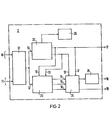
- the internal structure of the reactivity balance meter 2 is shown in more detail in FIG. 2.
- the indirect measured values 10 and the direct 11 first go into preprocessing tion module 21, in which the measured values are converted according to simple models and averages are formed across all fuel elements or control rods.
- the preprocessed indirect and direct measured values at output 12 are forwarded to two places. On the one hand, they arrive at a reactivity balance module 23 and, on the other hand, at a parameter estimation module 22.
- all reactivity parameters ⁇ j are periodically or as required by adapting the function (c) to the directly measured reactivity ⁇ mess 1 (e.g. using the smallest method Error squares) recalculated.
- the parameter estimation module 22 contains memory for storing these parameters and a computing part for the respective recalculation. If necessary, the results of each recalculation can be recorded in an output device 26, for example a printer.
- the respective current parameters are forwarded to the reactivity balance module 23 via lines 13 and 17.
- the current parameters can be used in the reactivity balance module 23 to calculate ⁇ mess 2 according to equation (c) and to compare the result with ⁇ mess 1 . This is done, for example, with the help of a microprocessor.
- the difference value ⁇ and the other reactivity contributions are passed on to a diagnostic module 24 via the outputs 14, 15 and 16.
- the output values of the parameter estimation module 22 are also fed to this diagnostic module 24 via its outputs 13 and 17.
- the preprocessing module 21 is also shown in detail.
- the indirect 10 and direct 11 input quantities are converted there into the quantities which are required for a representation of the reactivity g mess 2 according to equation (c).
- the 11 direct measured values are subjected to a somewhat more complicated reshaping.
- Using a simple model 211 for the thermal behavior of the fuel box the starting temperature of the coolant at each fuel ⁇ T 0, n and the coolant inlet temperature ⁇ T I with subsequent addition and averaging, the average temperature T SO at the upper end of the box and the average temperature T SI determined at the lower end of the envelopes.
- the temperature of the grid plate at the lower end of the fuel elements ⁇ TI * is calculated from the coolant inlet temperature ( ⁇ TI .
- the individual positions are calculated the actuating rods determines a mean value.
- the data collected pre-processing variables 12 are g to lun for a representation of the Reactivity S mess 2 according to equation (c) and can thus be forwarded to the parameter estimation module 22 and the reactivity balance module 23.
Landscapes
- Physics & Mathematics (AREA)
- Engineering & Computer Science (AREA)
- Plasma & Fusion (AREA)
- General Engineering & Computer Science (AREA)
- High Energy & Nuclear Physics (AREA)
- Monitoring And Testing Of Nuclear Reactors (AREA)
Applications Claiming Priority (2)
| Application Number | Priority Date | Filing Date | Title |
|---|---|---|---|
| DE3238522 | 1982-10-18 | ||
| DE19823238522 DE3238522A1 (de) | 1982-10-18 | 1982-10-18 | Verfahren und vorrichtung zur ueberwachung der reaktivitaetsbilanz des core eines kernreaktors und zur diagnose von reaktivitaetsstoerungen |
Publications (3)
| Publication Number | Publication Date |
|---|---|
| EP0108265A2 true EP0108265A2 (fr) | 1984-05-16 |
| EP0108265A3 EP0108265A3 (en) | 1987-07-01 |
| EP0108265B1 EP0108265B1 (fr) | 1989-03-29 |
Family
ID=6175975
Family Applications (1)
| Application Number | Title | Priority Date | Filing Date |
|---|---|---|---|
| EP83110019A Expired EP0108265B1 (fr) | 1982-10-18 | 1983-10-06 | Méthode et dispositif pour la surveillance du bilan neutronique du coeur d'un réacteur nucléaire et pour le diagnostic du changement de la réactivité |
Country Status (2)
| Country | Link |
|---|---|
| EP (1) | EP0108265B1 (fr) |
| DE (2) | DE3238522A1 (fr) |
Cited By (3)
| Publication number | Priority date | Publication date | Assignee | Title |
|---|---|---|---|---|
| FR2629623A1 (fr) * | 1988-04-05 | 1989-10-06 | Framatome Sa | Procede de determination et d'evaluation de la marge d'arret d'urgence d'un reacteur nucleaire a eau pressurisee |
| EP0326267A3 (en) * | 1988-01-19 | 1990-04-11 | Westinghouse Electric Corporation | Core reactivity validation computer and method |
| FR2818427A1 (fr) * | 2000-12-15 | 2002-06-21 | Framatome Anp | Procede de determination du temps de doublement d'un flux neutronique dans le coeur d'un reacteur nucleaire |
Families Citing this family (3)
| Publication number | Priority date | Publication date | Assignee | Title |
|---|---|---|---|---|
| DE19517104A1 (de) * | 1995-05-10 | 1996-11-14 | Istec Gmbh | Verfahren zur Zustandsüberwachung dynamischer Rauschprozesse |
| DE19737404A1 (de) * | 1997-08-27 | 1999-03-11 | Siemens Ag | Verfahren zur zerstörungsfreien Prüfung der Störfallfestigkeit einer elektrischen Komponente einer Kernkraftanlage |
| RU2507615C1 (ru) * | 2012-12-06 | 2014-02-20 | Федеральное государственное бюджетное учреждение "Национальный исследовательский центр "Курчатовский институт" | Способ измерения эффективности стержней регулирования реакторной установки |
Family Cites Families (3)
| Publication number | Priority date | Publication date | Assignee | Title |
|---|---|---|---|---|
| DE1639231A1 (de) * | 1968-03-18 | 1971-01-28 | Euratom | Reaktivitaets-Messgeraet fuer Kernreaktoren |
| AU5773773A (en) * | 1972-07-12 | 1975-01-09 | Unitedstates Atomic Energy Commission | Reactor reactivity and eigenvalue measurements |
| DE3273288D1 (en) * | 1981-05-13 | 1986-10-23 | Interatom | Method and arrangement to determine and indicate failures in the cooling system in a fuel element of a reactor core |
-
1982
- 1982-10-18 DE DE19823238522 patent/DE3238522A1/de not_active Withdrawn
-
1983
- 1983-10-06 EP EP83110019A patent/EP0108265B1/fr not_active Expired
- 1983-10-06 DE DE8383110019T patent/DE3379521D1/de not_active Expired
Cited By (4)
| Publication number | Priority date | Publication date | Assignee | Title |
|---|---|---|---|---|
| EP0326267A3 (en) * | 1988-01-19 | 1990-04-11 | Westinghouse Electric Corporation | Core reactivity validation computer and method |
| FR2629623A1 (fr) * | 1988-04-05 | 1989-10-06 | Framatome Sa | Procede de determination et d'evaluation de la marge d'arret d'urgence d'un reacteur nucleaire a eau pressurisee |
| EP0339301A1 (fr) * | 1988-04-05 | 1989-11-02 | Framatome | Procédé de détermination et d'évaluation de la marge d'arrêt d'urgence d'un réacteur nucléaire à eau pressurisée |
| FR2818427A1 (fr) * | 2000-12-15 | 2002-06-21 | Framatome Anp | Procede de determination du temps de doublement d'un flux neutronique dans le coeur d'un reacteur nucleaire |
Also Published As
| Publication number | Publication date |
|---|---|
| DE3379521D1 (en) | 1989-05-03 |
| EP0108265B1 (fr) | 1989-03-29 |
| DE3238522A1 (de) | 1984-04-19 |
| EP0108265A3 (en) | 1987-07-01 |
Similar Documents
| Publication | Publication Date | Title |
|---|---|---|
| DE102008038347B4 (de) | System zur analyse der leistungscharakteristik einer gasturbine | |
| DE69607168T2 (de) | Verfahren zur sensorfehlererkennung | |
| DE60016843T2 (de) | Verfahren und Einrichtung zum Erkennen der Kritikalitätsnähe in einem unter Verwendung von Kernbrennstoff betriebenen elektrischen Kraftwerk | |
| DE69324296T2 (de) | Verfahren zur Diagnose eines laufenden Prozesses | |
| DE60007772T2 (de) | Rekursive zustandsschätzung durch matrixfaktorisierung | |
| EP0713580B1 (fr) | Procede et dispositif permettant de surveiller la temperature d'une generatrice electrique | |
| DE112007003612B4 (de) | Prozesskontrollsystem mit einem Alarmanalysesystem und Verfahren zur Bereitstellung von Statistiken über Alarme von einem Prozesskontrollsystem, Computerprogrammprodukt und computerlesbares Medium | |
| DE2714069A1 (de) | Verfahren und einrichtung zum feststellen und analysieren von fehlerquellen | |
| DE3421522A1 (de) | Verfahren und einrichtung zur diagnose eines waermekraftwerks | |
| EP3390967B1 (fr) | Procede de surveillance d'au moins deux capteurs redondants | |
| DE68926429T2 (de) | Anlagen-Diagnoseapparat | |
| DE3141225A1 (de) | Verfahren und vorrichtung zur bestimmung des massenflusses eines stroemenden mediums | |
| EP4088077B1 (fr) | Procédé et dispositif de détermination de l'encrassement dans un échangeur de chaleur | |
| DE102019005710A1 (de) | Abnormitätserfassungsvorrichtung, abnormitätserfassungverfahren und programm | |
| DE112020003659T5 (de) | Verfahren zur diagnose von anomalien, vorrichtung zur diagnose von anomalienund programm zur diagnose von anomalien | |
| DE112005001748T5 (de) | Ein System und Verfahren zum Überwachen der Leistung eines Wärmetauschers | |
| DE69014734T2 (de) | Verfahren für die Berechnung der Leistungsverteilung im Kern eines Kernkraftreaktors und Verfahren zum Kalibrieren der umgebenden Neutronendetektoren des Kerns eines Kernkraftreaktors. | |
| DE10006455A1 (de) | Verfahren zum Betrieb einer technischen Anlage | |
| DE4406723A1 (de) | Verfahren zur Überwachung des Betriebszustands einer Maschine oder Anlage | |
| DE112017007279T5 (de) | Temperatur-Schätzeinrichtung und elektrische Einrichtung | |
| DE3445791A1 (de) | Waermeleistungsfaehigkeitswaechter fuer einen dampfturbogenerator | |
| EP0108265B1 (fr) | Méthode et dispositif pour la surveillance du bilan neutronique du coeur d'un réacteur nucléaire et pour le diagnostic du changement de la réactivité | |
| EP0291553A1 (fr) | Méthode pour régler une balance de dosage différentielle, en particulier pour matériaux en vrac, et une balance de dosage différentielle pour l'application de la méthode | |
| DE4416463A1 (de) | Verfahren zur Überwachung eines Siedewasserkernreaktors bezüglich Austrocknung des Kerns | |
| DE69514932T4 (de) | Einrichtung zur überwachung der spannungen in einer ausrüstung |
Legal Events
| Date | Code | Title | Description |
|---|---|---|---|
| PUAI | Public reference made under article 153(3) epc to a published international application that has entered the european phase |
Free format text: ORIGINAL CODE: 0009012 |
|
| AK | Designated contracting states |
Designated state(s): DE FR GB IT NL |
|
| 17P | Request for examination filed |
Effective date: 19841220 |
|
| PUAL | Search report despatched |
Free format text: ORIGINAL CODE: 0009013 |
|
| RHK1 | Main classification (correction) |
Ipc: G21C 17/10 |
|
| AK | Designated contracting states |
Kind code of ref document: A3 Designated state(s): DE FR GB IT NL |
|
| RAP1 | Party data changed (applicant data changed or rights of an application transferred) |
Owner name: INTERATOM GESELLSCHAFT MIT BESCHRAENKTER HAFTUNG |
|
| 17Q | First examination report despatched |
Effective date: 19880706 |
|
| GRAA | (expected) grant |
Free format text: ORIGINAL CODE: 0009210 |
|
| AK | Designated contracting states |
Kind code of ref document: B1 Designated state(s): DE FR GB IT NL |
|
| REF | Corresponds to: |
Ref document number: 3379521 Country of ref document: DE Date of ref document: 19890503 |
|
| ET | Fr: translation filed | ||
| ITF | It: translation for a ep patent filed | ||
| GBT | Gb: translation of ep patent filed (gb section 77(6)(a)/1977) | ||
| PGFP | Annual fee paid to national office [announced via postgrant information from national office to epo] |
Ref country code: GB Payment date: 19890930 Year of fee payment: 7 |
|
| PGFP | Annual fee paid to national office [announced via postgrant information from national office to epo] |
Ref country code: FR Payment date: 19891026 Year of fee payment: 7 |
|
| ITTA | It: last paid annual fee | ||
| PGFP | Annual fee paid to national office [announced via postgrant information from national office to epo] |
Ref country code: NL Payment date: 19891031 Year of fee payment: 7 |
|
| PGFP | Annual fee paid to national office [announced via postgrant information from national office to epo] |
Ref country code: DE Payment date: 19891219 Year of fee payment: 7 |
|
| PLBE | No opposition filed within time limit |
Free format text: ORIGINAL CODE: 0009261 |
|
| STAA | Information on the status of an ep patent application or granted ep patent |
Free format text: STATUS: NO OPPOSITION FILED WITHIN TIME LIMIT |
|
| 26N | No opposition filed | ||
| PG25 | Lapsed in a contracting state [announced via postgrant information from national office to epo] |
Ref country code: GB Effective date: 19901006 |
|
| PG25 | Lapsed in a contracting state [announced via postgrant information from national office to epo] |
Ref country code: NL Effective date: 19910501 |
|
| GBPC | Gb: european patent ceased through non-payment of renewal fee | ||
| NLV4 | Nl: lapsed or anulled due to non-payment of the annual fee | ||
| PG25 | Lapsed in a contracting state [announced via postgrant information from national office to epo] |
Ref country code: FR Effective date: 19910628 |
|
| PG25 | Lapsed in a contracting state [announced via postgrant information from national office to epo] |
Ref country code: DE Effective date: 19910702 |
|
| REG | Reference to a national code |
Ref country code: FR Ref legal event code: ST |