EP0108728A2 - Tampons auriculaires insonorisants en matière polymère expansée - Google Patents
Tampons auriculaires insonorisants en matière polymère expansée Download PDFInfo
- Publication number
- EP0108728A2 EP0108728A2 EP83830216A EP83830216A EP0108728A2 EP 0108728 A2 EP0108728 A2 EP 0108728A2 EP 83830216 A EP83830216 A EP 83830216A EP 83830216 A EP83830216 A EP 83830216A EP 0108728 A2 EP0108728 A2 EP 0108728A2
- Authority
- EP
- European Patent Office
- Prior art keywords
- section
- density
- plug
- tip
- tampon
- Prior art date
- Legal status (The legal status is an assumption and is not a legal conclusion. Google has not performed a legal analysis and makes no representation as to the accuracy of the status listed.)
- Granted
Links
Images

Classifications
-
- A—HUMAN NECESSITIES
- A61—MEDICAL OR VETERINARY SCIENCE; HYGIENE
- A61F—FILTERS IMPLANTABLE INTO BLOOD VESSELS; PROSTHESES; DEVICES PROVIDING PATENCY TO, OR PREVENTING COLLAPSING OF, TUBULAR STRUCTURES OF THE BODY, e.g. STENTS; ORTHOPAEDIC, NURSING OR CONTRACEPTIVE DEVICES; FOMENTATION; TREATMENT OR PROTECTION OF EYES OR EARS; BANDAGES, DRESSINGS OR ABSORBENT PADS; FIRST-AID KITS
- A61F11/00—Methods or devices for treatment of the ears or hearing sense; Non-electric hearing aids; Methods or devices for enabling ear patients to achieve auditory perception through physiological senses other than hearing sense; Protective devices for the ears, carried on the body or in the hand
- A61F11/06—Protective devices for the ears
- A61F11/08—Protective devices for the ears internal, e.g. earplugs
Definitions
- Tampons of this kind are known, inter alia, from document US-A-Re 29 487. These pads are in a single piece of cylindrical or conical shape, in a single expanded polymer material.
- Buffers provided with a core are known from documents SE-A-147,790, CH-A-575,232, GB-A-733,542, US-A-2,538,339 and US-A-3,736,929.
- the ear plug of Figure 1 consists of two sections or layers 1 and 2 of poly material. expanded. Each of these sections has a generally cylindrical shape with a diameter larger than that of the average human ear canal in adult subjects. An acceptable diameter can be between 1.5 cm and 3.0 cm. It is understood that the cylindrical term also indicates other suitable shapes, such as the frustoconical shape, in this case the target diameter being that of the middle section, as well as the spherical shape, in this case the target diameter being that of the sphere.
- the section 1 has a lower density and the section 2 has a higher density.
- the adhesion of the two sections 1 and 2 is carried out by simple superposition and surface interpenetration of the layers during their preparation.
- the densities and thicknesses of the two sections are chosen so as to obtain the suitable acoustic barrier effect.
- Section 1 mainly has the function of marrying the internal shape of the ear canal;
- section 2 mainly has the function of a handle, but also that of improving sound insulation.
- the ear plug of FIG. 2 comprises a section 3 of expanded polymer material of generally cylindrical shape, and a section in the form of an appendage or peduncle 4 of density greater than that of section 3.
- Section 3 ends in a layer or film thin (skin) 5 of the same density.
- the section 3 mainly has the soundproofing function, being intended for introduction into the ear;
- the peduncle 4 mainly has the handle function;
- the ear plug of FIG. 3 comprises a section 6, made of expanded polymer material, a section 7, also made of expanded polymer, but with a density greater than that of section 6, as well as an appendage or peduncle 8 and a layer or film. thin 9, the latter two having a density greater than that of the section 7.
- Section 6 mainly has the function of soundproofing, being intended for introduction into the ear canal.
- the section 7 has the function of improving the sound insulation and can also be used as a handle in addition to the peduncle 8.
- the density of the soundproofing sections 1, 3 and 6 can vary between 0.01 and 0.20 g / cc (grams / cubic centimeter) and preferably between 0.11 and 0.12 g / CC.
- the length of these sections 1.3 and 6 can be between 10 and 20 mm.
- the density of the sections 2 and 7 can vary between 0.13 and 0.22 g / cc. Their length can be between 6 and 10 mm.
- the density of the peduncles 4 and 8 and of the films 5 and 9 can vary between 0.9 and 1.1 g / cc. Their length can be up to 30 mm or more. The thickness of the films 5 and 9 can vary between 0.1 and 0.5 mm.
- the polymers constituting the various layers or segments, the stalk and the film may be polymers and c o-polymers of ethylene, propylene, vinyl chloride, vinyl acetate, acetate cellulo se, isobutylene or isocyanate.
- This example relates to the preparation of a buffer of the kind of that of FIG. 1.
- PVC polyvinyl chloride
- composition II was deposited by coating on a conveyor belt so as to obtain a layer the thickness of 1 mm; then it was pre-gelled by passing the strip through a 7 m long oven at a speed of 4 m / min, at a nominal temperature of 130 ° C. On composition II, composition I was then deposited by coating over a thickness of 1.7 mm. Then the two compositions were passed through the oven, with a belt speed of 3 m / min, at a nominal temperature of 200 ° C.
- a semi-finished product of the total thickness of 2 cm was thus obtained, in which the layer of composition I had a thickness of 1.3 cm and a density of 0.12 g / cc, and the layer of the composition II a thickness of 0.7 cm and a density of 0.22 g / cc.
- the ear plugs were obtained in punching the semi-finished product.
- section 1 was obtained from composition I and section 2 was obtained from composition II.
- pads have been obtained which have very good mechanical properties, a sound-absorbing behavior superior to that of devices made of polymeric material currently on the market, as well as characteristics of surface appearance and particularly pleasant to the touch.
- This example relates to the preparation of a tampon of the kind illustrated in FIG. 2.
- the plastisol of composition IV was deposited by coating on an aluminum mold essentially consisting of a plate in which had been formed, at intervals of 2 cm, cylindrical cells 0.5 cm in diameter and 1 cm deep , until a layer 0.3 mm thick is obtained on the surface of the plate.
- composition III was deposited by coating on a thickness of 1.7 mm.
- the whole was placed in a forced circulation oven for a period of 8 min and at a nominal temperature of 200 ° C.
- stamps like those in FIG. 2 were obtained, in which the section 3 had a length of 2 cm, a diameter of 0.8 cm and a density of 0.14 g / cc. ; the film 5 had a thickness of 0.2 mm and a density of 1.1 g / cc; peduncle 4 had a length of 10 mm and a density of 1.1 g / cc.
- This example relates to the preparation of a buffer of the kind of that of FIG. 3.
- compositions of PVC plastisol were prepared with the components and in the amounts indicated below.
Landscapes
- Health & Medical Sciences (AREA)
- Life Sciences & Earth Sciences (AREA)
- Biomedical Technology (AREA)
- Acoustics & Sound (AREA)
- Biophysics (AREA)
- Otolaryngology (AREA)
- Psychology (AREA)
- Engineering & Computer Science (AREA)
- Physics & Mathematics (AREA)
- Heart & Thoracic Surgery (AREA)
- Vascular Medicine (AREA)
- Animal Behavior & Ethology (AREA)
- General Health & Medical Sciences (AREA)
- Public Health (AREA)
- Veterinary Medicine (AREA)
- Absorbent Articles And Supports Therefor (AREA)
- Manufacture Of Porous Articles, And Recovery And Treatment Of Waste Products (AREA)
- Laminated Bodies (AREA)
- Dental Preparations (AREA)
Abstract
Description
- L'invention concerne les tampons auriculaires en matière polymère expansée.
- On connaît bien l'exigence de protéger les organes de l'appareil auditif contre les dérangements provoqués par des explosions, des ondes de choc, des niveaux excessifs d'intensité sonore, qui peuvent non seulement être gênants mais provoquer des lésions à l'oreille interne ou à ses liaisons nerveuses sans que toutefois cette protection rende nulle la capacité d'écoute.
- On connaît beaucoup de dispositifs qui se prêtent à l'introduction dans l'une et l'autre oreille et qui se comportent sensiblement comme une barrière acoustique entre l'ambiance extérieure et la membrane du tympan. Ces dispositifs protecteurs pour être efficaces comme barrière acoustique doivent adhérer parfaitement à la paroi du conduit auditif sans. empêcher l'équilibrage de la pression sur la membrane du tympan. On sait en effet qu'une pression excercée sur le tympan crée des dérangements gênants surtout si elle doit être supportée pendant longemps. On sait également que les dimensions et la forme du conduit auditif de l'homme sont très variables d'un individu à l'autre et, chez le même individu, d'une oreille à l'autre. Même si l'on voulait faire recours à des tampons réalisés sur mesure, leur efficacité protectrice serait annulée par les changements de forme du conduit auditif provoqués par le mouvement de la mâchoire. On comprendra donc que les dispositifs basés sur des formes anatomiques et sur des systèmes d'accrochage particuliers pour adhérer à la paroi du conduit auditif ont des performances acoustiques insuffisantes.
- Pour pallier ces inconvénients sont entrés dans l'usage depuis quelques années des tampons en matière polymère expansée qui, en plus d'avoir de bonnes propriétés insonorisantes, sont atoxiques et dépourvus d'effets collatéraux nuisibles.
- Des tampons de ce genre sont connus, entre autres, par le document US-A-Re 29 487. Ces tampons sont en une seule pièce de forme cylindrique ou conique, en une seule matière polymère expansée.
- L'utilisation d'une seule matière expansée, si celle-ci est trop souple, a l'inconvénient de procurer une insonorisation insuffisante et de donner lieu à des difficultés soit d'introduction dans le conduit auditif que d'extraction de celui-ci. Si au contraire la matière expansée est trop rigide, à la suite d'une densité supérieure, l'introduction et l'extraction du tampon sont plus aisées, mais ses possibilités d'adaptation et d'acceptation dans le conduit auditif sont inférieures.
- En plus, tout comme le plus simple et le plus ancien des tampons auriculaires, c'est-à-dire une boule d'ouate malaxée avec de la cire, et tout comme d'autres tampons en matière fibreuse emprégnée de substances ductiles convenables, ces tampons en matière polymère doivent être déformés et comprimés avec les doigts pour être introduits dans l'oreille. Ceci constitue un inconvénient remarquable du point de vue hygiénique en général et notamment dans les milieux de travail où l'usager peut toucher des matières dangereuses ou tout au moins irritantes.
- Leur extraction de l'oreille présente un inconvénient analogue : étant donnée la position où ils se disposent en général, ils obligent l'usager à introduire les doigts dans la partie initiale du conduit auditif.
- D'autres tampons connus sont munis d'une âme intérieure relativement rigide qui dans certains cas fait saillie du corps du tampon pour ccnstituer un organe de préhension qui rend l'introduction et l'extraction plus aisées. La présence d'une âme a toutefois l'inconvénient de rendre le tampon plus rigide et donc moins susceptible d'adaptation et d'acceptation dans le conduit auditif.
- Des tampons pourvus d'une âme sont connus par les documents SE-A-147 790, CH-A-575 232, GB-A-733 542, US-A-2 538 339 et US-A-3 736 929.
- La présente invention a pour but la réalisation d'un tampon auriculaire en matière polymère expansée, efficace du point de vue de la protection acoustique, dépourvu d'effets collatéraux nuisibles pour l'usager, , et perfectionné de façon à permettre son introduction sans que l'on soit obligés de déformer avec les doigts des parties du tampon qui se trouveront ensuite au contact des parois du conduit auditif, ainsi qu'à éviter le contact des doigts avec les premières voies auditives soit pendant l'introduction que pendant l'extraction.
- Selon l'invention ce but est atteint grâce à un tampon auriculaire caractérisé en ce qu'il comprend une succession d'au moins deux tronçons alignés coaxialement et adhérents l'un à l'autre, en des matières polymères expansées de densités décroissantes d'un tronçon à celui contigu, et desquels le tronçon de densité inférieure a la fonction d'adaptation du tampon dans le conduit auditif, tandis que le tronçon ou les tronçons de densité supérieure ont principalement la fonction de poignée pour l'introduction du tampon et son extraction du conduit auditif.
- Grâce à cette solution le tronçon de densité inférieure, qui constitue le tampon proprement dit, peut être réalisé avec la souplesse qui convient le plus pour son adaptation dans le conduit auditif. Le tronçon ou les tronçons de densité supérieure, qui ne sont pas introduits dans le conduit auditif, peuvent être manipulés aisément, grâce à leur rigidité relativement élevée, sans qu'ils subissent des déformations qui pourraient amener les doigts au contact de la paroi du conduit. Ces tronçons de densité supérieure peuvent aussi améliorer l'isolation phonique.
- Dans ce qui suit, l'invention est exposée plus en détail à l'aide des dessins.
- La figure 1 est une vue en perspective schématique d'un tampon auriculaire selon une première réalisation.
- La figure 2 est une vue en perspective schématique d'un tampon selon une deuxième réalisation.
- La figure 3 est une vue en perspective schématique d'un tampon auriculaire selon une troisième réalisation.
- Le tampon auriculaire de la figure 1 est constitué par deux tronçons ou couches 1 et 2 de matière poly.- expansée. Chacun de ces tronçons a une forme généralement cylindrique d'un diamètre plus grand que celui de la moyenne des conduits auditifs humains chez les sujets adultes. Un diamètre acceptable peut être compris entre 1,5 cm et 3,0 cm. Il est entendu que le terme cylindrique indique également d'autres formes convenables, telles que la forme tronconique, dans ce cas le diamètre visé étant celui de la section moyenne, ainsi que la forme sphérique, dans ce cas le diamètre visé étant celui de la sphère.
- Sur la figure 1 le tronçon 1 a une densité inférieure et le tronçon 2 a une densité supérieure. L'adhésion des deux tronçons 1 et 2 est réalisée par simple superposition et interpénétration superificielle des couches lors de leur préparation. Les densités et les épaisseurs des deux tronçons sont choisies de façon à obtenir l'effet de barrière acoustique convenable. Le tronçon 1 a principalement la fonction d'épouser la forme intérieure du conduit auditif ; le tronçon 2 a principalement la fonction de poignée, mais aussi celle d'améliorer l'isolation phonique.
- Le tampon auriculaire de la figure 2 comprend un tronçon 3 en matière polymère expansée de forme généralement cylindrique, et un tronçon en forme d'appendice ou pédoncule 4 de densité supérieure à celle du tronçon 3. Le tronçon 3 se termine par une couche ou pellicule mince (skin) 5 de même densité. Le tronçon 3 a principalement la fonction d'insonorisation, étant destiné à l'introduction dans l'oreille ; le pédoncule 4 a principalement la fonction de poignée ; la couche 5, qui est réalisé de préférence en la même matière du pédoncule 4, a principalement une fonction d'ancrage du pédoncule 4 au tronçon 3.
- Le tampon auriculaire de la figure 3 comprend un tronçon 6, en matière polymère expansée, un tronçon 7, lui aussi en polymère expansé, mais de densité supérieure à celle du tronçon 6, ainsi qu'un appendice ou pédoncule 8 et une couche ou pellicule mince 9, ces deux derniers ayant une densité supérieure à celle du tronçon 7.
- Le tronçon 6 a principalement la fonction d'insonorisation, étant destiné à l'introduction dans le conduit auditif. Le tronçon 7 a la fonction d'améliorer l'isolation phonique et peut être utilisé également comme poignée en plus du pédoncule 8.
- Dans les réalisations des figures 1 à 3 la densité des tronçons insonorisants 1, 3 et 6 peut varier entre 0,01 et 0,20 g/cc (grammes/centimètre cube) et de préférence entre 0,11 et 0,12 g/cc. La longueur de ces tronçons 1,3 et 6 peut être comprise entre 10 et 20 mm.
- Dans les réalisations des figures 1 et 3 la densité des tronçons 2 et 7 peut varier entre 0,13 et 0,22 g/cc. Leur longueur peut être comprise entre 6 et 10 mm.
- Dans les réalisations des figures 2 et 3 la densité des pédoncules 4 et 8 et des pellicules 5 et 9 peut varier entre 0,9 et 1,1 g/cc. Leur longueur peut aller jusqu'à 30 mm ou plus. L'épaisseur des pellicules 5 et 9 peut varier entre 0,1 et 0,5 mm.
- Les polymères constituant les diverses couches ou tronçons, le pédoncule et la pellicule peuvent être en des polymères et co-polymères d'éthylène, propylène, chlorure de vinyle, vinyl -acétate, acétate de cellulose, isobutylène ou isocyanate.
- Sont à préférer notamment les homopolymères et les co-polymères du chlorure de vinyle.
- Dans ce qui suit sont donnés des exemples, non limitatifs, pour une meilleure compréhension de l'invention.
- Cet exemple est relatif à la préparation d'un tampon du genre de celui de la figure 1.
- On a préparé deux compositions à base d'un plastisol de polyvinyl-chlorure (PVC), avec les ingrédients et dans les quantités indiquées ci-dessous.
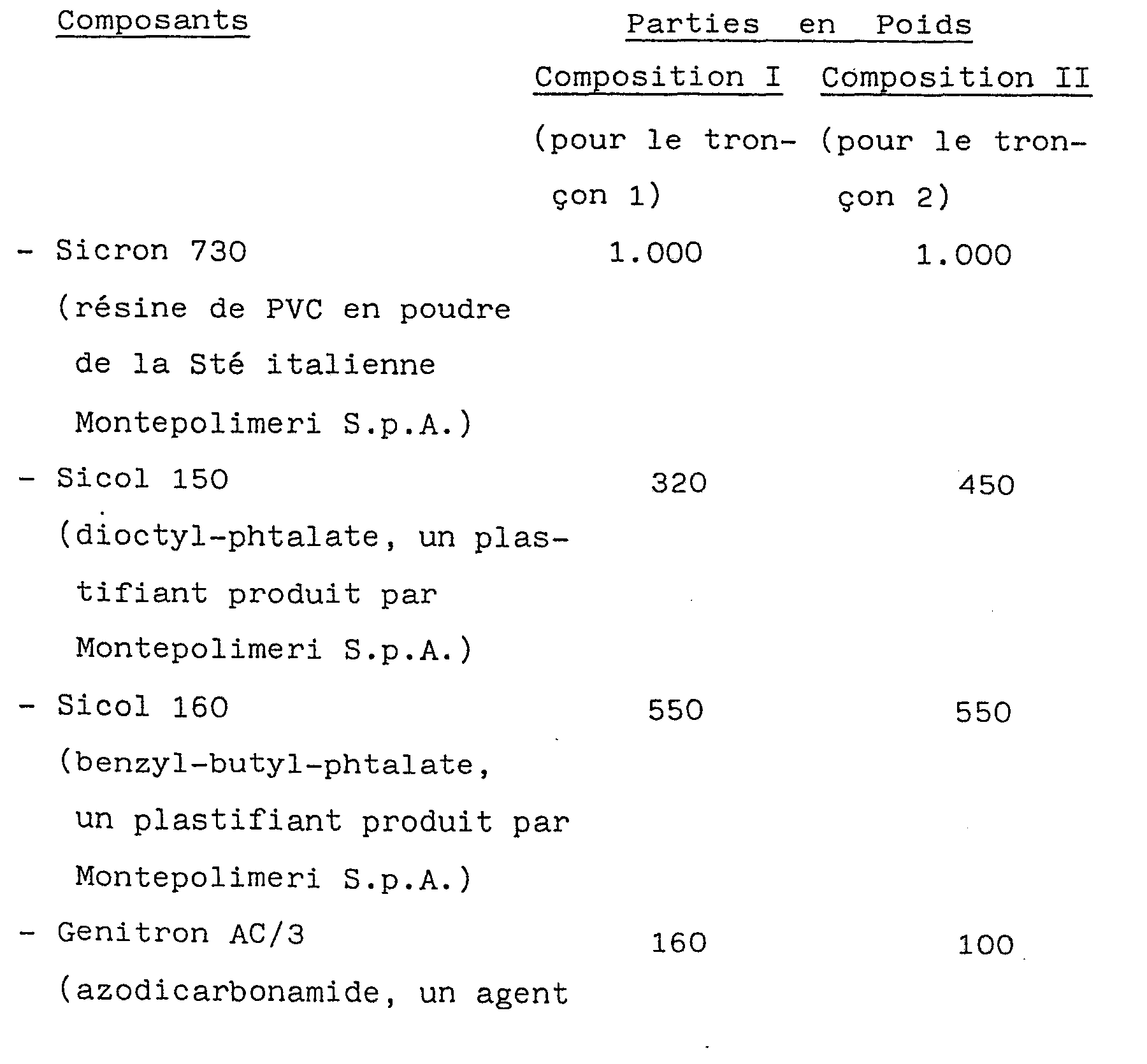
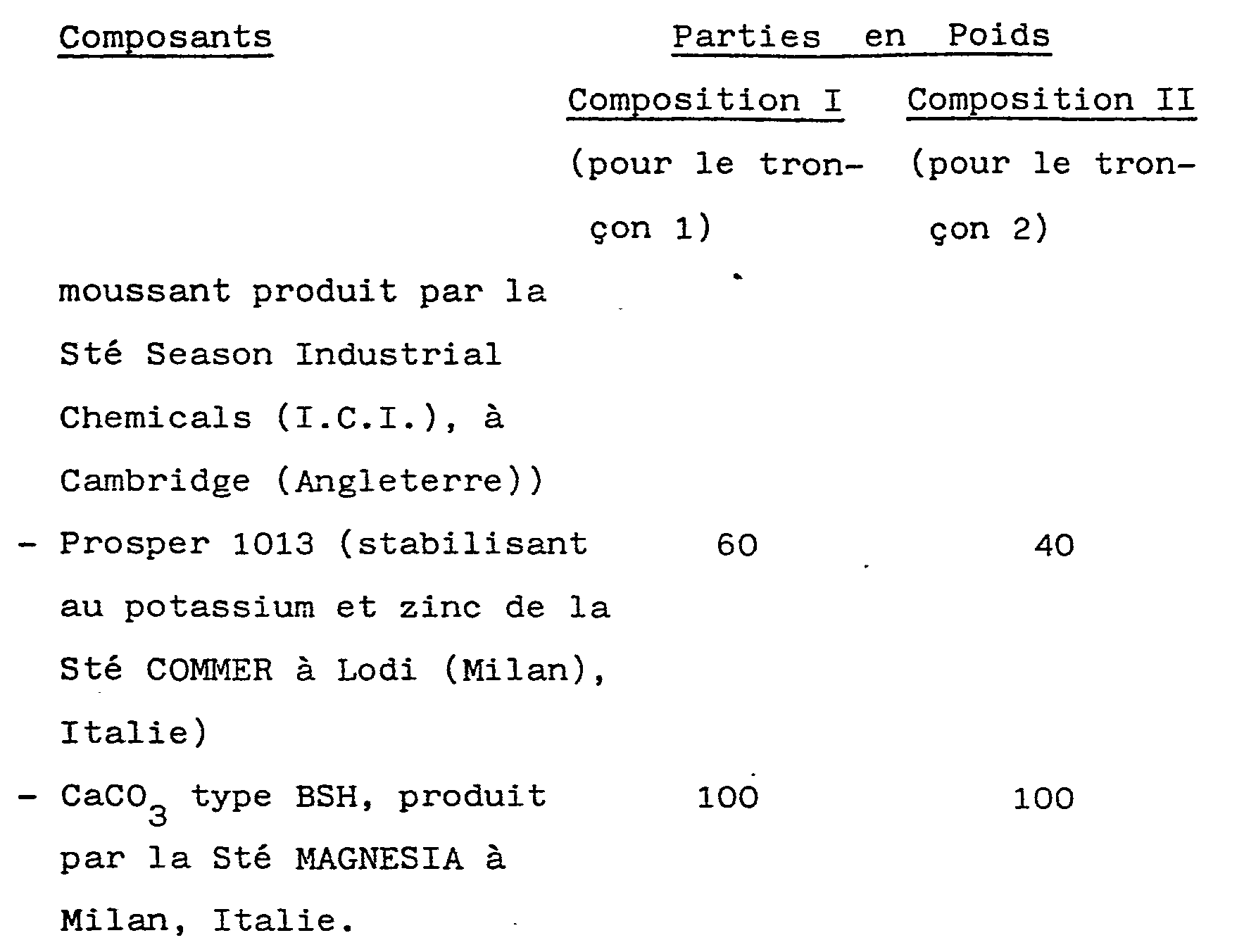
- La composition II a été déposée par enduction sur une bande transporteuse de façon à obtenir une couche de l'épaisseur de 1 mm ; ensuite on a procédé à sa pré-gélification en faisant passer la bande dans un four de 7 m de long à une vitesse de 4 m/min, à la température nominale de 130°C. Sur la composition II on a ensuite déposé par enduction la composition I sur une épaisseur de 1,7 mm. Ensuite on a fait passer les deux compositions dans le four, avec une vitesse de la bande de 3 m/min, à la température nominale de 200°C.
- On a ainsi obtenu un produit demi-fini de l'épaisseur totale de 2 cm, dans lequel la couche de la composition I avait une épaisseur de 1,3 cm et une densité de 0,12 g/cc, et la couche de la composition II une épaisseur de 0,7 cm et une densité de 0,22 g/cc.
- Les tampons auriculaires ont été obtenus en découpant à l'emporte-pièce le produit demi-fini. Dans ces tampons (figure 1) le tronçon 1 était obtenu à partir de la composition I et le tronçon 2 à partir de la composition II.
- Avec les formulations ci-indiquées et par le procédé décrit on a obtenu des tampons qui présentent de très bonnes propriétés mécaniques, un comportement insonorisant supérieur à celui des dispositifs en matière polymère actuellement dans le commerce, ainsi que des caractéristiques d'aspect superficiel et de sensation agréable au toucher particulièrement satisfaisantes.
- Cet exemple est relatif à la préparation d'un tampon du genre illustré sur la figure 2.
- On a préparé deux compositions de plastisol de PVC avec les ingrédients et dans les quantités indiquées ci-dessus.


- Le plastisol de la composition IV a été déposé par enduction sur un moule en aluminium constitué essentiellement par une plaque dans laquelle avaient été ménagés, à des intervalles de 2 cm, des alvéoles cylindriques de 0,5 cm de diamètre et de 1 cm de profondeur, jusqu'à obtenir, sur la surface de la plaque, une couche de 0,3 mm d'épaisseur.
- Le moule ainsi rempli a été mis pendant un temps de 5 min dans un four à la température nominale de 130°C. Ensuite sur la composition IV ainsi traitée on a déposé par enduction le plastisol de la composition III sur une épaisseur de 1,7 mm.
- L'ensemble a été mis dans un four à circulation forcée pendant un temps de 8 min et à une température nominale de 200°C.
- Par découpage successif à l'emporte-pièce on a obtenu des tampons comme ceux de la figure 2, dans lesquels le tronçon 3 avait une longueur de 2 cm, un diamètre de 0,8 cm et une densité de 0,14 g/cc ; la pellicule 5 avait une épaisseur de 0,2 mm et une densité de 1,1 g/cc ; le pédoncule 4 avait une longueur de 10 mm et une densité de 1,1 g/cc.
- Cet exemple est relatif à la préparation d'un tampon du genre de celui de la figure 3.
- On a préparé trois compositions de plastisol de PVC avec les composants et dans les quantités indiquées ci-dessous.
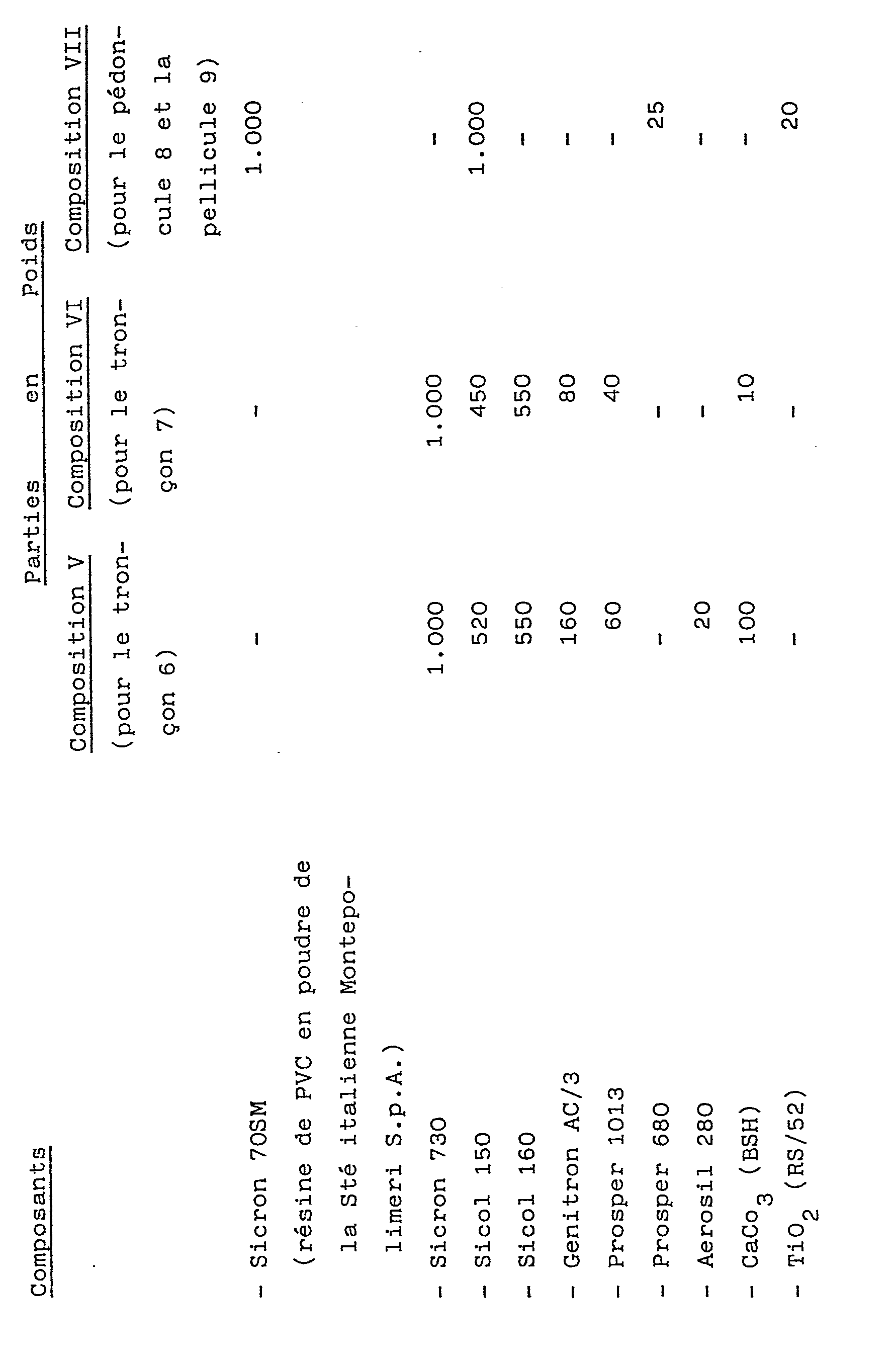
- Le procédé, dans lequel on a fait usage du même moule utilisé pour la réalisation des tampons selon l'exemple 2, a été effectué avec les opérations successives suivantes :
- - remplissage du moule avec la composition VII,
- - pré-gélification de cette composition dans un four à la température nominale de 130°C pendant un temps de 5 min ;
- - application par enduction de la composition VI sur la composition VII, et sa pré-gélification à la température nominale de 130°C pendant un temps de 5 min ;
- - application par enduction de la composition V sur la composition VI ;
- - maintien du moule contenant l'ensemble des trois compositions dans un four à circulation forcée à la température nominale de 200°C et pendant 8 min.
- Les tampons du genre de ceux de la figure 3 ont été ensuite obtenus par découpage à l'emporte-pièce.
Claims (6)
Priority Applications (1)
| Application Number | Priority Date | Filing Date | Title |
|---|---|---|---|
| AT83830216T ATE33934T1 (de) | 1982-11-08 | 1983-11-03 | Schalldichter ohrpfropf aus expandiertem polymermaterial. |
Applications Claiming Priority (2)
| Application Number | Priority Date | Filing Date | Title |
|---|---|---|---|
| IT6830382 | 1982-11-08 | ||
| IT68303/82A IT1156545B (it) | 1982-11-08 | 1982-11-08 | Inserti auricolari fonoassorbenti in materiale polimerico espanso |
Publications (3)
| Publication Number | Publication Date |
|---|---|
| EP0108728A2 true EP0108728A2 (fr) | 1984-05-16 |
| EP0108728A3 EP0108728A3 (en) | 1985-03-27 |
| EP0108728B1 EP0108728B1 (fr) | 1988-05-04 |
Family
ID=11308913
Family Applications (1)
| Application Number | Title | Priority Date | Filing Date |
|---|---|---|---|
| EP83830216A Expired EP0108728B1 (fr) | 1982-11-08 | 1983-11-03 | Tampons auriculaires insonorisants en matière polymère expansée |
Country Status (4)
| Country | Link |
|---|---|
| EP (1) | EP0108728B1 (fr) |
| AT (1) | ATE33934T1 (fr) |
| DE (1) | DE3376465D1 (fr) |
| IT (1) | IT1156545B (fr) |
Cited By (12)
| Publication number | Priority date | Publication date | Assignee | Title |
|---|---|---|---|---|
| EP0468123A1 (fr) * | 1988-02-26 | 1992-01-29 | Jovan, S.L. | Perfectionnements dans l'obtention de protecteurs otologiques |
| WO1992006659A1 (fr) * | 1990-10-16 | 1992-04-30 | Cabot Safety Corporation | Protege-tympan en mousse polymere |
| US5119833A (en) * | 1991-03-15 | 1992-06-09 | Argus Corporation | Compressible foam earplug |
| FR2773988A1 (fr) * | 1998-01-29 | 1999-07-30 | Williams Schmit | Bouchon protecteur auriculaire |
| EP0862397A4 (fr) * | 1996-08-15 | 2001-04-11 | Cabot Safety Intermediate Corp | Protecteur auriculaire contenant une mousse et un composant poreux et procede de fabrication correspondant |
| WO2004062539A1 (fr) * | 2003-01-09 | 2004-07-29 | Kwan Ho Kim | Bouchon d'oreille jetable |
| WO2006084172A1 (fr) | 2005-02-04 | 2006-08-10 | Hearing Components, Inc. | Element pouvant etre jete par l’utilisateur destine a etre utilise dans le canal auditif et procedes de fabrication de celui-ci |
| WO2014011412A1 (fr) * | 2012-07-12 | 2014-01-16 | 3M Innovative Properties Company | Procédé de fabrication d'un bouchon d'oreille |
| US8679607B2 (en) | 2012-07-12 | 2014-03-25 | 3M Innovative Properties Company | Foamable article |
| WO2015105774A1 (fr) * | 2014-01-10 | 2015-07-16 | 3M Innovative Properties Company | Bouchon d'oreille a ajustement instantane, procede et dispositif |
| US9549855B2 (en) | 2013-02-15 | 2017-01-24 | 3M Innovative Properties Company | Earplug with tip cavity and methods of manufacturing the same |
| US9737439B2 (en) | 2012-07-12 | 2017-08-22 | 3M Innovative Properties Company | Push-in earplug |
Families Citing this family (3)
| Publication number | Priority date | Publication date | Assignee | Title |
|---|---|---|---|---|
| US7984716B2 (en) | 2007-06-22 | 2011-07-26 | Kimberly-Clark Worldwide Inc. | Self-conforming sound attenuation earplug |
| US8113207B2 (en) | 2008-08-22 | 2012-02-14 | Kimberly-Clark Worldwide, Inc. | Self-conforming sound attenuation earplug |
| USD717937S1 (en) | 2013-02-15 | 2014-11-18 | 3M Innovative Properties Company | Earplug |
Family Cites Families (4)
| Publication number | Priority date | Publication date | Assignee | Title |
|---|---|---|---|---|
| DE1120632B (de) * | 1960-11-15 | 1961-12-28 | Pfau Wanfried G M B H H | Laermschutzvorrichtung fuer das menschliche Ohr |
| US3811437A (en) * | 1971-10-26 | 1974-05-21 | Cabot Corp | Earplugs |
| DE2325823A1 (de) * | 1973-05-22 | 1974-12-19 | Envac Ets | Gehoerschutz |
| US3881570A (en) * | 1973-08-06 | 1975-05-06 | Marion Health And Safety Inc | Self-fitting hearing protector |
-
1982
- 1982-11-08 IT IT68303/82A patent/IT1156545B/it active
-
1983
- 1983-11-03 EP EP83830216A patent/EP0108728B1/fr not_active Expired
- 1983-11-03 DE DE8383830216T patent/DE3376465D1/de not_active Expired
- 1983-11-03 AT AT83830216T patent/ATE33934T1/de not_active IP Right Cessation
Cited By (24)
| Publication number | Priority date | Publication date | Assignee | Title |
|---|---|---|---|---|
| EP0468123A1 (fr) * | 1988-02-26 | 1992-01-29 | Jovan, S.L. | Perfectionnements dans l'obtention de protecteurs otologiques |
| WO1992006659A1 (fr) * | 1990-10-16 | 1992-04-30 | Cabot Safety Corporation | Protege-tympan en mousse polymere |
| US5203352A (en) * | 1990-10-16 | 1993-04-20 | Cabot Safety Corporation | Polymeric foam earplug |
| US5119833A (en) * | 1991-03-15 | 1992-06-09 | Argus Corporation | Compressible foam earplug |
| EP0862397A4 (fr) * | 1996-08-15 | 2001-04-11 | Cabot Safety Intermediate Corp | Protecteur auriculaire contenant une mousse et un composant poreux et procede de fabrication correspondant |
| FR2773988A1 (fr) * | 1998-01-29 | 1999-07-30 | Williams Schmit | Bouchon protecteur auriculaire |
| WO2004062539A1 (fr) * | 2003-01-09 | 2004-07-29 | Kwan Ho Kim | Bouchon d'oreille jetable |
| WO2006084172A1 (fr) | 2005-02-04 | 2006-08-10 | Hearing Components, Inc. | Element pouvant etre jete par l’utilisateur destine a etre utilise dans le canal auditif et procedes de fabrication de celui-ci |
| US7600604B2 (en) | 2005-02-04 | 2009-10-13 | Hearing Components, Inc. | User disposable member for use within the ear canal and methods for manufacturing the same |
| AU2006210499B2 (en) * | 2005-02-04 | 2011-05-19 | Hearing Components, Inc. | User disposable member for use within the ear canal and methods for manufacturing the same |
| US8968613B2 (en) | 2012-07-12 | 2015-03-03 | 3M Innovative Properties Company | Method of making an earplug |
| KR20200028495A (ko) * | 2012-07-12 | 2020-03-16 | 쓰리엠 이노베이티브 프로퍼티즈 캄파니 | 귀마개를 제조하는 방법 |
| WO2014011412A1 (fr) * | 2012-07-12 | 2014-01-16 | 3M Innovative Properties Company | Procédé de fabrication d'un bouchon d'oreille |
| US11123902B2 (en) | 2012-07-12 | 2021-09-21 | 3M Innovative Properties Company | Method of making a personal protective article |
| US10966867B2 (en) | 2012-07-12 | 2021-04-06 | 3M Innovative Properties Company | Push-in earplug |
| EP3670134A1 (fr) * | 2012-07-12 | 2020-06-24 | 3M Innovative Properties Company | Procédé de fabrication d'un bouchon d'oreille |
| US9737439B2 (en) | 2012-07-12 | 2017-08-22 | 3M Innovative Properties Company | Push-in earplug |
| US10065344B2 (en) | 2012-07-12 | 2018-09-04 | 3M Innovative Properties Company | Method of making a personal protective article |
| US8679607B2 (en) | 2012-07-12 | 2014-03-25 | 3M Innovative Properties Company | Foamable article |
| US10441471B2 (en) | 2012-07-12 | 2019-10-15 | 3M Innovative Properties Company | Push-in earplug |
| US10398602B2 (en) | 2013-02-15 | 2019-09-03 | 3M Innovative Properties Company | Earplug with tip cavity and methods of manufacturing the same |
| US9549855B2 (en) | 2013-02-15 | 2017-01-24 | 3M Innovative Properties Company | Earplug with tip cavity and methods of manufacturing the same |
| CN105899171A (zh) * | 2014-01-10 | 2016-08-24 | 3M创新有限公司 | 模制泡沫的推入贴合耳塞、方法以及装置 |
| WO2015105774A1 (fr) * | 2014-01-10 | 2015-07-16 | 3M Innovative Properties Company | Bouchon d'oreille a ajustement instantane, procede et dispositif |
Also Published As
| Publication number | Publication date |
|---|---|
| IT8268303A0 (it) | 1982-11-08 |
| DE3376465D1 (en) | 1988-06-09 |
| EP0108728B1 (fr) | 1988-05-04 |
| IT1156545B (it) | 1987-02-04 |
| IT8268303A1 (it) | 1984-05-08 |
| EP0108728A3 (en) | 1985-03-27 |
| ATE33934T1 (de) | 1988-05-15 |
Similar Documents
| Publication | Publication Date | Title |
|---|---|---|
| EP0108728A2 (fr) | Tampons auriculaires insonorisants en matière polymère expansée | |
| US5799658A (en) | Hearing protective device comprising a foam and a porous component and method of manufacture thereof | |
| US6241042B1 (en) | Hearing protective device | |
| US4552137A (en) | Earplugs | |
| WO1991007914A1 (fr) | Protecteur auriculaire en mousse moulee et son procede de production | |
| KR960012429B1 (ko) | 보청기용 슬리이브 및 보청기 | |
| US9668043B2 (en) | Elastomeric component for earbud headphones and headphones including such elastomeric components | |
| EP0906731A3 (fr) | Gant médical sans poudre et son procédé de fabrication | |
| US20020124851A1 (en) | Hearing protective device and method of making same | |
| FR2717450A1 (fr) | Conditionnement en matériau plastique composite présentant un effet doux au toucher. | |
| EP0836840A3 (fr) | Protège-tympan en mousse revêtu d'élastomère imperméable | |
| WO2000067638A1 (fr) | Accessoires auditifs plastisol de controle acoustique | |
| US1514152A (en) | Ear cushion | |
| CH668904A5 (fr) | Protege-tympan a ailettes multiples. | |
| FR2680463A1 (fr) | Bouchon d'oreille pour la protection auditive. | |
| JP2612920B2 (ja) | 耳当て具 | |
| JP2006305737A (ja) | 把持部材及び把持部材の製造方法 | |
| CN218041728U (zh) | 一种舒适透气降噪的耳机耳套 | |
| CA2234163C (fr) | Protecteur auriculaire contenant une mousse et un composant poreux et procede de fabrication correspondant | |
| EP4349311B1 (fr) | Pansement à film mince pourvu de perforations et de fentes | |
| EP0441946A1 (fr) | Protege-tympans | |
| CN2604165Y (zh) | 耳塞构造 | |
| EP1103195B1 (fr) | Chausson de confort pour chaussure de ski | |
| JP2021171616A (ja) | 口内清掃具. | |
| FR2458582A1 (fr) | Savonnette allegee comportant un noyau de faible densite |
Legal Events
| Date | Code | Title | Description |
|---|---|---|---|
| PUAI | Public reference made under article 153(3) epc to a published international application that has entered the european phase |
Free format text: ORIGINAL CODE: 0009012 |
|
| AK | Designated contracting states |
Designated state(s): AT BE CH DE FR GB LI LU NL SE |
|
| PUAL | Search report despatched |
Free format text: ORIGINAL CODE: 0009013 |
|
| AK | Designated contracting states |
Designated state(s): AT BE CH DE FR GB LI LU NL SE |
|
| 17P | Request for examination filed |
Effective date: 19850708 |
|
| 17Q | First examination report despatched |
Effective date: 19860822 |
|
| D17Q | First examination report despatched (deleted) | ||
| GRAA | (expected) grant |
Free format text: ORIGINAL CODE: 0009210 |
|
| RAP1 | Party data changed (applicant data changed or rights of an application transferred) |
Owner name: AMPLIFON S.P.A. |
|
| AK | Designated contracting states |
Kind code of ref document: B1 Designated state(s): AT BE CH DE FR GB LI LU NL SE |
|
| REF | Corresponds to: |
Ref document number: 33934 Country of ref document: AT Date of ref document: 19880515 Kind code of ref document: T |
|
| GBT | Gb: translation of ep patent filed (gb section 77(6)(a)/1977) | ||
| REF | Corresponds to: |
Ref document number: 3376465 Country of ref document: DE Date of ref document: 19880609 |
|
| PLBE | No opposition filed within time limit |
Free format text: ORIGINAL CODE: 0009261 |
|
| STAA | Information on the status of an ep patent application or granted ep patent |
Free format text: STATUS: NO OPPOSITION FILED WITHIN TIME LIMIT |
|
| 26N | No opposition filed | ||
| REG | Reference to a national code |
Ref country code: CH Ref legal event code: PUE Owner name: AMPLISILENCE S.R.L. |
|
| NLS | Nl: assignments of ep-patents |
Owner name: AMPLISILENCE S.R.L. TE ROBASSOMERO, ITALIE. |
|
| REG | Reference to a national code |
Ref country code: GB Ref legal event code: 732 |
|
| REG | Reference to a national code |
Ref country code: FR Ref legal event code: TP |
|
| EPTA | Lu: last paid annual fee | ||
| EAL | Se: european patent in force in sweden |
Ref document number: 83830216.4 |
|
| REG | Reference to a national code |
Ref country code: CH Ref legal event code: PUE Owner name: SISPE S.R.L. |
|
| REG | Reference to a national code |
Ref country code: GB Ref legal event code: 732E |
|
| NLS | Nl: assignments of ep-patents |
Owner name: SISPE S.R.L. TE TURIJN, ITALIE. |
|
| REG | Reference to a national code |
Ref country code: FR Ref legal event code: TP |
|
| REG | Reference to a national code |
Ref country code: GB Ref legal event code: IF02 |
|
| PGFP | Annual fee paid to national office [announced via postgrant information from national office to epo] |
Ref country code: SE Payment date: 20020927 Year of fee payment: 20 |
|
| PGFP | Annual fee paid to national office [announced via postgrant information from national office to epo] |
Ref country code: AT Payment date: 20021008 Year of fee payment: 20 |
|
| PGFP | Annual fee paid to national office [announced via postgrant information from national office to epo] |
Ref country code: GB Payment date: 20021016 Year of fee payment: 20 |
|
| PGFP | Annual fee paid to national office [announced via postgrant information from national office to epo] |
Ref country code: CH Payment date: 20021018 Year of fee payment: 20 |
|
| PGFP | Annual fee paid to national office [announced via postgrant information from national office to epo] |
Ref country code: NL Payment date: 20021021 Year of fee payment: 20 |
|
| PGFP | Annual fee paid to national office [announced via postgrant information from national office to epo] |
Ref country code: DE Payment date: 20021022 Year of fee payment: 20 |
|
| PGFP | Annual fee paid to national office [announced via postgrant information from national office to epo] |
Ref country code: LU Payment date: 20021024 Year of fee payment: 20 |
|
| PGFP | Annual fee paid to national office [announced via postgrant information from national office to epo] |
Ref country code: BE Payment date: 20021122 Year of fee payment: 20 |
|
| PGFP | Annual fee paid to national office [announced via postgrant information from national office to epo] |
Ref country code: FR Payment date: 20021128 Year of fee payment: 20 |
|
| PG25 | Lapsed in a contracting state [announced via postgrant information from national office to epo] |
Ref country code: LI Free format text: LAPSE BECAUSE OF EXPIRATION OF PROTECTION Effective date: 20031102 Ref country code: GB Free format text: LAPSE BECAUSE OF EXPIRATION OF PROTECTION Effective date: 20031102 Ref country code: CH Free format text: LAPSE BECAUSE OF EXPIRATION OF PROTECTION Effective date: 20031102 |
|
| PG25 | Lapsed in a contracting state [announced via postgrant information from national office to epo] |
Ref country code: NL Free format text: LAPSE BECAUSE OF EXPIRATION OF PROTECTION Effective date: 20031103 Ref country code: LU Free format text: LAPSE BECAUSE OF NON-PAYMENT OF DUE FEES Effective date: 20031103 Ref country code: AT Free format text: LAPSE BECAUSE OF EXPIRATION OF PROTECTION Effective date: 20031103 |
|
| REG | Reference to a national code |
Ref country code: GB Ref legal event code: PE20 |
|
| REG | Reference to a national code |
Ref country code: CH Ref legal event code: PL |
|
| BE20 | Be: patent expired |
Owner name: *SISPE S.R.L. Effective date: 20031103 |
|
| NLV7 | Nl: ceased due to reaching the maximum lifetime of a patent |
Effective date: 20031103 |
|
| EUG | Se: european patent has lapsed |