EP0108968B1 - Verfahren zur Herstellung von aktivem Aluminiumoxyd - Google Patents
Verfahren zur Herstellung von aktivem Aluminiumoxyd Download PDFInfo
- Publication number
- EP0108968B1 EP0108968B1 EP83110653A EP83110653A EP0108968B1 EP 0108968 B1 EP0108968 B1 EP 0108968B1 EP 83110653 A EP83110653 A EP 83110653A EP 83110653 A EP83110653 A EP 83110653A EP 0108968 B1 EP0108968 B1 EP 0108968B1
- Authority
- EP
- European Patent Office
- Prior art keywords
- aluminium
- aluminum
- electrolyte
- cell
- ions
- Prior art date
- Legal status (The legal status is an assumption and is not a legal conclusion. Google has not performed a legal analysis and makes no representation as to the accuracy of the status listed.)
- Expired
Links
Images

Classifications
-
- C—CHEMISTRY; METALLURGY
- C01—INORGANIC CHEMISTRY
- C01F—COMPOUNDS OF THE METALS BERYLLIUM, MAGNESIUM, ALUMINIUM, CALCIUM, STRONTIUM, BARIUM, RADIUM, THORIUM, OR OF THE RARE-EARTH METALS
- C01F7/00—Compounds of aluminium
- C01F7/02—Aluminium oxide; Aluminium hydroxide; Aluminates
- C01F7/42—Preparation of aluminium oxide or hydroxide from metallic aluminium, e.g. by oxidation
- C01F7/428—Preparation of aluminium oxide or hydroxide from metallic aluminium, e.g. by oxidation by oxidation in an aqueous solution
-
- B—PERFORMING OPERATIONS; TRANSPORTING
- B01—PHYSICAL OR CHEMICAL PROCESSES OR APPARATUS IN GENERAL
- B01J—CHEMICAL OR PHYSICAL PROCESSES, e.g. CATALYSIS OR COLLOID CHEMISTRY; THEIR RELEVANT APPARATUS
- B01J21/00—Catalysts comprising the elements, oxides, or hydroxides of magnesium, boron, aluminium, carbon, silicon, titanium, zirconium, or hafnium
- B01J21/02—Boron or aluminium; Oxides or hydroxides thereof
- B01J21/04—Alumina
-
- C—CHEMISTRY; METALLURGY
- C01—INORGANIC CHEMISTRY
- C01P—INDEXING SCHEME RELATING TO STRUCTURAL AND PHYSICAL ASPECTS OF SOLID INORGANIC COMPOUNDS
- C01P2006/00—Physical properties of inorganic compounds
- C01P2006/10—Solid density
-
- C—CHEMISTRY; METALLURGY
- C01—INORGANIC CHEMISTRY
- C01P—INDEXING SCHEME RELATING TO STRUCTURAL AND PHYSICAL ASPECTS OF SOLID INORGANIC COMPOUNDS
- C01P2006/00—Physical properties of inorganic compounds
- C01P2006/12—Surface area
-
- C—CHEMISTRY; METALLURGY
- C01—INORGANIC CHEMISTRY
- C01P—INDEXING SCHEME RELATING TO STRUCTURAL AND PHYSICAL ASPECTS OF SOLID INORGANIC COMPOUNDS
- C01P2006/00—Physical properties of inorganic compounds
- C01P2006/14—Pore volume
-
- C—CHEMISTRY; METALLURGY
- C01—INORGANIC CHEMISTRY
- C01P—INDEXING SCHEME RELATING TO STRUCTURAL AND PHYSICAL ASPECTS OF SOLID INORGANIC COMPOUNDS
- C01P2006/00—Physical properties of inorganic compounds
- C01P2006/80—Compositional purity
Definitions
- the invention relates to a process for the production of active aluminum oxide by internal electrolysis of metallic aluminum, i. H. through its anodic dissolution and thermal decomposition of the resulting highly disperse basic aluminum hydrogel without external power source.
- the active aluminum oxide obtained is suitable, inter alia, as a catalyst and as a catalyst support.
- the aluminum oxides used as catalyst or catalyst support are structurally crystalline ⁇ or T modifications, porous, disperse substances with a large specific surface area, which are preferably used in extruded form, as lozenges or spheres.
- the aluminum oxide intended for this purpose is subject to very strict requirements, both in terms of its physical-mechanical properties and its chemical composition.
- a high-purity active y-aluminum oxide can be characterized, for example, by the following data:
- the production of such an active aluminum oxide consists of the following steps: production of an aluminum hydroxide gel of suitable quality, shaping of the hydroxide gel and finally its thermal decomposition, in which the active y- or ⁇ -Al 2 O 3 structure is formed.
- the solution must also contain mercury ions, because otherwise the passivation of the aluminum would stop the reaction even in concentrated nitric acid.
- the presence of chloride ions accelerates the dissolution process (although mercury salt is required even in the presence of chloride), but the chloride ions adversely affect the structure of the gel, i. H. they reduce its active area and thus that of the active aluminum oxide produced from it.
- hydroxide gel of the appropriate quality can be obtained.
- electrical energy is used for this.
- the electrochemical production and also the electrochemical cleaning of the aluminum are extremely energy-intensive.
- the calcination of the hydroxide gel is added to these energy costs.
- the electrical energy requirement for dissolving the aluminum is not acceptable from the outset as a thermodynamically unnecessary effort.
- the investment costs of the commutation device and the expansion of the electrical network must also be taken into account. It is a common experience that the current transformers play the most important role in the investment costs for the installation of electrochemical objects.
- the object of the invention was now to reduce the energy expenditure.
- the invention thus relates to a process for the production of active aluminum oxide by anodic dissolution of aluminum, which is characterized in that aluminum bodies which have been depassivated beforehand by being immersed in a solution containing mercury ions are switched as anode against a cathode made of graphite or steel which does not form an amalgam, the fills the galvanic element obtained in this way with liquid electrolyte solution, which removes, dries and thermally decomposes the aluminum hydrogel formed from the dissolved aluminum and the electrolyte in the absence of an external power source from the cell.
- the galvanic element is built up by interconnecting several galvanic cells and the gel is emptied from these cells and filled with fresh electrolyte cyclically at different times.
- electrolyte containing nitrate ions as the electrolyte, optionally together with an aqueous solution of aluminum nitrate.
- nitric acid it is particularly preferred to use nitric acid.
- nitrate ion concentration at a value of 0.1 to 5.0, preferably 0.5 to 2.0 mol / l, by adding electrolyte.
- the invention is based on the knowledge that a continuous anodic dissolution of the aluminum and thereby the production of a hydroxyl gel with favorable properties also without an external power source, i. H. is possible without energy expenditure if the aluminum to be dissolved is used as the anode of a galvanic element.
- the electrolyte of the galvanic element contains aluminum ions, preferably in addition to nitrate anions.
- An electron conductor which does not form an amalgam and has a low hydrogen overvoltage, namely steel or graphite, is used as the cathode.
- the galvanic elements described are connected in parallel with one another, and the filling of the cells with electrolyte, preferably nitric acid, and the emptying of the cells or the removal of the hydroxide gel formed is not carried out simultaneously in all cells, but with a certain one temporal shift.
- the cell working with the fresher electrolyte solution has a depolarizing effect on the entirety of the system and thereby prevents the electrode processes from slowing down, which would otherwise necessarily occur as a result of the drop in the acid concentration.
- the freshly filled cells activate the cells that have been working for a long time and contain less acid.
- a further important finding according to the invention is that no mercury salt has to be metered into the cells in the process according to the invention, but that it suffices to immerse the aluminum body (e.g. plates, rods) working as an anode by immersing it in a mercury-containing salt to activate acid bath.
- the amalgam film that adheres well to the surface of the aluminum is sufficient to prevent passivation. This measure firstly reduces the need for mercury salts, and secondly, neither the electrolyte nor the product is contaminated with mercury.
- nitric acid mercury solution is prepared by dissolving mercury or mercury (11) oxide in small portions in concentrated nitric acid and then preparing the activation bath from this stock solution of known concentration and composition by dilution.
- the corrosion of the aluminum is due to the fact that the adherent protective layer of aluminum oxide can not form on the aluminum amalgam upper che f LAE, which gives their commonly known corrosion resistance to aluminum and its alloys. In the present case, however, the aim is not to corrode the aluminum in any form, but to produce a hydroxide gel that has the specified physicochemical properties. In the event of corrosion in air and under other uncontrollable conditions, the corrosion product with the desired properties does not arise, and there is currently no known aftertreatment process with which the undefined composite corrosion product of aluminum could be transformed into a hydroxide gel from which high-quality ⁇ -AI203 can be obtained.
- hydrogel produced in another way is mixed or kneaded with a little nitric acid before shaping, ie basic aluminum nitrate is produced from part of the aluminum hydroxide, because the hydroxide or oxide hydroxide formed from basic aluminum nitrate on thermal decomposition is an excellent binder for the elementary crystals and the required mechanical strength of the finished catalyst or catalyst carrier.
- the basic aluminum nitrate hydrogel containing the NO 3 ions in molecular dispersion is particularly suitable for the thermal decomposition of active aluminum oxide-controlled surface and pore structure.
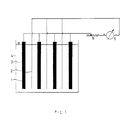
- FIG. 1 A device which is particularly suitable for carrying out the method is shown in FIG. 1.
- the cathodes 1 made of graphite or acid-proof steel form a common pole, as do the aluminum anodes 2 suspended between them.
- the electrolyte solution 3 which preferably contains nitrate ions
- the anodes 2 are galvanically corroded and thus also enriched in hydrate gel.
- the hydrate gel is removed discontinuously, preferably by suction.
- the electrolyte and the resulting gel are located in the cell vessel 4, which is preferably made of plastic.
- the flowing galvanic current is regulated with the resistor 5 and displayed on the ammeter 6.
- FIG. 2 The parallel connection of several of the galvanic cells shown in FIG. 1 is shown in FIG. 2.
- the cathodes 1 and the anodes 2 of the identically constructed galvanic cells A, B, C and D are all connected to the common cathode busbar 7 and anode busbar 8, respectively.
- the filling of the cell vessels with fresh electrolyte and the suctioning off of the gel formed are carried out discontinuously, but shifted in time from one another. This always ensures that there is relatively fresh electrolyte in a cell at all times during operation and that the potential of all electrodes is shifted in a favorable direction, i. H. Depolarization occurs. This also stimulates the function of those cells in which gel formation has already progressed.
- 12 rods made of 5 kg of refined aluminum and 12 cylindrical graphite rods are hung in a cylindrical plastic barrel with a volume of 200 liters.
- the aluminum rods are previously treated with the pre-activation solution to the expected immersion depth.
- the preactivation solution is a one-molar nitric acid, which contains 0.8 g of mercury ions per liter.
- the aluminum rods remain in the pre-activation solution for 15 minutes.
- the aluminum and graphite rods are alternately arranged on the chess board according to the system of black and white fields. All graphite electrodes, on the one hand, and all aluminum electrodes, on the other, are conductively connected to the cathode or anode busbar by means of flexible, insulated lines.
- the cell is initially filled with 2 molar nitric acid: first, deionized water is poured into the barrel using an exchange resin, and to this the calculated amount of nitric acid is added.
- the liquid level must not reach the point of connection of the flexible lines to the electrodes. Accordingly, the volume of the cell solution is 80 liters.
- the circuit of the cell assembled in this way is closed with a sliding resistor of high power (a so-called starting resistance) and an ammeter with a measuring range up to 200 A.
- a sliding resistor of high power a so-called starting resistance
- an ammeter with a measuring range up to 200 A.
- the current supplied by the rapidly warming cell is kept below 100 A so that the solution in the cell does not start to boil.
- the stabilization of the pH value the current intensity - if the resistance is completely removed - adjusts to around 15 A, and the contents of the cell cool down to ambient temperature.
- the gel accumulated under the solution is removed by suction and the cell is refilled with fresh nitric acid. This cycle is repeated until the aluminum anodes have been used up and become so thin that they have to be replaced. The process is continued after new, preactivated anodes have been inserted. The anode residues that have become thin are melted in a manner known per se and cast again to form anodes.
- Example 1 The cell type described in Example 1 is used, but six cells are operated simultaneously in order to intensify the process.
- the cathodes of all cells are connected to the cathode bus bar and all anodes to the anode bus bar.
- the solution is renewed in 2 cells every 8 hours, after 8 hours in two others, and after another 8 hours in the last two cells. In this way it is achieved that the gel is aspirated once a day in each cell and the solution is renewed.
- productivity is roughly tripled compared to the procedure according to Example 1; the emptying, which is otherwise due every three days, can be carried out after just one day.
- the hydrogel obtained is worked up to high-purity aluminum oxide in the manner described in Example 1, the quality parameters of which are given in Table 1.
Landscapes
- Chemical & Material Sciences (AREA)
- Organic Chemistry (AREA)
- Materials Engineering (AREA)
- Inorganic Chemistry (AREA)
- Geology (AREA)
- Engineering & Computer Science (AREA)
- Life Sciences & Earth Sciences (AREA)
- Chemical Kinetics & Catalysis (AREA)
- Compounds Of Alkaline-Earth Elements, Aluminum Or Rare-Earth Metals (AREA)
- Water Treatment By Electricity Or Magnetism (AREA)
- Electrolytic Production Of Non-Metals, Compounds, Apparatuses Therefor (AREA)
- Compositions Of Oxide Ceramics (AREA)
- Catalysts (AREA)
Description
- Die Erfindung betrifft ein Verfahren zur Herstellung von aktivem Aluminiumoxyd durch innere Elektrolyse von metallischem Aluminium, d. h. durch dessen ohne äußere Stromquelle vorgenommenes anodisches Auflösen und thermisches Zersetzen des entstehenden hochdispersen basischen Aluminiumhydrogels. Das erhaltene aktive Aluminiumoxyd ist unter anderem als Katalysator und als Katalysatorträger geeignet.
- Die als Katalysator oder Katalysatorträger verwendeten Aluminiumoxyde sind strukturell kristalline γ-oder T-Modifikationen, poröse, disperse Stoffe mit großer spezifischer Oberfläche, die bevorzugt in extrudierter Form, als Pastillen oder Kugeln verwendet werden. An für diese Zwecke vorgesehenes Aluminiumoxyd werden sehr strenge Anforderungen gestellt, sowohl was die physikalisch-mechanischen Eigenschaften wie auch was die chemische Zusammensetzung betrifft. Ein hochreines aktives y-Aluminiumoxyd kann zum Beispiel durch die folgenden Daten charakterisiert werden :


- Die Herstellung eines derartigen aktiven Aluminiumoxydes besteht aus folgenden Schritten : Herstellung eines Aluminiumhydroxyd-Gels geeigneter Qualität, Formung des Hydroxydgels und schließlich seine thermische Zersetzung, bei der die aktive y- oder η-Al2O3-Struktur entsteht.
- Zur Herstellung des Aluminiumhydroxyd-Gels gibt es verschiedene Verfahren. Eine Möglichkeit besteht darin, hochreines Aluminium in Salpetersäure aufzulösen. Dies ist einesteils vorteilhaft, weil durch Einbau der Nitrationen gewisse Vorteile in der Struktur erzielt werden ; nachteilig ist jedoch, daß in dem Maße, wie der Überschuß der Salpetersäure geringer wird, die Reaktion immer langsamer abläuft und auf diese Weise die Produktivität des Prozesses nicht zufriedenstellend ist.
- Wie beim chemischen Auflösen von Aluminium meistens, so muß auch hier die Lösung Quecksilberionen enthalten, weil sonst durch die Passivierung des Aluminiums auch in konzentrierter Salpetersäure die Reaktion zum Stillstand kommen würde. Die Anwesenheit von Chloridionen beschleunigt den Lösungsprozeß (obwohl auch bei Anwesenheit von Chlorid Quecksilbersalz benötigt wird), jedoch beeinflussen die Chloridionen die Struktur des Gels in ungünstiger Weise, d. h. sie verringern seine aktive Fläche und damit auch die des daraus hergestellten aktiven Aluminiumoxydes.
- Zur Herstellung des Hydroxydgels sind auch Verfahren bekannt geworden, die auf der nachträglichen Entfernung von Fremdionen aus dem durch Reinigung aus natürlichem Tonerdehydrat hergestellten oder aus der Lösung von Aluminiumsalzen durch Ausfällen mit Chemikalien hergestellten Hydroxyd beruhen. Diese Verfahren haben den gemeinsamen Nachteil, daß jede Entfernung von Fremdionen - sei es durch Auswaschen, sei es durch Dialyse - große Volumina erfordert und auch das Tempo, in dem die Konzentration der Fremdionen absinkt, exponentiell zu der Konzentration der Ionen abnimmt. Graphisch dargestellt erinnert die lonenkonzentrationskurve an die Abkühlkurven, die Diffusions- und Austauschgeschwindigkeit der Ionen von ihrer jeweiligen Konzentration abhängt.
- Der durch Waschen erfolgenden völligen Entfernung der Fremdionen ist auch noch eine prinzipielle Grenze gesetzt, da ein Teil dieser Ionen durch isomorphe Substitution oder Dislokationen ins Gitter eingebaut wird, und andere Ionen durch Chemisorption an die Teilchen des Gels gebunden werden.
- Zur Herstellung von Katalysatoren wird aber sehr reines Aluminiumoxyd gebraucht. Dieses Bedürfnis konnte mit den Forderungen nach wirtschaftlicher Fertigung bis heute nicht in befriedigender Weise abgestimmt werden.
- Die Anwesenheit der Fremdionen kann umgangen werden, wenn man metallisches Aluminium in einem niederen, wasserfreien Alkohol, meistens in Ethyl- oder Isopropylalkohol auflöst und das gebildete Alkoholat mit ionenfreiem Wasser zersetzt. Mit diesem Verfahren kann entsprechend reines Hydroxydgel erhalten werden, jedoch ist das Verfahren durch den im Überschuß einzusetzenden Alkohol sehr teuer.
- Zur Herstellung von Aluminiumhydroxyd-Gel (s. Gmelins Handbuch der anorganischen Chemie, 8. Aufl., 1934, System Nr. 35. « Aluminium », Teil B, Verlag Chemie GmbH., Berlin, Seiten 100, 101) ist es weiterhin in einem Elektrolyseverfahren möglich, hochreines Aluminium anodisch aufzulösen.
- Auf diese Weise kann zwar Hydroxydgel der geeigneten Qualität erhalten werden. Nachteilig ist jedoch, daß dazu Elektroenergie gebraucht wird. Bereits die Tonerdeherstellung, dann die elektrochemische Herstellung und ebenfalls die elektrochemische Reinigung des Aluminiums sind hochgradig energieintensiv. Später addiert sich zu diesen Energiekosten noch die Kalzinierung des Hydroxydgels. Der Elektroenergiebedarf für das Auflösen des Aluminiums ist als ein thermodynamisch unnötiger Aufwand von vorneherein nicht akzeptierbar. Außer den Energiekosten sind auch noch die Investitionskosten der Kommutiervorrichtung und der Erweiterung des elektrischen Netzes zu berücksichtigen. Es ist eine allgemeine Erfahrung, daß bei der Anlage elektrochemischer Objekte in den Investitionskosten meistens die Stromwandler die entscheidende Rolle spielen.
- Aufgabe der Erfindung war es nun, den Energieaufwand zu vermindern.
- Gegenstand der Erfindung ist also ein Verfahren zur Herstellung von aktivem Aluminiumoxid durch anodisches Auflösen von Aluminium, das dadurch gekennzeichnet ist, daß man vorher durch Eintauchen in eine Quecksilberionen enthaltende Lösung depassivierte Aluminiumkörper als Anode gegen eine kein Amalgam bildende Kathode aus Graphit oder Stahl schaltet, das auf diese Weise erhaltene galvanische Element mit flüssiger Elektrolytlösung füllt, das aus dem aufgelösten Aluminium und dem Elektrolyt in Abwesenheit einer äußeren Stromquelle gebildete Aluminiumhydrogel aus der Zelle entfernt, trocknet und thermisch zersetzt.
- Nach einer bevorzugten Verfahrensweise baut man das galvanische Element durch Zusammenschalten mehrerer galvanischer Zellen auf und nimmt die Entleerung des Gels aus diesen Zellen sowie das Auffüllen mit frischem Elektrolyt zu unterschiedlichen Zeitpunkten zyklisch vor.
- Weiter ist es bevorzugt, als Elektrolyt einen Nitrationen enthaltenden Elektrolyt zu verwenden, gegebenenfalls zusammen mit einer wäßrigen Lösung von Aluminiumnitrat.
- Besonders bevorzugt ist es, Salpetersäure zu verwenden.
- Bevorzugt ist es auch, die Nitrationenkonzentration durch Zusatz von Elektrolyt auf einem Wert von 0,1 bis 5,0 vorzugsweise 0,5 bis 2,0 Mol/I, zu halten.
- Die Erfindung beruht auf der Erkenntnis, daß eine kontinuierliche anodische Auflösung des Aluminiums und dadurch die Herstellung eines über günstige Eigenschaften verfügenden Hydroxylgels auch ohne äußere Stromquelle, d. h. ohne Energieaufwand möglich ist, wenn man das aufzulösende Aluminium als Anode eines galvanischen Elementes verwendet. Der Elektrolyt des galvanischen Elementes enthält - vorzugsweise neben Nitratanionen - Aluminiumionen. Als Kathode verwendet man einen kein Amalgam bildenden, über eine geringe Wasserstoffüberspannung verfügenden Elektronenleiter, nämlich Stahl oder Graphit. Gemäß einer bevorzugten Ausführungsform der Erfindung werden mehrere der beschriebenen galvanischen Elemente miteinander parallel geschaltet, und das Auffüllen der Zellen mit Elektrolyt, vorzugsweise Salpetersäure, und das Entleeren der Zellen bzw. die Entnahme des gebildeten Hydroxydgels erfolgt nicht gleichzeitig in allen Zellen, sondern mit einer gewissen zeitlichen Verschiebung. In diesem Falle übt die mit der frischeren Elektrolytlösung arbeitende Zelle eine depolarisierende Wirkung auf die Gesamtheit des Systems aus und verhindert dadurch ein Langsamer werden der Elektrodenvorgänge, was sonst infolge des Absinkens der Säurekonzentration unbedingt eintreten würde. Die frisch aufgefüllten Zellen aktivieren die schon seit längerer Zeit arbeitenden, weniger Säure enthaltenden Zellen.
- Eine weitere wichtige erfindungsgemäße Erkenntnis ist, daß im erfindungsgemäßen Verfahren kein Quecksilbersalz in die Zellen dosiert werden muß, sondern daß es ausreicht, die als Anode arbeitenden Aluminiumkörper (z. B. Platten, Stäbe) vor dem Einhängen in die Zelle durch Eintauchen in ein quecksilbersalzhaltiges saures Bad zu aktivieren. Der dabei auf der Oberfläche des Aluminiums entstehende, gut haftende Amalgamfilm reicht aus, die Passivierung zu verhindern. Durch diese Maßnahme wird erstens der Bedarf an Quecksilbersalzen herabgesetzt, und zweitens wird weder der Elektrolyt noch das Produkt mit Quecksilber verunreinigt.
- Die Praxis erwies, daß es zu einer zufriedenstellenden Aktivierung des Aluminiums ausreicht, die Anoden vor dem Einhängen in die galvanische Zelle etwa 15 Minuten in In Salpetersäure, die pro Liter 0.5-1,0 g Quecksilberionen enthält, einer Voraktivierung zu unterziehen. Die salpetersaure Quecksilberlösung wird hergestellt, indem man in konzentrierter Salpetersäure Quecksilber oder Quecksilber (11) oxyd in kleinen Portionen auflöst und aus dieser Stammlösung bekannter Konzentration und Zusammensetzung dann durch Verdünnen das Aktivierungsbad herstellt.
- Es ist übrigens eine bekannte Tatsache, daß bei Verunreinigung einer Aluminiumfläche mit Quecksilber, d. h. bei partieller Amalgambildung auf der Oberfläche die sog. katastrophale Korrosion des Aluminiums auch an der Luft eintritt und zum bloßen Aufschluß des Aluminiums demnach die erfindungsgemäße galvanische Zelle gar nicht erforderlich wäre.
- Die Korrosion des Aluminiums ist darauf zurückzuführen, daß auf der Aluminiumamalgam-Oberflä- che die festhaftende Schutzschicht aus Aluminiumoxyd nicht entstehen kann, die dem Aluminium und seinen Legierungen ihre allgemein bekannte Korrosionsfestigkeit verleiht. Im vorliegenden Fall besteht das Ziel jedoch nicht darin, das Aluminium in irgendeiner Form zu korrodieren, sondern ein Hydroxydgel herzustellen, das über die angegebenen physikalisch-chemischen Eigenschaften verfügt. Bei Korrosion an der Luft und unter sonstigen unkontrollierbaren Bedingungen entsteht nicht das Korrosionsprodukt mit den gewünschten Eigenschaften, und es ist gegenwärtig auch kein Nachbehandlungsverfahren bekannt, mit dem das undefiniert zusammengesetzte Korrosionsprodukt des Aluminiums zu einem Hydroxydgel umgebildet werden könnte, aus dem hochqualitatives γ-AI203 gewinnbar ist.
- Das erfindungsgemäß herstellbare Gel ist vorzugsweise ein basisches Aluminiumnitrat-Hydrogel, d. h. es enthält in molekularer Dispersion N03 =lonen. Es ist bekannt, daß man auf andere Weise hergestelltes Hydrogel vor dem Formen mit etwas Salpetersäure vermischt oder verknetet, d. h. aus einem Teil des Aluminiumhydroxyds basisches Aluminiumnitrat herstellt, weil das aus basischem Aluminiumnitrat bei thermischer Zersetzung entstehende Hydroxyd oder Oxydhydroxyd ein ausgezeichnetes Bindemittel für die Elementarkristalle ist und dem fertigen Katalysator oder Katalysatorträger die notwendige mechanische Festigkeit verleitht. Es wurde erkannt, daß das die NO3--lonen in molekularer Dispersion enthaltende basische Aluminiumnitrat-Hydrogel zur durch thermische Zersetzung erfolgenden Herstellung von aktivem Aluminiumoxyd kontrollierter Oberfläche und Porenstruktur besonders geeignet ist.
- Eine zur Durchführung des Verfahrens besonders geeignete Vorrichtung ist in Fig. 1 dargestellt. Die aus Graphit oder säurefestem Stahl bestehenden Kathoden 1 bilden einen gemeinsamen Pol, ebenso die zwischen ihnen eingehängten Aluminiumanoden 2. In der vorzugsweise Nitrationen enthaltenden Elektrolytlösung 3 erfolgt laufend die galvanische Korrosion der Anoden 2 und damit auch eine Anreicherung an Hydratgel. Das Hydratgel wird diskontinuierlich, vorzugsweise durch Absaugen, entfernt. Der Elektrolyt und das entstehende Gel befinden sich in dem vorzugsweise aus Kunststoff gefertigten Zellengefäß 4. Der fließende galvanische Strom wird mit dem Widerstand 5 reguliert und am Amperemeter 6 angezeigt.
- Die Parallelschaltung mehrerer der in Fig. 1 gezeigten galvanischen Zellen ist in Fig. 2 dargestellt. Die Kathoden 1 und die Anoden 2 der identisch aufgebauten galvanischen Zellen A, B, C und D sind alle an die gemeinsame Kathodensammelschiene 7 beziehungsweise Anodensammelschiene 8 angeschlossen. Das Auffüllen der Zellengefäße mit frischem Elektrolyt und das Absaugen des gebildeten Gels werden diskontinuierlich vorgenommen, jedoch zeitlich gegeneinander verschoben. Dadurch ist immer gewährleistet, daß zu jedem Zeitpunkt des Betriebes in einer Zelle verhältnismäßig frischer Elektrolyt vorliegt und dadurch das Potential sämtlicher Elektroden in eine günstige Richtung verschoben wird, d. h. Depolarisation eintritt. Dadurch wird auch die Funktion derjenigen Zellen stimuliert, in denen die Gelbildung schon fortgeschritten ist.
- Die Erfindung wird an Hand der folgenden Beispiele näher erläutert.
- In ein zylindrisches Kunststoffaß von 200 Liter Volumen werden 12 Stäbe aus je 5 kg raffiniertem Aluminium und 12 zylindrische Graphitstäbe eingehängt. Die Aluminiumstäbe werden vorher bis zu der zu erwartenden Eintauchtiefe mit Voraktivierungslösung behandelt. Die Voraktivierungslösung ist einmolare Salpetersäure, die pro Liter 0,8 g Quecksilberionen enthält. Die Aluminiumstäbe bleiben für 15 Minuten in der Voraktivierungslösung. In der Zelle sind die Aluminium- und Graphitstäbe miteinander abwechselnd nach dem System der schwarzen und weißen Felder auf dem Schachbrett angeordnet. Mittels flexibler, isolierter Leitungen sind einesteils alle Graphitelektroden, zum anderen alle Aluminiumelektroden leitend an die Kathodenbeziehungsweise Anodensammelschiene angeschlossen. Die Zelle wird zu Beginn mit 2molarer Salpetersaure aufgefüllt-: zuerst wird mittels Austauscherharz entsalzenes Wasser in das Faß gefüllt, und zu diesem wird die berechnete Menge Salpetersäure gegeben. Der Flüssigkeitsspiegel darf den Anschlußpunkt der flexiblen Leitungen an die Elektroden nicht erreichen. Dementsprechend beträgt das Volumen der Zellenlösung 80 Liter.
- Der Stromkreis der auf diese Weise zusammengestellten Zelle wird mit einem Schiebewiderstand hoher Leistung (einem sog. Anlaßwiderstand) und einem Amperemeter mit einem Meßbereich bis 200 A geschlossen. Mit Hilfe des Widerstandes wird zu Beginn der von der sich stark erwärmenden Zelle gelieferte Strom auf einem Wert unter 100 A gehalten, damit die Lösung in der Zelle nicht zu kochen beginnt. Durch die ständige Reaktion der Salpetersäure reichert sich in der Zelle Aluminiumnitrat an, und der pH-Wert stabilisiert sich bei 3,9-4,1. Bei diesem pH-Wert beginnt und verläuft auch die Gelbildung. Mit der Stabilisierung des pH-Wertes stellt sich die Stromstärke - wenn der Widerstand völlig herausgenommen wird - auf etwa 15 A ein, und der Inhalt der Zelle kühlt sich auf Umgebungstemperatur ab. Nach drei Tagen wird das unter der Lösung angesammelte Gel durch Absaugen entfernt, und die Zelle wird wieder mit frischer Salpetersäure aufgefüllt. Dieser Zyklus wird so oft wiederholt, bis die Aluminiumanoden soweit aufgebraucht und dünn geworden sind, daß sie ausgewechselt werden müssen. Nach dem Einhängen neuer, voraktivierter Anoden wird das Verfahren fortgesetzt. Die dünn gewordenen Anodenreste werden in an sich bekannter Weise eingeschmolzen und erneut zu Anoden gegossen.
- Aus dem abgesaugten Gel, das in molekularer Verteilung N03-lonen enthält, wird der größte Teil des Wassergehaltes durch Zentrifugieren oder durch Altern in an sich bekannter Weise entfernt, dann wird das Gel zu Fäden von 1,5 mm Durchmesser extrudiert, getrocknet und schließlich bei 500-700 °C thermisch zersetzt. Das erhaltene hochreine aktive Aluminiumoxyd ist seiner Struktur nach γ-Al2O3, seine chemische Zusammensetzung ist in der folgenden Tabelle 1 angegeben.

- Es wird der in Beispiel 1 beschriebene Zellentyp verwendet, jedoch zwecks Intensivierung des Prozesses werden sechs Zellen gleichzeitig betrieben. Die Kathoden aller Zellen werden an die Kathodensammelschiene, und alle Anoden an die Anodensammelschiene angeschlossen. Alle 8 Stunden wird in jeweils 2 Zellen die Lösung erneuert, nach 8 Stunden in zwei anderen, und nach weiteren 8 Stunden in den letzten beiden Zellen. Auf diese Weise wird erreicht, daß in jeder Zelle täglich einmal das Gel abgesaugt und die Lösung erneuert wird. Durch das Parallelschalten der Zellen und ihren zeitlich gegeneinander verschobenen Betrieb wird die Produktivität im Vergleich zu der Verfahrensweise gemäß Beispiel 1 etwa verdreifacht ; die sonst aller drei Tage fällige Entleerung kann schon nach einem Tag vorgenommen werden. Das gewonnene Hydrogel wird auf die im Beispiel 1 beschriebene Weise zu hochreinem Aluminiumoxyd aufgearbeitet, dessen Qualitätsparameter in der Tabelle 1 angegeben sind.
Claims (5)
Applications Claiming Priority (2)
| Application Number | Priority Date | Filing Date | Title |
|---|---|---|---|
| HU360282 | 1982-11-09 | ||
| HU823602A HU189188B (en) | 1982-11-09 | 1982-11-09 | Process for producing active aluminium-oxid |
Publications (2)
| Publication Number | Publication Date |
|---|---|
| EP0108968A1 EP0108968A1 (de) | 1984-05-23 |
| EP0108968B1 true EP0108968B1 (de) | 1988-01-20 |
Family
ID=10964743
Family Applications (1)
| Application Number | Title | Priority Date | Filing Date |
|---|---|---|---|
| EP83110653A Expired EP0108968B1 (de) | 1982-11-09 | 1983-10-25 | Verfahren zur Herstellung von aktivem Aluminiumoxyd |
Country Status (6)
| Country | Link |
|---|---|
| EP (1) | EP0108968B1 (de) |
| AT (1) | ATE32106T1 (de) |
| DD (1) | DD230885A1 (de) |
| DE (1) | DE3375407D1 (de) |
| HU (1) | HU189188B (de) |
| SU (1) | SU1355120A3 (de) |
Cited By (1)
| Publication number | Priority date | Publication date | Assignee | Title |
|---|---|---|---|---|
| RU2361669C1 (ru) * | 2007-12-26 | 2009-07-20 | Открытое акционерное общество "Новомосковский институт азотной промышленности" | Способ получения катализатора для синтеза меламина из карбамида |
Families Citing this family (10)
| Publication number | Priority date | Publication date | Assignee | Title |
|---|---|---|---|---|
| US7582277B2 (en) | 2002-04-19 | 2009-09-01 | Saint-Gobain Ceramics & Plastics, Inc. | Seeded boehmite particulate material and methods for forming same |
| US20050124745A1 (en) | 2002-04-19 | 2005-06-09 | Saint-Gobain Ceramics & Plastics, Inc. | Flame retardant composites |
| WO2003089508A1 (en) | 2002-04-19 | 2003-10-30 | Saint-Gobain Ceramics & Plastics, Inc. | Novel boehmite particles and polymer materials incorporating same |
| US20060104895A1 (en) | 2004-11-18 | 2006-05-18 | Saint-Gobain Ceramics & Plastics, Inc. | Transitional alumina particulate materials having controlled morphology and processing for forming same |
| US7479324B2 (en) | 2005-11-08 | 2009-01-20 | Saint-Gobain Ceramics & Plastics, Inc. | Pigments comprising alumina hydrate and a dye, and polymer composites formed thereof |
| WO2009085870A2 (en) | 2007-12-19 | 2009-07-09 | Saint-Gobain Ceramics & Plastics, Inc. | Aggregates of alumina hydrates |
| WO2010077779A2 (en) | 2008-12-17 | 2010-07-08 | Saint-Gobain Ceramics & Plastics, Inc. | Applications of shaped nano alumina hydrate in inkjet paper |
| RU2466937C2 (ru) * | 2010-12-21 | 2012-11-20 | Андрей Павлович Лысенко | Способ получения оксида алюминия, пригодного для производства искусственных кристаллов корунда |
| RU2664135C1 (ru) * | 2017-07-17 | 2018-08-15 | Федеральное государственное бюджетное учреждение науки Институт химии высокочистых веществ им. Г.Г. Девятых Российской академии наук (ИХВВ РАН) | Способ электрохимического получения порошков оксида алюминия |
| RU2742575C1 (ru) * | 2020-10-14 | 2021-02-08 | Общество с ограниченной ответственностью "Империус Групп" | Способ получения альфа-оксида алюминия для последующего выращивания монокристаллического сапфира |
Family Cites Families (1)
| Publication number | Priority date | Publication date | Assignee | Title |
|---|---|---|---|---|
| US3974055A (en) * | 1974-12-23 | 1976-08-10 | The Dow Chemical Company | Aluminum alloy anode composition |
-
1982
- 1982-11-09 HU HU823602A patent/HU189188B/hu unknown
-
1983
- 1983-10-25 DE DE8383110653T patent/DE3375407D1/de not_active Expired
- 1983-10-25 EP EP83110653A patent/EP0108968B1/de not_active Expired
- 1983-10-25 AT AT83110653T patent/ATE32106T1/de not_active IP Right Cessation
- 1983-11-04 SU SU833658449A patent/SU1355120A3/ru active
- 1983-11-08 DD DD83256453A patent/DD230885A1/de not_active IP Right Cessation
Cited By (1)
| Publication number | Priority date | Publication date | Assignee | Title |
|---|---|---|---|---|
| RU2361669C1 (ru) * | 2007-12-26 | 2009-07-20 | Открытое акционерное общество "Новомосковский институт азотной промышленности" | Способ получения катализатора для синтеза меламина из карбамида |
Also Published As
| Publication number | Publication date |
|---|---|
| DE3375407D1 (en) | 1988-02-25 |
| ATE32106T1 (de) | 1988-02-15 |
| SU1355120A3 (ru) | 1987-11-23 |
| EP0108968A1 (de) | 1984-05-23 |
| DD230885A1 (de) | 1985-12-11 |
| HU189188B (en) | 1986-06-30 |
Similar Documents
| Publication | Publication Date | Title |
|---|---|---|
| DE2818971A1 (de) | Verbesserte vorrichtung und verbessertes verfahren zur abtrennung eines metalles aus einem salz | |
| EP0108968A1 (de) | Verfahren zur Herstellung von aktivem Aluminiumoxyd | |
| DE2146262A1 (de) | Verfahren und vorrichtung zur elektrolytischen reduktion von verbindungen kernphysikalisch spaltbarer elemente | |
| DE4239295C2 (de) | Verfahren zur Herstellung von reinem Nickelhydroxid sowie dessen Verwendung | |
| DE1182211B (de) | Verfahren zur elektrolytischen Abscheidung eines Bleidioxydueberzugs auf einer Graphitanode | |
| DE1903858B2 (de) | Verfahren zur herstellung der nickelelektroden fuer galvanische akkumulatoren, bei welchem die poren elektrisch leitender platten mit metalloxid bzw. -hydroxid gefuellt werden | |
| DE2240731C3 (de) | Verfahren zur Herstellung von Glyoxylsäure | |
| DE2713236B2 (de) | Verfahren zur Herstellung basischer Aluminiumchloride | |
| DE2641905C2 (de) | Verfahren zur Regenerierung verbrauchter Ätzlösungen | |
| DE2602031C2 (de) | Verfahren zur Herstellung von Zinnll-sulfat | |
| DE2940741C2 (de) | ||
| DE2060066B2 (de) | Verfahren zur Herstellung von Magnesiumhydroxid und Chlorgas durch Elektrolyse von wäßrigen Elektrolyten, die in der Hauptmenge Magnesiumchlorid sowie Alkalichlorid gelöst enthalten | |
| EP0445516B1 (de) | Verfahren und Vorrichtung zum Erzeugen von Silbernitrat | |
| DE4218916C2 (de) | Verwendung einer Gitteranode zur elektrolytische Entgiftung oder Regeneration einer Cyanid enthaltenden wäßrigen Lösung | |
| DE593669C (de) | Verfahren und Vorrichtung zur Herstellung von AEthylen aus Acetylen | |
| DE2441036C2 (de) | Verfahren zur elektrochemischen Hydrodimerisation von Acrylnitril | |
| DE2015739A1 (en) | Aluminium anodic oxidation baths regenerated by - electrodialysis | |
| DE869195C (de) | Verfahren und Vorrichtung zur elektrolytischen Gewinnung von Fluor | |
| DE1592217C3 (de) | Verfahren zur Herstellung von pharmazeutischem Bismuthylnitrat | |
| DE2016207A1 (en) | Alkali amalgam prodn in electrolytic cell | |
| EP0713928B1 (de) | Verfahren und Vorrichtung zur Herstellung von Natriumnitrit | |
| DE322193C (de) | Verfahren und Einrichtung zur elektrolytischen Zerlegung von Salzloesungen | |
| DE406079C (de) | Verfahren zur Herstellung von Alkalikarbonat aus Sulfaten | |
| DE707394C (de) | Verfahren zur Aufarbeitung von metallischen Stoffen | |
| EP0087166A1 (de) | Verfahren zur elektrolytischen Regenerierung von verbrauchter Schwefelsäure-Beizflüssigkeit |
Legal Events
| Date | Code | Title | Description |
|---|---|---|---|
| PUAI | Public reference made under article 153(3) epc to a published international application that has entered the european phase |
Free format text: ORIGINAL CODE: 0009012 |
|
| AK | Designated contracting states |
Designated state(s): AT BE CH DE FR GB IT LI NL SE |
|
| 17P | Request for examination filed |
Effective date: 19841109 |
|
| GRAA | (expected) grant |
Free format text: ORIGINAL CODE: 0009210 |
|
| AK | Designated contracting states |
Kind code of ref document: B1 Designated state(s): AT BE CH DE FR GB IT LI NL SE |
|
| REF | Corresponds to: |
Ref document number: 32106 Country of ref document: AT Date of ref document: 19880215 Kind code of ref document: T |
|
| REF | Corresponds to: |
Ref document number: 3375407 Country of ref document: DE Date of ref document: 19880225 |
|
| ET | Fr: translation filed | ||
| GBT | Gb: translation of ep patent filed (gb section 77(6)(a)/1977) | ||
| ITF | It: translation for a ep patent filed | ||
| PLBE | No opposition filed within time limit |
Free format text: ORIGINAL CODE: 0009261 |
|
| STAA | Information on the status of an ep patent application or granted ep patent |
Free format text: STATUS: NO OPPOSITION FILED WITHIN TIME LIMIT |
|
| 26N | No opposition filed | ||
| PGFP | Annual fee paid to national office [announced via postgrant information from national office to epo] |
Ref country code: GB Payment date: 19900907 Year of fee payment: 8 |
|
| PGFP | Annual fee paid to national office [announced via postgrant information from national office to epo] |
Ref country code: AT Payment date: 19900912 Year of fee payment: 8 |
|
| PGFP | Annual fee paid to national office [announced via postgrant information from national office to epo] |
Ref country code: SE Payment date: 19901016 Year of fee payment: 8 |
|
| PGFP | Annual fee paid to national office [announced via postgrant information from national office to epo] |
Ref country code: FR Payment date: 19901023 Year of fee payment: 8 |
|
| PGFP | Annual fee paid to national office [announced via postgrant information from national office to epo] |
Ref country code: CH Payment date: 19901026 Year of fee payment: 8 |
|
| ITTA | It: last paid annual fee | ||
| PGFP | Annual fee paid to national office [announced via postgrant information from national office to epo] |
Ref country code: NL Payment date: 19901031 Year of fee payment: 8 |
|
| PGFP | Annual fee paid to national office [announced via postgrant information from national office to epo] |
Ref country code: BE Payment date: 19901114 Year of fee payment: 8 |
|
| PGFP | Annual fee paid to national office [announced via postgrant information from national office to epo] |
Ref country code: DE Payment date: 19901228 Year of fee payment: 8 |
|
| PG25 | Lapsed in a contracting state [announced via postgrant information from national office to epo] |
Ref country code: GB Effective date: 19911025 Ref country code: AT Effective date: 19911025 |
|
| PG25 | Lapsed in a contracting state [announced via postgrant information from national office to epo] |
Ref country code: SE Effective date: 19911026 |
|
| PG25 | Lapsed in a contracting state [announced via postgrant information from national office to epo] |
Ref country code: LI Effective date: 19911031 Ref country code: CH Effective date: 19911031 Ref country code: BE Effective date: 19911031 |
|
| BERE | Be: lapsed |
Owner name: KOPORC ELEKTRONIKAI ALKATRESZ ES MUSZAKI KERAMIAG Effective date: 19911031 Owner name: MAGYAR SZENHIDROGENIPARI KUTATO-FEJLESZTO INTEZET Effective date: 19911031 |
|
| PG25 | Lapsed in a contracting state [announced via postgrant information from national office to epo] |
Ref country code: NL Effective date: 19920501 |
|
| NLV4 | Nl: lapsed or anulled due to non-payment of the annual fee | ||
| GBPC | Gb: european patent ceased through non-payment of renewal fee | ||
| PG25 | Lapsed in a contracting state [announced via postgrant information from national office to epo] |
Ref country code: FR Effective date: 19920630 |
|
| REG | Reference to a national code |
Ref country code: CH Ref legal event code: PL |
|
| PG25 | Lapsed in a contracting state [announced via postgrant information from national office to epo] |
Ref country code: DE Effective date: 19920701 |
|
| REG | Reference to a national code |
Ref country code: FR Ref legal event code: ST |
|
| EUG | Se: european patent has lapsed |
Ref document number: 83110653.9 Effective date: 19920510 |