EP0109807A1 - Zink-Brom-Batterie mit Langzeitstabilität - Google Patents
Zink-Brom-Batterie mit Langzeitstabilität Download PDFInfo
- Publication number
- EP0109807A1 EP0109807A1 EP83306866A EP83306866A EP0109807A1 EP 0109807 A1 EP0109807 A1 EP 0109807A1 EP 83306866 A EP83306866 A EP 83306866A EP 83306866 A EP83306866 A EP 83306866A EP 0109807 A1 EP0109807 A1 EP 0109807A1
- Authority
- EP
- European Patent Office
- Prior art keywords
- electrolyte
- electrode
- face
- cell
- anode
- Prior art date
- Legal status (The legal status is an assumption and is not a legal conclusion. Google has not performed a legal analysis and makes no representation as to the accuracy of the status listed.)
- Withdrawn
Links
- ZRXYMHTYEQQBLN-UHFFFAOYSA-N [Br].[Zn] Chemical compound [Br].[Zn] ZRXYMHTYEQQBLN-UHFFFAOYSA-N 0.000 title claims abstract description 7
- 230000007774 longterm Effects 0.000 title abstract description 3
- 239000003792 electrolyte Substances 0.000 claims abstract description 73
- GDTBXPJZTBHREO-UHFFFAOYSA-N bromine Chemical compound BrBr GDTBXPJZTBHREO-UHFFFAOYSA-N 0.000 claims abstract description 31
- 239000002245 particle Substances 0.000 claims abstract description 29
- 230000000712 assembly Effects 0.000 claims abstract description 22
- 238000000429 assembly Methods 0.000 claims abstract description 22
- 239000003610 charcoal Substances 0.000 claims abstract description 21
- 230000003134 recirculating effect Effects 0.000 claims abstract description 8
- 125000006850 spacer group Chemical group 0.000 claims abstract description 6
- 230000001427 coherent effect Effects 0.000 claims abstract description 3
- 210000004027 cell Anatomy 0.000 claims description 74
- VNDYJBBGRKZCSX-UHFFFAOYSA-L zinc bromide Chemical compound Br[Zn]Br VNDYJBBGRKZCSX-UHFFFAOYSA-L 0.000 claims description 43
- 239000000758 substrate Substances 0.000 claims description 33
- WKBOTKDWSSQWDR-UHFFFAOYSA-N Bromine atom Chemical compound [Br] WKBOTKDWSSQWDR-UHFFFAOYSA-N 0.000 claims description 15
- 229910052794 bromium Inorganic materials 0.000 claims description 15
- 238000006243 chemical reaction Methods 0.000 claims description 13
- 239000012528 membrane Substances 0.000 claims description 10
- 238000007747 plating Methods 0.000 claims description 10
- 239000007789 gas Substances 0.000 claims description 9
- 229940102001 zinc bromide Drugs 0.000 claims description 9
- 239000000463 material Substances 0.000 claims description 8
- 238000003860 storage Methods 0.000 claims description 8
- 239000007788 liquid Substances 0.000 claims description 7
- 230000007062 hydrolysis Effects 0.000 claims description 6
- 238000006460 hydrolysis reaction Methods 0.000 claims description 6
- 229910052751 metal Inorganic materials 0.000 claims description 4
- 239000002184 metal Substances 0.000 claims description 4
- UFHFLCQGNIYNRP-UHFFFAOYSA-N Hydrogen Chemical compound [H][H] UFHFLCQGNIYNRP-UHFFFAOYSA-N 0.000 claims description 3
- 239000011230 binding agent Substances 0.000 claims description 3
- 210000001787 dendrite Anatomy 0.000 claims description 3
- 239000001257 hydrogen Substances 0.000 claims description 3
- 229910052739 hydrogen Inorganic materials 0.000 claims description 3
- CUILPNURFADTPE-UHFFFAOYSA-N hypobromous acid Chemical compound BrO CUILPNURFADTPE-UHFFFAOYSA-N 0.000 claims description 3
- 239000000126 substance Substances 0.000 claims description 3
- 238000007906 compression Methods 0.000 claims description 2
- 230000006835 compression Effects 0.000 claims description 2
- 239000011148 porous material Substances 0.000 claims description 2
- 230000000717 retained effect Effects 0.000 claims description 2
- 238000007789 sealing Methods 0.000 claims description 2
- 229910001509 metal bromide Inorganic materials 0.000 claims 3
- 229910052736 halogen Inorganic materials 0.000 claims 2
- 150000002367 halogens Chemical class 0.000 claims 2
- 239000012811 non-conductive material Substances 0.000 claims 2
- 239000011800 void material Substances 0.000 claims 2
- 230000002159 abnormal effect Effects 0.000 claims 1
- 230000015572 biosynthetic process Effects 0.000 claims 1
- 238000007599 discharging Methods 0.000 claims 1
- 238000005755 formation reaction Methods 0.000 claims 1
- 230000015556 catabolic process Effects 0.000 abstract description 4
- 238000006731 degradation reaction Methods 0.000 abstract description 4
- 239000012530 fluid Substances 0.000 abstract description 3
- 239000000383 hazardous chemical Substances 0.000 abstract description 2
- OKTJSMMVPCPJKN-UHFFFAOYSA-N Carbon Chemical compound [C] OKTJSMMVPCPJKN-UHFFFAOYSA-N 0.000 description 32
- HCHKCACWOHOZIP-UHFFFAOYSA-N Zinc Chemical compound [Zn] HCHKCACWOHOZIP-UHFFFAOYSA-N 0.000 description 18
- 239000011701 zinc Substances 0.000 description 18
- 229910052725 zinc Inorganic materials 0.000 description 18
- 229910052799 carbon Inorganic materials 0.000 description 16
- 229910002804 graphite Inorganic materials 0.000 description 12
- 239000010439 graphite Substances 0.000 description 12
- 239000000203 mixture Substances 0.000 description 10
- XLYOFNOQVPJJNP-UHFFFAOYSA-N water Substances O XLYOFNOQVPJJNP-UHFFFAOYSA-N 0.000 description 8
- BQCIDUSAKPWEOX-UHFFFAOYSA-N 1,1-Difluoroethene Chemical compound FC(F)=C BQCIDUSAKPWEOX-UHFFFAOYSA-N 0.000 description 7
- 229920006370 Kynar Polymers 0.000 description 7
- 239000004593 Epoxy Substances 0.000 description 6
- 239000000654 additive Substances 0.000 description 6
- 238000013461 design Methods 0.000 description 6
- 229920003023 plastic Polymers 0.000 description 6
- 239000004033 plastic Substances 0.000 description 6
- VYPSYNLAJGMNEJ-UHFFFAOYSA-N Silicium dioxide Chemical compound O=[Si]=O VYPSYNLAJGMNEJ-UHFFFAOYSA-N 0.000 description 5
- -1 ammonium halides Chemical class 0.000 description 5
- 239000002202 Polyethylene glycol Substances 0.000 description 4
- QVGXLLKOCUKJST-UHFFFAOYSA-N atomic oxygen Chemical compound [O] QVGXLLKOCUKJST-UHFFFAOYSA-N 0.000 description 4
- 239000001301 oxygen Substances 0.000 description 4
- 229910052760 oxygen Inorganic materials 0.000 description 4
- 230000003071 parasitic effect Effects 0.000 description 4
- 229920001223 polyethylene glycol Polymers 0.000 description 4
- 239000004800 polyvinyl chloride Substances 0.000 description 4
- 239000004809 Teflon Substances 0.000 description 3
- 229920006362 Teflon® Polymers 0.000 description 3
- 230000000996 additive effect Effects 0.000 description 3
- 238000003491 array Methods 0.000 description 3
- 238000005266 casting Methods 0.000 description 3
- 238000010276 construction Methods 0.000 description 3
- 230000001351 cycling effect Effects 0.000 description 3
- 238000005538 encapsulation Methods 0.000 description 3
- 238000004146 energy storage Methods 0.000 description 3
- 238000009432 framing Methods 0.000 description 3
- 230000014759 maintenance of location Effects 0.000 description 3
- 229920000915 polyvinyl chloride Polymers 0.000 description 3
- 150000003839 salts Chemical class 0.000 description 3
- 238000010517 secondary reaction Methods 0.000 description 3
- NLXLAEXVIDQMFP-UHFFFAOYSA-N Ammonia chloride Chemical compound [NH4+].[Cl-] NLXLAEXVIDQMFP-UHFFFAOYSA-N 0.000 description 2
- 229920002584 Polyethylene Glycol 6000 Polymers 0.000 description 2
- 239000004743 Polypropylene Substances 0.000 description 2
- 239000004676 acrylonitrile butadiene styrene Substances 0.000 description 2
- 239000004411 aluminium Substances 0.000 description 2
- 229910052782 aluminium Inorganic materials 0.000 description 2
- XAGFODPZIPBFFR-UHFFFAOYSA-N aluminium Chemical compound [Al] XAGFODPZIPBFFR-UHFFFAOYSA-N 0.000 description 2
- 238000013459 approach Methods 0.000 description 2
- 239000002131 composite material Substances 0.000 description 2
- 230000005484 gravity Effects 0.000 description 2
- 150000002500 ions Chemical class 0.000 description 2
- 238000002955 isolation Methods 0.000 description 2
- AMXOYNBUYSYVKV-UHFFFAOYSA-M lithium bromide Chemical compound [Li+].[Br-] AMXOYNBUYSYVKV-UHFFFAOYSA-M 0.000 description 2
- 238000012986 modification Methods 0.000 description 2
- 230000004048 modification Effects 0.000 description 2
- BASFCYQUMIYNBI-UHFFFAOYSA-N platinum Chemical compound [Pt] BASFCYQUMIYNBI-UHFFFAOYSA-N 0.000 description 2
- 229920001155 polypropylene Polymers 0.000 description 2
- 230000002265 prevention Effects 0.000 description 2
- 229920002379 silicone rubber Polymers 0.000 description 2
- 239000002904 solvent Substances 0.000 description 2
- 230000006641 stabilisation Effects 0.000 description 2
- 241000143437 Aciculosporium take Species 0.000 description 1
- 229920001353 Dextrin Polymers 0.000 description 1
- 239000004375 Dextrin Substances 0.000 description 1
- 235000006200 Glycyrrhiza glabra Nutrition 0.000 description 1
- 244000303040 Glycyrrhiza glabra Species 0.000 description 1
- 239000008118 PEG 6000 Substances 0.000 description 1
- 239000002033 PVDF binder Substances 0.000 description 1
- 239000004698 Polyethylene Substances 0.000 description 1
- 239000002253 acid Substances 0.000 description 1
- 238000005903 acid hydrolysis reaction Methods 0.000 description 1
- 230000002378 acidificating effect Effects 0.000 description 1
- 150000007513 acids Chemical class 0.000 description 1
- XECAHXYUAAWDEL-UHFFFAOYSA-N acrylonitrile butadiene styrene Chemical compound C=CC=C.C=CC#N.C=CC1=CC=CC=C1 XECAHXYUAAWDEL-UHFFFAOYSA-N 0.000 description 1
- 229920000122 acrylonitrile butadiene styrene Polymers 0.000 description 1
- SWLVFNYSXGMGBS-UHFFFAOYSA-N ammonium bromide Chemical compound [NH4+].[Br-] SWLVFNYSXGMGBS-UHFFFAOYSA-N 0.000 description 1
- 239000012298 atmosphere Substances 0.000 description 1
- 238000009529 body temperature measurement Methods 0.000 description 1
- 239000003054 catalyst Substances 0.000 description 1
- 238000000576 coating method Methods 0.000 description 1
- 230000000536 complexating effect Effects 0.000 description 1
- 239000008139 complexing agent Substances 0.000 description 1
- 238000011109 contamination Methods 0.000 description 1
- 238000005260 corrosion Methods 0.000 description 1
- 230000007797 corrosion Effects 0.000 description 1
- 230000000593 degrading effect Effects 0.000 description 1
- 230000008021 deposition Effects 0.000 description 1
- 230000000881 depressing effect Effects 0.000 description 1
- 235000019425 dextrin Nutrition 0.000 description 1
- 238000006073 displacement reaction Methods 0.000 description 1
- 238000009826 distribution Methods 0.000 description 1
- 238000003487 electrochemical reaction Methods 0.000 description 1
- 238000005868 electrolysis reaction Methods 0.000 description 1
- 125000003700 epoxy group Chemical group 0.000 description 1
- 239000000835 fiber Substances 0.000 description 1
- 235000013312 flour Nutrition 0.000 description 1
- NBVXSUQYWXRMNV-UHFFFAOYSA-N fluoromethane Chemical compound FC NBVXSUQYWXRMNV-UHFFFAOYSA-N 0.000 description 1
- 238000009472 formulation Methods 0.000 description 1
- 239000003292 glue Substances 0.000 description 1
- LPLVUJXQOOQHMX-QWBHMCJMSA-N glycyrrhizinic acid Chemical compound O([C@@H]1[C@@H](O)[C@H](O)[C@H](O[C@@H]1O[C@@H]1C([C@H]2[C@]([C@@H]3[C@@]([C@@]4(CC[C@@]5(C)CC[C@@](C)(C[C@H]5C4=CC3=O)C(O)=O)C)(C)CC2)(C)CC1)(C)C)C(O)=O)[C@@H]1O[C@H](C(O)=O)[C@@H](O)[C@H](O)[C@H]1O LPLVUJXQOOQHMX-QWBHMCJMSA-N 0.000 description 1
- 231100000206 health hazard Toxicity 0.000 description 1
- 239000004615 ingredient Substances 0.000 description 1
- 235000011477 liquorice Nutrition 0.000 description 1
- 238000005259 measurement Methods 0.000 description 1
- VNWKTOKETHGBQD-UHFFFAOYSA-N methane Chemical compound C VNWKTOKETHGBQD-UHFFFAOYSA-N 0.000 description 1
- 238000012544 monitoring process Methods 0.000 description 1
- 238000000465 moulding Methods 0.000 description 1
- 239000004745 nonwoven fabric Substances 0.000 description 1
- 229910052697 platinum Inorganic materials 0.000 description 1
- 229920000647 polyepoxide Polymers 0.000 description 1
- 229920000573 polyethylene Polymers 0.000 description 1
- 229920002635 polyurethane Polymers 0.000 description 1
- 239000004814 polyurethane Substances 0.000 description 1
- 229920002981 polyvinylidene fluoride Polymers 0.000 description 1
- 238000004382 potting Methods 0.000 description 1
- 239000000843 powder Substances 0.000 description 1
- 239000000376 reactant Substances 0.000 description 1
- 230000001172 regenerating effect Effects 0.000 description 1
- 230000008929 regeneration Effects 0.000 description 1
- 238000011069 regeneration method Methods 0.000 description 1
- 230000029219 regulation of pH Effects 0.000 description 1
- 229920005989 resin Polymers 0.000 description 1
- 239000011347 resin Substances 0.000 description 1
- 238000007665 sagging Methods 0.000 description 1
- 239000000565 sealant Substances 0.000 description 1
- 235000012239 silicon dioxide Nutrition 0.000 description 1
- 239000000377 silicon dioxide Substances 0.000 description 1
- 239000007787 solid Substances 0.000 description 1
- 238000001179 sorption measurement Methods 0.000 description 1
- 230000003068 static effect Effects 0.000 description 1
- 235000020357 syrup Nutrition 0.000 description 1
- 239000006188 syrup Substances 0.000 description 1
- 238000012360 testing method Methods 0.000 description 1
- 238000013022 venting Methods 0.000 description 1
- 229920002554 vinyl polymer Polymers 0.000 description 1
- 238000003466 welding Methods 0.000 description 1
Images


Classifications
-
- H—ELECTRICITY
- H01—ELECTRIC ELEMENTS
- H01M—PROCESSES OR MEANS, e.g. BATTERIES, FOR THE DIRECT CONVERSION OF CHEMICAL ENERGY INTO ELECTRICAL ENERGY
- H01M10/00—Secondary cells; Manufacture thereof
- H01M10/36—Accumulators not provided for in groups H01M10/05-H01M10/34
- H01M10/365—Zinc-halogen accumulators
-
- B—PERFORMING OPERATIONS; TRANSPORTING
- B60—VEHICLES IN GENERAL
- B60L—PROPULSION OF ELECTRICALLY-PROPELLED VEHICLES; SUPPLYING ELECTRIC POWER FOR AUXILIARY EQUIPMENT OF ELECTRICALLY-PROPELLED VEHICLES; ELECTRODYNAMIC BRAKE SYSTEMS FOR VEHICLES IN GENERAL; MAGNETIC SUSPENSION OR LEVITATION FOR VEHICLES; MONITORING OPERATING VARIABLES OF ELECTRICALLY-PROPELLED VEHICLES; ELECTRIC SAFETY DEVICES FOR ELECTRICALLY-PROPELLED VEHICLES
- B60L50/00—Electric propulsion with power supplied within the vehicle
- B60L50/50—Electric propulsion with power supplied within the vehicle using propulsion power supplied by batteries or fuel cells
- B60L50/60—Electric propulsion with power supplied within the vehicle using propulsion power supplied by batteries or fuel cells using power supplied by batteries
- B60L50/64—Constructional details of batteries specially adapted for electric vehicles
-
- H—ELECTRICITY
- H01—ELECTRIC ELEMENTS
- H01M—PROCESSES OR MEANS, e.g. BATTERIES, FOR THE DIRECT CONVERSION OF CHEMICAL ENERGY INTO ELECTRICAL ENERGY
- H01M6/00—Primary cells; Manufacture thereof
- H01M6/42—Grouping of primary cells into batteries
- H01M6/46—Grouping of primary cells into batteries of flat cells
- H01M6/48—Grouping of primary cells into batteries of flat cells with bipolar electrodes
-
- Y—GENERAL TAGGING OF NEW TECHNOLOGICAL DEVELOPMENTS; GENERAL TAGGING OF CROSS-SECTIONAL TECHNOLOGIES SPANNING OVER SEVERAL SECTIONS OF THE IPC; TECHNICAL SUBJECTS COVERED BY FORMER USPC CROSS-REFERENCE ART COLLECTIONS [XRACs] AND DIGESTS
- Y02—TECHNOLOGIES OR APPLICATIONS FOR MITIGATION OR ADAPTATION AGAINST CLIMATE CHANGE
- Y02E—REDUCTION OF GREENHOUSE GAS [GHG] EMISSIONS, RELATED TO ENERGY GENERATION, TRANSMISSION OR DISTRIBUTION
- Y02E60/00—Enabling technologies; Technologies with a potential or indirect contribution to GHG emissions mitigation
- Y02E60/10—Energy storage using batteries
-
- Y—GENERAL TAGGING OF NEW TECHNOLOGICAL DEVELOPMENTS; GENERAL TAGGING OF CROSS-SECTIONAL TECHNOLOGIES SPANNING OVER SEVERAL SECTIONS OF THE IPC; TECHNICAL SUBJECTS COVERED BY FORMER USPC CROSS-REFERENCE ART COLLECTIONS [XRACs] AND DIGESTS
- Y02—TECHNOLOGIES OR APPLICATIONS FOR MITIGATION OR ADAPTATION AGAINST CLIMATE CHANGE
- Y02T—CLIMATE CHANGE MITIGATION TECHNOLOGIES RELATED TO TRANSPORTATION
- Y02T10/00—Road transport of goods or passengers
- Y02T10/60—Other road transportation technologies with climate change mitigation effect
- Y02T10/70—Energy storage systems for electromobility, e.g. batteries
Definitions
- the present invention relates to a zinc-bromine secondary battery.
- the battery with which the invention is concerned employs an array of cells connected in series by means of intervening bipolar electrodes and employs a single recirculating electrode conducted by manifolds between an external storage tank and the several cells of the array. It is an object of the invention to provide a cell of the aforesaid kind in which long term system degradation is avoided, self-discharge is limited, the environmental hazards associated with the use of bromine are minimised and the internal resistance may be made acceptably low.
- the invention provides a secondary battery using the zinc-bromine electrocouple comprising a multiplicity of electrodes disposed in a linear array and defining therebetween cell spaces having confronting anode and cathode faces with the electrodes intermediate the ends of .
- the array each defining an anode face in one cell space and a cathode face in an adjoining cell space with the anode and cathode faces in electrically conductive relationship so that the intermediate electrodes connect the several cell spaces in series, a single electrolyte which is partly in the cell spaces and partly in a reservoir and means for recirculating the electrolyte continuously between the cell spaces and the reservoir so that it flows longitudinally through the cell spaces, characterised in that the cathode face of each intermediate electrode has a coherent porous mass of binder-free charcoal particles of stable dimensions and configuration lightly compressed into electrical contact with it and with each other, spacer means holding said particles off from contact with the confronting anode face and in that means divides the flow path through each cell space into a major flow path which bypasses the charcoal particles and in which there is a faster higher throughput electrolyte flow and a minor flow path in which electrolyte branches off from the major path to flow slowly through the mass of porous material and rejoin the main flow.
- a secondary battery comprising a multiple cell array and circulation of electrolyte through the cells and around a substantially closed liquid loop circulating system outside the cells.
- the electrolyte comprises aqueous zinc-bromide solution per se, or with resistance depressing and/or plating brightener additives and/or bromine complexing additives to suppress bromine volatility.
- Each cell is of a single electrolyte type; that is, no means are provided to split the cell into two electrolyte compartments with distinctly different electrolyte flow therein.
- the latter artifact is often employed in the prior art to prevent parasitic chemical reaction between bromine and zinc.
- a pseudo two- compartment structure is employed in each cell by creating a low flow pool of electrolyte in a charcoal containing region at each cathode face by a membrane separating such pool from a high flow rate pool.
- Each cell comprises a positive electrode (cathode) with porous surfacing to store molecular bromine and a negative electrode (anode) which serves as a substrate for zinc deposition.
- the reactions occur, proceeding primarily to the right, with bromine adsorption at the cathode and zinc plating at the anode.
- Secondary reactions simultaneously occurring along with (I) and (II) during discharge and/or charge involve partial electrolysis of additives or of the salt provided (eg. to decrease resistivity) and/or of the polyethylene glycol or tetra ammonium halides which may have. been provided to suppress bromine volatility, if any, in the electrolyte and to a small extent of the water itself and hydrolysis, including hydrolysis of bromine.
- the main reactions (I) and (II) proceed to. return zinc and bromine to solution. Gases formed on battery operation tend to escape. Bromine vapour pressure goes from 100 mm Hg at 0°C to about 600 mm at 50°C.
- the secondary reactions are negligible or sufficiently countered through the system of the present invention and that they will not prevent repeatable charge and discharge over thousands of cycles. In some instances, these secondary reactions are promoted and used to maintain system stability.
- active carbon embedded in the electrode positive electrode side, at least catalyses the hydrolysis of molecular bromine and liberates oxygen from the water, to compensate inevitable drift of system pH.
- the electrodes are provided and cells are defined by an array of intermediate electrode assemblies with opposing anode and cathode faces, described further below in this summary.
- the present invention preferably provides a construction and arrangement such that zinc bromide molarity of the electrolyte is 0.5 to 1.5 at full charge and 2 to 4 at deep discharge.
- This low molarity throughout cycling limits safety hazards, holds resistivity to an acceptable range and limits zinc attack in a single cell.
- This low molarity corresponds to low density (1.06 gm/cc at 0.5 molar, 1.72 gm/cc at 4.0).
- prior art systems range over 4 molar and over 2.0 gm/cc at some stage of cycling.
- Each cell has the form of a thin volume defined by confronting anode and cathode electrodes, each preferably having an aspect ratio (height to width) of more than 2.0, but less than 10.0, and preferably arranged with an electrical series, hydraulic parallel array of such cells utilising mid-bipolar electrodes and using end electrodes with external connections.
- the mid and end electrode edges may be sealed to prevent cell to cell leakage of electrolyte and also to prevent leakage to the exterior of the cell array.
- a circulating system for the array comprises intake and outlet manifolds, a circulating loop, a pump and a, preferably small, storage reservoir, a heat exchanger, vent means, drain means, and electrolyte measuring means.
- the drain feature allows quick emptying of the cell array in case of catastrophic electrical or chemical runaway condition therein.
- the limited recirculation of the system of the present invention together with the array construction thereof and means for assuring uniform flow and reaction conditions, provides uniform temperature distribution through the device and uniform reactant supply, prevention of zinc dendrites shorting out from anode to cathode, reduced polarisation and a means of electrolyte measurement and modification (physically or chemically).
- the end and mid-electrodes have, eg. minimal thicknesses, on the order of 0.10" to 0.030" (0.25 to 0.076 cms.) respectively and inter-electrode spacing of about .05" (0.12 cms.) for a high power version and spacing of up to about 0.30" (0.76 cms) for a low power version. They afford low resistances, on the order of milliohms even in 10-100 cell arrays (for 6 to 110 volt devices). For most practical purposes electrode edge lengths of 20 by 40 inches (50 by 101 cms.) to as low as 2 by 4 inches (5 by 10 cms.) will be utilised.
- the electrodes are hot pressed plastic substrates (preferably polyvinyl/chloride-graphite composites) with face particles of porous carbon bonded to the substrate.
- the end electrodes have metal screens adhered to their substrates or encapsulated in such substrates.
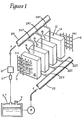
- FIG. 1 there is shown a battery 10 with end electrode assemblies constituting an end anode 12-and cathode 14 and mid-electrodes 16 forming cells (with spacing ported-membrane screen assemblies 17) in an electrical series, fluid parallel array.
- An inlet manifold 22 and outlet manifold 24 provide flow through the cells of electrolyte as indicated by arrows F.
- An external flow system comprises a pump P, and storage tank S.T. with gas vent V, a monitoring instrument I and heat exchanger Q. Screens 5 are affixed to (or encapsulated within) the end electrode assemblies.
- a leak proof casing preferably of inert plastic (eg. an epoxy encapsulation), is applied to the exterior of the battery 10 of Figure 2 (but is not shown in such figure).
- the tributaries are very thin compared to the manifolds and are constructed such that cell to cell current leakage of the battery produces less than 1% degradation of current generating efficiency.
- FIGs 2-4 show one of the mid-electrode assemblies 16 in greater detail. within the epoxy encapsulation covering 18 of the battery.
- Each such assembly comprises an electrode substrate 26, which is a planar conductive carbon/plastic composite of low lateral (perpendicular to the plane of the substrate) and low sheet resistivity.
- Such substrates have oppositng faces usable as anode and cathode faces, which faces may be of identical form, or different forms as hereinafter described.
- the anode face is designated 26A and the cathode face 26C in Figures 3 and 4.
- the batteries 10 will - in practice - comprise at least ten and in many cases substantially over twenty such electrode assemblies 16 in a long array between the end electrodes 12 and 14.
- the electrode substrate of the end electrode assembly 12 provides anode face usage only and that the electrode substrate of the end electrode assembly 14 provides only cathode face usage.
- the electrode substrates are preferably made of a hot pressed mixture of graphite and bromine resistant plastics, preferably polyvinylidene fluoride [but less expensive resins can be employed for some applications, eg. acrylonitrile-butadiene-styrene (ABS) or polyvinylchloride (PVC)].
- Each anode face 16A preferably has a surface enhancement ratio (actual surface area to planar projection area) of at least 3:1, preferably over 5:1.
- Such enhancement helps assure uniformity of zinc plating on the anode face during battery charging and good adhesion of the plating.
- the enhancement may be provided by diverse means, eg. cross-hatch scoring of a pressed sub- strate or moulding in ridge or hump patterns or embedding particles in the surface (preferably particles of such low conductivity relative to the substrate -- a fraction of 1/1000th or less -- as to constitute a virtual insulator by comparison). It is also desirable to similarly enhance the surface of cathode face 26C; but in such case the particles in the surface (if that approach is used) would be conductive.
- the cathode face 26C is covered with unbonded activated charcoal in an amount and depth proportioned to the battery's energy storage specifications.
- the charcoal is retained within a rectangular curbing frame 26F, overlaid with a polypropylene screen cover 26P which is in turn overlaid with a membrane 26M and a spacer screen 26S with ribs 26B.
- the membrane is provided with vent holes 26H at the bottom as shown in Figure 2A and also at the top. Such hole arrays 26H span the width of membrane 26M at top and bottom. They allow electrolyte flow to enter from the main cell channel to the zone containing the charcoal and equalise pressure on initial admission of flow to the cell.
- a preferred material of the cover 26P is a Pellon brand non-woven fabric, heat bonded (at fibre cross-overs) using polypropylene fibres so constructed to form a non- degrading porous mat. It maintains chemical inertness, structural integrity and mechanical strength under cell operation conditions and has attributes of low resistance, light weight and low cost.
- a preferred material of the membrane 26M is W.R. Grace Co's Daramic brand microporous polyethylene sheet.
- a preferred material for surfacing anode face 26A is a silicon dioxide particle layer which serves to anchor the zinc plating and makes the anode surface more wettable. Active carbon (preferably Barnaby-Cheney's UU or OL grades by Calgon Co. type ⁇ ) is pressed into the cathode face 16C to enhance contact . between substrate 16B and the charcoal particles.
- the electrode substrates are held in holders 16H which are frames, preferably made of PVC or polyurethane.
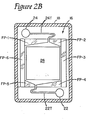
- the carbon particle holding region is defined by a frame 26 F which may be in an inner edge of holder 26H or may comprise separate framing pieces inserted in a rectangular arrangement to define the carbon particle mass (see FP-1 - FP-6 in Figure 2B).
- an electrode substrate plate 26 is employed with active surface particles embedded only in region 26" of its cathode face.
- the carbon particle mass is held and slightly compressed in the space defined by such framing and the overlying covers 26P, 26M, 26S with ribs 26R and the substrate 26. No binders are used and the carbon is amply filled in such space and lightly compressed by the repeating arrangement of items 26C, 26P, 26M, 26S, 26C, 26P, 26M, 26S, etc., between end electrodes 12 and 14.
- Such compression arrangement affords reliable spacing and retention of elements 26, 26P, 26M, 26S, none of which would be rigid per se, but behave as though rigid in a stacked array between 12 and 14 to help assure uniformity of electrolyte flow between electrodes and avoidance of electrodes randomly sagging towards each other.
- a well W and dome D are provided between adjacent electrode assemblies below and above each electrode substrate 26 through appropriate cutaways of holders 16H to define areas outside of electrode zones - an escaping gas region in dome D and an escaping liquid region (providing a region for flaked-off particles of zinc coatings) in well W.
- the dome and wells are V-shaped for assuring complete capture and their apexes are offset for optimising uniformity of electrolyte flow from the tributary 22T which feeds well W to the tributary 24T which is the outlet for exiting liquid (and any escaping gases), and additionally offset in a way that allows maximising lengths of such tributaries in the limited spaces of holder 16H.
- a sealant 16S preferably of epoxy, surrounds each electrode substrate 26 to secure it to the holder 16H and assure that there is no leakage around such edges (to avoid chemical reactions, which would parasitically degrade the main electrochemical reactions of the battery).
- the electrodes are constructed of graphite and fluorocarbon binders, a material not easily cemented or glued. Except for solvent welding of two identically materialled components such as PVC or ABS, cementing or adhering two parts together may be unreliable and cementing two large areas or long length parts with glues, epoxies, etc. in a manner which will not develop fluid leaks is not practical.
- the electrode edges are dipped into a tray type mould for casting of epoxy. Each of the four edges is thus “potted” by suspending the array or stack about 0.5 inches (1.2 cms.) above the bottom of the shown mould. Epoxy is poured into the mould up to a predetermined level into the stack.
- Electrolyte compostions for the ZnBr 2 system have a range of concentrations and ingredients depending upon the properties desired.
- High drain rate (high power density) units employ electrolyte of lowest available resistance resulting in the regime of low resistivity such as shown in Figure 7.
- High energy capacity module designs will tend to use relatively high concentrations of ZnBr 2 salt to minimise water weight and, in some designs, complexing agents for increased capacity and charge retention and a brightener additive for improved zinc plating quality (lower dendritic growth).
- compositions are:
- pH stabilisation or balance of electrolyte is achieved automatically in cells as described herein because of the hydrolysis of Br 2 in the presence of active carbon.
- the carbon catalyses the reaction: and the oxygen is released from the HBrO at a later time thus balancing the loss of H 2 at the zinc electrode.
- the hydrogen loss at the zinc or negative electrode is via the reaction:
- the pH reaches a relatively stable range of value of between 2 and 4 during cell operation depending upon temperature, state of charge and electrolyte composition.
- the last reaction above represents a coulombic loss in efficiency and should be minimised in any event.
- Electrolyte pH control is an important feature of use of active carbon electrodes. Since the pH of ZnBr 2 solution is acidic eg., in the range of 2 - 4 during normal cell operation, H 2 gas is generated at the surface of the negative electrode. thus regenerating H+ ions which are lost at the negative electrode and with the eventual liberation of 0 2 . Hence, there is no need for making other ancillary provisions for pH regulation as there is in other prior art systems.
- pH stabilisation or balance of electrolyte is achieved automatically in these cells because of the hydrolysis of Br 2 in the presence of active carbon.
- the carbon catalyses the reaction: and the oxygen is released from the HBrO at a later time thus balancing the loss of H 2 at the zinc electrode.
- the hydrogen loss at the zinc or (+) electrode is via the reaction:
- the pH reaches a relatively stable range of value of between land 4 during cell operation depending upon temperature, state of charge and electrolyte compostion.
- the last reaction above represents a coulombic loss in efficiency and should be minimised in any event.
- the electrode assemblies are manufactured as follows:
- the resistance of a channel is expressible as ohms
- ⁇ /l 0.20 amps/30.6 inches 0.0065 in.
- the minimum necessary length,xL, per tributary is
- tributary lengths and areas may be. similarly computed via the above relationships for different design criteria of permissible losses, discharge current and stack size, N.
- a regenerable vent trap may be provided in reservoir R for entrapment of free bromine traces escaping from the electrolyte through the O2 and H 2 venting of the reservoir.
- Data obtained for equilibrium vapour pressure of Br 2 in the presence of adsorbed Br 2 on active carbon surfaces shows that for 0.1 to 0.2 gm of Br 2 per gram of carbon (activated coconut charcoal) the partial pressure of Br 2 is significantly less than 10- 3 mm. of Hg. This gives a presence of 1 part per million of Br 2 in a vent trap with active carbon at rated saturation of 0.1 to 0.2 gm. of adsorbed Br 2 . Partial pressures of much less than 0.01 ppm of Br 2 are maintainable even in the worst rated conditions for system operation.
- a regenerable trap eliminates the need to add HBr to the system periodically and to replace the activated carbon.
- the trap may be located above the electrolyte level in the reservoir R.
- a temperature sensor for system control may be located below the liquid levels for direct electrolyte temperature measurement.
- a control unit I ( Figure 1) sensing the cut-off temperature switches off the power to the motor of pump D. Electrolyte drains backwards through the well W, the pump D into the storage tank S. Another more rapid approach to draining may be employed in which the pump D is bypassed by a large drain line into the reservoir and not only is the pump motor switched off when the temperature becomes too high, but a solenoid activated or back pressure release valve opens into the drain. Positive displacement pumps could then be used in such a configuration.
- the electrolyte flow rates for a bipolar array of 17 electrodes with plate areas of 200 sq. in. (1290 sq. cms.) is between 1 and 2 gallons/minute (4.5 to 9 litres/minute) and a pressure head of 0.5 to 1.0 psi (3.44 to 6.9 K Pa). Slower flow rates may be employed.
- Batteries made as described above were repeatedly cycled 25 times or more through constant charging current at 8 amperes and constant current discharge at 6, 8, 10 or 12 amperes (Amp). No degradation of the voltage-time characteristics of the discharge cycles was noted over the course of such repeated cycling.
- the voltage-time characteristics are shown in Figure 5 where voltage (volts) at the terminals (screens S in Figure 1) is plotted against time (hours) of discharge cycle. Electrolye pH, temperature and pressure drops were continuously measured and found to remain in normal circuits.
- the test batteries were one kilowatt hour systems comprising 12 cells with 140 sq. in.
Landscapes
- Engineering & Computer Science (AREA)
- Mechanical Engineering (AREA)
- Sustainable Development (AREA)
- Sustainable Energy (AREA)
- Power Engineering (AREA)
- Transportation (AREA)
- Life Sciences & Earth Sciences (AREA)
- Manufacturing & Machinery (AREA)
- Chemical & Material Sciences (AREA)
- Chemical Kinetics & Catalysis (AREA)
- Electrochemistry (AREA)
- General Chemical & Material Sciences (AREA)
- Hybrid Cells (AREA)
Applications Claiming Priority (2)
| Application Number | Priority Date | Filing Date | Title |
|---|---|---|---|
| US06/441,491 US4482614A (en) | 1982-11-15 | 1982-11-15 | Zinc-bromine battery with long term stability |
| US441491 | 1995-05-15 |
Publications (1)
| Publication Number | Publication Date |
|---|---|
| EP0109807A1 true EP0109807A1 (de) | 1984-05-30 |
Family
ID=23753075
Family Applications (1)
| Application Number | Title | Priority Date | Filing Date |
|---|---|---|---|
| EP83306866A Withdrawn EP0109807A1 (de) | 1982-11-15 | 1983-11-10 | Zink-Brom-Batterie mit Langzeitstabilität |
Country Status (7)
| Country | Link |
|---|---|
| US (1) | US4482614A (de) |
| EP (1) | EP0109807A1 (de) |
| JP (1) | JPS59146171A (de) |
| AU (1) | AU2131383A (de) |
| CA (1) | CA1207832A (de) |
| GB (1) | GB2132004A (de) |
| ZA (1) | ZA838458B (de) |
Cited By (3)
| Publication number | Priority date | Publication date | Assignee | Title |
|---|---|---|---|---|
| EP0291496A3 (en) * | 1987-05-14 | 1990-06-20 | S.E.A. Studiengesellschaft Fur Energiespeicher Und Antriebssysteme Gesellschaft M.B.H. | Metal-halogen battery |
| CN104604020A (zh) * | 2012-04-06 | 2015-05-06 | 普里默斯电力公司 | 用于金属-卤素液流电池组的流体性架构 |
| US10892524B2 (en) | 2016-03-29 | 2021-01-12 | Eos Energy Storage, Llc | Electrolyte for rechargeable electrochemical cell |
Families Citing this family (20)
| Publication number | Priority date | Publication date | Assignee | Title |
|---|---|---|---|---|
| US4740434A (en) * | 1985-11-29 | 1988-04-26 | Kabushiki Kaisha Meidensha | Surface treated electrodes applicable to zinc-halogen secondary batteries |
| US4758473A (en) * | 1986-11-20 | 1988-07-19 | Electric Power Research Institute, Inc. | Stable carbon-plastic electrodes and method of preparation thereof |
| US4948681A (en) * | 1988-05-02 | 1990-08-14 | Globe-Union Inc. | Terminal electrode |
| US5173362A (en) * | 1991-02-01 | 1992-12-22 | Globe-Union, Inc. | Composite substrate for bipolar electrodes |
| AT396312B (de) * | 1991-05-24 | 1993-08-25 | Energiespeicher & Antriebssyst | Verfahren zum laden einer mehrzahl von batterien |
| JPH05267074A (ja) * | 1992-03-23 | 1993-10-15 | Nissin Kogyo Kk | コイル組立体およびその成形装置 |
| FR2770035B1 (fr) * | 1997-10-20 | 1999-12-10 | Alsthom Cge Alcatel | Batterie monobloc contenant un dispositif de mesure de la temperature interne |
| ITVI20030099A1 (it) * | 2003-05-16 | 2004-11-17 | Franco Stocchiero | Metodo per la formazione di batterie al piombo -acido ed |
| US7939190B2 (en) * | 2003-07-09 | 2011-05-10 | Premium Power Corporation | Systems and methods for selective cell and/or stack control in a flowing electrolyte battery |
| US7410714B1 (en) | 2004-07-15 | 2008-08-12 | The United States Of America As Represented By The Administration Of Nasa | Unitized regenerative fuel cell system |
| US7990276B2 (en) * | 2008-01-09 | 2011-08-02 | Black & Decker Inc. | Battery identification for battery packs with inter-cell taps |
| US9294026B2 (en) | 2011-12-20 | 2016-03-22 | United Technologies Corporation | Method of operating a power generation system |
| CN105308771B (zh) | 2013-03-08 | 2017-10-20 | 普里默斯电力公司 | 用于多相电解质流控制的存储槽 |
| US10305111B2 (en) | 2014-10-06 | 2019-05-28 | Eos Energy Storage, Llc | Terminal assembly for bipolar electrochemical cell or battery |
| US10290891B2 (en) | 2016-01-29 | 2019-05-14 | Primus Power Corporation | Metal-halogen flow battery bipolar electrode assembly, system, and method |
| US20200036046A1 (en) | 2016-10-11 | 2020-01-30 | Princeton University | Membrane-free non-flowing single cell zinc bromine battery with bromine-trapping composite carbon foam electrode |
| JP7219462B2 (ja) * | 2019-03-26 | 2023-02-08 | 国立研究開発法人産業技術総合研究所 | 亜鉛二次電池 |
| KR102255426B1 (ko) | 2019-08-30 | 2021-05-24 | 한국과학기술원 | 아연-브롬 전지용 양극 및 이의 제조방법 |
| KR20220154744A (ko) * | 2020-03-16 | 2022-11-22 | 어드밴스드 배터리 컨셉츠, 엘엘씨 | 배터리 어셈블리, 그 제조 방법 및 열 제어 |
| CN113140809B (zh) * | 2021-04-22 | 2022-05-10 | 大连理工大学 | 一种基于二维材料MoS2下的高性能可充电溴离子电池及其制备方法 |
Citations (10)
| Publication number | Priority date | Publication date | Assignee | Title |
|---|---|---|---|---|
| GB449687A (en) * | 1934-05-03 | 1936-07-01 | Fritz Hochwald | Improvements in or relating to secondary cells |
| DE1071176B (de) * | 1959-12-17 | Dr. Helmuth Mylius, Stuttgart | Verfahren zur Speicherung elektrischer Energie | |
| US3382102A (en) * | 1965-09-02 | 1968-05-07 | Gen Electric | Zinc-bromine secondary cell |
| US3738870A (en) * | 1969-04-23 | 1973-06-12 | Consiglio Nazionale Ricerche | Storage batteries containing zinc halide in an aqueous solution of the type having a soluble cathode and a dissolved anode |
| US3772085A (en) * | 1971-11-18 | 1973-11-13 | Occidental Energy Dev Co | Method and apparatus for improving efficiency of high energy density batteries of metal-metal halide-halogen type by boundary layer |
| US3773560A (en) * | 1971-11-18 | 1973-11-20 | Occidental Energy Dev Co | Circulation of electrolyte over a metal electrode of a cell in a high energy density battery |
| US3827915A (en) * | 1971-02-03 | 1974-08-06 | Zito Co | In a battery,a halogen retention vent means |
| US3915744A (en) * | 1971-08-31 | 1975-10-28 | Consiglio Nazionale Ricerche | Electric battery |
| US4218521A (en) * | 1978-12-08 | 1980-08-19 | Electric Power Research Institute, Inc. | Metal-halogen battery having reduced dendrite growth |
| US4346150A (en) * | 1981-06-01 | 1982-08-24 | Exxon Research & Engineering Co. | Electrochemical construction |
Family Cites Families (6)
| Publication number | Priority date | Publication date | Assignee | Title |
|---|---|---|---|---|
| GB1065815A (en) * | 1964-06-24 | 1967-04-19 | Ever Ready Co | Improvements in or relating to galvanic dry batteries |
| CH509672A (it) * | 1969-04-23 | 1971-06-30 | Consiglio Nazionale Ricerche | Elettrodo per accumulatori elettrici a alogenuro di zinco in elettrolita acquoso del tipo a catodo solubile ed anodo disciolto |
| US3811945A (en) * | 1972-08-24 | 1974-05-21 | Consiglio Nazionale Ricerche | Electric battery |
| US3806368A (en) * | 1972-11-14 | 1974-04-23 | Zito Co | Zinc bromide battery |
| GB1485124A (en) * | 1973-09-14 | 1977-09-08 | Unigate Ltd | Electro-chemical cells or batteries |
| US4038459A (en) * | 1976-03-17 | 1977-07-26 | Eco-Control, Inc. | Halogen complexing alcohols and nitriles |
-
1982
- 1982-11-15 US US06/441,491 patent/US4482614A/en not_active Expired - Fee Related
-
1983
- 1983-11-10 GB GB08330036A patent/GB2132004A/en not_active Withdrawn
- 1983-11-10 CA CA000440932A patent/CA1207832A/en not_active Expired
- 1983-11-10 EP EP83306866A patent/EP0109807A1/de not_active Withdrawn
- 1983-11-14 ZA ZA838458A patent/ZA838458B/xx unknown
- 1983-11-14 AU AU21313/83A patent/AU2131383A/en not_active Abandoned
- 1983-11-14 JP JP58212638A patent/JPS59146171A/ja active Pending
Patent Citations (10)
| Publication number | Priority date | Publication date | Assignee | Title |
|---|---|---|---|---|
| DE1071176B (de) * | 1959-12-17 | Dr. Helmuth Mylius, Stuttgart | Verfahren zur Speicherung elektrischer Energie | |
| GB449687A (en) * | 1934-05-03 | 1936-07-01 | Fritz Hochwald | Improvements in or relating to secondary cells |
| US3382102A (en) * | 1965-09-02 | 1968-05-07 | Gen Electric | Zinc-bromine secondary cell |
| US3738870A (en) * | 1969-04-23 | 1973-06-12 | Consiglio Nazionale Ricerche | Storage batteries containing zinc halide in an aqueous solution of the type having a soluble cathode and a dissolved anode |
| US3827915A (en) * | 1971-02-03 | 1974-08-06 | Zito Co | In a battery,a halogen retention vent means |
| US3915744A (en) * | 1971-08-31 | 1975-10-28 | Consiglio Nazionale Ricerche | Electric battery |
| US3772085A (en) * | 1971-11-18 | 1973-11-13 | Occidental Energy Dev Co | Method and apparatus for improving efficiency of high energy density batteries of metal-metal halide-halogen type by boundary layer |
| US3773560A (en) * | 1971-11-18 | 1973-11-20 | Occidental Energy Dev Co | Circulation of electrolyte over a metal electrode of a cell in a high energy density battery |
| US4218521A (en) * | 1978-12-08 | 1980-08-19 | Electric Power Research Institute, Inc. | Metal-halogen battery having reduced dendrite growth |
| US4346150A (en) * | 1981-06-01 | 1982-08-24 | Exxon Research & Engineering Co. | Electrochemical construction |
Non-Patent Citations (1)
| Title |
|---|
| JOURNAL OF THE ELECTROCHEMICAL SOCIETY, vol. 111, no. 11, November 1964, pages 1201-1204 * |
Cited By (6)
| Publication number | Priority date | Publication date | Assignee | Title |
|---|---|---|---|---|
| EP0291496A3 (en) * | 1987-05-14 | 1990-06-20 | S.E.A. Studiengesellschaft Fur Energiespeicher Und Antriebssysteme Gesellschaft M.B.H. | Metal-halogen battery |
| CN104604020A (zh) * | 2012-04-06 | 2015-05-06 | 普里默斯电力公司 | 用于金属-卤素液流电池组的流体性架构 |
| US9627704B2 (en) | 2012-04-06 | 2017-04-18 | Primus Power Corporation | Fluidic architecture for metal-halogen flow battery |
| CN104604020B (zh) * | 2012-04-06 | 2017-09-19 | 普里默斯电力公司 | 用于金属‑卤素液流电池组的流体性架构 |
| US10892524B2 (en) | 2016-03-29 | 2021-01-12 | Eos Energy Storage, Llc | Electrolyte for rechargeable electrochemical cell |
| US11942606B2 (en) | 2016-03-29 | 2024-03-26 | EOS Energy Technology Holdings, LLC | Electrolyte for rechargeable electrochemical cell |
Also Published As
| Publication number | Publication date |
|---|---|
| AU2131383A (en) | 1984-05-24 |
| GB2132004A (en) | 1984-06-27 |
| ZA838458B (en) | 1984-07-25 |
| JPS59146171A (ja) | 1984-08-21 |
| US4482614A (en) | 1984-11-13 |
| CA1207832A (en) | 1986-07-15 |
| GB8330036D0 (en) | 1983-12-14 |
Similar Documents
| Publication | Publication Date | Title |
|---|---|---|
| EP0109807A1 (de) | Zink-Brom-Batterie mit Langzeitstabilität | |
| US4069371A (en) | Energy conversion | |
| US4539268A (en) | Sealed bipolar multi-cell battery | |
| EP0664930B1 (de) | Elektrochemischer apparat zur sirumversorgung unter anwendung einer luftelektrode | |
| EP0068508B1 (de) | Methanol-Brennstoffzelle | |
| EP3422446B1 (de) | Versenkbare gasförmige oxidationsmittelkathode für ein elektrochemisches zellsystem | |
| US20100003586A1 (en) | Redox flow cell | |
| BG61627B1 (bg) | Метод и система за електрохимично акумулиране на енергияи/или генериране на мощност | |
| CA1257325A (en) | Lightweight bipolar metal-gas battery | |
| US20090053601A1 (en) | Modular Bipolar Battery | |
| EP0200327A2 (de) | Doppelschichtkondensatoren | |
| HK1001071B (en) | Electrochemical energy storage and/or power delivery cell with ph control | |
| ES2009213A6 (es) | Bateria de acumuladores electricos | |
| FI88439C (fi) | Foerfarande och anordning foer laddning av en sluten, sekundaer elektrokemisk stroemkaella | |
| US4746585A (en) | Comb-type bipolar stack | |
| US4135039A (en) | Electrode structures and electrodes therefrom for use in electrolytic cells or batteries | |
| GB1587748A (en) | Energy conversion apparatus | |
| US12567626B1 (en) | Zinc bromine cell having enclosed electrodes | |
| Abbey et al. | Pore size engineering applied to starved electrochemical cells and batteries | |
| JP2853271B2 (ja) | 電解液静止型亜鉛―臭素電池 | |
| CN1182615C (zh) | 非循环电解液锌溴电池 | |
| CN121569388A (zh) | 具有可渗透电极的开放池电池模块 | |
| JP2853294B2 (ja) | 電解液静止型の亜鉛―臭素二次電池 | |
| Li et al. | pH Differential Power Sources with Electrochemical Neutralisation | |
| Smedley et al. | A zinc-air fuel cell |
Legal Events
| Date | Code | Title | Description |
|---|---|---|---|
| PUAI | Public reference made under article 153(3) epc to a published international application that has entered the european phase |
Free format text: ORIGINAL CODE: 0009012 |
|
| AK | Designated contracting states |
Designated state(s): DE FR IT SE |
|
| STAA | Information on the status of an ep patent application or granted ep patent |
Free format text: STATUS: THE APPLICATION IS DEEMED TO BE WITHDRAWN |
|
| 18D | Application deemed to be withdrawn |
Effective date: 19850131 |
|
| RIN1 | Information on inventor provided before grant (corrected) |
Inventor name: ZITO, RALPH |