EP0109976A1 - Zylindrischer Permanentmagnet und Verfahren zu seiner Herstellung - Google Patents
Zylindrischer Permanentmagnet und Verfahren zu seiner Herstellung Download PDFInfo
- Publication number
- EP0109976A1 EP0109976A1 EP82111152A EP82111152A EP0109976A1 EP 0109976 A1 EP0109976 A1 EP 0109976A1 EP 82111152 A EP82111152 A EP 82111152A EP 82111152 A EP82111152 A EP 82111152A EP 0109976 A1 EP0109976 A1 EP 0109976A1
- Authority
- EP
- European Patent Office
- Prior art keywords
- permanent magnet
- magnet
- cylindrical permanent
- cylindrical
- magnetic
- Prior art date
- Legal status (The legal status is an assumption and is not a legal conclusion. Google has not performed a legal analysis and makes no representation as to the accuracy of the status listed.)
- Granted
Links
- 238000004519 manufacturing process Methods 0.000 title 1
- 230000005291 magnetic effect Effects 0.000 claims abstract description 56
- 239000000203 mixture Substances 0.000 claims abstract description 6
- 229910052712 strontium Inorganic materials 0.000 claims abstract description 6
- 229910052788 barium Inorganic materials 0.000 claims abstract description 5
- 229910052745 lead Inorganic materials 0.000 claims abstract description 5
- 238000000034 method Methods 0.000 claims abstract 4
- 239000000463 material Substances 0.000 claims description 8
- XLYOFNOQVPJJNP-UHFFFAOYSA-N water Substances O XLYOFNOQVPJJNP-UHFFFAOYSA-N 0.000 claims description 6
- 238000005245 sintering Methods 0.000 claims description 4
- 230000004907 flux Effects 0.000 description 17
- 239000002245 particle Substances 0.000 description 11
- 229910000859 α-Fe Inorganic materials 0.000 description 9
- 239000004033 plastic Substances 0.000 description 5
- 230000004323 axial length Effects 0.000 description 4
- 230000005415 magnetization Effects 0.000 description 4
- 230000002093 peripheral effect Effects 0.000 description 4
- 230000003247 decreasing effect Effects 0.000 description 3
- 238000002474 experimental method Methods 0.000 description 3
- 230000008901 benefit Effects 0.000 description 2
- 230000000694 effects Effects 0.000 description 2
- 230000009467 reduction Effects 0.000 description 2
- 244000043261 Hevea brasiliensis Species 0.000 description 1
- 239000000654 additive Substances 0.000 description 1
- 238000013459 approach Methods 0.000 description 1
- 239000003990 capacitor Substances 0.000 description 1
- 230000008859 change Effects 0.000 description 1
- 239000000470 constituent Substances 0.000 description 1
- 230000018109 developmental process Effects 0.000 description 1
- 238000001035 drying Methods 0.000 description 1
- 229920001971 elastomer Polymers 0.000 description 1
- 239000003302 ferromagnetic material Substances 0.000 description 1
- 239000012467 final product Substances 0.000 description 1
- 230000006698 induction Effects 0.000 description 1
- 239000006247 magnetic powder Substances 0.000 description 1
- 239000011159 matrix material Substances 0.000 description 1
- 229910052751 metal Inorganic materials 0.000 description 1
- 239000002184 metal Substances 0.000 description 1
- 238000012986 modification Methods 0.000 description 1
- 230000004048 modification Effects 0.000 description 1
- 229920003052 natural elastomer Polymers 0.000 description 1
- 229920001194 natural rubber Polymers 0.000 description 1
- AJCDFVKYMIUXCR-UHFFFAOYSA-N oxobarium;oxo(oxoferriooxy)iron Chemical compound [Ba]=O.O=[Fe]O[Fe]=O.O=[Fe]O[Fe]=O.O=[Fe]O[Fe]=O.O=[Fe]O[Fe]=O.O=[Fe]O[Fe]=O.O=[Fe]O[Fe]=O AJCDFVKYMIUXCR-UHFFFAOYSA-N 0.000 description 1
- 230000035515 penetration Effects 0.000 description 1
- 230000035699 permeability Effects 0.000 description 1
- 230000002441 reversible effect Effects 0.000 description 1
- 239000005060 rubber Substances 0.000 description 1
- 239000007787 solid Substances 0.000 description 1
- CIOAGBVUUVVLOB-UHFFFAOYSA-N strontium atom Chemical compound [Sr] CIOAGBVUUVVLOB-UHFFFAOYSA-N 0.000 description 1
- 229920003051 synthetic elastomer Polymers 0.000 description 1
- 229920003002 synthetic resin Polymers 0.000 description 1
- 239000000057 synthetic resin Substances 0.000 description 1
- 239000005061 synthetic rubber Substances 0.000 description 1
Images
Classifications
-
- H—ELECTRICITY
- H01—ELECTRIC ELEMENTS
- H01F—MAGNETS; INDUCTANCES; TRANSFORMERS; SELECTION OF MATERIALS FOR THEIR MAGNETIC PROPERTIES
- H01F7/00—Magnets
- H01F7/02—Permanent magnets [PM]
- H01F7/0205—Magnetic circuits with PM in general
- H01F7/021—Construction of PM
-
- C—CHEMISTRY; METALLURGY
- C04—CEMENTS; CONCRETE; ARTIFICIAL STONE; CERAMICS; REFRACTORIES
- C04B—LIME, MAGNESIA; SLAG; CEMENTS; COMPOSITIONS THEREOF, e.g. MORTARS, CONCRETE OR LIKE BUILDING MATERIALS; ARTIFICIAL STONE; CERAMICS; REFRACTORIES; TREATMENT OF NATURAL STONE
- C04B35/00—Shaped ceramic products characterised by their composition; Ceramics compositions; Processing powders of inorganic compounds preparatory to the manufacturing of ceramic products
- C04B35/01—Shaped ceramic products characterised by their composition; Ceramics compositions; Processing powders of inorganic compounds preparatory to the manufacturing of ceramic products based on oxide ceramics
- C04B35/26—Shaped ceramic products characterised by their composition; Ceramics compositions; Processing powders of inorganic compounds preparatory to the manufacturing of ceramic products based on oxide ceramics based on ferrites
- C04B35/2683—Other ferrites containing alkaline earth metals or lead
-
- H—ELECTRICITY
- H02—GENERATION; CONVERSION OR DISTRIBUTION OF ELECTRIC POWER
- H02K—DYNAMO-ELECTRIC MACHINES
- H02K1/00—Details of the magnetic circuit
- H02K1/06—Details of the magnetic circuit characterised by the shape, form or construction
- H02K1/22—Rotating parts of the magnetic circuit
- H02K1/27—Rotor cores with permanent magnets
- H02K1/2706—Inner rotors
- H02K1/272—Inner rotors the magnetisation axis of the magnets being perpendicular to the rotor axis
- H02K1/2726—Inner rotors the magnetisation axis of the magnets being perpendicular to the rotor axis the rotor consisting of a single magnet or two or more axially juxtaposed single magnets
- H02K1/2733—Annular magnets
Definitions
- the present invention broadly relates to a magnet suitable for use as the rotor magnet of a stepping motor and, more particularly, to a cylindrical permanent magnet having a surface multipolar anisotropy.
- ferrite magnets such as barium ferrite magnet, strontium ferrite magnet and so forth have been used as the permanent magnet for multi- polar magnetization.
- Materials of such permanent magnets are stoichiometrically expressed by MO ⁇ 6Fe 2 O 3 , where M represents an element such as Ba, Sr, Pb or their mixtures with or without bivalent metal such as Ca.
- MO ⁇ nFe 2 O 3 where n represents a value of 5 to 6.
- Various cylindrical permanent magnets have been proposed and used hitherto, such as isotropic ferrite magnet, ring anisotropic ferrite magnet, and plastic magnets formed by dispersing ferrite magnetic powder in a matrix such as synthetic rubber, synthetic resin or natural rubber.
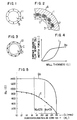
- the ring anisotropic magnet 11 as shown in Fig. 1 has a radial particle orientation as shown by arrows B.
- the magnetization after the sintering is conducted by means of a magnetizing yoke A composed of a yoke member 1 formed of ferromagnetic material and coils 2 as shown in Fig. 2. Therefore, the direction of particle orientation and the direction of line of magnetic force indicated by arrows C locally discord with each other.
- the ring anisotropic magnet 11 cannot provide effective particle orientation.
- the conventional cylindrical permanent magnet could not avert from the problem of large inertia force which is caused inevitably by increased wall thickness for obtaining a high magnetic properties.
- an object of the invention is to provide a multipolar surface magnetized magnet having a high surface magnetic flux density.
- Another object of the invention is to provide a permanent magnet which exhibits a high holding torque when used as the rotor magnet of a stepping motor.
- a sintered cylindrical permanent magnet having a magneto-plumbite type crystalline structure expressed by MO ⁇ nFe 2 O 3 , where M represents Ba, Sr, Pb or their mixture and n being a value of 5 to 6, the magnet being provided in its cylindrical surface with multipolar anisotropy.
- the advantage of the invention is remarkable particularly when more than 8 (eight) poles are provided on the outer peripheral surface of the cylindrical body of the magnet.
- surface anisotropy in this specification is used to mean such a state that magnetic poles of different polarities actually exist or are formable on the same surface of the permanent magnet such as cylindrical outer peripheral surface, and easy axes of magnetization of ferrite particles, which have magneto-plumbite crystalline structure having unidirectional magnetic anisotropy, are substantially aligned with the lines, normally arcuate lines, interconnecting the magnetic poles through the body of the magnet.
- the invention aims also at providing a cylindrical permanent magnet in which the particle orientation for attaining effective amount of magnetic flux is achieved in advance to the sintering thereby to impart the surface multipolar anisotropy while attaining high magnetic properties and a reduced inertia force.
- the multipolar cylindrical magnet for use as the rotor of a motor is required to satisfy both of the demands for high magnetic properties and low inertia force. These two demands, however, are generally incompatible with each other.
- the wall thickness (t) of the cylindrical permanent magnet is increased for attaining a high surface magnetic flux density Bo, the inertia force I is increased undesirably, as will be understood from Fig. 4.
- the wall thickness (t) is reduced to satisfy the requirement for smaller inertia force, the surface magnetic flux density is decreased unfavourably. Accordingly, it is necessary to optimize the size of the magnet so as to obtain sufficiently small inertia force without being accompanied by substantial reduction in the surface magnetic flux density Bo.
- the inside and outside diameters of the cylindrical permanent magnet are selected to meet the following condition.
- D 1 represents the inside diameter of magnet
- D2 represents the outside diameter of permanent magnet
- P represents the number of magnetic poles
- K 1 represents a constant.
- the inside to outside diameter ratio T ranges between 0 and 1.0. As the ratio gets closer to 1, the wall thickness (t) becomes smaller so that the surface magnetic flux density B 0 gets smaller. To the contrary, as the ratio T approaches 0 (zero), the wall thickness (t) gets larger to make the magnet resemble a pillar or solid cylinder, resulting in an increased inertia force I.
- the optimum ratio T between the inside diameter and the outside diameter of the cylindrical permanent magnet of the invention is determined by this formula.
- the cylindrical permanent magnet of the invention is formed from a material containing, in addition to the major constituents mentioned before, a suitable amount of additives for imparting a self-supporting force, as well as 14 to 20% of water for permitting the rotation of particles when the material is placed under the influence of a magnetic field. Then, formed body is placed under the influence of the magnetic field to orientate the particles in the direction of lines of magnetic force, and is then sintered to become the permanent magnet as the final product. The magnet, if desired, is machined to a final shape.
- the water content is selected to range between 14 and 20% because any water content below 14% makes the compacted body too hard to permit smooth orientation of particles for attaining desired anisotropy, resulting in an imperfect magnetic properties, while a water content in excess of 20% seriously deteriorates the self-supporting force of the compacted body to make the forming materially impossible.
- the coil of the yoke may be connected to an instantaneous D.C. power supply, wherein an A.C. power source is used as an input and the A.C. current is rectified and raised to a predetermined D.C. voltage to charge a group of capacitors which effect discharge through thyristors.
- a magnetic field of over about 10,000 Oersted is enough to accomplish this invention. Not only one but a combination of two pulse magnetic fields may be applied.
- a green body having an outside diameter, inside diameter and axial length of 33 mm, 23 mm and 30 mm, respectively, were formed by a compressing machine from a material consisting of powdered Sr ferrite (Sr0 ⁇ 5.6Fe 2 O 3 ) containing 18% of water.
- the green body was inserted into a multipolar magnetizing yoke A as shown in Fig. 2 and was subjected to a magnetic field of more than 3,000 Oe.
- the green body was then sintered at 1200°C following 24 hour drying.
- the wintered body was machined to have an outside diameter, inside diameter and axial length of 26 mm, 18 mm and 20 mm, respectively.
- the body 3 was then magnetized by a multipolar magnetizing yoke having a shape similar to the magnetizing yoke A shown in Fig. 2, and the surface magnetic flux density B 0 was measured, the result of which is shown in Table 1 below together with the values obtained with a conventional isotropic magnet, ring anisotropic magnet and a plastic magnet by way of reference.
- the permanent magnet of the invention has attained about 40% increase in the surface magnetic flux density as compared with conventional magnets.
- the cylindrical permanent magnet of the invention used in this experiment had an outside diameter, inside diameter and axial length of 26 mm, 18 mm and 20 mm, respectively, and had 24 (twenty four) magnetic poles in total.
- the constant value K 1 is selected to range between 1.5 and 2.5 in view of the curve shown in Fig. 5, so that the size of the permanent magnet is optimized to provide a reduced inertia force without being accompanied by substantial reduction in the surface magnetic flux density.
- the magnet of the invention Since the magnetic properties were all measured in the radial direction, the magnet of the invention exhibits quite a low residual induction Br of 2600 Gauss. This magnet, however, exhibits quite a high holding torque.
- the cylindrical permanent magnet of the invention is provided with the surface multipolar anisotropy prior to the sintering so that the particles are oriented in the magnetizing direction.
- the sintered permanent magnet of the invention therefore, has an extremely high surface magnetic flux density which in turn permits a high magnetic properties.
- the weight and, hence, the inertia force of the magnet is decreased advantageously as compared with conventional magnets, without being accompanied by any substantial decrease in the magnetic properties.
- the reduced weight permits also an economical use of the material.
- the cylindrical permanent magnet of the invention may have an increased axial length so that it may be used in a copying machine incorporating a magnetic brush development for latent images.
Landscapes
- Engineering & Computer Science (AREA)
- Chemical & Material Sciences (AREA)
- Power Engineering (AREA)
- Ceramic Engineering (AREA)
- Physics & Mathematics (AREA)
- Electromagnetism (AREA)
- Manufacturing & Machinery (AREA)
- Materials Engineering (AREA)
- Structural Engineering (AREA)
- Organic Chemistry (AREA)
- Permanent Field Magnets Of Synchronous Machinery (AREA)
- Manufacturing Cores, Coils, And Magnets (AREA)
Priority Applications (2)
| Application Number | Priority Date | Filing Date | Title |
|---|---|---|---|
| DE8282111152T DE3277951D1 (en) | 1982-12-02 | 1982-12-02 | Cylindrical permanent magnet and manufacturing method of it |
| EP19820111152 EP0109976B1 (de) | 1982-12-02 | 1982-12-02 | Zylindrischer Permanentmagnet und Verfahren zu seiner Herstellung |
Applications Claiming Priority (1)
| Application Number | Priority Date | Filing Date | Title |
|---|---|---|---|
| EP19820111152 EP0109976B1 (de) | 1982-12-02 | 1982-12-02 | Zylindrischer Permanentmagnet und Verfahren zu seiner Herstellung |
Publications (2)
| Publication Number | Publication Date |
|---|---|
| EP0109976A1 true EP0109976A1 (de) | 1984-06-13 |
| EP0109976B1 EP0109976B1 (de) | 1988-01-07 |
Family
ID=8189370
Family Applications (1)
| Application Number | Title | Priority Date | Filing Date |
|---|---|---|---|
| EP19820111152 Expired EP0109976B1 (de) | 1982-12-02 | 1982-12-02 | Zylindrischer Permanentmagnet und Verfahren zu seiner Herstellung |
Country Status (2)
| Country | Link |
|---|---|
| EP (1) | EP0109976B1 (de) |
| DE (1) | DE3277951D1 (de) |
Citations (6)
| Publication number | Priority date | Publication date | Assignee | Title |
|---|---|---|---|---|
| US3014141A (en) * | 1956-03-15 | 1961-12-19 | Cons Electronics Ind | Synchronous motor and rotor |
| CH428967A (de) * | 1963-01-11 | 1967-01-31 | Cochardt Alexander Ing Dr | Verfahren zur Ausrichtung der magnetisierbaren Partikel von axial durchbrochenen Presskörpern und Vorrichtung zur Durchführung des Verfahrens |
| US3719842A (en) * | 1971-05-28 | 1973-03-06 | Mallory & Co Inc P R | Synchronous motor |
| FR2191334A1 (de) * | 1972-06-30 | 1974-02-01 | Electrical Remote Control Co | |
| US3808491A (en) * | 1972-11-15 | 1974-04-30 | Philips Corp | Shaded pole synchronous motor |
| US4026975A (en) * | 1973-09-26 | 1977-05-31 | U.S. Philips Corporation | Radially anisotropic magnet body |
-
1982
- 1982-12-02 EP EP19820111152 patent/EP0109976B1/de not_active Expired
- 1982-12-02 DE DE8282111152T patent/DE3277951D1/de not_active Expired
Patent Citations (6)
| Publication number | Priority date | Publication date | Assignee | Title |
|---|---|---|---|---|
| US3014141A (en) * | 1956-03-15 | 1961-12-19 | Cons Electronics Ind | Synchronous motor and rotor |
| CH428967A (de) * | 1963-01-11 | 1967-01-31 | Cochardt Alexander Ing Dr | Verfahren zur Ausrichtung der magnetisierbaren Partikel von axial durchbrochenen Presskörpern und Vorrichtung zur Durchführung des Verfahrens |
| US3719842A (en) * | 1971-05-28 | 1973-03-06 | Mallory & Co Inc P R | Synchronous motor |
| FR2191334A1 (de) * | 1972-06-30 | 1974-02-01 | Electrical Remote Control Co | |
| US3808491A (en) * | 1972-11-15 | 1974-04-30 | Philips Corp | Shaded pole synchronous motor |
| US4026975A (en) * | 1973-09-26 | 1977-05-31 | U.S. Philips Corporation | Radially anisotropic magnet body |
Also Published As
| Publication number | Publication date |
|---|---|
| EP0109976B1 (de) | 1988-01-07 |
| DE3277951D1 (en) | 1988-02-11 |
Similar Documents
| Publication | Publication Date | Title |
|---|---|---|
| US4547758A (en) | Cylindrical permanent magnet and method of manufacturing | |
| US4600555A (en) | Method of producing a cylindrical permanent magnet | |
| US2903329A (en) | Device for molding anisotropic permanent magnets | |
| US5913255A (en) | Radially anisotropic sintered R-Fe-B-based magnet and production method thereof | |
| JPS6359243B2 (de) | ||
| USRE34229E (en) | Cylindrical permanent magnet and method of manufacturing | |
| US6537463B2 (en) | Resin-bonded magnet, its product, and ferrite magnet powder and compound used therefor | |
| EP0109976B1 (de) | Zylindrischer Permanentmagnet und Verfahren zu seiner Herstellung | |
| JP3007491B2 (ja) | 側面配向型異方性磁石 | |
| JPS6134249B2 (de) | ||
| GB2057194A (en) | A method of producing a permanent anisotropic magnet | |
| JPH0340487B2 (de) | ||
| JPS61237405A (ja) | 多極着磁磁石 | |
| JPH07111924B2 (ja) | 磁気ロール及び磁気ロール用円筒状磁石の製造方法 | |
| JPS62232107A (ja) | 異方性樹脂磁石およびその製造方法 | |
| JPS59211502A (ja) | 表面多極異方性永久磁石体の製造方法 | |
| JPS55133069A (en) | Magnetic brush developing device | |
| GB2069766A (en) | Improvements in or relating to methods of producing anisotropic permanent magnets and magnets produced by such methods | |
| EP4531064A1 (de) | Oberflächenbehandeltes magnetisches material und magnet | |
| JPS5923448B2 (ja) | 異方性磁石 | |
| JPS60931B2 (ja) | 異方性磁石の製造方法及び製造装置 | |
| JPS62235703A (ja) | 異方性樹脂磁石 | |
| JPH0211006B2 (de) | ||
| JPH02311147A (ja) | 複合円筒状永久磁石 | |
| JPS59143171A (ja) | マグネチツクロ−ルの製造方法 |
Legal Events
| Date | Code | Title | Description |
|---|---|---|---|
| PUAI | Public reference made under article 153(3) epc to a published international application that has entered the european phase |
Free format text: ORIGINAL CODE: 0009012 |
|
| AK | Designated contracting states |
Designated state(s): CH DE FR GB LI |
|
| 17P | Request for examination filed |
Effective date: 19841122 |
|
| 17Q | First examination report despatched |
Effective date: 19860121 |
|
| R17C | First examination report despatched (corrected) |
Effective date: 19860701 |
|
| GRAA | (expected) grant |
Free format text: ORIGINAL CODE: 0009210 |
|
| AK | Designated contracting states |
Kind code of ref document: B1 Designated state(s): CH DE FR GB LI |
|
| REF | Corresponds to: |
Ref document number: 3277951 Country of ref document: DE Date of ref document: 19880211 |
|
| ET | Fr: translation filed | ||
| PLBE | No opposition filed within time limit |
Free format text: ORIGINAL CODE: 0009261 |
|
| STAA | Information on the status of an ep patent application or granted ep patent |
Free format text: STATUS: NO OPPOSITION FILED WITHIN TIME LIMIT |
|
| 26N | No opposition filed | ||
| REG | Reference to a national code |
Ref country code: GB Ref legal event code: 727 |
|
| REG | Reference to a national code |
Ref country code: GB Ref legal event code: 727A |
|
| REG | Reference to a national code |
Ref country code: GB Ref legal event code: 727B |
|
| REG | Reference to a national code |
Ref country code: GB Ref legal event code: SP |
|
| PGFP | Annual fee paid to national office [announced via postgrant information from national office to epo] |
Ref country code: GB Payment date: 19931123 Year of fee payment: 12 |
|
| PGFP | Annual fee paid to national office [announced via postgrant information from national office to epo] |
Ref country code: FR Payment date: 19931224 Year of fee payment: 12 |
|
| PGFP | Annual fee paid to national office [announced via postgrant information from national office to epo] |
Ref country code: CH Payment date: 19931227 Year of fee payment: 12 |
|
| PGFP | Annual fee paid to national office [announced via postgrant information from national office to epo] |
Ref country code: DE Payment date: 19940228 Year of fee payment: 12 |
|
| PG25 | Lapsed in a contracting state [announced via postgrant information from national office to epo] |
Ref country code: GB Effective date: 19941202 |
|
| PG25 | Lapsed in a contracting state [announced via postgrant information from national office to epo] |
Ref country code: LI Effective date: 19941231 Ref country code: CH Effective date: 19941231 |
|
| GBPC | Gb: european patent ceased through non-payment of renewal fee |
Effective date: 19941202 |
|
| PG25 | Lapsed in a contracting state [announced via postgrant information from national office to epo] |
Ref country code: FR Effective date: 19950831 |
|
| REG | Reference to a national code |
Ref country code: CH Ref legal event code: PL |
|
| PG25 | Lapsed in a contracting state [announced via postgrant information from national office to epo] |
Ref country code: DE Effective date: 19950901 |
|
| REG | Reference to a national code |
Ref country code: FR Ref legal event code: ST |