EP0110328A2 - Verfahren zur Herstellung von Wasserglasschaumstoffen aus Aerosoldosen - Google Patents
Verfahren zur Herstellung von Wasserglasschaumstoffen aus Aerosoldosen Download PDFInfo
- Publication number
- EP0110328A2 EP0110328A2 EP83111771A EP83111771A EP0110328A2 EP 0110328 A2 EP0110328 A2 EP 0110328A2 EP 83111771 A EP83111771 A EP 83111771A EP 83111771 A EP83111771 A EP 83111771A EP 0110328 A2 EP0110328 A2 EP 0110328A2
- Authority
- EP
- European Patent Office
- Prior art keywords
- solution
- silicate solution
- hardener
- alkali
- blowing agent
- Prior art date
- Legal status (The legal status is an assumption and is not a legal conclusion. Google has not performed a legal analysis and makes no representation as to the accuracy of the status listed.)
- Granted
Links
- 238000000034 method Methods 0.000 title claims description 33
- 235000019353 potassium silicate Nutrition 0.000 title claims description 16
- NTHWMYGWWRZVTN-UHFFFAOYSA-N sodium silicate Chemical compound [Na+].[Na+].[O-][Si]([O-])=O NTHWMYGWWRZVTN-UHFFFAOYSA-N 0.000 title claims description 16
- 239000000443 aerosol Substances 0.000 title description 10
- 239000000463 material Substances 0.000 title 1
- 239000006260 foam Substances 0.000 claims abstract description 41
- 239000004848 polyfunctional curative Substances 0.000 claims abstract description 30
- 229910052910 alkali metal silicate Inorganic materials 0.000 claims abstract description 22
- 239000003995 emulsifying agent Substances 0.000 claims abstract description 15
- BPQQTUXANYXVAA-UHFFFAOYSA-N Orthosilicate Chemical compound [O-][Si]([O-])([O-])[O-] BPQQTUXANYXVAA-UHFFFAOYSA-N 0.000 claims abstract description 9
- 238000010276 construction Methods 0.000 claims abstract description 7
- 238000005187 foaming Methods 0.000 claims abstract description 6
- 238000009413 insulation Methods 0.000 claims abstract description 3
- 239000012774 insulation material Substances 0.000 claims abstract 2
- 239000004604 Blowing Agent Substances 0.000 claims description 18
- 239000000203 mixture Substances 0.000 claims description 13
- 239000003380 propellant Substances 0.000 claims description 7
- DDXLVDQZPFLQMZ-UHFFFAOYSA-M dodecyl(trimethyl)azanium;chloride Chemical compound [Cl-].CCCCCCCCCCCC[N+](C)(C)C DDXLVDQZPFLQMZ-UHFFFAOYSA-M 0.000 claims description 6
- 239000007789 gas Substances 0.000 claims description 6
- GKQHIYSTBXDYNQ-UHFFFAOYSA-M 1-dodecylpyridin-1-ium;chloride Chemical compound [Cl-].CCCCCCCCCCCC[N+]1=CC=CC=C1 GKQHIYSTBXDYNQ-UHFFFAOYSA-M 0.000 claims description 5
- 239000003513 alkali Substances 0.000 claims description 5
- REZZEXDLIUJMMS-UHFFFAOYSA-M dimethyldioctadecylammonium chloride Chemical compound [Cl-].CCCCCCCCCCCCCCCCCC[N+](C)(C)CCCCCCCCCCCCCCCCCC REZZEXDLIUJMMS-UHFFFAOYSA-M 0.000 claims description 5
- IAYPIBMASNFSPL-UHFFFAOYSA-N Ethylene oxide Chemical compound C1CO1 IAYPIBMASNFSPL-UHFFFAOYSA-N 0.000 claims description 4
- 229910004298 SiO 2 Inorganic materials 0.000 claims description 4
- 229960000541 cetyl alcohol Drugs 0.000 claims description 4
- -1 insulation Substances 0.000 claims description 4
- 239000007788 liquid Substances 0.000 claims description 4
- ULUAUXLGCMPNKK-UHFFFAOYSA-N Sulfobutanedioic acid Chemical compound OC(=O)CC(C(O)=O)S(O)(=O)=O ULUAUXLGCMPNKK-UHFFFAOYSA-N 0.000 claims description 3
- 150000001733 carboxylic acid esters Chemical class 0.000 claims description 3
- 235000014113 dietary fatty acids Nutrition 0.000 claims description 3
- 239000000194 fatty acid Substances 0.000 claims description 3
- 229930195729 fatty acid Natural products 0.000 claims description 3
- 150000004665 fatty acids Chemical class 0.000 claims description 3
- 239000000057 synthetic resin Substances 0.000 claims description 3
- 229920003002 synthetic resin Polymers 0.000 claims description 3
- 239000003760 tallow Substances 0.000 claims description 3
- 239000004338 Dichlorodifluoromethane Substances 0.000 claims description 2
- 239000004111 Potassium silicate Substances 0.000 claims description 2
- 239000004115 Sodium Silicate Substances 0.000 claims description 2
- 150000003863 ammonium salts Chemical class 0.000 claims description 2
- 239000002280 amphoteric surfactant Substances 0.000 claims description 2
- 125000000129 anionic group Chemical group 0.000 claims description 2
- 239000003945 anionic surfactant Substances 0.000 claims description 2
- 150000001642 boronic acid derivatives Chemical class 0.000 claims description 2
- 229910052791 calcium Inorganic materials 0.000 claims description 2
- 125000004432 carbon atom Chemical group C* 0.000 claims description 2
- 125000002091 cationic group Chemical group 0.000 claims description 2
- 239000003093 cationic surfactant Substances 0.000 claims description 2
- 150000001768 cations Chemical class 0.000 claims description 2
- PXBRQCKWGAHEHS-UHFFFAOYSA-N dichlorodifluoromethane Chemical compound FC(F)(Cl)Cl PXBRQCKWGAHEHS-UHFFFAOYSA-N 0.000 claims description 2
- 235000019404 dichlorodifluoromethane Nutrition 0.000 claims description 2
- 239000004664 distearyldimethylammonium chloride (DHTDMAC) Substances 0.000 claims description 2
- 150000002191 fatty alcohols Chemical class 0.000 claims description 2
- 230000007062 hydrolysis Effects 0.000 claims description 2
- 238000006460 hydrolysis reaction Methods 0.000 claims description 2
- 150000002484 inorganic compounds Chemical class 0.000 claims description 2
- 229910010272 inorganic material Inorganic materials 0.000 claims description 2
- 229910052749 magnesium Inorganic materials 0.000 claims description 2
- 239000002736 nonionic surfactant Substances 0.000 claims description 2
- 239000003921 oil Substances 0.000 claims description 2
- 150000002894 organic compounds Chemical class 0.000 claims description 2
- 229910052913 potassium silicate Inorganic materials 0.000 claims description 2
- NNHHDJVEYQHLHG-UHFFFAOYSA-N potassium silicate Chemical compound [K+].[K+].[O-][Si]([O-])=O NNHHDJVEYQHLHG-UHFFFAOYSA-N 0.000 claims description 2
- 150000003856 quaternary ammonium compounds Chemical class 0.000 claims description 2
- 150000003839 salts Chemical class 0.000 claims description 2
- 239000011734 sodium Substances 0.000 claims description 2
- 229910052911 sodium silicate Inorganic materials 0.000 claims description 2
- 239000007787 solid Substances 0.000 claims description 2
- 229910052725 zinc Inorganic materials 0.000 claims description 2
- BYUMYPPGJBLEIS-UHFFFAOYSA-N acetic acid;propane-1,2,3-triol Chemical class CC(O)=O.CC(O)=O.CC(O)=O.OCC(O)CO BYUMYPPGJBLEIS-UHFFFAOYSA-N 0.000 claims 2
- 239000011261 inert gas Substances 0.000 claims 2
- WFWLQNSHRPWKFK-UHFFFAOYSA-N Tegafur Chemical compound O=C1NC(=O)C(F)=CN1C1OCCC1 WFWLQNSHRPWKFK-UHFFFAOYSA-N 0.000 claims 1
- 238000007792 addition Methods 0.000 claims 1
- 150000001408 amides Chemical class 0.000 claims 1
- 239000004035 construction material Substances 0.000 claims 1
- 239000000945 filler Substances 0.000 claims 1
- 239000003349 gelling agent Substances 0.000 claims 1
- 238000004519 manufacturing process Methods 0.000 abstract description 6
- 239000000243 solution Substances 0.000 description 18
- URAYPUMNDPQOKB-UHFFFAOYSA-N triacetin Chemical compound CC(=O)OCC(OC(C)=O)COC(C)=O URAYPUMNDPQOKB-UHFFFAOYSA-N 0.000 description 4
- IJGRMHOSHXDMSA-UHFFFAOYSA-N Atomic nitrogen Chemical compound N#N IJGRMHOSHXDMSA-UHFFFAOYSA-N 0.000 description 3
- MUBZPKHOEPUJKR-UHFFFAOYSA-N Oxalic acid Chemical compound OC(=O)C(O)=O MUBZPKHOEPUJKR-UHFFFAOYSA-N 0.000 description 3
- 230000015572 biosynthetic process Effects 0.000 description 3
- 239000006185 dispersion Substances 0.000 description 3
- CURLTUGMZLYLDI-UHFFFAOYSA-N Carbon dioxide Chemical compound O=C=O CURLTUGMZLYLDI-UHFFFAOYSA-N 0.000 description 2
- LCGLNKUTAGEVQW-UHFFFAOYSA-N Dimethyl ether Chemical compound COC LCGLNKUTAGEVQW-UHFFFAOYSA-N 0.000 description 2
- XLOMVQKBTHCTTD-UHFFFAOYSA-N Zinc monoxide Chemical compound [Zn]=O XLOMVQKBTHCTTD-UHFFFAOYSA-N 0.000 description 2
- 239000000654 additive Substances 0.000 description 2
- WNLRTRBMVRJNCN-UHFFFAOYSA-N adipic acid Chemical compound OC(=O)CCCCC(O)=O WNLRTRBMVRJNCN-UHFFFAOYSA-N 0.000 description 2
- 239000004566 building material Substances 0.000 description 2
- 238000000354 decomposition reaction Methods 0.000 description 2
- BXWNKGSJHAJOGX-UHFFFAOYSA-N n-hexadecyl alcohol Natural products CCCCCCCCCCCCCCCCO BXWNKGSJHAJOGX-UHFFFAOYSA-N 0.000 description 2
- 238000001556 precipitation Methods 0.000 description 2
- 239000011541 reaction mixture Substances 0.000 description 2
- XLYOFNOQVPJJNP-UHFFFAOYSA-N water Substances O XLYOFNOQVPJJNP-UHFFFAOYSA-N 0.000 description 2
- RTBFRGCFXZNCOE-UHFFFAOYSA-N 1-methylsulfonylpiperidin-4-one Chemical compound CS(=O)(=O)N1CCC(=O)CC1 RTBFRGCFXZNCOE-UHFFFAOYSA-N 0.000 description 1
- FEIQOMCWGDNMHM-UHFFFAOYSA-N 5-phenylpenta-2,4-dienoic acid Chemical compound OC(=O)C=CC=CC1=CC=CC=C1 FEIQOMCWGDNMHM-UHFFFAOYSA-N 0.000 description 1
- OYPRJOBELJOOCE-UHFFFAOYSA-N Calcium Chemical compound [Ca] OYPRJOBELJOOCE-UHFFFAOYSA-N 0.000 description 1
- VEXZGXHMUGYJMC-UHFFFAOYSA-M Chloride anion Chemical compound [Cl-] VEXZGXHMUGYJMC-UHFFFAOYSA-M 0.000 description 1
- FYYHWMGAXLPEAU-UHFFFAOYSA-N Magnesium Chemical compound [Mg] FYYHWMGAXLPEAU-UHFFFAOYSA-N 0.000 description 1
- 239000002174 Styrene-butadiene Substances 0.000 description 1
- KDYFGRWQOYBRFD-UHFFFAOYSA-N Succinic acid Natural products OC(=O)CCC(O)=O KDYFGRWQOYBRFD-UHFFFAOYSA-N 0.000 description 1
- XTXRWKRVRITETP-UHFFFAOYSA-N Vinyl acetate Chemical compound CC(=O)OC=C XTXRWKRVRITETP-UHFFFAOYSA-N 0.000 description 1
- HCHKCACWOHOZIP-UHFFFAOYSA-N Zinc Chemical compound [Zn] HCHKCACWOHOZIP-UHFFFAOYSA-N 0.000 description 1
- 239000002253 acid Substances 0.000 description 1
- 239000001361 adipic acid Substances 0.000 description 1
- 235000011037 adipic acid Nutrition 0.000 description 1
- JFCQEDHGNNZCLN-UHFFFAOYSA-N anhydrous glutaric acid Natural products OC(=O)CCCC(O)=O JFCQEDHGNNZCLN-UHFFFAOYSA-N 0.000 description 1
- 239000008346 aqueous phase Substances 0.000 description 1
- 239000007864 aqueous solution Substances 0.000 description 1
- 238000007664 blowing Methods 0.000 description 1
- MTAZNLWOLGHBHU-UHFFFAOYSA-N butadiene-styrene rubber Chemical compound C=CC=C.C=CC1=CC=CC=C1 MTAZNLWOLGHBHU-UHFFFAOYSA-N 0.000 description 1
- HOWJQLVNDUGZBI-UHFFFAOYSA-N butane;propane Chemical compound CCC.CCCC HOWJQLVNDUGZBI-UHFFFAOYSA-N 0.000 description 1
- KDYFGRWQOYBRFD-NUQCWPJISA-N butanedioic acid Chemical compound O[14C](=O)CC[14C](O)=O KDYFGRWQOYBRFD-NUQCWPJISA-N 0.000 description 1
- 239000011575 calcium Substances 0.000 description 1
- 239000001569 carbon dioxide Substances 0.000 description 1
- 229910002092 carbon dioxide Inorganic materials 0.000 description 1
- 239000003638 chemical reducing agent Substances 0.000 description 1
- 230000003111 delayed effect Effects 0.000 description 1
- 125000000118 dimethyl group Chemical group [H]C([H])([H])* 0.000 description 1
- 239000000839 emulsion Substances 0.000 description 1
- 150000002148 esters Chemical class 0.000 description 1
- 238000001704 evaporation Methods 0.000 description 1
- 238000007511 glassblowing Methods 0.000 description 1
- 235000013773 glyceryl triacetate Nutrition 0.000 description 1
- 238000010438 heat treatment Methods 0.000 description 1
- 238000002347 injection Methods 0.000 description 1
- 239000007924 injection Substances 0.000 description 1
- 239000011777 magnesium Substances 0.000 description 1
- 229910052751 metal Inorganic materials 0.000 description 1
- 239000002184 metal Substances 0.000 description 1
- 150000001247 metal acetylides Chemical group 0.000 description 1
- 239000003094 microcapsule Substances 0.000 description 1
- 229910052757 nitrogen Inorganic materials 0.000 description 1
- JCXJVPUVTGWSNB-UHFFFAOYSA-N nitrogen dioxide Inorganic materials O=[N]=O JCXJVPUVTGWSNB-UHFFFAOYSA-N 0.000 description 1
- 229920000620 organic polymer Polymers 0.000 description 1
- 235000006408 oxalic acid Nutrition 0.000 description 1
- 150000002978 peroxides Chemical group 0.000 description 1
- 239000004033 plastic Substances 0.000 description 1
- 229920003023 plastic Polymers 0.000 description 1
- 229920000642 polymer Polymers 0.000 description 1
- 239000002861 polymer material Substances 0.000 description 1
- 239000000843 powder Substances 0.000 description 1
- 239000000779 smoke Substances 0.000 description 1
- 238000007711 solidification Methods 0.000 description 1
- 230000008023 solidification Effects 0.000 description 1
- 239000011115 styrene butadiene Substances 0.000 description 1
- 229920003048 styrene butadiene rubber Polymers 0.000 description 1
- 239000000126 substance Substances 0.000 description 1
- 230000008719 thickening Effects 0.000 description 1
- 239000002341 toxic gas Substances 0.000 description 1
- 229960002622 triacetin Drugs 0.000 description 1
- CYRMSUTZVYGINF-UHFFFAOYSA-N trichlorofluoromethane Chemical compound FC(Cl)(Cl)Cl CYRMSUTZVYGINF-UHFFFAOYSA-N 0.000 description 1
- 229940029284 trichlorofluoromethane Drugs 0.000 description 1
- 239000011701 zinc Substances 0.000 description 1
- 239000011787 zinc oxide Substances 0.000 description 1
Classifications
-
- C—CHEMISTRY; METALLURGY
- C04—CEMENTS; CONCRETE; ARTIFICIAL STONE; CERAMICS; REFRACTORIES
- C04B—LIME, MAGNESIA; SLAG; CEMENTS; COMPOSITIONS THEREOF, e.g. MORTARS, CONCRETE OR LIKE BUILDING MATERIALS; ARTIFICIAL STONE; CERAMICS; REFRACTORIES; TREATMENT OF NATURAL STONE
- C04B24/00—Use of organic materials as active ingredients for mortars, concrete or artificial stone, e.g. plasticisers
- C04B24/12—Nitrogen containing compounds organic derivatives of hydrazine
-
- C—CHEMISTRY; METALLURGY
- C04—CEMENTS; CONCRETE; ARTIFICIAL STONE; CERAMICS; REFRACTORIES
- C04B—LIME, MAGNESIA; SLAG; CEMENTS; COMPOSITIONS THEREOF, e.g. MORTARS, CONCRETE OR LIKE BUILDING MATERIALS; ARTIFICIAL STONE; CERAMICS; REFRACTORIES; TREATMENT OF NATURAL STONE
- C04B24/00—Use of organic materials as active ingredients for mortars, concrete or artificial stone, e.g. plasticisers
- C04B24/005—Halogen-containing compounds
-
- C—CHEMISTRY; METALLURGY
- C04—CEMENTS; CONCRETE; ARTIFICIAL STONE; CERAMICS; REFRACTORIES
- C04B—LIME, MAGNESIA; SLAG; CEMENTS; COMPOSITIONS THEREOF, e.g. MORTARS, CONCRETE OR LIKE BUILDING MATERIALS; ARTIFICIAL STONE; CERAMICS; REFRACTORIES; TREATMENT OF NATURAL STONE
- C04B24/00—Use of organic materials as active ingredients for mortars, concrete or artificial stone, e.g. plasticisers
- C04B24/16—Sulfur-containing compounds
-
- C—CHEMISTRY; METALLURGY
- C04—CEMENTS; CONCRETE; ARTIFICIAL STONE; CERAMICS; REFRACTORIES
- C04B—LIME, MAGNESIA; SLAG; CEMENTS; COMPOSITIONS THEREOF, e.g. MORTARS, CONCRETE OR LIKE BUILDING MATERIALS; ARTIFICIAL STONE; CERAMICS; REFRACTORIES; TREATMENT OF NATURAL STONE
- C04B24/00—Use of organic materials as active ingredients for mortars, concrete or artificial stone, e.g. plasticisers
- C04B24/24—Macromolecular compounds
- C04B24/28—Macromolecular compounds obtained otherwise than by reactions only involving carbon-to-carbon unsaturated bonds
- C04B24/32—Polyethers, e.g. alkylphenol polyglycolether
-
- C—CHEMISTRY; METALLURGY
- C04—CEMENTS; CONCRETE; ARTIFICIAL STONE; CERAMICS; REFRACTORIES
- C04B—LIME, MAGNESIA; SLAG; CEMENTS; COMPOSITIONS THEREOF, e.g. MORTARS, CONCRETE OR LIKE BUILDING MATERIALS; ARTIFICIAL STONE; CERAMICS; REFRACTORIES; TREATMENT OF NATURAL STONE
- C04B40/00—Processes, in general, for influencing or modifying the properties of mortars, concrete or artificial stone compositions, e.g. their setting or hardening ability
- C04B40/06—Inhibiting the setting, e.g. mortars of the deferred action type containing water in breakable containers ; Inhibiting the action of active ingredients
- C04B40/0641—Mechanical separation of ingredients, e.g. accelerator in breakable microcapsules
- C04B40/065—Two or more component mortars
-
- C—CHEMISTRY; METALLURGY
- C09—DYES; PAINTS; POLISHES; NATURAL RESINS; ADHESIVES; COMPOSITIONS NOT OTHERWISE PROVIDED FOR; APPLICATIONS OF MATERIALS NOT OTHERWISE PROVIDED FOR
- C09K—MATERIALS FOR MISCELLANEOUS APPLICATIONS, NOT PROVIDED FOR ELSEWHERE
- C09K3/00—Materials not provided for elsewhere
- C09K3/30—Materials not provided for elsewhere for aerosols
-
- Y—GENERAL TAGGING OF NEW TECHNOLOGICAL DEVELOPMENTS; GENERAL TAGGING OF CROSS-SECTIONAL TECHNOLOGIES SPANNING OVER SEVERAL SECTIONS OF THE IPC; TECHNICAL SUBJECTS COVERED BY FORMER USPC CROSS-REFERENCE ART COLLECTIONS [XRACs] AND DIGESTS
- Y10—TECHNICAL SUBJECTS COVERED BY FORMER USPC
- Y10S—TECHNICAL SUBJECTS COVERED BY FORMER USPC CROSS-REFERENCE ART COLLECTIONS [XRACs] AND DIGESTS
- Y10S261/00—Gas and liquid contact apparatus
- Y10S261/26—Foam
Definitions
- the invention relates to a process for producing foams based on alkali metal silicates by mixing the foam-forming components originally present in two separate pressure vessels and expelling the water glass foam with the aid of a propellant gas liquefied at room temperature under pressure.
- the patent literature describes a number of processes and various blowing agents and various curing systems for the production of water glass foams.
- the blowing agent for example, by the decomposition of peroxides, preferably H 2 0 2 , by metal powder or other reducing agents (DE-OS 22 27 640) or by the decomposition of carbides is formed in aqueous solution (DE-OS 22 26 841);
- physical foaming in which the foam is formed by blowing in gases, for example air (DE-OS 20 39 736), or heating (DE-OS 29 48 778).
- the present invention remedies this.
- a process for producing foams based on alkali metal silicates which is characterized in that an aqueous alkali silicate solution on the one hand and a hardener solution on the other hand are present in separate pressure vessels A and B, the hardener solution in vessel B by actuating a valve of the silicate solution is fed into container A and mixed with it, and a foam propellant which is liquid under increased pressure in the range from 0 to 50 ° C. in combination with a suitable emulsifier is used to generate foam when the removal valve is actuated.
- the idea according to the invention is to emulsify a gas liquefied between 0 and 50 ° C., preferably at room temperature, under pressure in an aqueous water glass solution in an aerosol container A and to trigger the hardening by the hardener component contained in a separate container B. Press overpressure into tank A.
- An aerosol can or a special plastic container can also serve as container B; it can also be accommodated as an inner container in aerosol can A in accordance with EP-A 0 042 128.
- the hardener is transferred into container A by screwing in a spindle or operating a special valve. After water glass solution, propellant and hardener have been emulsified by shaking the entire container, actuation of the aerosol valve initiates the physical foaming by evaporating the liquefied gas which acts as a propellant. At the same time, the delayed hardening leads to a solidification of the foam structure. The foam achieves its final strength through physical setting (water release).
- Sodium silicate and / or potassium silicate solutions are preferably used for the production of the water glass foams.
- alkali silicate solutions are used in which the molar ratio SiO 2 / Na 2 is 2 to 4: 1, preferably 2.5 to 3.5: 1, or the oil ratio SiO 2 / K 2 O 2.8 to 4: 1, is preferably 3.2 to 3.5: 1.
- the total solids content of the solution is 27 to 50% by weight, so that the solution at 20 ° C. has a density of 1.25 to 1.60 g / cm 3 and a viscosity of 10 to 5000 mPa.s, preferably from 50 to 1000 mPas. s.
- the alkali silicate solutions may be used.
- quaternary ammonium compounds, borates and / or synthetic resins and alkali-compatible organic and / or inorganic compounds are added.
- Commercially available synthetic resin dispersions such as, for example, styrene-acrylic acid ester dispersions, styrene-butadiene dispersions or polymers containing vinyl acetate are preferred.
- Hardeners which can be used according to the invention can be organic as well as inorganic, liquid or gaseous in nature.
- the organic hardeners that can be used include, in particular under the action of alkali, acid-releasing esters such as, for example, glycerol triacetate.
- the dimethyl esters of oxalic acid, succinic acid, glutaric acid and adipic acid can also be used as hardeners, but give water glass foams of lower strength.
- they can be used to regulate the pot life, ie the time from the addition of the hardener to the silicate solution until hardening.
- oxides or salts of polyvalent cations for example zinc, magnesium or calcium, can be added to the carboxylic acid esters; for example, zinc oxide is used.
- the hardener component into the alkali silicate solution in microencapsulated form.
- Microcapsules which are soluble in alkali or soluble in the blowing agent ensure that the hardener component is released when used according to the invention.
- the hardener component is in one of the two pressure vessels, e.g. an aerosol can.
- the addition to the alkali silicate solution is carried out using a blowing agent or blowing agent mixture which is gaseous at above 0 ° C., preferably at room temperature, for example nitrogen or carbon dioxide.
- this hardener / blowing agent combination can be mixed with a blowing agent liquefied at 0 ° C. to 50 ° C., preferably at room temperature, under increased pressure.
- a blowing agent is also used to bring out the alkali silicate hardener mixture from the pressure vessel A when the water glass foams are used according to the invention. This must be resistant to hydrolysis and alkali.
- Commonly used blowing agents e.g. Dichlorodifluoromethane, dimethyl ether, propane-butane and if necessary. Addition of other blowing agents, e.g. Trichlorofluoromethane can be used.
- the blowing agent and the hardener to evenly distribute or emulsify in the aqueous phase.
- special emulsifiers must be added to the water glass-blowing agent-hardener mixture. Suitable emulsifiers are those which are stable to alkali and which, when mixed with water glass, do not increase the viscosity thereof or cause precipitation in the water glass (gel formation).
- the emulsifiers necessary for foam generation can be contained in pressure vessel A and / or in pressure vessel B. The prerequisite for this is that they are compatible with the alkali silicate solution, the hardener and the propellant gas and do not cause any precipitations in the alkali silicate system.
- emulsifiers are adducts of fatty alcohols with ethylene oxide, for example oleyl-cetyl alcohol with 2 to 5 mole of ethylene oxide, ammonium salts with one or two linear alkyl radicals with 12 to 17 carbon atoms, such as D istearyldimethylammonium chloride or lauryltrimethylammonium chloride, and monoesters of sulfosuccinic acid with tallow fatty acid monoethanolamide.
- ethylene oxide for example oleyl-cetyl alcohol with 2 to 5 mole of ethylene oxide
- ammonium salts with one or two linear alkyl radicals with 12 to 17 carbon atoms, such as D istearyldimethylammonium chloride or lauryltrimethylammonium chloride
- monoesters of sulfosuccinic acid with tallow fatty acid monoethanolamide such as D istearyldimethylammonium chloride or lauryltrimethylammonium chloride
- the silicate foams obtained by the process according to the invention are notable for high thermal stability (up to 300 ° C.). According to DIN 4102, they are classified in building material class A 2 (non-combustible building materials). The thermal conductivity of various air-dried silicate foams cured at room temperature was 0.043 to 0.068 w / m depending on the foam density and moisture content. K.
- reaction mixture After injection of hardener component B into component A, approx. 1 min. shaken by hand and the reaction mixture is homogenized. Immediately after shaking until just onset of curing (Tcpfzeit), the reaction mixture could be foamed-erosoldose via a valve lever from the A.
- composition of the component mixtures according to the invention and the pot lives and bulk densities obtained can be seen from the examples below.
- foam stability denotes the possible disintegration of the fresh, uncured foam. It is defined as the period within which none. noticeable disintegration of the foam could be observed (ie ⁇ 10% decrease in volume).
- composition of the individual components in the tables below is given in g.
Landscapes
- Chemical & Material Sciences (AREA)
- Engineering & Computer Science (AREA)
- Ceramic Engineering (AREA)
- Materials Engineering (AREA)
- Organic Chemistry (AREA)
- Structural Engineering (AREA)
- Dispersion Chemistry (AREA)
- Analytical Chemistry (AREA)
- Chemical Kinetics & Catalysis (AREA)
- Curing Cements, Concrete, And Artificial Stone (AREA)
- Manufacture Of Porous Articles, And Recovery And Treatment Of Waste Products (AREA)
- Detergent Compositions (AREA)
- Containers And Packaging Bodies Having A Special Means To Remove Contents (AREA)
Abstract
Description
- Die Erfindung betrifft ein Verfahren zur Herstellung von Schäumen auf der Basis von Alkalimetallsilikaten durch Mischen der ursprünglich in zwei getrennten Druckbehältern vorliegenden, den Schaum bildenden Komponenten und Austreiben des Wasserglasschaums mit Hilfe eines bei Raumtemperatur unter Druck verflüssigten Treibgases.
- In der Patentliteratur werden eine Reihe von Verfahren sowie verschiedene Treibmittel und diverse Härtungssysteme zur Herstellung von Wasserglasschäumen beschrieben. Hierbei sind zwei grundsätzlich verschiedene Verfahrensgänge zu unterscheiden: Einerseits die chemische Schäumung, bei der das Treibmittel z.B. durch die Zersetzung von Peroxiden, bevorzugt H202, durch Metallpulver oder andere Reduktionsmittel (DE-OS 22 27 640) oder durch die Zersetzung von Carbiden in wässriger Lösung (DE-OS 22 26 841) gebildet wird; andererseits die physikalische Schäumung, bei der die Schaumbildung durch Einblasen von Gasen, z.B. Luft (DE-OS 20 39 736), oder Erhitzen (DE-OS 29 48 778) erfolgt.
- Beide Verfahrensgänge erfordern aufwendige Maschinen für die Dosierung und Durchmischung mehrerer Komponenten (Wasserglaslösung, Härter, Treibmittel). Sie eignen sich zwar zur Herstellung von Erzeugnissen aus Silikatschäumen im industriellen Maßstab, sind jedoch zur einfachen Erzeugung von Silikatschäumen vor Ort, d.h. z.B. im Bauwesen auf der Baustelle, wenig geeignet. Gerade hier wären jedoch Silikatschäume wegen ihrer unbestrittenen Vorteile gegenüber organischen Polymermaterialien (bessere Temperaturbeständigkeit ohne Abgabe von giftigen Gasen oder Rauch, Unbrennbarkeit, bessere Verarbeitbarkeit bei gleichen Isolations- und Konstruktionseigenschaften) vorteilhaft einsetzbar. Insbesondere ist eine Methode zur einfachen Erzeugung von Ortsschäumen bisher nicht bekannt.
- Die vorliegende Erfindung schafft hier Abhilfe.
- Demgemäß bezieht sie sich auf ein Verfahren zur Erzeugung von Schäumen auf der Basis von Alkalimetallsilikaten, das dadurch gekennzeichnet ist, daß eine wässrige Alkalisilikatlösung einerseits und eine Härterlösung andererseits in separaten Druckbehältern A und B vorliegen, die Härterlösung in Behälter B durch Betätigen eines Ventils der Silikatlösung in Behälter A zugeführt und mit ihr vermischt wird und zur Schaumerzeugung bei Betätigen des Entnahmeventils ein unter erhöhtem Druck im Bereich von 0 bis 50°C flüssiges Treibgas in Kombination mit einem geeigneten Emulgator verwendet wird.
- Der erfindungsgemäße Gedanke besteht darin, ein zwischen 0 und 50°C, bevorzugt bei Raumtemperatur, unter Druck verflüssigtes Gas in einer wässrigen Wasserglaslösung in einem Aerosolbehälter A zu emulgieren und zur Auslösung der Härtung die Härterkomponente, die in einem gesonderten Behälter B enthalten ist, durch Überdruck in den Behälter A zu drücken.
- Als Behälter B kann ebenfalls eine Aerosoldose oder aber ein spezieller Kunststoffbehälter dienen; er kann ferner entsprechend der EP-A 0 042 128 als Innenbehälter in der Aerosoldose A untergebracht sein. Hierbei wird der Härter durch Eindrehen einer Spindel oder Betätigen eines speziellen Ventils in den Behälter A überführt. Nachdem durch Schütteln des gesamten Gebindes Wasserglaslösung, Treibmittel und Härter emulgiert sind, wird durch Betätigen des Aerosolventils die physikalische Verschäumung durch Verdampfen des als Treibmittel fungierenden verflüssigten Gases eingeleitet. Gleichzeitig führt die verzögert einsetzende Härtung zu einer Verfestigung des Schaumgerüstes. Durch physikalische Abbindung (Wasserabgabe) erlangt der Schaum seine Endfestigkeit.
- Für die Herstellung der Wasserglasschäume werden vorzugsweise Natriumsilikat- und/oder Kaliumsilikatlösungen verwendet.
- In dem erfindungsgemäßen Verfahren werden Alkalisilikatlösungen eingesetzt, in denen das Molverhältnis Si02/Na20 2 bis 4 : 1, vorzugsweise 2,5 bis 3,5 : 1, bzw. das MOlverhälthis SiO2/K2O 2,8 bis 4 : 1, vorzugsweise 3,2 bis 3,5 : 1 beträgt. Dabei beträgt der Gesamtfeststoffgehalt der Lösung 27 bis 50 Gew.-%, so daß die Lösung bei 20°C eine Dichte von 1,25 bis 1,60 g/cm3 sowie eine Viskosität von 10 bis 5000 mPa.s vorzugsweise von 50 bis 1000 mPas . s aufweist. Zur Verbesserung der mechanischen Festigkeit der gebildeten Schäume können den Alkalisilikatlösungen ggfls. quaternäre Ammoniumverbindungen, Borate und/oder Kunstharze sowie alkaliverträgliche organische und/oder anorganische Verbindungen zugesetzt werden. Bevorzugt werden im Handel erhältliche Kunstharzdispersionen, wie z.B. Styrol-Acrylsäurcester-Dispersionen, Styrol-Butadien-Dispersionen oder Vinylacetat enthaltende Polymere. Erfindungsgemäß verwendbare Härter können sowohl organischer als auch anorganischer, flüssiger bzw. gasförmiger Natur sein. Zu den verwendbaren organischen Härtern zählen insbesondere unter Einwirkung von Alkali säureabspaltende Ester wie z.B. Glyzerintriacetat. Auch die Dimethylester der Oxalsäure, Bernsteinsäure, Glutarsäure und Adipinsäure sind als Härter verwendbar, ergeben jedoch Wasserglasschäume geringerer Festigkeit. Im Gemisch mit Glyzerintriacetat können sie zur Regulierung der Topfzeit, d.h. der Zeitspanne von der Zugabe des Härters zur Silikatlösung bis zur Verhärtung, eingesetzt werden. Zusätzlich können den Carbonsäureestern Oxide oder Salze mehrwertiger Kationen, z.B. Zink, Magnesium oder Calcium zugemischt werden; beispielsweise wird Zinkoxid verwendet.
- Grundsätzlich ist es auch möglich, die Härterkömponente in mikroverkapselter Form in die Alkalisilikatlösung einzubringen. Alkalilösliche bzw. im Treibmittel lösliche Mikrokapseln gewährleisten eine Freisetzung der Härterkomponente bei erfindungsgemäßer Verwendung.
- In der bevorzugten Ausführungsform der vorliegenden Erfindung ist jedoch die Härterkomponente in einem der beiden Druckbehälter, z.B. einer Aerosoldose, enthalten. Das Zusetzen zur Alkalisilikatlösung erfolgt mit einem bei über 0°C, bevorzugt bei Raumtemperatur gasförmigen Treibmittel bzw. Treibmittelgemisch, beispielsweise Stickstoff oder Kohlendioxid. Zusätzlich kann diese Härter-/Treibmittel-Kombination mit einem bei 0°C bis 50°C, bevorzugt bei Raumtemperatur unter erhöhtem Druck verflüssigten Treibmittel gemischt werden.
- Zum Ausbringen der Alkalisilikat-Härter-rüschung aus dem Druckbehälter A bei der erfindungsgemäßen Verwendung der Wasserglasschäume wird ebenfalls ein Treibmittel eingesetzt. Dieses muß hydrolyse- und alkalibeständig sein. Es können dazu allgemein übliche Treibmittel, z.B. Dichlordifluormethan, Dimethylether, Propan-Butan sowie ggfls. Zusätze weiterer Treibmittel, z.B. Trichlorfluormethan, verwendet werden.
- Für die erfindungsgemäße Ausführung des Verfahrens ist es besonders wichtig, das Treibmittel und den Härter . in der wässrigen Phase gleichmässig-zu verteilen bzw. zu emulgieren. Hierfür müssen dem Wasserglas-Treibmitel-Härter-Gemisch spezielle Emulgatoren zugesetzt werden. Geeignet sind solche Emulgatoren, die alkalistabil sind und beim Vermischen mit Wasserglas keine Viskositätserhöhung desselben bzw. keine Ausfällungen im Wasserglas (Gelbildung) bewirken. Beim Schütteln der Aerosoldose, bei dem die Wasserglaslösung mit den anderen Komponenten vermischt wird, soll eine Emulsion gebildet werden. Dabei darf kein Eindicken erfolgen. Die zur Schaumerzeugung notwendigen Emulgatoren können gemäss der Erfindung in Druckbehälter A und/oder in Druckbehälter B enthalten sein. Voraussetzung dafür ist, daß sie mit der Alkalisilikatlösung, dem Härter und dem Treibgas verträglich sind und keine Ausfällungen im Alkalisilikat-System verursachen.
- Als Emulgatoren werden an sich bekannte, nichtionogene, anionaktive, kationaktive und/oder amphotere Tenside eingesetzt. Bevorzugt verwendete Emulgatoren sind Addukte von Fettalkoholen an Ethylenoxid, z.B. von Oleyl-Cetyl-Alkohol an 2 bis 5 MOl Etylenoxid, Ammoniumsalze mit einem oder zwei linearen Alkylresten mit 12 bis 17 C-Atomen wie Distearyldimethylammonium- chlorid oder Lauryltrimethylammoniumchlorid, sowie Monoester der Sulfobernsteinsäure mit Talgfettsäuremonoethanolamid.
- Die nach dem erfindungsgemäßen Verfahren erhaltenen Silikatschaumstoffe zeichnen sich nach Erhärten durch eine hohe Thermostabilität (bis 300°C) aus. Nach DIN 4102 sind sie in die Baustoffklasse A 2 (nichtbrennbare Baustoffe) einzuordnen. Die Wärmeleitfähigkeit verschiedener bei Raumtemperatur ausgehärteter, lufttrockener Silikatschaumstoffe betrug je nach Schaumrohdichte und Feuchtigkeitsgehalt 0,043_bis 0,068 w/m . K.
- Das erfindungsgemäße Verfahren wird durch die nachfolgenden Beispiele erläutert.
- Wasserglaslösung, Emulgator, Treibmittel und ggfls. weitere erfindungsgemäße Zusätze wurden in eine Aerosoldose eingefüllt und ergaben die Komponente A.
- In eine zweite Aerosoldose wurde der Härter und ggfls. erfindungsgemäße Zusätze eingefüllt und mit Stickstoff auf einen Druck von ca 10 bar eingestellt (Komponente B).
- Nach Injektion der Härterkomponente B in die Komponente A wurde ca 1 min. von Hand geschüttelt und das Reaktionsgemisch so homogenisiert. Unmittelbar nach dem Schütteln bis zur gerade einsetzenden Härtung (Tcpfzeit) konnte das Reaktionsgemisch über einen Ventilhebel aus der Aerosoldose-ausgeschäumt werden.
- Die Zusammensetzung der erfindungsgemäßen Komponentenmischungen sowie die erhaltenen Topfzeiten und Rohdichten lassen sich den nachfolgenden Beispielen entnehmen.
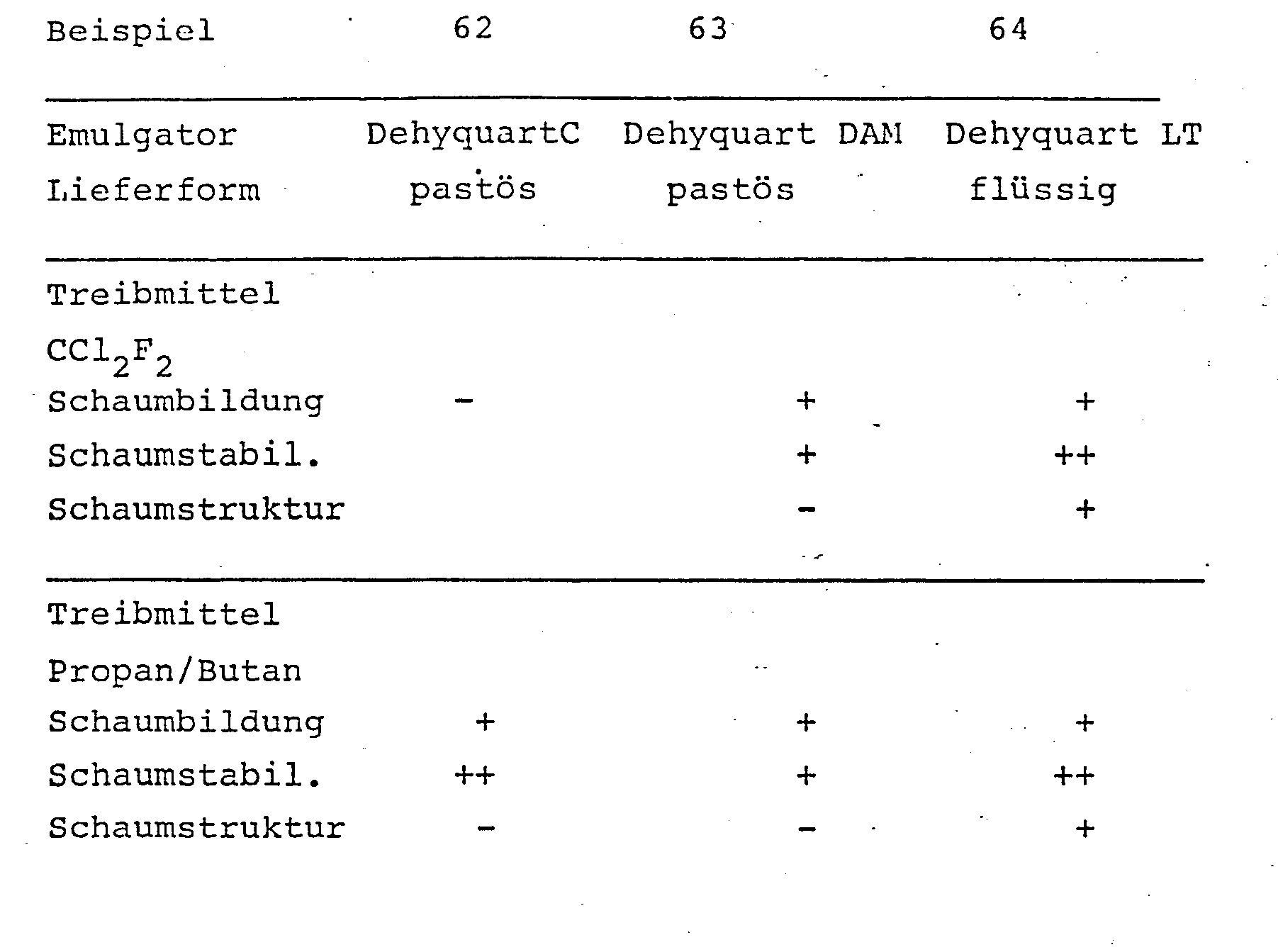
- Folgende Emulgatoren wurden in dem erfindungsgemäßen Verfahren eingesetzt:
- Emulgin 0 2 Oleyl-Cetylalkohol + 2 Mol EO
- Emulgin 0 5 Oleyl-Cetylalkohol + 5 Mol EO
- Elfanol 510 Sulfobernsteinsäuremonoester + Talgfettsäuremonoethanolamid
- Dehyquart C Laurylpyridiniumchlorid
- Dehyquart DAM Distearyldimethylammoniumchlorid
- Dehyquart LT Lauryltrimethylammoniumchlorid.
- Bildete sich bei der Produktentnahme aus der Aerosoldose kein oder nur wenig Schaum, wurde die Schaumbildung mit "-" bewertet, bei befriedigender bis sehr guter Schaumbildung wurde mit "+" bewertet.
- Der Begriff Schaumstabilität kennzeichnet das mögliche Zerfallen des frischen, unausgehärteten Schaumes. Sie ist als die Zeitspanne definiert, innerhalb der kein . merkliches Zerfallen des Schaumes beobachtet werden konnte (d.h. ≦10 % Volumenabnahme).

- Die Schaumstruktur nach Erhärtung und Trocknung des Schaumes (ca. 3 Tage bei 25 + 5°C) wurde visuell beurteilt. Mit "+" wurde eine feinzellige Schaumstruktur, mit "o" eine gröbere und/oder ungleichmässige, mit "-" eine sehr grobzellige und für technische Zwecke unbrauchbare Schaumstruktur gekennzeichnet.
- Die Zusammensetzung der einzelnen Komponenten in den nachfolgenden Tabellen wird in g angegeben.


Claims (21)
Applications Claiming Priority (2)
| Application Number | Priority Date | Filing Date | Title |
|---|---|---|---|
| DE3244523 | 1982-12-02 | ||
| DE19823244523 DE3244523A1 (de) | 1982-12-02 | 1982-12-02 | Verfahren zur herstellung von wasserglasschaumstoffen aus aerosoldosen |
Publications (3)
| Publication Number | Publication Date |
|---|---|
| EP0110328A2 true EP0110328A2 (de) | 1984-06-13 |
| EP0110328A3 EP0110328A3 (en) | 1985-07-10 |
| EP0110328B1 EP0110328B1 (de) | 1987-10-07 |
Family
ID=6179577
Family Applications (1)
| Application Number | Title | Priority Date | Filing Date |
|---|---|---|---|
| EP83111771A Expired EP0110328B1 (de) | 1982-12-02 | 1983-11-24 | Verfahren zur Herstellung von Wasserglasschaumstoffen aus Aerosoldosen |
Country Status (3)
| Country | Link |
|---|---|
| US (1) | US4533490A (de) |
| EP (1) | EP0110328B1 (de) |
| DE (2) | DE3244523A1 (de) |
Cited By (3)
| Publication number | Priority date | Publication date | Assignee | Title |
|---|---|---|---|---|
| WO2014094078A1 (en) * | 2012-12-20 | 2014-06-26 | Albert Fleury | Composition and method for manufacturing a foam, combination of components for composing such a composition, foam and use thereof |
| WO2015097108A1 (de) * | 2013-12-23 | 2015-07-02 | Hüttenes-Albertus Chemische Werke GmbH | Zweikomponenten-system insbesondere zur bildung eines klebemittels |
| WO2016153385A1 (ru) * | 2015-03-26 | 2016-09-29 | Общество С Ограниченной Ответственностью Нпо "Современные Пожарные Технологии" | Вспененный гель кремнезема, способ его применения и получения |
Families Citing this family (9)
| Publication number | Priority date | Publication date | Assignee | Title |
|---|---|---|---|---|
| US4816186A (en) * | 1986-11-03 | 1989-03-28 | Amalgamated Chemical, Inc. | Water based aerosol flame-proofing composition and method of manufacture |
| US5215786A (en) * | 1991-08-20 | 1993-06-01 | Rusmar Incorporated | Composition for providing a foam barrier between a substrate and the atmosphere and the method of use |
| DE10141777A1 (de) | 2001-08-25 | 2003-03-06 | Basf Ag | Elastischer anorganischer Schaum |
| NL1021323C2 (nl) * | 2002-08-23 | 2004-03-08 | Modina B V | Werkwijze voor het bereiden van een schuim op basis van silicaat, schuim verkregen volgens een dergelijke werkwijze alsmede de toepassing hiervan. |
| NL1027015C2 (nl) * | 2004-09-10 | 2006-03-13 | Modina B V | Werkwijze voor het bereiden van een schuim op basis van silicaat, inrichting voor toepassing ervan, spuitbus, en volgens de werkwijze verkregen schuimproduct. |
| KR101600645B1 (ko) | 2008-04-29 | 2016-03-07 | 바스프 에스이 | 탄성 무기-유기 혼성 발포체 |
| RU2543007C2 (ru) | 2009-10-27 | 2015-02-27 | Басф Се | Эластичный неорганическо-огранический гибридный пеноматериал |
| DE102011055188A1 (de) * | 2011-11-09 | 2013-05-16 | Volker Fritz | Wässrige Lösung |
| DE102017011280A1 (de) | 2017-12-07 | 2019-06-13 | Igp Chemie Gmbh | Schaummassen und deren Herstellung |
Family Cites Families (19)
| Publication number | Priority date | Publication date | Assignee | Title |
|---|---|---|---|---|
| US3181737A (en) * | 1963-09-30 | 1965-05-04 | R H Macy & Co Inc | Method of storing, combining and applying two-part polymer mixtures |
| US3341418A (en) * | 1965-03-03 | 1967-09-12 | Gillette Co | Self-heating shaving preparation composition |
| DE1617825C3 (de) * | 1966-03-03 | 1974-11-28 | Hans Schwarzkopf Gmbh, 2000 Hamburg | Vorrichtung zum Mischen und Versprühen einer aus wenigstens zwei flüssigen, pulverförmigen oder pastenförmigen Bestandteilen und einem Treibgas bestehenden Mischung |
| FR1567912A (de) * | 1967-10-09 | 1969-05-23 | ||
| US3839220A (en) * | 1968-10-23 | 1974-10-01 | Mennen Co | Microcapsules for use in pressurized systems |
| CH501567A (de) * | 1969-08-15 | 1971-01-15 | Centrans Gmbh | Verfahren zur Herstellung von porösem Silikat-Hartschaum |
| US3679599A (en) * | 1970-08-03 | 1972-07-25 | Phillips Petroleum Co | Pressurized chamber containing self-curing ingredients |
| US3725095A (en) * | 1971-04-01 | 1973-04-03 | Du Pont | Foamed alkali silicate binder compositions |
| US3741898A (en) * | 1971-07-09 | 1973-06-26 | Southwest Res Inst | Foamed product from sodium silicate and process of manufacture thereof |
| DE2165912A1 (de) * | 1971-12-31 | 1973-07-05 | Bayer Ag | Verfahren zur herstellung von schaumstoffen |
| DE2226640A1 (de) * | 1972-05-31 | 1973-12-13 | Hoermann Kg | Zargen-putzkasten |
| DE2226841A1 (de) * | 1972-06-02 | 1973-12-20 | Bayer Ag | Verfahren zur verschaeumung von silicatloesungen |
| FR2219130A1 (en) * | 1973-02-22 | 1974-09-20 | Retif Claude | Low or high density refractory insulating matl. - from common precursors by expanding or dissolving away part of the mass |
| AU6650174A (en) * | 1973-03-14 | 1975-09-11 | John Thompson | Spraying gels |
| US3951834A (en) * | 1973-10-09 | 1976-04-20 | Owens-Corning Fiberglas Corporation | Foamed products from sodium silicate |
| US3970219A (en) * | 1975-03-03 | 1976-07-20 | Spitzer Joseph G | Aerosol containers for foaming and delivering aerosols and process |
| DE2644780A1 (de) * | 1976-10-04 | 1978-04-06 | Hago Chemie Gmbh & Co | Vorrichtung zur abgabe mindestens zweier fliessfaehiger stoffe in vermischter form aus einem behaelter mittels treibgas und verfahren zum abpacken der stoffe unter verwendung der vorrichtung |
| DE2948778A1 (de) * | 1979-12-04 | 1981-06-11 | Bosch-Siemens Hausgeräte GmbH, 7000 Stuttgart | Thermischer isolierstoff mit einem selbsttragenden anorganischen isolierschaumstoff |
| DE3022389A1 (de) * | 1980-06-14 | 1981-12-24 | Ara-Werk Krämer + Co, 7441 Unterensingen | Aerosoldose o.dgl. zur ausgabe von unter druck stehenden fluessigkeiten |
-
1982
- 1982-12-02 DE DE19823244523 patent/DE3244523A1/de not_active Withdrawn
-
1983
- 1983-07-19 US US06/515,040 patent/US4533490A/en not_active Expired - Fee Related
- 1983-11-24 DE DE8383111771T patent/DE3374000D1/de not_active Expired
- 1983-11-24 EP EP83111771A patent/EP0110328B1/de not_active Expired
Cited By (4)
| Publication number | Priority date | Publication date | Assignee | Title |
|---|---|---|---|---|
| WO2014094078A1 (en) * | 2012-12-20 | 2014-06-26 | Albert Fleury | Composition and method for manufacturing a foam, combination of components for composing such a composition, foam and use thereof |
| BE1021665B1 (nl) * | 2012-12-20 | 2015-12-23 | Fleury, Albert | Samenstelling en werkwijze voor het vervaardigen van een schuim, combinatie van componenten voor het samenstellen van een dergelijke samenstelling, schuim en gebruik daarvan. |
| WO2015097108A1 (de) * | 2013-12-23 | 2015-07-02 | Hüttenes-Albertus Chemische Werke GmbH | Zweikomponenten-system insbesondere zur bildung eines klebemittels |
| WO2016153385A1 (ru) * | 2015-03-26 | 2016-09-29 | Общество С Ограниченной Ответственностью Нпо "Современные Пожарные Технологии" | Вспененный гель кремнезема, способ его применения и получения |
Also Published As
| Publication number | Publication date |
|---|---|
| DE3374000D1 (en) | 1987-11-12 |
| US4533490A (en) | 1985-08-06 |
| EP0110328B1 (de) | 1987-10-07 |
| DE3244523A1 (de) | 1984-06-07 |
| EP0110328A3 (en) | 1985-07-10 |
Similar Documents
| Publication | Publication Date | Title |
|---|---|---|
| EP0110328B1 (de) | Verfahren zur Herstellung von Wasserglasschaumstoffen aus Aerosoldosen | |
| EP0561978A1 (de) | Verfahren zur herstellung von feinporigem schaum aus im wesentlichen anorganischen bestandteilen. | |
| DE4031401A1 (de) | Stabilisatorzusammensetzung fuer chlorhaltige polymere und verfahren zu ihrer herstellung | |
| DE2842582C2 (de) | ||
| DE2323488A1 (de) | Verfahren zur herstellung von schaumoder kompaktstoffen | |
| DE1231895B (de) | Herstellen von schaumfoermigen Polyester-Formteilen | |
| EP0001992A1 (de) | Verschäumbare Magnesiazementmischung, ihre Verwendung und Verfahren zur Herstellung poröser Formkörper | |
| CH653663A5 (de) | Verfahren zur herstellung eines anorganisch-organischen schaumstoffes aus silikaten und poly(meth)acrylsaeuren. | |
| DE1285677B (de) | Formstoffmischung zum Herstellen von Giessformen | |
| EP0231415B1 (de) | Mittel auf der Basis von modifizierten Alkalimetallsilikatlösungen zum Abdichten und/oder Verfestigen und/oder zum Binden | |
| DE3201345C2 (de) | Verfahren zur Herstellung von ungesättigten Polyesterharz-Schäumen und verschäumbare Mischung zur Durchführung des Verfahrens | |
| DE4227536C1 (de) | Nicht brennbarer, Füllstoff enthaltender Hartschaum auf Phenol-Furanharzbasis | |
| DE2856137B2 (de) | Anorganisch-organischer Verbundstoff und Verfahren zu seiner Herstellung | |
| DE2531241C3 (de) | Verfahren zum Herstellen von Schaumstoffen aus Gemischen von bituminösen Massen, Phenolharzen und Treibmitteln | |
| DE2164957A1 (de) | Verfahren zur herstellung von formkoerpern | |
| DE1917012A1 (de) | Phenolharzschaumstoff mit verminderter Schrumpfneigung | |
| DE2153532A1 (de) | Verfahren zur herstellung von formkoerpern | |
| DE3200514A1 (de) | Verfahren zur herstellung von festen silicatschaumstoffen und hierfuer geeignete massen | |
| DE2237460C3 (de) | Verfahren zur Herstellung von porösen Formkörpern aus Kalkmörtel | |
| DE1569490A1 (de) | Verfahren zur Herstellung von Schaumstoffen | |
| DE4212229A1 (de) | Verfahren zur Herstellung von feinporigen Isolierwerkstoffen aus ausschließlich anorganischen Bestandteilen | |
| DE2226841A1 (de) | Verfahren zur verschaeumung von silicatloesungen | |
| AT390051B (de) | Gasbeton-bauteil | |
| DE2246378A1 (de) | Verfahren zur giessung von gasbeton | |
| DE3800584A1 (de) | Nicht brennbarer, fuellstoff enthaltender hartschaum auf phenol-furanharzbasis |
Legal Events
| Date | Code | Title | Description |
|---|---|---|---|
| PUAI | Public reference made under article 153(3) epc to a published international application that has entered the european phase |
Free format text: ORIGINAL CODE: 0009012 |
|
| AK | Designated contracting states |
Designated state(s): AT BE CH DE FR GB IT LI NL |
|
| PUAL | Search report despatched |
Free format text: ORIGINAL CODE: 0009013 |
|
| AK | Designated contracting states |
Designated state(s): AT BE CH DE FR GB IT LI NL |
|
| 17P | Request for examination filed |
Effective date: 19851220 |
|
| 17Q | First examination report despatched |
Effective date: 19861106 |
|
| RBV | Designated contracting states (corrected) |
Designated state(s): DE |
|
| GRAA | (expected) grant |
Free format text: ORIGINAL CODE: 0009210 |
|
| AK | Designated contracting states |
Kind code of ref document: B1 Designated state(s): DE |
|
| REF | Corresponds to: |
Ref document number: 3374000 Country of ref document: DE Date of ref document: 19871112 |
|
| PLBE | No opposition filed within time limit |
Free format text: ORIGINAL CODE: 0009261 |
|
| STAA | Information on the status of an ep patent application or granted ep patent |
Free format text: STATUS: NO OPPOSITION FILED WITHIN TIME LIMIT |
|
| 26N | No opposition filed | ||
| PGFP | Annual fee paid to national office [announced via postgrant information from national office to epo] |
Ref country code: DE Payment date: 19901029 Year of fee payment: 8 |
|
| PG25 | Lapsed in a contracting state [announced via postgrant information from national office to epo] |
Ref country code: DE Effective date: 19920801 |