EP0110532A2 - Imprimante à jet d'encre entraînée par faisceau électronique - Google Patents
Imprimante à jet d'encre entraînée par faisceau électronique Download PDFInfo
- Publication number
- EP0110532A2 EP0110532A2 EP83306263A EP83306263A EP0110532A2 EP 0110532 A2 EP0110532 A2 EP 0110532A2 EP 83306263 A EP83306263 A EP 83306263A EP 83306263 A EP83306263 A EP 83306263A EP 0110532 A2 EP0110532 A2 EP 0110532A2
- Authority
- EP
- European Patent Office
- Prior art keywords
- film
- ink
- print head
- substrate
- window
- Prior art date
- Legal status (The legal status is an assumption and is not a legal conclusion. Google has not performed a legal analysis and makes no representation as to the accuracy of the status listed.)
- Granted
Links
- 238000010894 electron beam technology Methods 0.000 title claims abstract description 38
- 239000010409 thin film Substances 0.000 claims abstract description 37
- 239000010408 film Substances 0.000 claims description 73
- 239000000758 substrate Substances 0.000 claims description 64
- 239000000463 material Substances 0.000 claims description 53
- 238000000034 method Methods 0.000 claims description 35
- 238000005229 chemical vapour deposition Methods 0.000 claims description 16
- 238000000151 deposition Methods 0.000 claims description 13
- 238000005530 etching Methods 0.000 claims description 12
- 238000004519 manufacturing process Methods 0.000 claims description 9
- 238000010438 heat treatment Methods 0.000 claims description 8
- 230000015572 biosynthetic process Effects 0.000 claims description 6
- 229910021420 polycrystalline silicon Inorganic materials 0.000 claims description 6
- 229920005591 polysilicon Polymers 0.000 claims description 6
- 230000004044 response Effects 0.000 claims description 6
- 229910052581 Si3N4 Inorganic materials 0.000 claims description 5
- ZOKXTWBITQBERF-UHFFFAOYSA-N Molybdenum Chemical compound [Mo] ZOKXTWBITQBERF-UHFFFAOYSA-N 0.000 claims description 4
- 239000006096 absorbing agent Substances 0.000 claims description 4
- 239000004020 conductor Substances 0.000 claims description 4
- 229910052750 molybdenum Inorganic materials 0.000 claims description 4
- 239000011733 molybdenum Substances 0.000 claims description 4
- WFKWXMTUELFFGS-UHFFFAOYSA-N tungsten Chemical compound [W] WFKWXMTUELFFGS-UHFFFAOYSA-N 0.000 claims description 4
- 229910052721 tungsten Inorganic materials 0.000 claims description 4
- 239000010937 tungsten Substances 0.000 claims description 4
- 238000004880 explosion Methods 0.000 abstract description 3
- 239000010410 layer Substances 0.000 description 17
- 238000010276 construction Methods 0.000 description 9
- 230000008021 deposition Effects 0.000 description 9
- 230000008569 process Effects 0.000 description 8
- 238000006243 chemical reaction Methods 0.000 description 7
- XUIMIQQOPSSXEZ-UHFFFAOYSA-N Silicon Chemical compound [Si] XUIMIQQOPSSXEZ-UHFFFAOYSA-N 0.000 description 6
- 229910052710 silicon Inorganic materials 0.000 description 6
- 239000010703 silicon Substances 0.000 description 6
- 239000000126 substance Substances 0.000 description 6
- 150000001875 compounds Chemical class 0.000 description 4
- 239000000376 reactant Substances 0.000 description 4
- 125000006850 spacer group Chemical group 0.000 description 4
- 235000012431 wafers Nutrition 0.000 description 4
- -1 SiC Chemical class 0.000 description 3
- 239000011521 glass Substances 0.000 description 3
- 229910052751 metal Inorganic materials 0.000 description 3
- 239000002184 metal Substances 0.000 description 3
- 230000035515 penetration Effects 0.000 description 3
- 239000004033 plastic Substances 0.000 description 3
- 229920003023 plastic Polymers 0.000 description 3
- 239000004593 Epoxy Substances 0.000 description 2
- OAKJQQAXSVQMHS-UHFFFAOYSA-N Hydrazine Chemical compound NN OAKJQQAXSVQMHS-UHFFFAOYSA-N 0.000 description 2
- PXHVJJICTQNCMI-UHFFFAOYSA-N Nickel Chemical compound [Ni] PXHVJJICTQNCMI-UHFFFAOYSA-N 0.000 description 2
- KWYUFKZDYYNOTN-UHFFFAOYSA-M Potassium hydroxide Chemical compound [OH-].[K+] KWYUFKZDYYNOTN-UHFFFAOYSA-M 0.000 description 2
- 239000004411 aluminium Substances 0.000 description 2
- 229910052782 aluminium Inorganic materials 0.000 description 2
- XAGFODPZIPBFFR-UHFFFAOYSA-N aluminium Chemical compound [Al] XAGFODPZIPBFFR-UHFFFAOYSA-N 0.000 description 2
- 238000001505 atmospheric-pressure chemical vapour deposition Methods 0.000 description 2
- 230000004888 barrier function Effects 0.000 description 2
- 230000006378 damage Effects 0.000 description 2
- 238000000354 decomposition reaction Methods 0.000 description 2
- 238000005137 deposition process Methods 0.000 description 2
- 239000012776 electronic material Substances 0.000 description 2
- PCHJSUWPFVWCPO-UHFFFAOYSA-N gold Chemical compound [Au] PCHJSUWPFVWCPO-UHFFFAOYSA-N 0.000 description 2
- 239000010931 gold Substances 0.000 description 2
- 229910052737 gold Inorganic materials 0.000 description 2
- 238000007641 inkjet printing Methods 0.000 description 2
- 238000004518 low pressure chemical vapour deposition Methods 0.000 description 2
- 230000007246 mechanism Effects 0.000 description 2
- 150000002739 metals Chemical class 0.000 description 2
- 239000000203 mixture Substances 0.000 description 2
- 238000001020 plasma etching Methods 0.000 description 2
- 238000007639 printing Methods 0.000 description 2
- 238000000926 separation method Methods 0.000 description 2
- 238000005476 soldering Methods 0.000 description 2
- RZVAJINKPMORJF-UHFFFAOYSA-N Acetaminophen Chemical compound CC(=O)NC1=CC=C(O)C=C1 RZVAJINKPMORJF-UHFFFAOYSA-N 0.000 description 1
- OKTJSMMVPCPJKN-UHFFFAOYSA-N Carbon Chemical compound [C] OKTJSMMVPCPJKN-UHFFFAOYSA-N 0.000 description 1
- VYZAMTAEIAYCRO-UHFFFAOYSA-N Chromium Chemical compound [Cr] VYZAMTAEIAYCRO-UHFFFAOYSA-N 0.000 description 1
- RYGMFSIKBFXOCR-UHFFFAOYSA-N Copper Chemical compound [Cu] RYGMFSIKBFXOCR-UHFFFAOYSA-N 0.000 description 1
- PIICEJLVQHRZGT-UHFFFAOYSA-N Ethylenediamine Chemical compound NCCN PIICEJLVQHRZGT-UHFFFAOYSA-N 0.000 description 1
- 229910005091 Si3N Inorganic materials 0.000 description 1
- 229910003910 SiCl4 Inorganic materials 0.000 description 1
- RTAQQCXQSZGOHL-UHFFFAOYSA-N Titanium Chemical compound [Ti] RTAQQCXQSZGOHL-UHFFFAOYSA-N 0.000 description 1
- 238000010521 absorption reaction Methods 0.000 description 1
- 238000013459 approach Methods 0.000 description 1
- 238000000429 assembly Methods 0.000 description 1
- 230000000712 assembly Effects 0.000 description 1
- 239000011324 bead Substances 0.000 description 1
- 230000008901 benefit Effects 0.000 description 1
- 229910052799 carbon Inorganic materials 0.000 description 1
- BGTFCAQCKWKTRL-YDEUACAXSA-N chembl1095986 Chemical compound C1[C@@H](N)[C@@H](O)[C@H](C)O[C@H]1O[C@@H]([C@H]1C(N[C@H](C2=CC(O)=CC(O[C@@H]3[C@H]([C@@H](O)[C@H](O)[C@@H](CO)O3)O)=C2C=2C(O)=CC=C(C=2)[C@@H](NC(=O)[C@@H]2NC(=O)[C@@H]3C=4C=C(C(=C(O)C=4)C)OC=4C(O)=CC=C(C=4)[C@@H](N)C(=O)N[C@@H](C(=O)N3)[C@H](O)C=3C=CC(O4)=CC=3)C(=O)N1)C(O)=O)=O)C(C=C1)=CC=C1OC1=C(O[C@@H]3[C@H]([C@H](O)[C@@H](O)[C@H](CO[C@@H]5[C@H]([C@@H](O)[C@H](O)[C@@H](C)O5)O)O3)O[C@@H]3[C@H]([C@@H](O)[C@H](O)[C@@H](CO)O3)O[C@@H]3[C@H]([C@H](O)[C@@H](CO)O3)O)C4=CC2=C1 BGTFCAQCKWKTRL-YDEUACAXSA-N 0.000 description 1
- 239000011248 coating agent Substances 0.000 description 1
- 238000000576 coating method Methods 0.000 description 1
- 230000006835 compression Effects 0.000 description 1
- 238000007906 compression Methods 0.000 description 1
- 229910052802 copper Inorganic materials 0.000 description 1
- 239000010949 copper Substances 0.000 description 1
- 239000002178 crystalline material Substances 0.000 description 1
- 230000001419 dependent effect Effects 0.000 description 1
- 230000000694 effects Effects 0.000 description 1
- 239000005357 flat glass Substances 0.000 description 1
- 239000012530 fluid Substances 0.000 description 1
- 239000011888 foil Substances 0.000 description 1
- 239000003574 free electron Substances 0.000 description 1
- 239000007789 gas Substances 0.000 description 1
- 229910052739 hydrogen Inorganic materials 0.000 description 1
- 239000001257 hydrogen Substances 0.000 description 1
- 125000004435 hydrogen atom Chemical class [H]* 0.000 description 1
- 239000007788 liquid Substances 0.000 description 1
- 238000001465 metallisation Methods 0.000 description 1
- 229910021421 monocrystalline silicon Inorganic materials 0.000 description 1
- 229910052759 nickel Inorganic materials 0.000 description 1
- 230000000704 physical effect Effects 0.000 description 1
- 238000005240 physical vapour deposition Methods 0.000 description 1
- 239000002574 poison Substances 0.000 description 1
- 231100000614 poison Toxicity 0.000 description 1
- 238000002360 preparation method Methods 0.000 description 1
- 238000012545 processing Methods 0.000 description 1
- 239000011241 protective layer Substances 0.000 description 1
- 239000005297 pyrex Substances 0.000 description 1
- 230000000717 retained effect Effects 0.000 description 1
- 238000012552 review Methods 0.000 description 1
- 238000004904 shortening Methods 0.000 description 1
- FDNAPBUWERUEDA-UHFFFAOYSA-N silicon tetrachloride Chemical compound Cl[Si](Cl)(Cl)Cl FDNAPBUWERUEDA-UHFFFAOYSA-N 0.000 description 1
- 239000010421 standard material Substances 0.000 description 1
- 239000010936 titanium Substances 0.000 description 1
- 229910052719 titanium Inorganic materials 0.000 description 1
- 238000012546 transfer Methods 0.000 description 1
- 230000008016 vaporization Effects 0.000 description 1
- XLYOFNOQVPJJNP-UHFFFAOYSA-N water Substances O XLYOFNOQVPJJNP-UHFFFAOYSA-N 0.000 description 1
Images




Classifications
-
- B—PERFORMING OPERATIONS; TRANSPORTING
- B41—PRINTING; LINING MACHINES; TYPEWRITERS; STAMPS
- B41J—TYPEWRITERS; SELECTIVE PRINTING MECHANISMS, i.e. MECHANISMS PRINTING OTHERWISE THAN FROM A FORME; CORRECTION OF TYPOGRAPHICAL ERRORS
- B41J2/00—Typewriters or selective printing mechanisms characterised by the printing or marking process for which they are designed
- B41J2/005—Typewriters or selective printing mechanisms characterised by the printing or marking process for which they are designed characterised by bringing liquid or particles selectively into contact with a printing material
- B41J2/01—Ink jet
- B41J2/135—Nozzles
- B41J2/14—Structure thereof only for on-demand ink jet heads
- B41J2/14016—Structure of bubble jet print heads
- B41J2/14088—Structure of heating means
- B41J2/14104—Laser or electron beam heating the ink
-
- B—PERFORMING OPERATIONS; TRANSPORTING
- B41—PRINTING; LINING MACHINES; TYPEWRITERS; STAMPS
- B41J—TYPEWRITERS; SELECTIVE PRINTING MECHANISMS, i.e. MECHANISMS PRINTING OTHERWISE THAN FROM A FORME; CORRECTION OF TYPOGRAPHICAL ERRORS
- B41J2/00—Typewriters or selective printing mechanisms characterised by the printing or marking process for which they are designed
- B41J2/005—Typewriters or selective printing mechanisms characterised by the printing or marking process for which they are designed characterised by bringing liquid or particles selectively into contact with a printing material
- B41J2/01—Ink jet
- B41J2/135—Nozzles
- B41J2/14—Structure thereof only for on-demand ink jet heads
- B41J2002/14387—Front shooter
Definitions
- This invention relates to a new and improved printing device capable of very high speed, but yet which is inexpensive to produce.
- it concerns the use of an electron beam as the source of thermal energy for the driver in a thermal ink jet printer; and a new and improved electron window which can withstand high pressures, thereby making such writing possible at the high temperatures and pressures necessary in thermal ink jet printing.
- CTR cathode ray tube
- a major constraint on the window is that it be able to withstand large pressure differences from one side to the other, while at the same time not causing significant scattering of the beam.
- Such a constraint is very restrictive. It generally means that the window must be quite small and quite thin, small in order to be adequately supported to withstand significant pressure differences and thin to avoid beam scattering.
- U.S. Patent No. 3,211,937 discloses a carbon coated foil window which can withstand high pressure differences but its use is limited to high energy situations, i.e., electron energies of the order of 5 MeV to avoid significant absorption or scattering.
- U.S. Patent No. 3,788,892 discloses a method of making a compound window, i.e., a window array made up of a number of smaller windows, each being quite thin and small, thereby achieving adequate supporting structure to withstand large pressure differences.
- the window is unsuitable for many applications because of the intervening supporting structures between individual windows.
- the window disclosed in U.S. Patent No. 3,611,418, in order to withstand large pressure differences while being large in size must be backed up by a suitable supporting member having a series of slits or perforations, or a mesh-like form. Again these intervening supporting structures tend to interfere with numerous applications.
- none of the above windows is desirable for use in the hostile environment of a thermal ink jet.
- This window has the advantage of being long and narrow without intervening supporting structures. It is generally fabricated by growing a- thin film by chemical reaction with the bulk supporting member, and then differentially etching the bulk supporting member to leave the window portion, that portion of the bulk supporting member which is retained forming a sturdy mounting or frame for the window.
- forming such a film by chemical reaction with the bulk supporting member usually means that the thin film is formed by pyrolytic decomposition of a reactant gas (e.g., H 2 0) into its component species, followed by reaction of these active species with whatever is nearby (e.g., a Si substrate) to grow a film of new material (e.g., Si0 2 ) on top of the substrate.
- a reactant gas e.g., H 2 0
- Such a process for forming a thin film has a number of inherent disadvantages.
- the thickness of the window formed in this way is extremely limited because one of the reactants must diffuse through the newly formed layer.
- the thicker the window the longer it takes to grow, the time varying approximately exponentially with film thickness.
- the internal stress in the film cannot be controlled independently of the thickness, so that the thicker the film, the higher the stress.
- a film of Si0 2 such as that disclosed by U.S. Patent No. 3,815,094 could be made with a thickness much in excess of 1 micron by this process, because the magnitude of the internal stress would be very high, perhaps high enough to crack the film.
- the ink heating mechanism is quickly heated, transferring a significant amount of energy to the ink, thereby vaporizing a small portion of the ink and producing a bubble in the capillary.
- This in turn creates a pressure wave which propels an ink droplet or droplets from the orifice onto a nearby writing surface.
- the bubble quickly collapses before it can escape from the orifice.
- this bubble collapse can cause quick destruction of the resistor through cavitation damage if appropriate precautions are not taken.
- these precautions include coating the resistor with a protective layer, carefully controlling the bubble collapse, or mounting the resistor on an unsupported portion of a strong thin film which will permit flexure, the film being between the resistor and the ink.
- the present invention provides a print head of the thermal ink jet type which is activated by an electron beam comprising an ink reservoir for containing ink, and orifice means for permitting ejection of ink droplets from said reservoir in response to said bubble formation, and characterized by a film of electron permeable material in close proximity to said ink reservoir, and absorber means attached to said film and arranged to be in thermal contact with said ink, for absorbing electrons from said electron beam which pass through said film, and for converting the kinetic energy of electrons so absorbed to thermal energy for heating said ink to form a bubble therein.
- the present invention further provides a print head of the thermal ink jet type which is activated by an electron beam comprising an.ink reservoir having an inner surface for containing ink, and orifice means for permitting ejection of ink droplets from said reservoir in response to said bubble formation, and characterized by a film of electron permeable material in contact with said ink, said film having a thickness such that electrons from.said electron beam penetrate said film and are absorbed in said ink to create a bubble therein.
- the present invention further provides a print head of the thermal ink jet type which is activated by an electron beam comprising an ink reservoir having an inner surface for containing ink, and orifice means for permitting ejection of ink droplets from said reservoir in response to said bubble formation, and characterized by a film in contact with said ink for absorbing electrons from said electron beam and for converting the kinetic energy of said electrons to thermal energy for quickly heating said ink to form a bubble therein.
- the present invention further provides a print head as set forth in any one of the last three immediately preceding paragraphs in combination with a CRT having an electron gun for generating electrons and for providing kinetic energy to said electrons to form an electron beam, a tube body housing said electron gun, and characterized by first means located in close proximity to said film for permitting the exit of electrons in said electron beam from said tube body.
- said film is formed by chemical vapor deposition onto ⁇ -substrate of a material different from said film.
- said substrate has an electron window formed therein by etching completely through said substrate but not through said film.
- said electron window has a length much greater than its width.
- said substrate has a plurality of said electron windows.
- said substrate comprises a support layer and a heat control layer.
- said heat control layer is located between said thin film and said support layer.
- said film comprises a material selected from SiC, Si 3 N 4 , BN, B 4 C and A1 4 C 3 .
- said film comprises a layer of SiC having a thickness in the range of 1 micron to 5 microns.
- said absorber means comprises at least one small area of electrically conductive material.
- said film has a substantially flat surface which forms a portion of said inner surface of said reservoir.
- said orifice means comprises a surface which is spaced apart from said thin film and defines another portion of said inner surface of said ink reservoir, said surface of said orifice means having a portion thereof which is substantially flat.
- said orifice means has at least one hole in said portion thereof which is substanially flat.
- the present invention further provides a method of making an electron beam window on a surface having a slot therein, the method comprising the steps of selecting a first material as a substrate, depositing a film of a second material which is permeable to electrons at the electron beam energy of interest, attaching said film and said substrate to said surface and covering said slot with said film, said film being adjacent to said first substrate, and etching away said substrate to leave said film attached to said surface in a manner covering said slot.
- said second material is selected from SiC, BN, B 4 C, Si 3 N 4 and A14 C 3.
- said second material is deposited by chemical vapor deposition on said substrate.
- the step of attaching said film is performed by anodic bonding.
- said substrate comprises a polycrystalline material.
- said polycrystalline material is selected from tungsten, molybdenum and polysilicon.
- a new type of thermal ink jet print head which is driven by an electron beam.
- the print head is constructed of an electron permeable thin film (electron window) which in one embodiment, has on one of its surfaces a plurality of electron absorbing (heater) pads that are in thermal contact with an ink reservoir.
- electron window electron permeable thin film
- the electrons traverse the window and are absorbed in the ink rather than in pads, and in another embodiment the electrons are absorbed directly in the window itself.
- a particularly important element of the invention is the construction of the electron window.
- a method of making the electron window is to deposit a thin film of an inert, high strength material or compound comprising elements having a low atomic number onto a substrate by chemical vapor deposition (CVD). Following that deposition, a window pattern and window support perimeter are photolithographically defined and the substrate is etched to leave the desired window structure.
- CVD chemical vapor deposition
- this method of window construction lies in the fact that the films formed by CVD can be carefully controlled as to their stoichiometry and as to their internal stress (both sign and magnitude) during the deposition process.
- the substrate provides only physical support and does not participate in the chemical reaction, the choice of compound is not restricted by the substrate material.
- thin films of compounds such as SiC, BN, B4C, S i3 N 4 and A1 4 C 3 can be formed on a variety of substrates to provide films which are exceedingly tough and pinhole free, and which exhibit nearly zero internal stress. Furthermore, due to their extreme strength, these materials allow fabrication of extremely thin windows.
- FIGS 1A to 1F depict one embodiment of a method of constructing a long thin electron beam window.
- the process is begun by depositing a film 11, which is to provide the electron beam window, onto a substrate 13 which is a clean Si wafer having a ⁇ 100> orientation, the deposition being accomplished by CVD.
- CVD chemical Vapor Deposition
- Typical materials for the film 11 include SiC, BN, Si 3 N 4 , A1 4 C 3 , or B 4 C, while typical thicknesses T for the film 11 range from about 0.5 micron up to about 5 microns, with a preferred range of about 1 micron up to about 2 microns. Stress in the film 11 is usually maintained below about 2X10 9 dynes/cm 2 .
- window assembly 15 and 16 as illustrated in Figure 1C provides a more detailed picture of the window assembly 15 showing a long narrow window 17 approximately in the middle of the assembly where the substrate 13 has been etched away.
- Typical window assembly dimension L ranges from about 1 inch (2.5cm) to about 3 inches (7.6cm) a width D typically on the order of 0.375 inches (9.5mm).
- Figure 1D shows a cross-sectional view of the window assembly 15, illustrating the relationship among the various elements of the window assembly.
- Typical window widths W range from 0 in. (Ocm) to 0.100 in.(0.254cm), with a preferred width of about 0.015 in. (0.4mm).
- a typical thickness S for the silicon substrate 13 is of the order of 0.020 in. (0.5mm)
- a CRT faceplate 19 is prepared, typically of pyrex 7740 plate glass, in order to match the thermal expansion coefficient of the Si.
- a slot 21 (see Figure lE) having a width on the order of 0.125 in. (.317cm) is cut into the faceplate 19, and the face plate is polished flat to within 10 microns or more preferably to within 3 microns.
- the window 17 of the window assembly 15 is then carefully aligned with the slot 21 of the faceplate 19, and field assisted bonding (i.e., anodic bonding) is then used to bond the window assembly to the faceplate ( Figure IF).
- the faceplate 19 is joined to an electron gun/funnel assembly 23 and the system is pumped out and sealed according to customary procedures.
- CVD can also be used to grow films independently of substrate composition. This lends great flexibility in choosing the optimum combination of substrate and window materials, and permits manufacture of much longer electron windows.
- polycrystalline substrate materials appear to be particularly useful, as long as they are chosen appropriately, i.e., provided that their thermal expansion coefficient closely matches that of the window film, they can withstand the deposition temperatures (up to about 1200 degrees centigrade), they are amenable to further processing such as etching, they can be bonded easily to tube components, and they are sufficiently rigid for handling ease.
- Some examples of such materials are tungsten, molybdenum, and polysilicon.
- LPCVD low pressure CVD
- typical reaction tube temperatures range from 250 degrees C to 1000 degrees C, with flow rates usually in the range of 100-600 scc/min. (i.e., standard cc/min.), 0.05-0.10 for the ratio B 2 H 6/ H 2 , and 0.25-5 for the ratio B 2 H 6 /NH 3 .
- FIG. 2 shows an embodiment of a typical long narrow window assembly 35 formed using a polycrystalline substrate 33.
- a portion of substrate 33 is etched away, e.g., by wet chemical, plasma, reactive ion, or other methods leaving a narrow portion of film 31 to define a window 37.
- the window assembly 35 can then be bonded to a face 39 of a CRT structure 43 by suitable clean techniques, of course being careful to align the window 37 with a slot 41 in the CRT.
- the bonding techniques can vary somewhat.
- the window assembly can be anodically bonded to the face, using an additional aluminium layer to enhance bonding if necessary.
- the polysilicon substrate 33 is to be placed next to the face 39 with the film 31 to the outside, not only can anodic bonding be used, but a clean soldering technique may be used as well.
- an adhesion layer of titanium is evaporated onto the substrate 33 followed by a layer of gold, after which the substrate is soldered to the faceplate.
- a substrate of a different material may require slightly different bonding techniques. For example, for molybdenum or tungsten substrates, it is typical to evaporate an adhesion layer of nickel followed by a layer of copper before soldering the substrate to the CRT faceplate.
- a similar embodiment is to deposit a suitable film (e.g., SiC) onto a polycrystalline substrate to make a sandwich structure as described above. Then, the sandwich structure is bonded to a CRT faceplate by the techniques described above with the film next to the faceplate, the CRT faceplate having a narrow slit such as the slit 41 in Figure 2A. Following that bonding, the polycrystalline substrate can be completely etched away, leaving only the thin film bonded to the CRT faceplate. This provides an electron window in the CRT faceplate and relieves the requirement for precision etching of the slot in the window support substrate, a process which is more difficult to accomplish.
- a suitable film e.g., SiC
- All of the above embodiments can be used to write on paper or other recording media directly, either in the ambient atmosphere or in a controlled vacuum environment to avoid ionization effects in the air.
- another particularly important use of an electron window formed by CVD is in the area of electron beam driven thermal ink jet printers.
- a thermal ink jet print head 50 is attached to a faceplate 69 of a CRT 63, by methods similar to those described earlier when fastening an electron window assembly to a CRT faceplate.
- the print head 50 has a significantly different construction from that of prior art thermal ink jet devices.
- the concept of the construction of the print head 50 centers around the use of the electron beam to supply the thermal energy required to activate the ink et head.
- First a long narrow window assembly is constructed much as previously described.
- the window assembly is made by using CVD to deposit a thin film 51 of window material onto a substrate 53. A portion of the substrate 53 is etched away leaving a long narrow channel 62 (which closely resembles the channel shown in Figure 2A which there the exposed thin film window 37).
- FIG. 3B and 3C Shown in Figures 3B and 3C is a cross-section of one end of the print head 50 illustrating details of its internal construction.
- the head is made up of an orifice plate 57 and spacers 55, 58, and 59 configured in a manner to create an ink reservoir 64.
- the window assembly is made up of the substrate 53 and the thin film 51, with the thin film 51 located on the side of the reservoir which is next to the CRT faceplate.
- Located on the thin film 51 immediately opposite the channel 62 are a plurality of heater pads 60 which are thin film metalizations for absorbing electrons from the electron beam.
- the orifice plate 57 has a plurality of orifices 56 which are located substantially opposite an equal number of heater pads. These heater pads are located on the thin film 51 immediately opposite the channel 62 and are typically made up of a thin layer of conductor. Thus, the heater pads readily absorb electrons incident from the beam, thereby providing the thermal energy needed to drive the thermal ink jet.
- the specific composition of materials, and the specific dimensions of the various components making up the ink jet head varies considerably depending on the desired application.
- the basic physical constraints in this particular embodiment are that the electron window formed by the channel 62 and the thin film 51 be thin enough to transmit enough electrons at a particular CRT voltage onto each heater pad to create bubbles of sufficient size to eject droplets of ink, while at the same time the window must be sufficiently strong to withstand the pressures created by the expanding and collapsing bubbles.
- the typical dimensions and materials used in resistor driven thermal ink jet systems are substantially the same as those in the electron beam driven ink jet head in order to meet the physical requirements for production of high quality printing.
- the substrate 53 and thin film 51 combination for making the electron window portion can be constructed of the same materials and in the same manner as described earlier with regard to Figures 1 and 2.
- the thickness of the substrate 53 is not critical and can vary over a wide range. Usually no upper limit on its thickness is required other than what can reasonably be made. As to a lower limit, that is determined by ease of handling during window construction and by physical parameters pertaining to the supports required to back up the electron window assembly. Typical thicknesses for a polysilicon substrate 53 range from about 250 microns upward when used with a SiC thin film 51. The thickness of the thin film 51 varies depending on electron beam energy.
- the thickness of thin film 51 is typically in the range of 1 to 5 microns when the window has a narrow dimension S of the order of 2 to 5 mils (.05 to .127mm).
- the heater pads 60 are usually constructed by customary electronic fabrication techniques such as physical or chemical vapor deposition. Standard materials for the heater pads 60 are good conductors, such as chrome/gold or aluminium, which are generally formed into square pads ranging from about 3 mils X 3 mils (.076mm x .076mm) to 5 mils X 5 mils (.127mm x .127mm) and approximately 0.25 to 5 microns thick.
- the spacers 55, 58, and 59 maintain a separation between thin film 51 and the orifice plate 57, thereby providing a capillary channel 64 for ink to flow from an inlet pipe 65 throughout the head and to the vicinity of the heater pads.
- the spacers 55, 58, and 59 typically provide a separation of approximately 1.5 to 3 mils (.038mm to .076mm), and can be constructed of almost any inert material which can be readily formed or shaped on the surface of the thin film 51. Good examples are selected plastics materials, glass, or Riston (registered trademark of Dupont), since it is photoetchable.
- the orifice plate 57 can also be constructed of a wide variety of materials.
- a silicon wafer approximately 20 mils (0.5mm) thick of ⁇ 100> orientation is particularly convenient since very precise orifices 56 can be easily etched into the structure. (See U.S. patent No. 4,007,464).
- other materials are more practical; for example, a piece of metal or even plastics material with a thickness at the orifice in the range of 0.5 to 5 mils (.013mm to 0.13mm). Orifice sizes too can vary significantly depending on the desired drop size.
- orifices of about 4 to 16 square mils (2.58 x 10- 3 to 10.3 x 10- 3 mm 2 ) have acceptable performance, with the preferred size being about 9 square mils (5.81 x 10- 3 mm 2 ). It should be apparent, however, that the beam current could be increased substantially while shortening exposure times to achieve higher speed.
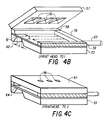
- FIG. 4A, 4B, and 4C Another embodiment of a thermal ink jet device according to the invention is shown in Figures 4A, 4B, and 4C.
- the electrons are absorbed directly in the ink, rather than in heater pads.
- This approach achieves a much higher energy efficiency in creating bubbles, since the energy is absorbed in the ink itself, rather than in a heater pad which not only has a heat capacity itself but is also in intimate contact with a large heat reservoir, i.e., the electron window.
- the basic structure includes the CRT 63 and a print head 70 which is identical to the print head 50 of the previous, embodiment with the exception that the heater pads 60 have been omitted.
- the various dimensions of the previous embodiment are suitable, including the thickness of the thin film 51, which is typically in the range of 1 to 5 microns when using a 20 to 30kV beam.
- the basic principle is that for these low beam energies, the electrons are absorbed in the ink substantially at the surface of the window, since the penetration depth for 30kV electrons in a fluid such as water-based ink is only about 20 microns or less. With the enhanced energy efficiency, the energy requirement per ejected droplet can be substantially reduced, perhaps to as low as 0.5 microjoules/droplet.
- An alternative embodiment can also be depicted by Figures 4A, 4B, and 4C. In this alternative embodiment, the electrons are absorbed in the window itself.
- FIG. 5A, 5B, 5C, and 5D Shown in Figures 5A, 5B, 5C, and 5D is yet another embodiment according to the invention of an electron beam riven
- the general concept is similar to that described in Figures 3A, 3B, and 3C, except that the electron window is not formed by etching a channel in the substrate material but instead is formed by etching a plurality of holes, each hole terminating at an electron window located immediately opposite a heating pad.
- the process typically begins by depositing a heat control layer 86 onto a substrate 85, the substrate again being made up of any of the substrate materials described in the previous embodiments and with substantially the same dimensional constraints.
- Typical materials for the heat control layer 86 are well known in the art and include, among others, Si0 2 and A1 2 0 3 , with typical thicknesses in the range of 1 to 10 microns, but generally varying depending on the particular material used and desired bubble collapse characteristics. (It should be noted that the heat control layer is not meant to be restricted to this particular window arrangement, but can be used as well with other window geometries, e.g., the slot geometry above.) Following deposition of the control layer 86, a thin film 87 of electron window material is deposited thereon. Typical window materials and thicknesses are as described in previous embodiments.
- a plurality of holes such as 81, 82, and 83 are etched through the substrate 85 and the heat control layer 86, leaving electron windows such as 91, 92, and 93, respectively, each window being typically in the range of 1 to 2 microns in diameter.
- Any number of etching techniques can be used depending on the particular combination of materials and hole geometry desired, for example, wet chemical or dry systems such as plasma etching might be used for isotropic etching. Even biased plasma etching, although slow, might be used for anisotropic etching for accurate control of hole size and configuration.
- a plurality of heater pads represented by elements 101, 102, and 103 are deposited opposite electron windows 91, 92, and 93, respectively, each pad being constructed of the same materials and having the same dimensions as in previous embodiments.
- Spacers 88 and 89 are provided to separate the thin film 87 from an orifice plate 90, thus forming a cavity for holding ink.
- an ink fill tube 84 for permitting ink to enter the cavity.
- the orifice plate 90 has a plurality of orifices, as represented by orifice 91, which are recessed in a trough 95 so that the orifice plate can be quite thick over a large region.
- This geometry provides good structural stability for large print heads, while at the same time permiting an optimum thickness for the orifice plate at the orifices in order to promote good droplet definition.
- the thickness of the orifice plate measured from inside the reservoir to the outside edge of an orifice ranges from about 2 mils to about 5 mils (.050 to .127mm).
- the orifice plate 95 can be constructed of a variety of materials, including but not limited to glass, silicon, polysilicon, selected plastics materials, and various metals.
- Shown in Figure 5B is a view of a portion of the thin film 87 illustrating the relationship of the heater pads 101, 102, and 103. Each of these heater pads lies along the trough 95 immediately opposite an orifice.
- a barrier such as 105 and 106 is provided between successive heater pads to keep pressure waves generated by one heater pad from affecting the ejection of ink from orifices that correspond to other heater pads.
- Such barriers are generally made up of silicon, photopolymer, glass bead-filled epoxy, or metals.
- the entire assembly can be attached to the face of a CRT 107 by the techniques previously described. Electrons for driving the print head are then provided by an electron gun assembly 108.
- an embodiment that may be particularly advantageous would be to construct a two-part system.
- One part would be a CRT with an electron window much as described in Figure 2A.
- the second part would then be a completely separate thermal ink jet assembly having its own electron window structure which would be placed in juxtaposition with the CRT window. Electrons from the CRT could then pass through the CRT window and through the thermal ink jet window to a heater pad within the thermal ink jet. In this way one could use the electron beam to drive the thermal ink jet without requiring that the CRT and the ink jet head to be an integral unit.
- the thermal ink jet or the CRT could be easily replaced.
Landscapes
- Physics & Mathematics (AREA)
- Optics & Photonics (AREA)
- Particle Formation And Scattering Control In Inkjet Printers (AREA)
Applications Claiming Priority (2)
| Application Number | Priority Date | Filing Date | Title |
|---|---|---|---|
| US443710 | 1982-11-22 | ||
| US06/443,710 US4455561A (en) | 1982-11-22 | 1982-11-22 | Electron beam driven ink jet printer |
Publications (3)
| Publication Number | Publication Date |
|---|---|
| EP0110532A2 true EP0110532A2 (fr) | 1984-06-13 |
| EP0110532A3 EP0110532A3 (en) | 1984-11-28 |
| EP0110532B1 EP0110532B1 (fr) | 1987-08-19 |
Family
ID=23761883
Family Applications (1)
| Application Number | Title | Priority Date | Filing Date |
|---|---|---|---|
| EP83306263A Expired EP0110532B1 (fr) | 1982-11-22 | 1983-10-14 | Imprimante à jet d'encre entraînée par faisceau électronique |
Country Status (4)
| Country | Link |
|---|---|
| US (1) | US4455561A (fr) |
| EP (1) | EP0110532B1 (fr) |
| JP (1) | JPS59155053A (fr) |
| DE (1) | DE3373068D1 (fr) |
Cited By (2)
| Publication number | Priority date | Publication date | Assignee | Title |
|---|---|---|---|---|
| EP0197723A3 (en) * | 1985-04-03 | 1988-06-08 | Xerox Corporation | Thermal ink jet printhead and process therefor |
| EP0871972A4 (fr) * | 1995-01-05 | 2000-03-01 | American Int Tech | Dispositif a faisceau d'electrons dote d'une fenetre en monocristal et d'une anode adaptee |
Families Citing this family (15)
| Publication number | Priority date | Publication date | Assignee | Title |
|---|---|---|---|---|
| USRE32572E (en) * | 1985-04-03 | 1988-01-05 | Xerox Corporation | Thermal ink jet printhead and process therefor |
| US4765864A (en) * | 1987-07-15 | 1988-08-23 | Sri International | Etching method for producing an electrochemical cell in a crystalline substrate |
| US5235239A (en) * | 1990-04-17 | 1993-08-10 | Science Research Laboratory, Inc. | Window construction for a particle accelerator |
| US5285131A (en) * | 1990-12-03 | 1994-02-08 | University Of California - Berkeley | Vacuum-sealed silicon incandescent light |
| US5493177A (en) * | 1990-12-03 | 1996-02-20 | The Regents Of The University Of California | Sealed micromachined vacuum and gas filled devices |
| JPH1134331A (ja) * | 1994-04-18 | 1999-02-09 | Beam Soken:Kk | レーザー印刷方式 |
| US5557163A (en) * | 1994-07-22 | 1996-09-17 | American International Technologies, Inc. | Multiple window electron gun providing redundant scan paths for an electron beam |
| US5898261A (en) * | 1996-01-31 | 1999-04-27 | The United States Of America As Represented By The Secretary Of The Air Force | Fluid-cooled particle-beam transmission window |
| JP3649743B2 (ja) | 1996-06-12 | 2005-05-18 | ウシオ電機株式会社 | 陽極の窓領域が薄いモノリシックシリコン膜により形成される化学線源 |
| US7334871B2 (en) * | 2004-03-26 | 2008-02-26 | Hewlett-Packard Development Company, L.P. | Fluid-ejection device and methods of forming same |
| US7387370B2 (en) * | 2004-04-29 | 2008-06-17 | Hewlett-Packard Development Company, L.P. | Microfluidic architecture |
| US7293359B2 (en) * | 2004-04-29 | 2007-11-13 | Hewlett-Packard Development Company, L.P. | Method for manufacturing a fluid ejection device |
| DE102005028930A1 (de) * | 2005-06-22 | 2007-01-04 | Technische Universität München | Vorrichtung für die Spektroskopie mit geladenen Analyten |
| US7268315B2 (en) * | 2005-07-13 | 2007-09-11 | Hewlett-Packard Development Company, L.P. | Monitoring slot formation in substrates |
| US20080036810A1 (en) * | 2006-06-29 | 2008-02-14 | Dixon Michael J | Printing Processes Such as for Uniform Deposition of Materials and Surface Roughness Control |
Family Cites Families (8)
| Publication number | Priority date | Publication date | Assignee | Title |
|---|---|---|---|---|
| US3211937A (en) * | 1962-04-20 | 1965-10-12 | Ross E Hester | Carbon-coated electron-transmission window |
| US3611418A (en) * | 1967-10-03 | 1971-10-05 | Matsushita Electric Industrial Co Ltd | Electrostatic recording device |
| US3607680A (en) * | 1967-10-03 | 1971-09-21 | Matsushita Electric Industrial Co Ltd | Methof for producing a device for transmitting an electron beam |
| US3553719A (en) * | 1967-12-18 | 1971-01-05 | Matsushita Electric Industrial Co Ltd | Printing device of modulation on faceplate of cathode-ray tube |
| US3582954A (en) * | 1969-02-24 | 1971-06-01 | Stephen F Skala | Printing by selective ink ejection from capillaries |
| US3788892A (en) * | 1970-05-01 | 1974-01-29 | Rca Corp | Method of producing a window device |
| JPS4942418B1 (fr) * | 1970-12-23 | 1974-11-14 | ||
| JPS54117205A (en) * | 1978-03-03 | 1979-09-12 | Canon Kk | Recording liquid |
-
1982
- 1982-11-22 US US06/443,710 patent/US4455561A/en not_active Expired - Fee Related
-
1983
- 1983-10-14 DE DE8383306263T patent/DE3373068D1/de not_active Expired
- 1983-10-14 EP EP83306263A patent/EP0110532B1/fr not_active Expired
- 1983-11-09 JP JP58210678A patent/JPS59155053A/ja active Granted
Cited By (2)
| Publication number | Priority date | Publication date | Assignee | Title |
|---|---|---|---|---|
| EP0197723A3 (en) * | 1985-04-03 | 1988-06-08 | Xerox Corporation | Thermal ink jet printhead and process therefor |
| EP0871972A4 (fr) * | 1995-01-05 | 2000-03-01 | American Int Tech | Dispositif a faisceau d'electrons dote d'une fenetre en monocristal et d'une anode adaptee |
Also Published As
| Publication number | Publication date |
|---|---|
| EP0110532B1 (fr) | 1987-08-19 |
| JPS59155053A (ja) | 1984-09-04 |
| EP0110532A3 (en) | 1984-11-28 |
| JPH0252627B2 (fr) | 1990-11-14 |
| US4455561A (en) | 1984-06-19 |
| DE3373068D1 (en) | 1987-09-24 |
Similar Documents
| Publication | Publication Date | Title |
|---|---|---|
| EP0113168B1 (fr) | Procédé de fabrication d'une fenétre permettent le passage des électrons | |
| EP0110532B1 (fr) | Imprimante à jet d'encre entraînée par faisceau électronique | |
| US4494036A (en) | Electron beam window | |
| US6345424B1 (en) | Production method for forming liquid spray head | |
| US5160577A (en) | Method of fabricating an aperture plate for a roof-shooter type printhead | |
| US6402301B1 (en) | Ink jet printheads and methods therefor | |
| CA1059197A (fr) | Methode de fabrication d'un ensemble de tuyere d'injection d'encre | |
| EP0580283B1 (fr) | Tête à jet d'encre et son procédé de fabrication | |
| US4112436A (en) | Glass nozzle array for an ink jet printer and method of forming same | |
| US4786357A (en) | Thermal ink jet printhead and fabrication method therefor | |
| US6718632B2 (en) | Method of making a fluid-jet ejection device | |
| JPH0327027B2 (fr) | ||
| US5760804A (en) | Ink-jet printing head for a liquid-jet printing device operating on the heat converter principle and process for making it | |
| JPH03116627A (ja) | マイクロチャネル電子増倍管およびその製造方法 | |
| US20030058309A1 (en) | Fully integrated printhead using silicon on insulator wafer | |
| JPH078570B2 (ja) | インクジェット式印字ヘッド及びその製造方法 | |
| JPH08230192A (ja) | 熱インクジェット式プリントヘッドの製造方法 | |
| US6155674A (en) | Structure to effect adhesion between substrate and ink barrier in ink jet printhead | |
| US5208606A (en) | Directionality of thermal ink jet transducers by front face metalization | |
| AU4749596A (en) | Electron beam device with single crystal window and matching anode | |
| US7914123B2 (en) | Inkjet printhead and manufacturing method thereof | |
| US6168263B1 (en) | Ink jet recording apparatus | |
| EP1226947B1 (fr) | Revêtement de film fin d'un substrat pourvu de fente et techniques de formation des substrats pourvu de fente | |
| JPH06106722A (ja) | 液体レベル制御構造及びその製造方法並びに液滴イジェクタ | |
| JP3088849B2 (ja) | インクジェット記録ヘッド |
Legal Events
| Date | Code | Title | Description |
|---|---|---|---|
| PUAI | Public reference made under article 153(3) epc to a published international application that has entered the european phase |
Free format text: ORIGINAL CODE: 0009012 |
|
| 17P | Request for examination filed |
Effective date: 19831024 |
|
| AK | Designated contracting states |
Designated state(s): DE FR GB |
|
| PUAL | Search report despatched |
Free format text: ORIGINAL CODE: 0009013 |
|
| AK | Designated contracting states |
Designated state(s): DE FR GB |
|
| 17Q | First examination report despatched |
Effective date: 19860113 |
|
| GRAA | (expected) grant |
Free format text: ORIGINAL CODE: 0009210 |
|
| AK | Designated contracting states |
Kind code of ref document: B1 Designated state(s): DE FR GB |
|
| REF | Corresponds to: |
Ref document number: 3373068 Country of ref document: DE Date of ref document: 19870924 |
|
| ET | Fr: translation filed | ||
| PLBE | No opposition filed within time limit |
Free format text: ORIGINAL CODE: 0009261 |
|
| STAA | Information on the status of an ep patent application or granted ep patent |
Free format text: STATUS: NO OPPOSITION FILED WITHIN TIME LIMIT |
|
| 26N | No opposition filed | ||
| PGFP | Annual fee paid to national office [announced via postgrant information from national office to epo] |
Ref country code: FR Payment date: 19920913 Year of fee payment: 10 |
|
| PGFP | Annual fee paid to national office [announced via postgrant information from national office to epo] |
Ref country code: DE Payment date: 19920914 Year of fee payment: 10 |
|
| PGFP | Annual fee paid to national office [announced via postgrant information from national office to epo] |
Ref country code: GB Payment date: 19920929 Year of fee payment: 10 |
|
| PG25 | Lapsed in a contracting state [announced via postgrant information from national office to epo] |
Ref country code: GB Effective date: 19931014 |
|
| GBPC | Gb: european patent ceased through non-payment of renewal fee |
Effective date: 19931014 |
|
| PG25 | Lapsed in a contracting state [announced via postgrant information from national office to epo] |
Ref country code: FR Effective date: 19940630 |
|
| PG25 | Lapsed in a contracting state [announced via postgrant information from national office to epo] |
Ref country code: DE Effective date: 19940701 |
|
| REG | Reference to a national code |
Ref country code: FR Ref legal event code: ST |