EP0111071A2 - Métier à tisser multiphasé à foule linéaire avec un rotor de tissage - Google Patents
Métier à tisser multiphasé à foule linéaire avec un rotor de tissage Download PDFInfo
- Publication number
- EP0111071A2 EP0111071A2 EP83109389A EP83109389A EP0111071A2 EP 0111071 A2 EP0111071 A2 EP 0111071A2 EP 83109389 A EP83109389 A EP 83109389A EP 83109389 A EP83109389 A EP 83109389A EP 0111071 A2 EP0111071 A2 EP 0111071A2
- Authority
- EP
- European Patent Office
- Prior art keywords
- stop
- guide
- warp threads
- combs
- slats
- Prior art date
- Legal status (The legal status is an assumption and is not a legal conclusion. Google has not performed a legal analysis and makes no representation as to the accuracy of the status listed.)
- Granted
Links
Images

Classifications
-
- D—TEXTILES; PAPER
- D03—WEAVING
- D03D—WOVEN FABRICS; METHODS OF WEAVING; LOOMS
- D03D41/00—Looms not otherwise provided for, e.g. for weaving chenille yarn; Details peculiar to these looms
- D03D41/005—Linear-shed multiphase looms
-
- D—TEXTILES; PAPER
- D03—WEAVING
- D03C—SHEDDING MECHANISMS; PATTERN CARDS OR CHAINS; PUNCHING OF CARDS; DESIGNING PATTERNS
- D03C13/00—Shedding mechanisms not otherwise provided for
Definitions
- the invention relates to a row shed weaving machine with a weaving rotor on which, in the direction of rotation, alternately stop combs formed by stop lamellae for the weft threads and guide combs formed by guide lamellas for the warp threads and containment elements for the high shed position of the warp threads are arranged, and with a in the running direction of the warp threads before Webrotor arranged control means for lateral deflection and optional assignment of each warp thread to a shed holder.
- each stop comb alternately contains first and second stop slats and each guide comb alternately contains first and second guide slats, the second stop and guide slats compared to the first at the points of the slat combs which first enter the warp threads during the rotary movement of the weaving rotor each have a recess, and that the lateral deflection of the warp threads by the control means reaches its maximum after immersing the first stop or guide slats.
- the tube into which the respective warp thread is to be read is twice as wide as it is without these cut-outs at the moment each lamella comb is immersed in the warp thread coulter, so that each warp thread is sure to get into the double-width tube.
- the warp threads are laterally deflected even more strongly by the control means and are laterally applied to the first immersed first stop or guide slats which delimit the double-width tube.
- the warp threads are positively guided into the then normal-width tube when the second slats are immersed and are reliably read into it. Reading the warp threads into the double-width tube can be made even easier by arranging the stop and guide combs in a mutually displaced manner, as in US Pat. No. 4,290,458.
- the weaving rotor of a row shed weaving machine has a hollow roller 1 which extends across the width of the weaving machine and which is supported on its end faces by tubular stubs 2 mounted on the machine frame (not shown). During operation, the weaving rotor rotates in the direction indicated by an arrow P in the figure.
- the structure and mode of operation of a series shed weaving machine with a weaving rotor are assumed to be known and are not explained in more detail here; in this connection reference is made to US Pat. No. 4,290,458.
- the stop combs 3 contain first and second stop slats 5, 5 'for striking the inserted weft threads
- the guide combs 4 contain first and second guide slats 6, 6' for the warp threads K.
- the lamella combs 3 and 4 When the weaving rotor rotates in the direction P, the lamella combs 3 and 4 first immerse themselves in the warp threads K at the corners of the first lamellae 5 and 6, which are denoted by 15 and 16.
- the second slats 5 'and 6' differ from the first slats 5 and 6 in that they each have a cutout 17 or 18 at these points which first dive into the warp threads.
- These recesses are formed by the fact that, in the case of the second lamellae 5 ', 6', the points first immersed in the warp threads with respect to the corresponding points 15, l6 of the first lamellae 5 and 6 in the direction of rotation P of the weaving rotor by a few, preferably by 2 to 7 Are set back millimeters. According to the illustration, this is achieved in that either the corresponding slat corner is chamfered, as in the second guide slats 6 ', or in the same way as in the second stop slats 5', these slats have a smaller width than the first stop slats, in that the slat edge which is at the front in the direction of rotation P. is set back.
- the first and second fins 5, 5 'and 6, 6' are arranged alternately within each fin comb 3, 4.
- the guide slats 6, 6 ' are provided with shed retaining elements for the high shed position of the warp threads K, which are formed by projections 7, 7' projecting laterally from the guide slats.
- Each first guide plate 6 is provided with a projection 7 and every second guide plate 6 'is provided with a projection 7', which protrude from the guide plates 6, 6 'on different sides and are offset with respect to one another in the warp direction.
- each tube that is, the space between adjacent guide fins 6, 6 'is alternately provided for the up or down position of the warp threads K.
- the respective compartment holding member is formed by two projections 7, 7 ′ projecting against each other. Because of the offset of these projections in the warp direction, the tube width can be adjusted between the single and double the value of the laterally protruding height of the projections 7, 7 '.
- the first and second stop plates 5, 5 'of the stop combs 3 on the one hand and the first and second guide plates 6, 6' or guide combs 4 on the other hand are each aligned and the alignment lines of the individual guide plates 6 and 6 'run in the middle of the tube of the stop plates 5 and 5 'and vice versa.
- the stop plates 5, 5 'of the stop combs 3 are thus along the first and the guide plates 6, 6' of the guide combs 4 are arranged along the second circumferential circles on the hollow roller 1 and both types of circumferential circles are mutually divided by half, that is by one half pipe width shifted.
- Corresponding first stop lamellae 5, corresponding second stop lamellae 5 ', corresponding first guide lamellae 6 and corresponding second guide lamellae 6' of all lamella combs 3 and 4 are respectively in common planes, that is to say they are in each case in alignment with one another.
- the hollow roll 1 is on its jacket with a number of swallows parallel to the roll axis corresponding to the number of guide channels F.
- Tail grooves provided, which is each provided for receiving a common support for a stop and guide comb 3, 4.
- this carrier consists of two mutually parallel rails 8, 9, of which the rail 9 is provided with a dovetail corresponding to the dovetail groove mentioned.
- the rail 9 is distributed over its length at intervals of approximately 5 to 10 cm with threaded bores, into each of which a countersunk screw 10 is screwed, which protrudes with one end from the rail 9 and presses against the rail 8.
- the distance between the two rails 8 and 9 can be adjusted by turning the screws 10.
- Each lamella 5, 5 'and 6, 6' has two fastening legs which enclose a mouth 11 and 12, which partially surrounds the rails 8, 9.
- the mouth 11, 12 of each lamella 5, 5 'or 6, 6' is delimited at the end of each fastening leg by a projection. These projections are provided for snapping on two diagonally opposite edges of the two rails 8 and 9.
- the width of the mouth 11, 12 and the cross section of the rails 8, 9 are dimensioned such that when the screws 10 are loosened, that is to say when the two rails 8 and 9 are at a small mutual distance from one another, the lamellae 5, 5 'and 6, 6' with their Attachment legs on the rails 8, 9 and then know to be fixed by adjusting the screws 10.
- Each carrier formed by the rails 8, 9 carries two lamella combs which are displaced relative to one another by half a pitch or tube width, a stop comb 3 with first and second stop lamellae 5, 5 'and a guide comb 4 with first and second guide slats 6, 6 '.
- Each carrier is fixed in its dovetail groove.
- the geometry of the lamellar combs 3, 4 on the weaving rotor is designed such that when a warp thread K alternately assumes the high or low position in the guide channels F, that is, always between the projections 7, 7 ' of a certain and the next but one guide comb 4 is tensioned, the point of intersection of the warp thread sheets is always in the space between the stop and guide comb 3 or 4 of each pair of lamella combs carried by a common carrier.
- large warp densities i.e. small distances in the weft direction between the slats, this facilitates the shed movement of the warp threads K.
- the warp threads K loop around the weaving rotor in this way and, moreover, as seen in the weft direction, always alternately assume the high or low position within each guide comb 4, then this corresponds to a 1/1 or plain weave.
- the warp threads K due to their tension between the projections 7, 7 'of the different guide combs 4, automatically assume the low position in every second guide channel F. It would therefore not be necessary for this binding to have any special shelf holding devices.
- the specialist holding members are required for the deep compartment position.
- these are formed by an elongated member 13 running parallel to the lamellar combs in the form of a rod or a tube.
- the organ 13 is in each pair of lamella combs 3, 4 is stored at the point of intersection of the warp thread coulters.
- the guide plates 6, 6 ′ are each provided with a recess 14 for holding the organ 13, which preferably extends in one piece over the entire length of the plate combs 3, 4.
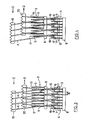
- FIGS. 3 and 4 show, on the basis of a schematically illustrated processing of a stop comb 3 and a guide comb 4 with the control means for the lateral deflection of the warp threads K, their reading into the slat combs and the function of the second stop and guide slats 5 provided with the cutouts 17 and 18 ', 6'.
- the two figures represent two different stages of the import process.
- the two fin combs 3 and 4 with the fins 5, 5 'and 6, 6' are mutually displaced by half a pitch or tube width.
- the warp threads K are guided in the direction of the warp threads arranged in front of the weaving rotor shed bars 19 and 20 and run from these to the lamellar combs 3 and 4.
- Each shed bar 19, 20 leads in each case to the same binding warp threads K, that is to say warp threads, each together in the top - or lie in the sub-compartment.
- the individual slats 5, 5 1 and 6, 6 ' are each symbolized by a thick full line, the recesses 17 and 18 on every second stop and guide slats 5' and 6! are not fully extended, but bordered with thin lines.
- the guide comb 4 under consideration is fully immersed in the warp threads K, and the stop comb 3 in FIG. 3 begins its immersion movement. Due to the fact that every second stop lamella 5 'is provided with a recess 17, the warp threads K do not have to be read into a normal-width tube A in the first stage of immersion shown in FIG. 3, but can be read into a double-width tube 2A. The same applies to the immersion of the guide combs 4 with the tubes B. It is obvious that the double-width tubes considerably increase the security of the correct reading in of the warp threads K.
- the shed forming rods 19, 20 designed as toothed racks have been moved by their drive in such a way that the warp threads K assume the positions shown.
- the warp threads K guided by the shedding rod 19 were moved to the left (arrow C) and the warp threads K guided by the shedding rod 20 were moved to the right (arrow D), in each case into a position where they were certainly in the double-width tubes width 2A can be read.
- the two stages of reading in the warp threads K can run in a continuous process and merge into one another, but they can also be carried out discontinuously, that is to say in two separate steps. It is essential that s is read into a double-wide type in a sort of presorting during the first stage and then into the final, normal-width tube during the second stage, with the warp threads K being positively guided into the tube in the second stage.
- each stop and guide comb 3, 4 could be arranged on the hollow roller 1 in a suitable manner.
- the shape of the organ 13 is arbitrary within wide limits; for example, the compartment holding members for the low compartment position could also be formed by projections on the stop or guide slats. In any case, however, it is advantageous if these shed retaining elements are arranged at the point of intersection of the warp thread sheets. The location of this crossing point can also vary and depends on the selected geometry. The crossing point could also lie within the stop or guide combs 3 or 4.
- the relevant stop or guide lamellae 5 or 6 would have a corresponding bore through which the organ 13 would have been pushed, or they would be provided at the corresponding point with projections serving as a specialist organ for the lowering of the warp threads.
- the stop and guide combs 3, 4 are mutually displaced by half a division, because up to a certain value of the warp density the warp threads can be read into the double-width tubes without this displacement.
- the mutual displacement has the advantage, however, that even in the first stage of the reading-in there is a kind of positive guidance of the warp threads in that they can be brought to the side against the fins that delimit the tube in the previously immersed fin comb. If one already deflected the warp threads K sideways so far in the first stage that they get into their final tube with certainty, then with large warp densities, warp threads K could jump into an adjacent wrong tube. This danger is eliminated by the cut-out on every second lamella, since this ensures reliable reading into a double-width tube even with a slight lateral deflection of the warp threads.
Landscapes
- Engineering & Computer Science (AREA)
- Textile Engineering (AREA)
- Looms (AREA)
Applications Claiming Priority (2)
| Application Number | Priority Date | Filing Date | Title |
|---|---|---|---|
| CH726482 | 1982-12-14 | ||
| CH7264/82 | 1982-12-14 |
Publications (3)
| Publication Number | Publication Date |
|---|---|
| EP0111071A2 true EP0111071A2 (fr) | 1984-06-20 |
| EP0111071A3 EP0111071A3 (en) | 1985-06-19 |
| EP0111071B1 EP0111071B1 (fr) | 1987-02-04 |
Family
ID=4322418
Family Applications (1)
| Application Number | Title | Priority Date | Filing Date |
|---|---|---|---|
| EP83109389A Expired EP0111071B1 (fr) | 1982-12-14 | 1983-09-21 | Métier à tisser multiphasé à foule linéaire avec un rotor de tissage |
Country Status (7)
| Country | Link |
|---|---|
| US (1) | US4498501A (fr) |
| EP (1) | EP0111071B1 (fr) |
| JP (1) | JPS602744A (fr) |
| CS (1) | CS248713B2 (fr) |
| DD (1) | DD213701A5 (fr) |
| DE (1) | DE3369711D1 (fr) |
| SU (1) | SU1463136A3 (fr) |
Cited By (1)
| Publication number | Priority date | Publication date | Assignee | Title |
|---|---|---|---|---|
| EP0584433A1 (fr) * | 1992-08-28 | 1994-03-02 | Sulzer RàTi Ag | Dispositif à tramer pour un métier à tisser multiphase à foule linéaire |
Families Citing this family (10)
| Publication number | Priority date | Publication date | Assignee | Title |
|---|---|---|---|---|
| DE3364083D1 (en) * | 1983-10-12 | 1986-07-17 | Rueti Ag Maschf | Linear-shed multiphase loom with a weaving rotor |
| DE3575167D1 (de) * | 1985-04-02 | 1990-02-08 | Sulzer Ag | Webrotor fuer reihenfachwebmaschinen. |
| DE59108995D1 (de) * | 1990-05-11 | 1998-07-02 | Rueti Ag Maschf | Reihenfachwebmaschine |
| US5188154A (en) * | 1991-05-21 | 1993-02-23 | Sulzer Brothers Limited | Weaving rotor comb fin design for series-shed loom |
| DE59306953D1 (de) * | 1992-05-15 | 1997-09-04 | Rueti Ag Maschf | Reihenfachwebmaschine |
| DE59303756D1 (de) * | 1993-02-26 | 1996-10-17 | Rueti Ag Maschf | Einlegevorrichtung für eine Reihenfachwebmaschine |
| EP0645483B1 (fr) * | 1993-09-24 | 1997-04-16 | Sulzer RàTi Ag | Dispositif à tramer pour un métier à tisser multiphase à foule linéaire et métier à tisser multiphase à foule linéaire avec un dispositif à tramer |
| US5947163A (en) * | 1995-06-22 | 1999-09-07 | Sulzer Rueti Ag | Series shed weaving rotor with staggered beat-up lamella |
| EP0831159A1 (fr) * | 1996-09-24 | 1998-03-25 | Sulzer Rüti Ag | Rotor de tissage pour un métier à tisser multiphasé à foule linéaire |
| US8596303B1 (en) * | 2012-01-11 | 2013-12-03 | Susan B. Ballenger | Supplementary beater for a handloom |
Family Cites Families (6)
| Publication number | Priority date | Publication date | Assignee | Title |
|---|---|---|---|---|
| DE1008215B (de) * | 1952-02-29 | 1957-05-09 | Augusto Gentilini | Kontinuierlich arbeitende Flachwebmaschine |
| CH543621A (de) * | 1972-04-14 | 1973-10-31 | Rueti Ag Maschf | Einrichtung zum Bilden von Gewebebindungen |
| CH610364A5 (en) * | 1976-09-15 | 1979-04-12 | Sulzer Ag | Series shed-weaving machine |
| CH633591A5 (de) * | 1978-12-07 | 1982-12-15 | Rueti Ag Maschf | Reihenfachwebmaschine mit einem webrotor. |
| CH633590A5 (de) * | 1978-12-07 | 1982-12-15 | Rueti Ag Maschf | Reihenfachwebmaschine mit einem webrotor. |
| CH645418A5 (de) * | 1980-03-27 | 1984-09-28 | Rueti Ag Maschf | Einrichtung zur fuehrung eines mittels eines stroemenden fluidums angetriebenen schussfadens im webfach einer webmaschine. |
-
1983
- 1983-09-21 DE DE8383109389T patent/DE3369711D1/de not_active Expired
- 1983-09-21 EP EP83109389A patent/EP0111071B1/fr not_active Expired
- 1983-11-28 US US06/555,622 patent/US4498501A/en not_active Expired - Lifetime
- 1983-12-12 SU SU833679358A patent/SU1463136A3/ru active
- 1983-12-13 JP JP58233784A patent/JPS602744A/ja active Granted
- 1983-12-14 DD DD83257949A patent/DD213701A5/de unknown
- 1983-12-14 CS CS839406A patent/CS248713B2/cs unknown
Cited By (1)
| Publication number | Priority date | Publication date | Assignee | Title |
|---|---|---|---|---|
| EP0584433A1 (fr) * | 1992-08-28 | 1994-03-02 | Sulzer RàTi Ag | Dispositif à tramer pour un métier à tisser multiphase à foule linéaire |
Also Published As
| Publication number | Publication date |
|---|---|
| JPH043456B2 (fr) | 1992-01-23 |
| DD213701A5 (de) | 1984-09-19 |
| EP0111071A3 (en) | 1985-06-19 |
| SU1463136A3 (ru) | 1989-02-28 |
| JPS602744A (ja) | 1985-01-09 |
| US4498501A (en) | 1985-02-12 |
| DE3369711D1 (en) | 1987-03-12 |
| EP0111071B1 (fr) | 1987-02-04 |
| CS248713B2 (en) | 1987-02-12 |
Similar Documents
| Publication | Publication Date | Title |
|---|---|---|
| EP0111071B1 (fr) | Métier à tisser multiphasé à foule linéaire avec un rotor de tissage | |
| EP0013321B1 (fr) | Métier à tisser multiphasé à foule linéaire avec un rotor de tissage | |
| EP0012253B1 (fr) | Métier à tisser multiphasé à foule linéaire avec un rotor de tissage | |
| EP0196349B1 (fr) | Rotor de tissage pour un métier à tisser multiphasé à foule linéaire | |
| EP0093078B1 (fr) | Métier à tisser multiphasé à foule linéaire avec un rotor de tissage | |
| DE2120626C3 (de) | Drehblatt und Webschützen für Wellenfach-Webmaschinen | |
| CH645418A5 (de) | Einrichtung zur fuehrung eines mittels eines stroemenden fluidums angetriebenen schussfadens im webfach einer webmaschine. | |
| DE2634966C2 (de) | Fachbildevorrichtung einer triaxialen Webmaschine | |
| DE2409421C2 (de) | Vorrichtung zur mechanischen Betätigung von Fadenführungsgliedern | |
| EP0199880A1 (fr) | Dispositif d'insertion de trame pour métier à tisser, plus particulièrement un métier à tisser à navette à griffe | |
| EP0111072B1 (fr) | Métier à tisser multiphasé à foule linéaire avec un rotor de tissage | |
| EP0093841B1 (fr) | Support de lames en forme de peigne pour métiers à tisser, en particulier pour le rotor de tissage de métiers à tisser multiphasé à foule linéaire et son procédé de fabrication | |
| DE2645369A1 (de) | Triaxiale webmaschine mit einer vorrichtung zum umsetzen der litzen | |
| DE2823222C3 (de) | Webeblatt | |
| DE1286976B (de) | Anschlagvorrichtung fuer Wellenwebmaschinen | |
| DE1953864C3 (de) | Vorrichtung zum Auftragen von mittels Schußfäden abgebundener Effektfäden auf ein Gewebe | |
| DE1289497B (de) | Schuetzenantrieb fuer Wellenwebmaschine | |
| DE2825679A1 (de) | Verfahren und vorrichtung zum schusseintrag an webmaschinen mittels eines fluidums durch fuehrung und antrieb des schussfadens im webfach in einem als lamellen gebildeten kanal | |
| DE1292094B (de) | Schuetzenantriebs- und Anschlagorgane fuer Wellenwebmaschinen | |
| CH655744A5 (en) | Lamellar comb for weaving machines, especially for the weaving rotor of row-shed weaving machines | |
| DE2625363C3 (de) | Vorrichtung zum wahlweisen Bewegen von Lamellen | |
| DE1785071C (de) | Webschützen | |
| CH637706A5 (en) | Weft-thread guide device on a jet-weaving machine | |
| EP0831159A1 (fr) | Rotor de tissage pour un métier à tisser multiphasé à foule linéaire | |
| DE8005822U1 (de) | Drehereinrichtung fuer greiferwebmaschinen |
Legal Events
| Date | Code | Title | Description |
|---|---|---|---|
| PUAI | Public reference made under article 153(3) epc to a published international application that has entered the european phase |
Free format text: ORIGINAL CODE: 0009012 |
|
| AK | Designated contracting states |
Designated state(s): BE CH DE FR GB IT LI |
|
| RBV | Designated contracting states (corrected) |
Designated state(s): BE CH DE FR GB IT LI |
|
| PUAL | Search report despatched |
Free format text: ORIGINAL CODE: 0009013 |
|
| AK | Designated contracting states |
Designated state(s): BE CH DE FR GB IT LI |
|
| 17P | Request for examination filed |
Effective date: 19850502 |
|
| 17Q | First examination report despatched |
Effective date: 19860613 |
|
| ITF | It: translation for a ep patent filed | ||
| GRAA | (expected) grant |
Free format text: ORIGINAL CODE: 0009210 |
|
| AK | Designated contracting states |
Kind code of ref document: B1 Designated state(s): BE CH DE FR GB IT LI |
|
| REF | Corresponds to: |
Ref document number: 3369711 Country of ref document: DE Date of ref document: 19870312 |
|
| ET | Fr: translation filed | ||
| PLBE | No opposition filed within time limit |
Free format text: ORIGINAL CODE: 0009261 |
|
| STAA | Information on the status of an ep patent application or granted ep patent |
Free format text: STATUS: NO OPPOSITION FILED WITHIN TIME LIMIT |
|
| 26N | No opposition filed | ||
| PG25 | Lapsed in a contracting state [announced via postgrant information from national office to epo] |
Ref country code: GB Effective date: 19880921 |
|
| PG25 | Lapsed in a contracting state [announced via postgrant information from national office to epo] |
Ref country code: LI Effective date: 19880930 Ref country code: CH Effective date: 19880930 |
|
| REG | Reference to a national code |
Ref country code: CH Ref legal event code: PL |
|
| GBPC | Gb: european patent ceased through non-payment of renewal fee | ||
| PGFP | Annual fee paid to national office [announced via postgrant information from national office to epo] |
Ref country code: FR Payment date: 19930812 Year of fee payment: 11 |
|
| ITTA | It: last paid annual fee | ||
| PG25 | Lapsed in a contracting state [announced via postgrant information from national office to epo] |
Ref country code: FR Effective date: 19950531 |
|
| REG | Reference to a national code |
Ref country code: FR Ref legal event code: ST |
|
| PGFP | Annual fee paid to national office [announced via postgrant information from national office to epo] |
Ref country code: DE Payment date: 20020907 Year of fee payment: 20 |
|
| PGFP | Annual fee paid to national office [announced via postgrant information from national office to epo] |
Ref country code: BE Payment date: 20020913 Year of fee payment: 20 |
|
| BE20 | Be: patent expired |
Owner name: *MASCHINENFABRIK SULZER-RUTI A.G. Effective date: 20030921 |