EP0111583B1 - Züchtung von anaeroben Mikroorganismen - Google Patents
Züchtung von anaeroben Mikroorganismen Download PDFInfo
- Publication number
- EP0111583B1 EP0111583B1 EP19820111853 EP82111853A EP0111583B1 EP 0111583 B1 EP0111583 B1 EP 0111583B1 EP 19820111853 EP19820111853 EP 19820111853 EP 82111853 A EP82111853 A EP 82111853A EP 0111583 B1 EP0111583 B1 EP 0111583B1
- Authority
- EP
- European Patent Office
- Prior art keywords
- weight
- anaerobic
- oxygen
- composition
- parts
- Prior art date
- Legal status (The legal status is an assumption and is not a legal conclusion. Google has not performed a legal analysis and makes no representation as to the accuracy of the status listed.)
- Expired
Links
Images
Classifications
-
- C—CHEMISTRY; METALLURGY
- C12—BIOCHEMISTRY; BEER; SPIRITS; WINE; VINEGAR; MICROBIOLOGY; ENZYMOLOGY; MUTATION OR GENETIC ENGINEERING
- C12M—APPARATUS FOR ENZYMOLOGY OR MICROBIOLOGY; APPARATUS FOR CULTURING MICROORGANISMS FOR PRODUCING BIOMASS, FOR GROWING CELLS OR FOR OBTAINING FERMENTATION OR METABOLIC PRODUCTS, i.e. BIOREACTORS OR FERMENTERS
- C12M41/00—Means for regulation, monitoring, measurement or control, e.g. flow regulation
- C12M41/30—Means for regulation, monitoring, measurement or control, e.g. flow regulation of concentration
- C12M41/34—Means for regulation, monitoring, measurement or control, e.g. flow regulation of concentration of gas
-
- C—CHEMISTRY; METALLURGY
- C12—BIOCHEMISTRY; BEER; SPIRITS; WINE; VINEGAR; MICROBIOLOGY; ENZYMOLOGY; MUTATION OR GENETIC ENGINEERING
- C12M—APPARATUS FOR ENZYMOLOGY OR MICROBIOLOGY; APPARATUS FOR CULTURING MICROORGANISMS FOR PRODUCING BIOMASS, FOR GROWING CELLS OR FOR OBTAINING FERMENTATION OR METABOLIC PRODUCTS, i.e. BIOREACTORS OR FERMENTERS
- C12M23/00—Constructional details, e.g. recesses, hinges
- C12M23/24—Gas permeable parts
-
- C—CHEMISTRY; METALLURGY
- C12—BIOCHEMISTRY; BEER; SPIRITS; WINE; VINEGAR; MICROBIOLOGY; ENZYMOLOGY; MUTATION OR GENETIC ENGINEERING
- C12M—APPARATUS FOR ENZYMOLOGY OR MICROBIOLOGY; APPARATUS FOR CULTURING MICROORGANISMS FOR PRODUCING BIOMASS, FOR GROWING CELLS OR FOR OBTAINING FERMENTATION OR METABOLIC PRODUCTS, i.e. BIOREACTORS OR FERMENTERS
- C12M29/00—Means for introduction, extraction or recirculation of materials, e.g. pumps
Definitions
- the present invention relates to a method for culturing an anaerobic bacterium.
- Anaerobic bacteria cannot utilize molecular oxygen because they do not have a cytochrome enzyme system, so they do not grow under usual culturing procedures. Since they grow only under conditions where no oxygen is present, culture media are required to be maintained under completely oxygen free conditions for the growth of anaerobic bacteria. To this end, various expedients are required and special devices and apparatuses are needed. Furthermore, operation of these devices and apparatuses requires a considerable degree of skill.
- GB-A-2 083 496 discloses a method of cultivating anaerobic bacterium by using an oxygen- removing composition containing fillers such as ferrous carbonate, an oxide or hydroxide of an alkali metal or alkaline earth metal, and activated carbon. It is taught that the oxygen concentration and carbon dioxide concentration of the cultivating atmosphere should be made 0.1 % or less'and 5 to 15%, respectively, within 10 hours.
- the present invention has as its object to provide a method for culturing an anaerobic bacterium, that is, creating an anaerobic atmosphere where concentrations of oxygen and carbon dioxide are within predetermined ranges within a short period of time.
- This innovation will enable public health centers, general/clinics and hospitals to culture anaerobic bacteria.
- the culture of anaerobic bacteria was possible only in large hospitals or medical institutes which were equipped with bacterial inspection facilities.
- the object of the present invention is to provide a process for culturing anaerobic bacteria which comprises removing molecular oxygen in a closed system by the absorption of such oxygen by means of a chemical reaction, simultaneously generating carbon dioxide to a concentration dependent upon the type of anaerobic bacteria, and then maintaining such an atmosphere for a predetermined period of time for culturing said anaerobic bacteria.
- a further object of the present invention is to provide the culturing of anaerobic bacteria in a favorable manner in an anaerobic culture atmosphere of a closed system which is generated within 6 hours to a point where the oxygen concentration is 0.1 % or lower and the carbon dioxide concentration ranges from 5 to 50%.
- the present invention provides a method for culturing an anaerobic bacterium comprising placing a composition for generating an anaerobic atmosphere in a gas permeable bag made of a gas permeable sheet; separately placing the gas permeable bag and a culture medium inoculated with the anaerobic bacterium in an envelope; and hermetically closing the envelope and culturing the anaerobic bacterium under an anaerobic atmosphere which is formed as a result of a chemical reaction of the composition for generating an anaerobic atmosphere comprising not more than 0.1 % oxygen and 5 to 50% carbon dioxide; wherein said composition comprises ascorbic acid or salt thereof as an oxygen-absorbing agent; a hydrated carbonate of an alkali metal or an alkaline earth metal; a bicarbonate of an alkali metal; and a metal compound selected from ferrous compounds, and cuprous or cupric compounds.
- a method for culturing an anaerobic bacterium comprising placing a composition for generating an anaerobic atmosphere in a gas permeable bag made of a gas permeable sheet; separately placing the gas permeable bag and a culture medium inoculated with the anaerobic bacterium in an envelope; and hermetically closing the envelope and culturing the anaerobic bacterium under an anaerobic atmosphere which is formed as a result of a chemical reaction of the composition for generating an anaerobic atmosphere comprising not more than 0.1 % oxygen and 5 to 50% carbon dioxide; wherein said composition comprises a hydrated ferrous salt as an oxygen-absorbing agent, two kinds of alkaline compounds, one of which is a hydroxide of an alkali metal or alkaline earth metal, and the other a carbonate, and a sulfite of an alkaline earth metal.
- the invention uses as an oxygen absorbing agent a hydrated ferrous salt such as hydrated ferrous sulfate or hydrated ferrous chloride as a major ingredient, two further different kinds of alkaline compounds, such as hydroxide or carbonate of alkali metal or alkaline earth metal are used together with said oxygen absorbing agent. Varying ratios of such a carbonate and a hydroxide may be used to adjust the concentrations of oxygen and carbon dioxide.
- alkali or alkaline earth metal hydroxide such as Ca(OH 2 )
- ferrous sulfate which has a high reactivity with ferrous sulfate, is required to facilitate the oxygen absorption of hydrated ferrous salt (such as FeSO 4 ⁇ 7H 2 0) as the major component and of calcium sulfite.
- water liberated in Reaction (1) (preferably water liberated in the initial reaction of ferrous sulfate heptahydrate) is subjected to the absorption of water and generation of carbon dioxide by the ferrous sulfate and one of the alkaline compounds, i.e., a carbonate such as calcium carbonate according to Reaction (2) and to the oxygen absorption reaction by means of alkaline earth metal sulfite such as calcium sulfite according to Reaction (3).
- composition used according to the present invention requires two different kinds of alkaline compounds such as hydroxides of alkali metal or alkaline earth metal and a carbonate in order to cause the initial reaction as described above and to cause the reaction for generating carbon dioxide to occur.
- alkaline compounds such as hydroxides of alkali metal or alkaline earth metal and a carbonate
- the amount of carbon dioxide to be generated may be adjusted by varying the amount of a carbonate which functions as a source for carbon dioxide generation.
- the hydrated ferrous salts to be used according to the present invention may include, for example, FeS0 4 . 5H 2 0, FeS0 4 - 7H 2 0, FeCl 2 ⁇ 4H 2 0. Ferrous sulfate heptahydrate is most preferred.
- the alkaline earth metal sulfite may include, for example, CaSO 3 ⁇ 1/2H 2 0, CaSO 3 ⁇ 2H 2 0, BaS0 3 . Among them, CaSO 3 ⁇ 1/2H 2 0 is most preferred.
- the hydroxides of alkali metal and alkaline earth metal may include, for example, KOH, NaOH, LiOH, Ca(OH) Z , Ba(OH) 2 , Mg(OH) 2 .
- Carbonates of alkali metal or alkaline earth metal includes K 2 CO 3 , Na 2 C0 3 , Li 2 C0 3 , CaC0 3 , BaC0 3 , MgC0 3 , BeC0 3 , KHC0 3 , NaHC0 3 , LiHC0 3 or their hydrates such as Na2C03. 10H 2 0, MgC0 3 . 3H 2 0, Na 2 CO 3 ⁇ 7H20, BeCO 3 ⁇ 4H 2 0, KNaCO 3 ⁇ 6H 2 0.
- the porous carrier may include, for example, activated carbon, zeolite, bentonite, activated clay and activated alumina, with activated carbon being most preferred.
- the mixing ratios of each of the ingredients may range as follows.
- the ratio of carbonate in relative to hydroxide should be adjusted in the range of 0.5:1 to 4: 1.0.5 part by weight of the porous carrier may be included in the above composition.
- Table 1 which follows illustrates examples of blending each of the ingredients based on the amounts of carbon dioxide generated. In the table below, units are in parts by weight.
- the present invention uses as an oxygen absorbing agent ascorbic acid or salts. thereof such as sodium L-ascorbate as a major ingredient, two different kinds of alkaline compounds, namely, hydrated alkali metal or alkaline earth metal carbonates such as Na 2 C0 3 . 10 H 2 0 and a bicarbonate or alkali metal such as NaHC0 3 are used together with said oxygen absorbing agent.
- concentrations of oxygen and carbon dioxide may be adjusted by varying the mixing ratios of the major ingredient and the alkaline compounds.
- the use of the two different kinds of alkaline compounds as illustrated above is for the following reasons. In order to facilitate and speed-up the reaction when ascorbic acid or its salt is the major component, water and a catalyst are required.
- the catalyst to be used here may be ferrous sulfate (for the initial reaction) and activated carbon
- various techniques for supplying the water may be considered. For example, there may be included a step in which water is added at the time of filling or blending and a process in which hydrated active carbon is employed. These processes, however, are accompanied by practical difficulties in that the water is not dispersed homogeneously, or the reaction proceeds too quickly.
- a hydrated carbonate of alkali or alkaline earth metal as an alkaline compound is chosen as a prerequisite ingredient in order to maintain a pH balance in a system and to supply water. Since this alkaline compound has the property to liberate about 90% of its hydrate at temperatures higher than about 35°C, it can supply water uniformly during the step of blending or granulating.
- ingredients according to the latter aspect of the present invention causes ascorbic acid or its salt, for example, sodium L-ascorbate to proceed with the oxygen absorption reaction as shown in Reaction Step (4) below.
- the other alkaline compound i.e., a bicarbonate
- a main reaction involved in this step is shown in a reaction scheme below. For example, oxalic acid is reacted with sodium bicarbonate according to Reaction (5) below.
- composition used in accordance with this aspect of the present invention requires two different kinds of alkaline compounds, i.e., a hydrated carbonate of alkali metal or alkaline earth metal and a bicarbonate of alkali metal, in order to provide a desired anaerobic atmosphere.
- alkaline compounds i.e., a hydrated carbonate of alkali metal or alkaline earth metal and a bicarbonate of alkali metal
- Adjustment of the amounts of carbon dioxide generated may be achieved by varying the amounts of the hydrated carbonate and the bicarbonate used.
- An ascorbic acid and salts thereof (ascorbate) to be used in accordance with the present invention may include, for example, L-ascorbic acid, calcium L-ascorbate, sodium L-ascorbate, D-iso-ascorbic acid and sodium D-iso-ascorbate.
- L-ascorbic acid calcium L-ascorbate
- sodium L-ascorbate sodium L-ascorbate
- D-iso-ascorbic acid sodium D-iso-ascorbate.
- sodium L-ascorbate sodium L-ascorbate.
- the hydrated carbonate of alkali metal or alkaline earth metal may include, for example, Na 2 CO 3 ⁇ 7H 2 O, Na 2 CO 3 ⁇ 10H 2 O, BeCO 3 ⁇ 4H 2 O, KNaCO 3 ⁇ 6H 2 O and MgCO 3 ⁇ 6H 2 O. Among them, Na 2 CO 3 ⁇ 10H 2 O is most preferred.
- the bicarbonate of alkali metal may include, for example, KHC0 3 , NaHC0 3 and LiHC0 3 .
- Sodium bicarbonate is generally preferred.
- the ferrous compound and cuprous or cupric compound may include, for example, FeS0 4 , FeSO 4 ⁇ 7H 2 O, FeS04' 10H 2 0, FeCl 2 , FeCl 2 ⁇ 4H 2 0, CuSO 4 , CuSO 4 ⁇ 5H 2 O, CuCI, CuCl 2 , CuCl 2 ⁇ 2H 2 O.
- porous carrier may be used, for example, activated carbon, zeolite, bentonite, activated clay and activated alumina.
- Activated carbon is generally preferred.
- the mixing ratios of each of the. ingredients may range as follows.
- the ratio of the alkaline compounds in relative to ascorbic acid or its salt should be adjusted in the range of 0.3:1 to 4:1.
- the above two kinds of alkaline compounds should be added in equal amounts.
- Table 2 which follows illustrates examples of blends based on the amount of carbon dioxide generated. In Table 2 below, units are in parts by weight.
- the amount of the compositions as illustrated hereinabove may be varied according to the amount of air remaining in a closed system, and with the time required for the removal of oxygen by absorption.
- compositions used according to the present invention may be employed by being packed with a suitable gas permeable packing material.
- compositions may be stored by being packed with a packing material incapable of ventilating oxygen in order to prevent any oxygen-absorbing reaction from occurring during storage.
- compositions used in accordance with the present invention may merely be placed in a container such as a laboratory dish or a Kolben culture test tube which is inoculated with anaerobic bacteria to be cultured, or in a jar in which a variety of test specimens are placed, or in a synthetic resin bag having a low gas permeability to gases such as oxygen, carbon dioxide, vapor or the like. Accordingly, this process may render an atmosphere anaerobic in a very simple manner.
- agents A and B to be used in accordance with the present invention both release and absorb little heat at the start of a reaction with air, and that a reaction can start within a wide range of temperatures.
- This process accordingly is applicable to mesophiles and thermophiles as well as to psychrophiles. Furthermore, this process does not disperse or absorb water during the reaction with air, so that a culture medium contained in a closed system neither gets too dry nor too moist.
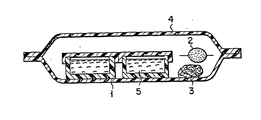
- a deoxidizer having the composition illustrated below was placed in a gas permeable bag 2 filled with 600 cm 3 of air and made of a paper of fine quality which was laminated with polyethylene film equipped in its inner layer with small pores.
- This bag was then placed in a bag 4 made of a laminate body consisting of a 50 pm thick polyethylene film and a 20 11m thick polypropylene film coated with vinylidene chloride.
- bacterium A an agar gum culture inoculated with B. melaninogenicus SS. intermedius
- the culture was carried out at 35 to 37°C for 48 hours.
- Table 4 illustrates the concentrations of gases (O 2 /CO 2 ) in the bag 4 measured after 6 hours.
- A-1, A-4, B-1 and B-4 are beyond the scope defined in accordance with the present invention and do not satisfy the requirements for 0.1 % or less of 0 2 and 5 to 50% of C0 2 within 6 hours.
- the absorbent cotton 3 containing the indicator turned white.
- bacteria propagated to the extent that they could be observed from outside the bag. Observation after opening the bag was accordingly unnecessary, unlike in conventional procedures.
- a deoxidizer containing the same composition as in Example 1 (A-1 to A-4 and B-1 to B ⁇ 4) was placed in a bag consisting of a laminate body made of a polyethylene film and a polypropylene film coated with vinylidene chloride together with a laboratory dish containing an agar gum medium (manufactured by Nisui Seiyaku K.K.) inoculated with B. melaninogenicus SS. intermedius and B. melaninogenicus SS. nedaninogenicus. The bag was sealed and then cultured at 37°C for 48 hours. Table 5 below indicates results of the culture.
- A-2, A-4, B-2 and B-3 which each comprised a composition according to the present invention.
Landscapes
- Chemical & Material Sciences (AREA)
- Health & Medical Sciences (AREA)
- Organic Chemistry (AREA)
- Life Sciences & Earth Sciences (AREA)
- Engineering & Computer Science (AREA)
- Bioinformatics & Cheminformatics (AREA)
- Zoology (AREA)
- Wood Science & Technology (AREA)
- Microbiology (AREA)
- Sustainable Development (AREA)
- Biotechnology (AREA)
- Biomedical Technology (AREA)
- Biochemistry (AREA)
- General Engineering & Computer Science (AREA)
- General Health & Medical Sciences (AREA)
- Genetics & Genomics (AREA)
- Analytical Chemistry (AREA)
- Clinical Laboratory Science (AREA)
- Micro-Organisms Or Cultivation Processes Thereof (AREA)
Claims (6)
Priority Applications (2)
| Application Number | Priority Date | Filing Date | Title |
|---|---|---|---|
| DE8282111853T DE3276537D1 (en) | 1982-12-21 | 1982-12-21 | Culture of anaerobic bacteria |
| EP19820111853 EP0111583B1 (de) | 1982-12-21 | 1982-12-21 | Züchtung von anaeroben Mikroorganismen |
Applications Claiming Priority (1)
| Application Number | Priority Date | Filing Date | Title |
|---|---|---|---|
| EP19820111853 EP0111583B1 (de) | 1982-12-21 | 1982-12-21 | Züchtung von anaeroben Mikroorganismen |
Publications (2)
| Publication Number | Publication Date |
|---|---|
| EP0111583A1 EP0111583A1 (de) | 1984-06-27 |
| EP0111583B1 true EP0111583B1 (de) | 1987-06-10 |
Family
ID=8189415
Family Applications (1)
| Application Number | Title | Priority Date | Filing Date |
|---|---|---|---|
| EP19820111853 Expired EP0111583B1 (de) | 1982-12-21 | 1982-12-21 | Züchtung von anaeroben Mikroorganismen |
Country Status (2)
| Country | Link |
|---|---|
| EP (1) | EP0111583B1 (de) |
| DE (1) | DE3276537D1 (de) |
Families Citing this family (6)
| Publication number | Priority date | Publication date | Assignee | Title |
|---|---|---|---|---|
| JP3818324B2 (ja) * | 1996-03-26 | 2006-09-06 | 三菱瓦斯化学株式会社 | ガス濃度調節剤及び低酸素濃度環境の調節方法 |
| EP0869172B1 (de) * | 1997-04-01 | 2003-10-15 | Mitsubishi Gas Chemical Company, Inc. | Kulturatmosphäreregulator und Verfahren zum Züchten von anaeroben Bakterien |
| GB9801153D0 (en) * | 1998-01-21 | 1998-03-18 | Whitley Don Scient Ltd | Anaerobic culturing |
| EP2505644B1 (de) * | 2009-11-24 | 2018-09-19 | Mitsubishi Gas Chemical Company, Inc. | Atmosphärensteuernde zusammensetzung |
| JP6593564B1 (ja) * | 2019-03-20 | 2019-10-23 | 三菱瓦斯化学株式会社 | 細菌培養用ガス濃度調整剤及びこれを用いた細菌の培養方法 |
| JP7322545B2 (ja) * | 2019-06-24 | 2023-08-08 | 三菱瓦斯化学株式会社 | 嫌気性細菌培養用ガス濃度調整剤及びこれを用いた嫌気性細菌の培養方法 |
Family Cites Families (1)
| Publication number | Priority date | Publication date | Assignee | Title |
|---|---|---|---|---|
| JPS5739776A (en) * | 1980-08-20 | 1982-03-05 | Mitsubishi Gas Chem Co Inc | Cultivation of anaerobic bacteria |
-
1982
- 1982-12-21 DE DE8282111853T patent/DE3276537D1/de not_active Expired
- 1982-12-21 EP EP19820111853 patent/EP0111583B1/de not_active Expired
Also Published As
| Publication number | Publication date |
|---|---|
| DE3276537D1 (en) | 1987-07-16 |
| EP0111583A1 (de) | 1984-06-27 |
Similar Documents
| Publication | Publication Date | Title |
|---|---|---|
| EP0167229B1 (de) | Erzeugung von anaerobischen oder mikroaerophilischen Bedingungen | |
| EP0073590A2 (de) | Mikroaerophilische Atmosphäre erzeugender Artikel | |
| US3246959A (en) | Apparatus for generating gas | |
| JPS5856679A (ja) | 嫌気性菌培養方法及び雰囲気調整剤 | |
| GB2083496A (en) | Cultivating anaerobic bacterium | |
| EP0111583A1 (de) | Züchtung von anaeroben Mikroorganismen | |
| US4904597A (en) | Method for cultivation of bacteria of the genus campylobacter | |
| JPS584913B2 (ja) | 嫌気性細菌の培養法 | |
| EP0798373A2 (de) | Gaskonzentrationsregulierung | |
| EP0869172B1 (de) | Kulturatmosphäreregulator und Verfahren zum Züchten von anaeroben Bakterien | |
| EP0527228A1 (de) | Agenz für die umgebungsluftkonditionierung | |
| EP0120111A1 (de) | Verfahren zum Züchten von anaeroben Bakterien und Materialien zur Erzeugung der Kulturatmosphäre | |
| JPH10327845A (ja) | 雰囲気調整剤及び嫌気性細菌の培養法 | |
| JPS6143995B2 (de) | ||
| JP2009291166A (ja) | 雰囲気調整剤及びそれを用いた細胞培養方法 | |
| JPS58141779A (ja) | 嫌気性細菌の培養方法 | |
| JPH04117300A (ja) | 多種の嫌気性菌の同時検出方法 | |
| JPS5851890A (ja) | 嫌気性細菌の培養法 | |
| JPS59232087A (ja) | 嫌気性細菌の培養方法 | |
| JPS58141780A (ja) | 嫌気性細菌の培養方法 | |
| JPS58141781A (ja) | 嫌気性細菌の培養方法 | |
| JP2674151B2 (ja) | 嫌気性菌の培養装置及び培養方法 | |
| JPS5978682A (ja) | 嫌気性細菌培養用脱酸素剤 | |
| US6642047B2 (en) | Exothermic chemistry and method for generating an anaerobic environment | |
| JP2014023541A (ja) | 雰囲気調整剤及びそれを用いた細胞培養方法 |
Legal Events
| Date | Code | Title | Description |
|---|---|---|---|
| PUAI | Public reference made under article 153(3) epc to a published international application that has entered the european phase |
Free format text: ORIGINAL CODE: 0009012 |
|
| 17P | Request for examination filed |
Effective date: 19821221 |
|
| AK | Designated contracting states |
Designated state(s): DE FR GB |
|
| GRAA | (expected) grant |
Free format text: ORIGINAL CODE: 0009210 |
|
| AK | Designated contracting states |
Kind code of ref document: B1 Designated state(s): DE FR GB |
|
| REF | Corresponds to: |
Ref document number: 3276537 Country of ref document: DE Date of ref document: 19870716 |
|
| ET | Fr: translation filed | ||
| PLBE | No opposition filed within time limit |
Free format text: ORIGINAL CODE: 0009261 |
|
| STAA | Information on the status of an ep patent application or granted ep patent |
Free format text: STATUS: NO OPPOSITION FILED WITHIN TIME LIMIT |
|
| 26N | No opposition filed | ||
| PGFP | Annual fee paid to national office [announced via postgrant information from national office to epo] |
Ref country code: GB Payment date: 19901210 Year of fee payment: 9 |
|
| PGFP | Annual fee paid to national office [announced via postgrant information from national office to epo] |
Ref country code: FR Payment date: 19901215 Year of fee payment: 9 |
|
| PGFP | Annual fee paid to national office [announced via postgrant information from national office to epo] |
Ref country code: DE Payment date: 19910131 Year of fee payment: 9 |
|
| PG25 | Lapsed in a contracting state [announced via postgrant information from national office to epo] |
Ref country code: GB Effective date: 19911221 |
|
| GBPC | Gb: european patent ceased through non-payment of renewal fee | ||
| PG25 | Lapsed in a contracting state [announced via postgrant information from national office to epo] |
Ref country code: FR Effective date: 19920831 |
|
| PG25 | Lapsed in a contracting state [announced via postgrant information from national office to epo] |
Ref country code: DE Effective date: 19920901 |
|
| REG | Reference to a national code |
Ref country code: FR Ref legal event code: ST |