EP0113119A2 - Dispositif pour la détection de l'écartement de caractères - Google Patents
Dispositif pour la détection de l'écartement de caractères Download PDFInfo
- Publication number
- EP0113119A2 EP0113119A2 EP83113182A EP83113182A EP0113119A2 EP 0113119 A2 EP0113119 A2 EP 0113119A2 EP 83113182 A EP83113182 A EP 83113182A EP 83113182 A EP83113182 A EP 83113182A EP 0113119 A2 EP0113119 A2 EP 0113119A2
- Authority
- EP
- European Patent Office
- Prior art keywords
- character
- register
- width
- pitch
- value
- Prior art date
- Legal status (The legal status is an assumption and is not a legal conclusion. Google has not performed a legal analysis and makes no representation as to the accuracy of the status listed.)
- Granted
Links
Images


Classifications
-
- G—PHYSICS
- G06—COMPUTING OR CALCULATING; COUNTING
- G06V—IMAGE OR VIDEO RECOGNITION OR UNDERSTANDING
- G06V30/00—Character recognition; Recognising digital ink; Document-oriented image-based pattern recognition
- G06V30/10—Character recognition
- G06V30/14—Image acquisition
- G06V30/148—Segmentation of character regions
- G06V30/158—Segmentation of character regions using character size, text spacings or pitch estimation
-
- G—PHYSICS
- G06—COMPUTING OR CALCULATING; COUNTING
- G06V—IMAGE OR VIDEO RECOGNITION OR UNDERSTANDING
- G06V30/00—Character recognition; Recognising digital ink; Document-oriented image-based pattern recognition
- G06V30/10—Character recognition
Definitions
- This invention relates to a character pitch detecting apparatus for use in a character segmenting system, and more particularly to a character pitch detecting apparatus for detecting whether a character block (which is a group of substantially aligned characters) printed on a paper and including merged characters is of a variable-pitch type or a fixed-pitch type.
- OCR optical character recognition
- a character-pitch detecting apparatus for use in a character segmenting system for scanning character arrays on a paper and for segmenting to individual charcters, comprising: means for producing a binary character image having white and black bits by scanning said character arrays; means responsive to said binary character image for extracting character blocks which are surrounded by said white bits; means responsive to said character blocks for generating height data and width data for said character blocks; means for storing frequency information with respect to said width data; means responsive to said height data for providing an average height data; means responsive to said average height data for providing a possible range of the character-block width in which one-character can be existed; means responsive to said frequency information stored in said storing means for providing upper and lower limit values in width of a character block which is most frequently appeared within said possible range; means for renewing said upper limit value in response to said frequency information stored in said storing means to provide upper and lower limit values with respect to one-character width class; and means responsive to said lower and upper limit values with respect to said one-character width class for
- signals on signal lines are represented by adding a symbol S at the end of reference numerals representative of the signal lines.
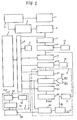
- a scanner 1 optically scans a character array printed or hand-written onapaper to produce an electric signal, which is converted to a binary character image and then written into a character memory 2.
- a character-block extractor 3 detects character images, i.e., character blocks which are surrounded by white (binary "0") bits in the stored binary character image in the memory2, and supplied to a character block register 4 character-block data including biginning point, width and height thereof.
- the character block extracter 3 is disclosed in JP-A-57/141779.
- the width data of a plurality of character blocks stored in the charcter block register 4 are sequentially transferred to a controller 6.
- the controller 6 converts sequentially transferred width data to address for a frequency table memory 5 from which stored contents are read out and incremented by +1 in adder 11.
- the incremented contents are then stored at the same addresses in the frequency table memory 5.
- the frequency values of the character blocks having the width V i are stored at the address V i in the frequency table memory (The frequency table memory 5 has been reset to "0" at a start of the operation).
- the height data of the plurality of character blocks stored in the character block register 4 are sequentially transferred to an average-height detector 7.
- the average-height detector 7 calculates an average-value H m in the height of the plurality of character blocks.
- the detector 7 may be of a circuit for producing as the average height the most frequently appeared height.
- the average height data H m is supplied to a multiplier 10 which is also supplied with constants C 1 , C 2 and C 3 (C 1 ⁇ C 2 , C 3 ⁇ C 2 ) from a constant register 15 , and calculates values C 1 H m , C 2 H m and C 3 H m .
- the values C 1 H m and C 2 H 2 are stored as lower limit and upper limit of a width range for a possible one-character in a one-character width-range register 12, respectively.
- the value C 3 H m is stored in a threshold value register 17.
- the values C 1 H m and C 2 H m are supplied through the controller 6 to the frequency table memory 5, whereby the frequency values for the character widths within the width range from C 1 H m to C 2 H m are read out from the frequency table memory 5 and then supplied to a most-frequently appeared width detector 13 which is also supplied with a constant ⁇ T from a constant register 16.
- the detector 13 counts the frequency values at a interval ⁇ T to detect the lower and upper limit values V L and V U representative of the most-frequently appeared width range;
- the lower and upper limit values V L and V U , and the frequency value N S counted within the interval are supplied to a one-character initial class register 14 in a one-character class register 8.
- the register 8 renews the upper limit value V U in response to the frequency information stored in the memory 5 to provide a one-character width section, i.e., upper value and lower value of the width of the one-character.
- the register 8 comprises the one-character initial class register 81, a counter 82, a frequency value register 83, a zero detector 84, a subtractor 85, a comparator 86 and an OR-circuit 87.
- the upper limit value Vu stored in the register 81 is set in the counter 82 and counted up by +1.
- the frequency value corresponding to the width of the character block which is the content of the counter 82 is read out from the table memory 5 by the controller 6 and stored in the frequency value register 83.
- the zero detector 84 detects whether the content of the register 83 is zero or not. When zero is detected, an output signal 841S on a signal line 841 becomes to binary "1", which is supplied through the OR-circuit 87 to the counter 82, whereby the content of the counter 82 is counted up by +1.
- the upper limit value of the character block width which is the content of the register 81, and the content of the counter 82 are transferred to the subtractor 85 by the operation of the controller 6.
- the subtractor 85 subtracts the upper limit value in the register 81 from the content of the counter 82.
- the subtracted value is transferred to the comparator 86 and compared with the content of the threshold register 17.
- an output signal 861S on a signal line 861 becomes to binary "1" whereby the upper limit value stored in the register 81 is renewed and the content of the counter 82 is counted up by +1 by the operation of the controller 6.
- the lower limit value stored in the register 81 and the upper limit value renewed in the above-mentioned manner are transferred to the one-character width class register 18.
- a decision circuit 9 detects whether the character pitch in the character arrays stored in the memory 2 is variable or fixed.
- a subtractor 91 subracts the lower limit value from the upper limit value and supplies the resulted value to the comparator 93, which is also supplied with a predetermined threshold value from a register 92.
- the threshold value in the register 92 may be determined depending upon the average height detected by the average height detector 7 as in the register 17.
- the comparator 93 produces an output signal 931S of binary "1" representative of the fixed pitch.
- the comparator 93 produces an output signal 931S of binary "0" representative of the variable pitch.
- the second embodiment is identical to the first embodiment except that the first embodiment comprises the one-character width class detector 8 and the decision circuit 9, while the second embodiment comprises a one-character width class detector 80 and a decision circuit 90.
- the detector 80 comprises a one-character initial class register 800, an upper limit value register 810, a counter 820, a frequency value register 830, a zero detector 840, a subtractor 850, a comparator 960, the threshold register 17, an increased frequency register 880, an adder 890 and an OR-circuit 870.
- the register 800 is identical to the register 81 in the first embodiment.
- the upper limit value stored in the register 800 is transferred to the upper limit value register 810.
- the upper limit value stored in the register 810 is set in the counter 820 and counted up by +1.
- the frequency value corresponding to the width of the character block which is the content of the counter 820 is read out from the table memory 5 by the controller 6 and stored in the frequency value register 830.
- the zero detector 840 detects whether the content of the register 830 is zero or not. When zero is detected, an output signal 8410S on a signal line 8410 becomes to binary "1", which is supplied through the OR-circuit 870 to the counter 820, whereby the content of the counter 820 is counted up by +1.
- the upper limit value of the character block width which is the content of the register 810
- the content of the counter 820 is transferred to the subtractor 850 by the operation of the controller 6.
- the content of the frequency register 830 is transferred to the adder 890, in which the contents in the registers 830 and 880 are added to each other to produce an increased frequency value which is stored in the register 880 (The register 880 has been reset to "0" at a start of the operation).
- the subtractor 850 subtracts the upper limit value in the register 810 from the content of the counter 820 to produce the subtracted value, which is transferred to the comparator 860, and compared with the content of the threshold register 17.
- an output signal 8610S on a signal line 8610 becomes to binary "1", whereby the upper limit value stored in the register 810 is renewed and the content of the counter 820 is counted up by +1 by the operation of the controller 6.
- the content of the register 17 is less than or equal to the subtracted value, the lower limit value stored in the register 800, the content of the register 810 and the content of the register 880 are transferred to the dicision circuit 90.
- the decision circuit 90 produces a decision function in response to the upper and lower limit values Vu and V L and the frequency value N S (which are the contents of the register 800), the upper limit value V CU for the one-character width class (which is the content of the register 810), and the frequency value incremental component ⁇ N S from the frequency value N S (which is the content of the register 880), and then decides whether it is the variable-pitch type or the fixed-pitch type in response to the decision function. instead of using the incremental component AN S , the sum of the frequency value N S and the incremental component ⁇ N S .
- a subtractor 930 subtracts the lower value V L from the upper limit value V U supplied from the register 800 to produce a difference (V U - V L ), which is transferred to a divider 960.
- a subtracter 940 subtracts the lower value V L supplied from the register 800 from the upper limit value V CU for the one-character width class supplied from the register 810 to produce a difference (V CU - V L ), which is transferred to the divider 960.
- the divider 960 divides the difference (V CU - V L ) supplied from the subtracter 940 by the difference (Vu - V L ) supplied from the subtracter 930 to produce a value (V CU - V L )/(V U - V L ), which is transferred to a multiplier 970.
- the value (V CU - V L )/(V U - V L ) represents a ratio of increment of the width of the character block.
- the value V CU is sufficiently greater than the value V U , whereby the value (V CU - V L )/(V U - V L ) is greater than that in case of the fixed-pitch type.
- a divider 910 divides the frequency value incremental component ⁇ N S by the frequency value N S to produce a value ⁇ N S /N S , which is transferred to the multiplier 970.
- the value ⁇ N S /N S in the variable-pitch type is greater than that in case of the fixed-pitch type.
- the multiplier 970 produces the output value ⁇ N S /N S (V CU - V L )/(V U - V L ), which is transferred to a comparator 980.
- the comparator 980 compares the output value from the multiplier 970 with the content of a threshold register 970. When the content of the register 920 is greater than the output value from the multiplier 970, an output signal 9810S on a signal line 9810 becomes binary "0" representative of the variable-pitch type. When it is less than or equal to the output value, the output signal 9810S becomes binary "1" representative of the fixed-pitch-type.
Landscapes
- Engineering & Computer Science (AREA)
- Computer Vision & Pattern Recognition (AREA)
- Physics & Mathematics (AREA)
- General Physics & Mathematics (AREA)
- Multimedia (AREA)
- Theoretical Computer Science (AREA)
- Character Input (AREA)
Applications Claiming Priority (4)
| Application Number | Priority Date | Filing Date | Title |
|---|---|---|---|
| JP229025/82 | 1982-12-28 | ||
| JP57229025A JPS59121589A (ja) | 1982-12-28 | 1982-12-28 | 文字ピッチ識別装置 |
| JP58000317A JPS59125477A (ja) | 1983-01-05 | 1983-01-05 | 文字ピツチ識別装置 |
| JP317/83 | 1983-01-05 |
Publications (3)
| Publication Number | Publication Date |
|---|---|
| EP0113119A2 true EP0113119A2 (fr) | 1984-07-11 |
| EP0113119A3 EP0113119A3 (en) | 1986-10-29 |
| EP0113119B1 EP0113119B1 (fr) | 1989-08-23 |
Family
ID=26333274
Family Applications (1)
| Application Number | Title | Priority Date | Filing Date |
|---|---|---|---|
| EP83113182A Expired EP0113119B1 (fr) | 1982-12-28 | 1983-12-28 | Dispositif pour la détection de l'écartement de caractères |
Country Status (2)
| Country | Link |
|---|---|
| EP (1) | EP0113119B1 (fr) |
| DE (1) | DE3380462D1 (fr) |
Cited By (2)
| Publication number | Priority date | Publication date | Assignee | Title |
|---|---|---|---|---|
| EP0138079A3 (en) * | 1983-09-29 | 1988-07-06 | International Business Machines Corporation | Character recognition apparatus and method for recognising characters associated with diacritical marks |
| EP0120334B1 (fr) * | 1983-03-01 | 1989-12-06 | Nec Corporation | Système pour la détection de l'écartement de caractères |
-
1983
- 1983-12-28 DE DE8383113182T patent/DE3380462D1/de not_active Expired
- 1983-12-28 EP EP83113182A patent/EP0113119B1/fr not_active Expired
Non-Patent Citations (1)
| Title |
|---|
| IBM TECHNICAL DISCLOSURE BULLETIN, vol. 14, no. 10, March 1972, pages 3104-3107, New York, US; R.J. BAUMGARTNER: "Character pitch determination" * |
Cited By (2)
| Publication number | Priority date | Publication date | Assignee | Title |
|---|---|---|---|---|
| EP0120334B1 (fr) * | 1983-03-01 | 1989-12-06 | Nec Corporation | Système pour la détection de l'écartement de caractères |
| EP0138079A3 (en) * | 1983-09-29 | 1988-07-06 | International Business Machines Corporation | Character recognition apparatus and method for recognising characters associated with diacritical marks |
Also Published As
| Publication number | Publication date |
|---|---|
| EP0113119A3 (en) | 1986-10-29 |
| EP0113119B1 (fr) | 1989-08-23 |
| DE3380462D1 (en) | 1989-09-28 |
Similar Documents
| Publication | Publication Date | Title |
|---|---|---|
| US5377280A (en) | Method and apparatus for automatic language determination of European script documents | |
| EP0120334B1 (fr) | Système pour la détection de l'écartement de caractères | |
| EP0481979B1 (fr) | Reconnaissance de documents et indexage automatique pour la reconnaissance optique de caracteres | |
| US4504972A (en) | Method and apparatus for automatic recognition of image and text or graphics areas on printed masters | |
| US4757551A (en) | Character recognition method and system capable of recognizing slant characters | |
| US4411015A (en) | Method and apparatus for automatic recognition of image and text/graphics areas on a master | |
| EP0472313B1 (fr) | Appareil et procédé de traitement d'image | |
| US5438628A (en) | Method for matching text images and documents using character shape codes | |
| US5805740A (en) | Bar-code field detecting apparatus performing differential process and bar-code reading apparatus | |
| Pal et al. | Automatic separation of words in multi-lingual multi-script Indian documents | |
| US5081690A (en) | Row-by-row segmentation and thresholding for optical character recognition | |
| JPS63158678A (ja) | 単語間スペ−ス検出方法 | |
| EP0045803A1 (fr) | Systeme et procede de traitement des caracteristiques d'une ligne horizontale dans une image | |
| EP0676891A2 (fr) | Procédé d'établissement de seuil pour des images document | |
| EP0809205B1 (fr) | Appareil et méthode pour détecter des lignes de caractères par l'utilisation d'information de projection simplifiée; Appareil et méthode de reconnaissance de caractères | |
| EP0949580A2 (fr) | Seuillage commandé par classification d'une image à valeurs de gris normalisées | |
| EP0113119B1 (fr) | Dispositif pour la détection de l'écartement de caractères | |
| JPH0430070B2 (fr) | ||
| Tsuji et al. | Character image segmentation | |
| Ma et al. | An enhanced skew angle estimation technique for binary document images | |
| bin Omar et al. | The removal of secondaries of Jawi characters | |
| Raza et al. | Recognition of facsimile documents using a database of robust features | |
| EP0080533B1 (fr) | Système de séparation de caractères utilisé dans un lecteur de caractères optique | |
| JPH0259502B2 (fr) | ||
| JPH05307640A (ja) | 文字読取装置 |
Legal Events
| Date | Code | Title | Description |
|---|---|---|---|
| PUAI | Public reference made under article 153(3) epc to a published international application that has entered the european phase |
Free format text: ORIGINAL CODE: 0009012 |
|
| 17P | Request for examination filed |
Effective date: 19831228 |
|
| AK | Designated contracting states |
Designated state(s): DE IT NL |
|
| PUAL | Search report despatched |
Free format text: ORIGINAL CODE: 0009013 |
|
| AK | Designated contracting states |
Kind code of ref document: A3 Designated state(s): DE IT NL |
|
| 17Q | First examination report despatched |
Effective date: 19870413 |
|
| GRAA | (expected) grant |
Free format text: ORIGINAL CODE: 0009210 |
|
| AK | Designated contracting states |
Kind code of ref document: B1 Designated state(s): DE IT NL |
|
| REF | Corresponds to: |
Ref document number: 3380462 Country of ref document: DE Date of ref document: 19890928 |
|
| ITF | It: translation for a ep patent filed | ||
| PLBE | No opposition filed within time limit |
Free format text: ORIGINAL CODE: 0009261 |
|
| STAA | Information on the status of an ep patent application or granted ep patent |
Free format text: STATUS: NO OPPOSITION FILED WITHIN TIME LIMIT |
|
| 26N | No opposition filed | ||
| ITTA | It: last paid annual fee | ||
| PGFP | Annual fee paid to national office [announced via postgrant information from national office to epo] |
Ref country code: NL Payment date: 20021227 Year of fee payment: 20 |
|
| PGFP | Annual fee paid to national office [announced via postgrant information from national office to epo] |
Ref country code: DE Payment date: 20030109 Year of fee payment: 20 |
|
| PG25 | Lapsed in a contracting state [announced via postgrant information from national office to epo] |
Ref country code: NL Free format text: LAPSE BECAUSE OF EXPIRATION OF PROTECTION Effective date: 20031228 |
|
| NLV7 | Nl: ceased due to reaching the maximum lifetime of a patent |
Effective date: 20031228 |