EP0113920A2 - Verfahren zur Herstellung von stabilen Lösungen kationischer Methinfarbstoffe und ihre Verwendung zum Spinnfärben - Google Patents
Verfahren zur Herstellung von stabilen Lösungen kationischer Methinfarbstoffe und ihre Verwendung zum Spinnfärben Download PDFInfo
- Publication number
- EP0113920A2 EP0113920A2 EP83113225A EP83113225A EP0113920A2 EP 0113920 A2 EP0113920 A2 EP 0113920A2 EP 83113225 A EP83113225 A EP 83113225A EP 83113225 A EP83113225 A EP 83113225A EP 0113920 A2 EP0113920 A2 EP 0113920A2
- Authority
- EP
- European Patent Office
- Prior art keywords
- alkyl
- ring
- radical
- methyl
- formula
- Prior art date
- Legal status (The legal status is an assumption and is not a legal conclusion. Google has not performed a legal analysis and makes no representation as to the accuracy of the status listed.)
- Withdrawn
Links
- 0 C[C@](C1)[C@]2C1*CC2 Chemical compound C[C@](C1)[C@]2C1*CC2 0.000 description 4
- VKDIWRUULHQWJS-UHFFFAOYSA-N CC[n]1c(ccc(C)c2)c2c2c1cccc2 Chemical compound CC[n]1c(ccc(C)c2)c2c2c1cccc2 VKDIWRUULHQWJS-UHFFFAOYSA-N 0.000 description 1
- SRSXLGNVWSONIS-UHFFFAOYSA-N OS(c1ccccc1)(=O)=O Chemical compound OS(c1ccccc1)(=O)=O SRSXLGNVWSONIS-UHFFFAOYSA-N 0.000 description 1
Classifications
-
- D—TEXTILES; PAPER
- D06—TREATMENT OF TEXTILES OR THE LIKE; LAUNDERING; FLEXIBLE MATERIALS NOT OTHERWISE PROVIDED FOR
- D06P—DYEING OR PRINTING TEXTILES; DYEING LEATHER, FURS OR SOLID MACROMOLECULAR SUBSTANCES IN ANY FORM
- D06P1/00—General processes of dyeing or printing textiles, or general processes of dyeing leather, furs, or solid macromolecular substances in any form, classified according to the dyes, pigments, or auxiliary substances employed
- D06P1/41—General processes of dyeing or printing textiles, or general processes of dyeing leather, furs, or solid macromolecular substances in any form, classified according to the dyes, pigments, or auxiliary substances employed using basic dyes
- D06P1/42—General processes of dyeing or printing textiles, or general processes of dyeing leather, furs, or solid macromolecular substances in any form, classified according to the dyes, pigments, or auxiliary substances employed using basic dyes using basic dyes without azo groups
-
- C—CHEMISTRY; METALLURGY
- C09—DYES; PAINTS; POLISHES; NATURAL RESINS; ADHESIVES; COMPOSITIONS NOT OTHERWISE PROVIDED FOR; APPLICATIONS OF MATERIALS NOT OTHERWISE PROVIDED FOR
- C09B—ORGANIC DYES OR CLOSELY-RELATED COMPOUNDS FOR PRODUCING DYES, e.g. PIGMENTS; MORDANTS; LAKES
- C09B23/00—Methine or polymethine dyes, e.g. cyanine dyes
- C09B23/10—The polymethine chain containing an even number of >CH- groups
- C09B23/105—The polymethine chain containing an even number of >CH- groups two >CH- groups
-
- C—CHEMISTRY; METALLURGY
- C09—DYES; PAINTS; POLISHES; NATURAL RESINS; ADHESIVES; COMPOSITIONS NOT OTHERWISE PROVIDED FOR; APPLICATIONS OF MATERIALS NOT OTHERWISE PROVIDED FOR
- C09B—ORGANIC DYES OR CLOSELY-RELATED COMPOUNDS FOR PRODUCING DYES, e.g. PIGMENTS; MORDANTS; LAKES
- C09B23/00—Methine or polymethine dyes, e.g. cyanine dyes
- C09B23/14—Styryl dyes
- C09B23/145—Styryl dyes the ethylene chain carrying an heterocyclic residue, e.g. heterocycle-CH=CH-C6H5
-
- C—CHEMISTRY; METALLURGY
- C09—DYES; PAINTS; POLISHES; NATURAL RESINS; ADHESIVES; COMPOSITIONS NOT OTHERWISE PROVIDED FOR; APPLICATIONS OF MATERIALS NOT OTHERWISE PROVIDED FOR
- C09B—ORGANIC DYES OR CLOSELY-RELATED COMPOUNDS FOR PRODUCING DYES, e.g. PIGMENTS; MORDANTS; LAKES
- C09B23/00—Methine or polymethine dyes, e.g. cyanine dyes
- C09B23/16—Methine or polymethine dyes, e.g. cyanine dyes the polymethine chain containing hetero atoms
- C09B23/162—Methine or polymethine dyes, e.g. cyanine dyes the polymethine chain containing hetero atoms only nitrogen atoms
- C09B23/164—Methine or polymethine dyes, e.g. cyanine dyes the polymethine chain containing hetero atoms only nitrogen atoms containing one nitrogen atom
-
- C—CHEMISTRY; METALLURGY
- C09—DYES; PAINTS; POLISHES; NATURAL RESINS; ADHESIVES; COMPOSITIONS NOT OTHERWISE PROVIDED FOR; APPLICATIONS OF MATERIALS NOT OTHERWISE PROVIDED FOR
- C09B—ORGANIC DYES OR CLOSELY-RELATED COMPOUNDS FOR PRODUCING DYES, e.g. PIGMENTS; MORDANTS; LAKES
- C09B67/00—Influencing the physical, e.g. the dyeing or printing properties of dyestuffs without chemical reactions, e.g. by treating with solvents grinding or grinding assistants, coating of pigments or dyes; Process features in the making of dyestuff preparations; Dyestuff preparations of a special physical nature, e.g. tablets, films
- C09B67/0071—Process features in the making of dyestuff preparations; Dehydrating agents; Dispersing agents; Dustfree compositions
- C09B67/0075—Preparations with cationic dyes
- C09B67/0076—Preparations of cationic or basic dyes in liquid form
-
- D—TEXTILES; PAPER
- D01—NATURAL OR MAN-MADE THREADS OR FIBRES; SPINNING
- D01F—CHEMICAL FEATURES IN THE MANUFACTURE OF ARTIFICIAL FILAMENTS, THREADS, FIBRES, BRISTLES OR RIBBONS; APPARATUS SPECIALLY ADAPTED FOR THE MANUFACTURE OF CARBON FILAMENTS
- D01F1/00—General methods for the manufacture of artificial filaments or the like
- D01F1/02—Addition of substances to the spinning solution or to the melt
- D01F1/06—Dyes
Definitions
- Suitable solutions for cationic methine dyes for spin dyeing acid-modified synthetic fibers for example acid-modified polyamide and polyester fibers and polyacrylonitrile fibers, have hitherto been prepared by dissolving the finished dyes in a solvent compatible with the spinning system.
- the foreign salts from the manufacture must be carefully removed as they clog the spinneret system. Chlorides in particular can lead to corrosion problems.
- Suitable organic solvents are preferably the amides of lower aliphatic carboxylic acids, especially dimethyl- and diethylformamide and dimethylacetamide.
- Acids of the formula (VI) in which Y represents methyl, phenyl or p-tolyl are very particularly preferred.
- nonionic substituents are to be understood as meaning the substituents which are customary in dye chemistry and do not dissociate under customary production and use conditions, such as halogen, for example fluorine, chlorine, bromine, hydroxy, alkyl, alkenyl, aryl, aralkyl, aryloxy, alkoxy or hydroxyalkoxy, cycloalkoxy, aralkoxy, aryloxyalkoxy, alkylthio, aralkylthio, arylthio, nitro, cyano, formyl, alkylcarbonyl, arylcarbonyloxy, alkylcarbonyloxy, alkoxycarbonyloxy, alkylcarbonylamino, alkylaminocarbonyloxy, arylcarbonyl, aralkylcarbonyl, arylsulfonylamino, Aralkylsulfonylamino, A lkylsulfonylamino, A lkyl
- alkyl radicals are to be understood in particular as C i to C 8 alkyl radicals and alkenyl radicals in particular as C 3 to C 5 alkenyl radicals.
- Suitable aryl radicals are in particular the phenyl or naphthyl radical.
- Suitable aralkyl radicals are in particular the benzyl, ⁇ or ⁇ -phenylethyl, ⁇ , ⁇ or t-phenylpropyl radical.
- Cycloalkyl is preferably understood to mean cyclohexyl.
- the aliphatic and isocyclic radicals can in turn bear the abovementioned nonionic substituents.
- Acyl means, for example, acetyl, propionyl, benzoyl or carbamoyl.
- the advantage of the new process is that - without going through an aqueous phase from which the dye is isolated by salting out, filtering and drying and without the dye isolated in this way having to be dissolved again in a spinning solution and then filtered - immediately an applicable spin liquid setting. With the new process, therefore, no waste water is produced, and the labor-intensive and energy-intensive drying of the dye isolated from the solution is eliminated.
- Dye solutions are obtained which are very highly concentrated on dye salts of the formula (I), for example they contain 10 to 70% of dye.
- Suitable aldehydes of the formula (II) are, for example, 4-dimethylaminobenzaldehyde, 4-diethylaminobenzaldehyde, 4 - [(2-chloroethyl) methylamino] benzaldehyde, 4 - [(2-chloroethyl) ethylamino] benzaldehyde, 4- [butyl ( 2-chloroethyl) amino] benzaldehyde, 4- [butyl (2-cyanoethyl) amino] benzaldehyde, 3 - [(4-formylphenyl) methylamino] propanitrile, 4 - [(2-chloroethyl) -ethylamino] -2-methylbenzaldehyde, 4 - [(2-cyanoe
- Suitable compounds of the formula III are, for example, 1,3,3-trimethyl-2-methylene-indoline, 1,3,3,5-tetramethyl-2-methylene-indoline, 1,3,3-trimethyl-5-chloro-2 -methylene indoline, 1,3,3-trimethyl-5-methoxy-2-methylene indoline, 1,3,3-trimethyl-5-carboethoxy-3-methylene indoline, 1,3,3-trimethyl-5 -methylsulfonyl-2-methylene-indoline, 1,3,3-trimethyl-5-benzyl-2-methylene-indoline, 1,3,3-trimethyl-5-benzoyloxy-2-methyleneindoline, 1,3,3-trimethyl -5- (4-chlorophenoxy) -2-methylene indoline, 1,3,3-trimethyl-7-methoxy-2-methylene indoline, 1,3,3-trimethyl-5-chloro-7-methoxy -2-methylene indoline, 1,
- Intermediates of formula IV suitable for the process are, for example: 1,3,3-trimethyl-2-methylene-indoline- ⁇ -aldehyde, 1,3,3,5-tetramethyl-2-methylene-indoline- ⁇ - aldehyde, 1 , 3,3-trimethyl-5-chloro-2-methylene-indoline- ⁇ -aldehyde, 1,3,3-trimethyl-5-methoxy-2-methylene-indoline- ⁇ -aldehyde, 1,3,3-trimethyl -5-carboethoxy-2-methylene-indoline- ⁇ -aldehyde, 1,3,3-trimethyl-5-methylsulfonyl-2-methylene-indoline- ⁇ -aldehyde, 1,3,3-trimethyl-5-benzyl-2 -methylene indoline ⁇ -aldehyde, 1,3,3-trimethyl-5-benzyloxy-2-methylene-indoline- ⁇ -aldehyde, 1,3,3
- Suitable amines of the formula (V) are, for example: 4-amino-diphenyl ether, 4-amino-4'-methyl-diphenyl ether, 4-amino-4'-ethyl-diphenyl ether, 4-amino-4'-tert-butyl- diphenyl ether, 4-amino-4'-cyclohexyl-diphenyl ether, 4-amino-2'-methyl-diphenyl ether, 4-amino-3'-methyl-diphenyl ether, 4-amino-4'-methoxy-diphenyl ether, 4- Amino-3'-methoxy-diphenyl ether, 4-amino-4'-ethoxy-diphenyl ether, 4-amino-4'-acetylamino-diphenyl ether, 4-amino-4'-hydroxydiphenyl ether, 4-amino-4'-nitro-diphenyl ether , 4-amino-4'-chloro
- Suitable acids of the formulas (VI) and (VII) are, for example: benzenesulfonic acid, 2-methyl-benzenesulfonic acid, 4-methyl-benzenesulfonic acid, 2,4-dimethylbenzenesulfonic acid, 2-chloro-benzenesulfonic acid, 4-chloro-benzenesulfonic acid, 2,4- Dichlorobenzenesulfonic acid, 4-hydroxybenzenesulfonic acid, 4-methoxybenzenesulfonic acid, naphthalene-1-sulfonic acid, naphthalene-2-sulfonic acid, methanesulfonic acid, ethanesulfonic acid, butanesulfonic acid, methylsulfonic acid, ethylsulfuric acid or mixtures thereof and also phosphoric acid diethyl ester.
- the dyes are prepared by either first adding the aldehyde, then the organic acid and finally the base to the solvent, or by initially adding the base and acid and then adding the aldehyde.
- the reaction temperature is selected in the range between 20 ° C and 100 ° C, preferably between 30 ° C and 60 ° C.
- the molar ratio of aldehyde / base is preferably 1, whereas 1 to 2 equivalents based on organic acid are used.
- the total concentration based on the solvent can be between 10% and 70%.
- the implementation is surprisingly smooth and quantitative. In this way, stable, concentrated, mineral salt-free solutions of dyes are obtained, which can be metered directly into the spinning system.
- the ready-to-use violet dye solution is adjusted using about 280 g of dimethylformamide.
- the solution contains the dye in an approx. 20% concentration and dyes - added to the spinning solution - polyacrylonitrile in bluish red tones.
- the solution contains the dye of the formula and dyes polyacrylonitrile in orange tones in the spinning solution.
Landscapes
- Chemical & Material Sciences (AREA)
- Organic Chemistry (AREA)
- Engineering & Computer Science (AREA)
- Chemical Kinetics & Catalysis (AREA)
- Textile Engineering (AREA)
- Manufacturing & Machinery (AREA)
- General Chemical & Material Sciences (AREA)
- Coloring (AREA)
- Indole Compounds (AREA)
- Cosmetics (AREA)
Abstract
Description
- Zum Spinnfärben von sauer modifizierten Synthesefasern, beispielsweise von sauer modifizierten Polyamid- und Polyesterfasern und von Polyacrylnitrilfasern, geeignete Lösungen kationischer Methinfarbstoffe wurden bisher durch Lösen der fertigen Farbstoffe in einem mit dem Spinnsystem verträglichen Lösungsmittel hergestellt. Die aus der Herstellung stammenden Fremdsalze müssen sorgfältig entfernt werden, da sie das Spinndüsensystem verstopfen. Insbesondere können Chloride zu Korrosionsproblemen führen.
- Es wurde nun gefunden, daß man mineralsalzfreie, gebrauchsfertige Spinnlösungen von kationischen Methinfarbstoffen erhält, wenn man ihre Herstellung durch Kondensation von aromatisch-isocyclischen oder -heterocyclischen oder araliphatischen Aldehyden und Methylen oder Aminogruppen enthaltenden Verbindungen in einem für die Spinnfärbung geeigneten organischen Lösemittel in Gegenwart einer freien Sulfon- oder Phosphonsäure herstellt.
- Geeignete organische Lösemittel sind vorzugsweise die Amide niederer aliphatischer Carbonsäuren, insbesondere Dimethyl- und Diethylformamid und Dimethylacetamid.
- Nach dem neuen Verfahren werden vorzugsweise Lösungen von Farbstoffen der allgemeinen Formel

- m für 0 oder 1,
- A für einen isocyclischen oder heterocyclischen aromatischen Rest oder einen Rest der Formel
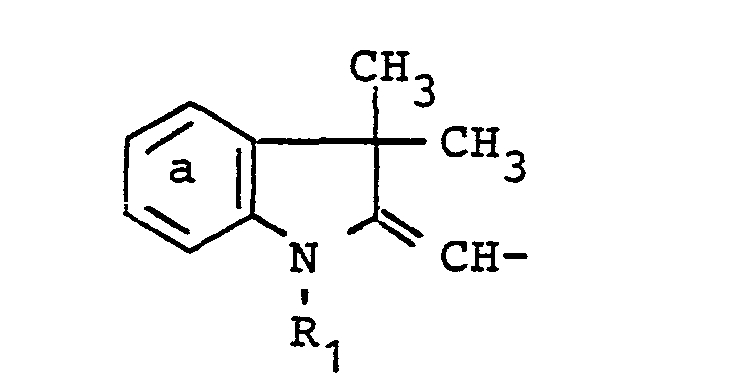
- R1 für Alkyl, Alkenyl oder Aralkyl,
- B für einen isocyclischen oder heterocyclischen aromatischen Rest oder einen Rest der Formel

- R für Wasserstoff, Alkyl oder Aralkyl oder für Alkylen, das mit B in der o-Stellung zum Stickstoff verbunden ist,
- X für ein Anion der Formel

- Y . für Alkyl, Aryl oder Alkoxy stehen, worin A oder B eine positive Ladung trägt, und worin a, A, B, R, R1, R2 und Y durch nichtionische Reste substituiert sein können, durch Kondensation von Aldehyden der Formel


- A, B, a, R und R1 die in Formel (I) angegebene Bedeutung haben, in Gegenwart von Säuren der Formel

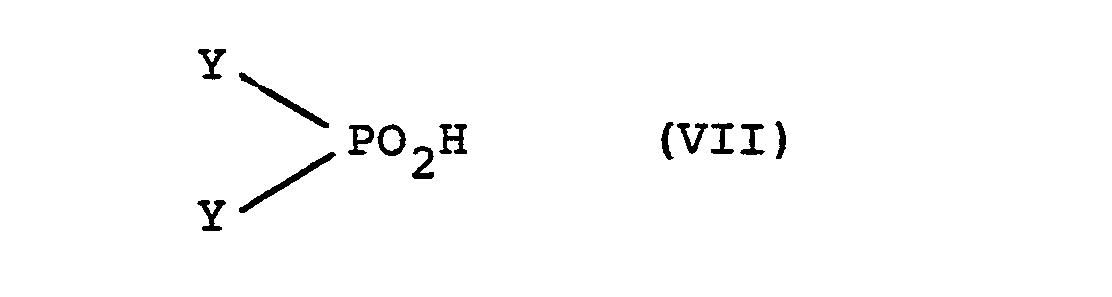
- Y die vorstehend angegebene Bedeutung hat, im organischen Lösungsmittel hergestellt.
- Als Säuren sind besonders diejenigen der Formel (VI) und (VII) zu nennen, worin
- Y für einen Alkoxyrest mit 1-4 C-Atomen, einen gegebenenfalls durch 1-3 Alkylreste mit 1-4 C-Atomen, Alkoxyreste mit 1-4 C-Atomen, Halogen oder Hydroxyl substituierter Phenylrest oder einen C1- bis C4-Alkylrest steht.
- Ganz besonders sind Säuren der Formel (VI) bevorzugt, worin Y für Methyl, Phenyl oder p-Tolyl steht.
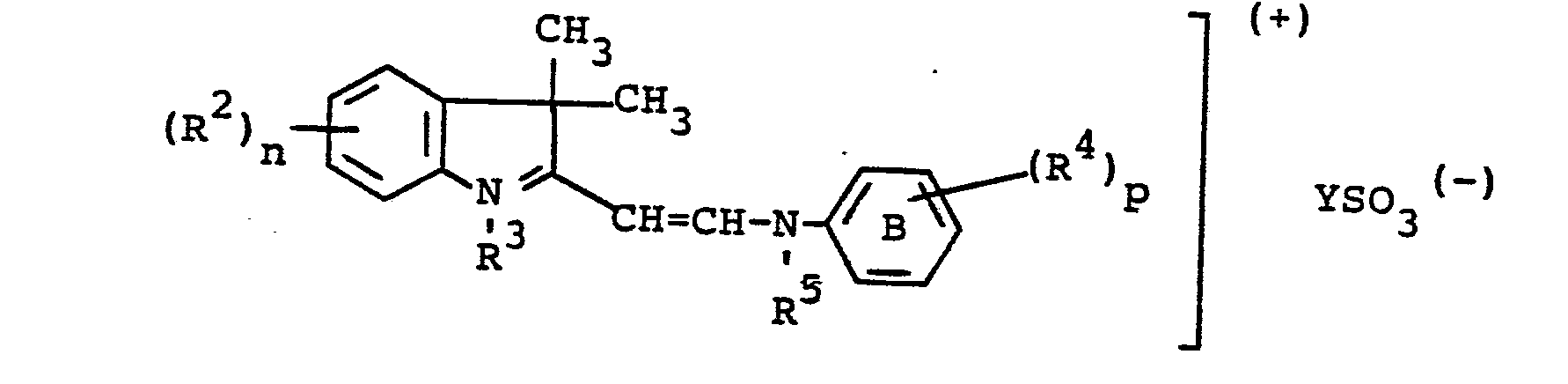
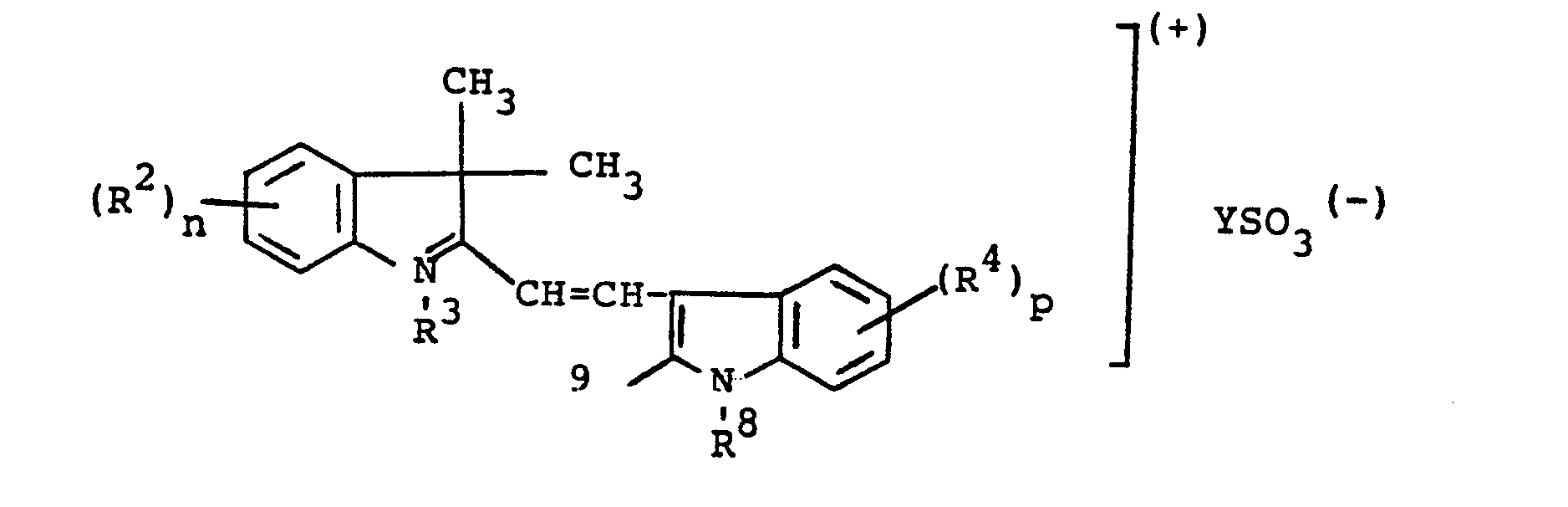
- Bevorzugte Gruppe von Farbstoffen, die nach dem neuen Verfahren darstellbar sind, entsprechen den allgemeinen Formeln


- R2 für Wasserstoff, einen Alkylrest mit 1 bis 4 C-Atomen, Halogen, Alkoxy mit 1 bis 4 C-Atomen, Phenoxy, Benzyloxy, Benzyl, Carboxyl, Phenoxyethyl, Phenoxyethoxy, einen Carbonsäurealkylester mit 1 bis 4 C-Atomen, eine gegebenenfalls durch 1 oder 2 C1- bis C4-Alkylreste substituierte Carbonamidgruppe, eine gegebenenfalls durch 1 oder 2 C1- bis C4-Alkylreste substituierte Sulfonamidgruppe, Alkylsulfonyl mit 1 bis 4 C-Atomen, Phenylsulfonyl, eine Cyan-, Trifluormethyl-, Acetyl- oder Benzoylgruppe,
- R 3 für einen gegebenenfalls durch Hydroxy, Alkoxy, Acyloxy, Halogen, Cyan, Carboxy, C1-C4-Carbalkoxy, Carbonamido oder Acetyl substituierten Alkylrest mit 1 bis 4 C-Atomen stehen,
- R4 die gleiche Bedeutung wie R2 hat oder zusammen mit dem Benzolring B ein Tetralin-,.Naphthalin- oder Benzdioxanringsystem bildet,
- R6 für Wasserstoff oder einen Rest mit der gleichen Bedeutung wie R 3,
- R7 die gleiche Bedeutung wie R6 haben kann, oder für gegebenenfalls durch Alkyl oder Alkoxy mit 1 bis 4 C-Atomen substituiertes Phenyl steht, oder für einen Alkylsubstituenten, der einen 5- oder 6- gliedrigen Ring zur benachbarten Stellung des Arylringes B schließt, wobei dieser dabei gebildete heterocyclische 5- oder 6-gliedrige Ring gegebenenfalls alkylsubstituiert oder mit oder mit einem weiteren carbocyclischen Ring kondensiert sein kann, steht,
- R 8 für Wasserstoff, C1 bis C4-Alkyl,
- R 9 für Wasserstoff, C1 bis C4-Alkyl, gegebenenfalls durch Alkyl mit 1 bis 4 C-Atomen substituiertes Phenyl stehen,
- Y die obengenannte Bedeutung hat und
- n und p für 1 oder 2 stehen.
- Von den Farbstoffen der Formeln (VIII), (IX) und (X) sind insbesondere solche zu nennen, worin
- n und p für 1 stehen,
- R 2 für Wasserstoff, Chlor, Methyl, Methoxy, Ethoxy, Benzyl, Phenoxy, Benzyloxy oder Carbomethoxy,
- R 3 für Methyl,
- R 4 für Wasserstoff, Methyl, Methoxy, Ethoxy, Benzyl, Benzyloxy, Phenoxy, Chlor, C1- bis C2-alkylsubstituiertes Carbonamid oder zusammen mit dem Ring B für ein Naphthalin-, Tetrahydronaphthalin- oder Benzdioxanringsystem,
- R 5 für Wasserstoff oder bevorzugt für einen Alkylrest, der zur o-Stellung des Ringes B einen 5- oder 6-Ring schließt, der durch 1 bis 3 C1- bis C2-Alkylgruppen substituiert oder mit einem Cyclohexanring kondensiert sein kann, stehen,
- R 6 für Wasserstoff, Methyl oder Ethyl,
- R für Wasserstoff, Methyl, Ethyl, Phenyl, durch Alkyl oder Alkoxy mit 1 bis 2 C-Atomen substituiertes Phenyl oder einen Phenylrest, der orthoständig zum Ring B kondensiert ist,
- R 8 für Wasserstoff, Methyl oder Ethyl,
- R 9 für Methyl oder Phenyl stehen und
- Y die gleiche Bedeutung wie oben.hat.
- Unter nichtionischen Substituenten sind im Sinne der vorliegenden Erfindung die in der Farbstoffchemie üblichen und unter gebräuchlichen Herstellungs- und Verwendungsbedingungen nicht dissoziierenden Substituenten zu verstehen, wie Halogen, z.B. Fluor, Chlor, Brom, Hydroxy, Alkyl, Alkenyl, Aryl, Aralkyl, Aryloxy, Alkoxy oder Hydroxyalkoxy, Cycloalkoxy, Aralkoxy, Aryloxyalkoxy, Alkylthio, Aralkylthio, Arylthio, Nitro, Cyan, Formyl, Alkylcarbonyl, Arylcarbonyloxy, Alkylcarbonyloxy, Alkoxycarbonyloxy, Alkylcarbonylamino, Alkylaminocarbonyloxy, Arylcarbonyl, Aralkylcarbonyl, Arylsulfonylamino, Aralkylsulfonylamino, Alkylsulfonylamino, Ureido, N-Alkyl-ureido, Aryloxycarbonylamino, Alkyloxycarbonylamino, Carbamoyl, N-Alkyl-carbamoyl, N,N-Dialkyl-carbamoyl, N-Alkyl-N-arylcarbamoyl, Sulfamoyl, N-Alkyl-sulfamoyl, N,N-Dialkyl- sulfamoyl, Alkylsulfonyl, Alkenylsulfonyl, Arylsulfonyl, Aralkylsulfonyl, Aryloxysulfonyl, Aryloxycarbonyl, Alkoxycarbonyl, Aralkoxycarbonyl, Mono-, Di- oder Trialkylsulfamidin, Alkylarylsulfamidin, Alkylcycloalkylsulfamidin und Arylazo. Auch Polyglykoletherreste mit Halogen-, Hydroxy- oder Alkyloxysubstituenten sind geeignet.
- In den Formeln und in den vorstehend genannten nichtionischen Substituenten sind unter Alkylresten insbesondere Ci- bis C8-Alkylreste und unter Alkenylresten insbesondere C3- bis C5-Alkenylreste zu verstehen.
- Geeignete Arylreste sind insbesondere der Phenyl- oder Naphthylrest.
- Geeignete Aralkylreste sind insbesondere der Benzyl-, α- oder ß-Phenylethyl-, α-, ß- oder t-Phenylpropylrest. Unter Cycloalkyl wird vorzugsweise Cyclohexyl verstanden. Durch Ankondensation weiterer Ringe an die Ringe A und B entstehen beispielsweise Naphthalin-, Tetralin- oder Benzdioxansysteme.
- Die aliphatischen und isocyclischen Reste können ihrerseits die vorstehend genannten nichtionischen Substituenten tragen.
- Unter Acyl wird beispielsweise Acetyl, Propionyl, Benzoyl oder Carbamoyl verstanden.
- Der Vorteil des neuen Verfahrens besteht darin, daß man - ohne eine wäßrige Phase zu durchlaufen, aus der der Farbstoff durch Aussalzen, Abfiltrieren und Trocknen isoliert werden und ohne daß der so isolierte Farbstoff wieder zu einer Spinnlösung gelöst und anschließend filtriert werden muß - unmittelbar zu einer anwendbaren Spinn-Flüssigeinstellung gelangt. Bei dem neuen Verfahren Fällt daher kein Abwasser an, und das arbeits- und energieaufwendige Trocknen des aus der Lösung isolierten Farbstoffes entfällt.
- Es werden Farbstoff-Lösungen erhalten, die sehr hoch konzentriert an Farbsalzen der Formel (I) sind, beispielsweise enthalten sie 10 bis 70 % Farbstoff. Geeignete Aldehyde der Formel (II) sind beispielsweise 4-Dimethylaminobenzaldehyd, 4-Diethylaminobenzaldehyd, 4-[(2-Chlorethyl)-methylamino]-benzaldehyd, 4-[(2-Chlorethyl)-ethylamino]-benzaldehyd, 4-[Butyl(2-chlorethyl)-amino]-benzaldehyd, 4-[Butyl(2-cyanethyl)amino]-benz- aldehyd, 3-[(4-Formyl-phenyl)-methylamino]-propannitril, 4-[(2-Chlorethyl)-ethyl-amino]-2-methylbenzaldehyd, 4-[(2-Cyanethyl)-methyl-amino]-2-methyl-benzaldehyd, 4-[N-Ethyl-N-B-(4-methoxycarbonylbenzoyloxy)-ethylamino)-2-methylbenzaldehyd, N-Methyl-3-formylcarbazol, N-Ethyl-3-formylcarbazol, 4-(Benzyl-ethylamino)-benzaldehyd, 4-(Benzyl-ethylamino)-2-methylbenzaldehyd, 4[4-Ethoxyphenyl)-ethyl)-amino/-benzaldehyd, 4-L(4-Ethoxyphenyl)-methyl)-amino]-benzaldehyd, 2-Methyl-3-formyl-1H-indol, 1-Methyl-2-phenyl-3-formyl-indol, 1,2-Dimethyl-3-formyl- indol.
- Geeignete Verbindungen der Formel III sind beispielsweise 1,3,3-Trimethyl-2-methylen-indolin, 1,3,3,5-Tetramethyl-2-methylen-indolin, 1,3,3-Trimethyl-5-chlor-2-methylen- indolin, 1,3,3-Trimethyl-5-methoxy-2-methylen-indolin, 1,3,3-Trimethyl-5-carboethoxy-3-methylen-indolin, 1,3,3-Trimethyl-5-methylsulfonyl-2-methylen-indolin, 1,3,3-Trimethyl-5-benzyl-2-methylen-indolin, 1,3,3-Trimethyl-5-benzoyloxy-2-methylenindolin, 1,3,3-Trimethyl-5-(4-chlor- phenoxy)-2-methylen-indolin, 1,3,3-Trimethyl-7-methoxy-2-methylen-indolin, 1,3,3-Trimethyl-5-chlor-7-methoxy-2-methylen-indolin, 1,3,3-Trimethyl-5,7-dimethoxy-2-methylenindolin, 1,3,3-Trimethyl-7-phenoxy-2-methylen- indolin.
- Für das Verfahren geeignete Zwischenprodukte der Formel IV sind beispielsweise: 1,3,3-Trimethyl-2-methylen-indolin-ω -aldehyd, 1,3,3,5-Tetramethyl-2-methylen-indolin- ω - aldehyd, 1,3,3-Trimethyl-5-chlor-2-methylen-indolin- ω - aldehyd, 1,3,3-Trimethyl-5-methoxy-2-methylen-indolin-ω-aldehyd, 1,3,3-Trimethyl-5-carboethoxy-2-methylen- indolin- ω-aldehyd, 1,3,3-Trimethyl-5-methylsulfonyl-2-methylen-indolin- ω-aldehyd, 1,3,3-Trimethyl-5-benzyl-2-methylen-indolin- ω-aldehyd, 1,3,3-Trimethyl-5-benzyloxy-2-methylen-indolin-ω-aldehyd, 1,3,3-Trimethyl-5-(4-chlor-phenoxy)-2-methylen-indolin- ω-aldehyd, 1,3,3-Trimethyl-7-methoxy-2-methylen-indolin-ω-aldehyd, 1,3,3-Trimethyl-5-chlor-7-methoxy-2-methylen-indolin-ω-aldehyd, 1,3,3-Trimethyl-5,7-dimethoxy-2-methylen- indolin-ω -aldehyd, 1,3,3-Trimethyl-7-phenoxy-2-methylen- indolin- ω-aldehyd .
- Geeignete Amine der Formel (V) sind beispielsweise: 4-Amino-diphenylether, 4-Amino-4'-methyl-diphenylether, 4-Amino-4'-ethyl-diphenylether, 4-Amino-4'-tert.-butyl-diphenylether, 4-Amino-4'-cyclohexyl-diphenyl- ehter, 4-Amino-2'-methyl-diphenylether, 4-Amino-3'-methyl- diphenylether, 4-Amino-4'-methoxy-diphenylether, 4-Amino-3'-methoxy-diphenylether, 4-Amino-4'-ethoxy-diphenylether, 4-Amino-4'-acetylamino-diphenylether, 4-Amino-4'-hydroxydiphenylether, 4-Amino-4'-nitro-diphenylether, 4-Amino-4'-chlor-diphenylether, 4-Amino-2'-chlordiphenylether, 4-Amino-3'-chlor-diphenylether, 4-Amino-phenyl-α-naphthylether, 4-Aminophenyl-ß-naphthylether, 4-Amino-2',3',5'-trimethyl-diphenylether, 4-Aminophenyl-benzylether, 3-Aminophenyl-benzylether, 2-Aminophenyl-benzylether, 2-Aminodiphenylether, 4-Aminophenyl-4'-methylbenzylether, 4-Aminophenyl-4'-chlorbenzylether, 4-Aminophenyl.-2'-chlorbenzylether, 4-Aminophenyl-3',4'-dichlorbenzylether, 4-Aminobenzyl-2',4',5'-trichlorbenzylether, 3-Aminophenyl-4'-methylbenzylether, 3-Aminophenyl-4'-chlor- benzylether, 3-Aminophenyl-2'-chlorbenzylether, 3-Aminophenyl-3',4'-dichlorbenzylether, 3-Aminophenyl-2',4',5'-trichlorbenzylether, 2-Aminophenyl-4'-methylbenzylether, 2-Aminophenyl-4'-chlorbenzylether, 2-Aminophenyl-3',4'-dichlorbenzylether, 2-Aminophenyl-2',4',5'-trichlorbenzyl- ether, 4-Amino-2-methylphenyl-benzylether, 5-Amino-2-methyl-phenyl-benzylether, 2-Amino-5-methyl-phenyl-benzylether, 4-Amino-2-methoxy-phenyl-benzylether, 4-Amino-3-methoxy-phenyl-benzyletherm 4-Amino-3-methyl-phenylbenzylether, 4-Amino-3-chlor-phenyl-benzylether, 4-Amino-2-chlor-phenyl-benzylether, 4-Amino-2-methyl-phenyl-4'-methylbenzylether, 5-Amino-2-methyl-phenyl-3',4'-di- chlorbenzylether, 2-Amino-5-methyl-phenyl-4'-chlorbenzyl- ether, 4-Amino-2-methoxy-phenyl-4'-methylbenzylether, 4-Amino-3-methyl-phenyl-2',4',5'-trichlorbenzylether, Anilin, p-Toluidin, m-Toluidin, o-Anisidin, m-Anisidin, p-Anisidin, o-Phenetidin, p-Phenetidin, 4-Dodecyloxyanilin, 4-Amino-acetanilid, N-Benzoyl-p-phenylendiamin, 2,4-Dimethoxy-anilin, 2,5-Dimethoxy-anilin, 3,4-Dimethoxy-anilin, 2-Chlor-4-amino-anisol, 2,4,5-Trimethyl-anilin, 2,3,5-Trimethyl-anilin, 5-Amino-2-acgtylamino- anisol, 6-Amino-3-methoxy-toluol, 3,4-Dicyan-anilin, p-Sulfanilsäureamid, 4-Amino-benzamid, 4-Chlor-anilin, 4-Fluor-anilin, 1,2,3,4-Tetrahydro-5-amino-naphthalin, 4-Amino-2,5-diethoxy-benzoesäureanilid, 4-Amino-2-methyl-5-methoxy-benzanilid, 4-Cyclohexyl-anilin, 2,4-Diethoxyanilin, 1-Amino-naphthalin, 2-Methyl-2,3-dihydro-indol, Hexahydrocarbazol, 2,3,3-Trimethyl-2,3-dihydro-indol, 2,3,3-Trimethyl-5-methoxy-2,3-dihydro-indol, 4-Aminobrenzcatechinethylenether, 6-Amino-benzdioxan, 1,2,3,4-Tetrahydro-6-methoxy-chinolin, 4-Methylamino-phenylbenzylether, 4-Ethylamino-phenylbenzylether.
- Geeignete Säuren der Formeln (VI) und (VII) sind beispielsweise: Benzolsulfonsäure, 2-Methyl-benzolsulfonsäure, 4-Methyl-benzolsulfonsäure, 2,4-Dimethylbenzolsulfonsäure, 2-Chlor-benzolsulfonsäure, 4-Chlor-benzolsulfonsäure, 2,4-Dichlor-benzolsulfonsäure, 4-Hydroxybenzolsulfonsäure, 4-Methoxybenzolsulfonsäure, Naphthalin-1-sulfonsäure, Naphthalin-2-sulfonsäure, Methansulfonsäure, Ethansulfonsäure, Butansulfonsäure, Methylschwefelsäure, Ethylschwefelsäure oder deren Gemische sowie Phosphorsäurediethylester.
- Anspruchsgemäß werden die Farbstoffe hergestellt, indem man in das Lösemittel nacheinander entweder zunächst den Aldehyd, dann die organische Säure und schließlich die Base einträgt oder aber Base und Säure vorlegt und dann den Aldehyd zugibt.
- Die Reaktionstemperatur wählt man im Bereich zwischen 20°C und 100°C, vorzugsweise zwischen 30°C und 60°C.
- Das molare Verhältnis Aldehyd/Base beträgt vorzugsweise 1, wogegen darauf bezogen an organischer Säure 1 bis 2 Äquivalente eingesetzt werden. Die Gesamtkonzentration bezogen auf das Lösemittel kann zwischen 10 % und 70 % liegen.
- Die Umsetzung erfolgt überraschend glatt und quantitativ. Man erhält auf diese Weise stabile, konzentrierte, mineralsalzfreie Lösungen von Farbstoffen, die direkt dem Spinnsystem zudosiert werden können.
- In 450 g Dimethylformamid werden nacheinander 44,4 g p-Dimethylaminobenzaldehyd und 90 g p-Toluolsulfonsäure eingetragen und unter Rühren auf 50°C erwärmt. In die entstandene Lösung tropft man innerhalb 15 Minuten 51 g 1,3,3-Trimethyl-2-methylen-indolin zu und läßt 10 Stunden bei 50°C nachrühren.
- Nach dem Abkühlen auf Raumtemperatur wird mit etwa 280 g Dimethylformamid die gebrauchsfertige violette FarbstoffLösung eingestellt.
- Die Lösung enthält in einer ca. 20 %igen Konzentration den Farbstoff

- In 1245 g Dimethylformamid werden 66,5 g 2-Methyl-indolin und 100 g p-Toluolsulfonsäure verrührt. Bei 35°C werden langsam 101 g Fischers Aldehyd /(1,3,3-Trimethyl-indolin-2-yliden)-acetaldehyd/ eingetragen. Nach 2 Stunden bei 35°C ist die Umsetzung vollständig. Nach dem Abkühlen auf Raumtemperatur wird die gelbe Spinnfarbstoff-Lösung mit Dimethylformamid auf die gewünschte Farbstärke eingestellt.
- Die Lösung enthält den Farbstoff der Formel

- Für die nach den geschilderten Verfahren herstellbaren Farbstofflösungen seien beispielhaft genannt:


Claims (8)



Applications Claiming Priority (2)
| Application Number | Priority Date | Filing Date | Title |
|---|---|---|---|
| DE19833301024 DE3301024A1 (de) | 1983-01-14 | 1983-01-14 | Verfahren zur herstellung von stabilen loesungen kationischer methinfarbstoffe und ihre verwendung zum spinnfaerben |
| DE3301024 | 1983-01-14 |
Publications (2)
| Publication Number | Publication Date |
|---|---|
| EP0113920A2 true EP0113920A2 (de) | 1984-07-25 |
| EP0113920A3 EP0113920A3 (de) | 1985-05-08 |
Family
ID=6188255
Family Applications (1)
| Application Number | Title | Priority Date | Filing Date |
|---|---|---|---|
| EP83113225A Withdrawn EP0113920A3 (de) | 1983-01-14 | 1983-12-30 | Verfahren zur Herstellung von stabilen Lösungen kationischer Methinfarbstoffe und ihre Verwendung zum Spinnfärben |
Country Status (2)
| Country | Link |
|---|---|
| EP (1) | EP0113920A3 (de) |
| DE (1) | DE3301024A1 (de) |
Cited By (3)
| Publication number | Priority date | Publication date | Assignee | Title |
|---|---|---|---|---|
| US8544475B2 (en) | 2005-08-30 | 2013-10-01 | L'oreal | Packaging and applicator assembly including a magnetic device, a magnetic device, a method of forming a pattern on a nail using a magnetic device and a method of manufacturing a magnetic device |
| US9609934B2 (en) | 2004-10-05 | 2017-04-04 | L'oreal | Method of applying makeup by means of a magnetic composition including at least one interferential pigment |
| US9649261B2 (en) | 2004-10-05 | 2017-05-16 | L'oreal | Method of applying makeup to a surface and a kit for implementing such a method |
Families Citing this family (2)
| Publication number | Priority date | Publication date | Assignee | Title |
|---|---|---|---|---|
| US8007772B2 (en) | 2002-10-02 | 2011-08-30 | L'oreal S.A. | Compositions to be applied to the skin and the integuments |
| US7981404B2 (en) | 2004-04-08 | 2011-07-19 | L'oreal S.A. | Composition for application to the skin, to the lips, to the nails, and/or to hair |
Family Cites Families (4)
| Publication number | Priority date | Publication date | Assignee | Title |
|---|---|---|---|---|
| DE1077372B (de) * | 1957-10-18 | 1960-03-10 | Bayer Ag | Verfahren zum Spinnfaerben von Polyacrylnitril oder Acrylnitril enthaltenden Mischpolymerisaten |
| BE837655A (fr) * | 1976-01-16 | 1976-07-16 | Procede de preparation de colorants cationiques purs | |
| DE2945028A1 (de) * | 1979-11-08 | 1981-05-21 | Hoechst Ag, 6000 Frankfurt | Quartaere und basische azamethinverbindungen, verfahren zu ihrer herstellung und ihre verwendung als farbmittel |
| DE3213966A1 (de) * | 1982-04-16 | 1983-10-27 | Bayer Ag, 5090 Leverkusen | Verfahren zur herstellung von kationischen methinfarbstoffen |
-
1983
- 1983-01-14 DE DE19833301024 patent/DE3301024A1/de not_active Withdrawn
- 1983-12-30 EP EP83113225A patent/EP0113920A3/de not_active Withdrawn
Cited By (3)
| Publication number | Priority date | Publication date | Assignee | Title |
|---|---|---|---|---|
| US9609934B2 (en) | 2004-10-05 | 2017-04-04 | L'oreal | Method of applying makeup by means of a magnetic composition including at least one interferential pigment |
| US9649261B2 (en) | 2004-10-05 | 2017-05-16 | L'oreal | Method of applying makeup to a surface and a kit for implementing such a method |
| US8544475B2 (en) | 2005-08-30 | 2013-10-01 | L'oreal | Packaging and applicator assembly including a magnetic device, a magnetic device, a method of forming a pattern on a nail using a magnetic device and a method of manufacturing a magnetic device |
Also Published As
| Publication number | Publication date |
|---|---|
| EP0113920A3 (de) | 1985-05-08 |
| DE3301024A1 (de) | 1984-07-19 |
Similar Documents
| Publication | Publication Date | Title |
|---|---|---|
| DE3623156A1 (de) | Verfahren zur herstellung polycyclischer verbindungen | |
| EP0176472B1 (de) | Methinazoverbindungen | |
| EP0029136B1 (de) | Quartäre und basische Azamethinverbindungen, Verfahren zu ihrer Herstellung und ihre Verwendung als Farbmittel | |
| DE3301024A1 (de) | Verfahren zur herstellung von stabilen loesungen kationischer methinfarbstoffe und ihre verwendung zum spinnfaerben | |
| DE1070313B (de) | Verfahren zur Herstellung von 1-Amino-4- phenylamino- anthrachinon- 2- sulfonsäuren | |
| DE2234468C3 (de) | Basische Azofarbstoffe, ihre Herstellung und ihre Verwendung zum Färben von vorzugsweise sauermodifizierten Synthesefasern | |
| EP0074569A2 (de) | Kationische Methinfarbstoffe, Verfahren zu ihrer Herstellung sowie deren Verwendung zum Färben von Textilmaterialien und anderen Substraten | |
| DE2437549A1 (de) | Kationische farbstoffe | |
| EP0113921A2 (de) | Verfahren zur Herstellung von stabilen Lösungen kationischer Methinfarbstoffe | |
| DE1932647A1 (de) | Sulfonsaeuregruppenhaltige Anthrachinonfarbstoffe | |
| EP0042556B1 (de) | Verfahren zur Herstellung kationischer Alkylarylhydrazonfarbstoffe und deren Farbbasen | |
| DE693025C (de) | Verfahren zur Herstellung von Polymethinfarbstoffen | |
| DE2219217A1 (de) | Disazofarbstoffe | |
| DE2040652B2 (de) | Methinfarbstoffe | |
| EP0113922A2 (de) | Verfahren zur Herstellung von kationischen Methinfarbstoffen | |
| DE2245093A1 (de) | Wasserloesliche azofarbstoffe der pyrimido-bis-benzimidazolreihe | |
| DE889197C (de) | Verfahren zur Herstellung von Anthrachinonfarbstoffen | |
| DE1925288B2 (de) | Sulfonsaeuregruppenfreie disazofarbstoffe, ihre herstellung und verwendung zum faerben stickstoffhaltiger fasermaterialien | |
| DE2040653C3 (de) | Methinfarbstoffe, Verfahren zu deren Herstellung und ihre Verwendung zum Färben von bestimmten Polymerisaten, Mischpolymerisaten, Leder, tannierter Baumwolle, Druckpasten und ligninhaltigen Fasern | |
| EP0033459A1 (de) | Benzoxazolylstilbene, Verfahren zu deren Herstellung und deren Verwendung als optische Aufheller | |
| DE2211958A1 (de) | Basische farbstoffe | |
| EP0109527A1 (de) | Wasserunlösliche Monoazofarbstoffe, Verfahren zu deren Herstellung und Verwendung | |
| DE849879C (de) | Verfahren zur Herstellung von neuen Azofarbstoffen | |
| DE1133053B (de) | Verfahren zur Herstellung basischer Farbstoffe | |
| DE2237634C3 (de) | Anthrachinonazopigmente, Verfahren zu deren Herstellung und ihre Verwendung |
Legal Events
| Date | Code | Title | Description |
|---|---|---|---|
| PUAI | Public reference made under article 153(3) epc to a published international application that has entered the european phase |
Free format text: ORIGINAL CODE: 0009012 |
|
| 17P | Request for examination filed |
Effective date: 19831230 |
|
| AK | Designated contracting states |
Designated state(s): CH DE FR GB LI |
|
| PUAL | Search report despatched |
Free format text: ORIGINAL CODE: 0009013 |
|
| AK | Designated contracting states |
Designated state(s): CH DE FR GB LI |
|
| 17Q | First examination report despatched |
Effective date: 19860509 |
|
| D17Q | First examination report despatched (deleted) | ||
| STAA | Information on the status of an ep patent application or granted ep patent |
Free format text: STATUS: THE APPLICATION HAS BEEN WITHDRAWN |
|
| 18W | Application withdrawn |
Withdrawal date: 19910508 |
|
| R18W | Application withdrawn (corrected) |
Effective date: 19910508 |
|
| APAF | Appeal reference modified |
Free format text: ORIGINAL CODE: EPIDOSCREFNE |
|
| RIN1 | Information on inventor provided before grant (corrected) |
Inventor name: BARA, HELMUT Inventor name: WIESEL, MANFRED, DR. |