EP0114065A2 - Bloc de construction - Google Patents
Bloc de construction Download PDFInfo
- Publication number
- EP0114065A2 EP0114065A2 EP84100272A EP84100272A EP0114065A2 EP 0114065 A2 EP0114065 A2 EP 0114065A2 EP 84100272 A EP84100272 A EP 84100272A EP 84100272 A EP84100272 A EP 84100272A EP 0114065 A2 EP0114065 A2 EP 0114065A2
- Authority
- EP
- European Patent Office
- Prior art keywords
- channels
- block
- channel
- module
- upper shell
- Prior art date
- Legal status (The legal status is an assumption and is not a legal conclusion. Google has not performed a legal analysis and makes no representation as to the accuracy of the status listed.)
- Withdrawn
Links
Images


Classifications
-
- E—FIXED CONSTRUCTIONS
- E04—BUILDING
- E04C—STRUCTURAL ELEMENTS; BUILDING MATERIALS
- E04C1/00—Building elements of block or other shape for the construction of parts of buildings
- E04C1/39—Building elements of block or other shape for the construction of parts of buildings characterised by special adaptations, e.g. serving for locating conduits, for forming soffits, cornices, or shelves, for fixing wall-plates or door-frames, for claustra
- E04C1/392—Building elements of block or other shape for the construction of parts of buildings characterised by special adaptations, e.g. serving for locating conduits, for forming soffits, cornices, or shelves, for fixing wall-plates or door-frames, for claustra for ventilating, heating or cooling
-
- E—FIXED CONSTRUCTIONS
- E04—BUILDING
- E04B—GENERAL BUILDING CONSTRUCTIONS; WALLS, e.g. PARTITIONS; ROOFS; FLOORS; CEILINGS; INSULATION OR OTHER PROTECTION OF BUILDINGS
- E04B2/00—Walls, e.g. partitions, for buildings; Wall construction with regard to insulation; Connections specially adapted to walls
- E04B2/02—Walls, e.g. partitions, for buildings; Wall construction with regard to insulation; Connections specially adapted to walls built-up from layers of building elements
- E04B2/14—Walls having cavities in, but not between, the elements, i.e. each cavity being enclosed by at least four sides forming part of one single element
- E04B2/16—Walls having cavities in, but not between, the elements, i.e. each cavity being enclosed by at least four sides forming part of one single element using elements having specially-designed means for stabilising the position
- E04B2/18—Walls having cavities in, but not between, the elements, i.e. each cavity being enclosed by at least four sides forming part of one single element using elements having specially-designed means for stabilising the position by interlocking of projections or inserts with indentations, e.g. of tongues, grooves, dovetails
-
- E—FIXED CONSTRUCTIONS
- E04—BUILDING
- E04B—GENERAL BUILDING CONSTRUCTIONS; WALLS, e.g. PARTITIONS; ROOFS; FLOORS; CEILINGS; INSULATION OR OTHER PROTECTION OF BUILDINGS
- E04B2/00—Walls, e.g. partitions, for buildings; Wall construction with regard to insulation; Connections specially adapted to walls
- E04B2/02—Walls, e.g. partitions, for buildings; Wall construction with regard to insulation; Connections specially adapted to walls built-up from layers of building elements
- E04B2002/0202—Details of connections
- E04B2002/0243—Separate connectors or inserts, e.g. pegs, pins or keys
- E04B2002/0247—Strips or bars
Definitions
- the invention relates to a building block. This should be able to be used in a particularly advantageous manner for the production of floors or walls. With this stone, the heating or cooling of the rooms should be improved.
- the building block to be created should continue to be relatively easy to install.
- the module according to the invention is characterized by at least one circumferential groove, which is used to receive a tongue for a tongue and groove connection with neighboring structures stones is determined, and by at least one channel which is intended for conducting a gaseous or liquid medium or for receiving a conduit or hose for this or an electrical heating wire.
- adjacent building blocks with springs in between can be aligned well with each other, i.e. they are in the same plane. This applies both to the arrangement of the groove (s) in a plane parallel to the largest surface of the module and to the arrangement of the grooves normal to this.
- Such a last-mentioned groove arrangement can usefully contribute to improving the holding connection of a wall or the like of greater strength to be created from the building blocks and can also promote the aesthetic external appearance of an edge or end face formed by such building blocks. If the building blocks are installed correctly, one channel of one building block connects to an assigned channel of the neighboring building block, so that, for example, a floor produced in this way is penetrated in the desired manner by channels for, for example, a flow medium.
- the latter can be used for heating or cooling.
- the aforementioned correct connection of the modules to one another can also mean that the mouth of one channel in one module is not assigned a channel of an adjacent module, i.e. the channel mouth in one module is closed by an adjacent module, so that the channel ends at this point .
- surfaces 2 and 3 can be square or rectangular.
- the channels 5 to 8 can penetrate the building block 1 in the transverse or longitudinal direction. These channels 5 to 8 can be against each other open out overlying block sides, only one block side 10 being visible in FIG. 1. The other block side mentioned is congruent with this. However, one or more channels 5 to 8 can also open out on adjoining block sides in order to deflect the flow medium.
- These last two module pages could be pages 10 and 11, for example. Module 1 also has a page 32.
- the module 1 shown in FIG. 1 is symmetrical with respect to a vertical plane 12, so that the module therefore has a total of five channels, one of which is not shown.
- a dummy joint 31 extends at right angles to the plane of the drawing over the entire extent of surface 2.
- Channels 5 to 8 and the channel (not shown) are molded in during the manufacture of the module. These channels can be used to direct the flow medium; but they can also be used to hold pipes 13 and 14 or a heating coil (not shown).
- the module has a lower shell 16 and an upper shell 17, the circumferential groove 4 being shown purely, for example, as only present in the upper shell 17, but could also be provided only in the lower shell 16 or in both shells 17 and 16.
- the upper shell has base areas 2 and 18.
- the lower shell 16 has base areas 19 and 3.
- the surfaces 2 and 3 of the stone 15 according to FIG. 2 correspond to the surfaces 2 and 3 of the block 1 according to FIG. 1.
- the block 15 can preferably be between the surfaces 11 and 32 have half the width as the block 1 between its surfaces 11 and 32.
- the block 15 then has the width and the distance between the surface 11 and the plane 12 of the dummy joint 31 in the case of the stone 1.
- the lower shell 16 is provided with at least one channel 20, as can be seen from the top view of the lower shell 16 in FIG. 3.
- the surfaces 2 and 3 of the module 15 can preferably be square.
- the lower shell and the upper shell in turn have the side surfaces 10 and 11 as in the case of module 1 according to FIG. 1.
- the channel 20 has different openings 36 on the side surfaces 10, 11 and 21 of the lower shell 16. The channel 20 thus opens out both at the opposite ones Pages 10 and 21 as well as on the adjacent pages 10 and 11.
- the two-part design of the module 15 ′ according to FIGS. 2 and 3 has the advantage, for example, that the upper shell 17 can be made of a different material than the lower shell 16. If one assumes that the upper shell 17 is intended to face the interior of the room when laying the building block in rooms, then a material can be preferably used for the upper shell 17 which has a greater thermal conductivity than that of the lower shell 16. Regardless of whether the flow medium flowing in the duct 20 directly or in pipes or hoses is used for heating or cooling the room, such a measure now achieves improved heat transfer (cold transfer), because the heat conduction (cold conduction) essentially takes place via the material the upper shell 17, since this has better heat conduction (cold conduction). The same applies if a heating coil is installed in the duct.
- the two-part module according to FIGS. 2 and 3 also has the advantage that the upper shell 17 can be made of a more valuable material than the lower shell 16.
- the upper shell 17 can with its upper surface 2 directly form the tread in the room. A less attractive material can then be used for the invisible lower shell.
- a module 22 which is intended, for example, to produce a wall.
- This module in turn has a top 2 and a bottom 3 and a circumferential groove 4.
- This module 22 has. Channels 23 and 24, which are present as channel-like trough-shaped depressions in the building block material.
- the channel 20 is present as a trough-like, trough-shaped depression in the lower shell 16.
- this module has channels 23 and 24 present as channels.
- the module 1 according to FIG. 1, on the other hand, has tubular channels, and the module 15 according to FIGS.
- 2 and 3 also has a tubular channel 20 which is formed by the upper shell 17 and lower shell 16. 2 and 3, the upper shell 17 is part of the module and results in a closed channel in the module.
- the channels 24 and 23 present as a groove-like depression are covered by a cover plate 25, which can be designed, for example, as a wall tile. This cover plate 25 now again creates closed tubular channels 23 and 24.
- FIG. 4 it is shown purely for example how two modules 22 and 22 'connect to one another.
- a spring designated here 9 ′, which lies in two mutually facing sections of the circumferential grooves 4.
- the module 22 can preferably have, for example, a recess 26 in its edge region, which serves to fasten the modules 22 to a carrier 28 with a screw 27.
- insulation material 30 is arranged between this wall 29 and the module 22.
- the channel 20 shown in FIG. 2 could only be present in the upper shell 17; however, it is also possible to provide the channel 20 both in the lower shell 16 (as shown) and in the upper shell 17.
- the spring-9 is shown more clearly. It preferably consists of a plastic.
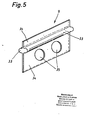
- the length of the spring can preferably correspond to the distance between the surfaces 11 and 32 of the module 15 according to FIGS. 2 and 3. This distance is then half as large as for module 1 according to FIG. 1.
- Module 15 determines the grid for module 1 according to FIG. 1. Module 15 determines the grid when this module is installed. If blocks with a double grid are laid between them, they have a dummy joint, such as joint 31 in FIG. 1. The floor or wall formed then has a uniform grid dimension.
- the spring 9 has a connecting part 33 and a sealing part 34.
- the connecting part 33 lies in adjacent grooves 4 of adjacent modules 1 and 1 '.
- the sealing part 34 lies between adjacent side surfaces 10, 11, 21 and 32 of adjacent building blocks 1 and 1 '.
- the sealing part 34 seals the channels 5, 6, 8 and 20 of adjacent building blocks from one another in such a way that there is no leakage of the flow mediums arises.
- the spring 9 has two openings 35.
- the mouths 36 of the channels 20 on the side surfaces 10, 11 and 21 are arranged in a grid dimension, that is to say at such a distance from one another and from the adjacent side surfaces 10, 11, 21 and 32 that the channels of adjacent building blocks are always one inside the other when laid pass, with the exception, however, of such channels 5, 6, 8 or 20, whose orifices 36 adjoin a side surface 32 of an adjacent building block, since such a side surface 32 has no orifice 36.
- the orifices 36 of the channels 5, 6 and 8 are therefore in the same grid as the channels 20, and expediently all the channels 5, 6, 8 and 20 also have the same diameter, at least in their mouth openings.
- the length of the spring 9 thus extends from the side surface 11 to the plane of symmetry 12.
- Two springs 9 are therefore required for the entire side surface 10 in FIG. 1.
- the sealing part 34 of the spring 9 still has the effect that adjacent building blocks 1, 1 'cannot come into direct contact with one another, so that if adjacent building blocks are loaded unevenly after laying on the floor, they cannot be supported directly on one another and thus also none Breaking out at the edges of the building blocks can occur.
- the spring 9 can also be designed in two parts in such a way that its sealing part 34, which has the openings 35, is separated from its connecting part 33, which can certainly continue in the other sealing part 24 on the opposite side.
- the separate one can then expediently be used Sealing part 34 to improve its sealing function between adjacent components from fluid-tight sealing material, for example not only liquid but also gas-tight sealing material, which may also have a certain compressibility to facilitate assembly, at least in its near-surface zones.
- the heating means can be brought as close as possible to the surface (2) to be heated (cooling) of a room, so that the energy used for heating or cooling can be used as economically as possible and losses can be minimized.
Landscapes
- Engineering & Computer Science (AREA)
- Architecture (AREA)
- Civil Engineering (AREA)
- Structural Engineering (AREA)
- Mechanical Engineering (AREA)
- Physics & Mathematics (AREA)
- Electromagnetism (AREA)
- Floor Finish (AREA)
- Building Environments (AREA)
Applications Claiming Priority (2)
| Application Number | Priority Date | Filing Date | Title |
|---|---|---|---|
| CH22083A CH658697A5 (de) | 1983-01-14 | 1983-01-14 | Baustein. |
| CH220/83 | 1983-01-14 |
Publications (2)
| Publication Number | Publication Date |
|---|---|
| EP0114065A2 true EP0114065A2 (fr) | 1984-07-25 |
| EP0114065A3 EP0114065A3 (fr) | 1984-08-22 |
Family
ID=4182010
Family Applications (1)
| Application Number | Title | Priority Date | Filing Date |
|---|---|---|---|
| EP84100272A Withdrawn EP0114065A3 (fr) | 1983-01-14 | 1984-01-12 | Bloc de construction |
Country Status (3)
| Country | Link |
|---|---|
| EP (1) | EP0114065A3 (fr) |
| CH (1) | CH658697A5 (fr) |
| DE (1) | DE8400859U1 (fr) |
Cited By (5)
| Publication number | Priority date | Publication date | Assignee | Title |
|---|---|---|---|---|
| WO1986001244A1 (fr) * | 1984-08-07 | 1986-02-27 | Graham Mariott Thorp | Systeme de conduites pour cables |
| AT401292B (de) * | 1993-04-22 | 1996-07-25 | Berger Harro | Wandheizung |
| AT406495B (de) * | 1998-04-06 | 2000-05-25 | Thomas H Dipl Ing Lehner | Wand eines gebäudes mit zumindest einem kanal für leiter für licht od. dgl. sowie halteelement |
| GB2460837A (en) * | 2008-06-10 | 2009-12-16 | Tarmac Ltd | Method of controlling the temperature within a room of a building |
| RU2465415C1 (ru) * | 2011-03-17 | 2012-10-27 | Александр Михайлович Балаев | Стеновой блок (варианты), материал для изготовления стеновых блоков, форма для изготовления стеновых блоков (варианты), способ изготовления стеновых блоков и поточная линия для изготовления стеновых блоков |
Families Citing this family (2)
| Publication number | Priority date | Publication date | Assignee | Title |
|---|---|---|---|---|
| DE3910629C2 (de) * | 1989-04-01 | 1994-03-24 | Herbert Moser | Hohlraumboden mit Kabelführungen |
| DE4036520A1 (de) * | 1990-11-16 | 1992-05-21 | Koester Helmut | Kuehl- und heizbauelemente |
Family Cites Families (4)
| Publication number | Priority date | Publication date | Assignee | Title |
|---|---|---|---|---|
| CH369272A (de) * | 1959-02-19 | 1963-05-15 | Maerchy Johann | Mörtelfreies Mauerwerk |
| FR1520532A (fr) * | 1967-02-14 | 1968-04-12 | Procédé pour la construction de murs et de cloisons | |
| DE2452373C3 (de) * | 1974-11-05 | 1980-09-11 | Sebastian Wochner Kg, 7461 Dotternhausen | Wärmedämmendes Wandelement |
| DE3041624A1 (de) * | 1980-11-05 | 1982-06-09 | Werner T. Dipl.-Ing. 3000 Hannover Huss | Pflasterung fuer hof- und hallenflaechen, verfahren zur herstellung dieser pflasterung und werkstein zur herstellung dieser pflasterung |
-
1983
- 1983-01-14 CH CH22083A patent/CH658697A5/de not_active IP Right Cessation
-
1984
- 1984-01-12 EP EP84100272A patent/EP0114065A3/fr not_active Withdrawn
- 1984-01-13 DE DE19848400859 patent/DE8400859U1/de not_active Expired
Cited By (8)
| Publication number | Priority date | Publication date | Assignee | Title |
|---|---|---|---|---|
| US4858401A (en) * | 1984-07-08 | 1989-08-22 | Thorp Graham M | Cable ducting system |
| WO1986001244A1 (fr) * | 1984-08-07 | 1986-02-27 | Graham Mariott Thorp | Systeme de conduites pour cables |
| AT401292B (de) * | 1993-04-22 | 1996-07-25 | Berger Harro | Wandheizung |
| AT406495B (de) * | 1998-04-06 | 2000-05-25 | Thomas H Dipl Ing Lehner | Wand eines gebäudes mit zumindest einem kanal für leiter für licht od. dgl. sowie halteelement |
| GB2460837A (en) * | 2008-06-10 | 2009-12-16 | Tarmac Ltd | Method of controlling the temperature within a room of a building |
| CN102119301A (zh) * | 2008-06-10 | 2011-07-06 | 塔迈克建工材料有限公司 | 改变热负载的温度 |
| GB2460837B (en) * | 2008-06-10 | 2012-03-28 | Tarmac Building Products Ltd | Changing the temperature of a thermal load |
| RU2465415C1 (ru) * | 2011-03-17 | 2012-10-27 | Александр Михайлович Балаев | Стеновой блок (варианты), материал для изготовления стеновых блоков, форма для изготовления стеновых блоков (варианты), способ изготовления стеновых блоков и поточная линия для изготовления стеновых блоков |
Also Published As
| Publication number | Publication date |
|---|---|
| EP0114065A3 (fr) | 1984-08-22 |
| DE8400859U1 (de) | 1984-09-06 |
| CH658697A5 (de) | 1986-11-28 |
Similar Documents
| Publication | Publication Date | Title |
|---|---|---|
| DE9103262U1 (de) | Installationskanal für Versorgungsleitungen | |
| DE2600147A1 (de) | Waermeaustauscher fuer hohe temperaturen | |
| EP0114065A2 (fr) | Bloc de construction | |
| DE2154039C3 (de) | Verbundstein | |
| EP1531306B1 (fr) | Plaque en plastique pour le montage de tubes dans lesquels circule un fluide | |
| DE2936640A1 (de) | Baustein und bauverfahren | |
| DE3425019A1 (de) | Bodenplatte fuer einen aufgestaenderten boden und aus solchen bodenplatten gebildeter boden | |
| DE69905419T2 (de) | Bodenplatte für eine Fussbodenheizungsanlage | |
| WO1998005905A1 (fr) | Panneau de chauffage ou de refroidissement a tubes capillaires pourvu d'une mince couche de couverture en ciment | |
| DE2924305C2 (de) | Hohlplattenförmiges Wärmeaustauschelement | |
| DE3146650A1 (de) | "mauerstein, insbesondere mehrwandstein" | |
| DE102020003270A1 (de) | Ausgleichselement für den Längenausgleich von Verbindungsmuffen für flüssigkeits- oder gasführende Leitungen | |
| EP0084647B1 (fr) | Noyau d'étanchéité utilisé dans la construction de barrages | |
| DE1459740A1 (de) | Verbundpflasterstein | |
| AT369838B (de) | Abdeckung von gebaeudeteilen, insb. fussboeden oder raumwaenden | |
| DE69917174T2 (de) | Spritzgegossene Heizungsplatte, Zusammensetzung, Vorrichtung und Verfahren zu deren Herstellung | |
| DE3222184A1 (de) | Waermetauscher-anordnung zur belegung von fussboeden und waenden | |
| EP0552162B1 (fr) | Element de construction similaire a une dalle ayant des fonctions de protection, d'aeration, d'isolation thermique et de drainage, et son dispositif de fixation | |
| AT370820B (de) | Hohlbaustein | |
| AT270156B (de) | Baustein | |
| DE1565317C (de) | Wärmespeicherofen | |
| DE1565317A1 (de) | Waermespeicherofen | |
| DE2165977A1 (de) | Mantelbetonwand oder dergleichen | |
| DE4319423A1 (de) | Dämmstein | |
| LU85028A1 (de) | Gitterstein fuer senkrechte winderhitzer sowie mit diesen gittersteinen aufgebaute winderhitzerausgitterung |
Legal Events
| Date | Code | Title | Description |
|---|---|---|---|
| PUAI | Public reference made under article 153(3) epc to a published international application that has entered the european phase |
Free format text: ORIGINAL CODE: 0009012 |
|
| PUAL | Search report despatched |
Free format text: ORIGINAL CODE: 0009013 |
|
| AK | Designated contracting states |
Designated state(s): AT BE DE FR GB IT LU NL |
|
| AK | Designated contracting states |
Designated state(s): AT BE DE FR GB IT LU NL |
|
| 17P | Request for examination filed |
Effective date: 19850122 |
|
| STAA | Information on the status of an ep patent application or granted ep patent |
Free format text: STATUS: THE APPLICATION IS DEEMED TO BE WITHDRAWN |
|
| 18D | Application deemed to be withdrawn |
Effective date: 19870121 |
|
| RIN1 | Information on inventor provided before grant (corrected) |
Inventor name: HERGENROEDER, KARL HEINZ |