EP0114308A1 - Sprühgetrocknetes Mehrkomponenten-Waschmittel - Google Patents
Sprühgetrocknetes Mehrkomponenten-Waschmittel Download PDFInfo
- Publication number
- EP0114308A1 EP0114308A1 EP83112669A EP83112669A EP0114308A1 EP 0114308 A1 EP0114308 A1 EP 0114308A1 EP 83112669 A EP83112669 A EP 83112669A EP 83112669 A EP83112669 A EP 83112669A EP 0114308 A1 EP0114308 A1 EP 0114308A1
- Authority
- EP
- European Patent Office
- Prior art keywords
- weight
- powder component
- powder
- spray
- detergent
- Prior art date
- Legal status (The legal status is an assumption and is not a legal conclusion. Google has not performed a legal analysis and makes no representation as to the accuracy of the status listed.)
- Granted
Links
- 238000005406 washing Methods 0.000 title abstract description 12
- 239000000843 powder Substances 0.000 claims abstract description 59
- 239000000203 mixture Substances 0.000 claims abstract description 23
- 239000003599 detergent Substances 0.000 claims abstract description 22
- XLYOFNOQVPJJNP-UHFFFAOYSA-N water Substances O XLYOFNOQVPJJNP-UHFFFAOYSA-N 0.000 claims abstract description 16
- 239000000470 constituent Substances 0.000 claims abstract description 13
- 238000002156 mixing Methods 0.000 claims abstract description 11
- 239000002736 nonionic surfactant Substances 0.000 claims abstract description 11
- 238000001694 spray drying Methods 0.000 claims abstract description 11
- 239000013543 active substance Substances 0.000 claims abstract description 7
- 108010045403 Calcium-Binding Proteins Proteins 0.000 claims abstract description 5
- 102000005701 Calcium-Binding Proteins Human genes 0.000 claims abstract description 5
- -1 methylene phosphoric acid Chemical compound 0.000 claims description 17
- 229910000323 aluminium silicate Inorganic materials 0.000 claims description 13
- 150000001875 compounds Chemical class 0.000 claims description 12
- 238000000034 method Methods 0.000 claims description 12
- 239000002002 slurry Substances 0.000 claims description 11
- 239000007844 bleaching agent Substances 0.000 claims description 10
- 239000012190 activator Substances 0.000 claims description 9
- 102000004190 Enzymes Human genes 0.000 claims description 6
- 108090000790 Enzymes Proteins 0.000 claims description 6
- 238000001035 drying Methods 0.000 claims description 5
- 229910000503 Na-aluminosilicate Inorganic materials 0.000 claims description 4
- 238000004519 manufacturing process Methods 0.000 claims description 4
- 235000012217 sodium aluminium silicate Nutrition 0.000 claims description 4
- 239000000429 sodium aluminium silicate Substances 0.000 claims description 3
- URGAHOPLAPQHLN-UHFFFAOYSA-N sodium aluminosilicate Chemical compound [Na+].[Al+3].[O-][Si]([O-])=O.[O-][Si]([O-])=O URGAHOPLAPQHLN-UHFFFAOYSA-N 0.000 claims description 3
- 239000004615 ingredient Substances 0.000 claims description 2
- 238000002360 preparation method Methods 0.000 claims description 2
- 150000003138 primary alcohols Chemical class 0.000 claims description 2
- 229920006395 saturated elastomer Polymers 0.000 claims description 2
- 229910000147 aluminium phosphate Inorganic materials 0.000 claims 2
- NBIIXXVUZAFLBC-UHFFFAOYSA-N phosphoric acid Substances OP(O)(O)=O NBIIXXVUZAFLBC-UHFFFAOYSA-N 0.000 claims 2
- IAYPIBMASNFSPL-UHFFFAOYSA-N Ethylene oxide Chemical compound C1CO1 IAYPIBMASNFSPL-UHFFFAOYSA-N 0.000 claims 1
- 229920000137 polyphosphoric acid Polymers 0.000 claims 1
- 239000011734 sodium Substances 0.000 abstract description 18
- 239000002253 acid Substances 0.000 abstract description 16
- 150000003839 salts Chemical class 0.000 abstract description 10
- MTHSVFCYNBDYFN-UHFFFAOYSA-N diethylene glycol Chemical class OCCOCCO MTHSVFCYNBDYFN-UHFFFAOYSA-N 0.000 abstract description 7
- DGAQECJNVWCQMB-PUAWFVPOSA-M Ilexoside XXIX Chemical compound C[C@@H]1CC[C@@]2(CC[C@@]3(C(=CC[C@H]4[C@]3(CC[C@@H]5[C@@]4(CC[C@@H](C5(C)C)OS(=O)(=O)[O-])C)C)[C@@H]2[C@]1(C)O)C)C(=O)O[C@H]6[C@@H]([C@H]([C@@H]([C@H](O6)CO)O)O)O.[Na+] DGAQECJNVWCQMB-PUAWFVPOSA-M 0.000 abstract description 5
- VYPSYNLAJGMNEJ-UHFFFAOYSA-N Silicium dioxide Chemical compound O=[Si]=O VYPSYNLAJGMNEJ-UHFFFAOYSA-N 0.000 abstract description 5
- 229910052783 alkali metal Inorganic materials 0.000 abstract description 5
- 229910052708 sodium Inorganic materials 0.000 abstract description 5
- PMZURENOXWZQFD-UHFFFAOYSA-L Sodium Sulfate Chemical compound [Na+].[Na+].[O-]S([O-])(=O)=O PMZURENOXWZQFD-UHFFFAOYSA-L 0.000 abstract description 4
- 239000003945 anionic surfactant Substances 0.000 abstract description 4
- 229910052938 sodium sulfate Inorganic materials 0.000 abstract description 4
- 235000011152 sodium sulphate Nutrition 0.000 abstract description 4
- 150000003863 ammonium salts Chemical class 0.000 abstract description 3
- 125000000129 anionic group Chemical group 0.000 abstract description 3
- 229910052681 coesite Inorganic materials 0.000 abstract description 3
- 229910052906 cristobalite Inorganic materials 0.000 abstract description 3
- 239000003112 inhibitor Substances 0.000 abstract description 3
- 230000007935 neutral effect Effects 0.000 abstract description 3
- 230000003287 optical effect Effects 0.000 abstract description 3
- 229910052682 stishovite Inorganic materials 0.000 abstract description 3
- 229910052905 tridymite Inorganic materials 0.000 abstract description 3
- 239000002202 Polyethylene glycol Substances 0.000 abstract description 2
- 229920001223 polyethylene glycol Polymers 0.000 abstract description 2
- 239000000377 silicon dioxide Substances 0.000 abstract description 2
- 239000003381 stabilizer Substances 0.000 abstract description 2
- 239000002888 zwitterionic surfactant Substances 0.000 abstract description 2
- 229910018404 Al2 O3 Inorganic materials 0.000 abstract 1
- 229910004742 Na2 O Inorganic materials 0.000 abstract 1
- 150000001340 alkali metals Chemical class 0.000 abstract 1
- 235000012239 silicon dioxide Nutrition 0.000 abstract 1
- LYCAIKOWRPUZTN-UHFFFAOYSA-N ethylene glycol Natural products OCCO LYCAIKOWRPUZTN-UHFFFAOYSA-N 0.000 description 14
- 235000014113 dietary fatty acids Nutrition 0.000 description 12
- 239000000194 fatty acid Substances 0.000 description 12
- 229930195729 fatty acid Natural products 0.000 description 12
- 150000004665 fatty acids Chemical class 0.000 description 12
- HNPSIPDUKPIQMN-UHFFFAOYSA-N dioxosilane;oxo(oxoalumanyloxy)alumane Chemical compound O=[Si]=O.O=[Al]O[Al]=O HNPSIPDUKPIQMN-UHFFFAOYSA-N 0.000 description 9
- 239000007921 spray Substances 0.000 description 8
- 239000003760 tallow Substances 0.000 description 8
- 239000000047 product Substances 0.000 description 7
- RPACBEVZENYWOL-XFULWGLBSA-M sodium;(2r)-2-[6-(4-chlorophenoxy)hexyl]oxirane-2-carboxylate Chemical compound [Na+].C=1C=C(Cl)C=CC=1OCCCCCC[C@]1(C(=O)[O-])CO1 RPACBEVZENYWOL-XFULWGLBSA-M 0.000 description 7
- 150000007513 acids Chemical class 0.000 description 6
- 125000004432 carbon atom Chemical group C* 0.000 description 6
- 239000000654 additive Substances 0.000 description 4
- 150000001298 alcohols Chemical class 0.000 description 4
- 125000000217 alkyl group Chemical group 0.000 description 4
- 230000015572 biosynthetic process Effects 0.000 description 4
- 239000011248 coating agent Substances 0.000 description 4
- 238000000576 coating method Methods 0.000 description 4
- 229940088598 enzyme Drugs 0.000 description 4
- 239000012065 filter cake Substances 0.000 description 4
- 239000000126 substance Substances 0.000 description 4
- 229920002134 Carboxymethyl cellulose Polymers 0.000 description 3
- LFQSCWFLJHTTHZ-UHFFFAOYSA-N Ethanol Chemical compound CCO LFQSCWFLJHTTHZ-UHFFFAOYSA-N 0.000 description 3
- KKCBUQHMOMHUOY-UHFFFAOYSA-N Na2O Inorganic materials [O-2].[Na+].[Na+] KKCBUQHMOMHUOY-UHFFFAOYSA-N 0.000 description 3
- 229910019142 PO4 Inorganic materials 0.000 description 3
- 229910004298 SiO 2 Inorganic materials 0.000 description 3
- YXFVVABEGXRONW-UHFFFAOYSA-N Toluene Chemical compound CC1=CC=CC=C1 YXFVVABEGXRONW-UHFFFAOYSA-N 0.000 description 3
- 235000010290 biphenyl Nutrition 0.000 description 3
- 125000006267 biphenyl group Chemical group 0.000 description 3
- 239000001768 carboxy methyl cellulose Substances 0.000 description 3
- 235000010948 carboxy methyl cellulose Nutrition 0.000 description 3
- 150000001735 carboxylic acids Chemical class 0.000 description 3
- 239000008112 carboxymethyl-cellulose Substances 0.000 description 3
- 150000002191 fatty alcohols Chemical class 0.000 description 3
- 239000007789 gas Substances 0.000 description 3
- 229920000609 methyl cellulose Polymers 0.000 description 3
- 239000001923 methylcellulose Substances 0.000 description 3
- 235000010981 methylcellulose Nutrition 0.000 description 3
- 239000002245 particle Substances 0.000 description 3
- 239000010452 phosphate Substances 0.000 description 3
- 239000000344 soap Substances 0.000 description 3
- 239000000725 suspension Substances 0.000 description 3
- ALSTYHKOOCGGFT-KTKRTIGZSA-N (9Z)-octadecen-1-ol Chemical compound CCCCCCCC\C=C/CCCCCCCCO ALSTYHKOOCGGFT-KTKRTIGZSA-N 0.000 description 2
- JDSQBDGCMUXRBM-UHFFFAOYSA-N 2-[2-(2-butoxypropoxy)propoxy]propan-1-ol Chemical group CCCCOC(C)COC(C)COC(C)CO JDSQBDGCMUXRBM-UHFFFAOYSA-N 0.000 description 2
- HRPVXLWXLXDGHG-UHFFFAOYSA-N Acrylamide Chemical compound NC(=O)C=C HRPVXLWXLXDGHG-UHFFFAOYSA-N 0.000 description 2
- DBVJJBKOTRCVKF-UHFFFAOYSA-N Etidronic acid Chemical compound OP(=O)(O)C(O)(C)P(O)(O)=O DBVJJBKOTRCVKF-UHFFFAOYSA-N 0.000 description 2
- YLQBMQCUIZJEEH-UHFFFAOYSA-N Furan Chemical compound C=1C=COC=1 YLQBMQCUIZJEEH-UHFFFAOYSA-N 0.000 description 2
- 108091005804 Peptidases Proteins 0.000 description 2
- 239000004365 Protease Substances 0.000 description 2
- CDBYLPFSWZWCQE-UHFFFAOYSA-L Sodium Carbonate Chemical compound [Na+].[Na+].[O-]C([O-])=O CDBYLPFSWZWCQE-UHFFFAOYSA-L 0.000 description 2
- 239000004115 Sodium Silicate Substances 0.000 description 2
- 229920002472 Starch Polymers 0.000 description 2
- 150000003926 acrylamides Chemical class 0.000 description 2
- 239000003513 alkali Substances 0.000 description 2
- 150000001447 alkali salts Chemical class 0.000 description 2
- 150000001412 amines Chemical class 0.000 description 2
- 239000007864 aqueous solution Substances 0.000 description 2
- 230000001580 bacterial effect Effects 0.000 description 2
- 238000004061 bleaching Methods 0.000 description 2
- 125000003178 carboxy group Chemical group [H]OC(*)=O 0.000 description 2
- 239000003795 chemical substances by application Substances 0.000 description 2
- 229920001577 copolymer Polymers 0.000 description 2
- RWGFKTVRMDUZSP-UHFFFAOYSA-N cumene Chemical compound CC(C)C1=CC=CC=C1 RWGFKTVRMDUZSP-UHFFFAOYSA-N 0.000 description 2
- 150000004985 diamines Chemical class 0.000 description 2
- YRIUSKIDOIARQF-UHFFFAOYSA-N dodecyl benzenesulfonate Chemical compound CCCCCCCCCCCCOS(=O)(=O)C1=CC=CC=C1 YRIUSKIDOIARQF-UHFFFAOYSA-N 0.000 description 2
- 239000011363 dried mixture Substances 0.000 description 2
- 230000000694 effects Effects 0.000 description 2
- 150000002148 esters Chemical class 0.000 description 2
- 238000007046 ethoxylation reaction Methods 0.000 description 2
- 230000002349 favourable effect Effects 0.000 description 2
- 238000010438 heat treatment Methods 0.000 description 2
- 229930195733 hydrocarbon Natural products 0.000 description 2
- WGCNASOHLSPBMP-UHFFFAOYSA-N hydroxyacetaldehyde Natural products OCC=O WGCNASOHLSPBMP-UHFFFAOYSA-N 0.000 description 2
- 150000004682 monohydrates Chemical class 0.000 description 2
- 229940055577 oleyl alcohol Drugs 0.000 description 2
- XMLQWXUVTXCDDL-UHFFFAOYSA-N oleyl alcohol Natural products CCCCCCC=CCCCCCCCCCCO XMLQWXUVTXCDDL-UHFFFAOYSA-N 0.000 description 2
- 150000003009 phosphonic acids Chemical class 0.000 description 2
- 229920000642 polymer Polymers 0.000 description 2
- 229920001296 polysiloxane Polymers 0.000 description 2
- 229960001922 sodium perborate Drugs 0.000 description 2
- 239000012418 sodium perborate tetrahydrate Substances 0.000 description 2
- 159000000000 sodium salts Chemical class 0.000 description 2
- NTHWMYGWWRZVTN-UHFFFAOYSA-N sodium silicate Chemical compound [Na+].[Na+].[O-][Si]([O-])=O NTHWMYGWWRZVTN-UHFFFAOYSA-N 0.000 description 2
- 229910052911 sodium silicate Inorganic materials 0.000 description 2
- IBDSNZLUHYKHQP-UHFFFAOYSA-N sodium;3-oxidodioxaborirane;tetrahydrate Chemical compound O.O.O.O.[Na+].[O-]B1OO1 IBDSNZLUHYKHQP-UHFFFAOYSA-N 0.000 description 2
- YKLJGMBLPUQQOI-UHFFFAOYSA-M sodium;oxidooxy(oxo)borane Chemical compound [Na+].[O-]OB=O YKLJGMBLPUQQOI-UHFFFAOYSA-M 0.000 description 2
- 239000008107 starch Substances 0.000 description 2
- 235000019698 starch Nutrition 0.000 description 2
- 238000003860 storage Methods 0.000 description 2
- BDHFUVZGWQCTTF-UHFFFAOYSA-M sulfonate Chemical compound [O-]S(=O)=O BDHFUVZGWQCTTF-UHFFFAOYSA-M 0.000 description 2
- FRPJTGXMTIIFIT-UHFFFAOYSA-N tetraacetylethylenediamine Chemical compound CC(=O)C(N)(C(C)=O)C(N)(C(C)=O)C(C)=O FRPJTGXMTIIFIT-UHFFFAOYSA-N 0.000 description 2
- JIRHAGAOHOYLNO-UHFFFAOYSA-N (3-cyclopentyloxy-4-methoxyphenyl)methanol Chemical compound COC1=CC=C(CO)C=C1OC1CCCC1 JIRHAGAOHOYLNO-UHFFFAOYSA-N 0.000 description 1
- PSBDWGZCVUAZQS-UHFFFAOYSA-N (dimethylsulfonio)acetate Chemical group C[S+](C)CC([O-])=O PSBDWGZCVUAZQS-UHFFFAOYSA-N 0.000 description 1
- FEWFXBUNENSNBQ-UHFFFAOYSA-N 2-hydroxyacrylic acid Chemical compound OC(=C)C(O)=O FEWFXBUNENSNBQ-UHFFFAOYSA-N 0.000 description 1
- 229910018072 Al 2 O 3 Inorganic materials 0.000 description 1
- QGZKDVFQNNGYKY-UHFFFAOYSA-O Ammonium Chemical compound [NH4+] QGZKDVFQNNGYKY-UHFFFAOYSA-O 0.000 description 1
- 102000013142 Amylases Human genes 0.000 description 1
- 108010065511 Amylases Proteins 0.000 description 1
- 241000194108 Bacillus licheniformis Species 0.000 description 1
- 244000063299 Bacillus subtilis Species 0.000 description 1
- 235000014469 Bacillus subtilis Nutrition 0.000 description 1
- BVKZGUZCCUSVTD-UHFFFAOYSA-M Bicarbonate Chemical class OC([O-])=O BVKZGUZCCUSVTD-UHFFFAOYSA-M 0.000 description 1
- 240000002791 Brassica napus Species 0.000 description 1
- 239000004215 Carbon black (E152) Substances 0.000 description 1
- 244000060011 Cocos nucifera Species 0.000 description 1
- 235000013162 Cocos nucifera Nutrition 0.000 description 1
- IMROMDMJAWUWLK-UHFFFAOYSA-N Ethenol Chemical compound OC=C IMROMDMJAWUWLK-UHFFFAOYSA-N 0.000 description 1
- PIICEJLVQHRZGT-UHFFFAOYSA-N Ethylenediamine Chemical compound NCCN PIICEJLVQHRZGT-UHFFFAOYSA-N 0.000 description 1
- 241000233866 Fungi Species 0.000 description 1
- WQZGKKKJIJFFOK-GASJEMHNSA-N Glucose Natural products OC[C@H]1OC(O)[C@H](O)[C@@H](O)[C@@H]1O WQZGKKKJIJFFOK-GASJEMHNSA-N 0.000 description 1
- TTZMPOZCBFTTPR-UHFFFAOYSA-N O=P1OCO1 Chemical compound O=P1OCO1 TTZMPOZCBFTTPR-UHFFFAOYSA-N 0.000 description 1
- 102000035195 Peptidases Human genes 0.000 description 1
- 229920002845 Poly(methacrylic acid) Polymers 0.000 description 1
- 239000004952 Polyamide Substances 0.000 description 1
- 239000004698 Polyethylene Substances 0.000 description 1
- ZLMJMSJWJFRBEC-UHFFFAOYSA-N Potassium Chemical compound [K] ZLMJMSJWJFRBEC-UHFFFAOYSA-N 0.000 description 1
- DNIAPMSPPWPWGF-UHFFFAOYSA-N Propylene glycol Chemical group CC(O)CO DNIAPMSPPWPWGF-UHFFFAOYSA-N 0.000 description 1
- 235000019484 Rapeseed oil Nutrition 0.000 description 1
- 102100037486 Reverse transcriptase/ribonuclease H Human genes 0.000 description 1
- 239000004902 Softening Agent Substances 0.000 description 1
- 229920002125 Sokalan® Polymers 0.000 description 1
- 241000187392 Streptomyces griseus Species 0.000 description 1
- QAOWNCQODCNURD-UHFFFAOYSA-L Sulfate Chemical compound [O-]S([O-])(=O)=O QAOWNCQODCNURD-UHFFFAOYSA-L 0.000 description 1
- GSEJCLTVZPLZKY-UHFFFAOYSA-N Triethanolamine Chemical compound OCCN(CCO)CCO GSEJCLTVZPLZKY-UHFFFAOYSA-N 0.000 description 1
- XSQUKJJJFZCRTK-UHFFFAOYSA-N Urea Chemical compound NC(N)=O XSQUKJJJFZCRTK-UHFFFAOYSA-N 0.000 description 1
- 229910021536 Zeolite Inorganic materials 0.000 description 1
- 239000001083 [(2R,3R,4S,5R)-1,2,4,5-tetraacetyloxy-6-oxohexan-3-yl] acetate Substances 0.000 description 1
- UAOKXEHOENRFMP-ZJIFWQFVSA-N [(2r,3r,4s,5r)-2,3,4,5-tetraacetyloxy-6-oxohexyl] acetate Chemical compound CC(=O)OC[C@@H](OC(C)=O)[C@@H](OC(C)=O)[C@H](OC(C)=O)[C@@H](OC(C)=O)C=O UAOKXEHOENRFMP-ZJIFWQFVSA-N 0.000 description 1
- YDONNITUKPKTIG-UHFFFAOYSA-N [Nitrilotris(methylene)]trisphosphonic acid Chemical compound OP(O)(=O)CN(CP(O)(O)=O)CP(O)(O)=O YDONNITUKPKTIG-UHFFFAOYSA-N 0.000 description 1
- 229910000288 alkali metal carbonate Inorganic materials 0.000 description 1
- 150000008041 alkali metal carbonates Chemical class 0.000 description 1
- 229910052910 alkali metal silicate Inorganic materials 0.000 description 1
- 229910052936 alkali metal sulfate Inorganic materials 0.000 description 1
- 150000008051 alkyl sulfates Chemical class 0.000 description 1
- 229940045714 alkyl sulfonate alkylating agent Drugs 0.000 description 1
- 150000008052 alkyl sulfonates Chemical class 0.000 description 1
- 125000005263 alkylenediamine group Chemical group 0.000 description 1
- 235000019418 amylase Nutrition 0.000 description 1
- 229940025131 amylases Drugs 0.000 description 1
- 239000002518 antifoaming agent Substances 0.000 description 1
- 239000007900 aqueous suspension Substances 0.000 description 1
- 238000000889 atomisation Methods 0.000 description 1
- 239000002585 base Substances 0.000 description 1
- 239000004305 biphenyl Substances 0.000 description 1
- 239000004202 carbamide Substances 0.000 description 1
- 229920002678 cellulose Polymers 0.000 description 1
- 229920003086 cellulose ether Polymers 0.000 description 1
- 230000000536 complexating effect Effects 0.000 description 1
- 238000002425 crystallisation Methods 0.000 description 1
- 230000008025 crystallization Effects 0.000 description 1
- 150000007973 cyanuric acids Chemical class 0.000 description 1
- 125000004122 cyclic group Chemical group 0.000 description 1
- 230000006378 damage Effects 0.000 description 1
- 239000013530 defoamer Substances 0.000 description 1
- 230000003111 delayed effect Effects 0.000 description 1
- FSBVERYRVPGNGG-UHFFFAOYSA-N dimagnesium dioxido-bis[[oxido(oxo)silyl]oxy]silane hydrate Chemical compound O.[Mg+2].[Mg+2].[O-][Si](=O)O[Si]([O-])([O-])O[Si]([O-])=O FSBVERYRVPGNGG-UHFFFAOYSA-N 0.000 description 1
- VTIIJXUACCWYHX-UHFFFAOYSA-L disodium;carboxylatooxy carbonate Chemical compound [Na+].[Na+].[O-]C(=O)OOC([O-])=O VTIIJXUACCWYHX-UHFFFAOYSA-L 0.000 description 1
- 239000002270 dispersing agent Substances 0.000 description 1
- 239000006185 dispersion Substances 0.000 description 1
- 238000004090 dissolution Methods 0.000 description 1
- 239000000428 dust Substances 0.000 description 1
- NFDRPXJGHKJRLJ-UHFFFAOYSA-N edtmp Chemical compound OP(O)(=O)CN(CP(O)(O)=O)CCN(CP(O)(O)=O)CP(O)(O)=O NFDRPXJGHKJRLJ-UHFFFAOYSA-N 0.000 description 1
- 238000005265 energy consumption Methods 0.000 description 1
- 150000002170 ethers Chemical class 0.000 description 1
- 235000021323 fish oil Nutrition 0.000 description 1
- 239000006260 foam Substances 0.000 description 1
- 239000003205 fragrance Substances 0.000 description 1
- 239000008103 glucose Substances 0.000 description 1
- KWIUHFFTVRNATP-UHFFFAOYSA-N glycine betaine Chemical group C[N+](C)(C)CC([O-])=O KWIUHFFTVRNATP-UHFFFAOYSA-N 0.000 description 1
- 150000002334 glycols Chemical class 0.000 description 1
- 125000001046 glycoluril group Chemical group [H]C12N(*)C(=O)N(*)C1([H])N(*)C(=O)N2* 0.000 description 1
- 229940042795 hydrazides for tuberculosis treatment Drugs 0.000 description 1
- 150000002430 hydrocarbons Chemical class 0.000 description 1
- 150000002462 imidazolines Chemical class 0.000 description 1
- 238000010348 incorporation Methods 0.000 description 1
- 230000003993 interaction Effects 0.000 description 1
- 238000011068 loading method Methods 0.000 description 1
- 239000000391 magnesium silicate Substances 0.000 description 1
- 229910052919 magnesium silicate Inorganic materials 0.000 description 1
- 235000019792 magnesium silicate Nutrition 0.000 description 1
- 239000000463 material Substances 0.000 description 1
- 125000002496 methyl group Chemical group [H]C([H])([H])* 0.000 description 1
- XJRBAMWJDBPFIM-UHFFFAOYSA-N methyl vinyl ether Chemical compound COC=C XJRBAMWJDBPFIM-UHFFFAOYSA-N 0.000 description 1
- 125000000250 methylamino group Chemical group [H]N(*)C([H])([H])[H] 0.000 description 1
- 125000004573 morpholin-4-yl group Chemical group N1(CCOCC1)* 0.000 description 1
- MGFYIUFZLHCRTH-UHFFFAOYSA-N nitrilotriacetic acid Chemical class OC(=O)CN(CC(O)=O)CC(O)=O MGFYIUFZLHCRTH-UHFFFAOYSA-N 0.000 description 1
- 239000003921 oil Substances 0.000 description 1
- 235000019198 oils Nutrition 0.000 description 1
- JRZJOMJEPLMPRA-UHFFFAOYSA-N olefin Natural products CCCCCCCC=C JRZJOMJEPLMPRA-UHFFFAOYSA-N 0.000 description 1
- 239000012188 paraffin wax Substances 0.000 description 1
- 235000011837 pasties Nutrition 0.000 description 1
- 239000002304 perfume Substances 0.000 description 1
- ZUOUZKKEUPVFJK-UHFFFAOYSA-N phenylbenzene Natural products C1=CC=CC=C1C1=CC=CC=C1 ZUOUZKKEUPVFJK-UHFFFAOYSA-N 0.000 description 1
- NBIIXXVUZAFLBC-UHFFFAOYSA-K phosphate Chemical compound [O-]P([O-])([O-])=O NBIIXXVUZAFLBC-UHFFFAOYSA-K 0.000 description 1
- ZJAOAACCNHFJAH-UHFFFAOYSA-N phosphonoformic acid Chemical class OC(=O)P(O)(O)=O ZJAOAACCNHFJAH-UHFFFAOYSA-N 0.000 description 1
- 125000003703 phosphorus containing inorganic group Chemical group 0.000 description 1
- 239000004584 polyacrylic acid Substances 0.000 description 1
- 229920002647 polyamide Polymers 0.000 description 1
- 229920001083 polybutene Polymers 0.000 description 1
- 229920000728 polyester Polymers 0.000 description 1
- 229920000573 polyethylene Polymers 0.000 description 1
- 229920001444 polymaleic acid Polymers 0.000 description 1
- 229920001451 polypropylene glycol Polymers 0.000 description 1
- 229910052700 potassium Inorganic materials 0.000 description 1
- 239000011591 potassium Substances 0.000 description 1
- 159000000001 potassium salts Chemical class 0.000 description 1
- 108090000623 proteins and genes Proteins 0.000 description 1
- 238000005204 segregation Methods 0.000 description 1
- 229910000029 sodium carbonate Inorganic materials 0.000 description 1
- FQENQNTWSFEDLI-UHFFFAOYSA-J sodium diphosphate Chemical compound [Na+].[Na+].[Na+].[Na+].[O-]P([O-])(=O)OP([O-])([O-])=O FQENQNTWSFEDLI-UHFFFAOYSA-J 0.000 description 1
- 229940045872 sodium percarbonate Drugs 0.000 description 1
- 229940048086 sodium pyrophosphate Drugs 0.000 description 1
- 239000007787 solid Substances 0.000 description 1
- 239000000243 solution Substances 0.000 description 1
- 238000005507 spraying Methods 0.000 description 1
- 230000000087 stabilizing effect Effects 0.000 description 1
- 235000000346 sugar Nutrition 0.000 description 1
- 150000008163 sugars Chemical class 0.000 description 1
- 150000003462 sulfoxides Chemical class 0.000 description 1
- 150000003467 sulfuric acid derivatives Chemical class 0.000 description 1
- 239000004094 surface-active agent Substances 0.000 description 1
- 238000003786 synthesis reaction Methods 0.000 description 1
- 150000004685 tetrahydrates Chemical class 0.000 description 1
- 235000019818 tetrasodium diphosphate Nutrition 0.000 description 1
- 239000001577 tetrasodium phosphonato phosphate Substances 0.000 description 1
- 150000003852 triazoles Chemical class 0.000 description 1
- 150000003628 tricarboxylic acids Chemical class 0.000 description 1
- 229920003169 water-soluble polymer Polymers 0.000 description 1
- 239000010457 zeolite Substances 0.000 description 1
- 239000004711 α-olefin Substances 0.000 description 1
Classifications
-
- C—CHEMISTRY; METALLURGY
- C11—ANIMAL OR VEGETABLE OILS, FATS, FATTY SUBSTANCES OR WAXES; FATTY ACIDS THEREFROM; DETERGENTS; CANDLES
- C11D—DETERGENT COMPOSITIONS; USE OF SINGLE SUBSTANCES AS DETERGENTS; SOAP OR SOAP-MAKING; RESIN SOAPS; RECOVERY OF GLYCEROL
- C11D11/00—Special methods for preparing compositions containing mixtures of detergents
- C11D11/02—Preparation in the form of powder by spray drying
-
- C—CHEMISTRY; METALLURGY
- C11—ANIMAL OR VEGETABLE OILS, FATS, FATTY SUBSTANCES OR WAXES; FATTY ACIDS THEREFROM; DETERGENTS; CANDLES
- C11D—DETERGENT COMPOSITIONS; USE OF SINGLE SUBSTANCES AS DETERGENTS; SOAP OR SOAP-MAKING; RESIN SOAPS; RECOVERY OF GLYCEROL
- C11D3/00—Other compounding ingredients of detergent compositions covered in group C11D1/00
- C11D3/02—Inorganic compounds ; Elemental compounds
- C11D3/12—Water-insoluble compounds
- C11D3/124—Silicon containing, e.g. silica, silex, quartz or glass beads
- C11D3/1246—Silicates, e.g. diatomaceous earth
- C11D3/128—Aluminium silicates, e.g. zeolites
Definitions
- DE-AS 24 12 837 discloses low-phosphate or phosphate-free detergents containing alkali alumosilicates, which are able to replace all or part of the phosphate as a detergent builder. These are preferably finely crystalline, synthetically produced, water-insoluble, bound water-containing sodium aluminosilicates of the formula which have a calcium binding capacity of 50 to 200 mg, in particular of at least -100 mg / g CaO active substance (AS): These can, as is said, be processed into detergents of powdery to granular nature by all processes known in the art.
- DE-AS 26 15 698 conveys the teaching that aqueous slurries or filter-moist pastes of synthetic aluminosilicate are prepared by adding 0.2 to 7% by weight of a dispersant, including certain nonionic surfactants, polymers containing carboxyl groups and count phosphonic acids, and can stabilize 0.2 to 7% of a non-phosphorus-containing inorganic salt, such as sodium sulfate.
- a dispersant including certain nonionic surfactants, polymers containing carboxyl groups and count phosphonic acids
- a non-phosphorus-containing inorganic salt such as sodium sulfate.
- These stabilized suspensions can also be processed into powdered products, for example softening agents or, after incorporation into detergent slurries, into customary washing nulvers.
- the invention furthermore relates to a process for the preparation of the compositions according to the above definition of the invention, which is characterized in that a slurry of the 1st powder component containing 35 to 50% by weight aluminosilicate and 40 to 60% by weight water and the other constituents spray dried in a manner known per se and mixed with the second powder component obtained by spray drying a slurry containing 50 to 32% by weight of water in the stated mixing ratio,
- the aluminosilicates of formula I are used in the usual hydrated, finely crystalline form, i. H. they have practically no particles larger than 30 microns and preferably consist of at least 80% of particles less than 10 microns in size.
- Their calcium binding capacity which is determined according to the information in DE 24 12 837, relates to the active substance content (AS) which corresponds to an aluminosilicate dewatered by heating at 800 ° C for one hour.
- AS active substance content
- Synthetic zeolites of the NaA and NaX type and mixtures thereof are particularly useful.
- the 1st powder component further comprises sodium sulfate in proportions of from 2 to 10, preferably 3 to 8 G ew .-%, zo loading gene on anhydrous salt.
- Another constituent are nonionic surfactants, which are present in proportions of 1 to 5, preferably 2 to 4, parts by weight and have an HLB value of 7.5 to 11, in particular 8 to 10.
- nonionic surfactants are ethoxylation products of saturated and monounsaturated linear or, in the 1st position, methyl-branched, primary alcohols with 12 to 20 C atoms and 2 to 7, in particular 3 to 6, ethylene glycol ether groups, the content E of glycol ether groups (in weight -% based on the surfactant molecule) of the relationship obey.
- Z are particularly suitable.
- B. tallow fatty alcohols with 4 to 6 glycol ether groups.
- nonionic surfactants of this group are ethoxylated amines, fatty acids and fatty acid amides with 10 to 20, in particular 12 to 18, carbon atoms, for example.
- polyphosphonic acids or their sodium, potassium or ammonium salts in question wherein the ammonium salts are also understood to be the salts derived from organic ammonium bases, such as mono-, di- or triethanolamine.
- Suitable polyphosphonic acids are 1-hydroxyethane-1,1-diphosphonic acid, aminotri- (methylenephosphonic acid), ethylenediaminetetra- (methylenephosphonic acid) and their higher homologs, such as.
- the proportion of polyphosphonic acids or their salts in the 1st powder component is 0 to 8, preferably 1 to 7% by weight.
- the water content is between 10 and 25, preferably between 12 and 20% by weight, which means both the water of crystallization or adsorptively bound and the water escaping when the aluminosilicate is heated to a temperature of 800 ° C.
- the mixing of the constituents contained in the first powder component is expediently carried out after the synthesis of the sodium aluminosilicate.
- the aluminosilicate which is still moist or is in aqueous suspension or is present as a filter cake is mixed with the additives, for example by introducing the filter cake into an aqueous solution of the additives or washing the filter cake on the filter with the aqueous solution , so that the adhering water is replaced by the applied solution.
- the suspensions of the aluminosilicates obtained in this way are notable for a particularly long shelf life, ie. H. they do not tend to segregate or settle solid, non-redispersible residues. They can be stored and transported in this form.
- the same process conditions can also be used for the spray drying of the 2nd powder component.
- the second powder component also consists of a spray-dried mixture which, in addition to aluminosilicates of the formula I, contains customary detergent constituents; which are stable under the conditions of hot spray drying. These include common anionic or nonionic surfactants, phosphate-free co-builders, as well as washing alkalis and neutral salts. as well as other auxiliary substances usually contained in detergents.
- Suitable anionic surfactants are those of the sulfonate or sulfate type, in particular alkylbenzene sulfonates, olefin sulfonates, alkyl sulfonates and ⁇ -sulfofatty acid esters, primary alkyl sulfates and the sulfates of ethoxylated higher molecular weight alcohols having 5 2 to 3 glycol ether groups.
- alkali soaps of fatty acids of natural or synthetic origin for example the sodium soaps of coconut, palm or tallow fatty acids and, if foam control is desired, also those of hydrogenated rapeseed or fish oil fatty acids.
- Alkyl betaines and especially alkyl sulfobetaines are suitable as zwitterionic surfactants.
- the anionic surfactants are preferably in the form of the sodium salts. If the anionic and zwitterionic; Compounds have an aliphatic hydrocarbon radical, this should preferably be straight-chain and Have 12 to 18 carbon atoms. In the compounds having an araliphatic hydrocarbon radical, the preferably unbranched alkyl chains contain .6 'to 16, in particular 10 to 14, carbon atoms.
- Suitable nonionic surfactants are ethoxylated alcohols with 12 to 18 carbon atoms and an average of 3 to 20, preferably 5 to 15, glycol ether groups.
- ethoxylated, primary C 14 -C 18 alcohols such as tallow fatty alcohol or oleyl alcohol, of which a part thereof has 10 to 16 glycol ether groups and a second part has 3 to 7 glycol ether groups.
- the quantitative ratio of the two parts can be, for example, 4: 1 to 1: 4.
- nonionic surfactants are those derived from the above-mentioned compounds and having both ethylene glycol and propylene glycol ether groups, for example alcohols with 10 to 30 ethylene glycol ether groups and from 1 to 30 per p ylenglykolether- groups; also ethoxylation products of alkylphenols, fatty acid amides and fatty acids.
- the water-soluble polyethylene oxyadducts containing 20 to 250 ethylene glycol ether groups and 10 to 100 propylene glycol ether groups on polypropylene glycol, ethylenediaminopolypropylene glycol and alkylpolypropylene glycol with 1 to 10 carbon atoms in the alkyl chain can also be used.
- the compounds mentioned usually contain 1 to 5 ethylene glycol units per propylene glycol unit.
- Nonionic compounds of the amine oxide and sulfoxide type which can optionally also be ethoxylated, can also be used.
- the second Pulverkom p onente ??.nosti.phosphatbuilder salts and washing alkalis which include the alkali metal silicates, alkali metal carbonates and bicarbonates, alkali metal borates and alkali metal sulfates, preferably in the form of sodium salts.
- the sodium silicate can have a ratio of Si0 2 to Na 2 0 of 1: 1 to 1: 3.5
- the second powder component can additionally contain so-called co-builders, which are able to increase the effect of sodium almosilicates considerably even in small amounts.
- co-builders are polyphosphonic acids or their alkali metal salts, as they are optional components of the l. Powder component are described.
- aminopolycarboxylic acids with a complexing action. These include in particular alkali salts of nitrilotriacetic acid and ethylenediaminotetraacetic acid. The salts of diethylenetriamineopentaacetic acid and the higher homologues of the aminopolycarboxylic acid mentioned are also suitable.
- the polymeric carboxylic acids with a molecular weight of at least 350 are also suitable in the form of the water-soluble sodium or potassium salts, such as polyacrylic acid, polymethacrylic acid, poly- ⁇ -hydroxyacrylic acid.
- Neutral salts in particular sodium sulfate, and magnesium silicate acting as a stabilizer for per compounds also come into consideration as further constituents.
- Further washing aids which may be present in the spray-dried powder component are graying inhibitors and optical brighteners and additives which improve the powder structure, for example alkali metal salts or toluene, cumene or xylene sulfonic acid.
- Suitable graying inhibitors are, in particular, carboxymethyl cellulose, methyl cellulose, furthermore water-soluble polyesters and polyamides from polyvalent carboxylic acids and glycols or diamines, which have free carboxyl groups, betain groups or sulfobetaine groups capable of salt formation, and polymers or copolymers of vinyl alcohol, vinyl amide and acrylamide, colloidally soluble in water, acrylamides and acrylamides .
- Suitable optical brighteners are the alkali salts of 4,4-bis (-2 "-anilino-4" -morpholino-1,3,5-triazinyl-6 "- amino) -stilbene-2,2'-disulfonic acid or compounds of the same structure which carry a diethanolamino group, a methylamino group or a ⁇ -methoxyethylamino group instead of the morpholino group, and brighteners of the substituted diphenylstyryl type, for example the alkali metal salts of 4,4'-bis (2-sulfostyryl) diphenyl, 4,4, '-Bis (4-chloro-3-sulfostyryl) diphenyls and 4- (4-chlorostyryl) -4' - (2-sulfostyryl) diphenyls.
- enzymes from the class of proteases, amylases and L are ipasen mixtures thereof respectively. Enzymes obtained from bacterial strains or fungi such as Bacillus subtilis, Bacillus licheniformis and Streptomyces griseus are particularly suitable.
- the enzymes can be embedded in coating substances or subsequently granulated onto the spray-dried second powder component. Fragrances and anti-foaming agents such as silicones or paraffin hydrocarbons to avoid loss of effectiveness are usually added to the spray-dried second powder component.
- the perhydrates and per-compounds usually used in washing and bleaching agents are suitable as bleaching components.
- the perhydrates preferably include sodium perborate, which can be present as a tetrahydrate or as a monohydrate, furthermore the perhydrates of sodium carbonate (sodium percarbonate), sodium pyrophosphate (perpyrophosphate), sodium silicate (persilicate) and urea. These perhydrates are preferably used together with bleach activators.
- the bleach activators include in particular N-acyl compounds and O-acyl compounds.
- suitable N-acyl compounds are multiply acylated alkylenediamines, such as tetraacetylmethylene diamine, tetraacetylethylenediammino or their higher homologues, and acylated glycolurils, such as tetraacethylglycoluril.
- N-alkyl-N-sulfonyl-carbonamides N-acylhydantoins, N-acylated cyclic hydrazides, triazoles, urazoles, diketopiperazines, sulfurylamice, cyanurates and imidazolines.
- O-acyl compounds are in addition carboxylic particular acylated sugars, such as glucose in 'question.
- Preferred bleach activators are tetraacetylethylenediamine and glucose pentaacetate.
- the bleach activators can be coated with coating substances in order to avoid interactions with the per-compounds, particularly during the storage of powdery mixtures, as is the case, for example, in DE-PS 11 62 967, DE-PS 21 38 584, DE-PS 22 20 296, DE -OS 23 38 412, DE-OS 26 50 429 and DE-OS 30 11 998 is described.
- Particularly suitable coating substances are water-soluble polymers, such as polyethylene glycol, cellulose ethers, cellulose esters, water-soluble starch ethers and starch esters, and nonionic surfactants of the alkoxylated alcohol, alkylphenol, fatty acid and fatty acid amide type.
- the polyphosphonic acids to be used according to the invention can be mixed with the bleach activators before they are coated or coated, so that they are enclosed by the coating material together with them. This can have an additional stabilizing effect.
- the mixing of the two powder components can be carried out using conventional mixing devices, the mechanical stressing of the spray products being as low as possible in order to avoid destruction of the structure and increased formation of dust or fine-grained fractions.
- Per compounds, bleach activators and enzymes can be considered as the third powder component.
- the mixing ratio of the components to one another is preferably such that the detergent as a whole contains the following essential constituents:
- the agents according to the invention are distinguished by their favorable use and dispersibility in the wash liquor. Their production poses no problems when preparing and processing the slurries into spray products. The mixtures show no tendency to segregate during transport and storage.
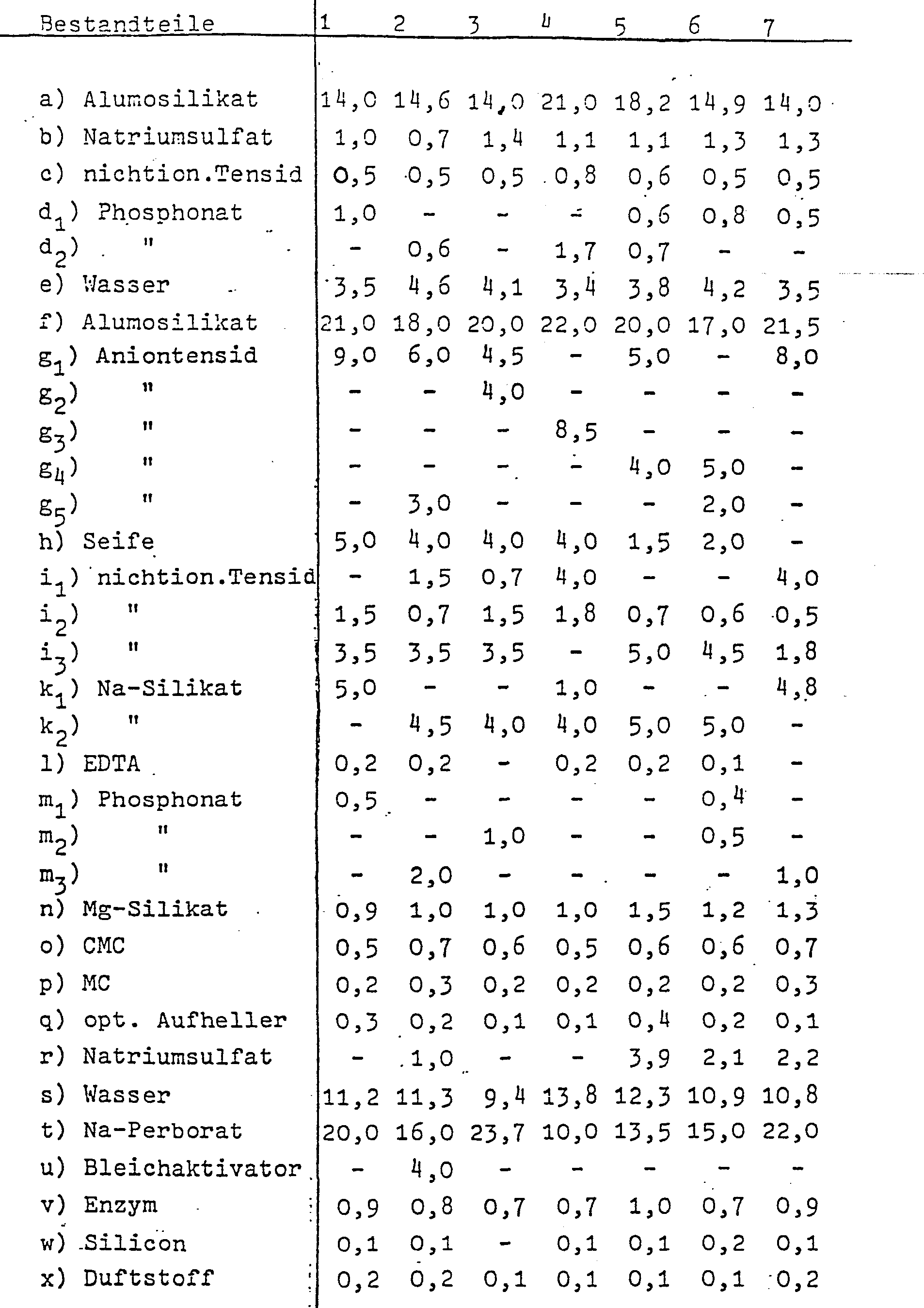
- the composition of the agents is shown in the following table.
- the 1st powder component comprises the components (a) - (e), the 2nd powder component the components (f) - (s).
- the components (t) - (x) were subsequently mixed into the spray-dried mixture of the two powder components, the perfume oil (x) having been sprayed onto the sodium perborate beforehand.
- the first powder component was produced from a 50 percent by weight, that of the 2: powder component. from a 55% by weight, aqueous batch by spray drying via nozzles by means of countercurrent heating gases having an inlet temperature of 280 ° C. and an outlet temperature of 84 ° C.
- the bulk densities of the 1st powder component were between 550 and 630 g / l, those of the 2nd powder component between 360 and 400g / l.
- the powder components were mixed using belt scales in free-fall mixers.
Landscapes
- Chemical & Material Sciences (AREA)
- Life Sciences & Earth Sciences (AREA)
- Engineering & Computer Science (AREA)
- Chemical Kinetics & Catalysis (AREA)
- Oil, Petroleum & Natural Gas (AREA)
- Wood Science & Technology (AREA)
- Organic Chemistry (AREA)
- Inorganic Chemistry (AREA)
- Detergent Compositions (AREA)
Abstract
Description
- Aus der DE-AS 24 12 837 sind phosphatarme bzw. phosphatfreie Waschmittel mit einem Gehalt an Alkalialumosilikaten bekannt, welche Phosphat ganz oder teilweise als Waschmittelbuilder zu ersetzen vermögen. Es handelt sich dabei vorzugsweise um feinkristalline, synthetisch hergestellte, wasserunlösliche, gebundenes Wasser enthaltende Natriumalumosilikate der Formel

- Die DE-AS 26 15 698 (D 5394) vermittelt die Lehre, daß man wäßrige Aufschlämmungen bzw. filterfeuchte Pasten von synthetischem Alumosilikat durch Ansatz von 0,2 bis 7 Gew.-% eines Dispergiermittels, zu denen bestimmte nichtionische Tenside, Carboxylgruppen enthaltende Polymere und Phosphonsäuren zählen, sowie 0,2 bis 7 % eines nicht phosphorhaltigen anorganischen Salzes, wie Natriumsulfat, stabilisieren kann. Diese stabilisierten Suspensionen können ebenfalls zu pulverförmigen Produkten, z.B. Enthärtungsmitteln bzw. nach Einarbeiten in Waschmittelslurries zu üblichen Waschnulvern weiterverarbeitet werden. Die letztere Arbeitsweise hat sich besonders dann als vorteilhaft erwiesen, wenn der Gehalt der sprühgetrockneten Waschpulver zu Alumosilikaten 30 Gew.-% nicht wesentlich übersteigt und insbesondere im Bereich zwischen 15 und 25 Gew.-% liegt. In diesem Bereich treten auch unter ungünstigeren Verfahrensbedingungen keine Probleme beim Ansetzen und Verarbeiten des Slurries auf und die erhaltenen Waschpulver zeichnen sich durch eine gute Benetzbarkeit und Verteilbarkeit beim Losen in der Waschlauge auf. Wird jedoch in phosphatfreien bzw, phosphatarmen Waschmitteln der Anteil des wasserunlöslichen Alumosilikats auf wesentlich mehr als 30 Gew.-%, bezogen auf das Sprühprodukt, erhöht, so bedarf es erhöhter Aufmerksamkeit beim Ansetzen und Weiterverarbeiten der verhältnismäßig wasserreichen, jedoch verhältnismäßig viskosen Slurries, um das Auftreten von Inhomogenitäten zu vermeiden. Außerdem kann es z.B. in Waschmaschinen älterer Bauart mit ungünstig konstruierten Einspülvorrichtungen aufgrund des erhöhten Anteils an unlöslichen Bestandteilen zu einer verzögerten Auflösung und Dispergierung des Waschmittels in der Waschlauge kommen.
- Diese Probleme werden durch die vorliegende Erfindung gelöst.
- Gegenstand der Erfindung ist ein aus einem Gemisch von mindestens zwei durch Sprühtrocknung hergestellten Pulverkomponenten bestehendes Waschmittel mit einem Gehalt an 30 bis 50 Gew.-% eines feinkristallinen, synthetischen, gebundenes Wasser enthaltendem Natriumalumosilikat der Formel (I)

- 1. Pulverkombonente:

- 2. Pulverkomponente:

- Gegenstand der Erfindung ist weiterhin ein Verfahren zur Herstellung der Mittel gemäß vorstehender Erfindungsdefinition, das dadurch gekennzeichnet ist, daß man eine 35 bis 50 Gew.-% Alumosilikat und 40 bis 60 Gew.-% Wasser sowie die übrigen Bestandteile enthaltende Aufschlämmung der 1. Pulverkomponente in an sich bekannter Weise sprühtrocknet und sie mit der 2. Pulverkomponente, die durch Sprühtrocknung einer 50 bis 32 Gew.-% Wasser enthaltenden Aufschlämmung erhalten wurde im angegebenen Mischungsverhältnis vermischt,
- Die Alumosilikate der Formel I kommen in der üblichen hydratisierten, feinkristallinen Form zum Einsatz, d. h. sie weisen praktisch keine Teilchen größer als 30 micron auf und bestehen vorzugsweise zu wenigstens 80 % aus Teilchen einer Größe von weniger als 10 Mikron, Ihr Calciumbindevormögen, das nach den Angaben der DE 24 12 837 bestimmt wird, bezieht sich auf den Aktivstoff- .gehalt (AS) der einem durch einstündiges Erhitzen auf 800°C entwässerten Alumosilikat entspricht. Brauchbar sind insbesondere synthetische Zeolithe von Typ NaA und NaX sowie deren Gemische.
- Die 1. Pulverkomponente enthält weiterhin Natriumsulfat in Anteilen von 2 bis 10 vorzugsweise von 3 bis 8 Gew.-%, be- zogen auf wasserfreies Salz. Ein weiterer Bestandteil sind nichtionische Tenside, die in Anteilen von 1 bis 5, vorzugsweise 2 bis 4 Gewichtsteilen anwesend sind und einen HLB-Wert von 7,5 bis 11, insbesondere von 8 bis 10 aufweisen. Beispiele für derartige nichtionische Tenside sind Ethoxylierungsprodukte von gesättigten und einfach ungesättigten linearen oder in 1. Stellung methylverzweigten, primären Alkoholen mit 12 bis 20 C-Atomen und 2 bis 7, insbesondere 3 bis 6 Ethylenglykolethergruppen, wobei- der Gehalt E an Glykolethergruppen (in Gewichts-% bezogen auf das Tensidmolekül) der Beziehung

- Weitere geeignete nichtionische Tenside dieser Gruppe sind ethoxylierte Amine, Fettsäuren und Fettsäureamide mit 10 bis 20, insbesondere 12 bis 18 C-Atomen, so z. B. Fettsäuremono- oder diethanolamide. Beispiele für derartige Verbindungen sind beispielsweise in der DE-A1- 26 15 698 aufgeführt.
- Als fakultativer Bestandteil der 1. Pulverkomponente kom- . men Polyphosphonsäuren bzw. ihre Natrium-, Kalium- oder Ammoniumsalze infrage, wobei zu den Ammoniumsalzen auch die von organischen Ammoniumbasen, wie Mono-, Di- oder Triethanolamin abgeleiteten Salze zu verstehen sind. Geeignete Polyphosphonsäuren sind 1-Hydroxyethan-1,1-diphosphonsäure, Aminotri-(methylenphosphonsäure), Ethylendiamin- tetra-(methylenphosphonsäure) und deren höhere Homologen, wie z. B. Diethylentriaminpenta-(methylcnphosphonsäure)..
- Weitere brauchbare Phosphonsäuren bzw. Phosphonocarbonsäuren sind ebenfalls in der DE-A1-26 15 698 aufgeführt.
- Der Anteil der Polyphosphonsäuren bzw. ihrer Salze in der 1. Pulverkomponente beträgt O bis 8, vorzugsweise 1 bis 7 Gewichts-%. Der Wassergehalt liegt zwischen 10 und 25, vorzugsweise zwischen 12 und 20 Gewichts -%, wobei darunter sowohl das Kristallwasser bzw. adsorptiv gebundene als auch das beim Erhitzen des Alumosilikats auf eine Temperatur von 800 °C entweichende Wasser verstanden wird.
- Das Vermischen der in der 1. Pulverkomponente enthaltenen Bestandteile erfolgt zweckmäßigerweise im Anschluß an die Synthese des Natriumalumosilikats. Hierzu wird das von der Herstellung noch feuchte bzw. in wäßriger Suspension befindliche oder als Filterkuchen vorliegende Alumosilikat mit den Zusätzen vermischt, beispielsweise dadurch, daß man den Filterkuchen in eine wäßrige Lösung der Zusatzstoffe einträgt oder mit der wäßrigen Lösung den auf dem Filter befindlichen Filterkuchen nachwäscht, so daß das anhaftende Wasser durch die aufgebrachte Lösung ersetzt wird. Die so erhaltenen-Suspensionen der Alumosilikate zeichnen sich durch eine besonders hohe Lagerfähigkeit aus, d. h. sie neigen nicht zum Entmischen oder zum Absetzen fester, nicht wieder redispergierbarer Rückstände. Sie können in dieser Form bevorratet und transportiert werden. Ihre Weiterverarbeitung zur 1. Pulverkomponente erfolgt bevorzugt durch Sprühtrocknung, wobei die in der Waschmittelherstellung üblichen Verfahren benutzt werden können, d. h. Trocknung mit heißen Temperaturen von 150 - 360 °, vorzugsweise 200 - 300 °C aufweisenden Trocknungsgasen in Sprühtürmen, Düsen- oder Scheibenzerstäubung der Suspension, Produktführung im Gleich- oder Gegenstrom und lineare oder zyklonartige Führung des Trockengases.
- Die gleichen Verfahrensbedingungen können auch bei der Sprühtrocknung der 2. Pulverkomponente angewendet werden.
- Die 2. Pulverkomponente besteht ebenfalls aus einem sprühgetrockneten Gemisch, das neben Alumosilikaten der Formel I übliche Waschmittelbestandteile enthält; die unter den Bedingungen der Heißsprühtrocknung beständig sind. Hierzu zählen übliche anionische bzw. nichtionische Tenside, phosphatfreie Co-Builder, sowie Waschalkalien und Neutralsalze. sowie sonstige üblicherweise in Waschmitteln enthaltene Hilfsstoffe.
- Geeignete anionische Tenside sind solche vom Sulfonat-oder Sulfattyp, insbesondere Alkylbenzolsulfonate, Olefinsulfonate, Alkylsulfonate und α-Sulfofettsäureester, primäre Alky-lsulfate sowie die Sulfate von ethoxylierten, 5 2 bis 3 Glykolethergruppen aufweisenden höhermolekularen Alkoholen. In Frage kommen ferner Alkaliseifen von Fettsäuren natürlichen oder synthetischen Ursprungs, zum Beispiel die Natriumseifen von Kokos-, Palm- oder Talgfettsäuren und, sofern eine Schaumdämpfung erwünscht ist, auch solche von hydrierten Raps- oder Fischölfettsäuren. Als zwitterionische Tenside kommen Alkylbetaine und insbesondere Alkylsulfobetaine in Frage. Die anionischen Tenside liegen vorzugsweise in Form der Natriumsalze vor. Sofern die genannten anionischen und zwitterionischen ; Verbindungen einen aliphatischen Kohlenwasserstoffrest besitzen, soll dieser bevorzugt gradkettig sein und 12 bis 18 Kohlenstoffatome aufweisen. In den Verbindungen mit einem araliphatischen Kohlenwasserstoffrest enthalten die vorzugsweise unverzweigten Alkylketten .6'bis 16, insbesondere 10 bis 14 Kohlenstoffatome. Geeignete nichtionische Tenside sind ethoxylierte Alkohole mit 12 bis 18 Kohlenstoffatomen und durchschnittlich 3 bis 20, vorzugsweise 5 bis 15 Glykolethergruppen. Besonders geeignet sind Gemische ethoxylierter, primärer C14-C18-Alkohole, wie Talgfettalkohol oder Oleylalkohol, wovon ein Teil derselben 10 bis 16 Glykolethergruppen und ein zweiter Teil 3 bis 7 Glykolethergruppen aufweist. Das Mengenverhältnis der beiden Teile kann beispielsweise 4 : 1 bis 1 : 4 betragen.
- Weitere geeignete nichtionische Tenside sind solche, die sich von den vorgenannten Verbindungen ableiten und sowohl Ethylenglykol- als auch Propylenglykolethergruppen aufweisen, beispielsweise Alkohole mit 10 bis 30 Ethylenglykolethergruppen und 1 bis 30 Propylenglykolether- gruppen; ferner Ethoxylierungsprodukte von Alkylphenolen, Fettsäureamiden und Fettsäuren. Brauchbar sind auch die wasserlöslichen, 20 bis 250 Ethylenglykolethergruppen und 10 bis 100 Propylenglykolethergruppen enthaltenden Polyethylenoxiaddukte an Polypropylenglykol, Ethylendiaminopolypropylenglykol und Alkylpolypropylenglykol mit 1 bis 10 Kohlenstoffatomen in der Alkylkette. Die genannten Verbindungen enthalten üblicherweise pro Propylenglykol-Einheit 1 bis 5 Ethylenglykoleinheiten. Auch nichtionische Verbindungen vom Typ der Aminoxide und Sulfoxide, die gegebenenfalls auch ethoxyliert sein können, sind verwendbar.
- Die 2. Pulverkomponente enthält.weiterhin.phosphatfreie Gerüstsalze und Waschalkalien, zu denen die Alkalisilikate, Alkalicarbonate bzw. -bicarbonate, Alkaliborate und Alkalisulfate, vorzugsweise in Form der Natriumsalze zählen. Das Natriumsilikat kann ein Verhältnis von Si02 zu Na20 von 1 : 1 bis 1 : 3,5 aufweisen
- Die 2. Pulverkomponente kann zusätzlich sogenannte Co-Builder enthalten, die bereits in geringen Mengen die Wirkung der Natriumalmosilikate erheblich zu steigern vermögen. Als Co-Builder eignen sich insbesondere Polyphosphonsäuren bzw. deren Alkalimetallsalze, so wie sie als fakultative Bestandteile der l. Pulverkomponente beschrieben sind.
- Weitere Co-Builder, die in der 2. Pulverkomponente vorliegen können, sind komplexierend wirkende Aminopolycarbonsäuren. Hierzu zählen insbesondere Alkalisalze der Nitrilotriessigsäure und Ethylendiaminotetraessigsäure. Geeignet sind ferner die Salze der Diethylentriaminopentaessigsäure sowie der höheren Homologen der genannten Aminopolycarbonsäure.
- Weiterhin eignen sich die polymeren Carbonsäuren mit einem Molekulargewicht von mindestens 350 in Form der wasserlöslichen Natrium- oder Kaliumsalze, wie Polyacrylsäure, Polymethacrylsäure, Poly-α-hydroxyacrylsäure. Polymaleinsäure, Polyitaconsäure, Polymesaconsäure, Polybutentricarbonsäure sowie die Copolymerisate der entsprechenden monomeren Carbonsäuren untereinander oder mit ethylenisch ungesättigten Verbindungen, wie Ethylen, Propylen, Isobutylen, Vinylmethylether oder Furan.
- Als weitere Bestandteile kommen Neutralsalze, insbesondere Natriumsulfat sowie als Stabilisator für Perverbindungen wirkendes Magnesiumsilikat in Betracht. Weitere Waschhilfsmittel, die in der sprühgetrockneten 2 Pulverkomponente anwesend sein können, sind Vergrauungsinhibitoren und optische Aufheller und die Pulverstruktur verbessernde Zusätze, zum Beispiel Alkalisalze oder Toluol-, Cumol- oder Xylolsulfonsäure.
- Als Vergrauungsinhibitoren eignen sich insbesondere Carboxymethylcellulose, Methylcellulose, ferner wasserlösliche Polyester und Polyamide aus mehrwertigen Carbonsäuren und Glykolen beziehungsweise Diaminen, die freie, zur Salzbildung befähigte Carboxylgruppen, Betaingruppen oder Sulfobetaingruppen aufweisen sowie kolloidal in Wasser lösliche Polymere beziehungsweise Copolymere des Vinylalkohols, Vinylpyrrolidons, Acrylamids und Acrylnitrils.
- Geeignete optische Aufheller sind die Alkalisalze der 4,4-Bis(-2"-anilino-4"-morpholino-1,3,5-triazinyl-6"- amino)-stilben-2,2'-disulfonsäure oder gleichartig aufgebaute Verbindungen, die anstelle der Morpholinogruppe eine Diethanolaminogruppe, eine Méthylaminogruppe oder eine β-Methoxyethylaminogruppe tragen. Weiterhin kommen Aufheller vom Typ der substituierten Diphenylstyryle in Frage, z.B. die Alkalisalze des 4,4'-Bis-(2-sulfostyryl)-diphenyls, 4,4'-Bis(4-chlor-3-sulfosty- ryl)-diphenyls und 4- (4-chlorstyryl)-4'-(2-sulfostyryl)-diphenyls.
- Weitere Zusätze, die aen beiden Pulverkomponenten bzw. deren Gemischen gesondert nach der Sprühtrocknung zugesetzt werden, sind Enzyme aus der Klasse der Proteasen, Lipasen und Amylasen beziehungsweise deren Gemische. Besonders geeignet sind aus Bakterienstämmen oder Pilzen, wie Bacillus subtilis, Bacillus licheniformis und Streptomyces griseus gewonnene enzymatische Wirkstoffe. Die Enzyme können in Hüllsubstanzen eingebettet sein oder nachträglich auf die sprühgetrocknete 2. Pulverkomponente aufgranuliert werden. Auch Duftstoffe und Schaumdämpfungsmittel, wie Silicone oder Paraffinkohlenwasserstoffe zwecks Vermeidung von Wirkungsverlusten, werden in der Regel nachträglich der sprühgetrockneten 2. Pulverkomponente zugesetzt.
- Als Bleichkomponente kommen die überlicherweise in Wasch-und Bleichmitteln verwendeten Perhydrate und Perverbindungen in Frage. Zu den Perhydraten zählen bevorzugt Natriumperborat, das als Tetrahydrat oder auch als Monohydrat vorliegen kann, ferner die Perhydrate des Natriumcarbonats (Natriumpercarbonat), des Natriumpyrophosphats (Perpyrophosphat), des Natriumsilikats (Persilikat) sowie des Harnstoffes. Diese Perhydrate kommen bevorzugt zusammen mit Bleichaktivatoren zum Einsatz.
- Bevorzugt kommt Natriumperborat-tetrahydrat in Verbindung mit Bleichaktivatoren als Bleichkomponente in Frage. Zu den Bleichaktivatoren zählen insbesondere N-AcylverbindunJen und O-Acylverbindungen. Beispiele für geeignete N-Acylverbindungen sind mehrfach acylierte Alkylendiamine, wie Tetraacetylmethylendiamin, Tetraacetylethylendiammino noch deren höhere Homologen, sowie acylierte Glykolurile, wie Tetraacethylglykoluril. Weitere Beispiele sind N-Alkyl-N-sulfonyl-carbonamide, N-Acylhydantoine, N-acylierte cyclische Hydrazide, Triazole, Urazole, Diketopiperazine, Sulfurylamice, Cyanurate und Imidazoline. Als O-Acylverbindungen kommen neben Carbonsäureanhydriden insbesondere acylierte Zucker, wie Glucosepentaacetat in 'Frage.
- Bevorzugte Bleichaktivatoren sind Tetraacetylethylendiamin und Glucosepentaacetat.
- Die Bleichaktivatoren können zwecks Vermeidung von Wechselwirkungen mit den Perverbindungen, insbesondere während der Lagerung pulverförmiger Gemische, mit Hüllsubstanzen überzogen sein, so wie dies beispielsweise in DE-PS 11 62 967, DE-PS 21 38 584, DE-PS 22 20 296, DE-OS 23 38 412, DE-OS 26 50 429 und DE-OS 30 11 998 beschrieben ist. Besonders geeignete Hüllsubstanzen sind wasserlösliche Polymere, wie Polyethylenglykol, Celluloseether, Celluloseester, wasserlösliche Stärkeether und Stärkeester sowie nichtionische Tenside vom Typ der alkoxylierten Alkohole, Alkylphenole, Fettsäuren und Fettsäureamide. Die erfindungsgemäß zu verwendenden Polyphosphonsäuren können vor dem Beschichten bzw. Umhüllen der Bleichaktivatoren mit diesen vermischt weraen, so daß sie gemeinsam mit diesen vom Hüllmaterial eingeschlossen werden. Dies kann einen zusätzlichen Stabilisierungseffekt bewirken.
- Das Vermischen der beiaen Pulverkomponenten kann mit üblichen Mischvorrichtungen vorgenommen werden, wobei eine möglichst geringe mechanische Beanspruchung der Sprühprodukte anzustreben ist, um eine Zerstörung der Konstruktur und eine erhöhte Bildung von Staub bzw. feinkörnigen Anteilen zu vermeiden. Man kann auch so vorgehen, daß man die wäßrigen Ansätze der beiden Komponenten gleichzeitig über getrennte Düsen in einem Sprühturm versprühen, wobei die Düsen in einer gemeinsamen Ebene im oberen Teil des Sprühturmes oder auch in verschiedenen Ebenen angeordnet sein können, so wie dies beispielsweise in der britischen Patentschrift 1.189.543 offenbar ist. Durch das gemeinsame Versprühen kann der Verfahrensschritt des nachträglichen Vermischens der beiden Pulverkomponenten eingespart werden.
- Nach erfolgtem Vermischen weisen die erfindungsgemäßen Waschmittel bevorzugt die folgende Zusammensetzung auf (Angaben in Gewichtsprozent) :
- 1. Pulverkomponente

- 2. Pulverkomponente


- Als 3. Pulverkomponente kommen Perverbindungen, Bleichaktivatoren und Enzyme infrage. Das Mischungsverhältnis der Komponenten untereinander wird vorzugsweise so bemessen, daß das zusammengesetzte Waschmittel insgesamt die folgenden wesentlichen Bestandteile enthält:

- Die erfindungsgemäßen Mittel zeichnen sich durch ein günstiges Benutzungs- und Dispergiervermögen in der Waschflotte aus. Ihre Herstellung wirft keine Probleme bei dem Ansetzen und Weiterverarbeiten der Slurries zu Sprühprodukten auf. Die Gemische zeigen während des Transportes und der Lagerung keine Neigung zum Entmischen.
- Die Zusammensetzung der Mittel ist der folgenden Tabelle zu entnehmen. Die 1. Pulverkomponente umfaßt die Bestandteile (a) - (e), die 2. Pulverkomponente die Bestandteile (f) - (s). Die Bestandteile (t) - (x) wurden dem sprühgetrockneten Gemisch der beiden'Pulverkomponenten nachträglich zugemischt, wobei das Parfümöl (x) zuvor auf das Natriumperborat aufgesprüht worden war.
- Soweit die gewählten Bezeichnungen nicht aus sich heraus verständlich sind, werden sie im folgendem näher charakterisiert:
- c) = C16-18-Talgalkohol 5-fach ethoxyliert
- g1) = n-Dodecylbenzolsulfonat (Na-Salz)
- d1) = 1-Hydroxethan-1,1-diphosphonats-Na
- d2) = Aminotri-(methylenphosphonat)-Na
- g 2) = C 13-15 n-Alkansulfonat (Na-Salz)
- g 3) = C14-17Alphaolefinsulfonat (Na-Salz)
- g4) = Alphasulfofettsäuremethylester aus hydrierter Palmkernfettsäure (Na-Salz)
- g5) = Talgfettalkoholsulfat (Na-Salz)
- h) = Seife aus Talgfettsäuren (Na-Salz)
- i1) = Talgalkohol 15-fach ethoxyliert
- i2) = Talgfettalkohol 5-fach ethoxyliert
- i3) = technischer Oleylalkohol 10-fach ethoxyliert
- k1) = Na2O : Si02 = 1 : 3,3
- k2) = Na2O : SiO2 = 1 : 2
- m1) = 1-Hydroxyethan-1,1-diphosphonat-Na
- m2) = Aminotri-(methylenphosphonat)-Na
- m ) = Ethylendiamin-tetra-(methylenphosphonat)-Na
- o3) = Carboxymethylcellulose (Na-Salz)
- p) = Methylcellulose
- t) = Natriumperborat-tetrahydrat in den Beispielen 1 - 3 und 5 - 7, Monohydrat im Beispiel 4
- u) = Tetraacetylethylendiamin
- v) = Bakterienprotease
- w) = Silicon-Entschäumer.
- Als Alumosilikat wurde ein synthetisch hergestellter kristalliner Zeolith vom NaA-Typ der Formel 1,04 Na20 Al2O3 ·2,05 SiO2, 4,3 H2O
mit einem bei 22 °C bestimmten Ca-Bindevermögen von 170 mg CaO/g und einer mittleren Teilchengröße von 4,8 Mikron (100 % kleiner als 15 Mikron) verwendet. - Die Herstellung der 1. Pulverkomponente erfolgte aus einem 50-gewichtsprozentigen, die der 2: Pulverkomponente. aus einem 55-gewichtsprozentigen, wäßrigen Ansatz durch Sprühtrocknung über Düsen mittels im Gegenstrom geführten, eine Eintrittstemperatur von 280 °C und eine Austrittstemperatur von 84 °C aufweisenden Heizgasen.
- Die Schüttgewichte der 1. Pulverkomponente lagen zwischen 550 und 630 g/l, die der 2. Pulverkomponente zwischen 360 und 400g/1. Das Vermischen der Pulverbestandteile erfolgte über Bandwaagen in Freifallmischern.
- Beim Ansetzen, Homogenisieren und Bevorraten der wäßrigen Sprühansätze traten keine Probleme, bzw. keine Entmischungen auf. Die Pulvergemische erwiesen sich als gut rieselfähig und ließen sich in automatischen Waschmaschinen einwandfrei einspülen, d. h., in den Einspülvorrichtungen war keine Rückstandsbildung zu verzeichnen.
wobei das Mischungsverhältnis von 1. zu 2. Pulverkomponente 1 : 2 bis 1 : 7 beträgt.
Claims (10)

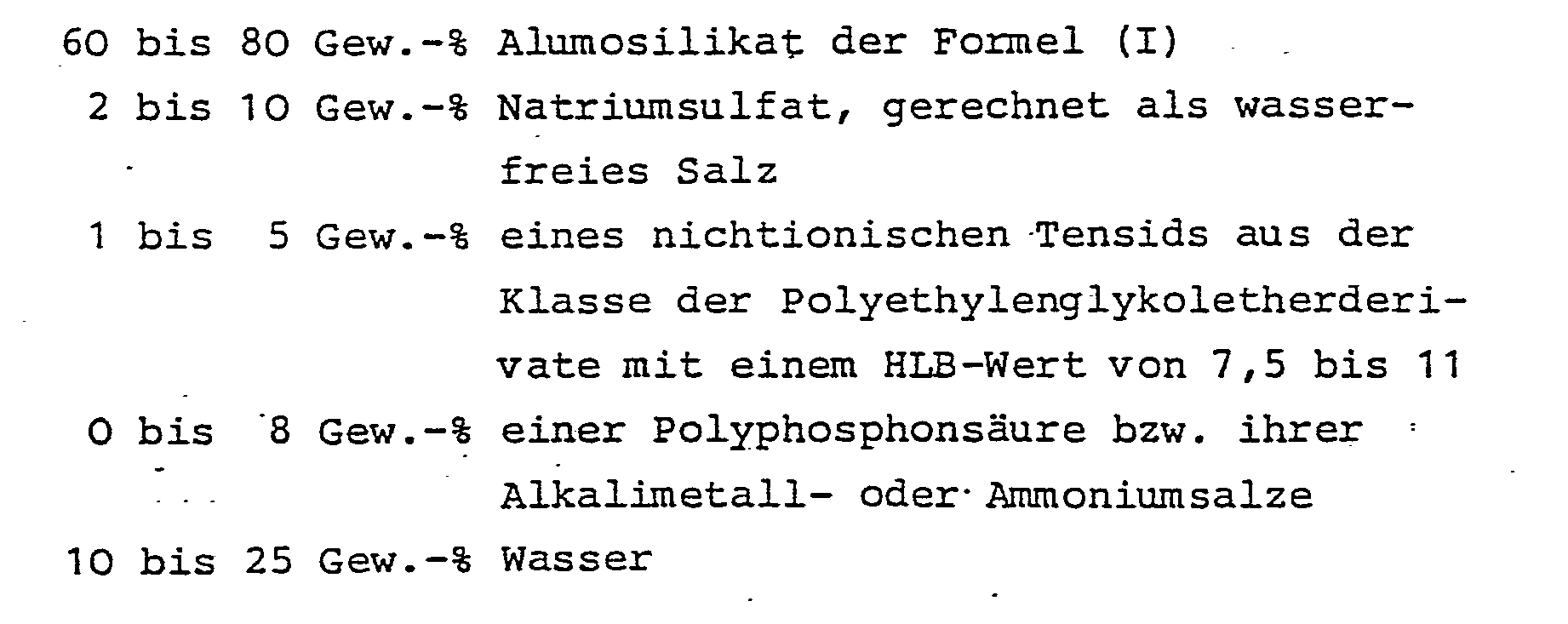


wobei das Mischungsverhältnis von 1. zu 2. Pulverkomponente 1 : 2 bis 1 : 7 beträgt.


Priority Applications (1)
| Application Number | Priority Date | Filing Date | Title |
|---|---|---|---|
| AT83112669T ATE26126T1 (de) | 1982-12-24 | 1983-12-16 | Spruehgetrocknetes mehrkomponenten-waschmittel. |
Applications Claiming Priority (2)
| Application Number | Priority Date | Filing Date | Title |
|---|---|---|---|
| DE19823248022 DE3248022A1 (de) | 1982-12-24 | 1982-12-24 | Spruehgetrocknetes mehrkomponenten-waschmittel |
| DE3248022 | 1982-12-24 |
Publications (2)
| Publication Number | Publication Date |
|---|---|
| EP0114308A1 true EP0114308A1 (de) | 1984-08-01 |
| EP0114308B1 EP0114308B1 (de) | 1987-03-25 |
Family
ID=6181765
Family Applications (1)
| Application Number | Title | Priority Date | Filing Date |
|---|---|---|---|
| EP83112669A Expired EP0114308B1 (de) | 1982-12-24 | 1983-12-16 | Sprühgetrocknetes Mehrkomponenten-Waschmittel |
Country Status (3)
| Country | Link |
|---|---|
| EP (1) | EP0114308B1 (de) |
| AT (1) | ATE26126T1 (de) |
| DE (2) | DE3248022A1 (de) |
Cited By (6)
| Publication number | Priority date | Publication date | Assignee | Title |
|---|---|---|---|---|
| EP0195127A3 (en) * | 1985-02-09 | 1987-09-30 | Degussa Aktiengesellschaft | Detergent builder |
| EP0340590A1 (de) * | 1988-05-02 | 1989-11-08 | Henkel Kommanditgesellschaft auf Aktien | Waschmitteladditiv |
| EP0291869A3 (de) * | 1987-05-21 | 1990-07-18 | Henkel Kommanditgesellschaft auf Aktien | Phosphatfreies Waschmittel mit reduzierter Inkrustierungstendenz |
| WO1992006167A1 (de) * | 1990-10-08 | 1992-04-16 | Henkel Kommanditgesellschaft Auf Aktien | Percarbonathaltiges waschmittel |
| WO1994013775A1 (de) * | 1992-12-16 | 1994-06-23 | Henkel Kommanditgesellschaft Auf Aktien | Verfahren zur herstellung von pulverförmigen waschmitteln |
| EP0460925B1 (de) * | 1990-06-06 | 1998-03-25 | Unilever Plc | Reinigungsmittelzusammensetzungen |
Families Citing this family (4)
| Publication number | Priority date | Publication date | Assignee | Title |
|---|---|---|---|---|
| GB8504489D0 (en) * | 1985-02-21 | 1985-03-27 | Monsanto Europe Sa | Aminomethylenephosphonate compositions |
| DE3545947A1 (de) * | 1985-12-23 | 1987-07-02 | Henkel Kgaa | Phosphatfreies, granulares waschmittel |
| US4741862A (en) * | 1986-08-22 | 1988-05-03 | Dow Corning Corporation | Zeolite built detergent compositions |
| DE19538028A1 (de) * | 1995-10-12 | 1997-04-17 | Sued Chemie Ag | Waschmittelzusatz |
Citations (3)
| Publication number | Priority date | Publication date | Assignee | Title |
|---|---|---|---|---|
| DE2412837B2 (de) * | 1973-04-13 | 1978-05-18 | Henkel Kgaa, 4000 Duesseldorf | |
| DE2814083A1 (de) * | 1977-04-22 | 1978-11-02 | Henkel Kgaa | Phosphatfreies waschmittel, insbesondere fuer erhoehte temperaturen |
| EP0001853A1 (de) * | 1977-11-07 | 1979-05-16 | THE PROCTER & GAMBLE COMPANY | Reinigungsmittelmischungen mit verbesserter Bleichwirkung |
-
1982
- 1982-12-24 DE DE19823248022 patent/DE3248022A1/de not_active Withdrawn
-
1983
- 1983-12-16 EP EP83112669A patent/EP0114308B1/de not_active Expired
- 1983-12-16 DE DE8383112669T patent/DE3370493D1/de not_active Expired
- 1983-12-16 AT AT83112669T patent/ATE26126T1/de not_active IP Right Cessation
Patent Citations (3)
| Publication number | Priority date | Publication date | Assignee | Title |
|---|---|---|---|---|
| DE2412837B2 (de) * | 1973-04-13 | 1978-05-18 | Henkel Kgaa, 4000 Duesseldorf | |
| DE2814083A1 (de) * | 1977-04-22 | 1978-11-02 | Henkel Kgaa | Phosphatfreies waschmittel, insbesondere fuer erhoehte temperaturen |
| EP0001853A1 (de) * | 1977-11-07 | 1979-05-16 | THE PROCTER & GAMBLE COMPANY | Reinigungsmittelmischungen mit verbesserter Bleichwirkung |
Cited By (7)
| Publication number | Priority date | Publication date | Assignee | Title |
|---|---|---|---|---|
| EP0195127A3 (en) * | 1985-02-09 | 1987-09-30 | Degussa Aktiengesellschaft | Detergent builder |
| EP0291869A3 (de) * | 1987-05-21 | 1990-07-18 | Henkel Kommanditgesellschaft auf Aktien | Phosphatfreies Waschmittel mit reduzierter Inkrustierungstendenz |
| EP0340590A1 (de) * | 1988-05-02 | 1989-11-08 | Henkel Kommanditgesellschaft auf Aktien | Waschmitteladditiv |
| WO1989010953A1 (fr) * | 1988-05-02 | 1989-11-16 | Henkel Kgaa | Additif pour produit a lessive |
| EP0460925B1 (de) * | 1990-06-06 | 1998-03-25 | Unilever Plc | Reinigungsmittelzusammensetzungen |
| WO1992006167A1 (de) * | 1990-10-08 | 1992-04-16 | Henkel Kommanditgesellschaft Auf Aktien | Percarbonathaltiges waschmittel |
| WO1994013775A1 (de) * | 1992-12-16 | 1994-06-23 | Henkel Kommanditgesellschaft Auf Aktien | Verfahren zur herstellung von pulverförmigen waschmitteln |
Also Published As
| Publication number | Publication date |
|---|---|
| DE3370493D1 (en) | 1987-04-30 |
| DE3248022A1 (de) | 1984-06-28 |
| ATE26126T1 (de) | 1987-04-15 |
| EP0114308B1 (de) | 1987-03-25 |
Similar Documents
| Publication | Publication Date | Title |
|---|---|---|
| EP0228011B1 (de) | Phospahtreduziertes, granulares Waschmittel | |
| AT390447B (de) | Waschmittelzusammensetzung | |
| EP0595946B1 (de) | Verfahren zur herstellung von waschmitteln mit hohem schüttgewicht und verbesserter lösegeschwindigkeit | |
| EP0200953A2 (de) | Körniges Waschmittel mit verbessertem Reinigungsvermögen | |
| EP0291869A2 (de) | Phosphatfreies Waschmittel mit reduzierter Inkrustierungstendenz | |
| DE69730654T2 (de) | Zitronensäuremonohydrat enthaltende Persäuregranulate zwecks verbesserter Auflösbarkeit | |
| EP0364739A2 (de) | Waschmittel für niedrige Temperaturen | |
| EP0114308B1 (de) | Sprühgetrocknetes Mehrkomponenten-Waschmittel | |
| EP0605502B1 (de) | Flüssiges oder pastenförmiges wasch- oder reinigungsmittel | |
| DE2539110B2 (de) | Verfahren zum Waschen bzw. Bleichen von Textilien, sowie Mittel zur Durchführung des Verfahrens | |
| EP0133566A2 (de) | Vergrauungsverhütender Zusatz für phosphatfreie und phosphatarme Waschmittel | |
| DE69636644T2 (de) | Verfahren zur herstellung von granularen waschmittelkomponenten oder -zusammensetzungen | |
| EP0614484B1 (de) | Pulverförmige tensidmischung | |
| EP0120492A2 (de) | Körnige, freifliessende Waschmittelkomponente und Verfahren zu ihrer Herstellung | |
| EP0576479B1 (de) | Flüssiges oder pastenförmiges waschmittel | |
| EP0011846B1 (de) | Wasch- und Reinigungsmittel, enthaltend ein phosphatarmes Gerüstsalzgemisch | |
| CH661055A5 (de) | Bleichende detergenszusammensetzung in teilchenform. | |
| EP0937132B1 (de) | Verfahren zur herstellung enzym- und bleichmittelhaltiger wasch- und reinigungsmittel | |
| DE4325882A1 (de) | Enzymatischer Vergrauungsinhibitor | |
| CH662360A5 (de) | Teilchenfoermige bleichende detergenszusammensetzung. | |
| DE3121242A1 (de) | Verfahren zum bleichen und desinfizieren von textilien und mittel zur durchfuehrung des verfahrens | |
| CH677929A5 (de) | ||
| DE1951556B2 (de) | Pulverförmiges bis körniges, Perborat enthaltendes Waschmittel | |
| DE4125178A1 (de) | Pulverfoermige aniontensidzubereitung | |
| EP0369317A1 (de) | Wasch- und Reinigungsmittel mit einem Gehalt an sek. Dialkylethersulfaten |
Legal Events
| Date | Code | Title | Description |
|---|---|---|---|
| PUAI | Public reference made under article 153(3) epc to a published international application that has entered the european phase |
Free format text: ORIGINAL CODE: 0009012 |
|
| AK | Designated contracting states |
Designated state(s): AT BE CH DE FR GB IT LI LU NL SE |
|
| 17P | Request for examination filed |
Effective date: 19841208 |
|
| GRAA | (expected) grant |
Free format text: ORIGINAL CODE: 0009210 |
|
| AK | Designated contracting states |
Kind code of ref document: B1 Designated state(s): AT BE CH DE FR GB IT LI NL |
|
| REF | Corresponds to: |
Ref document number: 26126 Country of ref document: AT Date of ref document: 19870415 Kind code of ref document: T |
|
| REF | Corresponds to: |
Ref document number: 3370493 Country of ref document: DE Date of ref document: 19870430 |
|
| ET | Fr: translation filed | ||
| ITF | It: translation for a ep patent filed | ||
| PLBE | No opposition filed within time limit |
Free format text: ORIGINAL CODE: 0009261 |
|
| STAA | Information on the status of an ep patent application or granted ep patent |
Free format text: STATUS: NO OPPOSITION FILED WITHIN TIME LIMIT |
|
| 26N | No opposition filed | ||
| PGFP | Annual fee paid to national office [announced via postgrant information from national office to epo] |
Ref country code: CH Payment date: 19891127 Year of fee payment: 7 |
|
| PGFP | Annual fee paid to national office [announced via postgrant information from national office to epo] |
Ref country code: DE Payment date: 19891129 Year of fee payment: 7 |
|
| PGFP | Annual fee paid to national office [announced via postgrant information from national office to epo] |
Ref country code: FR Payment date: 19891211 Year of fee payment: 7 Ref country code: AT Payment date: 19891211 Year of fee payment: 7 |
|
| ITTA | It: last paid annual fee | ||
| PGFP | Annual fee paid to national office [announced via postgrant information from national office to epo] |
Ref country code: NL Payment date: 19891231 Year of fee payment: 7 Ref country code: GB Payment date: 19891231 Year of fee payment: 7 |
|
| PGFP | Annual fee paid to national office [announced via postgrant information from national office to epo] |
Ref country code: BE Payment date: 19900102 Year of fee payment: 7 |
|
| PG25 | Lapsed in a contracting state [announced via postgrant information from national office to epo] |
Ref country code: GB Effective date: 19901216 Ref country code: AT Effective date: 19901216 |
|
| PG25 | Lapsed in a contracting state [announced via postgrant information from national office to epo] |
Ref country code: LI Effective date: 19901231 Ref country code: CH Effective date: 19901231 Ref country code: BE Effective date: 19901231 |
|
| BERE | Be: lapsed |
Owner name: HENKEL K.G.A.A. Effective date: 19901231 |
|
| PG25 | Lapsed in a contracting state [announced via postgrant information from national office to epo] |
Ref country code: NL Effective date: 19910701 |
|
| GBPC | Gb: european patent ceased through non-payment of renewal fee | ||
| NLV4 | Nl: lapsed or anulled due to non-payment of the annual fee | ||
| PG25 | Lapsed in a contracting state [announced via postgrant information from national office to epo] |
Ref country code: FR Effective date: 19910830 |
|
| REG | Reference to a national code |
Ref country code: CH Ref legal event code: PL |
|
| PG25 | Lapsed in a contracting state [announced via postgrant information from national office to epo] |
Ref country code: DE Effective date: 19910903 |
|
| REG | Reference to a national code |
Ref country code: FR Ref legal event code: ST |