EP0114626A2 - Ditriazolylvinyl-phenyl-ketone, Verfahren zu ihrer Herstellung und ihre Verwendung als Nitrifikationshemmer - Google Patents
Ditriazolylvinyl-phenyl-ketone, Verfahren zu ihrer Herstellung und ihre Verwendung als Nitrifikationshemmer Download PDFInfo
- Publication number
- EP0114626A2 EP0114626A2 EP84100311A EP84100311A EP0114626A2 EP 0114626 A2 EP0114626 A2 EP 0114626A2 EP 84100311 A EP84100311 A EP 84100311A EP 84100311 A EP84100311 A EP 84100311A EP 0114626 A2 EP0114626 A2 EP 0114626A2
- Authority
- EP
- European Patent Office
- Prior art keywords
- phenyl
- nitrification
- ketones
- ditriazolylvinyl
- formula
- Prior art date
- Legal status (The legal status is an assumption and is not a legal conclusion. Google has not performed a legal analysis and makes no representation as to the accuracy of the status listed.)
- Granted
Links
- 0 CC=N*C=*C=** Chemical compound CC=N*C=*C=** 0.000 description 1
Classifications
-
- C—CHEMISTRY; METALLURGY
- C07—ORGANIC CHEMISTRY
- C07D—HETEROCYCLIC COMPOUNDS
- C07D231/00—Heterocyclic compounds containing 1,2-diazole or hydrogenated 1,2-diazole rings
- C07D231/02—Heterocyclic compounds containing 1,2-diazole or hydrogenated 1,2-diazole rings not condensed with other rings
- C07D231/10—Heterocyclic compounds containing 1,2-diazole or hydrogenated 1,2-diazole rings not condensed with other rings having two or three double bonds between ring members or between ring members and non-ring members
- C07D231/12—Heterocyclic compounds containing 1,2-diazole or hydrogenated 1,2-diazole rings not condensed with other rings having two or three double bonds between ring members or between ring members and non-ring members with only hydrogen atoms, hydrocarbon or substituted hydrocarbon radicals, directly attached to ring carbon atoms
-
- C—CHEMISTRY; METALLURGY
- C05—FERTILISERS; MANUFACTURE THEREOF
- C05G—MIXTURES OF FERTILISERS COVERED INDIVIDUALLY BY DIFFERENT SUBCLASSES OF CLASS C05; MIXTURES OF ONE OR MORE FERTILISERS WITH MATERIALS NOT HAVING A SPECIFIC FERTILISING ACTIVITY, e.g. PESTICIDES, SOIL-CONDITIONERS, WETTING AGENTS; FERTILISERS CHARACTERISED BY THEIR FORM
- C05G3/00—Mixtures of one or more fertilisers with additives not having a specially fertilising activity
- C05G3/90—Mixtures of one or more fertilisers with additives not having a specially fertilising activity for affecting the nitrification of ammonium compounds or urea in the soil
-
- C—CHEMISTRY; METALLURGY
- C07—ORGANIC CHEMISTRY
- C07D—HETEROCYCLIC COMPOUNDS
- C07D233/00—Heterocyclic compounds containing 1,3-diazole or hydrogenated 1,3-diazole rings, not condensed with other rings
- C07D233/54—Heterocyclic compounds containing 1,3-diazole or hydrogenated 1,3-diazole rings, not condensed with other rings having two double bonds between ring members or between ring members and non-ring members
- C07D233/56—Heterocyclic compounds containing 1,3-diazole or hydrogenated 1,3-diazole rings, not condensed with other rings having two double bonds between ring members or between ring members and non-ring members with only hydrogen atoms or radicals containing only hydrogen and carbon atoms, attached to ring carbon atoms
-
- C—CHEMISTRY; METALLURGY
- C07—ORGANIC CHEMISTRY
- C07D—HETEROCYCLIC COMPOUNDS
- C07D249/00—Heterocyclic compounds containing five-membered rings having three nitrogen atoms as the only ring hetero atoms
- C07D249/02—Heterocyclic compounds containing five-membered rings having three nitrogen atoms as the only ring hetero atoms not condensed with other rings
- C07D249/08—1,2,4-Triazoles; Hydrogenated 1,2,4-triazoles
-
- Y—GENERAL TAGGING OF NEW TECHNOLOGICAL DEVELOPMENTS; GENERAL TAGGING OF CROSS-SECTIONAL TECHNOLOGIES SPANNING OVER SEVERAL SECTIONS OF THE IPC; TECHNICAL SUBJECTS COVERED BY FORMER USPC CROSS-REFERENCE ART COLLECTIONS [XRACs] AND DIGESTS
- Y02—TECHNOLOGIES OR APPLICATIONS FOR MITIGATION OR ADAPTATION AGAINST CLIMATE CHANGE
- Y02P—CLIMATE CHANGE MITIGATION TECHNOLOGIES IN THE PRODUCTION OR PROCESSING OF GOODS
- Y02P60/00—Technologies relating to agriculture, livestock or agroalimentary industries
- Y02P60/20—Reduction of greenhouse gas [GHG] emissions in agriculture, e.g. CO2
- Y02P60/21—Dinitrogen oxide [N2O], e.g. using aquaponics, hydroponics or efficiency measures
-
- Y—GENERAL TAGGING OF NEW TECHNOLOGICAL DEVELOPMENTS; GENERAL TAGGING OF CROSS-SECTIONAL TECHNOLOGIES SPANNING OVER SEVERAL SECTIONS OF THE IPC; TECHNICAL SUBJECTS COVERED BY FORMER USPC CROSS-REFERENCE ART COLLECTIONS [XRACs] AND DIGESTS
- Y10—TECHNICAL SUBJECTS COVERED BY FORMER USPC
- Y10S—TECHNICAL SUBJECTS COVERED BY FORMER USPC CROSS-REFERENCE ART COLLECTIONS [XRACs] AND DIGESTS
- Y10S71/00—Chemistry: fertilizers
- Y10S71/902—Nitrification inhibition
Definitions
- the invention relates to new ditriazolylvinyl-phenyl-ketones, their preparation and their use as nitrification inhibitors.
- Ammonium nitrogen is oxidized in the soil by bacteria from the genera Nitrosomonas and Nitrobacter or nitrite nitrogen to nitrate nitrogen.
- the extent of nitrification depends on the soil type, the pH value of the soil, the soil moisture and the biological activity of the soil. Since nitrate nitrogen, unlike ammonium nitrogen, is also subject to leaching, especially on lighter soils, and is therefore no longer available for plant nutrition, and there is a risk of nitrate accumulation in the groundwater, nitrification inhibition is of particular importance.
- Dazomet (3,5-dimethyltetrahydro-1,3,5-thiadiazin-2-thione).
- the last-mentioned compound also has the name Nitrapyrin and is sold as a nitrification inhibitor under the trade name (R) N-Serve.
- R trade name
- dicyandiamide which has gained importance as a nitrification inhibitor (Agricultural Research: Sonderheft 27, 74-8 2 , 1972).
- pyrimidine and pyrazole derivatives should be mentioned (see, for example, DE-OS 27 45 833). However, these substances do not meet all requirements with regard to their effectiveness and duration of action, economy, harmlessness or their application properties such as water solubility, dispersibility, vapor pressure etc.
- the reaction is carried out in the presence of a solvent, e.g. of dimethylformamide, dimethyl sulfoxide, hexamethylphosphoric triamide, tetrahydrofuran, dioxane or acetonitrile, and of basic substances such as alkali or alkaline earth metal hydroxides, carbonates, alcoholates or phenates, preferably sodium and potassium carbonate.
- a solvent e.g. of dimethylformamide, dimethyl sulfoxide, hexamethylphosphoric triamide, tetrahydrofuran, dioxane or acetonitrile
- basic substances such as alkali or alkaline earth metal hydroxides, carbonates, alcoholates or phenates, preferably sodium and potassium carbonate.
- the dihalogen vinyl ketones required for the reaction are known and can be prepared by known processes (see, for example, 8. Houben-Weyl-Müller, Methods of Organic Chemistry, 4th Edition, Georg Thieme Verlag, Stuttgart 1968, Vol. 7/4, P. 442).
- the substances according to the invention can be used alone or in a mixture with solid or liquid fertilizers which contain ammonium nitrogen, urea or ammonia; the application is also common possible with P flanzen angers- or soil improvers.
- the active ingredients are expediently applied simultaneously with the fertilizer.
- the application rates are from 0.05 to 10 kg / ha, preferably from 0 5 to 3 kg / ha.
- the active compounds can be used in amounts of 0.5 to 10 percent by weight, based on fertilizer nitrogen.
- nitrification inhibitors according to the invention are very effective, non-toxic, non-volatile, sufficiently water-soluble and stable. They remain in the ground for a long time, so they remain effective for a long time. They therefore not only serve to protect the environment by preventing nitrate from being washed out into the groundwater, but also to significantly improve the use of fertilizer nitrogen, especially on lighter soils.
Landscapes
- Chemical & Material Sciences (AREA)
- Organic Chemistry (AREA)
- Life Sciences & Earth Sciences (AREA)
- Soil Sciences (AREA)
- Pest Control & Pesticides (AREA)
- Agricultural Chemicals And Associated Chemicals (AREA)
- Organic Low-Molecular-Weight Compounds And Preparation Thereof (AREA)
- Preparation Of Compounds By Using Micro-Organisms (AREA)
- Fertilizers (AREA)
- Pharmaceuticals Containing Other Organic And Inorganic Compounds (AREA)
- Heterocyclic Carbon Compounds Containing A Hetero Ring Having Nitrogen And Oxygen As The Only Ring Hetero Atoms (AREA)
Abstract

- R Halogen, Alkyl mit 1 bis 6 C-Atomen, Alkoxy, mit 1 bis 6 C-Atomen, Trifluormethyl, Cyano, Nitro, Phenyl oder Phenoxy und
- n eine ganze Zahl von 0 bis 5 bedeutet, und in der die beiden Triazolringe wahlweise in 1- oder 4-Stellung mit der Vinylgruppe verknüpft sein können, ihre Herstellung und ihre Verwendung als Nitrifikationshemmer.
Description
- Die Erfindung betrifft neue Ditriazolylvinyl-phenyl-ketone, ihre Herstellung und ihre Verwendung als Nitrifikationshemmer.
- Ammoniumstickstoff wird im Boden durch Bakterien aus den Gattungen Nitrosomonas und Nitrobacter Ober Nitritstickstoff zu Nitratstickstoff oxidiert. Das Ausmaß der Nitrifikation ist abhängig von der Bodenart, dem pH-Wert des Bodens, der Bodenfeuchtigkeit und der biologischen Aktivität des Bodens. Da der Nitratstickstoff im Gegensatz zum Ammoniumstickstoff vor allem auch auf leichteren Böden der Auswaschung unterliegt und damit für die Pflanzenernährung nicht mehr verfügbar ist, und die Gefahr einer Nitrat-Anreicherung im Grundwasser besteht, kommt der Nitrifikationshemmung besondere Bedeutung zu.
- Ein u.a. für diesen Zweck verwendetes Handelsprodukt ist Dazomet (3,5-Dimethyltetrahydro-1,3,5-thiadiazin-2-thion). Literaturhinweis für Dazomet, 1,3-Dichlorpropen, l,2-Dibrom-3-chlorpropan sowie 2-Chlor-6-trichlor-methylpyridin: Down to Earth 32, 14-17, 1976. Die zuletzt angeführte Verbindung hat auch die Bezeichnung Nitrapyrin und wird als Nitrifikationshemmer unter dem Handelsnamen(R) N-Serve vertrieben. Ferner ist als Handelsprodukt noch Dicyandiamid zu nennen, das als Nitrifikationsinhibitor Bedeutung erlangt hat (Landw. Forschung: Sonderheft 27, 74-82, 1972). Schließlich seien Pyrimidin- und Pyrazolderivate erwähnt (vgl. z.B. DE-OS 27 45 833). Diese Substanzen genügen jedoch nicht allen Ansprüchen hinsichtlich ihrer Wirksamkeit und Wirkungsdauer, Wirtschaftlichkeit, Unschädlichkeit oder ihrer anwendungstechnischen Eigenschaften wie Wasserlöslichkeit, Di-spergierbarkeit, Dampfdruck usw.
- Der Erfindung lag daher die Aufgabe zugrunde, verbesserte Nitrifikationshemmer zu entwickeln, die den bekannten in möglichst vielen der genannten Eigenschaften überlegen sind. Es wurde nun gefunden, daß Ditriazolylvinyl-phenyl-ketone der Formel I

- R Fluor, Brom, Iod, vorzugweise Chlor, Alkyl mit 1 bis 6 C-Atomen, vorzugsweise Methyl, Alkoxy mit 1 bis 6 C-Atomen, Trifluormethyl, Cyano, Nitro, Phenyl oder Phenoxy und
- n eine ganze Zahl von 0 bis 5, vorzugsweise 0, 1 oder 2 bedeutet,
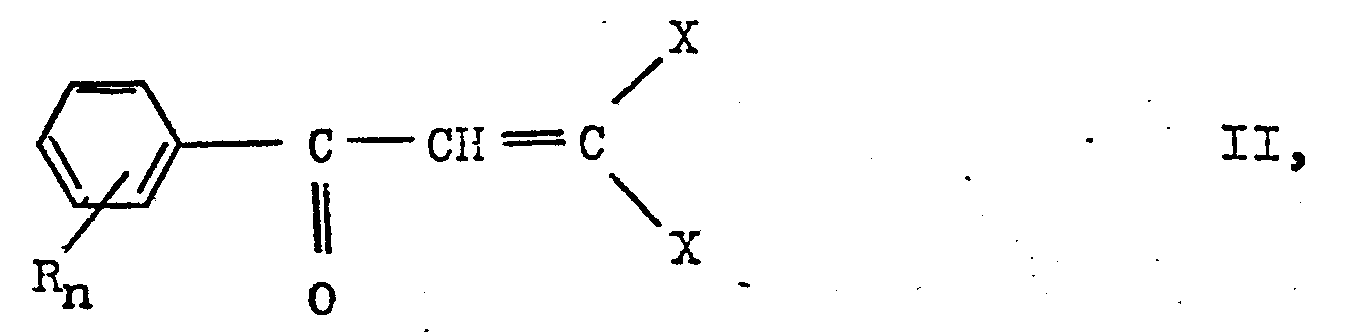
- Es wurde ferner gefunden, daß die Verbindungen der Formel I sehr leicht und in guten Ausbeuten durch Umsetzung von Dihalogenvinylketonen der Formel II, in der R und n die oben angegebenen Bedeutungen haben, und X für Fluor, Iod, vorzugsweise für Chlor oder Brom steht, mit 1,2,4-Triazol erhalten werden.
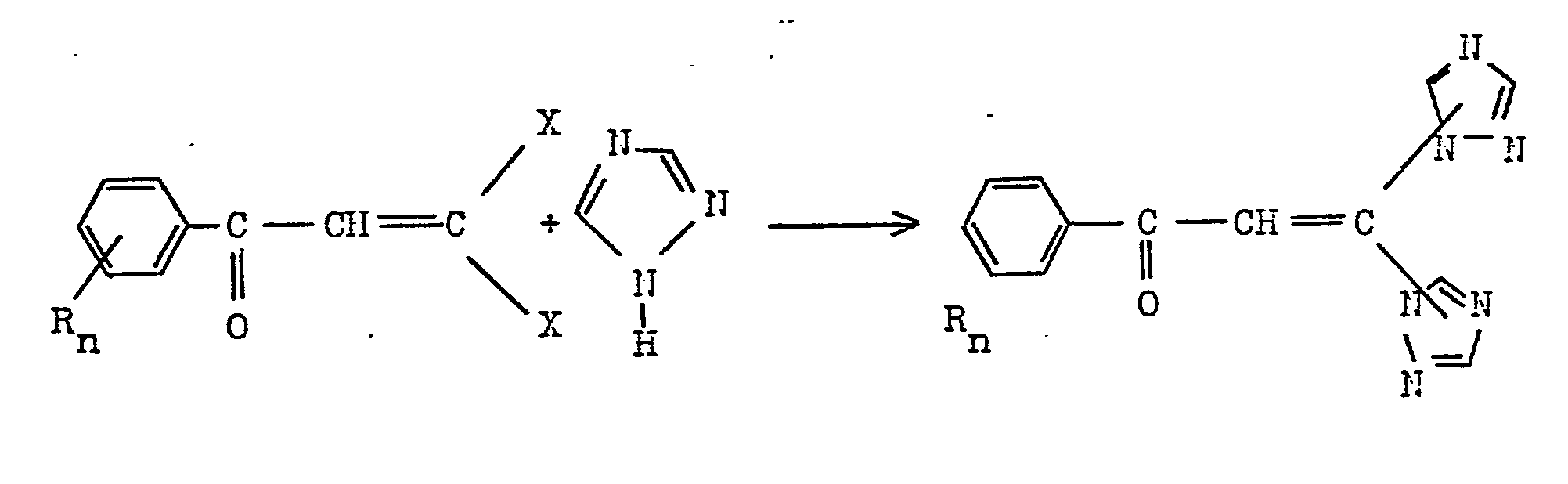
- Die Umsetzung wird in Anwesenheit eines Lösungsmittels, z.B. von Dimethylformamid, Dimethylsulfoxid, Hexamethylphosphorsäuretriamid, Tetrahydrofur n, Dioxan oder Acetonitril, und von basischen Substanzen, wie Alkali-oder Erdalkalihydroxiden, -carbonaten, -alkoholaten oder -phenolaten, vorzugsweise Natrium- und Kaliumcarbonat, durchgeführt.
- Die für die Umsetzung benötigten Dihalogenvinylketone sind bekannt und können nach bekannten Verfahren hergestellt werden (vgl. z.8. Houben-Weyl-Müller, Methoden der organischen Chemie, 4. Auflage, Georg Thieme Verlag, Stuttgart 1968, Bd. 7/4, S. 442).
- Die erfindungsgemäßen Substanzen können allein oder im Gemisch mit festen oder flüssigen Düngemitteln, die Ammoniumstickstoff, Harnstoff oder Ammoniak enthalten, angewendet werden; auch ist die Ausbringung gemeinsam mit Pflanzenbehandlungs- oder Bodenverbesserungsmitteln möglich. Zweckmäßigerweise werden die Wirkstoffe gleichzeitig mit dem Düngemittel ausgebracht. Die Aufwandmengen betragen 0,05 bis 10 kg/ha, vorzugsweise 0,5 bis 3 kg/ha. Bei der mit festen oder flüssigen Düngemitteln kombinierten Anwendung können die Wirkstoffe in Mengen von 0,5 bis 10 Gewichtsprozent, bezogen auf Düngemittelstickstoff, eingesetzt werden.
- Die erfindungsgemäßen Nitrifikationshemmer sind sehr wirksam, ungiftig, nicht flüchtig, ausreichend wasserlöslich und stabil. Sie verbleiben lange im Boden, bleiben also lange wirksam. Sie dienen somit nicht nur dem Umweltschutz, indem sie das Auswaschen von Nitrat in das Grundwasser verhindern, sondern auch einer wesentlichen Verbesserung der Ausnutzung des Düngerstickstoffs, insbesondere bei leichteren Böden.
- Die in den Beispielen genannten Teile beziehen sich auf das Gewicht. Raumteile (RT) verhalten sich zu Gewichtsteilen wie Liter zu Kilogramm.
-

- 1,1-Bis(1,2,4-triazolyl)-3-(2,4-dichlorphenyl)propen-3-on
- 27,1 Teile 1,I-Dichlor-3-(2,4-dichlorphenyl)propen-3-on, 13,8 Teile 1,2,4-Triazol und 13,8 Teile Kaliumcarbonat wurden in 300 RT Acetonitril .2 h unter Rückfluß erhitzt. Nach Abkühlen auf Raumtemperatur versetzte man mit 300 RT Wasser, extrahierte zweimal mit je 500 RT Methylenchlorid, trocknete über Natriumsulfat und engte im Vakuum zur Trockne ein.
- Ausbeute: 27,8 Teile (80 % d. Th.)
Schmp: 200 bis 203°C - C13H8Cl2N6O Ber. C 46,6 H 2.7 N 25.1 Cl 21.2
(335) Gef. C 46,8 H 2.5 N 24.7 Cl 20.9 - Analog Beispiel 1 wurden folgende Produkte erhalten:
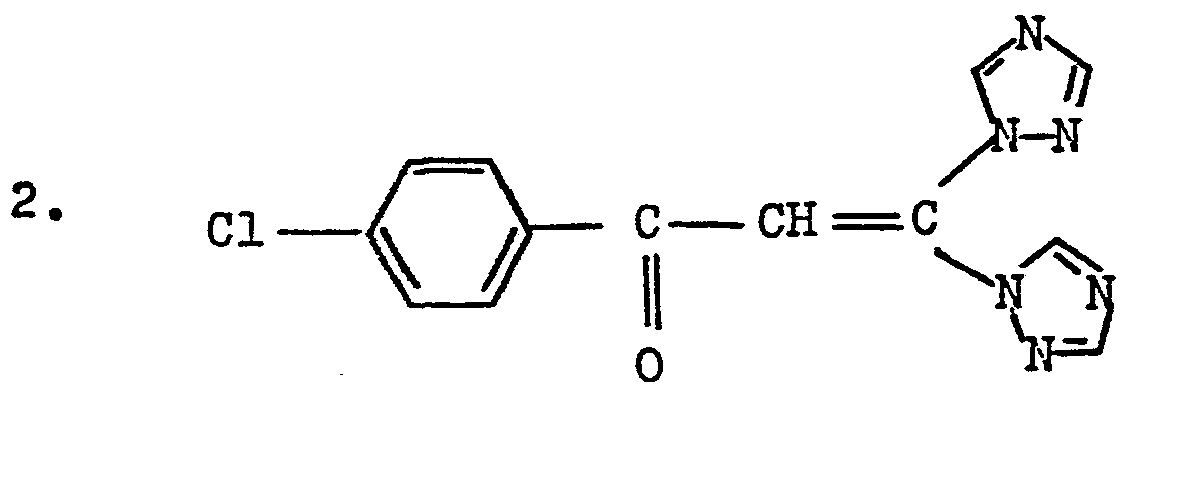
- C13H9C1N60 Ber. C 51.9 H.3.0 N 28.0 Cl 11.8
(300,5) Gef. C 52.1 H 3.0 N 27.9 Cl 11.8
- C13H9ClN60 Ber. C 51.9 H 3.0 N 28.0 Cl 11.8
(300,5) Gef. C 51.9 H 3.0 N 27.7 Cl 11.6
- 1,1-Bis(1,2,4-triazolyl)-3-(2-methylphenyl)propen-3-on Schmp: 1670C
- C14H12N60 Ber. C 60.0 H 4.3 N 30.0
(280) Gef. C 60.0 H 4.2 N 29.2 - Zu 200 g eines lehmigen Sandbodens, dessen Feuchtigkeitsgehalt auf 50 % der maximalen Wasserkapazität eingestellt war, wurden 220 mg Ammoniumsulfat gegeben und gründlich vermischt. Danach wurden die Wirkstoffe, in 0,2 ml Aceton gelöst, in Mengen von 1 ppm, bezogen auf feuchten Sandboden, zugesetzt. Nach sorgfältiger Durchmischung wurden die Bodenproben nach Verdunsten des Acetons in mit Aluminiumfolie zur Vermeidung von Wasserverlusten abgedeckten 1 Liter-Gläsern zusammen mit den Kontrollen ohne Wirkstoffzusatz über einen Zeitraum von 28 Tagen bei 21°C bebrütet. Danach wurden jeweils 2,5 g der Bodenproben in 100 ml-Erlenmeyerkolben eingefüllt und 22,5 ml einer O,ln Kaliumsulfat-Lösung zugesetzt. Nach 30-minütigem Schütteln wurde abfiltriert, und jeweils 2,5 ml der Bodenauszüge wurden mit 16,25 ml aqua dest. vermischt. Anschließend wurden zum Nachweis der im Bodenauszug noch vorhandenen Ammoniumionen 1,25 ml Neßler-Reagenz hinzugefügt und gründlich geschüttelt. Die Farbveränderungen wurden dann photometrisch bei einer Wellenlänge von 420 nm gemessen. Anhand von Standardkurven, die durch Messung von Lösungen mit bekannten Ammoniumsulfat-Gehalten ermittelt worden waren, wurden die noch in den Bodenproben vorhandenen Ammoniumsulfat-Mengen bestimmt. Die prozentuale Hemmung der Nitrifikation in den behandelten Bodenproben wurde im Vergleich mit den unbehandelten Bodenproben (nur Ammoniumsulfat--Zusatz) nach folgender Formel berechnet:

- a = Nitrifikationsrate von Ammoniumsulfat
- b = Nitrifikationsrate von Ammoniumsulfat + Nitrifikationshemmer.

und in der die beiden Triazolringe in 4-Stellung oder vorzugsweise in 1-Stellung mit der Vinylgruppe verknüpft sind,
überraschend gute Eigenschaften als Nitrifikationshemmer aufweisen.
Claims (4)

und in der die beiden Triazolringe wahlweise in 1- oder 4-Stellung mit der Vinylgruppe verknüpft sein können.
und in der die beiden Triazolringe in 1-Stellung mit der Vinylgruppe verknüpft sind.
Priority Applications (1)
| Application Number | Priority Date | Filing Date | Title |
|---|---|---|---|
| AT84100311T ATE47847T1 (de) | 1983-01-22 | 1984-01-13 | Ditriazolylvinyl-phenyl-ketone, verfahren zu ihrer herstellung und ihre verwendung als nitrifikationshemmer. |
Applications Claiming Priority (2)
| Application Number | Priority Date | Filing Date | Title |
|---|---|---|---|
| DE19833302098 DE3302098A1 (de) | 1983-01-22 | 1983-01-22 | Ditriazolylvinyl-phenyl-ketone, verfahren zu ihrer herstellung und ihre verwendung als nitrifikationshemmer |
| DE3302098 | 1983-01-22 |
Publications (3)
| Publication Number | Publication Date |
|---|---|
| EP0114626A2 true EP0114626A2 (de) | 1984-08-01 |
| EP0114626A3 EP0114626A3 (en) | 1986-03-26 |
| EP0114626B1 EP0114626B1 (de) | 1989-11-08 |
Family
ID=6188958
Family Applications (1)
| Application Number | Title | Priority Date | Filing Date |
|---|---|---|---|
| EP84100311A Expired EP0114626B1 (de) | 1983-01-22 | 1984-01-13 | Ditriazolylvinyl-phenyl-ketone, Verfahren zu ihrer Herstellung und ihre Verwendung als Nitrifikationshemmer |
Country Status (5)
| Country | Link |
|---|---|
| US (1) | US4550173A (de) |
| EP (1) | EP0114626B1 (de) |
| JP (1) | JPS59172479A (de) |
| AT (1) | ATE47847T1 (de) |
| DE (2) | DE3302098A1 (de) |
Families Citing this family (1)
| Publication number | Priority date | Publication date | Assignee | Title |
|---|---|---|---|---|
| DE3423762A1 (de) * | 1984-06-28 | 1986-01-09 | Basf Ag, 6700 Ludwigshafen | Verfahren zur herstellung von chlorolefinen |
Family Cites Families (6)
| Publication number | Priority date | Publication date | Assignee | Title |
|---|---|---|---|---|
| GB1580535A (en) * | 1976-08-27 | 1980-12-03 | Ici Ltd | Substituted ketones and their use as herbicides |
| DE2745833C2 (de) * | 1977-10-12 | 1986-10-16 | VEB Fahlberg-List Chemische und pharmazeutische Fabriken, DDR 3013 Magdeburg | Mittel zur Hemmung bzw. Regelung der Nitrifikation von Ammoniumstickstoff in Kulturböden |
| GB1592516A (en) * | 1977-11-02 | 1981-07-08 | Fahlberg List Magdeberg Chemis | Method for inhibiting or regulating the nitrification of ammonium nitrogen in cultivated soils |
| EP0009298A1 (de) * | 1978-07-27 | 1980-04-02 | Imperial Chemical Industries Plc | Heterocyclische Verbindungen, Verfahren zu ihrer Herstellung, diese Verbindungen enthaltende pestizide Zusammensetzungen und Verfahren zur Schädlingsbekämpfung |
| DE2846980A1 (de) * | 1978-10-28 | 1980-05-08 | Bayer Ag | 1-ethen-azol-derivate, verfahren zu ihrer herstellung und ihre verwendung als fungizide |
| US4379921A (en) * | 1980-08-21 | 1983-04-12 | Sumitomo Chemical Company, Limited | Production of triazolylvinyl ketones |
-
1983
- 1983-01-22 DE DE19833302098 patent/DE3302098A1/de not_active Withdrawn
-
1984
- 1984-01-11 JP JP59002101A patent/JPS59172479A/ja active Pending
- 1984-01-13 AT AT84100311T patent/ATE47847T1/de not_active IP Right Cessation
- 1984-01-13 EP EP84100311A patent/EP0114626B1/de not_active Expired
- 1984-01-13 DE DE8484100311T patent/DE3480394D1/de not_active Expired
- 1984-01-17 US US06/571,454 patent/US4550173A/en not_active Expired - Fee Related
Also Published As
| Publication number | Publication date |
|---|---|
| EP0114626A3 (en) | 1986-03-26 |
| US4550173A (en) | 1985-10-29 |
| JPS59172479A (ja) | 1984-09-29 |
| DE3302098A1 (de) | 1984-07-26 |
| EP0114626B1 (de) | 1989-11-08 |
| DE3480394D1 (en) | 1989-12-14 |
| ATE47847T1 (de) | 1989-11-15 |
Similar Documents
| Publication | Publication Date | Title |
|---|---|---|
| DE3688374T2 (de) | Pyrazolsulfonamidderivat, Verfahren zu seiner Herstellung und dieses enthaltendes Herbizid. | |
| DE69839392T2 (de) | In 1-stellung substituierte 4-carbamoyl-1,2,4-triazol-5-on-derivate und herbizide | |
| CH647513A5 (de) | Triazol-derivate, deren herstellung und verwendung. | |
| DE2638470A1 (de) | Imidazole und 1,2,4-triazole, verfahren zur herstellung derselben, solche verbindungen enthaltende zusammensetzungen zur bekaempfung von schaedlingen und verfahren zur bekaempfung von schaedlingen | |
| DE69322118T2 (de) | Amino-Thiazolderivate und ihre Anwendung als Fungizide | |
| DE2657578C2 (de) | (1-Imidazolyl)-alkanonoximäther | |
| EP0278445B1 (de) | Azolhalbaminal-Derivate und ihre Verwendung als Nitrifikationsinhibitoren | |
| DE3586371T2 (de) | Verfahren zur behandlung des bodens und zusammensetzung zur konservierung von stickstoff im boden. | |
| EP0114626B1 (de) | Ditriazolylvinyl-phenyl-ketone, Verfahren zu ihrer Herstellung und ihre Verwendung als Nitrifikationshemmer | |
| EP1663997B1 (de) | 1h-azolyl-methyl-amide, verfahren zu ihrer herstellung und ihre verwendung als nitrifikationsinhibitoren | |
| EP0139135B1 (de) | 4-Alkylimidazol-Derivate, ihre Herstellung und Verwendung | |
| DE2339217A1 (de) | Neue cyclische verbindungen mit einer harnstoffgruppe, verfahren zur herstellung und herbicide zusammensetzungen | |
| EP1272472B1 (de) | 1h-pyrazol-derivate, verfahren zu ihrer herstellung und deren verwendung zur hemmung und steuerung der nitrifikation | |
| DE2810267A1 (de) | Verfahren zur herstellung von phenylpyridazinonderivaten | |
| DE2239892A1 (de) | Mittel zur bekaempfung von pflanzenpathogenen organismen | |
| DE2856974C2 (de) | 1- [N-(4-Chlor-2- trifluormethylphenyl)phenylacetimidoyl] - imidazo! und seine Metallkomplexe, Verfahren zur Herstellung dieser Verbindungen sowie deren Verwendung in Fungiziden | |
| DE2502932C2 (de) | Metallkomplexe von N-Trityl-azolen, Verfahren zu ihrer Herstellung sowie ihre Verwendung als Fungizide | |
| DE2814041C3 (de) | 1-AlkoxyalkyUmidoyUmidazolderivate und Verfahren zu deren Herstellung | |
| AT340201B (de) | Pestizides fungizides und bakterizides mittel | |
| DE2543999A1 (de) | Duengemittel zur versorgung von pflanzen mit eisen | |
| DE19913475A1 (de) | Verwendung 2-chlorsubstituierter nicht-flüchtiger 1-Azolyl-ethanol-Derivate als Nitrifikationsinhibitoren | |
| DE2045098C3 (de) | N-substituierte N-Thioformylhydroxylamine, Verfahren zu ihrer Herstellung und ihre Verwendung als antibacterielles oder fungicides Mittel | |
| DE2457599A1 (de) | Pyran-derivate und ihre verwendung als herbicide | |
| DD227957B5 (de) | Wirkstoffkombinationen zur Hemmung bzw. Regelung der Nitrifikation von Ammoniumstickstoff in Kulturboeden | |
| AT299244B (de) | Verfahren zur Herstellung von neuen Organozinnverbindungen |
Legal Events
| Date | Code | Title | Description |
|---|---|---|---|
| PUAI | Public reference made under article 153(3) epc to a published international application that has entered the european phase |
Free format text: ORIGINAL CODE: 0009012 |
|
| AK | Designated contracting states |
Designated state(s): AT BE CH DE FR GB IT LI NL SE |
|
| PUAL | Search report despatched |
Free format text: ORIGINAL CODE: 0009013 |
|
| AK | Designated contracting states |
Kind code of ref document: A3 Designated state(s): AT BE CH DE FR GB IT LI NL SE |
|
| 17P | Request for examination filed |
Effective date: 19860212 |
|
| 17Q | First examination report despatched |
Effective date: 19870224 |
|
| GRAA | (expected) grant |
Free format text: ORIGINAL CODE: 0009210 |
|
| AK | Designated contracting states |
Kind code of ref document: B1 Designated state(s): AT BE CH DE FR GB IT LI NL SE |
|
| REF | Corresponds to: |
Ref document number: 47847 Country of ref document: AT Date of ref document: 19891115 Kind code of ref document: T |
|
| ITF | It: translation for a ep patent filed | ||
| GBT | Gb: translation of ep patent filed (gb section 77(6)(a)/1977) | ||
| PGFP | Annual fee paid to national office [announced via postgrant information from national office to epo] |
Ref country code: FR Payment date: 19891213 Year of fee payment: 7 |
|
| REF | Corresponds to: |
Ref document number: 3480394 Country of ref document: DE Date of ref document: 19891214 |
|
| PGFP | Annual fee paid to national office [announced via postgrant information from national office to epo] |
Ref country code: AT Payment date: 19891218 Year of fee payment: 7 |
|
| PGFP | Annual fee paid to national office [announced via postgrant information from national office to epo] |
Ref country code: SE Payment date: 19891219 Year of fee payment: 7 Ref country code: CH Payment date: 19891219 Year of fee payment: 7 |
|
| PGFP | Annual fee paid to national office [announced via postgrant information from national office to epo] |
Ref country code: DE Payment date: 19900108 Year of fee payment: 7 |
|
| ITTA | It: last paid annual fee | ||
| PGFP | Annual fee paid to national office [announced via postgrant information from national office to epo] |
Ref country code: NL Payment date: 19900131 Year of fee payment: 7 Ref country code: GB Payment date: 19900131 Year of fee payment: 7 |
|
| PGFP | Annual fee paid to national office [announced via postgrant information from national office to epo] |
Ref country code: BE Payment date: 19900215 Year of fee payment: 7 |
|
| ET | Fr: translation filed | ||
| PLBE | No opposition filed within time limit |
Free format text: ORIGINAL CODE: 0009261 |
|
| STAA | Information on the status of an ep patent application or granted ep patent |
Free format text: STATUS: NO OPPOSITION FILED WITHIN TIME LIMIT |
|
| 26N | No opposition filed | ||
| PG25 | Lapsed in a contracting state [announced via postgrant information from national office to epo] |
Ref country code: GB Effective date: 19910113 Ref country code: AT Effective date: 19910113 |
|
| PG25 | Lapsed in a contracting state [announced via postgrant information from national office to epo] |
Ref country code: SE Effective date: 19910114 |
|
| PG25 | Lapsed in a contracting state [announced via postgrant information from national office to epo] |
Ref country code: DE Effective date: 19910121 |
|
| PG25 | Lapsed in a contracting state [announced via postgrant information from national office to epo] |
Ref country code: LI Effective date: 19910131 Ref country code: CH Effective date: 19910131 Ref country code: BE Effective date: 19910131 |
|
| PG25 | Lapsed in a contracting state [announced via postgrant information from national office to epo] |
Ref country code: NL Effective date: 19910801 |
|
| GBPC | Gb: european patent ceased through non-payment of renewal fee | ||
| NLV4 | Nl: lapsed or anulled due to non-payment of the annual fee | ||
| PG25 | Lapsed in a contracting state [announced via postgrant information from national office to epo] |
Ref country code: FR Effective date: 19910930 |
|
| REG | Reference to a national code |
Ref country code: CH Ref legal event code: PL |
|
| REG | Reference to a national code |
Ref country code: FR Ref legal event code: ST |
|
| EUG | Se: european patent has lapsed |
Ref document number: 84100311.4 Effective date: 19910910 |