EP0115565A1 - Verfahren zur Programmierung eines zu einem Messgerät gehörenden nichtflüchtigen Schreib-/Lesespeichers sowie Messgerät zur Durchführung des Verfahrens - Google Patents
Verfahren zur Programmierung eines zu einem Messgerät gehörenden nichtflüchtigen Schreib-/Lesespeichers sowie Messgerät zur Durchführung des Verfahrens Download PDFInfo
- Publication number
- EP0115565A1 EP0115565A1 EP83108989A EP83108989A EP0115565A1 EP 0115565 A1 EP0115565 A1 EP 0115565A1 EP 83108989 A EP83108989 A EP 83108989A EP 83108989 A EP83108989 A EP 83108989A EP 0115565 A1 EP0115565 A1 EP 0115565A1
- Authority
- EP
- European Patent Office
- Prior art keywords
- information carrier
- measuring device
- measuring instrument
- pulse sequence
- read
- Prior art date
- Legal status (The legal status is an assumption and is not a legal conclusion. Google has not performed a legal analysis and makes no representation as to the accuracy of the status listed.)
- Granted
Links
- 230000015654 memory Effects 0.000 title claims abstract description 10
- 238000000034 method Methods 0.000 title claims description 9
- 238000001208 nuclear magnetic resonance pulse sequence Methods 0.000 claims description 12
- 239000000969 carrier Substances 0.000 claims description 3
- 238000005303 weighing Methods 0.000 abstract description 4
- 238000012423 maintenance Methods 0.000 description 8
- 230000006870 function Effects 0.000 description 4
- 238000003860 storage Methods 0.000 description 3
- 230000006399 behavior Effects 0.000 description 2
- 230000002950 deficient Effects 0.000 description 2
- 230000008439 repair process Effects 0.000 description 2
- 230000008672 reprogramming Effects 0.000 description 2
- MWRWFPQBGSZWNV-UHFFFAOYSA-N Dinitrosopentamethylenetetramine Chemical compound C1N2CN(N=O)CN1CN(N=O)C2 MWRWFPQBGSZWNV-UHFFFAOYSA-N 0.000 description 1
- 230000008901 benefit Effects 0.000 description 1
- 230000008859 change Effects 0.000 description 1
- 238000006243 chemical reaction Methods 0.000 description 1
- 238000012790 confirmation Methods 0.000 description 1
- 238000012937 correction Methods 0.000 description 1
- 238000013461 design Methods 0.000 description 1
- 230000007257 malfunction Effects 0.000 description 1
- 238000004519 manufacturing process Methods 0.000 description 1
- 230000008569 process Effects 0.000 description 1
- 230000001681 protective effect Effects 0.000 description 1
- 238000002076 thermal analysis method Methods 0.000 description 1
- GYTROFMCUJZKNA-UHFFFAOYSA-N triethyl triethoxysilyl silicate Chemical compound CCO[Si](OCC)(OCC)O[Si](OCC)(OCC)OCC GYTROFMCUJZKNA-UHFFFAOYSA-N 0.000 description 1
- 230000000007 visual effect Effects 0.000 description 1
Images
Classifications
-
- G—PHYSICS
- G11—INFORMATION STORAGE
- G11C—STATIC STORES
- G11C16/00—Erasable programmable read-only memories
- G11C16/02—Erasable programmable read-only memories electrically programmable
- G11C16/06—Auxiliary circuits, e.g. for writing into memory
- G11C16/10—Programming or data input circuits
-
- G—PHYSICS
- G01—MEASURING; TESTING
- G01G—WEIGHING
- G01G23/00—Auxiliary devices for weighing apparatus
- G01G23/18—Indicating devices, e.g. for remote indication; Recording devices; Scales, e.g. graduated
- G01G23/36—Indicating the weight by electrical means, e.g. using photoelectric cells
- G01G23/37—Indicating the weight by electrical means, e.g. using photoelectric cells involving digital counting
- G01G23/375—Indicating the weight by electrical means, e.g. using photoelectric cells involving digital counting during the movement of a coded element
Definitions
- the invention relates to a method for programming a non-volatile read / write memory belonging to a measuring device, in particular to a balance, which can be programmed by reading in a predetermined electrical pulse sequence.
- the invention further relates to a measuring device, in particular a balance, with a non-volatile read / write memory that can be programmed by reading in a predetermined electrical pulse sequence.
- Non-volatile read / write memories have been available on the market for some time, known as EAROM (electrically alterable read.only memory) or EEPROM (electrically erasable programmable read only memory).
- EAROM electrically alterable read.only memory
- EEPROM electrically erasable programmable read only memory
- the term EAROM is used in the following description, but this is not intended to be a limitation to the types commonly referred to. Even with modern scales and other measuring devices, there is always a need for simplification as far as possible, for example in terms of the number of different types Building blocks or to facilitate maintenance and repair work. In particular, this also applies to the electronic devices with digital storage elements considered here.
- EAROMs are sensitive to electrical interference, and even with the use of suitable protective measures (e.g. capacitive shielding) there remains a residual risk of the stored data being changed unintentionally or being lost. The EAROM in question must then be corrected (overwritten with the correct data) or replaced.
- a single microprocessor system for example a one-chip processor, and a single EAROM type are used, it allows the design of a plurality of different types within a device family by programming the latter differently.
- the type differences can relate, for example, to the permissible display resolution, to the displayed unit or to certain conversions, as well as to additional functions such as standstill control, choice of measuring time, etc.
- each type has a correspondingly programmed EAROM, which in turn a corresponding variety of programmed EAROMs in the manufacturing and spare parts warehouse and there is a risk of confusion when exchanged on the device.
- the object of the present invention was to solve the problems mentioned, that is, firstly to enable simple reconfiguration in the event of a repair, and secondly to drastically reduce the number of differently programmed EAROMs required for a plurality of device types.
- the predetermined pulse sequence is obtained by scanning an information carrier assigned to the device.
- the assignment of the type-specific information directly to the device allows only unprogrammed EAROMs to be in stock, which are then programmed for the first time when the device is installed or when a defective EAROM is replaced.
- the necessary information can be taken directly from the information carrier on the device.
- the information carrier can e.g. be a punched tape or a magnetic card, the data of which is then read into the EAROM using a punched tape or magnetic card reader via a corresponding interface.
- An embodiment of the method is preferred in which the predetermined pulse sequence is obtained by scanning an optically scannable bar code located on the information carrier with the aid of a bar code reader.
- the barcode is insensitive to interference and e.g. easy and durable to produce on paper or film (printing process).
- control information for the pulse sequences read in is made visible in the display assigned to the measuring device. This means that it can be recognized immediately, particularly in the case of bar codes, if e.g. part of the code was mistakenly not scanned.
- the invention is seen in the fact that the device is assigned an information carrier from which the predetermined pulse sequence can be extracted by scanning using a scanning device.
- the information carrier is preferably glued into the housing of the device.
- the information carrier has a bar code.
- the device can be assigned several information carriers with different information content. So it is e.g. With a scale, it is possible to change the behavior of the scale by temporarily reprogramming the EAROM for maintenance work (e.g. checks or readjustments), for example switching off certain functions and switching on others. After maintenance has been completed, the device will be programmed back to normal working behavior.
- maintenance work e.g. checks or readjustments
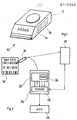
- the scale 10 comprises a housing 12 in a known manner. Two paper labels 14 and 16 are glued into this inside. Both labels are printed with a bar code of known type, label 14 containing the code for the normal work program of the balance, label 16, on the other hand, a code for a program changed for maintenance and control purposes. Both labels are provided with corresponding designations for visual identification, label 16, for example, with the type designation A 3.
- the -tracked S means "service", i.e. the corresponding program is (only) for maintenance purposes.
- Figure 2 illustrates an application.
- the code for the maintenance is scanned (label 16) by means of a code reading pen (bar code reader) 18, i.e.
- the scale 10 then functions differently in some functions than in normal weighing operation (the label 16 is shown separately in FIG. 2, but in reality it remains in the housing cover 12).
- the code reading pen 18 can be of the type HP HEDS 3000 (Hewlett Packard), for example. It supplies the signals sampled by the label 16 in TTL form to the one-chip microprocessor system 20 of the scale electronics 22.
- the micropor, processor 20 collects the information received, checks it and stores it in a buffer store (RAM) 24. After when the label 16 has been scanned and checked, the contents of the RAM 24 are written into the EAROM 25; this is programmed (new or re).
- the confirmation 'A 3 / S' first appears in the balance display 26, and then, after each line of code, the number as a prompt the next line to be read from the label 16. If a line has been left out in whole or in part, the display shows 'Error'. This is achieved by a corresponding combination of check digits from the individual lines of code.
- the EAROM 24 is reprogrammed into the normal weighing mode by reading the code on the label 14. The same applies in the event that an EAROM has to be corrected after a malfunction or a defective EAROM has to be exchanged for a new (not yet programmed) EAROM.
- bar codes are, for example, the UPC or the EAN code, furthermore the code 39 or a 2-out-of-5 code. Depending on the type of device, an optimally suitable code will be selected.
- the (re-programming or re-programming) of the preferred EAROM can affect all or only part of the storage capacity.
- the invention relates not only to scales but also to other measuring devices, such as Titrators, pH meters, digital voltmeters, devices in the field of thermal analysis and others.
Landscapes
- Physics & Mathematics (AREA)
- General Physics & Mathematics (AREA)
- Testing Or Calibration Of Command Recording Devices (AREA)
- Recording Measured Values (AREA)
- Tests Of Electronic Circuits (AREA)
- Optical Recording Or Reproduction (AREA)
Abstract
Description
- Die Erfindung betrifft ein Verfahren zur Programmierung eines zu einem Messgerät, insbesondere zu einer Waage gehörenden, durch Einlesen einer vorgegebenen elektrischen Impulsfolge programmierbaren nichtflüchtigen Schreib-/ Lesespeichers.
- Die Erfindung betrifft ferner ein Messgerät, insbesondere eine Waage, mit einem durch Einlesen einer vorgegebenen elektrischen Impulsfolge programmierbaren nichtflüchtigen Schreib-/Lesespeicher.
- Nichtflüchtige Schreib-/Lesespeicher sind seit einiger Zeit auf dem Markt erhältliche Speicherbauteile, bekannt als z.B. EAROM (electrically alterable read.only memory) oder EEPROM (electrically erasable programmable read only memory). Aus sprachlichen Gründen wird in der folgenden Beschreibung der Begriff EAROM verwendet, ohne dass dies eine Beschränkung auf üblicherweise so bezeichnete Typen sein soll.fAuch bei modernen Waagen und anderen Messgeräten besteht immer das Bedürfnis nach möglichst weitgehender Vereinfachung, sei es z.B. hinsichtlich der Anzahl typenspezifisch unterschiedlicher Bausteine oder hinsichtlich der Erleichterung von Wartungs- und Reparaturarbeiten. Insbesondere gilt dies auch für die hier betrachteten elektronischen Geräte mit digitalen Speicherelementen. Es bot sich daher an, in solchen Geräten die bisher verwendeten Arten von Festwertspeichern (ROMs) wenigstens teilweise durch EAROMs zu ersetzen, schon um den damit verbundenen Vorteil einer erhöhten Flexibilität zu gewinnen. Damit sind jedoch einige Probleme verbunden. So sind EAROMs empfindlich gegenüber elektrischen Störimpulsen, und auch bei Anwendung geeigneter Schutzmassnahmen (z.B: kapazitive Abschirmung) bleibt ein Restrisiko der Art, dass gespeicherte Daten ungewollt verändert werden bzw. verloren gehen. Das betreffende EAROM muss dann korrigiert (mit den korrekten Daten überschrieben) oder ersetzt werden.
- Ein weiteres Problem ergibt sich aus den Anwendungsmöglichkeiten dieses Elementes. Es erlaubt, bei Verwendung eines einzigen Mikroprozessorsystems, z.B. eines Ein-Chip-Prozessors, und eines einzigen EAROM-Typs, durch unterschiedliches Programmieren des letzteren die Gestaltung einer Mehrzahl von unterschiedlichen Typen innerhalb einer Gerätefamilie. Die Typenunterschiede können sich z.B. bei Waagen auf die zuläsige Anzeigeauflösung, auf die angezeigte Einheit oder auf bestimmte Umrechnungen beziehen, ferner auf zusätzliche Funktionen wie Stillstandskontrolle, Wahl der Messzeit u.a. Daraus folgt, dass jedem Typ ein entsprechend programmiertes EAROM zuzuordnen ist, was wiederum eine entsprechende Vielfalt an programmierten EAROMs im Fabrikations- und Ersatzteillager bedingt sowie beim Austausch am Gerät Verwechslungsgefahren in sich birgt.
- Die vorliegende Erfindung hatte zur Aufgabe, die genannten Probleme zu lösen, also, erstens, im Reparaturfall eine einfache Rekonfigurierung zu ermöglichen, und, zweitens, die für eine Mehrzahl von Gerätetypen notwendige Anzahl von unterschiedlich programmierten EAROMs drastisch zu reduzieren.
- Zur Lösung dieser Aufgabe wird bei einem Verfahren der eingangs genannten Art vorgeschlagen, dass die vorgegebene Impulsfolge durch Abtasten eines dem Gerät zugeordneten Informationsträgers gewonnen wird. Die Zuordnung der typenspezifischen Information direkt zum Gerät erlaubt es, nur mehr unprogrammierte EAROMs am Lager zu haben, die dann erstmals bei der Gerätemontage bzw. beim Ersatz eines defekten EAROM programmiert werden. In beiden Fällen wie auch im Falle der Korrekturprogrammierung (z.B. nach dem oben erwähnten Auftauchen von Störimpulsen) kann die notwendige Information (Programmdaten) direkt vom Informationsträger am Gerät abgenommen werden.
- Dabei bieten sich mehrere Möglichkeiten an. So kann der Informationsträger z.B. ein Lochstreifen sein oder eine Magnetkarte, deren Daten dann mittels eines Lochstreifen- bzw. Magnetkartenlesers über ein entsprechendes Interface in das EAROM eingelesen werden. Bevorzugt wird eine Ausgestaltung des Verfahrens, bei welcher die vorgegebene Impulsfolge durch Abtasten eines auf dem Informationsträger befindlichen, optisch abtastbaren Strichcodes mit Hilfe eines Strichcodelesers gewonnen wird. Der Strichcode ist störungsunempfindlich und z.B. auf Papier oder Folie leicht und dauerhaft herstellbar (Druckverfahren).
- Zur Sicherstellung einer korrekten Programmierung ist es zweckmässig, wenn zu den jeweils eingelesenen Impulsfolgen Kontrollangaben in der dem Messgerät zugeordneten Anzeige sichtbar gemacht werden. Damit kann insbesondere im Falle des Strichcodes sofort erkannt werden, wenn z.B. ein Teil des Codes irrtümlich nicht abgetastet wurde.
- Bezogen auf ein Messgerät der oben genannten Art wird die Erfindung darin gesehen, dass dem Gerät ein Informationsträger zugeordnet ist, dem die vorgegebene Impulsfolge durch Abtastung mit Hilfe eines Abtastgerätes entnommen werden kann. Dabei ist der Informationsträger vorzugsweise in das Gehäuse des Gerätes eingeklebt. In einer bevorzugten Ausgestaltung der Erfindung weist der Informationsträger einen Strichcode auf.
- Weiterhin kann es zweckmässig sein, dass dem Gerät mehrere Informationsträger mit unterschiedlichem Informationsgehalt zugeordnet sind. Damit ist es z.B. bei einer Waage möglich, durch temporäres Umprogrammieren des EAROM für Wartungsarbeiten (z.B. Kontrollen oder Nacheinstellungen) das Verhalten der Waage zu verändern, beispielsweise gewisse Funktionen aus-, andere einzuschalten. Nach beendeter Wartung wird wieder auf normales Arbeitsverhalten des Gerätes zurückprogrammiert.
- Ein Ausführungsbeispiel der Erfindung wird im folgenden anhand der schematischen Zeichnung erläutert, in welcher
- Figur 1 eine Waage, und
- Figur 2 eine Programmierschaltung darstellen.
- Die Waage 10 umfasst in bekannter Weise ein Gehäuse 12. In dieses sind innen zwei Papieretiketten 14 und 16 eingeklebt. Beide Etiketten sind mit einem Streifen-oder Strichcode (bar code) bekannter Art bedruckt, wobei das Etikett 14 den Code für das normale Arbeitsprogramm der Waage enthält, das Etikett 16 hingegen einen Code für ein für Wartungs- und Kontrollzwecke geändertes Programm. Beide Etiketten sind zur visuellen Identifizierung mit entsprechenden Bezeichnungen versehen, das Etikett 16 beispielsweise mit der Typenbezeichnung A 3. Das -nachgestellte S bedeutet "Service", d.h. das entsprechende Programm ist (nur) für Wartungszwecke.
- Figur 2 verdeutlicht einen Anwendungsfall. Anlässlich eines Kundendienstes wird mittels eines Codelesestiftes (Strichcodelesers) 18 der Code für die Wartung abgetastet (Etikett 16), d.h. die Waage 10 arbeitet danach in einigen Funktionen anders als im normalen Wägebetrieb (das Etikett 16 ist zwar in Figur 2 separat gezeichnet, es verbleibt in Wirklichkeit aber im Gehäusedeckel 12).
- Der Codelesestift 18 kann beispielsweise vom Typ HP HEDS 3000 (Firma Hewlett Packard) sein. Er liefert die vom Etikett 16 abgetasteten Signale in TTL-Form an das Ein-Chip-Mikroprozessor-System 20 der Waagenelektronik 22. Der Mikropor,zessor 20 sammelt die erhaltenen Informationen, kontrolliert sie und speichert sie in einem Zwischenspeicher (RAM) 24. Nach beendeter Abtastung des Etiketts 16 und erfolgter Kontrolle wird der Inhalt des RAM 24 in das EAROM 25 eingeschrieben; dieses ist damit (neu oder um-) programmiert.
- Zur Kontrolle für den Wartungstechniker erscheint dabei in der Waagenanzeige 26 zunächst die Bestätigung 'A 3 / S', sodann, nach jeder Codezeile, als Aufforderung die Nummer der nächsten zu lesenden Zeile aus dem Etikett 16. Wurde eine Zeile ganz oder teilweise ausgelassen, so erscheint in der Anzeige 26 'Error'. Dies wird erreicht durch eine entsprechende Kombination von Prüfziffern aus den einzelnen Codezeilen.
- Nach abgeschlossener Wartung wird das EAROM 24 durch Lesen des Codes des Etiketts 14 wieder in den normalen Wägemodus zurückprogrammiert. Dasselbe gilt für den Fall, dass ein EAROM nach einer Störung wieder korrigiert oder aber ein defektes gegen ein neues (noch unprogrammiertes) EAROM ausgetauscht werden muss.
- Bekannte Strichcodes sind beispielsweise der UPC- oder der EAN-Code, ferner der Code 39 oder ein 2-aus-5-Code. Je nach Art des Gerätes wird man einen optimal geeigneten Code auswählen.
- Unter den im Rahmen der Erfindung möglichen Variationen seien als Beispiele angeführt:
- - Anordnung des Informationsträgers in einem beliebigen Teil eines mehrteiligen Systems (z.B. aus Wägeplattform und separater Anzeige oder, im Falle eines anderen Messgerätes, aus Messteil und Steuerteil bestehend);
- - Anordnung des Informationsträgers aussen, falls ein Oeffnen des Gerätes oder Geräteteils nicht zweckmässig erscheint;
- - Anordnung mehrerer typenspezifischer Informationsträger im Rahmen eines Gerätes oder Systems, sofern es die Art der Typenunterschiede erlaubt; dies gestattet eine nachträgliche Umprogrammierung derart, dass z.B. eine in Gramm anzeigende Waage in eine Karatwaage verwandelt wird;
- - Lesen des Etiketts und (Um-)Programmieren des EAROMs mit Hilfe einer dem Strichcodeleser 18 zugeordneten eigenen, mikroprozessorgesteuerten Programmierschaltung 19. Dies kann z.B. dann erforderlich sein, wenn das Mikroprozessorsystem 20 der Waagenelektronik 22 zu wenig Speicherkapazität hat. In diesem Falle würden die abgetasteten, aufbereiteten und kontrollierten Daten direkt dem EAROM 25 eingeschrieben. Diese Variante ist in Figur 2 gestrichelt angedeutet.
- Ferner sei der Vollständigkeit halber erwähnt, dass die (Neu- oder Um-)Programmierung des hier bevorzugten EAROMs jeweils die ganze oder aber nur einen Teil der Speicherkapazität betreffen kann. Schliesslich sei nochmals betont, dass die Erfindung sich ausser auf Waagen auch auf andere Messgeräte bezieht, wie z.B. Titratoren, pH-Messgeräte, Digitalvoltmeter, Geräte auf dem Gebiet der Thermoanalyse und andere mehr.
Claims (7)
Applications Claiming Priority (2)
| Application Number | Priority Date | Filing Date | Title |
|---|---|---|---|
| CH49483A CH659890A5 (de) | 1983-01-29 | 1983-01-29 | Messgeraet mit einem durch einlesen einer vorgegebenen elektrischen impulsfolge programmierbaren nichtfluechtigen schreib-/lesespeicher. |
| CH494/83 | 1983-01-29 |
Publications (2)
| Publication Number | Publication Date |
|---|---|
| EP0115565A1 true EP0115565A1 (de) | 1984-08-15 |
| EP0115565B1 EP0115565B1 (de) | 1988-12-14 |
Family
ID=4188289
Family Applications (1)
| Application Number | Title | Priority Date | Filing Date |
|---|---|---|---|
| EP19830108989 Expired EP0115565B1 (de) | 1983-01-29 | 1983-09-12 | Verfahren zur Programmierung eines zu einem Messgerät gehörenden nichtflüchtigen Schreib-/Lesespeichers sowie Messgerät zur Durchführung des Verfahrens |
Country Status (4)
| Country | Link |
|---|---|
| EP (1) | EP0115565B1 (de) |
| JP (1) | JPS59138923A (de) |
| CH (1) | CH659890A5 (de) |
| DE (2) | DE3378704D1 (de) |
Cited By (2)
| Publication number | Priority date | Publication date | Assignee | Title |
|---|---|---|---|---|
| FR2636464A1 (fr) * | 1988-09-14 | 1990-03-16 | Sgs Thomson Microelectronics | Memoire eprom avec signature interne concernant notamment le mode de programmation |
| US5680353A (en) * | 1988-09-14 | 1997-10-21 | Sgs-Thomson Microelectronics, S.A. | EPROM memory with internal signature concerning, in particular, the programming mode |
Families Citing this family (1)
| Publication number | Priority date | Publication date | Assignee | Title |
|---|---|---|---|---|
| DE3709717C2 (de) * | 1987-03-25 | 1997-05-15 | Mettler Toledo Albstadt Gmbh | Meßgerät, insbesondere Waage |
Citations (4)
| Publication number | Priority date | Publication date | Assignee | Title |
|---|---|---|---|---|
| DE2519727A1 (de) | 1975-05-02 | 1976-11-11 | Berkel Patent Nv | Justierbare messvorrichtung, insbesondere waage |
| GB1564568A (en) | 1977-05-18 | 1980-04-10 | Triner Scale & Mfg Co | Electronic postage scale |
| EP0024436A1 (de) | 1979-03-01 | 1981-03-11 | KUZE, Yoshikazu | Umwandlungsvorrichtung für folgesteuerungsdaten |
| EP0042600A2 (de) | 1980-06-21 | 1981-12-30 | International Standard Electric Corporation | Gerät der Unterhaltungselektronik mit einer Programmiereinrichtung für vorausgewählte Rundfunk- und/oder Fernsehprogrammbeiträge |
-
1983
- 1983-01-29 CH CH49483A patent/CH659890A5/de not_active IP Right Cessation
- 1983-08-12 JP JP14867983A patent/JPS59138923A/ja active Pending
- 1983-09-12 EP EP19830108989 patent/EP0115565B1/de not_active Expired
- 1983-09-12 DE DE8383108989T patent/DE3378704D1/de not_active Expired
-
1984
- 1984-01-20 DE DE19848401641 patent/DE8401641U1/de not_active Expired
Patent Citations (4)
| Publication number | Priority date | Publication date | Assignee | Title |
|---|---|---|---|---|
| DE2519727A1 (de) | 1975-05-02 | 1976-11-11 | Berkel Patent Nv | Justierbare messvorrichtung, insbesondere waage |
| GB1564568A (en) | 1977-05-18 | 1980-04-10 | Triner Scale & Mfg Co | Electronic postage scale |
| EP0024436A1 (de) | 1979-03-01 | 1981-03-11 | KUZE, Yoshikazu | Umwandlungsvorrichtung für folgesteuerungsdaten |
| EP0042600A2 (de) | 1980-06-21 | 1981-12-30 | International Standard Electric Corporation | Gerät der Unterhaltungselektronik mit einer Programmiereinrichtung für vorausgewählte Rundfunk- und/oder Fernsehprogrammbeiträge |
Cited By (3)
| Publication number | Priority date | Publication date | Assignee | Title |
|---|---|---|---|---|
| FR2636464A1 (fr) * | 1988-09-14 | 1990-03-16 | Sgs Thomson Microelectronics | Memoire eprom avec signature interne concernant notamment le mode de programmation |
| WO1990003033A1 (fr) * | 1988-09-14 | 1990-03-22 | Sgs Thomson Microelectronics S.A. | Memoire eprom avec signature interne concernant notamment le mode de programmation |
| US5680353A (en) * | 1988-09-14 | 1997-10-21 | Sgs-Thomson Microelectronics, S.A. | EPROM memory with internal signature concerning, in particular, the programming mode |
Also Published As
| Publication number | Publication date |
|---|---|
| DE8401641U1 (de) | 1984-05-03 |
| CH659890A5 (de) | 1987-02-27 |
| DE3378704D1 (en) | 1989-01-19 |
| EP0115565B1 (de) | 1988-12-14 |
| JPS59138923A (ja) | 1984-08-09 |
Similar Documents
| Publication | Publication Date | Title |
|---|---|---|
| DE3688014T2 (de) | Verfahren zur Steuerung von Frankiermaschinen. | |
| DE69323104T2 (de) | Anordnung mit einem Speicher und Mitteln zur Datenbestätigung. | |
| DE19858840A1 (de) | Verfahren zum bidirektionalen Datentransfer zwischen einem Terminal und einer Chipkarte sowie Chipkarte | |
| DE2512902B2 (de) | Datenaustauschsystem | |
| DE60122865T2 (de) | Ausgabesystem für IC-Karten | |
| EP0195885B1 (de) | Verfahren und Anordnung zum nichtflüchtigen Speichern des Zählerstandes einer elektronischen Zählschaltung | |
| DE3111355A1 (de) | Verfahren zum betreiben automatischer vorrichtungen wie kassen oder aehnliches und vorrichtung zur durchfuehrung des verfahrens | |
| DE3804925A1 (de) | Tragbare elektronische vorrichtung | |
| DE3314976C2 (de) | ||
| WO1992007338A1 (de) | Frankierstreifengeber-system | |
| DE69405424T2 (de) | Verfahren zum Kontrollieren des täglichen Postgebührenverbrauchs einer Frankiermaschine und Frankiermaschine zur Durchführung dieses Verfahrens | |
| EP0854425A2 (de) | Anordnung und Verfahren zur Verbesserung der Datensicherheit mittels Ringpuffer | |
| DE3586756T2 (de) | Elektronische registrierkasse. | |
| DE3705864C2 (de) | ||
| DE69726358T2 (de) | Lesegerät für magnetische Karte | |
| DE60224937T2 (de) | Verfahren und anordnung zum verknüpfen von verwandelten appletdateien | |
| DE19734483A1 (de) | Verfahren und Vorrichtung zum Zusammenführen und Verbinden von Kunststoffkarten und Kartenträgern | |
| EP0115565A1 (de) | Verfahren zur Programmierung eines zu einem Messgerät gehörenden nichtflüchtigen Schreib-/Lesespeichers sowie Messgerät zur Durchführung des Verfahrens | |
| DE2160711A1 (de) | Anzeigevorrichtung | |
| DE10350221A1 (de) | Verfahren und Vorrichtung zum Bereitstellen von Karten | |
| EP0353530B2 (de) | Verfahren zum Unterscheidbarmachen von elektronischen Schaltungen mit nichtflüchtigem Speicher | |
| DE2858818C2 (de) | Transportierbarer Informationsträger mit einem Mikroprozessor und einem programmierbaren Festwertspeicher | |
| DE3232165C2 (de) | Verfahren und Anordnung zum Programmieren eines Festwert-Speichers eines digital gesteuerten Zeichengerätes | |
| DE4102197A1 (de) | Ein system und verfahren zur kontrolle einer gemeinsam verwendeten datenstation durch verwendung einer speicherkarte | |
| DE10146544B4 (de) | Vorrichtung und Verfahren zur manuellen Annahme und Erfassung von Leergutartikeln |
Legal Events
| Date | Code | Title | Description |
|---|---|---|---|
| PUAI | Public reference made under article 153(3) epc to a published international application that has entered the european phase |
Free format text: ORIGINAL CODE: 0009012 |
|
| 17P | Request for examination filed |
Effective date: 19840516 |
|
| AK | Designated contracting states |
Designated state(s): DE FR GB IT NL |
|
| GRAA | (expected) grant |
Free format text: ORIGINAL CODE: 0009210 |
|
| AK | Designated contracting states |
Kind code of ref document: B1 Designated state(s): DE FR GB IT NL |
|
| PG25 | Lapsed in a contracting state [announced via postgrant information from national office to epo] |
Ref country code: IT Free format text: LAPSE BECAUSE OF FAILURE TO SUBMIT A TRANSLATION OF THE DESCRIPTION OR TO PAY THE FEE WITHIN THE PRESCRIBED TIME-LIMIT;WARNING: LAPSES OF ITALIAN PATENTS WITH EFFECTIVE DATE BEFORE 2007 MAY HAVE OCCURRED AT ANY TIME BEFORE 2007. THE CORRECT EFFECTIVE DATE MAY BE DIFFERENT FROM THE ONE RECORDED. Effective date: 19881214 |
|
| REF | Corresponds to: |
Ref document number: 3378704 Country of ref document: DE Date of ref document: 19890119 |
|
| GBT | Gb: translation of ep patent filed (gb section 77(6)(a)/1977) | ||
| ET | Fr: translation filed | ||
| PLBE | No opposition filed within time limit |
Free format text: ORIGINAL CODE: 0009261 |
|
| STAA | Information on the status of an ep patent application or granted ep patent |
Free format text: STATUS: NO OPPOSITION FILED WITHIN TIME LIMIT |
|
| 26N | No opposition filed | ||
| NLT1 | Nl: modifications of names registered in virtue of documents presented to the patent office pursuant to art. 16 a, paragraph 1 |
Owner name: METTLER-TOLEDO AG TE GREIFENSEE, ZWITSERLAND. |
|
| REG | Reference to a national code |
Ref country code: FR Ref legal event code: CD |
|
| PGFP | Annual fee paid to national office [announced via postgrant information from national office to epo] |
Ref country code: NL Payment date: 19940930 Year of fee payment: 12 |
|
| PG25 | Lapsed in a contracting state [announced via postgrant information from national office to epo] |
Ref country code: NL Effective date: 19960401 |
|
| NLV4 | Nl: lapsed or anulled due to non-payment of the annual fee |
Effective date: 19960401 |
|
| REG | Reference to a national code |
Ref country code: FR Ref legal event code: CD |
|
| PGFP | Annual fee paid to national office [announced via postgrant information from national office to epo] |
Ref country code: GB Payment date: 19990813 Year of fee payment: 17 |
|
| PGFP | Annual fee paid to national office [announced via postgrant information from national office to epo] |
Ref country code: FR Payment date: 19990817 Year of fee payment: 17 |
|
| PGFP | Annual fee paid to national office [announced via postgrant information from national office to epo] |
Ref country code: DE Payment date: 19990820 Year of fee payment: 17 |
|
| PG25 | Lapsed in a contracting state [announced via postgrant information from national office to epo] |
Ref country code: GB Free format text: LAPSE BECAUSE OF NON-PAYMENT OF DUE FEES Effective date: 20000912 |
|
| GBPC | Gb: european patent ceased through non-payment of renewal fee |
Effective date: 20000912 |
|
| PG25 | Lapsed in a contracting state [announced via postgrant information from national office to epo] |
Ref country code: FR Free format text: LAPSE BECAUSE OF NON-PAYMENT OF DUE FEES Effective date: 20010531 |
|
| PG25 | Lapsed in a contracting state [announced via postgrant information from national office to epo] |
Ref country code: DE Free format text: LAPSE BECAUSE OF NON-PAYMENT OF DUE FEES Effective date: 20010601 |
|
| REG | Reference to a national code |
Ref country code: FR Ref legal event code: ST |
|
| APAH | Appeal reference modified |
Free format text: ORIGINAL CODE: EPIDOSCREFNO |