EP0116328A2 - Récipient d'emballage sous pression pour des balles de tenniset analogue - Google Patents
Récipient d'emballage sous pression pour des balles de tenniset analogue Download PDFInfo
- Publication number
- EP0116328A2 EP0116328A2 EP19840100892 EP84100892A EP0116328A2 EP 0116328 A2 EP0116328 A2 EP 0116328A2 EP 19840100892 EP19840100892 EP 19840100892 EP 84100892 A EP84100892 A EP 84100892A EP 0116328 A2 EP0116328 A2 EP 0116328A2
- Authority
- EP
- European Patent Office
- Prior art keywords
- container
- weld seam
- container according
- layer
- seam
- Prior art date
- Legal status (The legal status is an assumption and is not a legal conclusion. Google has not performed a legal analysis and makes no representation as to the accuracy of the status listed.)
- Granted
Links
Images
Classifications
-
- B—PERFORMING OPERATIONS; TRANSPORTING
- B65—CONVEYING; PACKING; STORING; HANDLING THIN OR FILAMENTARY MATERIAL
- B65D—CONTAINERS FOR STORAGE OR TRANSPORT OF ARTICLES OR MATERIALS, e.g. BAGS, BARRELS, BOTTLES, BOXES, CANS, CARTONS, CRATES, DRUMS, JARS, TANKS, HOPPERS, FORWARDING CONTAINERS; ACCESSORIES, CLOSURES, OR FITTINGS THEREFOR; PACKAGING ELEMENTS; PACKAGES
- B65D75/00—Packages comprising articles or materials partially or wholly enclosed in strips, sheets, blanks, tubes or webs of flexible sheet material, e.g. in folded wrappers
- B65D75/26—Articles or materials wholly enclosed in laminated sheets or wrapper blanks
-
- B—PERFORMING OPERATIONS; TRANSPORTING
- B32—LAYERED PRODUCTS
- B32B—LAYERED PRODUCTS, i.e. PRODUCTS BUILT-UP OF STRATA OF FLAT OR NON-FLAT, e.g. CELLULAR OR HONEYCOMB, FORM
- B32B15/00—Layered products comprising a layer of metal
- B32B15/04—Layered products comprising a layer of metal comprising metal as the main or only constituent of a layer, which is next to another layer of the same or of a different material
- B32B15/08—Layered products comprising a layer of metal comprising metal as the main or only constituent of a layer, which is next to another layer of the same or of a different material of synthetic resin
- B32B15/09—Layered products comprising a layer of metal comprising metal as the main or only constituent of a layer, which is next to another layer of the same or of a different material of synthetic resin comprising polyesters
-
- B—PERFORMING OPERATIONS; TRANSPORTING
- B32—LAYERED PRODUCTS
- B32B—LAYERED PRODUCTS, i.e. PRODUCTS BUILT-UP OF STRATA OF FLAT OR NON-FLAT, e.g. CELLULAR OR HONEYCOMB, FORM
- B32B15/00—Layered products comprising a layer of metal
- B32B15/20—Layered products comprising a layer of metal comprising aluminium or copper
-
- B—PERFORMING OPERATIONS; TRANSPORTING
- B32—LAYERED PRODUCTS
- B32B—LAYERED PRODUCTS, i.e. PRODUCTS BUILT-UP OF STRATA OF FLAT OR NON-FLAT, e.g. CELLULAR OR HONEYCOMB, FORM
- B32B27/00—Layered products comprising a layer of synthetic resin
- B32B27/06—Layered products comprising a layer of synthetic resin as the main or only constituent of a layer, which is next to another layer of the same or of a different material
- B32B27/08—Layered products comprising a layer of synthetic resin as the main or only constituent of a layer, which is next to another layer of the same or of a different material of synthetic resin
-
- B—PERFORMING OPERATIONS; TRANSPORTING
- B32—LAYERED PRODUCTS
- B32B—LAYERED PRODUCTS, i.e. PRODUCTS BUILT-UP OF STRATA OF FLAT OR NON-FLAT, e.g. CELLULAR OR HONEYCOMB, FORM
- B32B27/00—Layered products comprising a layer of synthetic resin
- B32B27/32—Layered products comprising a layer of synthetic resin comprising polyolefins
-
- B—PERFORMING OPERATIONS; TRANSPORTING
- B32—LAYERED PRODUCTS
- B32B—LAYERED PRODUCTS, i.e. PRODUCTS BUILT-UP OF STRATA OF FLAT OR NON-FLAT, e.g. CELLULAR OR HONEYCOMB, FORM
- B32B27/00—Layered products comprising a layer of synthetic resin
- B32B27/36—Layered products comprising a layer of synthetic resin comprising polyesters
-
- B—PERFORMING OPERATIONS; TRANSPORTING
- B32—LAYERED PRODUCTS
- B32B—LAYERED PRODUCTS, i.e. PRODUCTS BUILT-UP OF STRATA OF FLAT OR NON-FLAT, e.g. CELLULAR OR HONEYCOMB, FORM
- B32B3/00—Layered products comprising a layer with external or internal discontinuities or unevennesses, or a layer of non-planar shape; Layered products comprising a layer having particular features of form
- B32B3/02—Layered products comprising a layer with external or internal discontinuities or unevennesses, or a layer of non-planar shape; Layered products comprising a layer having particular features of form characterised by features of form at particular places, e.g. in edge regions
- B32B3/04—Layered products comprising a layer with external or internal discontinuities or unevennesses, or a layer of non-planar shape; Layered products comprising a layer having particular features of form characterised by features of form at particular places, e.g. in edge regions characterised by at least one layer folded at the edge, e.g. over another layer ; characterised by at least one layer enveloping or enclosing a material
-
- B—PERFORMING OPERATIONS; TRANSPORTING
- B65—CONVEYING; PACKING; STORING; HANDLING THIN OR FILAMENTARY MATERIAL
- B65D—CONTAINERS FOR STORAGE OR TRANSPORT OF ARTICLES OR MATERIALS, e.g. BAGS, BARRELS, BOTTLES, BOXES, CANS, CARTONS, CRATES, DRUMS, JARS, TANKS, HOPPERS, FORWARDING CONTAINERS; ACCESSORIES, CLOSURES, OR FITTINGS THEREFOR; PACKAGING ELEMENTS; PACKAGES
- B65D81/00—Containers, packaging elements, or packages, for contents presenting particular transport or storage problems, or adapted to be used for non-packaging purposes after removal of contents
- B65D81/18—Containers, packaging elements, or packages, for contents presenting particular transport or storage problems, or adapted to be used for non-packaging purposes after removal of contents providing specific environment for contents, e.g. temperature above or below ambient
- B65D81/20—Containers, packaging elements, or packages, for contents presenting particular transport or storage problems, or adapted to be used for non-packaging purposes after removal of contents providing specific environment for contents, e.g. temperature above or below ambient under vacuum or superatmospheric pressure, or in a special atmosphere, e.g. of inert gas
- B65D81/2046—Containers, packaging elements, or packages, for contents presenting particular transport or storage problems, or adapted to be used for non-packaging purposes after removal of contents providing specific environment for contents, e.g. temperature above or below ambient under vacuum or superatmospheric pressure, or in a special atmosphere, e.g. of inert gas under superatmospheric pressure
- B65D81/2061—Containers, packaging elements, or packages, for contents presenting particular transport or storage problems, or adapted to be used for non-packaging purposes after removal of contents providing specific environment for contents, e.g. temperature above or below ambient under vacuum or superatmospheric pressure, or in a special atmosphere, e.g. of inert gas under superatmospheric pressure in a flexible container
-
- B—PERFORMING OPERATIONS; TRANSPORTING
- B32—LAYERED PRODUCTS
- B32B—LAYERED PRODUCTS, i.e. PRODUCTS BUILT-UP OF STRATA OF FLAT OR NON-FLAT, e.g. CELLULAR OR HONEYCOMB, FORM
- B32B2307/00—Properties of the layers or laminate
- B32B2307/70—Other properties
- B32B2307/724—Permeability to gases, adsorption
- B32B2307/7242—Non-permeable
-
- B—PERFORMING OPERATIONS; TRANSPORTING
- B32—LAYERED PRODUCTS
- B32B—LAYERED PRODUCTS, i.e. PRODUCTS BUILT-UP OF STRATA OF FLAT OR NON-FLAT, e.g. CELLULAR OR HONEYCOMB, FORM
- B32B2323/00—Polyalkenes
- B32B2323/04—Polyethylene
-
- B—PERFORMING OPERATIONS; TRANSPORTING
- B32—LAYERED PRODUCTS
- B32B—LAYERED PRODUCTS, i.e. PRODUCTS BUILT-UP OF STRATA OF FLAT OR NON-FLAT, e.g. CELLULAR OR HONEYCOMB, FORM
- B32B2323/00—Polyalkenes
- B32B2323/10—Polypropylene
-
- B—PERFORMING OPERATIONS; TRANSPORTING
- B32—LAYERED PRODUCTS
- B32B—LAYERED PRODUCTS, i.e. PRODUCTS BUILT-UP OF STRATA OF FLAT OR NON-FLAT, e.g. CELLULAR OR HONEYCOMB, FORM
- B32B2439/00—Containers; Receptacles
- B32B2439/40—Closed containers
-
- B—PERFORMING OPERATIONS; TRANSPORTING
- B65—CONVEYING; PACKING; STORING; HANDLING THIN OR FILAMENTARY MATERIAL
- B65D—CONTAINERS FOR STORAGE OR TRANSPORT OF ARTICLES OR MATERIALS, e.g. BAGS, BARRELS, BOTTLES, BOXES, CANS, CARTONS, CRATES, DRUMS, JARS, TANKS, HOPPERS, FORWARDING CONTAINERS; ACCESSORIES, CLOSURES, OR FITTINGS THEREFOR; PACKAGING ELEMENTS; PACKAGES
- B65D2565/00—Wrappers or flexible covers; Packaging materials of special type or form
- B65D2565/38—Packaging materials of special type or form
- B65D2565/381—Details of packaging materials of special type or form
- B65D2565/387—Materials used as gas barriers
-
- Y—GENERAL TAGGING OF NEW TECHNOLOGICAL DEVELOPMENTS; GENERAL TAGGING OF CROSS-SECTIONAL TECHNOLOGIES SPANNING OVER SEVERAL SECTIONS OF THE IPC; TECHNICAL SUBJECTS COVERED BY FORMER USPC CROSS-REFERENCE ART COLLECTIONS [XRACs] AND DIGESTS
- Y02—TECHNOLOGIES OR APPLICATIONS FOR MITIGATION OR ADAPTATION AGAINST CLIMATE CHANGE
- Y02W—CLIMATE CHANGE MITIGATION TECHNOLOGIES RELATED TO WASTEWATER TREATMENT OR WASTE MANAGEMENT
- Y02W30/00—Technologies for solid waste management
- Y02W30/50—Reuse, recycling or recovery technologies
- Y02W30/80—Packaging reuse or recycling, e.g. of multilayer packaging
Definitions
- the invention relates to a container for the pressure-tight packaging of objects, in particular tennis balls.
- tennis balls For the storage or shipping of certain goods, it is often expedient or necessary to pack these goods in pressurized containers.
- tennis balls if not kept under pressure, lose their internal pressure and thus their elasticity.
- tennis balls are nowadays preferably stored in containers, such as cans, with an internal pressure which is excessive in relation to the atmospheric pressure.
- Containers made from plastic films are also known.
- such containers have shortcomings, in particular with regard to the gas impermeability and / or the strength of weld seams.
- the invention has for its object to provide a container of the type mentioned, which is economical and easy to manufacture, both with regard to an inexpensive packaging material and a simplification of the packaging process, in particular the sealing and pressurizing, as well as with regard to a reliable pressure tightness Packaging of the objects and the container strength has optimal properties and is still economical even with smaller quantities of packaging to be manufactured and the packaging of fewer or individual objects.
- the container consists of an at least substantially adapted to the shape of the objects to be packaged and sealed by means of welded multilayer film, which comprises at least one layer of gas-impermeable material and at least one layer with a strength that at least withstands the internal pressure of the container , at least the layer forming the inner surface of the container being weldable.
- the individual layers can each be used optimally or their thickness can be dimensioned, so that overall a comparatively inexpensive and extremely problem-free overall material with regard to the actual packaging process with very positive properties. Is an advantage further that the film thickness can be relatively small in this case gehal- t s.
- the multilayer film can be designed by targeted dimensioning of the corresponding layers so that the packaging can be at least partially adapted to the shape of the objects to be packaged without problems, but on the other hand has sufficient strength to at least the internal pressure of the container and, for example, those occurring during the transport of the container To withstand loads.
- the multilayer film advantageously comprises a further weldable layer.
- the multilayer film also has a further weldable layer on the side forming the outer surface of the container.
- a layer lying on the outside of the film is only required if overlap connections, i.e. Welds that are obtained by welding the inner surface of the container to the outer surface of the container are provided.
- the middle layer of the multilayer film is formed by the layer of gas-impermeable material and on both sides this gas-impermeable layer is arranged one of the layers of strengthening material.
- the gas-impermeable layer advantageously consists of aluminum and the strengthening layers consist of polyester.
- the weldable layers of the multilayer film are expediently layers which give the weld seams high strength even at a temperature which is slightly below the softening temperature required for welding. Due to the existence of the best possible so-called hot-tack, it is achieved that longer cooling times while pressing the seams in question are not necessary.
- the weldable layers of the multilayer film advantageously consist of polyethylene or polypropylene.
- a variant which is preferred in practice is that at least some of the weld seams are formed without overlap by welding the inner surfaces of the container, and these non-overlapping weld seams are folded back onto the container body and are completely attached to the container body by at least one tape, an adhesive strip or the like.
- weld seams With the use of such weld seams without overlap, the opening of the container is considerably simplified due to the relatively low strength of these weld seams. Due to the fact that these weld seams are folded back onto the container body and are completely attached to the container body by the band, they can nevertheless withstand the internal pressure of the container and the loads acting on the container. While pressure-tight packaging is thus always guaranteed when the weld seams are folded back and fixed by the tape, the weld seam can be opened, for example, after the tape has been removed by applying slight pressure to the packaging and the associated increase in pressure in the packaging.
- At least the container is advantageously closed by a longitudinal weld seam and at both ends by a transverse weld seam, at least the transverse weld seams being formed without overlap by welding the inner surfaces of the container, folded back onto the container body and fixed by the band.
- a narrow strip of the multilayer film can be formed into a long tubular shape by welding along a longitudinal seam. Pieces with a length corresponding to the number of tennis balls to be packed are now cut from this tube. Now you can either weld one end of the tube, then insert the balls and then weld the other end. However, the balls can also be inserted into the tube piece first and then both open ends welded at the same time.
- the generation of overpressure in the packaging can take place after closing, e.g. via valves or openings to be closed later. However, it can also be inserted into the container together with the tennis balls, for example a gas-forming tablet, which generates the desired overpressure after the container has been closed. It is also conceivable to close the container in a supercooled gas atmosphere at atmospheric pressure, whereupon the desired internal container pressure is set by subsequent heating of the container by the ambient temperature.
- the principle of folding back and fixing the transverse seams can in principle also be used for packaging that does not have a longitudinal seam, i.e. e.g. in the case of a seamless hose produced by extrusion, in which case only cross seams would then have to be closed.
- a further preferred embodiment variant, in which the multilayer film has a weldable layer both on the side forming the inner surface of the container and on the side forming the outer surface of the container, is that the longitudinal weld seam is an overlapping seam which is formed by welding the inner surface of the container to the outer surface of the container.
- Such a longitudinal weld seam obtained by an overlapping connection of the two edge parts of the multilayer film is relatively flexible and can adapt better to the folding processes. Because of this overlap connection, the longitudinal seam is also sufficiently firm and does not need to be secured by an adhesive strip or the like.
- the weld seams can expediently be arranged such that they form a coherent seam.
- the tape is advantageously attached to the container body in the direction of the non-overlapping and folded-back weld seams and at least covers these non-overlapping weld seams.
- the tape is preferably wrapped around the entire container body, so that there is no risk of the tape being released unintentionally and thus of opening the container even under greater loads.
- the band can be wrapped around the container body in one direction, whereby all band seams are covered or fixed by this band.
- the tape can expediently have a tear-open aid for opening the container.
- This tear-open aid can be, for example, a tear seam with a suitable tear organ. It is also conceivable, for example, to fold over the tape or the adhesive strip at the ends, so that the ends do not adhere to the container body and the tape can be pulled off the container at these ends.
- a particularly advantageous embodiment consists in that at least a part of the non-overlapping weld seams formed by welding the container inner surfaces are each designed such that they each can withstand the container internal pressure only with the support of the belt and at withdrawal of the tape without any further M is anipula- tion open.
- the container is opened along a non-overlapping weld seam, in particular an end transverse weld seam of the elongated container, and the objects accommodated in the container are removed or pushed out of the container on the end face, it is often advisable, depending on the type of the packaged objects, to ensure this that the container can be opened along one long side.
- At least one of the non-overlapping transverse weld seams and at least one overlapping longitudinal weld seam form a coherent seam, which is at least essentially in one plane, and that at least one preferably in the area of an adjacent longitudinal weld seam in this transverse weld seam arranged tear aid is provided, which consists in particular of a material weakening or notch, which is preferably. extends over half the width of the cross weld.
- the end of the transverse weld seam which has the tear aid for example a notch
- the end of the transverse weld seam which has the tear aid is first exposed by pulling off the adhesive tape.
- the ear of the weld seam with the notch has erected due to the internal pressure in the container
- the pack can be opened, since the pack is on both Sides of the longitudinal seam practically tears open like a predetermined breaking point. It is therefore in full length opened so that the objects can be easily removed.
- the two ends of at least the cross-weld seam having the tear aid are folded back onto the relevant end face of the elongated container and attached to it.
- This design ensures that the two ears or tips of the cross weld in question are always reliably attached to the container body by the tape, even with a higher internal pressure in the container, and that the residual stress in the ends or ears of the cross weld cannot lead to the adhesive tape becoming premature replaces.
- the longitudinal weld seam is advantageously centrally folded on the end face, so that it forms a reinforced section of the transverse weld seam. This practically defines an exact predetermined breaking point on both sides of the longitudinal weld.
- a further advantageous embodiment of the container is that the end of the transverse weld seam, which is designed without a tear aid and is folded back onto the end face, is additionally and independently of the band on the end face which defines the end provided with the tear aid.
- the container is opened along the predetermined breaking points on both sides of the longitudinal weld seam, while the transverse weld seam generally remains closed at least in the area still defined on the container body.
- the end of the transverse weld seam which is formed without a tear aid, is expediently fixed to the end face of the container by welding, an adhesive and / or a further band, in particular extending transversely to the transverse weld seam.
- the band which fixes the end of the cross weld seam on the end face provided with the tear aid, preferably extends along the cross weld seam over the entire end face and at least partially along one of the two sides of the container.
- this tape is now generally only pulled off until the ear of the transverse welding seam which has the tear aid has risen.
- the additional fixation of the other ear of the transverse weld seam ensures, however, that even when the band defining the end provided with the tearing aid is pulled off further or when this band is completely pulled off, the other ear of the transverse weld seam continues to rest against the relevant end face of the container remains so that only the ear of the cross-weld seam which has the tear aid rises up and the container is vented only when the tear in the area of the tear aid.
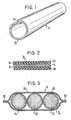
- a first embodiment of a container 10 for the pressure-tight packaging of tennis balls 24 is shown, which is formed from a multilayer film 12 (see in particular FIG. 2).
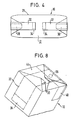
- the container 10 is shown in the form which it has before filling the tennis balls and before closing its two ends. 3, the container 10 is already filled and closed at both ends. 4, the container 10 is shown in the final form in which it is provided for storage or shipping.
- the multilayer film 12 from which the container 10 is made comprises a middle layer 14 of gas impermeable material, e.g. Aluminum, on both sides of this gas-impermeable layer 14 a layer 16, 18 made of a material which gives the body the required strength, e.g. Polyester, and on the side forming the inner surface of the container and on the side forming the outer surface of the container in each case a layer 20, 22 of weldable material, e.g. Polyethylene (Fig. 2).
- a middle layer 14 of gas impermeable material e.g. Aluminum
- a layer 16, 18 made of a material which gives the body the required strength, e.g. Polyester
- a layer 20, 22 of weldable material e.g. Polyethylene (Fig. 2).
- Certain functions such as gas impermeability, strength and weldability are thus assigned to the individual sub-layers of the multilayer film 12.
- the thickness of the respective layers are dimensioned in such a way that, with regard to gas impermeability, strength and weldability, an optimal container material results overall.
- the film thickness can be kept relatively small.
- a narrow strip of the multilayer film 12 is first formed into a long tubular structure by welding along an overlapping longitudinal seam 26. Pieces with a length corresponding to the number of tennis balls 24 to be packed are now cut from this tube (FIG. 1).
- the container 10 is now closed at both ends by a cross weld 28, 30, which are obtained by welding the inner surfaces of the container (FIG. 3). You can, for example, first weld one end of the container 10, then insert the tennis balls 24 and then weld the other end. However, it is also possible to first insert the tennis balls into the container and then to weld both open ends at the same time.
- the required internal pressure in the container can be generated after the container has been closed, e.g. via valves or openings to be closed later (not shown). However, it is more expedient to insert a gas-forming tablet into the container together with the tennis balls, after which the desired overpressure is established after the container has been closed.
- the container can also be closed in a supercooled gas atmosphere at atmospheric pressure, whereupon the higher internal pressure arises as a result of the container being heated by the ambient temperature.
- the two transverse weld seams 28, 30, are folded back onto the container body and secured against the container body by at least one tape 32, an adhesive strip or the like (FIG. 4). Since the container takes on an essentially cylindrical shape as a result of the tennis balls, there is a relatively complicated transition to the transverse weld seams. These transverse weld seams retain their full length, which is therefore larger than the diameter of the cylindrical container body. The folding of the transverse welds having container ends must therefore be done m ehrdimensional. As can be seen in FIG. 4, the transverse weld seams 28, 30 finally lie both on the respective end face and on two opposite side faces of the container.
- the band 32 is attached to the container body in the direction of the non-overlapping and folded back cross-weld seams 28, 30 and extends in the essentially around the entire container body.
- the band 32 is somewhat wider than the transverse weld seams, so that these are completely covered by the band. However, the band can also extend over substantially the entire width of the container.
- the non-overlapping transverse weld seams 28, 30 formed by welding the inner surfaces of the container are each designed such that they can only withstand the internal pressure of the container with the support of the band 32 and open when the band is pulled off without further manipulation or even with slight pressure exerted on the container.
- the longitudinal weld seam 26 cuts the two transverse weld seams 28, 30 approximately in the middle thereof at a right angle. This facilitates both the production of the cross weld seams and the folding of the container end areas. Due to the overlap connection, the longitudinal weld seam 26 is sufficiently firm and does not need to be secured by an adhesive strip.
- the longitudinal weld seam 26 is also more flexible due to this overlap connection and can adapt better to the folding processes.
- the band 32 defining the transverse weld seams 28, 30 has a tear-open aid 34.
- This tear-open aid is obtained in a simple manner in that the tape ends are folded over and thus do not adhere to the container body, so that the tape can be easily removed from the container body via these ends.
- a loop or the like can also be provided as a tear-off aid.
- FIGS. 1, 3 and 4 show a further embodiment of the container 10 which, like the container described in FIGS. 1, 3 and 4, can in turn be formed from such a multilayer film 12 as described in connection with FIG. 2 has been.
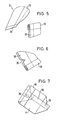
- 5 shows the container in the form which it has after the longitudinal weld seam 26 has been produced and the transverse weld seam 30 present at the end forming the lid.
- the corner region of the container is shown again, in which the longitudinal weld seam 26 and the transverse weld seam 30 overlap.
- FIG. 6 shows a view of this corner region of the cover closure from below, with a notch 36 being provided in the transverse weld seam 30.
- FIG. 7 shows an end view of the container, in which initially only the end of the transverse weld seam 30 which is designed without a notch is folded back onto the container body. 8, the container 10 is shown in the final form in which it is provided for storage or shipping.
- the non-overlapping transverse weld seam 30 provided at the end on the cover side and the overlapping longitudinal weld seam 26 form a coherent seam which is essentially in one plane (cf. FIG. 5).
- the longitudinal weld seam 26 is in this case folded centrally on the end face, so that it forms a reinforced section of the transverse weld seam 30.
- one half of the longitudinal weld seam 26 lies on one side and the other half of this seam on the opposite side of the container 10.
- the corner region of this lid closure of the container thus has a thickness which corresponds to four times the thickness of the normal container wall.
- a notch 36 is provided in the vicinity of the adjacent longitudinal weld seam 26, which extends essentially over half the width of this transverse weld seam and serves as a tear aid (cf. in particular FIG. 6).
- the end or ear of the transverse weld seam 30 which is designed without a notch is first folded back onto the relevant end face 44 of the container and is particularly secured by an adhesive 38 and a band 40 extending transversely to the transverse weld seam 30. Subsequently, the end or ear of the transverse weld seam 30 having the notch 36 is folded back onto the end face 44 and attached to this end face by means of the band 32 having the tear-open aid 34 on this end face (cf. FIG. 8).
- the band 40 for the additional fixing of the end of the transverse weld seam 30 which is formed without a tear aid extends transversely to this transverse weld seam
- the upper band 32 runs parallel and along this transverse weld seam.
- Each of the two bands 32, 40 is guided from one side surface over the end surface 44 and to the opposite side surface.
- the bottom of this container can in turn be of the same design as was described in connection with the embodiment variant according to FIGS. 1, 3 and 4.
- the tape 32 is now pulled off by means of the tear-open aid 34 at least until the end or ear of the transverse weld seam provided with the notch 36 is raised as a result of the internal pressure in the container. Even if this band 32 is pulled off further or completely, the other ear of the transverse weld seam 30, which is particularly secured by the adhesive point 38 and the band 40, remains attached to the end face 44. This prevents the cross weld 30 from fully erecting and suddenly opening with a loud bang.
- the upstanding tip of the transverse weld seam 30, which has the notch 36 is gripped and pulled along the longitudinal weld seam 26 to the bottom side.
- the notch pull through the transverse weld 30 at the ear concerned and slowly and relatively silently deflate the container / then pull the container further open, since it tears open on both sides of the longitudinal seam similarly to a predetermined breaking point.
- the balls can be easily removed.
- the ends of the transverse weld seam 30 folded back onto the end face 44 also ensure, among other things, that the ends of this transverse weld seam are always held reliably against the end face 44 by the bands 32, 40 and that these adhesive tapes are prematurely detached by the internal tension of the ends or ears this cross weld seam cannot occur.
Landscapes
- Engineering & Computer Science (AREA)
- Mechanical Engineering (AREA)
- Packages (AREA)
- Packaging Of Annular Or Rod-Shaped Articles, Wearing Apparel, Cassettes, Or The Like (AREA)
- Auxiliary Devices For And Details Of Packaging Control (AREA)
- Catching Or Destruction (AREA)
- Toys (AREA)
Priority Applications (1)
| Application Number | Priority Date | Filing Date | Title |
|---|---|---|---|
| AT84100892T ATE40329T1 (de) | 1983-02-10 | 1984-01-27 | Behaelter zur druckdichten verpackung von tennisbaellen und dergleichen. |
Applications Claiming Priority (2)
| Application Number | Priority Date | Filing Date | Title |
|---|---|---|---|
| DE19833304590 DE3304590A1 (de) | 1983-02-10 | 1983-02-10 | Behaelter zur druckdichten verpackung von gegenstaenden, insbesondere tennisbaellen |
| DE3304590 | 1983-02-10 |
Publications (3)
| Publication Number | Publication Date |
|---|---|
| EP0116328A2 true EP0116328A2 (fr) | 1984-08-22 |
| EP0116328A3 EP0116328A3 (en) | 1985-12-11 |
| EP0116328B1 EP0116328B1 (fr) | 1989-01-25 |
Family
ID=6190518
Family Applications (1)
| Application Number | Title | Priority Date | Filing Date |
|---|---|---|---|
| EP19840100892 Expired EP0116328B1 (fr) | 1983-02-10 | 1984-01-27 | Récipient d'emballage sous pression pour des balles de tenniset analogue |
Country Status (5)
| Country | Link |
|---|---|
| US (1) | US4564107A (fr) |
| EP (1) | EP0116328B1 (fr) |
| JP (2) | JPS59199464A (fr) |
| AT (1) | ATE40329T1 (fr) |
| DE (2) | DE3304590A1 (fr) |
Cited By (2)
| Publication number | Priority date | Publication date | Assignee | Title |
|---|---|---|---|---|
| FR2578816A1 (fr) * | 1985-03-13 | 1986-09-19 | Dunlop Ltd | Emballage etanche a la pression |
| DE3815641A1 (de) * | 1988-05-07 | 1989-11-16 | Peter Wiering | Verschliessbarer behaelter fuer bespielte tennisbaelle |
Families Citing this family (10)
| Publication number | Priority date | Publication date | Assignee | Title |
|---|---|---|---|---|
| US4972948A (en) * | 1990-05-18 | 1990-11-27 | Shinzo Saiki | Multi-module golf ball sleeve |
| JPH0724736U (ja) * | 1992-02-28 | 1995-05-12 | 有限会社シンクドリーム | 封緘兼開封テープ付サンドイッチ等用の袋 |
| DE4218922C2 (de) * | 1992-06-10 | 1995-09-14 | Mader Paul Joachim | Verfahren und Vorrichtung zum Transportieren und Aufbewahren von Tennisbällen |
| DE19742240A1 (de) * | 1997-09-25 | 1999-04-01 | Euro Style Shop Systeme Gmbh | Umverpackung für Lebensmittel |
| JP2000219234A (ja) * | 1999-01-29 | 2000-08-08 | Bridgestone Sports Co Ltd | ゴルフボール用箱 |
| IT1316769B1 (it) * | 2000-02-18 | 2003-05-12 | Getters Spa | Pannello evacuato per isolamento termico con ridotta conduzione dicalore ai bordi |
| US7174696B2 (en) * | 2002-03-01 | 2007-02-13 | Free-Flow Packaging International, Inc. | Machine and method for inflating and sealing air-filled packing cushions |
| US9717811B2 (en) * | 2011-09-30 | 2017-08-01 | Avent, Inc. | Flexible multi-panel sterilization assembly with side tabs |
| US9296535B2 (en) * | 2011-09-30 | 2016-03-29 | Avent, Inc. | Flexible multi-panel sterilization assembly with mass balancing side tabs |
| DE102015007745A1 (de) * | 2015-06-17 | 2016-12-22 | Benitez und Veronese GbR (Vertretungsberechtigter Gesellschafter: Elena Veronese, Kienitzer Str. 97, 12049 Berlin) | Transportbehältnis |
Citations (3)
| Publication number | Priority date | Publication date | Assignee | Title |
|---|---|---|---|---|
| US2635742A (en) | 1951-09-21 | 1953-04-21 | Wingfoot Corp | Package which includes multiply film enclosure with plasticizer between the plies |
| GB1238276A (fr) | 1968-10-28 | 1971-07-07 | ||
| US4124117A (en) | 1977-10-14 | 1978-11-07 | Rudy Marion F | Apparatus for repressuring tennis and similar play balls |
Family Cites Families (29)
| Publication number | Priority date | Publication date | Assignee | Title |
|---|---|---|---|---|
| US27038A (en) * | 1860-02-07 | Improvement in railroad-brakes | ||
| CA506757A (fr) * | 1954-10-26 | V. Brady Charles | Sac | |
| US1935612A (en) * | 1931-02-09 | 1933-11-21 | Bemis Bro Bag Co | Fastening |
| US2355108A (en) * | 1940-09-04 | 1944-08-08 | American Can Co | Container |
| US2339305A (en) * | 1942-04-16 | 1944-01-18 | Marathon Paper Mills Co | Packaging method |
| US2430459A (en) * | 1944-01-22 | 1947-11-11 | Marathon Corp | Laminated sheet heat-sealable container |
| US2582982A (en) * | 1946-11-05 | 1952-01-22 | Pennsylvania Rubber Company | Pressure packaged tennis ball |
| US2554841A (en) * | 1948-07-13 | 1951-05-29 | Jr Herbert Rumsey | Package |
| FR985889A (fr) * | 1949-05-11 | 1951-07-24 | Quaker Oats Co | Perfectionnements aux emballages |
| DE1747782U (de) * | 1957-04-03 | 1957-06-27 | Hoechst Ag | Packung fuer tennisbaelle. |
| US2975955A (en) * | 1959-04-30 | 1961-03-21 | Union Bag Camp Paper Corp | Heat sealable stepped end bag |
| US3058575A (en) * | 1959-11-20 | 1962-10-16 | Goodman Mfg Co | Automatic two directional belt training troughing idler assembly |
| US3067923A (en) * | 1960-11-15 | 1962-12-11 | Minnesota Mining & Mfg | Carton |
| US3268184A (en) * | 1964-05-06 | 1966-08-23 | Allan M Biggar | Temperature actuated inflation device |
| FR1442465A (fr) * | 1965-05-05 | 1966-06-17 | Sachet à compartiments multiples | |
| DE1536381A1 (de) * | 1966-12-31 | 1970-01-22 | Waldhof Zellstoff Fab | Mehrwandiger Sack oder Beutel aus Schlauchfolie aus thermoplastischem Material |
| CH501533A (it) * | 1967-10-27 | 1971-01-15 | Star Stabilimento Alimentare | Materiale d'imballaggio fogliforme, procedimento per la sua fabbricazione e utilizzazione di tale materiale per fabbricare imballaggi del tipo a busta |
| SE362051B (fr) * | 1968-03-19 | 1973-11-26 | Akerlund & Rausing Ab | |
| US3542190A (en) * | 1968-06-27 | 1970-11-24 | Cpc International Inc | Convenience package for flat storage and shipment,that is foldable to a tetrahedronal shape for mixing and dispensing |
| USRE27038E (en) | 1969-04-23 | 1971-01-26 | Radial turbine blade damping device | |
| DE2326594A1 (de) * | 1973-05-24 | 1974-12-05 | Dunlop Ag | Tennisball-verpackung |
| JPS534154Y2 (fr) * | 1973-05-25 | 1978-02-01 | ||
| DE7537552U (de) * | 1975-11-26 | 1977-05-12 | Robert Bosch Gmbh, 7000 Stuttgart | Quaderförmige Veipackung |
| JPS5817136B2 (ja) * | 1976-12-02 | 1983-04-05 | 新日本製鐵株式会社 | 溶融滓の処理装置 |
| JPS6031673B2 (ja) * | 1977-04-15 | 1985-07-23 | 東レ株式会社 | 三層積層ポリプロピレンフイルム |
| GB1555748A (en) * | 1977-09-01 | 1979-11-14 | Tetra Pak Int | Opening of containers |
| US4224367A (en) * | 1978-05-22 | 1980-09-23 | Scholle Corporation | Multiple ply packaging material comprising outer plies sealed around an inner ply |
| GB2094270B (en) * | 1981-03-10 | 1985-01-23 | Sumitomo Rubber Ind | Pressurized container |
| US4384646A (en) * | 1981-03-16 | 1983-05-24 | Sumitomo Rubber Industries, Ltd. | Pressurized preservation container |
-
1983
- 1983-02-10 DE DE19833304590 patent/DE3304590A1/de not_active Withdrawn
-
1984
- 1984-01-27 AT AT84100892T patent/ATE40329T1/de not_active IP Right Cessation
- 1984-01-27 DE DE8484100892T patent/DE3476369D1/de not_active Expired
- 1984-01-27 EP EP19840100892 patent/EP0116328B1/fr not_active Expired
- 1984-02-09 US US06/578,523 patent/US4564107A/en not_active Expired - Fee Related
- 1984-02-10 JP JP59022065A patent/JPS59199464A/ja active Pending
-
1992
- 1992-04-16 JP JP1992031597U patent/JPH04121275U/ja active Pending
Patent Citations (3)
| Publication number | Priority date | Publication date | Assignee | Title |
|---|---|---|---|---|
| US2635742A (en) | 1951-09-21 | 1953-04-21 | Wingfoot Corp | Package which includes multiply film enclosure with plasticizer between the plies |
| GB1238276A (fr) | 1968-10-28 | 1971-07-07 | ||
| US4124117A (en) | 1977-10-14 | 1978-11-07 | Rudy Marion F | Apparatus for repressuring tennis and similar play balls |
Cited By (2)
| Publication number | Priority date | Publication date | Assignee | Title |
|---|---|---|---|---|
| FR2578816A1 (fr) * | 1985-03-13 | 1986-09-19 | Dunlop Ltd | Emballage etanche a la pression |
| DE3815641A1 (de) * | 1988-05-07 | 1989-11-16 | Peter Wiering | Verschliessbarer behaelter fuer bespielte tennisbaelle |
Also Published As
| Publication number | Publication date |
|---|---|
| EP0116328A3 (en) | 1985-12-11 |
| EP0116328B1 (fr) | 1989-01-25 |
| JPS59199464A (ja) | 1984-11-12 |
| DE3304590A1 (de) | 1984-08-16 |
| DE3476369D1 (en) | 1989-03-02 |
| US4564107A (en) | 1986-01-14 |
| JPH04121275U (ja) | 1992-10-29 |
| ATE40329T1 (de) | 1989-02-15 |
Similar Documents
| Publication | Publication Date | Title |
|---|---|---|
| DE3628478C2 (fr) | ||
| DE69709608T2 (de) | Verfahren zum flüssigkeitsdichten Verschliessen eines Behälterbodens | |
| DE69209421T2 (de) | Flexible Behälter | |
| DE3810555A1 (de) | Schlauchfoermiger behaelter aus kunststoffmaterial und verfahren zu seiner herstellung | |
| DE2164152A1 (de) | Schutzbehälter und Verfahren zu seiner Herstellung | |
| DE1597175B2 (de) | Rontgenfilmpack, insbesondere fur zahnmedizinische Zwecke | |
| DE2420110A1 (de) | Zigarettenpackung | |
| EP0116328B1 (fr) | Récipient d'emballage sous pression pour des balles de tenniset analogue | |
| DE69303012T2 (de) | Verpackung hergestellt aus einem dünnen gefaltenen zuschnitt zur bildung eines beutels für schüttgut | |
| CH361911A (de) | Verfahren zur Herstellung eines dauerhaft verschlossenen Aufreissbehälters | |
| DE1815288A1 (de) | Flachbodenpackung | |
| DE2647983A1 (de) | Packung fuer, insbesondere unter druck stehende, fluessigkeiten | |
| DE1461762A1 (de) | Verfahren zur Herstellung von Packungen | |
| DE2827803B2 (de) | Verpackung für mit einer Kruste überzogene Backwaren und Verfahren zu ihrer Herstellung | |
| DE3413918A1 (de) | Kombidose | |
| CH678846A5 (fr) | ||
| EP0358916A1 (fr) | Emballage, feuille composée pour la fabrication d'un emballage, dispositif de fabrication de la feuille composée et procédé de fabrication d'emballages sous vide | |
| DE2351189C3 (de) | Verpackung mit einem Kunststoff-Innenbehälter und einer diesen umgebenden Umhüllung | |
| DE3812205C2 (de) | Verpackungsbehälter | |
| DE4409945A1 (de) | Quaderförmige Flachgiebelverbundpackung und Verfahren zu ihrer Herstellung | |
| CH631125A5 (de) | Verpackungsbehaelter. | |
| DE2507722A1 (de) | Beutel aus thermoplastischer kunststoffolie und verfahren zu seiner herstellung | |
| DE4104559A1 (de) | Faltschachtel mit innenbeutel und verfahren zu ihrer herstellung | |
| DE2158076B2 (de) | Quaderförmige Verpackung | |
| EP2332850A1 (fr) | Sac doté d'une membrane |
Legal Events
| Date | Code | Title | Description |
|---|---|---|---|
| PUAI | Public reference made under article 153(3) epc to a published international application that has entered the european phase |
Free format text: ORIGINAL CODE: 0009012 |
|
| AK | Designated contracting states |
Designated state(s): AT BE CH DE FR GB IT LI LU NL SE |
|
| PUAL | Search report despatched |
Free format text: ORIGINAL CODE: 0009013 |
|
| AK | Designated contracting states |
Designated state(s): AT BE CH DE FR GB IT LI LU NL SE |
|
| 17P | Request for examination filed |
Effective date: 19860515 |
|
| 17Q | First examination report despatched |
Effective date: 19861023 |
|
| R17C | First examination report despatched (corrected) |
Effective date: 19870511 |
|
| RAP1 | Party data changed (applicant data changed or rights of an application transferred) |
Owner name: DUNLOP LIMITED Owner name: DUNLOP GMBH |
|
| ITF | It: translation for a ep patent filed | ||
| GRAA | (expected) grant |
Free format text: ORIGINAL CODE: 0009210 |
|
| AK | Designated contracting states |
Kind code of ref document: B1 Designated state(s): AT BE CH DE FR GB IT LI LU NL SE |
|
| REF | Corresponds to: |
Ref document number: 40329 Country of ref document: AT Date of ref document: 19890215 Kind code of ref document: T |
|
| REF | Corresponds to: |
Ref document number: 3476369 Country of ref document: DE Date of ref document: 19890302 |
|
| GBT | Gb: translation of ep patent filed (gb section 77(6)(a)/1977) | ||
| ET | Fr: translation filed | ||
| PLBE | No opposition filed within time limit |
Free format text: ORIGINAL CODE: 0009261 |
|
| STAA | Information on the status of an ep patent application or granted ep patent |
Free format text: STATUS: NO OPPOSITION FILED WITHIN TIME LIMIT |
|
| 26N | No opposition filed | ||
| ITTA | It: last paid annual fee | ||
| PGFP | Annual fee paid to national office [announced via postgrant information from national office to epo] |
Ref country code: FR Payment date: 19931215 Year of fee payment: 11 |
|
| PGFP | Annual fee paid to national office [announced via postgrant information from national office to epo] |
Ref country code: SE Payment date: 19940125 Year of fee payment: 11 Ref country code: AT Payment date: 19940125 Year of fee payment: 11 |
|
| PGFP | Annual fee paid to national office [announced via postgrant information from national office to epo] |
Ref country code: NL Payment date: 19940131 Year of fee payment: 11 Ref country code: LU Payment date: 19940131 Year of fee payment: 11 |
|
| PGFP | Annual fee paid to national office [announced via postgrant information from national office to epo] |
Ref country code: BE Payment date: 19940207 Year of fee payment: 11 |
|
| PGFP | Annual fee paid to national office [announced via postgrant information from national office to epo] |
Ref country code: CH Payment date: 19940216 Year of fee payment: 11 |
|
| EPTA | Lu: last paid annual fee | ||
| PGFP | Annual fee paid to national office [announced via postgrant information from national office to epo] |
Ref country code: GB Payment date: 19941212 Year of fee payment: 12 |
|
| PG25 | Lapsed in a contracting state [announced via postgrant information from national office to epo] |
Ref country code: LU Free format text: LAPSE BECAUSE OF NON-PAYMENT OF DUE FEES Effective date: 19950127 Ref country code: AT Effective date: 19950127 |
|
| PG25 | Lapsed in a contracting state [announced via postgrant information from national office to epo] |
Ref country code: SE Effective date: 19950128 |
|
| EAL | Se: european patent in force in sweden |
Ref document number: 84100892.3 |
|
| PG25 | Lapsed in a contracting state [announced via postgrant information from national office to epo] |
Ref country code: LI Effective date: 19950131 Ref country code: CH Effective date: 19950131 Ref country code: BE Effective date: 19950131 |
|
| BERE | Be: lapsed |
Owner name: DUNLOP G.M.B.H. Effective date: 19950131 |
|
| PG25 | Lapsed in a contracting state [announced via postgrant information from national office to epo] |
Ref country code: NL Effective date: 19950801 |
|
| PG25 | Lapsed in a contracting state [announced via postgrant information from national office to epo] |
Ref country code: FR Effective date: 19950929 |
|
| REG | Reference to a national code |
Ref country code: CH Ref legal event code: PL |
|
| NLV4 | Nl: lapsed or anulled due to non-payment of the annual fee |
Effective date: 19950801 |
|
| EUG | Se: european patent has lapsed |
Ref document number: 84100892.3 |
|
| REG | Reference to a national code |
Ref country code: FR Ref legal event code: ST |
|
| PG25 | Lapsed in a contracting state [announced via postgrant information from national office to epo] |
Ref country code: GB Effective date: 19960127 |
|
| GBPC | Gb: european patent ceased through non-payment of renewal fee |
Effective date: 19960127 |
|
| PGFP | Annual fee paid to national office [announced via postgrant information from national office to epo] |
Ref country code: DE Payment date: 20020429 Year of fee payment: 19 |
|
| PG25 | Lapsed in a contracting state [announced via postgrant information from national office to epo] |
Ref country code: DE Free format text: LAPSE BECAUSE OF NON-PAYMENT OF DUE FEES Effective date: 20030801 |