EP0117403B1 - Dérivés de 6-(Acylaminoaryl)-3(2H)-pyridazinones, leur préparation et utilisation - Google Patents
Dérivés de 6-(Acylaminoaryl)-3(2H)-pyridazinones, leur préparation et utilisation Download PDFInfo
- Publication number
- EP0117403B1 EP0117403B1 EP84100381A EP84100381A EP0117403B1 EP 0117403 B1 EP0117403 B1 EP 0117403B1 EP 84100381 A EP84100381 A EP 84100381A EP 84100381 A EP84100381 A EP 84100381A EP 0117403 B1 EP0117403 B1 EP 0117403B1
- Authority
- EP
- European Patent Office
- Prior art keywords
- alkyl
- phenyl
- group
- formula
- alkoxy
- Prior art date
- Legal status (The legal status is an assumption and is not a legal conclusion. Google has not performed a legal analysis and makes no representation as to the accuracy of the status listed.)
- Expired
Links
- 0 CCC(CC*C)N(C)C Chemical compound CCC(CC*C)N(C)C 0.000 description 4
Classifications
-
- C—CHEMISTRY; METALLURGY
- C07—ORGANIC CHEMISTRY
- C07D—HETEROCYCLIC COMPOUNDS
- C07D231/00—Heterocyclic compounds containing 1,2-diazole or hydrogenated 1,2-diazole rings
- C07D231/02—Heterocyclic compounds containing 1,2-diazole or hydrogenated 1,2-diazole rings not condensed with other rings
- C07D231/10—Heterocyclic compounds containing 1,2-diazole or hydrogenated 1,2-diazole rings not condensed with other rings having two or three double bonds between ring members or between ring members and non-ring members
- C07D231/12—Heterocyclic compounds containing 1,2-diazole or hydrogenated 1,2-diazole rings not condensed with other rings having two or three double bonds between ring members or between ring members and non-ring members with only hydrogen atoms, hydrocarbon or substituted hydrocarbon radicals, directly attached to ring carbon atoms
-
- A—HUMAN NECESSITIES
- A61—MEDICAL OR VETERINARY SCIENCE; HYGIENE
- A61P—SPECIFIC THERAPEUTIC ACTIVITY OF CHEMICAL COMPOUNDS OR MEDICINAL PREPARATIONS
- A61P1/00—Drugs for disorders of the alimentary tract or the digestive system
- A61P1/04—Drugs for disorders of the alimentary tract or the digestive system for ulcers, gastritis or reflux esophagitis, e.g. antacids, inhibitors of acid secretion, mucosal protectants
-
- A—HUMAN NECESSITIES
- A61—MEDICAL OR VETERINARY SCIENCE; HYGIENE
- A61P—SPECIFIC THERAPEUTIC ACTIVITY OF CHEMICAL COMPOUNDS OR MEDICINAL PREPARATIONS
- A61P7/00—Drugs for disorders of the blood or the extracellular fluid
- A61P7/02—Antithrombotic agents; Anticoagulants; Platelet aggregation inhibitors
-
- A—HUMAN NECESSITIES
- A61—MEDICAL OR VETERINARY SCIENCE; HYGIENE
- A61P—SPECIFIC THERAPEUTIC ACTIVITY OF CHEMICAL COMPOUNDS OR MEDICINAL PREPARATIONS
- A61P9/00—Drugs for disorders of the cardiovascular system
- A61P9/12—Antihypertensives
-
- C—CHEMISTRY; METALLURGY
- C07—ORGANIC CHEMISTRY
- C07D—HETEROCYCLIC COMPOUNDS
- C07D233/00—Heterocyclic compounds containing 1,3-diazole or hydrogenated 1,3-diazole rings, not condensed with other rings
- C07D233/54—Heterocyclic compounds containing 1,3-diazole or hydrogenated 1,3-diazole rings, not condensed with other rings having two double bonds between ring members or between ring members and non-ring members
- C07D233/56—Heterocyclic compounds containing 1,3-diazole or hydrogenated 1,3-diazole rings, not condensed with other rings having two double bonds between ring members or between ring members and non-ring members with only hydrogen atoms or radicals containing only hydrogen and carbon atoms, attached to ring carbon atoms
-
- C—CHEMISTRY; METALLURGY
- C07—ORGANIC CHEMISTRY
- C07D—HETEROCYCLIC COMPOUNDS
- C07D237/00—Heterocyclic compounds containing 1,2-diazine or hydrogenated 1,2-diazine rings
- C07D237/02—Heterocyclic compounds containing 1,2-diazine or hydrogenated 1,2-diazine rings not condensed with other rings
- C07D237/04—Heterocyclic compounds containing 1,2-diazine or hydrogenated 1,2-diazine rings not condensed with other rings having less than three double bonds between ring members or between ring members and non-ring members
-
- C—CHEMISTRY; METALLURGY
- C07—ORGANIC CHEMISTRY
- C07D—HETEROCYCLIC COMPOUNDS
- C07D237/00—Heterocyclic compounds containing 1,2-diazine or hydrogenated 1,2-diazine rings
- C07D237/02—Heterocyclic compounds containing 1,2-diazine or hydrogenated 1,2-diazine rings not condensed with other rings
- C07D237/06—Heterocyclic compounds containing 1,2-diazine or hydrogenated 1,2-diazine rings not condensed with other rings having three double bonds between ring members or between ring members and non-ring members
- C07D237/10—Heterocyclic compounds containing 1,2-diazine or hydrogenated 1,2-diazine rings not condensed with other rings having three double bonds between ring members or between ring members and non-ring members with hetero atoms or with carbon atoms having three bonds to hetero atoms with at the most one bond to halogen, e.g. ester or nitrile radicals, directly attached to ring carbon atoms
- C07D237/14—Oxygen atoms
-
- C—CHEMISTRY; METALLURGY
- C07—ORGANIC CHEMISTRY
- C07D—HETEROCYCLIC COMPOUNDS
- C07D237/00—Heterocyclic compounds containing 1,2-diazine or hydrogenated 1,2-diazine rings
- C07D237/26—Heterocyclic compounds containing 1,2-diazine or hydrogenated 1,2-diazine rings condensed with carbocyclic rings or ring systems
-
- C—CHEMISTRY; METALLURGY
- C07—ORGANIC CHEMISTRY
- C07D—HETEROCYCLIC COMPOUNDS
- C07D249/00—Heterocyclic compounds containing five-membered rings having three nitrogen atoms as the only ring hetero atoms
- C07D249/02—Heterocyclic compounds containing five-membered rings having three nitrogen atoms as the only ring hetero atoms not condensed with other rings
- C07D249/08—1,2,4-Triazoles; Hydrogenated 1,2,4-triazoles
-
- C—CHEMISTRY; METALLURGY
- C07—ORGANIC CHEMISTRY
- C07D—HETEROCYCLIC COMPOUNDS
- C07D401/00—Heterocyclic compounds containing two or more hetero rings, having nitrogen atoms as the only ring hetero atoms, at least one ring being a six-membered ring with only one nitrogen atom
- C07D401/02—Heterocyclic compounds containing two or more hetero rings, having nitrogen atoms as the only ring hetero atoms, at least one ring being a six-membered ring with only one nitrogen atom containing two hetero rings
- C07D401/12—Heterocyclic compounds containing two or more hetero rings, having nitrogen atoms as the only ring hetero atoms, at least one ring being a six-membered ring with only one nitrogen atom containing two hetero rings linked by a chain containing hetero atoms as chain links
-
- C—CHEMISTRY; METALLURGY
- C07—ORGANIC CHEMISTRY
- C07D—HETEROCYCLIC COMPOUNDS
- C07D401/00—Heterocyclic compounds containing two or more hetero rings, having nitrogen atoms as the only ring hetero atoms, at least one ring being a six-membered ring with only one nitrogen atom
- C07D401/14—Heterocyclic compounds containing two or more hetero rings, having nitrogen atoms as the only ring hetero atoms, at least one ring being a six-membered ring with only one nitrogen atom containing three or more hetero rings
-
- C—CHEMISTRY; METALLURGY
- C07—ORGANIC CHEMISTRY
- C07D—HETEROCYCLIC COMPOUNDS
- C07D403/00—Heterocyclic compounds containing two or more hetero rings, having nitrogen atoms as the only ring hetero atoms, not provided for by group C07D401/00
- C07D403/02—Heterocyclic compounds containing two or more hetero rings, having nitrogen atoms as the only ring hetero atoms, not provided for by group C07D401/00 containing two hetero rings
- C07D403/12—Heterocyclic compounds containing two or more hetero rings, having nitrogen atoms as the only ring hetero atoms, not provided for by group C07D401/00 containing two hetero rings linked by a chain containing hetero atoms as chain links
-
- C—CHEMISTRY; METALLURGY
- C07—ORGANIC CHEMISTRY
- C07D—HETEROCYCLIC COMPOUNDS
- C07D405/00—Heterocyclic compounds containing both one or more hetero rings having oxygen atoms as the only ring hetero atoms, and one or more rings having nitrogen as the only ring hetero atom
- C07D405/02—Heterocyclic compounds containing both one or more hetero rings having oxygen atoms as the only ring hetero atoms, and one or more rings having nitrogen as the only ring hetero atom containing two hetero rings
- C07D405/12—Heterocyclic compounds containing both one or more hetero rings having oxygen atoms as the only ring hetero atoms, and one or more rings having nitrogen as the only ring hetero atom containing two hetero rings linked by a chain containing hetero atoms as chain links
-
- C—CHEMISTRY; METALLURGY
- C07—ORGANIC CHEMISTRY
- C07D—HETEROCYCLIC COMPOUNDS
- C07D413/00—Heterocyclic compounds containing two or more hetero rings, at least one ring having nitrogen and oxygen atoms as the only ring hetero atoms
- C07D413/02—Heterocyclic compounds containing two or more hetero rings, at least one ring having nitrogen and oxygen atoms as the only ring hetero atoms containing two hetero rings
- C07D413/12—Heterocyclic compounds containing two or more hetero rings, at least one ring having nitrogen and oxygen atoms as the only ring hetero atoms containing two hetero rings linked by a chain containing hetero atoms as chain links
Definitions
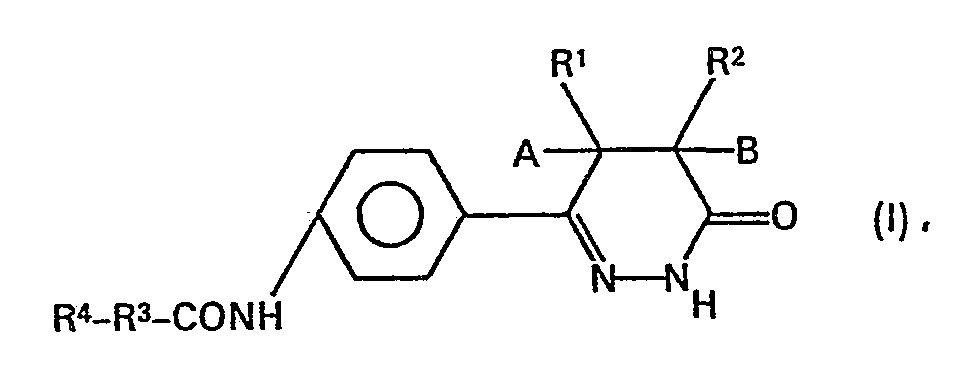
- the invention relates to new 6- (acylaminoaryl) -3 (2H) -pyridazinone derivatives, processes for their preparation and their use in combating diseases.
- Pharmacologically active 6- (acylaminoaryl) -4,5-dihydro-3 (2H) -pyridazinones are already known, cf. DE-OS 1670158, DE-OS 2123246, DE-OS 2150436, DE-OS 2157453, DE-OS 2304977, DE-OS 2727481, DE-OS 2854191, DE-OS 2854475, DE-OS 3022176, DE-OS 3022177, DE-OS 3033702, DE-OS 3209158, DE-OS 3209159, JP-OS 53.124-279, JP-OS 58008015, JP-OS 58008016 as well as the unpublished documents WP 8301447 and US-PS 4397854.
- R I preferably represents a hydrogen atom, a methyl group or together with R 2 a C 1-2 alkylene radical. Particularly preferred meanings for R I are: a hydrogen atom or, if A and B are hydrogen atoms, a methyl group.
- R I and R 2 together represent a C 1-4 alkylene group, the methylene group should be mentioned in particular.
- a and B are preferably hydrogen atoms or a common bond, but they are particularly preferably hydrogen atoms.
- R3 preferably denotes a straight-chain C 1-4 alkylene group, which can be substituted by a C 1-3 alkyl group or two methyl groups.
- R 3 particularly preferably represents a C 1-3 alkylene group, in particular the methylene or ethylene group, which can be substituted by a methyl group.
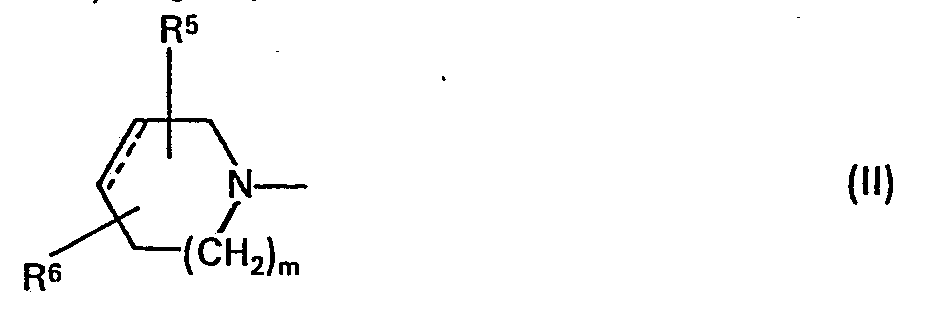
- R 4 is a group of the formula II
- R 5 preferably represents a hydrogen atom, a C 1-4 alkyl group which is optionally substituted by a phenyl radical, a C 3-6 cycloalkyl group, a phenyl group which is optionally substituted by 1 to 2 halogen atoms, C 1-4 alkyl, C 1-4 alkoxy groups and / or a trifluoromethyl, nitrile and / or nitro group may be substituted, or a group of the formula R 7 R 8 N -, in which R 7 a hydrogen atom or a phenyl group which can be substituted 1 to 2 times by halogen atoms, C 1-4 alkyl, C 1-4 alkoxy groups and / or a nitrile and / or nitro group, and R 8 is a C 1-4 -Acyl or benzoyl group or R 7 and R 8 together with the nitrogen atom form a benzimidazol-2-one-1-
- R6 preferably represents a hydrogen atom, a C 1-4 alkyl, a hydroxy, a C 1-4 acyl, a (C 1-5 alkoxy) carbonyl or a cyano group.
- Particularly preferred radicals for R 5 are a C 1-4 alkyl group substituted by phenyl, a phenyl group optionally substituted by a halogen atom or a group of the formula R 7 R8N in which R 7 is a phenyl group and R 8 is a C 1-4 acyl group.
- R 7 R8N a group of the formula R 7 R8N in which R 7 is a phenyl group and R 8 is a C 1-4 acyl group.
- the benzyl group and the phenyl radical, which is optionally substituted by a halogen atom are particularly noteworthy.
- R 5 and R 6 together form a C 1-4 alkylene chain, unsubstituted chains or those which are substituted by 1 to 3 methyl groups are preferred.
- m is preferably 0.1 or 2, particularly preferably 1.
- R 4 is a group of the formula 111, the following radicals are preferred for R 9 :
- a C 1-3 hydrocarbon radical which is substituted by a naphthyl radical or a phenyl radical which may be 1 to 2 times by halogen atoms, C 1-4 - Alkyl, C 1-4 alkoxy groups and / or by a trifluoromethyl, hydroxy, C 1-4 acyl, (C 1-5 alkoxy) carbonyl, nitro and / or nitrile group ; a naphthyl radical; a phenyl radical which can be substituted 1 to 3 times by halogen atoms, C 1-4 alkyl, C 1-4 alkoxy groups and / or by a trifluoromethyl or a C 1-4 acyl group; a 6-membered heteroaryl radical with 1 to 2 nitrogen atoms.
- Particularly preferred radicals for R 9 are a C 1-3 hydrocarbon radical which is substituted by a phenyl group, where the phenyl group can be substituted by a C 1-4 alkoxy group; a naphthyl radical; a phenyl group which may be substituted by 1 or 2 halogen atoms, C 1-4 alkyl, C 1-4 alkoxy groups and / or a trifluoromethyl group; and the pyridyl group.
- Particularly important are a benzyl group, which may be substituted by a methoxy group, a phenyl group, which may be substituted by a halogen atom, and the pyridyl group.
- P is preferably 2.
- R 4 is a group of the formula IV, the following meanings for R 10 are preferred:
- a C 1-8 alkyl radical which is optionally substituted by a phenyl radical which may contain 1 to 2 C 1-4 alkyl groups and / or halogen atoms; a C 3-12 cycloalkyl radical which can be substituted by 1 to 3 methyl groups, a benzyl or a phenyl radical; a bi- or tricyclic C 7-10 alkyl radical which is optionally substituted by 1 to 3 methyl radicals; or a benzo-fused C 5-7 cycloalkyl group.
- R 10 are: A C I-4 alkyl which is substituted by a phenyl radical; a C 6-8 cycloalkyl radical which may be substituted by a phenyl group; a benzo-fused C 5-6 cycloalkyl group.
- R 11 preferably denotes a hydrogen atom or a C 1-8 alkyl radical and in particular a hydrogen atom or a C 1-4 alkyl radical.
- R 12 and R 13 are preferably hydrogen or halogen or C 1-4 alkyl groups and n is 1 or 2. Hydrogen atoms are particularly preferred for R 12 and R 13 and 2 for n.
- R 4 is a group of the formula VI, an oxygen or sulfur atom is preferred for G and R 14 and R 15 are preferably hydrogen atoms or methyl groups.
- R 4 is preferably one of the groups of the formulas 11, 111, IV and / or V, particularly preferably one of the groups II, III and / or V.
- the compounds of the formula I in which A, B and R 2 represent a hydrogen atom are 6-aryl-4,5-dihydro-3 (2H) -pyridazinones, while compounds of the formula I in which A , B are hydrogen atoms and R I and R 2 together represent a methylene, ethylene, propylene or butylene group, as 2-aryl-3,4-diaza-bicycio [4.1.0] hepten- (2) -one - (5), 2-Aryl-3,4-diaza-bicyclo [4.2.0] octen- (2) -one- (5), 2-aryl-3,4-diaza-bicyclo [4.3.0] nonen- (2) -one- (5) or 2-aryl-3,4-diaza-bicyclo- [4.40] decen- (2) -one (5) are to be designated.
- the compounds of the formula in which A and B together form a bond are 6-aryl-3 (2H) pyridazinones.
- physiologically acceptable acids examples include hydrochloric acid, sulfuric acid, phosphoric acid, acetic acid, citric acid, tartaric acid, malonic acid, succinic acid, maleic acid, fumaric acid, malic acid, lactic acid, diamidosulfonic acid, glutamic acid and aspartic acid.
- the reaction a) is carried out under customary conditions, i.e. usually using at least an equimolar amount of the compound of the formula VIII, in the presence of at least an equimolar amount of an auxiliary base as an acid-binding agent, optionally with the addition of an iodide as catalyst (if X is not iodine), advantageously in the presence of a solvent, at temperatures from 0 to 140 ° C, preferably 30 to 100 ° C, optionally at the boiling point of the reaction mixture and optionally using pressure. There is also no need to add an auxiliary base. In such a case, it is expedient to use at least two equivalents of the compound of the formula VIII.
- Solvents which are inert under the reaction conditions such as aromatic hydrocarbons, for example toluene or xylene, aliphatic or aromatic chlorohydrocarbons, such as methylene chloride, ethylene chloride or chlorobenzene, cyclic aliphatic ethers, such as tetrahydrofuran or dioxane, lower alkanols such as methanol, ethanol or isopropanol, aliphatic ketones , such as acetone, diethyl ketone or methyl ethyl ketone, or dialkyl amides, such as dimethylformamide or N-methylpyrrolidone, into consideration.
- aromatic hydrocarbons for example toluene or xylene
- aliphatic or aromatic chlorohydrocarbons such as methylene chloride, ethylene chloride or chlorobenzene
- cyclic aliphatic ethers such as tetrahydrofuran or dioxane
- Auxiliary bases as acid-binding agents are expediently inorganic bases, such as sodium or potassium carbonate, sodium or potassium hydrogen carbonate, tertiary organic amines, such as triethylamine, or an excess of the amines R 4 H.
- Iodides as catalysts are expediently alkali iodides, preferably potassium iodide or sodium iodide, or quaternary ammonium iodides, e.g. Tetrabutylammonium iodide.
- the iodide is generally used in amounts of 1 to 10 mol%. However, up to 1 molar amounts of the catalyst can also be used.
- the substances of formula VII used as the starting compound are known or can be prepared by known methods.
- the reaction b) takes place under the conditions customary for N-acylation, generally using at least an equimolar amount of the acid halide, expediently in the presence of a solvent, if appropriate in the presence of an acid-binding agent, at a temperature of 0 to 100 ° C, preferably up to 70 ° C, optionally at the boiling point of the reaction mixture and optionally using pressure.
- Ketones are preferred as solvents on an industrial scale; such as acetone, diethyl ketone or methyl ethyl ketone, otherwise e.g. aromatic hydrocarbons, such as benzene, toluene or xylene, cyclic ethers, such as tetrahydrofuran or dioxane, aliphatic or aromatic chlorinated hydrocarbons, such as methylene chloride, ethylene chloride or chlorobenzene, or dialkylamides, such as dimethylformamide or N-methylpyrrolidone, into consideration.
- Acid-binding agents are expediently weak inorganic bases, such as sodium or potassium carbonate, sodium or potassium hydrogen carbonate, or organic bases, such as tertiary amines.
- the substances of formula IX used as the starting compound are known or can be prepared by known methods.
- the ring closure reaction c) with hydrazine which is preferably used as the hydrate, advantageously takes place in a solvent, in particular a lower alcohol, such as methanol, ethanol or propanol, a cyclic aliphatic ether, such as tetrahydrofuran or dioxane, or in a dialkylamide, in particular dimethylformamide or N-methylpyrrolidone, where the temperature can be 20 to 150 ° C, preferably 50 to 100 ° C.
- a solvent in particular a lower alcohol, such as methanol, ethanol or propanol, a cyclic aliphatic ether, such as tetrahydrofuran or dioxane, or in a dialkylamide, in particular dimethylformamide or N-methylpyrrolidone, where the temperature can be 20 to 150 ° C, preferably 50 to 100 ° C.
- 1 mol of hydrazine or hydrazine hydrate is used per mol
- the reaction can be carried out under normal pressure or under elevated pressure.
- the compounds of formula XI used as starting substances can be prepared by using an amino acid of formula XII in the A, B, Ri and R 2 specified for Formula 1 have meanings, acylated with a compound of the formula X under the conditions specified for the acylation of a compound of the formula IX with a compound of the formula X and the compound obtained if it is the hydrochloride or the hydrobromide of a compound of the formula XI , converted into the free amino acid.
- the invention also relates to the enantiomers which are advantageously already at the stage of the compound IX, provided that A, B and R 2 are hydrogen atoms, in a known manner, for example by forming diastereomeric salts with an optically active carboxylic acid, such as dibenzoyl tartaric acid or camphor-10- sulfonic acid, separated and obtained by separate reaction of the optically active precursors thus obtained.
- an optically active carboxylic acid such as dibenzoyl tartaric acid or camphor-10- sulfonic acid
- Compounds of formula 1 in which R 3 represents a substituted alkylene group can contain an asymmetric carbon atom in this alkylene chain.
- the invention also relates to the enantiomers which can be obtained in a known manner, for example by forming diastereomeric salts with an optically active carboxylic acid or sulfonic acid, or by using corresponding optically active precursors, such as, for example, the compounds of the formulas VII, X or XI.
- the compounds 1 in the amine part R 4 can have asymmetric carbon atoms. They are preferably prepared starting from the optically active amines VIII by reaction with a compound VII or via the intermediates X or Xl.
- R 1 and R 2 together represent a methylene, ethylene, propylene or butylene group (3,4-diaza-bicyclo [4.1.0] heptenone, 3,4-diaza-bicyclo [4.2. 0] -oc-tenones, 3,4-diaza-bicyclo [4.3.0] nonenones and 3,4-diaza-bicyclo [4.4.0] decenones), because of the asymmetric carbon atoms form 1 and 6 of 3,4 -Diaza-bicyclo [4.nO] alkene- (2) -one- (5) rings also racemates.
- the invention also relates to the enantiomers obtainable therefrom.
- the compounds of the formula according to the invention and their salts with a pharmaceutically acceptable acid are distinguished in particular by antiplatelet properties, antihypertensive, gastric secretion-inhibiting or positively inotropic properties.
- Platelet-rich plasma is obtained by centrifugation (300 g, 10 min duration at 4 ° C) of venous citrate blood.
- the photometric measurement of the thrombocyte aggregation is carried out with the addition of MgCl 2 (final concentration 10 mmol / l) and collagen Stago (final concentration 0.02 mg / ml) in the Born aggregometer Mk 3.
- the maximum change in extinction / sec is used as the aggregation measure.
- the aggregation-inhibiting activity of the substances is tested after an incubation period of 10 minutes.
- the concentration which causes 50% inhibition of the aggregation is determined as EC 50%.
- mice of 3 to 5 male Sprague-Dawley rats (240 to 280 g) were given the substances intraperitoneally or intravenously under urethane anesthesia (1.78 mg / kg i.p.).
- the blood pressure in the carotid artery is measured using a Statham transducer.
- the ED 20% is the dose which lowers the mean carotid blood pressure by 20%.
- the dose is determined as ED 0.75, which causes an average pH increase of 0.75 compared to untreated control animals.
- the substances according to the invention act in very low doses.
- the present invention accordingly also relates to therapeutic agents or preparations which, in addition to pharmaceutically customary vehicles and diluents, contain a compound of the formula 1 or its salt as active ingredient, and the use of these compounds for therapeutic purposes.
- the therapeutic agents or preparations can be used with the customary carriers or diluents and usually Pharmaceutical technical auxiliaries can be prepared in a known manner with a suitable dosage in accordance with the desired type of application. Doses of 0.1 to 100 mg are possible in humans, oral administration being preferred.
- Dosage forms that are suitable for oral administration are, for example, tablets, film-coated tablets, coated tablets, capsules, pills, powders, solutions, supersensions or depot forms.
- the compounds to be used according to the invention are processed with the carriers customary in pharmaceutical pharmacy.
- the corresponding tablets can be mixed, for example, by mixing the active ingredient with known auxiliaries, for example inert diluents, such as dextrose, sugar, sorbitol, polyvinylpyrrolidone, mannitol, calcium carbonate, calcium phosphate or milk sugar, disintegrants such as corn, starch, alginic acid or polyvinylpyrrolidone, binders, such as starch or Gelatin, lubricants such as magnesium stearate or talc and / or agents for achieving a depot effect such as carboxypolymethylene, carboxymethyl cellulose, cellulose acetate phthalate or polyvinyl acetate can be obtained.
- the tablets can also consist of several layers (see H. Sucker et al, Pharmaceutical Technology, Thieme-Verlag, Stuttgart 1978).
- Coated tablets can accordingly be produced by coating cores produced analogously to the tablets with agents commonly used in tablet coatings, for example polyvinylpyrrolidone or shellac, gum arabic, talc, titanium dioxide or sugar.
- the coated tablet can also consist of several layers, wherein the auxiliaries mentioned above for the tablets can be used.
- Examples 2 to 104 were prepared analogously to Example 1. If the compounds are obtained as oils, they can be purified by extraction with methylene chloride and / or column chromatography on silica gel or aluminum oxide using methylene chloride / methanol mixtures as the eluent.
- Example 2 Analogously to Example 1, 6- [p- (3-chloropropionylamino) phenyl] -3- (2H) -pyridazinone and 6- [p- (3-chloropropionylamino) phenyl] -5-methyl-3 (2H) -pyridazinone or from 6- [p- (3-chloropropionylamino) phenyl] -6-methyl-3 (2H) -pyridazinone the compounds of Examples 108 to 117 are obtained.
- Example 2 Analogously to Example 1, the compounds of the examples were obtained by reacting 6- [p- (chloro- or bromoalkanoyl (amino) phenyl] -4,5-dihydro-5-methyl-3 (2H) pyridazinones with 4-phenylpiperidine or phenylpiperazine 116 to 125 received.
- Example 1 The compounds of Examples 1 to 125 can be prepared analogously to Example 126.
- the hydrochloride obtained above was dissolved in methanol and an equimolar amount of sodium methylate was added. After stripping off the solvent and adding H 2 0, the substance was extracted with methylene chloride. After the methylene chloride phase had been dried over Na 2 S0 4 and the solvent had been stripped off, the substance was stirred with acetone and suction filtered. This gave 6- ⁇ p- [3- (2-phenylethylamino) propionylamino] phenyl) -4,5-dihydro-3 (2H) pyridazinone, mp 130-132 ° C.
- the active ingredient is moistened with polyvinylpyrrolidone in 10% aqueous solution, passed through a sieve with a mesh size of 1.0 mm and dried at 50.degree. These granules are mixed with polyethylene glycol (mean MW 4,000), hydroxypropylmethyl cellulose, talc and magnesium stearate and pressed into tablets of 240 mg.
- composition of the coated tablets is composition of the coated tablets:
- the mixture of the active substance with lactose and corn starch is granulated with an 8% aqueous solution of the polyvinylpyrrolidone through a 1.5 mm sieve, dried at 50 ° C. and passed through a 1.0 mm sieve again.
- the granules obtained in this way are mixed with magnesium stearate and pressed to dragee cores.
- the dragee cores obtained are coated in a conventional manner with a casing which consists essentially of sugar and talc.
Landscapes
- Chemical & Material Sciences (AREA)
- Organic Chemistry (AREA)
- Health & Medical Sciences (AREA)
- Life Sciences & Earth Sciences (AREA)
- General Health & Medical Sciences (AREA)
- Veterinary Medicine (AREA)
- Chemical Kinetics & Catalysis (AREA)
- General Chemical & Material Sciences (AREA)
- Medicinal Chemistry (AREA)
- Nuclear Medicine, Radiotherapy & Molecular Imaging (AREA)
- Bioinformatics & Cheminformatics (AREA)
- Pharmacology & Pharmacy (AREA)
- Engineering & Computer Science (AREA)
- Animal Behavior & Ethology (AREA)
- Public Health (AREA)
- Heart & Thoracic Surgery (AREA)
- Cardiology (AREA)
- Diabetes (AREA)
- Hematology (AREA)
- Pharmaceuticals Containing Other Organic And Inorganic Compounds (AREA)
- Plural Heterocyclic Compounds (AREA)
- Nitrogen And Oxygen Or Sulfur-Condensed Heterocyclic Ring Systems (AREA)
- Organic Low-Molecular-Weight Compounds And Preparation Thereof (AREA)
- Air-Conditioning For Vehicles (AREA)
- Nitrogen Condensed Heterocyclic Rings (AREA)
- Heterocyclic Carbon Compounds Containing A Hetero Ring Having Oxygen Or Sulfur (AREA)
Claims (14)


Priority Applications (1)
| Application Number | Priority Date | Filing Date | Title |
|---|---|---|---|
| AT84100381T ATE34741T1 (de) | 1983-01-22 | 1984-01-16 | 6-(acylaminoaryl)-3(2h)-pyridazinonderivate, ihre herstellung und verwendung. |
Applications Claiming Priority (2)
| Application Number | Priority Date | Filing Date | Title |
|---|---|---|---|
| DE3302021 | 1983-01-22 | ||
| DE19833302021 DE3302021A1 (de) | 1983-01-22 | 1983-01-22 | 6-aryl-4,5-dihydro-3(2h)-pyridazinone, ihre herstellung und verwendung |
Publications (2)
| Publication Number | Publication Date |
|---|---|
| EP0117403A1 EP0117403A1 (fr) | 1984-09-05 |
| EP0117403B1 true EP0117403B1 (fr) | 1988-06-01 |
Family
ID=6188901
Family Applications (1)
| Application Number | Title | Priority Date | Filing Date |
|---|---|---|---|
| EP84100381A Expired EP0117403B1 (fr) | 1983-01-22 | 1984-01-16 | Dérivés de 6-(Acylaminoaryl)-3(2H)-pyridazinones, leur préparation et utilisation |
Country Status (18)
| Country | Link |
|---|---|
| US (3) | US4636504A (fr) |
| EP (1) | EP0117403B1 (fr) |
| JP (1) | JPS59139365A (fr) |
| AT (1) | ATE34741T1 (fr) |
| AU (1) | AU563974B2 (fr) |
| CA (1) | CA1229597A (fr) |
| CS (1) | CS254969B2 (fr) |
| DD (1) | DD211344A5 (fr) |
| DE (2) | DE3302021A1 (fr) |
| DK (1) | DK24984A (fr) |
| ES (1) | ES8407486A1 (fr) |
| FI (1) | FI840224A7 (fr) |
| GR (1) | GR81690B (fr) |
| HU (1) | HU192389B (fr) |
| IL (1) | IL70744A (fr) |
| NO (1) | NO840213L (fr) |
| SU (1) | SU1648250A3 (fr) |
| ZA (1) | ZA84438B (fr) |
Families Citing this family (21)
| Publication number | Priority date | Publication date | Assignee | Title |
|---|---|---|---|---|
| DE3302021A1 (de) * | 1983-01-22 | 1984-07-26 | Basf Ag, 6700 Ludwigshafen | 6-aryl-4,5-dihydro-3(2h)-pyridazinone, ihre herstellung und verwendung |
| GB8400863D0 (en) * | 1984-01-13 | 1984-02-15 | Smith Kline French Lab | Chemical compounds |
| JPS6144873A (ja) * | 1984-08-10 | 1986-03-04 | Mitsubishi Chem Ind Ltd | ピリダジノン誘導体またはその塩類 |
| US4816454A (en) * | 1984-09-21 | 1989-03-28 | Cassella Aktiengesellschaft | 4,5-dihydro-3(2H)-pyridazinones and their pharmacological use |
| JPS61158969A (ja) * | 1984-12-24 | 1986-07-18 | ワーナー‐ランバート・コンパニー | 4,5‐ジヒドロ‐4,4‐ジアルキル‐6‐(置換)フエニル‐3(2h)‐ピリダジノン類 |
| AU581324B2 (en) * | 1985-07-05 | 1989-02-16 | Smith Kline & French Laboratories Limited | Substituted 6-phenyl-4,5-dihydro pyradazin-3-ones |
| DE3535947A1 (de) * | 1985-10-09 | 1987-04-09 | Basf Ag | Kombinationspraeparat |
| HU195645B (en) * | 1985-10-30 | 1988-06-28 | Gyogyszerkutato Intezet | Process for preparing novel 3(2h)-pyridazinone derivatives and pharmaceutical compositions comprising the same |
| GB8603780D0 (en) * | 1986-02-15 | 1986-03-19 | Smith Kline French Lab | Chemical compounds |
| ES2011011B3 (es) * | 1986-12-13 | 1989-12-16 | Basf Ag | Preparado de combinacion |
| DE3735207A1 (de) * | 1987-10-17 | 1989-04-27 | Basf Ag | Mittel auf der basis von phenylpyridazinon-derivaten zur wachstumsfoerderung und fettreduktion bei tieren |
| DE3804490A1 (de) * | 1988-02-12 | 1989-08-24 | Heumann Pharma Gmbh & Co | Substituierte 6-phenyldihydro-3(2h)-pyridazinone, verfahren zu ihrer herstellung und diese verbindungen enthaltende arzneimittel |
| DE3814057A1 (de) * | 1988-04-26 | 1989-11-09 | Heumann Pharma Gmbh & Co | 6-oxo-pyridazinderivate, verfahren zu ihrer herstellung und diese verbindungen enthaltende arzneimittel |
| DE3902316A1 (de) * | 1989-01-26 | 1990-08-02 | Lentia Gmbh | Neue piperazinylalkyl-3(2h)-pyridazinone, verfahren zu ihrer herstellung und ihre verwendung als blutdrucksenkende mittel |
| JP3442815B2 (ja) * | 1992-05-13 | 2003-09-02 | 第一製薬株式会社 | ジアザビシクロアルケン誘導体 |
| FR2713225B1 (fr) * | 1993-12-02 | 1996-03-01 | Sanofi Sa | N-pipéridino-3-pyrazolecarboxamide substitué. |
| US5700801A (en) * | 1994-12-23 | 1997-12-23 | Karl Thomae, Gmbh | Piperazine derivatives, pharmaceutical compositions containing these compounds, their use and processes for preparing them |
| DE10131133A1 (de) * | 2001-06-28 | 2003-01-16 | Bayer Ag | Pyridazinone |
| US7402580B2 (en) | 2002-02-19 | 2008-07-22 | Ono Pharmaceutical Co., Ltd. | Fused pyridazine derivative compounds and drugs containing these compounds as the active ingredient |
| US9452980B2 (en) * | 2009-12-22 | 2016-09-27 | Hoffmann-La Roche Inc. | Substituted benzamides |
| MY195528A (en) | 2016-03-17 | 2023-01-30 | Hoffmann La Roche | 5-Ethyl-4-Methyl-Pyrazole-3-Carboxamide Derivative Having Activity as Agonist of Taar |
Citations (1)
| Publication number | Priority date | Publication date | Assignee | Title |
|---|---|---|---|---|
| EP0107735A1 (fr) * | 1981-10-20 | 1984-05-09 | Mitsui Toatsu Kagaku Kabushiki Kaisha | Nouveaux derives de pyridazinone |
Family Cites Families (20)
| Publication number | Priority date | Publication date | Assignee | Title |
|---|---|---|---|---|
| DE1670043C3 (de) * | 1966-01-07 | 1975-05-22 | Basf Ag, 6700 Ludwigshafen | Verfahren zur Herstellung von 3-(Aminophenyl)-pyridazon-(6)-derivaten |
| US3689652A (en) * | 1970-10-09 | 1972-09-05 | William Vincent Curran | Method of lowering blood pressure in mammals |
| IL37788A0 (en) * | 1970-10-09 | 1971-12-29 | American Cyanamid Co | New pyridazinone compounds,their preparation and pharmaceutical compositions containing them |
| DE2123246C2 (de) * | 1971-05-11 | 1982-11-25 | Basf Ag, 6700 Ludwigshafen | 6-[p-(β-Phenyläthylaminoacetylamino)-phenyl]-4,5-dihydropyridazon-(3) |
| BE791539A (fr) * | 1971-11-19 | 1973-05-17 | Basf Ag | Dihydropyridazones, leur preparation et leurs utilisations therapeutiques |
| US3824271A (en) * | 1972-07-20 | 1974-07-16 | American Cyanamid Co | 3-alkyl-3-(benzoyl)propionitriles |
| US3888901A (en) * | 1972-07-20 | 1975-06-10 | American Cyanamid Co | Process of preparing 3-alkyl-3-(benzoyl)propionitriles |
| DE2304977A1 (de) * | 1973-02-01 | 1974-08-08 | Basf Ag | Neue dihydropyridazinone |
| JPS6053022B2 (ja) * | 1977-04-07 | 1985-11-22 | ウェルファイド株式会社 | ピリダジノン誘導体 |
| DE2727481A1 (de) * | 1977-06-18 | 1979-01-11 | Basf Ag | Dihydropyridazone und dihydropyridazone enthaltende therapeutische mittel |
| CH638763A5 (de) * | 1978-03-02 | 1983-10-14 | Glasmatec Ag | Einrichtung zum automatischen versiegeln von isolierglasscheiben. |
| DE2854191A1 (de) * | 1978-12-15 | 1980-07-03 | Basf Ag | Dihydropyridazinone, verfahren zu ihrer herstellung und diese verbindungen enthaltende therapeutische mittel |
| DE2854475A1 (de) * | 1978-12-16 | 1980-07-03 | Basf Ag | Neue 3,4-diaza-bicyclo eckige klammer auf 4.1.0 eckige klammer zu hepten-(2)- one-(5), verfahren zu ihrer herstellung und diese verbindungen enthaltende therapeutische mittel |
| DE3022176A1 (de) * | 1980-06-13 | 1982-01-07 | Basf Ag, 6700 Ludwigshafen | Neue dihydropyridazinone, verfahren zu ihrer herstellung und diese verbindungen enthaltende therapeutische mittel |
| GR81309B (fr) * | 1980-06-13 | 1984-12-11 | Basf Ag | |
| DE3033702A1 (de) * | 1980-09-08 | 1982-04-22 | Basf Ag, 6700 Ludwigshafen | Neue dihydropyridazinone, verfahren zu ihrer herstellung und diese verbindungen enthaltende therapeutische mittel |
| DE3022177A1 (de) * | 1980-06-13 | 1982-01-07 | Basf Ag, 6700 Ludwigshafen | Neue dihydropyridazinone, verfahren zu ihrer herstellung und diese verbindung enthaltende therapeutische mittel |
| DE3209158A1 (de) * | 1982-03-13 | 1983-09-15 | Basf Ag, 6700 Ludwigshafen | Neue 6-aryl-4,5-dihydro-3(2h)-pyridazinone, verfahren zu ihrer herstellung, diese verbindungen enthaltende therapeutische mittel und deren verwendung |
| DE3209159A1 (de) * | 1982-03-13 | 1983-09-15 | Basf Ag, 6700 Ludwigshafen | Neue 6-aryl-4,5-dihydro-3(2h)-pyridazinone, verfahren zu ihrer herstellung, diese verbindungen enthaltende therapeutische mittel und deren verwendung |
| DE3302021A1 (de) * | 1983-01-22 | 1984-07-26 | Basf Ag, 6700 Ludwigshafen | 6-aryl-4,5-dihydro-3(2h)-pyridazinone, ihre herstellung und verwendung |
-
1983
- 1983-01-22 DE DE19833302021 patent/DE3302021A1/de not_active Withdrawn
- 1983-12-29 GR GR73392A patent/GR81690B/el unknown
-
1984
- 1984-01-16 AT AT84100381T patent/ATE34741T1/de not_active IP Right Cessation
- 1984-01-16 DE DE8484100381T patent/DE3471655D1/de not_active Expired
- 1984-01-16 EP EP84100381A patent/EP0117403B1/fr not_active Expired
- 1984-01-17 US US06/571,675 patent/US4636504A/en not_active Ceased
- 1984-01-18 CA CA000445508A patent/CA1229597A/fr not_active Expired
- 1984-01-19 FI FI840224A patent/FI840224A7/fi not_active Application Discontinuation
- 1984-01-20 HU HU84245A patent/HU192389B/hu not_active IP Right Cessation
- 1984-01-20 ZA ZA84438A patent/ZA84438B/xx unknown
- 1984-01-20 SU SU843692325A patent/SU1648250A3/ru active
- 1984-01-20 DK DK24984A patent/DK24984A/da not_active Application Discontinuation
- 1984-01-20 AU AU23660/84A patent/AU563974B2/en not_active Ceased
- 1984-01-20 JP JP59007418A patent/JPS59139365A/ja active Pending
- 1984-01-20 DD DD84259520A patent/DD211344A5/de not_active IP Right Cessation
- 1984-01-20 NO NO840213A patent/NO840213L/no unknown
- 1984-01-20 ES ES529055A patent/ES8407486A1/es not_active Expired
- 1984-01-22 IL IL70744A patent/IL70744A/xx unknown
- 1984-01-23 CS CS84509A patent/CS254969B2/cs unknown
-
1986
- 1986-10-08 US US06/916,843 patent/US4873246A/en not_active Expired - Lifetime
-
1988
- 1988-05-02 US US07/189,136 patent/USRE33476E/en not_active Expired - Lifetime
Patent Citations (1)
| Publication number | Priority date | Publication date | Assignee | Title |
|---|---|---|---|---|
| EP0107735A1 (fr) * | 1981-10-20 | 1984-05-09 | Mitsui Toatsu Kagaku Kabushiki Kaisha | Nouveaux derives de pyridazinone |
Also Published As
| Publication number | Publication date |
|---|---|
| ZA84438B (en) | 1984-09-26 |
| ATE34741T1 (de) | 1988-06-15 |
| US4873246A (en) | 1989-10-10 |
| CA1229597A (fr) | 1987-11-24 |
| IL70744A (en) | 1987-12-20 |
| DE3302021A1 (de) | 1984-07-26 |
| DD211344A5 (de) | 1984-07-11 |
| ES529055A0 (es) | 1984-09-16 |
| HU192389B (en) | 1987-06-29 |
| ES8407486A1 (es) | 1984-09-16 |
| SU1648250A3 (ru) | 1991-05-07 |
| AU2366084A (en) | 1984-07-26 |
| USRE33476E (en) | 1990-12-04 |
| IL70744A0 (en) | 1984-04-30 |
| FI840224A0 (fi) | 1984-01-19 |
| AU563974B2 (en) | 1987-07-30 |
| DE3471655D1 (en) | 1988-07-07 |
| FI840224L (fi) | 1984-07-23 |
| CS254969B2 (en) | 1988-02-15 |
| JPS59139365A (ja) | 1984-08-10 |
| US4636504A (en) | 1987-01-13 |
| CS50984A2 (en) | 1987-07-16 |
| NO840213L (no) | 1984-07-23 |
| DK24984A (da) | 1984-07-23 |
| FI840224A7 (fi) | 1984-07-23 |
| GR81690B (fr) | 1984-12-12 |
| EP0117403A1 (fr) | 1984-09-05 |
| DK24984D0 (da) | 1984-01-20 |
Similar Documents
| Publication | Publication Date | Title |
|---|---|---|
| EP0000113B1 (fr) | Dihydropyridazones, procédé pour leur préparation et médicaments les contenant, et dihydropyridazones utilisables dans le traitment médical | |
| EP0117403A1 (fr) | Dérivés de 6-(Acylaminoaryl)-3(2H)-pyridazinones, leur préparation et utilisation | |
| EP0469013B1 (fr) | Arylpyridazines, leur preparation, leur utilisation et medicaments les contenant | |
| EP0068310B1 (fr) | 2-Aryl-3,4-diaza-bicyclo(4.n.0)alkén -(2)-ones-(5), procédé pour leur préparation et médicaments contenant ces composés | |
| EP0400519A1 (fr) | Hydroxy-2-n-propylamines, médicaments contenant ces composés et leur procédé de préparation | |
| EP1529041B1 (fr) | Nouveaux promedicaments de 1-methyl-2-(4-amidinophenylaminomethyl)-benzimidazol-5-yl-acide carboxylique-(n-2-pyridil-n-2-hydroxycarbonylethyl)-amide, leur preparation et leur utilisation en tant que medicaments | |
| AT403282B (de) | 3(2h)-pyridazinon-derivate und verfahren zu ihrer herstellung | |
| EP0041215A2 (fr) | Imidazoazolalkénylcarboxamides, intermédiaires pour leur préparation, leur préparation et leur application comme médicaments | |
| DE2150436A1 (de) | Neue organische Verbindungen,ihre Herstellung und ihre Verwendung | |
| DE3509333A1 (de) | Substituierte benzimidazolderivate, verfahren zu ihrer herstellung, sie enthaltende pharmazeutische zubereitungen und ihre verwendung als magensaeuresekretionshemmer | |
| EP0012366B1 (fr) | 3,4-Diaza-bicyclo(4.1.0)hepten-2-ones-5, leur procédé de préparation et compositions thérapeutiques les contenant | |
| EP0089528B1 (fr) | 6-Aryl-4,5-dihydro-3(2H)-pyridazinones, leurs préparation et usage | |
| DE4027592A1 (de) | Neue pyrrolobenzimidazole, imidazobenzoxazinone und imidazochinolone, verfahren zu ihrer herstellung und ihre verwendung sowie die verbindungen enthaltende zubereitungen | |
| EP0012338A1 (fr) | Dihydropyridazinones, procédé pour leur préparation et médicaments contenant ces composés | |
| EP0042107B1 (fr) | Dihydropyridazinones, leurs procédés de production et compositions pharmaceutiques les contenant | |
| EP0045911B1 (fr) | Dérivés de propanolamine, procédé pour leur préparation et médicaments contenant ces composés | |
| EP0026321B1 (fr) | 6-Imidazol-1-yl-3-hydrazino-pyridazines, procédé pour leur préparation et médicaments les contenant | |
| DE3715763A1 (de) | Diarylalkyl-substituierte alkylamine, verfahren zu ihrer herstellung, ihre verwendung sowie sie enthaltende arzneimittel | |
| EP0001108A1 (fr) | 1,4-Dihydropyridazines, procédé pour leur préparation et leur utilisation dans les produits pharmaceutiques | |
| DE3639466A1 (de) | Neue pyrrolo-benzimidazole, diese verbindungen enthaltende arzneimittel und verfahren zu ihrer herstellung | |
| DE69523640T2 (de) | Substituierte 6-r-1,3,4-thiadiazin-2-amine, deren verwendung als anaesthetische, cardiovaskulare und hypometabolische mittel, und eine sie enthaltende pharmazeutische zubereitung | |
| DE69318869T2 (de) | Pyrazolo(3,4-a)acridinderivate als Analgetika | |
| EP0042513B1 (fr) | Dihydropyridazinones, leurs procédés de production et compositions pharmaceutiques les contenant | |
| DE4239540A1 (de) | Neue heterocyclische Verbindungen mit antiasthmatischer/antiallergischer, entzündungshemmender, positiv inotroper und blutdrucksenkender Wirkung | |
| EP0202461A1 (fr) | Dérivés de la (N-alkinyl-N-phénylamino)-2 imidazolidine, leurs sels d'addition d'acides, médicaments les contenant et leur procédé de préparation |
Legal Events
| Date | Code | Title | Description |
|---|---|---|---|
| PUAI | Public reference made under article 153(3) epc to a published international application that has entered the european phase |
Free format text: ORIGINAL CODE: 0009012 |
|
| AK | Designated contracting states |
Designated state(s): AT BE CH DE FR GB IT LI NL SE |
|
| 17P | Request for examination filed |
Effective date: 19840704 |
|
| RIN1 | Information on inventor provided before grant (corrected) |
Inventor name: LENKE, DIETER, PROF.DR. Inventor name: FRIEDRICH, LUDWIG, DR. Inventor name: GRIES, JOSEF, DR. Inventor name: LEHMANN, HANS DIETER, PROF.DR. Inventor name: KOENIG, HORST, PROF.DR. Inventor name: FRANKE, ALBRECHT, DR. Inventor name: THYES, MARCO, DR. Inventor name: ROSSY, PHILLIP A., DR. |
|
| GRAA | (expected) grant |
Free format text: ORIGINAL CODE: 0009210 |
|
| AK | Designated contracting states |
Kind code of ref document: B1 Designated state(s): AT BE CH DE FR GB IT LI NL SE |
|
| REF | Corresponds to: |
Ref document number: 34741 Country of ref document: AT Date of ref document: 19880615 Kind code of ref document: T |
|
| ITF | It: translation for a ep patent filed | ||
| REF | Corresponds to: |
Ref document number: 3471655 Country of ref document: DE Date of ref document: 19880707 |
|
| GBT | Gb: translation of ep patent filed (gb section 77(6)(a)/1977) | ||
| ET | Fr: translation filed | ||
| PGFP | Annual fee paid to national office [announced via postgrant information from national office to epo] |
Ref country code: NL Payment date: 19890131 Year of fee payment: 9 |
|
| PLBE | No opposition filed within time limit |
Free format text: ORIGINAL CODE: 0009261 |
|
| STAA | Information on the status of an ep patent application or granted ep patent |
Free format text: STATUS: NO OPPOSITION FILED WITHIN TIME LIMIT |
|
| 26N | No opposition filed | ||
| PGFP | Annual fee paid to national office [announced via postgrant information from national office to epo] |
Ref country code: AT Payment date: 19901207 Year of fee payment: 8 |
|
| PGFP | Annual fee paid to national office [announced via postgrant information from national office to epo] |
Ref country code: SE Payment date: 19901212 Year of fee payment: 8 Ref country code: FR Payment date: 19901212 Year of fee payment: 8 Ref country code: CH Payment date: 19901212 Year of fee payment: 8 |
|
| PGFP | Annual fee paid to national office [announced via postgrant information from national office to epo] |
Ref country code: GB Payment date: 19910114 Year of fee payment: 8 |
|
| PGFP | Annual fee paid to national office [announced via postgrant information from national office to epo] |
Ref country code: BE Payment date: 19910115 Year of fee payment: 8 |
|
| PGFP | Annual fee paid to national office [announced via postgrant information from national office to epo] |
Ref country code: DE Payment date: 19910121 Year of fee payment: 8 |
|
| ITTA | It: last paid annual fee | ||
| PG25 | Lapsed in a contracting state [announced via postgrant information from national office to epo] |
Ref country code: GB Effective date: 19920116 Ref country code: DE Effective date: 19920116 Ref country code: AT Effective date: 19920116 |
|
| PG25 | Lapsed in a contracting state [announced via postgrant information from national office to epo] |
Ref country code: SE Effective date: 19920117 |
|
| PG25 | Lapsed in a contracting state [announced via postgrant information from national office to epo] |
Ref country code: LI Effective date: 19920131 Ref country code: CH Effective date: 19920131 Ref country code: BE Effective date: 19920131 |
|
| BERE | Be: lapsed |
Owner name: BASF A.G. Effective date: 19920131 |
|
| PG25 | Lapsed in a contracting state [announced via postgrant information from national office to epo] |
Ref country code: NL Effective date: 19920801 |
|
| GBPC | Gb: european patent ceased through non-payment of renewal fee | ||
| NLV4 | Nl: lapsed or anulled due to non-payment of the annual fee | ||
| PG25 | Lapsed in a contracting state [announced via postgrant information from national office to epo] |
Ref country code: FR Effective date: 19920930 |
|
| REG | Reference to a national code |
Ref country code: CH Ref legal event code: PL |
|
| REG | Reference to a national code |
Ref country code: FR Ref legal event code: ST |
|
| EUG | Se: european patent has lapsed |
Ref document number: 84100381.7 Effective date: 19920806 |