EP0117822A2 - Skibindung mit automatischer Einrastung - Google Patents
Skibindung mit automatischer Einrastung Download PDFInfo
- Publication number
- EP0117822A2 EP0117822A2 EP84400386A EP84400386A EP0117822A2 EP 0117822 A2 EP0117822 A2 EP 0117822A2 EP 84400386 A EP84400386 A EP 84400386A EP 84400386 A EP84400386 A EP 84400386A EP 0117822 A2 EP0117822 A2 EP 0117822A2
- Authority
- EP
- European Patent Office
- Prior art keywords
- slide
- ski
- binding
- threaded rod
- nut
- Prior art date
- Legal status (The legal status is an assumption and is not a legal conclusion. Google has not performed a legal analysis and makes no representation as to the accuracy of the status listed.)
- Withdrawn
Links
Images

Classifications
-
- A—HUMAN NECESSITIES
- A63—SPORTS; GAMES; AMUSEMENTS
- A63C—SKATES; SKIS; ROLLER SKATES; DESIGN OR LAYOUT OF COURTS, RINKS OR THE LIKE
- A63C7/00—Devices preventing skis from slipping back; Ski-stoppers or ski-brakes
- A63C7/10—Hinged stoppage blades attachable to the skis in such manner that these blades can be moved out of the operative position
- A63C7/1006—Ski-stoppers
- A63C7/1013—Ski-stoppers actuated by the boot
-
- A—HUMAN NECESSITIES
- A63—SPORTS; GAMES; AMUSEMENTS
- A63C—SKATES; SKIS; ROLLER SKATES; DESIGN OR LAYOUT OF COURTS, RINKS OR THE LIKE
- A63C7/00—Devices preventing skis from slipping back; Ski-stoppers or ski-brakes
- A63C7/10—Hinged stoppage blades attachable to the skis in such manner that these blades can be moved out of the operative position
- A63C7/1006—Ski-stoppers
- A63C7/1046—Ski-stoppers actuated by the ski-binding
- A63C7/1053—Ski-stoppers actuated by the ski-binding laterally retractable above the ski surface
-
- A—HUMAN NECESSITIES
- A63—SPORTS; GAMES; AMUSEMENTS
- A63C—SKATES; SKIS; ROLLER SKATES; DESIGN OR LAYOUT OF COURTS, RINKS OR THE LIKE
- A63C9/00—Ski bindings
- A63C9/08—Ski bindings yieldable or self-releasing in the event of an accident, i.e. safety bindings
- A63C9/085—Ski bindings yieldable or self-releasing in the event of an accident, i.e. safety bindings with sole hold-downs, e.g. swingable
- A63C9/08507—Ski bindings yieldable or self-releasing in the event of an accident, i.e. safety bindings with sole hold-downs, e.g. swingable with a plurality of mobile jaws
- A63C9/08514—Ski bindings yieldable or self-releasing in the event of an accident, i.e. safety bindings with sole hold-downs, e.g. swingable with a plurality of mobile jaws pivoting about a transversal axis
-
- A—HUMAN NECESSITIES
- A63—SPORTS; GAMES; AMUSEMENTS
- A63C—SKATES; SKIS; ROLLER SKATES; DESIGN OR LAYOUT OF COURTS, RINKS OR THE LIKE
- A63C9/00—Ski bindings
- A63C9/005—Ski bindings with means for adjusting the position of a shoe holder or of the complete binding relative to the ski
-
- A—HUMAN NECESSITIES
- A63—SPORTS; GAMES; AMUSEMENTS
- A63C—SKATES; SKIS; ROLLER SKATES; DESIGN OR LAYOUT OF COURTS, RINKS OR THE LIKE
- A63C9/00—Ski bindings
- A63C9/08—Ski bindings yieldable or self-releasing in the event of an accident, i.e. safety bindings
- A63C9/084—Ski bindings yieldable or self-releasing in the event of an accident, i.e. safety bindings with heel hold-downs, e.g. swingable
- A63C9/0847—Details of the manual release
-
- A—HUMAN NECESSITIES
- A63—SPORTS; GAMES; AMUSEMENTS
- A63C—SKATES; SKIS; ROLLER SKATES; DESIGN OR LAYOUT OF COURTS, RINKS OR THE LIKE
- A63C9/00—Ski bindings
- A63C9/08—Ski bindings yieldable or self-releasing in the event of an accident, i.e. safety bindings
- A63C9/084—Ski bindings yieldable or self-releasing in the event of an accident, i.e. safety bindings with heel hold-downs, e.g. swingable
- A63C9/0848—Structure or making
-
- A—HUMAN NECESSITIES
- A63—SPORTS; GAMES; AMUSEMENTS
- A63C—SKATES; SKIS; ROLLER SKATES; DESIGN OR LAYOUT OF COURTS, RINKS OR THE LIKE
- A63C9/00—Ski bindings
- A63C9/08—Ski bindings yieldable or self-releasing in the event of an accident, i.e. safety bindings
- A63C9/085—Ski bindings yieldable or self-releasing in the event of an accident, i.e. safety bindings with sole hold-downs, e.g. swingable
- A63C9/08592—Structure or making
Definitions
- the invention relates to a ski binding with automatic boot, with front and rear stops each comprising a slide which is longitudinally movable relative to the ski against an adjustable elastic force and which carries locking members suitable for being applied. pressure on the sole edge of a ski boot.
- Bindings of this type are well known and have, in general, the drawback of allowing lateral movement of the boot relatively easily relative to the ski in the event of violent effort, but of opposing vertical or oblique movement of the shoe, except to use complex and expensive mechanisms. In addition, after release of the shoe following a fall, it is often necessary to manually unlock the binding before relaunching.
- the object of the invention is in particular to avoid these drawbacks and to this end provides a ski binding which is simple in structure, inexpensive, and of safe operation, by allowing the boot to be released by lateral, vertical or oblique.
- the binding according to the invention is characterized in that the locking members of the front and rear stops are formed by two polygonal, in particular triangular, cams, each mounted for rotation about a substantially horizontal axis on the slide, the two axes of rotation of the cams being symmetrical with respect to the axis of movement of the slide and forming an angle between them obtuse whose apex is oriented on the side opposite the shoe.
- the polygonal or triangular cams forming the locking members allow the shoe to be released by movement in all directions, as well as putting on and taking off without manual intervention.
- the axes of rotation of said cams are carried by a support piece adjustable in height relative to the slide, for example by means of a dovetail guide, said support piece being associated an adjustment screw ensuring its displacement relative to the slide and its immobilization in the desired position.
- stops of the binding according to the invention are thus adaptable to all types of shoes and to all heights of sole flange.
- the slide is guided in translation on a slide suitable for being fixed on the ski and comprises an axial housing in which is received an adjustment mechanism comprising a nut fixed in rotation and made integral with the slide , a threaded rod screwed into the nut at one end and comprising at its other end a screwing head external to the slide, and elastically compressible rings freely traversed by the rod and clamped between a rigid ring which is integral with the slide and is crossed freely by the threaded rod, and a compression member carried by the threaded rod.
- an adjustment mechanism comprising a nut fixed in rotation and made integral with the slide , a threaded rod screwed into the nut at one end and comprising at its other end a screwing head external to the slide, and elastically compressible rings freely traversed by the rod and clamped between a rigid ring which is integral with the slide and is crossed freely by the threaded rod, and a compression member carried by the threaded rod.
- the nut comprises a finger or a positioning ball loaded by a spring and passing through a lumen of the slide to engage in a notch of the slide, and this slide comprises several longitudinally aligned notches, which are separated from each other. from a predetermined distance.
- the binding according to the invention is thus, on the one hand, adaptable to different shoe sizes ' and, on the other hand, movable as a whole with respect to the ski to modify the location of the skier's center of gravity along the length skis, for example according to the nature of the snow on which one is skiing and the type of course which one wishes to carry out.
- the aforementioned rigid ring is made integral with the slide by an eccentric carried by a lever mounted for rotation in the slide around a vertical axis, for manual opening and closing of the binding .
- This arrangement allows manual opening and closing of the binding, by rotating a lever through 180 ° and without the need to modify the adjustment of the front and rear stops.
- these front and rear stops can be made of injection molded plastic.
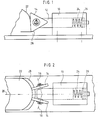
- the rear stop represented in FIGS. 1 and 2 comprises a body 10, fixedly mounted on the ski, for example by means of screws, and comprising a longitudinal housing in which is engaged a slide 12 carrying at its front end, external to the body 10 , two polygonal cams 14, which are here of triangular shape with rounded apex, each mounted for rotation about a horizontal axis 16, 18 respectively, these two horizontal axes being symmetrical with respect to the longitudinal axis 20 of the stop and making between them an obtuse angle, the top of which is oriented towards the rear, opposite a ski boot 22, the rear part of which is intended to be engaged by the triangular cams 14.
- the rear end of the slide 12 engaged in the body 10 bears on an elastically compressible spring or element 24 interposed between this rear end of the slide 12 and a piston or the like 26 movable longitudinally in position inside the body 10, for example by screwing from the rear end of this body, for adjusting the elastic compressive force applied to the slide 12 by the element 24.
- the triangular cams 14 holding the boot allow both vertical or oblique movement of the boot relative to the ski, the cams then pivoting around their axes of rotation 16, 18, that a lateral displacement of the shoe, all these movements resulting in a displacement of the slides 12 opposite the shoe and a compression of the elements 24.
- Voluntary heaving is carried out without difficulty, by raising the heel of the shoe relative to the binding, which has the effect of rotating the cams 14 about their axes of rotation and causing the rearward slide of the slide 12 of the rear stop, or by operating a manual opening device which can be equipped the stops, as will be seen with reference to the following figures.
- the various elements of the stops of a fixing according to the invention can be made of molded plastic, these stops being thus light, insensitive to corrosion and inexpensive.
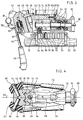
- the reference 30 designates a ski on which is fixedly mounted a longitudinal slide 32, for example by means of screws 34.
- a slide 32 On the slide 32 is retained and guided in longitudinal translation a slide 36.
- the slide 36 At its front end, the slide 36 comprises two parallel ribs 38 of rectangular section, which are substantially vertical or inclined slightly forward and upward as shown, and whose longitudinal median planes form an angle between them.
- ribs 38 are received in grooves of corresponding shape of a support piece 40 on which two polygonal cams 42, for example triangular, corresponding to the cams 14 of Figures 1 and 2, are each rotatably mounted around a horizontal shaft 44, the two shafts 44 being symmetrical with respect to the longitudinal axis 46 of the stop and forming between them an obtuse angle with apex oriented towards the rear.
- two polygonal cams 42 for example triangular, corresponding to the cams 14 of Figures 1 and 2
- a screw 48 is screwed into a threaded hole 50 in the front part of the slide 36, this hole extending parallel to the ribs 38 and the screw 48 comprising a screw head 50 accessible from the outside of the stop and an annular flange 52 engaged in a groove of the support piece 40, so that the screwing or unscrewing of the screw 48 causes the translation in one direction or the other of the support piece 40 along the ribs 38 and allows the height adjustment of this support piece 40 relative to the slide 36.
- the support piece 40 also allows the mounting of ski brakes comprising, conventionally, two parts symmetrical with respect to the binding and each having a rod 54 terminated by a serrated lug 56, each rod 54 being secured to a bent lever 58 comprising at one end a spherical head 60 suitable for being engaged by the sole of the ski boot, and a straight branch pivotally mounted in the support piece 40 and ending in an eccentric 62 applied under a piston 64 housed in a bore of the support piece 40 and loaded by a spring formed of elastically compressible rings 66 ( Figures 3 and 6).
- the branches 58 rotatably mounted in the support piece 40 are oblique so that the thrust on the spherical heads 60 by the ski boot sole from the position shown in Figures 3 and 5, causes the ascent to the top of the rods 54 and the legs 56 and their approximation of one another above the ski 30 ( Figure 4).
- the release of the ski boot by the binding brings, by relaxation of the elastically compressible rings 66, the rods 54 and the tabs 56 into the position shown in FIGS. 3 and 5.
- the slide 36 comprises a longitudinal housing 70, of circular section and opening out towards the rear, in which is housed a mechanism for adjusting the hardness of the stop, comprising a threaded rod 72 whose front end is screwed in a nut 74 immobilized in rotation relative to the slide 36 and passing through a slit or lower light lower 76 of the slide, formed opposite the slide 32.
- the nut 74 is made integral with the slide by means of a cylindrical sleeve 78 screwed into a hole in the nut and housing a ball 80 loaded elastically by a spring or an elastically compressible ring 82.
- the ball 80 is suitable for s 'Engage in one of the notches of the slide 32, formed by a series of cylindrical holes 84. These holes are perpendicular to the plane of the ski and are longitudinally aligned in the slide 32, being separated from each other by a corresponding predetermined distance for example at a size or a half size of a ski boot.
- a stop pin 86 is placed in the bore 84 according to the bore in which the ball 80 is partially received, and stop form on which the sleeve 78 carries, to prevent the recoil of the nut 74.
- the rear end of the threaded rod 72 comprises a head 88 for driving in rotation, external to the slide 36.
- a nut 90 is screwed onto the rear end of the threaded rod and bears against elastically compressible rings 92 freely traversed by the threaded rod and interposed between the nut 90 and a ring 94 which is also freely traversed by the threaded rod and which is made integral with the slide 36 by means of an eccentric 96 carried by a lever 98 mounted for rotation about an axis vertical in the slide 36, the eccentric 96 being formed by an eccentric cylindrical finger which is received in a housing of the ring 94.
- a stop ring 100 integral with the threaded rod, stop form of the ring 94, at the 'opposite of the elastically compressible rings 92.
- Another stop ring 102 is integral with the front end of the threaded rod 72 and prevents the latter from coming out of the nut 74 by unscrewing.
- This rear stopper is used as follows:
- the stop pin 86 is placed in the desired hole 84 of the slide 32, then the slide 36 is engaged by its rear end on the front of the slide 32 and pulled back until that the ball 80 falls into the bore 84 immediately preceding the bore provided with the stop pin 86.
- the head 88 of the threaded rod 72 By rotation of the head 88 of the threaded rod 72, it is possible to screw or unscrew this rod in the nut 74 and thus move the slide 36, through the ring 94 and the eccentric 96, relative to the nut 74 and the slide 32, to perfectly adapt the binding to the size of the ski boot.
- the nut 90 onto the threaded rod 72 the compression of the elastically compressible rings 92 is adjusted to obtain the desired hardness of the stop.
- the operating lever 98 makes it possible to advance the slide 36 in the direction of the shoe, by means of the eccentric 96, when it is in the position shown in FIGS. 3 and 4, and to move the slide back with respect to the shoe, for manual opening of the binding, when this lever is turned 180 ° in one direction or the other.
- This movement of the slide 36 resulting from the rotation of the lever 98 does not modify the hardness setting resulting from the screwing of the nut 90.
- any thrust on the triangular cams 42 caused by a violent force or by a fall of the skier translated by a rearward movement of the slide 36 having the effect, by the eccentric 96 engaged in the ring 94, of a compression of the rings 92.
- the front stop is substantially identical to the rear stop, but is devoid of the ski brakes 54, 56 and 58.
- the front and rear stops are removable by pushing the stops towards each other by hand with sufficient force to overcome the force of the spring 82 applying the ball 80 in a cylindrical bore. that 84 of the slide 32.
- the front and rear stops, mounted on the slides 32 are thus adaptable to shoes of different sizes and allow, for a determined size, an adjustment of the position of the center of gravity of the skier on the ski by displacement of the two front and rear stops in the same direction and over the same distance determined by the notches of the slides 32.
- the main components of these stops can be made of injection molded plastic.
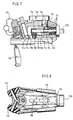
- FIGS 7 and 8 show an alternative embodiment of a rear stop according to the invention, differing from the embodiment of Figures 3 to 6 by the structure of the slide and the adjustment mechanism.
- the notches of the slide 112 are no longer formed by cylindrical bores, but by longitudinally aligned cavities comprising a horizontal transverse bottom 114, an oblique front face 116 and a vertical rear face 118.
- the nut 74 screwed onto the front end of the threaded rod 72 is made integral with the slide 112 by means of a cylindrical sleeve 78 screwed as before into a lower orifice of the nut 74 and housing a cylindrical pin 80 loaded by a spring or a elastically compressible element 82, this cylindrical pin 80 being engaged in one of the cavities of the slide 112 and abutting against the rear vertical face 118 thereof.
- the slide 36 is engaged by its front end on the rear end of the slide 112 (in the case of a rear stop) and is pushed by hand until the pin 80 is engaged in the desired cavity or notch of the slide, the oblique front faces 116 of these notches allowing the slide 36 to move forward, while the faces vertical rear 118 of these notches prohibit the displacement of the slide backwards.
- the rear end of the threaded rod 72, external to the slide, is integral with a rotation drive head 120, which bears directly on elastically compressible rings 92 freely traversed by the threaded rod and bearing on a rigid ring 94 made integral with the slide 36 by the eccentric 96 of an operating lever 98, as in the previous embodiment.
- the threaded rod 72 is more or less screwed into the nut 74, which moves the slide 36 in one direction or the other relative to the rear part of a ski boot and comes apply the triangular cams 42 to this rear part with a greater or lesser force.
- this rear stop is substantially identical to that of FIGS. 3 to 6.
Landscapes
- Footwear And Its Accessory, Manufacturing Method And Apparatuses (AREA)
Applications Claiming Priority (2)
| Application Number | Priority Date | Filing Date | Title |
|---|---|---|---|
| FR8303246 | 1983-02-28 | ||
| FR8303246A FR2541584B1 (fr) | 1983-02-28 | 1983-02-28 | Fixation de ski |
Publications (2)
| Publication Number | Publication Date |
|---|---|
| EP0117822A2 true EP0117822A2 (de) | 1984-09-05 |
| EP0117822A3 EP0117822A3 (en) | 1985-06-19 |
Family
ID=9286340
Family Applications (1)
| Application Number | Title | Priority Date | Filing Date |
|---|---|---|---|
| EP84400386A Withdrawn EP0117822A3 (en) | 1983-02-28 | 1984-02-27 | Self-engaging ski binding |
Country Status (2)
| Country | Link |
|---|---|
| EP (1) | EP0117822A3 (de) |
| FR (1) | FR2541584B1 (de) |
Cited By (2)
| Publication number | Priority date | Publication date | Assignee | Title |
|---|---|---|---|---|
| EP0636392A1 (de) * | 1993-07-27 | 1995-02-01 | Marker Deutschland GmbH | Bremsarm einer Skibremse |
| EP2664365A1 (de) * | 2012-05-18 | 2013-11-20 | Skis Rossignol | Skibindung mit Bremse |
Family Cites Families (9)
| Publication number | Priority date | Publication date | Assignee | Title |
|---|---|---|---|---|
| DE1428994A1 (de) * | 1961-07-26 | 1969-01-09 | Rolf Hatlapa | Sicherheitsskistrammer |
| DE1578891A1 (de) * | 1965-12-02 | 1970-07-02 | Salomon & Fils F | Skibindung mit unabhaengigen Backen oder Rollen |
| FR1534442A (fr) * | 1966-08-27 | 1968-07-26 | Dispositif de fixation pour ski | |
| CH453989A (fr) * | 1967-08-28 | 1968-03-31 | Mottet Willy | Fixation de ski à libération automatique |
| AT308584B (de) * | 1971-06-29 | 1973-07-10 | Hermann Gruber Dipl Ing | Türschloß mit automatischer Innenverriegelung |
| FR2224182A1 (en) * | 1973-04-09 | 1974-10-31 | Siot Taillefer Paul | Stop for release binding of ski - has recesses in plate which automatically realigns when boot is released |
| FR2265420B1 (de) * | 1974-04-02 | 1979-05-11 | Salomon & Fils F | |
| FR2399260A1 (fr) * | 1977-08-01 | 1979-03-02 | Curti Spa | Perfectionnements aux fixations de securite pour skis |
| CH632415A5 (en) * | 1978-07-26 | 1982-10-15 | Suhner Intertrade Ag | Ski brake on a sole depressor of a safety ski binding |
-
1983
- 1983-02-28 FR FR8303246A patent/FR2541584B1/fr not_active Expired
-
1984
- 1984-02-27 EP EP84400386A patent/EP0117822A3/fr not_active Withdrawn
Cited By (4)
| Publication number | Priority date | Publication date | Assignee | Title |
|---|---|---|---|---|
| EP0636392A1 (de) * | 1993-07-27 | 1995-02-01 | Marker Deutschland GmbH | Bremsarm einer Skibremse |
| US5533744A (en) * | 1993-07-27 | 1996-07-09 | Marker Deutschland Gmbh | Ski brake spur |
| EP2664365A1 (de) * | 2012-05-18 | 2013-11-20 | Skis Rossignol | Skibindung mit Bremse |
| FR2990624A1 (fr) * | 2012-05-18 | 2013-11-22 | Rossignol Sa | Fixation de ski avec frein |
Also Published As
| Publication number | Publication date |
|---|---|
| EP0117822A3 (en) | 1985-06-19 |
| FR2541584A1 (fr) | 1984-08-31 |
| FR2541584B1 (fr) | 1985-12-20 |
Similar Documents
| Publication | Publication Date | Title |
|---|---|---|
| WO1996032992A1 (fr) | Fixation de securite pour le ski de telemark, la randonnee nordique et le saut a ski | |
| EP0398794A1 (de) | Verstellbare Schuhbindung für Wintersport | |
| EP0241360A1 (de) | Sicherheitsskibindung | |
| FR2641703A1 (fr) | Dispositif de fixation de securite de ski, monoski ou surf de neige | |
| EP2552559A1 (de) | Bindung zum üben von skilaufen | |
| FR2625443A1 (fr) | Fixation de securite pour ski destinee a maintenir, de facon declenchable, l'avant d'une chaussure montee sur le ski | |
| FR3008896A1 (fr) | Systeme de fixation reglable pour planche de glisse et planche equipee d’un tel systeme | |
| FR2467611A1 (fr) | Frein de ski | |
| FR2831455A1 (fr) | Ensemble de retenue d'une chaussure sur une planche de glisse | |
| CH673400A5 (de) | ||
| FR2493711A1 (fr) | Retenue de talon pour une fixation de securite de ski | |
| EP0179692A1 (de) | Sicherheitsskibindung | |
| CH675053A5 (de) | ||
| FR2722420A1 (fr) | Fixation pour une planche a neige | |
| FR2463629A1 (fr) | Fixation de securite pour ski | |
| FR2613949A1 (fr) | Dispositif de fixation de ski a chaussage automatique | |
| CH675835A5 (de) | ||
| FR2736274A1 (fr) | Dispositif de retenue d'une chaussure sur une planche de glisse destinee a la pratique du surf sur la neige. | |
| FR2630339A1 (fr) | Procede et dispositif pour coupler une paire de skis, et dispositif comprenant deux skis ainsi equipes | |
| CH491652A (fr) | Butée de sécurité avant pour fixation de ski | |
| EP3708230A1 (de) | Haltevorrichtung für gleitbrette | |
| FR2588192A1 (fr) | Talonniere, notamment pour fixation de securite de ski | |
| FR2527464A1 (fr) | Butee avant de fixation de securite de ski | |
| FR2631244A1 (fr) | Machoire anterieure equipant des fixations de securite pour skis | |
| EP3492153B1 (de) | Ferseneinheit für skibindung |
Legal Events
| Date | Code | Title | Description |
|---|---|---|---|
| PUAI | Public reference made under article 153(3) epc to a published international application that has entered the european phase |
Free format text: ORIGINAL CODE: 0009012 |
|
| AK | Designated contracting states |
Designated state(s): AT CH DE FR GB IT LI NL SE |
|
| PUAL | Search report despatched |
Free format text: ORIGINAL CODE: 0009013 |
|
| AK | Designated contracting states |
Designated state(s): AT CH DE FR GB IT LI NL SE |
|
| 17P | Request for examination filed |
Effective date: 19851216 |
|
| 17Q | First examination report despatched |
Effective date: 19861126 |
|
| STAA | Information on the status of an ep patent application or granted ep patent |
Free format text: STATUS: THE APPLICATION IS DEEMED TO BE WITHDRAWN |
|
| 18D | Application deemed to be withdrawn |
Effective date: 19880830 |
|
| RIN1 | Information on inventor provided before grant (corrected) |
Inventor name: DURFORT, RAYMOND |