EP0118930B1 - Verfahren zur Herstellung von Metallmatrizen - Google Patents
Verfahren zur Herstellung von Metallmatrizen Download PDFInfo
- Publication number
- EP0118930B1 EP0118930B1 EP84200085A EP84200085A EP0118930B1 EP 0118930 B1 EP0118930 B1 EP 0118930B1 EP 84200085 A EP84200085 A EP 84200085A EP 84200085 A EP84200085 A EP 84200085A EP 0118930 B1 EP0118930 B1 EP 0118930B1
- Authority
- EP
- European Patent Office
- Prior art keywords
- layer
- copy
- metal
- information track
- negative
- Prior art date
- Legal status (The legal status is an assumption and is not a legal conclusion. Google has not performed a legal analysis and makes no representation as to the accuracy of the status listed.)
- Expired
Links
- 229910052751 metal Inorganic materials 0.000 title claims description 83
- 239000002184 metal Substances 0.000 title claims description 83
- 238000004519 manufacturing process Methods 0.000 title claims description 23
- 238000000034 method Methods 0.000 claims description 39
- 239000000203 mixture Substances 0.000 claims description 35
- 229920003002 synthetic resin Polymers 0.000 claims description 34
- 239000000057 synthetic resin Substances 0.000 claims description 34
- 239000007788 liquid Substances 0.000 claims description 19
- 239000011521 glass Substances 0.000 claims description 11
- 239000007767 bonding agent Substances 0.000 claims description 5
- 238000000926 separation method Methods 0.000 claims description 5
- 239000004922 lacquer Substances 0.000 description 15
- 238000009713 electroplating Methods 0.000 description 11
- 239000003795 chemical substances by application Substances 0.000 description 7
- 229920002120 photoresistant polymer Polymers 0.000 description 7
- 229920002379 silicone rubber Polymers 0.000 description 7
- BQCADISMDOOEFD-UHFFFAOYSA-N Silver Chemical compound [Ag] BQCADISMDOOEFD-UHFFFAOYSA-N 0.000 description 6
- 230000003647 oxidation Effects 0.000 description 6
- 238000007254 oxidation reaction Methods 0.000 description 6
- 239000004945 silicone rubber Substances 0.000 description 6
- 229910052709 silver Inorganic materials 0.000 description 6
- 239000004332 silver Substances 0.000 description 6
- QTBSBXVTEAMEQO-UHFFFAOYSA-M Acetate Chemical compound CC([O-])=O QTBSBXVTEAMEQO-UHFFFAOYSA-M 0.000 description 5
- 239000011159 matrix material Substances 0.000 description 5
- -1 silane compound Chemical class 0.000 description 5
- 239000004411 aluminium Substances 0.000 description 4
- 229910052782 aluminium Inorganic materials 0.000 description 4
- XAGFODPZIPBFFR-UHFFFAOYSA-N aluminium Chemical compound [Al] XAGFODPZIPBFFR-UHFFFAOYSA-N 0.000 description 4
- 239000003054 catalyst Substances 0.000 description 4
- 229920003229 poly(methyl methacrylate) Polymers 0.000 description 4
- 239000004926 polymethyl methacrylate Substances 0.000 description 4
- 239000000243 solution Substances 0.000 description 4
- WSFSSNUMVMOOMR-UHFFFAOYSA-N Formaldehyde Chemical compound O=C WSFSSNUMVMOOMR-UHFFFAOYSA-N 0.000 description 3
- PXHVJJICTQNCMI-UHFFFAOYSA-N Nickel Chemical compound [Ni] PXHVJJICTQNCMI-UHFFFAOYSA-N 0.000 description 3
- 150000001875 compounds Chemical class 0.000 description 3
- 239000000470 constituent Substances 0.000 description 3
- 229910000077 silane Inorganic materials 0.000 description 3
- KWVGIHKZDCUPEU-UHFFFAOYSA-N 2,2-dimethoxy-2-phenylacetophenone Chemical compound C=1C=CC=CC=1C(OC)(OC)C(=O)C1=CC=CC=C1 KWVGIHKZDCUPEU-UHFFFAOYSA-N 0.000 description 2
- WHNWPMSKXPGLAX-UHFFFAOYSA-N N-Vinyl-2-pyrrolidone Chemical compound C=CN1CCCC1=O WHNWPMSKXPGLAX-UHFFFAOYSA-N 0.000 description 2
- DAKWPKUUDNSNPN-UHFFFAOYSA-N Trimethylolpropane triacrylate Chemical compound C=CC(=O)OCC(CC)(COC(=O)C=C)COC(=O)C=C DAKWPKUUDNSNPN-UHFFFAOYSA-N 0.000 description 2
- 150000001252 acrylic acid derivatives Chemical class 0.000 description 2
- 125000005396 acrylic acid ester group Chemical group 0.000 description 2
- 239000007864 aqueous solution Substances 0.000 description 2
- 238000007906 compression Methods 0.000 description 2
- 238000005137 deposition process Methods 0.000 description 2
- 230000002349 favourable effect Effects 0.000 description 2
- 239000011888 foil Substances 0.000 description 2
- 239000005337 ground glass Substances 0.000 description 2
- 238000001465 metallisation Methods 0.000 description 2
- KERTUBUCQCSNJU-UHFFFAOYSA-L nickel(2+);disulfamate Chemical compound [Ni+2].NS([O-])(=O)=O.NS([O-])(=O)=O KERTUBUCQCSNJU-UHFFFAOYSA-L 0.000 description 2
- 230000003287 optical effect Effects 0.000 description 2
- 229920005989 resin Polymers 0.000 description 2
- 239000011347 resin Substances 0.000 description 2
- SQGYOTSLMSWVJD-UHFFFAOYSA-N silver(1+) nitrate Chemical compound [Ag+].[O-]N(=O)=O SQGYOTSLMSWVJD-UHFFFAOYSA-N 0.000 description 2
- 229940096522 trimethylolpropane triacrylate Drugs 0.000 description 2
- YTLYLLTVENPWFT-UPHRSURJSA-N (Z)-3-aminoacrylic acid Chemical compound N\C=C/C(O)=O YTLYLLTVENPWFT-UPHRSURJSA-N 0.000 description 1
- ZDQNWDNMNKSMHI-UHFFFAOYSA-N 1-[2-(2-prop-2-enoyloxypropoxy)propoxy]propan-2-yl prop-2-enoate Chemical compound C=CC(=O)OC(C)COC(C)COCC(C)OC(=O)C=C ZDQNWDNMNKSMHI-UHFFFAOYSA-N 0.000 description 1
- SMZOUWXMTYCWNB-UHFFFAOYSA-N 2-(2-methoxy-5-methylphenyl)ethanamine Chemical compound COC1=CC=C(C)C=C1CCN SMZOUWXMTYCWNB-UHFFFAOYSA-N 0.000 description 1
- GOXQRTZXKQZDDN-UHFFFAOYSA-N 2-Ethylhexyl acrylate Chemical compound CCCCC(CC)COC(=O)C=C GOXQRTZXKQZDDN-UHFFFAOYSA-N 0.000 description 1
- NIXOWILDQLNWCW-UHFFFAOYSA-N 2-Propenoic acid Natural products OC(=O)C=C NIXOWILDQLNWCW-UHFFFAOYSA-N 0.000 description 1
- JHWGFJBTMHEZME-UHFFFAOYSA-N 4-prop-2-enoyloxybutyl prop-2-enoate Chemical compound C=CC(=O)OCCCCOC(=O)C=C JHWGFJBTMHEZME-UHFFFAOYSA-N 0.000 description 1
- WQZGKKKJIJFFOK-GASJEMHNSA-N Glucose Natural products OC[C@H]1OC(O)[C@H](O)[C@@H](O)[C@@H]1O WQZGKKKJIJFFOK-GASJEMHNSA-N 0.000 description 1
- 239000004372 Polyvinyl alcohol Substances 0.000 description 1
- 239000012670 alkaline solution Substances 0.000 description 1
- WQZGKKKJIJFFOK-VFUOTHLCSA-N beta-D-glucose Chemical compound OC[C@H]1O[C@@H](O)[C@H](O)[C@@H](O)[C@@H]1O WQZGKKKJIJFFOK-VFUOTHLCSA-N 0.000 description 1
- 238000005234 chemical deposition Methods 0.000 description 1
- 238000000151 deposition Methods 0.000 description 1
- 230000008021 deposition Effects 0.000 description 1
- 229920001971 elastomer Polymers 0.000 description 1
- 239000008103 glucose Substances 0.000 description 1
- 239000004615 ingredient Substances 0.000 description 1
- 239000003999 initiator Substances 0.000 description 1
- 238000001746 injection moulding Methods 0.000 description 1
- 230000005012 migration Effects 0.000 description 1
- 238000013508 migration Methods 0.000 description 1
- 229910052759 nickel Inorganic materials 0.000 description 1
- 238000002161 passivation Methods 0.000 description 1
- 229920002492 poly(sulfone) Polymers 0.000 description 1
- 229920000515 polycarbonate Polymers 0.000 description 1
- 239000004417 polycarbonate Substances 0.000 description 1
- 229920000728 polyester Polymers 0.000 description 1
- 229920005749 polyurethane resin Polymers 0.000 description 1
- 229920002451 polyvinyl alcohol Polymers 0.000 description 1
- 239000012429 reaction media Substances 0.000 description 1
- 239000012266 salt solution Substances 0.000 description 1
- 229910001961 silver nitrate Inorganic materials 0.000 description 1
- 238000004544 sputter deposition Methods 0.000 description 1
- 239000007858 starting material Substances 0.000 description 1
- 239000000126 substance Substances 0.000 description 1
Images


Classifications
-
- G—PHYSICS
- G11—INFORMATION STORAGE
- G11B—INFORMATION STORAGE BASED ON RELATIVE MOVEMENT BETWEEN RECORD CARRIER AND TRANSDUCER
- G11B23/00—Record carriers not specific to the method of recording or reproducing; Accessories, e.g. containers, specially adapted for co-operation with the recording or reproducing apparatus ; Intermediate mediums; Apparatus or processes specially adapted for their manufacture
- G11B23/0057—Intermediate mediums, i.e. mediums provided with an information structure not specific to the method of reproducing or duplication such as matrixes for mechanical pressing of an information structure ; record carriers having a relief information structure provided with or included in layers not specific for a single reproducing method; apparatus or processes specially adapted for their manufacture
-
- G—PHYSICS
- G11—INFORMATION STORAGE
- G11B—INFORMATION STORAGE BASED ON RELATIVE MOVEMENT BETWEEN RECORD CARRIER AND TRANSDUCER
- G11B7/00—Recording or reproducing by optical means, e.g. recording using a thermal beam of optical radiation by modifying optical properties or the physical structure, reproducing using an optical beam at lower power by sensing optical properties; Record carriers therefor
- G11B7/24—Record carriers characterised by shape, structure or physical properties, or by the selection of the material
- G11B7/26—Apparatus or processes specially adapted for the manufacture of record carriers
- G11B7/261—Preparing a master, e.g. exposing photoresist, electroforming
Definitions
- the invention relates to a method of manufacturing metal dies which are suitable for use in the production of information discs of synthetic resin, in which from a master disc which comprises a supporting plate carrying on one side a layer of synthetic resin in which a spiral-like information track or an information track built up from concentric circles is provided, a first negative copy is made, a positive copy is manufactured from the negative copy and a second negative copy in metal is then manufactured from the positive copy.
- the information discs of synthetic resin which are manufactured by means of the metal dies are, for example, gramophone records but in particular discs of synthetic resin having an optically readable information track.
- Such optical discs are known as Laservision Disc, in case of video (image) information and Compact Disc, in case of audio (sound) information.
- An optically readable information track has a crenellated profile of informations areas which are situated alternately at a higher level and at a lower level.
- the areas or bits are read in reflection by means of laser light.
- the areas have small longitudinal dimensions of, for example, 0.3 to 3 itm.
- the difference in height between the areas is where d is the refractive index, A is the wavelength of the reading laser light, and n is an integer.
- the first negative copy derived from the master disc, the positive copy and the second negative copy all have been manufactured from metal since many years.
- a method of manufacturing a metal matrix having video information also is disclosed in the US-A-4,211,617, with reference to US-A-4,130,620.
- a negative copy of silicon rubber is made from the master disc.
- the master disc is provided with the release agent polyvinyl alcohol and then with a liquid mixture of a silicone rubber and a catalyst.
- a glass plate comprising a bonding agent is pressed against the liquid mixture of silicone rubber. The rubber is cured under pressure at an elevated temperature. Finally the glass plate and the attached layer of cured silicone rubber, in which the information track of the master disc is copied, is removed from the master disc.
- a positive copy is manufactured from the obtained negative copy by providing the silicone rubber matrix with a liquid mixture of a polyurethane resin, a thinner and a catalyst.
- a supporting foil of polyester is placed on said mixture.
- the resin subsequently is cured and the supporting foil with the cured resin layer is removed from the silicone rubber matrix.
- the resulting positive copy is silver-plated on the side of the information track.
- the silver-plated copy serves as a starting material for the manufacture of a negative "mother" matrix of metal from which positive metal copies can be made by electroplating.
- negative metal copies are manufactured which may be used as dies in the manufacture of synthetic resin replicas (US-A-4,211,617, column 6, line 46 to column 7, line 43). This known method is very cumbersome and rather expensive.
- the disadvantage of the method is that as a result of the temperature and pressure treatment, tensions will be built up in the silicone rubber matrix and the polurethane copies derived therefrom. Upon release of the tensions, deformations are likely to occur whereby the quality of the stored information is reduced resulting into a high reject percentage.
- the invention provides a method which mitigates the above-mentioned problems.
- the first negative copy and/or the positive copy are manufactured from a light-cured composition. This concept leads to the following process variants:
- the light-curable composition used in the method in accordance with the invention is, for example, a mixture of light-curable, for example UV light-curable, acrylic acid esters (acrylates), particularly mono-, di-, tri-, ortetra-esters of acrylic acid.
- Light-curable polyenethiol compounds may also be used. Suitable compounds and mixtures of compounds are described in NL-A-76 11 395, NL-A-79 04 113, NL-A-80 05 674 and NL-A-78 04 036 all in the name of N.V. Philips' Gloeilampenfabrieken.
- a transparent supporting plate is placed on the layer of the liquid, light-curable composition, the layer is then cured by exposure to light via the transparent supporting plate and the resulting copy which comprises the supporting plate and the cured layer bonded thereto in which the information track is copied, is removed from the original.
- the supporting plate is manufactured from glass and is provided with a bonding agent.
- An attractive bonding agent is a silane compound, in particular a silane compound having an unsaturated organic radical, such as y-methacryloxypropyltrimethoxysilane.
- Still another favourable embodiment of the method in accordance with the invention is characterized in that upon making a copy while using the light-curable composition, in case the surface from which the copy is made consists of a synthetic resin, the surface of synthetic resin is first provided with a separation layer.
- the master disc is preferably first provided with a separation layer on the side of the information track.
- a suitable separation layer is a metal layer, for example, an electroless deposited silver layer.
- the master disc with an optically readable information track mostly comprises a flat, ground glass plate carrying one one side a layer of a photoresist, usually a positive photoresist, for example the photoresist known by the tradename of Shipley.
- An information track has been provided in the photoresist layer by means of an imagewise exposure to, for example, modulated laser light.
- the master disc for gramophone records mostly comprises an aluminium supporting plate which one one side is provided with a lacquer, for example an acetate lacquer, in which the information track has been cut mechanically.
- the supporting plate may also be provided with a light curable lacquer, such as a lacquer based upon acrylic acid esters (acrylates).
- the lacquer is cured partly in such manner that the hardness of the lacquer is optimum to cut a track. After having provided the track the lacquer is post-cured by means of for example UV-light.
- the master disc preferably is provided on the side of the layer of synthetic resin such as a photoresist layer or lacquer layer, with a metal layer applied by means of an electroless metalization process.
- a metal layer applied by means of an electroless metalization process.
- Known processes for this purpose are vapour deposition process, sputtering process and chemical deposition process.
- the surface of synthetic resin is treated simultaneously or successively with a metal salt solution, for example an ammonical silver nitrate solution, and a solution of reduction agent, for example a solution of formaldehyde or glucose.
- a layer of the liquid light-curable composition is applied and a transparent supporting plate is provided hereon.
- a useful supporting plate is, for example, a plate manufactured from a transparent synthetic resin, for example, polymethylmethacrylate, polysulphone or polycarbonate.
- a glass supporting plate is preferred which, as compared with a plate of synthetic resin, shows a betterform stability and is impervious to moisture.
- the layer of the light curable composition is cured by exposure via the supporting plate.
- the supporting plate with the cured layer bonded thereto is removed from the master disc.
- the electroless metal layer may come off with the negative copy.
- a positive copy of metal is manufactured from the negative copy by growing a metal peel, in particular an Ni-peel, on the electroless deposited metal layer by means of an electro- plating process (electrolytically).
- the metal peel together with the electroless metal layer is separate from the negative copy.
- the obtained positive copy preferably consists of a nickel peel carrying a silver layer on the side of the copied information track.
- the desired dies of metal are manufactured from the positive copy.
- the electroless metal layer such as an Ag-layer
- an aqueous ammonical solution of an oxidation agent for example H 2 0 2 .
- the metal surface usually an Ni-surface
- a metal peel of, for example, Ni is grown hereon by means of an electro-plating process. Due to the passivation the grown metal peel can easily be removed from the.positive copy and herewith the desired die is obtained.
- a first negative copy of metal is manufactured from the master disc.
- the master disc on the side of the layer of synthetic resin is provided with an electroless metal layer, for example, an Ag-layer.
- a metal peel for example an Ni-peel is grown by electroplating. The metal peel with the electroless metal layer is removed from the master disc.
- a layer of a liquid, light-curable composition is provided on the electroless metal layer of the thus obtained first negative copy .
- the layer is covered with a transparent supporting plate, then cured via the supporting plate and finally the assembly of the supporting plate and cured layer bonded thereto is removed from the first negative copy.
- the information track is copied in the cured layer of the resulting positive copy.
- the cured layer is provided with an electroless deposited metal layer, for example an Ag-layer.
- a metal peel for example an Ni-peel, is provided hereon by electroplating.
- the Ni-peel with the Ag-layer bonded thereto is removed from the positive copy and finally the silver layer is removed selectively by treatment with an oxidation agent.
- the resulting metal die is suitable for the manufacture of replicas of synthetic resin.
- the variant b of the process is a particularly interesting method because a large number of, for example, 1000 positive copies can be made from the first negative copy and each in turn provide one or more dies.
- both the first negative copy and the positive copy derived herefrom are manufactured by using the liquid, light-curable composition.
- the first negative copy of the master disc is manufactured in the same manner as described hereabove for variant a of the process.
- the first negative copy comprises a transparent supporting plate and a light-cured layer bonded thereto in which the information track of the master disc is copied and which is covered with an electroless deposited metal layer.
- Said metal layer is provided with a layer of the liquid, light-curable composition and covered with a transparent supporting plate.
- the layer of the light curable composition is cured by exposure via the supporting plate and the supporting plate together with the cured layer bonded thereto is removed from the first negative copy.
- the above-mentioned electroless metal layer preferably remains bonded to the first negative copy so that the negative copy can be used many times to make positive copies.
- the resulting positive copy on the side of the cured layer in which in the information track is copied is provided with a metal layer applied by an electroless deposition process and thereafter by a metal peel grown electrolytically upon the electroless metal layer. The metal peel is removed and further processed to a die in the same manner as described for variant b of the process.
- positive sub-dies can be manufactured from the metal dies by using the light-curable- liquid composition and a transparent supporting plate in the manner described above.
- sub-dies of synthetic resin negative metal copies are made by metallizing the sub-dies first by electroless deposition and subsequently by electroplating.
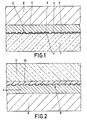
- a master disc comprises a flat ground glass supporting plate 1 which on one side comprises a layer of photoresist 2 in which an optically readable information track 3 is provided by means of modulated laser light.
- Information track 3 has a crenellated profile of information areas 4 situated at a higher level and information areas 5 situated at a lower level.
- the layer of photoresist is coated with a vapour-deposited layer 6 of Ag.
- Layer 6 is connected to the cathode of an electroplating bath which comprises an aqueous solution of nickel sulphamate.
- an Ni-peel 7 is deposited on layer 6.
- Said peel 7 is provided with a rigid metal disc 8 on the surface remote from the silver layer 6.
- Ag-layer 13 is connected to the cathode of an electroplating bath which comprises an aqueous solution of nickel sulphamate. When current passes, an Ni-peel 14 is deposited. A rigid metal plate 15, for example an aluminium plate, is bonded to peel 14 and the resulting die 14, 15 is removed from the positive copy 10, 11. Die 14, 15 has an optically readable information track which is a negative of that of the master disc.
- the desired information discs of synthetic resin can be manufactured by means of the die by using the conventional processes, such as a compression process, an injection moulding process or the process known from Netherlands Patent Application 76 11 395 (PHM 8576).
- the die 14, 15 may be used both with and without an Ag-layer 13.
- a sub-die of synthetic resin can be manufactured from die 14, 15 by using a liquid, light-curable composition and a transparent supporting plate as described hereinbefore.
- the resulting sub-die comprises a supporting plate of, for example, glass or of a transparent synthetic resin, for example, polymethylmethacrylate and a cured layer of a synthetic resin which is bonded thereto and has been obtained by exposing the light curable composition to light.
- a second negative die is manufactured by metallization and bonding a rigid metal plate.
- a master disc destined for gramophone records comprises an aluminium supporting plate 16 ( Figure 4) which on one side has an acetate lacquer 17 in which a spiral-like information track 18 has been cut.
- the free surface of the layer of acetate lacquer is covered with an electroless deposited layer 19 of Ag.
- a liquid light-curable composition 20 is provided on layer 19, comprising the following constituents:
- a supporting plate 21 of polymethylmethacrylate is provided on the lacquer layer 20.
- the lacquer layer 20 is cured by exposure to UV-light which is irradiated via the supporting plate 21.
- the master disc 16,17 is removed, the Ag-layer 19 remaining bonded to the cured layer 20.
- the resulting negative copy 19, 20, 21 comprises an information track 22 ( Figure 5) which is the negative of information track 18 of the master disc.
- the process is further carried out as shown in Figure 5 in which the same reference numerals are used for the same components as in Figure 4.
- An Ni-peel 23 is grown on Ag-layer 19 by an electroplating process.
- a rigid metal plate 24 is bonded to peel 23.
- the negative copy 20, 21 is removed, the silver layer 19 remaining bonded to the metal layer 23.
- the resulting positive copy 19, 23, 24 comprises an information track 25 ( Figure 6) which is identical to information track 18.
- the silver layer is then removed by treatment with an oxidation agent in an alkaline reaction medium.
- the released Ni-surface is passivated, also by a treatment with an aqueous, alkaline solution of an oxidation agent.
- Ni-peel 26 is grown by an electroplating process on the positive copy 23, 24 on the side of the information track 25.
- the peel is provided with a rigid metal plate 27.
- a metal die 26, 27 is obtained.
- the information track of the die is the negative replica of the information track 18 of the master disc.
- the usual gramophone records of synthetic resin can be manufactured by means of the die 26, 27, for example, by using a compression process.
- a master disc for gramophone records comprises an aluminium supporting plate 28 which on one side has an acetate lacquer 29 with information track 30 ( Figure 7).
- a layer 31 of a light-curable composition is provided directly on the acetate lacquer 29 and comprises the following constituents:
- Layer 31 is cured by exposure to UV-light.
- the master disc 28, 29 is removed and the resulting negative copy 31 comprises an information track 32 ( Figure 8) which is the negative of the information track 30.
- the negative copy 31 is provided on the side of information track 32 with a layer 33 of a light-curable lacquer (composition) with the following ingredients:
- copy 31 may first be provided with a separation layer of metal and then be provided with the layer 33.
- a transparent supporting plate 34 of polymethylmethacrylate is placed on layer 33.
- the layer 33 is cured by exposure via the supporting plate 34 and the resulting positive copy 33, 34 in which the information track is copied is removed from the negative copy 31.
- the positive copy is metallized on the side of the information track first by an electroless process and then by electro- plating.
- a rigid metal plate is applied and the negative copy of metal (die) thus manufactured is removed from the positive copy in the same manner as described with reference to Figure 5.
- Gramophone records of synthetic resin can be manufactured by means of the die in the usual manner.
Landscapes
- Engineering & Computer Science (AREA)
- Manufacturing & Machinery (AREA)
- Manufacturing Optical Record Carriers (AREA)
- Moulds For Moulding Plastics Or The Like (AREA)
- Injection Moulding Of Plastics Or The Like (AREA)
Claims (6)
Applications Claiming Priority (2)
| Application Number | Priority Date | Filing Date | Title |
|---|---|---|---|
| NL8300344A NL8300344A (nl) | 1983-01-31 | 1983-01-31 | Methode voor de vervaardiging van metalen matrijzen. |
| NL8300344 | 1983-01-31 |
Publications (2)
| Publication Number | Publication Date |
|---|---|
| EP0118930A1 EP0118930A1 (de) | 1984-09-19 |
| EP0118930B1 true EP0118930B1 (de) | 1988-04-20 |
Family
ID=19841318
Family Applications (1)
| Application Number | Title | Priority Date | Filing Date |
|---|---|---|---|
| EP84200085A Expired EP0118930B1 (de) | 1983-01-31 | 1984-01-23 | Verfahren zur Herstellung von Metallmatrizen |
Country Status (4)
| Country | Link |
|---|---|
| EP (1) | EP0118930B1 (de) |
| JP (1) | JPS59143623A (de) |
| DE (1) | DE3470623D1 (de) |
| NL (1) | NL8300344A (de) |
Families Citing this family (2)
| Publication number | Priority date | Publication date | Assignee | Title |
|---|---|---|---|---|
| CA1284126C (en) * | 1985-08-19 | 1991-05-14 | Mark S. Kaplan | Micro replication process |
| NL8503234A (nl) * | 1985-11-25 | 1987-06-16 | Philips Nv | Matrijs. |
Citations (1)
| Publication number | Priority date | Publication date | Assignee | Title |
|---|---|---|---|---|
| NL7611395A (nl) * | 1976-10-15 | 1978-04-18 | Philips Nv | Werkwijze voor het vermenigvuldigen van kunst- stof informatiedragers alsmede een in deze werkwijze toegepaste giethars, substraat en matrijs. |
Family Cites Families (3)
| Publication number | Priority date | Publication date | Assignee | Title |
|---|---|---|---|---|
| US1358949A (en) * | 1915-07-15 | 1920-11-16 | Aeolian Co | Process of making sound-records |
| US2075646A (en) * | 1933-01-28 | 1937-03-30 | Rca Corp | Method of making a record mold |
| US3565978A (en) * | 1967-09-11 | 1971-02-23 | Xerox Corp | Replication of surface deformation images |
-
1983
- 1983-01-31 NL NL8300344A patent/NL8300344A/nl not_active Application Discontinuation
-
1984
- 1984-01-23 DE DE8484200085T patent/DE3470623D1/de not_active Expired
- 1984-01-23 EP EP84200085A patent/EP0118930B1/de not_active Expired
- 1984-01-30 JP JP1497684A patent/JPS59143623A/ja active Pending
Patent Citations (1)
| Publication number | Priority date | Publication date | Assignee | Title |
|---|---|---|---|---|
| NL7611395A (nl) * | 1976-10-15 | 1978-04-18 | Philips Nv | Werkwijze voor het vermenigvuldigen van kunst- stof informatiedragers alsmede een in deze werkwijze toegepaste giethars, substraat en matrijs. |
Also Published As
| Publication number | Publication date |
|---|---|
| JPS59143623A (ja) | 1984-08-17 |
| EP0118930A1 (de) | 1984-09-19 |
| DE3470623D1 (en) | 1988-05-26 |
| NL8300344A (nl) | 1984-08-16 |
Similar Documents
| Publication | Publication Date | Title |
|---|---|---|
| US4482511A (en) | Method of manufacturing a stamper for information storage discs | |
| US4211617A (en) | Process for producing a stamper for videodisc purposes | |
| GB1579710A (en) | Method of manufacturing dies | |
| KR910010090B1 (ko) | 블레이즈드 홀로그램(blazed holograms)의 제조방법 | |
| JP2518828B2 (ja) | マトリツクス | |
| US4650735A (en) | Method of manufacturing a metal matrix and an intermediate product obtained in performing the method | |
| EP0118930B1 (de) | Verfahren zur Herstellung von Metallmatrizen | |
| JPS5916332B2 (ja) | 原盤複製用成形型 | |
| US4964958A (en) | Method of producing a metal matrix | |
| CN1053985C (zh) | 光盘预刻版衬底及其制造方法 | |
| US5699848A (en) | Method for manufacturing a replica stamper | |
| TW559800B (en) | Manufacturing method for multi-layer information storage medium | |
| JPS59224320A (ja) | 金型の製造方法 | |
| US4358780A (en) | Optical information record member | |
| CN1097890A (zh) | 用于制作供压制特定光盘用的模具的主盘及其制作方法 | |
| JPH0337842A (ja) | 情報記録媒体用スタンパーの製造方法 | |
| EP0460346A2 (de) | Verfahren zur Herstellung einer optischen Platte | |
| EP0354773B1 (de) | Herstellung optischer Platten | |
| US4861437A (en) | Method of manfacturing a mould and providing it with a backing and mould manufactured according to the invention | |
| EP0884724A2 (de) | Optische Platten | |
| JPH05339774A (ja) | スタンパ製造方法 | |
| KR100686146B1 (ko) | 광 기록 매체 제조방법 | |
| JPS6262450A (ja) | スタンパの製法 | |
| JP3212628B2 (ja) | 光ディスク製造方法 | |
| JPS5764345A (en) | Manufacture of optical disk |
Legal Events
| Date | Code | Title | Description |
|---|---|---|---|
| PUAI | Public reference made under article 153(3) epc to a published international application that has entered the european phase |
Free format text: ORIGINAL CODE: 0009012 |
|
| AK | Designated contracting states |
Designated state(s): DE FR GB IT NL |
|
| 17P | Request for examination filed |
Effective date: 19841220 |
|
| 17Q | First examination report despatched |
Effective date: 19860515 |
|
| GRAA | (expected) grant |
Free format text: ORIGINAL CODE: 0009210 |
|
| AK | Designated contracting states |
Kind code of ref document: B1 Designated state(s): DE FR GB IT NL |
|
| PG25 | Lapsed in a contracting state [announced via postgrant information from national office to epo] |
Ref country code: NL Effective date: 19880420 Ref country code: IT Free format text: LAPSE BECAUSE OF FAILURE TO SUBMIT A TRANSLATION OF THE DESCRIPTION OR TO PAY THE FEE WITHIN THE PRESCRIBED TIME-LIMIT;WARNING: LAPSES OF ITALIAN PATENTS WITH EFFECTIVE DATE BEFORE 2007 MAY HAVE OCCURRED AT ANY TIME BEFORE 2007. THE CORRECT EFFECTIVE DATE MAY BE DIFFERENT FROM THE ONE RECORDED. Effective date: 19880420 Ref country code: FR Free format text: THE PATENT HAS BEEN ANNULLED BY A DECISION OF A NATIONAL AUTHORITY Effective date: 19880420 |
|
| REF | Corresponds to: |
Ref document number: 3470623 Country of ref document: DE Date of ref document: 19880526 |
|
| EN | Fr: translation not filed | ||
| NLV1 | Nl: lapsed or annulled due to failure to fulfill the requirements of art. 29p and 29m of the patents act | ||
| PG25 | Lapsed in a contracting state [announced via postgrant information from national office to epo] |
Ref country code: GB Effective date: 19890123 |
|
| PLBE | No opposition filed within time limit |
Free format text: ORIGINAL CODE: 0009261 |
|
| STAA | Information on the status of an ep patent application or granted ep patent |
Free format text: STATUS: NO OPPOSITION FILED WITHIN TIME LIMIT |
|
| 26N | No opposition filed | ||
| GBPC | Gb: european patent ceased through non-payment of renewal fee | ||
| PGFP | Annual fee paid to national office [announced via postgrant information from national office to epo] |
Ref country code: DE Payment date: 19930326 Year of fee payment: 10 |
|
| PG25 | Lapsed in a contracting state [announced via postgrant information from national office to epo] |
Ref country code: DE Effective date: 19941001 |