EP0119587A2 - Vorrichtung zum Anbringen von Schliesselementen an Kleidungsstücken - Google Patents
Vorrichtung zum Anbringen von Schliesselementen an Kleidungsstücken Download PDFInfo
- Publication number
- EP0119587A2 EP0119587A2 EP84102766A EP84102766A EP0119587A2 EP 0119587 A2 EP0119587 A2 EP 0119587A2 EP 84102766 A EP84102766 A EP 84102766A EP 84102766 A EP84102766 A EP 84102766A EP 0119587 A2 EP0119587 A2 EP 0119587A2
- Authority
- EP
- European Patent Office
- Prior art keywords
- die
- guide
- guide track
- fastener element
- slide bar
- Prior art date
- Legal status (The legal status is an assumption and is not a legal conclusion. Google has not performed a legal analysis and makes no representation as to the accuracy of the status listed.)
- Granted
Links
Images







Classifications
-
- A—HUMAN NECESSITIES
- A44—HABERDASHERY; JEWELLERY
- A44B—BUTTONS, PINS, BUCKLES, SLIDE FASTENERS, OR THE LIKE
- A44B19/00—Slide fasteners
- A44B19/42—Making by processes not fully provided for in one other class, e.g. B21D53/50, B21F45/18, B22D17/16, B29D5/00
- A44B19/44—Securing metal interlocking members to ready-made stringer tapes
-
- A—HUMAN NECESSITIES
- A41—WEARING APPAREL
- A41H—APPLIANCES OR METHODS FOR MAKING CLOTHES, e.g. FOR DRESS-MAKING OR FOR TAILORING, NOT OTHERWISE PROVIDED FOR
- A41H37/00—Machines, appliances or methods for setting fastener-elements on garments
- A41H37/10—Setting buttons
-
- A—HUMAN NECESSITIES
- A41—WEARING APPAREL
- A41H—APPLIANCES OR METHODS FOR MAKING CLOTHES, e.g. FOR DRESS-MAKING OR FOR TAILORING, NOT OTHERWISE PROVIDED FOR
- A41H37/00—Machines, appliances or methods for setting fastener-elements on garments
-
- A—HUMAN NECESSITIES
- A41—WEARING APPAREL
- A41H—APPLIANCES OR METHODS FOR MAKING CLOTHES, e.g. FOR DRESS-MAKING OR FOR TAILORING, NOT OTHERWISE PROVIDED FOR
- A41H37/00—Machines, appliances or methods for setting fastener-elements on garments
- A41H37/04—Setting snap fasteners
Definitions
- the present invention relates to an apparatus for attaching pairs of fastener elements such as snap fasteners, buttons, ornaments or the like onto a garment.
- a fastener attaching machine which comprises a reciprocable punch movable toward and away from a die to force one fastener element held above the die by means of a gripper, into clinching engagement with the other fastener element supported on the die with a garment sandwiched between the elements
- the other fastener element released from the gripper is likely to be displaced from a suitable position with respect to the one fastener element.
- Another object of the present invention is to provide a fastener attaching apparatus having a gripping mechanism for placing one fastener element onto the other fastener element reliably with accuracy.
- an apparatus for attaching a pair of fastener elements onto a garment comprising: a frame, a die mechanism mounted on said frame and having a die for supporting thereon one of the fastener elements, a gripping mechanism mounted on said frame for releasably holding the other fastener element, and a punch mechanism mounted on said frame and having a reciprocable punch reciprocally movable toward and away from said die to attach the pair of fastener elements to the garment, CHARACTERIZED IN THAT said gripping mechanism includes a slide bar reciprocably supported on said frame, a pair of grip fingers pivotably connected to one end of said slide bar and having a pair of free ends, respectively, disposed above said die and jointly constituting a retaining portion for holding therein the other element, said fingers having a pair of opposed projections, respecively, a first spring means urging said slide bar away from said die, a second spring means acting between said fingers to urge said free ends toward one another, a cam plate operatively connected to said
- the present invention is particularly useful when embodied in a fastener attaching apparatus such as shown in Figures 1 and 2, generally indicated by the reference numeral 20.
- the apparatus 20 is used for attaching a female member of a snap button to a garment C, and generally comprises a die mechanism 21 for supporting thereon a tack or button fastener A of the female member, a gripping mechanism 22 for holding a button head B ( Figure 3) of the female member, a guide mechanism 23 for introducing one button head B at a time into a retaining portion of the gripping mechanism 22, a punch mechanism 24 for forcing the button head B which has been released from the retaining portion, against the button fastener A supported on the die mechanism 21, and a drive mechanism 25 ( Figure 2) for reciprocating the gripping mechanism 22 and the punch mechanism 24, in timed relation to one another, with respect to the die mechanism 21, all the mechanisms 21 - 25 being mounted on a frame 26.
- the button fastener A includes a circular dish-like base Al and a shank A2 projecting perpendicularly and centrally from the base Al and having a pointed end.
- the button head B includes a circular base Bl and an enlarged annular socket portion B2 defining therein a circular recess B3 for snappingly retaining the plug of a male member (not shown).
- the base Bl has a central through-hole B4 through which the pointed shank A2 of the button fastener A is thrusted to sandwich the garment C ( Figure 1 and 2) between the bases Al, Bl.
- the die mechanism 21 includes a die 27 onto which the button fastener A is supported, and a support shaft 28 received in a vertical bore 29 extending through a table 30 secured to the frame 26.
- the shaft 28 has an externally threaded upper portion 31 projecting upwardly from the bore 29, and an internally threaded axial hole 32 opening at one end to the lower end of the shaft 28.
- An adjust nut 33 is threaded over the upper portion 31 of the shaft 28 and a flanged screw 34 is threaded into the hole 32 to thereby secure the shaft 28 to the table 30.
- the die 27 is threaded to the upper end of the shaft 28 and has in its top surface a recess 35 complementary in contour with the base Al of the button fastener A.
- the button fastener A is manually placed in the recess 35 with its shank A2 driven through the garment C.
- the support shaft 28 has an axial key seat 36 holding therein a flat key 37 which also is slidably received in a vertical key way 38 in the table 30 opening to the bore 29.
- the shaft 28 is prevented from rotating about its own axis but it is movable in an axial direction in response to rotation of the adjust nut 33 while the screw 34 loosened.
- the vertical position of the die 27 can be adjusted.
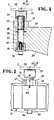
- the die mechanism 21 includes a scale 39 as shown in Figure 5, which is composed of a reference mark 40 on the table 30 and a series of circumferentially spaced lines 41 and a corresponding number of figures 42 on the peripheral surface of the adjust nut 33.
- the reading of the scale 39 indicates the amount of vertical movement of the die 27 corresponding to the amount of angular movement of the adjust nut 33.
- the gripping mechanism 22 includes a slide bar 43 vertically movably mounted on a support block 44 secured to the frame 26 _above the die 27, and a pair of juxstaposed grip fingers 45, 45 pivotably connected at one end to the lower end of the slide bar 43 by means of a pair of pins 46, 46, respectively.
- the grip fingers 45 are bent into a generally L-shape ( Figure 1 and 3) and have the respective free ends overlying the die 27 and jointly constituting a recessed retaining portion 47 for holding the button head B.
- a tension spring 48 extends between the fingers 45 to urge the free ends of the fingers 45 toward one another, as better shown in Figure 7.
- the grip fingers 45 have a pair of opposed trapezoidal projections 49 substantially centrally between the respective pins 46, 46 and the respective free ends of the grip fingers 45.
- the retaining portion 47 has a pocket 50 for receiving therein the base Bl of the button head B.
- the slide bar 43 is received in a vertical groove 51 in the support block 44, the groove 51 being open at one side.
- a cover plate 52 is secured to the support block 44 to close the open side of the groove 51, thereby preventing the slide bar 43 from displacing laterally out of the groove 51.
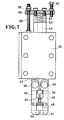
- the slide bar 43 has a substantially C-shaped cross section ( Figure 6) and defines therein a longitudinal guide channel 53 in which a cam plate 54 is slidably received.
- the cam plate 54 is connected to a plunger 55 of the punch mechanism 24 (described below in detail) for reciprocation with the plunger 55.
- An end plate 56 is secured to the upper end of the slide bar 43 and has a pair of extensions projecting sideway from the slide bar 43 in opposite directions.
- a compression spring 57 is disposed in the guide channel 53 between the end plate 56 and the cam plate 54 to urge the slide bar 43 upwardly away from the cam plate 54.
- a stud bolt 58 projects from the upper end of the support block 44 and extends upwardly through one extension of the end plate 56.
- a nut 59 is threaded over the stud bolt 58 and is normally held in engagement with the upper surface of the end plate 56 to limit the upward movement of the slide bar 43.
- a headed bolt 60 is threaded through the other extension of the end plate 56 and is engageable with the support block 44 to limit the downward movement of the slide bar 43.
- the cam plate 54 is disposed between the grip fingers 45 and includes a wide upper portion 61 and a narrow lower portion 62 divided by a pair of beveled surfaces 63, 63 extending respectively in complemenry to a pair of beveled upper surfaces 64, 64 of the respective projections 49, 49.
- the lower portion 62 has a neck 62a contiguous to the upper portion 61 and a head 62b which is slightly wider than the neck 62a and which is substantially narrower than the upper portion 61.
- the gripping mechanism 22 thus constructed operates as follows: When the cam plate 54 is in the retracted position of Figure 9(A), the head 62b engages the projections 49 to slightly spread the retaining portion 47 of the grip fingers 45 against the bias of the tension spring 48 ( Figure 7) so that the button head Bl supplied from the guide mechanism 23 can be received smoothly in the spread retaining portion 47 with the base Bl placed in the pocket 50. Downward movement of the cam plate 54 brings the neck 62a to engage the projections 49 whereupon the fingers 45 are slightly moved toward one another by the force of the tension spring 48 ( Figure 7) to thereby grip the button head Bl in the retaining portion 47.
- the cam plate 54 returns from the extended position of Figure 9(C) through the position of Figure 9(B) to the retracted position of Figure 9(A) in which the retaining portion 47 of the fingers 45 is ready to receive the next button head. Due to a frictional force created between the upper portion 61 and the projections 49 forced thereagainst by the bias of the tension spring 48 ( Figure 7), the fingers 45 are moved upwardly together with the cam plate 54 until the end plate 56 abuts against the nut 59 on the stud bolt 58 ( Figure 7).
- the guide mechanism 23 is disposed on the opposite side of the punch mechanism 24 to the gripping mechanism 22, and it includes a chute 65 comprising a grooved guide block 66 secured to both the support block 43 and the frame 26, and a cover plate 67 secured to the guide block 66 to define therebetween a guide track 68 for the passage therethrough of the button heads B, the guide track 68 having a rectangular shape in transverse cross section (Figure 6).
- the guide track 68 has a vertically extending upper portion and a curved lower portion contiguous to the upper portion and terminating in an outlet facing to the retaining portion 47 of the fingers 45 which are held in the retracted position of Figure 3.
- a parts feeder 69 is secured to the frame 26 and is connected to an upper end of the chute 65 for supplying the button heads B successively in the guide track 68.
- the parts feeder 69 has a conventional structure which utilizes mechanical vibrations created, in response to reciprocating movement of the punch mechanism 24, for feeding the button heads B successively down the chute 65 with the socket portion B2 of each button head B directed away from the cover plate 67.
- a hopper 70 is coupled to the parts feeder 69 remotely from the chute 65 for supplying the parts feeder 69 with the button heads B.
- the punch mechanism 24 includes a punch 71 secured to the lower end of the plunger 55 extending through the support block 44 in vertical alignment with the die 27.
- the upper end of the plunger 55 is pivotably connected to the free end of a lower arm 72 of a toggle joint 73.
- the punch 71 is kept to project beyond the lower end of the cam plate 54 and has on its bottom surface a central projection 74 receivable in the recess B3 in the socket portion B2 of the button head B ( Figure 9(B)).
- the drive mechanism 25 includes a fluid-actuated cylinder 75 mounted on the frame 26, an L-shaped rocking lever 76 rockably mounted on the frame 26 and having a lower arm 77 pivotably connected to an end of a piston rod 78 of the cylinder 75, a connceting rod 79 pivotably connected at opposite ends to the free end of an upper arm 80 of the rocking lever 76 and the pivot of the toggle joint 73, and a connecting link 81 pivotably connected at opposite ends to the connecting rod 79 and an oscillating lever 82 connected for corotation with a drive shaft 83 of the parts feeder 69.
- the free end of an upper arm 84 of the toggle joint 73 is journaled on the frame 26.
- the guide mechanism 23 further includes a parts-supply unit 85 ( Figures 1 and 3) assembled with the upper portion of the chute 65 for feeding one button head B down the guide track 68 to the retaining portion 47 of the fingers 45 each time the punch mechanism 24 completes one cycle of operation.
- the unit 85 includes a bell crank 86 pivotably supported on the guide block 66 behind the guide track 68, and a hollow cylindrical spacer 87 interposed between the guide block 66 and the bell crank 86.
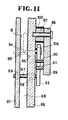
- the bell crank 86 has a horizontal arm 88 extending transversely to the guide track 68 and a vertical arm 89 extending longitudinally of the guide track 68, the vertical arm 89 having a pair of spaced first and second pins 90, 91 projecting perpendicularly from the distal end of the arm 89 toward the guide block 66, as shown in Figure 11.
- a pair of first and second pivot levers 92, 93 is disposed one on each side of the vertical arm 89 of the bell crank 86 substantially in parallel relation to one another.
- the first lever 92 is pivotably connected at the lower end thereof to the guide block 66 and has a first stop pin 94 projecting from the upper end of the lever 92 through a pair of aligned oblong guide holes 95, 96, respectively, in the guide block 66 and the cover plate 67.
- the second lever 93 is pivotably connected at the upper end thereof to the guide block 66 and has a second stop pin 97 projecting from the lower end of the lever 93 through a pair of aligned oblong guide holes 98, 99, respectively, in the guide block 66 and the cover plate 67.
- the pair of guide holes 95, 96 and the pair of guide holes 98, 99 extend transversely to the guide track 68 across opposed sidewalls 68a, 68b of the guide track 68, the guide holes 95, 96 being spaced from the guide holes 98, 99 longitudinally of the guide track 68 by a distance substantially equal to the diameter of the annular socket portion B2 of the button head B.
- a torsion spring 100 is disposed around the spacer 87 and acts between the guide block 66 and the bell crank 86 to urge the latter clockwise in Figure 10 to thereby bring the horizontal arm 88 into engagement with a rocking pin 101.
- the rocking pin 101 is connected to a horizontal lever 102 secured to a cross pin 103 which extends through a longitudinal groove 44a in the support block 44 across the plunger 55 and the cam plate 54 to connect them together.
- Each of the pivot levers 92, 93 is urged to angularly move toward a corresponding one of the pins 90, 91 by means of a respective torsion spring 104, 105 acting between the lever 92, 93 and the guide block 66.
- the stop pins 94, 97 are movable, in response to reciprocation of the plunger 55 of the punch mechanism 24, to alternately project into and retract from the guide track 68, thereby releasing one button head B at a time from the parts-supply unit 85 to the retaining portion 47 of the grip fingers 45.
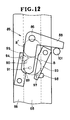
- the punch mechanism 24 then is returned to the retracted position, during which time the bell crank 85 is turned clockwise in Figure 12 by the rocking pin 101 against the bias of the torsion spring 100 ( Figure 10).
- This movement of the bell crank 85 causes the pivot levers 92, 93 to pivot clockwise and counterclockwise, respectively, in Figure 12 with the result that the lowermost button head B is released from the unit 85 as the stop pin 97 is retracted from the guide track 88 while the succeeding button head B' is prevented by the stop pin 94 from moving beyond the latter.
- the button heads B are supplied from the unit 85 to the retaining portion 47 of the grip fingers 45 one at a time the punch mechanism 24 completes one cycle of reciprocation.
- the cylinder 75 is actuated to extend the piston rod 78 whereupon the toggle joint 73 expands its arms 72, 84 to descend the plunger 55, the cam plate 54 and the slide bar 43 toward the die 27.
- the cam plate 54 controls the grip fingers 45 to release the button head B from the retaining portion 47 onto the button fastener A supported on the die, immediately before the punch 71 reaches the lowermost position in which the button head B and the button fastener A are clinched together with the garment C sandwiched therebetween.
- the bell crank 86 and the pivot levers 92, 93 of the parts-supply unit 85 pivot to allow the lowermost button head B to move downwards by its own weight by a distance substantially equal to the maximum diameter of the button head B.
- the toggle joint 73 contracts its arms 72, 84 to move the plunger 55, cam plate 54 and the slide bar 43 away from the die 27.
- the grip fingers 45 returns to a position ready to receive the succeeding button head in the slightly expanded retaining portion 47, and the bell crank 86 and the pivot levers 92, 93 pivot to allow the lowermost button head to slide along the guide track 68 to the retaining portion 47.
- the apparatus 20 constructed in accordance with the invention has the following advantages: Since the grip fingers 45 and the punch 71 are operatively connected together to reciprocate in timed relation to one another such that they release the button head B immediately before the punch 71 reaches the lowermost position, the button head B thus released is properly set on the button fastener A supported on the die 27.
- the gripping mechanism 22 operates reliably and is simple in structure because reciprocation and opening and closing of the grip fingers 45 are controlled by the springs 48, 57 and the cam plate 54 operatively connected to the punch 71 for reciprocation therewith.
- the apparatus 20 may include a speed reducing device 106 ( Figure 3) for slowing down sliding movement of the button head B prior to the arrival of the same at the retaining portion 47 of the grip fingers 45.
- the device 106 is disposed in the chute 65 near the outlet of the guide track 68.
- the device 106 comprises a pair of opposed recess and projection 107, 108 facing to the guide track 68 to define therebetween an offset passage 108 which is wide enough to allow the button head to pass therethrough.
- the recess 107 extends in the same plane as the guide track 68, and the projection 108 is provided by an exposed portion of a pin 108a partly embedded in the guide block 66 and extending between the guide block 66 and the cover plate 67.
- the button head B supplied from the parts-supply unit 85 ( Figure 3) is displaced laterally (leftward in Figure 14) into the recess 107 upon impinging engagement with the projection 108, then advances along the offset passage 109, then again displaced laterally (rightward in Figure 14) from the recess 107 into the guide track 68.
- the speed of downward movement of the button head B is reduced to an extent that the button head B enters and then is received in the retaining portion 47 of the grip fingers 45 without tilting in the retaining portion.
- Figure 16 shows a modification of the apparatus 20 shown in Figures 1 to 3.
- the modified apparatus includes an overturing device 110 disposed in the chute 65 between the parts-supply unit 85 and the speed reducing unit 106, for turning over the button head B (Figure 13) or a cap-like button head B" ( Figure 18) as the latter slides along the guide track 68.
- the overturning device 110 comprises a pair of opposed recess and projection 111, 112 extending in a direction perpendicular to the general plane of the guide track 68 to thereby define therebetween a substantially L-shaped overturning passage 113 communicating at opposite ends with the guide track 68.
- the projection l12 has a sewtooth shape in transverse cross section and has a sloped surface l14 facing upstream of the guide track 68, the projection extending beyond the thickness of the guide track 68.
- the recess 111 is complementary in shape with the sewtooth-shaped projection 112 and has a bottom or root 115 and a guide wall 116 extending downwardly from the root 115, the root 115 being spaced from a top end or crest l17 of the projection a distance which is larger than the diameter of the button head B, B".
- the button head B" which is supplied from the unit 85 ( Figure 16) down the guide track 68 into the overturning passage 113 with a domed top wall Bl" directed rightward in Figures 17(A) - 17(E), first slides along the sloped surface 114 of the projection 112 ( Figure 17(A)), then impinges against the root 115 of the recess 111 due to inertia ( Figure 17(B)), then tilts down against the guide wall 117 by its own weight, then slides along the guide wall 117 at the domed top wall B", and finally enters the guide track 68 with the domed top wall Bl" directed leftward.
- the button bead B" is overturned as its passes through the passage 113.
- the overturning device 110 is constituted by a first block 118 having the recess lll, a second block 119 having the projection 112, a third and a fourth block 120, 121 jointly forming a pair of opposed sidewalls of the overturning passage 113.
- the first block 118 has a top wing 122 adapted to be fitted with an upper portion of the chute 65 ( Figure 16) and a bottom ridge 123 adapted to be fitted in a groove 124 in the guide block 66 ( Figure 16).
- the first block 118 is secured to the guide block 66 by means of a screw 125, then the second, third and fourth blocks 119-121 are assembled with the first block 118 by means of screws 126-129, thereby defining therebetween the overturning passage 113 ( Figure 16) communicating with the guide track 68.
Landscapes
- Engineering & Computer Science (AREA)
- Textile Engineering (AREA)
- Slide Fasteners (AREA)
- Automatic Assembly (AREA)
Applications Claiming Priority (6)
| Application Number | Priority Date | Filing Date | Title |
|---|---|---|---|
| JP3936283U JPS59145531U (ja) | 1983-03-18 | 1983-03-18 | 釦加工機における部品把持装置 |
| JP39362/83 | 1983-03-18 | ||
| JP3936083U JPS59145529U (ja) | 1983-03-18 | 1983-03-18 | 部品減速装置を備えた釦加工装置 |
| JP39358/83 | 1983-03-18 | ||
| JP3935883U JPS59146317U (ja) | 1983-03-18 | 1983-03-18 | 釦加工機における部品反転装置 |
| JP39360/83 | 1983-03-18 |
Publications (3)
| Publication Number | Publication Date |
|---|---|
| EP0119587A2 true EP0119587A2 (de) | 1984-09-26 |
| EP0119587A3 EP0119587A3 (en) | 1985-10-30 |
| EP0119587B1 EP0119587B1 (de) | 1988-02-10 |
Family
ID=27290114
Family Applications (1)
| Application Number | Title | Priority Date | Filing Date |
|---|---|---|---|
| EP84102766A Expired EP0119587B1 (de) | 1983-03-18 | 1984-03-14 | Vorrichtung zum Anbringen von Schliesselementen an Kleidungsstücken |
Country Status (9)
| Country | Link |
|---|---|
| US (1) | US4579270A (de) |
| EP (1) | EP0119587B1 (de) |
| KR (1) | KR850003011Y1 (de) |
| AU (1) | AU556315B2 (de) |
| CA (1) | CA1216560A (de) |
| DE (1) | DE3469263D1 (de) |
| GB (1) | GB2138453B (de) |
| HK (1) | HK88688A (de) |
| SG (1) | SG100887G (de) |
Cited By (1)
| Publication number | Priority date | Publication date | Assignee | Title |
|---|---|---|---|---|
| FR2729055A1 (fr) * | 1995-01-09 | 1996-07-12 | Valibus Marcel | Systeme de pose pour boutons de mercerie en deux parties ou analogues |
Families Citing this family (6)
| Publication number | Priority date | Publication date | Assignee | Title |
|---|---|---|---|---|
| JPH0232662Y2 (de) * | 1985-11-12 | 1990-09-04 | ||
| US4768276A (en) * | 1986-03-28 | 1988-09-06 | Universal Fasteners Inc. | Method of applying a fastener to sheet material |
| US4995543A (en) * | 1989-03-23 | 1991-02-26 | Earl Gordon C | Magnetic stem and vertically fixed pocket device for a stationary riveting machine |
| US5452835A (en) * | 1994-08-01 | 1995-09-26 | Illinois Tool Works Inc. | Positioning mechanism for powered fastener-driving tool |
| KR20040024203A (ko) * | 2002-09-13 | 2004-03-20 | 주식회사두리산업 | 모자용 자동 단추 결합기의 밑단추 쓰러짐 방지장치 |
| DE102010060141A1 (de) | 2010-10-25 | 2012-04-26 | Ejot Gmbh & Co. Kg | Vorrichtung zur Positionierung und Zuführung von Befestigungselementen |
Family Cites Families (8)
| Publication number | Priority date | Publication date | Assignee | Title |
|---|---|---|---|---|
| US669516A (en) * | 1899-02-24 | 1901-03-12 | Shoe Hardware Company | Rivet-setting machine. |
| DE492877C (de) * | 1928-06-30 | 1930-02-27 | Heinrich Elsner | Nietmaschine fuer Voll-, Hohl- und Zweispitznieten |
| US1787190A (en) * | 1929-04-16 | 1930-12-30 | Elsner Heinrich | Riveting machine |
| US1967662A (en) * | 1932-11-14 | 1934-07-24 | Universal Button Fastening & B | Button attaching machine |
| US2261281A (en) * | 1938-12-12 | 1941-11-04 | Patent Button Co | Orienting button-attaching machine |
| DE2341258A1 (de) * | 1973-08-16 | 1975-02-27 | Schaeffer Homberg Gmbh | Maschine zum ansetzen von nieten, druckknoepfen oder dergleichen |
| DE2939262A1 (de) * | 1979-09-28 | 1981-04-09 | Schaeffer-Homberg Gmbh, 5600 Wuppertal | Maschine zum ansetzen von mit stielen o.dgl. ausgeruesteten knoepfen |
| JPS5922094Y2 (ja) * | 1979-12-13 | 1984-07-02 | ワイケイケイ株式会社 | 釦取付装置 |
-
1984
- 1984-03-14 CA CA000449604A patent/CA1216560A/en not_active Expired
- 1984-03-14 DE DE8484102766T patent/DE3469263D1/de not_active Expired
- 1984-03-14 EP EP84102766A patent/EP0119587B1/de not_active Expired
- 1984-03-16 US US06/590,579 patent/US4579270A/en not_active Expired - Fee Related
- 1984-03-16 KR KR2019840002279U patent/KR850003011Y1/ko not_active Expired
- 1984-03-16 AU AU25694/84A patent/AU556315B2/en not_active Ceased
- 1984-03-19 GB GB08407091A patent/GB2138453B/en not_active Expired
-
1987
- 1987-11-16 SG SG1008/87A patent/SG100887G/en unknown
-
1988
- 1988-11-03 HK HK886/88A patent/HK88688A/xx unknown
Cited By (1)
| Publication number | Priority date | Publication date | Assignee | Title |
|---|---|---|---|---|
| FR2729055A1 (fr) * | 1995-01-09 | 1996-07-12 | Valibus Marcel | Systeme de pose pour boutons de mercerie en deux parties ou analogues |
Also Published As
| Publication number | Publication date |
|---|---|
| AU2569484A (en) | 1984-09-20 |
| GB8407091D0 (en) | 1984-04-26 |
| EP0119587B1 (de) | 1988-02-10 |
| HK88688A (en) | 1988-11-11 |
| DE3469263D1 (en) | 1988-03-17 |
| US4579270A (en) | 1986-04-01 |
| AU556315B2 (en) | 1986-10-30 |
| CA1216560A (en) | 1987-01-13 |
| GB2138453B (en) | 1986-04-09 |
| SG100887G (en) | 1988-06-03 |
| EP0119587A3 (en) | 1985-10-30 |
| KR850003011Y1 (ko) | 1985-12-17 |
| GB2138453A (en) | 1984-10-24 |
| KR840006081U (ko) | 1984-11-30 |
Similar Documents
| Publication | Publication Date | Title |
|---|---|---|
| CA1148511A (en) | Apparatus for attaching fastener elements onto a garment | |
| EP0119587B1 (de) | Vorrichtung zum Anbringen von Schliesselementen an Kleidungsstücken | |
| US4799611A (en) | Apparatus for assembling pairs of garment fastener elements | |
| US4615473A (en) | Apparatus for assembling a pair of fastener elements | |
| EP0147809B1 (de) | Knopfansetzmaschine mit einer Optikpositioniereinrichtung | |
| EP0136634A2 (de) | Zuführvorrichtung von Bestandteilen für eine Knopfansetzmaschine | |
| US4645110A (en) | Drive control in an apparatus for assembling fastener elements | |
| US2732000A (en) | Levine | |
| EP0261361A2 (de) | Maschine zum Ansetzen von Kleiderverschlusselementen mit einem durch einen steuerbaren Stössel versehenen Stellenanzeiger | |
| KR870004091Y1 (ko) | 파스너 조립 및 부착기용 파스너 부품 공급장치 | |
| CA2008469A1 (en) | Stroke adjustment apparatus for light projector of button setting machine | |
| US4711020A (en) | Top end-stop attaching machine with improved top end-stop supplying apparatus | |
| US4137621A (en) | Apparatus and method of applying staple-like bottom stops to slide fasteners and the like | |
| EP0302361B1 (de) | Einrichtung zur Schliessung von Reissverschlüssen | |
| EP0215275B1 (de) | Bandzuführvorrichtung | |
| EP0548754A1 (de) | Knopfzuführung für eine Knopfansatzmaschine | |
| CA1242569A (en) | Apparatus for holding boxes in attachment of same to separable slide fastener chain with box pin and insertion pin | |
| US5933944A (en) | Article feeding arrangement | |
| CA1254370A (en) | Apparatus for assembling a pair of fastener elements | |
| JPS6313210Y2 (de) | ||
| JPS6329718Y2 (de) | ||
| HK127397A (en) | Button feed unit for button applicator | |
| TH12078B (th) | อุปกรณ์ย้ำติดชิ้นส่วนกระดุม | |
| JPS5813642B2 (ja) | 被服用留具取付機 |
Legal Events
| Date | Code | Title | Description |
|---|---|---|---|
| PUAI | Public reference made under article 153(3) epc to a published international application that has entered the european phase |
Free format text: ORIGINAL CODE: 0009012 |
|
| AK | Designated contracting states |
Designated state(s): BE CH DE FR IT LI NL SE |
|
| PUAL | Search report despatched |
Free format text: ORIGINAL CODE: 0009013 |
|
| AK | Designated contracting states |
Designated state(s): BE CH DE FR IT LI NL SE |
|
| 17P | Request for examination filed |
Effective date: 19860122 |
|
| 17Q | First examination report despatched |
Effective date: 19861204 |
|
| GRAA | (expected) grant |
Free format text: ORIGINAL CODE: 0009210 |
|
| AK | Designated contracting states |
Kind code of ref document: B1 Designated state(s): BE CH DE FR IT LI NL SE |
|
| ITF | It: translation for a ep patent filed | ||
| REF | Corresponds to: |
Ref document number: 3469263 Country of ref document: DE Date of ref document: 19880317 |
|
| ET | Fr: translation filed | ||
| PLBE | No opposition filed within time limit |
Free format text: ORIGINAL CODE: 0009261 |
|
| STAA | Information on the status of an ep patent application or granted ep patent |
Free format text: STATUS: NO OPPOSITION FILED WITHIN TIME LIMIT |
|
| 26N | No opposition filed | ||
| ITTA | It: last paid annual fee | ||
| PGFP | Annual fee paid to national office [announced via postgrant information from national office to epo] |
Ref country code: CH Payment date: 19940309 Year of fee payment: 11 |
|
| PGFP | Annual fee paid to national office [announced via postgrant information from national office to epo] |
Ref country code: DE Payment date: 19940331 Year of fee payment: 11 Ref country code: NL Payment date: 19940331 Year of fee payment: 11 |
|
| PGFP | Annual fee paid to national office [announced via postgrant information from national office to epo] |
Ref country code: SE Payment date: 19941212 Year of fee payment: 12 |
|
| PGFP | Annual fee paid to national office [announced via postgrant information from national office to epo] |
Ref country code: BE Payment date: 19941216 Year of fee payment: 12 |
|
| PGFP | Annual fee paid to national office [announced via postgrant information from national office to epo] |
Ref country code: FR Payment date: 19950120 Year of fee payment: 12 |
|
| EAL | Se: european patent in force in sweden |
Ref document number: 84102766.7 |
|
| PG25 | Lapsed in a contracting state [announced via postgrant information from national office to epo] |
Ref country code: CH Effective date: 19950331 Ref country code: LI Effective date: 19950331 |
|
| PG25 | Lapsed in a contracting state [announced via postgrant information from national office to epo] |
Ref country code: NL Effective date: 19951001 |
|
| REG | Reference to a national code |
Ref country code: CH Ref legal event code: PL |
|
| NLV4 | Nl: lapsed or anulled due to non-payment of the annual fee |
Effective date: 19951001 |
|
| PG25 | Lapsed in a contracting state [announced via postgrant information from national office to epo] |
Ref country code: DE Effective date: 19951201 |
|
| PG25 | Lapsed in a contracting state [announced via postgrant information from national office to epo] |
Ref country code: SE Effective date: 19960315 |
|
| PG25 | Lapsed in a contracting state [announced via postgrant information from national office to epo] |
Ref country code: BE Effective date: 19960331 |
|
| BERE | Be: lapsed |
Owner name: NIPPON NOTION KOGYO CO. LTD Effective date: 19960331 |
|
| PG25 | Lapsed in a contracting state [announced via postgrant information from national office to epo] |
Ref country code: FR Effective date: 19961129 |
|
| EUG | Se: european patent has lapsed |
Ref document number: 84102766.7 |
|
| REG | Reference to a national code |
Ref country code: FR Ref legal event code: ST |