EP0120342A2 - Procédé et dispositif de production d'un jet libre de gaz-particules solides avec courant constant de masse ou de volume et d'une vitesse déterminée - Google Patents
Procédé et dispositif de production d'un jet libre de gaz-particules solides avec courant constant de masse ou de volume et d'une vitesse déterminée Download PDFInfo
- Publication number
- EP0120342A2 EP0120342A2 EP84102247A EP84102247A EP0120342A2 EP 0120342 A2 EP0120342 A2 EP 0120342A2 EP 84102247 A EP84102247 A EP 84102247A EP 84102247 A EP84102247 A EP 84102247A EP 0120342 A2 EP0120342 A2 EP 0120342A2
- Authority
- EP
- European Patent Office
- Prior art keywords
- metering
- flow channel
- metering groove
- priority
- gas
- Prior art date
- Legal status (The legal status is an assumption and is not a legal conclusion. Google has not performed a legal analysis and makes no representation as to the accuracy of the status listed.)
- Granted
Links
Images



Classifications
-
- F—MECHANICAL ENGINEERING; LIGHTING; HEATING; WEAPONS; BLASTING
- F15—FLUID-PRESSURE ACTUATORS; HYDRAULICS OR PNEUMATICS IN GENERAL
- F15D—FLUID DYNAMICS, i.e. METHODS OR MEANS FOR INFLUENCING THE FLOW OF GASES OR LIQUIDS
- F15D1/00—Influencing flow of fluids
- F15D1/08—Influencing flow of fluids of jets leaving an orifice
-
- B—PERFORMING OPERATIONS; TRANSPORTING
- B05—SPRAYING OR ATOMISING IN GENERAL; APPLYING FLUENT MATERIALS TO SURFACES, IN GENERAL
- B05B—SPRAYING APPARATUS; ATOMISING APPARATUS; NOZZLES
- B05B7/00—Spraying apparatus for discharge of liquids or other fluent materials from two or more sources, e.g. of liquid and air, of powder and gas
- B05B7/14—Spraying apparatus for discharge of liquids or other fluent materials from two or more sources, e.g. of liquid and air, of powder and gas designed for spraying particulate materials
- B05B7/1404—Arrangements for supplying particulate material
- B05B7/1477—Arrangements for supplying particulate material means for supplying to several spray apparatus
-
- B—PERFORMING OPERATIONS; TRANSPORTING
- B01—PHYSICAL OR CHEMICAL PROCESSES OR APPARATUS IN GENERAL
- B01F—MIXING, e.g. DISSOLVING, EMULSIFYING OR DISPERSING
- B01F23/00—Mixing according to the phases to be mixed, e.g. dispersing or emulsifying
- B01F23/30—Mixing gases with solids
-
- B—PERFORMING OPERATIONS; TRANSPORTING
- B01—PHYSICAL OR CHEMICAL PROCESSES OR APPARATUS IN GENERAL
- B01F—MIXING, e.g. DISSOLVING, EMULSIFYING OR DISPERSING
- B01F25/00—Flow mixers; Mixers for falling materials, e.g. solid particles
- B01F25/40—Static mixers
- B01F25/42—Static mixers in which the mixing is affected by moving the components jointly in changing directions, e.g. in tubes provided with baffles or obstructions
Definitions
- the particle size range which requires measures to disperse the particles, begins at approximately 50 ⁇ m.
- the measures become more demanding with increasing fineness, because the adhesive forces between the particles increase with decreasing particle size.
- particle sizes below 10 ⁇ m complete dispersion without particle size reduction is particularly difficult.
- the invention has for its object to provide a method and an apparatus with which a gas-solid particle free jet which is constant over the cross section of mass flow or volume flow with completely dispersed particles of less than about 50 gm up to a few microns can be produced.
- a preferred embodiment of the method provides that the mixture is directed along a zigzag path before being discharged from the flow channel against impact surfaces.
- the gas / solid particle mixture can also or additionally be directed via a baffle cascade consisting of a plurality of baffle surfaces which are inclined alternately to one or the other side.
- the invention proposes a metering-dispersing device for generating a mass flow or volume flow constant gas-solid particle free jet of a certain speed, a metering device for the solid particles to be metered for generating a volume flow or mass flow constant solid particle flow and a flow channel with injector , which receives the solid particle stream emitted by the metering device with a suction mouth and which has a dispersing device behind the injector in front of an outlet nozzle for the gas-solid particle mixture.
- several baffles are arranged one behind the other in the dispersing device in front of the outlet nozzle Gas-solid particle mixture are taken in succession, provided.
- the injector of the flow channel has a central tube within a propellant gas chamber surrounding it, which is at a distance in front of a narrowing inlet nozzle in an annular. gap opens behind which the dispersing unit with the baffles is arranged.
- the distance between the mouth of the central tube and the inlet nozzle is preferably variable from a few millimeters to a few tenths of a millimeter.
- the central tube can be kept longitudinally displaceable. The degree of dispersion of the particles in the gas stream can thus be changed and adjusted before hitting the impact surfaces.
- the dosing groove can be located in differently designed carriers.
- the metering groove in the top of a turntable rotatable about a vertical axis of rotation is designed to be open at the top.
- the metering groove is located at the edge of the turntable, preferably in a wide ring protruding upwards.
- the wheel rim can be driven at a somewhat lower but still so high speed that the solid particles fall back cataract-like well before reaching the apex and fall freely out of the metering groove into a collecting funnel at the suction mouth of the flow channel.
- the material or the solid particles can be fed to the turntable, which can be rotated about a vertical axis of rotation, using a conventional mechanical metering device via a conveyor trough, in particular an oscillating conveyor trough.
- This type of feed is also possible in the metering groove provided on the inside of a wheel rim.
- a fluidized bed device is used for this purpose, in the fluidized bed chamber which is open at the top, the wheel rim is immersed with a lower segment so far that the metering groove fills from the side.
- predispersion is already achieved in the fluid bed.
- the metering groove is formed in the outside of an endless conveyor belt rotating around two horizontally spaced deflection rollers and the stripping device, the compression device and the suction port of the flow channel interact with the upper horizontal belt section, for which purpose Deflection pulleys are at a sufficient distance or the conveyor belt is of sufficient length.
- the two embodiments with the metering groove on the inside of a wheel rim and on the outside of a conveyor belt have the advantage that they are narrow transversely to the direction of movement of the metering groove and therefore several devices can easily be combined to form multiple arrangements in order to provide a wide, but in the To produce a high level of continuous gas-solid flat jet.
- One embodiment of these two devices therefore provides that, in order to generate such a wide free jet or flat jet, a plurality of metering and dispersing devices are arranged in parallel next to one another in such a way that the emerging free jets unite to form a wide flat jet at a certain distance from the mouth of the outlet nozzles . With such a device, exactly continuous coatings can be achieved over large widths.
- the flow channel consisting of suction channel, injector and baffle cascade is flat, i.e. the channel is not circular in cross section but rectangular with the width and the low height of the flat jet to be generated.
- the material is fed into the suction mouth of the flow channel directly from a fluidized bed channel, the length of which corresponds to the width of the suction channel.
- the fluidized bed channel is an elongated channel open at the top, the upper part of which is separated from the lower part into which the fluid (gas or air) is introduced by a sieve to be flowed upwards.
- the lower edge region of the fluidized bed channel has an elongated slot or a slot-shaped opening in one side wall through which the predispersed particles are sucked directly into the suction mouth of the flow channel.
- the outlet nozzle of the baffle cascade leaves a wide flat jet that is homogeneous immediately after the outlet.
- a metering device comprises a turntable 10 which can be rotated about a vertical axis and which, on the outer edge, forms an upwardly open annular metering groove 2 with a sharp-edged crown in an upwardly projecting rim Has.
- This is fed from a vibrating conveyor trough 1 to a vibration metering device 22, see FIGS. 2 to 4, a constant solid particle mass or volume flow in excess, which is improved in terms of its constancy by further measures on the turntable.
- the turntable 10 On the inside of the metering groove 2, the turntable 10 has elongated openings 32 between radial webs 33, see FIGS. 2 and 5. In this way, excess material, as well as material discharged by a cleaning brush 19, can fall to both sides of the metering groove 2 and into one Overflow funnel 23 and from this into a collecting vessel 24, see FIG. 4.
- the bulk material cone resulting from the laterally flowing excess on the metering groove 2 rotating under the vibrating conveyor trough 1 is first selected with a scraper device 3 with a scraper blade 36, which is shown in detail in FIG Bed height sheared off and then compacted easily and evenly to the same bulk material properties so that the cross section of the metering groove 2 is completely and evenly filled with a stationary compacting device 4 in the form of a rotatable press roll 4 'acting through its own weight, which shows FIG. 7 in detail .
- a rotating cylindrical brush 5 ' is provided in the direction of movement of the metering groove 2 behind the press roll 4' as a predispersion device 5, in particular for goods which are difficult to flow.
- This is encapsulated in a housing 43, to which air can be directed through an air supply 40.
- the previously uniform constant solid particle mass flow 8 is whirled up and completely out of the metering groove 2 into the suction mouth of a flow channel connected to its housing 43 in the area of the brush 5 ′ via a suction mouthpiece 42 in front of a damming weir 41 reaching into the metering groove 2 picked up and suctioned by the suction mouthpiece.
- the solid particles are constantly metered into the flow channel.
- the flow channel consists of a suction channel 6, an injector 9 and a baffle cascade 15 with an outlet nozzle 16.
- the injector shown in FIG. 12 has a longitudinally adjustable, conically tapering central pipe 11 in a hollow cylindrical housing 26 with end cover 27, through which the gas-solid mixture sucked out of the metering groove 2 is fed into and discharged into an inlet nozzle 13 formed in front of its mouth.
- the mouth of the central tube 11 forms an annular gap 12 with the inlet nozzle 13.
- propellant gas inlet openings are formed in the propellant gas chamber 28 formed between the inner wall of the housing 26 and the outer wall of the central tube 11 before the mouth of the central tube 11 in the wall of the housing 29 provided.
- a baffle cascade 15 according to FIG.
- the baffle contour asymmetrically and to roughen the surface of the baffle surfaces 17 in order to promote dispersion. This increases the dispersibility, since then it is no longer only the position of the baffle surfaces 17 that determines the particle wall abutments, but a whole spectrum of impingement angles further increases the dispersion probabilities.
- the gas-solid flow leaves through a channel piece 18 as an acceleration section, in which the dispersed solid particles are accelerated to almost the same final speed, and the outlet nozzle 16 leaves the baffle cascade 15 and thus the (dispersing ) Flow channel as free jet 7.
- the dispersion begins when the solid mass flow 8 is taken up in the injector 9.
- the suction of the solid particles from the metering groove 2 of the turntable 10 and the increasing acceleration and mixing with transport air at Passage through the suction channel 6 and the injector 9 leads to a separation and separation of the solid particles and agglomerates.
- the propellant gas volume flow V T flowing through the annular gap 12 with an admission pressure p of up to 10 bar induces a suction flow V S in the central tube 11 of the injector 9.
- the gap between the mouth of the central tube 11 and that which can be set to gap widths s of a few millimeters to tenths of a millimeter Inlet nozzle 13 acts on the propellant gas volume flow like a throttle.
- the flow velocities within the injector 9 and the baffle cascade 15 always remain below 100 m / s, so that no comminution, but only dispersion, is effected in the specified particle size range up to about 50 ⁇ m.
- Dispersing devices in which the particles are caused only by the shear rate of an injector and / or by a straight line Flow pipe, do not reach a degree of dispersion of more than 80%.
- baffles 17 The arrangement of three baffles 17 has been found to be the optimum. With a sufficiently large setting range of gap width s and pre-pressure PT , almost complete dispersion with values between 97% and 100% can be ensured.
- the operation of the device can be seen from the following example.
- the achievable solid mass flow is primarily determined by the speed of the turntable 10, which can be up to 100 rpm, the diameter and the cross section of the metering groove 2.
- Our own studies have shown that commercially available fine limestone at 10 rpm and a diameter of 20 cm and a cross section of the metering groove of 12 mm 2 can be achieved with a mass flow of 10 kg / h and a mass flow fluctuation of less than 4%.
- the metering device 22 is metered in excess up to three times the amount. Two thirds initially remain on and in the metering groove 2.
- the stripping device 3 reduces the predominant part of the resulting bulk during the first equalization gutkegels, while the press roller 4 'only results in a slight reduction in the compression.
- Geometric enlargements or reductions in the cross section of the metering groove 2 and the dimensions of the turntable 10 allow adaptation to larger or smaller mass flow ranges.
- FIGS. 2 to 4 show views of a metering-dispersing device 30 which, as a compilation of the devices for generating a gas-solid free jet, e.g. is used for the dry analysis of diffraction spectra to determine the particle size distribution from the swarm of solid particles.
- the disperse material to be analyzed is placed in a storage or feed hopper 21 of the metering device 22 and flows via its vibrating conveyor trough 1 onto the metering groove 2 of the turntable 10.
- the direction of movement on the predispersion device 5 is approximately the same as the suction direction in the suction channel 6.
- FIG. 5 shows, as a construction detail, the cross-sectional area 31 of the metering groove 2 of the turntable 10 and the spoke construction with elongated, curved openings 32 between radial webs 33 of the turntable 10, which is perforated to expel the excess.
- the steep side walls 34 which converge at the top of the metering groove 2 the metering groove 2 ensure an unimpeded discharge of the excess and a defined unwinding option for the press roll 4 'for the compression, without a second, undesirable solid bed being able to form on the end faces of the side walls 34 of the metering groove 2.
- FIG. 6 shows, in an enlarged representation, the scraper device 3 from a pivotable, rotatable blade holder 35 with a scraper blade 36, which can be variably locked in the angle of attack.
- a compacting device 4 is shown with a massive press roll 4 'high weight with adjustable compression spring 37 to determine the compression conditions.
- the press roll 4 ' is mounted in a bracket which is guided in a stationary manner by means of a vertical rod 38 and is supported on the compression spring 37 by means of a nut 39 screwed to its end, which in turn rests on a wall of a housing or mounting bracket (not shown).
- a predispersion device 5 is shown in the form of the rotating brush 5 '.
- the rotating brush 5 ' is rotatably installed in the housing in such a way that it extends completely into the metering groove 2 and receives the goods transported in its direction of rotation.
- the air supply 40 ensures that the suction channel 6 connected via the suction nozzle 42 receives the material pre-dispersed in sufficient air just above the upper edge of the metering groove.
- damming weir 41 which closes the cross section of the metering groove 2 in the direction of movement of the metering groove 2, behind the mouth of the suction mouthpiece 42, which together with the brush ensures the constant transfer of the mass flow into the suction mouthpiece 42.
- a larger air supply and a suction mouthpiece 42 directly associated with the metering groove 2 are dispensed with. Rather, the suction channel 6 is close to the upper one
- the apex of the brush 5 ' is connected so that the material is first lifted out of the dosing groove for predispersion.
- the brush 5 ' rotates counter to the transport direction of the F eststoffmassenstroms and causes deflection and increase the level of the suction channel 6 supported by the sucked air.
- the air is sucked in through the metering groove 2 emptied of the material, so that the absorption of the material is supported by the inflowing air.
- the housing 43 is encapsulated against external air and is placed in a substantially sealing manner on the turntable 10 above the metering groove 2.
- the cross section of the metering groove 2 of the turntable 10 can have a size of a few mm 2 to a few cm 2 in order to adapt to the particle size distributions and to cover a wide mass flow range up to a few 10 kg / h.
- the metering device 22 can also have a screw conveyor, a fluidized bed channel or another known organ as a conveyor element in addition to a vibrating conveyor channel 1.
- the metering groove 2 is provided on the outside of an endless, V-belt-shaped conveyor belt 58 which runs around two deflecting rollers 59 arranged at a horizontal distance.
- the right pulley 59 in the illustration is driven by a motor, not shown.
- the conveyor belt has a horizontally running upper belt section and a parallel lower belt section.
- the vibrating conveyor trough 1 of the metering device 22 opens and, above the metering groove 2, enters the material to be metered in excess.
- a stripping device 3 and a compression device 4 are in turn at a distance from the task location a press roll 4 'provided on the metering groove 2.
- steel strips 61 or other stabilizing protective parts are inserted into these.
- the metering groove 2 is provided in the inside of a wheel rim 63 of a wheel which can be rotated about a horizontal axis of rotation, with spokes 65 tapering obliquely onto a hub 64.
- the wheel rotates around a horizontal axis; the wheel rim 63 is thus vertical.
- the goods can in turn by means of a vibrating conveyor trough in the metering groove 2 in the deep most vacant position.
- a task is preferred here by means of a fluidized bed device 66 which has a box 67 which is open at the top and whose lower part is separated from the upper part by a sieve 68.
- the lower part is designed as an air box, into which air inlets 69 open laterally.
- the material to be fed is added to the top of the screen 68 in a known manner.
- a fluidized or fluidized bed forms above the screen 68.
- the assignment of the fluidized bed device 66 to the wheel rim 63 is such that it immerses in the fluidized bed 71 with a lower segment 70.
- the particles may enter laterally into the meter 2, and these 'fill. Since the wheel rim rotates at a higher speed and the metering groove 2 is equipped on the inside with ribs 72 to promote the carry-along of the goods, the goods are lifted out of the fluidized bed.
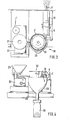
- Excess material is in turn sheared off by a stripping device 3 and compacted by a press roller 4 'before - in the embodiment according to FIG. 18 - near the upper apex by means of a brush 5' the material is taken up into the suction mouth of the suction channel 6, to which again the injector 9 and the baffle cascade 15 are connected, which form the flow channel.
- the speed of the wheel rim 63 is set so that the material is taken up to the brush 5 '.
- the rotational speed is chosen to be lower, so that the material detaches itself from the metering groove 2 before the upper apex and in free fall falls as a solid particle mass flow 76 into a collecting funnel 77 of the intake duct 6 .
- the stripping device 3, the compression device 4 and the predispersion device 5 can be on the inside radius can be arranged distributed over the entire circumference of the wheel rim 63, and in special cases the removal with the suction channel 6 without a predispersion device 5 and in particular at the apex, the transfer can take place under gravity in free fall.
- the "cataracting" behavior of an incompletely centrifuged material known from tube mills, pelletizers and the like in order to take over the solid particle mass flow 76 in free fall even in the case of detachment before reaching the apex in the collecting funnel 77 .
- the ribbing of the metering groove 2 is then particularly expedient, if not necessary, for forced delivery from the fluidized bed.
- the goods can be transferred to the horizontal injector W both parallel and normal to the axis of rotation of the wheel rim 63.
- the end face of the wheel rim facing the injector 9 must remain freely accessible so that the drive must be moved to the opposite side and led out of the area of the fluidized bed.
- the oblique spokes 65 serve this purpose.
- a plurality of metering-dispersing devices 75 can be arranged coaxially with one another, so that in turn common drive shafts 73 for all wheel rims 63 and common drive shafts 74 for the press rolls and optionally brushes can be provided, as shown in FIG 21 is shown.
- common drive shafts 73 for all wheel rims 63 and common drive shafts 74 for the press rolls and optionally brushes can be provided, as shown in FIG 21 is shown.
- the distance between the individual devices 75 the same considerations apply as for the multiple arrangement according to FIG. 17.
- a metering and dispersing device can also be used to generate a wide flat jet, in which the feed of a solid or particle stream which is constant in mass or volume flow telbar takes place in a so-called flat, ie elongated, flat flow channel of the width of the flat jet 53 to be generated.
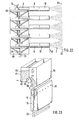
- the suction channel 6 of the flow channel which is formed in a block 80 parallel to a fluidized bed channel 81 of the metering device fed by a metering device (not shown), the injector 9 and the baffle cascade 15 of the flow channel are each flat, i.e. linearly elongated in width and proportional to the height of the flat jet 53 to be generated, as shown schematically in FIG. 23.
- An elongated fluidized bed channel 81 into which a metering device feeds the material, is connected upstream of the flow channel for a mass or volume flow constant feed.
- a sieve 82 At the bottom right-hand edge of the fluidized bed 83 which is set in operation in FIG. 23 there is a slot-shaped outlet opening 85 just above the sieve 82, to which the suction channel 6, which is curved downward in the exemplary embodiment shown, is connected.
Landscapes
- Chemical & Material Sciences (AREA)
- Chemical Kinetics & Catalysis (AREA)
- Dispersion Chemistry (AREA)
- Engineering & Computer Science (AREA)
- Physics & Mathematics (AREA)
- Fluid Mechanics (AREA)
- Mechanical Engineering (AREA)
- General Engineering & Computer Science (AREA)
- Feeding, Discharge, Calcimining, Fusing, And Gas-Generation Devices (AREA)
- Nozzles (AREA)
- Weight Measurement For Supplying Or Discharging Of Specified Amounts Of Material (AREA)
- Air Transport Of Granular Materials (AREA)
Priority Applications (1)
| Application Number | Priority Date | Filing Date | Title |
|---|---|---|---|
| AT84102247T ATE55556T1 (de) | 1983-03-02 | 1984-03-02 | Verfahren und vorrichtung zur erzeugung eines massenstrom- oder volumenstromkonstanten gasfeststoffteilchen-freistrahls bestimmter geschwindigkeit. |
Applications Claiming Priority (2)
| Application Number | Priority Date | Filing Date | Title |
|---|---|---|---|
| DE3307406 | 1983-03-02 | ||
| DE3307406 | 1983-03-02 |
Publications (3)
| Publication Number | Publication Date |
|---|---|
| EP0120342A2 true EP0120342A2 (fr) | 1984-10-03 |
| EP0120342A3 EP0120342A3 (en) | 1987-08-19 |
| EP0120342B1 EP0120342B1 (fr) | 1990-08-16 |
Family
ID=6192323
Family Applications (1)
| Application Number | Title | Priority Date | Filing Date |
|---|---|---|---|
| EP84102247A Expired - Lifetime EP0120342B1 (fr) | 1983-03-02 | 1984-03-02 | Procédé et dispositif de production d'un jet libre de gaz-particules solides avec courant constant de masse ou de volume et d'une vitesse déterminée |
Country Status (11)
| Country | Link |
|---|---|
| US (2) | US4573801A (fr) |
| EP (1) | EP0120342B1 (fr) |
| JP (1) | JPS6012165A (fr) |
| KR (1) | KR930002494B1 (fr) |
| AR (1) | AR242002A1 (fr) |
| AT (1) | ATE55556T1 (fr) |
| BR (1) | BR8400978A (fr) |
| DD (1) | DD212653A1 (fr) |
| DE (1) | DE3482967D1 (fr) |
| RU (1) | RU1787263C (fr) |
| ZA (1) | ZA841337B (fr) |
Cited By (3)
| Publication number | Priority date | Publication date | Assignee | Title |
|---|---|---|---|---|
| EP0670484A1 (fr) * | 1994-03-01 | 1995-09-06 | Amherst Process Instruments, Inc. | Système de dispersion de poudre sèche |
| DE102008056722B3 (de) * | 2008-11-07 | 2010-04-15 | Topas Gmbh Technologie-Orientierte Partikel-, Analysen- Und Sensortechnik | Staubdispergierer zur Erzeugung eines Aerosols |
| DE102010002058B4 (de) * | 2010-02-17 | 2012-03-22 | Topas Gmbh | Staubdispergierer zur Erzeugung eines Aerosols |
Families Citing this family (18)
| Publication number | Priority date | Publication date | Assignee | Title |
|---|---|---|---|---|
| US4945050A (en) * | 1984-11-13 | 1990-07-31 | Cornell Research Foundation, Inc. | Method for transporting substances into living cells and tissues and apparatus therefor |
| DE3851106T2 (de) * | 1987-07-13 | 1994-12-01 | Kinematica Gmbh | Vorrichtung zum Mischen fliessfähiger Medien. |
| US4895034A (en) * | 1987-07-28 | 1990-01-23 | Amherst Process Instruments, Inc. | Powder disperser for aerodynamic particle sizing system |
| SE468341C (sv) * | 1991-03-20 | 1997-08-04 | Kvaerner Pulping Tech | Apparat för blandning av en suspension av ett cellulosahaltigt fibermaterial och ett fluidum |
| NO911337D0 (no) * | 1991-04-05 | 1991-04-05 | Hans Hiorth | Reguleringsanordning for kontinuerlig statisk tynnskiktsblander. |
| US5171557A (en) * | 1991-05-28 | 1992-12-15 | Ford Motor Company | Method for silicon nitride precursor solids recovery |
| US5451106A (en) * | 1994-08-08 | 1995-09-19 | National Research Council Of Canada | Extensional flow mixer |
| US6042263A (en) * | 1998-04-29 | 2000-03-28 | Mentzer; Marvin R. | Mixed phase ruff body flow diffuser |
| US6139302A (en) * | 1998-07-07 | 2000-10-31 | Ovonic Battery Company, Inc. | Powder delivery system for electrode production |
| KR100724070B1 (ko) * | 1999-10-12 | 2007-06-04 | 도토기키 가부시키가이샤 | 복합 구조물 및 그의 제조방법과 제조장치 |
| US6454141B1 (en) | 2001-07-25 | 2002-09-24 | Coulter International Corp. | Non-pressurized dry powder dispensing apparatus |
| DE102007013321A1 (de) * | 2007-03-20 | 2008-09-25 | Jenoptik Laser, Optik, Systeme Gmbh | Vorrichtung und Verfahren zur Bestimmung von Partikelgröße und/oder Partikelform eines Partikelgemisches |
| US8114473B2 (en) * | 2007-04-27 | 2012-02-14 | Toto Ltd. | Composite structure and production method thereof |
| CN102794122B (zh) * | 2012-08-20 | 2014-04-23 | 西安交通大学 | 一种气体-纳米粒子两相均匀流体生成装置 |
| CN103395627B (zh) * | 2013-07-12 | 2016-06-22 | 裕东(中山)机械工程有限公司 | 一种同轴式气力输送喷射器 |
| EP2959992A1 (fr) | 2014-06-26 | 2015-12-30 | Eckart GmbH | Procédé de fabrication d'un aérosol contenant des particules |
| US20160303527A1 (en) * | 2015-04-16 | 2016-10-20 | Western Energy Support And Technology, Inc. | Fluid Mixing Device |
| CN118236880B (zh) * | 2024-05-30 | 2024-09-06 | 淄博昌聚源环保科技有限公司 | 一种气相脱氯剂的制备系统及方法 |
Family Cites Families (13)
| Publication number | Priority date | Publication date | Assignee | Title |
|---|---|---|---|---|
| DE522673C (de) * | 1925-08-26 | 1931-04-13 | Hermann Hildebrandt | Vorrichtung zum Mischen, Zerstaeuben oder Vergasen von Stoffen aller Art |
| US2878972A (en) * | 1955-02-18 | 1959-03-24 | Haloid Xerox Inc | Rough surface powder cloud generation |
| US3488699A (en) * | 1965-11-12 | 1970-01-06 | Eastman Kodak Co | Method and apparatus for continuously preparing dispersions |
| GB1220688A (en) * | 1967-06-29 | 1971-01-27 | Courtaulds Ltd | Mixing apparatus |
| US3707829A (en) * | 1970-10-21 | 1973-01-02 | Eastman Kodak Co | Apparatus for injecting dry solid particles into a liquid including noise muffling means |
| BE783859A (fr) * | 1971-06-18 | 1972-09-18 | Petzholdt J S | Dispositif de melange, d'homogeneisation et d'emulsionnement |
| GB1337155A (en) * | 1971-08-20 | 1973-11-14 | Standard Telephones Cables Ltd | Powder mixture feed mechanism |
| DE2238853A1 (de) * | 1972-05-18 | 1974-02-14 | Lorenian Zareh | Verfahren zur kontinuierlichen, gleichmaessigen und zwangslaeufigen foerderung und zur gleichzeitigen plastifizierung und mischung von werkstoffen, insbesondere von pulver oder koernigen kunststoffen und kunstharzen unter hohem druck |
| DE2807866C2 (de) * | 1978-02-23 | 1979-09-20 | Plasmainvent Ag, Zug (Schweiz) | Vorrichtung zum dosierten Zuführen von Pulver zu einer Pulververarbeitungseinheit |
| US4299655A (en) * | 1978-03-13 | 1981-11-10 | Beloit Corporation | Foam generator for papermaking machine |
| US4334783A (en) * | 1978-12-21 | 1982-06-15 | Showa Denko Kabushiki Kaisha | Mixing device |
| US4267946A (en) * | 1979-10-01 | 1981-05-19 | Thatcher Gary G | Particulate matter dispensing device |
| DE2939828C2 (de) * | 1979-10-01 | 1984-05-10 | Saladin AG, Sirnach, Thurgau | Verfahren und Vorrichtung zur Beschichtung einer Fläche mit einem Pulver |
-
1984
- 1984-02-23 ZA ZA841337A patent/ZA841337B/xx unknown
- 1984-02-27 US US06/583,675 patent/US4573801A/en not_active Expired - Lifetime
- 1984-03-01 BR BR8400978A patent/BR8400978A/pt not_active IP Right Cessation
- 1984-03-01 AR AR84295884A patent/AR242002A1/es active
- 1984-03-01 JP JP59037418A patent/JPS6012165A/ja active Granted
- 1984-03-02 DD DD260519A patent/DD212653A1/xx not_active IP Right Cessation
- 1984-03-02 AT AT84102247T patent/ATE55556T1/de not_active IP Right Cessation
- 1984-03-02 RU SU843710342A patent/RU1787263C/ru active
- 1984-03-02 EP EP84102247A patent/EP0120342B1/fr not_active Expired - Lifetime
- 1984-03-02 DE DE8484102247T patent/DE3482967D1/de not_active Expired - Lifetime
- 1984-03-02 KR KR1019840001041A patent/KR930002494B1/ko not_active Expired - Lifetime
-
1985
- 1985-10-04 US US06/784,346 patent/US4660986A/en not_active Expired - Lifetime
Cited By (3)
| Publication number | Priority date | Publication date | Assignee | Title |
|---|---|---|---|---|
| EP0670484A1 (fr) * | 1994-03-01 | 1995-09-06 | Amherst Process Instruments, Inc. | Système de dispersion de poudre sèche |
| DE102008056722B3 (de) * | 2008-11-07 | 2010-04-15 | Topas Gmbh Technologie-Orientierte Partikel-, Analysen- Und Sensortechnik | Staubdispergierer zur Erzeugung eines Aerosols |
| DE102010002058B4 (de) * | 2010-02-17 | 2012-03-22 | Topas Gmbh | Staubdispergierer zur Erzeugung eines Aerosols |
Also Published As
| Publication number | Publication date |
|---|---|
| EP0120342B1 (fr) | 1990-08-16 |
| US4660986A (en) | 1987-04-28 |
| DD212653A1 (de) | 1984-08-22 |
| AR242002A1 (es) | 1993-02-26 |
| EP0120342A3 (en) | 1987-08-19 |
| KR840007940A (ko) | 1984-12-11 |
| BR8400978A (pt) | 1984-10-09 |
| ATE55556T1 (de) | 1990-09-15 |
| DE3482967D1 (de) | 1990-09-20 |
| JPH0380071B2 (fr) | 1991-12-20 |
| KR930002494B1 (ko) | 1993-04-02 |
| JPS6012165A (ja) | 1985-01-22 |
| ZA841337B (en) | 1984-10-31 |
| US4573801A (en) | 1986-03-04 |
| RU1787263C (ru) | 1993-01-07 |
Similar Documents
| Publication | Publication Date | Title |
|---|---|---|
| EP0120342B1 (fr) | Procédé et dispositif de production d'un jet libre de gaz-particules solides avec courant constant de masse ou de volume et d'une vitesse déterminée | |
| DE2535382A1 (de) | Streumaschine | |
| EP2186575B1 (fr) | Dispositif de séparation d'un mélange pulvérulent dans un flux d'écoulement | |
| EP0546442A2 (fr) | Dispositif pour la séparation d'un mélange de matières de poids spécifiques différents | |
| DE1802161B2 (de) | Vorrichtung zum Herstellen von Matten, Vliesen od.dgl. aus faserförmigen Teilchen | |
| DE4326605A1 (de) | Verfahren und Vorrichtung zur Trennung eines feinkörnigen Feststoffes in zwei Kornfraktionen | |
| DE10196605B3 (de) | Vorrichtung zum Sortieren von Holzschnitzel in separate Fraktionen | |
| DE3626053C2 (fr) | ||
| DE3407871A1 (de) | Verfahren und vorrichtung zur erzeugung eines massenstrom- oder volumenstromkonstanten gas-feststoffteilchen-freistrahls bestimmter geschwindigkeit | |
| DE2720340C3 (de) | Verfahren und Vorrichtung zum Abscheiden von Faserflocken aus einem Transportluftstrom in einen Ablagerungsschacht | |
| DE1923230C3 (de) | Verfahren und Vorrichtung zur Längensortierung von Fasern | |
| DE60320230T2 (de) | Verfahren zum beschichten eines produktes und vorrichtung | |
| DE3626044C2 (fr) | ||
| EP1442855B1 (fr) | Dispositif pour distribution des matériaux granulaires sur un support en mouvement continu | |
| DE2757774A1 (de) | Vorrichtung zum abgeben von beflockungsfasern | |
| DE8406595U1 (de) | Vorrichtung zur Erzeugung eines massenstrom- oder volumenstromkonstanten Gas-Feststoffteilchen-Freistrahls bestimmter Geschwindigkeit | |
| DD212653A5 (de) | Verfahren u.vorrichtung zur erzeugung eines massenstrom-oder volumenstrom-konstanten gas-feststoffteilchen-freistrahls bestimmter geschwindigkeit | |
| DE8305962U1 (de) | Vorrichtung zur erzeugung eines massenstromkonstanten gas-feststoffteilchen-freistrahls | |
| DE1607642A1 (de) | Verfahren und Vorrichtung zum Abtrennen einer Grobfraktion aus einem pneumatisch gefoerderten Schuettgutstrom | |
| DE2422487A1 (de) | Verfahren zur verbesserung des sichteffektes beim aufstreuen eines vlieses aus unsortierten bestandteilen, vorzugsweise pflanzlicher herkunft auf eine transportvorrichtung und einrichtung zur ausuebung des verfahrens | |
| DE4416034A1 (de) | Verfahren zur Sichtung von feinkörnigen Stoffen und Einrichtung für die Durchführung des Verfahrens | |
| DE10101380B4 (de) | Sichterbeschickungungsstrecke bei Anlagen zur Herstellung von Holzfaserplatten | |
| DE1632241B1 (de) | Vorrichtung zum Trennen von Tabak von Gegenständen wie Zigarettenfiltern u. dgl. | |
| DE1597847C3 (de) | Vorrichtung zum gleichmäßigen Auftragen von elektrophotographischem Pulver auf ein flaches, durchlaufendes Material | |
| DE598422C (de) | Windsichter fuer staubfoermige Stoffe |
Legal Events
| Date | Code | Title | Description |
|---|---|---|---|
| PUAI | Public reference made under article 153(3) epc to a published international application that has entered the european phase |
Free format text: ORIGINAL CODE: 0009012 |
|
| AK | Designated contracting states |
Designated state(s): AT BE CH DE FR GB IT LI LU NL SE |
|
| PUAL | Search report despatched |
Free format text: ORIGINAL CODE: 0009013 |
|
| AK | Designated contracting states |
Kind code of ref document: A3 Designated state(s): AT BE CH DE FR GB IT LI LU NL SE |
|
| 17P | Request for examination filed |
Effective date: 19880218 |
|
| 17Q | First examination report despatched |
Effective date: 19880914 |
|
| DIN1 | Information on inventor provided before grant (deleted) | ||
| RAP1 | Party data changed (applicant data changed or rights of an application transferred) |
Owner name: SYMPATEC GMBH SYSTEM-PARTIKEL-TECHNIK |
|
| RIN1 | Information on inventor provided before grant (corrected) |
Inventor name: ROETHELE, STEFAN, DIPL.-ING. Inventor name: LESCHONSKI, KURT, PROF. DR.-ING. |
|
| RAP3 | Party data changed (applicant data changed or rights of an application transferred) |
Owner name: SYMPATEC GMBH SYSTEM-PARTIKEL-TECHNIK |
|
| GRAA | (expected) grant |
Free format text: ORIGINAL CODE: 0009210 |
|
| AK | Designated contracting states |
Kind code of ref document: B1 Designated state(s): AT BE CH DE FR GB IT LI LU NL SE |
|
| REF | Corresponds to: |
Ref document number: 55556 Country of ref document: AT Date of ref document: 19900915 Kind code of ref document: T |
|
| REF | Corresponds to: |
Ref document number: 3482967 Country of ref document: DE Date of ref document: 19900920 |
|
| ITF | It: translation for a ep patent filed | ||
| ET | Fr: translation filed | ||
| GBT | Gb: translation of ep patent filed (gb section 77(6)(a)/1977) | ||
| ITTA | It: last paid annual fee | ||
| PLBE | No opposition filed within time limit |
Free format text: ORIGINAL CODE: 0009261 |
|
| STAA | Information on the status of an ep patent application or granted ep patent |
Free format text: STATUS: NO OPPOSITION FILED WITHIN TIME LIMIT |
|
| 26N | No opposition filed | ||
| PGFP | Annual fee paid to national office [announced via postgrant information from national office to epo] |
Ref country code: AT Payment date: 19940315 Year of fee payment: 11 |
|
| PGFP | Annual fee paid to national office [announced via postgrant information from national office to epo] |
Ref country code: LU Payment date: 19940331 Year of fee payment: 11 |
|
| EPTA | Lu: last paid annual fee | ||
| EAL | Se: european patent in force in sweden |
Ref document number: 84102247.8 |
|
| PG25 | Lapsed in a contracting state [announced via postgrant information from national office to epo] |
Ref country code: LU Free format text: LAPSE BECAUSE OF NON-PAYMENT OF DUE FEES Effective date: 19950302 Ref country code: AT Effective date: 19950302 |
|
| PGFP | Annual fee paid to national office [announced via postgrant information from national office to epo] |
Ref country code: SE Payment date: 19950308 Year of fee payment: 12 |
|
| PG25 | Lapsed in a contracting state [announced via postgrant information from national office to epo] |
Ref country code: SE Effective date: 19960303 |
|
| EUG | Se: european patent has lapsed |
Ref document number: 84102247.8 |
|
| REG | Reference to a national code |
Ref country code: GB Ref legal event code: IF02 |
|
| PGFP | Annual fee paid to national office [announced via postgrant information from national office to epo] |
Ref country code: GB Payment date: 20030131 Year of fee payment: 20 |
|
| PGFP | Annual fee paid to national office [announced via postgrant information from national office to epo] |
Ref country code: FR Payment date: 20030321 Year of fee payment: 20 |
|
| PGFP | Annual fee paid to national office [announced via postgrant information from national office to epo] |
Ref country code: DE Payment date: 20030325 Year of fee payment: 20 |
|
| PGFP | Annual fee paid to national office [announced via postgrant information from national office to epo] |
Ref country code: BE Payment date: 20030327 Year of fee payment: 20 |
|
| PGFP | Annual fee paid to national office [announced via postgrant information from national office to epo] |
Ref country code: NL Payment date: 20030331 Year of fee payment: 20 |
|
| PGFP | Annual fee paid to national office [announced via postgrant information from national office to epo] |
Ref country code: CH Payment date: 20030506 Year of fee payment: 20 |
|
| PG25 | Lapsed in a contracting state [announced via postgrant information from national office to epo] |
Ref country code: LI Free format text: LAPSE BECAUSE OF EXPIRATION OF PROTECTION Effective date: 20040301 Ref country code: GB Free format text: LAPSE BECAUSE OF EXPIRATION OF PROTECTION Effective date: 20040301 Ref country code: CH Free format text: LAPSE BECAUSE OF EXPIRATION OF PROTECTION Effective date: 20040301 |
|
| PG25 | Lapsed in a contracting state [announced via postgrant information from national office to epo] |
Ref country code: NL Free format text: LAPSE BECAUSE OF EXPIRATION OF PROTECTION Effective date: 20040302 |
|
| REG | Reference to a national code |
Ref country code: GB Ref legal event code: PE20 |
|
| BE20 | Be: patent expired |
Owner name: *SYMPATEC G.M.B.H. SYSTEM-PARTIKEL-TECHNIK Effective date: 20040302 |
|
| REG | Reference to a national code |
Ref country code: CH Ref legal event code: PL |
|
| NLV7 | Nl: ceased due to reaching the maximum lifetime of a patent |
Effective date: 20040302 |