EP0120855B1 - Systeme de controle de vol base sur la puissance totale - Google Patents
Systeme de controle de vol base sur la puissance totale Download PDFInfo
- Publication number
- EP0120855B1 EP0120855B1 EP83900211A EP83900211A EP0120855B1 EP 0120855 B1 EP0120855 B1 EP 0120855B1 EP 83900211 A EP83900211 A EP 83900211A EP 83900211 A EP83900211 A EP 83900211A EP 0120855 B1 EP0120855 B1 EP 0120855B1
- Authority
- EP
- European Patent Office
- Prior art keywords
- signal
- aircraft
- speed
- command
- thrust
- Prior art date
- Legal status (The legal status is an assumption and is not a legal conclusion. Google has not performed a legal analysis and makes no representation as to the accuracy of the status listed.)
- Expired
Links
Images


Classifications
-
- G—PHYSICS
- G05—CONTROLLING; REGULATING
- G05D—SYSTEMS FOR CONTROLLING OR REGULATING NON-ELECTRIC VARIABLES
- G05D1/00—Control of position, course, altitude or attitude of land, water, air or space vehicles, e.g. using automatic pilots
- G05D1/04—Control of altitude or depth
- G05D1/06—Rate of change of altitude or depth
- G05D1/0607—Rate of change of altitude or depth specially adapted for aircraft
- G05D1/0615—Rate of change of altitude or depth specially adapted for aircraft to counteract a perturbation, e.g. gust of wind
- G05D1/0638—Rate of change of altitude or depth specially adapted for aircraft to counteract a perturbation, e.g. gust of wind by combined action on the pitch and on the motors
Definitions
- This invention pertains to the aircraft automatic flight contror art and, more particularly, to an integrated longitudinal flight control system based on total aircraft energy.
- Another objective of this invention is to provide a universal multi-input/output longitudinal control system, with appropriately coordinated elevator and throttle commands to provide consistent, accurate, decoupled control over the aircraft's vertical flight path and speed, in any desired combination of modes and flight condition.
- Yet another major objective of this invention is to provide a dramatic simplification in the overall automatic control system in terms of required hardware and software, by systematic integration of all control requirements, elimination of unnecessary duplication of functions and establishment of priority use of controllers.
- the presently disclosed system not only realizes major improvements in automatic control system performance and operational capabilities, but also improvements in safety by preventing aircraft stall, overspeed and engine overboost, and cost of ownership by simplifying system development, certification and maintenance.
- the aircraft vertical flight path and speed targets are normalized into vertical flight path angle and longitudinal acceleration command signals Yc and V c respectively. These commands are combined with their corresponding feedback variables and V to form the error signals and V e which, in turn, are used to produce signals y representative of the specific total energy rate error Es ⁇ and the rate of change of the energy distribution error L ⁇ relative to the aircraft's vertical flight path and speed targets.
- g is a constant representing acceleration due to gravity.
- the specific total energy rate error E Se is controlled to zero by commanding incremental thrust as a function of the E s ⁇ _ signal, while the energy distribution rate error L e is controlled to zero by commanding an incremental elevator position as a function of the signal, thereby driving the aircraft to the desired vertical flight path and speed targets.
- the overall design philosophy of the present flight control system is to compute the aircraft's total energy state and desired state, as represented by flight path, speed and associated targets, and control the total energy error with thrust, while using the elevator to control the energy distribution error between the flight path and speed.
- thrust is the most effective means to change the aircraft's energy state
- elevator control provides an effective means to modulate energy distribution and stabilize the aircraft's attitude.
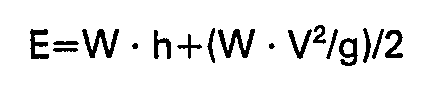
- the total energy E of an aircraft is given by:
- the total energy rate error is integrated by integrator circuit 72 using a gain constant KTI to develop the total energy error E se to which is added a term which has been amplified by the gain KTP in amplifier 74 to form the specific thrust command signal.
- This specific thrust command is scaled by multiplying it with factor representing the actual weight of the aircraft to form the final thrust command T c.
- the rate of change of total energy distribution error is integrated by indicator circuit 82 using a gain constant KEI to develop the total energy distribution error L ⁇ , to which is added a term which has been amplified by a gain KEP in amplifier 84 to form air partical elevator command signal ⁇ c .
- KEI gain constant
- To this 8 c signal is further processed by the addition of an altitude feedback signal 8, amplification by the gain K e in circuit 92 and the addition of a gain weighted pitch rate signal 8 to form a final elevator command signal ⁇ e c .
- the pitch altitude and pitch rate feed back components of the total elevator command signal provide the necessary innerloop pitch damping function.
- This control concept can be applied for any combination of specific speed and flight path control modes and at any flight condition.
- FIG. 1 blocks 38 and 24, illustrates circuitry for realizing the above control concept.
- an input command flight path angle Y c is applied as one input to a summer 12.
- a signal y is also fed to summer 12 .
- the summer 12 produces at its output a flight path error signal Y ⁇ which is equal to the difference between the commanded flight path angle and the actual flight path angle.
- the aircraft's longitudinal acceleration signal V is subtracted from the commanded longitudinal acceleration V c in a - summer 14.
- An amplifier 16 multiplies the resulting V e error signal by a fixed gain I/g, producing an output signal V ⁇ /g which is fed to inputs of summers 18 and 20. Also coupled as inputs to summers 18 and 20 is the signal Y ⁇ -
- the output signal from summer 20, which is of the form is the above derived total energy rate error signal, whereas the output of summer 18 is of a form shown to be the energy rate distribution error.
- the specific energy rate error signal Es ⁇ is applied to thrust command computation circuitry 22 which generates a thrust command signal ⁇ THRUST c .
- the signal ⁇ THRUSTC controls engine thrust, at block 24, thereby reducing the energy rate error signal to zero.
- the energy rate distribution error signal L ⁇ is fed to the elevator command computation circuitry 26, which circuitry responds by producing an elevator control command signal ⁇ elevator c .
- This signal when coupled to the aircraft's elevator at block 24, reduces the energy rate distribution error signal to zero.
- the aircraft is precisely guided from its present flight path angle and acceleration to the desired flight path angle and acceleration.
- the gain K h is selected equal to Ky to yield identical altitude and speed dynamics.
- the vertical speed command is divided by the aircraft's speed V to form the flight path angle command: and The altitude and speed errors are thus scaled in relative energy terms.
- Block 38 represents the previously described generalized thrust and elevator command computation.
- Block 32 represents the mode select and command control panel providing signals to blocks 30 and 34 specifying the pilot selected modes of operation as well as the command targets.
- Block 30 represents the flight path angle command normalization processing, receiving input signals of barometric altitude and altitude command for confrol in the ALTITUDE mode, radio altitude for control in the FLARE mode, barometric altitude and altitude commands for control in the VERTICAL PATH mode, flight path angle command for control in the FLIGHT PATH ANGLE mode, column force for control in the CONTROL WHEEL STEERING (CWS) mode and flight path angle command for the GO AROUND mode.
- CWS CONTROL WHEEL STEERING
- acceleration command normalization block 34 receives signals representing true airspeed, calibrated airspeed and calibrated airspeed command for control in the CAS mode, Mach number and Mach command for control in the MACH mode, groundspeed and groundspeed command for control in the SPEED PROFILE mode, providing time based flight path control (4D) capability.
- the VERTICAL PATH and SPEED PROFILE modes provide the capability to link up with a flight management computer 36 for receiving and controlling the aircraft to optimal flight path and speed profiles, as determined by the flight management computer based on consideration of aircraft operating economics and/or air traffic control.
- the mode and command control panel allows selection of any one of the path modes in combination with any one speed control mode.
- the output signal from block 30 of Figure 1 is the normalized flight path angle command signal y c
- the output from block 34 is the normalized longitudinal acceleration command signal V c .
- the two command signals y c and V c are fed to the control system 38.
- any desired autopilot or autothrottle mode may be implemented to utilize the above-described generalized energy rate error and energy rate distribution error control law.
- FIG 2 is a more detailed representation of the system shown in Figure 1 and illustrates implementation of the energy based control system for the basic command modes of altitude, vertical speed, flight path angle and longitudinal velocity.
- the pilot selected vertical speed command signal he is taken directly from the mode control panel.
- the vertical speed command signal h c selected by switch 44 from either the ALTITUDE or VERTICAL SPEED mode, is normalized into a flight path angle command signal Y c by dividing it by a signal representing the aircraft's velocity V, utilizing divider 46.
- the pilot selected flight path angle command signal Y c is taken directly from the mode control panel.
- the appropriate Y c signal is routed to summer 12.
- a signal representative of the actual flight path angle y is derived by dividing a signal representative of the aircraft's vertical velocity h by the longitudinal velocity signal V, utilizing divider circuit 52. Means for providing vertical and longitudinal velocity signals are commonly known in the flight control art.
- the flight path angle signal y is subtracted from the flight path angle command signal Y c to form the flight path angle error signal Y ⁇ .
- a velocity error signal V e is formed in summer 62 by subtracting the signal V representing the actual longitudinal velocity from the pilot selected velocity command signal- V c .
- the velocity error signal V e is normalized by multiplying it with the gain factor K v in amplifier 64 to form the acceleration command signal: V c -K v V ⁇ .
- the signal V representing the actual longitudinal acceleration and provided by means commonly known in the flight control art, is subtracted from the acceleration command signal V c to form the acceleration error signal V E .
- This V e signal, and also the V signal, is scaled by the gain factor I/g in amplifiers 16 and 66, respectively, to form the energy rate related signals V ⁇ /g and V/g (g is the gravity constant).
- summer 20 the flight path angle error signal Y ⁇ and the scaled acceleration error signal V ⁇ /g are added to form the specific total energy rate error signal: which for the altitude and speed control modes is developed as
- summer 18 the flight path angle error signal Y ⁇ is subtracted from the scaled acceleration error signal V E /g to form the energy rate distribution error signal; which for the altitude and speed modes is developed as
- the main thrust command signal is formed by integration of the specific energy rate error signal E S ⁇ from the output of summer 20, utilizing the integrator 72.
- the output from integrator 72 is a signal proportional to E se , which incrementally represents the specific energy error:
- the steady value of the output of integrator 72 corresponds to the thrust command required for trimmed flight.
- the specific energy error signal E se and the specific energy rate signal E ⁇ are amplified by suitable gains KTI and KTP respectively in blocks 72 and 74, and combined in summer 76, to form the actual net thrust command signal T c .
- the engine and throttle servo control blocks 78 and 80 are configured to make the engine deliver the commanded net thrust.
- the main elevator command signal is formed by integration of the energy rate distribution error L e from the output of summer 18, using integrator 82.
- the output of integrator 82 is a signal proportional to L ⁇ , which incrementally represents the energy distribution error:
- the steady state output of integrator 82 corresponds to the elevator command required for trimmed flight.
- the energy distribution rate signal L is formed in summer 68 by subtracting the normalized acceleration signal V/g from the flight path angle signal:
- the signals L e and L are amplified by suitable gain factors KEI and KEP respectively in blocks 82 and 84 and combined in summer 86 to form the pitch attitude command signal - ⁇ c .
- the pitch attitude command signal - ⁇ c and the signal ⁇ representative of the actual pitch-attitude obtained from a commonly available signal source, are combined in summer 88 and amplified by a factor K ⁇ in amplifier 92.
- the output of amplifier 92 is summed in summer 90 with the amplified pitch rate signal K ⁇ , which is produced at the output of amplifier 94.
- the resulting output from summer 90 is the final elevator position command signal ⁇ ec which is applied to the elevator servo control unit to position the elevator.
- the pitch attitude and pitch rate feedbacks serve to stabilize and augment the innerloop pitch dynamics of the aircraft so as to coordinate it precisely with the thrust innerloop dynamics.
- the present energy based flight control system is, thus, seen to exhibit numerous advantages.
- Figure 3 is a block diagram illustrating further provisions and features of the Total Energy Control System.
- the speed control outerloop does not require gain scheduling.
- a multiplier 100 scales the elevator command output ⁇ e by a gain factor KCAS, using variable gain amplifier 102.
- KCAS is a function of the calibrated airspeed CAS.
- the thrust command is scheduled proportional to aircraft weight to provide the exact net thrust command ⁇ Tc that is required to maintain uniform flight path and speed control dynamics with varying aircraft weight.
- the required incremental thrust is proportional to the sum of-the incremental flight path angle and normalized acceleration and also proportional to aircraft weight.
- multiplier 77 multiplies the specific thrust command signal output from summer 76 by a signal W which is representative of aircraft weight.
- the engine Since the required incremental net. thrust command is computed precisely, the engine must be controlled to put out the commanded net thrust. However, the engines are generally controlled by variables other than net thrust, for example throttle position, engine pressure ratio EPR or fan speed N 1 .
- the net thrust command is, therefore, converted into the appropriate engine variable ⁇ AEPR c for the example case.
- the normalized net thrust command is converted into an engine pressure ratio command, using amplifier 110, with a gain factor K EpR which is generally a function of Mach number.
- a control loop includes a summer circuit 114, and amplifier 116, a position servo 118, the engine 120, a summer circuit 122 and the amplifier 124.
- the throttles are controlled to a "predicted" position corresponding to the commanded ⁇ PR c and fine control of the engine thrust is achieved through the EPR loop.
- Summer circuit 122 combines the EPR feedback signal from the engine with a signal EPR IDLE representative of the engine pressure ratio at idle and the ⁇ EPRc to form an engine pressure ratio error feedback signal.
- This approach allows the throttles to go directly to the required steady state position, regardless of the dynamic response lag of the engine, thereby avoiding undesirable throttle position over- shoots.
- the overall engine control loop gain stays constant, yielding uniform thrust response dynamics for all flight conditions.
- Future engines may use electronic engine controls, capable of accepting net thrust or EPR commands exclusively, thereby greatly simplifying the interface with the flight control system.
- the Total Energy Control System has, therefore, been designed to safeguard the engines against overboost.
- the EPR-limit signal is supplied by an EPR-limit computing means.
- the engine is controlled to an incremental thrust command ⁇ EPRc .
- an absolute command signal EPR c is formed, as seen in Figure 3 by the addition of the EPR IDLE signal to the ⁇ EPRc signal in summer 302.
- the difference signal is fed back with high gain into the thrust command integrator 72 so that, in effect, the EPR c signal remains limited to the EPR-limit. This way also overshoots of the throttle position corresponding to the EPR-limit are avoided.
- Similar provisions may be used to limit the ⁇ dEPRc signal to a desired minimum value and the throttle position command to the desired forward and aft limits.
- a summer circuit 292 produces an output signal which is the difference between the aircraft's actual angle of attack a (alpha) and the maximum allowable angle of attack reference signal ⁇ REF .
- the signal a REF is computed as a function of flap position and MACH number in block 290.
- the resulting angle of attack error signal is normalized into a speed equivalent error V ⁇ , using a gain factor K a which is equal to the steady state value of the derivative dV/da.
- the short period a-response is attenuated by processing the normalized angle of attack error signal through a lag circuit 293, and the effect of the lag on the control dynamics is compensated by the addition of a short term airspeed error signal from the output of washout circuit 296 in summer 297.
- the input to washout circuit 296 is formed in summer 295 by combining a signal representative of true airspeed and a signal representative of the desired minimum speed increment AV which is developed as a function of the aircraft flap position in circuit 294.
- the result is a feedback signal V MINe that is equivalent to airspeed error relative to the steady state speed that corresponds to a REF'
- the signal V MIN ⁇ is continually compared to the airspeed error from the CAS, MACH or SPEED PROFILE mode and VMINe is selected via switch 298 whenever it is more positive than the regular speed control error signal.
- switchover between airspeed and angle of attack control is transient free and completely transparent.
- the minimum safe speed V MIN may be developed from signals representative of the aircraft weight and flap position to form the V MINe signal.
- the speed control is bounded on the upper side by the maximum operating speed V MO /M MO control, which is switched in whenever the airspeed error VMAXe relative to V MO /M MO and developed in circuit 300 is more negative than the airspeed error of the regular speed control mode.
- speed limiting control feeds into the generalized flight path and speed control circuitry, which includes the speed control priority provision using elevator only in case of thrust limiting, all flight modes are equally protected against stall and overspeed for all flight conditions.
- V MIN or V MAX control Automatic switching to V MIN or V MAX control is indicated by flashing the inappropriate speed command or an alert light on the mode control panel or other primary information display.
- the Y ⁇ is not discretely switched out but, rather, "washed out” as a function of time, using amplifier 144 with a variable gain factor KGAE.
- a conventional "wash out” circuit may be used.
- V e signal input to the elevator integral control signal path must be removed to prevent it from biasing the flight path control. This may be done by way of amplifier 146, which has a variable gain factor KVDE. Alternatively, a "washout" circuit may be used.
- V c limit in combination with the Y ⁇ variable gain amplifier 144.
- V MAX V+gy.
- the V c limit is further used to partition the total energy rate authority during conditions with limit thrust between flight path and speed control. This is achieved by setting whichever is greater when the thrust reaches the forward limit, and whichever is less when the thrust reaches the aft limit.
- the constant K was set to .5 when thrust reached the forward limit and to 1.0 when thrust reached the aft limit, resulting in a -50% reduction of the maximum thrust climb gradient to satisfy a large acceleration command and a temporary leveling off during idle descent in order to satisfy a deceleration command.
- the elevator innerloop control shown in embodiment of Figure 3, uses pitch rate and pitch attitude feedbacks.
- the path/speed control feedbacks and gains have been selected to yield critically damped responses to changes in the commanded flight path and/or speed for all conditions. Therefore, the normal acceleration, which is equal to Vy; can simply be limited by rate limiting the commanded flight path angle to a value where A NLIMIT is the maximum allowed normal acceleration. This rate limit is applied directly to the flight path angle command signal Yc , using rate limit circuitry 130 in Figure 3.
- the vertical acceleration limit may be achieved by rate limiting the vertical speed command he to a value This approach is used for the altitude mode implementation shown in Figure 5.
- the V c signal is also rate limited to a value using rate limiter 134. This assures that, in case of simultaneous flight path and speed commands, the input signals to the thrust or to the elevator command computation cancel, thereby minimizing the unnecessary controller activity.
- the rate limit on the acceleration command signal V c also helps to smooth the throttle and elevator response for large commands and reduce nuisance activity due to turbulence.
- V c rate limit necessitates the use of a corresponding V c amplitude limit.
- This rate of change of acceleration called for by the control law should be equal to or less than the set rate limit of V c . Therefore, which is achieved by limiting the amplitude of V c to ( ⁇ a NLIMIT9 )/V, or the amplitude of V e to This V c amplitude limit is provided by circuit 140. Failure to limit V c would result in response overshoots after large changes in the commanded speed, since the initial amplitude of V c would result in a higher rate of change of Vc than the actual rate limit can accommodate.
- a matching lie amplitude limiting circuit 142 has been implemented to assure that altitude response over-shoots are avoided when responding to large altitude commands with a rate limited or Y c . Derivation of the longitudinal acceleration signal
- the acceleration feedback signal is derived from engine thrust T, aircraft weight W, flight path angle y, and true airspeed V TRUE where
- the engines Since the derived V does not contain short term drag information, the engines will not respond immediately in case of flap or landing gear position changes and the airplane will slow down or speed up naturally.
- the desired throttle response inhibiting function to give pilots time to adjust speed commands in case of configuration changes, is realized without additional circuitry.
- the signal T/W may be developed from signals representative of thrust and weight.
- the thrust signal may be developed from engine EPR and altitude pressure ratio ⁇ , in reverse manner of that used to calculate the commanded EPR, taking the number of operating engines into account.
- ⁇ T/W may be derived using the signal (AT/W) c from the output of summer 76 and the known engine dynamics. For example: where - ⁇ E is the effective engine time constant. This approach eliminates the potential complexity of needing multiple engine EPR-feedback signals and avoids the need for specific engine information in the flight control computer when electronic engine controls are employed accepting net thrust commands.
- the derived longitudinal acceleration feedback is implemented using amplifier 150, divider 152, summer 154 and filter 156.
- the present Total Energy Control System is especially capable of controlling the effect of windshear since both speed and path deviation are fed back to form the energy error-based thrust command signal. Likewise, speed and path deviations are fed back to form the energy distribution error-based elevator command signal. This design also eliminates pitch/throttle coupling, excited by horizontal and vertical turbulence, a long standing problem with previous state-of-the-art systems.
- K v and K h are decreased and T4 increased to reduce controller activity induced by turbulence and minimize normal and longitudinal accelerations.
- System stability and command tracking in turbulence are virtually unaffected by changes in K v , K h , and ⁇ v .
- Further reduction of controller activity can be achieved by reducing the proportional and integral gains KEP, KTP, KEI, KTI. In that case, the system approaches a thrust and pitch attitude hold system. Then, when speed/altitude adjustments are required, or when the energy error exceeds a set limit (e.g. due to windshear), the system temporarily reverts to full "capture" gains.
- the energy based normalization reduces the system's sensitivity to altitude errors as speed increases, while energy errors tend to be equally distributed between speed and altitude.
- a flare control mode is provided by circuitry indicated generally at 310.
- This control circuitry combines principles of total energy control with the "Variable Tau” system described in co-pending patent application Serial No. 162,451 invented by Antonius A. Lambregts and Rolf Hansen, filed June 24, 1980 and assigned to the same assignee as the present application.
- the "Variable Tau” flare law commands the airplane to fly a geometrically fixed flare trajectory relative to the runway.
- the sinkrate feedback is switched over at flare initiation, via switch 312, from the inertially smoothed barometric complemented altitude signal h to a radio altitude derived fiFLARE.
- This is accomplished by a complementary high pass/low pass h filters 314 and 316.
- the signal input to lag circuit 314 is switched out at the time the radio altitude input signal to the high pass filter 316 drops below its limit.
- the response transients of the decaying lagged i signal and the buildup of the radio altitude rate signal developed at the output of the high pass filter 316 complement each other resulting in a smooth switchover to hR derived h FLARE .
- the radio altitude singal limit is set at a desired flare initiation height h FL , low enough to assure that the aircraft is over level terrain at the start of flare and high enough to allow a smooth flare maneuver.
- the flare control is, therefore, insensitive to uneven approach terrain.
- a second part of the flare control is obtained by switching from speed error feedback to a deceleration command, using switch 250.
- This deceleration command is selected to help rotate the aircraft and bring the throttles smoothly aft for a nominal undisturbed flare.
- the retard rate is modulated, however, based upon the energy error relative to a nominal flare.
- the energy based flight control system provides a full complement of pilot selectable longitudinal autopilot/autothrottle and flight management system control modes including:
- the Total Energy Control System allows a simpler, more effective mode control panel, illustrated in Figure 4, for the selection of these modes.
- the control functions are grouped into longitudinal flight path, speed and lateral flight path control modes.
- the system can be engaged by pressing any longitudinal flight path or speed mode engage button.
- the default speed or flight path mode (calibrated airspeed or flight path angle) will also engage. Only one path and one speed mode can be engaged simultaneously.
- the glide slope and vertical path modes have both an ARM and ENGAGE status. When these mode buttons are pressed and certain pre-engage requirements are met, these modes will arm, indicated by an amber arm light. Automatic engage follows and the light turns green when certain engage conditions are met.
- Figure 5 is a detailed block diagram showing the preferred implementation of the various pilot selectable control modes.
- the flight path angle mode is the basic path mode.
- the FPA mode circuitry is indicated generally at 200. This has been implemented rather than the vertical speed, because it allows precise range/altitude intercept capability when used in combination with the horizontal/vertical situation displays for profile descent operations. A special case of the range/altitude intercept is the final approach to the runway. With the proper navigation/display computations, it becomes a simple matter to target the flight path angle to the approach end of the runway. For this reason, inertial (rather than airmass referenced) flight path angle y 1 is used for the FPA mode. It is obtained by dividing the interially smoothed vertical speed h, derived in the complementary filter shown in Figure 6, by the ground speed, in divider circuitry 202.
- the flight path angle command y c is formed by adding the flight path angle that existed at the time of mode engagement, and memorized in the track and hold circuitry 204, to the desired incremental flight path command Ay.
- the ⁇ Y c signal is developed by counting the pulses of an optical encoder (not shown) which stimulated by rotation of the FPA select knob ( Figure 4) on the mode control panel.
- a Velocity Vector Control Wheel Steering (VCWS) mode has been implemented using the Total Energy Control concept to provide very precise manual maneuvering capability and superior aircraft handling and response characteristics.
- Direct control over the aircraft's velocity vector facilitates execution of flight paths which are inertially, i.e. earth referenced, such as glide slope capture and tracking.
- Such a control capability also reduces pilot workload shaprly, since the aircraft will track the inertial flight path established by the pilot, in spite of the disturbances.
- the present Total Energy Control system provides an even more ideal baseline control law for implementation of the VCWS mode, since it inherently provides decoupled control over the amplitude (V) of the aircraft's velocity vector and its direction (y).
- the Yc signal is developed by scaling the column force signal F coL after processing the signal in dead zone circuit 182, by a factor inversely proportional to inertially smoothed speed V in divider 184 and a factor KGDC in amplifier 186 to form the commanded rate of change of flight path angle signal Yc.
- the gain Y c /FcoL is scaled inversely proportional to V to provide approximately constant stick force per unit normal acceleration, regardless of the speed.
- the Y c signal output from amplifier 186 is filtered by a small lag in circuit 188, and integrated in circuit 190 to form the Yc signal.
- the small lag provides a more natural response for Y c which is used for pilot display to close the short term pilot control loop.
- the dead zone circuit 182 guards against inadvertent drift of the Y c signal when the pilot does not intend a maneuver.
- the natural response of the baseline control system to a Y c signal is to sluggish for manual control. Therefore, response augmentation is provided by feeding the Y c signal to the input of the thrust command integrator 72 of Figure 3 via summer 20 using the gain amplifier 292.
- the signal Y c is also fed to summers 18 and 86 of Figure 3 via gain amplifiers 294 and 296 for the development of coordinated pitch attitude command.
- the gains of amplifiers 292, 294 and 296 have been selected to provide the desired y response quickening without affecting the decoupling from speed control.
- the Y c input to circuit 188 is removed using switch 298 at the same time the Y ⁇ signal is removed from summer 18.
- the altitude mode can be directly engaged by pushing the HOLD button. It can also be armed to engage and capture a pre-selected altitude, simply by dialing the altitude knob to the desired altitude when another path mode is engaged and pressing the CAPT button. The mode then automatically engages to capture when the selected altitude is intercepted. While engaged, the altitude command can be changed to any desired value and the altitude mode . will execute the change unless the HOLD button has been pushed first. No mode switching is required. For substantial altitude changes, maximum thrust will be used. Speed control remains in effect at all times, and vertical maneuvers will not cause significant speed deviation since elevator and throttle commands are precisely coordinated to prevent this.
- the Y ⁇ signal is developed by normalization of the altitude error:
- the normalization of the altitude error uses a complementary filtered airspeed/groundspeed signal V which is representative of airspeed for low frequencies.
- V which is representative of airspeed for low frequencies.
- the filter is shown in Figure 7.
- Low frequency airspeed is used to preserve the energy relationship between altitude and airspeed and the filtering is needed to avoid undesired controller activity due to turbulence.
- the signal of h ⁇ ALT will be the same as the sign of he indicating that the commanded flight path angle for intercepting the target altitude is steeper than the actual flight path angle as established by the mode in control. Mode switch-over to ALT is inhibited as long as this condition exists. As h E reduces, h ⁇ ALT will eventually change sign, indicating that from that point on the ALT control law commands the aircraft to align itself with the target (horizontal) path.
- the ALT mode is engaged as soon as the sign of h ⁇ ALT becomes opposite to the sign of h cALT . Since only the signal of the integrator signal path is switched, mode switching is always transient free and fully adaptive to any flight condition. The integrators never need re-initialization. The commanded flight path is always captured without overshoot. The capture time constant is set by the gain Kh in amplifier 214.
- This simple mode transitioning concept eliminates the capture sub-mode and the command synchronization hardware or software that is used in conventional control laws to achieve smooth mode transitioning.
- the (hc) ALT signal is limited, by amplitude limiter 216 and rate limiter 218, to assure that, for large changes in the commanded altitude, the vertical speed and vertical acceleration stay within desirable limits and also to prevent altitude capture overshoots. However, for most flight conditions, the achievable h is restricted by the available thrust/drag.
- the glide slope control mode is implemented using the circuitry indicated generally at 220. This system is analogous to the altitude control mode. The only differences are:
- This mode also has a "pre-engage” or “arm” status where (h ⁇ ) Gs is computed but control engagement is inhibited until the sign of (h ⁇ ) GS becomes opposite to the sign of ( ⁇ hc) GS indicating the point where the glide slope capture trajectory is tangential to the existing flight path.
- glide slope captures are always fully adapted for the specific approach speeds and initial flight path, and capture overshoots are avoided.
- the proportional flight path angle feedback for glide slope control has an important advantage over a conventional h feedback system. While tracking the glide slope, the steady state y feedback signal is balanced out by the elevator and thrust command integrators and is unaffected by the approach speed. A deceleration on the glide slope causes, therefore, no control transient, and glide slope departures as occur in systems using an h feedback signal are, thus, eliminated at no additional hardware or software expense.
- Go-around mode control circuitry is indicated generally at 260.
- the go-around mode is achieved by simply switching, via switch 262 and switch 202, to a fixed flight path angle command ( Yc ) GA -This (Y c ) GA signal is selected to require full power for a nominal airplane weight and thrust condition.
- Yc fixed flight path angle command
- Speed control is maintained at all times.
- the pilot can then manage speed and flap commands as desired. Flaps may be retracted before changing the commanded speed since the a-limit control maintains a stall margin, regardless of the selected speed and flap position.
- the (Y C ) GA signal has a shaping filter 264 to allow shaping of the initial versus final response.
- Selection of a fixed 1Yc ) GA prevents excessive climb rates and pitch attitudes in case of a high thrust-to-weight ratio condition. In that case the system uses less than full power.
- the system is also safe for very low thrust-to-weight conditions (e.g. for failed engine) becuase the throttle simply drives to the forward limit and speed control is maintained through the elevator, even if the ( Yc ) GA cannot be satisfied entirely.
- the previously described speed control priority logic assures this operation.
- the commanded airspeed hold/select mode (CAS), which is the basic speed mode, is implemented using the circuitry shown generally at 230.
- a speed mode is always engaged simultaneously with the path mode:
- the CAS command is formed, as with the path mode commands, by memorization of the existing speed at mode engage, in track and hold circuit 232, with the addition of an incremental command signal CASe resulting from rotation of a speed knob.
- the CAS error which is the difference between CASe and the actual CAS is converted into a true airspeed error, via divider 234, using an altitude dependent conversion factor. this is done to keep the gain relationship between true airspeed and the acceleration damping constant over the entire flight path envelope and thereby maintain constant speed control dynamics.
- the resulting airspeed error V ⁇ SEL is normalized into an acceleration command V c by multiplication with the factor K " , via amplifier 236.
- the acceleration command V c together with acceleration eedback , are used to form the acceleration error signal for use in developing both the thrust and elevator commands.
- the MACH command signal is developed by circuitry indicated generally at 250 in a manner similar to the CAS command.
- the MACH command is converted to a true airspeed command V Tc by multiplication with the speed of sound.
- the speed of sound signal (a) is developed by dividing true airspeed by MACH in a divider circuit 252.
- the true airspeed error is formed by subtracting true airspeed V TRUE from the true airspeed command VT c'
- the resulting airspeed error is routed via switch 270 and switch 280 to amplifier 236 to produce the V c signal.
- the MACH or CAS modes can be used interchangeably.
- An automatic CAS to MACH switchover is built into the system which occurs when reaching a predetermined MACH number during climb and a MACH to CAS switchover on descent when CAS reaches a predetermined value.
- the switchover points can be set as desired to suit a particular climb and descent procedure.
- a ⁇ V c signal is developed from the V ⁇ SEL and the VTRUE signals using a washout circuit 282 and rate limit circuit 284. This ⁇ Vc signal is used to command the acceleration that is required during constant MACH/CAS climb or descent. Without it, some airspeed error would develop to null the V ⁇ signal.
- the rate limit circuit 284 is used in the ⁇ V c signal development to filter out undesired signals due to step changes in the CASe or MACH C .
- the present energy based flight control system provides coordinated control of speed and flight path. It is, therefore, ideally suited for controlling vertical paths and speeds that are pre-programmed in a flight management computer.
- the advantages of using the present system for vertical path and speed profile control are:
- the vertical path control mode circuitry is indicated generally at 290. Concurrent inputs h cN and h cN+1 of the commanded altitude for the present and for the next straight line segment of the vertical path profile are used.
- the vertical path profile may be developed in a flight management computer based on considerations for air traffic control or optimal aircraft operating economy.
- the vertical path control command development is entirely analogous to the glide slope control command development, except the dual computations for the present and the next leg are used. Computations for the next leg are carried out simultaneously with the computations for the present leg to determine the exact time for starting the capture of the next leg, just as is done for glide slope control.
- the first computation branch is supplied with the altitude command information for the next leg.
- the legs must be extended backwards to find the h c for the present position of the aircraft. Control thus reverts from one computation leg to the other and back, as the successive legs of the profile are flown.
- a commanded groundspeed VGc along with the actual aircraft groundspeed v G , is routed via switch 280 as inputs to the standard control circuitry.
- the present energy based flight control system can execute a speed command versus time profile without causing deviations from the vertical path profile.
- the generalized Y ⁇ and V c signals are developed as shown in Figure 5, for coupling to the standard thrust and elevator command processing shown in Figure 3.
- the Y ⁇ signal output of Figure 5 replaces the Y ⁇ signal output from summer 12 of Figure 3 and the V c signal of Figure 5 replaces the input to the V c limiter 140 of Figure 3.
Landscapes
- Engineering & Computer Science (AREA)
- Aviation & Aerospace Engineering (AREA)
- Radar, Positioning & Navigation (AREA)
- Remote Sensing (AREA)
- Physics & Mathematics (AREA)
- General Physics & Mathematics (AREA)
- Automation & Control Theory (AREA)
- Control Of Position, Course, Altitude, Or Attitude Of Moving Bodies (AREA)
Abstract
Claims (35)








la sélection étant réalisée sous la forme:


Applications Claiming Priority (1)
| Application Number | Priority Date | Filing Date | Title |
|---|---|---|---|
| PCT/US1982/001388 WO1984001345A1 (fr) | 1982-09-30 | 1982-09-30 | Systeme de controle de vol base sur la puissance totale |
Publications (3)
| Publication Number | Publication Date |
|---|---|
| EP0120855A1 EP0120855A1 (fr) | 1984-10-10 |
| EP0120855A4 EP0120855A4 (fr) | 1985-07-01 |
| EP0120855B1 true EP0120855B1 (fr) | 1989-01-25 |
Family
ID=22168264
Family Applications (1)
| Application Number | Title | Priority Date | Filing Date |
|---|---|---|---|
| EP83900211A Expired EP0120855B1 (fr) | 1982-09-30 | 1982-09-30 | Systeme de controle de vol base sur la puissance totale |
Country Status (4)
| Country | Link |
|---|---|
| US (1) | US4536843A (fr) |
| EP (1) | EP0120855B1 (fr) |
| DE (1) | DE3279390D1 (fr) |
| WO (1) | WO1984001345A1 (fr) |
Families Citing this family (92)
| Publication number | Priority date | Publication date | Assignee | Title |
|---|---|---|---|---|
| US4750127A (en) * | 1985-10-31 | 1988-06-07 | The Boeing Company | Energy compensated target speed for aircraft descent |
| US4862372A (en) * | 1985-11-26 | 1989-08-29 | The Boeing Company | Apparatus and methods for generating aircraft control commands using nonlinear feedback gain |
| US4725811A (en) * | 1986-02-13 | 1988-02-16 | Sundstrand Data Control, Inc. | Wind shear detection and alerting system |
| US4797674A (en) * | 1986-02-28 | 1989-01-10 | Honeywill Inc. | Flight guidance system for aircraft in windshear |
| US4809174A (en) * | 1986-04-29 | 1989-02-28 | The Boeing Company | Aircraft energy loading method and apparatus |
| US4764872A (en) * | 1986-07-16 | 1988-08-16 | Honeywell Inc. | Vertical flight path and airspeed control system for aircraft |
| FR2604001B1 (fr) * | 1986-09-15 | 1988-12-09 | Aerospatiale | Systeme de commande de vol electrique avec protection en incidence pour aeronef |
| US4767085A (en) * | 1986-10-27 | 1988-08-30 | Grumman Aerospace Corporation | Synthetic speed stability flight control system |
| US4893245A (en) * | 1988-01-11 | 1990-01-09 | Honeywell Inc. | Windshear guidance for aircraft having inertial sensor |
| DE3803015A1 (de) * | 1988-02-02 | 1989-08-10 | Pfister Gmbh | Verfahren und system zum betrieb eines luftfahrzeugs |
| US4918629A (en) * | 1988-04-07 | 1990-04-17 | The Boeing Company | Engine trim tachometer unit and calibration method |
| EP0368989A4 (fr) * | 1988-04-11 | 1990-06-26 | Sundstrand Data Control | Systeme de guidage a compensation de cisaillement du vent a protection contre le decrochage. |
| US5003305A (en) * | 1988-10-24 | 1991-03-26 | The Boeing Company | Apparatus and method for displaying aircraft flight path angle on an attitude display indicator |
| US5079711A (en) * | 1990-02-26 | 1992-01-07 | The Boeing Company | Aircraft high altitude vertical flight path and speed control system |
| US5121325A (en) * | 1990-04-04 | 1992-06-09 | Smiths Industries Aerospace & Defense Systems, Inc. | Required time of arrival (RTA) control system |
| US5050086A (en) * | 1990-04-30 | 1991-09-17 | The Boeing Company | Aircraft lateral-directional control system |
| US5377937A (en) * | 1991-09-03 | 1995-01-03 | The Boeing Company | Aircraft flare control system utilizing an envelope limiter |
| US5337982A (en) * | 1991-10-10 | 1994-08-16 | Honeywell Inc. | Apparatus and method for controlling the vertical profile of an aircraft |
| FR2688077B1 (fr) * | 1992-02-28 | 1994-05-27 | Aerospatiale | Procede de pilotage d'un avion en mode "maintien de vitesse par action sur la gouverne de profondeur". |
| US5478031A (en) * | 1993-09-29 | 1995-12-26 | Rockwell International Corporation | Airspeed control system which utilizes pitch hold command when pilot throttle changes oppose elevator control |
| US5574647A (en) * | 1993-10-04 | 1996-11-12 | Honeywell Inc. | Apparatus and method for computing wind-sensitive optimum altitude steps in a flight management system |
| US5641136A (en) * | 1994-12-22 | 1997-06-24 | Eidetics Aircraft, Inc. | Combat agility management system |
| US5746392A (en) * | 1995-05-15 | 1998-05-05 | The Boeing Company | Autopilot/flight director underspeed protection system |
| US5803408A (en) * | 1995-05-15 | 1998-09-08 | The Boeing Company | Autopilot/flight director stall protection system |
| US5695156A (en) * | 1995-05-15 | 1997-12-09 | The Boeing Company | Aircraft vertical position control system |
| US5833177A (en) * | 1995-05-15 | 1998-11-10 | The Boeing Company | Autopilot/flight director overspeed protection system |
| US6539290B1 (en) * | 1995-06-07 | 2003-03-25 | Dabulamanzi Holdings, Llc | Method, apparatus and design procedure for controlling multi-input, multi-output (MIMO) parameter dependent systems using feedback LTI'zation |
| FR2747204B1 (fr) * | 1996-04-05 | 1998-06-12 | Aerospatiale | Dispositif pour maintenir la vitesse d'un aeronef a l'interieur d'un domaine de vitesses determine |
| US5760712A (en) * | 1996-09-04 | 1998-06-02 | American Circuit Technology, Inc. | Fuel time indicator |
| US6041273A (en) * | 1997-07-01 | 2000-03-21 | The United States Of America As Represented By The Administrator Of The National Aeronautics And Space Administration | Emergency control aircraft system using thrust modulation |
| US6076024A (en) * | 1998-04-29 | 2000-06-13 | Sikorsky Aircraft Corporation | Earth-referenced wind adjustment for hovering aircraft |
| US6062513A (en) * | 1998-09-14 | 2000-05-16 | The Boeing Company | Total energy based flight control system |
| US6282466B1 (en) | 1998-11-03 | 2001-08-28 | The Boeing Company | Method of automated thrust-based roll guidance limiting |
| JP3654082B2 (ja) | 1999-09-27 | 2005-06-02 | ヤマハ株式会社 | 波形生成方法及び装置 |
| US6578794B1 (en) * | 2000-11-28 | 2003-06-17 | General Electric Co. | Methods and systems for jet engine overthrust protection |
| US6870490B2 (en) * | 2001-08-23 | 2005-03-22 | Honeywell International Inc. | Display of altitude and path capture trajectories |
| US6498967B1 (en) | 2001-09-10 | 2002-12-24 | The Goodyear Tire & Rubber Company | Tire initiated vehicle control system |
| US6636786B2 (en) * | 2001-10-18 | 2003-10-21 | The Boeing Company | Aircraft energy systems management method |
| US20040059474A1 (en) * | 2002-09-20 | 2004-03-25 | Boorman Daniel J. | Apparatuses and methods for displaying autoflight information |
| US6676088B1 (en) * | 2002-10-07 | 2004-01-13 | Safe Flight Instrument Corporation | Flare control system |
| US7132960B2 (en) * | 2002-10-15 | 2006-11-07 | Honeywell International Inc. | Approach monitoring and advisory system and method |
| FR2854128B1 (fr) * | 2003-04-22 | 2006-04-07 | Airbus France | Indicateur de pilotage pour un aeronef, en particulier un avion de transport, destine a fournir la poussee engendree par au moins un moteur de l'aeronef |
| US7460029B2 (en) | 2003-12-24 | 2008-12-02 | The Boeing Company | Systems and methods for presenting and obtaining flight control information |
| US7593793B2 (en) * | 2004-07-30 | 2009-09-22 | The Boeing Company | Adaptive control in the presence of input constraints |
| US7512462B2 (en) * | 2004-11-16 | 2009-03-31 | Northrop Grumman Corporation | Automatic contingency generator |
| US9235217B2 (en) * | 2005-10-03 | 2016-01-12 | Sikorsky Aircraft Corporation | Automatic dual rotor speed control for helicopters |
| FR2898584B1 (fr) * | 2006-03-15 | 2008-12-19 | Airbus France Sas | Procede et dispositif de commande de la poussee d'un aeronef multimoteur |
| US8331888B2 (en) * | 2006-05-31 | 2012-12-11 | The Boeing Company | Remote programmable reference |
| US7742847B2 (en) * | 2006-10-26 | 2010-06-22 | Honeywell International Inc. | Method and system for context sensitive aircraft navigation |
| US7774106B2 (en) | 2006-12-22 | 2010-08-10 | Pratt - Whitney Canada Corp. | Cruise control FADEC logic |
| US7949440B2 (en) * | 2006-12-22 | 2011-05-24 | Embraer-Empresa Brasileira De Aeronautica S.A. | Aircraft cruise speed control |
| US8508387B2 (en) * | 2007-05-24 | 2013-08-13 | Aviation Communication & Surveillance Systems Llc | Systems and methods for aircraft windshear detection |
| US8165733B2 (en) * | 2007-09-04 | 2012-04-24 | Embraer S.A. | Stall, buffeting, low speed and high attitude protection system |
| US8180562B2 (en) * | 2008-06-04 | 2012-05-15 | The Boeing Company | System and method for taxi route entry parsing |
| EP2151730A1 (fr) * | 2008-08-05 | 2010-02-10 | The Boeing Company | Navigation d'un avion en quatre dimensions |
| US8386167B2 (en) | 2008-11-14 | 2013-02-26 | The Boeing Company | Display of taxi route control point information |
| EP2282247B1 (fr) * | 2009-05-05 | 2019-07-10 | The Boeing Company | Guidage d'un avion en quatre dimensions |
| US8682562B2 (en) * | 2009-05-08 | 2014-03-25 | Rolls-Royce Corporation | Turbine engine thrust scheduling |
| US8321071B2 (en) * | 2009-07-31 | 2012-11-27 | Ge Aviation Systems, Llc | Method and system for vertical navigation using time-of-arrival control |
| JP5123964B2 (ja) * | 2010-02-26 | 2013-01-23 | 三菱重工業株式会社 | 航空機の制御システム、航空機の制御方法、及び航空機 |
| FR2958033B1 (fr) * | 2010-03-24 | 2012-05-25 | Dassault Aviat | Dispositif d'affichage de la variation d'energie d'un aeronef, procede et systeme d'affichage de la variation d'energie correspondants |
| FR2958050B1 (fr) * | 2010-03-24 | 2012-12-28 | Dassault Aviat | Procede et systeme de gestion de la variation d'energie d'un aeronef |
| ES2485294T3 (es) | 2010-08-24 | 2014-08-13 | The Boeing Company | Guiado en cuatro dimensiones de una aeronave |
| US20120265374A1 (en) * | 2011-04-15 | 2012-10-18 | Thomas Edward Yochum | Aircraft vertical trajectory optimization method |
| US8798820B2 (en) * | 2011-09-08 | 2014-08-05 | The Boeing Company | Consistent localizer captures |
| ES2531419T3 (es) * | 2011-09-21 | 2015-03-13 | Boeing Co | Una pantalla de guía de velocidad de aeronave |
| FR2984267B1 (fr) * | 2011-12-19 | 2015-08-28 | Airbus Operations Sas | Systeme de commande de l'energie d'un vehicule |
| US20130197724A1 (en) * | 2012-01-31 | 2013-08-01 | David Miller Ellis | Gust compensated total energy variometers |
| US9051061B2 (en) * | 2012-12-14 | 2015-06-09 | Safe Flight Instrument Corporation | Systems and methods for safely landing an aircraft |
| US8676407B1 (en) * | 2013-01-22 | 2014-03-18 | The Aerospace Corporation | Energy-angular momentum diagnostic method for launch vehicle performance |
| US9828113B2 (en) | 2013-11-05 | 2017-11-28 | Safe Flight Instrument Corporation | Tailstrike warning system |
| US9546003B2 (en) | 2014-03-14 | 2017-01-17 | Safe Flight Instrument Corporation | Deflare pitch command |
| US9346552B2 (en) | 2014-04-11 | 2016-05-24 | Safe Flight Instrument Corporation | Autothrottle retard control |
| US10543932B2 (en) * | 2014-04-22 | 2020-01-28 | Honeywell International Inc. | System and method for modulating premature descent protection envelope |
| CN104281154B (zh) * | 2014-10-17 | 2017-06-06 | 中国电子科技集团公司第二十七研究所 | 一种可控功耗的无人机飞行控制系统及方法 |
| US9815571B1 (en) * | 2015-03-04 | 2017-11-14 | Rockwell Collins, Inc. | Aircraft energy indicator generating system, device, and method |
| US20170008639A1 (en) | 2015-07-08 | 2017-01-12 | Safe Flight Instrument Corporation | Aircraft turbulence detection |
| EP3371673A1 (fr) * | 2015-11-06 | 2018-09-12 | BAE Systems PLC | Système de commande environnementale d'aéronef |
| US9989972B2 (en) * | 2016-02-22 | 2018-06-05 | The Boeing Company | Systems and methods to prevent an aircraft from tail contact with the ground |
| US10479481B2 (en) | 2016-09-28 | 2019-11-19 | The Boeing Company | Process and machine for reducing a drag component of a horizontal stabilizer on an aircraft |
| US10545511B2 (en) * | 2016-09-28 | 2020-01-28 | The Boeing Company | Process and machine for increasing a pitch authority of an aircraft |
| US10101749B1 (en) * | 2017-03-21 | 2018-10-16 | Bell Helicopter Textron Inc. | Combined airspeed and inertial data for rotorcraft longitudinal control |
| US10839698B1 (en) | 2019-06-18 | 2020-11-17 | Honeywell International Inc. | Methods and systems for depicting an energy state of a vehicle |
| CN110275546B (zh) * | 2019-07-31 | 2022-05-10 | 河海大学常州校区 | 一种无人机编队搜索与任务调度方法 |
| CN111290424B (zh) * | 2020-03-26 | 2020-11-06 | 南方医科大学南方医院 | 用于医院血液样本运输的无人机姿态控制方法及无人机 |
| CN112373704A (zh) * | 2020-11-17 | 2021-02-19 | 中国商用飞机有限责任公司 | 通过控制发动机推力来实现飞机的应急控制的系统及飞机 |
| FR3121127B1 (fr) * | 2021-03-23 | 2023-07-28 | Airbus Helicopters | Aéronef multimoteur muni d’un mode de fonctionnement économique et procédé appliqué |
| CN113485406B (zh) * | 2021-08-06 | 2024-03-15 | 北京航空航天大学 | 基于总能量控制的固定翼无人机纵向位速控制系统 |
| CN116136694B (zh) * | 2021-11-18 | 2025-05-13 | 海鹰航空通用装备有限责任公司 | 一种固定翼飞行器纵向及速度通道控制方法和装置 |
| WO2023122111A1 (fr) * | 2021-12-23 | 2023-06-29 | Electra Aero, Inc. | Système et procédé de commande de trajectoire de vol d'un aéronef à portance soufflée |
| US12384550B2 (en) * | 2021-12-23 | 2025-08-12 | Electra Aero, Inc. | System and method for controlling flight path of a blown lift aircraft |
| CN115981161B (zh) * | 2023-02-07 | 2023-07-11 | 大连理工大学 | 基于直接升力的固定翼飞机下滑控制增益指标优化方法 |
Family Cites Families (20)
| Publication number | Priority date | Publication date | Assignee | Title |
|---|---|---|---|---|
| US31159A (en) * | 1861-01-22 | Improvements harvesters | ||
| US3496769A (en) * | 1967-07-03 | 1970-02-24 | Carl W Vietor | Descent-approach system for aircraft |
| US3789661A (en) * | 1970-06-25 | 1974-02-05 | F Melsheimer | Aircraft glide angle and rate of change of total energy indication means |
| US3691356A (en) * | 1970-12-10 | 1972-09-12 | Sperry Rand Corp | Speed command and throttle control system for aircraft |
| IT972374B (it) * | 1971-10-21 | 1974-05-20 | Honeywell Inc | Perfezionamento nelle disposizioni di strumentazioni di voli per aeromobili |
| US3774017A (en) * | 1971-10-21 | 1973-11-20 | Honeywell Inc | Apparatus and method for achieving optimum performance of an airplane |
| US3748900A (en) * | 1971-11-04 | 1973-07-31 | Honeywell Inc | Rate of change of energy indicator |
| US3945593A (en) * | 1972-10-10 | 1976-03-23 | Bodenseewerk Geratetechnik Gmbh | Flight control apparatus |
| US3989208A (en) * | 1972-11-16 | 1976-11-02 | The Boeing Company | Thrust and flight path control decoupling system |
| US3901466A (en) * | 1972-11-16 | 1975-08-26 | Boeing Co | Thrust and flight path control decoupling system |
| US3908934A (en) * | 1973-12-03 | 1975-09-30 | Sperry Rand Corp | Programmed gain control for aircraft throttle control system |
| US3927306A (en) * | 1974-03-29 | 1975-12-16 | Sperry Rand Corp | Helicopter flight path control |
| US4129275A (en) * | 1974-11-22 | 1978-12-12 | The Boeing Company | Automatic flight control apparatus for aircraft |
| US3958107A (en) * | 1974-12-09 | 1976-05-18 | Edelson Andrew C | Fuel management computer |
| USRE31159E (en) | 1976-07-06 | 1983-02-22 | Societe Francaise d'Equipement pour la Navigation Aerienne | Flying method and system using total energy for an aircraft |
| US4127249A (en) * | 1977-02-07 | 1978-11-28 | The Boeing Company | Apparatus for computing the rate of change of energy of an aircraft |
| US4189119A (en) * | 1977-11-22 | 1980-02-19 | The Boeing Company | Turbulence compensated throttle control system |
| US4209152A (en) * | 1977-11-25 | 1980-06-24 | The Boeing Company | Turbulence compensated throttle control system for aircraft having throttle command signal path control means responsive to engine rating control and flare initiation |
| US4277041A (en) * | 1978-09-11 | 1981-07-07 | Lockheed Corporation | Aircraft cruise speed control system |
| JPS57191198A (en) * | 1981-03-02 | 1982-11-24 | Sperry Rand Corp | Detecting and alarming device for window shear |
-
1982
- 1982-09-30 EP EP83900211A patent/EP0120855B1/fr not_active Expired
- 1982-09-30 US US06/454,205 patent/US4536843A/en not_active Expired - Lifetime
- 1982-09-30 DE DE8383900211T patent/DE3279390D1/de not_active Expired
- 1982-09-30 WO PCT/US1982/001388 patent/WO1984001345A1/fr not_active Ceased
Also Published As
| Publication number | Publication date |
|---|---|
| WO1984001345A1 (fr) | 1984-04-12 |
| US4536843A (en) | 1985-08-20 |
| EP0120855A1 (fr) | 1984-10-10 |
| EP0120855A4 (fr) | 1985-07-01 |
| DE3279390D1 (en) | 1989-03-02 |
Similar Documents
| Publication | Publication Date | Title |
|---|---|---|
| EP0120855B1 (fr) | Systeme de controle de vol base sur la puissance totale | |
| Lambregts | Vertical flight path and speed control autopilot design using total energy principles | |
| US6062513A (en) | Total energy based flight control system | |
| US4326253A (en) | Lift control system for aircraft vertical path guidance | |
| US5079711A (en) | Aircraft high altitude vertical flight path and speed control system | |
| EP0601000B1 (fr) | Systeme de commande verticale pour aeronef a voilure tournante | |
| US5060889A (en) | Apparatus and methods for maintaining aircraft track angle during an asymmetric flight condition | |
| EP0321876B1 (fr) | Système de commande pour hélicoptères | |
| EP0082661B1 (fr) | Régulation de vitesse de croisière pour un système de commande de performance d'avion | |
| US5113346A (en) | Aircraft automatic landing system with engine out provisions | |
| US4956780A (en) | Flight path angle command flight control system for landing flare | |
| US5377937A (en) | Aircraft flare control system utilizing an envelope limiter | |
| EP0549014B1 (fr) | Méthode et dispositif de contrÔle de la poussée d'un aéronef pendant le vol de montée | |
| US4641268A (en) | Cruise airspeed control for aircraft | |
| US5036469A (en) | Pitch attitude command flight control system for landing flare | |
| US3291421A (en) | Pitch controller for automatic landing | |
| US4488235A (en) | Speed control system for aircraft | |
| Lambregts | Functional integration of vertical flight path and speed control using energy principles | |
| US4603389A (en) | Three cue flight director system for helicopters | |
| US4862372A (en) | Apparatus and methods for generating aircraft control commands using nonlinear feedback gain | |
| Lambregts | Operational aspects of the integrated vertical flight path and speed control system | |
| US3265333A (en) | Override control means for automatic landing system | |
| US3510090A (en) | Automatic altitude control apparatus for aircraft | |
| US3533579A (en) | Aircraft speed controller | |
| Lambregts | Total energy based flight control system |
Legal Events
| Date | Code | Title | Description |
|---|---|---|---|
| PUAI | Public reference made under article 153(3) epc to a published international application that has entered the european phase |
Free format text: ORIGINAL CODE: 0009012 |
|
| 17P | Request for examination filed |
Effective date: 19840523 |
|
| AK | Designated contracting states |
Kind code of ref document: A1 Designated state(s): DE FR GB NL |
|
| 17Q | First examination report despatched |
Effective date: 19860516 |
|
| R17C | First examination report despatched (corrected) |
Effective date: 19870130 |
|
| GRAA | (expected) grant |
Free format text: ORIGINAL CODE: 0009210 |
|
| AK | Designated contracting states |
Kind code of ref document: B1 Designated state(s): DE FR GB NL |
|
| REF | Corresponds to: |
Ref document number: 3279390 Country of ref document: DE Date of ref document: 19890302 |
|
| ET | Fr: translation filed | ||
| PLBI | Opposition filed |
Free format text: ORIGINAL CODE: 0009260 |
|
| 26 | Opposition filed |
Opponent name: MESSERSCHMITT - BOELKOW - BLOHM GMBH, OTTOBRUNN Effective date: 19891024 |
|
| NLR1 | Nl: opposition has been filed with the epo |
Opponent name: MESSERSCHMITT-BOELKOW-BLOHM GMBH. |
|
| PLAB | Opposition data, opponent's data or that of the opponent's representative modified |
Free format text: ORIGINAL CODE: 0009299OPPO |
|
| R26 | Opposition filed (corrected) |
Opponent name: DEUTSCHE AIRBUS GMBH HAMBURG Effective date: 19891024 |
|
| NLXE | Nl: other communications concerning ep-patents (part 3 heading xe) |
Free format text: IN PAT.BUL.05/90,CORR.:DEUTSCHE AIRBUS GMBH HAMBURG |
|
| PLBN | Opposition rejected |
Free format text: ORIGINAL CODE: 0009273 |
|
| STAA | Information on the status of an ep patent application or granted ep patent |
Free format text: STATUS: OPPOSITION REJECTED |
|
| 27O | Opposition rejected |
Effective date: 19911010 |
|
| NLR2 | Nl: decision of opposition | ||
| PGFP | Annual fee paid to national office [announced via postgrant information from national office to epo] |
Ref country code: NL Payment date: 20010831 Year of fee payment: 20 Ref country code: FR Payment date: 20010831 Year of fee payment: 20 Ref country code: DE Payment date: 20010831 Year of fee payment: 20 |
|
| PGFP | Annual fee paid to national office [announced via postgrant information from national office to epo] |
Ref country code: GB Payment date: 20010904 Year of fee payment: 20 |
|
| REG | Reference to a national code |
Ref country code: GB Ref legal event code: IF02 |
|
| PG25 | Lapsed in a contracting state [announced via postgrant information from national office to epo] |
Ref country code: GB Free format text: LAPSE BECAUSE OF EXPIRATION OF PROTECTION Effective date: 20020929 |
|
| PG25 | Lapsed in a contracting state [announced via postgrant information from national office to epo] |
Ref country code: NL Free format text: LAPSE BECAUSE OF EXPIRATION OF PROTECTION Effective date: 20020930 |
|
| REG | Reference to a national code |
Ref country code: GB Ref legal event code: PE20 Effective date: 20020929 |
|
| NLV7 | Nl: ceased due to reaching the maximum lifetime of a patent |
Effective date: 20020930 |
|
| APAH | Appeal reference modified |
Free format text: ORIGINAL CODE: EPIDOSCREFNO |