EP0123128A2 - Optoelektronische Abtastanordnung - Google Patents
Optoelektronische Abtastanordnung Download PDFInfo
- Publication number
- EP0123128A2 EP0123128A2 EP84103018A EP84103018A EP0123128A2 EP 0123128 A2 EP0123128 A2 EP 0123128A2 EP 84103018 A EP84103018 A EP 84103018A EP 84103018 A EP84103018 A EP 84103018A EP 0123128 A2 EP0123128 A2 EP 0123128A2
- Authority
- EP
- European Patent Office
- Prior art keywords
- light
- marking
- scanning arrangement
- optoelectronic scanning
- arrangement according
- Prior art date
- Legal status (The legal status is an assumption and is not a legal conclusion. Google has not performed a legal analysis and makes no representation as to the accuracy of the status listed.)
- Granted
Links
Images

Classifications
-
- G—PHYSICS
- G06—COMPUTING OR CALCULATING; COUNTING
- G06K—GRAPHICAL DATA READING; PRESENTATION OF DATA; RECORD CARRIERS; HANDLING RECORD CARRIERS
- G06K7/00—Methods or arrangements for sensing record carriers, e.g. for reading patterns
- G06K7/10—Methods or arrangements for sensing record carriers, e.g. for reading patterns by electromagnetic radiation, e.g. optical sensing; by corpuscular radiation
- G06K7/10544—Methods or arrangements for sensing record carriers, e.g. for reading patterns by electromagnetic radiation, e.g. optical sensing; by corpuscular radiation by scanning of the records by radiation in the optical part of the electromagnetic spectrum
- G06K7/10821—Methods or arrangements for sensing record carriers, e.g. for reading patterns by electromagnetic radiation, e.g. optical sensing; by corpuscular radiation by scanning of the records by radiation in the optical part of the electromagnetic spectrum further details of bar or optical code scanning devices
- G06K7/10861—Methods or arrangements for sensing record carriers, e.g. for reading patterns by electromagnetic radiation, e.g. optical sensing; by corpuscular radiation by scanning of the records by radiation in the optical part of the electromagnetic spectrum further details of bar or optical code scanning devices sensing of data fields affixed to objects or articles, e.g. coded labels
-
- G—PHYSICS
- G11—INFORMATION STORAGE
- G11B—INFORMATION STORAGE BASED ON RELATIVE MOVEMENT BETWEEN RECORD CARRIER AND TRANSDUCER
- G11B15/00—Driving, starting or stopping record carriers of filamentary or web form; Driving both such record carriers and heads; Guiding such record carriers or containers therefor; Control thereof; Control of operating function
- G11B15/02—Control of operating function, e.g. switching from recording to reproducing
- G11B15/05—Control of operating function, e.g. switching from recording to reproducing by sensing features present on or derived from record carrier or container
- G11B15/06—Control of operating function, e.g. switching from recording to reproducing by sensing features present on or derived from record carrier or container by sensing auxiliary features on record carriers or containers, e.g. to stop machine near the end of a tape
- G11B15/08—Control of operating function, e.g. switching from recording to reproducing by sensing features present on or derived from record carrier or container by sensing auxiliary features on record carriers or containers, e.g. to stop machine near the end of a tape by photoelectric sensing
Definitions
- the invention relates to an optoelectronic scanning arrangement according to the preamble of patent claim 1.
- optoelectronic scanning arrangements for monitoring movement processes.
- the further explanations are limited to those optoelectronic scanning arrangements in which the light emitted by a light transmitter is reflected by a reflection surface and registered in a light receiver.
- the light transmitter and the light receiver are housed in one housing and form a so-called reflection light barrier.
- a first signal indicates that light reflected by the light receiver is registered, that is to say a reflective surface is present
- a second signal indicates that no reflected light is registered, that is to say no reflective surface is present.
- a mirrored surface as the reflecting surface and a surface made of light-absorbing material as the non-reflecting surface. It is also known to use a deep slit as the non-reflecting surface, which can also be lined with light-absorbing material. Stray light and contamination of the reflective surface reduce the difference between the two associated signals. A Contamination of the reflecting surface results in less light in the light receiver and therefore a smaller signal. Despite scanning the non-reflecting surface, scattered light gives more light in the light receiver and thus a larger signal. Furthermore, a dirty, non-reflecting surface also causes more light in the light receiver and thus a disturbance of the signal.
- the optoelectronic scanning arrangement according to the invention ensures reliable operation even when the two surfaces are contaminated.
- the non-reflecting surface is preferably inclined toward the hub of the flanged disc disc.
- the reflection light barrier L consists of a light transmitter LS and a light receiver. LE, which are housed together in one housing.
- a non-reflective marking NM is to be understood as an area through which no light emitted by the light transmitter LS is reflected into the light receiver LE.
- the reflective marking RM or the non-reflecting marking NM move relative to the light barrier L.
- the direction of movement is selected perpendicular to the plane of the drawing in FIGS. 1 to 3. 1 and 2, the axis light transmitter LS, light receiver LE is perpendicular to the direction of movement, in FIG. 3 the axis light transmitter LS, light receiver LE is arranged parallel to the direction of movement.
- the light barrier L is arranged at a distance A from the reflective marking RM, which is determined by the geometric design of the light barrier L, since the light emitted by the light transmitter LS (represented by arrows in FIGS. 1 to 3) provided), while observing the angle of reflection from the reflective marking RM is reflected into the light receiver LE.
- the surface of the reflective marking RM is mirrored, for example, in order to increase the degree of reflection.
- the non-reflecting marking NM (FIGS. 2 and 3) is a surface which is inclined by an angle W against the axis of the light beam emitted by the light transmitter LS.
- the angle W is chosen so that, despite the divergence of the light beams, no light coming from the light transmitter LS is reflected by the non-reflective marking NM into the light receiver LE.
- This area can also be mirrored.
- the optoelectronic scanning arrangement according to the invention can be used, for example, to monitor the rotation of a tape reel, in particular the fixed winding in a magnetic tape device.
- the fixed winding consists of a hub N and two flanges, the opaque device facing the device being designed.
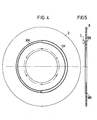
- the rear side is shown in plan view in FIG. 4, and such an opaque flanged washer B is shown in section in FIG. 5.
- Radial are the reflective marking RM on one half of the flanged wheel B and the non-reflective marking on the other half. tion NM arranged.
- the scanning reflection light barrier L is shown in FIG. 5.
- the surface of the non-reflective marking NM ' is inclined towards the hub N, so that the optoelectronic scanning arrangement is insensitive to external light entering from outside.
- the non-reflecting marking NM forms, on average (FIG. 5), a triangular profile together with the flanged wheel B.
- the height of this profile can be smaller, the smaller the divergence of the light sender LS emitted light, and the closer the photoelectric reflex switch L can be attached to the flanged wheel B.
Landscapes
- Physics & Mathematics (AREA)
- Electromagnetism (AREA)
- Engineering & Computer Science (AREA)
- Health & Medical Sciences (AREA)
- General Health & Medical Sciences (AREA)
- Toxicology (AREA)
- Artificial Intelligence (AREA)
- Computer Vision & Pattern Recognition (AREA)
- General Physics & Mathematics (AREA)
- Theoretical Computer Science (AREA)
- Optical Transform (AREA)
- Length Measuring Devices By Optical Means (AREA)
Abstract
Description
- Die Erfindung betrifft eine optoelektronische Abtastanordnung gemäß dem Oberbegriff des Patentanspruches 1.
- Es ist allgemein bekannt, optoelektronische Abtastanordnungen zur Überwachung von Bewegungsvorgängen zu verwenden. Die weiteren Ausführungen beschränken sich auf solche optoelektronischen Abtastanordnungen,bei denen das von einem Lichtsender abgegebene Licht von einer Reflektionsfläche reflektiert und in einem Lichtempfänger registriert wird. Meist sind hierbei der Lichtsender und der Lichtempfänger in einem Gehäuse untergebracht, und bilden eine sogenannte Reflexions-Lichtschranke.
- Um einen sicheren Betrieb der Reflexions-Lichtschranke zu gewährleisten, muß diese zwei eindeutig unterscheidbare Signale abgeben. Ein erstes Signal zeigt an, daß von dem Lichtempfänger reflektiertes Licht registriert wird, also eine reflektierende Fläche vorhanden ist, ein zweites Signal zeigt an, daß kein reflektiertes Licht registriert wird, also keine reflektierende Fläche vorhanden ist.
- Es ist denkbar, als reflektierende Fläche eine verspiegelte Fläche, und als nichtreflektierende Fläche eine Fläche aus lichtabsorbierendem Material zu verwenden. Es ist weiter bekannt, als nichtreflektierende Fläche einen tiefen Schlitz zu verwenden, der zudem noch mit lichtabsorbierendem Material ausgekleidet sein kann. Streulicht und eine Verschmutzung der reflektierenden Fläche verkleinern den Unterschied zwischen den beiden zugehörigen Signalen. Eine Verschmutzung der reflektierenden Fläche ergibt weniger Licht im Lichtempfänger und dadurch ein kleineres Signal. Streulicht ergibt trotz Abtastung der nichtreflektierenden Fläche mehr Licht im Lichtempfänger und damit ein größeres Signal. Weiter bewirkt eine verschmutzte, nichtreflektierende Fläche ebenfalls mehr Licht im Lichtempfänger und damit eine Störung des Signals.
- Es ist Aufgabe der Erfindung, für eine optoelektronische Abtastanordnung, insbesondere für eine Reflexions-Lichtschranke, Markierungen anzugeben, bei deren Abtastung sich die zugehörigen Ausgangssignale deutlich unterscheiden.
- Diese-Aufgabe wird erfindungsgemäß durch die im kennzeichnenden Teil des Patentanspruchs 1 angegebenen Merkmale gelöst.
- In den Unteransprüchen sind vorteilhafte Ausgestaltungen angegeben.
- Durch die erfindungsgemäße optoelektronische Abtastanordnung ist auch bei Verschmutzung der beiden Flächen ein sicherer Betrieb gewährleistet.
- Vorteilhaft ist die Verwendung der erfindungsgemäßen optoelektronischen Abtastanordnung zur Überwachung der Drehung einer Bandspule, insbesondere eines Festwickels, in einem Magnetbandgerät.
- Um den Einfluß von Fremdlicht zu vermeiden, ist vorzugsweise die nichtreflektierende Fläche zur Nabe der Bordscheibe der Bandspule hin geneigt.
- Im folgenden wird die erfindungsgemäße optoelektronische Abtastanordnung anhand eines Ausführungsbeispiels erläutert. Dabei zeigen:
- Fig. 1 eine Reflexions-Lichtschranke mit einer reflektierenden Markierung.
- Fig. 2 und 3 jeweils eine Reflexions-Lichtschranke mit einer nichtreflektierenden Markierung.
- Fig. 4 in Draufsicht die.Rückseite einer Bordscheibe eines Festwickels und
- Fig. 5 im Schnitt eine Bordscheibe eines Festwickels.
- In den Fig. 1 bis 3 ist eine optoelektronische Abtastanordnung dargestellt, die jeweils aus einer Reflexions-Lichtschranke L und einer reflektierenden Markierung RM (Fig. 1) bzw. einer nichtreflektierenden Markierung NM (Fig. 2 und 3) besteht. Die Reflexions-Lichtschranke L besteht hierbei aus einem Lichtsender LS und einem Lichtempfänger . LE, die gemeinsam in einem Gehäuse untergebracht sind. Unter einer nichtreflektierenden Markierung NM ist eine Fläche zu verstehen, durch die kein, vom Lichtsender LS abgegebenes Licht in den Lichtempfänger LE reflektiert wird.
- Im folgenden wird davon ausgegangen, daß sich die reflektierende Markierung RM bzw. die nichtreflektierende Markeirung NM relativ zur Lichtschranke L bewegen. Die Bewegungsrichtung ist in den Fig. 1 bis 3 senkrecht zur Zeichenebene gewählt. In den Fig. 1 und 2 ist die Achse Lichtsender LS, Lichtempfänger LE, senkrecht zur Bewegungsrichtung, in der Fig. 3 ist die Achse Lichtsender LS, Lichtempfänger LE parallel zur Bewegungsrichtung angeordnet. Die Lichtschranke L ist in einem Abstand A zur reflektierenden Markierung RM angeordnet., der durch die geometrische Bauform der Lichtschranke L bestimmt ist, da das vom Lichtsender LS ausgesandte Licht (in den Fig. 1 bis 3 durch Pfeile dargestellt), unter Einhaltung des Refelxionswinkels von der reflektierenden Markierung RM in den Lichtempfänger LE reflektiert wird. Die Fläche der reflektierenden Markierung RM ist beispielsweise, um den Reflexionsgrad zu erhöhen, verspiegelt.
- Die nichtreflektierende Markierung NM (Fig. 2 und 3) ist erfindungsgemäß eine Fläche, die um einen Winkel W gegen die Achse des vom Lichtsender LS ausgesandten Lichtbündels geneigt ist. Der Winkel W ist so gewählt, daß trotz Divergenz der Lichtstrahlen kein vom Lichtsender LS kommendes Licht von der nichtreflektierenden Markierung NM in den Lichtempfänger LE reflektiert wird. Auch diese Fläche kann verspiegelt sein.
- Die erfindungsgemäße optoelektronische Abtastanordnung kann beispielsweise zur Überwachung der Drehung einer Bandspule, insbesondere des Festwickels in einem Magnetbandgerät verwendet werden. Der Festwickel besteht hierbei aus einer Nabe N und zwei Bordscheiben, wobei die dem Gerät zugewandte opak ausgebildet ist. In Fig. 4 ist in Draufsicht die Rückseite., und in Fig. 5 im Schnitt eine solche opake Bordscheibe B dargestellt. Radial sind auf einer Hälfte der Bordscheibe B die reflektierende Markierung RM, auf der anderen Hälfte die nichtreflektierende Markie-. rung NM angeordnet. Weiter ist in Fig. 5 die abtastende -Reflexions-Lichtschranke L dargestellt. Wie hier zu sehen ist, ist die Fläche der nichtreflektierende Markierung NM' zur Nabe N hin geneigt, so daß die optoelektronische Abtastanordnung gegen von außen eindringendes Fremdlicht unempfindlich ist. Die nichtreflektierende Markierung NM bildet im Schnitt (Fig. 5) zusammen mit der Bordscheibe B ein dreieckförmiges Profil. Die Höhe dieses Profils kann umso kleiner sein, je kleiner die Divergenz des vom Lichtsender LS ausgesandten Lichtes ist, und je dichter die Reflexions-Lichtschranke L an der Bordscheibe B angebracht werden kann.
Claims (6)
dadurch gekennzeichnet , daß die Markierungen aus jeweils einer reflektierenden Markierung (RM), deren Fläche ein vom Lichtsender (LS) abgestrahltes Lichtbündel in den Lichtempfänger (LE) reflektiert, und einer nichtreflektierenden Markierung (NM) besteht, die aus einer um einen Winkel (W) gegen die Achse des Lichtbündels geneigten Fläche besteht, so daß das vom Lichtsender (LS) abgestrahlte Lichtbündel nicht in den Lichtempfänger (LE) reflektiert-wird.
dadurch gekennzeichnet_, daß die ncihtreflektierende Markierung (NM) aus einer verspiegelten Fläche besteht.
dadurch gekennzeichnet , daß die reflektierende Markierung (RM) und die nichtreflektieren- - den (NM) aus verspiegelten Flächen bestehen.
dadurch gekennzeichnet , daß damit die Drehung einer Bandspule in einem Magnetbandgerät überwacht wird.
dadurch gekennzeichnet , daß auf der, dem Gerät zugewandten Bordscheibe (B) der Bandspule radial die reflektierende Markierung (RM) und die nichtreflektierende Markierung (NM) aufgebracht sind.
dadurch gekennzeichnet , daß die nichtreflektierende Markierung (NM) im Schnitt zusammen mit der Bordscheibe (B) ein dreieckförmiges Profil bildet, wobei die nichtreflektierende Markierung (NM) zur Nabe (N) der Bordscheibe (B) hin geneigt ist.
Applications Claiming Priority (2)
| Application Number | Priority Date | Filing Date | Title |
|---|---|---|---|
| DE3310394A DE3310394C1 (de) | 1983-03-22 | 1983-03-22 | Optoelektronische Abtastanordnung |
| DE3310394 | 1983-03-22 |
Publications (3)
| Publication Number | Publication Date |
|---|---|
| EP0123128A2 true EP0123128A2 (de) | 1984-10-31 |
| EP0123128A3 EP0123128A3 (en) | 1986-03-12 |
| EP0123128B1 EP0123128B1 (de) | 1989-11-15 |
Family
ID=6194309
Family Applications (1)
| Application Number | Title | Priority Date | Filing Date |
|---|---|---|---|
| EP84103018A Expired EP0123128B1 (de) | 1983-03-22 | 1984-03-19 | Optoelektronische Abtastanordnung |
Country Status (3)
| Country | Link |
|---|---|
| US (1) | US4673809A (de) |
| EP (1) | EP0123128B1 (de) |
| DE (2) | DE3310394C1 (de) |
Cited By (2)
| Publication number | Priority date | Publication date | Assignee | Title |
|---|---|---|---|---|
| WO1995019012A1 (en) * | 1994-01-11 | 1995-07-13 | Hine Design Incorporated | Apparatus and methods for viewing identification marks on semiconductor wafers |
| DE102017001463A1 (de) * | 2017-02-15 | 2018-08-16 | Minebea Mitsumi Inc. | Spindelmotor |
Families Citing this family (6)
| Publication number | Priority date | Publication date | Assignee | Title |
|---|---|---|---|---|
| US4780610A (en) * | 1986-03-04 | 1988-10-25 | Alps Electric Co., Ltd. | Optical rotary encoder having superposed metal plate and shield plate |
| US4811002A (en) * | 1986-10-03 | 1989-03-07 | Honda Giken Kogyo Kabushiki Kaisha | Relative positional relation detecting system |
| US5616908A (en) * | 1991-09-17 | 1997-04-01 | Metrologic Instruments, Inc. | Automatic countertop laser scanner with flickering laser scanner beam for improved visibility thereof during bar code symbol reading |
| US5388048A (en) * | 1993-02-16 | 1995-02-07 | Silicon Heights Limited | Vehicle anti-collison device |
| JPH11201779A (ja) * | 1998-01-07 | 1999-07-30 | Fanuc Ltd | 光学式エンコーダ |
| US20030156531A1 (en) * | 2002-02-19 | 2003-08-21 | G6 Science Corporation | Disk data storage media with edge track data surface, methods to manufacture, exploit and convert conventional disk media to that having an edge track data surface |
Family Cites Families (9)
| Publication number | Priority date | Publication date | Assignee | Title |
|---|---|---|---|---|
| DE760288C (de) * | 1940-10-19 | 1954-04-22 | Aeg | Anordnung zur Messung und Anzeige der Frequenz von periodischen Vorgaengen, insbesondere zur leistungslosen Fernanzeige von Drehzahlen |
| DE2135195C3 (de) * | 1971-07-14 | 1974-05-09 | Magyar Optikai Muevek | Unter Verwendung von Abbildungselementen optisch abtastbare, informationstragende Einrichtung an bewegten Fahrzeugen |
| GB1416679A (en) * | 1971-11-05 | 1975-12-03 | Ferraris Dev Eng Co Ltd | Measurement of rotation of a rotary member |
| US4175236A (en) * | 1977-12-23 | 1979-11-20 | Owens-Illinois, Inc. | Method and apparatus of cavity identification of mold of origin |
| DE2909735B2 (de) * | 1979-03-13 | 1981-01-15 | Becker Autoradiowerk Gmbh, 7516 Karlsbad | Optischer Impulsgeber |
| US4387299A (en) * | 1979-06-25 | 1983-06-07 | Yazaki Sogyo Kabushiki Kaisha | Travel-distance signal generator for vehicles |
| US4409469A (en) * | 1980-01-21 | 1983-10-11 | Sharp Kabushiki Kaisha | Optical bar code reader |
| US4547073A (en) * | 1981-02-17 | 1985-10-15 | Matsushita Electric Industrial Co., Ltd. | Surface examining apparatus and method |
| US4536650A (en) * | 1983-01-26 | 1985-08-20 | Ing. C. Olivetti & C., S.P.A. | Optical transducer with a transparent shutter disk |
-
1983
- 1983-03-22 DE DE3310394A patent/DE3310394C1/de not_active Expired
-
1984
- 1984-03-19 DE DE8484103018T patent/DE3480495D1/de not_active Expired
- 1984-03-19 EP EP84103018A patent/EP0123128B1/de not_active Expired
-
1986
- 1986-08-18 US US06/899,184 patent/US4673809A/en not_active Expired - Fee Related
Cited By (3)
| Publication number | Priority date | Publication date | Assignee | Title |
|---|---|---|---|---|
| WO1995019012A1 (en) * | 1994-01-11 | 1995-07-13 | Hine Design Incorporated | Apparatus and methods for viewing identification marks on semiconductor wafers |
| US5831738A (en) * | 1994-01-11 | 1998-11-03 | Hine Design Inc. | Apparatus and methods for viewing identification marks on semiconductor wafers |
| DE102017001463A1 (de) * | 2017-02-15 | 2018-08-16 | Minebea Mitsumi Inc. | Spindelmotor |
Also Published As
| Publication number | Publication date |
|---|---|
| DE3480495D1 (de) | 1989-12-21 |
| EP0123128A3 (en) | 1986-03-12 |
| DE3310394C1 (de) | 1984-08-16 |
| EP0123128B1 (de) | 1989-11-15 |
| US4673809A (en) | 1987-06-16 |
Similar Documents
| Publication | Publication Date | Title |
|---|---|---|
| DE3517889C2 (de) | ||
| EP0897120B1 (de) | Vorrichtung zum Orten von in einen zu überwachenden Raumbereich eindringenden Objekten. | |
| DE3926228C2 (de) | ||
| DE9219146U1 (de) | Lichtelektrische Vorrichtung zum Orten von Hindernissen | |
| EP0377097A1 (de) | Lenkwinkelsensor für ein Kraftfahrzeug | |
| DE69001657T2 (de) | Optische kodierer. | |
| DE202011001702U1 (de) | Detektor und mobiler Automat mit demselben | |
| EP0123929A2 (de) | Fehlerfeststellungsvorrichtung | |
| EP0557564A1 (de) | Montagevorrichtung für eine Winkelmesseinrichtung | |
| DE19830120B4 (de) | Optoelektronische Sensoreinrichtung | |
| DE1774562B2 (de) | Anordnung zum Abtasten von rückstrahlenden Markierungen | |
| DE69123899T2 (de) | Optisches Gerät zum Detektieren der Position | |
| DE69205062T2 (de) | Optische Abtastvorrichtung. | |
| EP0123128B1 (de) | Optoelektronische Abtastanordnung | |
| DE2459358B2 (de) | Vorrichtung zur erfassung einer reflektierenden flaeche auf einem traegerkoerper | |
| EP0668236A1 (de) | Anordnung zur Lastpositionierung bei Kranen | |
| DE112016003886T5 (de) | Flüssigkeitssensor | |
| DE2236482A1 (de) | Unfallschutzlichtvorhang | |
| DE3710068C2 (de) | ||
| DE10147176A1 (de) | Sensoreinrichtung zur Erfassung der Benetzung einer Scheibe, insbesondere einer Kraftfahrzeugscheibe | |
| DE2432421A1 (de) | Optischer schalter | |
| DE19946220C1 (de) | Optoelektronische Sensoreinrichtung | |
| DE19838731C2 (de) | Lenkwinkelsensor | |
| DE69219005T2 (de) | Optischer Kopfantrieb | |
| DE2200092B2 (de) | Optische Lesevorrichtung zur Abtastung von Codemarken auf Gegenständen |
Legal Events
| Date | Code | Title | Description |
|---|---|---|---|
| PUAI | Public reference made under article 153(3) epc to a published international application that has entered the european phase |
Free format text: ORIGINAL CODE: 0009012 |
|
| AK | Designated contracting states |
Designated state(s): DE FR GB |
|
| 17P | Request for examination filed |
Effective date: 19841221 |
|
| PUAL | Search report despatched |
Free format text: ORIGINAL CODE: 0009013 |
|
| AK | Designated contracting states |
Kind code of ref document: A3 Designated state(s): DE FR GB |
|
| 17Q | First examination report despatched |
Effective date: 19880205 |
|
| GRAA | (expected) grant |
Free format text: ORIGINAL CODE: 0009210 |
|
| AK | Designated contracting states |
Kind code of ref document: B1 Designated state(s): DE FR GB |
|
| REF | Corresponds to: |
Ref document number: 3480495 Country of ref document: DE Date of ref document: 19891221 |
|
| ET | Fr: translation filed | ||
| GBT | Gb: translation of ep patent filed (gb section 77(6)(a)/1977) | ||
| PGFP | Annual fee paid to national office [announced via postgrant information from national office to epo] |
Ref country code: FR Payment date: 19900321 Year of fee payment: 7 |
|
| PGFP | Annual fee paid to national office [announced via postgrant information from national office to epo] |
Ref country code: DE Payment date: 19900528 Year of fee payment: 7 |
|
| PLBE | No opposition filed within time limit |
Free format text: ORIGINAL CODE: 0009261 |
|
| STAA | Information on the status of an ep patent application or granted ep patent |
Free format text: STATUS: NO OPPOSITION FILED WITHIN TIME LIMIT |
|
| 26N | No opposition filed | ||
| PGFP | Annual fee paid to national office [announced via postgrant information from national office to epo] |
Ref country code: GB Payment date: 19910218 Year of fee payment: 8 |
|
| PG25 | Lapsed in a contracting state [announced via postgrant information from national office to epo] |
Ref country code: FR Effective date: 19911129 |
|
| PG25 | Lapsed in a contracting state [announced via postgrant information from national office to epo] |
Ref country code: DE Effective date: 19920101 |
|
| REG | Reference to a national code |
Ref country code: FR Ref legal event code: ST |
|
| PG25 | Lapsed in a contracting state [announced via postgrant information from national office to epo] |
Ref country code: GB Effective date: 19920319 |
|
| GBPC | Gb: european patent ceased through non-payment of renewal fee |