EP0124461A1 - Procédé pour le nettoyage et la décontamination de lentilles de contact et composition pour sa mise en oeuvre - Google Patents
Procédé pour le nettoyage et la décontamination de lentilles de contact et composition pour sa mise en oeuvre Download PDFInfo
- Publication number
- EP0124461A1 EP0124461A1 EP84440016A EP84440016A EP0124461A1 EP 0124461 A1 EP0124461 A1 EP 0124461A1 EP 84440016 A EP84440016 A EP 84440016A EP 84440016 A EP84440016 A EP 84440016A EP 0124461 A1 EP0124461 A1 EP 0124461A1
- Authority
- EP
- European Patent Office
- Prior art keywords
- agent
- lens
- agents
- effect
- germs
- Prior art date
- Legal status (The legal status is an assumption and is not a legal conclusion. Google has not performed a legal analysis and makes no representation as to the accuracy of the status listed.)
- Granted
Links
- 239000000203 mixture Substances 0.000 title claims abstract description 48
- 238000004140 cleaning Methods 0.000 title claims abstract description 17
- 238000000034 method Methods 0.000 title claims abstract description 16
- 239000003795 chemical substances by application Substances 0.000 claims abstract description 44
- 244000052616 bacterial pathogen Species 0.000 claims abstract description 23
- 230000000694 effects Effects 0.000 claims abstract description 16
- 230000001590 oxidative effect Effects 0.000 claims abstract description 15
- 238000006243 chemical reaction Methods 0.000 claims abstract description 9
- 230000001954 sterilising effect Effects 0.000 claims abstract description 6
- 239000006227 byproduct Substances 0.000 claims abstract description 5
- 230000015556 catabolic process Effects 0.000 claims abstract description 5
- 238000006731 degradation reaction Methods 0.000 claims abstract description 5
- 238000004659 sterilization and disinfection Methods 0.000 claims abstract description 4
- AQLJVWUFPCUVLO-UHFFFAOYSA-N urea hydrogen peroxide Chemical group OO.NC(N)=O AQLJVWUFPCUVLO-UHFFFAOYSA-N 0.000 claims description 16
- 239000000843 powder Substances 0.000 claims description 12
- 239000000546 pharmaceutical excipient Substances 0.000 claims description 8
- 230000000844 anti-bacterial effect Effects 0.000 claims description 7
- 102000004169 proteins and genes Human genes 0.000 claims description 7
- 108090000623 proteins and genes Proteins 0.000 claims description 7
- 230000002730 additional effect Effects 0.000 claims description 4
- 239000011248 coating agent Substances 0.000 claims description 4
- 238000000576 coating method Methods 0.000 claims description 4
- 239000012736 aqueous medium Substances 0.000 claims description 3
- MSFGZHUJTJBYFA-UHFFFAOYSA-M sodium dichloroisocyanurate Chemical group [Na+].ClN1C(=O)[N-]C(=O)N(Cl)C1=O MSFGZHUJTJBYFA-UHFFFAOYSA-M 0.000 claims description 3
- 229920003229 poly(methyl methacrylate) Polymers 0.000 claims description 2
- 239000004926 polymethyl methacrylate Substances 0.000 claims description 2
- 150000003839 salts Chemical class 0.000 claims description 2
- 239000007787 solid Substances 0.000 claims description 2
- 239000002775 capsule Substances 0.000 claims 1
- 239000008187 granular material Substances 0.000 claims 1
- 239000011812 mixed powder Substances 0.000 claims 1
- 239000003638 chemical reducing agent Substances 0.000 abstract description 16
- 239000000047 product Substances 0.000 abstract description 16
- MHAJPDPJQMAIIY-UHFFFAOYSA-N Hydrogen peroxide Chemical compound OO MHAJPDPJQMAIIY-UHFFFAOYSA-N 0.000 abstract description 14
- 239000007800 oxidant agent Substances 0.000 abstract description 10
- 230000008569 process Effects 0.000 abstract description 6
- QWPPOHNGKGFGJK-UHFFFAOYSA-N hypochlorous acid Chemical compound ClO QWPPOHNGKGFGJK-UHFFFAOYSA-N 0.000 abstract description 3
- 239000007864 aqueous solution Substances 0.000 abstract description 2
- 238000011065 in-situ storage Methods 0.000 abstract description 2
- WQYVRQLZKVEZGA-UHFFFAOYSA-N hypochlorite Chemical compound Cl[O-] WQYVRQLZKVEZGA-UHFFFAOYSA-N 0.000 description 22
- 150000001875 compounds Chemical class 0.000 description 19
- 239000000243 solution Substances 0.000 description 18
- XLYOFNOQVPJJNP-UHFFFAOYSA-N water Substances O XLYOFNOQVPJJNP-UHFFFAOYSA-N 0.000 description 13
- 244000005700 microbiome Species 0.000 description 8
- 238000012360 testing method Methods 0.000 description 8
- 230000009471 action Effects 0.000 description 7
- 238000005202 decontamination Methods 0.000 description 7
- 230000003588 decontaminative effect Effects 0.000 description 7
- KRKNYBCHXYNGOX-UHFFFAOYSA-N citric acid Chemical compound OC(=O)CC(O)(C(O)=O)CC(O)=O KRKNYBCHXYNGOX-UHFFFAOYSA-N 0.000 description 6
- 239000000126 substance Substances 0.000 description 6
- 239000000725 suspension Substances 0.000 description 6
- 241000589517 Pseudomonas aeruginosa Species 0.000 description 5
- 241000191967 Staphylococcus aureus Species 0.000 description 5
- 230000000845 anti-microbial effect Effects 0.000 description 5
- 238000004090 dissolution Methods 0.000 description 5
- 238000002474 experimental method Methods 0.000 description 5
- -1 hypochlorite anions Chemical class 0.000 description 5
- 241000894006 Bacteria Species 0.000 description 4
- 241000191070 Escherichia coli ATCC 8739 Species 0.000 description 4
- DHMQDGOQFOQNFH-UHFFFAOYSA-N Glycine Chemical compound NCC(O)=O DHMQDGOQFOQNFH-UHFFFAOYSA-N 0.000 description 4
- UIIMBOGNXHQVGW-UHFFFAOYSA-M Sodium bicarbonate Chemical compound [Na+].OC([O-])=O UIIMBOGNXHQVGW-UHFFFAOYSA-M 0.000 description 4
- FAPWRFPIFSIZLT-UHFFFAOYSA-M Sodium chloride Chemical compound [Na+].[Cl-] FAPWRFPIFSIZLT-UHFFFAOYSA-M 0.000 description 4
- 239000002609 medium Substances 0.000 description 4
- 238000006386 neutralization reaction Methods 0.000 description 4
- 239000008213 purified water Substances 0.000 description 4
- CDBYLPFSWZWCQE-UHFFFAOYSA-L sodium carbonate Substances [Na+].[Na+].[O-]C([O-])=O CDBYLPFSWZWCQE-UHFFFAOYSA-L 0.000 description 4
- RYFMWSXOAZQYPI-UHFFFAOYSA-K trisodium phosphate Chemical compound [Na+].[Na+].[Na+].[O-]P([O-])([O-])=O RYFMWSXOAZQYPI-UHFFFAOYSA-K 0.000 description 4
- 230000000721 bacterilogical effect Effects 0.000 description 3
- 230000003111 delayed effect Effects 0.000 description 3
- 238000009472 formulation Methods 0.000 description 3
- 231100000252 nontoxic Toxicity 0.000 description 3
- 230000003000 nontoxic effect Effects 0.000 description 3
- 230000009467 reduction Effects 0.000 description 3
- 239000011734 sodium Substances 0.000 description 3
- SUKJFIGYRHOWBL-UHFFFAOYSA-N sodium hypochlorite Chemical compound [Na+].Cl[O-] SUKJFIGYRHOWBL-UHFFFAOYSA-N 0.000 description 3
- 239000001488 sodium phosphate Substances 0.000 description 3
- CURLTUGMZLYLDI-UHFFFAOYSA-N Carbon dioxide Chemical compound O=C=O CURLTUGMZLYLDI-UHFFFAOYSA-N 0.000 description 2
- ZAMOUSCENKQFHK-UHFFFAOYSA-N Chlorine atom Chemical compound [Cl] ZAMOUSCENKQFHK-UHFFFAOYSA-N 0.000 description 2
- KRKNYBCHXYNGOX-UHFFFAOYSA-K Citrate Chemical compound [O-]C(=O)CC(O)(CC([O-])=O)C([O-])=O KRKNYBCHXYNGOX-UHFFFAOYSA-K 0.000 description 2
- 229920003139 Eudragit® L 100 Polymers 0.000 description 2
- 239000004471 Glycine Substances 0.000 description 2
- DGAQECJNVWCQMB-PUAWFVPOSA-M Ilexoside XXIX Chemical compound C[C@@H]1CC[C@@]2(CC[C@@]3(C(=CC[C@H]4[C@]3(CC[C@@H]5[C@@]4(CC[C@@H](C5(C)C)OS(=O)(=O)[O-])C)C)[C@@H]2[C@]1(C)O)C)C(=O)O[C@H]6[C@@H]([C@H]([C@@H]([C@H](O6)CO)O)O)O.[Na+] DGAQECJNVWCQMB-PUAWFVPOSA-M 0.000 description 2
- ZLMJMSJWJFRBEC-UHFFFAOYSA-N Potassium Chemical compound [K] ZLMJMSJWJFRBEC-UHFFFAOYSA-N 0.000 description 2
- WCUXLLCKKVVCTQ-UHFFFAOYSA-M Potassium chloride Chemical compound [Cl-].[K+] WCUXLLCKKVVCTQ-UHFFFAOYSA-M 0.000 description 2
- 239000005708 Sodium hypochlorite Substances 0.000 description 2
- XSQUKJJJFZCRTK-UHFFFAOYSA-N Urea Chemical compound NC(N)=O XSQUKJJJFZCRTK-UHFFFAOYSA-N 0.000 description 2
- 239000002253 acid Substances 0.000 description 2
- 229910052783 alkali metal Inorganic materials 0.000 description 2
- QVGXLLKOCUKJST-UHFFFAOYSA-N atomic oxygen Chemical compound [O] QVGXLLKOCUKJST-UHFFFAOYSA-N 0.000 description 2
- 239000000460 chlorine Substances 0.000 description 2
- 229910052801 chlorine Inorganic materials 0.000 description 2
- 238000000354 decomposition reaction Methods 0.000 description 2
- CEJLBZWIKQJOAT-UHFFFAOYSA-N dichloroisocyanuric acid Chemical compound ClN1C(=O)NC(=O)N(Cl)C1=O CEJLBZWIKQJOAT-UHFFFAOYSA-N 0.000 description 2
- 239000012895 dilution Substances 0.000 description 2
- 238000010790 dilution Methods 0.000 description 2
- CEYULKASIQJZGP-UHFFFAOYSA-L disodium;2-(carboxymethyl)-2-hydroxybutanedioate Chemical compound [Na+].[Na+].[O-]C(=O)CC(O)(C(=O)O)CC([O-])=O CEYULKASIQJZGP-UHFFFAOYSA-L 0.000 description 2
- 230000006870 function Effects 0.000 description 2
- 239000002054 inoculum Substances 0.000 description 2
- 229910052500 inorganic mineral Inorganic materials 0.000 description 2
- 239000000463 material Substances 0.000 description 2
- 235000010755 mineral Nutrition 0.000 description 2
- 239000011707 mineral Substances 0.000 description 2
- 239000001301 oxygen Substances 0.000 description 2
- 229910052760 oxygen Inorganic materials 0.000 description 2
- 229920000642 polymer Polymers 0.000 description 2
- 229910052700 potassium Inorganic materials 0.000 description 2
- 239000011591 potassium Substances 0.000 description 2
- 229960003975 potassium Drugs 0.000 description 2
- 229910052708 sodium Inorganic materials 0.000 description 2
- WXMKPNITSTVMEF-UHFFFAOYSA-M sodium benzoate Chemical compound [Na+].[O-]C(=O)C1=CC=CC=C1 WXMKPNITSTVMEF-UHFFFAOYSA-M 0.000 description 2
- 239000004299 sodium benzoate Substances 0.000 description 2
- 235000010234 sodium benzoate Nutrition 0.000 description 2
- 235000017557 sodium bicarbonate Nutrition 0.000 description 2
- 229910000030 sodium bicarbonate Inorganic materials 0.000 description 2
- 229910000029 sodium carbonate Inorganic materials 0.000 description 2
- 235000017550 sodium carbonate Nutrition 0.000 description 2
- 239000011780 sodium chloride Substances 0.000 description 2
- 159000000000 sodium salts Chemical class 0.000 description 2
- 231100000331 toxic Toxicity 0.000 description 2
- 230000002588 toxic effect Effects 0.000 description 2
- 229920002818 (Hydroxyethyl)methacrylate Polymers 0.000 description 1
- YRIZYWQGELRKNT-UHFFFAOYSA-N 1,3,5-trichloro-1,3,5-triazinane-2,4,6-trione Chemical compound ClN1C(=O)N(Cl)C(=O)N(Cl)C1=O YRIZYWQGELRKNT-UHFFFAOYSA-N 0.000 description 1
- BNHZEEUKIRMPBI-UHFFFAOYSA-N 1,4-dichloropiperazine-2,5-dione Chemical compound ClN1CC(=O)N(Cl)CC1=O BNHZEEUKIRMPBI-UHFFFAOYSA-N 0.000 description 1
- JGSJELBDCSJYKS-UHFFFAOYSA-N 2-(dichloroamino)acetic acid Chemical compound OC(=O)CN(Cl)Cl JGSJELBDCSJYKS-UHFFFAOYSA-N 0.000 description 1
- AZQQPZDRBOZUGY-UHFFFAOYSA-N 2-[chloro-(N'-chlorocarbamimidoyl)amino]acetic acid Chemical compound ClN(CC(=O)O)C(NCl)=N AZQQPZDRBOZUGY-UHFFFAOYSA-N 0.000 description 1
- AZKHCWNPCUORLC-UHFFFAOYSA-N 3-(dichloroamino)propanoic acid Chemical compound OC(=O)CCN(Cl)Cl AZKHCWNPCUORLC-UHFFFAOYSA-N 0.000 description 1
- BVKZGUZCCUSVTD-UHFFFAOYSA-M Bicarbonate Chemical class OC([O-])=O BVKZGUZCCUSVTD-UHFFFAOYSA-M 0.000 description 1
- OYPRJOBELJOOCE-UHFFFAOYSA-N Calcium Chemical compound [Ca] OYPRJOBELJOOCE-UHFFFAOYSA-N 0.000 description 1
- ZKQDCIXGCQPQNV-UHFFFAOYSA-N Calcium hypochlorite Chemical compound [Ca+2].Cl[O-].Cl[O-] ZKQDCIXGCQPQNV-UHFFFAOYSA-N 0.000 description 1
- VEXZGXHMUGYJMC-UHFFFAOYSA-M Chloride anion Chemical compound [Cl-] VEXZGXHMUGYJMC-UHFFFAOYSA-M 0.000 description 1
- ZGTMUACCHSMWAC-UHFFFAOYSA-L EDTA disodium salt (anhydrous) Chemical compound [Na+].[Na+].OC(=O)CN(CC([O-])=O)CCN(CC(O)=O)CC([O-])=O ZGTMUACCHSMWAC-UHFFFAOYSA-L 0.000 description 1
- 241000588724 Escherichia coli Species 0.000 description 1
- WOBHKFSMXKNTIM-UHFFFAOYSA-N Hydroxyethyl methacrylate Chemical compound CC(=C)C(=O)OCCO WOBHKFSMXKNTIM-UHFFFAOYSA-N 0.000 description 1
- GUBGYTABKSRVRQ-QKKXKWKRSA-N Lactose Natural products OC[C@H]1O[C@@H](O[C@H]2[C@H](O)[C@@H](O)C(O)O[C@@H]2CO)[C@H](O)[C@@H](O)[C@H]1O GUBGYTABKSRVRQ-QKKXKWKRSA-N 0.000 description 1
- WHXSMMKQMYFTQS-UHFFFAOYSA-N Lithium Chemical compound [Li] WHXSMMKQMYFTQS-UHFFFAOYSA-N 0.000 description 1
- FYYHWMGAXLPEAU-UHFFFAOYSA-N Magnesium Chemical compound [Mg] FYYHWMGAXLPEAU-UHFFFAOYSA-N 0.000 description 1
- CERQOIWHTDAKMF-UHFFFAOYSA-N Methacrylic acid Chemical compound CC(=C)C(O)=O CERQOIWHTDAKMF-UHFFFAOYSA-N 0.000 description 1
- VVQNEPGJFQJSBK-UHFFFAOYSA-N Methyl methacrylate Chemical compound COC(=O)C(C)=C VVQNEPGJFQJSBK-UHFFFAOYSA-N 0.000 description 1
- 229910019093 NaOCl Inorganic materials 0.000 description 1
- 241000283973 Oryctolagus cuniculus Species 0.000 description 1
- 239000008118 PEG 6000 Substances 0.000 description 1
- 229910019142 PO4 Inorganic materials 0.000 description 1
- 229920002584 Polyethylene Glycol 6000 Polymers 0.000 description 1
- UIIMBOGNXHQVGW-DEQYMQKBSA-M Sodium bicarbonate-14C Chemical compound [Na+].O[14C]([O-])=O UIIMBOGNXHQVGW-DEQYMQKBSA-M 0.000 description 1
- 229920002472 Starch Polymers 0.000 description 1
- 230000002159 abnormal effect Effects 0.000 description 1
- 238000009825 accumulation Methods 0.000 description 1
- 150000007513 acids Chemical class 0.000 description 1
- 239000013543 active substance Substances 0.000 description 1
- 239000000654 additive Substances 0.000 description 1
- 150000001340 alkali metals Chemical class 0.000 description 1
- 229910052784 alkaline earth metal Inorganic materials 0.000 description 1
- 150000001342 alkaline earth metals Chemical class 0.000 description 1
- 239000004599 antimicrobial Substances 0.000 description 1
- 230000002238 attenuated effect Effects 0.000 description 1
- 239000003899 bactericide agent Substances 0.000 description 1
- 229910052788 barium Inorganic materials 0.000 description 1
- DSAJWYNOEDNPEQ-UHFFFAOYSA-N barium atom Chemical compound [Ba] DSAJWYNOEDNPEQ-UHFFFAOYSA-N 0.000 description 1
- 230000015572 biosynthetic process Effects 0.000 description 1
- 239000012888 bovine serum Substances 0.000 description 1
- 239000000872 buffer Substances 0.000 description 1
- 229910052791 calcium Inorganic materials 0.000 description 1
- 239000011575 calcium Substances 0.000 description 1
- 239000001569 carbon dioxide Substances 0.000 description 1
- 229910002092 carbon dioxide Inorganic materials 0.000 description 1
- 229920006217 cellulose acetate butyrate Polymers 0.000 description 1
- 239000007795 chemical reaction product Substances 0.000 description 1
- 229940001468 citrate Drugs 0.000 description 1
- 235000015165 citric acid Nutrition 0.000 description 1
- 239000012459 cleaning agent Substances 0.000 description 1
- 229920001688 coating polymer Polymers 0.000 description 1
- 210000004087 cornea Anatomy 0.000 description 1
- 230000008034 disappearance Effects 0.000 description 1
- 235000019262 disodium citrate Nutrition 0.000 description 1
- 239000002526 disodium citrate Substances 0.000 description 1
- 125000001495 ethyl group Chemical group [H]C([H])([H])C([H])([H])* 0.000 description 1
- 230000002349 favourable effect Effects 0.000 description 1
- 239000012729 immediate-release (IR) formulation Substances 0.000 description 1
- 238000007654 immersion Methods 0.000 description 1
- 125000001449 isopropyl group Chemical group [H]C([H])([H])C([H])(*)C([H])([H])[H] 0.000 description 1
- 239000000644 isotonic solution Substances 0.000 description 1
- 239000008101 lactose Substances 0.000 description 1
- 229910052744 lithium Inorganic materials 0.000 description 1
- LWXVCCOAQYNXNX-UHFFFAOYSA-N lithium hypochlorite Chemical compound [Li+].Cl[O-] LWXVCCOAQYNXNX-UHFFFAOYSA-N 0.000 description 1
- 229910052749 magnesium Inorganic materials 0.000 description 1
- 239000011777 magnesium Substances 0.000 description 1
- 229910052751 metal Inorganic materials 0.000 description 1
- 239000002184 metal Substances 0.000 description 1
- 125000002496 methyl group Chemical group [H]C([H])([H])* 0.000 description 1
- 229910000403 monosodium phosphate Inorganic materials 0.000 description 1
- 235000019799 monosodium phosphate Nutrition 0.000 description 1
- 235000015097 nutrients Nutrition 0.000 description 1
- 125000000962 organic group Chemical group 0.000 description 1
- 244000052769 pathogen Species 0.000 description 1
- 230000001717 pathogenic effect Effects 0.000 description 1
- 125000005342 perphosphate group Chemical group 0.000 description 1
- 235000021317 phosphate Nutrition 0.000 description 1
- 150000003013 phosphoric acid derivatives Chemical class 0.000 description 1
- 239000002504 physiological saline solution Substances 0.000 description 1
- 229920000193 polymethacrylate Polymers 0.000 description 1
- XAEFZNCEHLXOMS-UHFFFAOYSA-M potassium benzoate Chemical compound [K+].[O-]C(=O)C1=CC=CC=C1 XAEFZNCEHLXOMS-UHFFFAOYSA-M 0.000 description 1
- 239000001103 potassium chloride Substances 0.000 description 1
- 235000011164 potassium chloride Nutrition 0.000 description 1
- 229960002816 potassium chloride Drugs 0.000 description 1
- 239000001508 potassium citrate Substances 0.000 description 1
- 229960002635 potassium citrate Drugs 0.000 description 1
- 235000011082 potassium citrates Nutrition 0.000 description 1
- SATVIFGJTRRDQU-UHFFFAOYSA-N potassium hypochlorite Chemical compound [K+].Cl[O-] SATVIFGJTRRDQU-UHFFFAOYSA-N 0.000 description 1
- 239000002243 precursor Substances 0.000 description 1
- 238000004321 preservation Methods 0.000 description 1
- 239000003761 preservation solution Substances 0.000 description 1
- 230000002265 prevention Effects 0.000 description 1
- 230000000750 progressive effect Effects 0.000 description 1
- 125000001436 propyl group Chemical group [H]C([*])([H])C([H])([H])C([H])([H])[H] 0.000 description 1
- 238000000926 separation method Methods 0.000 description 1
- 229960002668 sodium chloride Drugs 0.000 description 1
- 239000001509 sodium citrate Substances 0.000 description 1
- AJPJDKMHJJGVTQ-UHFFFAOYSA-M sodium dihydrogen phosphate Chemical compound [Na+].OP(O)([O-])=O AJPJDKMHJJGVTQ-UHFFFAOYSA-M 0.000 description 1
- 229910000162 sodium phosphate Inorganic materials 0.000 description 1
- 235000011008 sodium phosphates Nutrition 0.000 description 1
- 241000894007 species Species 0.000 description 1
- 239000003381 stabilizer Substances 0.000 description 1
- 235000019698 starch Nutrition 0.000 description 1
- 238000003860 storage Methods 0.000 description 1
- 125000001424 substituent group Chemical group 0.000 description 1
- 239000004094 surface-active agent Substances 0.000 description 1
- 229950009390 symclosene Drugs 0.000 description 1
- 230000002195 synergetic effect Effects 0.000 description 1
- 125000000999 tert-butyl group Chemical group [H]C([H])([H])C(*)(C([H])([H])[H])C([H])([H])[H] 0.000 description 1
- IXZDIALLLMRYOU-UHFFFAOYSA-N tert-butyl hypochlorite Chemical compound CC(C)(C)OCl IXZDIALLLMRYOU-UHFFFAOYSA-N 0.000 description 1
- 230000009466 transformation Effects 0.000 description 1
- 229910000406 trisodium phosphate Inorganic materials 0.000 description 1
- 235000019801 trisodium phosphate Nutrition 0.000 description 1
Classifications
-
- C—CHEMISTRY; METALLURGY
- C11—ANIMAL OR VEGETABLE OILS, FATS, FATTY SUBSTANCES OR WAXES; FATTY ACIDS THEREFROM; DETERGENTS; CANDLES
- C11D—DETERGENT COMPOSITIONS; USE OF SINGLE SUBSTANCES AS DETERGENTS; SOAP OR SOAP-MAKING; RESIN SOAPS; RECOVERY OF GLYCEROL
- C11D3/00—Other compounding ingredients of detergent compositions covered in group C11D1/00
- C11D3/395—Bleaching agents
- C11D3/3955—Organic bleaching agents
-
- A—HUMAN NECESSITIES
- A61—MEDICAL OR VETERINARY SCIENCE; HYGIENE
- A61L—METHODS OR APPARATUS FOR STERILISING MATERIALS OR OBJECTS IN GENERAL; DISINFECTION, STERILISATION OR DEODORISATION OF AIR; CHEMICAL ASPECTS OF BANDAGES, DRESSINGS, ABSORBENT PADS OR SURGICAL ARTICLES; MATERIALS FOR BANDAGES, DRESSINGS, ABSORBENT PADS OR SURGICAL ARTICLES
- A61L12/00—Methods or apparatus for disinfecting or sterilising contact lenses; Accessories therefor
- A61L12/08—Methods or apparatus for disinfecting or sterilising contact lenses; Accessories therefor using chemical substances
- A61L12/10—Halogens or compounds thereof
- A61L12/107—Hypohalites; Active halogens
-
- A—HUMAN NECESSITIES
- A61—MEDICAL OR VETERINARY SCIENCE; HYGIENE
- A61L—METHODS OR APPARATUS FOR STERILISING MATERIALS OR OBJECTS IN GENERAL; DISINFECTION, STERILISATION OR DEODORISATION OF AIR; CHEMICAL ASPECTS OF BANDAGES, DRESSINGS, ABSORBENT PADS OR SURGICAL ARTICLES; MATERIALS FOR BANDAGES, DRESSINGS, ABSORBENT PADS OR SURGICAL ARTICLES
- A61L12/00—Methods or apparatus for disinfecting or sterilising contact lenses; Accessories therefor
- A61L12/08—Methods or apparatus for disinfecting or sterilising contact lenses; Accessories therefor using chemical substances
- A61L12/12—Non-macromolecular oxygen-containing compounds, e.g. hydrogen peroxide or ozone
- A61L12/124—Hydrogen peroxide; Peroxy compounds
-
- C—CHEMISTRY; METALLURGY
- C11—ANIMAL OR VEGETABLE OILS, FATS, FATTY SUBSTANCES OR WAXES; FATTY ACIDS THEREFROM; DETERGENTS; CANDLES
- C11D—DETERGENT COMPOSITIONS; USE OF SINGLE SUBSTANCES AS DETERGENTS; SOAP OR SOAP-MAKING; RESIN SOAPS; RECOVERY OF GLYCEROL
- C11D3/00—Other compounding ingredients of detergent compositions covered in group C11D1/00
- C11D3/0005—Other compounding ingredients characterised by their effect
- C11D3/0078—Compositions for cleaning contact lenses, spectacles or lenses
-
- C—CHEMISTRY; METALLURGY
- C11—ANIMAL OR VEGETABLE OILS, FATS, FATTY SUBSTANCES OR WAXES; FATTY ACIDS THEREFROM; DETERGENTS; CANDLES
- C11D—DETERGENT COMPOSITIONS; USE OF SINGLE SUBSTANCES AS DETERGENTS; SOAP OR SOAP-MAKING; RESIN SOAPS; RECOVERY OF GLYCEROL
- C11D3/00—Other compounding ingredients of detergent compositions covered in group C11D1/00
- C11D3/39—Organic or inorganic per-compounds
- C11D3/3945—Organic per-compounds
Definitions
- the subject of the present invention is a method for cleaning and decontaminating contact lenses, as well as compositions for carrying out this method.
- the method of the invention is applicable to most known contact lenses, for example polymethacrylate, hydroxyethylmethacrylate, cellulose acetate butyrate, etc. It is also applicable to the decontamination of storage cases for lenses and tips. hearing aids.
- French patent 7500237 describes a process for sterilizing hydrophilic contact lenses, characterized in that it comprises bringing the lens into contact with a solution of a compound releasing a non-toxic hypochlorite in an amount sufficient to destroy the micro - pathogenic organisms present, then reduction of hypochlorite to chloride by a non-toxic reducing agent, the quantity of which is sufficient for reduction of all hypochlorite.
- the present invention overcomes these drawbacks, that is to say simultaneously ensuring complete decontamination and effective cleaning of the lenses.
- the invention relates to a process for the sterilization and cleaning of contact lenses, of the type consisting in treating the lens, on the one hand with a first agent, of oxidizing character, having the effect of destroying the germs present on the lens, and on the other hand by a second agent, of a reducing nature, having the effect, by reaction with the first agent, of giving rise to reciprocal degradation by-products harmless to the eye, characterized in that one of the two agents has the additional effect of destroying the proteins, with a view to eliminating the veil disturbing the transparency of the lens, while the other agent itself has a bactericidal action exerted on germs, some of which at least are different from those sensitive to the first agent.
- the oxidizing compound of the redox system will be hydrogen peroxide released in situ by dissolving a precursor consisting of the first or the second compound.
- the redox systems of the invention ensure, by the same operation, the progressive decomposition of hydrogen peroxide according to the following reaction: 2 H 2 O 2 + Reducer ⁇ 2H 2 O + 2 (O) ⁇ O 2
- the contact lens is thus effectively cleaned and decontaminated by exposure to the action of hydrogen peroxide for an adequate period.
- the treated lens does not necessarily have to be removed from the container in which the treatment was carried out because the reducing agent present at the start acts so as to decompose H 2 0 2 by eliminating it thus by transformation into harmless reaction products, water and nascent oxygen.
- the latter has a cleaning effect and an additional decontamination action.
- Suitable oxidants are, for example, urea peroxide, perphosphates, perborates, percarbonates, alkali metal persulfates, this list not being limiting, and urea peroxide being the preferred compound according to the invention.
- the amount of oxidant to be used can vary from about 0.005% to 5%, and preferably from about 0.01% to 0.1 X.
- the reducing compound may be any hypochlorite or any chlorinated agent giving rise to hypochlorite anions at the time of use in an aqueous medium.
- the hypochlorite can be any mineral or organic hypochlorite of general formula A (OC1) x in which A represents a metal or an organic group, for example an alkali metal such as sodium, potassium and lithium, an alkaline earth metal such as barium, magnesium and calcium, an alkyl hypochlorite, for example tert-butyl, tert-amyl, ethyl, methyl, propyl, isopropyl and the like, and x represents the absolute charge of the mineral or organic substituent.
- sodium hypochlorite potassium hypochlorite, lithium hypochlorite, calcium hypochlorite, tert-butyl hypochlorite or tertio hypochlorite. -amyl.
- materials which give hypochlorous acid in aqueous solution can be used and which are stable when stored in the dry state.
- These materials are, for example N, N-dichloro t au- rine (sodium salt), N, N-dichloro-beta-alanine, N acid, N'-dichloroisocyanuric (potassium salt), N, N'-dichloroisocyanuric acid (sodium salt), N -chlorinated, N, N'-dichloro-2,5-pifugrazinedione, N, N'-1,3-dichloro-5,5-dimethylhydantoine, trichloroisocyanuric acid, N-chlorosyccinamide, N, N ' -dichloroglycocyamine, N, N-dichloroglycine.
- the amount of reducing agent which must be used to reduce the hydrogen peroxide according to favorable kinetics varies from approximately 0.02 X to approximately 6 X, and preferably from approximately 0.04% to 1%.
- the method consists in bringing the two compounds into play sequentially, by virtue of a specific structural presentation of the compositions of the invention such as, for example, multilayer tablet, tablet with several cores, one of the compounds being isolated from each other by a suitable coating, or by a separate presentation of the two compounds in a different container, for example double sachet or mechanical system (tilting container).
- a specific structural presentation of the compositions of the invention such as, for example, multilayer tablet, tablet with several cores, one of the compounds being isolated from each other by a suitable coating, or by a separate presentation of the two compounds in a different container, for example double sachet or mechanical system (tilting container).
- the invention therefore also relates to compositions for the sterilization and cleaning of contact lenses, of the type comprising a first agent, of oxidizing character, having the effect of destroying the germs present on the lens, and a second agent, of reducing character. , having the effect, by reaction with the first agent, of giving rise to reciprocal degradation by-products harmless to the eye, characterized in that one of the two agents has the additional effect of destroying proteins with a view to d '' remove the veil disturbing the transparency of the lens, while the other agent has an action bactericide exerted on germs, at least some of which are different from those sensitive to the first agent, the nature and the proportions of these agents being those already indicated above, and these agents intervening sequentially, according to the aforementioned specific presentation .
- compositions are used in the following manner.
- the lenses are placed by the user in any container, for example the lens case, in which a quantity of water has been previously disposed, depending on the volume of the container, and in which a sufficient quantity of the composition of the lens is added. the invention.
- the lenses are brought into contact with the composition for a period depending on the particular system used, at room temperature. The system ensures all safety, because the lenses can remain there several days without danger, the products of decomposition of the redox system being harmless for the eye.
- compositions according to the invention contain additives such as the solution, in which the lenses bathe after treatment, either isotonic and iso-pH (7,0,7,6).
- the wearer can directly place his suitably treated lenses on the eyes, without any subsequent treatment or rinsing.
- the method described above makes it possible to clean and decontaminate lenses daily while keeping them in their initial state. It allows you to do this in a situation of total security for the user.
- the products and instructions for use of the product are such that the user cannot make any operating error, decontamination and cleaning being carried out in a single operation.
- the substances which are used in the present invention namely the oxidants and the reducing agents, are chosen so that they do not affect the characteristics of the lens and not to be toxic to the eyes of the user of the lenses, nor to generate such toxic products.
- the final solution after cleaning and decontamination is isotonic and iso-pH to tears for the reasons of tolerance of the eye tissues contacted with the products and for reasons of compatibility with the polymer of the lens.
- Buffer excipients such as sodium benzoate, disodium edetate, sodium chloride or citrate, potassium chloride or citrate, phosphates and bicarbonates may be incorporated into the active substances described above. sodium and potassium.
- non-toxic excipients suitable for the eye allowing on the one hand delayed release of the reducing agent and, on the other hand, making it possible to avoid the chemical incompatibility between the oxidant and the reducing agent during the preservation of the product. , will be used in combination with the compositions of the invention.
- compositions according to the invention can be reinforced if an effervescent mixture is used comprising, in addition to the compounds described above, a product which releases, after dissolution, carbon dioxide whose mechanical action is cleaning.
- This product can be chosen, for example, without limitation, from the group comprising sodium bicarbonate, citric acid, sodium bicarbonate and sodium carbonate glycine (CGS), monosodium sodium citrate, monosodium phosphate .
- compositions in accordance with the invention are for example the following:
- compositions are to be dissolved respectively in 10 ml, 7 ml and 15 ml of water.
- This formulation avoids the possibility of reaction between the oxidizing compound, and the chlorinated trisodium phosphate (PTC) in a humidity-laden environment.
- Each layer is lubricated with sodium benzoate, PEG 6000 and hydrolyzed starches.
- This tablet is to be dissolved in 7 ml of purified water.
- the effervescence of these tri-layer tablets can be obtained by putting the CGS in the central layer (there is then an accentuated delay effect of the 3rd layer) or by incorporating it into the layer containing the P.T.C. (in this case, the amount of lactose in the 2nd layer is increased).
- Example III This example shows that the pretreatment with urea peroxide according to the invention retroactively destroys hypochlorite or hypochlorous acid.
- the redox system with programmed release, where the reducing agent is released in solution a certain time after the oxidant to allow the latter to act, is preferably in the form of a bi- or tri-layer tablet.
- hypochlorite released from chlorinated trisodium phosphate is itself oxidized by hydrogen peroxide produced by urea peroxide.
- the neutralization kinetics of free C1 2 shows that after 5 minutes of contact between the oxidant and the reducing agent, half of the released C1 2 is already destroyed by urea peroxide. After 1 hour, only 0.1 mg%, or 1 ppm, of free C1 2 remains in the solution. This amount of chlorine is perfectly biocompatible.
- This example illustrates the antimicrobial efficacy of a composition according to the invention, used in the form of two separate tablets.
- Tablet A has the following composition:
- the two tablets are introduced into 10 ml of germ suspension at 10 6 germs / ml.
- the powder "A” is dissolved in 10.0 ml of purified water contained in a suitable container for receiving the lenses. After 10 minutes of waiting, add the powder "B". A slight effervescence is observed, the final solution obtained being clear and limpid, having a pH of 7.3 and a cryoscopic point of -0.56 ° C.
- This example illustrates the antimicrobial efficacy of two compositions according to the invention each used in the form of a single tablet.
- Tablets A and B are intended to be dissolved in 10 ml of water.
- the solution obtained is clear and colorless, giving a pH of 7. 2 and a cryoscopic point of -0.57 ° C.
- This example illustrates the antibacterial efficacy of a composition according to the invention used in the form of a single powder, in which the grains of one of the two agents are coated with EUDRAGIT L 100. ..
- compositions are to be dissolved in 10 ml of water and bring, after dissolution, to a solution of pH 7.18 and cryoscopic point -0.56 ° C for composition I, and a solution of pH 7.0 and cryoscopic point of - 0.57 ° C for composition II.
- This formulation avoids the possibility of reaction between urea peroxide and sodium dichloroisocyanurate and allows delayed release of DCCNa in solution.
- the mixtures thus obtained are in the form of fine, non-sticky powders.
- Solution 1 is prepared from the combination of the two substances, solution 2 contains only urea peroxide, solution 3 contains only PTC.
- Three different types of bacteria are added to each of the solutions indicated at concentrations of 10 5 to 10 6 germs / ml. The number of live bacteria per culture on solid nutrient medium is observed after 1 h 30 of contact. The results obtained are re taken below.
- the formula tested is the complete formula: Urea peroxide and PTC brought into contact with bacteria at the same time. The concentration of the microorganisms is measured after counting.
- Urea peroxide and PTC put one after the other in contact: Urea peroxide + inoculum in contact for 15 min, then remaining from the formula.
- experiment 1 there is no delay effect: the two substances are brought into contact immediately.
- experiment 2 the delay effect is simulated by first making the urea peroxide act for 15 min, then the rest of the composition.
- the test used consists in causing the fouling of lenses. by immersion for 24 to 48 h in an isotonic solution of sodium chloride at 10% of attenuated bovine serum. We see the formation of a veil. After treatment of the veiled lenses by means of the compositions according to the invention, and in particular by application of those forming the subject of Examples IV and VI, without neutralization or rinsing, the disappearance of this veil is observed subjectively, and the lenses return to perfect transparency. The test was carried out on both soft and hard lenses.
- the lenses treated with the composition according to the invention showed no trace of deposits; thus demonstrating that the composition tested allows, in addition to effective cleaning, the prevention of a possible accumulation of deposits at the level of the lenses.
- compositions according to the invention both as anti-microbial compositions and as cleaning agents comes from the action of nascent oxygen which is released at the time of their use, which exerts a very strong oxidative action, particularly effective on anaerobic germs and on protein deposits, while the reducing agent and in particular sodium dichlorocyanurate exerts its own antibacterial action on all species of germs.
Landscapes
- Chemical & Material Sciences (AREA)
- Life Sciences & Earth Sciences (AREA)
- Chemical Kinetics & Catalysis (AREA)
- Health & Medical Sciences (AREA)
- Engineering & Computer Science (AREA)
- Oil, Petroleum & Natural Gas (AREA)
- Wood Science & Technology (AREA)
- Organic Chemistry (AREA)
- Epidemiology (AREA)
- General Chemical & Material Sciences (AREA)
- Animal Behavior & Ethology (AREA)
- General Health & Medical Sciences (AREA)
- Public Health (AREA)
- Veterinary Medicine (AREA)
- Inorganic Chemistry (AREA)
- Detergent Compositions (AREA)
- Apparatus For Disinfection Or Sterilisation (AREA)
- Eyeglasses (AREA)
- Agricultural Chemicals And Associated Chemicals (AREA)
- Liquid Crystal (AREA)
- Addition Polymer Or Copolymer, Post-Treatments, Or Chemical Modifications (AREA)
- Silicon Polymers (AREA)
Abstract
Description
- La présente invention a pour objet un procédé pour le nettoyage et la décontamination de lentilles de contact, ainsi que des compositions pour la mise en oeuvre de ce procédé.
- Le procédé de l'invention est applicable à la plupart des lentilles de contact connues, par exemple en polyméthacrylate, enhydroxyéthylmethacry- late, en acétobutyrate de cellulose etc... Il est également applicable à la décontamination des étuis de rangement des lentilles et des embouts de prothèses auditives.
- Des procédés de ce type, ayant pour but de décontaminer les lentilles par élimination des micro-organismes indésirables ainsi que de les nettoyer, sont déjà connus, et de nombreuses compositions ont été proposées à ces fins.
- Ainsi, le brevet français 7500237 décrit un procédé de stérilisation de lentilles cornéennes hydrophiles, caractérisé en ce qu'il comprend la mise en contact de la lentille avec une solution d'un composé libérant un hypochlorite non toxique en quantité suffisant à la destruction des micro- organismes pathogènes présents, puis la réduction de l'hypochlorite en chlorure par un agent réducteur non toxique dont la quantité suffit à la réduction de tout l'hypochlorite.
- Toutefois ce procédé demeure inefficace sur un certain nombre de germes pathogènes, et surtout il est sans action sur les dépôts protéiniques responsables de "voiles" qui troublent la transparence de la lentille.
- La présente invention permet de remédier à ces inconvénients, c'est-à-dire d'assurer simultanément la décontamination complète et un nettoyage efficace des lentilles.
- A cet effet, l'invention vise un procédé pour la stérilisation et le nettoyage des lentilles de contact, du type consistant à traiter la lentille, d'une part par un premier agent, de caractère oxydant, ayant pour effet de détruire les germes présents sur la lentille, et d'autre part par un second agent, de caractère réducteur, ayant pour effet, par réaction avec le premier agent, de donner naissance à des sous-produits de dégradation réciproque inoffensifs pour l'oeil, caractérisé en ce que l'un des deux agents a pour effet additionnel de détruire les protéines, en vue d'éliminer le voile troublant la transparence de la lentille, tandis que l'autre agent possède lui-même une action bactéricide s'exerçant sur des germes dont certains au moins sont différents de ceux sensibles au premier agent.
- De manière préférentielle le composé oxydant du système oxydo-réducteur sera de l'eau oxygénée libérée in situ par mise en solution d'un précurseur constitué par le premier ou le second composé.
- Les systèmes oxydo-réducteurs de l'invention assurent, par une même opération, la décomposition progressive du peroxyde d'hydrogène d'après la réaction suivante :
2 H2 O2 + Réductéur → 2H2O + 2 (O) → O2 - La lentille de contact est ainsi efficacement nettoyée et décontaminée par exposition à l'action du peroxyde d'hydrogène pendant une durée adéquate. Cependant, la lentille traitée ne doit pas nécessairement être retirée du récipient dans lequel le traitement a été effectué car le réducteur présent au départ agit de façon à décomposer H202 en l'éliminant ainsi par transformation en produits réactionnels inoffensifs, eau et oxygène naissant. Ce dernier, naturellement, a un effet nettoyant et une action de décontamination supplémentaire.
- On notera que la quantité de H202 que l'on retrouve dans le milieu après la décontamination et avant la réduction est quasiment identique à la quantité initiale présente dans le milieu.
- Des oxydants appropriés sont par exemple le peroxyde d'urée, les perphosphates, les perborates, les percarbonates, les persulfates de métaux alcalins, cette liste n'étant pas limitative, et le peroxyde d'urée étant le composé préféré selon l'invention.
- La quantité d'oxydant qui doit être utilisée peut varier depuis environ 0,005 % jusqu'à 5 %, et de préférence d'environ 0,01 % à 0,1 X.
- Par ailleurs le composé réducteur pourra être tout hypochlorite ou tout agent chloré donnant naissance à des anions hypochlorite au moment de l'emploi en milieu aqueux.
- L'hypochlorite peut être tout hypochlorite minéral ou organique de formule générale A(OC1)x dans laquelle A représente un métal ou un groupe organique, par exemple un métal alcalin tel que le sodium, le potassium et le lithium, un métal alcalino-terreux tel que le baryum, la magnésium et le calcium, un hypochlorite d'alkyle, par exemple de tertio-butyle, de tertio-amyle, d'éthyle, de méthyle, de propyle, d'iso- propyle et analogues, et x représente la charge absolue du substituant minéral ou organique. Ainsi, on peut utiliser par exemple de l'hypochlorite de sodium, de l'hypochlorite de potassium, de l'hypochlorite de lithium, de l'hypochlorite de calcium, de l'hypochlorite de tertio-butyle ou de l'hypochlorite de tertio-amyle.
- Au lieu d'ajouter l'hypochlorite tel quel, on peut utiliser des matières qui donnent de l'acide hypochloreux en solution aqueuse et qui sont stables lorsqu'on les conserve à l'état sec. Ces matières sont, par exemple la N,N-dichlorotau- rine (sel de sodium), la N,N-dichloro-bêta-alanine, l'acide N,N'-dichloroisocyanurique (sel de potassium), l'acide N,N'- dichloroisocyanurique (sel de sodium), la N-chlorurée, la N,N'-dichloro-2,5-pipérazinedione, la N,N'-1,3-dichloro-5,5-diméthylhydantoine, l'acide trichloroisocyanurique, le N-chlorosyccinamide, la N,N'-dichloroglycocyamine, la N,N-dichloroglycine.
- On peut également utiliser au même effet le complexe de phosphate trisodique hydraté et d'hypochlorite de sodium de formule n(Na3PO4, xH20) NaOCl, où n=4 à 7 et x= 11 à 12, que l'on désignera dans la suite par P.T.C.
- La quantité de réducteur qui doit être utilisée pour réduire le peroxyde d'hydrogène suivant une cinétique favorable varie d'environ 0,02 X à environ 6 X, et de préférence d'environ 0,04 % à 1 %.
- Selon une caractéristique importante de l'invention, le procédé consiste à faire intervenir les deux composés de manière séquentielle, grâce à une présentation structurelle spécifique des compositions de l'invention telle que par exemple comprimé multicouches, comprimé à plusieurs noyaux, l'un des composés étant isolé de l'autre par un enrobage approprié, ou par une présentation séparée des deux composés dans un conteneur différent, par exemple double sachet ou système mécanique (récipient basculant).
- L'invention vise donc également des compositions pour la stérilisation et le nettoyage des lentilles de contact, du type comprenant un premier agent, de caractère oxydant, ayant pour effet de détruire les germes présents sur la lentille, et un second agent, de caractère réducteur, ayant pour effet, par réaction avec le premier agent, de donner naissance à des sous-produits de dégradation réciproque inoffensifs pour l'oeil, caractérisé en ce que l'un des deux agents a pour effet additionnel de détruire les protéines en vue d'éliminer le voile troublant la transparence de la lentille, tandis que l'autre agent possède lui-même une action bactéricide s'exerçant sur des germes dont certains au moins sont différents de ceux sensibles au premier agent, la nature et les proportions de ces agents étant celles déjà indiquées plus haut, et ces agents intervenant de manière séquentielle, en fonction de la présentation spécifique précitée.
- Ces compositions sont mises en oeuvre de la manière suivante. Les lentilles sont disposées par l'utilisateur dans un récipient quelconque, par exemple l'étui des lentilles, dans lequel on a préalablement disposé une quantité d'eau, fonction du volume du récipient et dans lequel on ajoute une quantité suffisante de la composition de l'invention. Les lentilles sont mises en contact avec la composition pendant une durée fonction du système particulier utilisé, à température ambiante. Le système assure toute sécurité, car les lentilles peuvent y séjourner plusieurs jours sans danger, les produits de décomposition du système oxydo-réducteur étant inoffensifs pour l'oeil.
- Avantageusement, les compositions selon l'invention renferment des additifs tels que la solution, dans laquelle baignent les lentilles après traitement, soit isotonique et iso-pH (7,0.7,6).
- A la fin de cette opération de nettoyage et de décontamination, le porteur peut directement reposer ses lentilles convenablement traitées sur les yeux, sans aucun traitement ou rinçage ultérieur.
- Le procédé décrit ci-dessus permet de nettoyer et de décontaminer des lentilles quotidiennement en les maintenant dans leur état initial. Il permet de le faire dans une situation de sécurité totale pour l'utilisateur. Les produits et mode d'emploi du produit sont tels que l'utilisateur ne puisse commettre aucune erreur opératoire, la décontamination et le nettoyage se faisant en une opération unique.
- Les substances qui sont utilisées dans la présente invention, à savoir les oxydants et les réducteurs, sont choisis de manière à ce qu'ils n'affectent pas les caractéristiques physiques de la lentille et à ne pas être toxiques pour les yeux de l'utilisateur des lentilles, ni à générer de tels produits toxiques.
- La solution finale après nettoyage et dêcontami- nation est isotonique et iso-pH aux larmes pour les raisons de tolérance des tissus oculaires mis en contact avec les produits et pour des raisons de compatibilité avec le polymère de la lentille.
- On pourra incorporer aux substances actives décrites plus haut des excipients tampons, des agents de stabilisation convenables comme le benzoate de sodium, l'édétate disodique, le chlorure ou le citrate de sodium, le chlorure ou le citrate de potassium, des phosphates et bicarbonates de sodium et potassium.
- On a précisé précédemment que la mise en contact retardée de deux composés pouvait s'opérer soit à l'intérieur de présentations spécifiques (comprimés à noyaux multiples ou multi-couches), soit par une séparation physique (plusieurs sachets par exemple, ou produits portés par un support poreux en papier).
- Dans le deuxième cas, il n'y a pas de problème particulier à résoudre, les composés ne pouvant pas venir en contact avant leur utilisation.
- Dans le premier cas, par contre, il est impératif que les présentations externes garantissent une bonne conservation des produits, réactifs entre eux, dans le temps.
- A titre d'exemple, des excipients non toxiques pour l'oeil appropriés permettant d'une part la libération retardée du réducteur et permettant d'autre part d'éviter l'incompatibilité chimique entre l'oxydant et le réducteur durant la conservation du produit, seront employés en combinaison avec les compositions de l'invention.
- Ainsi le traitement pourra être réalisé avec un comprimé à double noyau, ou comprimé multi-couches avec enrobage du réducteur, libérant de manière séquentielle programmée dans le temps :
- - le composé oxydant
- - puis le produit réducteur de neutralisation, le tout dans un même milieu, rendu isotonique par les excipients du comprimé, ou inversement le composé réducteur puis le composé oxydant.
- Comme produit d'enrobage permettant d'isoler soit les grains de l'un des deux composés dans une composition granulée unique, soit le noyau central d'un comprimé comportant le premier composé enrobé à l'intérieur du second composé, on peut citer le sel de polyméthylméthacrylate soluble à pH 7, commercialisé par la firme ROHM PHARMA sous la marque "EUDRAGIT L-100".
- L'action des compositions selon l'invention peut être renforcée si on utilise un mélange effervescent comportant, outre les composés décrits ci-dessus, un produit dégageant, après mise en solution, du gaz carbonique dont l'action mécanique est nettoyante. Ce produit pourra être choisi par exemple, de manière non limitative, dans le groupe comprenant le bicarbonate de sodium, l'acide citrique, le bicarbonate de sodium et le carbonate glycine de sodium (CGS), le citrate de sodium monosodique, le phosphate monosodique.
- Exemple I. Des compositions conformes à l'invention sont par exemple les suivantes :

- Ces compositions sont à dissoudre respectivement dans 10 ml, 7ml et 15 ml d'eau.
- Cette formulation évite la possibilité de réaction entre le composé oxydant, et le phosphate trisodique chloré (PTC) dans un environnement chargé d'humidité.
- Cette difficulté a été détournée en empêchant le contact direct entre l'oxydant et le réducteur par utilisation de polymères d'enrobage du type acide méthacrylique et ester méthylique d'acide méthacrylique. Ce polymère aura donc une double fonction :
- 1) empêcher la libération immédiate du réducteur en solution en la différant par rapport au peroxyde d'urée,
- 2) empêcher l'incompatibilité physico-chimique d'une part entre l'oxydant et le réducteur, d'autre part entre les produits réactifs et certains excipients.
- Ces mélanges se présentent sous forme de poudre fine, non collante. Leur temps de dissolution est inférieur à 30 minutes. Ils produisent dans l'eau une légère effervescence due au citrate disodique et au C.G.S. (carbonate glycine de sodium). Exemple II. Pour stabiliser encore plus le comprimé, et éviter les éventuelles incompatibilités :
- - PTC / peroxyde d'urée,
- - PTC / acides
- - CGS / acide citrique
- A cet effet, on a recherché d'une part un comprimé destiné à être dissous dans 7 ml d'eau purifiée, d'autre part un comprimé tri-couches destiné à être dissous dans 7 ml d'eau physiologique.
- La formulation retenue est la suivante :
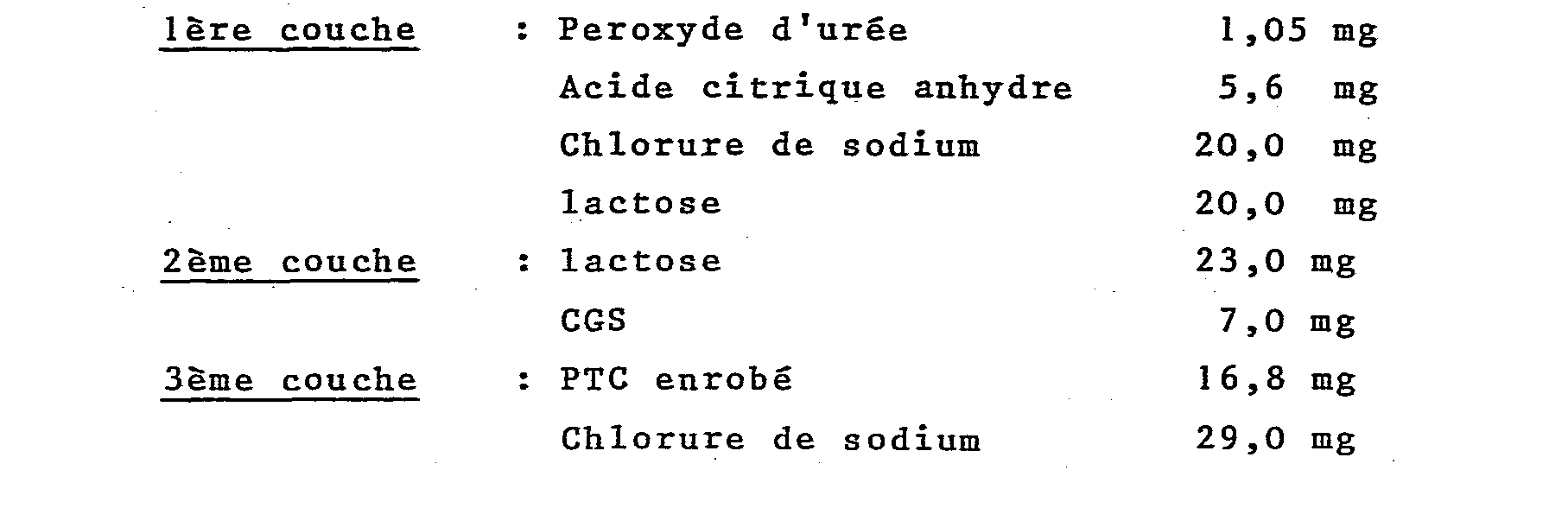

- Ce comprimé est à dissoudre dans 7 ml d'eau purifiée.
- L'effervescence de ces comprimés tri-couches peut être obtenue en mettant le CGS dans la couche centrale (on a alors un effet retard accentué de la 3ème couche) ou en l'incorporant dans la couche contenant le P.T.C. (dans ce cas, on augmente la quantité de lactose dans la 2ème,couche).
-

- L'hypochlorite libéré à partir du phosphate trisodique chloré est lui-même oxydé par l'eau oxygénée produite par le peroxyde d'urée. La cinétique de neutralisation du C12 libre montre qu'après 5 mn de contact entre l'oxydant et le réducteur, la moitié du C12 libéré est déjà détruite par le peroxyde d'urée. Après 1 heure, il ne reste plus que 0,1 mg %, soit 1 ppm, de C12 libre dans la solution. Cette quantité de chlore est parfaitement biocompatible.
- Cet exemple illustre l'efficacité antimicrobienne d'une composition selon l'invention, utilisée sous forme de deux comprimés séparés.
- Le comprimé A a la composition suivante :

- Les deux comprimés sont introduits dans 10 ml de suspension de germes à 106 germes/ml.
-

- Détermination de l'efficacité antimicrobienne des comprimés.

-

-

- La poudre "A" est mise en solution dans 10,0 ml d'eau purifiée contenue dans un récipient adéquat permettant de recevoir les lentilles. Après 10 minutes d'attente on rajoute la poudre "B". On observe une légère effervescence, la solution finale obtenue étant claire et limpide, présentant un pH de 7,3 et un point cryoscopique de -0,56°C.
- Le dosage après 15 minutes de mise en solution des poudres démontre une concentration en peroxyde d'hydrogène inférieure à 2 ppm et une concentration en chlore inférieure à 1 ppm.
- Essai bactériologique:
- La poudre "A" est mise en solution dans 10 ml de suspensions de germes à 10 germes/ml. Après 10 minutes, on rajoute la poudre "B", et on prélève après 1,2 et 5 minutes pour effectuer le dénombrement des germes survivants.
- Germes testés :
- Escherichia coli ATCC 8739
- Pseudomonas aeruginosa ATCC 9027
- Staphylococcus aureus ATCC 65380 Résultats.

- Cet exemple illustre l'efficacité antimicrobienne de deux compositions selon l'invention utilisées chacune sous forme d'un comprimé unique.
-


-

- Comprimé double noyau biconvexe, de couleur blanche
0̸ 7,5 mm, épaisseur : 4 mm.
Noyau interne enrobé
0̸ : 5,0 mm, épaisseur : 2,5 mm -


- Les comprimés A et B sont destinés à être dissouts dans 10 ml d'eau.
- Ces comprimés ainsi obtenus présentent une surface très régulière, non collante. Leur temps de dissolution est inférieur à 20 minutes. Ilsproduisent dans l'eau une effervescence dûe au phosphate monosodique et bicarbonate de sodium.
- La solution obtenue est limpide et incolore, donnant un pH de 7. 2 et un point cryoscopique de -0,57°C.
- Essai bactériologique :
- Pour démontrer l'efficacité antimicrobienne du comprimé B.
- On prépare des suspensions à 106 germes/ml et l'on met un comprimé en contact avec 10 ml de suspension . On prélève après dissolution du comprimé formé,après 1,2 et 18 heures, et on dénombre les germes survivants :
- Microorganismes utilisés :


- Résultats : Concentration des micro-organismes après dénombrement.

- Cet exemple illustre l'efficacité antibactérienne d'une composition selon l'invention utilisée sous forme d'une poudre unique, dans laquelle les grains de l'un des deux agents sont enrobés d'EUDRAGIT L 100. ..


- Ces compositions sont à dissoudre dans 10 ml d'eau et amènent après dissolution à une solution de pH 7,18 et point cryoscopique -0,56°C pour la composition I, et une solution de pH 7,0 et point cryoscopique de -0,57°C pour la composition II.
- Cette formulation évite la possibilité de réaction entre le peroxyde d'urée et la dichloroisocyanurate de sodium et permet une libération retardée du DCCNa en solution.
- Les mélanges ainsi obtenus se présentent sous forme de poudres fines, non collantes.
- Essai bactériologique :
- Les tests sont conduits sur la composition II ci-dessus.
- A 10 ml de suspension de germes à 108 germes/ml, on ajoute au temps 0 la quantité adéquate de la poudre testée. Après 1,3,5 et 10 minutes de mise en contact , les germes survivants sont dénonbrés.
- Germes testés :
- Escherichia Coli ATCC 8739
- Pseudomonas aeruginosa ATCC-9027
- Staphylococcus aureus ATCC 65380
- Résultats :
- Concentration des micro-organismes survivants en fonction du temps de contact et des dilutions effectuées lors du dénombrement.
-

-

-

- On prépare trois solutions dans du sérum physiologique. La solution 1 est préparée à partir de l'association des deux substances, la solution 2 ne contient que du peroxyde d'urée, la solution 3 ne contient que du PTC. On ajoute à chacune des solutions indiquées trois types de bactéries différentes à des concentrations de 105 à 106 germes/ml. On observe le nombre de bactéries vivantes par culture sur milieu nutritif solide après lh 30 de contact. Les résultats obtenus sont repris ci-après.
- La formule testée est la formule complète : Peroxyde d'urée et PTC mis au même moment en contact avec les bactéries. On mesure la concentration des micro-organismes après dénombrement.

- Peroxyde d'urée et PTC mis l'un après l'autre en contact : Peroxyde d'urée + inoculum en contact pendant 15 mn, puis restant de la formule.

- PTC + inoculum en contact pendant 15 mn, puis restant de la formule.


- Dans l'expérience 1, il n'y a pas d'effet retard : les deux substances sont mises en contact immédiatement. Dans l'expérience 2, on simule l'effet retard en faisant agir d'abord le peroxyde d'urée pendant 15 mn, puis le reste de la composition.
- L'expérience 3 est identique, le PTC étant mis en contact des germes d'abord puis le reste de la composition.
- Ces résultats mettent en évidence l'effet synergique antibactérien de l'association du peroxyde d'urée et du PTC particulièrement utile lorsque les deux substances sont mises en contact des bactéries l'une après l'autre. L'activité du système redox complet est significativement supérieure à celle de chacun des composés pris séparément.
- Enfin en ce qui concerne l'efficacité des compositions selon l'invention en tant que produits de nettoyage des lentilles, éliminant les dépôts protéiniques responsables du boile qui se forme durant le port des lentilles, le test utilisé consiste à provoquer l'encrassage de lentilles par immersion pendant 24 à 48 h dans une solution isotonique de chlorure de sodium à 10 % de sérum bovin atténué. On constate la formation d'un voile. Après traitement des lentilles voilées au moyen des compositions selon l'invention, et notamment par application de celles faisant l'objet des exemples IV et VI, sans neutralisation ni rinçage, on constate subjectivement la disparition de ce voile, et le retour des lentilles à une transparence parfaite. Le test a été effectué à la fois sur des lentilles souples et sur des lentilles dures.
- Afin de démontrer la bonne tolérance et l'efficacité du nettoyage - Six lapins Albinos sont équipés en lentilles de contact souples hydrophiles. Une des lentilles est traitée quotidiennement au moyen des compositions selon l'invention, et notamment par application de celle faisant l'objet de l'exemple VI ; l'autre lentille, servant de témoin, est traitée de manière classique en employant une solution de nettoyage et conservation contenant un surfactif et des anticeptiques.
- Après 25 jours de traitement quotidien, on a pu constater que les lentilles traitées par la composition selon l'invention, contrairement aux lentilles témoins, ne présentaient aucune trace de dépôts ; démontrant ainsi que la composition testée permet outre un nettoyage efficace, la prévention d'une éventuelle accumulation de dépôts au niveau des lentilles.
- De plus durant les 25 jours de test, aucune réaction d'intolérance ni variation anormale de l'état des cornées n'a été notée.
- On suppose que l'efficacité des compositions selon l'invention, à la fois comme compositions anti-microbiennes et comme agents de nettoyage provient de l'action de l'oxygène naissant qui se dégage au moment de leur utilisation, qui exerce une très forte action oxydante, particulièrement efficace sur les germes anaerobies et sur les dépôts protéiniques, tandis que l'agent réducteur et notamment le dichlorocyanurate de sodium exerce son action antibactérienne propre sur toutes les espèces de germes.
on réalise avantageusement un comprimé tri-couches.
Claims (11)
Priority Applications (1)
| Application Number | Priority Date | Filing Date | Title |
|---|---|---|---|
| AT84440016T ATE25928T1 (de) | 1983-04-20 | 1984-04-10 | Verfahren und zusammensetzung zum reinigen und entkeimen von kontaktlinsen. |
Applications Claiming Priority (2)
| Application Number | Priority Date | Filing Date | Title |
|---|---|---|---|
| FR8306608 | 1983-04-20 | ||
| FR8306608A FR2544880B1 (fr) | 1983-04-20 | 1983-04-20 | Procede pour le nettoyage et la decontamination de lentilles de contact et composition pour sa mise en oeuvre |
Publications (2)
| Publication Number | Publication Date |
|---|---|
| EP0124461A1 true EP0124461A1 (fr) | 1984-11-07 |
| EP0124461B1 EP0124461B1 (fr) | 1987-03-18 |
Family
ID=9288108
Family Applications (1)
| Application Number | Title | Priority Date | Filing Date |
|---|---|---|---|
| EP84440016A Expired EP0124461B1 (fr) | 1983-04-20 | 1984-04-10 | Procédé pour le nettoyage et la décontamination de lentilles de contact et composition pour sa mise en oeuvre |
Country Status (11)
| Country | Link |
|---|---|
| EP (1) | EP0124461B1 (fr) |
| JP (1) | JPS59206816A (fr) |
| AT (1) | ATE25928T1 (fr) |
| AU (1) | AU560506B2 (fr) |
| CA (1) | CA1269583A (fr) |
| DE (1) | DE3462657D1 (fr) |
| ES (1) | ES8606677A1 (fr) |
| FR (1) | FR2544880B1 (fr) |
| GR (1) | GR82259B (fr) |
| IE (1) | IE55346B1 (fr) |
| ZA (1) | ZA842853B (fr) |
Cited By (15)
| Publication number | Priority date | Publication date | Assignee | Title |
|---|---|---|---|---|
| EP0147100A3 (en) * | 1983-12-06 | 1986-02-19 | Contactasol Limited | Contact lenses |
| EP0209071A1 (fr) * | 1985-07-10 | 1987-01-21 | Ciba-Geigy Ag | Kit pour l'entretien des lentilles de contact |
| US4863627A (en) * | 1985-03-25 | 1989-09-05 | University Of Bath | Cleaning and/or disinfection of contact lenses |
| EP0401163A1 (fr) * | 1989-05-31 | 1990-12-05 | Ciba-Geigy Ag | Conditionnement jetable à usage unique pour lentilles de contact |
| EP0437179A2 (fr) | 1989-12-15 | 1991-07-17 | Ciba-Geigy Ag | Nettoyant à pH contrôlé pour enlever des protéines |
| FR2661668A1 (fr) * | 1990-05-02 | 1991-11-08 | Mcs Pharma Laboratoires | Procede de desinfection de l'eau et compositions pour sa mise en óoeuvre. |
| WO1993008130A1 (fr) * | 1990-05-02 | 1993-04-29 | Laboratoires Mcs-Pharma S.A. | Procede de desinfection de l'eau et compositions pour sa mise en ×uvre |
| WO1994014479A1 (fr) * | 1992-12-28 | 1994-07-07 | Bausch & Lomb Incorporated | Composition pour la liberation regulee de substances actives dans un milieu aqueux |
| WO1995006099A1 (fr) * | 1993-08-27 | 1995-03-02 | Alcon Laboratories, Inc. | Procede de nettoyage et de desinfection des lentilles de contact |
| WO1995014077A1 (fr) * | 1993-11-16 | 1995-05-26 | Warwick International Group Limited | Compositions d'activateur de blanchiment |
| WO1995018205A1 (fr) * | 1993-12-30 | 1995-07-06 | Bausch & Lomb Incorporated | Nettoyage de lentilles de contact hydrophiles par des moyens electrochimiques |
| US5576276A (en) * | 1989-12-15 | 1996-11-19 | Ciba Geigy Corp. | Method of cleaning ophthalmic lenses with alkaline composition |
| WO2009111170A1 (fr) * | 2008-02-29 | 2009-09-11 | Bausch & Lomb Incorporated | Formulations pharmaceutiques comprenant des matériaux polyanioniques et une source de peroxyde d’hydrogène |
| WO2015153161A1 (fr) | 2014-04-03 | 2015-10-08 | Novartis Ag | Système électrochimique pour désinfecter et nettoyer des lentilles de contact |
| US10398799B2 (en) | 2014-04-03 | 2019-09-03 | Novartis Ag | System for disinfecting contact lenses |
Families Citing this family (11)
| Publication number | Priority date | Publication date | Assignee | Title |
|---|---|---|---|---|
| DE3532433A1 (de) * | 1985-09-11 | 1987-03-26 | Iip Inst Fuer Ind Pharmazie Fo | Kontaktlinsenpflegesatz |
| DE3524659C2 (de) * | 1985-07-10 | 1999-02-18 | Novartis Ag | Kontaktlinsenpflegesatz |
| JPH0621905B2 (ja) * | 1986-08-15 | 1994-03-23 | ホ−ヤ株式会社 | コンタクトレンズ洗浄用組成物 |
| JPH0729883B2 (ja) * | 1987-12-18 | 1995-04-05 | ホーヤ株式会社 | コンタクトレンズ殺菌用組成物 |
| US5279673A (en) * | 1990-01-05 | 1994-01-18 | Allergan, Inc. | Methods to disinfect contact lenses |
| DE3937770A1 (de) * | 1989-11-14 | 1991-05-16 | Rolf K Dr Mueller | Verwendung eines aktivreinigers und vorrichtung zur durchfuehrung der verwendung |
| FR2656431B1 (fr) * | 1989-12-22 | 1994-06-10 | Essilor Int | Procede et solution pour decontaminer une lentille souple, en particulier du type hydrophile. |
| US5152912A (en) * | 1990-01-05 | 1992-10-06 | Allergan, Inc. | Chlorine dioxide precursor containing compositions useful in disinfecting contact lenses |
| ZA913506B (en) * | 1990-05-22 | 1992-02-26 | Alcon Lab Inc | Double redox system for disinfecting contact lenses |
| CA2062615A1 (fr) * | 1992-03-10 | 1993-09-11 | Garth T. Webb | Methode et trousse de desinfection de lentilles corneennes |
| US5447650A (en) * | 1993-10-06 | 1995-09-05 | Allergan, Inc. | Composition for preventing the accumulation of inorganic deposits on contact lenses |
Citations (6)
| Publication number | Priority date | Publication date | Assignee | Title |
|---|---|---|---|---|
| FR2226677A1 (fr) * | 1973-04-20 | 1974-11-15 | Allergan Pharma | |
| FR2256767A1 (fr) * | 1974-01-07 | 1975-08-01 | Nat Patent Dev Corp | |
| US3908680A (en) * | 1973-10-12 | 1975-09-30 | Flow Pharma Inc | Methods for cleaning and bleaching plastic articles |
| FR2424311A1 (fr) * | 1978-04-24 | 1979-11-23 | Senju Pharma Co | Compositions de nettoyage pour des lentilles de contact, a base d'uree ou d'un sel d'acide avec la guanidine, et d'un reducteur |
| GB2072371A (en) * | 1980-02-23 | 1981-09-30 | Toyo Contact Lens Co Ltd | Removing Contaminants on Contact Lenses Using Hypohalogenous Acid Salt |
| GB2094992A (en) * | 1981-03-18 | 1982-09-22 | Tomei Sangyo Kk | Method and apparatus for sterilizing an object such as a contact lens |
Family Cites Families (1)
| Publication number | Priority date | Publication date | Assignee | Title |
|---|---|---|---|---|
| US4143116A (en) * | 1976-08-18 | 1979-03-06 | American Optical Corporation | Contact lens sterilizing apparatus |
-
1983
- 1983-04-20 FR FR8306608A patent/FR2544880B1/fr not_active Expired
-
1984
- 1984-04-10 AT AT84440016T patent/ATE25928T1/de not_active IP Right Cessation
- 1984-04-10 DE DE8484440016T patent/DE3462657D1/de not_active Expired
- 1984-04-10 EP EP84440016A patent/EP0124461B1/fr not_active Expired
- 1984-04-16 GR GR74430A patent/GR82259B/el unknown
- 1984-04-16 ZA ZA842853A patent/ZA842853B/xx unknown
- 1984-04-18 ES ES531774A patent/ES8606677A1/es not_active Expired
- 1984-04-18 IE IE961/84A patent/IE55346B1/en unknown
- 1984-04-18 CA CA000452340A patent/CA1269583A/fr not_active Expired - Fee Related
- 1984-04-20 JP JP59080003A patent/JPS59206816A/ja active Pending
- 1984-04-24 AU AU27227/84A patent/AU560506B2/en not_active Ceased
Patent Citations (6)
| Publication number | Priority date | Publication date | Assignee | Title |
|---|---|---|---|---|
| FR2226677A1 (fr) * | 1973-04-20 | 1974-11-15 | Allergan Pharma | |
| US3908680A (en) * | 1973-10-12 | 1975-09-30 | Flow Pharma Inc | Methods for cleaning and bleaching plastic articles |
| FR2256767A1 (fr) * | 1974-01-07 | 1975-08-01 | Nat Patent Dev Corp | |
| FR2424311A1 (fr) * | 1978-04-24 | 1979-11-23 | Senju Pharma Co | Compositions de nettoyage pour des lentilles de contact, a base d'uree ou d'un sel d'acide avec la guanidine, et d'un reducteur |
| GB2072371A (en) * | 1980-02-23 | 1981-09-30 | Toyo Contact Lens Co Ltd | Removing Contaminants on Contact Lenses Using Hypohalogenous Acid Salt |
| GB2094992A (en) * | 1981-03-18 | 1982-09-22 | Tomei Sangyo Kk | Method and apparatus for sterilizing an object such as a contact lens |
Cited By (21)
| Publication number | Priority date | Publication date | Assignee | Title |
|---|---|---|---|---|
| EP0147100A3 (en) * | 1983-12-06 | 1986-02-19 | Contactasol Limited | Contact lenses |
| US4863627A (en) * | 1985-03-25 | 1989-09-05 | University Of Bath | Cleaning and/or disinfection of contact lenses |
| EP0209071A1 (fr) * | 1985-07-10 | 1987-01-21 | Ciba-Geigy Ag | Kit pour l'entretien des lentilles de contact |
| US5011661A (en) * | 1985-07-10 | 1991-04-30 | Ciba-Geigy Corporation | Contact lens care set |
| EP0401163A1 (fr) * | 1989-05-31 | 1990-12-05 | Ciba-Geigy Ag | Conditionnement jetable à usage unique pour lentilles de contact |
| US6096696A (en) * | 1989-12-15 | 2000-08-01 | Ciba Vision Corporation | Alkaline composition for removing protein deposits |
| EP0437179A2 (fr) | 1989-12-15 | 1991-07-17 | Ciba-Geigy Ag | Nettoyant à pH contrôlé pour enlever des protéines |
| EP0437179B1 (fr) * | 1989-12-15 | 1998-04-01 | Novartis AG | Nettoyant à pH contrÔlé pour enlever des protéines |
| US5576276A (en) * | 1989-12-15 | 1996-11-19 | Ciba Geigy Corp. | Method of cleaning ophthalmic lenses with alkaline composition |
| FR2661668A1 (fr) * | 1990-05-02 | 1991-11-08 | Mcs Pharma Laboratoires | Procede de desinfection de l'eau et compositions pour sa mise en óoeuvre. |
| WO1993008130A1 (fr) * | 1990-05-02 | 1993-04-29 | Laboratoires Mcs-Pharma S.A. | Procede de desinfection de l'eau et compositions pour sa mise en ×uvre |
| WO1994014479A1 (fr) * | 1992-12-28 | 1994-07-07 | Bausch & Lomb Incorporated | Composition pour la liberation regulee de substances actives dans un milieu aqueux |
| US5645848A (en) * | 1992-12-28 | 1997-07-08 | Bausch & Lomb Incorporated | Controlled release composition for active substances into an aqueous medium |
| EP0909808A3 (fr) * | 1993-08-27 | 1999-07-28 | Alcon Laboratories, Inc. | Procédé de nettoyage et de désinfection des lentilles de contact |
| WO1995006099A1 (fr) * | 1993-08-27 | 1995-03-02 | Alcon Laboratories, Inc. | Procede de nettoyage et de desinfection des lentilles de contact |
| WO1995014077A1 (fr) * | 1993-11-16 | 1995-05-26 | Warwick International Group Limited | Compositions d'activateur de blanchiment |
| WO1995018205A1 (fr) * | 1993-12-30 | 1995-07-06 | Bausch & Lomb Incorporated | Nettoyage de lentilles de contact hydrophiles par des moyens electrochimiques |
| WO2009111170A1 (fr) * | 2008-02-29 | 2009-09-11 | Bausch & Lomb Incorporated | Formulations pharmaceutiques comprenant des matériaux polyanioniques et une source de peroxyde d’hydrogène |
| WO2015153161A1 (fr) | 2014-04-03 | 2015-10-08 | Novartis Ag | Système électrochimique pour désinfecter et nettoyer des lentilles de contact |
| US10398799B2 (en) | 2014-04-03 | 2019-09-03 | Novartis Ag | System for disinfecting contact lenses |
| US10525158B2 (en) | 2014-04-03 | 2020-01-07 | Novartis Ag | Electrochemical system for disinfecting and cleaning contact lenses |
Also Published As
| Publication number | Publication date |
|---|---|
| AU2722784A (en) | 1984-10-25 |
| AU560506B2 (en) | 1987-04-09 |
| FR2544880B1 (fr) | 1986-08-29 |
| FR2544880A1 (fr) | 1984-10-26 |
| GR82259B (fr) | 1984-12-13 |
| IE55346B1 (en) | 1990-08-15 |
| JPS59206816A (ja) | 1984-11-22 |
| ATE25928T1 (de) | 1987-04-15 |
| CA1269583A (fr) | 1990-05-29 |
| ES531774A0 (es) | 1986-04-01 |
| ZA842853B (en) | 1984-12-24 |
| IE840961L (en) | 1984-10-20 |
| DE3462657D1 (en) | 1987-04-23 |
| ES8606677A1 (es) | 1986-04-01 |
| EP0124461B1 (fr) | 1987-03-18 |
Similar Documents
| Publication | Publication Date | Title |
|---|---|---|
| EP0124461B1 (fr) | Procédé pour le nettoyage et la décontamination de lentilles de contact et composition pour sa mise en oeuvre | |
| US4863627A (en) | Cleaning and/or disinfection of contact lenses | |
| EP1175149B9 (fr) | Composition desinfectante a base de h2o2, acides et ions metalliques | |
| JP3046393B2 (ja) | コンタクトレンズを消毒するための二重レドックス消毒系 | |
| JPH05502810A (ja) | レンズを消毒するための方法および組成物 | |
| CA2064471C (fr) | Systeme de desinfection des lentilles corneennes | |
| HUE026111T2 (en) | Peroxide solution for contact lens care | |
| JPS5848521B2 (ja) | 滅菌方法 | |
| FR2667220A1 (fr) | Composition d'agent nettoyant-decontaminant notamment pour instruments chirurgicaux. | |
| EP0720814A1 (fr) | Production de formulations desinfectantes biocides, à base d'ions peracétiques | |
| WO1991009630A1 (fr) | Procede et solution pour decontaminer une lentille souple, en particulier du type hydrophile | |
| FR2517208A1 (fr) | Composition pour le nettoyage et la sterilisation de protheses oculaires et auriculaires | |
| US5589387A (en) | Method for preventing the accumulation of inorganic deposits on contact lenses | |
| EP0236401A1 (fr) | Composition de nettoyage et d'entretien de lentilles de contact hydrophiles | |
| FR2479491A1 (fr) | Procede pour eliminer les souillures de la surface des lentilles de contact | |
| AU606051B2 (en) | Disinfecting composition | |
| EP0409703B1 (fr) | Préparation pour la décontamination et le nettoyage des lentilles de contact, et son utilisation | |
| US8937036B2 (en) | Cleaning, disinfecting, deodorizing, and bleaching composition for removable dental appliances | |
| EP1741451B1 (fr) | Utilisation pour le nettoyage et la desinfection dans le domaine de l'hygiène en production laitière | |
| CZ284797A3 (cs) | Antiseptický prostředek | |
| TWI222369B (en) | Method for preserving contact lenses | |
| FR2661668A1 (fr) | Procede de desinfection de l'eau et compositions pour sa mise en óoeuvre. | |
| FR2961108A1 (fr) | Procede et solution prete a l'emploi de nettoyage et de desinfection de lunettes | |
| EP0773799A1 (fr) | Systeme ameliore permettant de desinfecter des lentilles de contact a l'eau oxygenee | |
| BE824163A (fr) | Procede de sterilisation d'instruments medicaux et dentaires |
Legal Events
| Date | Code | Title | Description |
|---|---|---|---|
| PUAI | Public reference made under article 153(3) epc to a published international application that has entered the european phase |
Free format text: ORIGINAL CODE: 0009012 |
|
| AK | Designated contracting states |
Designated state(s): AT BE CH DE GB IT LI LU NL SE |
|
| 17P | Request for examination filed |
Effective date: 19841219 |
|
| 17Q | First examination report despatched |
Effective date: 19860117 |
|
| D17Q | First examination report despatched (deleted) | ||
| GRAA | (expected) grant |
Free format text: ORIGINAL CODE: 0009210 |
|
| ITF | It: translation for a ep patent filed | ||
| AK | Designated contracting states |
Kind code of ref document: B1 Designated state(s): AT BE CH DE GB IT LI LU NL SE |
|
| REF | Corresponds to: |
Ref document number: 25928 Country of ref document: AT Date of ref document: 19870415 Kind code of ref document: T |
|
| REF | Corresponds to: |
Ref document number: 3462657 Country of ref document: DE Date of ref document: 19870423 |
|
| PG25 | Lapsed in a contracting state [announced via postgrant information from national office to epo] |
Ref country code: LU Free format text: LAPSE BECAUSE OF NON-PAYMENT OF DUE FEES Effective date: 19870430 |
|
| PLBE | No opposition filed within time limit |
Free format text: ORIGINAL CODE: 0009261 |
|
| STAA | Information on the status of an ep patent application or granted ep patent |
Free format text: STATUS: NO OPPOSITION FILED WITHIN TIME LIMIT |
|
| 26N | No opposition filed | ||
| PGFP | Annual fee paid to national office [announced via postgrant information from national office to epo] |
Ref country code: LU Payment date: 19900328 Year of fee payment: 7 |
|
| ITTA | It: last paid annual fee | ||
| PGFP | Annual fee paid to national office [announced via postgrant information from national office to epo] |
Ref country code: SE Payment date: 19920326 Year of fee payment: 9 Ref country code: GB Payment date: 19920326 Year of fee payment: 9 Ref country code: DE Payment date: 19920326 Year of fee payment: 9 Ref country code: CH Payment date: 19920326 Year of fee payment: 9 |
|
| PGFP | Annual fee paid to national office [announced via postgrant information from national office to epo] |
Ref country code: BE Payment date: 19920402 Year of fee payment: 9 |
|
| PGFP | Annual fee paid to national office [announced via postgrant information from national office to epo] |
Ref country code: AT Payment date: 19920428 Year of fee payment: 9 |
|
| PGFP | Annual fee paid to national office [announced via postgrant information from national office to epo] |
Ref country code: NL Payment date: 19920430 Year of fee payment: 9 |
|
| PG25 | Lapsed in a contracting state [announced via postgrant information from national office to epo] |
Ref country code: GB Effective date: 19930410 Ref country code: AT Effective date: 19930410 |
|
| PG25 | Lapsed in a contracting state [announced via postgrant information from national office to epo] |
Ref country code: SE Effective date: 19930411 |
|
| PG25 | Lapsed in a contracting state [announced via postgrant information from national office to epo] |
Ref country code: LI Effective date: 19930430 Ref country code: CH Effective date: 19930430 Ref country code: BE Effective date: 19930430 |
|
| BERE | Be: lapsed |
Owner name: LABORATOIRES P.O.S. Effective date: 19930430 |
|
| PG25 | Lapsed in a contracting state [announced via postgrant information from national office to epo] |
Ref country code: NL Effective date: 19931101 |
|
| GBPC | Gb: european patent ceased through non-payment of renewal fee |
Effective date: 19930410 |
|
| NLV4 | Nl: lapsed or anulled due to non-payment of the annual fee | ||
| REG | Reference to a national code |
Ref country code: CH Ref legal event code: PL |
|
| PG25 | Lapsed in a contracting state [announced via postgrant information from national office to epo] |
Ref country code: DE Effective date: 19940101 |
|
| EUG | Se: european patent has lapsed |
Ref document number: 84440016.8 Effective date: 19931110 |