EP0124948B1 - Widerstandspaste für einen elektrischen Widerstand - Google Patents
Widerstandspaste für einen elektrischen Widerstand Download PDFInfo
- Publication number
- EP0124948B1 EP0124948B1 EP84200642A EP84200642A EP0124948B1 EP 0124948 B1 EP0124948 B1 EP 0124948B1 EP 84200642 A EP84200642 A EP 84200642A EP 84200642 A EP84200642 A EP 84200642A EP 0124948 B1 EP0124948 B1 EP 0124948B1
- Authority
- EP
- European Patent Office
- Prior art keywords
- paste
- resistance
- resistor
- resistor paste
- binder
- Prior art date
- Legal status (The legal status is an assumption and is not a legal conclusion. Google has not performed a legal analysis and makes no representation as to the accuracy of the status listed.)
- Expired
Links
Classifications
-
- C—CHEMISTRY; METALLURGY
- C07—ORGANIC CHEMISTRY
- C07D—HETEROCYCLIC COMPOUNDS
- C07D257/00—Heterocyclic compounds containing rings having four nitrogen atoms as the only ring hetero atoms
- C07D257/02—Heterocyclic compounds containing rings having four nitrogen atoms as the only ring hetero atoms not condensed with other rings
- C07D257/04—Five-membered rings
-
- H—ELECTRICITY
- H01—ELECTRIC ELEMENTS
- H01C—RESISTORS
- H01C7/00—Non-adjustable resistors formed as one or more layers or coatings; Non-adjustable resistors made from powdered conducting material or powdered semi-conducting material with or without insulating material
- H01C7/06—Non-adjustable resistors formed as one or more layers or coatings; Non-adjustable resistors made from powdered conducting material or powdered semi-conducting material with or without insulating material including means to minimise changes in resistance with changes in temperature
-
- A—HUMAN NECESSITIES
- A01—AGRICULTURE; FORESTRY; ANIMAL HUSBANDRY; HUNTING; TRAPPING; FISHING
- A01N—PRESERVATION OF BODIES OF HUMANS OR ANIMALS OR PLANTS OR PARTS THEREOF; BIOCIDES, e.g. AS DISINFECTANTS, AS PESTICIDES OR AS HERBICIDES; PEST REPELLANTS OR ATTRACTANTS; PLANT GROWTH REGULATORS
- A01N43/00—Biocides, pest repellants or attractants, or plant growth regulators containing heterocyclic compounds
- A01N43/64—Biocides, pest repellants or attractants, or plant growth regulators containing heterocyclic compounds having rings with three nitrogen atoms as the only ring hetero atoms
-
- H—ELECTRICITY
- H01—ELECTRIC ELEMENTS
- H01C—RESISTORS
- H01C17/00—Apparatus or processes specially adapted for manufacturing resistors
- H01C17/06—Apparatus or processes specially adapted for manufacturing resistors adapted for coating resistive material on a base
- H01C17/065—Apparatus or processes specially adapted for manufacturing resistors adapted for coating resistive material on a base by thick film techniques, e.g. serigraphy
- H01C17/06506—Precursor compositions therefor, e.g. pastes, inks, glass frits or green body
- H01C17/06513—Precursor compositions therefor, e.g. pastes, inks, glass frits or green body characterised by the resistive component
- H01C17/06533—Precursor compositions therefor, e.g. pastes, inks, glass frits or green body characterised by the resistive component composed of oxides
- H01C17/0654—Oxides of the platinum group
Definitions
- the invention relates to a resistance paste for an electrical resistance, consisting of a mixture of a metal oxide compound, a binder that remains permanently in the paste and a binder that is temporarily present in the paste, and to an electrical resistance, consisting of attached to a substrate, with connecting wires provided resistance material from the resistance paste, which has been freed from the binder temporarily present in the paste by heating.
- a disadvantage of most of the compositions is that the temperature coefficient of resistance is quite large in the temperature range of -55 to + 150 ° C. which is of interest for practical use and within this range is quite temperature-dependent. Another disadvantage that occurs very often is that the resistance value changes greatly over time.
- the object of the invention is now to create such a paste and a resistance body produced therewith, which has a resistance value that runs within a tolerance limit of not more than ⁇ 5% during the entire life of the resistance body.
- the temperature coefficient of resistance must remain between -10x10-6 / ° C and + 10x10- 6 / ° C within the temperature range of -55 to + 150 ° C.
- lifetime is understood to mean a period of 25 years at a temperature of 50 ° C.
- an accelerated endurance test is carried out at 200 ° C for 200 hours.
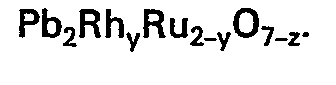
- the metal oxide compound has the formula below where 0.15 ⁇ y ⁇ 0.95 and O ⁇ z 0.5.
- a type of glass to be designated as the preferred composition area in this respect is characterized by the constituents PbO, Si0 2 , BO ,, 5 and optionally AIO ,, 5 between the limits in mol%:
- the resistance-determining component being more or less “diluted”.
- the temperature coefficient of the resistance is set very precisely to the desired value by a correct choice of y. As a result of the negligible migration of the constituents of the metal oxide compound, a very constant temperature coefficient of resistance is measured over the lifetime.
- a possible variation for setting the value of the specific resistance is the addition of an insulating oxide, such as aluminum oxide or titanium dioxide, which is difficult to dissolve or react with the other constituents.
- the compounds Pb 2 Rh y Ru 2-y O 7-z used in the examples are shown as follows.
- a basic solution of potassium ruthenate is assumed.
- the amount of Rh (N0 3 ) 3 solution determined by the desired value of y is added to this solution.
- the final pH of the solution must remain greater than 12.
- a triple amount (mol) of Pb (N0 3 ) 2 solution compared to the sum of ruthenate and rhodate is added to the mixture.
- a final pH value greater than 8 must also be ensured here, if necessary by adding KOH.
- the resulting precipitate is filtered off, washed twice with water and then, after drying in air for 1 hour, is burned at 700 ° C.
- the excess Pb0 is then removed with dilute HN0 3 , and the rest is dried at 150 ° C. in air.
- Glass powder with an average particle size of about 1 ⁇ m and a composition: is mixed in a weight ratio of 1: 1 with the resistance material Pb 2 Rh 0.80 Ru 1.20 O 6.5 with a particle size smaller than 0.2 ⁇ m.
- the powder is then processed into a paste with one or more binders and solvents, for example ethyl cellulose in benzyl benzoate.
- the paste is applied by screen printing to a substrate made of aluminum oxide, which has previously been provided with AgPd contacts.
- the printed substrates are dried and then heated according to the firing program at 850 ° C as the peak temperature.
- the surface resistances have a value of 2.5 kQ, a TC R of -8x10- 6 / 'C in the temperature range from -55 to + 20 ° C and a TC R of + 7x10⁻⁶ / ° C in the temperature range from +20 to + 150 ° C.
- a screen printing paste is produced with the glass powder from Example 1 and with the resistance material Pb 2 Rh 0.25 Ru 1.75 O 6.5 ', which has a particle size below 0.2 ⁇ m in a weight ratio of 6: 1.
- the resistance patterns on a substrate produced in the screen printing process, as in example 1, are subjected to a firing program after drying with a peak temperature of 750 ° C.
- the surface resistances obtained have a value of 0.3 M ⁇ with a layer thickness of 15 ⁇ m, a TC R in the temperature range from -55 to + 20 ° C from -6x 10- 6 / ° C and in the range from +20 to +150 ° Cfrom + 9x10 -6 / ° C.
- Glass powder with an average particle size of about 1 ⁇ m and the following composition: is mixed in a weight ratio of 1: 4 with the resistance material Pb 2 Rh 0.5 Ru 1.5 O 6.5 and processed into a paste.
- Resistors are produced on an Al 2 O 3 substrate using the screen printing process and the whole is exposed to a firing program with a peak temperature of 850 ° C. With a layer thickness of 15 ⁇ m, the resistances obtained have a value for the sheet resistance of approximately 50 k ⁇ .
- the TC R is: and
- the substrate with the resistors attached to it by screen printing is exposed to a firing process with a peak temperature of 750 ° C.
- the resistors have a surface resistance value of 0.8 M ⁇ with a layer thickness of 15 ⁇ m.
- the TC R is:
- the resistors are exposed to an accelerated endurance test for 200 hours at 200 ° C in air.
- the resistance values of all the resistors described above showed deviations of less than ⁇ 5% 0 at the end of the sample.
Landscapes
- Engineering & Computer Science (AREA)
- Microelectronics & Electronic Packaging (AREA)
- Chemical & Material Sciences (AREA)
- Organic Chemistry (AREA)
- Life Sciences & Earth Sciences (AREA)
- Manufacturing & Machinery (AREA)
- Physics & Mathematics (AREA)
- Electromagnetism (AREA)
- Plant Pathology (AREA)
- Pest Control & Pesticides (AREA)
- Agronomy & Crop Science (AREA)
- Health & Medical Sciences (AREA)
- Dentistry (AREA)
- General Health & Medical Sciences (AREA)
- Wood Science & Technology (AREA)
- Zoology (AREA)
- Environmental Sciences (AREA)
- Non-Adjustable Resistors (AREA)
- Glass Compositions (AREA)
- Parts Printed On Printed Circuit Boards (AREA)
Description
- Die Erfindung bezieht sich auf eine Widerstandspaste für einen elektrischen Widerstand, bestehend aus einem Gemisch aus einer metalloxidischen Verbindung, einem ständig in der Paste verbleibenden und einem vorübergehend in der Paste vorhandenen Bindemittel und auf einen elektrischen Widerstand, bestehend aus auf einem Substrat angebrachten, mit Anschlussdrähten versehenen Widerstandsmaterial aus der, durch Erhitzung von dem vorübergehend in der Paste vorhandenen Bindemittel befreiten, Widerstandspaste.
- Aus der US Patentschrift 3681 262 ist eine Widerstandspaste bekannt, um daraus Widerstandskörper herzustellen. Die in der Paste verwendeten metalloxidischen Verbindungen müssen der nachfolgenden allgemeinen Formel entsprechen:

- M" mindestens eines der Metalle Ru und Ir ist,
- x eine Zahl zwischen 0 und 2 ist,
- y eine Zahl zwischen 0 und 2 ist und
- z eine Zahl von 0 bis 1 ist, die wenigstens etwa gleich x/2 ist, falls
- M ein zweiwertiges Metall ist. Unter diese Klasse von metalloxidischen Verbindungen fällt auch eine Verbindung mit der Formel
- Ein Nachteil der meisten der Zusammensetzungen ist, dass der Temperaturkoeffizient des Widerstandes in dem für den praktischen Gebrauch interessanten Temperaturbereich von -55 bis +150°C ziemlich gross ist und innerhalb dieses Bereiches ziemlich stark temperaturabhängig verläuft. Ein weiterer Nachteil, der sehr oft auftritt, ist, dass der Widerstandswert sich im Laufe der Zeit stark ändert.
- Die Erfindung hat nun zur Aufgabe, eine derartige Paste und einen damit hergestellten Widerstandskörper zu schaffen, der einen Widerstandswert hat, der während der ganzen Lebensdauer des Widerstandskörpers innerhalb einer Toleranzgrenze von nicht mehr als ±5 %o verläuft. Ausserdem muss der Temperaturkoeffizient des Widerstands innerhalb des Temperaturbereiches von -55 bis +150°C zwischen -10x10-6/°C und +10x10-6/°C bleiben. Unter Lebensdauer wird in diesem Zusammenhang ein Zeitraum von 25 Jahren bei einer Temperatur von 50°C verstanden. Als Massstab wird dafür eine beschleunigte Dauerprobe während 200 Stunden bei 200°C durchgeführt.
- Diese Aufgabe wird dadurch gelöst, dass die metalloxidische Verbindung die untenstehende Formel aufweist

- Das Erhalten einer derart hohen Stabilität des nach dem Brennen erhaltenen Widerstandskörpers während der Gebrauchsdauer desselben ist der Tatsache zuzuschreiben, dass die Bestandteile der widerstandsbestimmenden metalloxidischen Verbindung eine zu vernachlässigende Migration in den üblichen, als ständig in der Paste verbleibendem Bindemittel (Dauerbindemittel) verwendeten Gläsern aufweist.
- Ein in dieser Hinsicht als bevorzugtes Zusammensetzungsgebiet zu bezeichnender Glastyp ist gekennzeichnet durch die Bestandteile PbO, Si02, BO,,5 und gegebenenfalls AIO,,5 zwischen den Grenzen in Mol%:

- Beim Einstellen des Pegels des spezifischen Widerstandes verfügt man über die Variationsmöglichkeit des Verhältnisses der widerstandsbestimmenden metalloxidischen Verbindung zu dem Dauerbindemittel, wobei der widerstandsbestimmende Bestandteil mehr oder weniger «verdünnt» wird. Der Temperaturkoeffizient des Widerstandes wird durch eine richtige Wahl von y äusserst genau auf den gewünschten Wert eingestellt. Infolge der zu vernachlässigenden Migration der Bestandteile der metalloxidischen Verbindung wird in der Lebensdauer ein sehr konstanter Temperaturkoeffizient des Widerstandes gemessen.
- Eine Variationsmöglichkeit zur Einstellung des Wertes des spezifischen Widerstandes ist die Hinzufügung eines isolierenden Oxids, wie Aluminiumoxid oder Titaniumdioxid, das sich nur schwer in den übrigen Bestandteilen löst bzw. mit denselben reagiert.
- Zur Erläuterung der Erfindung folgen untenstehend einige Ausführungsbeispiele. Die in den Beispielen verwendeten Verbindungen Pb2RhyRu2-yO7-z werden wie folgt dargestellt. Es wird ausgegangen von einer basischen Lösung von Kaliumruthenat. Dieser Lösung wird die durch den gewünschten Wert von y bestimmte Menge Rh(N03)3-Lösung hinzugefügt. Der End-pH-Wert der Lösung muss grösser bleiben als 12. Dem Gemisch wird eine dreifache Menge (Mol) Pb(N03)2-Lösung gegenüber der Summe von Ruthenat und Rhodat zugefügt. Auch dabei muss für einen End-pH-Wert grösser als 8 gesorgt werden, gegebenenfalls durch Hinzufügung von KOH. Der entstandene Niederschlag wird abfiltriert, zweimal mit Wasser gewaschen und daraufhin nach Trocknen während 1 Stunde an der Luft bei 700°C gebrannt. Danach wird der Überschuss an Pb0 mit verdünnter HN03 entfernt, und der Rest wird bei 150°C in Luft getrocknet.
- Glaspulver mit einer mittleren Teilchengrösse von etwa 1 µm und einer Zusammensetzung:

- Bei einer Schichtdicke von 15 µm haben die Flächenwiderstände einen Wert von 2,5 kQ, einen TCR von -8x10⁻⁶/'C im Temperaturbereich von -55 bis +20°C und einen TCR von +7x10⁻⁶/°C im Temperaturbereich von +20 bis +150°C.
- Es wird eine Siebdruckpaste hergestellt mit dem Glaspulver aus Beispiel 1 und mit dem Widerstandsmaterial Pb2Rh0,25Ru1,75O6.5' das eine Teilchengrösse unter 0,2 µm hat in einem Gewichtsverhältnis 6:1. Die im Siebdruckverfahren hergestellten Widerstandsmuster auf einem Substrat, wie in dem Beispiel 1, werden nach dem Trocknen einem Brennprogramm ausgesetzt mit einer Spitzentemperatur von 750°C. Die erhaltenen Flächenwiderstände haben einen Wert von 0,3 MΩ bei einer Schichtdicke von 15 µm, einen TCR im Temperaturbereich von -55 bis +20°C von -6x 10⁻⁶/°C und in dem Bereich von +20 bis +150°Cvon +9x10⁻⁶/°C.
- Glaspulver mit einer mittleren Teilchengrösse von etwa 1 µm und der folgenden Zusammenstellung:


- Der in Beispiel 3 beschriebenen Paste werden 2 Gew.% Ti02 hinzugefügt. Das Substrat mit den darauf im Siebdruckverfahren angebrachten Widerständen wird einem Brennprozess mit einer Spitzentemperatur von 750°C ausgesetzt. Die Widerstände zeigen einen Flächenwiderstandswert von 0,8 MΩ bei einer Schichtdicke von 15 µm. DerTCR beträgt:
-


- Die Widerstände werden zur Erprobung ihrer Stabilität einer beschleunigten Dauerprobe während 200 Stunden bei 200°C in Luft ausgesetzt.
- Die Widerstandswerte aller obenstehend beschriebenen Widerstände zeigten am Ende der Probe Abweichungen von weniger als ± 5%0.
Claims (4)


Applications Claiming Priority (2)
| Application Number | Priority Date | Filing Date | Title |
|---|---|---|---|
| NL8301631A NL8301631A (nl) | 1983-05-09 | 1983-05-09 | Weerstandspasta voor een weerstandslichaam. |
| NL8301631 | 1983-05-09 |
Publications (2)
| Publication Number | Publication Date |
|---|---|
| EP0124948A1 EP0124948A1 (de) | 1984-11-14 |
| EP0124948B1 true EP0124948B1 (de) | 1988-01-07 |
Family
ID=19841826
Family Applications (1)
| Application Number | Title | Priority Date | Filing Date |
|---|---|---|---|
| EP84200642A Expired EP0124948B1 (de) | 1983-05-09 | 1984-05-07 | Widerstandspaste für einen elektrischen Widerstand |
Country Status (6)
| Country | Link |
|---|---|
| US (1) | US4499011A (de) |
| EP (1) | EP0124948B1 (de) |
| JP (1) | JPS59208701A (de) |
| KR (1) | KR920000481B1 (de) |
| DE (1) | DE3468577D1 (de) |
| NL (1) | NL8301631A (de) |
Families Citing this family (4)
| Publication number | Priority date | Publication date | Assignee | Title |
|---|---|---|---|---|
| US4857384A (en) * | 1986-06-06 | 1989-08-15 | Awaji Sangyo K. K. | Exothermic conducting paste |
| FR2670008B1 (fr) * | 1990-11-30 | 1993-03-12 | Philips Electronique Lab | Circuit de resistances pour jauge de contrainte. |
| US5406852A (en) * | 1992-03-18 | 1995-04-18 | Matsushita Electric Industrial Co., Ltd. | Pressure sensor having a resistor element on a glass dryer with electrodes connected thereto |
| US5955938A (en) * | 1995-03-09 | 1999-09-21 | Sumitomo Metal (Smi) Electronics Devices, Inc. | RuO2 resistor paste, substrate and overcoat system |
Citations (1)
| Publication number | Priority date | Publication date | Assignee | Title |
|---|---|---|---|---|
| US3681262A (en) * | 1970-10-01 | 1972-08-01 | Du Pont | Compositions for making electrical elements containing pyrochlore-related oxides |
Family Cites Families (12)
| Publication number | Priority date | Publication date | Assignee | Title |
|---|---|---|---|---|
| JPS5128353A (en) * | 1974-09-03 | 1976-03-10 | Asahi Chemical Ind | Haisui no seibutsugakutekishorihoho oyobi sonosochi |
| NL7602663A (nl) * | 1976-03-15 | 1977-09-19 | Philips Nv | Weerstandsmateriaal. |
| JPS5837963B2 (ja) * | 1977-07-09 | 1983-08-19 | 住友金属鉱山株式会社 | 抵抗体用ペ−ストの製造方法 |
| NL7711927A (nl) * | 1977-10-31 | 1979-05-02 | Philips Nv | Werkwijze voor de bereiding van weerstands- materiaal en hiermede vervaardigde weerstands- lichamen. |
| US4176094A (en) * | 1977-12-02 | 1979-11-27 | Exxon Research & Engineering Co. | Method of making stoichiometric lead and bismuth pyrochlore compounds using an alkaline medium |
| US4129525A (en) * | 1977-12-02 | 1978-12-12 | Exxon Research & Engineering Co. | Method of making lead-rich and bismuth-rich pyrochlore compounds using an alkaline medium |
| US4124539A (en) * | 1977-12-02 | 1978-11-07 | Exxon Research & Engineering Co. | Pb2 [M2-x Pbx ]O7-y compounds wherein M is Ru, Ir or mixtures thereof, and method of preparation |
| NL7809553A (nl) * | 1978-09-20 | 1980-03-24 | Philips Nv | Weerstandsmateriaal. |
| NL7809554A (nl) * | 1978-09-20 | 1980-03-24 | Philips Nv | Weerstandsmateriaal. |
| NL7901864A (nl) * | 1979-03-08 | 1980-09-10 | Philips Nv | Weerstandsmateriaal. |
| NL7901863A (nl) * | 1979-03-08 | 1980-09-10 | Philips Nv | Weerstandsmateriaal. |
| NL8102809A (nl) * | 1981-06-11 | 1983-01-03 | Philips Nv | Weerstandspasta voor een weerstandslichaam. |
-
1983
- 1983-05-09 NL NL8301631A patent/NL8301631A/nl not_active Application Discontinuation
-
1984
- 1984-05-07 KR KR1019840002478A patent/KR920000481B1/ko not_active Expired
- 1984-05-07 EP EP84200642A patent/EP0124948B1/de not_active Expired
- 1984-05-07 DE DE8484200642T patent/DE3468577D1/de not_active Expired
- 1984-05-07 US US06/607,905 patent/US4499011A/en not_active Expired - Fee Related
- 1984-05-08 JP JP59090291A patent/JPS59208701A/ja active Pending
Patent Citations (1)
| Publication number | Priority date | Publication date | Assignee | Title |
|---|---|---|---|---|
| US3681262A (en) * | 1970-10-01 | 1972-08-01 | Du Pont | Compositions for making electrical elements containing pyrochlore-related oxides |
Also Published As
| Publication number | Publication date |
|---|---|
| NL8301631A (nl) | 1984-12-03 |
| DE3468577D1 (en) | 1988-02-11 |
| JPS59208701A (ja) | 1984-11-27 |
| EP0124948A1 (de) | 1984-11-14 |
| KR850000135A (ko) | 1985-02-25 |
| KR920000481B1 (ko) | 1992-01-14 |
| US4499011A (en) | 1985-02-12 |
Similar Documents
| Publication | Publication Date | Title |
|---|---|---|
| DE2603542C3 (de) | Feuchteabhängiger keramischer Widerstand | |
| DE69822770T2 (de) | Dickschicht-Piezoresistive-Fühleranordnung | |
| DE1194539B (de) | Widerstandsglasurmasse | |
| EP0327828B1 (de) | Unter Stickstoff einbrennbare Widerstandsmassen | |
| DE3785946T2 (de) | Halbleiterbauelement aus positiver keramik. | |
| DE2523009A1 (de) | Silbermasse und ihre verwendung | |
| DE3334922C2 (de) | Schichtwiderstand | |
| DE4445359A1 (de) | Sensor zum Nachweis von brennbaren Gasen | |
| DE3326716C2 (de) | ||
| EP0163004B1 (de) | Elektrische Widerstandszusammensetzung und Verfahren zur Herstellung der Widerstandselemente | |
| DE3039927A1 (de) | Elektrischer widerstand und verfahren zur herstellung | |
| DE2513844C2 (de) | Pulvermasse aus leitenden pyrochlorverwandten Oxiden und deren Verwendung | |
| DE2946753A1 (de) | Widerstandsmaterial, elektrischer widerstand und verfahren zur herstellung desselben | |
| DE2710199C2 (de) | Widerstandsmasse | |
| DE2353376A1 (de) | Halbleitende glasursubstanz | |
| EP0124948B1 (de) | Widerstandspaste für einen elektrischen Widerstand | |
| DE112019003625T5 (de) | Varistor-Passivierungsschicht und Verfahren zu ihrer Herstellung | |
| DE69125121T2 (de) | Keramisches Substrat für elektronische Schaltung und Verfahren zu dessen Herstellung | |
| DE2403667C3 (de) | Elektrische Widerstandsmasse aus elektrisch-leitfähigen, wismuthaltigen, polynären Oxiden pyrochlorverwandter Kristallstruktur und einem dielektrischen Feststoff und deren Verwendung zur Herstellung elektrischer Widerstände | |
| DE2324327C2 (de) | Keramisches Material für den Gebrauch in Widerstandspasten zur Herstellung von Dickschichtwiderständen und Verfahren zur Herstellung dieses Materials | |
| EP0529195B1 (de) | Widerstandsmasse zur Herstellung von Dickschicht-Widerständen | |
| DE3914844C2 (de) | ||
| DE2846577C2 (de) | Verfahren zur Herstellung von Widerstandsmaterial und durch dieses Verfahren hergestellte Widerstandskörper | |
| DE1113407B (de) | Verfahren zur Herstellung eines keramischen, dielektrischen Materials | |
| DE68914876T2 (de) | Dünnschichtwiderstand und Herstellungsverfahren. |
Legal Events
| Date | Code | Title | Description |
|---|---|---|---|
| PUAI | Public reference made under article 153(3) epc to a published international application that has entered the european phase |
Free format text: ORIGINAL CODE: 0009012 |
|
| AK | Designated contracting states |
Designated state(s): BE CH DE FR GB IT LI NL |
|
| 17P | Request for examination filed |
Effective date: 19841130 |
|
| 17Q | First examination report despatched |
Effective date: 19860410 |
|
| GRAA | (expected) grant |
Free format text: ORIGINAL CODE: 0009210 |
|
| AK | Designated contracting states |
Kind code of ref document: B1 Designated state(s): BE CH DE FR GB IT LI NL |
|
| REF | Corresponds to: |
Ref document number: 3468577 Country of ref document: DE Date of ref document: 19880211 |
|
| ITF | It: translation for a ep patent filed | ||
| ET | Fr: translation filed | ||
| GBT | Gb: translation of ep patent filed (gb section 77(6)(a)/1977) | ||
| PLBE | No opposition filed within time limit |
Free format text: ORIGINAL CODE: 0009261 |
|
| STAA | Information on the status of an ep patent application or granted ep patent |
Free format text: STATUS: NO OPPOSITION FILED WITHIN TIME LIMIT |
|
| 26N | No opposition filed | ||
| PG25 | Lapsed in a contracting state [announced via postgrant information from national office to epo] |
Ref country code: LI Effective date: 19890531 Ref country code: CH Effective date: 19890531 Ref country code: BE Effective date: 19890531 |
|
| PG25 | Lapsed in a contracting state [announced via postgrant information from national office to epo] |
Ref country code: NL Effective date: 19891201 |
|
| NLV4 | Nl: lapsed or anulled due to non-payment of the annual fee | ||
| REG | Reference to a national code |
Ref country code: CH Ref legal event code: PL |
|
| PGFP | Annual fee paid to national office [announced via postgrant information from national office to epo] |
Ref country code: GB Payment date: 19910501 Year of fee payment: 8 |
|
| PGFP | Annual fee paid to national office [announced via postgrant information from national office to epo] |
Ref country code: FR Payment date: 19910522 Year of fee payment: 8 |
|
| PGFP | Annual fee paid to national office [announced via postgrant information from national office to epo] |
Ref country code: DE Payment date: 19910726 Year of fee payment: 8 |
|
| PG25 | Lapsed in a contracting state [announced via postgrant information from national office to epo] |
Ref country code: GB Effective date: 19920507 |
|
| GBPC | Gb: european patent ceased through non-payment of renewal fee |
Effective date: 19920507 |
|
| PG25 | Lapsed in a contracting state [announced via postgrant information from national office to epo] |
Ref country code: FR Effective date: 19930129 |
|
| PG25 | Lapsed in a contracting state [announced via postgrant information from national office to epo] |
Ref country code: DE Effective date: 19930202 |
|
| REG | Reference to a national code |
Ref country code: FR Ref legal event code: ST |