EP0125080A2 - Méthode combinatoire de pesage et dispositif - Google Patents
Méthode combinatoire de pesage et dispositif Download PDFInfo
- Publication number
- EP0125080A2 EP0125080A2 EP84302862A EP84302862A EP0125080A2 EP 0125080 A2 EP0125080 A2 EP 0125080A2 EP 84302862 A EP84302862 A EP 84302862A EP 84302862 A EP84302862 A EP 84302862A EP 0125080 A2 EP0125080 A2 EP 0125080A2
- Authority
- EP
- European Patent Office
- Prior art keywords
- weighing
- articles
- combinatorial
- machines
- value
- Prior art date
- Legal status (The legal status is an assumption and is not a legal conclusion. Google has not performed a legal analysis and makes no representation as to the accuracy of the status listed.)
- Granted
Links
- 238000005303 weighing Methods 0.000 title claims abstract description 285
- 238000000034 method Methods 0.000 title claims description 31
- 238000007599 discharging Methods 0.000 claims abstract description 21
- 238000004806 packaging method and process Methods 0.000 description 7
- 230000002035 prolonged effect Effects 0.000 description 5
- 238000005259 measurement Methods 0.000 description 3
- 230000001105 regulatory effect Effects 0.000 description 3
- 238000010276 construction Methods 0.000 description 2
- 230000001276 controlling effect Effects 0.000 description 2
- 238000010586 diagram Methods 0.000 description 2
- 230000014759 maintenance of location Effects 0.000 description 2
- 238000004519 manufacturing process Methods 0.000 description 2
- 230000004044 response Effects 0.000 description 2
- 230000007423 decrease Effects 0.000 description 1
- 230000006866 deterioration Effects 0.000 description 1
- 235000013611 frozen food Nutrition 0.000 description 1
- 230000007257 malfunction Effects 0.000 description 1
- 230000000063 preceeding effect Effects 0.000 description 1
- 230000000717 retained effect Effects 0.000 description 1
Images

Classifications
-
- G—PHYSICS
- G01—MEASURING; TESTING
- G01G—WEIGHING
- G01G19/00—Weighing apparatus or methods adapted for special purposes not provided for in the preceding groups
- G01G19/387—Weighing apparatus or methods adapted for special purposes not provided for in the preceding groups for combinatorial weighing, i.e. selecting a combination of articles whose total weight or number is closest to a desired value
- G01G19/393—Weighing apparatus or methods adapted for special purposes not provided for in the preceding groups for combinatorial weighing, i.e. selecting a combination of articles whose total weight or number is closest to a desired value using two or more weighing units
Definitions
- This invention relates to a combinatorial weighing method and apparatus.
- a combinatorial weighing apparatus has a plurality of weighing machines each consisting of a weighing hopper and a weight sensor associated with the weighing hopper.
- combinatorial weighing is carried out by weighing articles which have been introduced into the weighing hoppers of the weighing machines, selecting the combination of weighing machines (referred to as the "optimum" combination") that gives a total weight value equal to a target weight value or closest to the target weight value within preset allowable limits, discharging only those articles contained by the weighing hoppers of the selected weighing machines, and subsequently replenishing the emptied weighing hoppers with new articles to prepare for the next weighing cycle.
- the foregoing sequence of steps is repeated to carry out a continuous, highly accurate weighing operation automatically.
- the target weight value is determined within a substantially constant range and the optimum hopper capacity is selected as an apparatus design specification within this range.
- the quantity of articles supplied to each weighing hopper and the supply timing are adjusted in advance in such a manner that the combination obtained will give the optimum precision, as will be described later.
- certain conditions in the production process may give rise to situations where weighing must be carried out using a target weight value which is greater (several times greater in some instances) than the abovementioned usual target weight value. Although such situations may be temporary, they can occur with some frequency.
- a disadvantage encountered with the above-described target weight dividing method when weighing out articles to a weight greater than the maximum weighing capacity is that combinatorial computations must be performed a considerable number of times to obtain a target weight above the maximum weighing capacity, so that the method is not suitable for weighing at high speed.
- Another problem with the foregoing combinatorial weighing method is that there are instances where some weighing machines remain unselected for a prolonged period of time so that the weighing hoppers thereof retain their articles for too long.
- the reason for prolonged retention of articles in a weighing hopper is that the article batch has a peculiar weight which does not lend itself to selection. If article batches having peculiar weights grow in number because they are unfit for selection, a situation will eventually arise in which no desirable combinations can be obtained.
- articles such as frozen foods will thaw or spoil if retained in the weighing hoppers for an extended period of time. It is obvious, therefore, that prolonged retention of articles in unselected weighing hoppers is undesirable and should be avoided.
- An embodiment of the present invention can provide a combinatorial weighing method and apparatus wherein, in a final combinatorial weighing operation, a final batch of articles can always be discharged from approximately half of the weighing machines constituting the apparatus, so that combinatorial weighing can be carried out with a high degree of precision.
- a combinatorial weighing system which uses a combinatorial weighing apparatus having N weighing machines for weighing out articles contained by the weighing machines.
- the system is capable of performing weighing using a final target weight value P which is greater than the maximum weighing capacity of the combinatorial weighing apparatus.
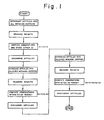
- the system operates by discharging articles from all N weighing machines, discharging articles from some of the N weighing machines one time at most, obtaining a difference value between the final target weight value P and the total weight of articles discharged in the foregoing steps, performing a combinatorial computation using the difference value as a target weight value Y, discharging articles from a combination of weighing machines selected by the combinatorial computation, and making the total weight value of articles discharged in the foregoing steps attain an optimum value, namely a value equal to the final target weight value P or closest to the final target weight value P within preset allowable limits.
- the target weight value will therefore be P grams.
- the amount of articles fed to each weighing machine should be adjusted to have an average value of 2P/N grams when N is even, and 2P/(N+I) grams grams when N is odd.
- the reason is as follows.
- the number of combinations that can be computed by a combinatorial weighing apparatus composed of N weighing machines, where a combination may be made up of only one weighing machine or up to all N of the weighing machines, is 2 N -1. When N is even, combinations composed of N/2 weighing machines will be the largest in number among said 2 N -1 combinations.
- each of the weighing machines is supplied with a batch of articles having a weight of approximately 2P/N (where N is even) or 2P/(N+I) (where N is odd), P being the target weight.
- N the number of weighing machines is ten, combinations made up of N/2 or five combinations will be the largest in number.
- the quantity of articles supplied to each of the weighing machines, as well as the supply time, is adjusted in such a manner that a combination equal or closest to the target value P is obtained from among the combinations consisting of five weighing machines.
- the target value is 1000 grams
- an adjustment is so effected that approximately 200 grams of the articles is supplied to each of the weighing machines, with there being a suitably small variance in the weight of the article batches from one weighing machine to another.
- the foregoing description deals with a standard combinatorial weighing apparatus in which all N of the weighing machines participate in the combinatorial computation process.
- the weighing machines belonging to the selected combination discharge their articles and are then resupplied.
- the next combination selection operation is performed using the M-N (four or five) weighing machines which did not participate in the preceeding combination selection, as well as those weighing machines which did participate but which were not selected.
- the purpose of this type of processing is to shorten the weighing cycle.
- regulating the amount of articles supplied to each weighing machine is performed based on the N weighing machines that participate in the selection processing, and not on the total number M of machines.
- a multiple weighing operation is performed by which articles can be weighed out to any target value greater than the maximum weighing capacity through a fewer number of weighing operations and with greater accuracy than heretofore possible in the prior art.
- a so-called “total discharge” is performed in which articles are discharged in suitable fashion from all weighing machines, and/or a so-called “partial discharge” in which articles are discharged from an arbitrary number K (1 ⁇ K ⁇ N) of the weighing machines.
- the target value (remaining weight value) of the final weighing operation namely the weighing operation performed last, will be approximately .a, where N is even, or .a, where N is odd.
- a represents the average weight of the articles supplied to each weighing machine.
- embodiments of the invention can exhibit the following advantages. Specifically, let X represent the weight of the articles weighed out by one weighing operation, where the target value P is greater than the maximum weighing capacity of the weighing apparatus:
- Fig. 2 is a view showing, in simplified form, the mechanism of a combinatorial weighing apparatus to which the present invention can be applied.
- Numeral 1 denotes a main feeder of vibratory conveyance type. Articles to be weighed are introduced into the main feeder 1 and imparted with vibratory motion for a predetermined length of time so as to be dispersed radially outward from the center of the main feeder.
- Numerals 2, 2... denote n-number of equally spaced weighing stations which are arranged around the main feeder 1 along radially extending lines to receive the articles dispersed by the main feeder.
- Each weighing station 2 includes a dispersing feeder 2a, a pool hopper 2b, a pool hopper gate 2c, a weighing hopper 2d, a weight sensor 2e, and a weighing hopper gate 2f.
- the dispersing feeder 2a may comprise solely a substantially circular bowl member which has a plurality of gates on its outer circumference, and which is vibrated so that articles will be transferred therealong away from the center of the bowl, or means having a plurality of troughs, provided with feeders, arranged radially about the center of a small circular bowl. In either case, each dispersing feeder 2a is so arranged that a predetermined weight of the articles can be introduced into the corresponding underlying pool hopper 2b.
- the quantity of articles supplied to the corresponding weighing hopper 2b is regulated by controlling the gate opening time or opening area.
- the supply of articles to the weighing hopper is regulated by controlling feeder vibration time and vibration amplitude.
- the pool hopper gate 2c is provided on each pool hopper 2b in
- Each weighing hopper 2d is provided with a weight sensor 2e of its own.
- the weight sensor 2e is operable to measure the weight of the articles introduced into the corresponding weighing hopper, and to apply an electrical signal indicative of the measured weight to a combination control unit, which is not shown.
- the combination control unit selects a combination of articles (the "optimum" combination) giving a total weight equal or closest to the target weight value, as will be described below in further detail.
- Each weighing hopper 2d is provided with its own weighing hopper gate 2f.
- a drive control unit upon receiving the signals from each of the weight sensors, produces a signal to open only the weighing hopper gates 2f of those weighing hoppers 2d that give the optimum combination, these gates 2f discharging the articles from the corresponding weighing hoppers 2d into a common chute 3 where they are collected together.
- the collecting chute 3 has the shape of a funnel and is so arranged as to receive the articles from any of the circularly arrayed weighing hoppers 2d via the hopper gates 2f, which are located above the funnel substantially along its outer rim.
- the articles received by the collecting chute 3 are collected at the centrally located lower end thereof by falling under their own weight or by being forcibly shifted along the inclined wall of the funnel by a mechanical scraper or the like, which is not shown.
- the articles collected by the collecting chute 3 are discharged into a packaging machine, which is not shown.
- numerals 101-1, 101-2... 101-N denote weighing machines of which there are N in number, each comprising the weighing hopper 2d and weight sensor 2e for measuring the weight of a batch of articles supplied thereto.
- Analog output voltages which are indicative of the weights measured thereby, are produced by the weighing machines 101-1, 101-2... 101-N and applied to a multiplexer 102, which delivers the analog voltages as an output in sequential fashion in response to a weight read signal WRS, described below.
- An analog-to-digital (A/D) converter 103 converts the analog weight voltages, which are received from the multiplexer 102, into digital weight signals.
- the digital output of the A/D converter 103 is applied to a combination control unit 104.
- the latter includes a processor 104a which receives the output of the A/D converter 103, a program memory 103b for storing a combinatorial processing program, and a data memory 10 4 c.
- the processor 104a executes combinatorial processing, described below, on the basis of the instructions constituting the processing program.
- a target weight setting unit 105 sets the target weight value P, which is applied to the processor 104a.
- Numeral 106 denotes a discharge control unit.
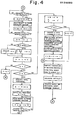
- the processor 104a responds by performing the operations N ⁇ 0, R ⁇ 0 (where R is the total weight of articles supplied to all weighing machines) and by sending the weight read signal WRS to the multiplexer 102.
- the latter responds to the weight read signal WRS by sequentially supplying the A/ D converter 103 with analog weight voltages W 1 , W 2 ... WN obtained from the respectively weighing machines 101-1, 101-2... 101-N.
- the A/D converter 103 converts each analog weight voltage into a digital value and applies a signal indicative of the digital value to the processor 104a.
- a total discharge and/or a partial discharge is performed depending upon the relation between a target weight value and the maximum weighing capacity of the weighing apparatus, and only a single combinatorial process step need be executed at the end to obtain .a or .a as the target weight value.
- This makes possible high-speed weighing owing to fewer weighing operations, and allow weighing to be carried out with great precision.
- a total discharge is performed in instances where the residual quantity Q is greater than the total weight R of all weighing machines, articles do not reside in the weighing hoppers for extending periods of time owing to prolonged non-selection of the corresponding weighing machines. This prevents deterioration of products such as frozen foodstuffs.
Landscapes
- Physics & Mathematics (AREA)
- General Physics & Mathematics (AREA)
- Weight Measurement For Supplying Or Discharging Of Specified Amounts Of Material (AREA)
Applications Claiming Priority (2)
| Application Number | Priority Date | Filing Date | Title |
|---|---|---|---|
| JP58074829A JPS59198323A (ja) | 1983-04-27 | 1983-04-27 | 組合せ計量方法 |
| JP74829/83 | 1983-04-27 |
Publications (3)
| Publication Number | Publication Date |
|---|---|
| EP0125080A2 true EP0125080A2 (fr) | 1984-11-14 |
| EP0125080A3 EP0125080A3 (en) | 1985-12-18 |
| EP0125080B1 EP0125080B1 (fr) | 1989-09-06 |
Family
ID=13558604
Family Applications (1)
| Application Number | Title | Priority Date | Filing Date |
|---|---|---|---|
| EP84302862A Expired EP0125080B1 (fr) | 1983-04-27 | 1984-04-27 | Méthode combinatoire de pesage et dispositif |
Country Status (5)
| Country | Link |
|---|---|
| US (1) | US4527645A (fr) |
| EP (1) | EP0125080B1 (fr) |
| JP (1) | JPS59198323A (fr) |
| AU (1) | AU561927B2 (fr) |
| DE (1) | DE3479682D1 (fr) |
Families Citing this family (7)
| Publication number | Priority date | Publication date | Assignee | Title |
|---|---|---|---|---|
| JPH0672797B2 (ja) * | 1984-04-25 | 1994-09-14 | 株式会社石田衡器製作所 | 組合せ計量装置と包装機との連動システム |
| GB2170013B (en) * | 1985-01-21 | 1988-05-25 | Yamato Scale Co Ltd | Combination weighing machines |
| JPS62231123A (ja) * | 1986-03-31 | 1987-10-09 | Anritsu Corp | 組合せ計量装置 |
| US4749008A (en) * | 1986-10-30 | 1988-06-07 | Kraft, Inc. | Methods and apparatus for container filling |
| JPH0627666B2 (ja) * | 1987-10-09 | 1994-04-13 | 株式会社石田衡器製作所 | 組合せ計数方法 |
| WO1992010728A1 (fr) * | 1990-12-14 | 1992-06-25 | Nambu Electric Co., Ltd. | Dispositif de ramassage d'articles |
| CN117446439A (zh) * | 2023-10-10 | 2024-01-26 | 中国烟草总公司郑州烟草研究院 | 一种定量自动投料装置及定量自动投料方法 |
Family Cites Families (10)
| Publication number | Priority date | Publication date | Assignee | Title |
|---|---|---|---|---|
| JPS5414946B2 (fr) * | 1972-08-12 | 1979-06-11 | ||
| US3977483A (en) * | 1975-04-02 | 1976-08-31 | The Kingsford Company | Material handling apparatus and method |
| US4137976A (en) * | 1977-05-09 | 1979-02-06 | Fiber Industries, Inc. | Method and apparatus for bale weight control |
| US4313507A (en) * | 1978-03-09 | 1982-02-02 | Hays Gordon W | Weight portioning method and apparatus |
| JPS56109022U (fr) * | 1980-01-23 | 1981-08-24 | ||
| JPS57141517A (en) * | 1981-02-25 | 1982-09-01 | Ishida Scales Mfg Co Ltd | Method and device for combined weighing or counting |
| JPS57171219A (en) * | 1981-04-14 | 1982-10-21 | Ishida Scales Mfg Co Ltd | Computer scale |
| JPS5841325A (ja) * | 1981-09-04 | 1983-03-10 | Ishida Scales Mfg Co Ltd | 計量方法 |
| US4448272A (en) * | 1981-10-09 | 1984-05-15 | Platt Saco Lowell Corporation | Method and apparatus for feeding, weighing and releasing fiber |
| JPS58223716A (ja) * | 1982-06-23 | 1983-12-26 | Ishida Scales Mfg Co Ltd | 組み合せ計量方法 |
-
1983
- 1983-04-27 JP JP58074829A patent/JPS59198323A/ja active Granted
-
1984
- 1984-03-12 AU AU25524/84A patent/AU561927B2/en not_active Ceased
- 1984-04-03 US US06/596,273 patent/US4527645A/en not_active Expired - Fee Related
- 1984-04-27 EP EP84302862A patent/EP0125080B1/fr not_active Expired
- 1984-04-27 DE DE8484302862T patent/DE3479682D1/de not_active Expired
Also Published As
| Publication number | Publication date |
|---|---|
| EP0125080A3 (en) | 1985-12-18 |
| AU561927B2 (en) | 1987-05-21 |
| JPH0340810B2 (fr) | 1991-06-20 |
| US4527645A (en) | 1985-07-09 |
| EP0125080B1 (fr) | 1989-09-06 |
| DE3479682D1 (en) | 1989-10-12 |
| JPS59198323A (ja) | 1984-11-10 |
| AU2552484A (en) | 1984-11-01 |
Similar Documents
| Publication | Publication Date | Title |
|---|---|---|
| EP0071473B1 (fr) | Groupement combinatoire d'articles | |
| US4508186A (en) | Weighing method and apparatus therefor | |
| US4442911A (en) | Method and apparatus for controlling zero adjustment of weight sensor | |
| EP0063056A2 (fr) | Méthode de pesage combinatoire et appareil pour celui-ci | |
| EP0074261B1 (fr) | Dispositif de pesage combinatoire | |
| EP0076167B1 (fr) | Pesage ou comptage combinatoire d'articles | |
| EP0124370B1 (fr) | Méthode et dispositif de pesage combinatoire | |
| EP0127326B1 (fr) | Méthode et dispositif de pesage combinatoire | |
| US4527645A (en) | Combinatorial weighing method and apparatus | |
| EP0103476A2 (fr) | Méthode de pesage combinatoire et dispositif y relatif | |
| US4508185A (en) | Combinatorial weighing method | |
| EP0119854B1 (fr) | Méthode de pesage combinatoire et dispositif | |
| US4549278A (en) | Combinatorial weighing method and apparatus | |
| EP0075489B1 (fr) | Groupement d'articles en accord avec des exigences présélectionnées du rapport nombre/poids | |
| US4552237A (en) | Combinatorial weighing method and apparatus | |
| US4574897A (en) | Combinatorial weighing apparatus | |
| US4527646A (en) | Combination weighing machine | |
| EP0097531B1 (fr) | Méthode de pesage combinatoire et dispositif | |
| US4557340A (en) | Method of combinatorial weighing in a combinatorial weighing machine | |
| EP0312272A2 (fr) | Méthode de comptage combinatoire et dispositif de pesage à cet effet |
Legal Events
| Date | Code | Title | Description |
|---|---|---|---|
| PUAI | Public reference made under article 153(3) epc to a published international application that has entered the european phase |
Free format text: ORIGINAL CODE: 0009012 |
|
| AK | Designated contracting states |
Designated state(s): DE FR GB IT |
|
| PUAL | Search report despatched |
Free format text: ORIGINAL CODE: 0009013 |
|
| AK | Designated contracting states |
Designated state(s): DE FR GB IT |
|
| 17P | Request for examination filed |
Effective date: 19860509 |
|
| 17Q | First examination report despatched |
Effective date: 19870706 |
|
| GRAA | (expected) grant |
Free format text: ORIGINAL CODE: 0009210 |
|
| AK | Designated contracting states |
Kind code of ref document: B1 Designated state(s): DE FR GB IT |
|
| REF | Corresponds to: |
Ref document number: 3479682 Country of ref document: DE Date of ref document: 19891012 |
|
| ET | Fr: translation filed | ||
| ITF | It: translation for a ep patent filed | ||
| PLBE | No opposition filed within time limit |
Free format text: ORIGINAL CODE: 0009261 |
|
| STAA | Information on the status of an ep patent application or granted ep patent |
Free format text: STATUS: NO OPPOSITION FILED WITHIN TIME LIMIT |
|
| 26N | No opposition filed | ||
| PGFP | Annual fee paid to national office [announced via postgrant information from national office to epo] |
Ref country code: DE Payment date: 19910410 Year of fee payment: 8 |
|
| PGFP | Annual fee paid to national office [announced via postgrant information from national office to epo] |
Ref country code: GB Payment date: 19910416 Year of fee payment: 8 |
|
| PGFP | Annual fee paid to national office [announced via postgrant information from national office to epo] |
Ref country code: FR Payment date: 19910419 Year of fee payment: 8 |
|
| ITTA | It: last paid annual fee | ||
| PG25 | Lapsed in a contracting state [announced via postgrant information from national office to epo] |
Ref country code: GB Effective date: 19920427 |
|
| GBPC | Gb: european patent ceased through non-payment of renewal fee | ||
| PG25 | Lapsed in a contracting state [announced via postgrant information from national office to epo] |
Ref country code: FR Effective date: 19921230 |
|
| PG25 | Lapsed in a contracting state [announced via postgrant information from national office to epo] |
Ref country code: DE Effective date: 19930101 |
|
| REG | Reference to a national code |
Ref country code: FR Ref legal event code: ST |