EP0125209A2 - Schmierstoffzusammensetzungen - Google Patents
Schmierstoffzusammensetzungen Download PDFInfo
- Publication number
- EP0125209A2 EP0125209A2 EP84810210A EP84810210A EP0125209A2 EP 0125209 A2 EP0125209 A2 EP 0125209A2 EP 84810210 A EP84810210 A EP 84810210A EP 84810210 A EP84810210 A EP 84810210A EP 0125209 A2 EP0125209 A2 EP 0125209A2
- Authority
- EP
- European Patent Office
- Prior art keywords
- alkyl
- formula
- och
- interrupted
- independently
- Prior art date
- Legal status (The legal status is an assumption and is not a legal conclusion. Google has not performed a legal analysis and makes no representation as to the accuracy of the status listed.)
- Granted
Links
Classifications
-
- C—CHEMISTRY; METALLURGY
- C10—PETROLEUM, GAS OR COKE INDUSTRIES; TECHNICAL GASES CONTAINING CARBON MONOXIDE; FUELS; LUBRICANTS; PEAT
- C10M—LUBRICATING COMPOSITIONS; USE OF CHEMICAL SUBSTANCES EITHER ALONE OR AS LUBRICATING INGREDIENTS IN A LUBRICATING COMPOSITION
- C10M137/00—Lubricating compositions characterised by the additive being an organic non-macromolecular compound containing phosphorus
- C10M137/02—Lubricating compositions characterised by the additive being an organic non-macromolecular compound containing phosphorus having no phosphorus-to-carbon bond
- C10M137/04—Phosphate esters
- C10M137/10—Thio derivatives
- C10M137/105—Thio derivatives not containing metal
-
- C—CHEMISTRY; METALLURGY
- C07—ORGANIC CHEMISTRY
- C07F—ACYCLIC, CARBOCYCLIC OR HETEROCYCLIC COMPOUNDS CONTAINING ELEMENTS OTHER THAN CARBON, HYDROGEN, HALOGEN, OXYGEN, NITROGEN, SULFUR, SELENIUM OR TELLURIUM
- C07F9/00—Compounds containing elements of Groups 5 or 15 of the Periodic Table
- C07F9/02—Phosphorus compounds
- C07F9/06—Phosphorus compounds without P—C bonds
- C07F9/16—Esters of thiophosphoric acids or thiophosphorous acids
- C07F9/165—Esters of thiophosphoric acids
- C07F9/1651—Esters of thiophosphoric acids with hydroxyalkyl compounds with further substituents on alkyl
-
- C—CHEMISTRY; METALLURGY
- C07—ORGANIC CHEMISTRY
- C07F—ACYCLIC, CARBOCYCLIC OR HETEROCYCLIC COMPOUNDS CONTAINING ELEMENTS OTHER THAN CARBON, HYDROGEN, HALOGEN, OXYGEN, NITROGEN, SULFUR, SELENIUM OR TELLURIUM
- C07F9/00—Compounds containing elements of Groups 5 or 15 of the Periodic Table
- C07F9/02—Phosphorus compounds
- C07F9/547—Heterocyclic compounds, e.g. containing phosphorus as a ring hetero atom
- C07F9/6527—Heterocyclic compounds, e.g. containing phosphorus as a ring hetero atom having nitrogen and oxygen atoms as the only ring hetero atoms
- C07F9/6533—Six-membered rings
-
- C—CHEMISTRY; METALLURGY
- C10—PETROLEUM, GAS OR COKE INDUSTRIES; TECHNICAL GASES CONTAINING CARBON MONOXIDE; FUELS; LUBRICANTS; PEAT
- C10M—LUBRICATING COMPOSITIONS; USE OF CHEMICAL SUBSTANCES EITHER ALONE OR AS LUBRICATING INGREDIENTS IN A LUBRICATING COMPOSITION
- C10M2223/00—Organic non-macromolecular compounds containing phosphorus as ingredients in lubricant compositions
- C10M2223/02—Organic non-macromolecular compounds containing phosphorus as ingredients in lubricant compositions having no phosphorus-to-carbon bonds
- C10M2223/04—Phosphate esters
- C10M2223/047—Thioderivatives not containing metallic elements
Definitions
- the present invention relates to lubricant compositions containing monothiophosphoric acid ester derivatives.
- additives are generally added to mineral and synthetic lubricants to improve their performance properties.
- additives which reduce the coefficient of friction.
- Such additives are also required to increase the load-bearing capacity of the lubricant, not to have a corrosive effect on the metal parts to be protected and to have good thermal resistance.
- R to R 13 can be straight-chain or branched alkyl, for example for R 3 to R 13 methyl, ethyl, n-propyl, isopropyl, n-butyl, sec-butyl and tert-butyl, for R in the rest -OR 9 and R 10 and R 11 au sserdem n-pentyl, tert-pentyl, n-hexyl, 1- and 6-methylpentyl, n-octyl, 2-ethylhexyl, 1,1-dimethylhexyl, n-decyl, n-dodecyl, 2 -Aethyldecyl, 1,1,7,7-tetramethyloctyl, n-tetradecyl, n-hexadecyl, n-octadecyl and eikosyl, but especially for R 9 C 1 -C 13 alkyl
- R 1 and R 2 are C 3 -C 12 alkyl, these can be the same radicals already mentioned with 3 to 12 carbon atoms.
- R and R are alkyl substituted by one or two oxygen or sulfur atoms, these are, for example, alkoxyalkyl and alkylthioalkyl groups, in particular alkoxyalkyl with a total of 3-12 C atoms, such as 2-methoxyethyl, 2-ethoxyethyl, 2-n-propoxyethyl, 2-isopropoxyethyl, 2-n-butoxyethyl, 2-n-octoxyethyl and methoxypropyl, as well as diethylene glycol monoalkyl ether groups such as ⁇ -methoxyethoxyethyl, ⁇ -ethoxyethoxyethyl and ⁇ -n-butyloxyethyloxy.
- R 1 and R 2 contain 3-6 C atoms as alkoxylalkyl.
- R 10 and R 11 are alkyl interrupted by one or two oxygen atoms, the radicals mentioned above can be the same.
- R 1 , R 2 , R 3 to R 6 , R 10 and R 11 can be C 5 -C 12 cycloalkyl, for example cyclopentyl, cyclohexyl, mono- and dimethylcyclohexyl, cyclooctyl, cyclodecyl or cyclododecyl. Cyclohexyl is preferred.
- R 9 as C 5 -C 12 cycloalkyl can stand for the same radicals already mentioned, but especially for C 6 -C 9 cycloalkyl.
- R 10 and R 11 are C 2 -C 22 alkenyl, they are straight-chain or branched substituents which have one or more double bonds, preferably one or two, such as 2-butenylene, 3-butenylene, 4-butenylene, 2 -Pentenylene, 3-pentenylene or 4-pentenylene
- phenyl is, for example, methyl, ethyl, isopropyl, n-butyl, sec-butyl, tert-butyl, tert-pentyl -, n-Hexyl, n-octyl, 1,1,3,3-tetramethylbutyl or 1,1,3,3,5,5-hexamethylhexyl groups.
- R 1 and R 2 are C 7 -C 9 phenylalkyl, it can be a, a-dimethylbenzyl, ⁇ -phenylethyl and in particular benzyl.
- R 7 and R 8 are as C 2 -C 19 alkoxycarbonyl, for example methoxycarbonyl, ethoxycarbonyl, butoxycarbonyl, hexoxycarbonyl, octoxy carbonyl, dodecyloxycarbonyl or octadecyloxycarbonyl.
- Preferred alkoxycarbonyl groups contain 2 to 9 carbon atoms, but in particular 2 to 5 carbon atoms.
- R, R12 and R 13 are C 2 -C 13 or C 2 -C 9 alkoxycarbonyl, these can be the same radicals already mentioned with 2 to 13 C or 2 to 9 C atoms. C 2 -C 5 alkoxycarbonyl is preferred.
- R , R 7 , R 8 , R 12 and R 13 are C6 -C 13 cycloalkoxycarbonyl, for example cyclopentoxy-, cyclohexoxy-, trimethylcyclohexoxy- or cycloheptoxycarbonyl, but especially cyclohexoxycarbonyl.
- C m H 2m is, for example, ethylene, 1,2-propylene, 1,3-methylpropylene-1,3, 1,4-butylene, 1-pentylene, 5, 1,6-hexamethylene, 2-methylethylene, 2-ethylethylene, 2-eikosylethylene, 1,2-dimethylethylene, 1,1,2,2-tetramethylethylene, 3-methylpentylene-1,3 or 3-tert-butyl - pentylene-1,3.
- this radical -OC m H 2m O- is interrupted by oxygen or sulfur atoms, it is, for example, [-O-CH (CH 3 ) -CH 2 ] 2 O, [-O-CH (CH 3 ) -CH 2 ] S or -OC 2 H 4 OC 2 H 4 OC 2 H 4 O-.
- R 7 and R 8 together with the carbon atom to which they are attached are, for example, 2- or 3-cyclopentenyl-1 or 3-cyclohexenyl-1.
- R 10 and R 11 together form a C 2 -C 22 ken alkylene or C 2 -C 22 Al y len with the N-atom to which they are attached form a ring, the ring by one or more atoms from the group : Oxygen, sulfur or nitrogen may be interrupted.
- the alkylene or alkenylene part of the ring can optionally be substituted one or more times by C 1 -C 4 alkyl, such as C 1 -C 4 alkylated 1,4-butylene or 1,5-pentylene, in particular methylated 1-butylene, 4 or pentylene-1.5.
- the alkenylene part of the ring can have one or two double bonds and for example 2-butenylene, 3-butenylene, 4-butenylene, 2-pentenylene, 3-pentenylene or 4-pentenylene.
- a heterocyclic ring is also interrupted by additional 0, S and / or N atoms, then together with the R 10 and R 11 -binding N atom it is in particular morpholino, thiomorpholino, piperazino, 4-methyl-piperazino , Pyrazole, imidazole, 1,2,3-triazole, 1,2,4-triazole, tetrazole, 2-imidazoline, 4-imidazoline, 2H, 6H-1,5,2-di-thiazine, pyralin, 3-pyrazoline or 2-pyrazoline.
- B is preferably the number 1.
- the respective open-chain or cyclic diphosphites of the formula III are initially reacted with PC1 3 either directly or via the subsequent reaction of the chlorophosphites isolated first with water synthesized, which by reaction with sulfur / NH 3 in an inert organic solvent via the easily accessible corresponding ammonium monothiophosphates of the formula IV and subsequent reaction with the suitable halogen compound provide the monothiophosphoric esters of the formula I.
- R, R 1 , R 2 , X and a have the above given meaning.
- Hal stands for halogen and preferably means chlorine or bromine.
- reaction of 1,3-diols can advantageously also be carried out by direct esterification of the diols with H 3 PO 3 (phosphorous acid) to give the corresponding compounds of the formula III.
- H 3 PO 3 phosphorous acid
- the compounds of formula I can be used raw, as they are in their synthesis. They can also be cleaned as a lubricant additive before use.
- the compounds of the formula I act as high-pressure additives in lubricants.
- Mineral and synthetic lubricating oils and their mixtures which are provided with 0.05 to 5% by weight, based on the lubricant, and preferably 0.1 to 3% by weight of a compound of the formula I, show excellent high-pressure Lubricating properties.
- the lubricant compositions according to the invention are distinguished in particular by good load-bearing capacity, good wear protection properties and a good friction-reducing effect. In addition, these ash-free connections have good thermal resistance.
- the lubricating oil formulation can additionally contain further additives which are added in order to improve certain usage properties. These are preferably antioxidants, metal passivators, rust inhibitors, viscosity index improvers, pour point depressants and dispersants / detergents, thickeners and other known antiwear agents, high pressure agents and friction reducers.
- the amount of these additives used is not limited. It depends on the chemical structure of the additives and the field of application and is known to the person skilled in the art. Preferably, several such additives are combined in order to obtain optimal properties.
- antioxidants are:
- metal passivators examples are:
- rust inhibitors are:
- viscosity index improvers examples include:
- Polymethacrylates vinyl pyrrolidone / methacrylate copolymers, polybutenes, olefin copolymers, styrene / acrylate copolymers.
- pour point depressants examples include:
- Alkylated naphthalenes, alkylated phenols, polymethacrylates Alkylated naphthalenes, alkylated phenols, polymethacrylates.
- polyalkenylsuccinimides are polyalkenylsuccinimides, oil-soluble metal soaps such as Ca, Ba, Mg and Al carboxylates, phenolates or sulfonates.
- wear protection additives examples include:
- Compounds containing sulfur and / or phosphorus and / or halogen such as sulfurized vegetable oils, zinc dialkyldithiophosphates, tritolyl phosphate, chlorinated paraffins, alkyl and aryl disulfides.
- Another object of the invention is the use of compounds of formula I as lubricant additives in lubricants, especially in lubricating oils and greases.
- the compounds of the formula I which are considered according to the invention are distinguished in particular by good friction behavior in the mixed friction area at a higher temperature. In addition, they have good thermal stability and freedom from ash.
- the lubricant compositions according to the invention are used in particular in hydraulic oils, gear and motor oils, lubricating greases and in metalworking oils.
- Parts and percentages mean parts by weight and percentages by weight.
- the monothiophosphate ammonium salts listed in Table 1 are prepared analogously.
- Th. Th Obtained iophosphoric acid-0.0-diisopropyl-S-acetic acid-n-hexyl ester as a colorless liquid.
- the product thus obtained is further increased by molecular distillation at 60 ° C / 6.65 ⁇ 10 -3 -1.33 ⁇ 10 -2 mbar cleans. Yield: 91.8 parts (77% of theory), colorless liquid with a refractive index (n D 20 ) of 1.4580.
- Example 10 which is prepared by processes known per se by adding 0.0-diisopropyl thiophosphorate to ethyl acrylate.
- Example 30 To test for friction-reducing properties, the compounds listed below are incorporated into an unalloyed lubricating oil (viscosity: 139.3 mm 2 ⁇ sec -1 / 40 ° C) and with the aid of the SRV device (vibration-friction wear device) from Optimol-Munich, see in this regard Lubrication Engineering, Vol. 39, No. 11, Nov. 1982, Advertising Index, cover 3, page 729) the coefficient of friction at 40 ° C and 110 ° C is determined.
- SRV device vibration-friction wear device
- an oscillating ball 50 Hz with a force of 200 N is pressed against a firmly clamped metal plate on which the test oil is located.
- the monothiophosphoric acid esters of the formula I considered in accordance with the invention show a superior friction-reducing effect in the mixed friction region at a lower (40 ° C.) and at a higher (110 ° C.) temperature than a base oil which contains no additive.
Landscapes
- Chemical & Material Sciences (AREA)
- Organic Chemistry (AREA)
- Health & Medical Sciences (AREA)
- Life Sciences & Earth Sciences (AREA)
- Biochemistry (AREA)
- General Health & Medical Sciences (AREA)
- Molecular Biology (AREA)
- Chemical Kinetics & Catalysis (AREA)
- General Chemical & Material Sciences (AREA)
- Oil, Petroleum & Natural Gas (AREA)
- Lubricants (AREA)
Abstract
Description
- Die vorliegende Erfindung betrifft Schmierstoffzusammensetzungen enthaltend Monothiophosphorsäureesterderivate.
- Mineralischen und synthetischen Schmierstoffen werden im allgemeinen verschiedene Zusatzstoffe zur Verbesserung ihrer Gebrauchseigenschaften beigegeben. Insbesondere besteht ein Bedarf an Additiven, welche den Reibungskoeffizienten vermindern. An solche Additive wird ausserdem die Anforderung gestellt, dass sie das Lasttragevermögen des Schmierstoffs erhöhen, nicht korrodierend auf die zu schützenden Metallteile wirken und eine gute Thermobeständigkeit besitzen.
- Verschiedenartige Schmierstoffzusätze wurden bereits vorgeschlagen, so beispielsweise verschiedene Dithiophosphorsäurederivate gemäss der DE-PS 2 104 041 und der DE-OS 2 756 488. Die Eigenschaften von solchen Additiven in Schmierölen sind vielfach nicht zufriedenstellend. Insbesondere ist die reibungsvermindernde Wirkung oder die Thermobeständigkeit nicht optimal.
- Es wurde nun gefunden, dass bestimmte aschefreie Monothiophosphorsäureester der Formel 1, sowohl gegenüber den Zinkdithiophosphaten als auch gegenüber entsprechenden metallfreien Dithiophosphaten, in mineralischen und synthetischen Schmierstoffen eine deutlich bessere reibungsvermindernde Wirkung im Mischreibungsgebiet bei höherer Temperatur aufweisen.
- Die Erfindung betrifft demgemäss Schmierstoffzusammensetzungen enthaltend
- a) ein mineralisches und/oder ein synthetisches Basisöl und
- b) mindestens eine Verbindung der Formel I

- a die Zahl 0 oder 1 und
- b eine ganze Zahl von 1 bis 6 darstellen,
- R -H, -CH3, -COOH, C2-C13 Alkoxycarbonyl, wobei der Rest Alkyl durch ein oder zwei Sauerstoffatome unterbrochen sein kann,oder C 6-C 13 Cycloalkoxycarbonyl bedeutet, und
- R und R2 unabhängig voneinander C3-C12 Alkyl, das durch ein oder zwei Sauerstoff- oder Schwefelatome unterbrochen sein kann, C5-C12 Cycloalkyl, unsubstituiertes oder durch eine bis drei C1-C12 Alkylgruppen substituiertes Phenyl, oder C7-C9 Phenylalkyl sind, ferner R1 und R2 zusammen einen bifunktionellen Rest der Formel II

- n 0 oder 1 ist,
- R3, R4, R und R unabhängig voneinander -H, C1-C4 Alkyl, C5-C12 Cycloalkyl oder Phenyl, und
- R7 und R8 unabhängig voneinander -H, C1-C4 Alkyl, Phenyl, -NO2, C2-C19 Alkoxycarbonyl oder C6-C13 Cycloalkoxycarbonyl bedeutet, oder
- R7 und R8 zusammen mit dem Kohlenstoffatom, an das sie gebunden sind, einen Cyclopentenyl- oder Cyclohexenylring bilden,
- X bei b = 1 -OR9 oder -N(R10)(R11) ist, wobei R9 -H, C1-C22 Alkyl, CS-C12 Cycloalkyl oder Phenyl, und R10 und R11, unabhängig voneinander -H,unsubstituiertes oder durch ein oder zwei Sauerstoffatome unterbrochenes C1-C22 Alkyl, C2-C22 Alkenyl oder C5-C12 Cycloalkyl bedeuten, oder
- R10 und R 11 zusammen mit dem Stickstoffatom, an das sie gebunden sind, einen C2-C22 Alkylen- oder C2-C22 Alkenylenring bilden, der durch Sauerstoff-, Schwefel- und/oder Stickstoffatome unterbrochen sein kann, und
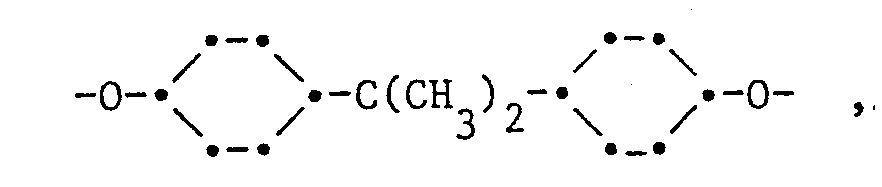
- X bei b > 1, einen mehrwertigen Rest der Formeln -OCmH2mO-, wobei die CmH2m-Gruppe durch ein oder 2 Sauerstoff- oder Schwefelatome unterbrochen sein kann, -OCH2-C(R12)(R13)-CH2O-,

- R 12 und R13 C1-C4 Alkyl, C2-C9 Alkoxycarbonyl, C6-C13 Cycloalkoxy- carbonyl, Phenyl oder -NO2 bedeuten, oder R12 und R13 zusammen mit dem Kohlenstoffatom, an das sie gebunden sind, einen Cyclopentenylring bilden, und R14 -CH3 oder -C2H5 darstellt.
- R bis R13 können geradkettiges oder verzweigtes Alkyl sein, beispielsweise für R3 bis R13 Methyl, Aethyl, n-Propyl, Isopropyl, n-Butyl, sec.-Butyl und tert.-Butyl, für R im Rest -OR9 und R10 und R11 ausserdem n-Pentyl, tert.-Pentyl, n-Hexyl, 1- und 6-Methylpentyl, n-Octyl, 2-Aethylhexyl, 1,1-Dimethylhexyl, n-Decyl, n-Dodecyl, 2-Aethyldecyl, 1,1,7,7-Tetramethyloctyl, n-Tetradecyl, n-Hexadecyl, n-Octadecyl und Eikosyl, insbesonders aber für R9 C1-C13 Alkyl.
- Stehen R1 und R2 für C3-C12 Alkyl, so kann es sich um dieselben bereits genannten Reste mit 3 bis 12 C-Atomen handeln.
- Sind R und R durch ein oder zwei Sauerstoff- oder Schwefelatome substituiertes Alkyl, so handelt es sich dabei beispielsweise um Alkoxyalkyl- und Alkylthioalkylgruppen, insbesondere um Alkoxyalkyl mit insgesamt 3-12 C-Atomen, wie 2-Methoxyäthyl, 2-Aethoxy- äthyl, 2-n-Propoxyäthyl, 2-Isopropoxyäthyl, 2-n-Butoxyäthyl, 2-n-Octoxyäthyl und Methoxypropyl, sowie um Diäthylenglykolmonoalkyl- äthergruppen wie β-Methoxyäthoxyäthyl, ß-Aethoxyäthoxyäthyl und β-n-Butyloxyäthoxyäthyl. Insbesondere zu erwähnen sind Verbindungen in welchen R1 und R2 als Alkoxylalkyl 3 - 6 C-Atome enthalten. Sind R10 und R11 durch ein oder zwei Sauerstoffatome unterbrochenes Alkyl, so kann es sich um dieselben bereits genannten Reste handeln.
- R1, R2, R 3 bis R 6, R10 und R11 können als C5-C12 Cycloalkyl z.B. Cyclopentyl, Cyclohexyl, Mono- und Dimethylcyclohexyl, Cyclooctyl, Cyclodecyl oder Cyclododecyl bedeuten, Bevorzugt ist Cyclohexyl.
- R9 als C5-C12 Cycloalkyl kann für dieselben bereits genannten Reste stehen, insbesondere aber für C6-C9 Cycloalkyl.
- Sind R10 und R11 C2-C22 Alkenyl, so handelt es sich um geradkettige oder verzweigte Substituenten, die eine oder mehrere Doppelbindungen aufweisen, bevorzugt eine oder zwei, wie beispielsweise 2-Butenylen, 3-Butenylen, 4-Butenylen, 2-Pentenylen, 3-Pentenylen oder 4-Pentenylen
- Sind R1 und R2 durch eine bis drei Alkylgruppen substituiertes Phenyl, so handelt es sich beispielsweise um Methyl-, Aethyl-, Isopropyl-, n-Butyl-, sec.-Butyl-, tert.-Butyl-, tert.-Pentyl-, n-Hexyl-, n-Octyl-, 1,1,3,3-Tetramethylbutyl- oder 1,1,3,3,5,5-Hexamethylhexylgruppen.
- Sind R1 und R2 C7-C9 Phenylalkyl, so kann es sich um a,a-Dimethylbenzyl, β-Phenyläthyl und insbesondere um Benzyl handeln. R7 und R8 sind als C2-C19 Alkoxycarbonyl beispielsweise Methoxycarbonyl, Aethoxycarbonyl, Butoxycarbonyl, Hexoxycarbonyl, Octoxycarbonyl, Dodecyloxycarbonyl oder Octadecyloxycarbonyl. Bevorzugte Alkoxycarbonylgruppen enthalten 2 bis 9 C-Atome, insbesondere aber 2 bis 5 C-Atome.
- Sind R, R12 und R13 C2-C13 bzw. C2-C9 Alkoxycarbonyl, so kann es sich um dieselben bereits genannten Reste mit 2 bis 13 C- bzw. 2- bis 9 C-Atomen handeln. Bevozugt ist C2-C5 Alkoxycarbonyl. Sind R, R7, R8, R12 und R13 C6-C13 Cycloalkoxycarbonyl, so handelt es sich dabei beispielsweise um Cyclopentoxy-, Cyclohexoxy-, Trimethylcyclohexoxy- oder Cycloheptoxycarbonyl, insbesondere aber um Cyclohexoxycarbonyl.
- Steht X für -OCmH2mO-, so handelt es sich für den Rest CmH2m beispielsweise um Aethylen, Propylen-1,2, 3-Methylpropylen-1,3, Butylen-1,4, Pentylen-1,5, Hexamethylen-1,6, 2-Methyläthylen, 2-Aethyläthylen, 2-Eikosyläthylen, 1,2-Dimethyläthylen, 1,1,2,2-Tetramethyläthylen, 3-Methylpentylen-1,3 oder 3-tert.-Butyl- pentylen-1,3. Ist dieser Rest -OCmH2mO- durch Sauerstoff- oder Schwefelatome unterbrochen, so handelt es sich beispielsweise um [-O-CH(CH3)-CH2]2O, [-O-CH(CH3)-CH2]S oder -OC2H4OC2H4OC2H4O-.
- R7 und R8 zusammen mit dem C-Atom,an das sie gebunden sind, sind beispielsweise 2- oder 3-Cyclopentenyl-1 oder 3-Cyclohexenyl-l.
- R 10 und R 11 bilden zusammen als C2-C22 Alkylen oder C2-C22 Alkenylen mit dem N-Atom, an das sie gebunden sind, einen Ring, wobei der Ring durch ein oder mehrere Atome aus der Gruppe: Sauerstoff, Schwefel oder Stickstoff unterbrochen sein kann. Hierbei können der Alkylen- oder der Alkenylenteil des Ringes gegebenenfalls ein-oder mehrfach durch C1-C4 Alkyl substituiert sein, wie C1-C4 alkyliertes Butylen-1,4 oder Pentylen-1,5, insbesondere methyliertes Butylen-1,4 oder Pentylen-1,5. Der Alkenylenteil des Ringes kann ein oder zwei Doppelbindungen aufweisen und beispielsweise 2-Butenylen, 3-Butenylen, 4-Butenylen, 2-Pentenylen, 3-Pentenylen oder 4-Pentenylen sein. Ist ein derartiger heterocyclischer Ring ausserdem durch zusätzliche 0-, S- und/oder N-Atome unterbrochen, so handelt es sich zusammen mit dem R10 und R 11 bindenden N-Atom insbesondere um Morpholino, Thiomorpholino, Piperazino, 4-Methyl-piperazino, Pyrazol, Imidazol, 1,2,3-Triazol, 1,2,4-Triazol, Tetrazol, 2-Imidazolin, 4-Imidazolin, 2H,6H-1,5,2-Di- thiazin, Pyralin, 3-Pyrazolin oder 2-Pyrazolin.
- Bevorzugt sind solche Schmierstoffzusammensetzungen, welche mindestens eine Verbindung der Formel I enthalten, in welcher a die Zahl 0 und b eine ganze Zahl von 1 bis 4 darstellen, R -H oder C2-C5 Alkoxycarbonyl und R1 und R2 unabhängig voneinander C3-C12 Alkyl, das durch ein oder zwei Sauerstoffatome unterbrochen sein kann, Cyclohexyl, unsubstituiertes oder durch eine bis drei C1-C12 Alkylgruppen substituiertes Phenyl,oder Benzyl bedeuten, ferner R1 und R2 zusammen einen bifunktionellen Rest der Formel II

- n die Zahl 0 oder 1 ist, R3, R4, R5 und R unabhängig voneinander -H, -CH3, oder -C2H5 bedeuten,
- R7 und R8 unabhängig voneinander -H, C1-C4 Alkyl, Phenyl, -N02 oder C2-C9 Alkoxycarbonyl bedeuten, oder
- Rund R8 zusammen mit dem Kohlenstoffatom, an das sie gebunden sind, einen Cyclohexenylring bilden, und
- X bei b = 1 -OR9 oder -N(R10)(R11) bedeutet, wobei R9 -H, C1-C13 Alkyl oder C6-C9 Cycloalkyl und R10 und R11 -H bedeuten, oder
- R10 und R11 zusammen mit dem Stickstoffatom, an das sie gebunden sind, einen C4-C6 Alkylenring bilden, der durch ein Sauerstoff-, Schwefel-oder Stickstoffatom unterbrochen sein kann und
- X bei b > 1 einen mehrwertigen Rest der Formel -OCmH2m 0-, wobei die CmH2m-Gruppe durch ein oder zwei Sauerstoff- oder Schwefelatome unterbrochen sein kann und m eine Zahl von 4 bis 6 ist, ferner X -OCH2-C(R12)(R13)-CH2O-, (-OCH2)3C-R14 oder (-OCH2)4O bedeutet, wobei R12 und R13 C1-C4 Alkyl oder C2-C4 Alkoxycarbonyl sind, oder R12 und R13 zusammen mit dem Kohlenstoffatom, an das sie gebunden sind, einen Cyclopentenylring darstellen, und R14 -CH3 oder -C2H5 bedeuten.
- Besonders bevorzugt sind solche Schmierstoffzusammensetzungen, welche mindestens eine Verbindung der Formel I enthalten, in welcher a und b die oben angegebene Bedeutung haben, R -H und R und R2 unabhängig voneinander C3-C12 Alkyl, Cyclohexyl oder unsubstituiertes oder durch 1 bis drei C1-C12 Alkylgruppen substituiertes Phenyl bedeuten, oder R1 und R2 zusammen einen bifunktionellen Rest der Formel II bedeuten, wobei n die Zahl 1, R3, R , R und R -H und R7 und R8 C1-C4 Alkyl oder C2-C3 Alkoxycarbonyl darstellen, und X bei b = 1 -OR9 oder -R(R10)(R11) bedeutet, wobei R -H, C1-C13 Alkyl oder C6-C9 Cyclohexyl und R10 und R 11 -H bedeuten, oder R10 und R11 zusammen mit dem Stickstoffatom, an das sie gebunden sind, Morpholino, Thiomorpholino, Piperazino oder 4-Methylpiperazino bedeuten, und X bei b > 1 einen mehrwertigen Rest der Formeln -OCmH2mO-, (-O-C2H4)2O oder (-OCH2)4O darstellt, wobei m eine ganze Zahl von 4 bis 6 ist.
- Ebenfalls bevorzugt sind Verbindungen der Formel I, worin X bei b = 1 -OR9 und X bei b > 1 einen mehrwertigen Rest der Formeln -OCmH2mO-, -OCH2-C(R12)(R13)-CH2O-,

- Als nicht limitierende Beispiele für Verbindungen der Formel I sind solche, in welchen die Symbole folgende Bedeutung haben:


- Mehrere Verbindungen der Formel I sind bekannte Produkte. Ihre Herstellung erfolgt nach an sich bekannten Verfahren, beispielsweise gemäss den allgemeinen Verfahren, welche in "Houben-Weyl, Methoden der Organischen Chemie", Band 12, Teil 2, S. 652-681, (Thieme Verlag, 1964) beschrieben sind.
- Ausgehend von entsprechenden Alkoholen oder Diolen werden durch Umsetzung mit PC13 entweder direkt oder über die nachfolgende Umsetzung der zuerst isolierten Chlorphosphite mit Wasser, zunächst die jeweiligen offenkettigen oder cyclischen Diphosphite der Formel III


- Die Reaktion von 1,3-Diolen kann vorteilhaft auch durch direkte Veresterung der Diole mit H3P03 (phosphoriger Säure) zu den entsprechenden Verbindungen der Formel III durchgeführt werden.
- Andere Verbindungen der Formel I sind neu und daher auch Gegenstand der Erfindung. Ihre Herstellung erfolgt in Analogie zu den für die bekannten Verbindungen angegebenen Verfahren. Neue Zwischenprodukte der Formeln III und IV stellen daher auch einen Gegenstand der vorliegenden Erfindung dar.
- Die Verbindungen der Formel I können roh eingesetzt werden, so wie sie bei ihrer Synthese ausfallen. Sie können auch vor ihrem Gebrauch als Schmierstoffzusatz gereinigt werden.
- Werden mehrere Verbindungen der Formel I gleichzeitig erfindungsgemäss verwendet, so werden diese Verbindungen einzeln oder im Gemisch dem Basisöl zugemischt.
- Die Verbindungen der Formel I wirken schon in sehr geringen Mengen als Hochdruck-Zusätze in Schmierstoffen. So zeigen mineralische und synthetische Schmieröle, sowie deren Gemische, welche mit 0,05 bis 5 Gew.-%, bezogen auf den Schmierstoff, und vorzugsweise 0,1 bis 3 Gew.-% einer Verbindung der Formel I ausgestattet sind, ausgezeichnete Hochdruck-Schmiereigenschaften. So zeichnen sich die erfindungsgemässen Schmierstoffzusammensetzungen insbesondere durch ein gutes Lasttragevermögen, gute Verschleissschutzeigenschaften, und eine gute reibungsvermindernde Wirkung aus. Zudem besitzen diese aschefreien Verbindungen eine gute Thermobeständigkeit.
- Die in Frage kommenden Schmierstoffe sind dem Fachmann geläufig und z.B. im "Schmiermittel Taschenbuch" (Hüthig Verlag, Heidelberg, 1974) beschrieben.
- Die Schmierölformulierung kann zusätzlich noch weitere Additive enthalten, die zwecks Verbesserung gewisser Gebrauchseigenschaften zugegeben werden. Dabei handelt es sich bevorzugt um Antioxidantien, Metallpassivatoren, Rostinhibitoren, Viskositätsindex-Verbesserer, Stockpunkterniedriger und Dispergierungsmittel/Detergentien, Verdicker sowie andere bekannte Antiverschleissmittel, Hochdruckmittel und Reibungsverminderer.
- Die eingesetzte Menge dieser Zusätze ist nicht beschränkt. Sie hängt von der chemischen Struktur der Zusätze und vom Anwendungsgebiet ab und ist dem Fachmann bekannt. Vorzugsweise werden mehrere derartige Zusätze kombiniert, um optimale Eigenschaften zu erhalten.
-
- a) Alkylierte und nicht-alkylierte aromatische Amine und Mischungen davon z.B. Dioctyldiphenylamin, Mono-t-octylphenyl-α- und -ß-naphthylamine, Phenothiazin, Dioctylphenothiazin, Phenyl-a-naphthylamin, N,N'-Di- sec.-butyl-p-phenylendiamin.
- b) Sterisch gehinderte Phenole, z.B. 2,6-Di-tert.-butyl-p-cresol, 4,4'-Bis-(2,6-diisopropylphenol), 2,4,6-Triisopropylphenol, 2,2'-Thio- bis-(4-methyl-6-tert.-butylphenol), 4,4'-Methylen-bis-(2,6-di-tert.-butylphenol).
- c) Alkyl-, Aryl- oder Alkaryl-phosphite, z.B.: Trinonylphosphit, Triphenylphosphit, Diphenyldecylphosphit.
- d) Ester von Thiodipropionsäure oder Thiodiessigsäure, z.B.: Dilaurylthiodipropionat oder Dioctylthiodiacetat.
- e) Salze von Carbamin- und Dithiophosphorsäuren, z.B.: Antimondiamyl-dithiocarbamat, Zink-diamyldithiophosphat.
- f) Kombination von zwei oder mehr Antioxidantien der obigen Additive, z.B.: ein alkyliertes Amin und ein sterisch gehindertes Phenol.
-
- a) für Kupfer, z.B. Benzotriazol, Tetrahydrobenzotriazol, 2-Mercaptobenzotriazol, 2,5-Dimercaptothiadiazol, Salicylidenpropylendiamin, Salze von Salicylaminoguanidin.
- b) für Blei, z.B. Sebacinsäurederivate, Chinizarin, Propylgallat.
- c) Kombination von zwei oder mehr der obigen Additive.
-
- a) Organische Säuren, ihre Ester, Metallsalze und Anhydride, z.B.: N-Oleoyl-sarcosin, Sorbitan-mono-oleat, Blei-naphthenat, Dodecenylbernsteinsäure-anhydrid.
- b) Stickstoffhaltige Verbindungen, z.B.:
- I. Primäre, sekundäre oder tertiäre aliphatische oder cycloaliphatische Amine und Amin-Salze von organischen und anorganischen Säuren, z.B. öllösliche Alkylammoniumcarboxylate.
- II. Heterocyclische Verbindungen, z.B.; Substituierte Imidazoline und Oxazoline.
- c) Phosphorhaltige Verbindungen, z.B.: Aminsalze von Phosphorsäure-partialestern.
- d) Schwefelhaltige Verbindungen, z.B.: Barium-dinonylnaphthalin-sulfonate, Calciumpetroleumsulfonate.
- e) Kombinationen von zwei oder mehr der obigen Additive.
- Polymethacrylate, Vinylpyrrolidon/Methacrylat-Copolymere, Polybutene, Olefin-Copolymere, Styrol/Acrylat-Copolymere.
- Alkylierte Naphthaline, alkylierte Phenole, Polymethacrylate.
- sind Polyalkenylbernsteinsäureimide, öllösliche Metallseifen wie Ca-, Ba-, Mg- und Al-Carboxylate, -Phenolate oder -Sulfonate.
- Schwefel und/oder Phosphor und/oder Halogen enthaltende Verbindungen, wie geschwefelte vegetabilische Oele, Zinkdialkyldithiophosphate, Tritolyl-phosphat, chlorierte Paraffine, Alkyl- und Aryldisulfide.
- Weiterer Gegenstand der Erfindung ist auch die Verwendung von Verbindungen der Formel I als Schmierstoffzusätze in Schmierstoffen, insbesondere in Schmierölen und -fetten.
- Die erfindungsgemäss in Betracht gezogenen Verbindungen der Formel" I zeichnen sich insbesondere durch ein gutes Reibverhalten im Mische reibungsgebiet bei höherer Temperatur aus. Zudem besitzen sie eine gute Thermostabilität und Aschefreiheit.
- Die erfindungsgemässen Schmierstoffzusammensetzungen finden Anwendung insbesondere in Hydraulikölen, Getriebe- und Motorenölen, Schmierfetten sowie in Metallbearbeitungsölen.
- Die folgenden Beispiele erläutern die Erfindung. Teile und Prozente bedeuten Gewichtsteile bzw. Gewichtsprozente.
- Zu einer Lösung von 197 Teilen (0,8 Mol) Dicyclohexylphosphit in 800 ml i-Propanol werden 25,65 Teile (0,8 Mol) Schwefel zugegeben und unter Rühren in mässigem Strom Ammoniak eingeleitet. Die Temperatur wird dabei durch Eiskühlung bei ca. 25°C gehalten. Nachdem der Schwefel vollständig in Lösung gegangen ist, wird die NH3-Zufuhr unterbrochen, eine Stunde bei Raumtemperatur und eine Stunde bei 40°C nachgerührt. Nach Zugabe von 6 Teilen Aktivkohle wird klarfiltriert und das Lösungsmittel im Vakuum bis zur beginnenden Ausfällung des Ammoniumsalzes abdestilliert. Die ausgefallenen Kristalle werden abgesaugt, mit Petroläther gewaschen und bei 80°C im Vakuum getrocknet. Dabei werden 191,9 Teile (81 % d.Th.) Thio- phosphorsäure-0,0-dicyclohexylester als farblose Kristalle vom Schmelzpunkt 177-180°C erhalten (als Ammoniumsalz).

- Analog werden die in Tabelle 1 zusammengestellten Monothiophosphat-Ammonium-Salze hergestellt.

- Ein Gemisch aus 75,36 Teilen (0,35 Mol) Ammonium-0,0-diisopropyl-thio- phosphat (Beispiel 6) und 62,55 Teilen (0,35 Mol) Chloressigsäure-n-hexylester in 600 ml Toluol wird innerhalb einer Stunde auf 90°C aufgeheizt und 12 Stunden bei dieser Temperatur gerührt. Anschliessend wird vom ausgefallenen Ammoniumchlorid abfiltriert und die organische Phase mit Wasser/Natriumhydrogencarbonat und abschliessend mit Wasser gewaschen. Nach Trocknung der Lösung mit wasserfreiem Natriumsulfat wird das Lösungsmittel im Vakuum abdestilliert und der Rückstand im Oelpumpen-Vakuum bei 60°C/6,65·10-2 mbar abdestilliert und dabei 113,75 Teile (96 % d.Th.) Thiophosphorsäure-0,0-diisopropyl-S-essigsäure-n-hexylester als farblose Flüssigkeit erhalten. Das so gewonnene Produkt wird durch Molekulardestillation bei 60°C/6,65·10-3-1,33·10-2 mbar weiter aufgereinigt. Ausbeute: 91,8 Teile (77 % d.Th.), farblose Flüssigkeit mit einem Brechungsindex (nD 20) vom 1,4580.
- 31P-NMR-Analyse: 22,8 ppm/H3PO4

- Analog werden die in Tabelle 2 zusammengestellten Monothiophosphatester der Formel I hergestellt. Ausnahme dazu ist das Beispiel 10, welches nach an sich bekannten Verfahren durch Addition von Thiophosphorsäure-0,0-diisopropylester an Acrylsäureäthylester hergestellt wird.


- Beispiel 30: Zur Prüfung auf reibungsvermindernde Eigenschaften werden die nachstehend aufgeführten Verbindungen in ein nichtlegiertes Schmieröl (Viskosität: 139,3 mm2·sec-1 /40°C) eingearbeitet und mit Hilfe des SRV-Gerätes (Schwing -Reib-Verschleiss-Gerät der Firma Optimol-München, siehe diesbezüglich Lubrication Engineering, Vol. 39, Nr. 11, Nov. 1982, Advertising Index, cover 3, page 729) der Reibungskoeffizient bei 40°C und 110°C bestimmt.
- Bei dem verwendeten Reibungsmessgerät wird eine oszillierende Kugel (50 Hz) mit einer Kraft von 200 N gegen ein fest eingespanntes Metallplättchen gepresst, auf dem sich das Prüföl befindet.
- Horizontal- und Vertikalkräfte werden mit Hilfe eines piezoelektrischen Kraftaufnehmers gemessen und das resultierende Signal über einen Ladungsverstärker direkt auf einen Schreiber übertragen.
- Die Prüfungsergebnisse sind in der folgenden Tabelle aufgeführt.

- Die erfindungsgemäss in Betracht gezogenen Monothiophosphorsäureester der Formel I zeigen gegenüber einem Basisöl, das keinen Zusatz enthält, im Mischreibungsgebiet sowohl bei tieferer (40°C) als auch bei höherer (110°C) Temperatur eine überlegene reibungsvermindernde Wirkung.
Claims (9)


Applications Claiming Priority (2)
| Application Number | Priority Date | Filing Date | Title |
|---|---|---|---|
| CH252583 | 1983-05-09 | ||
| CH2525/83 | 1983-05-09 |
Publications (3)
| Publication Number | Publication Date |
|---|---|
| EP0125209A2 true EP0125209A2 (de) | 1984-11-14 |
| EP0125209A3 EP0125209A3 (en) | 1985-09-11 |
| EP0125209B1 EP0125209B1 (de) | 1987-07-29 |
Family
ID=4235755
Family Applications (1)
| Application Number | Title | Priority Date | Filing Date |
|---|---|---|---|
| EP84810210A Expired EP0125209B1 (de) | 1983-05-09 | 1984-05-03 | Schmierstoffzusammensetzungen |
Country Status (4)
| Country | Link |
|---|---|
| US (1) | US4544492A (de) |
| EP (1) | EP0125209B1 (de) |
| JP (1) | JPS59219394A (de) |
| DE (1) | DE3465106D1 (de) |
Cited By (8)
| Publication number | Priority date | Publication date | Assignee | Title |
|---|---|---|---|---|
| WO1986006725A1 (en) * | 1985-05-03 | 1986-11-20 | The Lubrizol Corporation | Phosphorus-containing amides and their use in lubricant compositions |
| EP0465156A3 (en) * | 1990-06-29 | 1992-09-23 | Tonen Corporation | A hydraulic, lubricating and coupling composition |
| FR2691707A1 (fr) * | 1992-06-02 | 1993-12-03 | Ciba Geigy Ag | Dérivés de l'acide dithiophosphorique comme additifs de lubrifiants. |
| FR2691708A1 (fr) * | 1992-06-02 | 1993-12-03 | Ciba Geigy Ag | Dérivés de l'acide bis-dithiophosphorique comme additifs dans des lubrifiants. |
| US5320764A (en) * | 1991-07-17 | 1994-06-14 | Ciba-Geigy Corporation | Multifunctional lubricant additives |
| EP0667389A3 (de) * | 1994-02-11 | 1996-10-09 | Lubrizol Corp | Metallfreie hydraulische Flüssigkeit mit Amin-Salz. |
| EP0819754A1 (de) * | 1996-07-15 | 1998-01-21 | Ciba SC Holding AG | Beta-Dithiophosphorylierte Propionsäure in Schmierstoffen |
| CN114369488A (zh) * | 2020-10-16 | 2022-04-19 | 中国石油天然气股份有限公司 | 齿轮油添加剂组合物及其制备方法 |
Families Citing this family (11)
| Publication number | Priority date | Publication date | Assignee | Title |
|---|---|---|---|---|
| US5019284A (en) * | 1989-07-19 | 1991-05-28 | Mobil Oil Corporation | Multifunctional lubricant additives and compositions thereof |
| US5282988A (en) * | 1991-11-04 | 1994-02-01 | Mobil Oil Corporation | Lubricant additives |
| DE59813902D1 (de) | 1997-09-18 | 2007-03-29 | Ciba Sc Holding Ag | Schmierstoffzusammensetzungen mit Thiophosphorsäureestern und Dithiophosphorsäureestern |
| JP4789335B2 (ja) * | 2001-01-04 | 2011-10-12 | 昭和シェル石油株式会社 | 耐摩耗性潤滑油組成物 |
| US6534452B1 (en) * | 2001-03-27 | 2003-03-18 | Exxonmobil Research And Engineering Company | Long-life lubricating oil with wear prevention capability |
| WO2002102945A1 (en) * | 2001-06-14 | 2002-12-27 | Ciba Specialty Chemicals Holding Inc. | Improved antiwear performance of engine oils with $g(b)-dithiophosphorylated propionic acids |
| US20050096236A1 (en) * | 2003-11-04 | 2005-05-05 | Chevron Oronite S.A. | Ashless additive formulations suitable for hydraulic oil applications |
| US8299003B2 (en) * | 2005-11-09 | 2012-10-30 | Afton Chemical Corporation | Composition comprising a sulfur-containing, phosphorus-containing compound, and/or its salt, and uses thereof |
| US20070142237A1 (en) * | 2005-11-09 | 2007-06-21 | Degonia David J | Lubricant composition |
| US20070142660A1 (en) * | 2005-11-09 | 2007-06-21 | Degonia David J | Salt of a sulfur-containing, phosphorus-containing compound, and methods thereof |
| US8466096B2 (en) * | 2007-04-26 | 2013-06-18 | Afton Chemical Corporation | 1,3,2-dioxaphosphorinane, 2-sulfide derivatives for use as anti-wear additives in lubricant compositions |
Family Cites Families (7)
| Publication number | Priority date | Publication date | Assignee | Title |
|---|---|---|---|---|
| GB1287331A (en) * | 1970-01-29 | 1972-08-31 | Ciba Geigy Uk Ltd | Phosphorodithioic acid esters |
| US3655556A (en) * | 1970-08-14 | 1972-04-11 | Lubrizol Corp | Nitrogen-, phosphorus- and sulfur-containing lubricant additives |
| GB1347845A (en) * | 1970-09-05 | 1974-02-27 | Ciba Geigy Uk Ltd | Lubricating compositions containing phosphorodithioate esters |
| CH624142A5 (en) * | 1976-12-23 | 1981-07-15 | Ciba Geigy Ag | Lubricant compositions |
| US4333841A (en) * | 1978-10-19 | 1982-06-08 | Ciba-Geigy Corporation | Dithiophosphate lubricant additives |
| US4472288A (en) * | 1980-08-29 | 1984-09-18 | Chevron Research Company | Lubricant composition containing alkali metal borate and an oil-soluble amine salt of a phosphorus compound |
| EP0083123A1 (de) * | 1981-12-29 | 1983-07-06 | The Procter & Gamble Company | Alphaphosphato-Amide-Verbindungen und sie enthaltende Schmiermittel und Kohlenwasserstoff-Öl-Zusammensetzungen |
-
1984
- 1984-05-01 US US06/605,947 patent/US4544492A/en not_active Expired - Lifetime
- 1984-05-03 DE DE8484810210T patent/DE3465106D1/de not_active Expired
- 1984-05-03 EP EP84810210A patent/EP0125209B1/de not_active Expired
- 1984-05-09 JP JP59092728A patent/JPS59219394A/ja active Pending
Cited By (11)
| Publication number | Priority date | Publication date | Assignee | Title |
|---|---|---|---|---|
| WO1986006725A1 (en) * | 1985-05-03 | 1986-11-20 | The Lubrizol Corporation | Phosphorus-containing amides and their use in lubricant compositions |
| EP0465156A3 (en) * | 1990-06-29 | 1992-09-23 | Tonen Corporation | A hydraulic, lubricating and coupling composition |
| US5334320A (en) * | 1990-06-29 | 1994-08-02 | Tonen Corporation | Compositions for hydraulic, lubricating and coupling |
| US5320764A (en) * | 1991-07-17 | 1994-06-14 | Ciba-Geigy Corporation | Multifunctional lubricant additives |
| FR2691707A1 (fr) * | 1992-06-02 | 1993-12-03 | Ciba Geigy Ag | Dérivés de l'acide dithiophosphorique comme additifs de lubrifiants. |
| FR2691708A1 (fr) * | 1992-06-02 | 1993-12-03 | Ciba Geigy Ag | Dérivés de l'acide bis-dithiophosphorique comme additifs dans des lubrifiants. |
| US6380139B1 (en) | 1992-06-02 | 2002-04-30 | Ciba Specialty Chemicals Corporation | Bisdithiophosphoric acid derivatives as lubricant additives |
| EP0667389A3 (de) * | 1994-02-11 | 1996-10-09 | Lubrizol Corp | Metallfreie hydraulische Flüssigkeit mit Amin-Salz. |
| EP0819754A1 (de) * | 1996-07-15 | 1998-01-21 | Ciba SC Holding AG | Beta-Dithiophosphorylierte Propionsäure in Schmierstoffen |
| SG84506A1 (en) * | 1996-07-15 | 2001-11-20 | Ciba Sc Holding Ag | Beta-dithiophosphorylated propionic acid in lubricants |
| CN114369488A (zh) * | 2020-10-16 | 2022-04-19 | 中国石油天然气股份有限公司 | 齿轮油添加剂组合物及其制备方法 |
Also Published As
| Publication number | Publication date |
|---|---|
| US4544492A (en) | 1985-10-01 |
| JPS59219394A (ja) | 1984-12-10 |
| DE3465106D1 (en) | 1987-09-03 |
| EP0125209A3 (en) | 1985-09-11 |
| EP0125209B1 (de) | 1987-07-29 |
Similar Documents
| Publication | Publication Date | Title |
|---|---|---|
| EP0125209B1 (de) | Schmierstoffzusammensetzungen | |
| DE2809492C2 (de) | Trithio- und Tetrathiophosphorsäuretriester, Verfahren zu ihrer Herstellung sowie zur Herstellung von Trithiophosphorigsäureestern und Verwendung der Trithio- und Tetrathiophosphorsäuretriester | |
| US4189587A (en) | 1,3-Diaminomethyl-hydantoin additives for lubricating oils | |
| US3914241A (en) | Oil soluble derivatives of 2,5-di-mercapto-1,3,4-thiadiazole and process for preparation thereof | |
| EP0000514A1 (de) | Phenol-N, N-dioctyl-dithio-carbaminsäureester und damit stabilisierte Schmiermittel | |
| US3994923A (en) | 4-(3,5-Dialkyl-4-hydroxyphenyl)-1,2-dithiole-3-thiones | |
| DD299655A5 (de) | Schmiermittelzusammensetzungen | |
| EP0438375B1 (de) | Phoshponsäure- und Thionophosphonsäure-Derivate | |
| EP0049222B1 (de) | Dithiophosphate, Verfahren zu deren Herstellung und ihre Verwendung als Schmiermitteladditive | |
| DE4317980B4 (de) | Bis-Dithiophosphorsäurederivate als Schmiermitteladditive | |
| US4248723A (en) | Acetal derivatives as extreme pressure additives for lubricants | |
| EP0027776B1 (de) | Phenole als Stabilisatoren und sie enthaltende Zusammensetzungen | |
| US4376054A (en) | 1,3,2-Dioxaphospholanes as lubricant additives and lubricants containing same | |
| US3968123A (en) | (3-Thioxo-1,2-dithiol-4-yl) substituted triaryl phosphates and thiophosphates | |
| EP0317513A2 (de) | Mercaptotriazin-Derivate als Schmiermitteladditive | |
| DE2756488C2 (de) | Dithiophosphate und deren Einsatz in Schmiermitteln | |
| EP0004957A2 (de) | Stoffzusammensetzungen und Verwendung von chlorierten Derivaten der Buttersäure als Schmiermittelzusätze | |
| DE2715529C2 (de) | ||
| EP0203033B1 (de) | Aminomethylderivate von Benzothiazolinthion als Schmiermitteladditive | |
| EP0025774B1 (de) | Dithiophosphate, ihre Herstellung und sie enthaltende Schmiermittel | |
| US4424173A (en) | Process for producing O,O-diesters of thiophosphorus acid | |
| DE69007214T2 (de) | Butenylaromatische Aminstabilisatoren. | |
| EP0682022B1 (de) | Kondensationsprodukte aus Melamin, (Benzo)triazolen und Aldehyden | |
| EP0328488A2 (de) | Asymmetrische Disulfide in Schmierstoffzusammensetzungen | |
| DE2004047A1 (de) | Trithiopyrophosphorsaeureverbindungen,Verfahren zu ihrer Herstellung und Verwendung in Schmierstoffen |
Legal Events
| Date | Code | Title | Description |
|---|---|---|---|
| PUAI | Public reference made under article 153(3) epc to a published international application that has entered the european phase |
Free format text: ORIGINAL CODE: 0009012 |
|
| 17P | Request for examination filed |
Effective date: 19840505 |
|
| AK | Designated contracting states |
Designated state(s): DE FR GB IT |
|
| PUAL | Search report despatched |
Free format text: ORIGINAL CODE: 0009013 |
|
| AK | Designated contracting states |
Designated state(s): DE FR GB IT |
|
| 17Q | First examination report despatched |
Effective date: 19861021 |
|
| GRAA | (expected) grant |
Free format text: ORIGINAL CODE: 0009210 |
|
| AK | Designated contracting states |
Kind code of ref document: B1 Designated state(s): DE FR GB IT |
|
| REF | Corresponds to: |
Ref document number: 3465106 Country of ref document: DE Date of ref document: 19870903 |
|
| ITF | It: translation for a ep patent filed | ||
| ET | Fr: translation filed | ||
| PLBE | No opposition filed within time limit |
Free format text: ORIGINAL CODE: 0009261 |
|
| STAA | Information on the status of an ep patent application or granted ep patent |
Free format text: STATUS: NO OPPOSITION FILED WITHIN TIME LIMIT |
|
| 26N | No opposition filed | ||
| ITTA | It: last paid annual fee | ||
| PGFP | Annual fee paid to national office [announced via postgrant information from national office to epo] |
Ref country code: FR Payment date: 19970319 Year of fee payment: 14 |
|
| PGFP | Annual fee paid to national office [announced via postgrant information from national office to epo] |
Ref country code: DE Payment date: 19970402 Year of fee payment: 14 |
|
| PGFP | Annual fee paid to national office [announced via postgrant information from national office to epo] |
Ref country code: GB Payment date: 19970421 Year of fee payment: 14 |
|
| REG | Reference to a national code |
Ref country code: GB Ref legal event code: 732E |
|
| REG | Reference to a national code |
Ref country code: FR Ref legal event code: TP |
|
| PG25 | Lapsed in a contracting state [announced via postgrant information from national office to epo] |
Ref country code: GB Free format text: LAPSE BECAUSE OF NON-PAYMENT OF DUE FEES Effective date: 19980503 |
|
| PG25 | Lapsed in a contracting state [announced via postgrant information from national office to epo] |
Ref country code: FR Free format text: LAPSE BECAUSE OF NON-PAYMENT OF DUE FEES Effective date: 19980531 |
|
| GBPC | Gb: european patent ceased through non-payment of renewal fee |
Effective date: 19980503 |
|
| PG25 | Lapsed in a contracting state [announced via postgrant information from national office to epo] |
Ref country code: DE Free format text: LAPSE BECAUSE OF NON-PAYMENT OF DUE FEES Effective date: 19990302 |
|
| REG | Reference to a national code |
Ref country code: FR Ref legal event code: ST |