EP0125317A1 - Verfahren zum steuern des umschaltens einer mehrheit von motoren - Google Patents
Verfahren zum steuern des umschaltens einer mehrheit von motoren Download PDFInfo
- Publication number
- EP0125317A1 EP0125317A1 EP83903572A EP83903572A EP0125317A1 EP 0125317 A1 EP0125317 A1 EP 0125317A1 EP 83903572 A EP83903572 A EP 83903572A EP 83903572 A EP83903572 A EP 83903572A EP 0125317 A1 EP0125317 A1 EP 0125317A1
- Authority
- EP
- European Patent Office
- Prior art keywords
- motors
- circuit
- motor
- servo control
- velocity
- Prior art date
- Legal status (The legal status is an assumption and is not a legal conclusion. Google has not performed a legal analysis and makes no representation as to the accuracy of the status listed.)
- Granted
Links
Images

Classifications
-
- G—PHYSICS
- G05—CONTROLLING; REGULATING
- G05B—CONTROL OR REGULATING SYSTEMS IN GENERAL; FUNCTIONAL ELEMENTS OF SUCH SYSTEMS; MONITORING OR TESTING ARRANGEMENTS FOR SUCH SYSTEMS OR ELEMENTS
- G05B19/00—Program-control systems
- G05B19/02—Program-control systems electric
- G05B19/18—Numerical control [NC], i.e. automatically operating machines, in particular machine tools, e.g. in a manufacturing environment, so as to execute positioning, movement or co-ordinated operations by means of program data in numerical form
- G05B19/414—Structure of the control system, e.g. common controller or multiprocessor systems, interface to servo, programmable interface controller
- G05B19/4144—Structure of the control system, e.g. common controller or multiprocessor systems, interface to servo, programmable interface controller characterised by using multiplexing for control system
Definitions
- This invention relates to a plural motor changeover control system which, by means of the same control apparatus, controls changeover among a plurality of motors the outputs of which differ.
- a turning machining motor is driven when turning machining is performed, thereby to rotate a workpiece at a commanded rotational velocity to carry out the turning operation.
- a spindle is positioned at a predetermined point, upon which a motor for a rotary tool is driven to rotate the tool, thereby drilling a hole into the stationary workpiece.
- an object of the present invention is to provide a plural motor changeover control system which makes it possible to commonly apply a control unit with ease, and which is simple in construction and low in cost.
- Another object of the present invention is to provide a plural motor changeover control system which has a signal line switching circuit of a simple arrangement, and which is improved to dispense with the need for a driving power supply and a great amount of space.
- a plural motor changeover control system is for using a plurality of motors, the outputs whereof differ, by successively switching among the motors.
- the system has a single servo control circuit used in controlling a plurality of motors, and velocity error-amplitude command tables having characteristics corresponding to the plurality of motors the outputs whereof differ.
- a conversion table corresponding to a motor designated for operation from among the plurality of motors is selected, and an amplitude command is fetched from the selected conversion table, which command corresponds to a velocity error, which is a difference between an actual velocity of the designated motor and a commanded velocity
- the amplitude command is applied to the servo control circuit to control the designated motor.
- the system is additionally provided with a signal line switching circuit for switching among, and applying to the servo control circuit, feedback signals from the plurality of motors, the signal line switching circuit being constituted by an analog switch.
- an advantage is provided wherein a servo control circuit is commonly applied to enable changeover control of a plurality of motors having different outputs.
- a servo control circuit is commonly applied to enable changeover control of a plurality of motors having different outputs.
- to cope with motors for producing small outputs commensurate amplitude, phase and slip commands are applied.
- a resulting advantage is that an output torque characteristic can be satisfied by a small current corresponding to a velocity error.
- control is possible in accordance with optimum motor characteristics, such as generation and diminution of motor heat.
- the signal line switching circuit for applying the motor feedback signals to the servo control circuit is constituted by an analog switch, an advantage gained is that a power supply for driving the switch need not be separatly provided. Also, owing to semiconductor construction, little installation space is required and wiring is facilitated. Another practical advantage is that the power supply of the servo control circuit can be utilized.
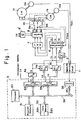
- Fig. 1 is a block diagram of an embodiment of the present invention
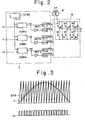
- Fig. 2 is a block diagram illustrating a principal portion of the arrangement of Fig. 1
- Fig. 3 is a view for describing the operation of the arrangement of Fig. 2
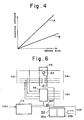
- Fig. 4 is a conversion table characteristic used in the present invention
- Fig. 5 is a view for describing a switching circuit arrangement of the present invention
- Fig. 6 is a view showing the details of a principal portion of the arrangement illustrated in Fig. 5.
- F ig. 1 is an overall block diagram of a control circuit embodying the present invention.
- numerals la, lb denote three-phase induction motors.
- the induction motor la rotates the spindle of a machine tool
- the induction motor lb rotates a tool.
- Numerals 2a, 2b denote pulse generators for producing velocity pulses TSA in dependence upon rotation of the AC motor 1.
- Numeral 3 designates an arithmetic circuit constituting part of a control section for the induction motors la, lb.
- the arithmetic circuit 3 senses the actual velocity R V of the induction motors la, lb on the basis of the velocity pulses TSA from the pulse generators 2a, 2b, and produces an amplitude command Id as well as U- and V-phase phase commands Ud, Vd in dependence upon the difference between the actual velocity and a commanded velocity C V .
- the arithmetic circuit 3 is composed of a processor 30 for performing processing, a program memory 31 storing a control program, a data memory 32 for storing various data, input/output ports 33, 34, a counter 35, and an address/data bus 36 interconnecting these components.
- the processor 30 retrieves a velocity error - amplitude command (ER-Id) conversion table, a velocity error - phase (ER- ⁇ conversion table, and a velocity error - slip frequency (ER-Ws) conversion table, these tables being provided in the data memory 32, and obtains a corresponding amplitude command Id, a corresponding phase y, and a corresponding slip frequency Ws.
- the processor 30 delivers the amplitude command Id to the input/output port 33 through the bus 36.
- the processor 30 retrieves an actual velocity - angular frequency (RV-Wo) conversion table from within the data memory 32, reads out a corresponding angular frequency Wo, calculates the U-phase phase command Ud [sin (Wot + Wst + V)] and the V-phase phase command Vd [sin (Wot + Wst + y+ (2/3) ⁇ ], reads out the U- and V-phase phase commands Ud, Vd, and delivers these commands to the input/output port 34 through the bus 36.
- RV-Wo velocity - angular frequency
- Numeral 4a denotes a digital/analog conversion signal (DA circuit) for converting the digital amplitude command Id into an analog amplitude command Is.
- Numerals 4b, 4c denote multiplying-type digital/analog conversion circuits for converting the respective U- and V-phase current commands Ud, Vd into analog quantities and for multiplying these analog quantities by the analog amplitude command Is to produce analog U- and V-phase current commands Iu, Iv, respectively.
- Numeral 5 designates a W-phase current forming circuit for forming a W-phase current command Iw from the analog U- and V-phase current commands Iu, Iv.
- Numeral 6 represents an operational amplifier for obtaining the difference between actual phase currents and the commanded currents Iu, Iv, Iw in the respective phases.
- the operational amplifier 6 is composed of an operational amplifier for calculating the difference between the commanded currents Iu, Iv, Iw in the respective phases, and the actual phase currents Iau, Iav, Iaw, respectively, and an arithmetic circuit for producing a W-phase phase current Iaw by adding Iav and Iau, which are sensed by current transformers 9a, 9b.
- Numeral 7 denotes a pulse-width modulating circuit
- numeral 8 an inverter controlled by an output signal from the pulse-width modulating circuit for providing a DC voltage derived from an externally provided three-phase AC power supply and a rectifying circuit (a group of diodes and a capacitor) for rectifying the three-phase alternating current into a direct current.
- the pulse-width modulating circuit 7 includes a sawtooth waveform generating circuit STSG, comparators COMu, COMv, COMw, NOT gates NOT 1 through NOT 3 , and drivers DV 1 through DV 6 .
- the inverter 8 includes six power transistors Ql through Q6 and six diodes Dl through D6.
- the comparators COMu, COMv, COMw of the pulse-width modulating circuit 7 compare a sawtooth signal STS with the amplitudes of the three-phase AC signals iu, iv, iw, respectively, and produce a "0" output when the magnitude of STS is exceeded by iu, iv or iw.
- the comparator COMu produces the current command i u c shown in Fig. 3. More specifically, pulse-width modulated three-phase current commands iuc, ivc, iwc dependent upon the amplitudes of iu, iv, iw are produced.
- Numeral 10 denotes a power line switching circuit for connecting the inverter 8 to the induction motor la by connecting contacts to the a side, and for connecting the inverter 8 to the induction motor lb by connecting the contacts to the b side.
- Numeral 11 designates a signal line switching circuit which, depending upon how switching is performed, connects either the pulse generator 2a or 2b to the counter 35 to apply the velocity pulses TSA, which are velocity feedback pulses, to the counter 35.
- the processor 30 of the arithmetic unit 3 reads the value in the counter 35, which counts the velocity pulses TSA, through the bus 36 to sense the actual velocity RV of the induction motor 1. Next, based on the error ER between the commanded velocity CV and the sensed actual velocity RV, the processor 30 retrieves the ER-Is, ER-Y, and ER-Ws conversion tables from the data memory 32, obtains the amplitude command Id, the phase ⁇ and the slip frequency Ws, retrieves the RV-Wo conversion table from within the data memory 32, obtains the corresponding angular frequency Wo, calculates the U- and V-phase phase commands Ud, Vd and, via the bus 36, applies the amplitude command Id to the input/output port circuit 33 and the U- and V -phase phase commands Ud, Vd to the input/output port circuit 34.
- the amplitude command Id from the input/output port 33 is converted into an analog amplitude command Is by the digital/analog conversion circuit 4a, which command is then applied to the multiplying-type digital/analog conversion circuits 4b, 4c.
- the U- and V-phase phase commands Ud, Vd are converted into analog quantities by the respective multiplying-type digital/analog conversion circuits 4b, 4c, which quantities are multiplied by the analog amplitude command Is to be converted into analog U- and V-phase current commands Iu, Iv.
- the U- and V-phase current commands Iu, Iv are applied to the W-phase current forming circuit 5, which produces the W-phase current Iw.
- the W-phase current Iw is applied to the operational amplifier 6 together with the U- and V-phase current commands Iu, Iv, respectively.
- the operational amplifier 6 receives the actual phase currents Iau, Iav from the converters 9a, 9b and forms the W-phase phase current Iaw.
- the operational amplifier 6 also produces three-phase AC signals iu, iv, iw, which are the differences between the three-phase current commands Iu, Iv, Iw and respective ones of the actual phase currents Iau, Iav, Iaw.
- the three-phase AC signals iu, iv, iw indicative of these differences are applied to the respective comparators COMu, COMv, COMw of the pulse-width modulating circuit 7.
- the comparators COMu, COMv, COMw compare the amplitudes of the three-phase AC signals iu, iv, iw with the amplitude of the sawtooth signal STS, and deliver as outputs three-phase current commands iuc, ivc, iwc produced by way of pulse width modulation.
- the outputs from the comparators are supplied to the NOT gates NOT 1 through NOT 3 and to the drivers DV 1 through DV 6 , which generate the inverter drive signals SQ1 through SQ6.
- the inverter drive signals SQ1 through SQ6 are applied to the bases of the power transistors Ql through Q6,, respectively, in the inverter 8 to control the on/off action of the power transistors Ql through Q6 for supplying three-phase current to the induction motor la.
- the induction motor la will thenceforth be controlled in a similar mode until the motor eventually rotates at the commanded velocity.
- the induction motor lb is driven by a similar operation when the contacts of the power line switching circuit 10 are connected to the b side and the pulse generator 2b is connected to the counter 35 by the signal line switching circuit 11.
- the data memory 32 is provided with a conversion table 32a for the conversion from velocity error to amplitude, phase and slip for the induction motor la, and with a conversion table 32b for the conversion from velocity error to amplitude, phase and slip for the induction motor lb.
- Either the conversion table 32a or 32b is selected in a shift-like manner in synchronism with the switching performed by the switching circuits 10, 11.
- This function is provided because the maximum outputs of the induction motors la, lb differ from each other, and is for the purpose of delivering an amplitude command that corresponds to the maximum output. Specifically, if we assume that a current of 41 (A) prevails at the maximum velocity error of the induction motor la and that a current of I (A) prevails at the maximum velocity error of the induction motor lb, then the amplitude command Id in both cases will be E volts when the same conversion table is used for both of the induction motors la, lb. This amplitude command Id is applied as a voltage value.
- a maximum amplitude command E will correspond to a current of 4I (A) for the induction motor la, and to a current of I (A) for the induction motor lb.
- the feedback voltages, namely the actual phase current values, from the current sensors 9a, 9b will be 4IR and IR, respectively, where R is the value of each current sensing resistor. These values are different, despite the fact that the voltages which prevail at the maximum velocity error are the same. Accordingly, current sensors whose current sensing resistors have values that differ from each other must be separately provided for the respective induction motors la, lb. This would not allow a servo control circuit to be applied commonly to both motors.
- a velocity error - amplitude command conversion table 32a having a characteristic of the kind indicated by A in Fig. 4 is provided for the induction motor la
- a velocity error - amplitude command conversion table 32b having a characteristic of the kind indicated by B in Fig. 4 is provided for the induction motor lb.
- velocity error - phase and velocity error - slip frequence conversion tables corresponding to the characteristics of the induction motors la, lb are provided for each of these motors.
- the amplitude command voltage of, e.g., the induction motor la when the maximum velocity error prevails will be E and that of the induction motor lb will be E/4, so that these will correspond to the aforementioned currents of 4I, I, respectively.
- the feedback voltages from the current sensors will be 4IR, IR, the ratio whereof will be the same as that of the abovementioned amplitude command voltages.
- Fig. 5 is a block diagram showing the details of a-plural motor switching circuit arrangement according to the present invention.
- Fig. 6 is a view showing the details of a principal portion of the arrangement illustrated in Fig. 5.
- SUT represents a servo control circuit consisting of a printed circuit board on which there are mounted the components of the arithmetic circiut 3 of Fig. 1 with the exception of the data memory 32, the DA converters 4a through 4c, the W-phase current forming circuit 5, the operational amplifier 6, the pulse-width modulating circuit 7 and the inverter circuit 8.
- the servo control circuit SUT has a connector CN4 for receiving velocity commands and switching commands, etc., from a spindle control section of an external NC unit, and for the exchange of other data and commands, a connector CN1 for receiving a velocity command signal from a switching circuit described below, a connector CN3 for receiving a fixed velocity pulse from a position coder 12 via a line L7, output terminals U, V, W, G for U, V, W and G (ground) phases, which are the outputs of the inverter 8, and fan motor output terminals FMA, FMB.
- POC denotes a circuit for stopping a spindle at a predetermined position.
- the circuit POC receives the fixed velocity pulse applied through the connector CN3 and controls the stopping of the induction motor la.
- the circuit is not illustrated in Fig. 1.
- Numeral 10 denotes the power line switching circuit of Fig. 1.
- the circuit has relays 100A, 100B, as well as electromagnetic contacts 101A, 101B, which correspond to the induction motors la, lb.
- the circuit 10 connects or disconnects the output terminals U, V, W, G of the servo control circuit SUT and lines Ll, L3, and connects or disconnects the fan motor output terminals FMA, FMB and lines L2, L4.
- Numeral 11A designates a cross board equipped with the signal line switching circuit 11 and the data memory 32 of the arithmetic circuit 32 shown in Fig. 1.
- the cross board 11A has a pair of analog switch groups lla, llb, and the data memory 32 storing the abovementioned conversion tables.
- a switching control circuit llc turns on either of the analog switch groups lla, llb so that velocity pulses from pulse generator 2a or 2b are transmitted to the connector CN1 through connector CNa or CNb.
- the analog switch groups lla, llb each have analog switches AS (e.g., FETs) the number whereof corresponds to the number of lines (four in the illustration). These analog switches are operated by the power supply voltage provided by the servo control circuit SUT via a flat cable FL and a connector CNR.
- a switching signal SW for selecting the induction motor la is provided by the NC unit
- the signal is applied to the switching control circuit llc (Fig. 6) through the connector CN2 to turn on each of the analog switches AS in the analog switch group lla.
- This applies the velocity pulses from the pulse generator 2a to the servo control circuit SUT (counter 35) through the line L5, connector CNa, analog switch group lla and connector CNl.
- relay 100A of the power line switching circuit 10 is actuated to turn on the electromagnetic contact 101A to connect the output terminals U, V, W, G of the servo control circuit SUT with the line Ll, and to connect the output terminals FMA, FMB with the line L2.
- the switching signal SW enters the servo control circuit SUT through the connector CN2 and flat cable FL, so that the arithmetic circuit 30 selects the conversion table 32a of data memory 32 through the flat cable FL.
- the servo control circuit SUT based on the velocity command CV received through the connector CN4, and in accordance with the velocity pulses from the pulse generator 2a, retrieves the conversion table 32a of the data memory 32 through the flat cable FL, generates the drive currents in each phase at the output terminals U, V, W and G, and applies these to the induction motor la through the line L l to control the induction motor la in the manner described in connection with Fig. 1. Furthermore, the servo control circuit SUT delivers fan motor drive signal via line L2 to drive the fan motor of the induction motor la. When a switching signal SW for selecting the induction motor lb is applied, on the other hand, the foregoing operation is reversed.
- each of the analog switches AS in the analog switch group llb is turned on.
- the arithmetic circuit 30 selects the conversion table 32b of data memory 32 through the flat cable F L .
- the servo control circuit SUT based on the velocity command CV received through the connector CN4, and in accordance with the velocity pulses from the pulse generator 2b, retrieves the conversion table 32b of the data memory 32 through the flat cable F L , generates the drive currents in each phase at the output terminals U, V, W and G, and applies these to the induction motor lb through the line L3 to control the induction motor lb.
- the fan motor of the induction motor lb is driven by a fan motor drive signal provided by the output terminals FMA, FMB of the servo control circuit SUT via the electromagnetic contact 101B and line L4. Since the cross panel llA is thus constructed of analog switches, a power supply or the like for driving relays is unnecessary.
- the power line switching circuit 10 handles large currents and high-power drive signals and is constructed of relay circuitry since analog switches cannot be used owing to their low breakdown voltage.
- one and the same data memory 32 stores the conversion tables 32a, 32b having the motor characteristics for two induction motors.
- the two conversion tables can each be stored in a separate memory.
- the conversion tables are switched between by the processor 30 delivering a switching signal to the switching circuit 10 in accordance with a program.
- the switching operation can be performed in response to an externally applied switching signal.
- this can be accomplished by a switching operation performed after the power supply has been turned off once, or by a clearing operation performed by the processor 30.
- the present invention is well-suited for application to a numerically controlled machine tool equipped with a plurality of induction motors the outputs whereof differ.
- the invention is not limited to such application but can also be utilized in other equipment that include a servo mechanism, such as in robot mechanisms.
Landscapes
- Engineering & Computer Science (AREA)
- Human Computer Interaction (AREA)
- Manufacturing & Machinery (AREA)
- Physics & Mathematics (AREA)
- General Physics & Mathematics (AREA)
- Automation & Control Theory (AREA)
- Control Of Multiple Motors (AREA)
Applications Claiming Priority (2)
| Application Number | Priority Date | Filing Date | Title |
|---|---|---|---|
| JP57199233A JPS5989592A (ja) | 1982-11-13 | 1982-11-13 | 複数モ−タの切替制御方式 |
| JP199233/82 | 1982-11-13 |
Publications (3)
| Publication Number | Publication Date |
|---|---|
| EP0125317A1 true EP0125317A1 (de) | 1984-11-21 |
| EP0125317A4 EP0125317A4 (de) | 1987-04-14 |
| EP0125317B1 EP0125317B1 (de) | 1990-01-17 |
Family
ID=16404366
Family Applications (1)
| Application Number | Title | Priority Date | Filing Date |
|---|---|---|---|
| EP83903572A Expired - Lifetime EP0125317B1 (de) | 1982-11-13 | 1983-11-11 | Verfahren zum steuern des umschaltens einer mehrheit von motoren |
Country Status (5)
| Country | Link |
|---|---|
| US (1) | US4641069A (de) |
| EP (1) | EP0125317B1 (de) |
| JP (1) | JPS5989592A (de) |
| DE (1) | DE3381132D1 (de) |
| WO (1) | WO1984002040A1 (de) |
Cited By (2)
| Publication number | Priority date | Publication date | Assignee | Title |
|---|---|---|---|---|
| EP0446733A3 (en) * | 1990-03-02 | 1992-07-01 | Kabushiki Kaisha Sg | Servo control system |
| CN110995068A (zh) * | 2019-12-20 | 2020-04-10 | 无锡奥特博电子科技有限公司 | 石油钻井平台变频传动系统 |
Families Citing this family (34)
| Publication number | Priority date | Publication date | Assignee | Title |
|---|---|---|---|---|
| JPS59178999A (ja) * | 1983-03-28 | 1984-10-11 | Mitsubishi Heavy Ind Ltd | 回転速度制御装置 |
| JPS61154493A (ja) * | 1984-12-26 | 1986-07-14 | Fanuc Ltd | サーボモータの駆動制御装置 |
| JPS61196788A (ja) * | 1985-02-22 | 1986-08-30 | Fanuc Ltd | 電動機の速度制御装置 |
| JPS61273192A (ja) * | 1985-05-24 | 1986-12-03 | Enshu Ltd | 速度アンプによる多軸モ−タ駆動制御方式 |
| DE3684894D1 (de) * | 1985-12-28 | 1992-05-21 | Forkardt Paul Gmbh | Werkzeugmaschine und deren betriebsverfahren. |
| JPS63202291A (ja) * | 1987-02-17 | 1988-08-22 | Fanuc Ltd | スピンドルモ−タ制御回路 |
| US4843292A (en) * | 1987-03-02 | 1989-06-27 | Yokogawa Electric Corporation | Direct drive motor system |
| JPH01308185A (ja) * | 1988-06-02 | 1989-12-12 | Fanuc Ltd | モータ制御装置 |
| JPH0229286A (ja) * | 1988-07-19 | 1990-01-31 | Mitsubishi Electric Corp | ミシンの制御装置 |
| US4956589A (en) * | 1988-12-12 | 1990-09-11 | Cherlo Victor M | Integrated tool control for work station |
| US5077506A (en) * | 1989-02-03 | 1991-12-31 | Dyonics, Inc. | Microprocessor controlled arthroscopic surgical system |
| JPH0731532B2 (ja) * | 1989-05-24 | 1995-04-10 | オ−クマ株式会社 | 数値制御装置 |
| US5087864A (en) * | 1989-10-30 | 1992-02-11 | Abel Manufacturing Co., Inc. | Apparatus for selectively controlling a plurality of electric motors |
| US5087867A (en) * | 1991-02-25 | 1992-02-11 | International Business Machines Corporation | Motor driving apparatus and printer |
| US5239241A (en) * | 1991-10-18 | 1993-08-24 | Xolox Corporation | Controller for an electric motor that operates on direct current |
| KR0163711B1 (ko) * | 1992-10-01 | 1999-01-15 | 윤종용 | 광 디스크 시스템의 스핀들 모터 제어 회로 |
| JPH07123501A (ja) * | 1993-10-28 | 1995-05-12 | Toshiba Corp | 電気車制御装置 |
| US5742143A (en) * | 1995-01-20 | 1998-04-21 | Kabushiki Kaisha Sankyo Seiki Seisakusho | Motor control system with selectively operated A/D convertor |
| US5650705A (en) * | 1995-02-13 | 1997-07-22 | Hart; John Roger | Apparatus and method for controlling currents in an inductor |
| AUPN422295A0 (en) * | 1995-07-18 | 1995-08-10 | Bytecraft Research Pty. Ltd. | Control system |
| US6252367B1 (en) * | 1999-01-11 | 2001-06-26 | Fanuc Ltd. | Servo controller |
| US6208097B1 (en) * | 1999-12-06 | 2001-03-27 | General Electric Company | Traction vehicle adhesion control system without ground speed measurement |
| US6724167B1 (en) * | 2000-03-17 | 2004-04-20 | Mitsubishi Denki Kabushiki Kaisha | Numerical control drive system |
| DE10336512B4 (de) * | 2002-08-08 | 2015-12-17 | Denso Corporation | Ansteuerungsvorrichtung für eine PWM-Steuerung von zwei induktiven Lasten mit reduzierter Erzeugung von elektrischen Störungen |
| DE20214764U1 (de) * | 2002-09-19 | 2002-11-21 | Stöber Antriebstechnik GmbH & Co, 75177 Pforzheim | Schalteinrichtung zur Ansteuerung wenigstens zweier Motoren |
| US7145300B2 (en) * | 2003-05-05 | 2006-12-05 | International Rectifier Corporation | Multi-axis AC servo control system and method |
| US8080966B2 (en) * | 2008-07-03 | 2011-12-20 | Honeywell International Inc. | Motor control architecture for simultaneously controlling multiple motors |
| JP6232752B2 (ja) * | 2013-05-31 | 2017-11-22 | セイコーエプソン株式会社 | 駆動装置、電子部品搬送装置、および電子部品検査装置 |
| JP6418844B2 (ja) * | 2014-08-20 | 2018-11-07 | ルネサスエレクトロニクス株式会社 | 半導体装置、モータ制御装置、撮像装置用レンズユニット、および撮像装置 |
| CN111541402A (zh) * | 2020-06-08 | 2020-08-14 | 佛山市南海思必拓塑机有限公司 | 一种多控伺服控制系统 |
| CN111650888A (zh) * | 2020-06-29 | 2020-09-11 | 齐齐哈尔二机床(集团)有限责任公司 | 一种基于drive-cliq电机切换控制系统 |
| CN113949314A (zh) * | 2021-10-21 | 2022-01-18 | 珠海格力电器股份有限公司 | 一种两电机系统的控制装置及其控制方法和两电机系统 |
| CN114244190A (zh) * | 2021-10-21 | 2022-03-25 | 珠海格力电器股份有限公司 | 一种双电机系统的控制装置及其控制方法和双电机系统 |
| CN114244191A (zh) * | 2021-10-21 | 2022-03-25 | 珠海格力电器股份有限公司 | 一种多电机系统的控制装置及其控制方法和多电机系统 |
Family Cites Families (10)
| Publication number | Priority date | Publication date | Assignee | Title |
|---|---|---|---|---|
| JPS49128215A (de) * | 1973-04-12 | 1974-12-09 | ||
| US4257103A (en) * | 1977-11-16 | 1981-03-17 | Heian Iron Works, Ltd. | Apparatus for controlling position of a plurality of machining shafts each including a machine tool fitted thereto |
| JPS54114008U (de) * | 1978-01-27 | 1979-08-10 | ||
| JPS54106776A (en) * | 1978-02-10 | 1979-08-22 | Fanuc Ltd | Positioning device |
| JPS54143985A (en) * | 1978-04-28 | 1979-11-09 | Fanuc Ltd | Spindle control method |
| JPS55143602A (en) * | 1979-04-24 | 1980-11-10 | Yokogawa Hokushin Electric Corp | Batch data setting system |
| JPS6010862B2 (ja) * | 1980-06-03 | 1985-03-20 | ファナック株式会社 | 三次元倣い制御方式 |
| DD154556A1 (de) * | 1980-11-14 | 1982-03-31 | Joachim Ebermann | Zwanglaufsteuerung an werkzeugmaschinen mit einer schaltungsanordnung zur schadensverhuetung |
| US4422027A (en) * | 1981-03-16 | 1983-12-20 | The United States Of America As Represented By The Secretary Of The Army | Linear motor controller |
| DE3148947A1 (de) * | 1981-12-10 | 1983-06-23 | Heidelberger Druckmaschinen Ag, 6900 Heidelberg | Vorrichtung zur steuerung einer vielzahl von stellmotoren an druckmaschinen |
-
1982
- 1982-11-13 JP JP57199233A patent/JPS5989592A/ja active Pending
-
1983
- 1983-11-11 US US06/631,559 patent/US4641069A/en not_active Expired - Fee Related
- 1983-11-11 EP EP83903572A patent/EP0125317B1/de not_active Expired - Lifetime
- 1983-11-11 DE DE8383903572T patent/DE3381132D1/de not_active Expired - Lifetime
- 1983-11-11 WO PCT/JP1983/000408 patent/WO1984002040A1/ja not_active Ceased
Non-Patent Citations (1)
| Title |
|---|
| See references of WO8402040A1 * |
Cited By (2)
| Publication number | Priority date | Publication date | Assignee | Title |
|---|---|---|---|---|
| EP0446733A3 (en) * | 1990-03-02 | 1992-07-01 | Kabushiki Kaisha Sg | Servo control system |
| CN110995068A (zh) * | 2019-12-20 | 2020-04-10 | 无锡奥特博电子科技有限公司 | 石油钻井平台变频传动系统 |
Also Published As
| Publication number | Publication date |
|---|---|
| DE3381132D1 (de) | 1990-02-22 |
| EP0125317B1 (de) | 1990-01-17 |
| JPS5989592A (ja) | 1984-05-23 |
| EP0125317A4 (de) | 1987-04-14 |
| US4641069A (en) | 1987-02-03 |
| WO1984002040A1 (fr) | 1984-05-24 |
Similar Documents
| Publication | Publication Date | Title |
|---|---|---|
| EP0125317B1 (de) | Verfahren zum steuern des umschaltens einer mehrheit von motoren | |
| EP0071941B1 (de) | Vorrichtung zum Antrieb eines bürstenlosen Mehrphasenmotors mit unterdrückter Drehmomentwelligkeit | |
| US6657413B2 (en) | Driving equipment for synchronous motors | |
| EP0009783B1 (de) | System zum Antrieb eines Motors mittels eines impulsbreiten modulierten Wechselrichters | |
| EP0075023A1 (de) | Steuerverfahren für wechselstrommotor und vorrichtung dazu | |
| US4602195A (en) | Industrial robot having individual electrical three-phase drives | |
| US4547719A (en) | Synchronous motor drive apparatus | |
| US20020000784A1 (en) | Power output device | |
| EP0500948B1 (de) | Antriebssystem für einen induktionsmotor | |
| US6577095B1 (en) | Brushless alternating current electric servo motor drive | |
| JPH067755B2 (ja) | モ−タ制御装置 | |
| US5220264A (en) | Control system for an AC servomotor having a permanent magnet type | |
| EP0214300B1 (de) | Vorrichtung zur regelung der geschwindigkeit eines elektromotors | |
| JPS5999988A (ja) | 複数モ−タの切替制御方式 | |
| JPH0947054A (ja) | サーボモータのダイナミックブレーキ回路 | |
| US5268628A (en) | Phase voltage measuring device of an AC motor and a measuring method thereof | |
| GB2266630A (en) | Inverter apparatus and transport system using the same | |
| JP2738163B2 (ja) | サーボモータ運転方法 | |
| EP0073839B1 (de) | Steuergerät für synchronmotor | |
| CA2048384C (en) | Motor control apparatus and method | |
| US12077224B2 (en) | Motor control device and electric power steering device | |
| JPS6135191A (ja) | Acモ−タ制御方式 | |
| KR200143969Y1 (ko) | 교류서어보의 전류제어기 | |
| KR940004953B1 (ko) | 디지탈 동기 전동기의 제어 장치 | |
| KR960014266B1 (ko) | 무부러쉬 직류모터 제어회로 |
Legal Events
| Date | Code | Title | Description |
|---|---|---|---|
| PUAI | Public reference made under article 153(3) epc to a published international application that has entered the european phase |
Free format text: ORIGINAL CODE: 0009012 |
|
| 17P | Request for examination filed |
Effective date: 19840724 |
|
| AK | Designated contracting states |
Designated state(s): DE FR GB |
|
| A4 | Supplementary search report drawn up and despatched |
Effective date: 19870414 |
|
| 17Q | First examination report despatched |
Effective date: 19871104 |
|
| GRAA | (expected) grant |
Free format text: ORIGINAL CODE: 0009210 |
|
| AK | Designated contracting states |
Kind code of ref document: B1 Designated state(s): DE FR GB |
|
| REF | Corresponds to: |
Ref document number: 3381132 Country of ref document: DE Date of ref document: 19900222 |
|
| ET | Fr: translation filed | ||
| PGFP | Annual fee paid to national office [announced via postgrant information from national office to epo] |
Ref country code: GB Payment date: 19901030 Year of fee payment: 8 |
|
| PLBE | No opposition filed within time limit |
Free format text: ORIGINAL CODE: 0009261 |
|
| STAA | Information on the status of an ep patent application or granted ep patent |
Free format text: STATUS: NO OPPOSITION FILED WITHIN TIME LIMIT |
|
| PGFP | Annual fee paid to national office [announced via postgrant information from national office to epo] |
Ref country code: DE Payment date: 19901114 Year of fee payment: 8 |
|
| 26N | No opposition filed | ||
| PGFP | Annual fee paid to national office [announced via postgrant information from national office to epo] |
Ref country code: FR Payment date: 19911023 Year of fee payment: 9 |
|
| PG25 | Lapsed in a contracting state [announced via postgrant information from national office to epo] |
Ref country code: GB Effective date: 19911111 |
|
| GBPC | Gb: european patent ceased through non-payment of renewal fee | ||
| PG25 | Lapsed in a contracting state [announced via postgrant information from national office to epo] |
Ref country code: DE Effective date: 19920801 |
|
| PG25 | Lapsed in a contracting state [announced via postgrant information from national office to epo] |
Ref country code: FR Effective date: 19930730 |
|
| REG | Reference to a national code |
Ref country code: FR Ref legal event code: ST |