EP0125883A2 - Signalgesteuertes Wellenformaufnahmegerät - Google Patents
Signalgesteuertes Wellenformaufnahmegerät Download PDFInfo
- Publication number
- EP0125883A2 EP0125883A2 EP84303150A EP84303150A EP0125883A2 EP 0125883 A2 EP0125883 A2 EP 0125883A2 EP 84303150 A EP84303150 A EP 84303150A EP 84303150 A EP84303150 A EP 84303150A EP 0125883 A2 EP0125883 A2 EP 0125883A2
- Authority
- EP
- European Patent Office
- Prior art keywords
- waveform recorder
- signal
- data channels
- sample
- analog
- Prior art date
- Legal status (The legal status is an assumption and is not a legal conclusion. Google has not performed a legal analysis and makes no representation as to the accuracy of the status listed.)
- Withdrawn
Links
Images


Classifications
-
- G—PHYSICS
- G01—MEASURING; TESTING
- G01R—MEASURING ELECTRIC VARIABLES; MEASURING MAGNETIC VARIABLES
- G01R13/00—Arrangements for displaying electric variables or waveforms
- G01R13/02—Arrangements for displaying electric variables or waveforms for displaying measured electric variables in digital form
- G01R13/0218—Circuits therefor
- G01R13/0254—Circuits therefor for triggering, synchronisation
- G01R13/0263—Circuits therefor for triggering, synchronisation for non-recurrent functions, e.g. transients
-
- G—PHYSICS
- G02—OPTICS
- G02B—OPTICAL ELEMENTS, SYSTEMS OR APPARATUS
- G02B6/00—Light guides; Structural details of arrangements comprising light guides and other optical elements, e.g. couplings
- G02B6/10—Light guides; Structural details of arrangements comprising light guides and other optical elements, e.g. couplings of the optical waveguide type
-
- G—PHYSICS
- G06—COMPUTING OR CALCULATING; COUNTING
- G06F—ELECTRIC DIGITAL DATA PROCESSING
- G06F13/00—Interconnection of, or transfer of information or other signals between, memories, input/output devices or central processing units
- G06F13/14—Handling requests for interconnection or transfer
- G06F13/36—Handling requests for interconnection or transfer for access to common bus or bus system
- G06F13/362—Handling requests for interconnection or transfer for access to common bus or bus system with centralised access control
Definitions
- the invention relates to electronic waveform recorders and, more particularly, to those that can record a plurality of different signals and can be triggered to record these signals in response to a change occurring in any one of these signals.
- mechanical waveform recorders typified by a chart recorder
- a writing instrument such as a pen
- the frequency response of these recorders is usually very low, typically from 5 to 10 Hz maximum. Consequently, - these recorders are incapable of accurately recording relatively high frequency signals (100Hz and higher).
- a chart recorder can be outfitted with a large roll of recording paper, widely spaced transients having a relatively low frequency content can be effectively recorded -- although with a considerable waste of paper.
- Electronic waveform recorders on the other hand, rely on converting input analog signals into digital data and storing the results in a digital memory, all at an extremely high speed.
- the stored analog signal can be subsequently retrieved either in digital form for subsequent processing or in analog form for display on a oscilloscope, for example.
- the rate at which the digital data can be read from the memory can usually be set to a different rate than that at which it was stored in order to either expand or compress the time scale of the displayed analog signals.
- electronic waveform recorders can accurately record extremely fast signals, i.e. signals having a frequency content in excess of 100kHz, these recorders have a limited memory which f disadvantageously restricts the total amount of stored data.
- the limited memory in electronic waveform recorders generally " precludes these recorders from being able to record high speed transients which are widely spaced apart.
- an analog signal that normally changes rather slowly for a period of two hours but does contain an occasional high frequency transient having a pulse width of 1 millisecond. Recording this transient with sufficient clarity might require 21 separate data points. This, in turn, necessitates that a sample be taken of the analog signal every 50 microseconds and stored in memory. To fully record two hours of such a signal, the recorder would require 144,000 K memory locations -- a prohibitive amount.
- the sampling rate which determines the resolution of the recorded signal
- the recording time increases, so would the amount of required memory.
- time-of-occurrence (commonly referred to as a "time-tag") of each stored sample is also stored in the memory along with the stored value.
- time-tag The time-of-occurrence of each stored sample is also stored in the memory along with the stored value.
- the system described in the '333 patent requires that all the samples be stored in various registers prior to any comparisons being made. Consequently, this, in turn, limits the dynamic (real-time) response of the system in the case of any rapidly occurring transient waveforms.
- circuitry described in the '333 patent is rather simple, its extensive and nearly exclusive reliance on digital processing disadvantageously complicates the circuitry of any multi-channel waveform recorder incorporating this circuit in the data recording circuitry for each channel.
- one such multi-channel data storage system is disclosed in U.S. Patent 3,344,406 (issued September 26, 1967 to A.W. Vinal). While this multi-channel system possesses excellent capabilities, the nearly exclusive use of digital processing renders the overall circuitry disadvantageously complex and extremely expensive.
- an object of the present invention is to provide a simple and inexpensive multi-channel electronic waveform recorder that is capable of accurately ' recording a plurality of analog waveforms.
- Another object is to substantially eliminate the need for the operator to have any familiarity with the period (or pulse width) of the analog waveform.
- a particular object is to accurately record a plurality of analog waveforms, each of which can have a frequency that widely varies from that of any other.
- Another particular object is to accurately record any generally unknown and infrequently occurring transient waveform without requiring an excessive amount of memory.
- Another object is to accurately record the time-of-occurrence of any recorded sample along with the value of that sample for any of the recorded waveforms.
- a further object is to allow the operator to quickly and easily vary any of the comparison data for any of the channels while the recorder is operating.
- the input signal is first sampled and converted, by, for example, an analog to digital (A/D) converter, into a stream of digital samples.
- A/D converter is operated near its maximum rate such that the time interval between any two adjacent samples approximates this minimum time needed by the converter to completely and accurately perform a conversion.
- the resulting digitized sample is stored in a first latch until the next successive conversion is complete.
- the digital data corresponding to this sample is then applied as input to both a second latch and to a random access memory.
- an analog selection circuit compares this analog equivalent of the,most recently stored sample to the then current value of the input signal.
- the output of the second latch is continuously applied to the input of a digital to analog (D/A) converter.
- the analog output of this converter - - representing the analog equivalent of the most recently stored sample of the input signal, and the current value of the input signal are both applied as respective inputs to an analog subtractor which generates a signal indicative of the difference existing therebetween.
- This difference signal is applied to a comparator, illustratively a window comparator, which, in turn, ascertains whether the magnitude of the difference is within or outside a preselected range.
- the comparator If the magnitude is outside the range, the comparator generates a "TAKE" return signal.
- the "TAKE" return signal is then applied to system control circuitry, both to cause the random access memory to store the data present in the first latch -- the digitized value of the current sample. of the input signal -- and to transfer this data into the second latch which, in turn, applies this data as input to the D/A converter.
- the magnitude of this difference signal is within the preselected range, then the current sample of the input signal is effectively ignored.
- the stability of the difference signal is substantially determined by variations in the input signal. Consequently, the determination to store any values of the input signal is essentially determined by variations in the input signal itself, and not by any external factors, such as drift, thermal changes, aging characteristics of the components or the like, occurring in the circuitry of the waveform recorder. This, in turn, eliminates a substantial source of error and thereby advantageously produces a far more accurately recorded waveform than would otherwise be possible.
- a clock which operates the A/D converter is fed as an input to a counter.
- the total count occurring at that time is stored in another memory at an address corresponding to the location where that sample is stored.
- the contents of the counter are reset, to illustratively zero, such that the counter is able to accurately count the appropriate interval for the next successive stored sample.
- each channel both continuously samples its input signal and simultaneously records each selected sample and its "time-tag" all during extremely short intervals of time, i.e. close to the minimum conversion time of the A/D converter which is substantially shorter than the minimum period (or pulse width) of the input signals that are likely to be recorded. Consequently, the recorder can accurately record any input signal having a longer period (or pulse width) without any adjustment being made to the recorder. Furthermore, since the recorder relies on amplitude differences, rather than on a specific amplitude, in order to select those samples to be recorded, the exact amplitude of any specific sample is essentially immaterial to the recorder, and thus to the operator.
- the sensitivity of each channel is varied through the application of the difference signal to a variable gain amplifier. As the gain is increased or decreased, so is the sensitivity. Since the gain, as well as each endpoint of the range, can be independently 5 adjusted while the waveform recorder is in operation, this advantageously provides an operator with complete flexibility in independently tailoring the operation of each channel in the multi-channel recorder to the particular input signal applied thereto.
- Another feature of the invention is to permit each or any selected subset of all of the channels in the waveform recorder to determine the points in time when all the channels simultaneously record a sample for all their respective input signals.
- the "TAKE" return signal produced by the comparator in each channel is applied through a switch to the system control circuitry. All the switched “TAKE” return signals are effectively tied together.
- a resultant "TAKE” data signal is generated and applied to each channel to cause it to store the current sample of its respective input signal. Consequently, at the occurrence of any switched "TAKE" return signal produced by any channel, all the channels simultaneously record data.
- any channel is appropriately positioned to disconnect the "TAKE" return signal generated by that channel from the system control circuitry, then that channel will record data only in response to a "TAKE" return signal generated by any other i channel.
- all these switches can be appropriately set such that any one or more of the channels determine when all the channels record data.
- a further feature of this invention is to ) provide a multi-channel waveform recorder that can be readily expanded to accommodate any number of channels. This is readily accomplished by essentially connecting all the channels in parallel off various control lines, and buses emanating from the system control circuitry. 5
- FIG. 1 depicts an overall block diagram of a multi-channel electronic waveform recorder which embodies the teachings of the present invention.
- the waveform recorder is comprised of a plurality of N substantially identical channels; specifically data channel 1, data channel 2, data channel 3, ... , data channel N.
- Each data channel records the waveform of a signal applied to its input, e.g. data channel 1 records a corresponding input appearing on lead la, data channel 2 records a corresponding input signal appearing on lead 2a and so on.
- the signal applied to the input can be either analog or digital.
- each channel provides an analog output equivalent to that which it is presently or has - just recorded; specifically, data channel 1 provides an analog output on lead lc, data channel 2 provides an analog output on lead 2c and so on.
- All the channels are connected in parallel to a plurality of control lines and buses -- specifically lines 101, 103-107, and 109 and 110 and buses 182 and 108 -which together emanate from system control 20.
- each of these lines and buses is driven by circuitry having a sufficiently high drive capability such that any requisite number of data channels can be connected in parallel without any significant attenuation occurring in any of the signals appearing on any of these lines or buses.
- System control 20 controls the operation of each of the data channels. Specifically, for recording, each channel independently monitors its associated input signal and, based upon whether the difference in amplitude -- as will be discussed shortly -- between the current value of the input signal and that of the most recently stored sample exceeds a pre-selected range, the channel determines whether the current value is to be recorded. In particular, all the channels simultaneously sample respective input signals whenever a pulse appears on sample data line 101. The frequency of these pulses is determined by the frequency of the record clock pulses applied to system control 20, via lead 127, from clock 14.
- any channel determines that the current value of its input signal is to be recorded, it provides an appropriate signal to system control 20, via "TAKE" return line 110.
- system control 20 applies appropriate pulses -- as will be discussed in detail shortly -- to "TAKE" data line 109, and record line 103. These pulses command each channel to simultaneously store the current sample of its associated input signal in a memory existing within that data channel at, more specifically, an address (location) specified by the address information then appearing on address bus 102. This address is appropriately incremented by system control 20 such that the next recorded sample of each input signal is stored at the next successive location in the memory within each data channel.
- time-of-occurrence (commonly referred to as a "time-tag") for each recorded sample, is stored in a memory within system control 20 at, more specifically, a location having an address corresponding to that of the stored sample. This is discussed in greater detail below in conjunction with the discussion of system control 20.
- system control 20 (shown in FIG. 1) also controls playback by all of the channels of the waveform stored in each. Specifically, to replay, i.e., read out the stored waveform and apply its analog equivalent to an output of the associated channel, system control 20 applies a train of clock pulses to replay clock line 106. The frequency of these pulses is determined by the frequency of replay clock pulses applied to system control 20, via lead 129, from clock 14.
- the frequency of the pulses can be adjusted by the operator to one of many pre-determined integral multiples or fractions of the recording rate, i.e., the frequency of the record clock pulses appearing on lead 127, depending upon the desired speed at which all the recorded waveforms are to be read out of their associated memories and whether that rate is to be faster, the same as or slower than the rate at which all the waveforms were recorded.
- the frequency accordingly, the operator can appropriately expand or compress the time scale of all the recorded waveforms.
- the replay clock pulse rate a very fast transient may be replayed at a sufficiently slow rate to allow an ordinary mechanical pen recorder to make a permanent and accurate record of this transient.
- several different replay clock pulse rates can be used in succession in order to appropriately expand or compress the time scale along various points in the recorded waveform.
- system control 20 also applies appropriate address information, via address bus 102, to the memory in every channel.
- the address information appearing on address bus 102 is appropriately incremented by system control 20 such that all the stored values for each waveform are read out in proper sequence from the ⁇ respective memories.
- system control 20 permits the operator to set the starting address, at which replay will occur, to correspond to any location in the memory. This advantageously permits the operator to replay any desired selected portion of the stored ) waveforms. For example, if only one particular transient signal is of interest and the waveform occurring prior thereto is not, then the address at which replay will start can be set to correspond to the beginning of the transient.
- Each of the data channels -- as discussed in 5 detail shortly -- uses a non-destructive random access memory (RAM) to store an recorded waveform which, in turn, advantageously permits the recorded waveform to be replayed as many times as desired.
- RAM non-destructive random access memory
- Address indicator 16 which is connected to address bus 102, provides an indication of the current address information present on this bus.
- address indicator 16 may be comprised of simple well known combinatorial circuitry which feeds a plurality of display drivers and 7 segment digital displays for converting binary address information on address bus 102 into any convenient desired digital form, such as octal, hex or binary coded decimal (BCD), and then subsequently displaying it. This provides an indication of the current address and thus, by inference, the amount of each memory that has been used (or conversely is available for subsequent storage).
- a direct indication of the amount of consumed memory space is provided by an alternate address indicator in which the address information is first applied as input to a digital-to-analog (D/A) converter which, in turn, applies its analog output to one of many well known digital panel meters.
- D/A digital-to-analog
- the digital panel meter will directly display the fractional amount of each memory that has been used up to that point for waveform storage. The remaining fractional amount of available memory can be readily obtained by subtracting the displayed amount from +1.0, either through electrical or other well-known means.
- system control 20, in conjunction ' with data transfer control 18, permits digital information to be directly transferred between any memory in any data channel or the ("time-tag") memory in system control unit 20 and any external digital device, such as a computer.
- data transfer unit 18 is connected to three standard bi-directional digital input/output (I/O) ports: serial data line 24 which is preferably RS-232C compatible, parallel multi-bit bus 25, and general purpose (input/output) interface bus 26 which is preferably compatible with the I.E.E.E. 488 standard.
- data transfer control 18 is comprised of a central processing unit (not shown), illustratively and preferably any one of a number of presently available and well known microprocessors, which is connected through commercially available and well known bi-directional communications circuits (also not shown) to the three I/O ports 24, 25 and 26.
- the microprocessor is also connected to address and data buses 102 and 108; to system control 20 by control lines 124, 125 and 126; and to each data channel 1, 2, 3 ... N, by a respective control line lb, 2b, 3b, ...
- data transfer control 18 To transfer data to any of these ports from the memory in either system control 20 or in any of the data channels, data transfer control 18 first applies an appropriate level change, via lead 124, to the address enable ( A E) input of system control 18. This disables the address generation circuitry and effectively disconnects it from address bus 102. Thereafter, data transfer control 18 applies the appropriate starting address to the address bus. It then applies an appropriate level to data direction line 107, via lead 113.
- This control line is connected as shown in FIGS. 2 and 3, to various bi-directional bus transceivers, which provide a bi-directional interface between all the RAM memories and the data bus, and functions to control the direction of the address and data flow between any of these memories and this bus.
- the level is set such as to permit data to be loaded onto data bus 108 by any of the RA M memories, via its associated bus transceiver.
- the transceiver enable (TE) and chip select (CS) lines associated with the desired RAM memory in either a data channel or the system control, is set by data transfer unit 18, via the particular line in cable 120, so as to select the RAM memory and enable the bus transceiver to transfer data from the selected RAM to the data bus.
- each data channel contains only one
- two separate TE (and CS) lines are each connected to a separate RAM memory within system control 20, and one TE (and CS) line, specifically lb, 2b, 2c, ... 2n, is connected to the RAM memory within each of the respective data channels 1, 2, 3, ... , N.
- data transfer control 18 energizes read line 105.
- Read line 105 and write line 104 are both effectively connected -- through OR gates as shown in FIG. 2 and 3 to each RAM memory and thereby control the read and write cycles for all the RAM memories. Consequently, with the desired starting address present on the address bus, the appropriate data direction set, the desired RAM selected and the proper bus transceiver enabled, the occurrence of a pulse on the read line initiates a read cycle which results in the stored sample in the desired RAM being transferred to data bus 108 and from there to data transfer control 18.
- This sample is then either stored locally within the data transfer control or applied as output to one or more of the three I/O ports 24, 25 or 26 depending upon instructions provided to or previously stored within the microprocessor comprising data transfer unit 18.
- To access values stored at a plurality of locations in the selected RAM first the address information is incremented and second the data transfer cycle described above is repeated for each such location.
- the sequence for transferring data from any of the I/O ports of data transfer unit 18 to any location within a selected RAM memory, occurring within either the system control or any data channel, is very similar to that described above for transferring data from a selected R A M to an I/O port.
- Transferring information into R AM is particularly useful if the waveform recorder is connected to one or more analog recording instruments, e.g. chart recorders, plotters or oscilloscopes, in that the waveform recorder is then converted into a simple graphics device which can take digital data from any of the three I/O ports, store it and repeatedly display it in an analog fashion.
- data transfer control 18 via lead 124, disables the address generation circuitry within system control 20. Thereafter, the data transfer control applies an appropriate level (opposite to that described above) to data direction line 113 to establish the proper direction of data flow through the bus transceivers, i.e. from the data bus to RAM memory. Thereafter, data transfer control 18 applies the appropriate initial address information to address bus 102, and applies the desired data to data bus 108. Next, data transfer control 18 selects the appropriate RAM memory and enables the appropriate bus transceiver through the associated bus transceiver enable and chip select line. Thereafter, data transfer control 18 applies a pulse to write line 104. This pulse initiates a RAM write cycle which stores the desired data in the selected RAM memory at the location specified by this initial address.
- the waveform recorder is comprised of a number of independent data channels, each of which records a waveform applied to its input.
- data channel 1 For the sake of brevity, only one such data channel, specifically data channel 1 will now be discussed.
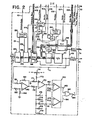
- a block diagram of the circuitry comprising this data channel is shown in FIG. 2.
- this data channel records a waveform as a sequence of digital samples. Specifically, the data channel first samples the waveform at an extremely high speed, then compares the current value of this waveform to a previously -- preferably the most recently -- stored sample and determines the difference existing therebetween. If this difference exceeds a predetermined range, the data channel applies an appropriate control signal to the system control which, in turn, signals the data channel to store a current (new) sample.
- a waveform to be recorded (hereinafter referred to as the input signal) is applied over lead la to data channel 1.
- the input signal is first sampled by analog to digital (A/D) converter 133 at a rate determined by a sequence of clock pulses generated by the system control (see FIG. 1) and appearing on sample data line 101.
- Sample timer 130 generates, in response to illustratively the falling edge of each clock pulse appearing as sample data line 101, a pulse which is applied over lead 131 to cause A/D converter 133 to start a conversion.
- sample timer 130 applies a pulse, via lead 132, to latch 135 to load this current (new) digitized sample into the latch.
- the overall speed of the waveform recorder in substantially influenced by the particular A/D converter that is used in each data channel. Conversion accuracy is determined by resolution, which is predicated upon the number of bits that are present in the output of the A/D converter. However, as the number of bits increases, the speed of the converter decreases. For example, a 12-bit A/D converter is generally slower than an 8-bit converter of the same type, and the 12-bit converter is generally faster than a 16-bit converter of the same type. With this in mind, a preferred A/D converter possessing both sufficient accuracy and a very short conversion time is the 12-bit A/D model number HI5712A manufactured by the ' Semiconductor Division of Harris Corporation (Harris).
- This A/D converter possesses a conversion time of approximately 8 microseconds. Since the sampling rate of the data channel is chosen to be slightly less than the maximum throughput of the A/D, the rate of the clock pulses appearing on sample data line 101 is preferably chosen to be approximately 100kHz, i.e. at this rate a new sample occurs every 10 microseconds and is immediately thereafter stored in latch 135.
- data channel 1 In the event the current sample of the input signal applied to data channel 1 is to be recorded, then data channel 1, in a manner to be described next, applies an appropriate level change to "TAKE" return line 110. This, in turn, causes the system control to apply an appropriate address to address bus 102 and appropriate pulses to record data line 103 and "TAKE" data line 109 which together -- in a manner to be described shortly -cause the current sample to be stored in RAM memory 137 at a location specified by the address then appearing on the address bus.
- the input signal is continuously compared to the analog equivalent of the most recently stored sample of this signal.
- the most recently stored sample within the RAM memory is temporarily stored in latch 139.
- the parallel output of this latch is applied over bus 140 to the input of digital to analog (D/A) converter 141 which, in turn, provides its analog equivalent on output lead 1c.
- the signal appearing on this lead (hereinafter referred to as the ouput signal) is preferably scaled to match the input signal by applying a well-known (but not shown) reference voltage of appropriate polarity and magnitude to D/A converter 141.
- the output signal will be assumed to have the same polarity as the input signal and scaled to match the input signal.
- the difference between the output signal, i.e. the analog equivalent of the most recently stored sample, and the input signal is generated by operational amplifier 160.
- the values of all resistors 161, 162, 163 and 164 are chosen to be equal such that the absolute gain of amplifier 160 with respect to either of its input signals is equal to one.
- the specific value of any of these resistors is not critical so long as it is substantially below the input impedance of the amplifier.
- amplifier 16u shouid preferably have a high common mode rejection ratio.
- One such amplifier is model number LM 321 manufactured by National Semiconductor Corporation.
- the difference signal produced by amplifier 160 is amplified by amplifier 170 which is connected in an inverting configuration.
- the gain of amplifier 170 is dependent on the ratio of the resistance of a selected one of the resistors 175 through 179 to the resistance of resistor 172.
- Switch 181 is used to select the desired resistor and thereby set the gain of this amplifier to one of a number of pre-defined values.
- the output of amplifier 170 may be nulled to zero, so as to cancel offsets for example, by appropriately adjusting variable resistor 174 which provides a bias current through resistor 173 and resistor 171 and, in turn, causes a cuuent to flow at the positive input of the amplifier.
- the amplified difference signal produced by amplifier 170 is fed, via lead 180, to window comparator 190.
- This comparator is preferably a single chip device, such as Harris Model No. 4905, which accepts two analog inputs and provides a digital signal compatible with TTL type logic. Plus and minus 15 volts and plus 5 volts are the required supply voltages for this chip.
- a window comparator senses whether the magnitude of an analog signal lies within a pre-selected range.
- the range is established by reference d.c. potentials applied to both the high and low bias inputs to the comparator. Any signal appearing on lead 180 that has a magnitude that lies within the "window", i.e.
- the difference signal on lead 180 possess a magnitude that lies outside the "window", i.e. either above the high bias value or below the low bias value, then a high-level (logical "1") digital output is applied to either of leads 193 or 194, respectively.
- the bias voltages are generally set equal amounts from zero. For example, the value of high bias may be set equal to +.5 volts, while that of low bias may be set to -.5 volts. If the difference signal applied, via lead 180, to window comparator 190 exceeds +.5V, then the signal on lead 193 would be high-level (logical "1").
- the signal on line 180 is more negative than -.5 volts, then the signal on lead 194 would also be high-level (logical "1"). However, if the difference signal appearing on lead 180 is within the "window” of +.5 volts, then both output signals on leads 193 and 194 are low-level (logical "0"). Either of the bias levels may be adjusted independently of the other by the operator through well-known potentiometers (not shown).
- Both output signals generated by window comparator 190 are applied as inputs to NOR gate 182.
- This gate inverts these output signals such that any difference signal on lead 180 that lies outside the pre-selected "window", i.e. comparison range, produces a low-level (logical"0") output, thereby signalling the system control to record the current values of all the waveforms.
- the output of this gate is applied through switch 185 to "TAKE" return line 110.
- Gate 182 is preferably an open-collector type such that the outputs of any number of these gates can be tied to the "TAKE" return line and one of these outputs can pull this line down to a low-level.
- An appropriate "pull-up" resistor 261 is connected to the "TAKE" return line within the system control, as shown in FIG. 3.
- switch 185 is open (opposite position to that shown in FIG. 2), then data channel 1 is not able to select any sample to be stored but instead only stores the current sample based upon selections made by any of the other data channels.
- the pulse is applied to record data line 103 by the system control.
- this pulse is applied to record timer 145, which, in turn, supplies a pulse via line 152, OR gate 153 and line 154, to latch 139.
- This pulse causes the latch to temporarily store the current sample appearing on line 136 and to apply it, via line 140, to the input of D/A converter 141.
- record timer 145 also applies a pulse to lead 146. This latter pulse is applied, via OR gate 147 and lead 148, to RAM memory 137 to initiate a write cycle.
- Display of all the recorded waveforms is effectuated by a series of pulses appearing on replay line 106 in conjunction with a sequence of incrementing addresses appearing on address bus 102. Specifically, whenever a replay operation is initiated, the system control applies an appropriate starting address to address bus 102. Each address is followed by a pulse applied to replay line 106. Within data channel 1, replay timer 150, in response to the pulse on replay line 106, first applies a pulse through OR gate 151 to the read terminal of RAM memory 137, followed a short time later -sufficiently long for the read cycle to occur -- by a pulse applied to latch 139, through OR gate 153 and via lead 154.
- RAM memory 137 is preferably comprised of 4K locations. Since A/ D converter 133 provides 12 bits of information, 3 - 4K X 4bit RAM chips illustratively model number MB8168 manufactured by Fujitsu Limited (Fujitsu) are used. Since 12 bits are required to access 4K locations, address bus 102 is 12 bits wide.
- write line 104, read line 105 and data direction line 107 are used to transfer data between any of the three I/O ports, on the data transfer control shown in FIG. 1, and RAM memory 137, through initiation of an appropriate write or read cycle involving the memory.
- both the current sample from A/D 133 and data in latch 135 are replaced by the next successive sample. If during the updating process, a low-level signal remains on "TAKE" return line 110, then the A/D converter 133 to D/A converter 141 chain (in each data channel) continues to update at each successive pulse on record line 103 until the "TAKE" return data signal returns to a high level (logical "1") state.
- system control 20 A block diagram of system control 20 is shown in FIG. 3. As previously discussed, the system control provides several functions. First, it determines when each data channel is to sample its associated input signal and second, in response to a low-level signal on "TAKE" return line 110 caused by any of the data channels, it commands all the data channels to record the current value of all the input signals. System control 20 also controls the replaying of any or all of the waveform data stored within all of the data channels.
- system control 20 provides a stream of record clock pulses on sample data line 101 which, in turn, is connected to every data channel. These pulses are generated by clock 14 (shown in FIG. 1) and have a period slightly longer than the maximum conversion time of the A/D converter in each data channel. These pulses are then applied over lead 127 to the data input of gate 202 within system control 20. Both the gate and record control 228 are enabled by a pulse provided by start record pushbutton 270 and applied to both via lead 271. Once enabled, gate 202 applies the record clock pulses to both sample data line 101 and, via lead 206, to an input of OR gate 207. From there, each record clock pulse is then applied over lead 239 to time counter 216 to increment its count by one.
- This counter is illustratively 24 bits long and is used to count the number of record clock pulses occurring between successively stored samples in order to generate the appropriate "time-tag" information for each stored sample.
- Each "time-tag” is stored in RAM memories 223 or 224 which together form a 4k x 24 bit RAM memory, preferably comprised of six 4k x 4 bit Fujitsu MB8168 RAM chips.
- any data channel determines that the current sample of each waveform should be recorded, that channel, as previously discussed, causes "TAKE" return line 110, which is connected to all the data channels, to assume a low-level (logical "0") state.
- record control 228 produces a pulse on line 259 to cause address register 230 to increment the address information, appearing on address bus 102, to point to the next successive location in all the RAM memories both within the system control 20 as well as within each of the data channels.
- record control 228 also applies another pulse to time counter 216, via lead 220, to cause the counter to output its current contents to the data input of RAM memories 223 and 224 via bus 217.
- time counter 216 Since time counter 216 is 24 bits long, bus 217 is 24 bits wide. After a very short interval of time has elapsed, i.e. long enough to allow the data from counter 216 to stabilize on bus 217, record control 228 outputs a pulse to the write enable (WE) input of RAM memories 223 and 224, via lead 227, OR gate 225 and lead 226.
- This OR gate is used to supply a write enable pulse to the RAM, i.e. to initiate a write cycle, from either of two sources: record control 228 or read line 105 -- the latter of which, as shown in FIG. 1, is connected via cable 120 to data transfer control 18. After another short interval of time has elapsed, i.e.
- reset 205 applies a pulse to counter 216 to reset its content to zero. Should the count in time counter 216 overflow prior to recording of any sample, then the counter applies a carry pulse output, via lead 218, to record control 228 which, in response thereto, initiates a recording operation in the same manner as if any data channel placed "TAKE" return line 110 in a low-level state.
- record control 228 also provides a low-level (logical "0") signal on "TAKE" data line 109 which is connected to every data channel. This low-level signal causes each data channel to store the current sampled value of its associated waveform by initiating, as previously discussed, a write cycle involving the RAM memory existing within the channel.
- record control 228 is fabricated from illustratively well-known combinatorial logic gates and flip-flops.
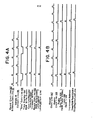
- FIG. 4a Illustrative waveforms of various internal control signals which depict the sequence of operations involved in recording are shown in FIG. 4a. As illustratively shown, a sample is recorded between the occurrence of the first and second, and third and fourth record clock pulses.
- the entire waveform recorder is automatically reset by reset circuit 205.
- This circuit applies appropriate reset pulses to both time counter 216 and address register 230 to reset their contents to zero, and to gates 202 and 203, via lead 204, to disable their outputs thereby preventing any further record clock pulses from reaching any of the data channels, via sample data line 101.
- address register 230 applies an appropriate carry out pulse to reset 205 via lead 297.
- System control 20 also controls replaying of the waveform samples previously stored within the RAM memory in each of the data channels.
- clock 14 shown in FIG. 1 and previously discussed
- the pulse rate of the replay clock pulses is preferably set, by manual controls (not shown) associated with clock 14, to an integral multiple (or fraction) of the pulse rate of the record clock pulses previously applied to lead 127, depending upon the degree of time compression or expansion desired in the replayed waveforms. If transient waveforms have been recorded, then the replay clock pulse rate is usually chosen to be a small fraction of the record pulse clock rate. In practice, replay clock pulse rates as slow as 1/10,000th that of the record clock pulse rate can be advantageously selected.
- the replay clock pulses are applied to the input of gate 203 within system control 20. Both this gate and replay control 210 are enabled by a pulse provided by start replay pushbutton 273 and applied to both via lead 274. Well known (not shown) electrical and/or mechanical interlocks exist between start record pushbutton 270 and start replay pushbutton 273 to prevent the recording and replay circuits from being simultaneously enabled.
- gate 203 applies the replay clock pulses to an input of OR gate 207 via lead 208, to the up/down input of counter 216 via lead 211, and to replay control 210 via lead 209. Each replay clock pulse appearing at the output of OR gate 207 and applied to time counter 216 causes this counter to change its present count by one.
- gate 203 in response to each replay clock pulse, generates a level change which when applied to the up/down input of time counter 216 causes the counter to change its direction of counting, from up (incrementing) to down (decrementing).
- time counter 216 is loaded -- in a manner to be described shortly -- with an appropriate "time-tag", associated with each previously stored sample, from RAM memories 223 and 224.
- Each pulse applied by gate 207 to time counter 216 decrements the "time-tag” in time counter 216 by one.
- time counter 216 applies a signal (pulse), via lead 213, to replay control 210.
- replay control 210 applies a pulse to replay data line 106, which is connected to all the data channels. This causes all the data channels to read out of their respective RAM memories the previously stored sample located at the address specified by the address information then appearing on address bus 102, and to present the equivalent analog values of all these samples at respective output lines of the data channels.
- replay centred 21C applies a pulse, via lead 215, to address register 230 to cause it to increment its address to point to the next successive location in the RAM memories. Thereafter, the incremented address information is applied to address bus 102 and, in turn, to the address input of RAM memories 223 and 224.
- Replay control 210 then applies an appropriate pulse, via lead 215 and OR gate 221, to cause these RAM memories to read out the "time-tag" stored at the incremented address. After the read cycle is completed, the "time-tag" information is present on bus 217.
- replay control 210 applies a pulse, via lead 212, to time counter 216 to load the read-out "time-tag" information into the counter. This "time-tag” is then counted down by subsequently occurring replay clock pulses applied to replay clock lead 129.
- replay control 210 is fabricated from illustratively well-known combinational logic gates and flip-flops.
- each sample stored within any data channel and its "time-tag" are both recorded simultaneously.
- the "time-tag” In order to replay each waveform in the sequence in which it was recorded, the "time-tag” must first be loaded into time counter 216 and decremented to zero prior to read out of its corresponding stored sample.
- the first stored sample (which incidentally is usually zero-valued) is read out and immediately converted to analog form and applied to the output line of the data channel. Thereafter, the "time-tag" associated with the second sample is then loaded into time counter 216 for subsequent decrementation. Replay of the remaining stored samples occurs according to the sequence described above.
- manual up/down control 201 is fed by the replay clock pulses appearing on line 129. Through various manual adjustments, (not shown), manual up/down control 201 applies pulses via leads 236 and 237, to address register 230 to increment or decrement the address contained therein at a rate and direction chosen by the operator.
- a pulse on lead 236 changes the contents of the address register, and the level of the voltage on lead 237 specifies the direction (increment or decrement) of this change.
- Bus transceivers 233 and 234 -- in conjunction with signals appearing on write line 104, read line 105, data direction line 107, address enable line 124 and bus transceiver enable lines 125 and 126 -- are all used to transfer stored waveform or "time-tag" values between any individual RAM memories within any of the data channels, (the waveform memories) or the RAM memory within system control 20 (the “time-tag” memory) and any of the three I/O ports associated with data transfer control 18 (shown in FIG. 1).
- data transfer control 18 prior to the occurrence of any data transfer, applies an appropriate level to address enable line 124, which within system control 20 shown in FIG. 3, is applied to address register 230.
- Bus transceiver enable lines 125 and 126 are used to enable either one of the bi-directional bus transceivers 233 or 234, respectively, to transfer data between either RA M memories 223 or 224 and data bus 108 in a direction determined by the signal then appearing on data direction line 107.
- Write and read lines 103 and 104 route respective control pulses generated by data tranrfer unit 18, via corresponding gates illustratively OR gates 221 or 225 located within sytstem control 20, to initiate a write or read cycle involving any of these RAM memories.
- FIG. 4b Illustrative waveforms of various internal control signals which depict the sequence of operations involved in playback are shown in FIG. 4b.
- the replay clock pulse rate has been chosen to be half that of the record clock pulse rate.
- an electronic waveform recorder embodying the principles of the present invention is not only readily able to accurately record a plurality of slowly varying waveforms over a long period of time, but it can also record occasional high frequency signals and/or transients with excellent accuracy.
- Ths recorder can advantageously replay a recorded waveform, in an analog form, any number of times and at any speed that is a multiple or fraction of the speed at which the waveform was originally recorded.
- the use of analog outputs advantageously permits any low speed mechanical waveform recorder or other analog device, e.g. a chart recorder, plotter or an oscilloscope, to be used as a graphic output device.
- an electronic waveform recorder embodying the teachings of the present invention can effectively function as an interface (and/or buffer) between a plurality of high speed signals and low speed mechanical recorders by providing a vehicle through which theese recorders can mechanically record a plurality of signals having frequency components far higher than the maximum frequency response of the mechanical recorders.
- the electronic waveform recorder can be implemented using microprocessor technology in which the system control is embodied in one microprocessor and its peripheral chips, and each data channel is comprised of analog loop and a microprocessor -- with the latter handling data storage and communications.
- the system control is embodied in one microprocessor and its peripheral chips
- each data channel is comprised of analog loop and a microprocessor -- with the latter handling data storage and communications.
- any one of a number of commercially available single chip microprocessors which incorporate on-chip A/D and/or D/A converters could be used within each data channel.
Landscapes
- Physics & Mathematics (AREA)
- General Physics & Mathematics (AREA)
- Optics & Photonics (AREA)
- Recording Measured Values (AREA)
- Selective Calling Equipment (AREA)
- Holo Graphy (AREA)
- Analogue/Digital Conversion (AREA)
- Signal Processing For Digital Recording And Reproducing (AREA)
Applications Claiming Priority (2)
| Application Number | Priority Date | Filing Date | Title |
|---|---|---|---|
| US49432283A | 1983-05-13 | 1983-05-13 | |
| US494322 | 1983-05-13 |
Publications (2)
| Publication Number | Publication Date |
|---|---|
| EP0125883A2 true EP0125883A2 (de) | 1984-11-21 |
| EP0125883A3 EP0125883A3 (de) | 1989-03-15 |
Family
ID=23964002
Family Applications (1)
| Application Number | Title | Priority Date | Filing Date |
|---|---|---|---|
| EP84303150A Withdrawn EP0125883A3 (de) | 1983-05-13 | 1984-05-10 | Signalgesteuertes Wellenformaufnahmegerät |
Country Status (4)
| Country | Link |
|---|---|
| EP (1) | EP0125883A3 (de) |
| JP (1) | JPS59212776A (de) |
| KR (1) | KR850000074A (de) |
| CA (1) | CA1244976A (de) |
Cited By (1)
| Publication number | Priority date | Publication date | Assignee | Title |
|---|---|---|---|---|
| KR101156298B1 (ko) * | 2005-07-25 | 2012-06-13 | 오베르뛰르 테크놀로지스 | 접촉식 통신 수단과 원격 통신 수단을 가지는 전자 개체 |
Family Cites Families (2)
| Publication number | Priority date | Publication date | Assignee | Title |
|---|---|---|---|---|
| BE756513A (fr) * | 1969-09-26 | 1971-03-01 | Western Electric Co | Montage pour coder des signaux |
| EP0019672B1 (de) * | 1979-05-29 | 1984-04-11 | Otis Engineering Corporation | Verfahren und Vorrichtung zur Aufzeichnung von Daten in einem Bohrloch |
-
1984
- 1984-03-23 KR KR1019840002560A patent/KR850000074A/ko not_active Withdrawn
- 1984-04-17 CA CA000452214A patent/CA1244976A/en not_active Expired
- 1984-05-10 EP EP84303150A patent/EP0125883A3/de not_active Withdrawn
- 1984-05-14 JP JP59094770A patent/JPS59212776A/ja active Pending
Cited By (1)
| Publication number | Priority date | Publication date | Assignee | Title |
|---|---|---|---|---|
| KR101156298B1 (ko) * | 2005-07-25 | 2012-06-13 | 오베르뛰르 테크놀로지스 | 접촉식 통신 수단과 원격 통신 수단을 가지는 전자 개체 |
Also Published As
| Publication number | Publication date |
|---|---|
| EP0125883A3 (de) | 1989-03-15 |
| KR850000074A (ko) | 1985-02-25 |
| CA1244976A (en) | 1988-11-15 |
| JPS59212776A (ja) | 1984-12-01 |
Similar Documents
| Publication | Publication Date | Title |
|---|---|---|
| US4308585A (en) | Electronic memory unit | |
| CA1143480A (en) | Waveform acquisition circuit | |
| US3662380A (en) | Transient recorder | |
| US4425643A (en) | Multi-speed logic analyzer | |
| EP0074235B1 (de) | Programmierbarer Signalanalysator | |
| EP0158802A1 (de) | Digitales Erfassungssystem mit schnellem Abtasttor | |
| JPS5847661B2 (ja) | 波形記憶装置 | |
| EP0177557B1 (de) | Zählvorrichtung und verfahren zur musternahme von frequenzen | |
| JPH0131143B2 (de) | ||
| US4631697A (en) | Signal controlled waveform recorder | |
| US5359533A (en) | Method for determining a frequency/time profile of hits, and device for carrying out the method | |
| US4213134A (en) | Circuit and method for the recorder display of high frequency periodic signals | |
| CA1244976A (en) | Signal controlled waveform recorder | |
| US6803868B2 (en) | Method and apparatus of producing a digital depiction of a signal | |
| USRE34843E (en) | Signal controlled waveform recorder | |
| GB2059229A (en) | Signal-envelope display system for a digital oscilloscope | |
| US3999128A (en) | Time interval measurement method and apparatus | |
| JPS6229965Y2 (de) | ||
| JPS5827465B2 (ja) | 論理信号測定器の論理信号表示方法 | |
| JPH051773Y2 (de) | ||
| SU1304170A1 (ru) | Устройство дл регистрации информации | |
| JPH04233472A (ja) | デジタル表示メータの表示方法 | |
| GB2129238A (en) | Snapshot recorder | |
| JPS6153800B2 (de) | ||
| KR940007584B1 (ko) | 컴퓨터 오디오의 디지탈 녹음 및 재생회로 |
Legal Events
| Date | Code | Title | Description |
|---|---|---|---|
| PUAI | Public reference made under article 153(3) epc to a published international application that has entered the european phase |
Free format text: ORIGINAL CODE: 0009012 |
|
| AK | Designated contracting states |
Designated state(s): CH DE FR GB IT LI |
|
| PUAL | Search report despatched |
Free format text: ORIGINAL CODE: 0009013 |
|
| AK | Designated contracting states |
Kind code of ref document: A3 Designated state(s): CH DE FR GB IT LI |
|
| STAA | Information on the status of an ep patent application or granted ep patent |
Free format text: STATUS: THE APPLICATION IS DEEMED TO BE WITHDRAWN |
|
| 18D | Application deemed to be withdrawn |
Effective date: 19881201 |
|
| RIN1 | Information on inventor provided before grant (corrected) |
Inventor name: FERGUSON, HUGO STANLEY |