EP0126416A1 - Reaktionsverfahren für die Umesterung von Fetten und Ölen - Google Patents
Reaktionsverfahren für die Umesterung von Fetten und Ölen Download PDFInfo
- Publication number
- EP0126416A1 EP0126416A1 EP84105522A EP84105522A EP0126416A1 EP 0126416 A1 EP0126416 A1 EP 0126416A1 EP 84105522 A EP84105522 A EP 84105522A EP 84105522 A EP84105522 A EP 84105522A EP 0126416 A1 EP0126416 A1 EP 0126416A1
- Authority
- EP
- European Patent Office
- Prior art keywords
- reaction
- oils
- lipase
- fats
- diglyceride
- Prior art date
- Legal status (The legal status is an assumption and is not a legal conclusion. Google has not performed a legal analysis and makes no representation as to the accuracy of the status listed.)
- Granted
Links
Images


Classifications
-
- C—CHEMISTRY; METALLURGY
- C12—BIOCHEMISTRY; BEER; SPIRITS; WINE; VINEGAR; MICROBIOLOGY; ENZYMOLOGY; MUTATION OR GENETIC ENGINEERING
- C12P—FERMENTATION OR ENZYME-USING PROCESSES TO SYNTHESISE A DESIRED CHEMICAL COMPOUND OR COMPOSITION OR TO SEPARATE OPTICAL ISOMERS FROM A RACEMIC MIXTURE
- C12P7/00—Preparation of oxygen-containing organic compounds
- C12P7/64—Fats; Fatty oils; Ester-type waxes; Higher fatty acids, i.e. having at least seven carbon atoms in an unbroken chain bound to a carboxyl group; Oxidised oils or fats
- C12P7/6436—Fatty acid esters
- C12P7/6445—Glycerides
- C12P7/6458—Glycerides by transesterification, e.g. interesterification, ester interchange, alcoholysis or acidolysis
-
- C—CHEMISTRY; METALLURGY
- C11—ANIMAL OR VEGETABLE OILS, FATS, FATTY SUBSTANCES OR WAXES; FATTY ACIDS THEREFROM; DETERGENTS; CANDLES
- C11C—FATTY ACIDS FROM FATS, OILS OR WAXES; CANDLES; FATS, OILS OR FATTY ACIDS BY CHEMICAL MODIFICATION OF FATS, OILS, OR FATTY ACIDS OBTAINED THEREFROM
- C11C3/00—Fats, oils, or fatty acids by chemical modification of fats, oils, or fatty acids obtained therefrom
- C11C3/04—Fats, oils, or fatty acids by chemical modification of fats, oils, or fatty acids obtained therefrom by esterification of fats or fatty oils
- C11C3/08—Fats, oils, or fatty acids by chemical modification of fats, oils, or fatty acids obtained therefrom by esterification of fats or fatty oils with fatty acids
-
- C—CHEMISTRY; METALLURGY
- C11—ANIMAL OR VEGETABLE OILS, FATS, FATTY SUBSTANCES OR WAXES; FATTY ACIDS THEREFROM; DETERGENTS; CANDLES
- C11C—FATTY ACIDS FROM FATS, OILS OR WAXES; CANDLES; FATS, OILS OR FATTY ACIDS BY CHEMICAL MODIFICATION OF FATS, OILS, OR FATTY ACIDS OBTAINED THEREFROM
- C11C3/00—Fats, oils, or fatty acids by chemical modification of fats, oils, or fatty acids obtained therefrom
- C11C3/04—Fats, oils, or fatty acids by chemical modification of fats, oils, or fatty acids obtained therefrom by esterification of fats or fatty oils
- C11C3/10—Ester interchange
-
- C—CHEMISTRY; METALLURGY
- C12—BIOCHEMISTRY; BEER; SPIRITS; WINE; VINEGAR; MICROBIOLOGY; ENZYMOLOGY; MUTATION OR GENETIC ENGINEERING
- C12P—FERMENTATION OR ENZYME-USING PROCESSES TO SYNTHESISE A DESIRED CHEMICAL COMPOUND OR COMPOSITION OR TO SEPARATE OPTICAL ISOMERS FROM A RACEMIC MIXTURE
- C12P7/00—Preparation of oxygen-containing organic compounds
- C12P7/64—Fats; Fatty oils; Ester-type waxes; Higher fatty acids, i.e. having at least seven carbon atoms in an unbroken chain bound to a carboxyl group; Oxidised oils or fats
- C12P7/6436—Fatty acid esters
- C12P7/6445—Glycerides
- C12P7/6454—Glycerides by esterification
Definitions
- This invention relates to a method for transesterifying fats and oils using lipase, and particularly, relates to a method for performing transesterification of fats and oils by lipase with two-step reaction comprizing hydrolysis step and esterification step.
- Transesterification reaction of fats and oils is, as well as hydrogenation, a key technology in the production of processed fats and oils.
- Conventional transesterifiction has been carried out in the presense of inorganic catalist and the like such as metallic sodium etc, however, such chemical process has a fault that fatty acid to be transesterified shows low position -selectivity for the binding sites in glycerol.
- lipase E C 3.1.1.3
- E C 3.1.1.3 emzyme for hydrolysis catalizes not only hydrolytic reaction but also esterification reaction (M. Iwai, Y. Tsujisaka, J. Gen. Appl. Microbiol. 10, 13, (1964) ) .
- Transesterifying reaction of fats and oils using lipase has several advantages that the progressed reaction is assured at ordinary temperature and atomospheric pressure, and so forth.
- transesterifying reaction of fats and oils by lipase has more advantage than chemical method using inorganic catalyst, but coversely, it has many difficulties and those diddiculties are necessary to be dissolved technologically in order to utilize them at industrial field.
- the object of this invention is to develop a reaction method for maintaining the stabilized reaction and for increasing the reaction rate to the level capable of industrialzation, by fully activating lipase in the reaction system, so as to attain industrial use of transesterification of fats and oils by lipase.
- the another object of this invention is to enhance the economical effeciency of the reaction process of transesterification, by preventing inactivating of lipase in the reaction system to make enable lipase to use repeatedly as the effectuated.
- lipase Concerning with lipase, it has been already proved by precursory investigations (See e.g. (1) J.Gen.Appl. Microbiol. 10, 13, (1964) , (2) Biochem. Biophys. Acta. 489, 415, (1977) , (3) ibid, 575, 156, (1979) , and (4) Agric. Biol. Chem. 40. 655 (1976) etc.) by Tujisaka, Iwai et al., that lipase is able to be used as a catalyst for esterification reaction which is a reaction of substrate specificity and of a reverse reaction of hydrolysis.
- the experimental data signally concords with the calculated data which was made under the assumption that reaction pathway in which new triglyceride should be formed by the esterification of diglyceride and fatty acid, that is, under the assumption that diglyceride should be an intermediate in transesterifying reaction, thus, above mentioned basic equation was introduced.
- the reaction method of this invention for transesterifying fats and oils by lipase is based upon a knowledge that diglyceride is an intermediate in transesterifying reaction of fats and oils, and based upon a conception that diglyceride, which have been hitherto considered as unfavorable by-product, shall be positively participated to the reaction and the reaction equilibrium is adjusted artificially.
- the reaction method of this invention for transesterifying fats and oils is charactrized by conducting transesterifying reaction in two step reaction, wherein the first step reaction is dominated by hydrolysis of fats and oils by lipase, and second step reaction is dominated by esterification of glyceride by lipase, and above mentioned reaction of two-step is able to be a successive process.
- the operation of bath placements for multi-step purpose is also able to adopted to increase the reaction yieldings.
- the reaction method of this invention for transesterifying fats and oils is favorablly carried out by adding alcohol into the reaction system.
- Preferred alcohols used in this invention are aliphatic alcohol having 4-18 of carbon number, and among them, favorable is buthyl alcohol, hexyl alcohol, octyl alcohol, decyl alcohol etc.
- Alcohol in this invention may be added to either first or second step, however, to add into both first and second step is favorable.
- first step that is the prevailing hydrolysis step it is favorable that alcohol is added at initial time of the reaction period.
- Amount of alcohol to be added at first step is allowable by it's equimolar or the less for the free fatty acid amount to be produced by the hydrolysis, and favorably, is it's proportionated amount to 50 - 90 mol% of free fatty acid estimated to be produced.
- second step that is the prevailing step of esterificaiton reaction, by adding of fatty acid, partial glyceride which is mostly diglyceride is esterified to produce triglyceride, and after proposed triglyceride composition is obtained, alcohol is added into the composition to make change the majority of free fatty acid remained to alcohol ester.
- the amount of alcohol to be added at second step may be the equimolar or the less for remaining free fatty acid after triglyceride has been produced, and alcohol amuont corresponding to 50 - 90 mol % of remaining free fatty acid is favorable.
- Lipase used in the reaction method of this invention for transesterifying fats and oils by lipase is favorablly co-existed with carrier thereof such as diatomaceous earth, active carbon, gypsum, geolite, cellulose and the like, and especially is the use desirably with carrier comprizing of porous solid and chitosan or it's derivative and in the form of fixed lipase on carrier which fixes lipase thereon.
- porous solid constituting said carrier is that one or more selected from a group consisting of Florisil (registered trade mark ; an activated magnesium silicate) , diatomaceous earth, Celite ( registered trade mark ; siliceous earth ) , silica gel, terra alba, Corncob and sawdust.
- Florisil registered trade mark ; an activated magnesium silicate
- diatomaceous earth Celite ( registered trade mark ; siliceous earth )
- silica gel silica gel
- terra alba Corncob and sawdust.
- favorable chitosan or it's derivative constituting said carrier is that one or the more selected from a group consisting of chitosan, N-acyl chitosan, N-mixed acyl chitosan, N,0-acyl chitosan, N-allylidene chitosan, N-alkylidene chitosan, salt of chitosan and those partially reacted. That partially reacted means the compound produced from the reaction of functional group of chitosan, that is amino group or hydroxy group is partially reacted.
- the deacetylized product from homogenous reaction system of chitin which have 40 - 60% of deacetylation ratio, also may be used effectively.
- Carrier of the fixed lipase used in this invention still may contain resin having strong water absorptiveness, and, theis kind of resin is water absorptive polyurethane resin, polyhydroxyethyl methacrylate, polyacrylic resin, starch-acrylic acid graft polymer (starch is graft-polymerized with acrylic acid, and the resulted is neutralized, then bridged by samll amount of bridging agent thus resin obtained) , starch-acrylonitrile graft polymer ( obtained by graft-polymeriztion the starch with acrylonitrile by radioactive rays of second Cerium salt, then hydrolytic decomposing, then purifying and drying) , process starch obtained by carboxymethylating the starch with monochloroacetic acid and bridging with formalin, cellulose-acrylonitrile graft polymer, processed cellulose resulted by carboxymethylating the cellulose with monochloroacetic acid and bridging with formalin, self-bridged of
- starch-acrylic acid graft copolymer, and self-bridged of the product obtained from the hydrolysis of copolymer of vinyl alcohol-acrylic acid or vinyl acetate-methylmethacrylate may be used favorably, and, former is e.g. commercialy available Sanwet IM-300 (registered trade mark, made by Sanyo Chemicals Co. Ltd., Japan ) later is e.g. Sumicagel S-50 ( registered trade mark, made by Sumitomo Chemical Co. Ltd., Japan ) .
- ratio of the usage of chitosan derivative for porous solid is 0.05 - 1 part by weight of chitosan derivative for 1 part by weight of porous solid, more favorable ratio of chitosan devivative is 0.1 -0.5 part by weight for 1 part by weight of porous solid.
- the usage of resin having strong water absorptiveness is favorably 0.05 - 1 part by weight part of it for 1 part by weight of porous solid, more favorablly 0.1 - 0.5 part by weight for 1 part by weight of porous solid.
- Fixed lipase used in this invention is prepared according to a method for preparing the fixed emzyme, characterized by forming the gel of chitosan derivative, dispersine porous solid into the formed gel and drying this dispersion to obtain a carrier, then fixing the lipase on to the carrier.
- An effective fixing of emzyme is attained by drying said despersion and pulverizing it to obtain carrier. Then it is mixed in to aqueous solution or buffered solution of emzyne.
- effective fixation is made by mixing emzyme powder with the dried, pulverized carrier, then adding water or buffered solution to the carrier, with continuous mixing.
- a method for dispersing porous solid in to the gel of chitosan derivative then drying it may be conducted by the use of, a process consisting of dispersing it in to acetone with stirring, or, a process consisting of forming a thin layer then drying it with air, or, a process of spray drying, or, a process of freeze-drying.
- fixed lipase used in this invention also may be produced by a method in which the resin having strong water absorptiveness is added to the dried up dispersion comprizing chitosan and porous solid, and the resulted is mixed, then, on which, enzyme is absorped by similar manner to above mentioned.
- the structure of the fixed lipase produced by above mentioned method is supposed that the surface of porous solid is being covered with the gel of chitosan derivative, and further, lipase is being fixed to said chitosan gel by such mode as the absorption, the inclusion, or ionic combination.
- both the surface part and inside of fine pores which are made of chitosan derivative and resin having strong water absorptiveness, and have the characteristic that both of these are able to change the water content of the surface and the inside, in which, reaction causes, of lipase.
- reaction system In the case of hydrolytic reaction, usually, the reaction system has been inhomogeneous system consisting of water and substrate, and in such reaction system, the production of emulsion has been caused at interfaces, frequently, and the difficulty has been happened with the separation of the decomposed material from aimed product, and, not only the degration of the operativeness has been conducted but also the lowered recovery ratio of the product has raised up the production cost.
- the reaction of this invention is able to be conducted in the reaction system in which free water is not contained substantially thus, no emulsion is almostly generated, and easily, separation of decomposed material and the heightened recovery ratio of the product is realized.
- the usage of said fixed lipase is desirablly 3 - 40 %, and more desirablly 6 -20 %, for the substrate (fats and oils ) .
- the usage of emzyme of 5 - 2000 U/g for the substrate is desirable and more desirable is 50 - 500 U/g for the substrate.
- the usage of the said fixed lipase for substrate is 0.5 - 10%, desirably, and is 1.0 - 5.0% more desirably.
- activity unit ( U) of emzyme As the amount of emzyme for substrate, 20 - 10000 U/g is desirable and 100 - 1000 U/g is more desirable.
- activity unit (U) of emzyme when the emzyme is added into emulsified olive oil liquid 5ml and 0.1 M phosphate buffered solution 4 ml then reacted for 30 minutes at 37 °C, each produced fatty acid corresponding to 0.05N sodium hydroxide solution 0.06 m1, is determined as activity unit (U ) .
- Emzymatic activity shown in example hereinafter has same meaning.
- Fats and oils as substrate used in the method of this invention for transesterifying fats and oilds by lipase are, usual vegetable and animal fats and oils or processed fats and oils, or, mixture thereof, and are e.g. soybean oil, cocoanut oil, sufflower oil, rapeseed oil, olive oil, corn oil, cotton seed oil, tallow, lard, fish oil, etc.
- glyceride having particular formulation and being raw material for the substrate of cacao butter e.g. 1,3-distearo-2-oleoglyceride, 1,3-palmito-2- oleoglyceride
- fats and oils containing a large quantity of oleic acid at 2-position of glyceride e.g. olive oil, camallia oil, sasanqua oil, palm butter, sal butter, illipe oil, kokum butter, Shea butter, mowrah oil, phulwara butter, Bolneo tallow or the fractinoned thereof.
- the method of the invention is desirably conducted with a reaction system, in which considerable large amount of water is added.
- the optimum amount of water for 1 part by weight of fats and oils is 0.02 - 0.10 part by weight and by the use of the system being added that range of water amount, the reaction product containing 20 - 40 wt. % of diglyceride for total glyceride, 20 - 60 wt. % in the case of the addition of alcohol, is obtained.
- fatty acid as the object of the transesterification is added to the reaction product which has been produced by the first step, and mixing and stirring is continued with keeping temperature at 20 - 50 °C.
- As lipase in this invention that of Rhizopus group, of Aspergillus group, of Candida group, of Mucor group and Pancreas lipase etc., may be used. And almost all of them are commercially available.
- lipase having 1,3-position specificity for triglyceride are particularly favorable, and lipase falling in this category is of Rhizopus delemar, of Rhizopus japonicus, of Mucor japonicus and so forth.
- the hydrolytic reaction is carried out in such a mode that the ratio of 1,2 (2,3 ) -diglyceride comprized in total diglyceride produced at said first step that is hydrolytic reaction step, reaches to 70 wt.% or the more, favorably 90 wt. % or the more, thus a selective transesterifying reaction is attained.
- the removal of water existing in the reaction system at esterification reaction step can be conducted effectively by vantulating a dried inert gas into the reaction system them exhausting it to the outside of the reaction system with the association of water.
- a dried inert gas may be nonexplosive, and for fats and oils nonreactive one or more such as nitrogen gas, Argon gas, Helium gas.
- the vantulating into the reaction system may be conducted by bubbling in liquid phase in the reactor, in addition to, blowing to the gaseous.phase.
- exhausted gas mixed is passed through a condenser being cooled to the temperature less than freezing point of water by using cooling medium, in which condenser, water contained in the gas mixed is changed into ice to be tropped, thus, water vapor is fully separated from inert gas.
- the separated gas is re-used by it's return to the inside of the reaction system.
- the amount of fatty acid to be added at second step (esterification reaction ) of the method of this invention is favorably 0.4 - 2.0 part by weight for 1 part by weight of fats and oils.
- Such fatty acid can be used is of carbon number 2 - 22 of straight chain saturated or unsaturated, e.g. palmitic acid, stearic acid, oleinic acid and so on.
- fatty acid is able to be used in such manner that all parts of prescribed amount are added at once, otherwise, the addition of these is made gradually with the progress of the reaction.
- the use of stearic acid or palmitic acid having high melting point has a tendency to cause an inhomogeneous state, and in such case, the fatty acid may be dissloved in inert organic solvent for lipase to make homogeneous system, then the reaction is conducted.
- solvent is n-hexane, hexane for industrial use, petroleum ether and the like, and they may be used 1 - 10 parts by weight for 1 part by weight of fatty acid.
- both first reaction (hydrolytic reaction ) and second reaction (esterification reaction ) are, as similar to ordinal emzymatic reaction, able to be conducted at 20 - 70°C.
- the method of this invention constitutes the transesterifying reaction by two steps reaction consitituting of hydrolytic reaction and esterification reaction, therefore, comparing to the reaction system comprizing the use of small amount of water, this invention enables an effective reaction, consequently, when comparing conventional one-step reaction which had to sacrifice the rate of the reaction in order to suppress in lower level the formation of partial glyceride to be produced by hydrolytic decomposition.
- the method of this invention facilitates both an extreme increase of the reaction rate and significant decrease of the content of partial glyceride such as diglyceride, monoglyceride in the final product, therefore, is eventual processing method fo reaction.
- the incearse of the reaction rate facilitates not only the shortening of the operation period of the reactor and the realization of effective and highly productive process, but also the shortening of the stay period of emzyme or emzymatic composition in reactor, therefore, inactivation of emzyme or deformation of emzymatic composition to be caused by the stress suffered from stirring or by physical change in the reactor, is alleviated.
- the method of this invention eliminates a complicated and troublesome labour and unreasonable drying operation, both of which are often seen in the conventional preparating process of emzymatic composition.
- this invention is able to remove easily water by a water removal operation at second step reaction of esterification reaction, when water is existing in the range of 3 - 10 wt. % for the substrate fats and oils, therefore, significant effect on the operativeness is rendered. Furthermore, with the method of this invention it is not required to adjust the water amount strictly at repeat use of emzyme (lipase) , and emzyme is activated again by adding of water to the reaction system, at the reaction of second times or thereafter, to enable stable processing.
- emzyme lipase
- Chitosan (Fownac N, made by Kyowa Oil and fat Co. Ltd., Japan ) 8g are added into 60g of 10 % acetic acid of water solution with stirring, to form chitosan acetic acid salt gel, and to this gel, 440g water and 32g of of Celite (commercial name ) are added to form homogeneous mixture, then, the mixture is dropped in 2000g of acetone with stirring, and insoluble materials are recovered by centrifuging, the insoluble materials are added into 1000g of acetone with mixing, then filtered and air-dried, then acetone removal treatment is conducted under the vacuum to dry it, resulted is a carrier consisting of chitosan acetic acid salt-Celite.
- lipase (98000 U /g ) 103mg originated from Rhizopus delemar are dissolved into 0.5g of wafer, and this is absorbed on said chitosan acetic acid salt-Celite carrier 2.0g to obtain fixed lipase.
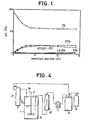
- Above fixed emzyme is added to the mixture of palm olein 38g end n-hexane 120g, then this is stirred and subjected to hydrolytic reaction in the closed reactor at 40 °C.
- TG, 1,2 (2,3 ) -DG, 1,3-DG, MG, FFA shows triglyceride, 1,2 (2,3 ) -diglyceride, 1,3-diglyceride, monoglyceride, free fatty acid, respectively.
- Lipase originated from Rhizopus delemar and used in this example has the specificity which attacks and cleaves 1-position and 3-position. Accordingly, as will be clear from Fig. 1, initial period of the reaction produces 1,2 (2,3 ) -diglyceride only. It is felf that prolonged reaction period increasese the ratio of 1,3-diglyceride, but , this phenomenon is not due to the influence by lipase, but due to the conversion of 1,2 (2,3 ) -diglyceride into 1,3- diglyceride by a non-emzymatic acyl group-trnasfer reaction. Concerning with such kind of transfer reaction, a report by Okumura et al. (See, S. Okumura, M. Iwai, T. Tsujisaka, Agric. Biol. Chem., 45, 185 ( 1981) ), is there..
- fatty acid is added at the point of time when hydrolytic reaction is nearly finished or just before time thereof.
- the equilibrium state of hydrolytic reaction is decided by initial amount of water, and, it is understood that increasing of water amount causes more increase of diglyceride at the equilibrium state.
- Solid fat content is determined on triglyceride sections. As a conditioning for determination of SFC, these fats and oils are liquefied completely, then allowed to stand for 30 minutes at 0 °C to harden the fats and oils, and allowed to stand for 2 hrs. at 20°C. Thereafter, allowing to stand for 1 hr at 30°C and for 2 hrs. at 20 °C, is repeated for seven times.
- the determination of SFC is conducted by using (PRAXIS MODEL) SFC-900, in accordance with conventional method (A.O.C.S.
- Transesterifying is conducted by similar condition to that of Referential experimental example 1 with the exception of stearic acid (NAA-180, made by Nippon Yushi Co. Ltd., Japan) 57g together with n-hexane 165g are added at the same time of adding fixed lipase into the mixture which comprizes palm olein and n-hexane, and is same as that of Referential experimental example 1.
- stearic acid NAA-180, made by Nippon Yushi Co. Ltd., Japan
- reaction mixtures are picked up fractionally, with same mode as Exective example 1, then triglyceride sections are fractionally picked up through column chromatography and SFC value is determined.
- Transesterifying reaction of fats and oils is conducted as follow, by using an apparatus shown in Fig. 4. Palm olein 38g is stirred together with the fixed emzyme and n-hexane 120g in the closed reactor A with stirring at 40 * C for 2 hrs, to conduct first step reaction (hydrolytic reaction ) .
- This mixed emzyme is prepared by dissolving lipase (98000 U /g) of 103mg originated form Rhizopus delemar, into 2.0g of water, and making absorb this on the same carrier as the used in Referential experimental example 1.
- Inert gas is associated with water vapor existing in phase 2, in which an equilibrium is being set up between liquid and gas. Then the associated inert gas is exhausted to the outside of the reaction system, from the reactor, and, thereby, the water content of the reaction system (second step reaction) is gradually lowered. At this second step reaction, average staying period of the inert gas is set up, to 3 seconds, approximately.
- inert gas associated with vapor of n-hexane and of water therein is passed into a surface condenser F wich is being cooled by dry ice at about -20°C, wherein,n-hexane is liquefied, water vapor is changed into ice, thus, separated three phase consisting of gas, liquid and solid is brought, and the liquefied n-hexane is returned to the reactor A.
- stirring is ceased and product is recovered.
- product is trimethylsilylated with the use of hexamethyldisilazane (HMDS) , trimethyl chlorosilane (TMCS) (made by Walko parmaceutical Co. Ltd., Japan) in accordance with the method of J. Blum et al. ( See, Lipid, 5, 601 (1970) ) , and is analyzed by Elevated temperature gas chromatography, the resulted is shown is shown is Table 2.
- diglyceride 24.6wt. % is produced by hydrolytic reaction of first step reaction, but, at second stepreaction, this diglyceride is gradually decrased by transesterifying reaction, and esterification reaction, and is decreased to 11.5 wt. % after 8 hrs. and after 12 hrs. is decreased to 7.4 wt.%.
- Transesterifying reaction consisting of first step reaction (hydrolytic reaction ) and second step reaction (esterification reaction ) is conducted by similar method to that of Example 2, and, fixed emzymeused is recovered after reaction is completed. Water corresponding to 5.0% for fats and oils as raw materials is absorbed on the recovered fixed emzyme.
- Transesterifying reaction consisting of hydrolytic reaction step and esterification reaction step is repeated by using that fixed emzyme, by similar manner as that of Example 2.
- Reaction mixture at 8 hours time lapse of esterification reaction step is trimethylsilylized in similar manner as that of Example 2, then it is analyzed by the elevated temperature gas chromatography.
- Comparative example 4 the resulted by reaction with the initial addition of stearic acid and with the eliminated hydrolytic reaction are analyzed by similar manner.
- reaction rate in Example 3 is very high, and on the other hand, reaction rate in Comparative example 4 is significantly decreased by the influence of the repeat reaction.
- Transesterifying reaction of fats and oils is conducted by using an apparatus shown in flow sheet of Fig. 4 as follow.
- Palm olein 38g together with fixed lipase on a carrier (which is prepared by the method that lipase (98000 U /g ) 103mg originated from Rhizopus delemar is dissolved into water 2.0g then it is absorbed on the carrier similar to that of Referential experimental example 1 ) , n-hexane 120g and butyl alcohol 2.5g, is stirred by stirrer la in the closed reactor A at 40°C for 2 hours, to conduct first step reaction (hydrolytic reaction ) . After completedreaction, small amounts of reaction mixture are fractionally picked up, and are analyzed as described hereinafter. The result is shown in Table 3.
- the inert gas containing vapors of n-hexane and of water is pasees into a surface condenser F which is being cooled by dry ice at about -20 °C, wherein n-hexane is liquefied, while water is changed to ice, and separated 3 phased of gas-liquid-solid are brought, and the liquefied n-hexane is returned to the reactor A.
- This second step reaction is lasted for 12 hrs.
- the amount of diglyceride contained in total glycerides is 43.3 wt. %, and monoglyceride contained in total glycerides is 7,6 wt. %.
- Reaction is conducted by similar method to that of Example 4 with the exception of the use of n-decyl alcohol as alcohol.
- the amount of alcohol to be added is 5.3g at first step reaction, and hydrolytic reaction is conducted at 40°C for 4 hrs.
- hydrolytic reaction is conducted at 40°C for 4 hrs.
- stearic acid 20g are added into the system andremoval of water in the system is started and esterification reaction is conducted with 8 hours of stirring.
- n-decyl alcohol 5.0g are added at the point of time when the content of diglyceride in total glycerides is decreased to about 10%, to esterify the free fatty acid.
- Table 4 The resulted analysis made by similar manner to that of Example 4 is shown in Table 4.
- n-butyl alcohol 4.5g are added into the reaction product which is prepared by the reaction according to a method similar to that of Example 4 comprizing first step reaction and second step reaction, with exception of no addition of alcohol at first step reaction. Stirring is continued for 4 hours with removing water by the apparatus shown in Fig. 4, to conduct esterification of free fatty acid.
Landscapes
- Chemical & Material Sciences (AREA)
- Organic Chemistry (AREA)
- Life Sciences & Earth Sciences (AREA)
- Engineering & Computer Science (AREA)
- Wood Science & Technology (AREA)
- Zoology (AREA)
- General Chemical & Material Sciences (AREA)
- Chemical Kinetics & Catalysis (AREA)
- Oil, Petroleum & Natural Gas (AREA)
- Biotechnology (AREA)
- Microbiology (AREA)
- Health & Medical Sciences (AREA)
- Biochemistry (AREA)
- Bioinformatics & Cheminformatics (AREA)
- General Engineering & Computer Science (AREA)
- General Health & Medical Sciences (AREA)
- Genetics & Genomics (AREA)
- Preparation Of Compounds By Using Micro-Organisms (AREA)
Applications Claiming Priority (6)
| Application Number | Priority Date | Filing Date | Title |
|---|---|---|---|
| JP88167/83 | 1983-05-19 | ||
| JP8816783A JPS59213390A (ja) | 1983-05-19 | 1983-05-19 | 固定化酵素及びその製造方法 |
| JP126392/83 | 1983-07-12 | ||
| JP58126392A JPS6019495A (ja) | 1983-07-12 | 1983-07-12 | リパ−ゼによる油脂類のエステル交換反応方法 |
| JP57739/84 | 1984-03-26 | ||
| JP59057739A JPS60203196A (ja) | 1984-03-26 | 1984-03-26 | リパ−ゼによる油脂類のエステル交換反応方法 |
Publications (2)
| Publication Number | Publication Date |
|---|---|
| EP0126416A1 true EP0126416A1 (de) | 1984-11-28 |
| EP0126416B1 EP0126416B1 (de) | 1988-01-07 |
Family
ID=27296364
Family Applications (1)
| Application Number | Title | Priority Date | Filing Date |
|---|---|---|---|
| EP84105522A Expired EP0126416B1 (de) | 1983-05-19 | 1984-05-15 | Reaktionsverfahren für die Umesterung von Fetten und Ölen |
Country Status (3)
| Country | Link |
|---|---|
| US (1) | US4874699A (de) |
| EP (1) | EP0126416B1 (de) |
| DE (1) | DE3468433D1 (de) |
Cited By (23)
| Publication number | Priority date | Publication date | Assignee | Title |
|---|---|---|---|---|
| WO1986005186A1 (en) * | 1985-02-27 | 1986-09-12 | Novo Industri A/S | Process for esterification |
| EP0200648A1 (de) * | 1985-04-26 | 1986-11-05 | Societe Nationale Elf Aquitaine | Verfahren und Vorrichtung zur enzymatischen Hydrolyse von Fettstoffen |
| GB2188057A (en) * | 1986-02-04 | 1987-09-23 | Inst Penyelidikan Minyak Kelap | Transesterification of fats and oils |
| GB2205850A (en) * | 1987-05-11 | 1988-12-21 | Kanegafuchi Chemical Ind | Process of enzymatic interesterification in a low water content condition |
| EP0257388A3 (de) * | 1986-08-13 | 1989-08-30 | Kao Corporation | Verfahren zur Umesterung von Fetten |
| EP0231089A3 (en) * | 1986-01-21 | 1989-11-15 | Chisso Corporation | Process for producing an optically active alcohol by a biochemical method |
| EP0266217A3 (en) * | 1986-10-30 | 1989-11-15 | Chisso Corporation | Process for producing optically active compounds |
| EP0288994A3 (en) * | 1987-05-01 | 1989-11-23 | Chisso Corporation | Process for producing optically active compounds |
| EP0354025A1 (de) | 1988-08-05 | 1990-02-07 | Fuji Oil Company, Limited | Mittel gegen Fettbleichen und Gebrauchsverfahren |
| EP0321777A3 (en) * | 1987-12-22 | 1990-05-09 | The Japanese Research And Development Association For Bioreactor System In Food Industry | Process for the transesterification of fat and oil |
| WO1991006661A1 (en) * | 1989-11-03 | 1991-05-16 | Opta Food Ingredients, Inc. | Lipase-catalyzed in situ generation of mono- and di-glycerides |
| US5116745A (en) * | 1990-04-19 | 1992-05-26 | The Procter & Gamble Company | Process for preparing 2-acylglycerides or 1,2-diacyl diglycerides or 2,3-diacyl diglycerides |
| US5128251A (en) * | 1987-12-09 | 1992-07-07 | Kao Corporation | Immobilized lipolytic enzyme for esterification and interesterification |
| US5137660A (en) * | 1991-03-15 | 1992-08-11 | The Procter & Gamble Company | Regioselective synthesis of 1,3-disubstituted glycerides |
| US5204251A (en) * | 1987-05-11 | 1993-04-20 | Kanegafuchi Kagaku Kogyo & Kabushiki Kaisha | Process of enzymatic interesterification maintaining a water content of 30-300 ppm using Rhizopus |
| EP0528815A4 (en) * | 1990-04-20 | 1993-07-14 | The Procter & Gamble Company | Stereoselective synthesis of 1,2-diglycerides and triglycerides |
| US5288619A (en) * | 1989-12-18 | 1994-02-22 | Kraft General Foods, Inc. | Enzymatic method for preparing transesterified oils |
| EP0688505A1 (de) * | 1994-06-24 | 1995-12-27 | Unilever N.V. | Behen-reiche Triglyceridöle |
| US5654018A (en) * | 1994-06-24 | 1997-08-05 | Loders Croklaan B.V. | Behenic-rich triglycerides |
| WO2007016646A1 (en) * | 2005-08-02 | 2007-02-08 | Durafizz, Llc | Methods and apparatus for removal of degradation byproducts and contaminants from food grade oil |
| CN108137472A (zh) * | 2015-08-14 | 2018-06-08 | 医药保健股份公司 | 鲸蜡脂肪酸、其制备系统及其应用 |
| WO2024099616A1 (en) * | 2022-11-07 | 2024-05-16 | Bc International Consulting | Lauric - non-lauric fat compositions |
| WO2025011800A1 (en) * | 2023-07-11 | 2025-01-16 | Bc International Consulting | Lauric fat compositions |
Families Citing this family (8)
| Publication number | Priority date | Publication date | Assignee | Title |
|---|---|---|---|---|
| JPS6261589A (ja) * | 1985-09-10 | 1987-03-18 | Fuji Oil Co Ltd | グリセリド油脂の加工法 |
| JPH0789944B2 (ja) * | 1986-12-23 | 1995-10-04 | 旭電化工業株式会社 | 製菓用油脂組成物の製法 |
| FI95395C (fi) * | 1994-09-07 | 1996-01-25 | Raision Tehtaat Oy Ab | Entsymaattinen menetelmä synteettisen esterin valmistamiseksi kasviöljystä |
| DE102004019472A1 (de) * | 2004-04-22 | 2005-11-17 | Bayer Healthcare Ag | Phenylacetamide |
| EP1728846A1 (de) * | 2005-05-30 | 2006-12-06 | Monsanto S.A.S. | Eine neue Biodieselzusammensetzung |
| UA97127C2 (uk) * | 2006-12-06 | 2012-01-10 | Бандж Ойлз, Инк. | Спосіб безперервної ферментативної обробки композиції, що містить ліпід, та система для його здійснення |
| KR100862548B1 (ko) * | 2007-12-18 | 2008-10-13 | 대한민국 | 무 트랜스 지방 함유 유지류 개발을 위한 저온에서의효소적 에스테르 교환반응 |
| CN110376307A (zh) * | 2019-08-13 | 2019-10-25 | 深圳市深大检测有限公司 | 水产品中孔雀石绿的残留检测方法 |
Citations (2)
| Publication number | Priority date | Publication date | Assignee | Title |
|---|---|---|---|---|
| GB2042579A (en) * | 1978-12-20 | 1980-09-24 | Ajinomoto Kk | Interesterification of glycerides |
| EP0064855A1 (de) * | 1981-05-07 | 1982-11-17 | Unilever Plc | Behandlung von Fetten |
Family Cites Families (4)
| Publication number | Priority date | Publication date | Assignee | Title |
|---|---|---|---|---|
| GB1577933A (en) * | 1976-02-11 | 1980-10-29 | Unilever Ltd | Fat process and composition |
| US4167447A (en) * | 1976-07-19 | 1979-09-11 | The United States Of America As Represented By The Secretary Of Agriculture | Method for insolubilizing enzymes on chitosan |
| US4420560A (en) * | 1981-11-17 | 1983-12-13 | Fuji Oil Company, Limited | Method for modification of fats and oils |
| IE54838B1 (en) * | 1982-04-30 | 1990-02-28 | Unilever Plc | Improvements in and relating to interesterification of triglycerides of fatty acids |
-
1984
- 1984-05-15 DE DE8484105522T patent/DE3468433D1/de not_active Expired
- 1984-05-15 EP EP84105522A patent/EP0126416B1/de not_active Expired
-
1986
- 1986-08-21 US US06/898,513 patent/US4874699A/en not_active Expired - Fee Related
Patent Citations (2)
| Publication number | Priority date | Publication date | Assignee | Title |
|---|---|---|---|---|
| GB2042579A (en) * | 1978-12-20 | 1980-09-24 | Ajinomoto Kk | Interesterification of glycerides |
| EP0064855A1 (de) * | 1981-05-07 | 1982-11-17 | Unilever Plc | Behandlung von Fetten |
Cited By (30)
| Publication number | Priority date | Publication date | Assignee | Title |
|---|---|---|---|---|
| WO1986005186A1 (en) * | 1985-02-27 | 1986-09-12 | Novo Industri A/S | Process for esterification |
| EP0200648A1 (de) * | 1985-04-26 | 1986-11-05 | Societe Nationale Elf Aquitaine | Verfahren und Vorrichtung zur enzymatischen Hydrolyse von Fettstoffen |
| FR2585365A1 (fr) * | 1985-04-26 | 1987-01-30 | Elf Aquitaine | Procede et appareil pour l'hydrolyse enzymatique de corps gras |
| EP0231089A3 (en) * | 1986-01-21 | 1989-11-15 | Chisso Corporation | Process for producing an optically active alcohol by a biochemical method |
| GB2188057A (en) * | 1986-02-04 | 1987-09-23 | Inst Penyelidikan Minyak Kelap | Transesterification of fats and oils |
| GB2188057B (en) * | 1986-02-04 | 1990-03-07 | Inst Penyelidikan Minyak Kelap | Transesterification of fats and oils |
| EP0257388A3 (de) * | 1986-08-13 | 1989-08-30 | Kao Corporation | Verfahren zur Umesterung von Fetten |
| EP0266217A3 (en) * | 1986-10-30 | 1989-11-15 | Chisso Corporation | Process for producing optically active compounds |
| EP0288994A3 (en) * | 1987-05-01 | 1989-11-23 | Chisso Corporation | Process for producing optically active compounds |
| GB2205850A (en) * | 1987-05-11 | 1988-12-21 | Kanegafuchi Chemical Ind | Process of enzymatic interesterification in a low water content condition |
| US5204251A (en) * | 1987-05-11 | 1993-04-20 | Kanegafuchi Kagaku Kogyo & Kabushiki Kaisha | Process of enzymatic interesterification maintaining a water content of 30-300 ppm using Rhizopus |
| GB2205850B (en) * | 1987-05-11 | 1991-01-30 | Kanegafuchi Chemical Ind | Process of enzymatic interesterification in a low water content condition |
| US5128251A (en) * | 1987-12-09 | 1992-07-07 | Kao Corporation | Immobilized lipolytic enzyme for esterification and interesterification |
| US5089404A (en) * | 1987-12-22 | 1992-02-18 | The Japanese Research And Development Association For Bioreactor System In Food Industry | Process for the transesterification of fat and oil |
| EP0321777A3 (en) * | 1987-12-22 | 1990-05-09 | The Japanese Research And Development Association For Bioreactor System In Food Industry | Process for the transesterification of fat and oil |
| EP0354025A1 (de) | 1988-08-05 | 1990-02-07 | Fuji Oil Company, Limited | Mittel gegen Fettbleichen und Gebrauchsverfahren |
| WO1991006661A1 (en) * | 1989-11-03 | 1991-05-16 | Opta Food Ingredients, Inc. | Lipase-catalyzed in situ generation of mono- and di-glycerides |
| US5288619A (en) * | 1989-12-18 | 1994-02-22 | Kraft General Foods, Inc. | Enzymatic method for preparing transesterified oils |
| US5116745A (en) * | 1990-04-19 | 1992-05-26 | The Procter & Gamble Company | Process for preparing 2-acylglycerides or 1,2-diacyl diglycerides or 2,3-diacyl diglycerides |
| EP0528815A4 (en) * | 1990-04-20 | 1993-07-14 | The Procter & Gamble Company | Stereoselective synthesis of 1,2-diglycerides and triglycerides |
| US5137660A (en) * | 1991-03-15 | 1992-08-11 | The Procter & Gamble Company | Regioselective synthesis of 1,3-disubstituted glycerides |
| US5654018A (en) * | 1994-06-24 | 1997-08-05 | Loders Croklaan B.V. | Behenic-rich triglycerides |
| EP0688505A1 (de) * | 1994-06-24 | 1995-12-27 | Unilever N.V. | Behen-reiche Triglyceridöle |
| WO2007016646A1 (en) * | 2005-08-02 | 2007-02-08 | Durafizz, Llc | Methods and apparatus for removal of degradation byproducts and contaminants from food grade oil |
| US8039653B2 (en) | 2005-08-02 | 2011-10-18 | Soane Energy, Llc | Methods and apparatus for removal of degradation byproducts and contaminants from oil for use in preparation of biodiesel |
| CN108137472A (zh) * | 2015-08-14 | 2018-06-08 | 医药保健股份公司 | 鲸蜡脂肪酸、其制备系统及其应用 |
| CN108137472B (zh) * | 2015-08-14 | 2021-08-03 | 医药保健股份公司 | 鲸蜡脂肪酸、其制备系统及其应用 |
| WO2024099616A1 (en) * | 2022-11-07 | 2024-05-16 | Bc International Consulting | Lauric - non-lauric fat compositions |
| WO2025011800A1 (en) * | 2023-07-11 | 2025-01-16 | Bc International Consulting | Lauric fat compositions |
| BE1031792B1 (nl) * | 2023-07-11 | 2025-02-11 | Bc Int Consulting | Laurische Vetsamenstellingen |
Also Published As
| Publication number | Publication date |
|---|---|
| EP0126416B1 (de) | 1988-01-07 |
| US4874699A (en) | 1989-10-17 |
| DE3468433D1 (en) | 1988-02-11 |
Similar Documents
| Publication | Publication Date | Title |
|---|---|---|
| EP0126416A1 (de) | Reaktionsverfahren für die Umesterung von Fetten und Ölen | |
| EP0320132B1 (de) | Immobilisiertes Enzym und Veresterung und Zwischenveresterung mit demselben | |
| US4268527A (en) | Method for producing cacao butter substitute | |
| EP0035883B1 (de) | Verfahren zur enzymatischen Zwischenveresterung von Fett und hierzu verwendetes Enzym | |
| US4719178A (en) | Rearrangement process | |
| EP0064855B1 (de) | Behandlung von Fetten | |
| EP0307154B1 (de) | Herstellung von Diglyceriden | |
| US6500974B2 (en) | Process for the preparation of a monoglyceride | |
| RU2528954C2 (ru) | Способ производства триглицеридной композиции | |
| EP0407959A2 (de) | Verfahren zur Herstellung von Polyolfettsäure-Monoestern | |
| US20030130533A1 (en) | Conjugated fatty acid containing monoglycerides and process for producing them | |
| EP0579928A1 (de) | Immobilisierte Lipase, Verfahren zu ihrer Herstellung und Verfahren für Transveresterung von Öl und Fett mit dieser Lipase | |
| EP4132282B1 (de) | Verfahren zur herstellung von sn-2-palmitintriacylglycerolen | |
| US5177013A (en) | Preparation of an immobilized lipase having a low water content without drying | |
| WO1992016639A1 (en) | Regioselective synthesis of 1,3-disubstituted glycerides | |
| JP2002507431A (ja) | 非消化性脂肪を合成および精製するための改良方法 | |
| JPH0316117B2 (de) | ||
| EP1931794B1 (de) | Zweistufiges verfahren zur herstellung von fettsäuren | |
| JP2021073951A (ja) | ジアシルグリセロール高含有油脂の製造方法 | |
| JP2570774B2 (ja) | 油脂の改質法 | |
| JPH0357759B2 (de) | ||
| JPH0365950B2 (de) | ||
| JP6069722B2 (ja) | エステル交換油脂の製造方法 | |
| JP6859212B2 (ja) | ジアシルグリセロール高含有油脂の製造方法 | |
| JPH04258291A (ja) | 固定化酵素およびその製造方法 |
Legal Events
| Date | Code | Title | Description |
|---|---|---|---|
| PUAI | Public reference made under article 153(3) epc to a published international application that has entered the european phase |
Free format text: ORIGINAL CODE: 0009012 |
|
| AK | Designated contracting states |
Designated state(s): DE FR GB NL SE |
|
| 17P | Request for examination filed |
Effective date: 19850403 |
|
| 17Q | First examination report despatched |
Effective date: 19860123 |
|
| GRAA | (expected) grant |
Free format text: ORIGINAL CODE: 0009210 |
|
| AK | Designated contracting states |
Kind code of ref document: B1 Designated state(s): DE FR GB NL SE |
|
| REF | Corresponds to: |
Ref document number: 3468433 Country of ref document: DE Date of ref document: 19880211 |
|
| ET | Fr: translation filed | ||
| PLBE | No opposition filed within time limit |
Free format text: ORIGINAL CODE: 0009261 |
|
| STAA | Information on the status of an ep patent application or granted ep patent |
Free format text: STATUS: NO OPPOSITION FILED WITHIN TIME LIMIT |
|
| 26N | No opposition filed | ||
| PGFP | Annual fee paid to national office [announced via postgrant information from national office to epo] |
Ref country code: GB Payment date: 19940505 Year of fee payment: 11 |
|
| PGFP | Annual fee paid to national office [announced via postgrant information from national office to epo] |
Ref country code: FR Payment date: 19940511 Year of fee payment: 11 Ref country code: DE Payment date: 19940511 Year of fee payment: 11 |
|
| PGFP | Annual fee paid to national office [announced via postgrant information from national office to epo] |
Ref country code: SE Payment date: 19940517 Year of fee payment: 11 |
|
| PGFP | Annual fee paid to national office [announced via postgrant information from national office to epo] |
Ref country code: NL Payment date: 19940531 Year of fee payment: 11 |
|
| EAL | Se: european patent in force in sweden |
Ref document number: 84105522.1 |
|
| PG25 | Lapsed in a contracting state [announced via postgrant information from national office to epo] |
Ref country code: GB Effective date: 19950515 |
|
| PG25 | Lapsed in a contracting state [announced via postgrant information from national office to epo] |
Ref country code: SE Effective date: 19950516 |
|
| PG25 | Lapsed in a contracting state [announced via postgrant information from national office to epo] |
Ref country code: NL Effective date: 19951201 |
|
| GBPC | Gb: european patent ceased through non-payment of renewal fee |
Effective date: 19950515 |
|
| NLV4 | Nl: lapsed or anulled due to non-payment of the annual fee |
Effective date: 19951201 |
|
| PG25 | Lapsed in a contracting state [announced via postgrant information from national office to epo] |
Ref country code: DE Effective date: 19960201 |
|
| EUG | Se: european patent has lapsed |
Ref document number: 84105522.1 |
|
| PG25 | Lapsed in a contracting state [announced via postgrant information from national office to epo] |
Ref country code: FR Effective date: 19960229 |
|
| REG | Reference to a national code |
Ref country code: FR Ref legal event code: ST |
|
| REG | Reference to a national code |
Ref country code: FR Ref legal event code: ST |