EP0126461A1 - Acier à résistance élevée et bonbonne à gaz ainsi produite - Google Patents
Acier à résistance élevée et bonbonne à gaz ainsi produite Download PDFInfo
- Publication number
- EP0126461A1 EP0126461A1 EP84105703A EP84105703A EP0126461A1 EP 0126461 A1 EP0126461 A1 EP 0126461A1 EP 84105703 A EP84105703 A EP 84105703A EP 84105703 A EP84105703 A EP 84105703A EP 0126461 A1 EP0126461 A1 EP 0126461A1
- Authority
- EP
- European Patent Office
- Prior art keywords
- weight percent
- steel alloy
- cylinder
- steel
- gas storage
- Prior art date
- Legal status (The legal status is an assumption and is not a legal conclusion. Google has not performed a legal analysis and makes no representation as to the accuracy of the status listed.)
- Granted
Links
- 238000003860 storage Methods 0.000 title claims abstract description 47
- 229910000831 Steel Inorganic materials 0.000 title claims description 29
- 239000010959 steel Substances 0.000 title claims description 29
- 229910000851 Alloy steel Inorganic materials 0.000 claims abstract description 68
- 239000007789 gas Substances 0.000 claims description 59
- NINIDFKCEFEMDL-UHFFFAOYSA-N Sulfur Chemical compound [S] NINIDFKCEFEMDL-UHFFFAOYSA-N 0.000 claims description 20
- 229910052717 sulfur Inorganic materials 0.000 claims description 20
- 239000011593 sulfur Substances 0.000 claims description 20
- OKTJSMMVPCPJKN-UHFFFAOYSA-N Carbon Chemical compound [C] OKTJSMMVPCPJKN-UHFFFAOYSA-N 0.000 claims description 19
- 229910052799 carbon Inorganic materials 0.000 claims description 19
- 238000005496 tempering Methods 0.000 claims description 19
- VYZAMTAEIAYCRO-UHFFFAOYSA-N Chromium Chemical compound [Cr] VYZAMTAEIAYCRO-UHFFFAOYSA-N 0.000 claims description 17
- 229910052804 chromium Inorganic materials 0.000 claims description 17
- 239000011651 chromium Substances 0.000 claims description 17
- 238000010791 quenching Methods 0.000 claims description 17
- 229910052720 vanadium Inorganic materials 0.000 claims description 17
- LEONUFNNVUYDNQ-UHFFFAOYSA-N vanadium atom Chemical compound [V] LEONUFNNVUYDNQ-UHFFFAOYSA-N 0.000 claims description 17
- XUIMIQQOPSSXEZ-UHFFFAOYSA-N Silicon Chemical compound [Si] XUIMIQQOPSSXEZ-UHFFFAOYSA-N 0.000 claims description 16
- 229910052710 silicon Inorganic materials 0.000 claims description 16
- 239000010703 silicon Substances 0.000 claims description 16
- ZOKXTWBITQBERF-UHFFFAOYSA-N Molybdenum Chemical compound [Mo] ZOKXTWBITQBERF-UHFFFAOYSA-N 0.000 claims description 15
- 229910052750 molybdenum Inorganic materials 0.000 claims description 15
- 239000011733 molybdenum Substances 0.000 claims description 15
- XEEYBQQBJWHFJM-UHFFFAOYSA-N Iron Chemical compound [Fe] XEEYBQQBJWHFJM-UHFFFAOYSA-N 0.000 claims description 14
- 230000001965 increasing effect Effects 0.000 claims description 14
- 229910052782 aluminium Inorganic materials 0.000 claims description 12
- XAGFODPZIPBFFR-UHFFFAOYSA-N aluminium Chemical compound [Al] XAGFODPZIPBFFR-UHFFFAOYSA-N 0.000 claims description 12
- 229910000734 martensite Inorganic materials 0.000 claims description 12
- OYPRJOBELJOOCE-UHFFFAOYSA-N Calcium Chemical compound [Ca] OYPRJOBELJOOCE-UHFFFAOYSA-N 0.000 claims description 9
- PWHULOQIROXLJO-UHFFFAOYSA-N Manganese Chemical compound [Mn] PWHULOQIROXLJO-UHFFFAOYSA-N 0.000 claims description 9
- OAICVXFJPJFONN-UHFFFAOYSA-N Phosphorus Chemical compound [P] OAICVXFJPJFONN-UHFFFAOYSA-N 0.000 claims description 9
- QVGXLLKOCUKJST-UHFFFAOYSA-N atomic oxygen Chemical compound [O] QVGXLLKOCUKJST-UHFFFAOYSA-N 0.000 claims description 9
- 229910052791 calcium Inorganic materials 0.000 claims description 9
- 239000011575 calcium Substances 0.000 claims description 9
- 229910052748 manganese Inorganic materials 0.000 claims description 9
- 239000011572 manganese Substances 0.000 claims description 9
- 239000001301 oxygen Substances 0.000 claims description 9
- 229910052760 oxygen Inorganic materials 0.000 claims description 9
- 229910052698 phosphorus Inorganic materials 0.000 claims description 9
- 239000011574 phosphorus Substances 0.000 claims description 9
- IJGRMHOSHXDMSA-UHFFFAOYSA-N Atomic nitrogen Chemical compound N#N IJGRMHOSHXDMSA-UHFFFAOYSA-N 0.000 claims description 8
- 229910052742 iron Inorganic materials 0.000 claims description 7
- PXHVJJICTQNCMI-UHFFFAOYSA-N Nickel Chemical compound [Ni] PXHVJJICTQNCMI-UHFFFAOYSA-N 0.000 claims description 6
- 230000001747 exhibiting effect Effects 0.000 claims description 5
- WPBNNNQJVZRUHP-UHFFFAOYSA-L manganese(2+);methyl n-[[2-(methoxycarbonylcarbamothioylamino)phenyl]carbamothioyl]carbamate;n-[2-(sulfidocarbothioylamino)ethyl]carbamodithioate Chemical compound [Mn+2].[S-]C(=S)NCCNC([S-])=S.COC(=O)NC(=S)NC1=CC=CC=C1NC(=S)NC(=O)OC WPBNNNQJVZRUHP-UHFFFAOYSA-L 0.000 claims description 5
- 239000003921 oil Substances 0.000 claims description 5
- 229910052757 nitrogen Inorganic materials 0.000 claims description 4
- 229910052761 rare earth metal Inorganic materials 0.000 claims description 4
- ZOXJGFHDIHLPTG-UHFFFAOYSA-N Boron Chemical compound [B] ZOXJGFHDIHLPTG-UHFFFAOYSA-N 0.000 claims description 3
- RYGMFSIKBFXOCR-UHFFFAOYSA-N Copper Chemical compound [Cu] RYGMFSIKBFXOCR-UHFFFAOYSA-N 0.000 claims description 3
- 229910052796 boron Inorganic materials 0.000 claims description 3
- 229910052802 copper Inorganic materials 0.000 claims description 3
- 239000010949 copper Substances 0.000 claims description 3
- 229910052759 nickel Inorganic materials 0.000 claims description 3
- WFKWXMTUELFFGS-UHFFFAOYSA-N tungsten Chemical compound [W] WFKWXMTUELFFGS-UHFFFAOYSA-N 0.000 claims description 3
- 229910052721 tungsten Inorganic materials 0.000 claims description 3
- 239000010937 tungsten Substances 0.000 claims description 3
- 229920000642 polymer Polymers 0.000 claims description 2
- 238000004519 manufacturing process Methods 0.000 abstract description 14
- 239000000463 material Substances 0.000 description 22
- 238000000034 method Methods 0.000 description 7
- 238000012360 testing method Methods 0.000 description 6
- 229910045601 alloy Inorganic materials 0.000 description 5
- 239000000956 alloy Substances 0.000 description 5
- 238000010438 heat treatment Methods 0.000 description 4
- 229910052751 metal Inorganic materials 0.000 description 4
- 239000002184 metal Substances 0.000 description 4
- MBMLMWLHJBBADN-UHFFFAOYSA-N Ferrous sulfide Chemical compound [Fe]=S MBMLMWLHJBBADN-UHFFFAOYSA-N 0.000 description 3
- 230000015572 biosynthetic process Effects 0.000 description 3
- 238000010276 construction Methods 0.000 description 3
- 238000005336 cracking Methods 0.000 description 3
- 230000007547 defect Effects 0.000 description 3
- 238000013461 design Methods 0.000 description 3
- 230000001627 detrimental effect Effects 0.000 description 3
- 230000000171 quenching effect Effects 0.000 description 3
- 150000002910 rare earth metals Chemical class 0.000 description 3
- CADICXFYUNYKGD-UHFFFAOYSA-N sulfanylidenemanganese Chemical compound [Mn]=S CADICXFYUNYKGD-UHFFFAOYSA-N 0.000 description 3
- 238000003466 welding Methods 0.000 description 3
- XKRFYHLGVUSROY-UHFFFAOYSA-N Argon Chemical compound [Ar] XKRFYHLGVUSROY-UHFFFAOYSA-N 0.000 description 2
- 238000007792 addition Methods 0.000 description 2
- PNEYBMLMFCGWSK-UHFFFAOYSA-N aluminium oxide Inorganic materials [O-2].[O-2].[O-2].[Al+3].[Al+3] PNEYBMLMFCGWSK-UHFFFAOYSA-N 0.000 description 2
- 230000007797 corrosion Effects 0.000 description 2
- 238000005260 corrosion Methods 0.000 description 2
- 238000005520 cutting process Methods 0.000 description 2
- 239000001257 hydrogen Substances 0.000 description 2
- 229910052739 hydrogen Inorganic materials 0.000 description 2
- 230000001939 inductive effect Effects 0.000 description 2
- 150000002739 metals Chemical class 0.000 description 2
- 238000011084 recovery Methods 0.000 description 2
- XTQHKBHJIVJGKJ-UHFFFAOYSA-N sulfur monoxide Chemical class S=O XTQHKBHJIVJGKJ-UHFFFAOYSA-N 0.000 description 2
- 229920001059 synthetic polymer Polymers 0.000 description 2
- 229910052684 Cerium Inorganic materials 0.000 description 1
- RWSOTUBLDIXVET-UHFFFAOYSA-N Dihydrogen sulfide Chemical compound S RWSOTUBLDIXVET-UHFFFAOYSA-N 0.000 description 1
- UFHFLCQGNIYNRP-UHFFFAOYSA-N Hydrogen Chemical compound [H][H] UFHFLCQGNIYNRP-UHFFFAOYSA-N 0.000 description 1
- 229910052779 Neodymium Inorganic materials 0.000 description 1
- BPQQTUXANYXVAA-UHFFFAOYSA-N Orthosilicate Chemical compound [O-][Si]([O-])([O-])[O-] BPQQTUXANYXVAA-UHFFFAOYSA-N 0.000 description 1
- 229910052777 Praseodymium Inorganic materials 0.000 description 1
- UCKMPCXJQFINFW-UHFFFAOYSA-N Sulphide Chemical compound [S-2] UCKMPCXJQFINFW-UHFFFAOYSA-N 0.000 description 1
- ATJFFYVFTNAWJD-UHFFFAOYSA-N Tin Chemical compound [Sn] ATJFFYVFTNAWJD-UHFFFAOYSA-N 0.000 description 1
- 238000002441 X-ray diffraction Methods 0.000 description 1
- HCHKCACWOHOZIP-UHFFFAOYSA-N Zinc Chemical compound [Zn] HCHKCACWOHOZIP-UHFFFAOYSA-N 0.000 description 1
- QCWXUUIWCKQGHC-UHFFFAOYSA-N Zirconium Chemical compound [Zr] QCWXUUIWCKQGHC-UHFFFAOYSA-N 0.000 description 1
- 229910052787 antimony Inorganic materials 0.000 description 1
- WATWJIUSRGPENY-UHFFFAOYSA-N antimony atom Chemical compound [Sb] WATWJIUSRGPENY-UHFFFAOYSA-N 0.000 description 1
- 229910052786 argon Inorganic materials 0.000 description 1
- 229910052785 arsenic Inorganic materials 0.000 description 1
- RQNWIZPPADIBDY-UHFFFAOYSA-N arsenic atom Chemical compound [As] RQNWIZPPADIBDY-UHFFFAOYSA-N 0.000 description 1
- 229910001566 austenite Inorganic materials 0.000 description 1
- 230000009286 beneficial effect Effects 0.000 description 1
- 229910052797 bismuth Inorganic materials 0.000 description 1
- JCXGWMGPZLAOME-UHFFFAOYSA-N bismuth atom Chemical compound [Bi] JCXGWMGPZLAOME-UHFFFAOYSA-N 0.000 description 1
- ZMIGMASIKSOYAM-UHFFFAOYSA-N cerium Chemical compound [Ce][Ce][Ce][Ce][Ce][Ce][Ce][Ce][Ce][Ce][Ce][Ce][Ce][Ce][Ce][Ce][Ce][Ce][Ce][Ce][Ce][Ce][Ce][Ce][Ce][Ce][Ce][Ce][Ce][Ce][Ce][Ce][Ce][Ce][Ce][Ce][Ce][Ce] ZMIGMASIKSOYAM-UHFFFAOYSA-N 0.000 description 1
- 230000003749 cleanliness Effects 0.000 description 1
- 150000001875 compounds Chemical class 0.000 description 1
- 239000002826 coolant Substances 0.000 description 1
- 230000003247 decreasing effect Effects 0.000 description 1
- 230000002939 deleterious effect Effects 0.000 description 1
- 238000011161 development Methods 0.000 description 1
- 230000000694 effects Effects 0.000 description 1
- 239000010408 film Substances 0.000 description 1
- 231100001261 hazardous Toxicity 0.000 description 1
- 125000004435 hydrogen atom Chemical group [H]* 0.000 description 1
- 229910000037 hydrogen sulfide Inorganic materials 0.000 description 1
- 239000012535 impurity Substances 0.000 description 1
- 230000006698 induction Effects 0.000 description 1
- 229910052746 lanthanum Inorganic materials 0.000 description 1
- FZLIPJUXYLNCLC-UHFFFAOYSA-N lanthanum atom Chemical compound [La] FZLIPJUXYLNCLC-UHFFFAOYSA-N 0.000 description 1
- 230000007246 mechanism Effects 0.000 description 1
- QEFYFXOXNSNQGX-UHFFFAOYSA-N neodymium atom Chemical compound [Nd] QEFYFXOXNSNQGX-UHFFFAOYSA-N 0.000 description 1
- 150000004767 nitrides Chemical class 0.000 description 1
- 238000000399 optical microscopy Methods 0.000 description 1
- 230000003389 potentiating effect Effects 0.000 description 1
- PUDIUYLPXJFUGB-UHFFFAOYSA-N praseodymium atom Chemical compound [Pr] PUDIUYLPXJFUGB-UHFFFAOYSA-N 0.000 description 1
- 230000002028 premature Effects 0.000 description 1
- 238000010405 reoxidation reaction Methods 0.000 description 1
- 238000007711 solidification Methods 0.000 description 1
- 230000008023 solidification Effects 0.000 description 1
- 238000010561 standard procedure Methods 0.000 description 1
- 230000002459 sustained effect Effects 0.000 description 1
- 239000010409 thin film Substances 0.000 description 1
- 229910052718 tin Inorganic materials 0.000 description 1
- XLYOFNOQVPJJNP-UHFFFAOYSA-N water Substances O XLYOFNOQVPJJNP-UHFFFAOYSA-N 0.000 description 1
- 229910052725 zinc Inorganic materials 0.000 description 1
- 239000011701 zinc Substances 0.000 description 1
- 229910052726 zirconium Inorganic materials 0.000 description 1
Images



Classifications
-
- C—CHEMISTRY; METALLURGY
- C22—METALLURGY; FERROUS OR NON-FERROUS ALLOYS; TREATMENT OF ALLOYS OR NON-FERROUS METALS
- C22C—ALLOYS
- C22C29/00—Alloys based on carbides, oxides, nitrides, borides, or silicides, e.g. cermets, or other metal compounds, e.g. oxynitrides, sulfides
-
- C—CHEMISTRY; METALLURGY
- C22—METALLURGY; FERROUS OR NON-FERROUS ALLOYS; TREATMENT OF ALLOYS OR NON-FERROUS METALS
- C22C—ALLOYS
- C22C38/00—Ferrous alloys, e.g. steel alloys
- C22C38/18—Ferrous alloys, e.g. steel alloys containing chromium
- C22C38/22—Ferrous alloys, e.g. steel alloys containing chromium with molybdenum or tungsten
-
- C—CHEMISTRY; METALLURGY
- C22—METALLURGY; FERROUS OR NON-FERROUS ALLOYS; TREATMENT OF ALLOYS OR NON-FERROUS METALS
- C22C—ALLOYS
- C22C38/00—Ferrous alloys, e.g. steel alloys
- C22C38/18—Ferrous alloys, e.g. steel alloys containing chromium
- C22C38/24—Ferrous alloys, e.g. steel alloys containing chromium with vanadium
Definitions
- This invention relates to gas storage cylinders and the steel of which they are made and more particularly to a novel gas storage cylinder which exhibits improved cylinder efficiency, ultimate tensile strength, fracture toughness, and fire resistance over gas storage cylinders which are currently available.
- Gases such as oxygen, nitrogen and argon, are delivered to a use point in a number of ways.
- the use of such gases requires a relatively small quantity of gas at one time, such as in metal cutting, welding, blanketing or metal fabrication operations, the gas is typically delivered to the use point and stored there in a gas storage cylinder.
- a gas storage cylinder exhibiting leak-before-break behavior
- the improvement whereby increased cylinder efficiency, ultimate tensile strength, fracture toughness and fire resistance are attained, comprising a cylinder shell of a low alloy steel consisting essentially of: '
- a further aspect of this invention comprises:
- cylinder means any vessel for the storage of gas at pressure and is not intended to be limited to vessels having a geometrically cylindrical configuration.
- leak-before-break behavior means the capability of a gas storage cylinder to fail gradually rather than suddenly.
- a cylinder's leak-before-break capability is determined in accord with established methods, as described, for example, in Fracture and Fatigue Control in Structures - Application of Fracture Mechanisms, S. T. Rolfe and J. M. Barsom. Prentice Hall Inc.. Englewood Cliffs, New Jersey, 1977, Section 13.6, "Leak-Before-Break".
- cylinder efficiency means the ratio of the maximum volume of stored gas, calculated at standard conditions, to cylinder weight.
- the term "ultimate tensile strength” means the maximum stress that the material can sustain without failure.
- hardenability refers to the capability of producing a fully martensitic steel microstructure by a heat treatment comprised of a solutionizing or austenitizing step followed by quenching in a cooling medium such as oil or a synthetic polymer based quenchant. Hardenability can be measured by a Jominy end quench test as described in The Hardenability of Steels, C. A. Siebert. D. U. Doane, and D. H. Breen. American Society for Metals. Metals Park, Ohio. 1977.
- inclusion means non-metallic phases found in all steels comprised principally of oxide and sulfide types.
- temper resistance means the ability of a steel having a quenched martensitic structure to resist softening upon exposure to elevated temperatures.
- fracture toughness K lc means a measure of the resistance of a material to extension of a sharp crack or flaw, as described, for example, in ASTM E616-81. Fracture toughness is measured by the standardized method described in ASTM E813-81.
- loop stress means the circumferential stress present in the cylinder wall due to internal pressure.
- Charge impact strength means a measure of the capability of a material to absorb energy during the propagation of a crack and is measured by the method described in ASTM E23-81.
- fire resistance means the ability of a cylinder to withstand exposure to high temperatures, as in a fire, so that the resultant increase in gas pressure is safely reduced by the safety relief device, such as a valve or disk, rather than by catastrophic failure of the cylinder due to insufficient high temperature strength.
- gas storage cylinder 10 is composed of a shell comprising cylindrical midsection 11 having a relatively uniform sidewall thickness, bottom portion 13 which is somewhat thicker than the sidewall, and top portion 12 which forms a narrowed neck region to support a gas valve and regulator as might be required to fill and discharge gas from the cylinder.
- Bottom portion 13 is formed with an inward concave cross-section in order to be able to more suitably carry the internal pressure load of the cylinder.
- the cylinder itself is intended to stand upright on the bottom portion.
- Cylinders such as is shown in Figure 1 are extensively employed to store and transport many different gases from a manufacture or filling point to a use point. When the cylinder is empty of desired gas it is returned for refilling. In the course of this activity considerable wear may be sustained by the cylinder in the form of nicks, dents and welding arc burns. Such in-service wear compounds any flaws which may be present in the cylinder from the time of manufacture. These original or in-service generated flaws are aggravated by the repeated loading to pressure, discharge, reloading, etc. which a cylinder undergoes as well as exposure to corrosion inducing environments.
- the steel alloy of this invention which is so perfectly suited to the specific problems which arise during cylinder use is, in addition to iron, composed of certain specific elements in certain precisely defined amounts. It is this precise definition of the alloy which makes this alloy so perfectly suited for use as a material for gas storage cylinder fabrication.
- the steel alloy of this invention contains from 0.28 to 0.50 weight percent carbon, preferably from 0.30 to 0.42 weight percent, most preferably from 0.32 to 0.36 weight percent. Carbon is the single most important element affecting the hardness and tensile strength of a quench and tempered martensitic steel. A carbon content below about 0.28 weight percent will not be sufficient to provide a tensile strength in the desired range of 150 to 175 thousands of pounds per square inch (ksi) after tempering at a temperature greater than that possible for DOT 4130X. Such elevated temperature tempering enables the steel alloy of this invention to have increased fire resistance over that of the heretofore commonly used cylinder steel. A carbon content above 0.50 weight percent can lead to quench cracking.
- the defined ranged for carbon concentration ensures sufficient carbon for the desired tensile strength after tempering while assuring a low enough carbon content and as-quenched hardness to preclude cracking during the cylinder quenching operation to produce martensite.
- Carbon, in the amount specified also contributes to hardenability and helps to assure that the cylinder will have a fully martensitic structure.
- the steel alloy should contain a sufficient quantity of elements such as manganese, silicon, chromium, molybdenum, nickel, tungsten, vanadium, boron, and the like to assure adequate hardenability.
- the hardenability must be sufficient to provide at least about 90 percent martensite throughout the cylinder wall after a one side quench in either an oil or a synthetic polymer quenchant which simulates an oil quench, as stipulated by DOT specification 3AA.
- a more severe water quench is not recommended because of the greater likelihood of introducing quench cracks which would seriously degrade the structural integrity of the vessel.
- the carbon content has been limited to 0.50 weight percent to further reduce the possibility of such quench cracks.
- Those skilled in the art are familiar with the concept of determining the hardenability of a given steel by calculating an ideal critical diameter, or by conducting an end quench test, such as the Jominy test. Since the required level of hardenability depends on wall thickness, quenching medium and conditions, surface condition, cylinder size and temperature, and the like, such emperical methods must be employed to establish an acceptable level of hardenability and a suitable alloy content to provide such hardenability. Standard techniques, such as optical microscopy or X-ray diffraction may be used to establish martensite content.
- Another material requirement which the alloy must satisfy is sufficient temper resistance. It is desirable to ensure a tempering temperature of at least about 1000°F and preferably at least about 1100°F. The ability to temper to the 150 to 175 ksi strength range of interest using this range of tempering temperatures will further assure the development of an optimal quenched and fully tempered microstructure during heat treatment. Such a range of tempering temperatures also eliminates the possibility of compensating for failure to obtain a fully martensitic structure due to an inadequate quench by tempering at a low temperature. Such a heat treatment would result in lower fracture toughness and flaw tolerance.
- Temper resistance and a sufficiently high tempering temperature range is also important because of possible cylinder exposure to elevated temperatures while in service. This may occur, for example, during a fire or due to inadvertent contact with welding and cutting torches.
- a high tempering temperature will minimize the degree of softening which would occur during such exposure.
- an alloy which allows a high tempering temperature to be used will also possess superior high temperature strength. This will increase the resistance of the cylinder to bulging and catastrophic failure due to exposure to such conditions during service.
- the steel alloy should have sufficient amounts of elements from the group of manganese. silicon, chromium, molybdenum, vanadium. and the like to allow a tempering temperature of at least 1000°F to be employed. A minimum carbon content of 0.28 weight percent has also been specified for the same reason.
- the steel alloy of this invention preferably contains from 0.6 to 0.9 weight percent manganese. This defined amount, in combination with the other specified elements and amounts of the invention, enables the steel alloy of this invention to have sufficient hardenability to provide a fully martensitic structure at quench rates which do not lead to quench cracking. This is important in order to obtain an optimum combination of strength and fracture toughness.
- the manganese also serves to tie up sulfur in the form of manganese sulfide inclusions rather than as iron sulfide. Iron sulfide is present in steels as thin films at prior austenite grain boundaries and is extremely detrimental to fracture toughness.
- the steel alloy of this invention generally has sulfur present as shape controlled calcium or rare earth containing oxy-sulfides. However, it is difficult to assure that absolutely all sulfur is incorporated into this type of inclusion. The presence of manganese in the amount specified addresses this problem and frees the invention from potentially hazardous iron sulfide films.
- the steel alloy of this invention preferably contains from 0.15 to 0.35 weight percent silicon.
- the silicon is present as a deoxidant which will promote the recovery of subsequent aluminum, calcium or rare earth additions. Silicon also contributes to temper resistance and, consequently, improves the fire resistance of the cylinder. Further, silicon is one of the elements which contributes to hardenability. A silicon content below 0.15 weight percent will not be sufficient to achieve good recovery of subsequent additions. A silicon content greater than 0.35 weight percent will not result in a further reduction in oxygen content to any great extent.
- the steel alloy of this invention preferably contains from ' 0.8 to 1.1 weight percent chromium.
- the chromium is present to increase the hardenability of the steel. It also contributes to temper resistance which is important for fire resistance. A chromium content below 0.8 weight percent in combination with the other specified elements and amounts of the invention will not be sufficient to provide adequate hardenability. At a chromium concentration greater than 1.1 weight percent, the effectiveness of the chromium in further increasing hardenability is significantly reduced.
- the steel alloy of this invention preferably contains from 0.15 to 0.25 weight percent molybdenum.
- Molybdenum is an extremely potent element for increasing hardenability and it also enhances temper resistance and high temperature strength. Molybdenum is particularly effective in this capacity in combination with chromium, and the defined range for molybdenum corresponds to the amounts of molybdenum which are particularly effective with the specified chromium concentration range.
- the steel alloy of this invention preferably contains from 0.005 to 0.05, most preferably from 0.01 to 0.03 weight percent aluminum.
- Aluminum is present as a deoxidant and for its beneficial effect on inclusion chemistry.
- An aluminum content below 0.005 weight percent may not be sufficient to produce a dissolved oxygen content of less than about 20 parts per million (ppm), which is desired in order to minimize the formation of oxide inclusions during solidification.
- ppm parts per million
- an aluminum content below 0.005 weight percent will not be sufficient to prevent the formation of silicate type oxide inclusions which are plastic and would reduce fracture toughness in the important transverse direction.
- An aluminum content greater than 0.05 weight percent could result in dirtier steel containing alumina galaxy stringers.
- the steel alloy of this invention preferably contains from 0.04 to 0.10 weight percent, most preferably from 0.07 to 0.10 weight percent vanadium.
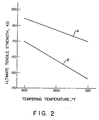
- Vanadium is present because of its strong nitride and carbide forming tendency which promotes secondary hardening and is the principle reason for the increased temper resistance of the invention, which is clearly shown in Figure 2.
- a vanadium content below 0.04 weight percent in combination with the other specified elements and amounts of the invention will not be sufficient to achieve the desired increase in temper resistance.
- high vanadium levels tend to decrease hardenability.
- a vanadium content greater than 0.10 weight percent would not be desirable and is not required as far as temper resistance is concerned.
- the carbon and manganese concentrations of this invention are specified to compensate for any possible hardenability decrease caused by the specified vanadium presence.
- the steel alloy of this invention contains not more than 0.040 weight percent, preferably not more than 0.025 weight percent phosphorus.
- a phosphorus concentration greater than 0.040 weight percent will increase the likelihood of grain boundary embrittlement and consequently a loss in toughness.
- the steel alloy of this invention contains not more than 0.015 weight percent sulfur, preferably not more than 0.010 weight percent.
- the presence of more than 0.015 weight percent sulfur will dramatically reduce fracture toughness. particularly in the transverse and short-transverse orientations. Since the highest cylinder stress is the hoop stress, it is imperative that fracture toughness in the transverse orientation be maximized.
- Limiting the sulfur content to not more than 0.015 weight percent, especially in conjunction with calcium or rare earth shape control provides the requisite transverse fracture toughness of at least 70 ksi square root inch, preferably 85 ksi square root inch, to achieve leak-before-break behavior at the 150 to 175 ksi tensile strength range.
- the steel alloy of this invention preferably contains calcium in a concentration of from 0.8 to 3 times the concentration of sulfur.
- Sulfur has a detrimental effect on transverse orientation fracture toughness because of the presence of elongated manganese sulfide inclusions.
- the presence of calcium in an amount essentially equal to that of sulfur results in the sulfur being present in the form of spherical oxy-sulfide inclusions rather than elongated manganese sulfide inclusions. This dramatically improves transverse fracture toughness.
- the presence of calcium also results in the formation of spherical shape controlled oxide inclusions rather than alumina galaxy stringers. This leads to a further improvement in transverse fracture toughness. Calcium also improves the fluidity of the steel which can reduce reoxidation, improve steel cleanliness, and increase the efficiency of steel production.
- the inclusion shape control achievable by the presence of calcium may also be obtained by the presence of rare earths or zirconium.
- rare earths such as lanthanum, cerium, praseodymium. neodymium, and the like are employed for such inclusion shape control, they are present in an amount of from 2 to 4 times the amount of sulfur present.
- the steel alloy of this invention preferably contains not more than 0.012 weight percent nitrogen.
- a nitrogen concentration greater than 0.012 weight percent can reduce fracture toughness, result in an intergranular fracture mode and lead to reduced hot workability.
- the steel alloy of this invention preferably contains not more than 0.010 weight percent oxygen.
- Oxygen in steel is present as oxide inclusions.
- An oxygen concentration greater than 0.010 weight percent will result in an excessive number of inclusions which reduce the toughness of the steel and reduce its microcleanliness.
- the steel alloy of this invention preferably contains not more than 0.20 weight percent copper.
- a copper concentration greater than 0.20 weight percent has a deleterious effect on hot workability and increases the likelihood of hot tears which can result in premature fatigue failure.
- Gas storage cylinders are fabricated from the steel alloy of this invention in any effective manner known to the art. Those skilled in the art of gas storage cylinder fabrication are familiar with such techniques and no further description of cylinder fabrication is necessary here.
- One often used cylinder fabrication method involves the drawing of the cylinder shell. This technique, although very effective both commercially and technically, tends to elongate any defect in the axial direction of the cylinder. Since the major material stresses in loaded cylinders are the hoop stresses on the cylinder wall, any such axially elongated defects would be oriented transverse to the major cylinder load thereby maximizing its detrimental effect on cylinder integrity. It has been found that the high strength steel alloy of this invention exhibits surpriform directional strength and ductility, and excellent transverse toughness, i.e., that the steel has surprisingly low anisotropy. This low anisotropy effectively counteracts any loss of structural integrity caused by elongation of defects. This quality of the steel alloy of this invention further enhances its unique suitability as a material for gas storage cylinder construction.
- Line A represents the room temperature ultimate tensile strength of the steel alloy of this invention as a function of tempering temperature and Line B represents the room temperature ultimate tensile strength as a function of tempering temperature of DOT 4130X.
- Ultimate tensile strength is important because the greater is the ultimate tensile strength of a material and corresponding design stress level the less material is necessary for a given cylinder design. This decrease in material usage is not only per se economically advantageous, but also the decreased weight leads to greatly improved cylinder efficiency.
- Figure 2 serves to demonstrate another advantage of the steel alloy of this invention.
- the ultimate tensile strength of this invention when tempered at about l100°F is about the same as the ultimate tensile strength of DOT 4130X when tempered at only about 900°F. Since the steel alloy of this invention can be heat treated to a given strength at a higher tempering temperature than that for DOT 4130X, the steel alloy of this invention has greater strength at elevated temperature, and therefore has far better fire resistance than DOT 4130X. This quality further enhances the specific suitability of the steel alloy of this invention as a material for gas storage cylinder construction.
- Line C represents the room temperature transverse fracture toughness of the steel alloy of this invention as a function of room temperature ultimate tensile strength and Line D represents the room temperature transverse fracture toughness as a function of room temperature ultimate tensile strength of DOT 4130X.
- Fracture toughness is an important parameter because it is a measure of the ability of a cylinder to retain its structural integrity in spite of flaws present and possibly made worse during fabrication and of nicks, dents and arc burns encountered during service.
- the transverse fracture toughness of the steel alloy of this invention is significantly greater than that of DOT 4130X.
- Fracture toughness is an important parameter for another reason. It is desirable for pressure vessels to exhibit leak-before-failure behavior. That is. if a pressure vessel should fail, it should fail in a gradual fashion so that the pressurized contents of the vessel can escape harmlessly. as opposed to a sudden catastrophic failure which can be extremely dangerous. In a cylinder any small flaw in the shell, whether originally present or inflicted during service, will grow as the cylinder is repeatedly recharged and eventually this cyclical loading of the cylinder wall will cause the flaw or crack to reach a critical size that will cause the cylinder to fail under applied load. Such flaws may also grow because of exposure to corrosion inducing environments while under pressure.
- the generally accepted standard for leak-before-break behavior is that the cylinder must maintain its structural integrity in the presence of a through-the-wall flaw of a length at least equal to twice the wall thickness.
- the fracture toughness of a material determines the relationship between the applied stress levels and the critical flaw sizes.
- the steel alloy of this invention has a fracture toughness of at least 70 ksi square root inch. preferably 85 ksi square root inch at an ultimate tensile strength of at least 150 ksi.
- the steel alloy of this invention having improved fracture toughness compared to that of the conventional cylinder fabrication material is able to maintain leak-before-break behavior for larger flaws and higher stresses than can the conventional material. This capability is a further indication of the specific suitability of the steel alloy of this invention as a material for gas storage cylinder construction.
- Table II tabulates and compares parameters of the cylinder of this invention (Column A) and a comparably sized cylinder conforming to DOT Specification 3AA (Column B) when oxygen is the gas to be stored.
- the oxygen volume is calculated at 70° F and atmospheric pressure.
- the gas storage cylinder of this invention is a significant improvement over present conventional cylinders.
- the gas storage cylinder of this invention exhibits a cylinder efficiency of about 3.4 compared to 2.3 of the conventional cylinder. This is a performance improvement of about 48 percent.
- the steel alloy of this invention is extremely well suited for use in the fabrication of gas storage cylinders intended to store gases other than hydrogen bearing gases. i.e.. hydrogen. hydrogen sulfide, etc. By such use one can now produce a far more efficient cylinder than was heretofore possible.
- the steel alloy and gas cylinder manufactured thereof of this invention simultaneously exhibit significantly better fracture toughness at higher ultimate tensile strengths and also improved fire resistance than any heretofore known steel alloy. This combination of qualities is uniquely well suited for gas storage cylinders.
Landscapes
- Chemical & Material Sciences (AREA)
- Engineering & Computer Science (AREA)
- Materials Engineering (AREA)
- Mechanical Engineering (AREA)
- Metallurgy (AREA)
- Organic Chemistry (AREA)
- Filling Or Discharging Of Gas Storage Vessels (AREA)
- Glass Compositions (AREA)
- Fluid-Damping Devices (AREA)
- Joining Of Glass To Other Materials (AREA)
- Laminated Bodies (AREA)
- Solid-Phase Diffusion Into Metallic Material Surfaces (AREA)
- Organic Low-Molecular-Weight Compounds And Preparation Thereof (AREA)
- Compounds Of Alkaline-Earth Elements, Aluminum Or Rare-Earth Metals (AREA)
- Pistons, Piston Rings, And Cylinders (AREA)
- Vehicle Body Suspensions (AREA)
- Compressors, Vaccum Pumps And Other Relevant Systems (AREA)
- Pressure Vessels And Lids Thereof (AREA)
- Heat Treatment Of Steel (AREA)
- Tunnel Furnaces (AREA)
- Rollers For Roller Conveyors For Transfer (AREA)
- Heat Treatments In General, Especially Conveying And Cooling (AREA)
- Heat Treatment Of Articles (AREA)
Priority Applications (1)
| Application Number | Priority Date | Filing Date | Title |
|---|---|---|---|
| AT84105703T ATE29153T1 (de) | 1983-05-19 | 1984-05-18 | Hochfester stahl und daraus hergestellte gasflaschen. |
Applications Claiming Priority (2)
| Application Number | Priority Date | Filing Date | Title |
|---|---|---|---|
| US496078 | 1983-05-19 | ||
| US06/496,078 US4461657A (en) | 1983-05-19 | 1983-05-19 | High strength steel and gas storage cylinder manufactured thereof |
Publications (3)
| Publication Number | Publication Date |
|---|---|
| EP0126461A1 true EP0126461A1 (fr) | 1984-11-28 |
| EP0126461B1 EP0126461B1 (fr) | 1987-08-26 |
| EP0126461B2 EP0126461B2 (fr) | 1991-06-12 |
Family
ID=23971144
Family Applications (1)
| Application Number | Title | Priority Date | Filing Date |
|---|---|---|---|
| EP84105703A Expired - Lifetime EP0126461B2 (fr) | 1983-05-19 | 1984-05-18 | Acier à résistance élevée et bonbonne à gaz ainsi produite |
Country Status (23)
| Country | Link |
|---|---|
| US (1) | US4461657A (fr) |
| EP (1) | EP0126461B2 (fr) |
| JP (1) | JPS6070165A (fr) |
| KR (1) | KR890003929B1 (fr) |
| AT (1) | ATE29153T1 (fr) |
| AU (1) | AU558571B2 (fr) |
| BR (1) | BR8402404A (fr) |
| CA (1) | CA1229250A (fr) |
| CS (1) | CS274407B2 (fr) |
| DE (1) | DE3465610D1 (fr) |
| DK (1) | DK159556C (fr) |
| EG (1) | EG17567A (fr) |
| ES (1) | ES9300007A1 (fr) |
| GR (1) | GR79950B (fr) |
| IE (1) | IE56352B1 (fr) |
| MX (1) | MX162794A (fr) |
| NO (1) | NO162161C (fr) |
| PH (2) | PH20738A (fr) |
| PL (1) | PL142925B1 (fr) |
| SG (1) | SG39189G (fr) |
| TR (1) | TR21926A (fr) |
| YU (1) | YU45622B (fr) |
| ZA (1) | ZA843789B (fr) |
Cited By (1)
| Publication number | Priority date | Publication date | Assignee | Title |
|---|---|---|---|---|
| EP4230607A4 (fr) * | 2020-10-15 | 2025-05-28 | Resonac Corporation | Récipient rempli de gaz et procédé de stockage de (e)-1,1,1,4,4,4-hexafluoro-2-butène |
Families Citing this family (14)
| Publication number | Priority date | Publication date | Assignee | Title |
|---|---|---|---|---|
| JPS60184665A (ja) * | 1984-02-29 | 1985-09-20 | Kobe Steel Ltd | 圧力容器用低合金鋼 |
| US5939018A (en) * | 1984-10-10 | 1999-08-17 | Kawasaki Steel Corporation | Martensitic stainless steels for seamless steel pipe |
| US4844111A (en) * | 1987-09-21 | 1989-07-04 | Union Carbide Corporation | High pressure regulator valve |
| US4909269A (en) * | 1987-09-21 | 1990-03-20 | Union Carbide Corporation | High pressure regulator valve |
| US5133928A (en) * | 1989-10-28 | 1992-07-28 | Chesterfield Cylinders Limited | Cylinder body of a steel composition |
| US5048721A (en) * | 1989-11-17 | 1991-09-17 | Union Carbide Industrial Gases Technology Corporation | Method for enhancing the mixture of gases within a cylinder |
| US5052586A (en) * | 1990-01-25 | 1991-10-01 | Philipp Juergen D | Gas cylinder gauge |
| US5387392A (en) * | 1993-08-25 | 1995-02-07 | Bethlehem Steel Corporation | High strength, high toughness steel grade and gas cylinder thereof |
| US7829144B2 (en) * | 1997-11-05 | 2010-11-09 | Tokyo Electron Limited | Method of forming a metal film for electrode |
| DE102006038713A1 (de) * | 2006-05-10 | 2007-11-29 | Schunk Kohlenstofftechnik Gmbh | Druckfester fluidbeaufschlagter Körper |
| KR20100029130A (ko) * | 2007-06-26 | 2010-03-15 | 씨알에스 홀딩즈 인코포레이티드 | 고강도 고인성 회전 샤프트 재료 |
| PL2430352T3 (pl) * | 2010-02-26 | 2014-01-31 | Faber Ind Spa | Sposób i układ do generowania informacji do śledzenia butli gazowych |
| CN115058646B (zh) * | 2022-05-23 | 2023-09-26 | 江阴兴澄特种钢铁有限公司 | 一种高强度、耐低温、耐腐蚀车载气瓶用钢及其制造方法 |
| WO2024247730A1 (fr) * | 2023-05-30 | 2024-12-05 | 株式会社レゾナック | Procédé de stockage de fluorure de phosphore, récipient de stockage et récipient de stockage chargé de gaz |
Citations (4)
| Publication number | Priority date | Publication date | Assignee | Title |
|---|---|---|---|---|
| LU32445A1 (fr) * | ||||
| DE746188C (de) * | 1936-08-07 | 1944-06-13 | Mannesmann Ag | Stahl fuer durch Tiefziehen hergestellte Leichtstahlflaschen |
| GB802855A (en) * | 1956-05-04 | 1958-10-15 | United States Steel Corp | Nickel-free, low-alloy, high-strength steel |
| DE1238676B (de) * | 1962-05-31 | 1967-04-13 | Gen Electric | Verwendung einer Chromstahllegierung fuer Schmiedestuecke |
Family Cites Families (23)
| Publication number | Priority date | Publication date | Assignee | Title |
|---|---|---|---|---|
| US2234047A (en) * | 1939-11-14 | 1941-03-04 | Midvale Company | High creep strength low alloy steel |
| US2244881A (en) * | 1940-04-04 | 1941-06-10 | Crane Co | Combined metal and treatment |
| US2250505A (en) * | 1941-03-03 | 1941-07-29 | Great Lakes Steel Corp | Alloy steel |
| US2375954A (en) * | 1942-09-30 | 1945-05-15 | Nat Steel Corp | Alloy steel |
| US2395687A (en) * | 1942-09-30 | 1946-02-26 | Nat Steel Corp | Alloy steel |
| US2447089A (en) * | 1946-04-13 | 1948-08-17 | Crucible Steel Company | Low alloy high tensile strength, high impact strength steel |
| US2586041A (en) * | 1951-04-06 | 1952-02-19 | United States Steel Corp | Low-alloy, high-hardenability steel with high toughness at high hardness levels |
| US2861908A (en) * | 1955-11-30 | 1958-11-25 | American Steel Foundries | Alloy steel and method of making |
| US2863763A (en) * | 1957-03-19 | 1958-12-09 | Samuel J Rosenberg | Ductile and tough high strength steel |
| US3092491A (en) * | 1957-05-02 | 1963-06-04 | Crucible Steel Co America | High strength alloy steel for atmospheric and elevated temperature service |
| US3068095A (en) * | 1959-05-29 | 1962-12-11 | Wilson Brothers | Alloy steels |
| US3155500A (en) * | 1959-05-29 | 1964-11-03 | Wilson Brothers | Alloy steels |
| US3152020A (en) * | 1961-05-11 | 1964-10-06 | United States Steel Corp | Fracture tough ultra high strength steel sheets |
| US3254991A (en) * | 1962-06-29 | 1966-06-07 | Republic Steel Corp | Steel alloy and method of making same |
| US3331682A (en) * | 1965-01-14 | 1967-07-18 | Hitachi Ltd | Low alloyed heat resisting steel |
| US3929428A (en) * | 1967-05-09 | 1975-12-30 | Yawata Iron & Steel Co | Wearing member having a pad-welded surface layer high in wear-resistance and heat crack-resistance |
| US3574602A (en) * | 1967-12-15 | 1971-04-13 | Yawata Iron & Steel Co | High tension tough steel having excellent property resisting to delayed rupture |
| US3992231A (en) * | 1975-05-01 | 1976-11-16 | Amax Inc. | Temper-stressed oil well casing |
| SU694557A1 (ru) * | 1978-06-02 | 1979-10-30 | Центральный Ордена Трудового Красного Знамени Научно-Исследовательский Институт Черной Металлургии Им. И.П.Бардина | Сталь |
| US4226645A (en) * | 1979-01-08 | 1980-10-07 | Republic Steel Corp. | Steel well casing and method of production |
| JPS55141546A (en) * | 1979-04-19 | 1980-11-05 | Nippon Kokan Kk <Nkk> | High tensile steel with superior sulfide corrosion crack resistance |
| US4354882A (en) * | 1981-05-08 | 1982-10-19 | Lone Star Steel Company | High performance tubulars for critical oil country applications and process for their preparation |
| JPS6035981B2 (ja) * | 1981-06-25 | 1985-08-17 | 住友金属工業株式会社 | 圧力容器用高強度高靭性圧延鋼材 |
-
1983
- 1983-05-19 US US06/496,078 patent/US4461657A/en not_active Expired - Lifetime
-
1984
- 1984-05-11 CA CA000454206A patent/CA1229250A/fr not_active Expired
- 1984-05-17 DK DK244084A patent/DK159556C/da not_active IP Right Cessation
- 1984-05-17 PH PH30689A patent/PH20738A/en unknown
- 1984-05-18 AU AU28398/84A patent/AU558571B2/en not_active Ceased
- 1984-05-18 ZA ZA843789A patent/ZA843789B/xx unknown
- 1984-05-18 MX MX201385A patent/MX162794A/es unknown
- 1984-05-18 CS CS376884A patent/CS274407B2/cs unknown
- 1984-05-18 BR BR8402404A patent/BR8402404A/pt not_active IP Right Cessation
- 1984-05-18 NO NO841988A patent/NO162161C/no not_active IP Right Cessation
- 1984-05-18 AT AT84105703T patent/ATE29153T1/de not_active IP Right Cessation
- 1984-05-18 DE DE8484105703T patent/DE3465610D1/de not_active Expired
- 1984-05-18 EP EP84105703A patent/EP0126461B2/fr not_active Expired - Lifetime
- 1984-05-18 KR KR1019840002715A patent/KR890003929B1/ko not_active Expired
- 1984-05-18 JP JP59098899A patent/JPS6070165A/ja active Granted
- 1984-05-18 GR GR74759A patent/GR79950B/el unknown
- 1984-05-18 IE IE1242/84A patent/IE56352B1/en not_active IP Right Cessation
- 1984-05-18 TR TR21926A patent/TR21926A/xx unknown
- 1984-05-19 EG EG320/84A patent/EG17567A/xx active
- 1984-05-21 PL PL1984247793A patent/PL142925B1/pl unknown
- 1984-05-21 YU YU88584A patent/YU45622B/sh unknown
-
1986
- 1986-08-27 PH PH34187A patent/PH22234A/en unknown
-
1987
- 1987-06-01 ES ES532621A patent/ES9300007A1/es not_active Expired
-
1989
- 1989-06-24 SG SG391/89A patent/SG39189G/en unknown
Patent Citations (4)
| Publication number | Priority date | Publication date | Assignee | Title |
|---|---|---|---|---|
| LU32445A1 (fr) * | ||||
| DE746188C (de) * | 1936-08-07 | 1944-06-13 | Mannesmann Ag | Stahl fuer durch Tiefziehen hergestellte Leichtstahlflaschen |
| GB802855A (en) * | 1956-05-04 | 1958-10-15 | United States Steel Corp | Nickel-free, low-alloy, high-strength steel |
| DE1238676B (de) * | 1962-05-31 | 1967-04-13 | Gen Electric | Verwendung einer Chromstahllegierung fuer Schmiedestuecke |
Non-Patent Citations (1)
| Title |
|---|
| STAHLSCHL]SSEL, 1974, page 129, Verlag Stahlschl}ssel, Marbach, DE; * |
Cited By (1)
| Publication number | Priority date | Publication date | Assignee | Title |
|---|---|---|---|---|
| EP4230607A4 (fr) * | 2020-10-15 | 2025-05-28 | Resonac Corporation | Récipient rempli de gaz et procédé de stockage de (e)-1,1,1,4,4,4-hexafluoro-2-butène |
Also Published As
Similar Documents
| Publication | Publication Date | Title |
|---|---|---|
| EP0126461B2 (fr) | Acier à résistance élevée et bonbonne à gaz ainsi produite | |
| EP3904541B1 (fr) | Acier pour environnements à hydrogène gazeux à haute pression, structure en acier pour environnements à hydrogène gazeux à haute pression et procédé de production d'acier pour environnements à hydrogène gazeux à haute pression | |
| EP1081244B1 (fr) | Acier à haute résistance, faiblement allié et résistant aux températures élevées | |
| US5922149A (en) | Method for making steel wires and shaped wires, and use thereof in flexible ducts | |
| US4578113A (en) | High strength steel | |
| JPS6411105B2 (fr) | ||
| EP2159296B1 (fr) | Acier trempé et durci et procédé permettant de produire des pièces à partir dudit acier | |
| EP0949340B1 (fr) | Acier ayant une excellente resistance de surface laterale scc pour canalisations | |
| US4325748A (en) | Method for producing steel plate having excellent resistance to hydrogen induced cracking | |
| KR100252413B1 (ko) | 고강도 cr-mo강용 저수소계 피복 아크 용접봉 | |
| EP0798394A1 (fr) | Acier martensitique pour tubes avec une excellant résistance à la corrosion et soudabilité | |
| JPH066771B2 (ja) | クリ−プ特性および耐水素侵食特性の優れた低合金鋼 | |
| JP2001026836A (ja) | 冷間加工性、転動疲労強度およびねじり疲労強度に優れた高周波焼入用鋼ならびに機械構造用部品 | |
| US2451469A (en) | Steels and structural embodiments thereof for use at low temperatures | |
| KR102821494B1 (ko) | 강철 조성물, 로트 물품 및 압축 가스용 이음매 없는 압력 용기의 제조 방법 | |
| EP0511648B1 (fr) | Acier ferritique et réfractaire à haute teneur en azote et en niobium, et son procédé de fabrication | |
| JPH06179909A (ja) | 極低温用鋼材の製造方法 | |
| JPH04297549A (ja) | 溶接性が改善された鋼材 | |
| JP2001059136A (ja) | 耐硫化水素腐食性および耐炭酸ガス腐食性能に優れたCr含有油井管用鋼 | |
| JPH06930B2 (ja) | 耐硫化水素応力腐食割れ特性と低温靭性に優れた極厚肉低溶接硬化性高張力鋼の製造方法 | |
| JPH0151526B2 (fr) | ||
| US4054447A (en) | Steel resistant to intergranular stress corrosion cracking | |
| JPS63206449A (ja) | 冷間圧造用低炭素鋼 | |
| FI72754B (fi) | Laaglegerat hoeghaallfast svetsbart staal | |
| JPH08269566A (ja) | Sr特性に優れた高強度・高靱性uoe鋼管の製造方法 |
Legal Events
| Date | Code | Title | Description |
|---|---|---|---|
| PUAI | Public reference made under article 153(3) epc to a published international application that has entered the european phase |
Free format text: ORIGINAL CODE: 0009012 |
|
| AK | Designated contracting states |
Designated state(s): AT BE CH DE FR GB IT LI LU NL SE |
|
| 17P | Request for examination filed |
Effective date: 19841213 |
|
| 17Q | First examination report despatched |
Effective date: 19860425 |
|
| ITF | It: translation for a ep patent filed | ||
| GRAA | (expected) grant |
Free format text: ORIGINAL CODE: 0009210 |
|
| AK | Designated contracting states |
Kind code of ref document: B1 Designated state(s): AT BE CH DE FR GB IT LI LU NL SE |
|
| REF | Corresponds to: |
Ref document number: 29153 Country of ref document: AT Date of ref document: 19870915 Kind code of ref document: T |
|
| REF | Corresponds to: |
Ref document number: 3465610 Country of ref document: DE Date of ref document: 19871001 |
|
| ET | Fr: translation filed | ||
| PLBI | Opposition filed |
Free format text: ORIGINAL CODE: 0009260 |
|
| 26 | Opposition filed |
Opponent name: THYSSEN EDELSTAHLWERKE AG, DUESSELDORF Effective date: 19880504 |
|
| PLBI | Opposition filed |
Free format text: ORIGINAL CODE: 0009260 |
|
| NLR1 | Nl: opposition has been filed with the epo |
Opponent name: THYSSEN EDELSTAHLWERKE AG |
|
| 26 | Opposition filed |
Opponent name: MANNESMANN AKTIENGESELLSCHAFT Effective date: 19880525 Opponent name: BRITISH STEEL CORPORATION Effective date: 19880525 Opponent name: JOS. HEISER VORMALS J. WINTER'S SOHN GESELLSCHAFT Effective date: 19880517 Opponent name: THYSSEN EDELSTAHLWERKE AG, DUESSELDORF Effective date: 19880504 |
|
| NLR1 | Nl: opposition has been filed with the epo |
Opponent name: MANNESMANN AKTIENGESELLSCHAFT Opponent name: BRITISH STEEL CORPORATION Opponent name: JOS. HEISER VORMALS J.WINTER KS SOHN GESELLSCHAFT |
|
| ITF | It: translation for a ep patent filed | ||
| PUAH | Patent maintained in amended form |
Free format text: ORIGINAL CODE: 0009272 |
|
| STAA | Information on the status of an ep patent application or granted ep patent |
Free format text: STATUS: PATENT MAINTAINED AS AMENDED |
|
| 27A | Patent maintained in amended form |
Effective date: 19910612 |
|
| AK | Designated contracting states |
Kind code of ref document: B2 Designated state(s): AT BE CH DE FR GB IT LI LU NL SE |
|
| REG | Reference to a national code |
Ref country code: CH Ref legal event code: AEN |
|
| NLR2 | Nl: decision of opposition | ||
| ET3 | Fr: translation filed ** decision concerning opposition | ||
| NLR3 | Nl: receipt of modified translations in the netherlands language after an opposition procedure | ||
| ITTA | It: last paid annual fee | ||
| EPTA | Lu: last paid annual fee | ||
| EAL | Se: european patent in force in sweden |
Ref document number: 84105703.7 |
|
| REG | Reference to a national code |
Ref country code: GB Ref legal event code: IF02 |
|
| PGFP | Annual fee paid to national office [announced via postgrant information from national office to epo] |
Ref country code: FR Payment date: 20020501 Year of fee payment: 19 |
|
| PGFP | Annual fee paid to national office [announced via postgrant information from national office to epo] |
Ref country code: SE Payment date: 20020502 Year of fee payment: 19 Ref country code: AT Payment date: 20020502 Year of fee payment: 19 |
|
| PGFP | Annual fee paid to national office [announced via postgrant information from national office to epo] |
Ref country code: CH Payment date: 20020503 Year of fee payment: 19 |
|
| PGFP | Annual fee paid to national office [announced via postgrant information from national office to epo] |
Ref country code: NL Payment date: 20020507 Year of fee payment: 19 |
|
| PGFP | Annual fee paid to national office [announced via postgrant information from national office to epo] |
Ref country code: GB Payment date: 20020515 Year of fee payment: 19 |
|
| PGFP | Annual fee paid to national office [announced via postgrant information from national office to epo] |
Ref country code: DE Payment date: 20020520 Year of fee payment: 19 |
|
| PGFP | Annual fee paid to national office [announced via postgrant information from national office to epo] |
Ref country code: LU Payment date: 20020523 Year of fee payment: 19 |
|
| PGFP | Annual fee paid to national office [announced via postgrant information from national office to epo] |
Ref country code: BE Payment date: 20020606 Year of fee payment: 19 |
|
| PG25 | Lapsed in a contracting state [announced via postgrant information from national office to epo] |
Ref country code: LU Free format text: LAPSE BECAUSE OF NON-PAYMENT OF DUE FEES Effective date: 20030518 Ref country code: GB Free format text: LAPSE BECAUSE OF NON-PAYMENT OF DUE FEES Effective date: 20030518 Ref country code: AT Free format text: LAPSE BECAUSE OF NON-PAYMENT OF DUE FEES Effective date: 20030518 |
|
| PG25 | Lapsed in a contracting state [announced via postgrant information from national office to epo] |
Ref country code: SE Free format text: LAPSE BECAUSE OF NON-PAYMENT OF DUE FEES Effective date: 20030519 |
|
| PG25 | Lapsed in a contracting state [announced via postgrant information from national office to epo] |
Ref country code: LI Free format text: LAPSE BECAUSE OF NON-PAYMENT OF DUE FEES Effective date: 20030531 Ref country code: CH Free format text: LAPSE BECAUSE OF NON-PAYMENT OF DUE FEES Effective date: 20030531 Ref country code: BE Free format text: LAPSE BECAUSE OF NON-PAYMENT OF DUE FEES Effective date: 20030531 |
|
| BERE | Be: lapsed |
Owner name: *UNION CARBIDE CORP. Effective date: 20030531 |
|
| PG25 | Lapsed in a contracting state [announced via postgrant information from national office to epo] |
Ref country code: NL Free format text: LAPSE BECAUSE OF NON-PAYMENT OF DUE FEES Effective date: 20031201 |
|
| PG25 | Lapsed in a contracting state [announced via postgrant information from national office to epo] |
Ref country code: DE Free format text: LAPSE BECAUSE OF NON-PAYMENT OF DUE FEES Effective date: 20031202 |
|
| EUG | Se: european patent has lapsed | ||
| GBPC | Gb: european patent ceased through non-payment of renewal fee |
Effective date: 20030518 |
|
| REG | Reference to a national code |
Ref country code: CH Ref legal event code: PL |
|
| PG25 | Lapsed in a contracting state [announced via postgrant information from national office to epo] |
Ref country code: FR Free format text: LAPSE BECAUSE OF NON-PAYMENT OF DUE FEES Effective date: 20040130 |
|
| NLV4 | Nl: lapsed or anulled due to non-payment of the annual fee |
Effective date: 20031201 |
|
| REG | Reference to a national code |
Ref country code: FR Ref legal event code: ST |
|
| PLAB | Opposition data, opponent's data or that of the opponent's representative modified |
Free format text: ORIGINAL CODE: 0009299OPPO |