EP0126701B1 - Composés d'insertion du graphite à performances améliorées et application électrochimique de ces composés - Google Patents
Composés d'insertion du graphite à performances améliorées et application électrochimique de ces composés Download PDFInfo
- Publication number
- EP0126701B1 EP0126701B1 EP84420088A EP84420088A EP0126701B1 EP 0126701 B1 EP0126701 B1 EP 0126701B1 EP 84420088 A EP84420088 A EP 84420088A EP 84420088 A EP84420088 A EP 84420088A EP 0126701 B1 EP0126701 B1 EP 0126701B1
- Authority
- EP
- European Patent Office
- Prior art keywords
- graphite
- electrochemical generator
- electrochemical
- insertion compound
- compounds
- Prior art date
- Legal status (The legal status is an assumption and is not a legal conclusion. Google has not performed a legal analysis and makes no representation as to the accuracy of the status listed.)
- Expired
Links
- OKTJSMMVPCPJKN-UHFFFAOYSA-N Carbon Chemical compound [C] OKTJSMMVPCPJKN-UHFFFAOYSA-N 0.000 title claims description 58
- 229910002804 graphite Inorganic materials 0.000 title claims description 58
- 239000010439 graphite Substances 0.000 title claims description 58
- 150000001875 compounds Chemical class 0.000 title claims description 27
- 230000002687 intercalation Effects 0.000 title 1
- 238000009830 intercalation Methods 0.000 title 1
- 238000003780 insertion Methods 0.000 claims description 21
- 230000037431 insertion Effects 0.000 claims description 21
- 239000000203 mixture Substances 0.000 claims description 8
- RUOJZAUFBMNUDX-UHFFFAOYSA-N propylene carbonate Chemical compound CC1COC(=O)O1 RUOJZAUFBMNUDX-UHFFFAOYSA-N 0.000 claims description 5
- 229910021381 transition metal chloride Inorganic materials 0.000 claims description 3
- 229910021586 Nickel(II) chloride Inorganic materials 0.000 claims 2
- 229910013462 LiC104 Inorganic materials 0.000 claims 1
- 238000001033 granulometry Methods 0.000 claims 1
- MHCFAGZWMAWTNR-UHFFFAOYSA-M lithium perchlorate Chemical compound [Li+].[O-]Cl(=O)(=O)=O MHCFAGZWMAWTNR-UHFFFAOYSA-M 0.000 claims 1
- 229910001486 lithium perchlorate Inorganic materials 0.000 claims 1
- WHXSMMKQMYFTQS-UHFFFAOYSA-N Lithium Chemical compound [Li] WHXSMMKQMYFTQS-UHFFFAOYSA-N 0.000 description 9
- 229910052744 lithium Inorganic materials 0.000 description 9
- 239000002245 particle Substances 0.000 description 8
- 238000000034 method Methods 0.000 description 7
- 238000007254 oxidation reaction Methods 0.000 description 6
- 239000000843 powder Substances 0.000 description 6
- 229910021382 natural graphite Inorganic materials 0.000 description 4
- WEVYAHXRMPXWCK-UHFFFAOYSA-N Acetonitrile Chemical compound CC#N WEVYAHXRMPXWCK-UHFFFAOYSA-N 0.000 description 3
- KRHYYFGTRYWZRS-UHFFFAOYSA-M Fluoride anion Chemical compound [F-] KRHYYFGTRYWZRS-UHFFFAOYSA-M 0.000 description 3
- PWHVEHULNLETOV-UHFFFAOYSA-N Nic-1 Natural products C12OC2C2(O)CC=CC(=O)C2(C)C(CCC2=C3)C1C2=CC=C3C(C)C1OC(O)C2(C)OC2(C)C1 PWHVEHULNLETOV-UHFFFAOYSA-N 0.000 description 3
- 239000003792 electrolyte Substances 0.000 description 3
- 230000003647 oxidation Effects 0.000 description 3
- 229910013684 LiClO 4 Inorganic materials 0.000 description 2
- 239000000470 constituent Substances 0.000 description 2
- 238000002360 preparation method Methods 0.000 description 2
- BZSXEZOLBIJVQK-UHFFFAOYSA-N 2-methylsulfonylbenzoic acid Chemical compound CS(=O)(=O)C1=CC=CC=C1C(O)=O BZSXEZOLBIJVQK-UHFFFAOYSA-N 0.000 description 1
- ZAMOUSCENKQFHK-UHFFFAOYSA-N Chlorine atom Chemical compound [Cl] ZAMOUSCENKQFHK-UHFFFAOYSA-N 0.000 description 1
- GRYLNZFGIOXLOG-UHFFFAOYSA-N Nitric acid Chemical compound O[N+]([O-])=O GRYLNZFGIOXLOG-UHFFFAOYSA-N 0.000 description 1
- ZLMJMSJWJFRBEC-UHFFFAOYSA-N Potassium Chemical compound [K] ZLMJMSJWJFRBEC-UHFFFAOYSA-N 0.000 description 1
- 238000002441 X-ray diffraction Methods 0.000 description 1
- 229910052783 alkali metal Inorganic materials 0.000 description 1
- 150000001340 alkali metals Chemical class 0.000 description 1
- 239000010406 cathode material Substances 0.000 description 1
- 238000006243 chemical reaction Methods 0.000 description 1
- 239000000460 chlorine Substances 0.000 description 1
- 229910052801 chlorine Inorganic materials 0.000 description 1
- 230000000052 comparative effect Effects 0.000 description 1
- 229910052802 copper Inorganic materials 0.000 description 1
- 238000002484 cyclic voltammetry Methods 0.000 description 1
- 230000008034 disappearance Effects 0.000 description 1
- 239000012153 distilled water Substances 0.000 description 1
- 230000005611 electricity Effects 0.000 description 1
- 239000007772 electrode material Substances 0.000 description 1
- 238000005868 electrolysis reaction Methods 0.000 description 1
- 229910052742 iron Inorganic materials 0.000 description 1
- 229910052748 manganese Inorganic materials 0.000 description 1
- 239000000463 material Substances 0.000 description 1
- 229910001507 metal halide Inorganic materials 0.000 description 1
- 150000005309 metal halides Chemical class 0.000 description 1
- 229910052759 nickel Inorganic materials 0.000 description 1
- 239000012299 nitrogen atmosphere Substances 0.000 description 1
- 230000001590 oxidative effect Effects 0.000 description 1
- 229910052700 potassium Inorganic materials 0.000 description 1
- 239000011591 potassium Substances 0.000 description 1
- 229910001414 potassium ion Inorganic materials 0.000 description 1
- QAOWNCQODCNURD-UHFFFAOYSA-N sulfuric acid Substances OS(O)(=O)=O QAOWNCQODCNURD-UHFFFAOYSA-N 0.000 description 1
- XLYOFNOQVPJJNP-UHFFFAOYSA-N water Chemical compound O XLYOFNOQVPJJNP-UHFFFAOYSA-N 0.000 description 1
- 239000003643 water by type Substances 0.000 description 1
Images

Classifications
-
- H—ELECTRICITY
- H01—ELECTRIC ELEMENTS
- H01M—PROCESSES OR MEANS, e.g. BATTERIES, FOR THE DIRECT CONVERSION OF CHEMICAL ENERGY INTO ELECTRICAL ENERGY
- H01M4/00—Electrodes
- H01M4/02—Electrodes composed of, or comprising, active material
- H01M4/36—Selection of substances as active materials, active masses, active liquids
- H01M4/58—Selection of substances as active materials, active masses, active liquids of inorganic compounds other than oxides or hydroxides, e.g. sulfides, selenides, tellurides, halogenides or LiCoFy; of polyanionic structures, e.g. phosphates, silicates or borates
- H01M4/583—Carbonaceous material, e.g. graphite-intercalation compounds or CFx
-
- C—CHEMISTRY; METALLURGY
- C01—INORGANIC CHEMISTRY
- C01B—NON-METALLIC ELEMENTS; COMPOUNDS THEREOF; METALLOIDS OR COMPOUNDS THEREOF NOT COVERED BY SUBCLASS C01C
- C01B32/00—Carbon; Compounds thereof
- C01B32/20—Graphite
- C01B32/21—After-treatment
- C01B32/23—Oxidation
-
- H—ELECTRICITY
- H01—ELECTRIC ELEMENTS
- H01M—PROCESSES OR MEANS, e.g. BATTERIES, FOR THE DIRECT CONVERSION OF CHEMICAL ENERGY INTO ELECTRICAL ENERGY
- H01M6/00—Primary cells; Manufacture thereof
- H01M6/14—Cells with non-aqueous electrolyte
- H01M6/16—Cells with non-aqueous electrolyte with organic electrolyte
Definitions
- the present invention relates to the use of graphite insertion compounds with improved performance in electrodes of electrochemical generators and in particular of high energy density cells using alkali metals such as lithium in their electrochemical chain.
- the graphite insertion compounds have been widely studied with a view to their electrochemical applications: graphitic fluoride CF, graphitic oxide compounds for insertion with metal halides, etc.
- the main object of the invention is to overcome these drawbacks of known electrodes by improving the performance of the graphite insertion compounds used in their composition.
- the graphite insertion compounds are obtained from graphite powder having a large specific surface, of at least 100 m 2 fg, and a small particle size at most equal to 4 ⁇ m.
- This "high surface” graphite can for example be obtained by vacuum grinding of natural graphite in a vibrating mill (Thesis M.J. Kent Ph. D. thesis City University London 1973).
- these compounds may advantageously be graphitic oxide or the graphite-NiC1 2 insertion compound.
- the constituent chosen is graphitic oxide
- this can be mixed with graphite or with a compound for inserting graphite with a transition metal chloride such as Fe, Ni, Co, Cu, Mn.
- Graphitic oxide is prepared from graphite powder with a specific surface of between 100 and 400 m 2 / g and a particle size of between 2 and 4 ⁇ m.
- the preparation method used is the Brodie method: 1 g of graphite is treated with 10 ml of concentrated HN0 3 with 2 g of KCLo 3 . At 60 ° C., under a dry nitrogen atmosphere, the mixture, continuously stirred, gives in two hours:
- the graphitic oxide obtained is washed several times with distilled water and then centrifuged until disappearance of the N0 3- , CI-, C10 3 -, H + and K + ions in the rinsing waters. It is then dried under vacuum at ordinary temperature for 24 hours.
- Electrodes are then produced from the graphitic oxide obtained, by mixing it with a Ceylon graphite powder, then by compressing the mixture.
- the percentage by weight of graphite is variable. It can range from around 50% (laboratory) to 10% (industry).
- Electrodes thus produced are mounted as cathodes in cells of which the anode is made of lithium and the electrolyte is a 1M solution of LiClO 4 in propylene carbonate, so as to constitute several identical cells.
- a different intentiostatic discharge is applied to each cell thus produced, that is to say that a different constant current density i is imposed for each cell and the voltage of the cell is measured as a function of the percentage of use.
- graphitic oxide that is to say the faradaic yield Ri.
- the maximum practical faradaic output for a given battery corresponds to the energy output for the most low voltage value e participating in the definition of e.
- the energy efficiency of the R E battery is:
- the Li / C 4 00H battery according to the invention can clearly be seen to come off both from the point of view of equivalent mass and energy density.
- the Li / C 4 00H battery is less expensive: graphitic oxide is cheaper than graphitic fluoride.
- This example is a variant of Example 1.
- the graphite mixed with graphitic oxide is replaced by the graphite insertion compound with MnCl 2 : C 7 MnCl 2 in equimassic proportion.
- the battery thus constituted has the advantage of being able to supply large values of current density for short times: of the order of 10 mA / cm 2 for a few minutes.
- the method for preparing the graphitic oxide chosen is the Brodie method. It can be replaced by any other method and in particular by that of Staudenmaier which consists in slowly oxidizing the graphite with a mixture of potassium or sodium chlorate, concentrated sulfuric acid and fuming nitric acid, keeping the mixture at ambient temperature. This method prevents the finest grains from disappearing.
- electrodes are then produced in an identical manner to that described in Example 1, and the electrodes obtained are cathode-mounted in batteries whose anode is made of lithium and the electrolysis of a solution 1 M of LiCl0 4 in propylene carbonate.
- the different batteries thus formed are then subjected to intentiostatic discharges.
- Table 3 collates the comparative results of the batteries according to the graphitic oxide used.
- the preparation method identical in the 4 cases, consists in making a mixture of graphite and NiC1 2 , in dehydrating this mixture at 300 ° C for 10 hours under vacuum, in introducing chlorine in sufficient quantity to ensure a pressure of 3 atm at 25 ° C, to seal the enclosure containing these products and finally to heat to 700 ° C.
- the products obtained are washed with acetonitrile to remove excess NiC1 2 and then dried in an oven.
- the graphite according to the invention leads to a practically pure first stage insertion compound, while if the grain size of the graphite increases, it is formed less and less from the first stage to profit of the second, respectively C 6 NiCl 2 and C 12 NiCl 2 .
- Table 4 groups the results according to the initial graphite.
- Electrodes are produced from the graphite / NiCl 2 insertion compound of the first stage obtained according to the invention by simply stamping the compound.
- Electrodes are mounted as cathodes in lithium cells, the anode of which is made of lithium and the electrolyte is a 1 M solution of LiClO 4 in propylene carbonate, so as to constitute several identical cells.
- the characteristics are measured by intentiostatic discharge as in Example 1.
- Cyclic voltammetry indicates a reversibility of positive electrodes that have only been partially discharged (50%).
Landscapes
- Chemical & Material Sciences (AREA)
- Inorganic Chemistry (AREA)
- Organic Chemistry (AREA)
- Chemical Kinetics & Catalysis (AREA)
- Electrochemistry (AREA)
- General Chemical & Material Sciences (AREA)
- Life Sciences & Earth Sciences (AREA)
- General Life Sciences & Earth Sciences (AREA)
- Geology (AREA)
- Engineering & Computer Science (AREA)
- Manufacturing & Machinery (AREA)
- Battery Electrode And Active Subsutance (AREA)
Description
- La présente invention est relative à la mise en oeuvre de composés d'insertion du graphite à performances améliorées dans des électrodes de générateurs électrochimiques et en particulier de piles à haute densité d'énergie utilisant dans leur chaîne électrochimique des métaux alcalins comme le lithium.
- Les recherches entreprises ces dernières années sur les piles à haute densité d'énergie utilisant du lithium à l'anode ont souvant été orientées vars la mise au point de nouveaux matériaux de cathode. Les conditions exigées pour de tels matériaux (faible masse équivalente, haut potentiel par rapport à l'anode, bonne conductivité mixte électronique et ionique, insolubilité dans l'électrolyte, etc ...) sont difficiles à réunir et des limitations d'utilisation apparaissent vite. *
- Les composés d'insertion du graphite ont été largement étudiés en vue de leurs applications électrochimiques: fluorure graphitique CF, oxyde graphitique composés d'insertion avec les halogénures métalliques, etc ...
- Ainsi, dans le domaine de la haute énergie, avec des piles à anode au lithium, des résultats intéressants ont été obtenus svec une cathode contenant du fluorure graphitique (voir par exemple GB-A-2 028 570).
- Des résultats encourageants ont également été obtenus avec une cathode contenant de l'oxyde graphitique. Toutefois, leur tension en cours d'utilisation s'abaisse assez rapidement et leur rendement énergétique reste médiocre.
- Le but principal de l'invention est de pallier ces inconvénients d'électrodes connues en améliorant les performances des composés d'insertion du graphite, entrant dans leur composition.
- Ce but est atteint selon l'invention en ce que les composés d'insertion du graphite sont obtenus à partir de poudre de graphie ayant une grande surface spécifique, d'au moins 100 m2fg, et une faible granulométrie au plus égale à 4 µm.
- Ce graphite "haute surface" peut par exemple être obtenu par broyage sous vide de graphite naturel dans un broyeur vibrant (Thèse M.J. Kent Ph. D. thesis City University London 1973).
- On constate en effet qu'en réalisant des composés d'insertion de graphite par les méthodes propres à chaque type de composé, mais en utilisant une telle poudre de graphite, on améliore nettement leurs performances dans le domaine électrochimique.
- Le choix du composé d'insertion selon l'invention dépend de l'application envisagée.
- Ainsi, comme constituants de cathodes de piles au lithium, ces composés peuvent être avantageusement l'oxyde graphitique ou le composé d'insertion graphite-NiC12.
- Lorsque le constituant choisi est l'oxyde graphitique, celui-ci peut être mélangé à du graphite ou a un composé d'insertion du graphite avec un chlorure de métal de transition tel que Fe, Ni, Co, Cu, Mn.
- Les exemples suivants donnés à titre indicatif et non limitatif, illustrent l'invention:
- On prépare de l'oxyde graphitique à partir de poudre de graphite de surface spécifique comprise entre 100 et 400 m2/g et de granulométrie comprise entre 2 et 4 µm.
- La méthode de préparation utilisée est la méthode de Brodie: 1 g de graphite est traité par 10 ml de HN03 concentré avec 2 g de KCLo3 . A 60°C, sous atmosphère d'azote sec, le mélange maintenu en continuelle agitation donne en deux heures:

- L'oxyde graphitique obtenu est lavé plusieurs fois avec de l'eau distillée puis centrifugé jusqu'à disparition des ions N03-, CI-, C103-, H+ et K+ dans les eaux de rinçage. Il est ensuite séché sous vide à température ordinaire pendant 24 heures.
- On réalise alors à partir de l'oxyde graphitique obtenu, des électrodes en le mélangeant avec une poudreede graphite de Ceylan, puis en comprimant le mélange. Le pourcentage en poids de graphite est variable. Il peut aller de 50 % environ (laboratoire) à 10 % (industrie).
- Ces électrodes ainsi réalisées sont montées comme cathodes dans des piles dont l'anode est en lithium et l'électrolyte une solution 1M de LiCI04 dans du carbonate de propylène, de manière à constituer plusieurs piles identiques.
- On applique à chaque pile ainsi réalisée, une décharge intentiostatique différente, c'est-à-dire que l'on impose une densité de courant constante i différente pour chaque pile et on mesure la tension de la pile en fonction du pourcentage d'utilisation d'oxyde graphitique, c'est-à-dire du rendement faradique Ri. Le rendement faradique maximum pratique pour une pile donnée correspond à l'énergie débitée pour la plus faible valeur de tension e participant à la définition du e.
- La valeur de la densité d'énergie D en Wh/kg est donnée par la relation:

- Q = quantité totale d'électricité disponible dans la pile (en coulombs)
- < e > = valeur moyenne de la tension de palier (en volts), pour une densité de courant donnée
- m = masse de la fraction électroactive de la cathode et de l'anode (en kg).
- La réaction bilan de la pile, en prenant comme formule de l'oxyde graphitique C400H est:

- Q = 96500 x 3 (en coulombs)
- m = MC400H + 3 Mu (en kg)
- La densité d'énergie théorique Dth de le pile est la valeur de D pour i=0.
- Le rendement énergétique de la pile RE est:

- La densité d'énergie pratique Dpr est donnée par la relation:

- Le tableau 1 rassemble les résultats.

- Si l'on compare ces résultats à ceux obtenus dans des piles au lithium identiques à la différence que la cathode est constituée de graphite et d'un oxyde graphitique provenant d'un graphite quelconque, on constate que:
- - la courbe de tension f (Ri) présente un palier plat pour le Graphite Haute surface et pas pour les autres,
- - la valeur du palier est notablement supérieure aux tensions correspondantes à même Ri des autres piles à oxyde graphitique de graphite naturel non broyé sous vide
- - le rendement énergétique de 75 à 85 % est 1,2 à 3 fois plus élevé qu'avec ces autres piles.
- On voit ainsi tout l'intérêt de l'oxyde graphitique obtenu à partir de poudre de graphite à haute surface spécifique et à faible granulométrie selon l'invention.
- Par ailleurs, on peut établir des comparaisons avec d'autres piles dont les caractéristiques sont rassemblées dans le tableau 2 suivant:

- On voit nettement se détacher la pile Li/C400H selon l'invention tant au point de vue masse équivalente que densité d'énergie. De plus, si on la compare à la pile Li/CF, dont les performances sont les plus proches, la pile Li/C400H est moins chère: l'oxyde graphitique revient moins cher que le fluorure graphitique.
- Cet exemple est une variante de l'exemple 1.
- La différence est que, lors de la réalisation d'électrodes, le graphite mélangé à l'oxyde graphitique est remplacé par le composé d'insertion de graphite avec MnCl2: C7MnCI2 en proportion équimassique.
- Les caractéristiques de la pile obtenue sont les suivantes:

- La pile ainsi constituée présente l'avantage de pouvoir fournir de grandes valeurs de densité de courant pendant des temps courts: de l'ordre de 10 mA/cm2 pendant quelques minutes.
- Dans ces deux exemples, la méthode de préparation de l'oxyde graphitique choisie est la méthode de Brodie. Elle peut être remplacée par toute autre méthode et en particulier par celle de Staudenmaier qui consiste à oxyder lentement le graphite par un mélange de chlorate de potassium ou de sodium, d'acide sulfurique concentré et d'acide nitrique fumant, en maintenant le mélange à température ambiante. Cette méthode évite la disparition des grains les plus fins.
- On prépare de l'oxyde graphitique par la méthode de Brodie décrite dans l'exemple 1, respectivement à partir:
- - de graphite "haute surface", de granulométrie comprise entre 2 et 4 µm
- - de graphite "poudre fine", de granulométrie comprise entre quelques dixièmes et quelques µm,
- en leur faisant subir une oxydation.
- A partir des différents oxydes graphitiques obtenus, on réalise alors des électrodes de manière identique à celle décrite dans l'exemple 1, et on monte les électrodes obtenues comme cathodes dans des piles dont l'anode est en lithium et l'électrolyse une solution 1 M de LiCI04 dans du carbonate de propylène.
- Les différentes piles ainsi constituées sont alors soumises à des décharges intentiostatiques.
- Le tableau 3 rassemble les résultats comparatifs des piles selon l'oxyde graphitique utilisé.

- Les figures 1 et 2 montrent les courbes de décharge:
- - d'une part, avec des électrodes comportant de l'oxyde graphitique obtenu soit à partir de graphite "haute surface" (O.G. Haute surface), soit à partir de graphite "poudre fine" (O.C. Poudre fine), ayant subi une oxydation, pour différentes densités de courant (figure 1)
- - d'autre part, avec des électrodes comportant de l'oxyde graphitique obtenu soit à partir de graphite "haute surface" soit à partir de graphite "poudre fine" ayant subi une oxydation, pour une même valeur de densité de courant (figure 2).
- Le tableau et les figures montrent que l'oxyde graphitique provenant d'un graphite "haute surface" conduit à de meilleures caractéristiques électrochimiques que l'oxyde graphitique provenant d'un graphite "poudre fine" oxydée.
- On prépare des composés d'insertion graphite/NiC12 à partir de différentes poudres de graphite:
- - graphite ayant une surface spécifique de 300 m2/g et une granulométrie < 3 µm, selon l'invention
- - graphite naturel de granulométrie comprise entre 80 et 125 µm,
- - graphite naturel (de Madagascar) en fines paillettes de tailles de l'ordre du mm,
- - pyrographite avec une granulométrie - 3 mm.
- La méthode de préparation, identique dans les 4 cas, consiste à faire un mélange du graphite et de NiC12, à déahydrater ce mélange a 300°C pendant 10 heures sous vide, à introduire du chlore en quantité suffisante pour assurer une pression de 3 atm à 25°C, à sceller l'enceinte contenant ces produits et enfin à chauffer à 700° C.
- Les produits obtenus sont lavés à l'acétonitrile pour éliminer l'exès de NiC12 puis séchés à l'étuve.
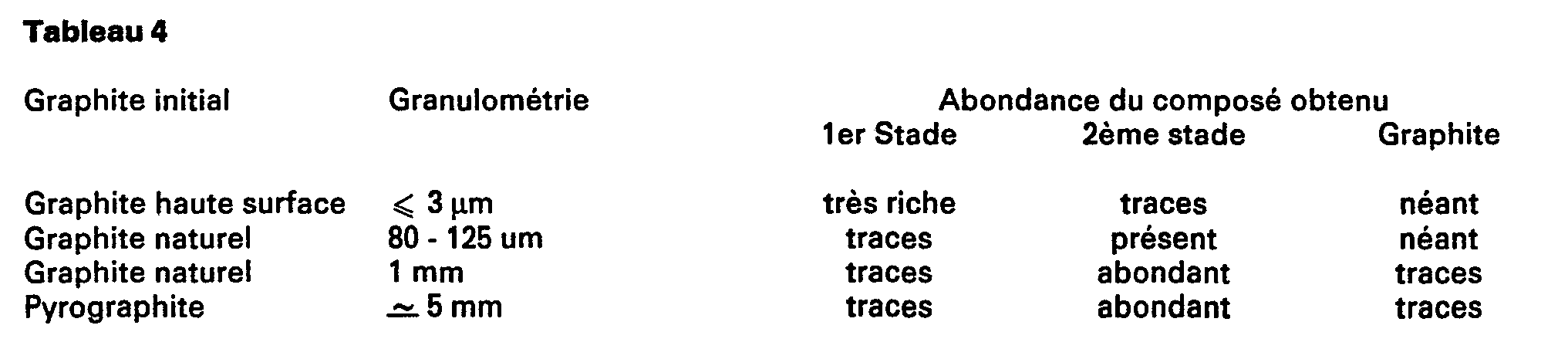
- Par analyse aux Rayons X, on constate que le graphite suivant l'invention conduit à un composé d'insertion du premier stade pratiquement pur, tandis que si la taille des grains du graphite augmente, il se forme de moins en moins du premier stade au profit du second, respectivement C6NiCl2 et C12NiCl2.
- Le tableau 4 regroupe les résultats en fonction du graphite initial.
- On réalise à partir du composé d'insertion graphite/NiCl2 du premier stade obtenu selon l'invention des électrodes en matriçant simplement le composé.
- Ces électrodes sont montées comme cathodes dans des piles au lithium dont l'anode est en lithium et l'électrolyte une solution 1 M de LiClO4 dans du carbonate de propylène, de manière à constituer plusieurs piles identiques. On en mesure les caractéristiques par décharge intentiostatique comme dans l'exemple 1.
- Le tableau 5 regroupe les résultats obtenus:

- Puisque le graphite "haute surface" permet d'obtenir le premier stade du composé d'insertion graphiteNiCI2, on obtient en conséquence une matière active d'électrode de capacité énergétique 30 % plus élevée que celle des autres électrodes de même nature connues jusqu'à présent.
- La voltamétrie cyclique indique une réversibilité d'électrodes positives n'ayant été déchargées que partiellement (50 %).
Claims (9)
Priority Applications (1)
| Application Number | Priority Date | Filing Date | Title |
|---|---|---|---|
| AT84420088T ATE30283T1 (de) | 1983-05-19 | 1984-05-16 | Graphiteinlagerungsverbindungen mit verbesserter leistung und elektrochemische anwendung dieser verbindungen. |
Applications Claiming Priority (4)
| Application Number | Priority Date | Filing Date | Title |
|---|---|---|---|
| FR8308266A FR2546153B1 (fr) | 1983-05-19 | 1983-05-19 | Composes d'insertion du graphite a performances ameliorees et applications electrochimiques de ces composes |
| FR8308266 | 1983-05-19 | ||
| FR848406365A FR2562883B2 (fr) | 1984-04-13 | 1984-04-13 | Composes d'insertion du graphite a performances ameliorees et applications electrochimiques de ces composes |
| FR8406365 | 1984-04-13 |
Related Child Applications (1)
| Application Number | Title | Priority Date | Filing Date |
|---|---|---|---|
| EP87101346.2 Division-Into | 1984-05-16 |
Publications (2)
| Publication Number | Publication Date |
|---|---|
| EP0126701A1 EP0126701A1 (fr) | 1984-11-28 |
| EP0126701B1 true EP0126701B1 (fr) | 1987-10-14 |
Family
ID=26223443
Family Applications (2)
| Application Number | Title | Priority Date | Filing Date |
|---|---|---|---|
| EP87101346A Withdrawn EP0241650A1 (fr) | 1983-05-19 | 1984-05-16 | Composés d'insertion du graphite à performances améliorées et application électrochimique de ces composés |
| EP84420088A Expired EP0126701B1 (fr) | 1983-05-19 | 1984-05-16 | Composés d'insertion du graphite à performances améliorées et application électrochimique de ces composés |
Family Applications Before (1)
| Application Number | Title | Priority Date | Filing Date |
|---|---|---|---|
| EP87101346A Withdrawn EP0241650A1 (fr) | 1983-05-19 | 1984-05-16 | Composés d'insertion du graphite à performances améliorées et application électrochimique de ces composés |
Country Status (3)
| Country | Link |
|---|---|
| US (1) | US4584252A (fr) |
| EP (2) | EP0241650A1 (fr) |
| DE (1) | DE3466837D1 (fr) |
Families Citing this family (14)
| Publication number | Priority date | Publication date | Assignee | Title |
|---|---|---|---|---|
| JPH0677458B2 (ja) * | 1984-11-12 | 1994-09-28 | 信淳 渡辺 | 電池活物質 |
| US5219680A (en) * | 1991-07-29 | 1993-06-15 | Ultracell Incorporated | Lithium rocking-chair rechargeable battery and electrode therefor |
| JPH08148185A (ja) * | 1994-06-28 | 1996-06-07 | Sharp Corp | 非水系二次電池及び非水系二次電池用負極 |
| CA2205767C (fr) * | 1996-05-23 | 2001-04-03 | Sharp Kabushiki Kaisha | Batterie secondaire a electrolyte non aqueux et methode de fabrication de matiere active d'electrode negative |
| US5876687A (en) * | 1997-04-04 | 1999-03-02 | The United States Of America As Represented By The Administrator Of The National Aeronautics And Space Administration | Elemental metals or oxides distributed on a carbon substrate or self-supported and the manufacturing process using graphite oxide as template |
| RU2133527C1 (ru) * | 1998-02-11 | 1999-07-20 | Акционерное общество закрытого типа "Карбид" | Пироуглеродсодержащий материал для анода литий-ионного аккумулятора и способ его изготовления |
| JP4527821B2 (ja) * | 1999-09-13 | 2010-08-18 | 日本碍子株式会社 | 電気化学キャパシタ |
| EP2067198A2 (fr) | 2006-09-25 | 2009-06-10 | Board of Regents, The University of Texas System | Cathodes d'oxyfluorure et d'oxyde de spinelle à substituants cationiques pour batteries au lithium |
| US8246856B2 (en) * | 2007-08-01 | 2012-08-21 | Dow Global Technologies Llc | Highly efficient process for manufacture of exfoliated graphene |
| US9029019B2 (en) * | 2007-08-17 | 2015-05-12 | Nanotek Instruments, Inc. | Carbon anode compositions for lithium ion batteries |
| US7993780B2 (en) | 2007-10-05 | 2011-08-09 | Nanotek Instruments, Inc. | Process for producing carbon anode compositions for lithium ion batteries |
| KR101556135B1 (ko) | 2008-09-01 | 2015-10-13 | 엘지전자 주식회사 | 이동단말기 및 그 제어 방법 |
| US10777808B2 (en) | 2017-01-30 | 2020-09-15 | Global Graphene Group, Inc. | Exfoliated graphite worm-protected metal fluoride and metal chloride cathode active materials for lithium batteries |
| CN120809855B (zh) * | 2025-09-15 | 2025-12-23 | 武汉理工大学 | 一种全天候、双高型的锂/氟化碳电池及其制备方法和应用 |
Family Cites Families (14)
| Publication number | Priority date | Publication date | Assignee | Title |
|---|---|---|---|---|
| US1639983A (en) * | 1925-07-07 | 1927-08-23 | Burgess Lab Inc C F | Galvanic cell |
| DE527695C (de) * | 1925-07-07 | 1931-06-20 | Burgess Battery Company | Depolarisator fuer galvanische Elemente |
| BE480433A (fr) * | 1947-03-06 | |||
| US3876444A (en) * | 1970-04-24 | 1975-04-08 | Gen Electric | Method of treating high strength carbon fibers |
| DE2139714C3 (de) * | 1971-08-07 | 1975-08-14 | Rheinisch-Westfaelisches Elektrizitaetswerk Ag, 4300 Essen | Galvanisches Sekundärelement mit auf Graphitbasis durch anodische Oxidation aufgebauter positiver Elektrode |
| US4041220A (en) * | 1972-08-18 | 1977-08-09 | Agence Nationale De Valorisation De La Recherche (Anvar) | Mixed conductors of graphite, processes for their preparation and their use, notably for the production of electrodes for electrochemical generators, and new electrochemical generators |
| US3956018A (en) * | 1974-12-30 | 1976-05-11 | Union Carbide Corporation | Primary electric current-producing dry cell using a (CFx)n cathode and an aqueous alkaline electrolyte |
| US4009323A (en) * | 1975-05-12 | 1977-02-22 | The United States Of America As Represented By The Secretary Of The Navy | Storage battery comprising positive electrode of a graphite and lithium fluoride compound |
| DE2608866C3 (de) * | 1976-03-04 | 1980-01-03 | Sigri Elektrographit Gmbh, 8901 Meitingen | Verfahren zum Herstellen von Graphithydrogensulfat |
| FR2364547A1 (fr) * | 1976-09-13 | 1978-04-07 | Anvar | Perfectionnements aux accumulateurs comportant des electrodes a halogene fonctionnant avec des electrolytes a base d'halogenures fondus |
| JPS5528246A (en) * | 1978-08-21 | 1980-02-28 | Oyo Kagaku Kenkyusho | Active material for battery |
| FR2442514A1 (fr) * | 1978-11-22 | 1980-06-20 | Anvar | Composition composite de materiau d'electrode et d'un materiau elastomere a conduction ionique et electrodes formees a partir de cette composition |
| US4329216A (en) * | 1980-07-07 | 1982-05-11 | Ppg Industries, Inc. | Electrolytic cell utilizing a transition metal-graphite intercalation compound cathode |
| JPS5835881A (ja) * | 1981-08-27 | 1983-03-02 | Kao Corp | 電気化学電池 |
-
1984
- 1984-05-16 EP EP87101346A patent/EP0241650A1/fr not_active Withdrawn
- 1984-05-16 EP EP84420088A patent/EP0126701B1/fr not_active Expired
- 1984-05-16 DE DE8484420088T patent/DE3466837D1/de not_active Expired
- 1984-05-21 US US06/612,437 patent/US4584252A/en not_active Expired - Fee Related
Also Published As
| Publication number | Publication date |
|---|---|
| EP0126701A1 (fr) | 1984-11-28 |
| DE3466837D1 (en) | 1987-11-19 |
| EP0241650A1 (fr) | 1987-10-21 |
| US4584252A (en) | 1986-04-22 |
Similar Documents
| Publication | Publication Date | Title |
|---|---|---|
| EP0126701B1 (fr) | Composés d'insertion du graphite à performances améliorées et application électrochimique de ces composés | |
| EP0098772B1 (fr) | Anodes composites et souples de pile au lithium en milieu non aqueux | |
| WO1990007798A1 (fr) | Batterie rechargeable a electrolyte solide | |
| EP0910547B1 (fr) | Nouveaux carbones fluores, leur procede de preparation et leur utilisation comme materiau d'electrode | |
| EP0159266A2 (fr) | Procédé pour préparer des électrodes négatives alliées et dispositifs utilisant ces électrodes | |
| EP0165827A1 (fr) | Générateur électrochimique à électrode composite | |
| Hunger et al. | Cathodic discharge of graphite intercalation compounds in organic electrolytes | |
| EP0614240A1 (fr) | Générateur électrochimique rechargeable au lithium | |
| CH629037A5 (fr) | Anode a gel et poudre. | |
| FR2465326A1 (fr) | Generateur electrochimique a electrolyte non aqueux | |
| US20220376291A1 (en) | Compound and battery comprising the same | |
| EP0415856B1 (fr) | Générateur électrochimique rechargeable comportant des polymères à l'état solide | |
| EP1490299B1 (fr) | Procede de purification en surface d'un graphite contenant des impuretes a l'aide d'une solution aqueuse diluee de nh4f et de h2so4 | |
| EP0464117B1 (fr) | Materiau d'electrode a base d'oxyde de vanadium contenant du lithium, procede de fabrication et utilisation dans un generateur electrochimique | |
| FR2465327A1 (fr) | Generateur electrochimique a electrolyte non aqueux | |
| FR2460046A1 (fr) | Piles non aqueuses a cathodes de bioxyde de manganese traite a la chaleur | |
| FR2546153A1 (fr) | Composes d'insertion du graphite a performances ameliorees et applications electrochimiques de ces composes | |
| Uchiyama et al. | Solvent effects on rechargeable lithium cells | |
| US4574113A (en) | Rechargeable cell | |
| FR2562883A2 (fr) | Composes d'insertion du graphite a performances ameliorees et applications electrochimiques de ces composes | |
| JP3497318B2 (ja) | 電極材料及び二次電池 | |
| FR2578685A1 (fr) | Cathode pour pile a anode d'un metal alcalin | |
| FR2613139A1 (fr) | Piles non aqueuses perfectionnees au bi2o3/li, renfermant un electrolyte a base de 3-methyl-2-oxazolidone | |
| EP1028914B1 (fr) | Produit carbone riche en lithium utilisable comme electrode negative dans un accumulateur au lithium | |
| FR2493607A2 (fr) | Generateur au lithium |
Legal Events
| Date | Code | Title | Description |
|---|---|---|---|
| PUAI | Public reference made under article 153(3) epc to a published international application that has entered the european phase |
Free format text: ORIGINAL CODE: 0009012 |
|
| AK | Designated contracting states |
Designated state(s): AT BE CH DE GB IT LI LU NL SE |
|
| RHK1 | Main classification (correction) |
Ipc: H01M 4/58 |
|
| 17P | Request for examination filed |
Effective date: 19841214 |
|
| R17P | Request for examination filed (corrected) |
Effective date: 19850104 |
|
| 17Q | First examination report despatched |
Effective date: 19860304 |
|
| GRAA | (expected) grant |
Free format text: ORIGINAL CODE: 0009210 |
|
| AK | Designated contracting states |
Kind code of ref document: B1 Designated state(s): AT BE CH DE GB IT LI LU NL SE |
|
| REF | Corresponds to: |
Ref document number: 30283 Country of ref document: AT Date of ref document: 19871015 Kind code of ref document: T |
|
| ITF | It: translation for a ep patent filed | ||
| REF | Corresponds to: |
Ref document number: 3466837 Country of ref document: DE Date of ref document: 19871119 |
|
| GBT | Gb: translation of ep patent filed (gb section 77(6)(a)/1977) | ||
| PLBE | No opposition filed within time limit |
Free format text: ORIGINAL CODE: 0009261 |
|
| STAA | Information on the status of an ep patent application or granted ep patent |
Free format text: STATUS: NO OPPOSITION FILED WITHIN TIME LIMIT |
|
| 26N | No opposition filed | ||
| ITTA | It: last paid annual fee | ||
| PGFP | Annual fee paid to national office [announced via postgrant information from national office to epo] |
Ref country code: GB Payment date: 19920410 Year of fee payment: 9 Ref country code: CH Payment date: 19920410 Year of fee payment: 9 |
|
| PGFP | Annual fee paid to national office [announced via postgrant information from national office to epo] |
Ref country code: DE Payment date: 19920411 Year of fee payment: 9 |
|
| PGFP | Annual fee paid to national office [announced via postgrant information from national office to epo] |
Ref country code: SE Payment date: 19920414 Year of fee payment: 9 Ref country code: AT Payment date: 19920414 Year of fee payment: 9 |
|
| PGFP | Annual fee paid to national office [announced via postgrant information from national office to epo] |
Ref country code: LU Payment date: 19920524 Year of fee payment: 9 |
|
| PGFP | Annual fee paid to national office [announced via postgrant information from national office to epo] |
Ref country code: BE Payment date: 19920526 Year of fee payment: 9 |
|
| PGFP | Annual fee paid to national office [announced via postgrant information from national office to epo] |
Ref country code: NL Payment date: 19920531 Year of fee payment: 9 |
|
| EPTA | Lu: last paid annual fee | ||
| PG25 | Lapsed in a contracting state [announced via postgrant information from national office to epo] |
Ref country code: LU Free format text: LAPSE BECAUSE OF NON-PAYMENT OF DUE FEES Effective date: 19930516 Ref country code: GB Effective date: 19930516 Ref country code: AT Effective date: 19930516 |
|
| PG25 | Lapsed in a contracting state [announced via postgrant information from national office to epo] |
Ref country code: SE Effective date: 19930517 |
|
| PG25 | Lapsed in a contracting state [announced via postgrant information from national office to epo] |
Ref country code: LI Effective date: 19930531 Ref country code: CH Effective date: 19930531 Ref country code: BE Effective date: 19930531 |
|
| BERE | Be: lapsed |
Owner name: S.A. LE CARBONE-LORRAINE Effective date: 19930531 |
|
| PG25 | Lapsed in a contracting state [announced via postgrant information from national office to epo] |
Ref country code: NL Effective date: 19931201 |
|
| GBPC | Gb: european patent ceased through non-payment of renewal fee |
Effective date: 19930516 |
|
| NLV4 | Nl: lapsed or anulled due to non-payment of the annual fee | ||
| REG | Reference to a national code |
Ref country code: CH Ref legal event code: PL |
|
| PG25 | Lapsed in a contracting state [announced via postgrant information from national office to epo] |
Ref country code: DE Effective date: 19940201 |
|
| EUG | Se: european patent has lapsed |
Ref document number: 84420088.1 Effective date: 19931210 |