EP0126827A1 - Formulierungen mit kontrollierter Abgabe biologisch aktiver Wassermittel - Google Patents
Formulierungen mit kontrollierter Abgabe biologisch aktiver Wassermittel Download PDFInfo
- Publication number
- EP0126827A1 EP0126827A1 EP83402161A EP83402161A EP0126827A1 EP 0126827 A1 EP0126827 A1 EP 0126827A1 EP 83402161 A EP83402161 A EP 83402161A EP 83402161 A EP83402161 A EP 83402161A EP 0126827 A1 EP0126827 A1 EP 0126827A1
- Authority
- EP
- European Patent Office
- Prior art keywords
- active agent
- biologically active
- fibers
- release
- aquatic
- Prior art date
- Legal status (The legal status is an assumption and is not a legal conclusion. Google has not performed a legal analysis and makes no representation as to the accuracy of the status listed.)
- Ceased
Links
Images




Classifications
-
- A—HUMAN NECESSITIES
- A01—AGRICULTURE; FORESTRY; ANIMAL HUSBANDRY; HUNTING; TRAPPING; FISHING
- A01N—PRESERVATION OF BODIES OF HUMANS OR ANIMALS OR PLANTS OR PARTS THEREOF; BIOCIDES, e.g. AS DISINFECTANTS, AS PESTICIDES OR AS HERBICIDES; PEST REPELLANTS OR ATTRACTANTS; PLANT GROWTH REGULATORS
- A01N25/00—Biocides, pest repellants or attractants, or plant growth regulators, characterised by their forms, or by their non-active ingredients or by their methods of application, e.g. seed treatment or sequential application; Substances for reducing the noxious effect of the active ingredients to organisms other than pests
- A01N25/08—Biocides, pest repellants or attractants, or plant growth regulators, characterised by their forms, or by their non-active ingredients or by their methods of application, e.g. seed treatment or sequential application; Substances for reducing the noxious effect of the active ingredients to organisms other than pests containing solids as carriers or diluents
- A01N25/10—Macromolecular compounds
-
- A—HUMAN NECESSITIES
- A01—AGRICULTURE; FORESTRY; ANIMAL HUSBANDRY; HUNTING; TRAPPING; FISHING
- A01N—PRESERVATION OF BODIES OF HUMANS OR ANIMALS OR PLANTS OR PARTS THEREOF; BIOCIDES, e.g. AS DISINFECTANTS, AS PESTICIDES OR AS HERBICIDES; PEST REPELLANTS OR ATTRACTANTS; PLANT GROWTH REGULATORS
- A01N25/00—Biocides, pest repellants or attractants, or plant growth regulators, characterised by their forms, or by their non-active ingredients or by their methods of application, e.g. seed treatment or sequential application; Substances for reducing the noxious effect of the active ingredients to organisms other than pests
- A01N25/34—Shaped forms, e.g. sheets, not provided for in any other sub-group of this main group
Definitions
- the present invention relates to formulations containing a biologically active agent which is useful in the treatment of aquatic vegetation. More particularly, the present invention relates to a controlled release formulation which delivers a herbicide, pesticide or fungicide to plants in an aquatic environment.
- Aquatic plants and in particular, aquatic weeds are of a substantial economic and health burden in many areas of the country. Such plants present a hazard to navigation, reduce or prevent the use of recreational facilities, serve as a habitat for harmful insects, destroy fish life, retard water flow in drainage channels and are also aesthetically unappealing. The annual losses which result from aquatic-weed infestations in the United States are estimated to be in excess of 100 million dollars.
- a controlled-release formulation or delivery system is defined as a combination of a biologically active agent and an excipient, which is usually a polymer which delivers the biologically active agent to a target where the agent is released at a controlled rate over a specified period.
- the chief advantage of controlled release formulations is that they permit a much less biologically active agent to be used over a given period of reactivity than would have to be administered in only one or several applications of the agent.
- Controlled release formulations have a marked advantage when potent biologically active agents are applied which have a normal short half-life, since the long acting, controlled release formulations will gradually release the agent thereby eliminating the frequent applications required for the short half-life agents.
- N .F. Cardarelli in Controlled Release Pesticide Formulations CRC Press, Cleveland Ohio, 1976, page 125-132 discloses controlled release pesticide formulations in which various pesticidal agents have been incorporated in polymeric carriers.
- An example is the incorporation of certain organotin compounds in elastomeric formulations based on the likes of chloroprene.
- the reference also mentions the controlled release of copper sulfate as an antifouling agent from encapsulated microporous polymer.
- the reference does not disclose the preparation of biologically active agent laden polymeric fibers, nor the use of such fibers as a means of providing effective delivery of a biologically active agent to an aquatic environment.
- controlled release encompasses many mechanisms.
- the earliest such formulations were based on the desorption of active agents from strong sorbents such as silica gel, mica and activated charcoal.
- most of the current systems are based on more controllable mechanisms such as diffusion through rate-controlling media, the erosion of biodegradable barrier materials and retrograde chemical reactions.
- the designers of controlled-release formulations or devices usually attempt to achieve zero-order (constant; rates of release.
- systems which exhibit time dependent release kinetics are proving to be useful for pesticide release, especially when the rate and duration of release are predictable and well controlled.
- the rate of biologically active agent release may be controlled by several sequential or simultaneously cooperating mechanisms which do not lend themselves to simple analysis. However, despite the difficulty, it is nevertheless possible to experimentally determine an overall "apparent" order of release for these complex systems.
- a heterogeneous dispersion of particles or droplets of the biologically active agent in a solid polymeric matrix which can be either biodegradable or non- biodegradable and which controls the release of agent by diffusion through the matrix, by erosion of the matrix, or by a combination of both diffusion and erosion; and (2) chemical bonding of a biologically active agent to a natural or synthetic polymeric material, as by pendant anhydride or ester linkages, or formulation of macromolecules of active agent via ionic or covalent linkages which control the release of the active agents by hydrolysis, thermodynamic dissociation, microbial degradation or by some other retrograde chemical reaction of the linkages.
- a third concept of controlled release formulations involves the preparation of capsules made of polymeric material filled with a solid or liquid biologically active agent or with a suspension or solution of the agent in a fluid, in which the release of active agent is controlled by Fickian diffusion through the capsule walls or through micropores in the capsule walls.
- one object of the present invention is to provide a controlled release formulation for the application of biologically active agents in an aquatic environment.
- Another object of the present invention is to provide a method by which aquatic plants can be effectively treated with a biologically active agent such as a herbicide, fungicide or pesticide.
- a controlled release, biologically active agent containing composition for use in an aquatic environment which comprises strands of polymeric fibers containing a biologically effective amount of a biologically active agent which is effective for the treatment of plants in an aquatic environment.
- the essence of the present invention is the provision of a controlled release polymeric formulation which is capable of providing a sustained application of a biologically active agent in an aquatic environment.
- the invention is based on the concept of active agent containing polymeric fibers which, when distributed in an aquatic environment, are spread with the flow of water and, as the fibers float and/or sink in the water, become entangled in the plants. While entangled in the plants, active agent is continually released from the fibers by diffusion therefrom and/or as the fiber materials degrade, erode or deteriorate.
- the entanglement of the active agent laden fibers in the plants has the advantage that the system of application does not become buried in the mud as other applied slow release systems, and accordingly, the bound active agent is released continually in the immediate environs of the treated aquatic plants.
- the first type of release a polymeric fiber which is spun containing active agent dissolved or dispersed in the matrix, will normally exhibit first order release kinetics.
- the rate of release will be proportional to the amount of active agent remaining in the fiber. Initially the rate of release of active agent occurs in large amounts, but with time, successively smaller amounts of active agent diffuse from the fiber.
- This form of active agent release may be particularly advantageous where larger amounts of the active agent are necessary for initial plant treatment, and smaller residual amounts are necessary to continue the treatment of the plants.
- the biologically active agent containing polymeric fibers of this first embodiment exhibit release profiles in which an inverse relationship of active agent loading to fractional release rate is described mathematically by Fick's law in the following form for devices of cylindrical geometry.
- D is the diffusion coefficient of the active agent in the polymer
- Cm 2 /S is the saturation solubility
- g/cm 3 is the saturation solubility
- r o is the radius of the cylinder
- C o is the active agent loading
- M t/ M m is the fraction of initial mass released at time t.
- the release rate of a reservoir device is determined by the membrane permeability and the device configuration.
- dM/dt is the rate of release of active agent
- h is the length of fiber
- D is the diffusion coefficient of active agent in the polymeric coating
- C s is the saturation solubility of active agent in the coating
- C f is the concentration of active agent in the receiving fluid (water)
- K is the partition coefficient of active agent between the polymeric coating and water
- r o is the radius of fiber (core + membrane)
- r i is the radius of the core only.
- the biologically active agents which are used in the manufacture of the polymeric fibers of the present invention are those which are effective in treating plants which grow in an aquatic environment. Accordingly, the biologically active agents include herbicides which are effective in controlling the growth of aquatic plants, pesticides which are effective against underwater pests which infest aquatic plants and fungicides which are effective in treating fungal infections of aquatic plants. Suitable herbicides which can be used in the present invention include all herbicides which are useful for the control of aquatic plants.
- undesirable aquatic plants whose growth is desired to be controlled include water hyacinth, water lettuce, alligator weed, Hydrilla, Eurasian watermilfoil, Southern naiad, Bladderwort, Coontail, Pond weed, Duckweed, Edelgrass and the like.
- Suitable herbicides include 6,7-dihydrodipyrido-(1,2-a:2',1'-c]pyrazidiinium dibromide (Diquat), l-methyl-3-phenyl-5[3-trifluoromethylphenyl]-4(lH)-pyridine(Fluridone), 2,6-dichlorobenzonitrile(Dichlobenil), 2,4-dichlorophenoxyacetic acid(2,4-D), 7-oxabicyclo[2,2,1]heptane-2,3-dicarboxylic acid (Endothall), the dimethylamine salt of 2,4-dichlorophenoxy acetic acid (2,4 D-DMA), the butoxyethanol ester of 2,4-dichlorophenoxy acetic acid or butoxyethyl (2,4-dichlorophenoxy) acetate (2,4 D-BEE), 2,3,6-trichlorophenyl acetic acid (Fenac), and the like.
- Suitable fungicides which may be used in the present invention include all those which combat fungal infections in aquatic environments such as 5 - methyl-1,2,4-triazolo(3,4-b(benzothiazole)) (Tricyclazole). This compound is well known for its effectiveness in treating fungal infections of rice plants as reported in a Technical Report by Lilly Research Laboratories.
- Suitable pesticides which may be utilized in the present invention include all those which combat pest infestation in aquatic environments such as 0,0,0',0'-tetramethyl-0,0'thiodi-p-phenylene phosphorothioate (Abate), 0,0-diethyl-0-3,5,6-trichloro-2-pyridyl- phosphorothioate (Dursban), 0,0-dimethyl dithiophosphate of diethyl mercaptosuccinate (Malathion), 2,2-dichlorovinyl dimethylphosphate (Dichlorvos), 0,0-dimethyl-0-[4-(methylthio)-m-tolyl] phosphorothioate (Baytex), Pyrethins, hexachloroepoxy-octahydro-endo, exo-dimethanonaphthalene (Dieldrin), hexachloroepoxy-octahydro-endo, endo-dimethanona
- the polymer which is useful as the matrix material in which the biologically active agent is entrapped is any polymer which is compatible, i.e. not reactive with the biologically active agent, and capable of delivering the active agent to aquatic plants and which will permit continuous active agent release in an aquatic environment.
- an additional, important characteristic of the polymer is that it be biodegradable and biocompatible meaning that the polymer itself is consumed by local chemical reactivity, although it is not mandatory for all applications that the polymer be biodegradable, and does not adversely affect the ecology of the environment in which it is applied.
- Such polymers as polyglycolic acid and polylactic acid are desirable from the biodegradability standpoint. More generally, polymers such as polycaprolactone, cellulose acetate, hydroxypropyl cellulose, chitin, sodium alginate, polyhydroxybutyrate, polypivalolactone, and the like are satisfactory matrix materials.
- thermoplastic resins can also be employed as a polymer substrate, although most thermosetting resins can not be used because they cannot be extruded into fibers. Some thermosetting resins can be extruded into fibers, and therefore it is possible to use some thermosetting polymers in the preparation of the present biologically active agent laden fibers.
- the biologically active agent bearing polymeric fiber material of the present invention can be prepared in any desired manner, including standard techniques such as melt-, wet-, dry- and gap fiber spinning methods.
- a biologically active agent in the desired quantity is mixed with a polymer such as pelleted or powdered polycaprolactone, and the mixture is extruded when heated above the melting point of the polymer into the shape of the factor.
- the biologically active agent under these conditions does not have to be soluble in the molten polymer but may be simply dispersed throughout the molten polymer.
- Conventional extrusion apparatus may be employed to prepare the active agent containing polymeric fibers.
- the polymeric fiber may be extruded as a hollow fiber.
- the fiber is then filled with an active agent or active agent formulation in its inner core.
- Conventional methodology and apparatus are available for the preparation of such fibers.
- the fibers are loaded with from 5 to 90 wt% of biologically active agent.
- a preferred weight ratio of biologically active agent to polymer ranges from 5:95 to 90:10, preferably, 10:90 to 60:40.
- Factors which usually affect the maximum amount of active agent which can be loaded in a given polymer include the fact that the polymer should not be loaded with active agent to such an extent that a physically unstable fiber is formed or that the fiber is mechanically weak, and the fact that the concentration should not be that high that the active agent forms as large sized aggregates in the polymeric matrix.
- the amount of active agent present in the fiber should be such that the fibers once applied release quantities of active agent over reasonable periods of application.
- the biologically active agent laden fibers of the present invention can be used in just about any type of aquatic environment from essentially stagnant bodies of water to flowing bodies of water such as rivers, streams and canals.
- the use of the fibers in the control of growth of aquatic plants in flowing bodies of water is a preferred embodiment of the invention.
- the treatment of rice plants in paddy fields with a fungicidal agent laden fiber mass is a preferred embodiment of the invention which relates to the treatment of plants in a relatively stagnant body of water.
- the amount of biologically active agent applied to a given body of water is that amount which is required to control the growth of undesirable aquatic plants or to control pest or fungal infestations of valuable aquatic environments. Normally, however, the amount of the biologically active agent applied ranges from about 0.1 to 10.0 pounds per acre.
- the fluridone used in this study is identified as Sample X-36950, 97% pure material supplied by Eli Lilly and Co.
- the polycaprolactone employed was PCL700 manufactured by Union Carbide Corp. Fiber blends containing fluridone were melt-spun on a melt indexer manufactured by the F. F. Slocomb Corp., Wilmington, Delaware.
- PCL polycaprolactone
- the extruded fibers were cooled in ambient air and collected in a Teflon-lined pan positioned about 15 inches below the spinneret. The fibers were then transferred to polyethylene bags, where they were stored until evaluated.
- the sample identifying numbers and ram weights employed in the spinning of each blend are shown in Table 1 as follows.
- the in vitro release of fluridone from PCL fibers having a range of fluridone loading prepared by the above described technique was determined by immersing triplicate samples of each fiber formulation in separate containers of 25-ml aliquots of 50% by weight aqueous alcohol. The sealed containers were agitated on an Eberbach shaker at 22°C. The receiving fluid was changed periodically and assayed for fluridone by measuring the absorption peak at 237 nm on a Perkin-Elmer 575 spectrophotometer. The quantity of fluridone released was determined from the Beer's Law plot of absorbance versus fluridone concentration.
- the release characteristics of fluridone from PCL were determined from PCL fibers containing 10%, 20% and 30% loadings.
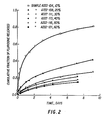
- the cumulative fraction of the total herbicide released from each fiber sample into a 50:50 ethanol-water solution was plotted versus time in days. These release profiles are shown in FIGURE 1, and they indicate that the cumulative fractional release of fluridone is inversely proportional to the initial herbicide loading. This pattern suggests that if the concentration of fluridone is increased in the fiber, a slower fractional rate of release will result meaning further that a longer period of release will be realized. If a first order delivery system is desired, the results obtained are meaningful in designing a long-term delivery system for fluridone.
- results shown in the table above are fairly close in value with an average of 2.03 x 10 -10 g cm -1 s - 1.
- results obtained are those predicted from systems in which release of agent is controlled by diffusion.
- the release profiles for the fluridone-loaded PCL monolithic fibers in reconstituted hardwater were obtained by the same procedure as those obtained for the ethanolic receiving media. Triplicate samples of each fiber were immersed in separate containers of 25 ml aliquots of reconstituted hardwater at 23°C. The sealed bottles maintained at 23°C were agitated on an E berbach shaker. The receiving fluid was periodically exchanged and assayed for fluridone by measuring the absorption peak at 236 nm on a Perkin-Elmer 575 spectrophotometer. The concentration of fluridone was then determined from the Beer's Law plot of absorbance versus fluridone concentration.
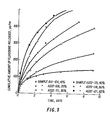
- FIGURE 3 shows the cumulative release of fluridone expressed as micrograms of fluridone released per centimeter of fiber versus time in days. This figure shows that although the fractional release rate is lower for the more highly loaded fibers, the actual quantity of fluridone released for the same time interval is higher than with the more loaded fibers.
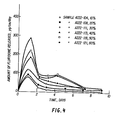
- FIGURE 4 shows the release of fluridone in amount released per length of fiber per day versus time in days.
- the fibers exhibit an initial burst of release of fluridone the first day and a gradual decrease to a substantially constant rate thereafter.
- a zero-order release rate is observed only for reservoir systems in which the herbicide is contained in a polymeric matrix surrounded by a rate-controlling herbicide-free polymer membrane.
- a modification of this system was prepared to approximate this type of release.
- the modified system consists of fluridone-loaded PCL monolithic fibers coated with an exterior layer of herbicide free PCL. Such fibers were prepared by immersing fluridone-loaded PCL monolithic fibers into a solution of PCL in toluene. The fibers were then pulled through selected orifices to give uniform and controlled coatings of PCL. The solvent was evaporated from the coated fibers, and the immersion procedure was repeated several times to obtain PCL coatings of various thicknesses.
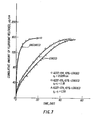
- FIGURES 5 to 8 show exemplary release profiles of fluridone from fluridone laden PCL fibers coated with a herbicide free PCL layer into hard water.
- FIGURE 5 contrasts the cumulative release of fluridone from two fibers, each loaded with 60% fluridone, but with different r o :r i ratios indicating different thicknesses of the outer P CL layer which is free of herbicidal agent, with a 60% fluridone fiber which is uncoated with a herbicide free PCL layer.
- the results not only show a slower rate of cumulative release of fluridone for the coated fibers, but also that the rate of release of fluridone is substantially more linear for the coated fibers over the entire tested time period than for the uncoated fiber.
- FIGURE 6 represents the cumulative fractional release of fluridone from fibers in the same experiment of FIGURE 5.
- FIGURES 7 and 8 represent the data obtained from the same type of experimentation from which the data for FIGURES 5 and 6 were obtained except that 10% fluridone laden fibers were used instead of 60% fluridone laden fibers.
- FIGURE 7 shows the cumulative release of fluridone into hard water
- FIGURE 8 shows the cumulative fractional release of fluridone into hard water
Landscapes
- Life Sciences & Earth Sciences (AREA)
- General Health & Medical Sciences (AREA)
- Health & Medical Sciences (AREA)
- Toxicology (AREA)
- Pest Control & Pesticides (AREA)
- Plant Pathology (AREA)
- Agronomy & Crop Science (AREA)
- Engineering & Computer Science (AREA)
- Dentistry (AREA)
- Wood Science & Technology (AREA)
- Zoology (AREA)
- Environmental Sciences (AREA)
- Agricultural Chemicals And Associated Chemicals (AREA)
Applications Claiming Priority (2)
| Application Number | Priority Date | Filing Date | Title |
|---|---|---|---|
| US49054483A | 1983-05-02 | 1983-05-02 | |
| US490544 | 1983-05-02 |
Publications (1)
| Publication Number | Publication Date |
|---|---|
| EP0126827A1 true EP0126827A1 (de) | 1984-12-05 |
Family
ID=23948507
Family Applications (1)
| Application Number | Title | Priority Date | Filing Date |
|---|---|---|---|
| EP83402161A Ceased EP0126827A1 (de) | 1983-05-02 | 1983-11-08 | Formulierungen mit kontrollierter Abgabe biologisch aktiver Wassermittel |
Country Status (6)
| Country | Link |
|---|---|
| EP (1) | EP0126827A1 (de) |
| JP (1) | JPS59219201A (de) |
| KR (1) | KR890001144B1 (de) |
| AU (1) | AU556090B2 (de) |
| BR (1) | BR8307245A (de) |
| NZ (1) | NZ205357A (de) |
Cited By (11)
| Publication number | Priority date | Publication date | Assignee | Title |
|---|---|---|---|---|
| EP0168862A3 (en) * | 1984-06-15 | 1986-08-27 | Nederlandse Centrale Organisatie Voor Toegepast-Natuurwetenschappelijk Onderzoek | Biodegradable polymer substrates loaded with active substance suitable for the controlled release of the active substance by means of a membrane |
| FR2604059A1 (fr) * | 1986-09-19 | 1988-03-25 | Nitto Electric Ind Co | Element d'extermination des parasites et procede utilisant un tel element. |
| EP0422820A3 (en) * | 1989-10-10 | 1991-09-11 | Wm. Wrigley Jr. Company | Gradual release structures made from fibre spinning techniques |
| EP0477478A1 (de) * | 1990-09-28 | 1992-04-01 | L.H.A. Mans Holding B.V. | Dekorationsmittel |
| ES2042418A1 (es) * | 1992-05-18 | 1993-12-01 | Tecno Holding S A | Metodo para el tratamiento externo de los cultivos vegetales. |
| DE4244000A1 (de) * | 1992-12-23 | 1994-06-30 | Buck Chem Tech Werke | Biologisch abbaubarer Verpackungswerkstoff |
| US5565407A (en) * | 1993-12-27 | 1996-10-15 | University Of Kansas Center For Research, Inc. | Biologically active agent encapsulated in biodegradable starch/polymer matrices |
| US5607686A (en) * | 1994-11-22 | 1997-03-04 | United States Surgical Corporation | Polymeric composition |
| FR2979188A1 (fr) * | 2011-08-24 | 2013-03-01 | De Varagnes Loic Chomel | Composition algicide, algistatique, herbicide ou herbistatique |
| WO2021166923A1 (ja) * | 2020-02-21 | 2021-08-26 | パナソニックIpマネジメント株式会社 | 樹脂組成物 |
| CN114849609A (zh) * | 2022-05-11 | 2022-08-05 | 吉林农业大学 | 一种负载性信息素的蛙卵状海藻酸钙/聚己内酯微球的制备方法 |
Citations (4)
| Publication number | Priority date | Publication date | Assignee | Title |
|---|---|---|---|---|
| US3590119A (en) * | 1968-11-01 | 1971-06-29 | Goodrich Co B F | Floating larvicide |
| CA958912A (en) * | 1969-12-12 | 1974-12-10 | Richard Bland | Herbicide, ion exchange resin for control of submerged aquatic plant life |
| US3864114A (en) * | 1972-03-27 | 1975-02-04 | William Edward Green | Soil treatment |
| GB2080687A (en) * | 1980-07-24 | 1982-02-10 | Environmental Chemicals Inc | Controlled release of active compounds from a polymer-based dispenser |
Family Cites Families (4)
| Publication number | Priority date | Publication date | Assignee | Title |
|---|---|---|---|---|
| JPS5287202A (en) * | 1976-01-16 | 1977-07-20 | Katayama Chemical Works Co | Method of removing damage by shipworm in seawater wood storage yard |
| JPS5338627A (en) * | 1976-09-20 | 1978-04-08 | Asahi Chem Ind Co Ltd | Fibrous herbicide |
| JPS5653280A (en) * | 1979-10-02 | 1981-05-12 | Mitsubishi Rayon Co | Acryl fiber having sterilizing property |
| JPS5927806A (ja) * | 1982-08-09 | 1984-02-14 | Kuraray Co Ltd | 生物忌避性を有するpva系水産用資材 |
-
1983
- 1983-08-23 NZ NZ205357A patent/NZ205357A/en unknown
- 1983-09-22 AU AU19378/83A patent/AU556090B2/en not_active Ceased
- 1983-11-08 EP EP83402161A patent/EP0126827A1/de not_active Ceased
- 1983-11-21 JP JP58219320A patent/JPS59219201A/ja active Pending
- 1983-12-29 BR BR8307245A patent/BR8307245A/pt not_active IP Right Cessation
-
1984
- 1984-05-02 KR KR1019840002375A patent/KR890001144B1/ko not_active Expired
Patent Citations (4)
| Publication number | Priority date | Publication date | Assignee | Title |
|---|---|---|---|---|
| US3590119A (en) * | 1968-11-01 | 1971-06-29 | Goodrich Co B F | Floating larvicide |
| CA958912A (en) * | 1969-12-12 | 1974-12-10 | Richard Bland | Herbicide, ion exchange resin for control of submerged aquatic plant life |
| US3864114A (en) * | 1972-03-27 | 1975-02-04 | William Edward Green | Soil treatment |
| GB2080687A (en) * | 1980-07-24 | 1982-02-10 | Environmental Chemicals Inc | Controlled release of active compounds from a polymer-based dispenser |
Cited By (17)
| Publication number | Priority date | Publication date | Assignee | Title |
|---|---|---|---|---|
| EP0168862A3 (en) * | 1984-06-15 | 1986-08-27 | Nederlandse Centrale Organisatie Voor Toegepast-Natuurwetenschappelijk Onderzoek | Biodegradable polymer substrates loaded with active substance suitable for the controlled release of the active substance by means of a membrane |
| US4965128A (en) * | 1984-06-15 | 1990-10-23 | Nederlandse Organisatie Voor Toegepast-Natuurwetenschappe Lijk | Biodegradable polymer substrates loaded with active substance suitable for the controlled release of the active substance by means of a membrane |
| FR2604059A1 (fr) * | 1986-09-19 | 1988-03-25 | Nitto Electric Ind Co | Element d'extermination des parasites et procede utilisant un tel element. |
| EP0422820A3 (en) * | 1989-10-10 | 1991-09-11 | Wm. Wrigley Jr. Company | Gradual release structures made from fibre spinning techniques |
| US5364627A (en) * | 1989-10-10 | 1994-11-15 | Wm. Wrigley Jr. Company | Gradual release structures made from fiber spinning techniques |
| EP0477478A1 (de) * | 1990-09-28 | 1992-04-01 | L.H.A. Mans Holding B.V. | Dekorationsmittel |
| ES2042418A1 (es) * | 1992-05-18 | 1993-12-01 | Tecno Holding S A | Metodo para el tratamiento externo de los cultivos vegetales. |
| DE4244000A1 (de) * | 1992-12-23 | 1994-06-30 | Buck Chem Tech Werke | Biologisch abbaubarer Verpackungswerkstoff |
| US5565407A (en) * | 1993-12-27 | 1996-10-15 | University Of Kansas Center For Research, Inc. | Biologically active agent encapsulated in biodegradable starch/polymer matrices |
| US5607686A (en) * | 1994-11-22 | 1997-03-04 | United States Surgical Corporation | Polymeric composition |
| FR2979188A1 (fr) * | 2011-08-24 | 2013-03-01 | De Varagnes Loic Chomel | Composition algicide, algistatique, herbicide ou herbistatique |
| WO2021166923A1 (ja) * | 2020-02-21 | 2021-08-26 | パナソニックIpマネジメント株式会社 | 樹脂組成物 |
| JP2021134233A (ja) * | 2020-02-21 | 2021-09-13 | パナソニックIpマネジメント株式会社 | 樹脂組成物 |
| CN115135740A (zh) * | 2020-02-21 | 2022-09-30 | 松下知识产权经营株式会社 | 树脂组合物 |
| CN115135740B (zh) * | 2020-02-21 | 2024-06-14 | 松下知识产权经营株式会社 | 树脂组合物 |
| CN114849609A (zh) * | 2022-05-11 | 2022-08-05 | 吉林农业大学 | 一种负载性信息素的蛙卵状海藻酸钙/聚己内酯微球的制备方法 |
| CN114849609B (zh) * | 2022-05-11 | 2023-12-19 | 吉林农业大学 | 一种负载性信息素的蛙卵状海藻酸钙/聚己内酯微球的制备方法 |
Also Published As
| Publication number | Publication date |
|---|---|
| NZ205357A (en) | 1986-01-24 |
| AU556090B2 (en) | 1986-10-23 |
| JPS59219201A (ja) | 1984-12-10 |
| BR8307245A (pt) | 1985-03-19 |
| KR890001144B1 (ko) | 1989-04-25 |
| KR840009201A (ko) | 1984-12-26 |
| AU1937883A (en) | 1984-11-08 |
Similar Documents
| Publication | Publication Date | Title |
|---|---|---|
| US6391328B1 (en) | Controlled delivery compositions and processes for treating organisms in a column of water on land | |
| US4971796A (en) | Slow release pest control granule composition | |
| FI80822C (fi) | Inkapslingsfoerfarande samt genom foerfarandet framstaelld, mikrokapslar innehaollande insektisidkomposition. | |
| CA2092328C (en) | Controlled release microcapsules | |
| JP2716724B2 (ja) | 改良された殺虫剤供給組成物及び水性環境下で昆虫の集団を防除するための方法 | |
| US6557298B2 (en) | Treatment of seeds with coatings containing hydrogel | |
| US4563344A (en) | Controlled release agglomerated carrier | |
| CA2255852C (en) | Microencapsulated compositions | |
| US4865842A (en) | Pesticidal composition for water treatment | |
| EP0126827A1 (de) | Formulierungen mit kontrollierter Abgabe biologisch aktiver Wassermittel | |
| US5484600A (en) | Insecticidal composite timed released particle | |
| US5660844A (en) | Collar to control arthropod infestations of animals | |
| AU2017280925B2 (en) | Insecticide formulation | |
| JPH05294801A (ja) | 害虫駆除剤 | |
| AU689716C (en) | Controlled delivery compositions and processes for treating organisms in the environment | |
| Hennessy | Microparticle dispensers for the controlled release of insect pheromones | |
| KR20000015910A (ko) | 마이크로캡슐화된 조성물 |
Legal Events
| Date | Code | Title | Description |
|---|---|---|---|
| PUAI | Public reference made under article 153(3) epc to a published international application that has entered the european phase |
Free format text: ORIGINAL CODE: 0009012 |
|
| AK | Designated contracting states |
Designated state(s): AT BE CH DE FR GB IT LI LU NL SE |
|
| 17P | Request for examination filed |
Effective date: 19850222 |
|
| 17Q | First examination report despatched |
Effective date: 19860304 |
|
| STAA | Information on the status of an ep patent application or granted ep patent |
Free format text: STATUS: THE APPLICATION HAS BEEN REFUSED |
|
| 18R | Application refused |
Effective date: 19880208 |
|
| RIN1 | Information on inventor provided before grant (corrected) |
Inventor name: DUNN, RICHARD L. Inventor name: LEWIS, DANNY H. |