EP0126828A1 - Doppelseitige Gewirke und Verfahren zu deren Herstellung - Google Patents
Doppelseitige Gewirke und Verfahren zu deren Herstellung Download PDFInfo
- Publication number
- EP0126828A1 EP0126828A1 EP19830402405 EP83402405A EP0126828A1 EP 0126828 A1 EP0126828 A1 EP 0126828A1 EP 19830402405 EP19830402405 EP 19830402405 EP 83402405 A EP83402405 A EP 83402405A EP 0126828 A1 EP0126828 A1 EP 0126828A1
- Authority
- EP
- European Patent Office
- Prior art keywords
- fabric
- facing
- yarns
- knit
- napping
- Prior art date
- Legal status (The legal status is an assumption and is not a legal conclusion. Google has not performed a legal analysis and makes no representation as to the accuracy of the status listed.)
- Granted
Links
- 239000004744 fabric Substances 0.000 title claims abstract description 151
- 238000000034 method Methods 0.000 title claims description 22
- 238000009940 knitting Methods 0.000 claims abstract description 26
- 239000000758 substrate Substances 0.000 claims description 52
- 239000000835 fiber Substances 0.000 claims description 33
- 238000010276 construction Methods 0.000 claims description 5
- 238000009432 framing Methods 0.000 claims description 4
- 238000009998 heat setting Methods 0.000 claims 1
- 239000000463 material Substances 0.000 description 11
- 230000006378 damage Effects 0.000 description 6
- 238000010586 diagram Methods 0.000 description 6
- 230000015572 biosynthetic process Effects 0.000 description 4
- 238000004519 manufacturing process Methods 0.000 description 4
- 230000001680 brushing effect Effects 0.000 description 3
- 239000003086 colorant Substances 0.000 description 3
- 230000003247 decreasing effect Effects 0.000 description 3
- 238000001035 drying Methods 0.000 description 3
- 244000144992 flock Species 0.000 description 3
- 238000009981 jet dyeing Methods 0.000 description 3
- 238000004900 laundering Methods 0.000 description 3
- 239000004745 nonwoven fabric Substances 0.000 description 3
- 239000000975 dye Substances 0.000 description 2
- 238000004043 dyeing Methods 0.000 description 2
- 230000000694 effects Effects 0.000 description 2
- 230000002250 progressing effect Effects 0.000 description 2
- 230000000750 progressive effect Effects 0.000 description 2
- 230000003313 weakening effect Effects 0.000 description 2
- 208000027418 Wounds and injury Diseases 0.000 description 1
- 101150052610 Yars1 gene Proteins 0.000 description 1
- 239000000853 adhesive Substances 0.000 description 1
- 230000001070 adhesive effect Effects 0.000 description 1
- 230000009286 beneficial effect Effects 0.000 description 1
- 210000000085 cashmere Anatomy 0.000 description 1
- 239000002131 composite material Substances 0.000 description 1
- 238000007796 conventional method Methods 0.000 description 1
- 230000007812 deficiency Effects 0.000 description 1
- 230000032798 delamination Effects 0.000 description 1
- 238000005108 dry cleaning Methods 0.000 description 1
- 230000009977 dual effect Effects 0.000 description 1
- 238000009963 fulling Methods 0.000 description 1
- 208000014674 injury Diseases 0.000 description 1
- 238000009413 insulation Methods 0.000 description 1
- 230000036961 partial effect Effects 0.000 description 1
- 239000003415 peat Substances 0.000 description 1
- 230000035699 permeability Effects 0.000 description 1
- 230000000704 physical effect Effects 0.000 description 1
- 229920000728 polyester Polymers 0.000 description 1
- 230000002035 prolonged effect Effects 0.000 description 1
- 230000002829 reductive effect Effects 0.000 description 1
- 230000002441 reversible effect Effects 0.000 description 1
- 238000009718 spray deposition Methods 0.000 description 1
- 230000000087 stabilizing effect Effects 0.000 description 1
- 239000000126 substance Substances 0.000 description 1
- 229920001187 thermosetting polymer Polymers 0.000 description 1
- 238000009941 weaving Methods 0.000 description 1
- 239000002759 woven fabric Substances 0.000 description 1
Images



Classifications
-
- D—TEXTILES; PAPER
- D04—BRAIDING; LACE-MAKING; KNITTING; TRIMMINGS; NON-WOVEN FABRICS
- D04B—KNITTING
- D04B21/00—Warp knitting processes for the production of fabrics or articles not dependent on the use of particular machines; Fabrics or articles defined by such processes
- D04B21/02—Pile fabrics or articles having similar surface features
-
- D—TEXTILES; PAPER
- D10—INDEXING SCHEME ASSOCIATED WITH SUBLASSES OF SECTION D, RELATING TO TEXTILES
- D10B—INDEXING SCHEME ASSOCIATED WITH SUBLASSES OF SECTION D, RELATING TO TEXTILES
- D10B2403/00—Details of fabric structure established in the fabric forming process
- D10B2403/01—Surface features
- D10B2403/012—Alike front and back faces
- D10B2403/0121—Two hairy surfaces, e.g. napped or raised
-
- D—TEXTILES; PAPER
- D10—INDEXING SCHEME ASSOCIATED WITH SUBLASSES OF SECTION D, RELATING TO TEXTILES
- D10B—INDEXING SCHEME ASSOCIATED WITH SUBLASSES OF SECTION D, RELATING TO TEXTILES
- D10B2503/00—Domestic or personal
- D10B2503/06—Bed linen
-
- Y—GENERAL TAGGING OF NEW TECHNOLOGICAL DEVELOPMENTS; GENERAL TAGGING OF CROSS-SECTIONAL TECHNOLOGIES SPANNING OVER SEVERAL SECTIONS OF THE IPC; TECHNICAL SUBJECTS COVERED BY FORMER USPC CROSS-REFERENCE ART COLLECTIONS [XRACs] AND DIGESTS
- Y10—TECHNICAL SUBJECTS COVERED BY FORMER USPC
- Y10T—TECHNICAL SUBJECTS COVERED BY FORMER US CLASSIFICATION
- Y10T428/00—Stock material or miscellaneous articles
- Y10T428/23907—Pile or nap type surface or component
- Y10T428/2395—Nap type surface
Definitions
- This invention relates to a knit double-faced fabric having particular utility for bedding blankets and apparel, which is light-weight and has excellent thermal insulation properties, permeability, and has hand and feel at least comparable or even superior to woven and finished Cashmere fabric produced by conventional methods.
- Non-woven fabrics are formed by needle looming fiber batts to produce an integrated fabric which are then subjected to napping and brushing operations. These non-woven fabrics have permitted the manufacture of a less expensive high loft blanket, but often do not achieve the drape and hand of woven blankets, and, the blankets are often subject to localized weaknesses which result in the formation of holes after prolonged use. Additionally, difficulty is experienced in controlling shedding and pilling, the control of this problem usually requiring chemical bonding of the napped and raised fibers, and the further loss of drape and hand of the fabric.
- Velvet-like surfaces may be formed by pmploying flock fiber with lengths of approximately Imm, and plush-like surfaces may be formed by employing flock fibers with lengths of approximately 1.5mm or more.
- Flocked blanket fabric while providing the tactile quality of a velvet or plush, has many deficiencies.
- the overall hand of the fabric is sponge-like, and sections of the fabric under hand pressure often exhibit a rubber-like resistance and lacks the drape and hand of conventionally woven blanket fabrics.
- delamination and wearing away of the flock often results in bald spots, a result often encountered in dry cleaning or laundering. Carefully controlled conditions of care are thus often required to prevent damage to the blanket.
- While knitted fabrics having a single fleece-facing are well known in the art, these single faced fabrics generally do not have the dimensional stability required of blanket material.
- Such fabrics may be made in a number of known ways, including knitting facing yarns into a knitted substrate and overfeeding of the facing yarn to create enlarged loops which can be napped and brushed to create a fleece surface.
- the loops may be presented on both surfaces of the substrate, such as shown in U.S. Patent No. 3,434,306 to Auville et al. issued March 25, 1969.
- Auville et al. teaches the manufacture of warp knit terry fabrics employing a double bar knitting machine in which the yarns of one of the bars is overfed to provide a double-sided terry fabric.
- the knit structure becomes dimensionally unstable, and would therefore be unsatisfactory as a blanket material.
- the present inventive overcomes these problems and provides a highly suitable knit blanket fabric of three bar construction which retains its stability both in the longitudinal direction and in the transverse or walewise direction, and is nappable on both surfaces without appreciably affecting the substrate, the characteristics of the fabric being at least t equal to and even superior to those of quality woven blankets.
- the present invention further teaches a novel method by which the knitted greige material can be napped and brushed to create a luxurious pile and loft with exceptional hand and feel.
- the fabric of the present invention includes a substrate to provide longitudinal stability; a first face which includes overfed loops; and, an opposite face which includes floats which are both nappable and provide lateral stability after napping.
- the unique method of the present invention teaches the napping of the knit fabric in a manner which raises the loops away from the substrate to prevent untoward injury of the substrate during the napping.
- the middle bar of a three bar warp knit machine knits the substrate; the bottom bar knits an overfed looped facing into the substrate; and the top bar knits into the substrate a lap facing comprised of floats, the floats preferably having a stitch interval in excess of the stitch interval of the looped facing.
- the substrate provides a longitudinally stable carrier for the face yarns.
- the overfed loops of the bottom bar are of a length and density sufficient to not only provide a desirable fleece surface when napped, but in addition to shield the substrate from damage during the napping.
- the top bar floats provide lateral stability even when napped.
- the loop face and the opposite float face may be knit of any suitable yarns, and the respective yarns can be of materials and colors different from each other. Thus the characteristics of each face may be different; and, if the yarns are pre- dyed, each of the facings may have a color different from the other.
- conventional jacquard knitting techniques it is possible to produce patterned fabric having an intaglio appearance on its respective faces.
- the fabric is knit of undyed yarns and then dyed, a jet dying process to bulk up the fabric may be employed. If the dye retentivity characteristics of the yarns differs, then, the resultant fabric will have differing shades of color on the face and back of the fabric.
- the fabric is then subjected to napping operations, preferably a sequential processing of each face, sufficient to raise and loft the pile of the respective facings while maintaining the integrity of the yarns of the lap facing, and without structurally weakening the yarns of the substrate.
- the lap face or float face of the fabric is first subjected to one or more napping operations to raise and loft the pile of the float facing. During this operation, the respective floats are raised and bowed, thus protecting the substrate from damage.
- the fabric is optionally tentered to tensionally stress the intact fibers of the floats, and ready the fabric for subsequent napping operations.
- the napping of the loops is performed in one or more napping operations, and if necessary, the fabric is tentered intermediate the napping operations. After the final napping operation the fabric is framed and heat set.
- the yarns are preferably thermosetting yarns such as polyester so that the. finishing heat set will provide further dimensional stability and will permit laundering and drying in conventional household washers and dryers.
- the physical properties of the fabric can readily be predetermined by pre-selection of yarns and sizes of the yarns.
- the drape, weight, surface, pile and hand of the finished fabric can also be pre-selected and can be modified by varying yarns and the length of the stitch intervals of the respective facings. In general a soft hand is easily achieved as the runs of the floats are free to flex relative to the substrate and the fibers of the napped loop facing are similarly free to bend relative to the substrate at positions intermediate the stitch intervals of the loops.
- a fabric can be knit employing four or more bars to produce patterns or textures in the finished fabric.
- the yarns fed by the bottom bar and which provide the loop face of the fabric are indicated at 10; the yarns fed by the middle bar and which provide the substrate for the fabric are indicated at 12; and, the yarns fed by the top bar and which provide the float face of the fabric are indicated at 14.
- the knitting pattern for the yarns 10 is 1,0-2,3, as is more clearly shown in Figure 2.
- the yarns 10 are overfed such that they provide loops 10a at each stitch, an appropriate sinker (not shown) being employed for this purpose.
- the yarns are overfed and controlled by the sinker to produce loops of approximately 0.1 mm or more in height.
- the yarns 12 are knit by the middle bar under normal tension on a pattern of 1,0-1,2, as shown in Figure 5.
- the yarns 14 are knit by the top bar under normal tension on a pattern of 1,0-4,5, as shown in Figure 8.
- the yarns 14 lie over the yarns 10 and 12, and the floats of the yarns 14 extend freely and can be moved out of the plane of the knit fabric.
- the yarns 10 can be knit .1,0-1,2 or, 1,0-2,3.
- the length of the loop may be greater than the 1,0-3,4 of Figure 2.
- Increasing the stitch intervals of the loop yarn 10 will result in an increase in the weight of the fabric and an increase. of the loop density of the loop face and the bulk thereof after napping.
- the bulk or the weight may also be modified by varying the yarn size, the preferable range of stitch interval is from 1,0-1,2 to 1,0-5,6.
- the stitch intervals of the yarn 12 of the substrate may be increased from 1,0-1,2 to 1,0-2,3. While further increase of the stitch length may be made, the increasing of the underlap or stitch length beyond 1,0-2,3 will tend to reduce longitudinal stability.
- the substrate can be also of chain or pillar stitch, having a pattern 1,0-0,1. Provided that sufficient stability is given to the fabric in the transverse direction by the float of back and front bars, the use of a chain or pillar stitch will result in a fabric having excellent longitudinal stability. However, a substrate made with stitch 1,0-1,2 is preferable because it provides a lateral connection between wales thus increasing the strength and stability of the fabric.
- the stitch intervals of the float yarns 14 can be increased to 1,0-5,6 or greater, or reduced to 1,0-3,4 or less.
- the increase in the length of the floats provides for greater bulking of the float face during napping. Decreasing the length of the float will have the opposite effect, and will decrease the density of the napped float face.
- the preferable range of knitting pattern is 1,0-3,4 to 1,0-5,6. As there is a relationship between the two outer faces, the ranges of each will be determined by the other.
- Figure 11 illustrates the stitch pattern of the yarns 10 and 12, the floats of the yarns 14 having been omitted for the sake of clarity.
- One of the yarns 10 of the loop face is shown starred, and one of the yarns 12 of the knit substrate is shown cross-hatched.
- the loop yarns 10 are overfed and knit on the pattern 1,0-2,3, it being understood that all loops are overfed and thus enlarged.
- the substrate yarns 10 are knit on the pattern 1,0-1,2.
- the loops 10a may be napped without napping the substrate. Napping of the substrate is to be avoided as it will weaken or even destroy the substrate. If weakened during the napping operation holes in the fabric would eventually result, particularly under the stress of launderings.
- FIG 12 the lap face knit on the pattern 1,0-4,5 is illustrated to show the stitch pattern of the yarns 12 and 14, the yarn 10 having been omitted for clarity.
- one of the yarns 12 of the knit substrate is shown cross-hatched, and one of the yarns 14 of the floats is shown starred, the yarns 14 having been knit on the pattern 1,0-4,5.
- the yarn 14 is knit into the substrate with floats 14a which extend across the face of the fabric opposite that of the loop face.
- the yarns 14 are fed under normal tension, and provide lateral stability to the fabric.
- the floats 14a are readily nappable and can be napped without napping and damage of the substrate. During the napping operation, the floats will be lifted and pulled away from the plane of the fabric and the napping wires will be spaced from the substrate.
- the substrate is not required to resist transverse stretching, and thus can be formed as a chain or pillar stitch as illustrated in Figure 13.
- the chain stitch or pillar stitch substrate provides stability for the fabric in the longitudinal direction. Structural integrity in the transverse direction is derived from the floats, the ends of the floats having been knit into spaced rows of the chain stitches.
- the floats 14a have a stitch interval of greater length than the stitch interval of the loop facing. This provides for better lift to the floats during the napping, and a higher loop density of the loop face, again assisting in the subsequently performed napping operations.
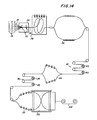
- the three bars of the knitting machine are indicated at 30 as feeding yarns 31 to the needles 32 of a knitting machine indicated by the block 33.
- the knit fabric 34 emerging from the knitting machine is fed to a continuous jet dyeing apparatus, indicated at 36. If the dyeing of the fabric is to be carried out in an autoclave-type jet dyeing apparatus, then, the knit fabric is reeled as it emerges from the knitting machine, and . subsequently is transferred into the autoclave and jet dyed. In the jet dyer, the fabric is dyed under heat and pressure, the dyestuffs being applied to the fabric in high pressure jets. This operation has the advantage of bulking up the fabric before the further processing thereof. After dyeing, excess dyestuff is removed, the fabric is subject to a mordanting operation, and is then washed preparatory to the next processing step.
- the dyed and bulked-up fabric On emerging from the jet dyer, the dyed and bulked-up fabric is fed to a framing or drying apparatus 38, and is dried under longitudinal and transverse tension.
- the jet dyeing, framing and drying steps are eliminated.
- the dyed, framed and dried fabric is then fed to a first napper in which the float face of the fabric is partially napped to initiate the lofting of the pile of the fibers of that face.
- the napper is a tandem napper having oppositely rotating napping cylinders 42, which sequentially raise the pile of the fibers and then tuck stray fiber ends back into the napped pile.
- the napping may be accomplished by either by a tandem napping process or a single napping process. Either napping operation causes drawing- up of the fabric in the transverse direction and a decrease in the width of the fabric.
- the fabric is passed through the napping equipment in a single pass and the rotating napping cylinders 48 sequentially raise the pile of the float face and then tuck the loose ends of the napped fibers back into the napped surface.
- the fabric is passed through one napper in two separate passes, the fabric being fed into the napper in the same direction on the second pass.
- This achieves the same level of raising and lofting of the fibers as is achieved in a single pass of a tandem napper.
- the partially napped fabric is fed to a tenter 44 and is restored to its original width prior to the fabric being fed to a second napper 46 in which the lofting of the fibers of the float face is completed.
- the napper is a tandem napper having oppositely rotating napping cylinders 48 which sequentially raise the pile of the float face and then tuck the loose ends of the napped fibers back into the napped surface.
- the second napper may, of course, be the same piece of equipment providing the first napper, in which event the fabric would be reeled between the respective operations.
- the fabric Resulting from the napping steps, the fabric will have become drawn up in the transverse direction.
- the fabric is then fed to a tenter 50 and restored to an acceptable width for further processing.
- the fabric is then framed and its faces reversed in the apparatus indicated at 52, preparatory to the subsequent processing steps.
- the processing steps so far described have the effect of converting the initial fabric 34 progressively to the form shown in Figure 16, reference now being made to that Figure.
- the fabric 34 is positioned with its float face 34a for presentation to the sequential napping cylinders 42 and 48.
- the pass through the first napper 40 produces a partial raising and napping of the floats alone of the fabric, and, a consequential drawing in of the fabric.
- the subsequent napping operation finalizes the napping and tucking operations and the final formation of the loft of the fibers on the float face as indicated at 34c, again producing a transverse drawing in of the fabric, such that the width of the fabric indicated at a, progressively is decreased to a width b, and then to a width c.
- the optional tenter 44 is employed, then, on the final tenter the width of the fabric b or c will more closely approximately the starting width a.
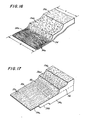
- the initial fabric is indicated at 34a, and, the sequential napping steps which have been performed on the float face are indicated at 34b and 34c.
- the yarn loops 10 Prior to commencement of the first napping operation 34b, the yarn loops 10 have a tendency to lay flat. In such a condition, the loops are not in their most advantageous position for napping, and, if that side of the fabric was the first to be napped, then an additional processing step in raising of the loops would be desirable before the napping operation could be carried out on the loop face. For example the loop face could be brushed up and possibly peat set or steamed to maintain them in somewhat erect condition.
- the napping operation performed on the float face of the fabric at 34b causes the loops to raise up without the intervention of any additional processing step.
- the second napping , operation performed on the float face at 34c has the result of erecting the loops such that they are properly disposed in generally perpendicular arrangement to the face of the fabric and readied for the napping operations to he performed on the loop face of the fabric.
- the consequential drawing-in of the width of the fabric has the beneficial effects of improving the erection of the loops for subsequent napping, and, increasing the loop density of the loops on the looped face.
- the fabric napped on the float face is reversed in the apparatus 52, and, optionally is reeled and then re- reeled to reverse it end-for-end, as indicated at 54.
- This readies the loop face for subsequent napping and orients the loops in a position in which they are optimally arranged for napping.
- the loop face of the fabric is fed to a first tandem napper 56 having napping drums 58, the napping drums 58 preferably being counter-rotating such that they act to raise and loft the pile of the loop face, and then tuck in stray ends of the lofted fibers.
- the fabric is then subjected to an optional tentering operation at 60, subsequent to which it is subjected to a second napping operation in a tandem napper 62 having napping drums 64.
- a tandem napper 62 having napping drums 64.
- the same tandem napper may be used for the nappers 40, 46, 56 and 62 and the same tenter may be used for the tenters 44, 50 and 60.
- the fabric is then framed and heat set in the apparatus 64, subsequent to which it is sheared into convenient lengths by a shear 66.
- the fabric emerging from the framing and setting apparatus 64 is the finished fabric for use as a blanket material or garment material.
- the respective first and second nappings of the loop face are indicated at 34d, 34e in Figure 17.
Landscapes
- Engineering & Computer Science (AREA)
- Textile Engineering (AREA)
- Knitting Of Fabric (AREA)
- Treatments For Attaching Organic Compounds To Fibrous Goods (AREA)
Priority Applications (1)
| Application Number | Priority Date | Filing Date | Title |
|---|---|---|---|
| AT83402405T ATE26003T1 (de) | 1983-05-20 | 1983-12-13 | Doppelseitige gewirke und verfahren zu deren herstellung. |
Applications Claiming Priority (2)
| Application Number | Priority Date | Filing Date | Title |
|---|---|---|---|
| US496434 | 1983-05-20 | ||
| US06/496,434 US4567075A (en) | 1983-05-20 | 1983-05-20 | Double faced knit fabric and method |
Publications (2)
| Publication Number | Publication Date |
|---|---|
| EP0126828A1 true EP0126828A1 (de) | 1984-12-05 |
| EP0126828B1 EP0126828B1 (de) | 1987-03-18 |
Family
ID=23972601
Family Applications (1)
| Application Number | Title | Priority Date | Filing Date |
|---|---|---|---|
| EP19830402405 Expired EP0126828B1 (de) | 1983-05-20 | 1983-12-13 | Doppelseitige Gewirke und Verfahren zu deren Herstellung |
Country Status (5)
| Country | Link |
|---|---|
| US (1) | US4567075A (de) |
| EP (1) | EP0126828B1 (de) |
| AT (1) | ATE26003T1 (de) |
| CA (1) | CA1207545A (de) |
| DE (2) | DE126828T1 (de) |
Cited By (8)
| Publication number | Priority date | Publication date | Assignee | Title |
|---|---|---|---|---|
| FR2610011A1 (fr) * | 1987-01-23 | 1988-07-29 | Vitebsky T Inst | Tricot-chaine molletonne |
| FR2636981A1 (fr) * | 1988-09-27 | 1990-03-30 | Delcer Sa Textile | Tricot chaine a effet de bouclette sur les deux faces et son procede de fabrication |
| EP0569304A1 (de) * | 1992-05-07 | 1993-11-10 | TEXTILES ET PLASTIQUES CHOMARAT (Société anonyme) | Plüschgestrick mit Jacquard-Effekten an einer Kettenstrickmaschine hergestellt und Verfahren zur dessen Herstellung |
| EP0645486A1 (de) * | 1993-09-27 | 1995-03-29 | Milliken Research Corporation | Klettenreissverschluss- oder Wishtuch |
| EP0745715A3 (de) * | 1995-06-02 | 1998-07-22 | Guilford Mills, Inc. | Kettengewirkte Plüschware die Widerstandsfähig ist gegen das Durchziehen der Polfäden |
| RU2203991C1 (ru) * | 2002-06-26 | 2003-05-10 | Московский государственный текстильный университет им. А.Н.Косыгина | Комбинированный основовязаный трикотаж |
| RU2203990C1 (ru) * | 2002-06-26 | 2003-05-10 | Московский государственный текстильный университет им. А.Н.Косыгина | Комбинированный основовязаный трикотаж |
| WO2018120790A1 (zh) * | 2016-12-31 | 2018-07-05 | 江苏悦达家纺有限公司 | 独幅logo色织小提花面料 |
Families Citing this family (31)
| Publication number | Priority date | Publication date | Assignee | Title |
|---|---|---|---|---|
| US4712281A (en) * | 1986-10-30 | 1987-12-15 | Guilford Mills, Inc. | Napped warp-knitted fabric and method of producing same |
| US4881383A (en) * | 1988-07-05 | 1989-11-21 | Guilford Mills, Inc. | Warp knitted fabric with satin-like back and brushable face and method of knitting same |
| US5267453A (en) * | 1991-06-06 | 1993-12-07 | Guilford Mills, Inc. | Loop-type textile fastener fabric and method of producing same |
| US5369859A (en) * | 1993-07-09 | 1994-12-06 | Fan; Sheng-Chi | Method of making chemical fiber knitted towelling |
| US5855125A (en) * | 1995-07-26 | 1999-01-05 | Malden Mills Industries, Inc. | Method for constructing a double face fabric and fabric produced thereby |
| US5791164A (en) * | 1996-06-17 | 1998-08-11 | Milliken Research Corporation | Outdoor sporting fabric |
| US6272701B1 (en) * | 1997-03-05 | 2001-08-14 | Xymid L.L.C. | Fitted mattress cover with a skirt having an integral elastic edge |
| US6196032B1 (en) | 1998-08-12 | 2001-03-06 | Malden Mills Industries, Inc. | Double face warp knit fabric with two-side effect |
| US6131419A (en) * | 1998-09-14 | 2000-10-17 | Malden Mills Industries, Inc. | Two face cut loop fabric |
| ES2176072B1 (es) * | 2000-03-08 | 2004-02-01 | S D Genoves Miralles S L | Procedimiento de fabricacion de tejidos de pelo a dos caras y tejido obtenido con dicho procedimiento |
| FR2811341B1 (fr) * | 2000-07-04 | 2002-08-23 | Aplix Sa | Tissu a double reseaux de boucles et procede de fabrication |
| US6823900B2 (en) | 2001-08-17 | 2004-11-30 | Tietex International, Ltd. | Fabric having a decorative textured surface |
| US6745600B2 (en) * | 2002-11-13 | 2004-06-08 | Harbor Healthcare, Inc. | Weft knitted blanket fabric and method of manufacturing the same |
| US20050208858A1 (en) * | 2003-01-02 | 2005-09-22 | Outside The Box, Inc. | Soft, durable nonwoven napped fabric |
| US6903511B2 (en) * | 2003-05-06 | 2005-06-07 | Zond, Inc. | Generation of uniformly-distributed plasma |
| US7465683B2 (en) * | 2003-11-24 | 2008-12-16 | Mcmurray Brian L | Functional double-faced performance warp knit fabric, method of manufacturing, and products made there from |
| DE102005038098B4 (de) * | 2005-08-10 | 2010-01-28 | BLüCHER GMBH | Adsorptionsfiltermaterial mit verbesserter Reißfestigkeit und/oder Weiterreißfestigkeit |
| US7707857B1 (en) | 2005-10-13 | 2010-05-04 | Mcmurray Fabrics, Inc. | Double faced weft-knit textile article |
| US7788953B1 (en) | 2005-10-13 | 2010-09-07 | Mcmurray Fabrics, Inc. | Double faced weft-knit textile article |
| US8388679B2 (en) | 2007-01-19 | 2013-03-05 | Maquet Cardiovascular Llc | Single continuous piece prosthetic tubular aortic conduit and method for manufacturing the same |
| ES2551516T3 (es) * | 2007-06-20 | 2015-11-19 | Atex Technologies, Inc. | Tejido comprimible con poder de recuperación, dispositivos, y métodos |
| US20090298370A1 (en) * | 2008-06-03 | 2009-12-03 | Mmi-Ipco, Llc | Flame Retardant Fabrics |
| US20110059288A1 (en) * | 2009-09-04 | 2011-03-10 | Shavel Jonathan G | Flannel sheeting fabric for use in home textiles |
| US8696741B2 (en) | 2010-12-23 | 2014-04-15 | Maquet Cardiovascular Llc | Woven prosthesis and method for manufacturing the same |
| GB2509929B (en) * | 2013-01-17 | 2017-05-24 | Aburnet Ltd | Hair retention bonnet |
| US20140260437A1 (en) * | 2013-03-13 | 2014-09-18 | Robert H. Fleming, Jr. | Skin-Contacting Tubular Fabric Underlay For Use Beneath A Therapeutic or Prosthetic Device |
| FR3031754B1 (fr) | 2015-01-16 | 2017-02-17 | Alstom Transp Tech | Textile tricote, notamment pour la realisation d'un revetement de siege, en particulier pour un vehicule ferroviaire |
| CH716114A1 (de) * | 2019-04-24 | 2020-10-30 | Schoeller Tech Ag | Flächige Velourmaschenware. |
| US10968549B1 (en) * | 2020-01-21 | 2021-04-06 | Zhejiang Dejun New Material Co., Ltd. | Fabric with high shielding performance, preparation method thereof, and application thereof in preparing advertising fabric |
| CN111394876B (zh) * | 2020-01-21 | 2022-04-05 | 浙江德俊新材料有限公司 | 一种高遮蔽性面料、制备方法及其在制备广告布方面的应用 |
| US12043929B2 (en) | 2021-09-01 | 2024-07-23 | Nike, Inc. | Knitted component with inlay plush |
Citations (4)
| Publication number | Priority date | Publication date | Assignee | Title |
|---|---|---|---|---|
| DE1942123A1 (de) * | 1968-09-20 | 1970-03-26 | Elitex Zd Y Textilniho Strojir | Doppelseitige Schlingendurchwirkung |
| DE2263575A1 (de) * | 1972-12-27 | 1974-07-11 | Gelsenberg Faserwerke Gmbh | Wirkwarenbahn |
| US3861175A (en) * | 1973-06-11 | 1975-01-21 | Du Pont | Process for knitting two-bar fabrics from three warp thread sets |
| DE2614598A1 (de) * | 1976-04-05 | 1977-10-06 | Walter Schmidt | Beidseitig aufrauhbare, einflaechig kettgewirkte plueschware |
Family Cites Families (5)
| Publication number | Priority date | Publication date | Assignee | Title |
|---|---|---|---|---|
| US3434306A (en) * | 1964-11-05 | 1969-03-25 | Celanese Corp | Warp knit terry fabrics |
| US3517530A (en) * | 1967-01-05 | 1970-06-30 | Magnus & Co As | Process for producing knitted articles having loop formations |
| US4193137A (en) * | 1977-05-06 | 1980-03-18 | Meadox Medicals, Inc. | Warp-knitted double-velour prosthesis |
| GB2022156B (en) * | 1978-04-14 | 1982-09-22 | Toyo Boseki | Warp knitted fabric woven or unwoven fabric used in making a liminate |
| US4199633A (en) * | 1978-05-16 | 1980-04-22 | Phillips Petroleum Company | Napped double knit fabric and method of making |
-
1983
- 1983-05-20 US US06/496,434 patent/US4567075A/en not_active Expired - Lifetime
- 1983-12-13 DE DE198383402405T patent/DE126828T1/de active Pending
- 1983-12-13 AT AT83402405T patent/ATE26003T1/de not_active IP Right Cessation
- 1983-12-13 DE DE8383402405T patent/DE3370359D1/de not_active Expired
- 1983-12-13 EP EP19830402405 patent/EP0126828B1/de not_active Expired
- 1983-12-16 CA CA000443553A patent/CA1207545A/en not_active Expired
Patent Citations (4)
| Publication number | Priority date | Publication date | Assignee | Title |
|---|---|---|---|---|
| DE1942123A1 (de) * | 1968-09-20 | 1970-03-26 | Elitex Zd Y Textilniho Strojir | Doppelseitige Schlingendurchwirkung |
| DE2263575A1 (de) * | 1972-12-27 | 1974-07-11 | Gelsenberg Faserwerke Gmbh | Wirkwarenbahn |
| US3861175A (en) * | 1973-06-11 | 1975-01-21 | Du Pont | Process for knitting two-bar fabrics from three warp thread sets |
| DE2614598A1 (de) * | 1976-04-05 | 1977-10-06 | Walter Schmidt | Beidseitig aufrauhbare, einflaechig kettgewirkte plueschware |
Cited By (9)
| Publication number | Priority date | Publication date | Assignee | Title |
|---|---|---|---|---|
| FR2610011A1 (fr) * | 1987-01-23 | 1988-07-29 | Vitebsky T Inst | Tricot-chaine molletonne |
| FR2636981A1 (fr) * | 1988-09-27 | 1990-03-30 | Delcer Sa Textile | Tricot chaine a effet de bouclette sur les deux faces et son procede de fabrication |
| EP0569304A1 (de) * | 1992-05-07 | 1993-11-10 | TEXTILES ET PLASTIQUES CHOMARAT (Société anonyme) | Plüschgestrick mit Jacquard-Effekten an einer Kettenstrickmaschine hergestellt und Verfahren zur dessen Herstellung |
| FR2690930A1 (fr) * | 1992-05-07 | 1993-11-12 | Chomarat Textiles Plastiques | Tricot velours à effets jacquard réalisé sur un métier à mailles jetées et procédé pour son obtention. |
| EP0645486A1 (de) * | 1993-09-27 | 1995-03-29 | Milliken Research Corporation | Klettenreissverschluss- oder Wishtuch |
| EP0745715A3 (de) * | 1995-06-02 | 1998-07-22 | Guilford Mills, Inc. | Kettengewirkte Plüschware die Widerstandsfähig ist gegen das Durchziehen der Polfäden |
| RU2203991C1 (ru) * | 2002-06-26 | 2003-05-10 | Московский государственный текстильный университет им. А.Н.Косыгина | Комбинированный основовязаный трикотаж |
| RU2203990C1 (ru) * | 2002-06-26 | 2003-05-10 | Московский государственный текстильный университет им. А.Н.Косыгина | Комбинированный основовязаный трикотаж |
| WO2018120790A1 (zh) * | 2016-12-31 | 2018-07-05 | 江苏悦达家纺有限公司 | 独幅logo色织小提花面料 |
Also Published As
| Publication number | Publication date |
|---|---|
| DE126828T1 (de) | 1986-01-02 |
| DE3370359D1 (en) | 1987-04-23 |
| US4567075A (en) | 1986-01-28 |
| CA1207545A (en) | 1986-07-15 |
| EP0126828B1 (de) | 1987-03-18 |
| ATE26003T1 (de) | 1987-04-15 |
Similar Documents
| Publication | Publication Date | Title |
|---|---|---|
| EP0126828B1 (de) | Doppelseitige Gewirke und Verfahren zu deren Herstellung | |
| US5855125A (en) | Method for constructing a double face fabric and fabric produced thereby | |
| US3279221A (en) | Textile product | |
| US3910075A (en) | Warp knit elastic fabric | |
| US3874958A (en) | Method of making burned-out fabric | |
| US6131419A (en) | Two face cut loop fabric | |
| US3835512A (en) | Method of producing relief patterned nonwoven textiles | |
| US3254510A (en) | Warp knit pile fabrics | |
| CN210481672U (zh) | 一种tpu包芯段染纱贾卡网布 | |
| JP3020863B2 (ja) | レース編物の編成方法及びレース編物 | |
| JPH0130938B2 (de) | ||
| JP2001123361A (ja) | ダブルラッシェル機による柄入り立体成形物及びその編成方法 | |
| JPH07216696A (ja) | スペーサファブリックとそれを製造する方法及びこの方法を実施する経編機 | |
| CN113604956B (zh) | 一种局部绒感凹凸毛圈网布及其制作方法 | |
| US6794008B2 (en) | Decorative texturized fabric | |
| CN87100264A (zh) | 经花双面长毛绒织物和毛毯 | |
| US6177170B1 (en) | Velvet-like jacquard fabrics and processes for making the same | |
| US2934924A (en) | Knitted pile fabrics | |
| US2960750A (en) | Pile fabrics and method of making same | |
| JP3054824U (ja) | 分散透孔を有する縦編み素材 | |
| JP2002212864A (ja) | カットパイル編地とその製造方法 | |
| JP3047536U (ja) | 凸状パイル柄の縦編み素材 | |
| JPH08134754A (ja) | 両面パイル縦編毛布の製造方法 | |
| JP3047293U (ja) | パイル柄分散の縦編み素材 | |
| CN222846954U (zh) | 一种色丝提花大格子法兰绒面料 |
Legal Events
| Date | Code | Title | Description |
|---|---|---|---|
| PUAI | Public reference made under article 153(3) epc to a published international application that has entered the european phase |
Free format text: ORIGINAL CODE: 0009012 |
|
| AK | Designated contracting states |
Designated state(s): AT BE CH DE FR GB IT LI LU NL SE |
|
| 17P | Request for examination filed |
Effective date: 19850605 |
|
| ITCL | It: translation for ep claims filed |
Representative=s name: JACOBACCI CASETTA & PERANI S.P.A. |
|
| EL | Fr: translation of claims filed | ||
| TCAT | At: translation of patent claims filed | ||
| TCNL | Nl: translation of patent claims filed | ||
| DET | De: translation of patent claims | ||
| 17Q | First examination report despatched |
Effective date: 19860515 |
|
| GRAA | (expected) grant |
Free format text: ORIGINAL CODE: 0009210 |
|
| AK | Designated contracting states |
Kind code of ref document: B1 Designated state(s): AT BE CH DE FR GB IT LI LU NL SE |
|
| REF | Corresponds to: |
Ref document number: 26003 Country of ref document: AT Date of ref document: 19870415 Kind code of ref document: T |
|
| REF | Corresponds to: |
Ref document number: 3370359 Country of ref document: DE Date of ref document: 19870423 |
|
| ET | Fr: translation filed | ||
| ITF | It: translation for a ep patent filed | ||
| PG25 | Lapsed in a contracting state [announced via postgrant information from national office to epo] |
Ref country code: BE Effective date: 19871231 |
|
| PLBE | No opposition filed within time limit |
Free format text: ORIGINAL CODE: 0009261 |
|
| STAA | Information on the status of an ep patent application or granted ep patent |
Free format text: STATUS: NO OPPOSITION FILED WITHIN TIME LIMIT |
|
| 26N | No opposition filed | ||
| BERE | Be: lapsed |
Owner name: FAB INDUSTRIES INC. Effective date: 19871231 |
|
| ITTA | It: last paid annual fee | ||
| EPTA | Lu: last paid annual fee | ||
| EAL | Se: european patent in force in sweden |
Ref document number: 83402405.1 |
|
| PGFP | Annual fee paid to national office [announced via postgrant information from national office to epo] |
Ref country code: CH Payment date: 20011221 Year of fee payment: 19 |
|
| PGFP | Annual fee paid to national office [announced via postgrant information from national office to epo] |
Ref country code: DE Payment date: 20011227 Year of fee payment: 19 |
|
| PGFP | Annual fee paid to national office [announced via postgrant information from national office to epo] |
Ref country code: SE Payment date: 20011228 Year of fee payment: 19 Ref country code: FR Payment date: 20011228 Year of fee payment: 19 Ref country code: AT Payment date: 20011228 Year of fee payment: 19 |
|
| PGFP | Annual fee paid to national office [announced via postgrant information from national office to epo] |
Ref country code: NL Payment date: 20011231 Year of fee payment: 19 Ref country code: LU Payment date: 20011231 Year of fee payment: 19 |
|
| REG | Reference to a national code |
Ref country code: GB Ref legal event code: IF02 |
|
| PGFP | Annual fee paid to national office [announced via postgrant information from national office to epo] |
Ref country code: GB Payment date: 20021212 Year of fee payment: 20 |
|
| PG25 | Lapsed in a contracting state [announced via postgrant information from national office to epo] |
Ref country code: LU Free format text: LAPSE BECAUSE OF NON-PAYMENT OF DUE FEES Effective date: 20021213 Ref country code: AT Free format text: LAPSE BECAUSE OF NON-PAYMENT OF DUE FEES Effective date: 20021213 |
|
| PG25 | Lapsed in a contracting state [announced via postgrant information from national office to epo] |
Ref country code: SE Free format text: LAPSE BECAUSE OF NON-PAYMENT OF DUE FEES Effective date: 20021214 |
|
| PG25 | Lapsed in a contracting state [announced via postgrant information from national office to epo] |
Ref country code: LI Free format text: LAPSE BECAUSE OF NON-PAYMENT OF DUE FEES Effective date: 20021231 Ref country code: CH Free format text: LAPSE BECAUSE OF NON-PAYMENT OF DUE FEES Effective date: 20021231 |
|
| PG25 | Lapsed in a contracting state [announced via postgrant information from national office to epo] |
Ref country code: NL Free format text: LAPSE BECAUSE OF NON-PAYMENT OF DUE FEES Effective date: 20030701 Ref country code: DE Free format text: LAPSE BECAUSE OF NON-PAYMENT OF DUE FEES Effective date: 20030701 |
|
| EUG | Se: european patent has lapsed | ||
| REG | Reference to a national code |
Ref country code: CH Ref legal event code: PL |
|
| NLV4 | Nl: lapsed or anulled due to non-payment of the annual fee |
Effective date: 20030701 |
|
| PG25 | Lapsed in a contracting state [announced via postgrant information from national office to epo] |
Ref country code: FR Free format text: LAPSE BECAUSE OF NON-PAYMENT OF DUE FEES Effective date: 20030901 |
|
| REG | Reference to a national code |
Ref country code: FR Ref legal event code: ST |
|
| PG25 | Lapsed in a contracting state [announced via postgrant information from national office to epo] |
Ref country code: GB Free format text: LAPSE BECAUSE OF EXPIRATION OF PROTECTION Effective date: 20031212 |
|
| REG | Reference to a national code |
Ref country code: GB Ref legal event code: PE20 |