EP0127797B1 - Markermoleküle für Fluoreszenz-Immuno-Assays sowie Verfahren und Zwischenprodukte zu deren Herstellung - Google Patents
Markermoleküle für Fluoreszenz-Immuno-Assays sowie Verfahren und Zwischenprodukte zu deren Herstellung Download PDFInfo
- Publication number
- EP0127797B1 EP0127797B1 EP84105272A EP84105272A EP0127797B1 EP 0127797 B1 EP0127797 B1 EP 0127797B1 EP 84105272 A EP84105272 A EP 84105272A EP 84105272 A EP84105272 A EP 84105272A EP 0127797 B1 EP0127797 B1 EP 0127797B1
- Authority
- EP
- European Patent Office
- Prior art keywords
- signifies
- porphin
- general formula
- compounds
- group
- Prior art date
- Legal status (The legal status is an assumption and is not a legal conclusion. Google has not performed a legal analysis and makes no representation as to the accuracy of the status listed.)
- Expired
Links
- 0 C*=*(**(*=C)=C)NC Chemical compound C*=*(**(*=C)=C)NC 0.000 description 1
Images

Classifications
-
- C—CHEMISTRY; METALLURGY
- C07—ORGANIC CHEMISTRY
- C07D—HETEROCYCLIC COMPOUNDS
- C07D487/00—Heterocyclic compounds containing nitrogen atoms as the only ring hetero atoms in the condensed system, not provided for by groups C07D451/00 - C07D477/00
- C07D487/22—Heterocyclic compounds containing nitrogen atoms as the only ring hetero atoms in the condensed system, not provided for by groups C07D451/00 - C07D477/00 in which the condensed system contains four or more hetero rings
-
- G—PHYSICS
- G01—MEASURING; TESTING
- G01N—INVESTIGATING OR ANALYSING MATERIALS BY DETERMINING THEIR CHEMICAL OR PHYSICAL PROPERTIES
- G01N33/00—Investigating or analysing materials by specific methods not covered by groups G01N1/00 - G01N31/00
- G01N33/48—Biological material, e.g. blood, urine; Haemocytometers
- G01N33/50—Chemical analysis of biological material, e.g. blood, urine; Testing involving biospecific ligand binding methods; Immunological testing
- G01N33/53—Immunoassay; Biospecific binding assay; Materials therefor
- G01N33/531—Production of immunochemical test materials
- G01N33/532—Production of labelled immunochemicals
- G01N33/533—Production of labelled immunochemicals with fluorescent label
-
- Y—GENERAL TAGGING OF NEW TECHNOLOGICAL DEVELOPMENTS; GENERAL TAGGING OF CROSS-SECTIONAL TECHNOLOGIES SPANNING OVER SEVERAL SECTIONS OF THE IPC; TECHNICAL SUBJECTS COVERED BY FORMER USPC CROSS-REFERENCE ART COLLECTIONS [XRACs] AND DIGESTS
- Y10—TECHNICAL SUBJECTS COVERED BY FORMER USPC
- Y10S—TECHNICAL SUBJECTS COVERED BY FORMER USPC CROSS-REFERENCE ART COLLECTIONS [XRACs] AND DIGESTS
- Y10S436/00—Chemistry: analytical and immunological testing
- Y10S436/80—Fluorescent dyes, e.g. rhodamine
Definitions
- JP-A-54-100 398 and JP-A-55-87 793 describe mesotetra (p-sulphophenyl) porphine derivatives or mesotetra (p-carboxyphenyl) porphine derivatives which are used as anticarcinogenic agents or as intermediates whose production should serve.
- the present invention relates to porphyrin derivatives which can be detected very sensitively by fluorescence spectroscopy and, since they are water-soluble, are ideally suited as marker molecules for highly sensitive fluorescence immunoassays.
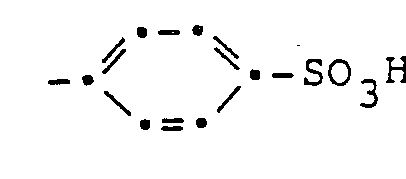
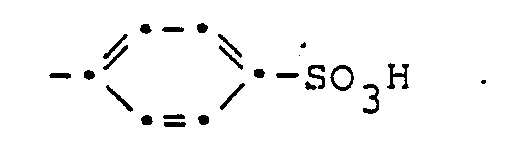
- the porphyrin derivatives according to the present invention correspond to the general formula wherein either R 1 is the group and R 2 the group or or R 1 is the group and R 2 the group mean, where X- is a chlorine, bromine or iodine anion, an aryl sulfonate ion, an alkyl sulfonate ion or an alkyl sulfate ion, A (C 1-8 ) alkylene and R 3 (C 1-4 ) alkyl, and sulfonic acid salts of compounds of Formula I, wherein R 1 is the group means.
- the present invention further relates to a process and intermediates for the preparation of these compounds.
- alkyl and alkylene denote straight-chain or branched, saturated hydrocarbon radicals.
- (C 1-4 ) alkyl denotes residues with 1 to 4 carbon atoms, such as methyl and the like.
- (C 1-8 ) alkylene denotes residues with 1 to 8 carbon atoms, such as methylene, pentamethylene and the like.
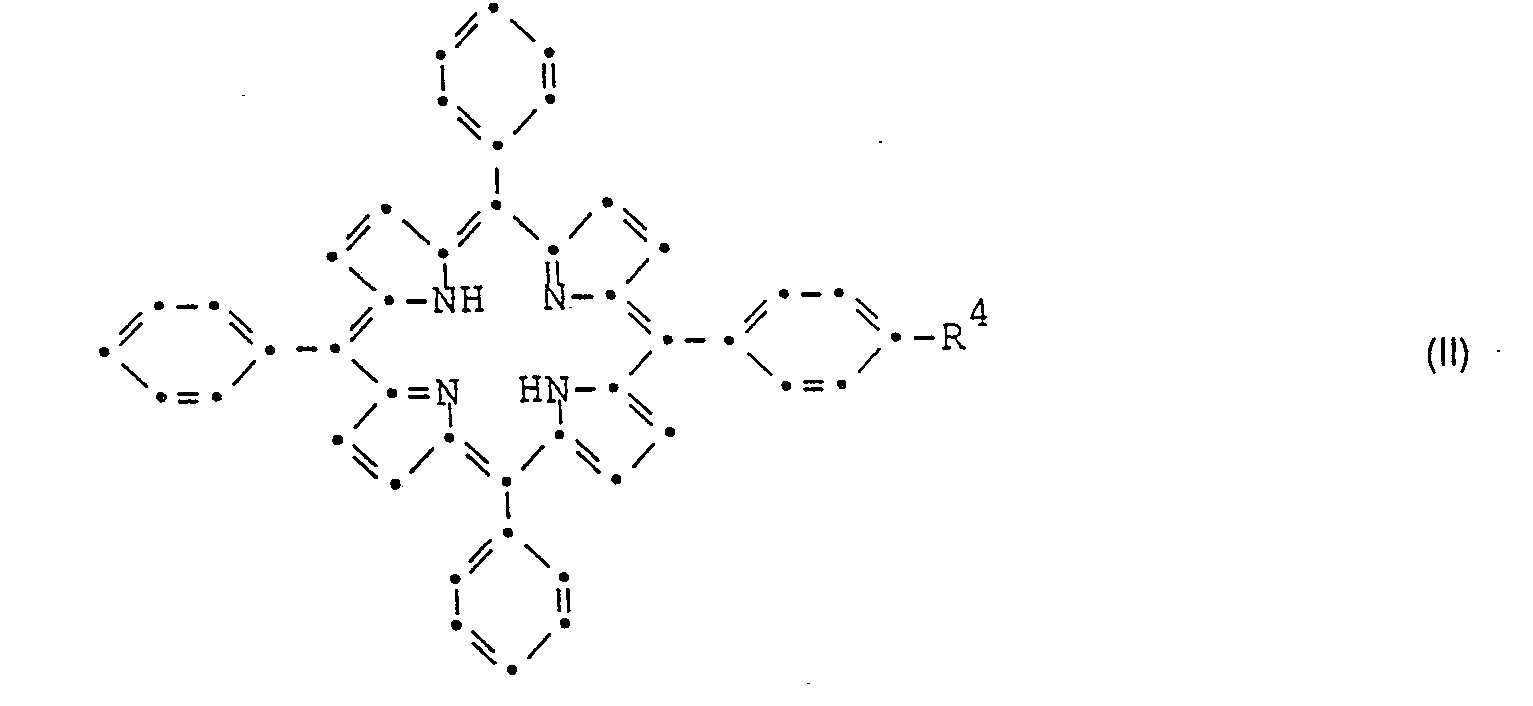
- compounds of the formula I in which R 'is the group and R 2 the group or mean be prepared by sulfonation of the phenyl groups in a compound of formula II.
- Concentrated sulfuric acid is preferably used as the sulfonating agent, and at elevated temperature, e.g. B. at about 100 ° C works.
- elevated temperature e.g. B. at about 100 ° C works.
- the desired sulfonation can also be carried out by other methods known per se.
- compounds of the formula I in which R 1 is the group and R 2 the group mean are prepared by alkylation of the pyridine nitrogen atoms in a compound of formula III.
- Appropriate alkyl chlorides, bromides or iodides, such as methyl iodide, arylsulfonic acid alkyl esters, such as ethyl p-toluenesulfonate, alkylsulfonic acid alkyl esters, dialkyl sulfates, such as diethyl sulfate, and the like can be used as alkylating agents.
- Suitable solvents are primarily polar solvents, for example alcohols, such as methanol, and mixtures thereof with water. The reaction is preferably carried out at room temperature.
- the sulfonic acid salts according to process variant c) are prepared by methods known per se and familiar to any person skilled in the art. Both salts with inorganic bases, e.g. B. alkali metal salts, as well as salts with organic bases, for. B. ammonium salts, in question. The corresponding sodium salts are preferred.
- the compounds of formula II used as starting materials are new and also the subject of the present invention. They can be prepared by using pyrrole, benzaldehyde and an aldehyde of the general formula wherein R 4 has the meaning given above, condensed with one another in a molar ratio of 4: 3: 1. This condensation takes place according to methods known per se and familiar to any person skilled in the art.
- the pyrrole is placed in an acidic organic solvent, such as acetic acid and propionic acid, and a mixture of the two.
- Aldehydes (preferably in a molar ratio of 3: 1) are slowly added.
- the reaction temperature is not critical, it is preferred to work at elevated temperature, for example at the boiling point of the reaction mixture.
- the product mixture is expediently separated in a manner known per se by means of chromatographic methods.
- the compounds of the formula IV are known or can be prepared by methods known per se and in analogy to the preparation of known representatives of this class of substances.
- the compounds of formula III used as starting materials are new and also a subject of the present invention. They can be made by using the compound of formula with a compound of the general formula wherein X is chlorine, bromine, iodine or an alkyl sulfonate, alkyl sulfate or an aryl sulfonate radical and A has the meaning given above.
- Suitable solvents are, for example, halogenated hydrocarbons, such as methylene chloride and chloroform, alcohols, such as methanol and ethanol, mixtures of the solvents mentioned and the like.
- the reaction can be carried out in a temperature range from about room temperature to the boiling point of the reaction mixture.
- the compound of formula V can be prepared by condensation of pyrrole and pyridine-4-carbaldehyde (molar ratio 1: 1) according to well-known methods. For example, the same reaction conditions can be used as in the previously described preparation of compounds of the formula II.
- the porphyrins according to general formula I or their sulfonic acid salts can be detected very sensitively by fluorescence spectroscopy. Since they are water-soluble, they are ideally suited as marker molecules for highly sensitive fluorescence immunoassays. They are particularly suitable for a time-resolved fluorescence immunoassay, as described, for example, in DT-OS 26 28 158.
- FITC fluorescein isocyanate
- the sensitivity of detection in fluorescence immunoassays can be improved. This is particularly important when determining small amounts of antigens in body fluids, such as e.g. B. plasma and serum, advantageous.
- a compound of general formula I is coupled to an immunological material in a conventional manner, e.g. B. with a water-soluble carbodiimide derivative, e.g. B: with 1-cyclohexyl-3- (2-morpholinoethyl) carbodiimide p-toluenesulfonate.
- the p-formylphenoxyacetic acid used as starting material is prepared from p-hydroxybenzaldehyde and iodoacetic acid in a manner known per se.
- Example 2 In analogy to the information in Example 1 b), from 200 mg of 4- (10,15,20-triphenyl-21H, 23H-porphin-5-yl) benzoic acid 90 mg (33%) of pure 4- [10 , 15,20-tris (4-sulfophenyl) -21H, 23H-porphin-5-yl] benzoic acid tetrasodium salt.
- UV ⁇ (e), 422 (210,000), 519 (14100), 554 (6,000), 584 (6,200), 640 (1,600) nm.
- porphine derivative was coupled to anti-CEA as described below with the aid of the water-soluble carbodiimide derivative 1-cyclohexyl-3- (2-morpholineethyl) carbodiimide-methyl-p-toluenesulfonate.
- the polystyrene balls are then three times with 2 to 5 ml of dist. Washed water and then transferred into test tubes, each containing 0.250 ml buffer solution with 2 x 10 8 M / I rabbit anti-CEA, which is labeled with porphyrin derivative (degree of labeling 0.42). After a 24-hour incubation at 37 ° C, the balls are again three times with 2 to 5 ml of dist. Washed water and then transferred into test tubes with 2 ml of sulfuric acid (0.09 N). After 30 minutes, the sulfuric acid solution is pipetted into measuring cuvettes and the porphine derivative (or anti-CEA) content is measured by fluorescence spectroscopy (excitation wavelength 433 nm; emission wavelength 670 nm).
- Table 1 lists the values of a CEA determination obtained with a number of ROCHE CEA standards.
- a normal human serum sample was analyzed using the same procedure as in Example 8, and a CEA content of 1 ng / ml was found.
Landscapes
- Health & Medical Sciences (AREA)
- Immunology (AREA)
- Chemical & Material Sciences (AREA)
- Life Sciences & Earth Sciences (AREA)
- Engineering & Computer Science (AREA)
- Organic Chemistry (AREA)
- Urology & Nephrology (AREA)
- Biomedical Technology (AREA)
- Hematology (AREA)
- Molecular Biology (AREA)
- Food Science & Technology (AREA)
- General Health & Medical Sciences (AREA)
- Cell Biology (AREA)
- Medicinal Chemistry (AREA)
- Physics & Mathematics (AREA)
- Analytical Chemistry (AREA)
- Biochemistry (AREA)
- Microbiology (AREA)
- General Physics & Mathematics (AREA)
- Pathology (AREA)
- Biotechnology (AREA)
- Pharmaceuticals Containing Other Organic And Inorganic Compounds (AREA)
- Nitrogen Condensed Heterocyclic Rings (AREA)
- Investigating Or Analysing Biological Materials (AREA)
Description
- In der JP-A-54-100 398 und der JP-A-55-87 793 werden Mesotetra (p-sulphophenyl) porphinderivate bzw. Meso-tetra (p-carboxyphenyl) porphinderivate beschrieben, welche als anticarcinogene Mittel bzw. als Zwischenprodukte zu deren Herstellung dienen sollen.
- Demgegenüber betrifft die vorliegende Erfindung Porphyrinderivate, die sich fluoreszenzspektroskopisch sehr empfindlich nachweisen lassen und, da sie wasserlöslich sind, bestens geeignet sind als Markermoleküle für hochempfindliche Fluoreszenz-Immunoassays.
- Die Porphyrinderivate gemäss vorliegender Erfindung entsprechen der allgemeinen Formel






- Die vorliegende Erfindung betrifft ferner ein Verfahren und Zwischenprodukte für die Herstellung dieser Verbindungen.
- Die Ausdrücke « Alkyl » und « Alkylen bezeichnen geradkettige oder verzweigte, gesättigte Kohlenwasserstoffreste. Der Ausdruck « (C1-4)-Alkyl » bezeichnet Reste mit 1 bis 4 Kohlenstoffatomen, wie Methyl und dergleichen. Der Ausdruck « (C1-8)-Alkylen bezeichnet Reste mit 1 bis 8 Kohlenstoffatomen, wie Methylen, Pentamethylen und dergleichen.
- Im Rahmen der vorliegenden Erfindung bevorzugte Verbindungen der Formel sind :
- 4-[10,15,20-Tris(4-sulfophenyl)-21 H,23H-porphin-5-yl]benzoesäure,
- [4-[10,15,20-Tris(4-sulfophenyl)-21 H,23H-porphin-5-yl]phenoxy]essigsäure,
- 6-[4-[10,15,20-Tris(4-sulfophenyl)-21 H,23H-porphin-5-yl]phenyl]hexancarbonsäure,
- 1-(Carboxymethyl)-1',1",1"'-trimethyl-4,4',4",4"'-(21H,23H-porphin-5,10,15,20-tetrayl)tetrakispyridinium tetrajodid,
- 1-(2-Carboxyäthyl)-1',1",1"'-trimethyl-4,4',4",4"'-(21H,23H-porphin-5,10,15,20-tetrayl)tetrakispyridinium. bromid trijodid und
- 1-(5-Carboxypentyl)-1',1",1"'-trimethyl-4,4',4",4"'-(21H,23H-porphin-5,10,15,20-tetrayl)tetrakispyridi- nium bromid trijodid.
- Die Verbindungen der Formel I und, wenn R1 die Gruppe

- a) eine Verbindung der allgemeinen Formel

- b) eine Verbindung der allgemeinen Formel

- c) eine nach Verfahren a) erhaltene Verbindung in ein Sulfonsäuresalz überführt.
- Gemäss Verfahrensvariante a) können Verbindungen der Formel I, worin R' die Gruppe


- Gemäss Verfahrensvariante b) können Verbindungen der Formel I, worin R1 die Gruppe


- Die Herstellung der Sulfonsäuresalze gemäss Verfahrensvariante c) erfolgt nach an sich bekannten und jedem Fachmann geläufigen Methoden. Es kommen dabei sowohl Salze mit anorganischen Basen, z. B. Alkalimetallsalze, als auch Salze mit organischen Basen, z. B. Ammoniumsalze, in Frage. Bevorzugt werden die entsprechenden Natriumsalze.
- Die als Ausgangsstoffe verwendeten Verbindungen der Formel II sind neu und ebenfalls Gegenstand der vorliegenden Erfindung. Sie können hergestellt werden, indem man Pyrrol, Benzaldehyd und einen Aldehyd der allgemeinen Formel

- Die Verbindungen der Formel IV sind bekannt oder können nach an sich bekannten Methoden und in Analogie zur Herstellung bekannter Vertreter dieser Stoffklasse hergestellt werden.
- Die als Ausgangsstoffe verwendeten Verbindungen der Formel III sind neu und ebenfalls Gegenstand der vorliegenden Erfindung. Sie können hergestellt werden, indem man die Verbindung der Formel


- Die Verbindung der Formel V kann durch Kondensation von Pyrrol und Pyridin-4-carbaldehyd (Molverhältnis 1 : 1) nach hinlänglich bekannten Methoden hergestellt werden. Es können beispielsweise die gleichen Reaktionsbedingungen wie bei der früher beschriebenen Herstellung von Verbindungen der Formel II angewendet werden.
- Die Porphyrine gemäss allgemeiner Formel I bzw. deren Sulfonsäuresalze lassen sich fluoreszenzspetroskopisch sehr empfindlich nachweisen. Da sie wasserlöslich sind, sind sie bestens geeignet als Markermoleküle für hochempfindliche Fluoreszenz-Immuno-Assays. Sie sind insbesondere geeignet für einen zeitaufgelösten Fluoreszenz-immuno-Assay, wie er beispielsweise in der DT-OS 26 28 158 beschrieben wird. Durch die Verwendung der Porphyrine gemäss allgemeiner Formel I anstelle des häufig verwendeten FITC (Fluoresceinisocyanat) kann die Nachweisempfindlichkeit bei Fluoreszens-Immuno- Assays verbessert werden. Dies ist insbesondere bei der Bestimmung geringer Mengen von Antigenen in Körperflüssigkeiten, wie z. B. Plasma und Serum, von Vorteil. Ein Beispiel eines solchen Antigens ist das carcinoembryonale Antigen (CEA). Die Kopplung einer Verbindung der allgemeinen Formel I an ein immunologisches Material erfolgt in herkömmlicher Weise, z. B. mit einem wasserlöslichen Carbodiimid-Derivat, z. B: mit 1-Cyclohexyl-3-(2-morpholinoäthyl)-carbodiimid-p-toluolsulfonat.
-
- a) Man erhitzt eine Mischung aus 2,5 ml Pyrrol und 134 ml Propionsäure zum Sieden und versetzt dann tropfenweise mit einer Lösung von 2 g p-Formylphenylcapronsäure und 3 ml Benzaldehyd in 5 ml Propionsäure. Man erhitzt noch während 30 Minuten unter Rückfluss zum Sieden, lässt die Reaktionslösung auf Zimmertemperatur abkühlen und neutralisiert die Propionsäure mit insgesamt 9,5 g Natriumhydroxid (pH 4). Man lässt über Nacht stehen und filtriert dann den schwarzen Niederschlag ab. Die Reinigung erfolgt durch Säulenchromatographie an 1,2 kg Kieselgel, wobei man nacheinander mit den folgenden Lösungsmitteln eluiert : Chloroform/Cyclohexan (1 : 1), Chloroform/Essigester (3 : 2) und (2 : 3), Essigester und Essigester mit 2 % Methanol. Das so erhaltene Produkt wird noch zweimal wie oben beschrieben chromatographiert und dann umkristallisiert. Hierzu wird das Produkt im möglichst wenig Chloroform gelöst, worauf man die doppelte Menge an Methanol zugibt und über Nacht bei 4 °C stehen lässt. Nach dem Abfiltrieren werden die Kristalle mit Methanol gewaschen und dann im Vakuum bei 20 °C getrocknet. Man erhält 810 mg (12%) 6-[4-(10,15,20-Triphenyl-21H,23H-porphin-5-yl)phenyl]he- xancarbonsäure.
- b) Man suspendiert 400 mg fein pulverisierte 6-[4-(10,15,20-Triphenyl-21 H,23H-porphin-5-yl))phenyl]hexancarbonsäure in 10 ml konzentrierter Schwefelsäure, erhitzt dieses Gemisch unter Feuchtigkeits-und Lichtausschluss während 6 Stunden auf 100 °C und lässt dann über Nacht bei 20 °C stehen. Anschliessend gibt man vorsichtig 15 ml Wasser hinzu, wobei sich das Gemisch erwärmt, und lässt wieder auf Zimmertemperatur abkühlen. Das ausgefallene grüne protonierte Produkt wird abfiltriert, mit wenig Aceton gewaschen, zusammen mit etwas Celite TM in 15 ml Wasser suspendiert und mit gesättigter Natriumbicarbonatlösung neutralisiert, bis sich die Lösung von grün nach rot-violett verfärbt. Reste von nicht umgesetztem Ausgangsprodukt werden zusammen mit dem Celite TM abfiltriert. Das Filtrat (etwa 100 ml) wird 4 mal je 3 Stunden lang gegen 4 Liter Wasser dialysiert (um anorganische Salze zu entfernen) und dann lyophilisiert. Die Reinigung erfolgt durch Chromatographie an Acrylamid-Gel AcA54 (LKB) ; Elutionsmittel : 150 mM Kochsalzlösung, das 10 mMol/l Natriumphosphat enthält (pH 7). Die Fraktionen mit reinem Produkt werden gepoolt und zur Entfernung des Kochsalzes gegen Wasser dialysiert und dann lyophilisiert. Man erhält 189 mg (35 %) 6-[4-[10,15,20-Tris(4-sulfophenyl)-21 H,23H-porphin-5-yl]phenyl]hexancarbonsäure-tetranatriumsalz.
- UV : λ (ε), 414 (364 000), 516 (12 700), 553 (6 100), 578 (5 600), 634 (3 400) nm.
- a) In Analogie zu den Angaben in Beispiel 1 a) erhält man aus Pyrrol, Benzaldehyd und p-Formyl-phenoxyessigsäure in einer Ausbeute von 7% [4-(10,15,20-Triphenyl-21H,23H-porphin-5-yl)pheno- xy]essigsäure.
- Die als Ausgangsstoff verwendete p-Formyl-phenoxyessigsäure wird aus p-Hydroxybenzaldehyd und Jodessigsäure in an sich bekannter Weise hergestellt.
- b) In Analogie zu den Angaben in Beispiel 1 b) erhält man aus [4-(10,15,20-Triphenyl-21H,23H-porphin-5-yl)-phenoxy]essigsäure in einer Ausbeute von 15% [4-[10,15,20-Tris(4-sulfophenyl)-21H,23H-porphin-5-yl]phenoxy]essigsäure.
- UV : λ (ε), 414 (397 000), 517 (13 000), 554 (6 400), 579 (5 600), 635 (3 100) nm.
-
- a) Man erhitzt 187 ml Propionsäure unter Rühren am Rückfluss und versetzt dann zuerst mit 3,47 ml Pyrrol und dann tropfenweise (innert 15 Minuten) mit 4,81 ml Pyridin-4-carbaldehyd. Man erhitzt während 30 Minuten am Rückfluss, lässt die Reaktionslösung auf Zimmertemperatur abkühlen, versetzt mit 105 g Natriumhydroxid in 400 ml Wasser, wobei mit Eis gekühlt wird, und nutscht den erhaltenen schwarzen Niederschlag ab. Zur Reinigung löst man diesen in 400 ml Chloroform und fällt das Produkt dann durch langsame Zugabe von 700 ml Cyclohexan aus. Durch dreimaliges Aufschlämmen in wenig Chloroform und anschliessendem Abnutschen werden noch weitere Verunreinigungen entfernt. Die weitere Reinigung erfolgt durch zweimalige Säulenchromatographie an Kieselgel ; Elutionsmittel : Chloroform, Chloroform/Methanol (9 : 1), Chloroform/Methanol (8 : 2) und Chloroform/Methanol (7 : 3). Das erhaltene Material wird in Aceton aufgeschlämmt, abgenutscht und an Kieselgel unter Eluieren mit Chloroform, das 3 % Methanol enthält, chromatographiert. Man erhält 600 mg (8 %) 5,10,15,20-Tetra(4-pyridyl)-21H,23H-porphin.
- b) Man löst 180 mg 5,10,15,20-Tetra(4-pyridyl)-21H,23H-porphin in 70 ml Chloroform/Methanol (9 : 1), versetzt mit 585 mg 6-Brom-Capronsäure und erhitzt anschliessend während 20 Stunden am Rückfluss. Dann engt man die Lösung im Vakuum auf 5 bis 10 ml ein und fällt das Produkt durch Zugabe von 250 ml Aether aus. Dieses wird auf eine 15 cm langen Kieselsäule gegeben, worauf man mit 500 ml Chloroform/Methanol (9 : 1) eluiert, die Startzone aus der Säule nimmt und diese mit 1 Liter Methanol und dann mit 1 Liter Chloroform/Methanol/Wasser (2:7:1) extrahiert. Das aus den Extrakten erhaltene Material wird durch präparative Dickschichtchromatographie weiter gereinigt ; Laufmittel Chloroform/Methanol/Dimethylformamid/Wasser (1 : 2 : 1 : 1). Die Hauptzone wird nach dem Herauskratzen zweimal mit je 250 ml Methanol und zweimal mit je 250 ml Chloroform/Methanol/Wasser (2:7:1) extrahiert. Schliesslich wird das Produkt noch viermal umgefällt. Hierzu löst man es zunächst in möglichst wenig Methanol und fällt es dann durch langsames Zutropfen von 250 ml Chloroform aus. Man erhält 30 mg 1-(5-Carboxypentyl)-4-(10,15,20-tri-4-pyridyl-21 H,23H-porphin-5-yl)pyridinium bromid.
- c) Man löst 20 mg 1-(5-Carboxypentyl)-4-(10,15,20-tri-4-pyridyl-21H,23H-porphin-5-yl)pyridinium bromid in 50 ml Methanol/Wasser (9 : 1), gibt 3,5 g Methyljodid dazu und lässt das Reaktionsgemisch bei Zimmertemperatur während 6 Tagen im Dunkeln stehen. Dann wird das Lösungsmittel mit dem überschüssigen Methyljodid im Vakuum abgezogen und das Produkt durch Umfällen gereinigt. Hierzu löst man es in möglichst wenig Methanol (etwa 5 ml) und fällt es durch langsames Zutropfen von 250 ml Chloroform wieder aus. Diese Reinigungsprozedur wird insgesamt dreimal durchgeführt. Man erhält 7 mg 1-(5-Carboxypentyl)-1',1", 1"'-trimethyl-4,4',4",4"'-(21H,23H-porphin-5,10,15,20-tetrayl)tetrakispyridi- nium bromid trijodid.
- UV : λ (ε), 422 (224 000), 519 (14 300), 556 (6 200), 584 (6 800), 640 (2 000) nm.
- a) Man löst 15,2 ml Benzaldehyd und 7,51 g 4-Carboxybenzaldehyd in 746 ml siedender Propionsäure, versetzt tropfenweise mit 13,9 ml Pyrrol, erhitzt anschliessend das erhaltene Gemisch während etwa 30 Minuten unter Rückfluss und lässt dann auf Zimmertemperatur abkühlen. Das Porphinderivat wird durch Zugabe von 0,5 I Wasser ausgefällt. Das abfiltrierte Rohprodukt wird durch zweimalige Säulenchromatographie an 1,2 kg Kieselgel vorgereinigt, wobei jeweils nacheinander mit den folgenden Lösungsmitteln eluiert wird : Chloroform/Cyclohexan (1 : 1), Chloroform/Essigester (3 : 2) und (1 : 1), Essigester sowie Essigester, das 2 % Methanol enthält. Zur weiteren Reinigung schlämmt man das Produkt in wenig Methanol auf und filtriert es ab. Dieser Prozess wird so lange wiederholt bis das Filtrat nur noch schwach gefärbt ist. Dann wird das so erhaltene Produkt an einer Kieselgelsäule mit Chloroform, Chloroform/Essigester (1 : 1) und Essigester als Elutionsmittel chromatographiert. Man erhält 1,7 g 4-(10,15,20-Triphenyl-21H,23H-porphin-5-yl)benzoesäure als violette Kristalle.
- b) In Analogie zu den Angaben in Beispiel 1 b) erhält man aus 200 mg 4-(10,15,20-Triphenyl-21H,23H-porphin-5-yl)benzoesäure 90 mg (33%) reines 4-[10,15,20-Tris(4-sulfophenyl)-21H,23H-porphin-5-yl]benzoesäure-tetranatriumsalz.
- UV : λ (ε), 413 (418 000), 517 (13 600), 554 (6 900), 578 (5 900), 634 (3 200) nm.
-
- a) Man löst 430 mg Tetrapyridylporphin in 150 ml Chloroform/Methanol (9 : 1), versetzt mit 1,05 g 3-Brom-propionsäure und erhitzt das Gemisch unter Rühren 18 Stunden lang auf 60 °C. Dann engt man die Lösung im Vakuum auf etwa 10 ml ein und fällt das Produkt durch langsame Zugabe von 300 ml Aether aus. Das abfiltrierte Porphingemisch wird auf eine Kieselgelsäule (Länge 15 cm, Durchmesser 2 cm) gegeben, worauf man mit 500 ml Chloroform/Methanol (9:1) eluiert. Dabei bleibt das gewünschte Produkt als violette Zone am Start zurück. Diese Startzone wird aus der Säule genommen und mit 2 I Methanol, sowie mit 2 I Chloroform/MethanoI/Dimethylformamid/Wasser (1 : 2 : 1 : 1) extrahiert. Die weitere Reinigung des Produktes erfolgt mittels präparativer Dickschichtchromatographie «Laufmittel : Chloroform/Methanol/Dimethylformamid/Wasser (1 : 2 : 1 : 1)]. Die Hauptzone wird nach dem Herauskratzen viermal mit je 250 ml Chloroform/Methanol/Wasser (2 : 7 : 1) extrahiert. Schliesslich wird das Produkt noch viermal umgefällt, indem man es in möglichst wenig (- 40 ml) Chloroform/Methanol/Wasser (2 : 7 : 1) löst und dann durch langsames Zutropfen von 300 ml Chloroform wieder ausfällt. Man erhält 42 mg reines 1-(2-Carboxyäthyl)-4-(10,15,20-tri-4-pyridyl-21H,23H-porphin-5-yl)-pyridinium bromid als violette Kristalle.
- b) Man löst 40 mg 1-(2-Carboxyäthyl)-4-(10,15,20-tri-4-pyridyl-21H,23H-porphin-5-yl)-pyridinium bromid in 120 ml Chloroform/MethanollWasser (2 : 7 : 1), gibt 7,1 g Methyljodid dazu und lässt das Reaktionsgemisch bei Zimmertemperatur während 6 Tagen im Dunkeln stehen. Dann wird das Volumen der Lösung im Vakuum auf 20 ml eingeengt, und das Produkt durch langsame Zugabe von 20 ml Aether ausgefällt. Nach dem Abfiltrieren und Auswaschen des Produktes mit Aether wird dieses durch dreimaliges Umfällen gereinigt. Hierzu löst man es jeweils in 20 ml Methanol und fällt es durch langsames Zutropfen von 200 ml Aether wieder aus. Man erhält 18,5 mg reines 1-(2-Carboxyäthyl)-1',1",1"'-trimethyl-4, 4',4",4"'-(21H,23H-porphin-5,10,15,20-tetrayl)tetrakispyridinium bromid trijodid als violettes Pulver.
- UV : λ (ε), 422 (236 000), 519 (14 600), 554 (5 700), 584 (6 200), 640 (1 400) nm.
-
- a) Man löst 619 mg Tetrapyridylporphin und 2,79 g Jodessigsäure in 300 ml Chloroform/Methanol (9 : 1) auf und lässt dieses Gemisch 22 Stunden bei Zimmertemperatur im Dunkeln stehen. Dann wird die Lösung im Vakuum auf etwa 20 ml eingeengt, und das Produkt durch langsames Zutropfen von 400 ml Aether ausgefällt. Das abfiltrierte und gut mit Aether ausgewaschene Porphingemisch wird auf eine Kieselgelsäule (Länge 15 cm, Durchmesser 2 cm) gegeben, worauf man mit 500 ml Chloroform/Methanol (9 : 1) eluiert. Das gewünschte Produkt bleibt dabei als violette Startzone zurück. Diese wird aus der Säule genommen und mit Chloroform/Methanol/Wasser (1 : 3.5 : 0,5) extrahiert. Die weitere Reinigung erfolgt mittels präparativer Dickschichtchromatographie (vgl. Beispiel 5), sowie durch Chromatographie an einer Kieselgelsäule [Länge 20 cm, Durchmesser 1 cm, Laufmittel : Chloroform/Methanol/Wasser (2 : 7 : 1)]. Schliesslich wird das Produkt noch insgesamt dreimal umgefällt, indem man es in etwa 30 ml Chloroform/Methanol/Wasser (2:7:1) löst und dann durch langsames Zutropfen von 300 ml Aether wieder ausfällt. Man erhält 68 mg 1-(Carboxymethyl)-4-(10,15,20-tri-4-pyridyl-21H,23H-porphin-5-yl)pyridinium jodid als violettes Pulver
- b) Man löst 68 mg 1-(Carboxymethyl)-4-(10,15,20-tri-4-pyridyl-21H,23H-porphin-5-yl)pyridinium jodid in 350 ml Chloroform/Methanol/Wasser (2 : 7 : 1), gibt 14 g Methyljodid dazu und lässt das Reaktionsgemisch bei Zimmertemperatur während 6 Tagen im Dunkeln stehen. Dann wird im Vakuum auf etwa 40 ml eingeengt, mit 40 ml Methanol versetzt, und das Produkt durch langsame Zugabe von 350 ml Aether ausgefällt. Nach dem Abfiltrieren und Auswaschen des Produktes mit Aether wird dieses durch dreimaliges Umfällen gereinigt. Hierzu löst man das Produkt jeweils in 40 ml Methanol und fällt es durch langsames Zutropfen von 300 ml Aether wieder aus. Man erhält 36 mg 1-(Carboxymethyl)-1',1",1"'- trimethyl-4,4',4",4"'-(21H,23H-porphin-5,10,15,20-tetrayl)tetrakispyridinium tetrajodid.
- UV : λ (e), 422 (210 000), 519 (14100), 554 (6 000), 584 (6 200), 640 (1 600) nm.
- Markierung von anti-CEA mit 6-[4-[10,15,20-Tris(4-sulfophenyl)-21H,23H-porphin-5-yl]phenyl]he- xancarbonsäure tetranatriumsalz.
- Die Kopplung des obenerwähnten Porphinderivates an anti-CEA erfolgte wie unten beschrieben mit Hilfe des wasserlöslichen Carbodiimid-Derivates 1-Cyclohexyl-3-(2-morpholinäthyl)-carbodiimid-methyl- p-toluol-sulfonat.
- Für die Kopplungsreaktion stellt man die folgenden Stammlösungen her :
- 1. 4 mg/ml Porphinderivat in Wasser bei pH 4,5 ; olivgrüne Lösung.
- 2. 2,9 mg/ml anti-CEA vom Kaninchen (DAKO Code No. A 115, Lot 042 A) in 200 mM NaHCO3 ; pH 8.6.
- Zu 3,2 mg 1-Cyclohexyl-3-(2-morpholinoäthyl)-carbodiimid-methyl-p-toluoisulfonat gibt man 400 µl der Stammlösung 1 mit dem Porphinderivat und durchmischt kurz am Vortex. Nach 2 minuten fügt man 400 µl der anti-CEA-Stammlösung 2 hinzu und durchmischt kurz am Vortex. Die Lösung verfärbt sich dabei rot und weist einen pH von 8,2 auf. Dieser wird mit wenig 1 N NaOH auf 8,6 eingestellt. Dann lässt man das Reaktionsgemisch im Dunkeln 16 Stunden bei Zimmertemperatur stehen.
- Zur Abtrennung des markierten anti-CEA's wurden 500 µl des Reaktionsgemisches über eine Säule (Länge 30 cm, Durchmesser 9 mm) mit Acrylamid Gel (AcA-54 von LKB) chromatographiert (Eluiermittel : 150 mM Natriumchlorid, 10 mM Natriumphosphat, 0,02 % Natriumazid, pH 7,0). Die Fraktionen mit dem höchsten Gehalt an markiertem anti-CEA wurden gepoolt - insgesamt 5 ml. In dieser Lösung wurde UVspektroskopisch der Gehalt an anti-CEA (bei 278 nm) und an Porphyrinderivat (bei 417 nm) bestimmt. Es wurden dabei folgende Konzentrationen erhalten :
- 0,31 x 10⁻⁶ M/I Porphinderivat und
- 0,73 x 10-s M/I anti-CEA.
- Dies entspricht einem Markierungsgrad von 0,42.
- Quantitative Bestimmung von CEA-Standards mit einem monoklonalen CEA-Antikörper und einem gebräuchlichen CEA-Antikörper (Kaninchen) :
- In die erforderliche Anzahl Teströhrchen (10 x 75 mm) werden je 0,250 ml CEA-Standardlösung (0 ng/ml CEA ; 2,0 ng/ml CEA ; 5 ng/ml CEA ; 10 ng/ml CEA und 20 ng/ml CEA in 0,2 M/I Natriumacetat, pH 5 mit 4 g/I Rinderserumalbumin) pipettiert, je eine mit monoklonalem Maus anti-CEA sensibilisierte Polystyrolkugel (Durchmesser 6,5 mm) zugefügt und bei 37 °C während 24 Stunden inkubiert.
- Anschliessend werden die Polystyrolkugeln dreimal mit je 2 bis 5 ml dest. Wasser gewaschen und dann in Teströhrchen transferiert, die je 0,250 ml Pufferlösung mit 2 x 10⁸ M/I Kaninchen anti-CEA enthalten, das mit Porphyrinderivat markiert ist (Markierungsgrad 0,42). Nach einer 24-stündigen Inkubation bei 37 °C werden die Kugeln wieder dreimal mit je 2 bis 5 ml dest. Wasser gewaschen und anschliessend in Teströhrchen mit je 2 ml Schwefelsäure (0,09 N) transferiert. Nach 30 Minuten pipettiert man die Schwefelsäure-Lösung in Messküvetten und misst den Gehalt an Porphinderivat (bzw. anti-CEA) fluoreszenz-spektroskopisch (Anregungswellenlänge 433 nm ; Emissionswellenlänge 670 nm).
- In Tabelle 1 sind die Werte einer CEA-Bestimmung aufgeführt, die mit einer Reihe von CEA-Standards von ROCHE erhalten wurden.

- In Figur I wird die relative Fluoreszenzintensität gegen die Konzentrationen an CEA in ng/ml aufgetragen.
- Mit dem gleichen Vorgehen wie in Beispiel 8 wurde eine normale humane Serumprobe analysiert, wobei ein CEA Gehalt von 1 ng/ml gefunden wurde.
Claims (14)





Applications Claiming Priority (2)
| Application Number | Priority Date | Filing Date | Title |
|---|---|---|---|
| CH304583 | 1983-06-03 | ||
| CH3045/83 | 1983-06-03 |
Publications (2)
| Publication Number | Publication Date |
|---|---|
| EP0127797A1 EP0127797A1 (de) | 1984-12-12 |
| EP0127797B1 true EP0127797B1 (de) | 1987-06-16 |
Family
ID=4247378
Family Applications (1)
| Application Number | Title | Priority Date | Filing Date |
|---|---|---|---|
| EP84105272A Expired EP0127797B1 (de) | 1983-06-03 | 1984-05-10 | Markermoleküle für Fluoreszenz-Immuno-Assays sowie Verfahren und Zwischenprodukte zu deren Herstellung |
Country Status (5)
| Country | Link |
|---|---|
| US (1) | US4614723A (de) |
| EP (1) | EP0127797B1 (de) |
| JP (1) | JPS6051191A (de) |
| AU (1) | AU560081B2 (de) |
| DE (1) | DE3464252D1 (de) |
Families Citing this family (117)
| Publication number | Priority date | Publication date | Assignee | Title |
|---|---|---|---|---|
| US4707454A (en) * | 1981-08-10 | 1987-11-17 | Bio-Diagnostics, Inc. | Fluorescent chlorophyll labeled assay reagents |
| US4649151A (en) * | 1982-09-27 | 1987-03-10 | Health Research, Inc. | Drugs comprising porphyrins |
| US4657902A (en) * | 1985-03-25 | 1987-04-14 | The Rockefeller University | Therapeutic use of tin mesoporphyrin |
| US5494793A (en) * | 1986-12-15 | 1996-02-27 | British Technology Group Usa Inc. | Monomeric phthalocyanine reagents |
| US5346670A (en) * | 1986-12-24 | 1994-09-13 | British Technology Group U.S.A. Inc. | Phthalocyanine and tetrabenztriazaporphyrin reagents |
| DE3800973C2 (de) * | 1987-03-25 | 1992-03-19 | Degussa Ag, 6000 Frankfurt, De | Oxowolfram(v)-porphyrin-komplexe wo(p)x |
| EP0363379B1 (de) * | 1987-04-17 | 1995-06-14 | DOLPHIN, David H. | Porphyrine, verfahren zu deren herstellung und verwendungen |
| US4892941A (en) * | 1987-04-17 | 1990-01-09 | Dolphin David H | Porphyrins |
| US5051337A (en) * | 1987-06-10 | 1991-09-24 | Director-General Of Agency Of Industrial Science And Technology | Optical recording material |
| US4876190A (en) * | 1987-10-21 | 1989-10-24 | Becton Dickinson & Company | Peridinin-chlorophyll complex as fluorescent label |
| GB8805849D0 (en) * | 1988-03-11 | 1988-04-13 | Efamol Holdings | Porphyrins & cancer treatment |
| DE3809671A1 (de) * | 1988-03-18 | 1989-09-28 | Schering Ag | Porphyrin-komplexverbindungen, verfahren zu ihrer herstellung und diese enthaltende pharmazeutische mittel |
| US5284647A (en) * | 1988-03-18 | 1994-02-08 | Schering Aktiengesellschaft | Mesotetraphenylporphyrin complex compounds, process for their production and pharmaceutical agents containing them |
| JPH01242584A (ja) * | 1988-03-24 | 1989-09-27 | Yoshio Imai | 芳香族ジアミン |
| US5109016A (en) * | 1988-05-23 | 1992-04-28 | Georgia State University Foundation, Inc. | Method for inhibiting infection or replication of human immunodeficiency virus with porphyrin and phthalocyanine antiviral compositions |
| US5192788A (en) * | 1988-05-23 | 1993-03-09 | Georgia State University Foundation, Inc. | Porphyrin antiviral compositions |
| FR2632187B1 (fr) * | 1988-06-02 | 1990-09-14 | Centre Nat Rech Scient | Derives de metalloporphyrines, leur preparation, leur application en therapeutique et leur utilisation pour la preparation de molecules hybrides |
| FR2656866B1 (fr) * | 1990-01-10 | 1992-05-15 | Cis Bio Int | Derives de porphyrine et metalloporphyrines eventuellement couples a une molecule biologiquement active, et composition pharmaceutique les contenant. |
| US5919922A (en) * | 1990-05-15 | 1999-07-06 | Hyperion, Inc. | Fluorescent dyes free of aggregation and serum binding |
| EP0529002B1 (de) * | 1990-05-15 | 2001-10-04 | Hyperion, Inc. | Fluoreszierende porphyrin- und fluoreszierende phthalocyanin-polyethylenglykol-, polyol- und saccharidderivate als fluoreszierende sonden |
| US5880287A (en) * | 1990-05-15 | 1999-03-09 | Hyperion, Inc. | Polyoxyhydrocarbyl related products and methods for fluorescence assays |
| US5641878A (en) * | 1991-05-15 | 1997-06-24 | Diatron Corporation | Porphyrin, azaporphyrin, and related fluorescent dyes free of aggregation and serum binding |
| US6060598A (en) * | 1990-05-15 | 2000-05-09 | Hyperion, Inc. | Fluorescence immunoassays using fluorescent dyes free of aggregation and serum binding |
| DE4210970C2 (de) * | 1992-04-02 | 1996-10-17 | Markus Dipl Chem Sauer | Verfahren zur simultanen optischen qualitativen und quantitativen Erfassung von verschiedenen mit Fluorochromen oder Fluorogenen markierten Molekülen eines Gemisches mittels Laserspektroskopie |
| US5252698A (en) * | 1992-10-09 | 1993-10-12 | Sri International | Metal ion porphyrin-containing poly(azine) |
| US5645964A (en) | 1993-08-05 | 1997-07-08 | Kimberly-Clark Corporation | Digital information recording media and method of using same |
| US6017661A (en) | 1994-11-09 | 2000-01-25 | Kimberly-Clark Corporation | Temporary marking using photoerasable colorants |
| US6017471A (en) | 1993-08-05 | 2000-01-25 | Kimberly-Clark Worldwide, Inc. | Colorants and colorant modifiers |
| US5733693A (en) | 1993-08-05 | 1998-03-31 | Kimberly-Clark Worldwide, Inc. | Method for improving the readability of data processing forms |
| US6211383B1 (en) | 1993-08-05 | 2001-04-03 | Kimberly-Clark Worldwide, Inc. | Nohr-McDonald elimination reaction |
| US5681380A (en) | 1995-06-05 | 1997-10-28 | Kimberly-Clark Worldwide, Inc. | Ink for ink jet printers |
| US5464741A (en) * | 1993-10-08 | 1995-11-07 | Henwell, Inc. | Palladium (II) octaethylporphine alpha-isothiocyanate as a phosphorescent label for immunoassays |
| US6127356A (en) | 1993-10-15 | 2000-10-03 | Duke University | Oxidant scavengers |
| US5994339A (en) * | 1993-10-15 | 1999-11-30 | University Of Alabama At Birmingham Research Foundation | Oxidant scavengers |
| US6071979A (en) | 1994-06-30 | 2000-06-06 | Kimberly-Clark Worldwide, Inc. | Photoreactor composition method of generating a reactive species and applications therefor |
| US6242057B1 (en) | 1994-06-30 | 2001-06-05 | Kimberly-Clark Worldwide, Inc. | Photoreactor composition and applications therefor |
| US5685754A (en) | 1994-06-30 | 1997-11-11 | Kimberly-Clark Corporation | Method of generating a reactive species and polymer coating applications therefor |
| WO1996009053A1 (en) * | 1994-09-20 | 1996-03-28 | Duke University | Oxidoreductase activity of manganic porphyrins |
| JPH10509429A (ja) * | 1994-10-14 | 1998-09-14 | ストラティジーン | ポリヌクレオチドのポルフィリン標識 |
| US6008268A (en) | 1994-10-21 | 1999-12-28 | Kimberly-Clark Worldwide, Inc. | Photoreactor composition, method of generating a reactive species, and applications therefor |
| US5837429A (en) | 1995-06-05 | 1998-11-17 | Kimberly-Clark Worldwide | Pre-dyes, pre-dye compositions, and methods of developing a color |
| US5786132A (en) | 1995-06-05 | 1998-07-28 | Kimberly-Clark Corporation | Pre-dyes, mutable dye compositions, and methods of developing a color |
| JPH11509180A (ja) * | 1995-06-07 | 1999-08-17 | デューク・ユニバーシティ | 酸化体脱除剤 |
| AU5535296A (en) | 1995-06-28 | 1997-01-30 | Kimberly-Clark Worldwide, Inc. | Novel colorants and colorant modifiers |
| PL321573A1 (en) | 1995-11-28 | 1997-12-08 | Kimberly Clark Co | Improved stabilising agents for dyes |
| US6099628A (en) | 1996-03-29 | 2000-08-08 | Kimberly-Clark Worldwide, Inc. | Colorant stabilizers |
| US5782963A (en) | 1996-03-29 | 1998-07-21 | Kimberly-Clark Worldwide, Inc. | Colorant stabilizers |
| US5855655A (en) | 1996-03-29 | 1999-01-05 | Kimberly-Clark Worldwide, Inc. | Colorant stabilizers |
| US5891229A (en) | 1996-03-29 | 1999-04-06 | Kimberly-Clark Worldwide, Inc. | Colorant stabilizers |
| US6004530A (en) * | 1996-06-04 | 1999-12-21 | Roche Diagnostics Gmbh | Use of metallo-porphyrin conjugates for the detection of biological substances |
| EP0811626B1 (de) * | 1996-06-04 | 2002-08-14 | Roche Diagnostics GmbH | Verwendung von einem Metalloporphyrinkonjugat für den Nachweis biologischer Verbindungen |
| US6001573A (en) * | 1996-06-14 | 1999-12-14 | Packard Bioscience B.V. | Use of porphyrins as a universal label |
| DE19743903A1 (de) * | 1997-07-16 | 1999-04-15 | Deutsch Zentr Luft & Raumfahrt | Verwendung von metallierten und/oder unmetallierten polymergebundenen Porphyrinen |
| DE19730469A1 (de) * | 1997-07-16 | 1999-01-21 | Deutsch Zentr Luft & Raumfahrt | Metallierte oder unmetallierte Porphyrinderivate |
| US6524379B2 (en) | 1997-08-15 | 2003-02-25 | Kimberly-Clark Worldwide, Inc. | Colorants, colorant stabilizers, ink compositions, and improved methods of making the same |
| JP2001521939A (ja) | 1997-11-03 | 2001-11-13 | デューク・ユニバーシティー | 置換されたポルフィリン類 |
| DE69928655T2 (de) | 1998-04-24 | 2006-08-24 | Duke University | Substituierte porphyrine |
| SK1552000A3 (en) | 1998-06-03 | 2000-08-14 | Kimberly Clark Co | Novel photoinitiators and applications therefor |
| AU4320799A (en) | 1998-06-03 | 1999-12-20 | Kimberly-Clark Worldwide, Inc. | Neonanoplasts and microemulsion technology for inks and ink jet printing |
| US6228157B1 (en) | 1998-07-20 | 2001-05-08 | Ronald S. Nohr | Ink jet ink compositions |
| US7640083B2 (en) | 2002-11-22 | 2009-12-29 | Monroe David A | Record and playback system for aircraft |
| CA2353685A1 (en) | 1998-09-28 | 2000-04-06 | Kimberly-Clark Worldwide, Inc. | Chelates comprising chinoid groups as photoinitiators |
| US6998106B1 (en) * | 1998-12-01 | 2006-02-14 | Duke University | Radioconjugation of internalizing antibodies |
| WO2000042110A1 (en) | 1999-01-19 | 2000-07-20 | Kimberly-Clark Worldwide, Inc. | Novel colorants, colorant stabilizers, ink compositions, and improved methods of making the same |
| EP1155019B1 (de) | 1999-01-25 | 2005-12-07 | National Jewish Medical and Research Center | Substituierte porphyrine und deren therapeutische verwendungen |
| US6331056B1 (en) | 1999-02-25 | 2001-12-18 | Kimberly-Clark Worldwide, Inc. | Printing apparatus and applications therefor |
| US6294698B1 (en) | 1999-04-16 | 2001-09-25 | Kimberly-Clark Worldwide, Inc. | Photoinitiators and applications therefor |
| US6368395B1 (en) | 1999-05-24 | 2002-04-09 | Kimberly-Clark Worldwide, Inc. | Subphthalocyanine colorants, ink compositions, and method of making the same |
| JP2004520380A (ja) * | 2001-01-19 | 2004-07-08 | ナショナル・ジュウィッシュ・メディカル・アンド・リサーチ・センター | 癌治療本出願は、2001年1月19日に出願の仮出願番号第60/262,390号の優先権を主張し、その全ての内容は、参照により本願明細書に援用したものとする。 |
| JP2005508864A (ja) | 2001-06-01 | 2005-04-07 | ナショナル・ジュウィッシュ・メディカル・アンド・リサーチ・センター | 糖尿病の治療、または移植術における使用、または免疫寛容の誘導のためのオキシダントスカベンジャー |
| US20030119203A1 (en) | 2001-12-24 | 2003-06-26 | Kimberly-Clark Worldwide, Inc. | Lateral flow assay devices and methods for conducting assays |
| US8367013B2 (en) | 2001-12-24 | 2013-02-05 | Kimberly-Clark Worldwide, Inc. | Reading device, method, and system for conducting lateral flow assays |
| US7118855B2 (en) | 2002-05-03 | 2006-10-10 | Kimberly-Clark Worldwide, Inc. | Diffraction-based diagnostic devices |
| US7485453B2 (en) | 2002-05-03 | 2009-02-03 | Kimberly-Clark Worldwide, Inc. | Diffraction-based diagnostic devices |
| US7771922B2 (en) | 2002-05-03 | 2010-08-10 | Kimberly-Clark Worldwide, Inc. | Biomolecule diagnostic device |
| US7223534B2 (en) | 2002-05-03 | 2007-05-29 | Kimberly-Clark Worldwide, Inc. | Diffraction-based diagnostic devices |
| US7214530B2 (en) | 2002-05-03 | 2007-05-08 | Kimberly-Clark Worldwide, Inc. | Biomolecule diagnostic devices and method for producing biomolecule diagnostic devices |
| US7223368B2 (en) | 2002-05-03 | 2007-05-29 | Kimberly-Clark Worldwide, Inc. | Diffraction-based diagnostic devices |
| EP1513537A4 (de) | 2002-06-07 | 2006-09-06 | Univ Duke | Substituierte porphyrine |
| US7091049B2 (en) | 2002-06-26 | 2006-08-15 | Kimberly-Clark Worldwide, Inc. | Enhanced diffraction-based biosensor devices |
| US7432105B2 (en) | 2002-08-27 | 2008-10-07 | Kimberly-Clark Worldwide, Inc. | Self-calibration system for a magnetic binding assay |
| US7314763B2 (en) | 2002-08-27 | 2008-01-01 | Kimberly-Clark Worldwide, Inc. | Fluidics-based assay devices |
| US7285424B2 (en) | 2002-08-27 | 2007-10-23 | Kimberly-Clark Worldwide, Inc. | Membrane-based assay devices |
| US7169550B2 (en) | 2002-09-26 | 2007-01-30 | Kimberly-Clark Worldwide, Inc. | Diffraction-based diagnostic devices |
| US7247500B2 (en) * | 2002-12-19 | 2007-07-24 | Kimberly-Clark Worldwide, Inc. | Reduction of the hook effect in membrane-based assay devices |
| US20040197819A1 (en) | 2003-04-03 | 2004-10-07 | Kimberly-Clark Worldwide, Inc. | Assay devices that utilize hollow particles |
| US7851209B2 (en) | 2003-04-03 | 2010-12-14 | Kimberly-Clark Worldwide, Inc. | Reduction of the hook effect in assay devices |
| US20070065826A1 (en) * | 2003-09-05 | 2007-03-22 | Ebara Corporation | Cationic dye compound for detecting nucleic acid double strand, and detection method and apparatus using same |
| EP1665586A1 (de) * | 2003-09-11 | 2006-06-07 | Telefonaktiebolaget LM Ericsson (publ) | Übertragungszeit-intervall-synchronisation in wcdma-systemen |
| US20050112703A1 (en) | 2003-11-21 | 2005-05-26 | Kimberly-Clark Worldwide, Inc. | Membrane-based lateral flow assay devices that utilize phosphorescent detection |
| US7943395B2 (en) | 2003-11-21 | 2011-05-17 | Kimberly-Clark Worldwide, Inc. | Extension of the dynamic detection range of assay devices |
| US7713748B2 (en) | 2003-11-21 | 2010-05-11 | Kimberly-Clark Worldwide, Inc. | Method of reducing the sensitivity of assay devices |
| US7943089B2 (en) | 2003-12-19 | 2011-05-17 | Kimberly-Clark Worldwide, Inc. | Laminated assay devices |
| US7815854B2 (en) | 2004-04-30 | 2010-10-19 | Kimberly-Clark Worldwide, Inc. | Electroluminescent illumination source for optical detection systems |
| US7796266B2 (en) | 2004-04-30 | 2010-09-14 | Kimberly-Clark Worldwide, Inc. | Optical detection system using electromagnetic radiation to detect presence or quantity of analyte |
| US7521226B2 (en) | 2004-06-30 | 2009-04-21 | Kimberly-Clark Worldwide, Inc. | One-step enzymatic and amine detection technique |
| US7094528B2 (en) * | 2004-06-30 | 2006-08-22 | Kimberly-Clark Worldwide, Inc. | Magnetic enzyme detection techniques |
| US7906276B2 (en) | 2004-06-30 | 2011-03-15 | Kimberly-Clark Worldwide, Inc. | Enzymatic detection techniques |
| US7939342B2 (en) | 2005-03-30 | 2011-05-10 | Kimberly-Clark Worldwide, Inc. | Diagnostic test kits employing an internal calibration system |
| US7803319B2 (en) * | 2005-04-29 | 2010-09-28 | Kimberly-Clark Worldwide, Inc. | Metering technique for lateral flow assay devices |
| US7858384B2 (en) | 2005-04-29 | 2010-12-28 | Kimberly-Clark Worldwide, Inc. | Flow control technique for assay devices |
| US7439079B2 (en) * | 2005-04-29 | 2008-10-21 | Kimberly-Clark Worldwide, Inc. | Assay devices having detection capabilities within the hook effect region |
| FR2889700B1 (fr) * | 2005-08-11 | 2012-11-23 | Synthinnove Lab | Marqueurs, leur procede de fabrication et leurs applications |
| US7504235B2 (en) | 2005-08-31 | 2009-03-17 | Kimberly-Clark Worldwide, Inc. | Enzyme detection technique |
| US7829347B2 (en) * | 2005-08-31 | 2010-11-09 | Kimberly-Clark Worldwide, Inc. | Diagnostic test kits with improved detection accuracy |
| US7279136B2 (en) | 2005-12-13 | 2007-10-09 | Takeuchi James M | Metering technique for lateral flow assay devices |
| US7645583B2 (en) * | 2005-12-14 | 2010-01-12 | Kimberly-Clark Worldwide, Inc. | Identification of compounds for inhibiting complexation of C-reactive protein with fibronectin |
| US7745158B2 (en) * | 2005-12-14 | 2010-06-29 | Kimberly-Clark Worldwide, Inc. | Detection of secreted aspartyl proteases from Candida species |
| US7618810B2 (en) | 2005-12-14 | 2009-11-17 | Kimberly-Clark Worldwide, Inc. | Metering strip and method for lateral flow assay devices |
| US8758989B2 (en) * | 2006-04-06 | 2014-06-24 | Kimberly-Clark Worldwide, Inc. | Enzymatic detection techniques |
| US7897360B2 (en) | 2006-12-15 | 2011-03-01 | Kimberly-Clark Worldwide, Inc. | Enzyme detection techniques |
| US8535617B2 (en) * | 2007-11-30 | 2013-09-17 | Kimberly-Clark Worldwide, Inc. | Blood cell barrier for a lateral flow device |
| US11382895B2 (en) | 2008-05-23 | 2022-07-12 | National Jewish Health | Methods for treating injury associated with exposure to an alkylating species |
| US9034596B1 (en) | 2014-04-17 | 2015-05-19 | Kuwait University | Method for fluorescent staining of cellular and intracellular membranes |
| WO2017139679A1 (en) | 2016-02-12 | 2017-08-17 | The Regents Of The University Of California | Systems and compositions for diagnosing pathogenic fungal infection and methods of using the same |
| EP3433377A4 (de) | 2016-03-23 | 2019-08-28 | The General Hospital Corporation | Assays und verfahren zur detektion von udp-glucose |
| EP3607320A4 (de) | 2017-04-03 | 2021-04-21 | The Regents of the University of California | Zusammensetzungen und verfahren zur diagnose von bauchspeicheldrüsenkrebs |
Family Cites Families (5)
| Publication number | Priority date | Publication date | Assignee | Title |
|---|---|---|---|---|
| US2951799A (en) * | 1957-11-13 | 1960-09-06 | Monsanto Chemicals | Photoxidation processes using heterocyclic photosensitizers |
| DE2308252A1 (de) * | 1973-02-20 | 1974-08-22 | Basf Ag | Verfahren zur herstellung von mesotetraarylporphinen |
| US4058732A (en) * | 1975-06-30 | 1977-11-15 | Analytical Radiation Corporation | Method and apparatus for improved analytical fluorescent spectroscopy |
| US4330637A (en) * | 1981-01-05 | 1982-05-18 | Western Electric Company, Inc. | Encapsulated electronic devices and encapsulating compositions |
| CA1186621A (en) * | 1981-08-10 | 1985-05-07 | John L. Hendrix | Fluoro immuno assay system |
-
1984
- 1984-05-10 EP EP84105272A patent/EP0127797B1/de not_active Expired
- 1984-05-10 DE DE8484105272T patent/DE3464252D1/de not_active Expired
- 1984-05-17 AU AU28319/84A patent/AU560081B2/en not_active Ceased
- 1984-05-23 US US06/613,127 patent/US4614723A/en not_active Expired - Fee Related
- 1984-06-01 JP JP59112923A patent/JPS6051191A/ja active Pending
Non-Patent Citations (1)
| Title |
|---|
| PATENT ABSTRACTS OF JAPAN, unexamined applications, C Field, Vol. 7, No. 277, 9. Dezember 1983, THE PATENT OFFICE JAPANESE GOVERNMENT, Seite 8 C 199 * |
Also Published As
| Publication number | Publication date |
|---|---|
| AU560081B2 (en) | 1987-03-26 |
| AU2831984A (en) | 1984-12-06 |
| EP0127797A1 (de) | 1984-12-12 |
| US4614723A (en) | 1986-09-30 |
| JPS6051191A (ja) | 1985-03-22 |
| DE3464252D1 (en) | 1987-07-23 |
Similar Documents
| Publication | Publication Date | Title |
|---|---|---|
| EP0127797A1 (de) | Markermoleküle für Fluoreszenz-Immuno-Assays sowie Verfahren und Zwischenprodukte zu deren Herstellung | |
| EP0178450B1 (de) | Metallkomplexe, an die ein immunologisch aktives Material gekoppelt werden kann bzw. ist, deren Herstellung und Verwendung | |
| DE3881735T2 (de) | Diagnostischer Fluoreszenztest, Testbestandteile und Konjugate. | |
| DE69731179T3 (de) | Fluorierte xanthenderivate | |
| DE3851216T2 (de) | Akridinium-Verbindungen als chemilumineszierende Bezeichnungen. | |
| DE3750503T2 (de) | Chemilumineszierende Acridinium- und Phenantridiniumsalze. | |
| DE69907185T2 (de) | Verfahren und reaktiv für einen energietransfer-assay | |
| DE68928973T2 (de) | Makrocyclische komplexe von yttrium, den lanthaniden und den actiniden mit peripheren kupplungsfunktionalitäten | |
| DE69801682T2 (de) | Versteifte trimethin-cyaninfarbstoffe | |
| DE69817165T2 (de) | Sulfonierte xanthenderivate | |
| DE69326834T2 (de) | Europium und terbium chelatore für zeitgelöste fluorometrische teste | |
| DE69617531T2 (de) | Fluoreszierende Markierungskomplexe mit grossem Stokes-Shift die durch Verbindung von Cyaninen und anderen resonanzenergieübertragungfähigen Fluorochromen zusammengestellt sind | |
| DE69613825T2 (de) | Hybride phtalocyaninederivaten und deren verwendungen | |
| EP1173519B1 (de) | Neue carbopyronin-fluoreszenz-farbstoffe | |
| JPS6216464A (ja) | 螢光ランタニドキレ−ト | |
| EP0567622B1 (de) | Neue pentacyclische verbindungen und ihre verwendung als absorptions- oder fluoreszenzfarbstoffe | |
| DE3628573A1 (de) | Chemilumineszierende acridinderivate und ihre verwendung in lumineszenzimmunoassays | |
| EP0085320B1 (de) | Kaliumreagens und Verfahren zur Bestimmung von Kaliumionen | |
| DE69624623T2 (de) | Versteifte Monomethin-Cyaninfarbstoffe | |
| EP3461814A1 (de) | Neue poly-sulfonierte fluoreszenz-farbstoffe | |
| DE2928048A1 (de) | Chemilumineszente phthalhydrazid- markierte konjugate | |
| DE68912462T2 (de) | Xanthenfarbstoffe. | |
| DE4439347A1 (de) | Metallkomplexe mit geladenem Linker | |
| CN111056985B (zh) | 一种部花菁类衍生物荧光探针及其制备方法和应用 | |
| DE69910642T2 (de) | 1,2-Dioxetanderivate |
Legal Events
| Date | Code | Title | Description |
|---|---|---|---|
| PUAI | Public reference made under article 153(3) epc to a published international application that has entered the european phase |
Free format text: ORIGINAL CODE: 0009012 |
|
| 17P | Request for examination filed |
Effective date: 19840510 |
|
| AK | Designated contracting states |
Designated state(s): BE CH DE FR GB IT LI NL |
|
| 17Q | First examination report despatched |
Effective date: 19860606 |
|
| GRAA | (expected) grant |
Free format text: ORIGINAL CODE: 0009210 |
|
| AK | Designated contracting states |
Kind code of ref document: B1 Designated state(s): BE CH DE FR GB IT LI NL |
|
| PG25 | Lapsed in a contracting state [announced via postgrant information from national office to epo] |
Ref country code: NL Effective date: 19870616 Ref country code: IT Free format text: LAPSE BECAUSE OF FAILURE TO SUBMIT A TRANSLATION OF THE DESCRIPTION OR TO PAY THE FEE WITHIN THE PRESCRIBED TIME-LIMIT;WARNING: LAPSES OF ITALIAN PATENTS WITH EFFECTIVE DATE BEFORE 2007 MAY HAVE OCCURRED AT ANY TIME BEFORE 2007. THE CORRECT EFFECTIVE DATE MAY BE DIFFERENT FROM THE ONE RECORDED. Effective date: 19870616 Ref country code: FR Free format text: THE PATENT HAS BEEN ANNULLED BY A DECISION OF A NATIONAL AUTHORITY Effective date: 19870616 Ref country code: BE Effective date: 19870616 |
|
| REF | Corresponds to: |
Ref document number: 3464252 Country of ref document: DE Date of ref document: 19870723 |
|
| EN | Fr: translation not filed | ||
| NLV1 | Nl: lapsed or annulled due to failure to fulfill the requirements of art. 29p and 29m of the patents act | ||
| PLBE | No opposition filed within time limit |
Free format text: ORIGINAL CODE: 0009261 |
|
| STAA | Information on the status of an ep patent application or granted ep patent |
Free format text: STATUS: NO OPPOSITION FILED WITHIN TIME LIMIT |
|
| PG25 | Lapsed in a contracting state [announced via postgrant information from national office to epo] |
Ref country code: GB Effective date: 19880510 |
|
| PG25 | Lapsed in a contracting state [announced via postgrant information from national office to epo] |
Ref country code: LI Effective date: 19880531 Ref country code: CH Effective date: 19880531 |
|
| 26N | No opposition filed | ||
| REG | Reference to a national code |
Ref country code: CH Ref legal event code: PL |
|
| GBPC | Gb: european patent ceased through non-payment of renewal fee | ||
| PG25 | Lapsed in a contracting state [announced via postgrant information from national office to epo] |
Ref country code: DE Effective date: 19890201 |