EP0128231B1 - Dispersions stables aqueuses concentrées de composés cationiques insolubles dans l'eau et leur préparation - Google Patents
Dispersions stables aqueuses concentrées de composés cationiques insolubles dans l'eau et leur préparation Download PDFInfo
- Publication number
- EP0128231B1 EP0128231B1 EP19830105693 EP83105693A EP0128231B1 EP 0128231 B1 EP0128231 B1 EP 0128231B1 EP 19830105693 EP19830105693 EP 19830105693 EP 83105693 A EP83105693 A EP 83105693A EP 0128231 B1 EP0128231 B1 EP 0128231B1
- Authority
- EP
- European Patent Office
- Prior art keywords
- alkoxylated
- mols
- water
- weight
- amine
- Prior art date
- Legal status (The legal status is an assumption and is not a legal conclusion. Google has not performed a legal analysis and makes no representation as to the accuracy of the status listed.)
- Expired
Links
- 0 CCCN=C(*)N(C)* Chemical compound CCCN=C(*)N(C)* 0.000 description 1
Classifications
-
- C—CHEMISTRY; METALLURGY
- C11—ANIMAL OR VEGETABLE OILS, FATS, FATTY SUBSTANCES OR WAXES; FATTY ACIDS THEREFROM; DETERGENTS; CANDLES
- C11D—DETERGENT COMPOSITIONS; USE OF SINGLE SUBSTANCES AS DETERGENTS; SOAP OR SOAP-MAKING; RESIN SOAPS; RECOVERY OF GLYCEROL
- C11D1/00—Detergent compositions based essentially on surface-active compounds; Use of these compounds as a detergent
- C11D1/66—Non-ionic compounds
- C11D1/835—Mixtures of non-ionic with cationic compounds
-
- C—CHEMISTRY; METALLURGY
- C11—ANIMAL OR VEGETABLE OILS, FATS, FATTY SUBSTANCES OR WAXES; FATTY ACIDS THEREFROM; DETERGENTS; CANDLES
- C11D—DETERGENT COMPOSITIONS; USE OF SINGLE SUBSTANCES AS DETERGENTS; SOAP OR SOAP-MAKING; RESIN SOAPS; RECOVERY OF GLYCEROL
- C11D1/00—Detergent compositions based essentially on surface-active compounds; Use of these compounds as a detergent
- C11D1/38—Cationic compounds
- C11D1/42—Amino alcohols or amino ethers
- C11D1/44—Ethers of polyoxyalkylenes with amino alcohols; Condensation products of epoxyalkanes with amines
-
- C—CHEMISTRY; METALLURGY
- C11—ANIMAL OR VEGETABLE OILS, FATS, FATTY SUBSTANCES OR WAXES; FATTY ACIDS THEREFROM; DETERGENTS; CANDLES
- C11D—DETERGENT COMPOSITIONS; USE OF SINGLE SUBSTANCES AS DETERGENTS; SOAP OR SOAP-MAKING; RESIN SOAPS; RECOVERY OF GLYCEROL
- C11D1/00—Detergent compositions based essentially on surface-active compounds; Use of these compounds as a detergent
- C11D1/38—Cationic compounds
- C11D1/62—Quaternary ammonium compounds
-
- C—CHEMISTRY; METALLURGY
- C11—ANIMAL OR VEGETABLE OILS, FATS, FATTY SUBSTANCES OR WAXES; FATTY ACIDS THEREFROM; DETERGENTS; CANDLES
- C11D—DETERGENT COMPOSITIONS; USE OF SINGLE SUBSTANCES AS DETERGENTS; SOAP OR SOAP-MAKING; RESIN SOAPS; RECOVERY OF GLYCEROL
- C11D3/00—Other compounding ingredients of detergent compositions covered in group C11D1/00
- C11D3/0005—Other compounding ingredients characterised by their effect
- C11D3/001—Softening compositions
- C11D3/0015—Softening compositions liquid
-
- C—CHEMISTRY; METALLURGY
- C11—ANIMAL OR VEGETABLE OILS, FATS, FATTY SUBSTANCES OR WAXES; FATTY ACIDS THEREFROM; DETERGENTS; CANDLES
- C11D—DETERGENT COMPOSITIONS; USE OF SINGLE SUBSTANCES AS DETERGENTS; SOAP OR SOAP-MAKING; RESIN SOAPS; RECOVERY OF GLYCEROL
- C11D1/00—Detergent compositions based essentially on surface-active compounds; Use of these compounds as a detergent
- C11D1/66—Non-ionic compounds
- C11D1/72—Ethers of polyoxyalkylene glycols
Definitions
- This present invention deals with concentrated aqueous dispersions or emulsions of insoluble cationic compounds, used as fabric softeners, with an improved stability with time, and in regards to temperature variations in relation to the viscosity and dispersibility in water of the said dispersions. It also deals with the adequate preparation methods for the obtention of the said dispersions.
- non-ionic alkoxylated surfactants for diluted compositions, and has been applied in concentrated compositions, for instance in the German Patent No. 29 11 198, in the French Patent No. 2 482 636 and in the US-Patent No. 3,947,076, although its utilization has not been sufficiently specified as far as the types of products are concerned, nor as to the effect produced therewith, and, nevertheless, their stabilizing action on viscosity has little effectivity at high temperatures, so it also has to be considered as only a partial answer.
- the part played by the alkoxylated amines in the compositions described by the documents above cited are both of fabric softening and of enhancing the stability of the dispersion, but all of them are referred to diluted softener compositions, and, moreover, the stabilizing action of the alkoxylated amine has to be concurrent with the joint action of other additives, like urea or alcohols.
- European Patent Application No. 56 695 is introduced for the first time the concept of the action of alkoxylated amines as factors to achieve a proper viscosity, as well as a satisfactory stability, in concentrated softener compositions, provided that it is associateed to the addition of low levels of electrolyte.
- the invention herein solves these problems, as in a surprising way unexpected results are achieved in good characteristics of viscosity and a good dispersibility in water of concentrated aqueous dispersions of insoluble cationic compounds, as well as an extended stabilization thereof in ranges of temperatures between 0° and 50°C, by means of the addition of amines with a high degree of alkoxylation in union with a precise and definite system of two non-ionic components. Also, surprisingly, the dispersions described in the invention herein exhibit an excellent adaptability in the maintenance of their physical properties versus abrupt and wide changes of temperature. Also inherent difficulties to the process of obtention of aqueous concentrated dispersions of cationic softeners are solved.
- the fundamental object of the invention herein is to achieve concentrated aqueous dispersions of insoluble cationic softeners with adequate viscosity and dispersibility and an improved stability in storage and in abrupt temperature changes. Another aim of the invention is the achievement of more economically profitable concentrated softener compositions. Another aim of the invention herein is to develop a process to obtain the compositions hereof, easy and dependable in its results.
- the invention herein relates to fabric softener compositions which are basically constituted by a cationic fabric softener, an alkoxylated amine and nonionic surfactant characterized in that the mixtures contain:
- an electrolyte preferably salts of strong acids and divalent metals, the effect of which is very beneficial on the viscosity parameter.
- the most adequate proportions of the said electrolyte range between 0.02% and 0.15%. Below the inferior limit, the electrolyte action is very unsubstantial, and above the upper limit, there is risk that undesirable phenomena may appear, undermining the stability of the compositions, due to problems of phase disruption.
- insoluble cationic compounds of the invention herein belong to the type usually used in aqueous dispersions with softening activities on textile fabrics, preferably those belonging to the following groups:
- alkoxylated tertiary amines with a number of mols of alkylene oxide of 20 to 100 per mol of amine, are highly important to achieve a viscosity between 50 and 900 mPas with a good stability, during long storage terms.
- the said amines can be used in proportions ranging from 0.1 % to 3% by weight, the preferred proportions are those from 0.5% to 1.5%, with a view to achieve a good balance between the desired effect of viscosity reduction and the final cost of the composition.
- non-ionic surfactants herein shows itself to be effective to achieve compatibility of the alkoxylated amine with a high degree of alkoxylation with the formulation in presence of small amounts of electrolyte, and it is also basic to confer on the dispersion its qualities of elasticity versus temperature changes during storage.
- These non-ionic surfactants are selected from amongst the group of alkoxylated fatty alcohols or alkoxylated alkylphenols with a general formula: wherein R 2 represents an alk(en)ylic group between C 8 and C 20 or phenylalkyl from C, to C io , n is an integer from 1 to 4, and z is a number between 1 and 75.
- the proportion between A and B can have a range between 10:1 to 1:10, the preferable proportion is between a range of 3:1 to 1:3.
- the process of obtention has also a great importance to obtain good results in viscosity, dispersibility in water, and stability.
- the temperature during the said process has to be maintained with decreasing rhythm between 60° and 30°C, but the most important factor is the order and rate of addition of the different components. So, for example, it is convenient to add to the water, in the first place, a molten mixture of the alkoxylated amine together with the system of non-ionic surfactants, and to adjust the pH by means of a strong acid between 3 and 5.
- the addition of the insoluble cationic compound is performed in a fractionated way, alternating with additions, also in a fractioned way, of the electrolyte. Small variations in the order of addition are the cause of dispersions with a very high initial viscosity or with a bad performance versus temperature variations.
- the insoluble cationic compounds are the active softening matter, and can be selected from amongst the following groups:
- Methyl-1-(hydrogenated tallow) amido ethyl-2-(hydrogenated tallow) imidazolinium methyl sulfate methyl-1-tallow amido ethyl-2 tallow imidazolinium methyl sulfate; methyl-l-oleyl amido ethyl-2-oleyl imidazolinium chloride; 1-ethylene bis(2-tallow, 1-methyl imidazolinium methyl sulfate).
- Preferred compounds are methyl-1-(hydrogenated tallow) amido-ethyl-2-(hydrogenated tallow) imidazolinium methyl sulfate, marketed by Sherex Chemical Company under the designation Varisoft® 445, and 3-methylethyl-1-(hydrogenated tallow) amido ethyl-2-(hydrogenated tallow) imidazolinium methyl sulfate, marketed by Rewo Chemische under the designation Rewoquat e W7500H.
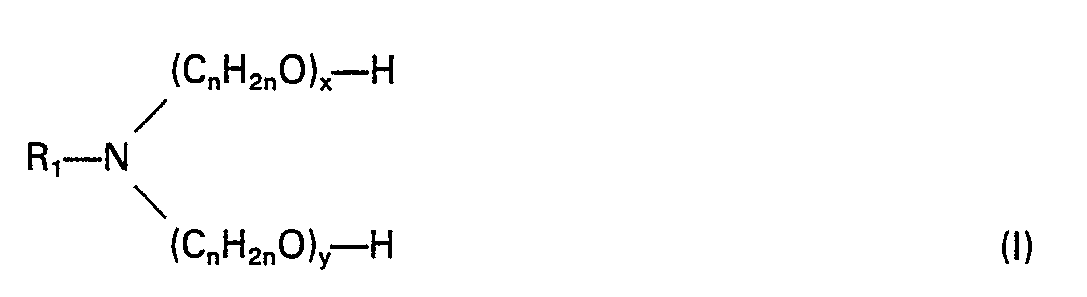
- the alkoxylated amines have the general formula I, wherein R 1 represents an alkyl or alkenyl group having from 10 to 20 carbon atoms, those corresponding to coconut, oleic, tallow, hydrogenated tallow, and hydrogenated tallow being preferred; n is an integer from 1 to 4, value 2 being preferred, which corresponds to ethoxylated amines.
- the values of x and y range between 10 and 50 in such a way that the total sum thereof ranges from 20 to 100, this is to say, the number of mols of ethylene oxide per amine mol must range from 20 to 100, although the preferred values of x + y range from 20 to 50.
- Etilenox® Pulcra
- Ethomeen® Akzo
- Genamin@ Hoechst
- Non-ionic surfactants have the general formula II, wherein R 2 represents an alkyl group of from 8 to 20 carbon atoms, for example, those corresponding to fatty alcohols like lauric, myristic, palmitic or stearic alchols, or the mixtures thereof, or an alkyl phenyl group with 7 to 10 carbons, as those corresponding to the alkyl phenols with 8 and 9 carbon atoms.
- the preferred groups are those corresponding to the lauric alcohol and nonylphenol.
- the value of n can be from 1 to 4, being the preferred value that of 2, and, therefore, the ethoxylated products. According to the invention herein, a binary system of non-ionic oxyethylenated surfactants is necessary in function of the Z value:
- binary system nonylphenol with 30 mols of ethylene oxide together with nonylphenol with 1.5 moles of ethylene oxide, with a weight ratio ranging from 3:1 to 1:3.
- compositions of the invention herein which are conventionally used in the field of fabric softeners, like dyes, perfumes, supplementary viscosity modifiers, emulgents, optical brighteners, antioxidants, germicides, fungicides, moisteners, etc.
- electrolytes as salts of divalent metals with strong acids, in weight ratios ranging between 200 and 1,500 ppm.
- electrolytes are calcium chloride and magnesium sulfate.
- auxiliary in viscosity control are linear or branched short chain alcohols from 1 to 4 carbon atoms.
- Isopropyl alcohols particularly, may be present in a proportion between 1 % and 4%, but not in a bigger proportion that may cause lack of stability.
- Optional components indicated to improve the water absorbancy of the fabrics treated with the softeners are the emulsified silicones, such as DC-347, DC-346 and DC-HV490, marketed by Dow Corning. Small amounts, of an order of 0.01% to 0.3% in active matter, are employed.
- Optical brighteners can also be employed, like, for example, derivatives of stilbene and distyrylbiphenyl, marketed by Ciba-Geigy as Tinopal®.
- 1.5 parts of ethoxylated hydrogenated tallow amine with 25 mols of ethylene oxide per mol of amine are mixed, at a temperature of 55°C, together with 1 part of ethoxylated nonylphenol with 30 mols of ethylene oxide per mol of nonylphenol and 1 part of ethoxylated nonylphenol with 1.5 mols of ethylene oxide per mol of nonylphenol.
- the said molten mixture is added to 70 parts of deionized water, at a temperature of 50° to 60°C, and with strong stirring. Hydrochloric acid 1 N is added until a pH of 3 to 4 is reached.
- the sample is again placed in the refrigerator, for another four days, and then it is removed, left to stabilize for one day at room temperature, and then the viscosity is tested at 20°C.
- the values of viscosity that have been found are:
- Dispersibility in water is approximate and orientative.
- a graduate cylinder is filled with a liter of water at 20°C ⁇ 5°C of temperature, and with a hardness of 20°FH.
- 0 means total dispersion and 10 no dispersion.
- the volume of water to which the dispersion has not arrived is measured, so that the optimal volume is that of 0 ml, and the worst one is that of 1000 ml.
- a dispersion is prepared with the following ingredients:
- the dispersion exhibits the following characteristics, determined according to the criteria established in example I:
- a dispersion is prepared with the following ingredients:
- the dispersion value exhibits the following characteristics, determined according to the criteria established in example I:
- a dispersion is prepared with the following ingredients:
- the dispersion exhibits the following characteristics, determined according to the criteria established in example I:
- the dispersions described in the examples I to IV exhibit excellent viscosity, dispersibility and stability characteristics during storage and in extreme temperature conditions for their use as fabric concentrated softeners.
Landscapes
- Chemical & Material Sciences (AREA)
- Life Sciences & Earth Sciences (AREA)
- Engineering & Computer Science (AREA)
- Chemical Kinetics & Catalysis (AREA)
- Oil, Petroleum & Natural Gas (AREA)
- Wood Science & Technology (AREA)
- Organic Chemistry (AREA)
- Treatments For Attaching Organic Compounds To Fibrous Goods (AREA)
Claims (9)
de façon telle que la proportion pondérale de ce mélange d'agents tensio-actifs non ioniques soit comprise (lire: que le rapport pondéral entre les deux agents tensio-actifs de ce mélange soit compris) dans la gamme de 10:1 à 1:10,
ces ingrédients étant dissous ou dispersés dans de l'eau à un pH allant de 3 à 5.


le rapport pondéral entre les deux agents tensio-actifs étant compris entre 3:1 et 1:3;
Priority Applications (3)
| Application Number | Priority Date | Filing Date | Title |
|---|---|---|---|
| EP19830105693 EP0128231B1 (fr) | 1983-06-10 | 1983-06-10 | Dispersions stables aqueuses concentrées de composés cationiques insolubles dans l'eau et leur préparation |
| DE8383105693T DE3373492D1 (en) | 1983-06-10 | 1983-06-10 | Stable concentrated aqueous dispersions of water-insoluble cationic compounds and preparation thereof |
| ES523600A ES8500988A1 (es) | 1983-06-10 | 1983-06-27 | Procedimiento para la obtencion de suavizantes concentrados para textiles |
Applications Claiming Priority (1)
| Application Number | Priority Date | Filing Date | Title |
|---|---|---|---|
| EP19830105693 EP0128231B1 (fr) | 1983-06-10 | 1983-06-10 | Dispersions stables aqueuses concentrées de composés cationiques insolubles dans l'eau et leur préparation |
Publications (2)
| Publication Number | Publication Date |
|---|---|
| EP0128231A1 EP0128231A1 (fr) | 1984-12-19 |
| EP0128231B1 true EP0128231B1 (fr) | 1987-09-09 |
Family
ID=8190519
Family Applications (1)
| Application Number | Title | Priority Date | Filing Date |
|---|---|---|---|
| EP19830105693 Expired EP0128231B1 (fr) | 1983-06-10 | 1983-06-10 | Dispersions stables aqueuses concentrées de composés cationiques insolubles dans l'eau et leur préparation |
Country Status (3)
| Country | Link |
|---|---|
| EP (1) | EP0128231B1 (fr) |
| DE (1) | DE3373492D1 (fr) |
| ES (1) | ES8500988A1 (fr) |
Families Citing this family (11)
| Publication number | Priority date | Publication date | Assignee | Title |
|---|---|---|---|---|
| GB8410322D0 (en) * | 1984-04-19 | 1984-05-31 | Unilever Plc | Aqueous concentrated fabric softening composition |
| US5145608A (en) * | 1986-02-06 | 1992-09-08 | Ecolab Inc. | Ethoxylated amines as solution promoters |
| DE3603579A1 (de) * | 1986-02-06 | 1987-08-13 | Henkel Kgaa | Verwendung ethoxylierter fettamine als loesungsvermittler |
| DE3643934A1 (de) * | 1986-12-22 | 1988-06-23 | Henkel Kgaa | Verwendung ausgewaehlter alkyl- und/oder alkenyl-diethanolaminverbindungen als loesungsvermittler fuer schaumarme tenside |
| JPH06506992A (ja) * | 1991-04-30 | 1994-08-04 | ザ、プロクター、エンド、ギャンブル、カンパニー | 置換イミダゾリンおよび高度にエトキシル化された化合物を含む布帛柔軟化剤 |
| MY108928A (en) * | 1992-12-22 | 1996-11-30 | Colgate Palmolive Co | Liquid fabric softening composition containing amidoamine softening compound |
| GB0014891D0 (en) * | 2000-06-16 | 2000-08-09 | Unilever Plc | Fabric softening compositions |
| WO2012005868A1 (fr) * | 2010-06-21 | 2012-01-12 | Basf Se | Composant tensioactif et composition le comprenant |
| US9719000B2 (en) | 2013-03-14 | 2017-08-01 | Basf Se | Hot melt adhesive and method of forming the same |
| US10487292B2 (en) | 2016-08-31 | 2019-11-26 | The Procter & Gamble Company | Fabric enhancer composition |
| US20190264136A1 (en) * | 2018-02-28 | 2019-08-29 | The Procter & Gamble Company | Fabric enhancer composition |
Family Cites Families (6)
| Publication number | Priority date | Publication date | Assignee | Title |
|---|---|---|---|---|
| US4157307A (en) * | 1978-08-07 | 1979-06-05 | The Procter & Gamble Company | Liquid fabric softener |
| US4233164A (en) * | 1979-06-05 | 1980-11-11 | The Proctor & Gamble Company | Liquid fabric softener |
| ATE13562T1 (de) * | 1981-01-16 | 1985-06-15 | Procter & Gamble | Textilbehandlungsmittel. |
| US4383063A (en) * | 1981-04-09 | 1983-05-10 | E. I. Du Pont De Nemours And Company | Polyvinyl alcohol based size composition |
| BE888535A (fr) * | 1981-04-23 | 1981-08-17 | Lesieur Cotelle | Compositions adoucissantes liquides pour textiles, |
| DE3135013A1 (de) * | 1981-09-04 | 1983-03-24 | Hoechst Ag, 6000 Frankfurt | "waescheweichspuelmittel" |
-
1983
- 1983-06-10 EP EP19830105693 patent/EP0128231B1/fr not_active Expired
- 1983-06-10 DE DE8383105693T patent/DE3373492D1/de not_active Expired
- 1983-06-27 ES ES523600A patent/ES8500988A1/es not_active Expired
Also Published As
| Publication number | Publication date |
|---|---|
| ES523600A0 (es) | 1984-11-01 |
| EP0128231A1 (fr) | 1984-12-19 |
| ES8500988A1 (es) | 1984-11-01 |
| DE3373492D1 (en) | 1987-10-15 |
Similar Documents
| Publication | Publication Date | Title |
|---|---|---|
| EP0056695B2 (fr) | Compositions pour le traitement de matières textiles | |
| EP0122141B1 (fr) | Compositions adoucissantes pour matières textiles | |
| US5403499A (en) | Concentrated fabric conditioning compositions | |
| EP0043622B1 (fr) | Composition d'adoucissement pour matières textiles | |
| EP0060003B1 (fr) | Compositions pour le traitement de matières textiles et leur préparation | |
| EP0013780B2 (fr) | Composition concentrée d'adoucissement pour tissus | |
| US4439335A (en) | Concentrated fabric softening compositions | |
| US4776965A (en) | Aqueous concentrated fabric softener | |
| JPS61102481A (ja) | 柔軟剤組成物 | |
| EP0280550B1 (fr) | Composition adoucissante pour textiles | |
| EP0112719A2 (fr) | Composition adoucissante pour matières textiles | |
| EP0128231A1 (fr) | Dispersions stables aqueuses concentrées de composés cationiques insolubles dans l'eau et leur préparation | |
| EP0052517B1 (fr) | Compositions concentrées d'adoucissants textiles | |
| DE3588115T2 (de) | Konzentrierte Weichmacherzusammensetzungen auf der Basis von quaternären ammoniumhaltigen kationischen oberflächenaktiven Verbindungen | |
| EP0746603B1 (fr) | Composition adoucissante pour textiles | |
| CA1232414A (fr) | Assouplissant aqueux pour textiles | |
| EP0125031B1 (fr) | Composition liquide d'assouplissement de tissus | |
| CA1204562A (fr) | Production de produits assouplisseurs de tissus | |
| US5468398A (en) | Liquid fabric softening composition | |
| KR950009498B1 (ko) | 직물 연화 조성물 | |
| US4442013A (en) | Concentrated fabric softening compositions | |
| CA1232415A (fr) | Assouplissant aqueux concentre pour tissus | |
| EP0159919A2 (fr) | Composition adoucissante aqueuse concentrée pour tissus | |
| JPH024710B2 (fr) | ||
| EP1254203B2 (fr) | Preparations de conditionnement de tissus |
Legal Events
| Date | Code | Title | Description |
|---|---|---|---|
| PUAI | Public reference made under article 153(3) epc to a published international application that has entered the european phase |
Free format text: ORIGINAL CODE: 0009012 |
|
| AK | Designated contracting states |
Designated state(s): BE CH DE FR GB IT LI NL |
|
| 17P | Request for examination filed |
Effective date: 19850508 |
|
| 17Q | First examination report despatched |
Effective date: 19860205 |
|
| ITF | It: translation for a ep patent filed | ||
| GRAA | (expected) grant |
Free format text: ORIGINAL CODE: 0009210 |
|
| AK | Designated contracting states |
Kind code of ref document: B1 Designated state(s): BE CH DE FR GB IT LI NL |
|
| REF | Corresponds to: |
Ref document number: 3373492 Country of ref document: DE Date of ref document: 19871015 |
|
| ET | Fr: translation filed | ||
| PLBE | No opposition filed within time limit |
Free format text: ORIGINAL CODE: 0009261 |
|
| STAA | Information on the status of an ep patent application or granted ep patent |
Free format text: STATUS: NO OPPOSITION FILED WITHIN TIME LIMIT |
|
| 26N | No opposition filed | ||
| PGFP | Annual fee paid to national office [announced via postgrant information from national office to epo] |
Ref country code: GB Payment date: 19900601 Year of fee payment: 8 |
|
| PGFP | Annual fee paid to national office [announced via postgrant information from national office to epo] |
Ref country code: FR Payment date: 19900620 Year of fee payment: 8 Ref country code: CH Payment date: 19900620 Year of fee payment: 8 |
|
| PGFP | Annual fee paid to national office [announced via postgrant information from national office to epo] |
Ref country code: BE Payment date: 19900629 Year of fee payment: 8 |
|
| ITTA | It: last paid annual fee | ||
| PGFP | Annual fee paid to national office [announced via postgrant information from national office to epo] |
Ref country code: NL Payment date: 19900630 Year of fee payment: 8 |
|
| PGFP | Annual fee paid to national office [announced via postgrant information from national office to epo] |
Ref country code: DE Payment date: 19900725 Year of fee payment: 8 |
|
| PG25 | Lapsed in a contracting state [announced via postgrant information from national office to epo] |
Ref country code: GB Effective date: 19910610 |
|
| PG25 | Lapsed in a contracting state [announced via postgrant information from national office to epo] |
Ref country code: LI Effective date: 19910630 Ref country code: CH Effective date: 19910630 Ref country code: BE Effective date: 19910630 |
|
| BERE | Be: lapsed |
Owner name: S.A. CAMP FABRICA DE JABONES Effective date: 19910630 |
|
| PG25 | Lapsed in a contracting state [announced via postgrant information from national office to epo] |
Ref country code: NL Effective date: 19920101 |
|
| GBPC | Gb: european patent ceased through non-payment of renewal fee | ||
| NLV4 | Nl: lapsed or anulled due to non-payment of the annual fee | ||
| PG25 | Lapsed in a contracting state [announced via postgrant information from national office to epo] |
Ref country code: FR Effective date: 19920228 |
|
| REG | Reference to a national code |
Ref country code: CH Ref legal event code: PL |
|
| PG25 | Lapsed in a contracting state [announced via postgrant information from national office to epo] |
Ref country code: DE Effective date: 19920401 |
|
| REG | Reference to a national code |
Ref country code: FR Ref legal event code: ST |