EP0128442A2 - Standard zum Farbenvergleich und Verfahren zum Gebrauch desselben - Google Patents
Standard zum Farbenvergleich und Verfahren zum Gebrauch desselben Download PDFInfo
- Publication number
- EP0128442A2 EP0128442A2 EP84106042A EP84106042A EP0128442A2 EP 0128442 A2 EP0128442 A2 EP 0128442A2 EP 84106042 A EP84106042 A EP 84106042A EP 84106042 A EP84106042 A EP 84106042A EP 0128442 A2 EP0128442 A2 EP 0128442A2
- Authority
- EP
- European Patent Office
- Prior art keywords
- color
- luminance
- value
- colored
- background
- Prior art date
- Legal status (The legal status is an assumption and is not a legal conclusion. Google has not performed a legal analysis and makes no representation as to the accuracy of the status listed.)
- Granted
Links
Images



Classifications
-
- G—PHYSICS
- G01—MEASURING; TESTING
- G01J—MEASUREMENT OF INTENSITY, VELOCITY, SPECTRAL CONTENT, POLARISATION, PHASE OR PULSE CHARACTERISTICS OF INFRARED, VISIBLE OR ULTRAVIOLET LIGHT; COLORIMETRY; RADIATION PYROMETRY
- G01J3/00—Spectrometry; Spectrophotometry; Monochromators; Measuring colours
- G01J3/46—Measurement of colour; Colour measuring devices, e.g. colorimeters
- G01J3/52—Measurement of colour; Colour measuring devices, e.g. colorimeters using colour charts
Definitions
- This invention relates generally to methods and apparatus for visually distinguishing color values, and particularly to such a method, and apparatus useful therein, for enabling more accurate results to be obtained from visual observation of color responses produced by colorimetric analytical tests such as those used to detect the presence and/or amount of various substances in test samples.
- visual measurement of the color response of a reacted solid-phase reagent test device usually involves comparison and matching of its colored response area with the predetermined colors on a scale of a standard reference chart.
- color charts are made up of a number of discretely-hued color blocks, each of which corresponds to a substantially different concentration level of the analyte in a test sample.
- the blocks are set against, and surrounded by, a solid white background.
- the accuracy of the visual-read results obtained by the foregoing methodology depends on the ease and certainty by which a human observer is able to discriminate between differing, but often closely related hues of the component color blocks of the chart. Subtle differences in hue of the blocks on such charts often correspond to large quantitative differences in analyte concentration. In order to optimize visual color discrimination, it is apparent that perceived visual differences between the color of adjacent blocks, ideally, should be maximized so that, from a visual standpoint, adjacent blocks which are observed in the same field of vision are as different in hue and intensity of color as possible to the human eye.
- the chemical reaction taking place in the test matrix after contact with an analyte in a sample should produce distinctly- colored reaction products, the spectral characteristics of which should vary dramatically with variances in the analyte concentration of the sample.
- Attempts have been made to achieve this goal to some extent in solid-phase devices by using various combinations of different chromogenic reagents in the test device, or by the inclusion of background dyes in the device which interact visually with the product chromophores to achieve a desired effect for a particular analyte concentration level.
- Color is generally accepted to be three-dimensional, having the characteristics (or color values) of hue, lightness and darkness.
- the literature seems to suggest that the optimum condition for determining how light (or how dark) qolored areas may be achieved by setting them against a background having about the same lightness/darkness Value.
- the literature seems to propose that the optimum condition for hue discrimination is when a background hue is made about equal to the hues being viewed against the background. So far as is known, however, no suggestion or disclosure has been made which sets forth a general relationship between the lightness/darkness dimension and the hue dimension, so that slight differences in the latter can be more easily perceived by selection of an appropriately light or dark background against which the hues are viewed, regardless of the actual hues of the colors being viewed.
- the "crispening effect" is described in this reference as relating only to gray samples on gray backgrounds, so that only the lightness/darkness dimensions (expressed as V, Munsell Value, or Y, luminescence factor) of the samples and backgrounds are involved.
- V Munsell Value
- Y luminescence factor
- this reference discloses that the foregoing concept can be extended to visual discrimination of colored samples differing only slightly from one another in hue, i.e., the ideal background for distinguishing between two similarly colored samples set against the background is of a hue similar to that of each of the two colored samples.
- the Judd and Wyszecki reference previously discussed refers to "lightness” as indicative only of the position of a given colored sample on a gray scale running from white to black, with no consideration of the hue or chromaticity of the sample as it relates to the "lightness” parameter.
- the hue characteristics are referred to in this reference as apparently observing similar visual discrimination principles, but independently of "lightness", that is, the background color need only be similar in hue to the two colors being perceived against it for optimum resolution of the actual hue of one color vis-a-vis the other.
- This work does not disclose or suggest any phenomenological relationship between "lightness" of a background and the ability of a human observer to accurately discriminate between colored samples set against it which may differ only slightly in hue, but not "lightness”.
- a color card is shown by Osborne, in U.S. Patent No. 2,074,704.
- the patentee seeks to bring out the full color or true color by associating or combining the colored sample or area with a black background of dull or light-absorptive finish.
- U.S. Patent No. 2,916,963 to Bouman discloses an apparatus for testing light discrimination, wherein light of different intensities and different color is the basis upon which the discrimination is made.
- Atkinson et al. U.S. Patent No. 3,438,737 (assigned to the present assignee) discloses devices for detecting protein in fluids.
- column 3 beginning at line 36, there is a discussion of the use of background coloring material in the compositions of the test devices themselves.
- U.S. Patent No. 3,653,771 to Piringer discloses a means for color evaluation of a color sample
- U.S. Patent No. 3,529,519 to Mitchell discloses an apparatus for color adjustment in photographic printing. In the latter, a background surface of neutral gray is provided for comparison purposes.
- Moyer et al. U.S. Patent No. 3,791,933, discloses a method for the rapid assay of enzyme substrates and the like. The test involves comparison between the color developed in a test spot and a conventional color chart. Furutani et al., U.S. Patent No. 4,160,646, discloses a method for analyzing liquid specimens. The test involves obtaining corrected reflectivities of the test pieces with regard to a reference piece. Faulkner, U.S. Patent No. 4,234,313, shows a testing composition where a colored indicator loses color in direct proportion to the amount of material being tested that is present. A comparison strip is also used in this system.
- U.S. Patent No. 4,330,299 to Cerami discloses a method for measuring the level of glucose in body fluids by placing a sample of the body fluid in contact with an indicator.
- a kit is also disclosed having indicator means which provides a color reaction different from that of the remaining color forming materials.
- the general configuration of many such color charts comprises a substantially solid white paper substrate having printed thereupon a series of solid colored blocks of various hues ranging from light to dark luminance as read from one side of the chart to the other.
- An indication of corresponding concentrations of an analyte is usually printed upon the chart proximate to each color block.
- luminance value a luminance factor consisting of a "percent reflectance” measurement obtained from a scanning reflectance spectrophotometer
- Yo a luminance factor obtained for a "perfect white” colored area and, therefore, is for practical purposes and in the present disclosure equal to 100.
- the factor Y can be obtained, for example, from a colored area by using a scanning reflectance spectrophotometer known as the "Rapid Scanner".
- a scanning reflectance spectrophotometer known as the "Rapid Scanner”.
- all Y measurements were taken by such a "Rapid Scanner” device interfaced with ** Source: D. Judd and C. Wyszecki, Color in Business Science and Industry, 3rd Ed. (John Wiley & Sons, New York).
- L * values describe human "lightness" perception, a * redness-greeness perception and b * yellowness-blueness perception.
- the Rapid Scanner instrument was constructed by the Ames Division of Miles Laboratories, Inc., Elkhart, Indiana, from whom complete information with respect to structural and performance characteristics is obtainable. See also, M. A. Genshaw and R. W. Rogers, Anal. Chem., Vol. 53, pp. 1949-1952 (1981).
- hue is defined as the visually observable *** CIE Recommendations on Uniform Color Spaces, Color Difference Equations and Metric Color Terms, in May, 1976 Supplement No. 2 to CIE Publication No. 15, Colorimetry (E-1.3.1), 1971. wavelength component of color produced by reflected incident light from an object, and is independent from “luminance” or "lightness/darkness”.
- the present invention provides an improved method for visually comparing the results of colorimetric test means, such as analytical tests, to a color reference standard, enabling substantially improved quantitation to be achieved for such tests.
- the present invention also provides improved apparatus, in the form of an improved color comparison reference standard, which is useful in the method.
- the standard can comprise a plurality of colored reference areas of differing hues corresponding to discrete reference values and to which a colored response area of a colorimetric analytical test can be compared to determine the reference value most closely related to the hue of the colored response area, and a background area against which the colored reference areas are displayed.
- the background area has a luminance (L * ) value of from about 15 to about 80, and the luminance (L * ) value of any portion of the background area is within about 30 of the average luminance (L * ) value of any two or more adjacent ones of the colored reference areas which are set against the portion of the background area.
- color comparison charts according to the invention which had a background luminance, or L * as previously defined, of from about 15 to about, 80, and a plurality of color blocks of varying hues displayed thereagainst, any two or more adjacent ones of such blocks having an average luminance within about 30 luminance (L * ) units of the portion of the background against which they are displayed, unexpectedly enabled the observers to more accurately match the hue responses of conventional colorimetric analytical tests with the hues of the color blocks of the chart, by comparison with similar matches obtained by the same observers using a largely conventional color chart.
- the principles and teachings of the presently disclosed invention can be applied to the improvement of techniques for instrumental or optical comparison of colors, or any other color matching techniques, such as in coating technology or other fields where precise correlation of hues is necessary and/or desirable.
- each portion of the background has a luminance (L * ) value of from about 15 to about 80, which, for example, if the overall hue of.the background is grayish, can comprise a color gradient ranging from a very light, unsaturated gray to a very dark, heavily saturated gray.
- the luminance of each portion of the background of any two or more adjacent color blocks being compared to one another, or being compared to the color response produced by an analytical test in accordance with the invention has an average luminance (L * ) value within about 30 L * units of that of the average of the adjacent color blocks.
- the luminescence value of each background portion is within about 20 L * units of the average of the color blocks compared, and most desirably, within about 10 L * units thereof.
- the most dramatic improvement, in terms of the ability of human observers to discern very subtle differences in color block hues and, therefore, to more accurately match the hue of an analytical test to an appropriate color block, has been noted for preferred embodiments of the invention having the latter features, i.e., wherein the background is at least within 20, or within 10, L * units of the color block average luminance.
- the unexpectedly advantageous visual effect produced by the invention which enables visual distinctions to be more readily and easily made between color hues set against a background area, appears to be substantially independent of the actual hue of the background area, also independent of the actual hues of the colors displayed thereagainst, and to be solely dependent upon selection of background lightness/darkness value (luminance).
- the advantageous effect produced by use of the invention appears to be substantially independent of the quality or value of the incident light under which embodiments of the invention are viewed, and so long as an observer possesses substantially normal color vision, also largely independent of human vision characteristics.
- a background can be selected which has an L * of around 20-30, to distinguish easily between subtle color block hues of very dark luminance, whereas if the colors being compared are very light and thus of much higher luminance values a comparatively light background can be selected, having an L * , for example, of from about 70-80.
- color chart hue resolution between two or more adjacent color blocks and between an analytical device and color blocks closely related in hue thereto has been greatly aided when a gradient background (in terms of luminance value) is used which varies continuously from light to dark.
- Such a preferred color comparison reference standard can comprise, for example, a color chart having a background gray against which the color block scale of the chart is displayed and which begins at about the same luminance as, e.g., light shades of adjacent yellow, green and orange blocks on one end of the chart, and continues to darken continuously such that the background luminance of the gray surrounding any two or more adjacent color blocks on the scale is within about 20, or less, L * units of the average luminance of any adjacent blocks, even though the remaining end of the chart displays substantially darker color blocks.
- luminance or amount of lightness/darkness of the background area
- simple gray gradients or a solid gray background
- suitable backgrounds can range, for example, in intensity and hue from light to dark green, light to dark blue, and light to dark brown.
- suitable color varients can be conceived by one of ordinary skill and used in the invention. Because the luminance, not the hue, of the background plays a critical part in the present invention, virtually any hue can be selected as desired for the background color so long as the luminance thereof is within the range of values herein specified.
- a typical prior art color comparison reference standard comprising a color chart for a colorimetric analytical test for glucose in urine
- the chart 10 is of a type typically used for making semiquantitative and quantitative comparisons of color developed in the solid phase reagent matrix of a test strip device for determining the presence and/or amount of glucose in urine.
- the chart 10 comprises a substantially solid white background area 11, for example of printed paper having an L * value of approximately 95, and a plurality of color blocks also printed upon the paper, as indicated by reference numerals 12 through 19.
- the paper substrate upon which the background area 11 and color blocks 12 through 19 are printed is of a conventional type for pharmaceutical labelling and has an adhesive backing, of conventional design, for adhering the chart 10 to a container for the analytical test
- the color blocks 12 through 19 are of various hues ranging from dark reddish brown (12) to medium yellow (19); adjacent ones of the blocks (e.g., 12 and 13; 13 and 14; 18 and 19; 17, 18 and 19) differ only slightly from one another in actual hue, so that the hue difference between any two or more adjacent ones thereof can be represented by a calculated ⁇ E value ranging from approximately four (4) to twenty-three (23).
- the blocks 12 through 19, as illustrated, are generally rectangular in shape and are situated so that each is surrounded by and displayed against a portion of the background area 11.
- the luminance (L * ) values of the respective color blocks 12 through 19 are, beginning with the block 12: 38.5, 41.1, 43.0, 46.2, 47.9, 59.1, 69.0 and 76.0.
- the color blocks 12 through 19 of the conventional color standard chart of Figure 1 differ only slightly in actual hue, each corresponds to a clinically significant difference in the concentration of glucose present in a urine sample, as would be indicated by matching the color thereof to the corresponding color of the reacted matrix of the aforementioned test device.
- the block 12 corresponds to a glucose level, or reference value, of 5000 or more milligrams per deciliter (mg/dl) of glucose, the block 13 to 2000 mg/dl, and the blocks 14 5 15, 16, 17, 18 and 19 to glucose concentration levels (reference values) of 1000, 500, 250, 100, 30 and 0 (negative), respectively.
- a color comparison reference standard comprising a color chart in accordance with a preferred embodiment of the present invention is indicated generally at 20.
- the chart 20, similarly to the conventional chart 10 of Figure 1, in the particular form illustrated comprises a paper substrate having an adhesive backing and is useful as a reference standard for comparing color responses thereto obtained from the reacted test matrix of a solid phase analytical device for determining glucose in urine.
- the chart 20 is substantially identical to the chart 10 in most respects except that it comprises a printed background area 21 of a substantially solid, medium brown hue (wavelength of 480 nanometers), luminance (L * ) value of 47.0, rather than a substantially solid white background having a luminance (L * ) value of about 95.
- Printed color blocks 22 through 29, inclusive which are surrounded by and displayed against a portion of the background area 21, are identically shaped and situated against the background area 21 as in the chart 10 of Figure 1.
- the color blocks 22 through 29, moreover, are of substantially identical hue and luminance as the blocks 12 through 19, respectively, of Figure 1.
- the background luminance (L * ) of the area 21, with respect to portions thereof which surround any two or more adjacent ones of the blocks 22 through 29 displayed thereagainst, unlike the conventional chart 10 of Figure 1 is within 30 luminance (L * ) units of the average luminance (L * ) of any adjacent ones of the blocks 22 through 29.
- the blocks 22 through 29 also correspond to like concentration levels (reference values) of glucose in urine, as described in Figure 1.
- the color comparison reference chart 30 comprises a paper substrate having an adhesive backing and a printed background area 31 surrounding printed color blocks 32 through 39.
- the blocks 32 through 39, inclusive, are of substantially identical shape, hue and luminance (L * ) as the blocks 22 through 29, respectively, of Figure 2, and are situated virtually identically on the chart 30.
- the background area 31 comprises a printed gradient of gray coloration, which, when viewed from the left side of the chart 30 to the right side thereof, ranges from a light medium gray to a dark medium gray, luminance (L * ) value of from about 70 to about 30.
- the luminance of the background 31 at any point surrounding any two or more adjacent ones of the blocks 32 through 39 which are displayed thereagainst is within about ten (10) L * units of the average luminance (L * ) value of the adjacent blocks.
- the blocks 32 through 39 moreover correspond to the same concentrations of glucose in urine as the blocks 22 through 29 of Figure 2.
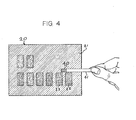
- the color chart 20 of Figure 2 is shown in use as a color reference standard for a solid phase, analytical reagent strip test for glucose in urine.
- a reacted test matrix, color response area 40 of a reagent strip 41 is shown displayed adjacent two or more of the color block areas 22 through 29 (shown adjacent blocks 22 and 23); the strip 41 is so placed that the color response area 40 is displayed against the background 21 and is observed in the same field of an observer's vision as adjacent blocks 22 and 23.
- the response area 40 is placed adjacent whichever one(s) of the blocks 22 through 29 appear to be most closely related in hue thereto and the concentration of glucose present in the urine sample being analyzed is determined or interpolated from the concentration (reference) value corresponding to the block or blocks in the observer's field of vision which are most closely related in hue, in the judgment of the observer.
- a piece of paper or other suitable substrate material can be coated or printed with colored inks using conventional techniques such as silk-screening or lithography, or other suitable substances can be used to form the background and colored areas which are displayed or set against it.
- a two-dimensional paper chart can be provided also with a suitable adhesive backing so that it can be conveniently adhered to a bottle or other container or packaging for a colorimetric test means.
- a color chart such as the particular embodiments described herein which are suitable for use with typical colorimetric tests used for determining substances in sample fluids and the like.
- Other embodiments of the invention can comprise, for example, colored cardboard, wood, metal, plastic or any other material which can be suitably colored to form a background, which, printed upon, mounted to or otherwise affixed thereto are displayed a plurality of colored areas of varying hues for viewing against the background.
- a color chart according to the invention can comprise a series of colored, fluid-filled vials, or other colored media of various sizes or shapes mounted suitably so as to be displayed against a background having the appropriate luminance value(s). Accordingly, it can be seen that the present invention is in no way limited to the specific embodiments shown in the drawings and described herein, but that the principles and advantageous features of the invention can be applied to many different forms of color comparison apparatus suited for various purposes.
- Example I In order to more fully point out and describe the advantages of the present invention, in terms of enhanced quantitation for visually-read colorimetric analytical tests, studies were conducted wherein embodiments of color charts prepared according to the invention were viewed by human observers and utilized to obtain quantitative readings from typical ones of such colorimetric tests, for comparison to similar readings obtained from color charts of largely conventional construction. The observers were selected from persons having no known color vision deficiencies.
- the charts which were prepared were of paper construction having printed thereupon a solid background color and a plurality of color blocks of differing hues, surrounded and separated one from another by the background.
- the charts, in hue, appearance, shape and arrangement of the color blocks, were substantially the same as those illustrated in Figures 1 and 2 of the Drawings and described herein in connection therewith.
- Adjacent ones of the color blocks on each chart thus differed only slightly in hue from one another on each chart, but were identical in hue as between charts, and corresponded to color responses, i.e. hues, which could be expected to be produced in the color area(s) of a solid phase reagent strip test for determining glucose in urine.
- each color block corresponded to glucose levels in urine of 0 (negative), 30, 100, 250, 500, 1000, 2000 and 5000 mg/dl, arranged as previously illustrated and described.
- the L * values of the color blocks beginning with the 0 (negative) mg/dl block and ending with the 5000 mg/dl block, were 76.0, 69.0, 59.1, 47.9, 46.2, 43.0, 41.1, and 38.5.
- the L * value, 47.0, of the background of the chart of the invention was at all points on the chart within about 30 L * units of the average L * value of any two or more adjacent color blocks.
- solid phase reagent strip test devices for urinary glucose were used to obtain color responses from urine samples previously determined to contain 0 (negative), 30, 100, 250, 500, 1000, 2000 and 5000 mg/dl of glucose.
- the glucose-containing urine samples were randomized and twenty-seven (27) observers having substantially normal color vision immersed the color-response matrix area of a set of the glucose test strips in each urine, removed the strips and compared the color developed in the matrix of each strip to the most closely corresponding color blocks, in terms of hue, of the conventional color comparison reference chart for the test, as shown in Figure 1, which had a substantially solid white background.
- the method of use of the chart and of comparison was substantially as previously described in connection with Figure 4, each color block corresponding to each level of glucose.
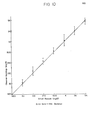
- Example II Additional studies were carried out, substantially as previously described in Example I, using substantially similar color charts and human observers, to further demonstrate the advantages of the invention over conventional color comparison apparatus and techniques. Eleven (11) observers were used in these further studies rather than the twenty-seven (27) of Example I. The results of this study are presented graphically in Figures 7 and 8, wherein it can be seen that, as in the Example I study, quantitation of visual readings of the test devices against the color chart of the invention ( Figure 8) was enhanced over readings similarly taken against the conventional, white-background color chart ( Figure 7).
- Example III Additional observer studies were carried out, substantially as described in the previous Examples. However, while the chart according to the invention which was used in this study was substantially identical to those described as used in Examples I and II, and illustrated in Figure 2, the conventional chart to which its performance was compared was one having a substantially solid white background but foreground colors ranging in hue from medium yellow to dark blue.
- This prior art chart was one designed as a standard color chart for a commercially available colorimetric test device for glucose in urine * wherein the predominant hues produced by the device are shades of blue and green, and correspond to color blocks of the chart representing glucose concentrations of 0, 100, 250, 500, 1000, 2000, 3000 and 5000 mg/dl. Urine samples containing glucose were tested and observation of the test device color responses was accomplished against each of the charts, in a manner substantially identical to that previously described in Examples I and II.
- the background papers used and their corresponding L * values were as follows:
- the color pairs (in strip format) had the following average L * values.
- ⁇ E values between the pairs are shown to provide some concept of how easily the hues of the pairs should be distinguishable.
- One ⁇ E unit of (hue) difference has been determined to be the minimum that the average human eye can discern.
- Five (5) ⁇ E unit differences between colors are detectable, but the perceived hues are quite closely related.
- the ⁇ E difference between the 2000 and 5000 mg/dl glucose levels of the previously described color blocks of the reference charts utilized in Examples I and II is about seven (7) ⁇ E units.
- the values following are the average (X) L * and ⁇ E values for the pairs.
- Mean L * values for the background preferred by the observers were obtained by averaging the L * values of the one background of each pair which was preferred by the readers.
- Example V A study was conducted to still further confirm the findings, discussed herein, that visual perception of very slight hue differences is substantially aided by selection of an appropriate background luminance (L * ) value within the range of from about 15 to about 80, and preferably within about 10 L * units of the average of the L * values of the colors being compared against the background.
Landscapes
- Spectroscopy & Molecular Physics (AREA)
- Physics & Mathematics (AREA)
- General Physics & Mathematics (AREA)
- Spectrometry And Color Measurement (AREA)
- Investigating Or Analysing Biological Materials (AREA)
- Processing Of Color Television Signals (AREA)
- Golf Clubs (AREA)
- Dental Preparations (AREA)
- Investigating Or Analysing Materials By The Use Of Chemical Reactions (AREA)
- Facsimile Image Signal Circuits (AREA)
- Testing, Inspecting, Measuring Of Stereoscopic Televisions And Televisions (AREA)
- Analysing Materials By The Use Of Radiation (AREA)
- Inspection Of Paper Currency And Valuable Securities (AREA)
- Eye Examination Apparatus (AREA)
Priority Applications (1)
| Application Number | Priority Date | Filing Date | Title |
|---|---|---|---|
| AT84106042T ATE50418T1 (de) | 1983-06-09 | 1984-05-28 | Standard zum farbenvergleich und verfahren zum gebrauch desselben. |
Applications Claiming Priority (2)
| Application Number | Priority Date | Filing Date | Title |
|---|---|---|---|
| US502462 | 1983-06-09 | ||
| US06/502,462 US4523852A (en) | 1983-06-09 | 1983-06-09 | Color comparison reference standard and method for using same |
Publications (3)
| Publication Number | Publication Date |
|---|---|
| EP0128442A2 true EP0128442A2 (de) | 1984-12-19 |
| EP0128442A3 EP0128442A3 (en) | 1986-05-21 |
| EP0128442B1 EP0128442B1 (de) | 1990-02-14 |
Family
ID=23997936
Family Applications (1)
| Application Number | Title | Priority Date | Filing Date |
|---|---|---|---|
| EP84106042A Expired - Lifetime EP0128442B1 (de) | 1983-06-09 | 1984-05-28 | Standard zum Farbenvergleich und Verfahren zum Gebrauch desselben |
Country Status (12)
| Country | Link |
|---|---|
| US (1) | US4523852A (de) |
| EP (1) | EP0128442B1 (de) |
| JP (1) | JPS608723A (de) |
| AT (1) | ATE50418T1 (de) |
| AU (1) | AU552277B2 (de) |
| CA (1) | CA1228526A (de) |
| DE (1) | DE3481374D1 (de) |
| DK (1) | DK284784A (de) |
| ES (2) | ES532955A0 (de) |
| FI (1) | FI842312A7 (de) |
| NO (1) | NO162933C (de) |
| ZA (1) | ZA843269B (de) |
Cited By (3)
| Publication number | Priority date | Publication date | Assignee | Title |
|---|---|---|---|---|
| EP0301524A3 (en) * | 1987-07-27 | 1989-07-05 | Omron Tateishi Electronics Co. | Test piece coloration comparative decision unit |
| US6157445A (en) * | 1992-01-07 | 2000-12-05 | Chromatics Color Sciences International, Inc. | Method and apparatus for detecting and measuring conditions affecting color |
| US6308088B1 (en) | 1992-01-07 | 2001-10-23 | Chromatics Color Sciences International, Inc. | Method and apparatus for detecting and measuring conditions affecting color |
Families Citing this family (53)
| Publication number | Priority date | Publication date | Assignee | Title |
|---|---|---|---|---|
| EP0144461B1 (de) * | 1983-12-14 | 1987-05-20 | DR.-ING. RUDOLF HELL GmbH | Verfahren und Schaltungsanordnung zum Erkennen von Farbtönen und Farben |
| US4657399A (en) * | 1983-12-23 | 1987-04-14 | Hall Neil R | Color mixture indicator device |
| US4931929A (en) * | 1985-01-22 | 1990-06-05 | Search & Source, Incorporated | Design component selection computer with specification of product characteristics and of color by machine readable device |
| JPS61251748A (ja) * | 1985-04-30 | 1986-11-08 | Norin Suisansyo Chikusan Shikenjo | 牛標準肉色模型の製造方法 |
| GB8608157D0 (en) * | 1986-04-03 | 1986-05-08 | Unilever Plc | Ovulation test chart |
| US4812412A (en) * | 1987-02-26 | 1989-03-14 | Health Research Inc. | Standard specimen and method of making and using same |
| US4857968A (en) * | 1987-08-06 | 1989-08-15 | Glen Peterson | Apparatus, methods and articles for internegative color balancing |
| US4871258A (en) * | 1988-04-29 | 1989-10-03 | Boehringer Mannheim Corporation | Color test meter |
| US4960565A (en) * | 1989-03-14 | 1990-10-02 | Ecostix Environmental Inc. | Acid monitoring kit |
| US5013244A (en) * | 1989-11-15 | 1991-05-07 | Davidson Jeffrey L | Colorimetric scale for correlating a shade two blended colors with the sun protection factor of a sun screening agent |
| JP2512979Y2 (ja) * | 1989-12-14 | 1996-10-02 | 諏訪貿易株式会社 | 宝石保証書 |
| US5132085A (en) * | 1991-02-28 | 1992-07-21 | Eastman Kodak Company | Test device with novel control symbolism |
| US5182707A (en) * | 1990-07-23 | 1993-01-26 | Healthdyne, Inc. | Apparatus for recording reagent test strip data by comparison to color lights on a reference panel |
| US5217744A (en) * | 1991-04-30 | 1993-06-08 | Little Jr Frederick N | Paint color testing method |
| US5217377A (en) * | 1991-04-30 | 1993-06-08 | Little Jr Frederick N | Paint color testing kit and method |
| US5240414A (en) * | 1993-01-05 | 1993-08-31 | Thompson Charles C | Method for shade selection in restorative dentistry |
| US5754184A (en) * | 1993-01-06 | 1998-05-19 | Eastman Kodak Company | Digital color system and method which provides a visual match across different input and output viewing conditions |
| EP0693686A3 (de) * | 1994-07-19 | 1997-07-23 | Basf Corp | Verfahren und Kit zur Analyse der Eigenschaften einer Farbe |
| US5967775A (en) * | 1997-07-02 | 1999-10-19 | Dental Devices, Llc | Dental color comparator device |
| US6061128A (en) * | 1997-09-04 | 2000-05-09 | Avocet Medical, Inc. | Verification device for optical clinical assay systems |
| JP3267925B2 (ja) * | 1998-04-07 | 2002-03-25 | 京セラミタ株式会社 | 粉体塗料の調色方法 |
| JP3052290B1 (ja) * | 1999-03-19 | 2000-06-12 | 健次 中島 | 動物用検尿スティック |
| US6629057B2 (en) | 1999-11-05 | 2003-09-30 | Beckman Coulter, Inc. | Comprehensive verification systems and methods for analyzer-read clinical assays |
| US6842654B2 (en) * | 2000-10-05 | 2005-01-11 | Ewarna.Com International Holdings Limited | System, and method for online color algorithm exchange |
| US6734973B1 (en) | 2001-02-06 | 2004-05-11 | The Regents Of The University Of California | Method and apparatus for determining plant nutrient status |
| US6998185B2 (en) * | 2002-01-11 | 2006-02-14 | Hewlett-Packard Development Company, L.P. | Dye-based fuel indicator system for fuel cells |
| US6717673B1 (en) | 2002-10-02 | 2004-04-06 | 3M Innovative Properties Company | Method of color-matching |
| US6982108B2 (en) * | 2002-10-02 | 2006-01-03 | 3M Innovative Properties Company | Color-matching article |
| US7773460B2 (en) * | 2002-11-04 | 2010-08-10 | Lindsay Holt | Medication regimen communicator apparatus and method |
| CA2538587A1 (en) * | 2003-09-19 | 2005-03-31 | Quidel Corporation | Iconic colorimetric test device with reduced susceptibility to false positive and false negative readings |
| US7266994B1 (en) * | 2003-11-12 | 2007-09-11 | Marathon Ashland Petroleum Co. | Measuring particulate in liquid storage tanks |
| US8003061B2 (en) * | 2004-05-06 | 2011-08-23 | Akers Biosciences, Inc. | Test strip card |
| US20070031914A1 (en) * | 2005-08-05 | 2007-02-08 | Wei Zhu | Devices for analyte assays and methods of use |
| JP4793074B2 (ja) * | 2006-04-20 | 2011-10-12 | 和光純薬工業株式会社 | 分析装置及び測定方法 |
| US7474390B2 (en) * | 2006-05-26 | 2009-01-06 | Lifescan Scotland Limited | Test strip with permutative grey scale calibration pattern |
| US7589828B2 (en) * | 2006-05-26 | 2009-09-15 | Lifescan Scotland Limited | System for analyte determination that includes a permutative grey scale calibration pattern |
| US7593097B2 (en) * | 2006-05-26 | 2009-09-22 | Lifescan Scotland Limited | Method for determining a test strip calibration code for use in a meter |
| US7586590B2 (en) * | 2006-05-26 | 2009-09-08 | Lifescan, Scotland, Ltd. | Calibration code strip with permutative grey scale calibration pattern |
| US7474391B2 (en) * | 2006-05-26 | 2009-01-06 | Lifescan Scotland Limited | Method for determining a test strip calibration code using a calibration strip |
| US9242389B2 (en) | 2012-01-23 | 2016-01-26 | The DILLON Group, Inc. | Draw down paint sample card and methods |
| US9345308B2 (en) * | 2013-03-14 | 2016-05-24 | Studio Dror, Inc. | Device for color matching a cosmetic composition with the skin shade of a person |
| US9068968B2 (en) | 2013-07-02 | 2015-06-30 | Daniel Gordon DRURY | Urine analysis device, method and system |
| US11030778B2 (en) * | 2014-03-31 | 2021-06-08 | Healthy.Io Ltd. | Methods and apparatus for enhancing color vision and quantifying color interpretation |
| US10068329B2 (en) * | 2014-05-12 | 2018-09-04 | Healthy.Io Ltd | Method and system for automated visual analysis of a dipstick using standard user equipment |
| US10991096B2 (en) | 2014-05-12 | 2021-04-27 | Healthy.Io Ltd. | Utilizing personal communications devices for medical testing |
| US11087467B2 (en) | 2014-05-12 | 2021-08-10 | Healthy.Io Ltd. | Systems and methods for urinalysis using a personal communications device |
| US9972077B2 (en) * | 2014-05-12 | 2018-05-15 | Healthy.Io Ltd. | Method and system for automated visual analysis of a dipstick using standard user equipment |
| GB201413047D0 (en) * | 2014-07-23 | 2014-09-03 | Boots Co Plc | Method of selecting colour cosmetics |
| CN109030480B (zh) * | 2018-08-16 | 2021-03-19 | 湖南友哲科技有限公司 | 样品分析方法、装置、可读存储介质及计算机设备 |
| FR3105408B1 (fr) | 2019-12-23 | 2021-12-03 | cosnova GmbH | Mesure de la couleur d’une cible zone d’intérêt d’un materieau, à éclairement contrôlé |
| FR3105407B1 (fr) | 2019-12-23 | 2021-12-03 | cosnova GmbH | Mesure de la couleur d'une cible zone d'intérêt d’un materiau, avec des cibles d’etalonnage de couleur |
| RU200112U1 (ru) * | 2020-01-29 | 2020-10-07 | Федеральное государственное учреждение "Федеральный исследовательский центр "Фундаментальные основы биотехнологии" Российской академии наук" (ФИЦ Биотехнологии РАН) | Карта сравнения для количественной интерпретации результатов иммунохроматографических тестов |
| CN114965323B (zh) * | 2022-06-23 | 2024-11-12 | 秦皇岛水熊科技有限公司 | 一种光谱滴定分析方法中测量数据有效性的判定方法、系统及装置 |
Family Cites Families (13)
| Publication number | Priority date | Publication date | Assignee | Title |
|---|---|---|---|---|
| US1070891A (en) * | 1912-10-04 | 1913-08-19 | Robert William Hochstetter | Color-comparer. |
| US1389836A (en) * | 1919-07-07 | 1921-09-06 | Mooney Melvin | Colorimeter and the like |
| US1598899A (en) * | 1925-03-18 | 1926-09-07 | Carl S Plaut | Color meter |
| US2074704A (en) * | 1933-09-02 | 1937-03-23 | Glenn E Osborne | Color card |
| US2245557A (en) * | 1938-12-22 | 1941-06-17 | Cities Service Oil Co | Apparatus for testing used lubricating oils |
| NL84710C (de) * | 1954-04-03 | |||
| US3438737A (en) * | 1965-10-01 | 1969-04-15 | Miles Lab | Protein test composition,device and method |
| US3529519A (en) * | 1968-04-11 | 1970-09-22 | Heath Co | Method and apparatus for color adjusting in photographic printing |
| US3653771A (en) * | 1969-10-29 | 1972-04-04 | Fritz Piringer | Method and devices for the determination of colors and color tolerances in a visual manner in any kind of artificial light or sunlight |
| US3791933A (en) * | 1971-02-25 | 1974-02-12 | Geomet | Rapid methods for assay of enzyme substrates and metabolites |
| AT347600B (de) * | 1974-11-11 | 1979-01-10 | Wellcome Found | Testeinrichtungen |
| JPS59779B2 (ja) * | 1977-01-20 | 1984-01-09 | 株式会社京都第一科学 | 尿等の分析方法 |
| US4330299A (en) * | 1981-03-09 | 1982-05-18 | Evreka, Inc. | Article and method for measuring glucose level in body fluids |
-
1983
- 1983-06-09 US US06/502,462 patent/US4523852A/en not_active Expired - Fee Related
-
1984
- 1984-04-27 CA CA000453030A patent/CA1228526A/en not_active Expired
- 1984-05-02 ZA ZA843269A patent/ZA843269B/xx unknown
- 1984-05-24 NO NO842075A patent/NO162933C/no unknown
- 1984-05-28 DE DE8484106042T patent/DE3481374D1/de not_active Expired - Fee Related
- 1984-05-28 EP EP84106042A patent/EP0128442B1/de not_active Expired - Lifetime
- 1984-05-28 AU AU28756/84A patent/AU552277B2/en not_active Ceased
- 1984-05-28 AT AT84106042T patent/ATE50418T1/de not_active IP Right Cessation
- 1984-05-30 ES ES532955A patent/ES532955A0/es active Granted
- 1984-06-07 FI FI842312A patent/FI842312A7/fi not_active Application Discontinuation
- 1984-06-08 DK DK284784A patent/DK284784A/da not_active Application Discontinuation
- 1984-06-08 JP JP59116721A patent/JPS608723A/ja active Granted
-
1985
- 1985-03-01 ES ES540887A patent/ES540887A0/es active Granted
Cited By (4)
| Publication number | Priority date | Publication date | Assignee | Title |
|---|---|---|---|---|
| EP0301524A3 (en) * | 1987-07-27 | 1989-07-05 | Omron Tateishi Electronics Co. | Test piece coloration comparative decision unit |
| US6157445A (en) * | 1992-01-07 | 2000-12-05 | Chromatics Color Sciences International, Inc. | Method and apparatus for detecting and measuring conditions affecting color |
| US6308088B1 (en) | 1992-01-07 | 2001-10-23 | Chromatics Color Sciences International, Inc. | Method and apparatus for detecting and measuring conditions affecting color |
| US6437863B1 (en) | 1992-01-07 | 2002-08-20 | Chromatics Color Sciences International, Inc. | Method and apparatus for detecting and measuring conditions affecting color |
Also Published As
| Publication number | Publication date |
|---|---|
| DE3481374D1 (de) | 1990-03-22 |
| CA1228526A (en) | 1987-10-27 |
| ES8603074A1 (es) | 1985-12-01 |
| ES8600811A1 (es) | 1985-10-16 |
| FI842312A0 (fi) | 1984-06-07 |
| NO842075L (no) | 1984-12-10 |
| DK284784A (da) | 1984-12-10 |
| EP0128442A3 (en) | 1986-05-21 |
| US4523852A (en) | 1985-06-18 |
| DK284784D0 (da) | 1984-06-08 |
| ZA843269B (en) | 1984-11-28 |
| AU552277B2 (en) | 1986-05-29 |
| NO162933C (no) | 1990-03-07 |
| ATE50418T1 (de) | 1990-02-15 |
| FI842312A7 (fi) | 1984-12-10 |
| JPS608723A (ja) | 1985-01-17 |
| ES532955A0 (es) | 1985-10-16 |
| EP0128442B1 (de) | 1990-02-14 |
| NO162933B (no) | 1989-11-27 |
| AU2875684A (en) | 1984-12-20 |
| ES540887A0 (es) | 1985-12-01 |
| JPH0418611B2 (de) | 1992-03-27 |
Similar Documents
| Publication | Publication Date | Title |
|---|---|---|
| EP0128442B1 (de) | Standard zum Farbenvergleich und Verfahren zum Gebrauch desselben | |
| Kelly et al. | Color: universal language and dictionary of names | |
| Post et al. | Correlations between field and laboratory measurements of soil color | |
| US5313267A (en) | Method and instrument for selecting personal compatible colors | |
| Hutchings | Instrumental specification | |
| EP0932038B1 (de) | Verfahren zum Klassifizieren und Anordnen von metallischen Lackfarben | |
| AU7525100A (en) | Method for colour matching by means of an electronic imaging device | |
| JP2001264327A (ja) | 視覚的効果を生じる比色ストリップ | |
| Pointer | Measuring colour rendering—a new approach | |
| Smedley | Discrimination between beers with small colour differences using the CIELAB colour space | |
| Gajadhur | CIELAB substrate and ink parameters influence on ink fluorescence intensity | |
| US11385103B2 (en) | Water color pigment solutions for use with reflectance-based diagnostic analyzers | |
| Pointer | Measuring colour reproduction | |
| Scofield et al. | A proposed method of designating color | |
| KR960006367B1 (ko) | 표준시료 및 이 시료를 사용한 석유제품의 astm색의 기기측정방법 | |
| KR970003311B1 (ko) | 표준시료 및 이 시료를 사용한 석유제품의 astm색의 기기측정 방법 | |
| Kim | The influence of parametric effects on the appearance of small colour differences | |
| Anders | Control of Whites: The Cibanoid White Scale | |
| Green-Armytage | Seven kinds of colour | |
| JPH0755570A (ja) | 標本の色彩と光沢度から再現データまたは評価のデータを取得する装置 | |
| JP3318912B1 (ja) | 三刺激値直読測色装置 | |
| US5864396A (en) | Color comparator system | |
| Billmeyer Jr et al. | Color and light | |
| Chichester | Comparison of Color-Measuring Instruments | |
| Bulger | A Colorimetric analysis of color variation due to changes in simulated ink trapping |
Legal Events
| Date | Code | Title | Description |
|---|---|---|---|
| PUAI | Public reference made under article 153(3) epc to a published international application that has entered the european phase |
Free format text: ORIGINAL CODE: 0009012 |
|
| 17P | Request for examination filed |
Effective date: 19840528 |
|
| AK | Designated contracting states |
Designated state(s): AT BE CH DE FR GB IT LI LU NL SE |
|
| PUAL | Search report despatched |
Free format text: ORIGINAL CODE: 0009013 |
|
| AK | Designated contracting states |
Kind code of ref document: A3 Designated state(s): AT BE CH DE FR GB IT LI LU NL SE |
|
| RAP1 | Party data changed (applicant data changed or rights of an application transferred) |
Owner name: MILES INC. |
|
| 17Q | First examination report despatched |
Effective date: 19880427 |
|
| GRAA | (expected) grant |
Free format text: ORIGINAL CODE: 0009210 |
|
| AK | Designated contracting states |
Kind code of ref document: B1 Designated state(s): AT BE CH DE FR GB IT LI LU NL SE |
|
| REF | Corresponds to: |
Ref document number: 50418 Country of ref document: AT Date of ref document: 19900215 Kind code of ref document: T |
|
| ITF | It: translation for a ep patent filed | ||
| ET | Fr: translation filed | ||
| REF | Corresponds to: |
Ref document number: 3481374 Country of ref document: DE Date of ref document: 19900322 |
|
| PGFP | Annual fee paid to national office [announced via postgrant information from national office to epo] |
Ref country code: AT Payment date: 19900507 Year of fee payment: 7 |
|
| PGFP | Annual fee paid to national office [announced via postgrant information from national office to epo] |
Ref country code: CH Payment date: 19900508 Year of fee payment: 7 |
|
| PGFP | Annual fee paid to national office [announced via postgrant information from national office to epo] |
Ref country code: BE Payment date: 19900523 Year of fee payment: 7 |
|
| PGFP | Annual fee paid to national office [announced via postgrant information from national office to epo] |
Ref country code: SE Payment date: 19900528 Year of fee payment: 7 |
|
| PG25 | Lapsed in a contracting state [announced via postgrant information from national office to epo] |
Ref country code: LU Free format text: LAPSE BECAUSE OF NON-PAYMENT OF DUE FEES Effective date: 19900531 |
|
| PGFP | Annual fee paid to national office [announced via postgrant information from national office to epo] |
Ref country code: LU Payment date: 19900611 Year of fee payment: 7 |
|
| PG25 | Lapsed in a contracting state [announced via postgrant information from national office to epo] |
Ref country code: NL Effective date: 19901201 |
|
| PLBE | No opposition filed within time limit |
Free format text: ORIGINAL CODE: 0009261 |
|
| STAA | Information on the status of an ep patent application or granted ep patent |
Free format text: STATUS: NO OPPOSITION FILED WITHIN TIME LIMIT |
|
| NLV4 | Nl: lapsed or anulled due to non-payment of the annual fee | ||
| 26N | No opposition filed | ||
| PG25 | Lapsed in a contracting state [announced via postgrant information from national office to epo] |
Ref country code: AT Effective date: 19910528 |
|
| PG25 | Lapsed in a contracting state [announced via postgrant information from national office to epo] |
Ref country code: SE Effective date: 19910529 |
|
| ITTA | It: last paid annual fee | ||
| PG25 | Lapsed in a contracting state [announced via postgrant information from national office to epo] |
Ref country code: LI Effective date: 19910531 Ref country code: CH Effective date: 19910531 Ref country code: BE Effective date: 19910531 |
|
| BERE | Be: lapsed |
Owner name: MILES INC. Effective date: 19910531 |
|
| REG | Reference to a national code |
Ref country code: CH Ref legal event code: PL |
|
| PGFP | Annual fee paid to national office [announced via postgrant information from national office to epo] |
Ref country code: DE Payment date: 19940414 Year of fee payment: 11 |
|
| PGFP | Annual fee paid to national office [announced via postgrant information from national office to epo] |
Ref country code: FR Payment date: 19940428 Year of fee payment: 11 |
|
| PGFP | Annual fee paid to national office [announced via postgrant information from national office to epo] |
Ref country code: GB Payment date: 19940518 Year of fee payment: 11 |
|
| EUG | Se: european patent has lapsed |
Ref document number: 84106042.9 Effective date: 19911209 |
|
| PG25 | Lapsed in a contracting state [announced via postgrant information from national office to epo] |
Ref country code: GB Effective date: 19950528 |
|
| GBPC | Gb: european patent ceased through non-payment of renewal fee |
Effective date: 19950528 |
|
| PG25 | Lapsed in a contracting state [announced via postgrant information from national office to epo] |
Ref country code: DE Effective date: 19960201 |
|
| PG25 | Lapsed in a contracting state [announced via postgrant information from national office to epo] |
Ref country code: FR Effective date: 19960229 |
|
| REG | Reference to a national code |
Ref country code: FR Ref legal event code: ST |
|
| REG | Reference to a national code |
Ref country code: FR Ref legal event code: ST |