EP0128861A2 - Polyaminamide enthaltend Polyalkylpiperidinylreste - Google Patents
Polyaminamide enthaltend Polyalkylpiperidinylreste Download PDFInfo
- Publication number
- EP0128861A2 EP0128861A2 EP84810211A EP84810211A EP0128861A2 EP 0128861 A2 EP0128861 A2 EP 0128861A2 EP 84810211 A EP84810211 A EP 84810211A EP 84810211 A EP84810211 A EP 84810211A EP 0128861 A2 EP0128861 A2 EP 0128861A2
- Authority
- EP
- European Patent Office
- Prior art keywords
- butyl
- hydrogen
- tert
- formula
- alkyl
- Prior art date
- Legal status (The legal status is an assumption and is not a legal conclusion. Google has not performed a legal analysis and makes no representation as to the accuracy of the status listed.)
- Granted
Links
Classifications
-
- C—CHEMISTRY; METALLURGY
- C07—ORGANIC CHEMISTRY
- C07D—HETEROCYCLIC COMPOUNDS
- C07D295/00—Heterocyclic compounds containing polymethylene-imine rings with at least five ring members, 3-azabicyclo [3.2.2] nonane, piperazine, morpholine or thiomorpholine rings, having only hydrogen atoms directly attached to the ring carbon atoms
- C07D295/16—Heterocyclic compounds containing polymethylene-imine rings with at least five ring members, 3-azabicyclo [3.2.2] nonane, piperazine, morpholine or thiomorpholine rings, having only hydrogen atoms directly attached to the ring carbon atoms acylated on ring nitrogen atoms
- C07D295/18—Heterocyclic compounds containing polymethylene-imine rings with at least five ring members, 3-azabicyclo [3.2.2] nonane, piperazine, morpholine or thiomorpholine rings, having only hydrogen atoms directly attached to the ring carbon atoms acylated on ring nitrogen atoms by radicals derived from carboxylic acids, or sulfur or nitrogen analogues thereof
- C07D295/182—Radicals derived from carboxylic acids
- C07D295/185—Radicals derived from carboxylic acids from aliphatic carboxylic acids
-
- C—CHEMISTRY; METALLURGY
- C07—ORGANIC CHEMISTRY
- C07D—HETEROCYCLIC COMPOUNDS
- C07D211/00—Heterocyclic compounds containing hydrogenated pyridine rings, not condensed with other rings
- C07D211/04—Heterocyclic compounds containing hydrogenated pyridine rings, not condensed with other rings with only hydrogen or carbon atoms directly attached to the ring nitrogen atom
- C07D211/06—Heterocyclic compounds containing hydrogenated pyridine rings, not condensed with other rings with only hydrogen or carbon atoms directly attached to the ring nitrogen atom having no double bonds between ring members or between ring members and non-ring members
- C07D211/36—Heterocyclic compounds containing hydrogenated pyridine rings, not condensed with other rings with only hydrogen or carbon atoms directly attached to the ring nitrogen atom having no double bonds between ring members or between ring members and non-ring members with hetero atoms or with carbon atoms having three bonds to hetero atoms with at the most one bond to halogen, e.g. ester or nitrile radicals, directly attached to ring carbon atoms
- C07D211/56—Nitrogen atoms
- C07D211/58—Nitrogen atoms attached in position 4
-
- C—CHEMISTRY; METALLURGY
- C07—ORGANIC CHEMISTRY
- C07D—HETEROCYCLIC COMPOUNDS
- C07D401/00—Heterocyclic compounds containing two or more hetero rings, having nitrogen atoms as the only ring hetero atoms, at least one ring being a six-membered ring with only one nitrogen atom
- C07D401/14—Heterocyclic compounds containing two or more hetero rings, having nitrogen atoms as the only ring hetero atoms, at least one ring being a six-membered ring with only one nitrogen atom containing three or more hetero rings
-
- C—CHEMISTRY; METALLURGY
- C08—ORGANIC MACROMOLECULAR COMPOUNDS; THEIR PREPARATION OR CHEMICAL WORKING-UP; COMPOSITIONS BASED THEREON
- C08G—MACROMOLECULAR COMPOUNDS OBTAINED OTHERWISE THAN BY REACTIONS ONLY INVOLVING UNSATURATED CARBON-TO-CARBON BONDS
- C08G69/00—Macromolecular compounds obtained by reactions forming a carboxylic amide link in the main chain of the macromolecule
- C08G69/02—Polyamides derived from amino-carboxylic acids or from polyamines and polycarboxylic acids
- C08G69/26—Polyamides derived from amino-carboxylic acids or from polyamines and polycarboxylic acids derived from polyamines and polycarboxylic acids
-
- C—CHEMISTRY; METALLURGY
- C08—ORGANIC MACROMOLECULAR COMPOUNDS; THEIR PREPARATION OR CHEMICAL WORKING-UP; COMPOSITIONS BASED THEREON
- C08G—MACROMOLECULAR COMPOUNDS OBTAINED OTHERWISE THAN BY REACTIONS ONLY INVOLVING UNSATURATED CARBON-TO-CARBON BONDS
- C08G73/00—Macromolecular compounds obtained by reactions forming a linkage containing nitrogen with or without oxygen or carbon in the main chain of the macromolecule, not provided for in groups C08G12/00 - C08G71/00
- C08G73/02—Polyamines
- C08G73/028—Polyamidoamines
-
- C—CHEMISTRY; METALLURGY
- C08—ORGANIC MACROMOLECULAR COMPOUNDS; THEIR PREPARATION OR CHEMICAL WORKING-UP; COMPOSITIONS BASED THEREON
- C08K—Use of inorganic or non-macromolecular organic substances as compounding ingredients
- C08K5/00—Use of organic ingredients
- C08K5/16—Nitrogen-containing compounds
- C08K5/34—Heterocyclic compounds having nitrogen in the ring
- C08K5/3412—Heterocyclic compounds having nitrogen in the ring having one nitrogen atom in the ring
- C08K5/3432—Six-membered rings
- C08K5/3435—Piperidines
Definitions
- the present invention relates to a new class of polymeric compounds containing piperidinyl residues and their use for stabilizing polymers.
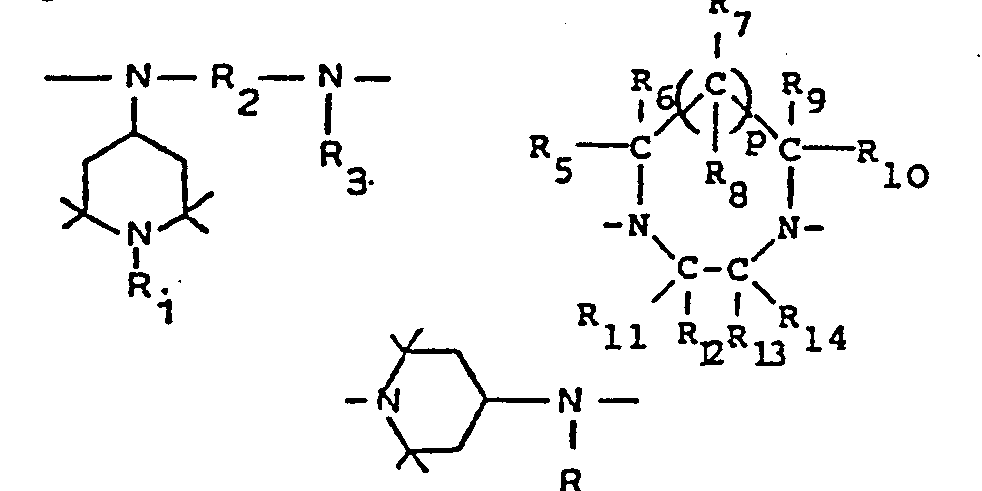
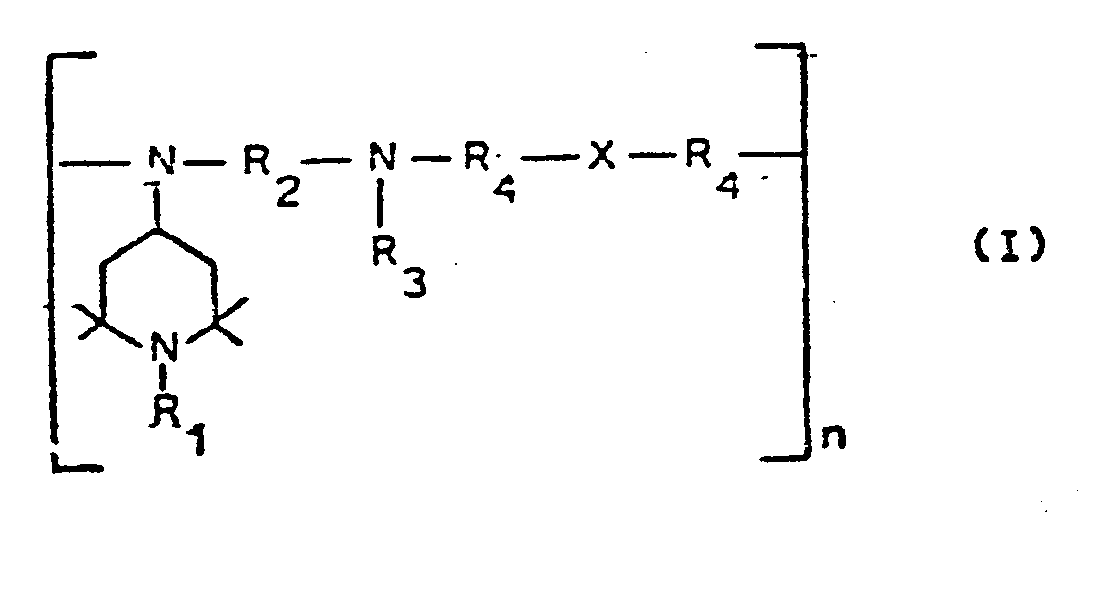
- the present invention accordingly relates to compounds of the general formula 1 wherein R 1 is hydrogen, 0 °, CH 2 CN, C 1 -C 12 alkyl, C3-C12 alkenyl, C 3 - C 12 alkynyl, unsubstituted or substituted C 7 -C 12 aralkyl or C 1 -C 12 acyl, R 2 C 2 -C 18 alkylene, C 5 -C 18 cycloalkylene, C 6 -C 18 arylene or C 7 -C 18 aralkylene, R 3 is hydrogen, C 1 -C 18 alkyl, C 5 -C 18 C y CLO alkyl, unsubstituted or substituted C6-C18 aryl, unsubstituted or substituted C 7 -C 18 aralkyl or a radical of the formula II is, wherein R 1 has the meaning given above, both R 4 radicals one
- X is a divalent radical containing one or more heterocyclic radicals of the formulas III, IV or V is where R 1 , R 2 and R 3 have the meaning given above, p is zero or 1 , R 5 , R 6 , R 7 , R 8 , R 9 , R 10 , R 11 , R 12 , R 13 and R 14 is hydrogen or methyl, R 15 is hydrogen, C 1 -C 18 alkyl, C 5 -C 18 cycloalkyl, un - unsubstituted or substituted C 6 -C 18 aryl or C 7 -C 18 aralkyl or a radical of formula II is and n represents a number from 2 to 100.
- Substituted aryl or aralkyl means aryl or aralkyl substituted by hydroxyl and / or by one or more C 1 -C 4 alkyl groups.
- Preferred compounds of the formula I are those in which R 1 is hydrogen, C 1 -C 6 alkyl, C 3 -C 6 alkenyl or alkynyl, benzyl or C 1 -C 6 acyl, R 2 C2-C 12 alkylene, C 6 -C 10 is cycloalkylene or C 8 -C 10 aralkylene, R 3 is C 1 -C 12 alkyl, C 6 -C 10 cycloalkyl or a radical of the formula II in which R 1 is hydrogen, methyl, allyl, benzyl or acetyl, R 15 Is hydrogen, C 1 -C 12 alkyl, C 6 -C 10 cycloalkyl, benzyl or a radical of the formula II in which R is hydrogen, methyl, allyl, benzyl or acetyl, m is a number from 1 to 5 and n is a number of Are 2 to 50.
- R 1 is hydrogen or methyl
- R 7 , R 8 , R 111 R 12 ' R 13 and R 14 are hydrogen
- R 15 is hydrogen or C 1 -C 4 alkyl
- m the number 1 or 2 and n represent a number from 2 to 20.
- Suitable solvents for carrying out the above-mentioned reaction are, for example, benzene, toluene, xylene, ethylbenzene, trimethylbenzene, tetralin, decalin, methanol, ethanol, isopropanol, n-butanol, butan-2-ol, isobutanol, n-pentanol, isopentanol, t-pentanol , n-hexanol, 4-methyl-pentan-2-ol, 2-methoxyethanol, 2-ethoxyethanol, 2-butoxyethanol, tetrahydrofuran, dioxane, dibutyl ether, 1,2-dimethoxyethane, 1,2-diethoxyethane, diethylene glycol dimethyl ether, diethylene glycol -diethyl ether, N, N-dimethylformamide, N, N-dimethylacetamide, N-methylpyrrolidone and di
- the reaction is carried out in the presence of an organic or inorganic base, e.g. Pyridine, triethylamine, tributylamine, sodium hydroxide, potassium hydroxide, sodium carbonate or potassium carbonate, the base having to be used at least in the equivalent amount in relation to the hydrogen chloride formed.
- organic or inorganic base e.g. Pyridine, triethylamine, tributylamine, sodium hydroxide, potassium hydroxide, sodium carbonate or potassium carbonate, the base having to be used at least in the equivalent amount in relation to the hydrogen chloride formed.
- the bis-halogenamides of the formula VI are known or, if some are still new, they can be prepared by known methods, for example by reacting a haloacyl halide with a diamine of the formula VII.
- the inorganic products are filtered off and the filtrate is evaporated to dryness.
- heating is initially carried out at normal pressure to 160 ° C and then a vacuum is applied while maintaining the same temperature (1.3 mbar).
- a yellowish resinous product with mp 115-123 ° C. and average molecular weight Mn 4400 is obtained.
- Example 12 49.1 g (0.1 mol) of N, N'-bis (chloroacetyl) -N, N'-bis- (2,2,6,6-tetramethyl-piperidin-4-yl) -l , 2-diaminoethane, 39.4 g (0.1 mol) of N, N'-bis- (2,2,6,6-tetramethyl-piperidin-4-yl) -l, 6-diaminohexane, 8.4 g Sodium hydroxide and 200 ml of 2-ethoxyethanol are mixed and boiled under reflux for 16 hours. The inorganic products are then filtered off and the solvent is evaporated off. A yellowish resinous solid substance is obtained with a melting point of 120-129 ° C. and Mn 2200.
- Example 13 33.7 g (0.1 mol) of 1-chloroacetyl-4- (N-ethylchloroacetamido) -2,2,6,6-tetramethyl-piperidine, 39.4 g (0.1 mol) of N, N '-Bis- (2,2,6,6-tetramethyl-piperidin-4-yl) -1, 6-diaminohexane, 100 ml of N, N-dimethylformamide and 27.6 g (0.2 mol) of potassium carbonate are mixed and Heated to 100 ° C for 16 hours. The insoluble products are then separated off by filtration and the solvent is evaporated off. A resinous solid substance with mp 80-92 ° C. and Mn 1800 is obtained.
- Example 14 54.7 g (0.1 mol) of N, N'-bis (3-chloropropionyl) -N, N'-bis (2,2,6,6-tetramethyl-piperidin-4-yl) -1,6-diaminohexane, 8.6 g (0.1 mol) of piperazine and 150 ml of methyl isobutylcarbinol are mixed and boiled under reflux for 4 hours. After 8 g of sodium hydroxide have been added, the mixture is boiled under reflux for a further 6 hours. The inorganic products are then separated off by filtration and the solvent is evaporated off. A yellowish solid substance with mp 87-95 ° C. and Mn 2000 is obtained.
- Example 15 50 g of the compound from Example 13, 13.8 g of paraformaldehyde, 24 g of 88% formic acid and 100 ml of water are mixed and boiled under reflux for 10 hours. After cooling, a solution of 18 g of sodium hydroxide in 200 ml of water is added and the reaction mixture is stirred for one hour at room temperature. The precipitated product is filtered off, washed with water and dried. A product with mp 92-100 ° C. and Mn 4500 is obtained.
- the compounds of the formula I are very effective in improving the light, heat and oxidation resistance of synthetic polymers such as, for example, high or low density polyethylene, polypropylene, ethylene / propylene copolymers, ethylene / vinyl acetate copolymers, polybutadiene, polyisoprene, polystyrene,
- synthetic polymers such as, for example, high or low density polyethylene, polypropylene, ethylene / propylene copolymers, ethylene / vinyl acetate copolymers, polybutadiene, polyisoprene, polystyrene,
- the compounds of the formula I can be used in a mixture with synthetic polymers in various proportions, which depend on the type of polymer, the end use and the presence of further additives. In general, it is advantageous to use 0.01 to 5% by weight of the compounds of the formula I, based on the weight of the polymers, preferably 0.1 to 1%.
- the compounds of the formula I can be incorporated into the polymeric materials by various methods, such as by dry mixing in powder form or wet mixing in the form of a solution or suspension or else in the form of a concentrated premix; the synthetic polymer can be used in the form of powder, granules, solution, suspension or latex.
- the polymers stabilized with the products of the formula I can be used for the production of moldings, foils, tapes, continuous filaments, lacquers, etc.
- esters of ß- (3,5-di-tert-butyl-4-hydroxyphenyl) propionic acid with mono- or polyhydric alcohols e.g.
- 2-hydroxybenzophenones e.g. the 4-hydroxy, 4-methoxy, 4-octoxy, 4-decyloxy, 4-dodecyloxy, 4-benzyloxy, 4,2 ', 4'-trihydroxy, 2'-hydroxy-4,4 '-dimethoxy derivative.
- Esters of optionally substituted benzoic acids e.g. 4-tert.butylphenylsalicylate, phenylsalicylate, octylphenylsalicylate, dibenzoylresorcinol, bis- (4-tert.butylbenzoyl) -resorcinol, benzoylresorcinol, 3,5-di-tert.butyl-4-hydroxybenzoic acid-2,4-di-tert. butylphenyl ester, 3,5-di-tert-butyl-4-hydroxybenzoic acid hexadecyl ester.
- ⁇ -cyano-ß ß-diphenylacrylic acid ethyl or isooctyl ester
- a-carbomethoxy-cinnamic acid methyl ester a-cyano-ß-methyl-p-methoxy-cinnamic acid methyl ester or -butyl ester
- ⁇ -carbomethoxy-p-methoxy-cinnamic acid- methyl ester N- (ß-carbomethoxy-ß-cyanovinyl) -2-methyl-indoline
- Nickel compounds e.g. Nickel complexes of 2,2'-thio-bis- [4- (1,1,3,3-tetramethylbutyl) phenol], such as the 1: 1 or the 1: 2 complex, optionally with additional ligands such as n- Butylamine, triethanolamine or N-cyclohexyl-diethanolamine, nickel dibutyldithiocarbamate, nickel salts of 4-hydroxy-3,5-di-tert-butylbenzylphosphonic acid monoalkyl esters such as methyl or ethyl esters, nickel complexes of ketoximes such as 2-hydroxy-4-methyl -phenyl-undecyl ketone oxime, nickel complexes of 1-phenyl-4-lauroyl-5-hydroxy-pyrazole, optionally with additional ligands.
- additional ligands such as n- Butylamine, triethanolamine or N-cyclohexyl-diethanolamine, nickel dibutyld
- Sterically hindered amines e.g. Bis (2,2,6,6-tetramethylpiperidyl) sebacate
- Metal deactivators e.g. N, N'-diphenyloxalic acid diamide, N-salicylal-N'-salicyloyl hydrazine, N, N'-bis-salicyloyl hydrazine, N, N'-bis (3,5-di-tert-butyl-4-hydroxyphenylpropionyl) hydrazine, 3-salicyloylamino-1,2,4-triazole, bis-benzylidene-oxalic acid dihydrazide.
- N, N'-diphenyloxalic acid diamide e.g. N, N'-diphenyloxalic acid diamide, N-salicylal-N'-salicyloyl hydrazine, N, N'-bis-salicyloyl hydrazine, N, N'-bis (3,5-di-tert-butyl-4-hydroxyphenylpropionyl) hydr
- Peroxide destroying compounds e.g. Esters of ⁇ -thio-dipropionic acid, for example the lauryl, stearyl, myristyl or tridecyl ester, mercaptobenzimidazole, the zinc salt of 2-mercaptobenzimidazole, zinc dibutyl dithiocarbamate ,. Dioctadecyl disulfide, pentaerythritol tetrakis (ß-dodecylmercapto) propionate.
- Esters of ⁇ -thio-dipropionic acid for example the lauryl, stearyl, myristyl or tridecyl ester, mercaptobenzimidazole, the zinc salt of 2-mercaptobenzimidazole, zinc dibutyl dithiocarbamate ,.
- Polyamide stabilizers e.g. Copper salts in combination with iodides and / or phosphorus compounds and salts of divalent manganese.
- Nucleating agents e.g. 4-tert-butylbenzoic acid, adipic acid, diphenylacetic acid.
- additives such as Plasticizers, lubricants, emulsifiers, pigments, optical brighteners, flame retardants, antistatic agents, blowing agents.
- Example 16 2 g each of the compounds listed in Table 1 and 1 g of pentaerythritol tetrakis-3- (3,5-di-t-butyl-4-hydroxyphenyl) propionate (antioxidant) are mixed with 1000 g of polypropylene with a melt index of 2.4 (® Propathen HF 18, product of Imperial Chemical Industries) and 1 g calcium stearate intimately mixed.
- polypropylene with a melt index of 2.4 (® Propathen HF 18, product of Imperial Chemical Industries) and 1 g calcium stearate intimately mixed.
- the mixture obtained is then extruded at a temperature of 180-220 ° C. and processed into granules, from which strips with a thickness of 50 ⁇ m and a width of 2.5 mm are produced.
- the working conditions are:
- the tapes obtained are placed on a white card in a Weather-Ometer 65 WR (ASTM G 27-70) at a black board temperature of 63 ° C. From time to time, samples are taken on which the remaining tensile strength is measured at constant speed using a tensometer; then the exposure time required to halve the original tensile strength is determined ( T 50) '
- Example 17 2.5 g each of the compounds listed in Table 2 and 1 g of n-octadecyl-3- (3,5-di-t-butyl-4-hydroxyphenyl) propionate (antioxidant) are mixed with 1000 g of polypropylene with a Melt index of 13 (® Propathen HF 85, product of Imperial Chemical Industries), 1 g calcium stearate and 1 g titanium dioxide intimately mixed.
- the mixture obtained is then extruded at a temperature of 180-220 ° C and processed into granules.
- the granules thus obtained are processed into fibers (titer: 20 den / fiber) under the following conditions:
- the fibers obtained are arranged on a white card in a Weather-Ometer 65 WR at a temperature of the black board of 63 ° C exposed.
- the T 50 value is determined as described in Example 16.
Landscapes
- Chemical & Material Sciences (AREA)
- Organic Chemistry (AREA)
- Health & Medical Sciences (AREA)
- Chemical Kinetics & Catalysis (AREA)
- Medicinal Chemistry (AREA)
- Polymers & Plastics (AREA)
- Hydrogenated Pyridines (AREA)
- Compositions Of Macromolecular Compounds (AREA)
- Polyamides (AREA)
- Plural Heterocyclic Compounds (AREA)
Abstract

Description
- Die vorliegende Erfindung betrifft eine neue Klasse von Piperidinylreste enthaltenden polymeren Verbindungen und ihre Verwendung zum Stabilisieren von Polymeren.
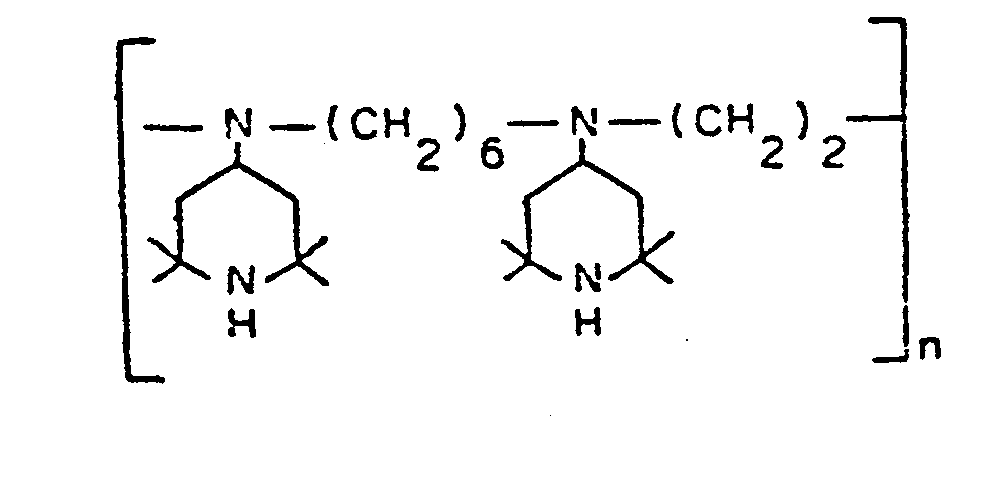
- Es ist bekannt, dass die physikalischen und chemischen Eigenschaften von synthetischen Polymeren stark beeinträchtigt werden, wenn diese dem Sonnenlicht oder dem Licht einer anderen UV-Lichtquelle ausgesetzt werden. Zur Verbesserung der Lichtbeständigkeit dieser Polymeren wurden verschiedene Stabilisatoren vorgeschlagen, wobei, insbesondere im Falle von Artikeln geringer Dicke, wie von Fasern, Bändern und Filmen, polymere Verbindungen, die Polyalkylpiperidylreste enthalten, als besonders geeignet bezeichnet werden, da sie sich dank dem relativ hohen Molekulargewicht durch besonders gute Extraktionsbeständigkeit auszeichnen. Produkte dieser Art sind aus folgenden Patentschriften bekannt: In US-Patent 4 086 204 sind Polytriazinverbindungen,wie z.B. diejenige der Formel


- Die vorliegende Erfindung betrifft demnach Verbindungen der allgemeinen Formel 1


- Gruppe -CmH2m-C(O)- bedeuten, wobei die Carbonylgruppe entweder an X oder an N gebunden ist und m eine Zahl von 1 bis 12 bedeutet, X ein zweiwertiger Rest enthaltend einen oder mehrere heterocyclische Reste der Formeln III, IV oder V

- In der vorliegenden Anmeldung bedeutet

- Dei Bedeutungen der verschiedenen Reste speziell erläuternde Beispiele sind wie folgt:
- Für R1 Wasserstoff, Cyanomethyl, Methyl, Ethyl, Propyl, n-Butyl, sek. Butyl, tert.Butyl, Hexyl, Octyl, 1,1,3,3-Tetramethylbutyl, Decyl, Dodecyl, Allyl, Methallyl, But-2-enyl, Hex-2-enyl, Undec-10-enyl, Propargyl, Benzyl, 4-Methylbenzyl, 4-t-Butylbenzyl, 4-Hydroxybenzyl, Acetyl, Propionyl, Butyryl, Caproyl und Beuzoyl;
- für R2 Ethylen,1,2- oder 1,3-Propylen, Tetramethylen, Hexamethylen, Decamethylen, Dodecamethylen, Cyclohexylen, Cyclohexylendimethylen, o-, mund p-Phenylen und o-, m- und p-Xylylen;
- für R3 Wasserstoff, Aethyl, Ethyl, Propyl, Isopropyl, n-Butyl, sek.Butyl, tert.Butyl, Isobutyl, Hexyl, 2-Ethylhexyl, Octyl, 1,1,3,3-Tetramethylbutyl, Decyl, Dodecyl, Octadecyl, Cyclohexyl, 2- oder 4-Methylcyclohexyl, 3,3,5-Trimethylcyclohexyl, Cyclooctyl, Cyclododecyl, Phenyl, o-, m- und p-Methylphenyl, 2,6-Dimethylphenyl, 2,4,6-Trimethylphenyl, 4-t-Butylphenyl, 4-t-Octylphenyl, 4-Methoxyphenyl, 4-Ethoxyphenyl, 3,5-Di-t-butyl-4-hydroxyphenyl, Benzyl, 4-Methylbenzyl, 4-Hydroxybenzyl, 3,5-Di-t-butyl-4-hydroxybenzyl, 2,2,6,6-Tetramethyl-piperidin-4-yl, 1,2,2,6,6-Pentamethyl-piperidin-4-yl, 1-Allyl-2,2,6,6-tetramethyl-piperidin-4-yl, 1-Benzyl-2,2,6,6-tetramethyl-piperidin-4-yl und 1-Acetyl-2,2,6,6-tetramethyl-piperidin-4-yl;
- für R15 Wasserstoff, Methyl, Ethyl, Propyl, Isopropyl, Butyl, sek.Butyl, tert.Butyl, Isobutyl, Hexyl, 2-Ethylhexyl, Octyl, 1,1,3,3-Tetramethylbutyl, Decyl, Dodecyl, Hexadecyl, Octadecyl, Cyclohexyl, 2- oder 4-Methylcyclohexyl, 3,3,5-Trimethylcyclohexyl, Cyclooctyl, Cyclododecyl, Phenyl, o-, m- und p-Methylphenyl, 2,6-Dimethylphenyl, 2,4,6-Trimethylphenyl, 4-t-Butylphenyl, 4-t-Octylphenyl, 4-Methoxyphenyl, 4-Ethoxyphenyl, 3,5-Di-t-butyl-4-hydroxyphenyl, Benzyl, 4-Methylbenzyl, 4-Hydroxybenzyl, 3,5-Di-t-butyl-4-hydroxybenzyl, 2,2,6,6-Tetramethylpiperidin-4-yl, 1,2,2,6,6-Pentamethyl-piperidin-4-yl, 1-Allyl-2,2,6,6-tetramethyl-piperdidin-4-yl, 1-Benzyl-2,2,6,6-tetramethyl-piperidin-4-yl und l-Acetyl-2,2,6,6-tetramethyl-piperidin-4-yl.
- Bevorzugt sind Verbindungen der Formel I, worin R1 Wasserstoff, C1-C6 Alkyl, C3-C6 Alkenyl oder Alkynyl, Benzyl oder C1-C6 Acyl ist, R2 C2-C12 Alkylen, C6-C10 Cycloalkylen oder C8-C10 Aralkylen bedeutet, R 3 C1-C12 Alkyl, C6-C10 Cycloalkyl oder ein Rest der Formel II ist, worin R1 Wasserstoff, Methyl, Allyl, Benzyl oder Acetyl bedeutet, R15 Wasserstoff, C1-C12 Alkyl, C6-C10 Cycloalkyl, Benzyl oder ein Rest der Formel II ist, worin R Wasserstoff, Methyl, Allyl, Benzyl oder Acetyl bedeutet, m eine Zahl von 1 bis 5 und n eine Zahl von 2 bis 50 sind.
- Besonders bevorzugt sind Verbindungen der Formel I, worin R1 Wasserstoff oder Methyl, R2 C2-C6 Alkylen, R3 C1-C4 Alkyl, Cycloalkyl, 2,2,6,6-Tetramethyl-piperidin-4-yl oder 1,2,2,6,6-Pentamethyl-piperidin-4-yl, R7, R8, R 111 R 12' R 13 und R 14 Wasserstoff, R15 Wasserstoff oder C1-C4 Alkyl sind, m die Zahl 1 oder 2 und n eine Zahl von 2 bis 20 bedeuten.
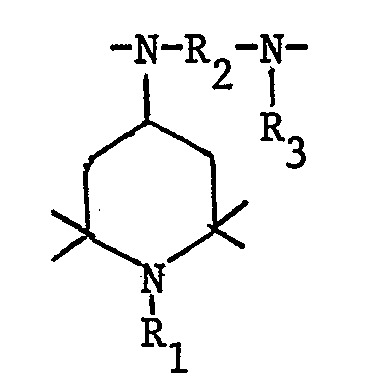
- Die Verbindungen der Formel I können durch Umsetzung eines Bis-halogenamids der Formel VI


- Geeignete Lösungsmittel zur Durchführung der obenerwähnten Umsetzung sind beispielsweise Benzol, Toluol, Xylol, Ethylbenzol, Trimethylbenzol, Tetralin, Decalin, Methanol, Ethanol, Isopropanol, n-Butanol, Butan-2-ol, Isobutanol, n-Pentanol, Isopentanol, t-Pentanol, n-Hexanol, 4-Methyl- pentan-2-ol, 2-Methoxyethanol, 2-Ethoxyethanol, 2-Butoxyethanol, Tetrahydrofuran, Dioxan, Dibutyläther, 1,2-Dimethoxyethan, I,2-Diethoxyethan, Diethylenglycol-dimethyläther, Diethylenglycol-diethyläther, N,N-Dimethylformamid, N,N-Dimethylacetamid, N-Methylpyrrolidon und Dimethylsulfoxid.
- Zum Abfangen des bei der Reaktion entstehenden Chlorwasserstoffs wird die Umsetzung in Gegenwart einer organischen oder anorganischen Base vorgenommen, wie z.B. Pyridin, Triethylamin, Tributylamin, Natriumhydroxid, Kaliumhydroxid, Natriumcarbonat oder Kaliumcarbonat, wobei die Base zumindest in der äquivalenten Menge in Bezug auf den sich bildenen Chlorwasserstoff eingesetzt werden muss. Die Bis-halogenamide der Formel VI sind bekannt oder, sollten einige noch neu sein, können sie nach bekannten Methoden hergestellt werden, wie beispielsweise durch Umsetzung eines Halogenoacylhalogenids mit einem Diamin der Formel VII.
- Zur besseren Veranschaulichung der vorliegenden Erfindung sind im folgenden einige Herstellungsbeispiele für Verbindungen der Formel I angegeben; diese Beispiele dienen ausschliesslich der Erläuterung und bedeuten keinerlei Einschränkung der Erfindung.
- N,N'-Bis-(chloracetyl)-N,N'-bis-(2,2,6,6-tetramethyl-piperidin-4-yl)-1,6-diaminohexan
- Eine Lösung von 118,6 g (1,05 Mol) Chloracetylchlorid in 100 ml Methylenchlorid wird langsam einer auf -20°C abgekühlten Lösung von 197 g (0,5 Mol) N,N*-Bis-(2,2,6,6-tetramethyl-piperidin-4-yl)-l, 6-diaminohexan in 1000 ml Methylenchlorid zugegeben, wobei die Temperatur -10°C nicht übersteigen soll. Die Reaktionsmischung wird eine Stunde gerührt und die Temperatur in dieser Zeit allmählich auf 0°C steigen gelassen. Danach wird innerhalb einer Stunde eine Lösung von 44 g (1.1 Mol) Natriumhydroxid in 180 ml Wasser zugegeben und eine weitere Stunde bei Zimmertemperatur gerührt. Dann wird die wässrige Phase abgetrennt, die organische Phase zur Trockne eingedampft und der Rückstand aus Aceton umkristallisiert. Das erhaltene Produkt hat einen Smp. von 131°C.
- Folgende Bis-halogenamide können durch analoges Verfahren erhalten werden:

- Wiederholt man das unter Beispiel 1 beschriebene Verfahren mit entsprechendem Bis-chloramid (VI) und Diamin (VII), so erhält man folgende Polyaminoamide der Formel


- Beispiel 12: 49, 1 g (0,1 Mol) N,N'-Bis-(chloracetyl)-N,N'-bis-(2,2,6,6-tetramethyl-piperidin-4-yl)-l,2-diaminoethan, 39,4 g (0,1 Mol) N,N'-Bis-(2,2,6,6-tetramethyl-piperidin-4-yl)-l,6-diaminohexan, 8,4 g Natriumhydroxid und 200 ml 2-Ethoxyethanol werden vermischt und 16 Stunden unter Rückfluss gekocht. Danach werden die anorganischen Produkte abfiltriert und das Lösungsmittel abgedampft. Man erhält eine gelbliche harzige feste Substanz mit Smp. 120 - 129°C und Mn 2200.
- Beispiel 13: 33,7 g (0,1 Mol) 1-Chloracetyl-4-(N-ethylchloracetamido)-2,2,6,6-tetramethyl-piperidin, 39,4 g (0,1 Mol) N,N'-Bis-(2,2,6,6-tetramethyl-piperidin-4-yl)-l,6-diaminohexan, 100 ml N,N-Dimethylformamid und 27,6 g (0,2 Mol) Kaliumcarbonat werden vermischt und 16 Stunden auf 100°C geheizt. Danach werden die unlöslichen Produkte durch Filtration abgetrennt und das Lösungsmittel abgedampft. Man erhält eine harzige feste Substanz mit Smp. 80 - 92°C und Mn 1800.
- Beispiel 14: 54,7 g (0,1 Mol) N,N'-Bis-(3-chlorpripionyl)-N,N'-bis-(2,2,6,6-tetramethyl-piperidin-4-yl)-1,6-diaminohexan, 8,6 g (0,1 Mol) Piperazin und 150 ml Methylisobutylcarbinol werden vermischt und 4 Stunden unter Rückfluss gekocht. Nachdem 8 g Natriumhydroxid zugegeben worden sind, wird für weitere 6 Stunden unter Rückfluss gekocht. Dann werden die anorganischen Produkte durch Filtration abgetrennt und das Lösungsmittel abgedampft. Man erhält eine gelbliche feste Substanz mit Smp. 87 - 95°C und Mn 2000.
- Beispiel 15: 50 g der Verbindung von Beispiel 13, 13,8 g Paraformaldehyd, 24 g 88%iger Ameisensäure und 100 ml Wasser werden vermischt und 10 Stunden unter Rückfluss gekocht. Nach dem Abkühlen wird eine Lösung von 18 g Natriumhydroxid in 200 ml Wasser zugegeben und die Reaktionsmischung eine Stunde bei Zimmertemperatur gerührt. Das ausgefallene Produkt wird abfiltriert, mit Wasser gewaschen und getrocknet. Man erhält ein Produkt mit Smp. 92-100°C und Mn 4500.
- Wie anfangs erwähnt, sind die Verbindungen der Formel I sehr wirksam bei der Verbesserung der Licht-, Wärme- und Oxydationsbeständigkeit von synthetischen Polymeren wie beispielsweise Polyäthylen hoher oder niedriger Dichte, Polypropylen, Aethylen/Propylencopolymeren, Aethylen/ Vinylacetatcopolymeren, Polybutadien, Polyisopren, Polystyrol,
- Butadien/Styrolcopolymeren, Acralnitril/Butadien/Styrolcopolymeren, Polymeren und Copolymeren von Vinylchlorid und Vinylidenchlorid, Polyoxymethylen, Polyurethanen, gesättigten und ungesättigten Polyestern, Polyamiden, Polycarbonaten, Polyacrylaten, Alkydharzen und Epoxidharzen.
- Die Verbindungen der Formel I können im Gemisch mit synthetischen Polymeren in verschiedenen Anteilen eingesetzt werden, die von der Art des Polymeren, dem Endzweck und der Gegenwart weiterer Zusatzstoffe abhängen. Im allgemeinen setzt man zweckmässig 0,01 bis 5 Gew.-Z der Verbindungen der Formel I, bezogen auf das Gewicht der Polymeren, vorzugsweise 0,1 bis 1%, ein.
- Die Verbindungen der Formel I können nach verschiedenen Verfahren in die polymeren Materialien eingearbeitet werden, wie durch trockenes Einmischen in Pulverform oder nasses Einmischen in Form einer Lösung oder Suspension oder auch in Form eines konzentrierten Vorgemisches; das synthetische Polymer lässt sich dabei in Form von Pulver, Granulat, Lösung, Suspension oder Latex einsetzen. Die mit den Produkten der Formel I stabilisierten Polymeren lassen sich zur Herstellung von Formkörpern, Folien, Bändern, Endlosfäden, Lacken usw. verwenden.
- Gegebenenfalls kann man den Mischungen von Verbindungen der Formel I mit den synthetischen Polymeren weitere Zusatzstoffe beigeben, wie beispielsweise Antioxydantien, UV-absorbierende Stoffe, Nickelstabilisatoren, Pigmente, Füllstoffe, Weichmacher, Antistatika, Flammschutzmittel, Schmierstoffe, Korrosionshemmstoffe sowie Metalldesaktivatoren. Beispiele für in Mischung mit Verbindungen der Formel I verwendbare Zusatzstoffe sind insbesondere:
-
- 2,6-Di-tert.butyl-4-methylphenol
- 2-Tert.butyl-4,6-dimethylphenol
- 2,6-Di-tert.butyl-4-ethylphenol
- 2,6-Di-tert.butyl-4-n-butylphenol
- 2,6-Di-tert.butyl-4-i-butylphenol
- 2,6-Di-cyclopentyl-4-methylphenol
- 2-(a-Methylcyclohexyl)-4,6-dimethylphenol
- 2,6-Di-octadecyl-4-methylphenol
- 2,4,6-Tri-cyclohexylphenol
- 2,6-Di-tert.butyl-4-methoxymethylphenol
-
- 2,6-Di-tert.butyl-4-methoxyphenol
- 2,5-Di-tert.butyl-hydrochinon
- 2,5-Di-tert.amyl-hydrochinon
- 2,6-Diphenyl-4-octadecyloxyphenol
-
- 2,2'-Thio-bis-(6-tert.butyl-4-methylphenol)
- 2,2'-Thio-bis-(4-octylphenol)
- 4,4'-Thio-bis-(6-tert.butyl-3-methylphenol)
- 4,4'-Thio-bis-(6-tert.butyl-2-methylphenol)
-
- 2,2'-Methylen-bis-(6-tert.butyl-4-methylphenol)
- 2,2'-Methylen-bis-(6-tert.butyl-4-ethylphenol)
- 2,2'-Methylen-bis-[4-methyl-6-(α-methylcyclohexyl)-phenol]
- 2,2'-Methylen-bis-(4-methyl-6-cyclohexylphenol)
- 2,2'-Methylen-bis-(6-nonyl-4-methylphenol)
- 2,2'-Methylen-bis-(4,6-di-tert.butylphenol)
- 2,2'-Ethyliden-bis-(4,6-di-tert.butylphenol)
- 2,2'-Ethyliden-bis-(6-tert.butyl-4-isobutylphenol)
- 2,2'-Methylen-bis-[6-(a-methylbenzyl)-4-nonylphenol]
- 2,2'-Methlyen-bis-[6-(α,α-dimethylbenzyl)-4-nonylphenol]
- 4,4'-Methylen-bis-(2,6-di-tert.butylphenol)
- 4,4'-Methylen-bis-(6-tert.butyl-2-methylphenol)
- 1,1-Bis-(5-tert.butyl-4-hydroxy-2-methylphenyl)-butan
- 2,6-Di-(3-tert.butyl-5-methyl-2-hydroxybenzyl)-4-methylphenol
- 1,1,3-Tris-(5-tert.butyl-4-hydroxy-2-methylphenyl)-butan
- 1,1-Bis-(5-tert.butyl-4-hydroxy-2-methylphenyl)-3-n-dodecylmercapto- butan
- Ethylenglycoi-bis-[3,3-bis-(3'-tert.butyl-4'-hydroxyphenyl)-butyrat] Di-(3-tert.butyl-4-hydroxy-5-methylphenyl)-dicyclopentadien
- Di-[2-(3'-tert.butyl-2'-hydroxy-5'-methyl-benzyl)-6-tert.butyl-4-methyl-phenyl]-terephthalat.
-
- 1,3,5-Tri-(3,5-di-tert.butyl-4-hydroxybenzyl)-2,4,6-trimethylbenzol
- Di-(3,5-di-tert.butyl-4-hydroxybenzyl)-sulfid
- 3,5-di-tert.butyl-4-hydroxybenzyl-mercaptoessigsäure-isooctylester
- Bis-(4-tert.butyl-3-hydroxy-2,6-dimethylbenzyl)dithiol-terephthalat
- 1,3,5-Tris-(3,5-di-tert.butyl-4-hydroxybenzyl)-isocyanurat
- 1,3,5-Tris-(4-tert.butyl-3-hydroxy-2,6-dimethylbenzyl)-isocyanurat
- 3,5-Di-tert.butyl-4-hydroxybenzyl-phosphonsäure-dioctadecylester
- 3,5-Di-tert.butyl-4-hydroxybenzyl-phosphonsäure-monoethylester,
- Calcium-salz.
-
- 4-Hydroxy-laurinsäureanilid
- 4-Hydroxy-stearinsäureanilid
- 2,4-Bis-octylmercapto-6-(3,5-di-tert.butyl-4-hydroxyanilino)-s-triazin
- N-(3,5-di-tert.butyl-4-hydroxyphenyl)-carbaminsäureoctylester.
-

-
- N,N'-Di-(3,5-di-tert.butyl-4-hydroxyphenylpropionyl)-hexamethylendiamin
- N,N'-Di-(3,5-di-tert.butyl-4-hydroxyphenylpropionyl)-trimethylen- diamin
- N,N'-Di-(3,5-di-tert.butyl-4-hydroxyphenylpropionyl)-hydrazin
- 2.1. 2-(2'-Hydroxyphenyl)-benztriazole, wie z.B. das 5'-Methyl-, 3',5'-Di-tert.butyl-, 5'-Tert.butyl-, 5'-(1,1,3,3-Tetramethylbutyl)-, 5-Chlor-3',5'-di-tert.butyl-, 5-Chlor-3'-tert.butyl-5'-methyl-, 3'-sec.Butyl-5'-tert.butyl, 4'-Octoxy-, 3',5'-Di- tert.amyl-, 3',5'-Bis-(a,a-dimethylbenzyl)-Derivat.
- 2.2. 2-Hydroxybenzophenone, wie z.B. das 4-Hydroxy-, 4-Methoxy-, 4-Octoxy-, 4-Decyloxy-, 4-Dodecyloxy-, 4-Benzyloxy-, 4,2',4'-Trihydroxy-, 2'-Hydroxy-4,4'-dimethoxy-Derivat.
- 2.3. Ester von gegebenenfalls substituierten Benzoesäuren, wie z.B. 4-Tert.butyl-phenylsalicylat, Phenylsalicylat, Octylphenylsalicylat, Dibenzoylresorcin, Bis-(4-tert.butylbenzoyl)-resorcin, Benzoylresorcin, 3,5-Di-tert.butyl-4-hydroxybenzoesäure-2,4-di- tert.butylphenylester, 3,5-Di-tert.butyl-4-hydroxybenzoesäurehexa- decylester.
- 2.4. Acrylate, wie z.B. a-Cyan-ß,ß-diphenylacrylsäure-ethylester bzw. -isooctylester, a-Carbomethoxy-zimtsäuremethylester, a-Cyano-ß-methyl-p-methoxy-zimtsäuremethylester bzw. -butylester, α-Carbomethoxy-p-methoxy-zimtsäure-methylester, N-(ß-Carbomethoxy-ß-cyanovinyl)-2-methyl-indolin,
- 2.5. Nickelverbindungen, wie z.B. Nickelkomplexe des 2,2'-Thio- bis-[4-(1,1,3,3-tetramethylbutyl)-phenols], wie der 1:1- oder der 1:2-Komplex, gegebenenfalls mit zusätzlichen Liganden wie n-Butylamin, Triethanolamin oder N-Cyclohexyl-diethanolamin, Nickeldibutyldithiocarbamat, Nickelsalze von 4-Hydroxy-3,5-di-tert.butylbenzyl- phosphonsäure-monoalkylestern wie vom Methyl- oder Ethylester, Nickelkomplexe von Ketoximen wie von 2-Hydroxy-4-methyl-phenyl-unde- cylketonoxim, Nickelkomplexe des 1-Phenyl-4-lauroyl-5-hydroxy-pyra- zols, gegebenenfalls mit zusätzlichen Liganden.
- 2.6. Sterisch gehinderte Amine, wie z.B. Bis-(2,2,6,6-tetramethylpiperidyl)-sebacat
- Bis-(1,2,2,6,6-pentamethylpiperidyl)-sebacat n-Butyl-3,5-di-tert.butyl-4-hydroxybenzyl-malonsäure-bis(1,2,2,6,6-pentamethylpiperidyl)-ester, Kondensationsprodukt aus 1-Hydroxyethyl-2,2,6,6-tetramethyl-4-hydroxypiperidin und Bernsteinsäure, Kondensationsprodukt aus N,N'-(2,2,6,6-Tetramethyl-4-piperidyl)-hexamethylendiamin und 4-tert.Octylamino-2,6-dichlor-1,3,5-s-triazin,
- Tris-(2,2,6,6-tetramethyl-4-piperidyl)-nitrilotriacetat, Tetrakis-(2,2,6,6-tetramethyl-4-piperidyl)-l,2,3,4-butantetracarbon- säure,
- 1,1'-(1,2-Ethandiyl)-bis-(3,3,5,5-tetramethyl-piperazinon).
- 2.7. Oxalsäurediamide, wie z.B. 4,4'-Di-octyloxy-oxanilid, 2,2'-Di-octyloxy-5,5'-di-tert.butyl-oxanilid, 2,2'-Di-dodecyloxy-5,5'-di-tert.butyl-oxanilid, 2-Ethoxy-2'-ethyl-oxanilid, N,N'-Bis-(3-dimethylaminopropyl)-oxalamid, 2-Ethoxy-5-tert.butyl-2'-ethyl- oxanilid und dessen Gemisch mit 2-Ethoxy-2'-ethyl-5,4'-di-tert.butyl-oxanilid, Gemische von ortho-und para-Methoxy- sowie von o- und p-Ethoxy-di-substituierte Oxaniliden.
- 3. Metalldesaktivatoren, wie z.B. N,N'-Diphenyloxalsäurediamid, N-Salicylal-N'-salicyloylhydrazin, N,N'-Bis-salicyloylhydrazin, N,N'-Bis-(3,5-di-tert.butyl-4-hydroxyphenylpropionyl)-hydrazin, 3-Salicyloylamino-1,2,4-triazol, Bis-benzyliden-oxalsäuredihydrazid.
- 4. Phosphite und Phosphonite, wie z.B. Triphenylphosphit, Diphenylalkylphosphite, Phenyldialkylphosphite, Tri-(nonylphenyl)-phosphit, Trilaurylphosphit, Trioctadecylphosphit, Distearyl-pentaerythritdiphosphit, Tris-(2,4-di-tert.butylphenyl)-phosphit, Diisodecylpentaerythrit-diphosphit, Di-(2,4-di-tert.butylphenyl)-pentaerythritdi- phosphit, Tristearyl-sorbit-triphosphit, Tetrakis-(2,4-di-tert.butylphenyl)-4,4'-biphenylen-diphosphonit.
- 5. Peroxidzerstörende Verbindungen, wie z.B. Ester der β-Thio-dipropionsäure, beispielsweise der Lauryl-, Stearyl-, Myristyl- oder Tridecylester, Mercaptobenzimidazol, das Zinksalz des 2-Mercaptobenzimidazols, Zink-dibutyl-dithiocarbamat,. Dioctadecyldisulfid, Pentaerythrit-tetrakis-(ß-dodecylmercapto)-propionat.
- 6. Polyamidstabilisatoren, wie z.B. Kupfersalze in Kombination mit Jodiden und/oder Phosphorverbindungen und Salze des zweiwertigen Mangans.
- 7. Basische Co-Stabilisatoren, wie z.B. Melamin, Polyvinylpyrrolidon, Dicyandiamid, Triallylcyanurat, Harnstoff-Derivate, Hydrazin-Derivate, Amine, Polyamide, Polyurethane, Alkali- und Erdalkalisalze höherer Fettsäuren, beispielsweise Ca-Stearat, Zn-Stearat, Mg-Stearat, Na-Ricinoleat, K-Palmitat, Antimonbrenzcatechinat oder Zinnbrenzcatechinat.
- 8. Nukleierungsmittel, wie z.B. 4-tert.Butylbenzoesäure, Adipinsäure, Diphenylessigsäure.
- 9. Füllstoffe und Verstärkungsmittel, wie z.B. Calciumcarbonat, Silikate, Glasfasern, Asbest, Talk, Kaolin, Glimmer, Bariumsulfat, Metalloxide und -hydroxide, Russ, Graphit.
- 10. Sonstige Zusätze, wie z.B. Weichmacher, Gleitmittel, Emulgatoren, Pigmente, Optische Aufheller, Flammschutzmittel, Antistatika, Treibmittel.
- Die Wirksamkeit der erfindungsgemässen Produkte als Stabilisatoren wird in den nachfolgenden Beispielen veranschaulicht, in welchen die Resultate der Stabilisierung von Polypropylenbändern und -fasern mit einigen typischen erfindungsgemässen Polyaminamiden wiedergegeben werden.
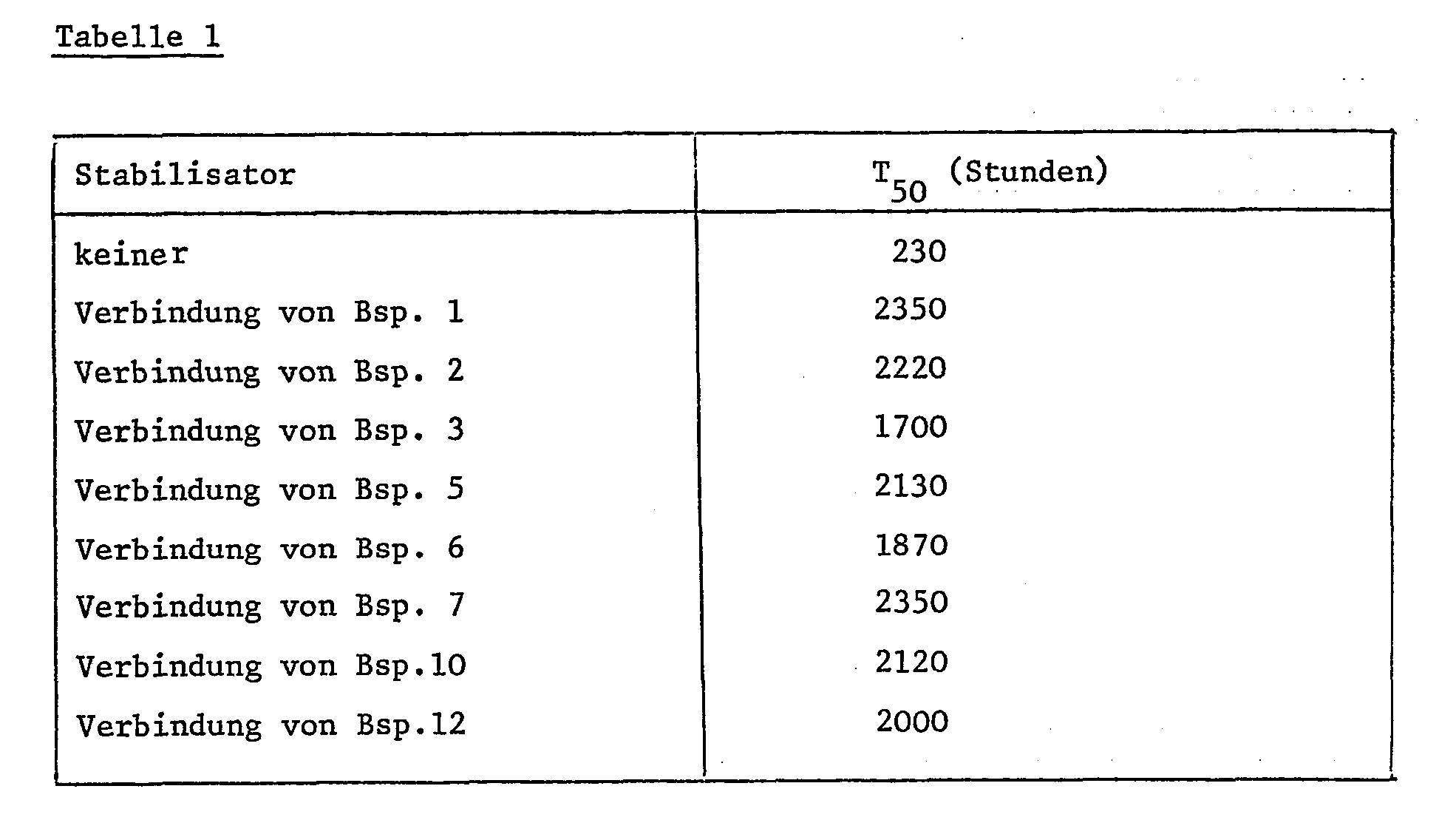
- Beispiel 16: Je 2 g der in Tabelle 1 angeführten Verbindungen und 1 g Pentaerythrit-tetrakis-3-(3,5-di-t-butyl-4-hydroxyphenyl)-propionat (Antioxydans) werden mit 1000 g Polypropylen mit einem Schmelzindex von 2,4 (® Propathen HF 18,Produkt der Imperial Chemical Industries) und 1 g Calciumstearat innig vermischt.
- Das erhaltene Gemisch wird dann bei einer Temperatur von 180-220°C extrudiert und zu Granulat verarbeitet, aus dem man Bänder einer Dicke von 50 µm und einer Breite von 2,5 mm herstellt. Die Arbeitsbedingungen sind:

- Die erhaltenen Bänder werden auf weisser Mappe angeordnet in einem Weather-Ometer 65 WR(ASTM G 27-70) bei einer Temperatur der schwarzen Tafel von 63°C ausgesetzt. Von Zeit zu Zeit werden Proben entnommen, an denen man die verbleibende Zugfestigkeit mittels eines Tensometers mit konstanter Geschwindigkeit misst; danach bestimmt man die zum Halbieren der ursprünglichen Zugfestigkeit erforderliche Aussetzungszeit (T50)'
- Die Resultate sind in Tabelle 1 wiedergegeben.
- Beispiel 17: Je 2,5 g der in Tabelle 2 angeführten Verbindungen und 1 g n-Octadecyl-3-(3,5-di-t-butyl-4-hydroxyphenyl)-propionat (Antioxidans) werden mit 1000 g Polypropylen mit einem Schmelzindex von 13 (® Propathen HF 85, Produkt der Imperial Chemical Industries), 1 g Calciumstearat und 1 g Titandioxid innig vermischt.
- Das erhaltene Gemisch wird dann bei einer Temperatur von 180-220°C extrudiert und zu Granulat verarbeitet. Die so erhaltenen Granulate werden unter folgenden Bedingungen zu Fasern (Titer: 20 den/Faser) verarbeitet:

- Die erhaltenen Fasern werden auf weisser Mappe angeordnet in einem Weather-Ometer 65 WR bei einer Temperatur der schwarzen Tafel von 63°C ausgesetzt. Der T50-Wert wird wie unter Beispiel 16 beschrieben bestimmt.
- Die Resultate sind in Tabelle 2 wiedergegeben.

Claims (6)


Applications Claiming Priority (2)
| Application Number | Priority Date | Filing Date | Title |
|---|---|---|---|
| IT21005/83A IT1164214B (it) | 1983-05-09 | 1983-05-09 | Composti polimerici contenenti radicali piperidinici,processo per la loro preparazione e loro impiego quali stabilizzanti per polimeri sintetici |
| IT2100583 | 1983-05-09 |
Publications (3)
| Publication Number | Publication Date |
|---|---|
| EP0128861A2 true EP0128861A2 (de) | 1984-12-19 |
| EP0128861A3 EP0128861A3 (en) | 1987-09-02 |
| EP0128861B1 EP0128861B1 (de) | 1990-12-12 |
Family
ID=11175291
Family Applications (1)
| Application Number | Title | Priority Date | Filing Date |
|---|---|---|---|
| EP84810211A Expired - Lifetime EP0128861B1 (de) | 1983-05-09 | 1984-05-03 | Polyaminamide enthaltend Polyalkylpiperidinylreste |
Country Status (5)
| Country | Link |
|---|---|
| EP (1) | EP0128861B1 (de) |
| JP (1) | JPH0629242B2 (de) |
| CA (1) | CA1236097A (de) |
| DE (1) | DE3483734D1 (de) |
| IT (1) | IT1164214B (de) |
Cited By (3)
| Publication number | Priority date | Publication date | Assignee | Title |
|---|---|---|---|---|
| FR2586678A1 (fr) * | 1985-08-27 | 1987-03-06 | Ciba Geigy Ag | Amines acylees a empechement sterique qui peuvent etre coupees photolytiquement, et leur application a la stabilisation de polymeres |
| EP0290393A3 (de) * | 1987-05-07 | 1991-07-31 | Ciba-Geigy Ag | Piperidin-Verbindungen zur Verwendung als Licht-, Wärme- und Oxidationsstabilisatoren für organische Werkstoffe |
| GB2266531A (en) * | 1992-04-14 | 1993-11-03 | Ciba Geigy Ag | Novel piperidine-triazine co-oligomers for use as stabilisers for organic materials |
Families Citing this family (1)
| Publication number | Priority date | Publication date | Assignee | Title |
|---|---|---|---|---|
| JPH0662830B2 (ja) * | 1985-04-11 | 1994-08-17 | 住友化学工業株式会社 | ポリアセタ−ル樹脂組成物 |
Family Cites Families (5)
| Publication number | Priority date | Publication date | Assignee | Title |
|---|---|---|---|---|
| JPS5042870U (de) * | 1973-08-23 | 1975-04-30 | ||
| DK144796C (da) * | 1975-03-21 | 1982-10-25 | Montefibre Spa | Stabiliseret alkenpolymerformstof eller-genstand og stabiliseringsmiddel til brug ved fremstillingen deraf |
| IT1052501B (it) * | 1975-12-04 | 1981-07-20 | Chimosa Chimica Organica Spa | Composti politriazinici utilizzabili per la stabilizzazione di polimeri sintetici e procedimento per la loro preparazione |
| CH626109A5 (de) * | 1976-05-11 | 1981-10-30 | Ciba Geigy Ag | |
| JPS58168369U (ja) * | 1982-05-08 | 1983-11-10 | 小野 智司 | 竹刀 |
-
1983
- 1983-05-09 IT IT21005/83A patent/IT1164214B/it active
-
1984
- 1984-05-03 DE DE8484810211T patent/DE3483734D1/de not_active Expired - Lifetime
- 1984-05-03 EP EP84810211A patent/EP0128861B1/de not_active Expired - Lifetime
- 1984-05-07 CA CA000453685A patent/CA1236097A/en not_active Expired
- 1984-05-09 JP JP59092727A patent/JPH0629242B2/ja not_active Expired - Lifetime
Cited By (6)
| Publication number | Priority date | Publication date | Assignee | Title |
|---|---|---|---|---|
| FR2586678A1 (fr) * | 1985-08-27 | 1987-03-06 | Ciba Geigy Ag | Amines acylees a empechement sterique qui peuvent etre coupees photolytiquement, et leur application a la stabilisation de polymeres |
| GB2180235A (en) * | 1985-08-27 | 1987-03-25 | Ciba Geigy Ag | Photolytically cleavable, n-acylated sterically hindered amines |
| GB2180235B (en) * | 1985-08-27 | 1989-08-09 | Ciba Geigy Ag | Photolytically cleavable, n-acylated sterically hindered amines |
| EP0290393A3 (de) * | 1987-05-07 | 1991-07-31 | Ciba-Geigy Ag | Piperidin-Verbindungen zur Verwendung als Licht-, Wärme- und Oxidationsstabilisatoren für organische Werkstoffe |
| GB2266531A (en) * | 1992-04-14 | 1993-11-03 | Ciba Geigy Ag | Novel piperidine-triazine co-oligomers for use as stabilisers for organic materials |
| GB2266531B (en) * | 1992-04-14 | 1996-03-13 | Ciba Geigy Ag | Novel piperidine-triazine co-oligomers for use as stabilisers for organic materials |
Also Published As
| Publication number | Publication date |
|---|---|
| JPH0629242B2 (ja) | 1994-04-20 |
| IT8321005A0 (it) | 1983-05-09 |
| EP0128861B1 (de) | 1990-12-12 |
| IT1164214B (it) | 1987-04-08 |
| JPS59210069A (ja) | 1984-11-28 |
| EP0128861A3 (en) | 1987-09-02 |
| DE3483734D1 (de) | 1991-01-24 |
| IT8321005A1 (it) | 1984-11-09 |
| CA1236097A (en) | 1988-05-03 |
Similar Documents
| Publication | Publication Date | Title |
|---|---|---|
| EP0119160B1 (de) | N-substituierte (4-Hydroxyphenylthiomethyl)-amine oder -ureide | |
| EP0107615B1 (de) | Mit Bis- oder Tris-(polyalkylpiperidinyl-amino)-1,3,5-triazine stabilisierte Polyolefine | |
| EP0117229A1 (de) | Neue, als Stabilisatoren für synthetische Polymere verwendbare Piperidinyl-triazinverbindungen | |
| EP0133164A2 (de) | Copolymerisierbare Verbindungen | |
| DE3811117A1 (de) | Lichtschutzmittelgemisch | |
| EP0142467A1 (de) | Piperidylreste enthaltende polymere Verbindungen und ihre Verwendung als Stabilisatoren für synthetische Polymere | |
| DE3426137A1 (de) | Polymere verbindungen enthaltend piperidinreste und ihre verwendung zum stabilisieren von synthetischen polymeren | |
| EP0214102B1 (de) | 5-Aralkylsubstituierte 2H-Benztriazole und stabilisierte Zusammensetzungen | |
| EP0241427A2 (de) | Mit di- oder trisubstituierten Hydroxylaminen stabilisierte Zusammensetzungen und neue di- oder trisubstituierte Hydroxylaminen | |
| EP0246189B1 (de) | Mit Aminoxyalkylaminen stabilisierte Zusammensetzungen | |
| EP0145658B1 (de) | Amide von Hydroxyphenylalkylthio-alkancarbonsäuren | |
| EP0081457A2 (de) | Phenole und ihre Verwendung als Stabilisatoren | |
| EP0140297A2 (de) | Thiocarbamat Stabilisatoren | |
| EP0124486B1 (de) | Verwendung von Dipiperidin-di-carbamaten zum Stabilisieren von synthetischen Polymeren | |
| EP0130945A2 (de) | N-Piperidyl-lactame als Lichtschutzmittel | |
| EP0344114B1 (de) | Ungesättigte Derivate von 2,2,6,6-Tetramethylpiperidin | |
| EP0153907A2 (de) | Verbindungen enthaltend Piperidinreste und ihre Verwendung zum Stabilisieren von synthetischen Polymeren | |
| EP0128861B1 (de) | Polyaminamide enthaltend Polyalkylpiperidinylreste | |
| EP0244355B1 (de) | Mit substituierten Aminocarbamaten stabilisierte Zusammensetzungen und neue substituierte Aminocarbamate | |
| EP0421932A1 (de) | Stabilisiertes organisches Material | |
| EP0113318B1 (de) | Neue (4-Hydroxyphenylthio)-imid Stabilisatoren | |
| DE3809628A1 (de) | Sich von 2,2,6,6-tetramethylpiperidin ableitende triazin-verbindungen | |
| EP0240463B1 (de) | Substituierte Aminoxypropionamide | |
| DE3426121C2 (de) | ||
| EP0157734A1 (de) | Substituierte Piperazinone als Lichtschutzmittel |
Legal Events
| Date | Code | Title | Description |
|---|---|---|---|
| PUAI | Public reference made under article 153(3) epc to a published international application that has entered the european phase |
Free format text: ORIGINAL CODE: 0009012 |
|
| 17P | Request for examination filed |
Effective date: 19840505 |
|
| AK | Designated contracting states |
Designated state(s): BE DE FR GB IT NL |
|
| PUAL | Search report despatched |
Free format text: ORIGINAL CODE: 0009013 |
|
| RAP1 | Party data changed (applicant data changed or rights of an application transferred) |
Owner name: CIBA-GEIGY AG Owner name: CIBA-GEIGY S.P.A. |
|
| RHK1 | Main classification (correction) |
Ipc: C07D211/58 |
|
| AK | Designated contracting states |
Kind code of ref document: A3 Designated state(s): BE DE FR GB IT NL |
|
| 17Q | First examination report despatched |
Effective date: 19880829 |
|
| GRAA | (expected) grant |
Free format text: ORIGINAL CODE: 0009210 |
|
| ITF | It: translation for a ep patent filed | ||
| AK | Designated contracting states |
Kind code of ref document: B1 Designated state(s): BE DE FR GB IT NL |
|
| REF | Corresponds to: |
Ref document number: 3483734 Country of ref document: DE Date of ref document: 19910124 |
|
| GBT | Gb: translation of ep patent filed (gb section 77(6)(a)/1977) | ||
| ET | Fr: translation filed | ||
| ITTA | It: last paid annual fee | ||
| PLBE | No opposition filed within time limit |
Free format text: ORIGINAL CODE: 0009261 |
|
| STAA | Information on the status of an ep patent application or granted ep patent |
Free format text: STATUS: NO OPPOSITION FILED WITHIN TIME LIMIT |
|
| 26N | No opposition filed | ||
| PGFP | Annual fee paid to national office [announced via postgrant information from national office to epo] |
Ref country code: FR Payment date: 19930322 Year of fee payment: 10 |
|
| PGFP | Annual fee paid to national office [announced via postgrant information from national office to epo] |
Ref country code: DE Payment date: 19930401 Year of fee payment: 10 |
|
| PGFP | Annual fee paid to national office [announced via postgrant information from national office to epo] |
Ref country code: GB Payment date: 19930426 Year of fee payment: 10 |
|
| PGFP | Annual fee paid to national office [announced via postgrant information from national office to epo] |
Ref country code: NL Payment date: 19930531 Year of fee payment: 10 |
|
| PGFP | Annual fee paid to national office [announced via postgrant information from national office to epo] |
Ref country code: BE Payment date: 19930608 Year of fee payment: 10 |
|
| PG25 | Lapsed in a contracting state [announced via postgrant information from national office to epo] |
Ref country code: GB Effective date: 19940503 |
|
| PG25 | Lapsed in a contracting state [announced via postgrant information from national office to epo] |
Ref country code: BE Effective date: 19940531 |
|
| BERE | Be: lapsed |
Owner name: CIBA-GEIGY A.G. Effective date: 19940531 |
|
| PG25 | Lapsed in a contracting state [announced via postgrant information from national office to epo] |
Ref country code: NL Free format text: LAPSE BECAUSE OF NON-PAYMENT OF DUE FEES Effective date: 19941201 |
|
| GBPC | Gb: european patent ceased through non-payment of renewal fee |
Effective date: 19940503 |
|
| NLV4 | Nl: lapsed or anulled due to non-payment of the annual fee | ||
| PG25 | Lapsed in a contracting state [announced via postgrant information from national office to epo] |
Ref country code: FR Effective date: 19950131 |
|
| PG25 | Lapsed in a contracting state [announced via postgrant information from national office to epo] |
Ref country code: DE Effective date: 19950201 |
|
| REG | Reference to a national code |
Ref country code: FR Ref legal event code: ST |