EP0129414A2 - Copolymères d'alpha oléfines ayant une distribution étroite de poids moléculaire - Google Patents
Copolymères d'alpha oléfines ayant une distribution étroite de poids moléculaire Download PDFInfo
- Publication number
- EP0129414A2 EP0129414A2 EP84304028A EP84304028A EP0129414A2 EP 0129414 A2 EP0129414 A2 EP 0129414A2 EP 84304028 A EP84304028 A EP 84304028A EP 84304028 A EP84304028 A EP 84304028A EP 0129414 A2 EP0129414 A2 EP 0129414A2
- Authority
- EP
- European Patent Office
- Prior art keywords
- copolymer
- composition
- ethylene
- less
- weight percent
- Prior art date
- Legal status (The legal status is an assumption and is not a legal conclusion. Google has not performed a legal analysis and makes no representation as to the accuracy of the status listed.)
- Granted
Links
Images



Classifications
-
- C—CHEMISTRY; METALLURGY
- C08—ORGANIC MACROMOLECULAR COMPOUNDS; THEIR PREPARATION OR CHEMICAL WORKING-UP; COMPOSITIONS BASED THEREON
- C08F—MACROMOLECULAR COMPOUNDS OBTAINED BY REACTIONS ONLY INVOLVING CARBON-TO-CARBON UNSATURATED BONDS
- C08F210/00—Copolymers of unsaturated aliphatic hydrocarbons having only one carbon-to-carbon double bond
- C08F210/02—Ethene
-
- C—CHEMISTRY; METALLURGY
- C08—ORGANIC MACROMOLECULAR COMPOUNDS; THEIR PREPARATION OR CHEMICAL WORKING-UP; COMPOSITIONS BASED THEREON
- C08F—MACROMOLECULAR COMPOUNDS OBTAINED BY REACTIONS ONLY INVOLVING CARBON-TO-CARBON UNSATURATED BONDS
- C08F210/00—Copolymers of unsaturated aliphatic hydrocarbons having only one carbon-to-carbon double bond
- C08F210/16—Copolymers of ethene with alpha-alkenes, e.g. EP rubbers
-
- C—CHEMISTRY; METALLURGY
- C08—ORGANIC MACROMOLECULAR COMPOUNDS; THEIR PREPARATION OR CHEMICAL WORKING-UP; COMPOSITIONS BASED THEREON
- C08F—MACROMOLECULAR COMPOUNDS OBTAINED BY REACTIONS ONLY INVOLVING CARBON-TO-CARBON UNSATURATED BONDS
- C08F210/00—Copolymers of unsaturated aliphatic hydrocarbons having only one carbon-to-carbon double bond
- C08F210/16—Copolymers of ethene with alpha-alkenes, e.g. EP rubbers
- C08F210/18—Copolymers of ethene with alpha-alkenes, e.g. EP rubbers with non-conjugated dienes, e.g. EPT rubbers
-
- C—CHEMISTRY; METALLURGY
- C08—ORGANIC MACROMOLECULAR COMPOUNDS; THEIR PREPARATION OR CHEMICAL WORKING-UP; COMPOSITIONS BASED THEREON
- C08F—MACROMOLECULAR COMPOUNDS OBTAINED BY REACTIONS ONLY INVOLVING CARBON-TO-CARBON UNSATURATED BONDS
- C08F297/00—Macromolecular compounds obtained by successively polymerising different monomer systems using a catalyst of the ionic or coordination type without deactivating the intermediate polymer
- C08F297/06—Macromolecular compounds obtained by successively polymerising different monomer systems using a catalyst of the ionic or coordination type without deactivating the intermediate polymer using a catalyst of the coordination type
- C08F297/08—Macromolecular compounds obtained by successively polymerising different monomer systems using a catalyst of the ionic or coordination type without deactivating the intermediate polymer using a catalyst of the coordination type polymerising mono-olefins
-
- C—CHEMISTRY; METALLURGY
- C08—ORGANIC MACROMOLECULAR COMPOUNDS; THEIR PREPARATION OR CHEMICAL WORKING-UP; COMPOSITIONS BASED THEREON
- C08L—COMPOSITIONS OF MACROMOLECULAR COMPOUNDS
- C08L23/00—Compositions of homopolymers or copolymers of unsaturated aliphatic hydrocarbons having only one carbon-to-carbon double bond; Compositions of derivatives of such polymers
- C08L23/02—Compositions of homopolymers or copolymers of unsaturated aliphatic hydrocarbons having only one carbon-to-carbon double bond; Compositions of derivatives of such polymers not modified by chemical after-treatment
- C08L23/04—Homopolymers or copolymers of ethene
- C08L23/08—Copolymers of ethene
- C08L23/0807—Copolymers of ethene with unsaturated hydrocarbons only containing four or more carbon atoms
- C08L23/0815—Copolymers of ethene with unsaturated hydrocarbons only containing four or more carbon atoms with aliphatic 1-olefins containing one carbon-to-carbon double bond
-
- C—CHEMISTRY; METALLURGY
- C08—ORGANIC MACROMOLECULAR COMPOUNDS; THEIR PREPARATION OR CHEMICAL WORKING-UP; COMPOSITIONS BASED THEREON
- C08L—COMPOSITIONS OF MACROMOLECULAR COMPOUNDS
- C08L23/00—Compositions of homopolymers or copolymers of unsaturated aliphatic hydrocarbons having only one carbon-to-carbon double bond; Compositions of derivatives of such polymers
- C08L23/02—Compositions of homopolymers or copolymers of unsaturated aliphatic hydrocarbons having only one carbon-to-carbon double bond; Compositions of derivatives of such polymers not modified by chemical after-treatment
- C08L23/16—Ethylene-propylene or ethylene-propylene-diene copolymers
-
- C—CHEMISTRY; METALLURGY
- C10—PETROLEUM, GAS OR COKE INDUSTRIES; TECHNICAL GASES CONTAINING CARBON MONOXIDE; FUELS; LUBRICANTS; PEAT
- C10M—LUBRICATING COMPOSITIONS; USE OF CHEMICAL SUBSTANCES EITHER ALONE OR AS LUBRICATING INGREDIENTS IN A LUBRICATING COMPOSITION
- C10M143/00—Lubricating compositions characterised by the additive being a macromolecular hydrocarbon or such hydrocarbon modified by oxidation
-
- C—CHEMISTRY; METALLURGY
- C10—PETROLEUM, GAS OR COKE INDUSTRIES; TECHNICAL GASES CONTAINING CARBON MONOXIDE; FUELS; LUBRICANTS; PEAT
- C10M—LUBRICATING COMPOSITIONS; USE OF CHEMICAL SUBSTANCES EITHER ALONE OR AS LUBRICATING INGREDIENTS IN A LUBRICATING COMPOSITION
- C10M143/00—Lubricating compositions characterised by the additive being a macromolecular hydrocarbon or such hydrocarbon modified by oxidation
- C10M143/02—Polyethylene
-
- C—CHEMISTRY; METALLURGY
- C10—PETROLEUM, GAS OR COKE INDUSTRIES; TECHNICAL GASES CONTAINING CARBON MONOXIDE; FUELS; LUBRICANTS; PEAT
- C10M—LUBRICATING COMPOSITIONS; USE OF CHEMICAL SUBSTANCES EITHER ALONE OR AS LUBRICATING INGREDIENTS IN A LUBRICATING COMPOSITION
- C10M171/00—Lubricating compositions characterised by purely physical criteria, e.g. containing as base-material, thickener or additive, ingredients which are characterised exclusively by their numerically specified physical properties, i.e. containing ingredients which are physically well-defined but for which the chemical nature is either unspecified or only very vaguely indicated
- C10M171/04—Specified molecular weight or molecular weight distribution
-
- B—PERFORMING OPERATIONS; TRANSPORTING
- B01—PHYSICAL OR CHEMICAL PROCESSES OR APPARATUS IN GENERAL
- B01J—CHEMICAL OR PHYSICAL PROCESSES, e.g. CATALYSIS OR COLLOID CHEMISTRY; THEIR RELEVANT APPARATUS
- B01J2219/00—Chemical, physical or physico-chemical processes in general; Their relevant apparatus
- B01J2219/00049—Controlling or regulating processes
- B01J2219/00051—Controlling the temperature
- B01J2219/00074—Controlling the temperature by indirect heating or cooling employing heat exchange fluids
- B01J2219/00087—Controlling the temperature by indirect heating or cooling employing heat exchange fluids with heat exchange elements outside the reactor
- B01J2219/00099—Controlling the temperature by indirect heating or cooling employing heat exchange fluids with heat exchange elements outside the reactor the reactor being immersed in the heat exchange medium
-
- B—PERFORMING OPERATIONS; TRANSPORTING
- B01—PHYSICAL OR CHEMICAL PROCESSES OR APPARATUS IN GENERAL
- B01J—CHEMICAL OR PHYSICAL PROCESSES, e.g. CATALYSIS OR COLLOID CHEMISTRY; THEIR RELEVANT APPARATUS
- B01J2219/00—Chemical, physical or physico-chemical processes in general; Their relevant apparatus
- B01J2219/00049—Controlling or regulating processes
- B01J2219/00051—Controlling the temperature
- B01J2219/00159—Controlling the temperature controlling multiple zones along the direction of flow, e.g. pre-heating and after-cooling
-
- B—PERFORMING OPERATIONS; TRANSPORTING
- B01—PHYSICAL OR CHEMICAL PROCESSES OR APPARATUS IN GENERAL
- B01J—CHEMICAL OR PHYSICAL PROCESSES, e.g. CATALYSIS OR COLLOID CHEMISTRY; THEIR RELEVANT APPARATUS
- B01J2219/00—Chemical, physical or physico-chemical processes in general; Their relevant apparatus
- B01J2219/00049—Controlling or regulating processes
- B01J2219/00186—Controlling or regulating processes controlling the composition of the reactive mixture
-
- C—CHEMISTRY; METALLURGY
- C08—ORGANIC MACROMOLECULAR COMPOUNDS; THEIR PREPARATION OR CHEMICAL WORKING-UP; COMPOSITIONS BASED THEREON
- C08L—COMPOSITIONS OF MACROMOLECULAR COMPOUNDS
- C08L2314/00—Polymer mixtures characterised by way of preparation
- C08L2314/02—Ziegler natta catalyst
-
- C—CHEMISTRY; METALLURGY
- C10—PETROLEUM, GAS OR COKE INDUSTRIES; TECHNICAL GASES CONTAINING CARBON MONOXIDE; FUELS; LUBRICANTS; PEAT
- C10M—LUBRICATING COMPOSITIONS; USE OF CHEMICAL SUBSTANCES EITHER ALONE OR AS LUBRICATING INGREDIENTS IN A LUBRICATING COMPOSITION
- C10M2205/00—Organic macromolecular hydrocarbon compounds or fractions, whether or not modified by oxidation as ingredients in lubricant compositions
-
- C—CHEMISTRY; METALLURGY
- C10—PETROLEUM, GAS OR COKE INDUSTRIES; TECHNICAL GASES CONTAINING CARBON MONOXIDE; FUELS; LUBRICANTS; PEAT
- C10M—LUBRICATING COMPOSITIONS; USE OF CHEMICAL SUBSTANCES EITHER ALONE OR AS LUBRICATING INGREDIENTS IN A LUBRICATING COMPOSITION
- C10M2205/00—Organic macromolecular hydrocarbon compounds or fractions, whether or not modified by oxidation as ingredients in lubricant compositions
- C10M2205/02—Organic macromolecular hydrocarbon compounds or fractions, whether or not modified by oxidation as ingredients in lubricant compositions containing acyclic monomers
-
- C—CHEMISTRY; METALLURGY
- C10—PETROLEUM, GAS OR COKE INDUSTRIES; TECHNICAL GASES CONTAINING CARBON MONOXIDE; FUELS; LUBRICANTS; PEAT
- C10M—LUBRICATING COMPOSITIONS; USE OF CHEMICAL SUBSTANCES EITHER ALONE OR AS LUBRICATING INGREDIENTS IN A LUBRICATING COMPOSITION
- C10M2205/00—Organic macromolecular hydrocarbon compounds or fractions, whether or not modified by oxidation as ingredients in lubricant compositions
- C10M2205/02—Organic macromolecular hydrocarbon compounds or fractions, whether or not modified by oxidation as ingredients in lubricant compositions containing acyclic monomers
- C10M2205/022—Ethene
-
- C—CHEMISTRY; METALLURGY
- C10—PETROLEUM, GAS OR COKE INDUSTRIES; TECHNICAL GASES CONTAINING CARBON MONOXIDE; FUELS; LUBRICANTS; PEAT
- C10M—LUBRICATING COMPOSITIONS; USE OF CHEMICAL SUBSTANCES EITHER ALONE OR AS LUBRICATING INGREDIENTS IN A LUBRICATING COMPOSITION
- C10M2205/00—Organic macromolecular hydrocarbon compounds or fractions, whether or not modified by oxidation as ingredients in lubricant compositions
- C10M2205/02—Organic macromolecular hydrocarbon compounds or fractions, whether or not modified by oxidation as ingredients in lubricant compositions containing acyclic monomers
- C10M2205/024—Propene
-
- C—CHEMISTRY; METALLURGY
- C10—PETROLEUM, GAS OR COKE INDUSTRIES; TECHNICAL GASES CONTAINING CARBON MONOXIDE; FUELS; LUBRICANTS; PEAT
- C10M—LUBRICATING COMPOSITIONS; USE OF CHEMICAL SUBSTANCES EITHER ALONE OR AS LUBRICATING INGREDIENTS IN A LUBRICATING COMPOSITION
- C10M2205/00—Organic macromolecular hydrocarbon compounds or fractions, whether or not modified by oxidation as ingredients in lubricant compositions
- C10M2205/08—Organic macromolecular hydrocarbon compounds or fractions, whether or not modified by oxidation as ingredients in lubricant compositions containing non-conjugated dienes
-
- C—CHEMISTRY; METALLURGY
- C10—PETROLEUM, GAS OR COKE INDUSTRIES; TECHNICAL GASES CONTAINING CARBON MONOXIDE; FUELS; LUBRICANTS; PEAT
- C10M—LUBRICATING COMPOSITIONS; USE OF CHEMICAL SUBSTANCES EITHER ALONE OR AS LUBRICATING INGREDIENTS IN A LUBRICATING COMPOSITION
- C10M2205/00—Organic macromolecular hydrocarbon compounds or fractions, whether or not modified by oxidation as ingredients in lubricant compositions
- C10M2205/10—Organic macromolecular hydrocarbon compounds or fractions, whether or not modified by oxidation as ingredients in lubricant compositions containing cycloaliphatic monomers
-
- C—CHEMISTRY; METALLURGY
- C10—PETROLEUM, GAS OR COKE INDUSTRIES; TECHNICAL GASES CONTAINING CARBON MONOXIDE; FUELS; LUBRICANTS; PEAT
- C10N—INDEXING SCHEME ASSOCIATED WITH SUBCLASS C10M RELATING TO LUBRICATING COMPOSITIONS
- C10N2020/00—Specified physical or chemical properties or characteristics, i.e. function, of component of lubricating compositions
- C10N2020/01—Physico-chemical properties
-
- Y—GENERAL TAGGING OF NEW TECHNOLOGICAL DEVELOPMENTS; GENERAL TAGGING OF CROSS-SECTIONAL TECHNOLOGIES SPANNING OVER SEVERAL SECTIONS OF THE IPC; TECHNICAL SUBJECTS COVERED BY FORMER USPC CROSS-REFERENCE ART COLLECTIONS [XRACs] AND DIGESTS
- Y10—TECHNICAL SUBJECTS COVERED BY FORMER USPC
- Y10S—TECHNICAL SUBJECTS COVERED BY FORMER USPC CROSS-REFERENCE ART COLLECTIONS [XRACs] AND DIGESTS
- Y10S526/00—Synthetic resins or natural rubbers -- part of the class 520 series
- Y10S526/916—Interpolymer from at least three ethylenically unsaturated monoolefinic hydrocarbon monomers
-
- Y—GENERAL TAGGING OF NEW TECHNOLOGICAL DEVELOPMENTS; GENERAL TAGGING OF CROSS-SECTIONAL TECHNOLOGIES SPANNING OVER SEVERAL SECTIONS OF THE IPC; TECHNICAL SUBJECTS COVERED BY FORMER USPC CROSS-REFERENCE ART COLLECTIONS [XRACs] AND DIGESTS
- Y10—TECHNICAL SUBJECTS COVERED BY FORMER USPC
- Y10S—TECHNICAL SUBJECTS COVERED BY FORMER USPC CROSS-REFERENCE ART COLLECTIONS [XRACs] AND DIGESTS
- Y10S526/00—Synthetic resins or natural rubbers -- part of the class 520 series
- Y10S526/922—Polymerization process of ethylenic monomers using manipulative technique
Definitions
- the present invention relates to novel copolymers of alpha-olefins. More specifically, it relates to novel copolymers of ethylene with other alpha-olefins comprised of copolymer chains with compositions which are intramolecularly heterogeneous and intermolecularly homogeneous, as well as, to a process for making these copolymers and their use in lube oil and elastomer applications.
- Ethylene-propylene copolymers are important commercial products. Two basic types of ethylene-propylene copolymers are commercially available. Ethylene-propylene copolymers (EPM) are saturated compounds requiring vulcanization with free radical generators such as organic peroxides. Ethylene-propylene terpolymers (EPDM) contain a small amount of non-conjugated diolefin, such as dicyclopentadiene; 1,4-hexadiene or ethylidene norbornene, which provides sufficient unsaturation to permit vulcanization with sulfur. Such polymers that include at least two monomers, i.e., EPM and EPDM, will hereinafter be collectively referred to as copolymers.
- EPM Ethylene-propylene copolymers
- EPDM Ethylene-propylene terpolymers
- copolymers have outstanding resistance to weathering, good heat aging properties and the ability to be compounded with large quantities of fillers and plasticizers resulting in low cost compounds which are particularly useful in automotive and industrial mechanical goods applications.
- Typical automotive uses are tire sidewalls, inner tubes, radiator and heater hose, vacuum tubing, weather stripping and sponge doorseals and Viscosity Index (V.I.) improvers for lubricating oil compositions.
- Typical mechanical goods uses are for appliance, industrial and garden hoses, both molded and extruded sponge parts, gaskets and seals and conveyor belt covers. These copolymers also find use in adhesives, appliance'parts as in hoses and gaskets, wire and cable and plastics blending.
- EPM and EPDM find many, varied uses. It is known that the properties of such copolymers which make them useful in a particular application are, in turn, determined by their composition and structure. For example, the ultimate properties of an EPM or EPDM copolymer are determined by such factors as composition, compositional distribution, sequence distribution, molecular weight, and molecular weight distribution (MWD).
- the efficiency of peroxide curing depends on composition. As the ethylene level increases, it can be shown that the "chemical" crosslinks per peroxide molecule increases. Ethylene content also influences the rheological and processing properties, because crystallinity, which acts as physical crosslinks, can be introduced. The crystallinity present at very high ethylene contents may hinder pro- cessibility and may make the cured product too "hard” at temperatures below the crystalline melting point to be useful as a rubber.
- a motor oil should not be too viscous at low temperatures so as to avoid serious frictional losses, facilitate cold starting and provide free oil circulation right from engine startup. On the other hand, it should not be too thin at working temperatures so as to avoid excessive engine wear and excessive oil consumption. It is most desirable to employ a lubricating oil which experiences the least viscosity change with changes in temperature.
- V.I. Viscosity Index
- Polymeric additives have been extensively used in lubricating oil compositions to impart desirable viscosity- temperature characteristics to the compositions.
- lubricating oil compositions which use EPM or EPDM copolymers or, more generally, ethylene-(C 3 -Cig) alpha-olefin copolymers, as V.I. improvers are well known.
- These additives are designed to modify the lubricating oil so that changes in viscosity occurring with variations in temperature are kept as small as possible.
- Lubricating oils containing such polymeric additives essentially maintain their viscosity at higher temperatures while at the same time maintaining desirable low viscosity fluidity at engine starting-temperatures.
- Low temperature performance relates to maintaining low viscosity at very low temperatures
- shear stability relates to the resistance of the polymeric additives to being broken down into smaller chains.
- the present invention is drawn to a novel copolymer of ethylene and at least one other alpha-olefin monomer which copolymer is intramolecularly heterogeneous and intermolecularly homogeneous. Furthermore, the MWD of the copolymer is very narrow. It is well known that the breadth of the MWD can be characterized by the ratios of various molecular weight averages. For example, an indication of a-narrow MWD in accordance with the present invention is that the ratio of weight to number average molecular weight ( M w /M n ) is less than 2.
- a ratio of the Z-average molecular weight to the weicht average molecular weight (M z/ M w ) of less than 1.8 typifies a narrow MWD in accordance with the present invention. It is known that the property advantages of copolymers in accordance with the present invention are related to these ratios. Small weight fractions of material can disproportionately influence these ratios while not significantly altering the property advantages which depend on them. For instance, the presence of a small weight fraction (e.g. 2%) of low molecular weight copolymer can depress Mn, and thereby raise M w/ M n above 2 while maintaining M z/ M w less than 1.8.
- a small weight fraction e.g. 2%) of low molecular weight copolymer can depress Mn, and thereby raise M w/ M n above 2 while maintaining M z/ M w less than 1.8.
- polymers in accordance with the present invention, are characterized by having at least one of M w/ M n less than 2 and M z /M w less than 1.8.
- the copolymer comprises chains within which the ratio of the monomers varies along the chain length.
- the copolymers in accordance with the present invention are preferably made in a tubular reactor. It has been discovered that to produce such copolymers requires the use of numerous heretofore undisclosed method steps conducted within heretofore undisclosed preferred ranges. Accordingly, the present invention is also drawn to a method for making the novel copolymers of the present invention.
- Copolymers in accordance with the present invention have been found to have improved properties in lubricating oil. Accordingly, the present invention is also drawn to a novel oil additive composition which comprises basestock. mineral oil of lubricating viscosity containing an effective amount of a viscosity index improver being copolymer in accordance with the present invention.
- U.S. 3,681,306 to Wehner is drawn to a process for producing ethylene/higher alpha-olefin copolymers having good processability, by polymerization in at least two consecutive reactor stages.
- this two-stage process provides a simple polymerization process that permits tailor-making ethylene/alpha-olefin copolymers having predetermined properties, particularly those ccn- tributing to processability in commercial applications such as cold-flow; high green strength and mill-ability.
- the inventive process is particularly adapted for producing elastomeric copolymers, such as ethylene/propylene/5-ethylidene-2-norbornene, using any of the coordination catalysts useful for making EPDM.
- the preferred process uses one tubular reactor followed by one pot reactor. However, it is also disclosed that one tubular reactor could be used, but operated at different reaction conditions to simulate two stages. As is seen from column 2, lines 14-20, the inventive process makes polymers of broader MWD than those made in a single stage reactor. Although intermediate polymer from the first (pipeline) reactor is disclosed as having a ratio of M w/ M n of about 2, as disclosed in column 5, lines 54-57, the final polymers produced by the inventive process have an M w/ M n of 2.4 to 5.
- U.S. 3,625,658 to Closon discloses a closed circuit tubular reactor apparatus with high recirculation rates of the reactants which can be used to make elastomers of ethylene and propylene.
- a hinged support 10 for vertical leg 1 of the reactor allows for horizontal expansion of the bottom leg thereof and prevents harmful deformations due to thermal expansions, particularly those experienced during reactor clean out.
- U.S. 4,065,520 to Bailey et al discloses the use of a batch reactor to make ethylene copolymers, including elastomers, having broad compositional distributions.
- Several feed tanks for the reactor are arranged in series, with the feed to each being varied to make the polymer.
- the products made have crystalline to semi-crystalline to amorphous regions and gradient changes in between.
- the catalyst system can use vanadium compounds alone or in combination with titanium compound and is exemplified by vanadium oxy-trichloride and diisobutyl aluminum chloride. In all examples titanium compounds are used.
- hydrogen and diethyl zinc known transfer agents, are used.
- the polymer chains produced have a compositionally disperse first length and uniform second length. Subsequent lengths have-various-other compositional distributions.
- U .S. 3,522,180 discloses copolymers of ethylene and propylene having a number average molecular weight of 10,000 to 40,000 and a propylene content of 20 to 70 mole percent as V. I . improvers in lube oils.
- the preferred M w / M n of these copolymers is less than about 4.0.
- U.S. 3,691,078 to Johnston et al discloses the use of ethylene-propylene copolymers containing 25-55 wt.% ethylene which have a pendent index of 18-33 and an average pendent size not exceeding 10 carbon atoms as lube oil additives.
- the Mw/Mn is less than about 8.
- U.S. 3,551,336 to Jacobson et al discloses the use of ethylene copolymers of 60-80 mole % ethylene, having no more than 1.3 wt.% of a polymer fraction which is insoluble in normal decane at 55°C as an oil additive. Minimization of this decane-insoluble fraction in the polymer reduces the tendency of the polymer to form haze in the oil, which-haze is evidence of low temperature instability probably caused by adverse interaction with pour depressant additives.
- the M w/ M n of these copolymers is "surprisingly narrow" and is less than about 4.0, preferably less than 2.6, e.g., 2.2.
- the present invention is drawn to novel copolymer of ethylene and at least one other alpha-olefin monomer which copolymer is intramolecularly heterogeneous and intermolecularly homogeneous and has an M W D characterized by at least one of M w/ M n of less than 2 and . M Z/ M w of less than 1.8.
- copolymer in accordance with the present invention comprises intramolecularly heterogeneous chains wherein at least two portions of an individual intramolecularly heterogeneous chain, each portion comprising at least 5 weight percent of the chain, differ in composition from one another by at least 5 weight percent ethylene, wherein the intermolecular compositional dispersity of the polymer is such that 95 wt.% of the polymer chains have a composition 15% or less different in ethylene from the average weight percent ethylene composition, and wherein the copolymer is characterized by at least one of a ratio of M w/ M n of less than 2 and a ratio of Mz/Mw of less than 1.8.
- EPM ethylene-propylene
- EPDM ethylene-propylene-diene
- Copolymer in accordance with the present invention is preferably made in a tubular reactor.
- ethylene due to its high reactivity, will be preferentially polymerized.
- the concentration of monomers changes along the tube in favor of propylene as the ethylene is depleted.
- the result is copolymer chains which are higher in ethylene concentration in the chain segments grown near the reactor inlet (as defined at the point at which the polymerization reaction commences), and higher in propylene concentration in the chain segments formed near the reactor outlet.
- An illustrative copolymer chain of ethylene-propylene is schematically presented below with E representing ethylene constituents and P representing propylene constituents in the chain:
- the far left-hand segment (1) thereof represents that portion of the chain formed at the reactor inlet where the reaction mixture is proportionately richer in the more reactive constituent ethylene.
- This segment comprises four ethylene molecules and one propylene molecule.
- subsequent segments are formed from left to right with the more reactive ethylene being depleted and the reaction mixture proportionately increasing in propylene concentration, the subsequent chain segments become more concentrated in propylene.
- the resulting chain is intramolecularly hetero g en- eous.
- composition can vary between chains as well as along the length of the chain.
- An object of this invention is to minimize the amount of interchain variation.
- the Inter-CD can be characterized by the difference in composition between some fraction of the copolymer and the average composition, as well as by the total difference in composition between the copolymer fractions containing the highest and lowest quantity of ethylene.
- Techniques for measuring the breadth of the Inter-CD are known as illustrated by Junghanns et al wherein a p-xylene-dimethylformamide solvent/non-solvent was used to fractionate copolymer into fractions of differing intermolecular composition.
- Other solvent/non-solvent systems can be used such as hexane-2-propanol, as will be discussed in more detail below.
- the Inter-CD of copolymer in accordance with the present invention is such that 95 wt.% of the copolymer chains have an ethylene composition that differs from the average weight percent ethylene composition by 15 wt. % or less.
- the preferred Inter-CD is about 13% or less, with the most preferred being about 10% or less.
- Jun g hanns et al found that their tubular reactor copolymer had an Inter-CD of greater than 15 weight %.
- the Intra-CD of copolymer in accordance with the present invention is such that at least two portions of an individual intramolecularly heterogeneous chain, each portion comprising at least 5 weight percent of the chain, differ in composition from one another by at least 5 weight percent ethylene. Unless otherwise indicated, this property of Intra-CD as referred to herein is based upon at least two 5 weight percent portions of copolymer chain.
- the Intra-CD of copolymer in accordance with the present invention can be such that at least two portions of copolymer chain differ by at least 10 weight percent ethylene. Differences-of at least 20 weight percent, as well as, of at least 40 weight percent ethylene are also considered to be in accordance with the present invention.
- the experimental procedure for determining Intra-CD is as follows. First the Inter-CD is established as described below, then the polymer chain is broken into fragments along its contour and the Inter-CD of the fragments is determined. The difference in the two results is due to Intra-CD as can be seen in the illustrative example below.
- Molecule A is 36.8 wt. % ethylene
- B is 46.6%
- C is 50% ethylene.
- the average ethylene content for the mixture is 44.3%.
- the Inter-CD is such that the highest ethylene polymer contains 5.7% more/ethylene than the average while the lowest ethylene content polymer contains 7.5% less ethylene than the average. Or, in other words, 100 weight % of the polymer is within +5.7 % and -7.5 % ethylene about an average of 44.3%. Accordingly, the Inter-CD is 7.5% when the given weight % of the polymer is 100%.
- the distribution may be represented graphically as by curve 1 in Figure 3.
- compositional differences shown by (b) and (d) in the figure between original and fragmented chains give minimum values for Intra-CD.
- the Intra-CD must be at least that great, for chain sections have been isolated which are the given difference in composition (b) or (d) from the highest or lowest composition polymer isolated from the original.
- the original polymer represented at (b) had sections of 72.7% ethylene and 0% ethylene in the same chain. It is highly likely that due to the inefficiency of the fractionation process any real . polymer with Intra-CD examined will have sections of lower or higher ethylene connected along its contour than that shown by the end points of the fractionation of the original polymer. Thus, this procedure determines a lower bound for Intra-CD.
- the original whole polymer can be fractionated (e.g., separate molecule A from molecule B from molecule C in the hypothetical example) with these fractions refractionated until they show no (or less) Inter-CD. Subsequent fragmentation of this intermolecularly homogeneous fraction now reveals the total Intra-CD.
- the fragments into which the original polymer is broken should be large enough to avoid end effects and to give a reasonable opportunity for the normal statistical distribution of segments to form over a given monomer conversion range in the polymerization. Intervals of ca 5 weight % of the polymer are convenient. For example, at an average polymer molecular weight of about 10 5 , fragments of ca 5000 molecular weight are appropriate.
- a detailed mathematical analysis of plug flow or batch polymerization indicates that the rate of change of composition along the polymer chain contour will be most severe at high ethylene conversion near the end of the polymerization. The shortest fragments are needed here to show the low propylene content sections.
- compositional dispersity for non-polar polymers
- solvent/.non-solvent fractionation which is based on the thermodynamics of phase separation. This technique is described in "Polymer Fractionation", M. Cantow editor, Academic 1967, p.341 ff and in H. Inagaki, T. Tanaku, Developments in Polymer Characterization, 3, 1 (1982). These are incorporated herein by reference.
- molecular weight governs insolubility more than does composition in a solvent/non-solvent solution.
- High molecular weight polymer is less soluble in a given solvent mix.
- A. fractionation procedure is as follows: Unfragmented polymer is dissolved in n-hexane at 23 0 C to form ca a 1% solution (1 g polymer/100 cc hexane). Isopropyl alcohol is titrated into the solution until turbidity appears at which time the precipitate is allowed to settle. The supernatant liquid is removed and the precipitate is dried by pressing between Mylar (polyethylene terphthalate) film at 150°C. Ethylene content is determined by ASTM method D-3900. Titration is resumed and subsequent fractions are recovered and analyzed until 100% of the polymer is collected. The titrations are ideally controlled to produce fractions of 5-10% by weight of the original polymer especially at the extremes of composition.
- the data are plotted as % ethylene versus the cumulative weight of polymer as defined by the sum of half the weight % of the fraction of that composition plus the total weight % of the previously collected fractions.
- Another portion of the original polymer is broken into fragments.
- a suitable method for doing this is by thermal degradation according to the following procedure: In a sealed container in a nitrogen-purged oven, a 2mm thick layer of the polymer is heated for 60 minutes at 330°C. This should be adequate to reduce a 10 5 molecular weight polymer to fragments of ca 5000 molecular weight. Such degradation does not change the average ethylene content of the polymer.
- This polymer is fractionated by the same procedure as.the high molecular weight precursor. Ethylene content is measured, as well as molecular weight on selected fractions.
- Ethylene content is measured by ASTM-D3900 for ethylene-propylene copolymers between 35 and 85 wt.% ethylene. Above 85% ASTM-D2238 can be used to obtain methyl group concentrations which are related to percent ethylene in an unambiguous manner for ethylene-propylene copolymers.
- ASTM-D3900 ASTM-D3900
- 85% ASTM-D2238 ASTM-D2238
- proton and carbon 13 nuclear magnetic resonance can be employed to determine the composition of such polymers. These are absolute techniques.requiring no calibration when operated such that all nucleii contribute equally to the spectra. For ranges not covered by the ASTM tests for ethylene-propylene copolymers, these nuclear magnetic resonance methods can also be used.
- M w/ M n is calculated from an elution time-molecular weight relationship whereas M z / M w is evaluated using the light scattering photometer.
- the numerical analyses can be performed using the commercially available computer software GPC2, MOLWT2 available from LDC/Milton Roy-Riviera Beach, Florida.
- copolymers. in-accordance with the present invention are comprised of ethylene and at least one other alpha-olefin. It is believed that such alpha-olefins could include those containing 3 to 18 carbon atoms, e.g., propylene, butene-1, pentene-1, etc. Alpha-olefins of 3 to 6 carbons are preferred due to economic considerations.
- the most preferred copolymers in accordance with the present invention are those comprised of ethylene and propylene or ethylene, propylene and diene.
- copolymers of ethylene and higher alpha-olefins such as propylene often include other polymerizable monomers.
- Typical of these other monomers may be non-conjugated dienes such as the following non-limiting examples:
- dienes containing at least one of the double bonds in a strained ring are preferred.
- the most preferred diene is 5-ethylidene-2-porbornene (ENE).
- ENE 5-ethylidene-2-porbornene
- the amount of diene (wt. basis) in the copolymer could be from about 0 % to 20% with 0% to 15% being preferred. The most preferred range is 0% to 10%.
- the most preferred copolymer in accordance with the present invention is ethylene-propylene or ethylene-propylene-diene.
- the average ethylene content of the copolymer could be as low as about 10 % on a weight basis.
- the preferred minimum is about 25%.
- a more preferred minimum is about 30%.
- the maximum ethylene content could be about 90% on a weight basis.
- the preferred maximum is about 85%, with the most preferred being about 80 % .
- the molecular weight of copolymer made in accordance with the present invention can vary over a wide range. It is believed that the weight average molecular weight could be as low as about 2,000. The preferred minimum is about 10,000. The most preferred minimum is about 20,000. It is believed that the maximum weight average molecular weight could be as high as about 12,000,000. The preferred maximum is about 1,000,000. The most preferred maximum is about 750,000.
- the molecular weight distribution is very narrow, as characterized by at least one of a ratio of M w/ M n of less than 2 and a ratio of M z/ M w of less than 1.8.
- MWD molecular weight distribution
- some typical advantages of such copolymers having narrow MWD are greater resistance to shear degradation, and when compounded and vulcanized, faster cure and better physical properties than broader MWD materials.
- the preferred copolymers have M w / M n less than about 1.6, with less than about 1. 4 being most preferred.
- the preferred M z/ M w is less than about 1.5, with less than about 1.3 being most preferred.
- Processes in accordance with the present invention produce copclymer by polymerization of a reaction mixture comprised of catalyst, ethylene and at least one additional alpha-olefin monomer. Solution polymerizations are preferred.
- any known solvent for the reaction mixture that is effective for the purpose can be used in conducting solution polymerizations ir accordance with the present invention.
- suitable solvents would be hydrocarbon solvents such as aliphatic, cycloaliphatic and aromatic hydrocarbon solvents, or halogenated versions of such solvents.
- the preferred solvents are C 12 or lower, straight chain or branched chain, saturated hydrocarbons, C 5 to Cg saturated alicyclic or aromatic hydrocarbons or C 2 to C 6 halogenated hydrocarbons. Most preferred are C 12 or lower, straight chain or branched chain hydrocarbons, particularly hexane.
- Nonlimiting illustrative examples of solvents are butane, pentane, hexane, heptane, cyclopentane, cyclohexane, cycloheptane, methyl cyclopentane, methyl cyclohexane, isooctane, benzene, toluene, xylene, chloroform, chlorobenzenes, tetrachloroethylene, dichloroethane and trichloroethane.
- Suitable reactors are a continuous flow tubular or a stirred batch reactor.
- a tubular reactor is well knowh and is designed to minimize mixing of the reactants in the direction of flow. As a result, reactant concentration will vary along the reactor length.
- the reaction mixture in a continuous flow stirred tank reactor (CFSTR) is blended with the incoming feed to produce a solution of essentially uniform-composition everywhere in the reactor. Consequently, the growing chains in a portion of the reaction mixture will have a variety of ages and thus a single CFSTR is not suitable for the process of this invention.
- CFSTR continuous flow stirred tank reactor
- 3 or more stirred tanks in series with all of the catalyst fed to the first reactor can approximate the performance of a tubular reactor. Accordingly, such tanks in series are considered to be in accordance with the present invention.
- a batch reactor is a suitable vessel, preferably equipped with adequate agitation, to which the catalyst, solvent, and monomer are added at the start of the polymerization. The charge of reactants is then left to polymerize for a time long enough to produce the desired product. For economic reasons, a tubular reactor is preferred to a batch reactor for carrying out the processes of this invention.
- the polymerization should be conducted such that:
- the desired polymer can be obtained if additional solvent and reactants (e.g., at least one of the ethylene, alpha-olefin and diene) are added either along the length of a tubular reactor or during the course of polymerization in a batch reactor. Operating in this fashion may be desirable in certain circumstances to control the polymerization rate or polymer composition. However, it is necessary to add essentially all of the catalyst at the inlet of the tube or at the onset of batch reactor operation to meet the requirement that essentially all polymer chains are initiated simultaneously.
- additional solvent and reactants e.g., at least one of the ethylene, alpha-olefin and diene
- tubular reactor is the preferred reactor system for carrying out processes in accordance with the present invention
- the following illustrative descriptions and examples are drawn to that system, but.will apply to other reactor systems as will readily occur to the artisan having the benefit of the present disclosure.
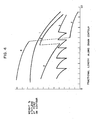
- various structures can be prepared by adding additional monomer(s) during the course of the polymerization, as shown in Fig.4, wherein composition is plotted versus position along the contour length of the chain.
- the Intra-CD of curve 1 is obtained by feeding all of the monomers at the tubular reactor inlet or at the start of a batch reaction.
- the Intra-CD of curve 2 can be made by adding additional ethylene at a point along the tube or, in a batch reactor, where the chains have reached about half their length.
- the Intra-CD's of Curve 3 requires multiple feed additions.
- the Intra-CD of curve 4 can be formed if additional comonomer rather than ethylene is added. This structure permits a whole ethylene composition range to be omitted from the chain. In each case, a third or more comonomers may be added.
- the composition of the catalyst used to produce alpha-olefin copolymers has a profound effect on copolymer product properties such as compositional dispersity and MWD.
- the catalyst utilized in practicing processes in accordance with the present invention should be such as to yield essentially one active catalyst species in the reaction mixture. More specifically, it should yield one primary active catalyst species which provides for substantially all of the polymerization reaction. Additional active catalyst species could be present, provided the copolymer product is in accordance with the present invention, e.g., narrow MWD and Inter-CD. it is believed that such additional active catalyst species could provide as much as 35% (weight) of the total copolymer. Preferably, they should account for about 10 % or less of the copolymer.
- the essentially one active species should provide for at least 65% of the total copolymer produced, preferably for at least 90% thereof.
- the extent to which a catalyst species contributes to the polymerization can be readily determined using the below- described techniques for characterizing catalyst according to the number of active catalyst species.
- MWD gel permeation chromatography
- Catalyst systems to be used in carrying out processes in accordance with the present invention may be Ziegler catalysts, which may typically include:
- the preferred catalyst system in practicing processes in accordance with the present invention comprises hydrocarbon-soluble vanadium compound in which the vanadium valence is 3 to 5 and organo-aluminum compound, with the proviso that the catalyst system yields essentially one active catalyst species as described above. At least one of the vanadium compound/organo-aluminum pair selected must also contain a valence-bonded halogen.
- R preferably represents a C 1 to C 10 aliphatic, alicyclic or aromatic hydrocarbon radical such as ethyl (Et), phenyl, isopropyl, butyl, propyl, n-butyl, i-butyl, t-butyl, hexyl, cyclohexyl, octyl, naphthyl, etc.
- the most preferred vanadium compounds are VC1 4 , VOC1 3 , and VOC1 2 (OR).
- the co-catalyst is preferably organo-aluminum compound.
- organo-aluminum compound In terms of chemical formulas, these compounds could be as follows: and where R and R' represent hydrocarbon radicals, the same or different, as described above with respect to the vanadium compound formula.
- the most preferred organo-aluminum compound is an aluminum alkyl sesquichloride such as A1 2 Et 3 Cl 3 or Al 2 (iBu) 3 Cl 3 .
- a catalyst system comprised of VC1 4 and Al 2 R 3 Cl 3 , preferably where R is ethyl, has been shown to be particularly effective.
- the molar amounts of catalyst components added to the reaction mixture should provide a molar ratio of aluminum/vanadium (Al/V) of at least about 2.
- Al/V aluminum/vanadium
- the preferred minimum Al/V is about 4.
- the maximum Al/V is based primarily on the considerations of catalyst expense and the desire to minimize the amount of chain transfer that may be caused by the organo-aluminum compound (as explained in detail below).
- the M w/ M n of the copolymer may rise above 2. Based on these considerations, the maximum Al/V could be about 25, however, a maximum of about 17 is more preferred. The most preferred maximum is about 15.
- Chain transfer agents for the Ziegler-catalyzed polymerization of alpha-olefins are well known and are illustrated, by way of example, by hydrogen or diethyl zinc for the production of EPM and EPDM. Such agents are very commonly used to control the molecular weight of EPM and E PDM produced in continuous flow stirred reactors.
- addition of chain transfer agents to a CFSTR reduces the polymer molecular weight but does not affect the molecular weight distribution.
- chain transfer reactions during tubular reactor polymerization in accordance with the present invention broaden polymer molecular weight distribution and Inter-CD.
- chain transfer agents in the reaction mixture should be minimized or omitted altogether.
- the amount of chain transfer agent used should be limited to those amounts that provide copolymer product in accordance with the desired limits as regards MWD and compositional dispersity. It is believed that the maximum amount of chain transfer agent present in the reaction mixture could be as high as about 0.2 mol/mol of transition metal, e.g., vanadium, again provided that the resulting copolymer product is in accordance with the desired limits as regards MWD and compositional dispersity.
- transition metal e.g., vanadium
- the organo-aluminum compound that gives the highest copolymer molecular weight at acceptable catalyst activity should be chosen. Furthermore, if the Al/V ratio has an effect cn the molecular weight of copolymer product, that Al/V should be used which gives the highest molecular weight also at acceptable catalyst activity. Chain transfer with propylene can best be limited by avoiding excessive temperature during-the polymerization as described below.
- Polymerizations in accordance with the present invention should be conducted in such a manner and under conditions sufficient to initiate propagation of essentially all copolymer chains simultaneously. This can be accomplished by utilizing the process steps and conditions described below.
- the catalyst components are preferably premixed, that is, reacted to form active catalyst outside of the reactor, to ensure rapid 'chain initiation.
- Aging of the premixed catalyst system that is, the time spent by the catalyst components (e.g., vanadium compound and organo-aluminum) in each other's presence outside of the reactor, should preferably be kept within limits. If not aged for a sufficient period of time, the components will not have reacted with each other sufficiently to yield an adequate quantity of active catalyst species, with the result of non- simultaneous chain initiation. Also, it is known that the activity of the catalyst species will decrease with time so that the aging must be kept below a maximum limit.
- the minimum aging period could be as low as about .1 second.
- the preferred minimum aging period is about .5 second, while the most preferred minimum aging period is about 1 second.
- the maximum aging period could be higher, for the preferred vanadium/organo-aluminum catalyst system the preferred maximum is about 200 seconds. A more preferred maximum is about 100 seconds.
- the most preferred maximum aging period is about 50 seconds.
- the premixing could be performed at low temperature such as 40°C or below. It is preferred that the premixing be performed at 25°C or below, with 15°C or below being most preferred.
- the temperature of the reaction mixture should also be kept within certain limits.
- the temperature at the reactor inlet should be high enough to provide complete, rapid chain initiation at the start of the polymerization reaction.
- the length of time the reaction mixture spends at high temperature must be short enough to minimize the amount of undesirable chain transfer and catalyst deactivation reactions.
- Temperature control of the reaction mixture is complicated somewhat by the fact that the polymerization reaction generates large quantities of heat. This problem is, preferably, taken care of by using prechilled feed to the reactor to absorb the heat of polymerization. With this technique, the reactor is operated adiabatically and the temperature is allowed to increase during the course of polymerization.
- heat can be removed from the reaction mixture, for example, by a heat exchanger surrounding at least a portion of the reactor or by well-known autorefrigeration techniques in the case of batch reactors or multiple stirred reactors in series.
- the inlet temperature of the reactor feed could be about from -50 o C to 500°C. It is believed that the outlet temperature of the reaction mixture could be as high as about 200°C.
- the preferred maximum cutlet temperature is about 70 o C. The most preferred maximum is about 50°C.
- reactor cooling such as by a cooling jacket, to remove the heat of polymerization, it has been determined that the temperature of the reaction mixture will increase from reactor-inlet to outlet by about 13°C per weight percent of copolymer in the reaction mixture (weight of copolymer per weight of solvent).
- the preferred maximum copolymer concentration at the reactor outlet is 25 wt./100 wt. diluent.
- the most preferred maximum concentration is 15 wt/100 wt.
- concentration there is no lower limit to concentration due to reactor operability, but for economic reasons it is preferred to have a copolymer concentration of at least 2 wt/100 wt. Most preferred is a concentration of at least 3 wt/100 wt.
- the rate of flow of the reaction mixture through the reactor should be high enough to provide good mixing of the reactants in the radial direction and minimize mixing in the axial direction.
- Good radial mixing is beneficial not only to both the Intra-and Inter-CD of-the copolymer chains but also to minimize radial temperature gradients due to the heat generated by the polymerization reaction. Radial temperature gradients will tend to broaden the molecular weight distribution of the copolymer since the polymerization rate is faster in the high temperature regions resulting from poor heat dissipation. The artisan will recognize that achievement of these objectives is difficult in the case of highly viscous solutions. This problem can be overcome to some extent through the use of radial mixing devices such as static mixers (e.g., those produced by the Kenics Corporation).
- residence time of the reaction mixture in the mix-free reactor can vary over a wide range. It is believed that the minimum could be as low as about 1 second. A preferred minimum is about 10 seconds. The most preferred minimum is about 15 seconds. It is believed that the maximum could be as high as about 3600 seconds. A preferred maximum is about 1800 seconds. The most preferred maximum is about 900 seconds.
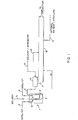
- reference numeral 1 generally refers to a premixing device for premixing the catalyst components.
- EPM ethylene and propylene
- the polymerization is an adiabatic, solution polymerization process using hexane solvent for both the catalyst system and the reaction mixture.
- the premixing device 1 comprises a temperature control bath 2, a fluid flow conduit 3 and mixing device 4 (e.g., a mixing tee).
- mixing device 4 e.g., a mixing tee
- To mixing device 4 are fed hexane solvent, vanadium tetrachloride and ethyl aluminum sesqui chloride through feed conduits 5, 6 and 7, respectively.
- the resulting catalyst mixture is caused to flow within conduit 3, optionally in-the form of a coiled tube, for a time long enough to produce the active catalyst species at the temperature set by the temperature bath.
- the temperature of the bath is set to give the desired catalyst solution temperature in conduit 3 at the outlet of the bath.
- the catalyst solution flows through conduit 8 into mixing zone 5 to provide an intimate mixing with hexane solvent and reactants (ethylene and propylene) which are fed through conduit 10.
- Any suitable mixing device can be used , such as a mechanical mixer, orifice mixer or mixing tee. For economic reasons, the mixing tee is preferred.
- the residence time of the reaction mixture in mixing zone 9 is kept short enough to prevent significant polymer formation therein before being fed through conduit 11 to tubular reactor 12.
- streams 8 and 10 can be fed directly to the inlet of reactor 12 if the flow rates are high enough to accomplish the desired level of intimate mixing.
- the hexane with dissolved monomers may be cooled upstream of mixing zone 9 to provide the desired feed temperature at the reactor inlet.
- Tubular reactor 12 is shown with optional, intermediate feed points 13-15 where additional monomers (e.g., ethylene as shown) and/or hexane can be fed to the reactor.
- additional monomers e.g., ethylene as shown
- hexane e.g., ethylene as shown
- the optional feeds would be used in the instance where it would be desirable to control the Intra-CD.
- external cooling means such as a cooling jacket surrounding at least a portion of the reactor system 12 can be provided.
- copolymer chains formed in accordance with the present invention are dispersed within the reaction mixture.
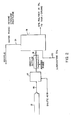
- Fig 2 schematically illustrates a process for mixing copolymer with lube oil
- copolymer product from reactor 12 is fed through conduit 16 to deashing section 17 wherein catalyst residues are removed from the reaction mixture in a known manner (known as deashing).
- the vanadium and aluminum compound residues are removed by reacting them with water to form hydrocarbon- insoluble hydroxides and then extracting the hydroxides into dilute acid.
- the polymer solution which primarily contains solvent, unreacted monomers and copolymer product (E?M) is fed through conduit 18 to lube oil mixing tank 19.
- tank 19 could be a staged series of tanks.
- Hot lube oil is fed through conduit 20 to mixing tank 19, wherein the remaining reaction mixture is heated up such that the remaining hexane and unreacted monomers are vaporized and removed through recycle conduit 21 through which they flow back for reuse in premixing device 1 following suitable purification to remove any catalyst poisons.
- the copolymer product being hydrocarbon-soluble, is now present in the lube oil and is removed from tank 19 as a copolymer- in-oil solution.
- the copolymer solution from the gravity settler can be steam distilled with subsequent extrusion drying of the polymer and then mixed with a hydrocarbon mineral oil diluent to produce an oil additive concentrate or lube oil additive.
- alpha-olefin copolymers having very narrow MWD can be made by direct polymerization.
- narrow MWD copolymers can be made using other known techniques, such as by fractionation or mechanical degradation, these techniques are considered to be impractical to the extent of being unsuitable for commercial-scale operation.
- EPDM made in accordance with the present invention the products have enhanced cure properties at a given Mooney Viscosity.
- EPM the products have good shear stability and excellent low temperature properties which make them especially suitable for lube oil applications.
- the narrower the MWD of the polymer the better the copolymer is considered to be.
- a lubricating oil composition in accordance with the present invention comprises a major amount of basestock lubricating oil (lube oil) of lubricating viscosity which contains an effective amount of viscosity index improver being a copolymer of ethylene and at least one other alpha- clef in as described in detail above. More specifically, the copolymer should have a MWD characterized by at least one of a ratio of M w/ M n of less than 2 and a ratio of M z / M w of less than 1.8.
- the preferred ratio of M w / M n is less than about-1.6, with less than about 1.4 being preferred.
- the preferred M z / M w is less than about 1.5, with less than about 1.3 being most preferred.
- the Intra-CD of the copolymer is such that at least two portions of an individual intramolecularly heterogeneous chain, each portion comprising at least 5 weight percent of said chain, differ in composition from one another by at least 5 weight percent ethylene.
- the Intra-CD can be such that at least two portions of copolymer chain differ by at least 10 weight percent ethylene. Differences of at least 20 weight percent, as well as, 40 weight percent ethylene are also considered to be in accordance with the present invention.
- the Inter-CD of the copolymer is such that 95 wt.% of the copolymer chains have an ethylene composition that differs from the copolymer average weight percent ethylene composition by 15 wt.% or less.
- the preferred Inter-CD is about 13% or less, with the most preferred being about 10% or less.
- the copolymer has all of the MWD, Intra-CD and Inter-CD . characteristics described above when incorporated in a lubricating oil or oil additive concentrate composition.
- ethylene-propylene copolymer is most preferred.
- the preferred ethylene content of the copolymer, on a weight basis, for use as a lube oil additive is about from 30% to 75%..
- the copolymer could have a weight average molecular weight as low as about 5,000.
- the preferred mimimum is about 15,000, with about 50,000 being the most preferred minimum.
- the maximum weight average molecular weight could be as high as about 500,000.
- the preferred maximum is about 300,000, with about 250,000 being the most preferred maximum.
- Copolymers of this invention may be employed in lubricating oils as viscosity index improvers or viscosity modifiers in amounts varying broadly from about 0.001 to 49 wt.%.
- the proportions giving the best results will vary somewhat according to the nature of the lubricating oil basestock and the specific purpose for which the lubricant is to serve in a given case.
- the polymer concentrations are within the range of about 0.1 to 15.0 wt% of the total composition which are amounts effective to provide viscosity index improvements.
- polymeric additives are sold as oil additive concentrates wherein the additive is present in amounts of about 5 to 50 wt%, preferably 6 to 25 wt% based on the total amount of hydrocarbon mineral oil diluent for the additive.
- the polymers of this invention are typically used in lubricating oils based on a hydrocarbon mineral oil having a viscosity of about 2- 40 centistokes (ASTM D-445) at 99°C, but lubricating oil basestocks comprised of a mixture of a hydrocarbon mineral oil and up to about 25 wt% of a synthetic lubricating oil such as esters of dibasic acids and complex esters derived from monobasic acids, polyglycols, dibasic acids and alcohols are also considered suitable.
- Finished lubricating oils containing the ethylenealpha-olefin polymers of the present invention will typically contain a number of other conventional additives in amounts required to provide their normal attendant functions and these include ashless dispersants, metal or over-based metal detergent additives, zinc dihydrocarbyl dithiophosphate, anti-wear additives, anti-oxidents, pour depressants, rust inhibitors, fuel economy or friction reducing additives and the like.
- the ashless dispersants include the polyalkenyl or berated polyalkenyl succinimide where the alkenyl group is derived from a C 3 -C 4 olefin, especially polyisobutenyl having a number average molecular weight of about 700 to 5,000.
- Other well known dispersants include the oil soluble polyol esters of hydrocarbon substituted succinic anhydride, e.g., polyisobutenyl succinic anhydride and the oil soluble oxazoline and lactone oxazoline dispersants derived from hydrocarbon substituted succinic anhydride and di-substituted amino alcohols.
- Lubricating oils typically contain about 0.5 to 5 wt.% of ashless dispersant.
- the metal detergent additives suitable in the oil are known in the-art and include one or more members selected from the group consisting of overbased oil-soluble calcium, magnesium and barium phenates, sulfurized phenates, and sulfonates especially the sulfonates of C 16 -C50 alkyl substituted benzene or toluene sulfonic acids which have a total base number of about 80 to 300.
- These overbased materials may be used as the sole metal detergent additive or in combination with the same additives in the neutral form but the overall metal detergent additive combination should have a basicity as represented by the foregoing total base number.
- they are present in amounts of from about 0.5 to 8 wt.% with a mixture of overbased magnesium sulfurized phenate and neutral calcium sulfurized phenate, obtained from C 8 to C 12 alkyl phenols being especially useful.
- the anti-wear additives useful are the oil-soluble zinc dihydrocarbyldithiophosphate having a total of at least 5 carbon atoms, preferably alkyl groups of C 4 -C S , typically used in amounts of about 0.5-6% by weight.
- olefin polymers such as other ethylene-propylene copolymers (e.g., those disclosed in the prior art as discussed above), polybutene, hydrogenated polymers and copolymers and terpolymers of styrene with isoprene and/or butadiene, polymers of alkyl acrylates or alkyl methacrylates, copolymers of alkyl methacrylates with N-vinyl pyrollidone or dimethyl- aminoalkyl methacrylate, post-grafted polymers of ethylene-propylene with an active monomer such as maleic anhydride which may be further reacted with alcohol or an alkylene polyamine, styrene-maleic anhydride polymers post-reacted with alcohols and amines and the like. These are used as required to provide the viscosity range desired in the finished oil, in accordance with known formulating techniques.
- Suitable oxidation inhibitors are hindered phenols, such as 2,6-ditertiary-butyl-paracresol, amines, sulfurized phenols and alkyl phenothiazines; usually a lubricating oil will contain about 0.01 to 3 weight percent of oxidation inhibitor depending on its effectiveness.
- Rust inhibitors are employed in very small proportions such as about 0.1 to 1 weight percent with suitable rust inhibitors being exemplified by C 9 -C 30 aliphatic succinic acids or anhydrides such as dodecenyl succinic anhydride.
- Antifoam agents are typically the polysilcxane silicone polymers present in amounts of about 0.01 to 1 weight percent.
- pour point depressants are used generally in amounts of from about 0.01 to about 10.0 wt.%, more typically from about 0.01 to about 1 wt.%, for most mineral oil basestocks of lubricating viscosity.
- Illustrative of pour point depressants which are normally used in lubricating oil compositions are polymers and copolymers of n-alkyl methacrylate and n-alkyl acrylates, copolymers of di - n-alkyl fumarate and vinyl acetate, alpha-olefin copolymers, alkylated naphthalenes, copolymers or terpolymers of alpha-olefins and styrene and/or alkyl styrene, styrene dialkyl malec,copolymers and the like.
- lube oil compositions made in accordance with the present invention preferably have a Mini Rotary Viscosity (MRV) measurement in centipoises (cps) at -25 0 C according to ASTM-D 3829 of less than 30,000.
- MMV Mini Rotary Viscosity
- cps centipoises
- an ethylene-propylene copolymer was prepared in a conventional continuous flow stirred tank reactor. Catalyst, monomers and solvent were fed to a 3 gallon reactor at rates shown in the accompanying Table I. Hexane was purified prior to use by passing over 4A molecular sieves (Union Carbide, Linde Div. 4A 1/16" pellets) and silica gel (W. R. Grace Co., Davison Chemical Div., PA-400 20-40 mesh) to remove polar impurities which act as catalyst poisons.
- 4A molecular sieves Union Carbide, Linde Div. 4A 1/16" pellets
- silica gel W. R. Grace Co., Davison Chemical Div., PA-400 20-40 mesh
- Catalyst solution was prepared by dissolving 37. 4 g of VCl 4 in 7 1 of purified n-hexane.
- Cocatalyst consisted of 96.0 g A1 2 E' 3 Cl 3 in 7 1 of n-hexane. These solutions were fed to the reactor at rates shown in Table I. For the case of catalyst premixing the two solutions were premixed at 0°C for 10 seconds prior to entry into the reactor.
- Copolymer was deashed by contacting with aqueous base and recovered by steam distillation of the diluent with mill drying of the product to remove residual volatiles.
- the product so prepared was analyzed for composition, compositional distribution and molecular weight distribution using the techniques discussed in the specification. Results were as in Table I.
- copolymers were essentially compositionally homogeneous with heterogeneity ⁇ 3% about the average, i.e. within experimental error.
- the polymerization reactor was a one-inch diameter pipe equipped with Kenics static mixer elements along its length. Monomers, hexane, catalyst, and cocatalyst were continuously fed to the reactor at one end and the copolymer solution and unreacted monomers were withdrawn from the other end. Monomers were purified and reactor temperature and pressure was controlled as in Example 1.
- a catalyst solution was prepared by dissolving 18.5 g of vanadium tetrachloride, VC1 4 , in 5.0 1 of purified n-hexane.
- the cocatalyst consisted of 142 g of ethyl aluminum sesqui chloride, A1 2 Et 3 C1 3 , in 5.0 1 of purified n-hexane.
- the two solutions were premixed at a given temperature (as indicated in TABLE II) for 10 seconds prior to entry into the reactor.
- Table II lists the feed rates for the monomers, catalyst, and the residence time of examples 2(A.), (B.), and ( C .). Polymer was recovered and analyzed as in Example 1.
- Figure 5 illustrates the polymer concentration- residence time relationship, with.concentration being presented in terms of polymer concentration at residence time t (C At residence time t )/polymer concentration at final t (C F i nal t) which exists at the end of the reactor. It is evident that in example 2(B.) the maximum polymerization rate occurs at about zero reaction time indicating fast initiation of all the polymer chains. As a result, a very narrow MWD EPM with (M w/ M n ) equal to 1.3 and (M z/ M w ) of 1.2 was produced through a process in accordance with the present invention.
- example 2(A.) shows that EPM with M w/ M n greater than 2.0 and M z / M w of 2.0 was obtained when the proper conditions were not used.
- lack of premixing of the catalyst components led to a reduced rate of chain initiation and broadened MWD.
- Sample A made without catalyst premixing, had a broad Inter-CD typical of the prior art (e.g., Junghanns).
- Inter-CD typical of the prior art (e.g., Junghanns).
- samples B and C Inter-CD was much reduced as a result of the premixing.
- Intra-CD is shown as the difference between the fractionation data on the fragmented and unfragmented samples.
- sample B the chains are shown to contain segments of at least 6% ethylene higher than that isolatable on the unfragmented material.
- the residual Inter-CD obscures the analysis of Intra-CD.
- sample C was first fractionated and then one fraction (the 3rd) was refractionated showing it to be homogeneous with regard to Inter-CD.
- Upon fragmentation a compositional dispersity as large as the original whole polymer Inter-CD was obtained.
- those chains must have had an Intra-CD of greater than 18%.
- the 2nd and 3rd fractions, which were similar, comprised more than 70% of the original polymer showing that the Inter- CD which obscured the Intra-CD was only due to a minor portion of the whole polymer.
- This example illustrates the use of additional monomer feed downstream of the reactor inlet (multiple feed points) to vary polymer composition and compositional distribution while maintaining a narrow MWD.
- a second hexane stream containing only ethylene was fed into the reactor downstream of the inlet in addition to those feeds used at the inlet.
- the polymerization conditions were the same except there was no second ethylene feed.
- the polymerization procedures of example 2(B.) were repeated. The process conditions are listed in Table III.
- the copolymer produced was recovered and analyzed by the procedures described in Example 1 above.
- the EN B content was determined by refractive index measurement ( I . J. G ardner and G. Ver Strate, Rubber Chem. Tech. 4 6, 1019 (1973)).
- the molecular weight distribution, rate of polymerization and compositions are shown in Table V.
- polymers made as described in the previous examples were dissolved in lubricating oil basestock and the viscosity effects were evaluated.
- the narrow MWD and intramolecular compositional distribution of these polymers provide improvements in MRV (Mini Rotary Viscosity) and SSI (Sonic Shear Index).
- MRV This is a viscosity measurement in centipoises (cps) at -25 0 C according to ASTM-D 3829 using the Mini-Rotary Viscometer and is an industry accepted evaluation for the low temperature pumpability of a lubricating oil.
- T.E. This represents Thickening Efficiency and is defined as the ratio of the weight percent of a polyisobutylene (sold as an oil solution by. Exxon Chemical Company as Paratone N), having a Staudinger molecular weight of 20,000, required to thicken a solvent-extracted neutral mineral lubricating oil, having a viscosity of 150 SUS at 37.8 o C., a viscosity index of 105 and an AST M pour point of 0°F., (Solvent 150 Neutral) to a viscosity of 12.3 centistokes at 98.9°C., to the weight percent of a test copolymer required to thicken the same oil to the same viscosity at the same temperature.
- SSI Shear Stability Index and measures the stability of polymers used as V.I. improvers in motor oils subjected to high shear rates.
- the sample under test is blended with a typical basestock to a viscosity increase at 210 0 F of 7.0 ⁇ 5 centistokes.
- Two portions of the blend are successively subjected to sonic shearing forces at a specific power input and a constant temperature for 15 minutes. Viscosities are determined on the blends both before and after the treatment; the decrease in viscosity after the treatment is a measure of the molecular breakdown of the polymer under test.
- a series of standard samples is used as a reference to establish the correct value for the sample under test. The corrected value is reported as the SSI which is the percent sonic breakdown to the nearest 1%.
- polymers made as described in Examples 1 and 2 were dissolved in lubricating oil to provide a kinematic viscosity of 13.5 centistokes at 100°C (ASTM D445)
- SSI was measured in Solvent 150 Neutral basestock (31 cs. min at 100°F, pour point of 50°F and broad wax distribution).
- MRV was measured in a Mid-Continent basestock being a mixture of Solvent 100 Neutral (20 cS. min at 100°F) and Solvent 250 Neutral (55 cS. min at 100°F) and having a narrow (C24-C36) wax distribution and containing 0.2 wt% vinyl acetate fumarate pour depressant (Para- flow 449, Exxon Chemical Co.).
- Example 2B outperformed Example 1 in SSI at the same T E .
- Example 3 the polymer of Example 3, which was made with multiple ethylene feeds and which retained its narrow MWD even with a second ethylene feed, has good shear stability.
- the shear stability of 3B was equivalent to the polymer made with the single feed. Thus, it is possible to tailor compositional distribution without significantly affecting MWD and SSI.
- Example 5(A) This example demonstrates a terpolymer in accordance with this invention exhibits the same viscosity improvements.
- a terpolymer sample was prepared as in Example 5(A). This sample was tested for SSI and MRV. Sample analysis and results appear in Table 10.
Landscapes
- Chemical & Material Sciences (AREA)
- Organic Chemistry (AREA)
- Chemical Kinetics & Catalysis (AREA)
- Health & Medical Sciences (AREA)
- Medicinal Chemistry (AREA)
- Polymers & Plastics (AREA)
- Oil, Petroleum & Natural Gas (AREA)
- General Chemical & Material Sciences (AREA)
- Inorganic Chemistry (AREA)
- Addition Polymer Or Copolymer, Post-Treatments, Or Chemical Modifications (AREA)
- Lubricants (AREA)
- Sealing Material Composition (AREA)
- Transition And Organic Metals Composition Catalysts For Addition Polymerization (AREA)
- Compositions Of Macromolecular Compounds (AREA)
- Polymerisation Methods In General (AREA)
Applications Claiming Priority (2)
| Application Number | Priority Date | Filing Date | Title |
|---|---|---|---|
| US06/504,582 US4540753A (en) | 1983-06-15 | 1983-06-15 | Narrow MWD alpha-olefin copolymers |
| US504582 | 1983-06-15 |
Publications (3)
| Publication Number | Publication Date |
|---|---|
| EP0129414A2 true EP0129414A2 (fr) | 1984-12-27 |
| EP0129414A3 EP0129414A3 (en) | 1986-06-25 |
| EP0129414B1 EP0129414B1 (fr) | 1990-10-31 |
Family
ID=24006894
Family Applications (1)
| Application Number | Title | Priority Date | Filing Date |
|---|---|---|---|
| EP84304028A Expired - Lifetime EP0129414B1 (fr) | 1983-06-15 | 1984-06-14 | Copolymères d'alpha oléfines ayant une distribution étroite de poids moléculaire |
Country Status (7)
| Country | Link |
|---|---|
| US (2) | US4540753A (fr) |
| EP (1) | EP0129414B1 (fr) |
| JP (2) | JPH0696624B2 (fr) |
| AU (1) | AU569304B2 (fr) |
| BR (1) | BR8402916A (fr) |
| CA (1) | CA1228699A (fr) |
| DE (1) | DE3483497D1 (fr) |
Cited By (19)
| Publication number | Priority date | Publication date | Assignee | Title |
|---|---|---|---|---|
| EP0204840A4 (fr) * | 1984-12-14 | 1988-09-07 | Exxon Research Engineering Co | Modification de la distribution des poids moleculaires dans un reacteur tubulaire. |
| EP0299608A1 (fr) * | 1987-07-13 | 1989-01-18 | Exxon Chemical Patents Inc. | Polymères modificateurs de viscosité |
| EP0240638A3 (fr) * | 1985-12-16 | 1990-01-17 | Exxon Research And Engineering Company | Polymères contenant des groupements fonctionnels de chlorosilane oléfinique et halogénure oléfinique et leur procédé de préparation |
| EP0369673A1 (fr) * | 1988-11-16 | 1990-05-23 | Exxon Chemical Patents Inc. | Compositions d'additif pour huile contenant un polymère d'amélioration de l'indice de viscosité et présentant un trouble réduit |
| EP0372735A1 (fr) * | 1988-11-16 | 1990-06-13 | Exxon Chemical Patents Inc. | Process for reducing haze in a lubricating oilcomposition |
| EP0624604A1 (fr) * | 1993-05-11 | 1994-11-17 | Montell Technology Company bv | Copolymères élastomères d'éthylène et d'alpha-oléfines et procédé pour leur préparation |
| WO1995027746A1 (fr) * | 1994-04-06 | 1995-10-19 | Exxon Chemical Patents Inc. | COPOLYMERES BLOCS CONTENANT DE L'ETHYLENE ET UNE α-OLEFINE ET LEURS PROCEDES DE PRODUCTION |
| EP0786511A3 (fr) * | 1996-01-16 | 1997-08-27 | Lubrizol Corp | |
| EP0790294A3 (fr) * | 1996-01-16 | 1997-08-27 | The Lubrizol Corporation | Compositions lubrifiantes |
| US5733980A (en) * | 1994-04-06 | 1998-03-31 | Exxon Chemical Patents Inc. | Ethylene α-olefin block copolymers and methods for production thereof |
| US6110880A (en) * | 1997-06-24 | 2000-08-29 | Exxon Chemical Patents Inc | Polyolefin block copolymer viscosity modifier |
| WO2001058968A1 (fr) * | 2000-02-09 | 2001-08-16 | Idemitsu Petrochemical Co., Ltd. | Copolymeres a base d'ethylene, leur procede de production et huiles lubrifiantes les contenant |
| WO2001085880A1 (fr) * | 2000-05-10 | 2001-11-15 | Mitsui Chemicals, Inc. | Modificateur de viscosite pour huile lubrifiante et composition d'huile lubrifiante |
| US6331600B1 (en) | 1993-06-30 | 2001-12-18 | Basell Technology Company Bv | Elastomeric copolymers of ethylene and propylene |
| WO2003001081A1 (fr) * | 2001-06-21 | 2003-01-03 | Habasit Ag | COURROIE MONOLITHIQUE COMPRENANT DES COPOLYMERES ETHYLENE-α OLEFINE |
| US6525007B2 (en) | 1998-12-09 | 2003-02-25 | Mitsui Chemicals, Inc. | Viscosity modifier for lubricating oil and lubricating oil composition |
| US6589920B2 (en) | 1999-03-30 | 2003-07-08 | Mitsui Chemicals, Inc. | Viscosity modifier for lubricating oil and lubricating oil composition |
| US7022766B2 (en) | 2001-05-31 | 2006-04-04 | Mitsui Chemicals, Inc. | Olefin block copolymer, viscosity index improver for lubricating oils and lubricating oil composition |
| US9441060B2 (en) | 2009-04-28 | 2016-09-13 | Exxonmobil Chemical Patents Inc. | Ethylene copolymers, methods for their production, and use |
Families Citing this family (257)
| Publication number | Priority date | Publication date | Assignee | Title |
|---|---|---|---|---|
| US4959436A (en) * | 1983-06-15 | 1990-09-25 | Exxon Research And Engineering Co. | Narrow MWD alpha-olefin copolymers |
| US4716207A (en) * | 1983-06-15 | 1987-12-29 | Exxon Research & Engineering Co. | Nodular copolymers comprising narrow MWD alpha-olefin copolymers coupled by non-conjugated dienes |
| US5030695A (en) * | 1983-06-15 | 1991-07-09 | Exxon Research & Engineering Company | End-capped polymer chains, star and graft copolymers, and process of making same |
| US4540753A (en) * | 1983-06-15 | 1985-09-10 | Exxon Research & Engineering Co. | Narrow MWD alpha-olefin copolymers |
| US4882406A (en) * | 1983-06-15 | 1989-11-21 | Exxon Research & Engineering Company | Nodular copolymers formed of alpha-olefin copolymers coupled by non-conjugated dienes |
| US4978720A (en) * | 1983-06-15 | 1990-12-18 | Exxon Research And Engineering Company | Olefinic chlorosilane and olefinic halide functional group containing polymers and method of forming the same |
| AU608787B2 (en) * | 1983-06-15 | 1991-04-18 | Exxon Research And Engineering Company | Narrow mwd alpha-olefin copolymers |
| DE3583036D1 (de) * | 1984-12-14 | 1991-07-04 | Exxon Research Engineering Co | Nodulare copolymere aus von nichtkonjugierten dienen gekuppelten alpha-olefinkopolymeren. |
| AU599627B2 (en) * | 1984-12-14 | 1990-07-26 | Exxon Research And Engineering Company | Copolymers of olefinic chlorosilanes and/or halides |
| DE3678024D1 (de) | 1985-03-26 | 1991-04-18 | Mitsui Petrochemical Ind | Fluessiges statisches ethylencopolymer, verfahren zur herstellung und anwendung desselben. |
| WO1987003603A1 (fr) * | 1985-12-16 | 1987-06-18 | Exxon Research And Engineering Company | Chaines de polymeres a extremites fermees, copolymeres greffes et en etoile, et leur procede de fabrication |
| EP0230753B1 (fr) * | 1985-12-16 | 1991-10-23 | Exxon Research And Engineering Company | Compositions de copolymères contenant un composant à distribution moléculaire étroite et procédé pour leur fabrication |
| US4843129A (en) * | 1985-12-27 | 1989-06-27 | Exxon Research & Engineering Company | Elastomer-plastic blends |
| US5011891A (en) * | 1985-12-27 | 1991-04-30 | Exxon Research & Engineering Company | Elastomer polymer blends |
| JPH0511449Y2 (fr) * | 1986-01-28 | 1993-03-22 | ||
| US5177147A (en) * | 1986-03-03 | 1993-01-05 | Advanced Elastomer Systems, Lp | Elastomer-plastic blends |
| JP2555284B2 (ja) * | 1987-05-14 | 1996-11-20 | 出光興産株式会社 | 温度特性改良潤滑油組成物 |
| JP2503536B2 (ja) * | 1987-10-19 | 1996-06-05 | 三井石油化学工業株式会社 | 潤滑油組成物 |
| US5229022A (en) * | 1988-08-01 | 1993-07-20 | Exxon Chemical Patents Inc. | Ethylene alpha-olefin polymer substituted mono- and dicarboxylic acid dispersant additives (PT-920) |
| US5266223A (en) * | 1988-08-01 | 1993-11-30 | Exxon Chemical Patents Inc. | Ethylene alpha-olefin polymer substituted mono-and dicarboxylic acid dispersant additives |
| CA2034759C (fr) * | 1988-08-01 | 2003-06-03 | Won R. Song | Additifs dispersants a base de polymere olefinique de l'ethylene substitue par des acides mono et dicarboxyliques |
| US5225091A (en) * | 1988-08-01 | 1993-07-06 | Exxon Chemical Patents Inc. | Ethylene alpha-olefin polymer substituted thiocarboxylic acid lubricant dispersant additives |
| US5277833A (en) * | 1988-08-01 | 1994-01-11 | Exxon Chemical Patents Inc. | Ethylene alpha-olefin polymer substituted mono-and dicarboxylic acid lubricant dispersant additives |
| US5759967A (en) * | 1988-08-01 | 1998-06-02 | Exxon Chemical Patents Inc | Ethylene α-olefin/diene interpolymer-substituted carboxylic acid dispersant additives |
| US5350532A (en) * | 1988-08-01 | 1994-09-27 | Exxon Chemical Patents Inc. | Borated ethylene alpha-olefin polymer substituted mono- and dicarboxylic acid dispersant additives |
| US4999403A (en) * | 1988-10-28 | 1991-03-12 | Exxon Chemical Patents Inc. | Graft polymers of functionalized ethylene-alpha-olefin copolymer with polypropylene, methods of preparation, and use in polypropylene compositions |
| US5167848A (en) * | 1989-05-30 | 1992-12-01 | Exxon Chemical Patents Inc. | Grafted viscosity index improver |
| US5262075A (en) * | 1989-05-30 | 1993-11-16 | Exxon Chemical Patents Inc. | Multifunctional viscosity index improver exhibitng improved low temperature viscometric properties |
| US6025448A (en) | 1989-08-31 | 2000-02-15 | The Dow Chemical Company | Gas phase polymerization of olefins |
| US5191042A (en) * | 1989-09-06 | 1993-03-02 | Exxon Chemical Patents Inc. | Process for preparing alpha-olefin copolymers having a narrow MWD and broad compositional distribution |
| AU6337690A (en) * | 1989-09-06 | 1991-04-08 | Exxon Chemical Patents Inc. | Alpha olefin copolymers having a narrow mwd and broad compositional distribution |
| JPH0832868B2 (ja) * | 1990-01-16 | 1996-03-29 | 豊田合成株式会社 | 液圧シリンダ用シール部品 |
| US5275747A (en) * | 1990-02-01 | 1994-01-04 | Exxon Chemical Patents Inc. | Derivatized ethylene alpha-olefin polymer useful as multifunctional viscosity index improver additive for oleaginous composition |
| US5151204A (en) * | 1990-02-01 | 1992-09-29 | Exxon Chemical Patents Inc. | Oleaginous compositions containing novel ethylene alpha-olefin polymer viscosity index improver additive |
| US5021595A (en) * | 1990-03-02 | 1991-06-04 | Exxon Chemical Patents Inc. | Transition metal catalyst composition for olefin polymerization |
| US5187246A (en) * | 1990-06-26 | 1993-02-16 | Union Carbide Chemicals & Plastics Technology Corporation | Process for making epr resins |
| US6538080B1 (en) | 1990-07-03 | 2003-03-25 | Bp Chemicals Limited | Gas phase polymerization of olefins |
| US5236998A (en) * | 1991-03-07 | 1993-08-17 | Occidental Chemical Corporation | Process for the manufacture of linear polyethylene containing α-alkene commonomers |
| US5250612A (en) * | 1991-10-07 | 1993-10-05 | The Dow Chemical Company | Polyethylene films exhibiting low blocking force |
| US5395471A (en) | 1991-10-15 | 1995-03-07 | The Dow Chemical Company | High drawdown extrusion process with greater resistance to draw resonance |
| US5674342A (en) | 1991-10-15 | 1997-10-07 | The Dow Chemical Company | High drawdown extrusion composition and process |
| US5525695A (en) | 1991-10-15 | 1996-06-11 | The Dow Chemical Company | Elastic linear interpolymers |
| US5582923A (en) | 1991-10-15 | 1996-12-10 | The Dow Chemical Company | Extrusion compositions having high drawdown and substantially reduced neck-in |
| US5783638A (en) | 1991-10-15 | 1998-07-21 | The Dow Chemical Company | Elastic substantially linear ethylene polymers |
| US5278272A (en) | 1991-10-15 | 1994-01-11 | The Dow Chemical Company | Elastic substantialy linear olefin polymers |
| US6291384B1 (en) | 1991-11-06 | 2001-09-18 | Mobil Oil Corporation | High activity catalyst prepared with alkoxysilanes |
| US5939348A (en) * | 1991-11-06 | 1999-08-17 | Mobil Oil Corporation | Catalyst for the manufacture of polythylene with a narrow molecular weight distribution |
| US5470812A (en) * | 1991-11-06 | 1995-11-28 | Mobil Oil Corporation | High activity polyethylene catalysts prepared with alkoxysilane reagents |
| GB9207736D0 (en) * | 1992-04-08 | 1992-05-27 | Exxon Chemical Patents Inc | Ethlene elastomer compounds having good processability and ageing properties |
| DE69333773T2 (de) | 1992-11-13 | 2006-04-06 | Cryovac, Inc. | Wärmeschrumpfbare, durch Single-site-Katalyse hergestellte Copolymere enthaltende Folien. |
| US5604043A (en) * | 1993-09-20 | 1997-02-18 | W.R. Grace & Co.-Conn. | Heat shrinkable films containing single site catalyzed copolymers having long chain branching |
| US5554310A (en) * | 1992-12-17 | 1996-09-10 | Exxon Chemical Patents Inc. | Trisubstituted unsaturated polymers |
| CA2110463C (fr) * | 1992-12-17 | 2005-02-08 | Jacob Emert | Additifs-dispersants interpolymeriques exempts de gel, utiles dans les compositions oleagineuses |
| CA2110649C (fr) * | 1992-12-17 | 2004-10-26 | Jacob Emert | Additifs dispersants d'alpha-olefine sans gel utilises dans des compositions oleagineuses |
| IL107927A0 (en) * | 1992-12-17 | 1994-04-12 | Exxon Chemical Patents Inc | Oil soluble ethylene/1-butene copolymers and lubricating oils containing the same |
| IT1264015B (it) * | 1993-04-07 | 1996-09-06 | Enichem Elastomeri Srl | Copolimeri elastomerici etilene-propilene a ridotto contenuto di cloro residuo |
| EP0629631B1 (fr) | 1993-06-07 | 2002-08-28 | Mitsui Chemicals, Inc. | Nouvelle composé métallique de transition, et catalyseur de polymérisation le contenant |
| US7316833B1 (en) | 1993-06-24 | 2008-01-08 | Penchiney Emballage Flexible Europe | Multi-layer thermoplastic films and packages made therefrom |
| US5350807A (en) * | 1993-06-25 | 1994-09-27 | Phillips Petroleum Company | Ethylene polymers |
| US5475067A (en) * | 1993-09-16 | 1995-12-12 | Exxon Chemical Patents Inc. | Process for polyolefin production using short residence time reactors |
| JP3670010B2 (ja) * | 1993-11-18 | 2005-07-13 | モービル・オイル・コーポレーション | 触媒組成物の製造方法 |
| US5405901A (en) * | 1994-07-06 | 1995-04-11 | Union Carbide Chemicals & Plastics Technology Corporation | Process of producing ethylene polymer blends in gas phase |
| US5792534A (en) | 1994-10-21 | 1998-08-11 | The Dow Chemical Company | Polyolefin film exhibiting heat resistivity, low hexane extractives and controlled modulus |
| US5549867A (en) * | 1994-11-03 | 1996-08-27 | Fiberweb North America, Inc. | Distribution enhanced polyolefin meltspinning process and product |
| US6287613B1 (en) | 1994-12-12 | 2001-09-11 | Cryovac Inc | Patch bag comprising homogeneous ethylene/alpha-olefin copolymer |
| US5795941A (en) * | 1995-10-03 | 1998-08-18 | The Dow Chemical Company | Crosslinkable bimodal polyolefin compositions |
| EP0876427B1 (fr) * | 1996-01-22 | 2002-09-25 | The Dow Chemical Company | Melanges d'elastomeres polyoleofiniques presentant des proprietes ameliorees |
| US5849823A (en) * | 1996-09-04 | 1998-12-15 | The Dow Chemical Company | Homogeneously branched ethylene α-olefin interpolymer compositions for use in gasket applications |
| US6610408B1 (en) | 1996-11-08 | 2003-08-26 | Solvay Engineered Polymers | TPO blends containing multimodal elastomers |
| US5763533A (en) * | 1996-12-10 | 1998-06-09 | Exxon Chemical Patents Inc. | Electrical devices including ethylene, α-olefin, vinyl norbornene elastomers and ethylene α-olefin polymers |
| US5912296A (en) * | 1997-05-19 | 1999-06-15 | Bridgestone Corporation | Extended polymer composition derived from grafted elastomers and polypropylene |
| US5910530A (en) * | 1997-05-19 | 1999-06-08 | Bridgestone Corporation | High damping gel derived from extending grafted elastomers and polypropylene |
| US6124513A (en) | 1997-06-20 | 2000-09-26 | Pennzoil-Quaker State Company | Ethylene-alpha-olefin polymers, processes and uses |
| US6586646B1 (en) | 1997-06-20 | 2003-07-01 | Pennzoil-Quaker State Company | Vinylidene-containing polymers and uses thereof |
| US6921794B2 (en) * | 1997-08-12 | 2005-07-26 | Exxonmobil Chemical Patents Inc. | Blends made from propylene ethylene polymers |
| US7232871B2 (en) | 1997-08-12 | 2007-06-19 | Exxonmobil Chemical Patents Inc. | Propylene ethylene polymers and production process |
| US7026404B2 (en) * | 1997-08-12 | 2006-04-11 | Exxonmobil Chemical Patents Inc. | Articles made from blends made from propylene ethylene polymers |
| US6635715B1 (en) | 1997-08-12 | 2003-10-21 | Sudhin Datta | Thermoplastic polymer blends of isotactic polypropylene and alpha-olefin/propylene copolymers |
| US5981643A (en) * | 1997-10-09 | 1999-11-09 | Exxon Chemical Patents, Inc. | Depression of the glass transition temperature of polyolefins containing cyclic monomers |
| US6248827B1 (en) | 1997-12-22 | 2001-06-19 | Bridgestone Corporation | Centipede polymers and preparation and application in rubber compositions |
| US6204354B1 (en) | 1998-05-06 | 2001-03-20 | Bridgestone Corporation | Soft compounds derived from polypropylene grafted disubstituted ethylene- maleimide copolymers |
| US6248825B1 (en) | 1998-05-06 | 2001-06-19 | Bridgestone Corporation | Gels derived from extending grafted centipede polymers and polypropylene |
| US6207763B1 (en) | 1998-06-12 | 2001-03-27 | Bridgestone Corporation | Application of disubstituted ethylene-maleimide copolymers in rubber compounds |
| TW460485B (en) | 1998-06-19 | 2001-10-21 | Japan Polyolefins Co Ltd | Ethylene.Α-olefin copolymer, and combinations, films and use thereof |
| JP2002519497A (ja) | 1998-07-01 | 2002-07-02 | エクソンモービル・ケミカル・パテンツ・インク | 結晶性プロピレンポリマーと結晶化可能プロピレンポリマーとを含んでなる弾性ブレンド |
| US6184292B1 (en) | 1998-10-05 | 2001-02-06 | Bridgestone Corporation | Soft gel polymers for high temperature use |
| US6133354A (en) * | 1998-11-17 | 2000-10-17 | Bridgestone Corporation | Copolymers as additives in thermoplastic elastomer gels |
| US6191217B1 (en) | 1998-11-17 | 2001-02-20 | Bridgestone Corporation | Gels derived from polypropylene grafted alkyl vinylether-maleimide copolymers |
| DE60017889T2 (de) | 1999-05-13 | 2006-04-06 | Exxonmobil Chemical Patents Inc., Baytown | Elastische fasern und daraus hergestellte artikel, die kristalline und kristallisierbare propylenpolymere enthalten |
| US6750284B1 (en) * | 1999-05-13 | 2004-06-15 | Exxonmobil Chemical Patents Inc. | Thermoplastic filled membranes of propylene copolymers |
| US6500563B1 (en) | 1999-05-13 | 2002-12-31 | Exxonmobil Chemical Patents Inc. | Elastic films including crystalline polymer and crystallizable polymers of propylene |
| MXPA02006199A (es) * | 1999-12-22 | 2003-10-15 | Exxon Chemical Patents Inc | Composiciones adhesivas a base de polipropileno. |
| US6455638B2 (en) | 2000-05-11 | 2002-09-24 | Dupont Dow Elastomers L.L.C. | Ethylene/α-olefin polymer blends comprising components with differing ethylene contents |
| US6350800B1 (en) | 2000-06-05 | 2002-02-26 | Bridgestone Corporation | Soft polymer gel |
| US6476117B1 (en) | 2000-06-05 | 2002-11-05 | Bridgestone Corporation | Grafted near-gelation polymers having high damping properties |
| US6384134B1 (en) | 2000-06-05 | 2002-05-07 | Bridgestone Corporation | Poly(alkenyl-co-maleimide) and maleated polyalkylene grafted with grafting agent, and epoxy polymer |
| US6417259B1 (en) | 2000-06-05 | 2002-07-09 | Bridgestone Corporation | Polyalkylene grafted centipede polymers |
| US6353054B1 (en) | 2000-07-31 | 2002-03-05 | Bridgestone Corporation | Alkenyl-co-maleimide/diene rubber copolymers and applications |
| AU8087901A (en) * | 2000-07-31 | 2002-02-13 | Lubrizol Corp | Viscosity improver compositions providing improved low temperature characteristics to lubricating oils |
| US6359064B1 (en) | 2000-09-08 | 2002-03-19 | Bridgestone Corporation | Compound of polyester and polyalkylene grafted comb polymer |
| US20060167184A1 (en) * | 2000-10-18 | 2006-07-27 | Waddell Walter H | Innerliners for use in tires |
| KR100387648B1 (ko) * | 2000-11-01 | 2003-06-27 | 현대자동차주식회사 | 폴리프로필렌 수지 조성물 |
| DE60238049D1 (de) | 2001-04-12 | 2010-12-02 | Exxonmobil Chem Patents Inc | Verfahren zur Polymerisation von Propylen und Ethylen in Lösung |
| JP4606644B2 (ja) * | 2001-05-29 | 2011-01-05 | 三井化学株式会社 | 潤滑油用粘度調整剤および潤滑油組成物 |
| JP4805235B2 (ja) * | 2001-05-31 | 2011-11-02 | 三井化学株式会社 | オレフィンブロック共重合体、潤滑油用粘度指数向上剤および潤滑油組成物 |
| JP4717264B2 (ja) * | 2001-05-31 | 2011-07-06 | 三井化学株式会社 | 潤滑油用粘度指数向上剤および潤滑油組成物 |
| US7220801B2 (en) * | 2001-06-22 | 2007-05-22 | Exxonmobil Chemical Patents Inc. | Metallocene-produced very low density polyethylenes or linear low density polyethylenes as impact modifiers |
| CN100443868C (zh) * | 2001-11-09 | 2008-12-17 | 埃克森美孚化学专利公司 | 利用拉曼光谱分析的聚合物性能的在线测量和控制 |
| US20030171223A1 (en) * | 2002-01-31 | 2003-09-11 | Winemiller Mark D. | Lubricating oil compositions with improved friction properties |
| US20030236177A1 (en) * | 2002-03-05 | 2003-12-25 | Wu Margaret May-Som | Novel lubricant blend composition |
| US8318993B2 (en) | 2002-03-05 | 2012-11-27 | Exxonmobil Research And Engineering Company | Lubricant blend composition |
| WO2004000900A1 (fr) * | 2002-06-19 | 2003-12-31 | Exxonmobil Chemical Patents, Inc. | Ethylene, comonomere d'alpha-olefine superieure et dienes, notamment du norbornene vinylique et polymeres fabriques au moyen des procedes de l'invention |
| EP1527112B1 (fr) * | 2002-07-31 | 2007-10-31 | ExxonMobil Chemical Patents Inc. | Polyethylene reticulable a base de silane |
| DE60335634D1 (de) * | 2002-09-05 | 2011-02-17 | Exxonmobil Chem Patents Inc | Stretchfoliewickelverfahren |
| US7235607B2 (en) * | 2002-09-05 | 2007-06-26 | Exxonmobil Chemical Patents Inc. | Shrink film |
| CA2501528A1 (fr) * | 2002-10-15 | 2004-04-15 | Exxonmobil Chemical Patents Inc. | Mesure et regulation en ligne des proprietes de polymeres par spectroscopie raman |
| WO2004063234A1 (fr) * | 2003-01-06 | 2004-07-29 | Exxonmobil Chemical Patents Inc. | Mesure et regulation en ligne de proprietes de produits polymeres par spectroscopie raman |
| WO2004063270A2 (fr) * | 2003-01-08 | 2004-07-29 | Exxonmobil Chemical Patents Inc. | Articles elastiques et leurs procedes de fabrication |
| US7776804B2 (en) * | 2005-03-16 | 2010-08-17 | The Lubrizol Corporation | Viscosity improver compositions providing improved low temperature characteristics to lubricating oil |
| JP2005099712A (ja) * | 2003-08-28 | 2005-04-14 | Sharp Corp | 表示装置の駆動回路および表示装置 |
| US7605217B2 (en) * | 2003-11-14 | 2009-10-20 | Exxonmobil Chemical Patents Inc. | High strength propylene-based elastomers and uses thereof |
| KR100586922B1 (ko) * | 2004-11-18 | 2006-06-08 | 금호폴리켐 주식회사 | 고수율의 이피(디)엠의 제조방법 및 수율의 제어방법,이피(디)엠의 회수방법 |
| US7803876B2 (en) * | 2005-01-31 | 2010-09-28 | Exxonmobil Chemical Patent Inc. | Processes for producing polymer blends and polymer blend pellets |
| US8076416B2 (en) | 2005-02-04 | 2011-12-13 | Exxonmobil Chemical Patents Inc. | Thermoplastic vulcanizates and their use |
| EP1896542B1 (fr) | 2005-06-24 | 2018-06-20 | ExxonMobil Chemical Patents Inc. | Composition d'adhesif à base de copolymere du propylene fonctionnalise plastifie |
| WO2007001694A1 (fr) | 2005-06-24 | 2007-01-04 | Exxonmobil Chemical Patents Inc. | Composition adhésive de copolymère de propylène fonctionnalisé |
| US7505129B2 (en) | 2005-07-22 | 2009-03-17 | Exxonmobil Chemical Patents Inc. | On-line analysis of polymer properties for control of a solution phase reaction system |
| US7483129B2 (en) * | 2005-07-22 | 2009-01-27 | Exxonmobil Chemical Patents Inc. | On-line properties analysis of a molten polymer by raman spectroscopy for control of a mixing device |
| US7505127B2 (en) * | 2005-07-22 | 2009-03-17 | Exxonmobil Chemical Patents Inc. | On-line raman analysis and control of a high pressure reaction system |
| US20070082154A1 (en) * | 2005-10-12 | 2007-04-12 | Benoit Ambroise | Multi-layer films, methods of manufacture and articles made therefrom |
| US7807593B2 (en) * | 2005-10-26 | 2010-10-05 | Dow Global Technologies Inc. | Multi-layer, pre-stretched elastic articles |
| WO2007130277A1 (fr) * | 2006-05-05 | 2007-11-15 | Exxonmobil Chemical Patents Inc. | Mélanges de polymères basse densité linéaires et articles fabriqués à partir de ces mélanges |
| US8617717B2 (en) * | 2006-06-09 | 2013-12-31 | Exxonmobil Chemical Patents Inc. | Heat sealable films from propylene and α-olefin units |
| WO2008016518A2 (fr) * | 2006-08-02 | 2008-02-07 | Exxonmobil Chemical Patents Inc. | Article en polymère à base de propylène |
| EP1911791A1 (fr) * | 2006-10-03 | 2008-04-16 | Institut Curie | Méthode de traitement de surfaces contenant des groupes Si-H |
| JPWO2008047878A1 (ja) | 2006-10-20 | 2010-02-25 | 三井化学株式会社 | 共重合体、潤滑油粘度調整剤および潤滑油組成物 |
| US7951871B2 (en) * | 2006-11-10 | 2011-05-31 | Exxonmobil Chemical Patents Inc. | Curing rubber by hydrosilation |
| US7955540B2 (en) * | 2007-01-19 | 2011-06-07 | Exxonmobil Chemical Patents Inc. | Extrusion of thermoplastic elastomers |
| US7951732B2 (en) * | 2007-01-26 | 2011-05-31 | Exxonmobil Chemical Patents Inc. | Elastomeric laminates for consumer products |
| US20080305220A1 (en) | 2007-05-25 | 2008-12-11 | Dimitris Gkinosatis | Multilayer heat shrinkable cook-in film |
| US8241753B2 (en) * | 2007-06-04 | 2012-08-14 | Exxonmobil Chemical Patents Inc. | Composite thermoplastic elastomer structures with high adhesion performance and uses for the same |
| US8962762B2 (en) * | 2007-06-13 | 2015-02-24 | Exxonmobil Chemical Patents Inc. | Thermoplastic polymer compositions, methods for making the same, and articles made therefrom |
| US20090053959A1 (en) | 2007-08-21 | 2009-02-26 | Sudhin Datta | Soft and Elastic Nonwoven Polypropylene Compositions |
| US7928162B2 (en) | 2007-09-13 | 2011-04-19 | Exxonmobil Research And Engineering Company | In-line process for producing plasticized polymers and plasticized polymer blends |
| US8338540B2 (en) | 2007-10-22 | 2012-12-25 | Dow Global Technologies Llc | Polymeric compositions and processes for molding articles |
| US8609772B2 (en) * | 2007-10-23 | 2013-12-17 | Exxonmobil Chemical Patents Inc. | Elastic films having improved mechanical and elastic properties and methods for making the same |
| US7906588B2 (en) * | 2007-10-26 | 2011-03-15 | Exxonmobil Chemical Patents Inc. | Soft heterogeneous isotactic polypropylene compositions |
| US8513361B2 (en) | 2007-12-28 | 2013-08-20 | Bridgestone Corporation | Interpolymers containing isobutylene and diene mer units |
| EP2083046A1 (fr) * | 2008-01-25 | 2009-07-29 | ExxonMobil Chemical Patents Inc. | Compositions élastomères thermoplastiques |
| EP2243795B1 (fr) | 2008-02-14 | 2012-09-19 | Mitsui Chemicals, Inc. | Procédé de fabrication de copolymères |
| US9234093B2 (en) * | 2008-03-31 | 2016-01-12 | Exxonmobil Chemical Patents Inc. | Thermoplastic vulcanizates |
| US8492447B2 (en) * | 2008-04-01 | 2013-07-23 | Exxonmobil Chemical Patents Inc. | Closed cell propylene-ethylene foam |
| US7985802B2 (en) | 2008-04-18 | 2011-07-26 | Exxonmobil Chemical Patents Inc. | Synthetic fabrics, components thereof, and methods for making the same |
| US9938400B2 (en) | 2008-04-23 | 2018-04-10 | Exxonmobil Chemical Patents Inc. | Propylene copolymers in soft thermoplastic blends |
| US8765832B2 (en) | 2011-10-14 | 2014-07-01 | Exxonmobil Chemical Patents Inc. | Polyolefin-based crosslinked compositions and methods of making them |
| US7867433B2 (en) * | 2008-05-30 | 2011-01-11 | Exxonmobil Chemical Patents Inc. | Polyolefin-based crosslinked articles |
| US8283400B2 (en) * | 2008-06-09 | 2012-10-09 | Exxonmobil Chemical Patents Inc. | Polyolefin adhesive compositions |
| US8431642B2 (en) * | 2008-06-09 | 2013-04-30 | Exxonmobil Chemical Patents Inc. | Polyolefin adhesive compositions and articles made therefrom |
| US8242198B2 (en) | 2008-06-09 | 2012-08-14 | Exxonmobil Chemical Patents Inc. | Polyolefin adhesive compositions |
| US8202941B2 (en) * | 2008-06-27 | 2012-06-19 | Exxonmobil Chemical Patents Inc. | High shrinkage propylene-based films |
| US20110135916A1 (en) | 2008-07-10 | 2011-06-09 | Pang-Chia Lu | Multilayer Films Having Improved Sealing Properties, Their Methods of Manufacture, and Articles Made Therefrom |
| CN102171318A (zh) | 2008-08-08 | 2011-08-31 | 埃克森美孚化学专利公司 | 用于机油粘度改进的经改善的烯属共聚物组合物 |
| US8476352B2 (en) | 2008-08-08 | 2013-07-02 | Exxonmobil Chemical Patents Inc. | Elastomeric compositions comprising hydrocarbon polymer additives having improved impermeability |
| US9168718B2 (en) * | 2009-04-21 | 2015-10-27 | Exxonmobil Chemical Patents Inc. | Method for producing temperature resistant nonwovens |
| US8710148B2 (en) | 2011-12-02 | 2014-04-29 | Exxonmobil Chemical Patents Inc. | Polymer compositions and nonwoven compositions prepared therefrom |
| US9498932B2 (en) | 2008-09-30 | 2016-11-22 | Exxonmobil Chemical Patents Inc. | Multi-layered meltblown composite and methods for making same |
| US8664129B2 (en) | 2008-11-14 | 2014-03-04 | Exxonmobil Chemical Patents Inc. | Extensible nonwoven facing layer for elastic multilayer fabrics |
| US10161063B2 (en) | 2008-09-30 | 2018-12-25 | Exxonmobil Chemical Patents Inc. | Polyolefin-based elastic meltblown fabrics |
| US8877867B2 (en) * | 2008-11-06 | 2014-11-04 | Exxonmobil Chemical Patents Inc. | Process for forming thermoplastic vulcanizates and extruded articles therefrom |
| US20100119855A1 (en) * | 2008-11-10 | 2010-05-13 | Trazollah Ouhadi | Thermoplastic Elastomer with Excellent Adhesion to EPDM Thermoset Rubber and Low Coefficient of Friction |
| WO2010098792A1 (fr) | 2009-02-27 | 2010-09-02 | Exxonmobil Chemical Patents Inc. | Stratifiés in situ non tissés multicouches et leur procédé de fabrication |
| US9289728B2 (en) | 2009-03-30 | 2016-03-22 | Toray Battery Separator Film Co., Ltd. | Microporous membranes, methods for making such membranes, and the use of such membranes as battery separator film |
| US8378042B2 (en) * | 2009-04-28 | 2013-02-19 | Exxonmobil Chemical Patents Inc. | Finishing process for amorphous polymers |
| US20120028866A1 (en) | 2010-07-28 | 2012-02-02 | Sudhin Datta | Viscosity Modifiers Comprising Blends of Ethylene-Based Copolymers |
| EP2435526A4 (fr) * | 2009-05-29 | 2012-10-31 | Exxonmobil Chem Patents Inc | Compositions d'adhésif polyoléfiniques et leur procédé de fabrication |
| US20110059277A1 (en) * | 2009-09-04 | 2011-03-10 | Rainer Kolb | Elastomeric Surface Coatings for Plastic Articles |
| WO2010147706A2 (fr) * | 2009-06-16 | 2010-12-23 | Exxonmobil Chemical Patents Inc. | Compositions de polyoléfine pour applications de revêtement |
| US20100316820A1 (en) * | 2009-06-16 | 2010-12-16 | Rainer Kolb | Composite Materials Comprising Propylene-Based Polymer Blend Coatings |
| US9017593B2 (en) | 2009-06-16 | 2015-04-28 | Exxonmobil Chemical Patents Inc. | Composite materials comprising propylene-based polymer blend coatings |
| US8975334B2 (en) * | 2009-07-23 | 2015-03-10 | Exxonmobil Chemical Patents Inc. | Crosslinkable propylene-based copolymers, methods for preparing the same, and articles made therefrom |
| US9005739B2 (en) * | 2009-07-23 | 2015-04-14 | Exxonmobil Chemical Patents Inc. | Laminated articles and their production |
| WO2011011124A1 (fr) | 2009-07-23 | 2011-01-27 | Exxonmobil Chemical Patents Inc. | Compositions de revêtement élastomère à base de polypropylène |
| US20110054117A1 (en) | 2009-08-27 | 2011-03-03 | Hall Gregory K | Polyolefin Adhesive Compositions and Method of Making Thereof |
| US8742019B2 (en) | 2009-10-02 | 2014-06-03 | Exxonmobil Chemical Patents Inc. | Crosslinked polyolefin polymer blends |
| US9879160B2 (en) | 2009-10-29 | 2018-01-30 | Exxonmobil Chemical Patents Inc. | Pressure-sensitive hot melt adhesive compositions |
| US8247494B2 (en) * | 2009-11-23 | 2012-08-21 | Exxonmobil Chemical Patents Inc. | Thermoset compositions with dispersed thermoplastic resin therein and process for making them |
| US8668975B2 (en) | 2009-11-24 | 2014-03-11 | Exxonmobil Chemical Patents Inc. | Fabric with discrete elastic and plastic regions and method for making same |
| KR20120114314A (ko) | 2009-12-23 | 2012-10-16 | 인비스타 테크놀러지스 에스.에이.알.엘. | 점착 방지 첨가제를 함유하는 탄성 섬유 |
| CN102762785A (zh) | 2009-12-23 | 2012-10-31 | 英威达技术有限公司 | 聚烯烃弹性纤维 |
| EP2515814B1 (fr) | 2009-12-23 | 2018-03-14 | Invista Technologies S.à.r.l. | Articles élastiques comprenant une fibre élastique de polyoléfine |
| JP6177526B2 (ja) | 2009-12-23 | 2017-08-09 | インヴィスタ テクノロジーズ エスアエルエルINVISTA TECHNOLOGIES S.a.r.l. | 伸縮性ポリオレフィン繊維を含有する布 |
| CN105175904B (zh) | 2009-12-30 | 2017-12-12 | 埃克森美孚化学专利公司 | 用于形成热塑性硫化橡胶的方法 |
| JP5498588B2 (ja) | 2010-01-27 | 2014-05-21 | エクソンモービル・ケミカル・パテンツ・インク | コポリマー、その組成物及びそれらの製造方法 |
| BR112012025925B1 (pt) | 2010-04-13 | 2020-03-17 | Univation Technologies, Llc | Mistura polimérica e filme |
| US20130137331A1 (en) | 2010-06-15 | 2013-05-30 | Galen C. Richeson | Nonwoven Fabrics Made From Polymer Blends And Methods For Making Same |
| US8557906B2 (en) | 2010-09-03 | 2013-10-15 | Exxonmobil Chemical Patents Inc. | Flame resistant polyolefin compositions and methods for making the same |
| WO2012050658A1 (fr) | 2010-10-13 | 2012-04-19 | Exxonmobil Chemical Patents Inc. | Modificateurs polymères hydrocarbonés |
| US9109143B2 (en) | 2010-10-15 | 2015-08-18 | Exxonmobil Chemical Patents Inc. | Polypropylene-based adhesive compositions |
| JP5722456B2 (ja) | 2010-11-09 | 2015-05-20 | エクソンモービル ケミカル パテンツ インコーポレイテッド | 2成分繊維およびそれらを作製する方法 |
| US20120123374A1 (en) | 2010-11-09 | 2012-05-17 | Richeson Galen C | Meltblown Nonwoven Compositions and Methods for Making Them |
| US8980415B2 (en) | 2010-12-03 | 2015-03-17 | Benoit Ambroise | Antistatic films and methods to manufacture the same |
| US9643388B2 (en) | 2011-01-28 | 2017-05-09 | Exxonmobil Chemical Patents Inc. | Multilayer films, their methods of production, and articles made therefrom |
| US9260635B2 (en) | 2011-06-17 | 2016-02-16 | Exxonmobil Chemical Patents Inc. | Polyolefin adhesive compositions and methods for preparing the same |
| WO2013134041A2 (fr) | 2012-03-09 | 2013-09-12 | Exxonmobil Chemical Patents Inc. | Compositions adhésives à base de polyoléfines et leurs procédés de préparation |
| KR101564159B1 (ko) | 2011-06-17 | 2015-10-28 | 엑손모빌 케미칼 패턴츠 인코포레이티드 | 반결정성 중합체의 냉각 및 펠렛화 방법 |
| US20120329351A1 (en) | 2011-06-21 | 2012-12-27 | Mehta Aspy K | Elastic Nonwoven Materials Comprising Propylene-Based and Ethylene-Based Polymers |
| US20130165354A1 (en) | 2011-12-22 | 2013-06-27 | Exxonmobil Research And Engineering Company | Method for improving engine fuel efficiency |
| US10059081B2 (en) | 2011-12-22 | 2018-08-28 | Exxonmobil Chemical Patents Inc. | Fibers and nonwoven materials prepared therefrom |
| BR112014020839B1 (pt) | 2012-03-05 | 2020-09-29 | Univation Technologies, Llc | Processo para fabricação de um catalisador de polimerização de olefina, processo para fabricação de um polietileno, e polietileno |
| US9505957B2 (en) | 2012-03-09 | 2016-11-29 | Exxonmobil Chemical Patents Inc. | Polyolefin adhesive compositions comprising nucleating agents for improved set time |
| US20130281340A1 (en) | 2012-04-19 | 2013-10-24 | Exxonmobil Chemical Patents Inc. | Lubricant Compositions Comprising Ethylene Propylene Copolymers and Methods for Making Them |
| CN104321378B (zh) | 2012-05-10 | 2016-09-07 | 埃克森美孚化学专利公司 | 组合物及其制备方法 |
| US9227886B2 (en) | 2012-10-12 | 2016-01-05 | Exxonmobil Chemical Patents Inc. | Polymerization process |
| IN2015DN03815A (fr) | 2012-12-28 | 2015-10-02 | Univation Tech Llc | |
| WO2015033658A1 (fr) * | 2013-09-06 | 2015-03-12 | 三菱樹脂株式会社 | Corps d'emballage |
| US9260552B2 (en) | 2013-11-15 | 2016-02-16 | Exxonmobil Chemical Patents Inc. | Process to produce polymers from pyridyldiamido transition metal complexes and use thereof |
| US20170181498A1 (en) | 2014-07-25 | 2017-06-29 | Exxonmobil Chemical Patents Inc. | Footwear Compositions Comprising Propylene-Based Elastomers |
| US10428210B2 (en) | 2014-10-29 | 2019-10-01 | Exxonmobil Chemical Patents Inc. | Polyolefin adhesive compositions for elastic applications |
| US10414881B2 (en) | 2014-11-25 | 2019-09-17 | Exxonmobil Chemical Patents Inc. | Method of making thermoplastic vulcanizates and thermoplastic vulcanizates made therefrom |
| WO2016137556A1 (fr) | 2015-02-26 | 2016-09-01 | Exxonmobil Chemical Patents Inc. | Procédé de formation de vulcanisats thermoplastiques et vulcanisats thermoplastiques fabriqués selon ledit procédé |
| CN115286873A (zh) | 2015-05-29 | 2022-11-04 | 埃克森美孚化学专利公司 | 包含宽分子量分布聚丙烯的热塑性硫化胶 |
| JP6499927B2 (ja) | 2015-06-10 | 2019-04-10 | Jxtgエネルギー株式会社 | 網状構造体 |
| US11118041B2 (en) | 2015-06-19 | 2021-09-14 | Exxonmobil Chemical Patents Inc. | Thermoplastic elastomer compositions comprising ultrahigh molecular weight polyethylene and methods for making the same |
| US10570228B2 (en) | 2015-07-20 | 2020-02-25 | Exxonmobil Chemical Patents Inc. | High softening point hydrocarbon resins |
| US9487653B2 (en) | 2015-12-08 | 2016-11-08 | Exxonmobil Chemical Patents Inc. | Process of making crosslinked polyolefin polymer blends and compositions prepared thereof |
| JP2019506486A (ja) | 2016-01-08 | 2019-03-07 | エクソンモービル・ケミカル・パテンツ・インク | 熱可塑性加硫物組成物、それからつくられた物品およびそれをつくる方法 |
| JP2019513307A (ja) | 2016-03-30 | 2019-05-23 | エクソンモービル・ケミカル・パテンツ・インク | 太陽電池用途向けの熱可塑性加硫物組成物 |
| US11186753B2 (en) | 2016-09-23 | 2021-11-30 | Exxonmobil Chemical Patents Inc. | Shrinkable thermoplastic vulcanizate and method and article |
| WO2018064048A1 (fr) | 2016-09-27 | 2018-04-05 | Univation Technologies, Llc | Procédé de commande de ramification à longue chaîne dans la production de polyéthylène |
| AR110303A1 (es) | 2016-12-01 | 2019-03-13 | Dow Global Technologies Llc | Películas multicapa |
| JP6845005B2 (ja) | 2016-12-27 | 2021-03-17 | Eneos株式会社 | 粘着テープ |
| WO2019018023A1 (fr) | 2017-07-21 | 2019-01-24 | Exxonmobil Chemical Patents Inc. | Matériau stratifié et son procédé de fabrication |
| CN111655782B (zh) | 2017-12-18 | 2023-11-10 | 国际人造丝公司 | 用于输送烃流体的热塑性硫化橡胶导管 |
| WO2019143420A1 (fr) | 2018-01-18 | 2019-07-25 | Exxonmobil Chemical Patents Inc. | Vulcanisats thermoplastiques |
| WO2019143419A1 (fr) | 2018-01-18 | 2019-07-25 | Exxonmobil Chemical Patents Inc. | Vulcanisats thermoplastiques |
| US11213798B2 (en) | 2018-02-12 | 2022-01-04 | Exxonmobil Chemical Patents Inc. | Metallocene catalyst feed system for solution polymerization process |
| EP3752538B1 (fr) | 2018-02-12 | 2024-07-03 | ExxonMobil Chemical Patents Inc. | Système d'alimentation de catalyseur métallocène pour un procédé de polymérisation en solution |
| WO2019173598A1 (fr) | 2018-03-08 | 2019-09-12 | Exxonmobil Chemical Patents Inc. | Copolymères linéaires d'éthylène et de propylène en tant que modificateurs de viscosité |
| EP3762475B1 (fr) | 2018-03-08 | 2025-08-20 | ExxonMobil Chemical Patents Inc. | Copolymères d'éthylène-propylène ramifiés à utiliser en tant que modificateurs de viscosité à économie de carburant améliorée |
| CN112997033B (zh) | 2018-09-14 | 2023-07-25 | 国际人造丝公司 | 热塑性硫化橡胶组合物、其制备和在柔性管状管道中的用途 |
| WO2020068408A1 (fr) | 2018-09-24 | 2020-04-02 | Exxonmobil Chemical Patents Inc. | Mélanges thermoplastiques et composites pour tuyaux flexibles |
| WO2020139499A1 (fr) | 2018-12-26 | 2020-07-02 | Exxonmobil Chemical Patents Inc. | Films de polypropylène coulés métallisés multicouches dopés avec une résine hydrocarbonée |
| MY207601A (en) | 2019-01-31 | 2025-03-06 | Dow Global Technologies Llc | Haze-free polyurethane formulations |
| CN113728024A (zh) | 2019-04-22 | 2021-11-30 | 普力马弹性体技术有限公司 | 热塑性弹性体组合物 |
| JP2022536829A (ja) * | 2019-06-21 | 2022-08-19 | エクソンモービル・ケミカル・パテンツ・インク | 熱可塑性加硫物組成物 |
| WO2021041406A1 (fr) | 2019-08-27 | 2021-03-04 | Chevron Oronite Company Llc | Copolymères d'éthylène et utilisation en tant que modificateurs de viscosité |
| US20220325086A1 (en) | 2019-09-04 | 2022-10-13 | Celanese International Corporation | Propylene-Rich Thermoplastic Vulcanizate Compositions and Articles |
| WO2021066963A1 (fr) | 2019-09-30 | 2021-04-08 | Dow Global Technologies Llc | Films élastiques multicouches à base de polyoléfine |
| US12534606B2 (en) | 2019-12-19 | 2026-01-27 | Exxonmobil Chemical Patents Inc. | Functionalized propylene based elastomer composition and method of making |
| EP4081589B1 (fr) | 2019-12-24 | 2023-12-27 | Dow Global Technologies LLC | Mousses d'élastomère de polyoléfines réticulées |
| US20230295407A1 (en) | 2020-07-02 | 2023-09-21 | Exxonmobil Chemical Patents | Thermoplastic Vulcanizate Compositions Containing Metallocene Multimodal Copolymer Rubber and Processes for Making Same |
| WO2022132268A1 (fr) | 2020-12-16 | 2022-06-23 | Celanese International Corporation | Joints de vulcanisat thermoplastique moulés par extrusion et méthodes de fabrication de tels joints |
| CN118660931A (zh) | 2021-09-30 | 2024-09-17 | 陶氏环球技术有限责任公司 | 可再生聚合物泡沫 |
| CN114309927B (zh) * | 2021-11-30 | 2022-11-08 | 清华大学 | 煤焦油基薄膜电子器件及其制备方法 |
| WO2024258701A1 (fr) | 2023-06-12 | 2024-12-19 | Dow Global Technologies Llc | Procede de stabilisation du sol |
| EP4512594A1 (fr) | 2023-08-23 | 2025-02-26 | Dow Global Technologies LLC | Compositions de polyéthylène pour rotomoulage |
| CN119569925A (zh) * | 2024-11-22 | 2025-03-07 | 万华化学集团股份有限公司 | 一种乙烯/α-烯烃共聚物及其制备方法和应用 |
Family Cites Families (32)
| Publication number | Priority date | Publication date | Assignee | Title |
|---|---|---|---|---|
| US3035040A (en) * | 1960-02-24 | 1962-05-15 | Phillips Petroleum Co | Reaction process for polymerization |
| US3162620A (en) * | 1961-05-04 | 1964-12-22 | Du Pont | Ethylene polymers prepared in the form of a coherent film at a quiescent liquid catalyst surface |
| US3380978A (en) * | 1965-06-17 | 1968-04-30 | Du Pont | Process for producing hydrocarbon polymers |
| US3389087A (en) * | 1965-12-23 | 1968-06-18 | Exxon Research Engineering Co | Lubricant containing ethylene-alpha-olefin polymers |
| US3468979A (en) * | 1968-01-16 | 1969-09-23 | Goodrich Co B F | Epdm polymer blend with building tack and green strength |
| US3551336A (en) * | 1969-06-30 | 1970-12-29 | Exxon Research Engineering Co | Lubricant containing ethylene-alpha-olefin polymer |
| US3681306A (en) * | 1969-10-24 | 1972-08-01 | Du Pont | Epdm polymerization process |
| US4059651A (en) * | 1970-03-11 | 1977-11-22 | Exxon Research & Engineering Co. | Curable blends of EPDM and polypropylene |
| NL170019C (nl) * | 1970-06-02 | Exxon Research Engineering Co | Werkwijze ter bereiding van een smeeroliemengsel. | |
| US3884993A (en) * | 1971-01-25 | 1975-05-20 | Copolymer Rubber & Chem Corp | EPM and EPDM rubbers having improved processability |
| US3879494A (en) * | 1971-02-22 | 1975-04-22 | Cpc International Inc | Polyblends of chemically joined, phase separated thermoplastic graft copolymers |
| JPS51515B2 (fr) * | 1971-08-13 | 1976-01-08 | ||
| US3790480A (en) * | 1972-12-29 | 1974-02-05 | Du Pont | Mineral oil composition |
| JPS5019310A (fr) * | 1973-05-31 | 1975-02-28 | ||
| US4087486A (en) * | 1975-05-15 | 1978-05-02 | Standard Oil Company (Indiana) | Polypropylene composition containing EPR |
| FR2322883A1 (fr) * | 1975-09-02 | 1977-04-01 | Michelin & Cie | Elastomeres du type e p t, et articles comportant de tels elastomeres |
| US4065520A (en) * | 1976-06-04 | 1977-12-27 | Union Carbide Corporation | Gradient polymers of two or more alpha mono-olefinic monomers capable of polymerizing with themselves and each other |
| US4087485A (en) * | 1976-08-16 | 1978-05-02 | Exxon Research & Engineering Co. | Polypropylene blends having high impact strength and improved optical properties |
| US4135044A (en) * | 1977-08-08 | 1979-01-16 | Exxon Research & Engineering Co. | Process for achieving high conversions in the production of polyethylene |
| JPS5952643B2 (ja) * | 1977-01-27 | 1984-12-20 | 三井化学株式会社 | エチレン共重合体 |
| US4414369A (en) * | 1977-08-17 | 1983-11-08 | Nippon Oil Company, Limited | Continuous process for the preparation of polyolefins having widely distributed molecular weights |
| US4192935A (en) * | 1978-01-06 | 1980-03-11 | DuPont of Canada Limited | Ethylene polymers of high melt index |
| JPS5948046B2 (ja) * | 1978-08-17 | 1984-11-24 | 三井化学株式会社 | エチレン共重合ゴム |
| US4221882A (en) * | 1979-01-31 | 1980-09-09 | Exxon Research & Engineering Co. | High impact melt-flowable dual continuum melt mixed polymer blends of polypropylene, polyethylene, and ethylene-propylene rubber |
| US4363904A (en) * | 1979-06-18 | 1982-12-14 | Union Carbide Corporation | High tear strength polymers |
| US4251646A (en) * | 1979-07-27 | 1981-02-17 | Exxon Research & Engineering Co. | Thermoplastic blend of polypropylene, EPM and propylene-ethylene copolymer |
| JPS5734145A (en) * | 1980-08-07 | 1982-02-24 | Mitsui Petrochem Ind Ltd | Ethylene-alpha-olefin copolymer composition |
| EP0060609B2 (fr) * | 1981-01-13 | 1994-09-28 | Mitsui Petrochemical Industries, Ltd. | Procédé de production d'un copolymère d'éthylène et d'une alpha oléfine |
| JPS57123205A (en) * | 1981-01-13 | 1982-07-31 | Mitsui Petrochem Ind Ltd | Production of low-molecular weight copolymer |
| FR2509315A1 (fr) * | 1981-07-10 | 1983-01-14 | Charbonnages Ste Chimique | Copolymeres heterogenes de l'ethylene pour la fabrication de films |
| US4375531A (en) * | 1982-01-11 | 1983-03-01 | Northern Petrochemical Company | High impact visbroken polymeric blends |
| US4540753A (en) * | 1983-06-15 | 1985-09-10 | Exxon Research & Engineering Co. | Narrow MWD alpha-olefin copolymers |
-
1983
- 1983-06-15 US US06/504,582 patent/US4540753A/en not_active Expired - Lifetime
-
1984
- 1984-05-16 CA CA000454469A patent/CA1228699A/fr not_active Expired
- 1984-06-14 DE DE8484304028T patent/DE3483497D1/de not_active Expired - Lifetime
- 1984-06-14 EP EP84304028A patent/EP0129414B1/fr not_active Expired - Lifetime
- 1984-06-14 BR BR8402916A patent/BR8402916A/pt not_active IP Right Cessation
- 1984-06-14 AU AU29384/84A patent/AU569304B2/en not_active Ceased
- 1984-06-15 JP JP59123575A patent/JPH0696624B2/ja not_active Expired - Lifetime
-
1985
- 1985-12-27 US US07/813,725 patent/US4874820A/en not_active Expired - Fee Related
-
1993
- 1993-06-10 JP JP5165264A patent/JP2684001B2/ja not_active Expired - Lifetime
Cited By (25)
| Publication number | Priority date | Publication date | Assignee | Title |
|---|---|---|---|---|
| EP0204840A4 (fr) * | 1984-12-14 | 1988-09-07 | Exxon Research Engineering Co | Modification de la distribution des poids moleculaires dans un reacteur tubulaire. |
| EP0240638A3 (fr) * | 1985-12-16 | 1990-01-17 | Exxon Research And Engineering Company | Polymères contenant des groupements fonctionnels de chlorosilane oléfinique et halogénure oléfinique et leur procédé de préparation |
| EP0299608A1 (fr) * | 1987-07-13 | 1989-01-18 | Exxon Chemical Patents Inc. | Polymères modificateurs de viscosité |
| EP0369673A1 (fr) * | 1988-11-16 | 1990-05-23 | Exxon Chemical Patents Inc. | Compositions d'additif pour huile contenant un polymère d'amélioration de l'indice de viscosité et présentant un trouble réduit |
| EP0372735A1 (fr) * | 1988-11-16 | 1990-06-13 | Exxon Chemical Patents Inc. | Process for reducing haze in a lubricating oilcomposition |
| EP0624604A1 (fr) * | 1993-05-11 | 1994-11-17 | Montell Technology Company bv | Copolymères élastomères d'éthylène et d'alpha-oléfines et procédé pour leur préparation |
| US6403737B1 (en) | 1993-05-11 | 2002-06-11 | Basell Technology Company Bv | Elastomeric copolymers of ethylene with α-olefins and process for their preparation |
| US6331600B1 (en) | 1993-06-30 | 2001-12-18 | Basell Technology Company Bv | Elastomeric copolymers of ethylene and propylene |
| AU706469B2 (en) * | 1994-04-06 | 1999-06-17 | Exxon Chemical Patents Inc. | Ethylene alpha-olefin block copolymers and methods for production thereof |
| US5798420A (en) * | 1994-04-06 | 1998-08-25 | Exxon Chemical Patents, Inc. | Ethylene-alpha olefin block copolymers and methods for production thereof |
| US5733980A (en) * | 1994-04-06 | 1998-03-31 | Exxon Chemical Patents Inc. | Ethylene α-olefin block copolymers and methods for production thereof |
| WO1995027746A1 (fr) * | 1994-04-06 | 1995-10-19 | Exxon Chemical Patents Inc. | COPOLYMERES BLOCS CONTENANT DE L'ETHYLENE ET UNE α-OLEFINE ET LEURS PROCEDES DE PRODUCTION |
| EP0786511A3 (fr) * | 1996-01-16 | 1997-08-27 | Lubrizol Corp | |
| US5883057A (en) * | 1996-01-16 | 1999-03-16 | The Lubrizol Corporation | Lubricating compositions |
| EP0790294A3 (fr) * | 1996-01-16 | 1997-08-27 | The Lubrizol Corporation | Compositions lubrifiantes |
| US6110880A (en) * | 1997-06-24 | 2000-08-29 | Exxon Chemical Patents Inc | Polyolefin block copolymer viscosity modifier |
| US6525007B2 (en) | 1998-12-09 | 2003-02-25 | Mitsui Chemicals, Inc. | Viscosity modifier for lubricating oil and lubricating oil composition |
| US6589920B2 (en) | 1999-03-30 | 2003-07-08 | Mitsui Chemicals, Inc. | Viscosity modifier for lubricating oil and lubricating oil composition |
| WO2001058968A1 (fr) * | 2000-02-09 | 2001-08-16 | Idemitsu Petrochemical Co., Ltd. | Copolymeres a base d'ethylene, leur procede de production et huiles lubrifiantes les contenant |
| US6835698B2 (en) | 2000-02-09 | 2004-12-28 | Idemitsu Petrochemical Co., Ltd. | Ethylene-base copolymers, process for producing the same and lubricating oil compositions containing the same |
| WO2001085880A1 (fr) * | 2000-05-10 | 2001-11-15 | Mitsui Chemicals, Inc. | Modificateur de viscosite pour huile lubrifiante et composition d'huile lubrifiante |
| US6764985B2 (en) | 2000-05-10 | 2004-07-20 | Mitsui Chemicals, Inc. | Viscosity modifier for lubricating oil and lubricating oil composition |
| US7022766B2 (en) | 2001-05-31 | 2006-04-04 | Mitsui Chemicals, Inc. | Olefin block copolymer, viscosity index improver for lubricating oils and lubricating oil composition |
| WO2003001081A1 (fr) * | 2001-06-21 | 2003-01-03 | Habasit Ag | COURROIE MONOLITHIQUE COMPRENANT DES COPOLYMERES ETHYLENE-α OLEFINE |
| US9441060B2 (en) | 2009-04-28 | 2016-09-13 | Exxonmobil Chemical Patents Inc. | Ethylene copolymers, methods for their production, and use |
Also Published As
| Publication number | Publication date |
|---|---|
| JPS6035009A (ja) | 1985-02-22 |
| AU569304B2 (en) | 1988-01-28 |
| EP0129414B1 (fr) | 1990-10-31 |
| BR8402916A (pt) | 1985-05-28 |
| US4540753A (en) | 1985-09-10 |
| DE3483497D1 (de) | 1990-12-06 |
| US4874820A (en) | 1989-10-17 |
| AU2938484A (en) | 1984-12-20 |
| EP0129414A3 (en) | 1986-06-25 |
| JPH0696624B2 (ja) | 1994-11-30 |
| JP2684001B2 (ja) | 1997-12-03 |
| JPH0641239A (ja) | 1994-02-15 |
| CA1228699A (fr) | 1987-10-27 |
Similar Documents
| Publication | Publication Date | Title |
|---|---|---|
| EP0129414B1 (fr) | Copolymères d'alpha oléfines ayant une distribution étroite de poids moléculaire | |
| US4792595A (en) | Narrow MWD alpha-olefin copolymers | |
| US4959436A (en) | Narrow MWD alpha-olefin copolymers | |
| EP0299608B1 (fr) | Polymères modificateurs de viscosité | |
| US4882406A (en) | Nodular copolymers formed of alpha-olefin copolymers coupled by non-conjugated dienes | |
| US4716207A (en) | Nodular copolymers comprising narrow MWD alpha-olefin copolymers coupled by non-conjugated dienes | |
| US4786697A (en) | Molecular weight distribution modification in a tubular reactor | |
| US4789714A (en) | Molecular weight distribution modification in tubular reactor | |
| US5013801A (en) | Molecular weight distribution modification in a tubular reactor | |
| EP0230753B1 (fr) | Compositions de copolymères contenant un composant à distribution moléculaire étroite et procédé pour leur fabrication | |
| AU585938B2 (en) | Olefin copolymers coupled by dienes | |
| US4978720A (en) | Olefinic chlorosilane and olefinic halide functional group containing polymers and method of forming the same | |
| EP0372735B1 (fr) | Process for reducing haze in a lubricating oilcomposition | |
| EP0422857A2 (fr) | Additifs à fonctions multiples d'amélioration de l'indice de viscosité | |
| AU608787B2 (en) | Narrow mwd alpha-olefin copolymers | |
| AU579446B2 (en) | Molecular weight distribution modification | |
| AU599627B2 (en) | Copolymers of olefinic chlorosilanes and/or halides | |
| EP0240638A2 (fr) | Polymères contenant des groupements fonctionnels de chlorosilane oléfinique et halogénure oléfinique et leur procédé de préparation | |
| EP0385729A2 (fr) | Compositions huileuses contenant un polymère d'un acide carboxylique estérifié par un alcool à quatorze carbones et un agent améliorant l'indice de viscosité | |
| KR960013613B1 (ko) | 알파-올레핀의 신규한 공중합체를 포함하는 윤활유 조성물 | |
| EP0400870B1 (fr) | Agent améliorant l'indice de viscosité à buts multiples dérivé de polyamine contenant un groupe amine primaire et au moins un groupe amine secondaire et présentant des propriétés viscométriques améliorées à basse température | |
| EP0385727A2 (fr) | Compositions huileuses contenant un polymère d'ester d'acide carboxylique et un agent améliorant l'indice de viscosité | |
| MXPA94000838A (en) | Viscosity modifier polymers |
Legal Events
| Date | Code | Title | Description |
|---|---|---|---|
| PUAI | Public reference made under article 153(3) epc to a published international application that has entered the european phase |
Free format text: ORIGINAL CODE: 0009012 |
|
| 17P | Request for examination filed |
Effective date: 19840622 |
|
| AK | Designated contracting states |
Designated state(s): BE DE FR GB IT NL SE |
|
| PUAL | Search report despatched |
Free format text: ORIGINAL CODE: 0009013 |
|
| AK | Designated contracting states |
Kind code of ref document: A3 Designated state(s): BE DE FR GB IT NL SE |
|
| 17Q | First examination report despatched |
Effective date: 19871007 |
|
| GRAA | (expected) grant |
Free format text: ORIGINAL CODE: 0009210 |
|
| ITF | It: translation for a ep patent filed | ||
| AK | Designated contracting states |
Kind code of ref document: B1 Designated state(s): BE DE FR GB IT NL SE |
|
| REF | Corresponds to: |
Ref document number: 3483497 Country of ref document: DE Date of ref document: 19901206 |
|
| ET | Fr: translation filed | ||
| PGFP | Annual fee paid to national office [announced via postgrant information from national office to epo] |
Ref country code: SE Payment date: 19910508 Year of fee payment: 8 |
|
| PGFP | Annual fee paid to national office [announced via postgrant information from national office to epo] |
Ref country code: BE Payment date: 19910626 Year of fee payment: 8 |
|
| ITTA | It: last paid annual fee | ||
| PLBE | No opposition filed within time limit |
Free format text: ORIGINAL CODE: 0009261 |
|
| STAA | Information on the status of an ep patent application or granted ep patent |
Free format text: STATUS: NO OPPOSITION FILED WITHIN TIME LIMIT |
|
| 26N | No opposition filed | ||
| PG25 | Lapsed in a contracting state [announced via postgrant information from national office to epo] |
Ref country code: SE Effective date: 19920615 |
|
| PG25 | Lapsed in a contracting state [announced via postgrant information from national office to epo] |
Ref country code: BE Effective date: 19920630 |
|
| BERE | Be: lapsed |
Owner name: EXXON RESEARCH AND ENGINEERING CY Effective date: 19920630 |
|
| EUG | Se: european patent has lapsed |
Ref document number: 84304028.8 Effective date: 19930109 |
|
| REG | Reference to a national code |
Ref country code: GB Ref legal event code: IF02 |
|
| PGFP | Annual fee paid to national office [announced via postgrant information from national office to epo] |
Ref country code: GB Payment date: 20030501 Year of fee payment: 20 |
|
| PGFP | Annual fee paid to national office [announced via postgrant information from national office to epo] |
Ref country code: NL Payment date: 20030513 Year of fee payment: 20 |
|
| PGFP | Annual fee paid to national office [announced via postgrant information from national office to epo] |
Ref country code: FR Payment date: 20030602 Year of fee payment: 20 |
|
| PGFP | Annual fee paid to national office [announced via postgrant information from national office to epo] |
Ref country code: DE Payment date: 20030630 Year of fee payment: 20 |
|
| PG25 | Lapsed in a contracting state [announced via postgrant information from national office to epo] |
Ref country code: GB Free format text: LAPSE BECAUSE OF EXPIRATION OF PROTECTION Effective date: 20040613 |
|
| PG25 | Lapsed in a contracting state [announced via postgrant information from national office to epo] |
Ref country code: NL Free format text: LAPSE BECAUSE OF EXPIRATION OF PROTECTION Effective date: 20040614 |
|
| REG | Reference to a national code |
Ref country code: GB Ref legal event code: PE20 |
|
| NLV7 | Nl: ceased due to reaching the maximum lifetime of a patent |
Effective date: 20040614 |