EP0129802B1 - Procédé pour l'hydroformylation continue d'alcool allylique - Google Patents
Procédé pour l'hydroformylation continue d'alcool allylique Download PDFInfo
- Publication number
- EP0129802B1 EP0129802B1 EP84106880A EP84106880A EP0129802B1 EP 0129802 B1 EP0129802 B1 EP 0129802B1 EP 84106880 A EP84106880 A EP 84106880A EP 84106880 A EP84106880 A EP 84106880A EP 0129802 B1 EP0129802 B1 EP 0129802B1
- Authority
- EP
- European Patent Office
- Prior art keywords
- reactor
- reaction
- hydroformylation
- rhodium
- range
- Prior art date
- Legal status (The legal status is an assumption and is not a legal conclusion. Google has not performed a legal analysis and makes no representation as to the accuracy of the status listed.)
- Expired
Links
Images


Classifications
-
- C—CHEMISTRY; METALLURGY
- C07—ORGANIC CHEMISTRY
- C07C—ACYCLIC OR CARBOCYCLIC COMPOUNDS
- C07C45/00—Preparation of compounds having >C = O groups bound only to carbon or hydrogen atoms; Preparation of chelates of such compounds
- C07C45/49—Preparation of compounds having >C = O groups bound only to carbon or hydrogen atoms; Preparation of chelates of such compounds by reaction with carbon monoxide
Definitions
- This invention relates to a process for continuous hydroformylating allyl alcohol. More particularly, it relates to a process for the continuous hydroformylation of allyl alcohol, which process is suitable for practical industrial use, and which process comprises the steps of hydroformylating allyl alcohol in a reactor with a gaseous mixture of hydrogen and carbon monoxide, in an aromatic hydrocarbon, in the presence of a rhodium complex represented by the formula wherein R is an aryl group, or a rhodium carbonyl cluster complex and a trisubstituted phosphine in an amount in excess of the amount of said rhodium complex, and separating hydroxybutylaldehydes from the resulting hydroformylation reaction mixture by extraction with an aqueous medium and recycling the extraction residue to the hydroformylation step as a catalyst-containing solution.
- a rhodium complex represented by the formula wherein R is an aryl group, or a rhodium carbonyl cluster complex and
- GB-A-1 493 154 there is described a process for the hydroformylation of allyl alcohol which comprises hydroformylating allyl alcohol with a gaseous mixture of hydrogen and carbon monoxide, in an organic solvent, in the presence of a rhodium complex as a catalyst, then extracting hydroxybutyraldehydes from the resulting hydroformylation reaction mixture with water and recycling the extraction residue to the hydroformylation reaction step as a catalyst-containing solution.
- US-A-4 215 077 discloses a process for the hydroformylation of lower olefins in the presence of a specific rhodium complex and a trisubstituted phosphine in an organic solvent, wherein a given amount of a specific diphosphinoalkane is added to the reaction system so as to markedly prolong the catalytic life of the rhodium catalyst.
- the hydroformylation reaction can be carried out industrially preferably by a continuous method in a stirring-type reaction vessel or a columnar reaction vessel and that, when allyl alcohol is used as the lower olefin, HBA is desirably extracted from the reaction mixture with water and the residual solution containing the catalyst component is recycled into the hydroformylation reaction system.
- US-A-4 277 627 discloses an improved process for hydroformylating an a-olefin in the presence of a rhodium complex and free triphenylphosphine wherein deactivation of said rhodium complex catalyst is minimized or prevented by determining a minimum stability factor necessary for obtaining the minimum rate of loss of activity.
- hydroxybutylaldehydes obtainable in the hydroformylation of allyl alcohol include 4-hydroxybutyraldehyde (hereinafter abbreviated as HBA) and 3 - hydroxy - 2 - methylpropionaldehyde (hereinafter referred to as HMPA). These can easily be converted to 1,4-butanediol (hereinafter abbreviated as 1,4-BG), and 2 - methyl - 1,3 - propanediol (hereinafter abbreviated as MPG), respectively, by hydrogenation.
- HBA 4-hydroxybutyraldehyde
- HMPA 3 - hydroxy - 2 - methylpropionaldehyde
- 1,4-BG 1,4-butanediol
- MPG 2 - methyl - 1,3 - propanediol
- allyl alcohol In the hydroformylation of allyl alcohol, two by-products are formed, in addition to the above-named two hydroformylation products.
- One by-product is propionaldehyde (hereinafter abbreviated as PrH), which is an isomerization product, and the other is n-propanol (hereinafter abbreviated as NPR), which is a hydrogenation product.
- PrH propionaldehyde
- NPR n-propanol
- a process for the continuous hydroformylation of allyl alcohol which includes the steps of hydroformylating allyl alcohol with a gaseous mixture of hydrogen and carbon monoxide, in an aromatic hydrocarbon, in the presence of a rhodium complex having the above formula and a trisubstituted phosphine in an amount in excess relative to that of said rhodium complex, separating hydroxybutyraldehydes from the resulting hydroformylation reaction mixture by extraction with an aqueous medium and recycling the extraction residue to the hydroformylation step as a catalyst-containing solution, in which process HBA can be producted with high selectivity, the dissolution of the rhodium complex into the aqueous extract layer can be markedly reduced and the catalytic activity of the rhodium complex can be maintained stable over a prolonged period of time, which process is characterized in that the hydroformylation reaction is carried out under conditions such that the value of A, defined by formula (I
- each reaction chamber is regarded as a single reactor and the above constant and variables should be selected accordingly for each reaction chamber.
- the value of A defined by the above formula (I) is considered to be closely related to the amount of carbon monoxide present in the reaction mixture. By maintaining the value of A within the above-specified range, it has become possible for the first time to conduct the continuous hydroformylation of allyl alcohol in an industrially and economically advantageous manner. The industrial significance of the present invention is thus very great.
- the rate of consumption of carbon monoxide as expressed by r eo in the above formula (I) can be determined easily by measuring the rate of flow of the feed gas entering the hydroformylation reactor and that of the effluent gas leaving said reactor, as well as the carbon monoxide concentration in the feed gas and that in the effluent gas.
- the value of this r eo can also be determined from the rate of feeding allyl alcohol into the hydroformylation reactor, the concentration of unreacted allyl alcohol in the reaction mixture and the selectivity of the hydroformylation reaction (total selectivity toward HBA and HMPA).
- the value of K is determined by measuring, independently of and separately from the hydroformylation reaction, the rate of oxidation of an aqueous sodium sulfite solution with air at 25°C in the same reactor that is to be used for said hydroformylation reaction or in a reactor of the same type.
- the method of measurement for this purpose has already been established and the details thereof can be found, for instance in Industrial and Engineering Chemistry, Vol. 48, No. 12, pages 2209-2122 (1956).
- This K " value depends on the method of supplying the feed gas and the shape of the hydroformylation reactor and also is subject to the influence of the stirring power of the reactor, the shape of the impeller, the method of distribution of the feed gas, and so on.
- the same reactor that is to be used in the hydroformylation or a reactor of the same construction is charged with an aqueous sodium sulfite solution and that air is fed into said reactor, in place of the hydrogen-carbon monoxide mixed gas, at the same linear velocity as under the hydroformylation reaction conditions, while maintaining the inside temperature at 25°C, under atmospheric pressure.
- the measurement for determining the K v value forthe hydroformylation reactor can also be conducted by using a reactor of the same type as the hydroformylation reactor but of smaller size.
- the value of a is 3,500 in cases where mechanical stirring is performed within the hydroformylation reaction vessel by means of an impeller or the like, whereas it is 1,200 in cases where mechanical stirring is not performed, for instance, in the case of a bubble column.
- the valu6 of ⁇ which is the viscosity of the reaction mixture at the reaction temperature, can be determined by conventional methods.
- any rhodium complex which is capable of catalyzing the hydroformylation reaction and is slightly soluble or insoluble in water can be used as the aforementioned rhodium complex. While a large number of such rhodium complexes are known, rhodium complexes represented by the formula wherein R is an aryl group, and rhodium carbonyl cluster complexes are preferred from the viewpoints of catalytic activity, solubility and ease of handling. Typical rhodium complexes are
- the concentration of the trisubstituted phosphine in the reaction mixture is maintained generally within the range of 50 to 300 mole equivalents, preferably 75 to 200 mole equivalents, per gram atom of rhodium in the rhodium complex. While a variety of trisubstituted phosphines can be used, it is preferred to use trisubstituted monophosphines which are represented by the general formula wherein R', R" and R'" are the same or different and each is an aryl group. Examples are triphenylphosphine, trinaphthylphosphine and tritolylphosphine. Among them, triphenylphosphine is most preferred from the viewpoints of availability, minimal loss by dissolution into the aqueous extract layer, stability, and so forth.
- the solvent to be used in the practice of the present invention is an aromatic hydrocarbon.
- Preferred solvents are benzene, toluene and xylene, which are capable of sufficiently dissolving the rhodium complex and trisubstituted phosphine.
- Allyl alcohol is preferably fed into the hydroformylation reaction zone at a rate such that the concentration of hydroxybutyraldehydes in the hydroformylation reaction mixture is maintained within the range of 0.5 to 3 moles per liter. It is advantageous that the final conversion of allyl alcohol should be not less than 90%, preferably not less than 97%, so that the loss of allyl alcohol by conversion thereof to NPR in the subsequent hydrogenation step can be minimized.
- the residence time of the reaction mixture within the hydroformylation reaction vessel is selected to be within the range of 1 to 10 hours so that the conversion of allyl alcohol can reach the above-mentioned range.
- the reaction pressure in the hydroformylation reaction is preferably not higher than 10 atmospheres (absolute pressure).
- the hydrogen/carbon monoxide partial pressure ratio in the feed gas is selected to be within the range of 1/1 to 30/1. In cases where the feed gas is supplied in divided streams to the reactor, the above partial pressure ratio should be taken into consideration as well and should be maintained in the above-described range for the reactor considered as a whole.
- a gas inert to the hydroformylation reaction such as nitrogen, helium, argon or methane, may be present in the reaction zone.
- a diphosphinoalkane represented by the general formula wherein B" B 2 , B 3 and B 4 are the same or different and each is an aryl group, and Z is a divalent hydrocarbon group containing 2 to 5 carbon atoms in the main chain thereof and which may optionally be substituted by a lower alkyl group or groups, can be present along with the trisubstituted phosphine in the hydroformylation reaction mixture.
- the diphosphinoalkane can contribute to stabilization of the rhodium complex catalyst and further prolongation of the catalyst life.
- the concentration of the diphosphinoalkane is desirably maintained within the range of 0.025 to 0.75 mole equivalents per gram atom of rhodium contained in the rhodium complex.
- the diphosphinoalkane is partly lost by dissolution into the aqueous extract layer or by oxidation with oxygen contained in a trace amount in the feed gas. Accordingly, it is desirable to supply make-up amounts of the same, either continuously or intermittently, so that its concentration can be maintained within the above range.
- some typical examples are given below.
- diphosphinoalkanes 1,4-bis(diphenylphosphino)butane is most preferred from the viewpoints of the hydroformylation reaction rate, HBA selectivity, catalytic activity-maintaining effect, availability, and so on.
- the value of K v in the above formula (I) depends on the shape of the reactor. Therefore, in the practice of the present invention, the kind of reactor to be used should desirably be taken into consideration as well.
- the reactors usable in the practice of the invention are roughly classifiable into two groups. One includes stirred-tank reactors (single-stage or multistage) and the other includes bubble-tower reactors (vertical or horizontal type, single-stage, compartment type, or multistage).
- stirred-tank reactors single-stage or multistage
- bubble-tower reactors vertical or horizontal type, single-stage, compartment type, or multistage.
- the combined use of two or more reactors can result in a reduction of the total reactorvolume and in a high allyl alcohol conversion with the residence time being shortened.
- the combination of reactors can be selected at will.
- stirred-tank reactors there can be considered the combined use of bubble-tower reactors alone or the use of a stirred-tank reactor as the first reactor and a bubble-tower reactor(s) as the second (and subsequent) reactor(s).
- the use of a stirred-tank reactor as the first reactor makes it easy to control the value of A defined by formula (I) within the range of 0.2 to 2.5, and, as a result, a high HBA selectivity can be attained and the loss by dissolution of the rhodium complex can be minimized.
- Stirred-tank reactors are better with regard to the ease of removal of the heat of reaction, ease of adjustment of the production rate, stability in operation, and so forth.
- the use of a bubble-tower reactor(s) as the second (and subsequent) reactor(s) makes it possible, in particular, to attain a high allyl alcohol conversion with the total reactor capacity being reduced as a whole and the residence time being shortened.
- the reaction mixture is extracted with an aqueous medium for the separation of hydroxybutyraldehydes therefrom, and the extraction residue, containing the catalyst component, is recycled to the hydroformylation reaction step.
- water is used as the aqueous medium for said extraction.
- the aqueous medium may optionally contain other extraction components or substantially inert components, 1,4-BG or/and MPG are typical of such optional components and they may be used to replace not more than 30 percent of the water used for the extraction.
- the aqueous medium is used in an amount selected from within the range of from 0.5 to 1.5 parts by volume, per one part by volume of the hydroformylation reaction mixture.
- the extraction apparatuses that can be used for the extraction procedure include agitated-column extractors (mixer-settlers, RDC (rotating-disk contractor), etc.) and plate-column extractors (perforated- plate columns, etc.) which are in conventional use.
- the extraction is carried out in an atmosphere consisting of an inert gas (e.g., nitrogen, helium, argon), gaseous hydrogen, a gaseous mixture of hydrogen and carbon monoxide, or the like, within the temperature range of 0°C to 50°C, preferably 5°C to 30°C.
- 1,4-BG and MPG each can be isolated from said aqueous solution by any conventional separation procedure.
- the water can be recycled to the extraction step for reuse.
- 1,4-BG obtainable in this way is useful as a raw material for the production of polyurethanes or as an intermediate for synthesizing a variety of industrially useful compounds.
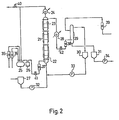
- the reference numbers identify parts as follows: 1,2...hydroformylation reactors; 3...extraction column; 4 to 13...conduits; 14...catalyst solution reservoir; 15...constant-flow pump; 21...reactor; 22...first reaction chamber; 23...9th reaction chamber; 24...circulating gas cooler; 25...gas reservoir; 26...compressor; 27...allyl alcohol reservoir; 28...reaction mixture cooler; 29...extraction column; 30...catalyst solution reservoir; 31...reaction product reservoir; 32 to 34...constant-flow pumps; 35 to 39...flowmeters; 40...pressure-adjusting valve; 41, 42...flow rate-adjusting valves; 51...reactor; 52, 53...gas flowmeters; 54...constant-flow pump; 55...pressure gauge; 56...compressor; 57...filter; 58...feed reservoir; 59...flow rate-adjusting valve.
- Reactor (1) was a 5.5-liter reactor (108.3 mm in diameter, 600 mm in height) equipped with a magnetic stirrer
- reactor (2) was a 10-liter reactor (130.8 mm in diameter, 750 mm in height) equipped with a magnetic stirrer
- extraction column (3) was a 2.2-liter agitated-column extractor.
- Each reactor was fitted with an external jacket so that the reactor internal temperature could be maintained at a constant level by causing water warmed to the intended temperature to flow through said jacket.
- reactor (1) was charged with 3.5 liters of an aqueous solution containing 0.5 mole/liter of sodium sulfite and 10 millimoles/liter of copper sulfate, and air was introduced under atmospheric pressure at the rate of 130 N I/hour while maintaining the internal temperature at 25°C. Stirring was performed at the rate given in Table 1, and 10-ml reaction mixture samples were taken at 10-minute intervals and assayed for sodium sulfite by titration with aqueous sodium thiosulfate. The reaction was continued for 60 minutes.
- the entire reaction system was charged with 13 liters of a toluene solution containing 1 millimole/liter of RhH(CO) ⁇ PPhg)3, 150 millimoles/liter of PPh 3 and 0.2 millimole/liter of Ph 2 P(CH 2 ) 4 PPh 2 , from the catalyst solution reservoir (14). Allyl alcohol was fed to the reactor (1) at the rate of 3 moles/hour and hydrogen and carbon monoxide were fed to the reactor (1) at the rates of 235 N I/hour and 65 N I/hour, respectively, through the line (4). The reaction mixture was transferred to reactor (2) through line (7) at the rate of 1.7 liters/hour so that the quantity of the reaction mixture in reactor (1) was maintained at 3.5 liters.
- the temperature and pressure within reactor (1) were maintained at 60°C and 2.1 atmospheres (absolute), respectively, and stirring was conducted at the rate of 570 rpm.
- the effluent gas from reactor (1) was sent to reactor (2) through line (6). Carbon monoxide was fed to reactor (2) through line (8) at the rate of 10 N I/hour.
- the effluent gas from reactor (2) was discharged from the system through line (9). While maintaining the quantity of the reaction mixture in reactor (2) at 7 liters, the reaction mixture was sent to extraction column (3) through line (10) at the rate of 1.7 liters/hour.
- the temperature and pressure within reactor (2) were maintained at 60°C and 2.0 atmospheres (absolute), respectively, and stirring was conducted at the rate of 800 rpm.
- the rate of flow of the effluent gas from reactor (1) was 194 N I/hour as measured in line (6)
- the carbon monoxide concentration in said effluent gas was 6.8 vol.%
- the carbon monoxide concentration in the gas entering reactor (2) was 11.3 vol.%
- the rate of flow of the effluent gas from reactor (2) was 186 N I/hour as measured in line (9)
- the carbon monoxide concentration in said effluent gas was 7.6 vol.%.
- the P co values for reactors (1) and (2) were calculated to be 0.270 atmosphere (absolute) and 0.187 atmosphere (absolute), respectively, and the r co values for reactors (1) and (2) to be 0.661 mole/liter .
- RhH(CO)(PPh 3 ) 3 , PPh 3 and Ph 2 P(CH 2 ) 4 PPh 2 were added together with toluene in appropriate amounts so that their concentrations could be maintained within the ranges of 0.99-1.01 millimoles/liter, 145-150 millimoles/liter and 0.18-0.2 millimole/liter, respectively.
- the reaction was performed continuously for 30 days.
- the allyl alcohol conversion was constant at 98% throughout the reaction period, with no changes in selectivity to each product.
- the dissolution of the rhodium complex into the aqueous extract layer always remained within the range of 8-10 ppb (as rhodium metal) as determined by atomic absorption photometry.
- the allyl alcohol conversion and selectivity to each product were determined in the same manner as described in Example 1 by analysis of the aqueous extract layer.
- the results of the reaction and the data for the dissolution of the rhodium complex into the aqueous extract layer are shown in Table 3, and the calculated values of A are shown in Table 4.
- Comparative Example 1 and Comparative Example 3 it was revealed that the catalytic activity decreased by about 0.5% daily.
- Comparative Example 2 the rhodium complex was dissolved into the aqueous extract layer in increased amounts and a decreasing tendency of the allyl alcohol conversion was noted.
- Reactor (21) was a multistage bubble-tower reactor, 100 mm in diameter and about 5 meters in height, composed of three 1.5 m-long reactor sections equipped with flanges, and top and bottom end plates. Perforated plates were disposed within the reactor so that the reactor consisted of a total of 9 reaction chambers.
- the reactor was fitted with sampling nozzles, thermometer nozzles and an external jacket. The interior of the reactor could be maintained at a constant temperature by flowing water warmed to the intended temperature through said jacket.
- the quantity of the reaction mixture within the reactor could be adjusted within the range of 30-40 liters by adjusting the position of a reaction mixture overflow nozzle. In this way, the allyl alcohol conversion could be adjusted.
- Extraction column (29) was an agitated-column extractor, 80 mm in diameter and 1.5 m in the length of the extraction-effecting portion.
- a toluene solution containing 1 millimole/liter of RhH(CO)(PPh 3 ) 3 , 150 millimoles/liter of PPh 3 and 0.1 millimole/liter of Ph 2 P(CH 2 ) 4 PPh 2 was fed from catalyst solution reservoir (30) to the reactor through constant-flow pump (33) at the rate of 13.64 liters/hour.
- the interior temperature of reactor (21) was maintained at 60.5°C.
- the feed gas which had the composition given in Table 5, was pressurized to 2.6 atmospheres (absolute) by means of compressor (26) and fed to the reactor at the rate of 3.93 Nm 3 /hour.
- Allyl alcohol was fed to the reactor from allyl alcohol reservoir (27) through constant-flow pump (32) at the rate of 2.18 liters/hour.
- the reaction mixture was allowed to overflow a nozzle fitted to the reactor at the upper part thereof.
- the overflow was cooled in cooler (28) and then sent to extraction column (29). Water was fed to the extraction column at the rate of 14.5 liters/hour, and the extraction was conducted under a nitrogen atmosphere.
- reaction product reservoir (31) The aqueous layer resulting from the extraction was temporarily stored in reaction product reservoir (31) and sent to the next hydrogenation step through constant-flow pump (34).
- the extraction residue containing the catalyst components was taken out from the top of the extraction column and transferred into catalyst solution reservoir (30) and therefrom recycled to the reactor through constant-flow pump (33).
- the catalyst solution to be recycled was analyzed for RhH(CO)(PPh 3 ) 3 , PPh 3 and Ph 2 P(CH 2 ) 4 PPh 2 and, according to the assay results, RhH(CO)(PPh 3 ) 3 , PPh 3 and Ph 2 P(CH 2 ) 4 PPh 2 were added together with toluene in necessary amounts so that their concentrations in said catalyst solution were maintained at 1 millimole/liter, 145-150 millimoles/liter and 0.08-0.10 millimole/liter, respectively.
- the effluent gas leaving the reactor from the top thereof was cooled in cooler (24) so as to recover condensable accompanying material. Part of the gas was released from the system and the remaining portion was returned to gas reservoir (25), where the consumptions of materials in the reaction and the losses by release were made up.
- the gas so adjusted was pressurized by means of compressor (26) and fed to the reactor.
- the reaction mixture was sampled, and the allyl alcohol conversion and the selectivities to HBA, HMPA, PrH and NPR were determined.
- the aqueous layer obtained by extraction was hydrogenated and the product was analyzed for 1,4-BG, MPG and NPR, and, based on the yields of 1,4-BG and MPG as found in that manner, the selectivities to HBA, HMPA, PrH and NPR were calculated.
- the selectivity values thus obtained were in agreement with the selectivity values data obtained by the direct gas chromatographical analysis of the reaction mixture from the reactor.
- the dissolution of the rhodium complex into the aqueous extract layer was determined by atomic absorption photometry.
- the gas leaving the reactor was analyzed for its composition, and the carbon monoxide partial pressure and hydrogen partial pressures at the outlet of the reactor were calculated.
- the pressure of the gaseous layer which formed under each perforated plate in the reactor and the composition thereof were measured or determined, and the carbon monoxide partial pressure and hydrogen partial pressure in each reaction chamber were measured. Based on the thus-obtained analytical results, the rate of consumption of carbon monoxide in each reaction chamber was calculated.
- the calculated values of Kv and A for the first and ninth reaction chambers as obtained in the above calculations are shown in Table 7.
Landscapes
- Chemical & Material Sciences (AREA)
- Organic Chemistry (AREA)
- Chemical Kinetics & Catalysis (AREA)
- Organic Low-Molecular-Weight Compounds And Preparation Thereof (AREA)
- Low-Molecular Organic Synthesis Reactions Using Catalysts (AREA)
- Catalysts (AREA)
Claims (6)



Applications Claiming Priority (2)
| Application Number | Priority Date | Filing Date | Title |
|---|---|---|---|
| JP114549/83 | 1983-06-24 | ||
| JP58114549A JPS606630A (ja) | 1983-06-24 | 1983-06-24 | アリルアルコ−ルの連続ヒドロホルミル化方法 |
Publications (2)
| Publication Number | Publication Date |
|---|---|
| EP0129802A1 EP0129802A1 (fr) | 1985-01-02 |
| EP0129802B1 true EP0129802B1 (fr) | 1987-01-14 |
Family
ID=14640564
Family Applications (1)
| Application Number | Title | Priority Date | Filing Date |
|---|---|---|---|
| EP84106880A Expired EP0129802B1 (fr) | 1983-06-24 | 1984-06-15 | Procédé pour l'hydroformylation continue d'alcool allylique |
Country Status (4)
| Country | Link |
|---|---|
| US (1) | US4567305A (fr) |
| EP (1) | EP0129802B1 (fr) |
| JP (1) | JPS606630A (fr) |
| DE (1) | DE3462026D1 (fr) |
Families Citing this family (17)
| Publication number | Priority date | Publication date | Assignee | Title |
|---|---|---|---|---|
| US4678857A (en) * | 1986-03-31 | 1987-07-07 | Texaco Inc. | Process for separation of product resulting from hydroformylation |
| DE3615472A1 (de) * | 1986-05-07 | 1987-11-12 | Basf Ag | Verfahren zur herstellung von (omega)-hydroxyaldehyden oder deren zyklischer halbacetale |
| US5426238A (en) * | 1993-06-10 | 1995-06-20 | Mitsubishi Kasei Corporation | Method for producing an aldehyde |
| US5945549A (en) * | 1999-01-22 | 1999-08-31 | Eastman Chemical Company | Production of aqueous solutions of mixtures of formyltertrahydrofuran and hydrates thereof |
| JP4608713B2 (ja) * | 1999-12-13 | 2011-01-12 | 三菱瓦斯化学株式会社 | 反応生成液からのアルデヒドの回収法 |
| US6225509B1 (en) | 2000-01-06 | 2001-05-01 | Arco Chemical Technology, L.P. | Allyl alcohol hydroformylation |
| FR2838431B1 (fr) * | 2002-04-11 | 2005-05-06 | Inst Francais Du Petrole | Procede d'hydroformylation mettant en oeuvre un catalyseur a base de cobalt dans un liquide ionique non-aqueux avec un recyclage du catalyseur ameliore |
| JP2006169131A (ja) * | 2004-12-13 | 2006-06-29 | Mitsubishi Chemicals Corp | ヒドロホルミル化方法 |
| US7271295B1 (en) | 2006-10-13 | 2007-09-18 | Lyondell Chemical Technology, L.P. | Hydroformylation process |
| US7279606B1 (en) | 2007-04-02 | 2007-10-09 | Lyondell Chemical Technology, L.P. | Hydroformylation process |
| US7655821B1 (en) | 2008-11-25 | 2010-02-02 | Lyondell Chemical Technology, L.P. | Direct hydrocarbonylation process |
| US7612241B1 (en) | 2009-03-23 | 2009-11-03 | Lyondell Chemical Technology, L.P. | Hydroformylation process |
| US7790932B1 (en) | 2009-12-21 | 2010-09-07 | Lyondell Chemical Technology, L.P. | Hydroformylation process |
| US8742180B1 (en) | 2012-11-13 | 2014-06-03 | Lyondell Chemical Technology, L.P. | Process control with Raman spectroscopy |
| CN105705647B (zh) | 2013-09-03 | 2020-03-27 | Ptt全球化学公众有限公司 | 从1,3-丙二醇制造丙烯酸、丙烯腈和1,4-丁二醇的方法 |
| EP3181546B1 (fr) | 2015-12-16 | 2018-05-02 | Evonik Degussa GmbH | Procede de carbonylation double d'alcools allyliques en di-esters correspondants |
| EP3530644B1 (fr) | 2018-02-26 | 2022-11-02 | Lyondell Chemical Technology, L.P. | Amélioration des catalyseurs de rhénium pour la conversion de la glycérine en alcool allylique |
Family Cites Families (10)
| Publication number | Priority date | Publication date | Assignee | Title |
|---|---|---|---|---|
| GB1338225A (en) * | 1969-12-31 | 1973-11-21 | Johnson Matthey Co Ltd | Catalytic reactions |
| JPS5129412A (en) * | 1974-08-30 | 1976-03-12 | Kuraray Co | Butanjioorurui no seizohoho |
| US4148830A (en) * | 1975-03-07 | 1979-04-10 | Union Carbide Corporation | Hydroformylation of olefins |
| CA1090823A (fr) * | 1976-04-08 | 1980-12-02 | Everard A.V. Brewester | Hydroformylation cyclique |
| US4277627A (en) * | 1977-01-25 | 1981-07-07 | Union Carbide Corporation | Hydroformylation process |
| ZA78147B (en) * | 1977-01-25 | 1978-11-29 | Union Carbide Corp | Improved hydroformylation process |
| US4215077A (en) * | 1978-02-09 | 1980-07-29 | Kuraray Co., Ltd. | Hydroformylation of olefins |
| JPS54106407A (en) * | 1978-02-09 | 1979-08-21 | Kuraray Co Ltd | Hydroformylation of allyl alcohol |
| JPS5545646A (en) * | 1978-09-29 | 1980-03-31 | Toyo Soda Mfg Co Ltd | Preparation of hydroxybutylaldehyde |
| US4348539A (en) * | 1979-11-01 | 1982-09-07 | Union Carbide Corporation | Heteronuclear-bridged rhodium clusters |
-
1983
- 1983-06-24 JP JP58114549A patent/JPS606630A/ja active Granted
-
1984
- 1984-06-15 DE DE8484106880T patent/DE3462026D1/de not_active Expired
- 1984-06-15 US US06/621,016 patent/US4567305A/en not_active Expired - Lifetime
- 1984-06-15 EP EP84106880A patent/EP0129802B1/fr not_active Expired
Also Published As
| Publication number | Publication date |
|---|---|
| US4567305A (en) | 1986-01-28 |
| EP0129802A1 (fr) | 1985-01-02 |
| JPS606630A (ja) | 1985-01-14 |
| JPH0581576B2 (fr) | 1993-11-15 |
| DE3462026D1 (en) | 1987-02-19 |
Similar Documents
| Publication | Publication Date | Title |
|---|---|---|
| EP0129802B1 (fr) | Procédé pour l'hydroformylation continue d'alcool allylique | |
| US4215077A (en) | Hydroformylation of olefins | |
| US7935850B2 (en) | Process for hydroformylation of propylene | |
| CA2027991C (fr) | Procede pour l'hydroformylation d'une olefine | |
| US5675041A (en) | Direct hydroformylation of a multi-component synthesis gas containing carbon monoxide, hydrogen, ethylene, and acetylene | |
| US4247486A (en) | Cyclic hydroformylation process | |
| US4960949A (en) | Low pressure rhodium catalyzed hydroformylation of olefins | |
| US4238419A (en) | Hydroformylation of olefinic compounds | |
| US4306087A (en) | Hydroformylation of olefinic compounds | |
| CA1090823A (fr) | Hydroformylation cyclique | |
| US4356333A (en) | Process for preparing n-octadienol | |
| US5367106A (en) | Coupled secondary oxo reaction system | |
| JPS6335536A (ja) | オレフイン性不飽和化合物の連続的ヒドロホルミル化法 | |
| EP0429963A1 (fr) | Méthode de récupération d'un complexe solide d'un métal de groupe VIII et méthode d'hydroformylation | |
| EP0096987A2 (fr) | Procédé d'hydroformylation | |
| KR101539779B1 (ko) | 노르말부탄올과 이소부틸알데히드의 병산 방법 | |
| CA1118451A (fr) | Methode de preparation d'aldehydes | |
| EP0064285B1 (fr) | Procédé de préparation de 1,9-nonanedial et/ou 9-hydroxy-7-nonène-1-al | |
| EP4217109B1 (fr) | Co-alimentation d'éthylène avec de l'alcool allylique dans l'hydroformylation pour fabriquer du 1,4-butanediol et du n-propanol | |
| EP0103891B1 (fr) | Procédé pour produire l'alpha-acétoxypropionaldéhyde | |
| JPH0662480B2 (ja) | α,ω−ジアルデヒドの製造方法 | |
| US2757202A (en) | Aldehyde synthesis process | |
| US5600017A (en) | Direct hydroformylation of a multi-component synthesis gas containing carbon monoxide hydrogen ethylene and acetylene-(LAW072) | |
| JP7438945B2 (ja) | 環状ヘミアセタール化合物の製造方法 | |
| US12595221B1 (en) | Hydroformylation processes |
Legal Events
| Date | Code | Title | Description |
|---|---|---|---|
| PUAI | Public reference made under article 153(3) epc to a published international application that has entered the european phase |
Free format text: ORIGINAL CODE: 0009012 |
|
| AK | Designated contracting states |
Designated state(s): DE FR GB NL |
|
| 17P | Request for examination filed |
Effective date: 19841210 |
|
| GRAA | (expected) grant |
Free format text: ORIGINAL CODE: 0009210 |
|
| AK | Designated contracting states |
Kind code of ref document: B1 Designated state(s): DE FR GB NL |
|
| REF | Corresponds to: |
Ref document number: 3462026 Country of ref document: DE Date of ref document: 19870219 |
|
| ET | Fr: translation filed | ||
| PLBE | No opposition filed within time limit |
Free format text: ORIGINAL CODE: 0009261 |
|
| STAA | Information on the status of an ep patent application or granted ep patent |
Free format text: STATUS: NO OPPOSITION FILED WITHIN TIME LIMIT |
|
| 26N | No opposition filed | ||
| REG | Reference to a national code |
Ref country code: GB Ref legal event code: IF02 |
|
| PGFP | Annual fee paid to national office [announced via postgrant information from national office to epo] |
Ref country code: FR Payment date: 20030610 Year of fee payment: 20 |
|
| PGFP | Annual fee paid to national office [announced via postgrant information from national office to epo] |
Ref country code: GB Payment date: 20030611 Year of fee payment: 20 |
|
| PGFP | Annual fee paid to national office [announced via postgrant information from national office to epo] |
Ref country code: DE Payment date: 20030626 Year of fee payment: 20 |
|
| PGFP | Annual fee paid to national office [announced via postgrant information from national office to epo] |
Ref country code: NL Payment date: 20030630 Year of fee payment: 20 |
|
| PG25 | Lapsed in a contracting state [announced via postgrant information from national office to epo] |
Ref country code: GB Free format text: LAPSE BECAUSE OF EXPIRATION OF PROTECTION Effective date: 20040614 |
|
| PG25 | Lapsed in a contracting state [announced via postgrant information from national office to epo] |
Ref country code: NL Free format text: LAPSE BECAUSE OF EXPIRATION OF PROTECTION Effective date: 20040615 |
|
| REG | Reference to a national code |
Ref country code: GB Ref legal event code: PE20 |
|
| NLV7 | Nl: ceased due to reaching the maximum lifetime of a patent |
Effective date: 20040615 |