EP0130710A1 - Lentille intra-oculaire - Google Patents
Lentille intra-oculaire Download PDFInfo
- Publication number
- EP0130710A1 EP0130710A1 EP84303881A EP84303881A EP0130710A1 EP 0130710 A1 EP0130710 A1 EP 0130710A1 EP 84303881 A EP84303881 A EP 84303881A EP 84303881 A EP84303881 A EP 84303881A EP 0130710 A1 EP0130710 A1 EP 0130710A1
- Authority
- EP
- European Patent Office
- Prior art keywords
- lens
- strut
- axis
- contact surface
- circumferential
- Prior art date
- Legal status (The legal status is an assumption and is not a legal conclusion. Google has not performed a legal analysis and makes no representation as to the accuracy of the status listed.)
- Withdrawn
Links
- 230000001179 pupillary effect Effects 0.000 claims description 11
- 230000003319 supportive effect Effects 0.000 claims description 7
- 230000003287 optical effect Effects 0.000 claims description 3
- 230000002093 peripheral effect Effects 0.000 abstract description 12
- 210000002159 anterior chamber Anatomy 0.000 description 9
- 210000001519 tissue Anatomy 0.000 description 8
- 210000001742 aqueous humor Anatomy 0.000 description 6
- 238000001356 surgical procedure Methods 0.000 description 6
- 208000002177 Cataract Diseases 0.000 description 5
- 239000002775 capsule Substances 0.000 description 5
- 210000004087 cornea Anatomy 0.000 description 5
- 238000000034 method Methods 0.000 description 4
- 210000001747 pupil Anatomy 0.000 description 4
- 230000001886 ciliary effect Effects 0.000 description 3
- 239000000463 material Substances 0.000 description 3
- 230000006835 compression Effects 0.000 description 2
- 238000007906 compression Methods 0.000 description 2
- 230000006378 damage Effects 0.000 description 2
- 238000002513 implantation Methods 0.000 description 2
- 238000003780 insertion Methods 0.000 description 2
- 230000037431 insertion Effects 0.000 description 2
- 238000004519 manufacturing process Methods 0.000 description 2
- 230000004048 modification Effects 0.000 description 2
- 238000012986 modification Methods 0.000 description 2
- 238000000465 moulding Methods 0.000 description 2
- 239000004033 plastic Substances 0.000 description 2
- 229920003023 plastic Polymers 0.000 description 2
- 230000009528 severe injury Effects 0.000 description 2
- 201000002862 Angle-Closure Glaucoma Diseases 0.000 description 1
- 206010061218 Inflammation Diseases 0.000 description 1
- 206010030113 Oedema Diseases 0.000 description 1
- 239000004743 Polypropylene Substances 0.000 description 1
- 206010047661 Vitreous prolapse Diseases 0.000 description 1
- 208000027418 Wounds and injury Diseases 0.000 description 1
- 230000006978 adaptation Effects 0.000 description 1
- 238000005452 bending Methods 0.000 description 1
- 238000005520 cutting process Methods 0.000 description 1
- 230000000694 effects Effects 0.000 description 1
- 229910000078 germane Inorganic materials 0.000 description 1
- 239000007943 implant Substances 0.000 description 1
- 238000007373 indentation Methods 0.000 description 1
- 230000004054 inflammatory process Effects 0.000 description 1
- 201000004614 iritis Diseases 0.000 description 1
- 238000005304 joining Methods 0.000 description 1
- 229920003229 poly(methyl methacrylate) Polymers 0.000 description 1
- 239000004926 polymethyl methacrylate Substances 0.000 description 1
- -1 polypropylene Polymers 0.000 description 1
- 229920001155 polypropylene Polymers 0.000 description 1
- 230000002207 retinal effect Effects 0.000 description 1
- 210000004127 vitreous body Anatomy 0.000 description 1
Images
Classifications
-
- A—HUMAN NECESSITIES
- A61—MEDICAL OR VETERINARY SCIENCE; HYGIENE
- A61F—FILTERS IMPLANTABLE INTO BLOOD VESSELS; PROSTHESES; DEVICES PROVIDING PATENCY TO, OR PREVENTING COLLAPSING OF, TUBULAR STRUCTURES OF THE BODY, e.g. STENTS; ORTHOPAEDIC, NURSING OR CONTRACEPTIVE DEVICES; FOMENTATION; TREATMENT OR PROTECTION OF EYES OR EARS; BANDAGES, DRESSINGS OR ABSORBENT PADS; FIRST-AID KITS
- A61F2/00—Filters implantable into blood vessels; Prostheses, i.e. artificial substitutes or replacements for parts of the body; Appliances for connecting them with the body; Devices providing patency to, or preventing collapsing of, tubular structures of the body, e.g. stents
- A61F2/02—Prostheses implantable into the body
- A61F2/14—Eye parts, e.g. lenses or corneal implants; Artificial eyes
- A61F2/16—Intraocular lenses
-
- A—HUMAN NECESSITIES
- A61—MEDICAL OR VETERINARY SCIENCE; HYGIENE
- A61F—FILTERS IMPLANTABLE INTO BLOOD VESSELS; PROSTHESES; DEVICES PROVIDING PATENCY TO, OR PREVENTING COLLAPSING OF, TUBULAR STRUCTURES OF THE BODY, e.g. STENTS; ORTHOPAEDIC, NURSING OR CONTRACEPTIVE DEVICES; FOMENTATION; TREATMENT OR PROTECTION OF EYES OR EARS; BANDAGES, DRESSINGS OR ABSORBENT PADS; FIRST-AID KITS
- A61F2/00—Filters implantable into blood vessels; Prostheses, i.e. artificial substitutes or replacements for parts of the body; Appliances for connecting them with the body; Devices providing patency to, or preventing collapsing of, tubular structures of the body, e.g. stents
- A61F2/02—Prostheses implantable into the body
- A61F2/14—Eye parts, e.g. lenses or corneal implants; Artificial eyes
- A61F2/16—Intraocular lenses
- A61F2002/1681—Intraocular lenses having supporting structure for lens, e.g. haptics
- A61F2002/1683—Intraocular lenses having supporting structure for lens, e.g. haptics having filiform haptics
Definitions
- This invention is in the field of medical prosthesis, and particularly relates to the use of artificial lenses to replace tissue lenses removed during cataract surgery.
- Cataract surgery involves the removal of the lens or lens nucleus from the eye of a patient, and it is common in such procedures to implant within the eye an artificial intraocular lens, the lens being supported in either the anterior or posterior chambers and being supported by wires or other structure that extend from the lens outwardly into contact with supportive, circumferential grooves or other structure adjacent the iris.
- Typical intraocular lenses are disclosed in the following references:
- Intraocular lenses in general are characterized by including a central lens or lenticular portion, and two or more struts, usually radially resilient, that extend outwardly of the lens and which gently but elastically engage appropriate circumferential eye structure adjacent the iris.
- the struts of intraocular lenses that are to be employed in the anterior chamber of the eye commonly engage the internal scleral sulcus, commonly called the "angle", formed between the iris and the internal periphery of the cornea, avoiding substantial contact or interference with the trabacular meshwork.
- Intraocular lenses intended to be mounted in the posterior chamber commonly have struts or other fixation devices that engage the ciliary recess or the circumferential edges of the posterior lens capsule that remains after removal of the lens nucleus.
- aqueous humor In normal human eyes, aqueous humor is discharged into the posterior chamber, flows through the pupil into the anterior chamber, and is removed from the anterior chamber by means of the trabacular meshwork and Schlemm's canals adjacent the internal scleral recess.
- the flow of aqueous humor in this manner is restricted or blocked, as may occur when the anterior face of the vitreous humor comes forward into contact with the iris following cataract surgery, acute glaucoma can result.
- one or more small surgical iridectomies are routinely performed in the iris during cataract surgery to provide alternate flow paths for aqueous humor.
- Peripheral iridectomies preferably are basal, that is, they are formed at the periphery of the iris.
- Non-basal peripheral iridectomies, formed in the iris at positions spaced inwardly from its periphery, have also been used but are less preferred in that they can become blocked or plugged by the anterior vitreous face
- Intraocular lenses commonly are surgically oriented so that their supporting structure is rotated out of alignment with basal peripheral iridectomies, and it generally is expected that the rotational position of intraocular lenses will remain fixed permanently.
- Intraocular lenses commonly are formed with small holes or indentations adjacent the lens periphery to accept instruments enabling surgeons to rotate the lenses into desired positions spaced rotationally from openings formed through basal peripheral iridectomy procedures.
- intraocular lenses seldom remain permanently fixed against rotation with respect to the lens axis.
- the lenses may in fact be rotationally displaced through commonplace rubbing of the eyes, with the result that the lens fixation elements over a period of months or years may come into contact with and may actually enter basal peripheral iridectomies formed during cataract surgery.
- Inflammation of the iris (iritis) may result, but more importantly, the lens itself, due to the resulting loss of placement of its fixation elements, may tilt or may become dislocated with respect to the pupillary axis.
- the lens itself if implanted in the anterior chamber, may touch and cause severe damage to the inner corneal surface, or, if placed in the posterior chamber, may cause rupture of the anterior vitreous face causing vitreous prolapse into the iridectomy wound, in turn leading to cystoid macular (retinal) edema.
- the undesired rotation of intraocular lenses in this manner, and the resulting problems that arise, have only recently been recognized. Unfortunately, such problems often arise months or years after a lens has been implanted and routine consultation with a surgeon has been terminated. As a result, severe damage to the eye can readily occur before corrective surgical steps can be taken.
- fixation elements previously employed with intraocular lenses are of wire or of a springy, wire-like material.
- the wire is formed into a "U"-shaped loop with the ends of the loop each being fixed to the lens.
- the fixation of such loops at both ends to the lens reduces the elasticity of the loops.
- the lens with the semi-rigid fixation loops accordingly is difficult to insert and properly place within the eye since the loops are not highly elastic and are deformed only with some difficulty. It has been proposed in U.S.
- Patent 4,338,687 to provide the lens itself with internal springs which resiliently receive ends of the "U"-shaped loops to > enable the loops as a whole to be elastically moved toward and away from the lens periphery.
- This lens structure is quite complicated and expensive. The increase in lens thickness required to accommodate the spring mechanism adds substantial weight to the device, resulting in increased potential damage to eye structures.
- the present invention provides an intraocular lens having fixation elements carried by it for sup- ' portive engagement with eye structure circumferential of the pupillary axis.
- the invention is characterized on the one hand by including at least one fixation element which is springy and resilient to enable easy insertion and placement of the lens within an eye, but which on the other hand is free of structure likely to be captured by a peripheral iridectomy opening.
- At least one of the fixation elements comprises an elongated resilient strut carried at one end by the lens.
- the strut includes a first portion extending outwardly of the lens generally toward the circumferential eye structure, a second portion having a contact surface engageable with the circumferential eye structure, and a third portion extending from the contact surface inwardly toward the lens for a distance, measured radially inwardly toward the lens axis, of at least about two-fifths of the radial distance of the contact surface from the lens axis when the strut is at rest.
- the third portion has a free end providing the fixation element with substantial elasticity toward and away from the circumferential supporting structure of the eye.
- the first portion of the strut comprises a proximal portion carried by the lens and which spirals outwardly of the lens periphery in one direction, and a distal portion into which the proximal portion merges and which is curved in the opposite direction outwardly of the lens periphery, the latter merging into the contact portion.
- the free end of the third strut portion is either itself spaced from the lens axis by a distance not more than three-fifths of the radial distance of the contact surface from the lens axis, or is bounded by desirably gently curved portions of the fixation element; that is, the radius of curvature taken along the length of the strut of all outer tissue-confronting, outwardly facing surfaces of the strut extending outwardly of the lens axis more than three-fifths of the radial distance from the lens axis to the contact surface preferably is at least about 0.8 millimeters.
- Movement of the contact surface of the fixation element toward or away from the lens axis results in movement of the free end of the element toward and away from the axis.
- the free end preferably is blunt or may be provided with a small knob.
- the invention is characterized by including at least one fixation element (and preferably a pair of opposed fixation elements) comprising an elongated, springy strut having a first portion carried at one end by the lens adjacent its periphery and having a proximal section extending through a portion of its length generally concentrically of the lens periphery.
- a second portion of the strut is provided with a contact surface engageable with circumferential eye structure.
- the first strut portion includes a smoothly curved distal section merging at one end into the proximal section,and merging at the other end into the second portion of the strut.
- the first and second portions of the strut each have a segment intersecting at generally right angles with a line drawn through the optical axis of the lens, the portion of the strut connecting the two segments having a radius of between about 1.0-2.0 mm.
- the first portion of the strut lies within about 1.5 mm of the periphery of the lens for at least 50° or more of the circumference of the lens.
- the strut may, if desired, include a third portion merging at one end into the second portion and extending generally inwardly toward the lens axis for a distance of at least about two-fifths of the radial distance of the contact surface from the lens axis.
- the fixation elements of each embodiment desirably include inner portions extending from the lens at an angle to the plane of the lens and outer portions lying generally in a plane parallel to but spaced slightly from the plane of the lens.
- the lens structure when implanted in the eye, carries the lens in a vaulted orientation spaced from the iris.
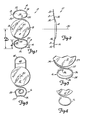
- a preferred device of the invention is shown generally as (10) and includes a lens (12) and fixation elements (14), (16).
- the fixation elements in this preferred embodiment are identical and are two in number, although three or four or more elements, of similar or different shapes, may be utilized.
- the lens (12) may be of any appropriate curvature, desirably plano-convex, and the lens and the fixation elements desirably are formed as one piece as by molding. Alternatively, the fixation elements may be attached to the lens after manufacture of the latter.
- the lens may include small sockets or openings (18) providing grasping points for an appropriate tool and enabling a surgeon to rotate the lens within the eye after the lens has been inserted.
- the lenses and fixation elements may be of any appropriate material, but preferably are made of an optically clear plastic such as polymethylmethacrylate. Molding and/or lathe cutting of lenses are well known and need not be described in detail. If the fixation elements are attached to the lens after manufacture of the latter (as by inserting and adhesively bonding the elements within lens aperatures formed desirably in or adjacent the lens periphery), the fixation elements may be of another plastic material, not necessarily transparent, such as polypropylene.
- the fixation elements (14), (16) are desirably gently curved, thin, resilient, wire-like struts and may have thicknesses on the order of about 0.25 mm.
- Strut (16) shown in Figure 1 includes a first portion (20) that is attached to and is carried at one end (22) by the lens, preferably the lens periphery, and which extends outwardly of the lens generally toward the circumferential tissue of the eye by which the lens is to be supported.
- a second portion of the strut is designated (24) and includes a contact surface (26) that is engageable with the circumferential eye structure.
- the lens strut (16) may include a third portion, designated (28), which extends thence inwardly generally toward the lens for a distance, measured radially toward the lens axis (30), of preferably at least about two-fifths of the radial distance of the contact surface (26) from the lens axis (30) when the strut is in its relaxed or at rest position.
- the third portion has a free end (32).
- the radial distance of the contact surface (26) from the lens axis (30) when the strut is in its rest position is designated in Figure 1 as “D"
- the distance, measured radially from the contact surface (26) toward the lens axis (30) through which the third portion (28) of the strut (16) extends is designated "d”.
- the ratio d/ D desirably is not less than about 0.40, and preferably is in the range of about 0.40 to about 0.50.
- the lens portion may have a diameter in the range of about 5-6 mm. and the at-rest diameter taken across the fixation elements may be in the range of about 12-14 mm.
- that portion of the strut structure (16) which is spaced radially from the lens axis (30) by at least three-fifths of the radial distance between the lens axis (30) and the contact surface (26) is formed with outwardly facing, tissue-confronting surfaces having radii of curvature taken along the length of the strut of at least about 0.8 millimeters, thereby avoiding the presence of sharp corners or edges within the zone within which may be found a peripheral iridectomy opening I ( Figures 6-8).
- the fixation elements typified by element (16) in Figure 1, in accordance with this invention, are resiliently or elastically moveable inwardly and outwardly of the lens, as shown schematically in Figure 5.
- the first portion (20) of the strut (referring to' Figure 5) comprises a proximal portion (34) and a distal portion (36), the latter smoothly joining the proximal portion to the second, circumferential eye structure-contacting portion (24).
- the proximal portion (34) desirably is smoothly curved and spirals generally outwardly of the lens periphery in one direction, as shown in Figure 5, and the distal portion (36) is curved in the opposite direction outwardly of the lens periphery.
- the spirally curved portion (34) because of its gentle curvature in a direction diverging only gradually from the periphery (38) of the lens, is quite elastic.
- a force is exerted on the contact surface (26) generally inwardly toward the lens axis, preferably a substantial amount of the resultant elastic movement of the strut is afforded by the proximal portion (34), the strut moving from its solid line rest position into the position shown in dashed lines in Figure 5.
- the strut returns resiliently toward the solid line relaxed or rest position shown in Figure 5. It will be noted that the configuration of the strut distally of the proximal portion (34) does not change substantially under the application and removal of such force.
- the fixation element (16) hence is elastically moveable between its rest position shown in solid lines in Figure 5 to a stressed position shown in phantom lines in Figure 5, the latter position typifying the position of the strut when inserted in an eye for exertion of gentle pressure generally radially outwardly of the lens upon supportive circumferential eye structure.
- the dimensions and dimensional ratios provided herein refer to the fixation elements when in their rest position.
- each strut (14), (16) is desirably bent at circumferential line "B" (shown in dashed lines in Figure 1) to provide an inner portion (50) that extends at an angle to the plane of the.lens and an outer portion (52) that includes the contact portion (24) and that lies generally in a plane parallel to but spaced slightly from the plane of the lens.
- the lens (12) is spaced anteriorly or posteriorly of the iris R when the lens device is inserted in an eye, as shown best in Figures 7 and 8.
- the strut end (32) is positioned within the inner angled portion (50) so that the end (32) is generally between the planes of the lens and the outer portion (52) when the strut is in its installed, slightly radially compressed position.
- the lens of Figure 3 employs one fixation element (16) that is similar to that shown in Figure 1, and another fixation element (40) in the shape of a "U"-shaped loop, the ends of the loop being carried by or attached to the periphery of the lens (12) and the fixation elements (16), (40) being diametrically opposed.
- the U-shaped loop (40) may have some radial resilience; its upper end (42) may be flattened somewhat upon the application of a radial force, and the legs (44) accordingly may be spread slightly. Primary resilience is afforded by the fixation element (16), however.
- Use of the intraocular lens shown in Figure 3 generally requires that the diameter of the circumferential eye structure to be contacted by the fixation elements-be measured with some exactness to assure that the axis (30) of the lens substantially coincides with the pupillary axis.
- the length of the third portion (28) of the strut (16) may be extended somewhat in comparison to the configuration shown in Figure 1.
- the third portion (28) may be sufficiently extended as to position the strut end (32) substantially at but not in contact with the periphery of the lens.
- the third portion (28) may also be extended into a spiral configuration as typified in Figures 3 and 5.
- the end (32) of the strut (16) may be positioned adjacent the contact surface (26) as shown in Figure 3, the strut (16) lies substantially in a single plane (slight bending of the plane is permitted) so that the terminus or end (32) is at least largely bounded and enclosed by the other smoothly curved portions of the strut that directly confront eye structure in the plane of the strut and is thus prevented from being captured in an iridectomy opening.
- the configuration shown in Figure 4 in which the free end (32) is nearer the periphery of the lens and the configuration of the strut resembles a bass clef symbol, is preferred.
- the radius of curvature measured along the length of the strut of all tissue-confronting, outwardly-facing surfaces of the strut that extend outwardly of the lens axis more than about three-fifths of the radial distance from the lens axis to the contact surface is at least about 0.8 mm.
- the configuration of the third portion (28), as described above, is important to prevent entry of a strut into peripheral iridectomies, this consideration is not germane to posterior chamber lenses, as may be mounted in the posterior capsule peripheral rim, as the very positioning of such lenses precludes contact between the struts and the iris. In such lenses, the third portion (28) of the strut (16) may be omitted entirely.
- the configuration shown in Figure 9 depicts a preferred embodiment characterized by particularly good flexibility and performance.
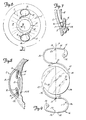
- the strut of this embodiment is characterized by having a segment (21) of its first portion (20) and a segment (23) of its second, circumferential eye structure-contacting portion (24), lying at substantially right angles to a line, designated "H" in Figure 9, which passes vertically through the lens axis (30).
- the curved, intermediary portion (36) between these two segments, (21) and (23), desirably has a radius "r" of from about 1.0-2.0 mm, and preferably of about 1.3-1.6 mm, the foregoing dimensions assuming an overall length of the lens device of about 1.3 cm.
- each first portion (20) of the struts (14) and (16) lie relatively close to the periphery (38) of the lens along a substantial portion of the circumference of the lens (12).
- each first portion (20) has a section lying within about 1.5 mm, and preferably about 1.0 mm, of the periphery (38) through an arc of at least 50° and preferably 75° or more measured circumferentially of the lens. This section desirably extends generally concentrically of the lens periphery.
- this configuration provides, it also effectively prevents pupillary capture of the lens; the first portions (20) of the struts (14) and (16) in effect add diameter to the lens body (12) and prevent the iris spincter from slipping between the first portions (20) and the lens periphery (38).
- the cornea of an eye is designated generally as "C", the anterior chamber as “A”, the posterior chamber as “P”, the iris as “R”, the ciliary recess as “CR”, the internal scleral sulcus (the “angle") as “S”, and the posterior capsule of the capsular bag as “PC”, the latter having a peripheral rim designated "PCR”.
- the anterior chamber is entered through an incision made through the cornea adjacent the limbus, and the natural lens or lens nucleus is removed, using common procedures.
- One or more peripheral iridectomies are then performed, leaving openings "I" that are generally triangular in shape and that extend inwardly toward the pupil from the periphery of the iris. I prefer to perform several such iridectomies, as shown in Figure 6, to insure proper flow of aqueous humor from the posterior chamber to the anterior chamber.
- a device of the invention such as that shown in Figure 6, is then inserted through the corneal incision. If the device is to be positioned in the anterior chamber, the struts (16) are positioned within the internal scleral sulcus as shown in Figure 7, care being taken to avoid substantial contact or interference with the trabacular meshwork shown at "T" in Figure 7. Only a very small amount of force is required to elastically compress the struts (16), and the size of the lens device (10) is chosen so that the surfaces (26) press outwardly gently against the internal scleral sulcus S.
- the surfaces (26) are gently curved so as to make more than point contact with the sulcus S, the desired contact extending across several millimeters measured circumferentially of the sulcus and thus preventing the lens from twisting or turning in the eye.
- the cornea is closed using common techniques.
- the device may be rotated so that the struts extend medially and laterally from the lens.
- the lens (12) is vaulted anteriorly slightly from the internal scleral sulcus, the lens thus being spaced between the iris R and the inner surface of the cornea C .
- the lens is suspended in aqueous humor.
- the pupil is dilated, if possible, and the device is passed through the pupil and is positioned with the contact surfaces of the struts (16) lying against and within the circumferential groove defining the ciliary recess CR, the lens (12) being vaulted posteriorly of the iris and being spaced posteriorly of the iris R and, desirably, anteriorly of the posterior lens capsule PC.
- the strut (16) may instead be supported within the rim PCR of the posterior lens capsule.
- the surface (26) which is oriented to contact the circumferential eye structure to support the lens (12) in place may be provided with two or more outwardly extending projections or "feet" of which one is designated (27).
- the feet are intended to contact the circumferential eye structure at two or more spaced points to thus avoid contact with the circumferential structure over a wide area and to support the lens against tilting.
- the contact surface (26) preferably is maintained generally out of contact with tissue involved in the transfer of aqueous humor, some interference with such tissue is readily tolerated.
Landscapes
- Health & Medical Sciences (AREA)
- Ophthalmology & Optometry (AREA)
- Cardiology (AREA)
- Oral & Maxillofacial Surgery (AREA)
- Transplantation (AREA)
- Engineering & Computer Science (AREA)
- Biomedical Technology (AREA)
- Heart & Thoracic Surgery (AREA)
- Vascular Medicine (AREA)
- Life Sciences & Earth Sciences (AREA)
- Animal Behavior & Ethology (AREA)
- General Health & Medical Sciences (AREA)
- Public Health (AREA)
- Veterinary Medicine (AREA)
- Prostheses (AREA)
Applications Claiming Priority (2)
| Application Number | Priority Date | Filing Date | Title |
|---|---|---|---|
| US06/502,312 US4542540A (en) | 1983-06-08 | 1983-06-08 | Intraocular lens |
| US502312 | 1983-06-08 |
Publications (1)
| Publication Number | Publication Date |
|---|---|
| EP0130710A1 true EP0130710A1 (fr) | 1985-01-09 |
Family
ID=23997250
Family Applications (1)
| Application Number | Title | Priority Date | Filing Date |
|---|---|---|---|
| EP84303881A Withdrawn EP0130710A1 (fr) | 1983-06-08 | 1984-06-08 | Lentille intra-oculaire |
Country Status (4)
| Country | Link |
|---|---|
| US (1) | US4542540A (fr) |
| EP (1) | EP0130710A1 (fr) |
| JP (1) | JPS6075054A (fr) |
| CA (1) | CA1210204A (fr) |
Cited By (3)
| Publication number | Priority date | Publication date | Assignee | Title |
|---|---|---|---|---|
| EP0118985A3 (fr) * | 1983-02-10 | 1985-07-31 | Kelman, Charles D. | Lentille intraoculaire |
| EP0195881A1 (fr) * | 1985-03-27 | 1986-10-01 | Pharmacia Ab | Lentille intra-oculaire |
| EP0326373A1 (fr) * | 1988-01-26 | 1989-08-02 | Nestle S.A. | Lentille intra-oculaire |
Families Citing this family (16)
| Publication number | Priority date | Publication date | Assignee | Title |
|---|---|---|---|---|
| US4681585A (en) * | 1984-04-11 | 1987-07-21 | Intermedics Intraocular, Inc. | Intraocular implant |
| US4676792A (en) * | 1986-08-26 | 1987-06-30 | Donald Praeger | Method and artificial intraocular lens device for the phakic treatment of myopia |
| ES2310015T3 (es) * | 1997-12-02 | 2008-12-16 | Hoya Corporation | Lente intraocular y procedimiento para producir lentes intraoculares de tipo moldeado. |
| US6342058B1 (en) | 1999-05-14 | 2002-01-29 | Valdemar Portney | Iris fixated intraocular lens and instrument for attaching same to an iris |
| US6152959A (en) * | 1999-05-14 | 2000-11-28 | Portney; Valdemar | Iris fixated intraocular lens |
| US6918930B2 (en) * | 1999-05-14 | 2005-07-19 | Valdemar Portney | Iris fixated intraocular lens suitable for use with attaching instrument |
| US6478821B1 (en) | 2000-01-12 | 2002-11-12 | Advanced Medical Optics, Inc. | Iris fixated intraocular lens and method of implantation |
| US6413277B1 (en) | 2000-05-18 | 2002-07-02 | Tobias H. Neuhann | Method for intraocular lens insertion and apparatus |
| US20020072796A1 (en) * | 2000-12-11 | 2002-06-13 | Hoffmann Laurent G. | Iris fixated intraocular lenses |
| US8486140B2 (en) * | 2001-01-30 | 2013-07-16 | Timothy R. Willis | Refractive intraocular implant lens and method |
| US20070142911A1 (en) * | 2001-01-30 | 2007-06-21 | Willis Timothy R | Refractive intraocular implant lens and method |
| AU2003225839A1 (en) * | 2002-03-15 | 2003-09-29 | Nanomix. Inc. | Modification of selectivity for sensing for nanostructure device arrays |
| US7074227B2 (en) * | 2002-12-12 | 2006-07-11 | Valdemar Portney | IOL insertion tool with forceps |
| TWI222680B (en) * | 2003-11-20 | 2004-10-21 | United Microelectronics Corp | Scribe line structure of wafer |
| US20050283163A1 (en) * | 2004-06-04 | 2005-12-22 | Valdemar Portney | Intraocular lens implanting instrument |
| EP3319553B1 (fr) | 2015-08-14 | 2024-01-31 | Willis, Timothy R. | Lentilles intraoculaires (iol) et ensembles associés |
Citations (7)
| Publication number | Priority date | Publication date | Assignee | Title |
|---|---|---|---|---|
| US4159546A (en) * | 1977-06-15 | 1979-07-03 | Shearing Steven P | Intraocular lens |
| US4174543A (en) * | 1978-06-01 | 1979-11-20 | Kelman Charles D | Intraocular lenses |
| US4242760A (en) * | 1979-06-11 | 1981-01-06 | Rainin Edgar A | Intraocular lens structure |
| EP0053384A1 (fr) * | 1980-12-01 | 1982-06-09 | Gerald D. Faulkner | Lentille intra-oculaire pour la chambre postérieure |
| US4340979A (en) * | 1981-03-18 | 1982-07-27 | Kelman Charles D | Intraocular lens |
| US4370760A (en) * | 1981-03-25 | 1983-02-01 | Kelman Charles D | Anterior chamber intraocular lens |
| US4435855A (en) * | 1980-04-01 | 1984-03-13 | Pannu Jaswant S | Universal intraocular lens and a method of measuring an eye chamber size |
Family Cites Families (8)
| Publication number | Priority date | Publication date | Assignee | Title |
|---|---|---|---|---|
| US4092749A (en) * | 1977-01-06 | 1978-06-06 | Sealy, Incorporated | Mattress spring unit construction |
| US4244060A (en) * | 1978-12-01 | 1981-01-13 | Hoffer Kenneth J | Intraocular lens |
| US4328595A (en) * | 1979-08-30 | 1982-05-11 | Sheets John H | Intraocular lens |
| US4343050A (en) * | 1980-07-14 | 1982-08-10 | Kelman Charles D | Intraocular lenses |
| US4338687A (en) * | 1980-10-14 | 1982-07-13 | Rainin Edgar A | Intraocular lens with spring mechanism |
| US4403353A (en) * | 1981-06-25 | 1983-09-13 | Tennant Jerald L | Anterior chamber implant lens |
| US4418431A (en) * | 1981-12-17 | 1983-12-06 | Feaster Fred T | Intraocular lens |
| US4412359A (en) * | 1982-04-26 | 1983-11-01 | Myers William D | Posterior chamber lens implant |
-
1983
- 1983-06-08 US US06/502,312 patent/US4542540A/en not_active Expired - Fee Related
-
1984
- 1984-06-07 CA CA000456085A patent/CA1210204A/fr not_active Expired
- 1984-06-08 EP EP84303881A patent/EP0130710A1/fr not_active Withdrawn
- 1984-06-08 JP JP59118027A patent/JPS6075054A/ja active Pending
Patent Citations (7)
| Publication number | Priority date | Publication date | Assignee | Title |
|---|---|---|---|---|
| US4159546A (en) * | 1977-06-15 | 1979-07-03 | Shearing Steven P | Intraocular lens |
| US4174543A (en) * | 1978-06-01 | 1979-11-20 | Kelman Charles D | Intraocular lenses |
| US4242760A (en) * | 1979-06-11 | 1981-01-06 | Rainin Edgar A | Intraocular lens structure |
| US4435855A (en) * | 1980-04-01 | 1984-03-13 | Pannu Jaswant S | Universal intraocular lens and a method of measuring an eye chamber size |
| EP0053384A1 (fr) * | 1980-12-01 | 1982-06-09 | Gerald D. Faulkner | Lentille intra-oculaire pour la chambre postérieure |
| US4340979A (en) * | 1981-03-18 | 1982-07-27 | Kelman Charles D | Intraocular lens |
| US4370760A (en) * | 1981-03-25 | 1983-02-01 | Kelman Charles D | Anterior chamber intraocular lens |
Cited By (3)
| Publication number | Priority date | Publication date | Assignee | Title |
|---|---|---|---|---|
| EP0118985A3 (fr) * | 1983-02-10 | 1985-07-31 | Kelman, Charles D. | Lentille intraoculaire |
| EP0195881A1 (fr) * | 1985-03-27 | 1986-10-01 | Pharmacia Ab | Lentille intra-oculaire |
| EP0326373A1 (fr) * | 1988-01-26 | 1989-08-02 | Nestle S.A. | Lentille intra-oculaire |
Also Published As
| Publication number | Publication date |
|---|---|
| US4542540A (en) | 1985-09-24 |
| JPS6075054A (ja) | 1985-04-27 |
| CA1210204A (fr) | 1986-08-26 |
Similar Documents
| Publication | Publication Date | Title |
|---|---|---|
| US4542540A (en) | Intraocular lens | |
| US4463458A (en) | Intraocular lens and implantation method | |
| US6241777B1 (en) | Phakic intraocular lenses | |
| US4575878A (en) | Intraocular lenses | |
| EP0591480B1 (fr) | Cristallin artificiel comprenant un element haptique | |
| US4370760A (en) | Anterior chamber intraocular lens | |
| US4629460A (en) | Intraocular lens | |
| US4687484A (en) | Anterior chamber intraocular lens | |
| US6755859B2 (en) | Iris fixated intraocular lenses | |
| RU2033114C1 (ru) | Искусственный хрусталик глаза | |
| US4174543A (en) | Intraocular lenses | |
| US5258025A (en) | Corrective intraocular lens | |
| JP2749205B2 (ja) | 2つの360°ハプティックを有する眼内レンズ | |
| US4547914A (en) | Intraocular posterior chamber lens | |
| EP0053384A1 (fr) | Lentille intra-oculaire pour la chambre postérieure | |
| GB2111835A (en) | Intraocular lens | |
| US6409763B1 (en) | Iris-supported intraocular lenses optics and rigid fixation members | |
| JPS6051905B2 (ja) | 眼球内レンズ | |
| EP0879030A1 (fr) | Lentille intraoculaire | |
| US4589147A (en) | Intraocular lens | |
| CA1165056A (fr) | Lentille intraoculaire | |
| US4642113A (en) | Intraocular lenses | |
| USRE34424E (en) | Intraocular lens | |
| US4704125A (en) | Intraocular lens for posterior chamber implantation | |
| KR0162655B1 (ko) | 인공수정체 |
Legal Events
| Date | Code | Title | Description |
|---|---|---|---|
| PUAI | Public reference made under article 153(3) epc to a published international application that has entered the european phase |
Free format text: ORIGINAL CODE: 0009012 |
|
| AK | Designated contracting states |
Designated state(s): AT BE CH DE FR GB IT LI LU NL SE |
|
| 17P | Request for examination filed |
Effective date: 19850304 |
|
| 17Q | First examination report despatched |
Effective date: 19860120 |
|
| STAA | Information on the status of an ep patent application or granted ep patent |
Free format text: STATUS: THE APPLICATION IS DEEMED TO BE WITHDRAWN |
|
| 18D | Application deemed to be withdrawn |
Effective date: 19860701 |