EP0130822B1 - Mélanges de substitut de sel à partir de chlorure de potassium et de maltodextrine et méthode de préparation - Google Patents
Mélanges de substitut de sel à partir de chlorure de potassium et de maltodextrine et méthode de préparation Download PDFInfo
- Publication number
- EP0130822B1 EP0130822B1 EP84304485A EP84304485A EP0130822B1 EP 0130822 B1 EP0130822 B1 EP 0130822B1 EP 84304485 A EP84304485 A EP 84304485A EP 84304485 A EP84304485 A EP 84304485A EP 0130822 B1 EP0130822 B1 EP 0130822B1
- Authority
- EP
- European Patent Office
- Prior art keywords
- maltodextrin
- mesh
- screen
- potassium chloride
- composition according
- Prior art date
- Legal status (The legal status is an assumption and is not a legal conclusion. Google has not performed a legal analysis and makes no representation as to the accuracy of the status listed.)
- Expired
Links
- WCUXLLCKKVVCTQ-UHFFFAOYSA-M Potassium chloride Chemical compound [Cl-].[K+] WCUXLLCKKVVCTQ-UHFFFAOYSA-M 0.000 title claims description 193
- 229920002774 Maltodextrin Polymers 0.000 title claims description 104
- 239000005913 Maltodextrin Substances 0.000 title claims description 101
- 229940035034 maltodextrin Drugs 0.000 title claims description 101
- 235000011164 potassium chloride Nutrition 0.000 title claims description 96
- 239000001103 potassium chloride Substances 0.000 title claims description 96
- 239000000203 mixture Substances 0.000 title claims description 87
- 150000003839 salts Chemical class 0.000 title claims description 44
- 238000000034 method Methods 0.000 title claims description 12
- 238000002360 preparation method Methods 0.000 title description 8
- FAPWRFPIFSIZLT-UHFFFAOYSA-M Sodium chloride Chemical compound [Na+].[Cl-] FAPWRFPIFSIZLT-UHFFFAOYSA-M 0.000 claims description 149
- 235000002639 sodium chloride Nutrition 0.000 claims description 125
- 239000011780 sodium chloride Substances 0.000 claims description 82
- 235000016337 monopotassium tartrate Nutrition 0.000 claims description 53
- KYKNRZGSIGMXFH-ZVGUSBNCSA-M potassium bitartrate Chemical compound [K+].OC(=O)[C@H](O)[C@@H](O)C([O-])=O KYKNRZGSIGMXFH-ZVGUSBNCSA-M 0.000 claims description 53
- 239000002245 particle Substances 0.000 claims description 31
- 238000009826 distribution Methods 0.000 claims description 21
- 230000000717 retained effect Effects 0.000 claims description 15
- 229920002245 Dextrose equivalent Polymers 0.000 claims description 13
- 150000001720 carbohydrates Chemical class 0.000 claims description 8
- 229920002472 Starch Polymers 0.000 claims description 3
- 235000019698 starch Nutrition 0.000 claims description 3
- 239000008107 starch Substances 0.000 claims description 3
- 150000004676 glycans Chemical class 0.000 claims description 2
- 238000004519 manufacturing process Methods 0.000 claims description 2
- 238000006116 polymerization reaction Methods 0.000 claims description 2
- 229920001282 polysaccharide Polymers 0.000 claims description 2
- 239000005017 polysaccharide Substances 0.000 claims description 2
- 238000004128 high performance liquid chromatography Methods 0.000 claims 1
- 239000000463 material Substances 0.000 description 28
- 238000012360 testing method Methods 0.000 description 19
- 238000013459 approach Methods 0.000 description 18
- 230000000052 comparative effect Effects 0.000 description 13
- 238000011156 evaluation Methods 0.000 description 10
- 235000002017 Zea mays subsp mays Nutrition 0.000 description 9
- 239000007787 solid Substances 0.000 description 7
- 235000013339 cereals Nutrition 0.000 description 6
- WQZGKKKJIJFFOK-GASJEMHNSA-N Glucose Natural products OC[C@H]1OC(O)[C@H](O)[C@@H](O)[C@@H]1O WQZGKKKJIJFFOK-GASJEMHNSA-N 0.000 description 5
- 241000482268 Zea mays subsp. mays Species 0.000 description 5
- 239000008121 dextrose Substances 0.000 description 5
- 235000013305 food Nutrition 0.000 description 5
- 239000000843 powder Substances 0.000 description 5
- 238000012545 processing Methods 0.000 description 5
- 230000000007 visual effect Effects 0.000 description 5
- 240000008042 Zea mays Species 0.000 description 4
- 235000005824 Zea mays ssp. parviglumis Nutrition 0.000 description 4
- 235000014633 carbohydrates Nutrition 0.000 description 4
- 235000005822 corn Nutrition 0.000 description 4
- 235000000346 sugar Nutrition 0.000 description 4
- 239000011248 coating agent Substances 0.000 description 3
- 238000000576 coating method Methods 0.000 description 3
- 239000004615 ingredient Substances 0.000 description 3
- 239000007858 starting material Substances 0.000 description 3
- 235000010675 chips/crisps Nutrition 0.000 description 2
- 239000013078 crystal Substances 0.000 description 2
- 229910003460 diamond Inorganic materials 0.000 description 2
- 239000010432 diamond Substances 0.000 description 2
- 150000002016 disaccharides Chemical class 0.000 description 2
- 150000002772 monosaccharides Chemical class 0.000 description 2
- 235000013606 potato chips Nutrition 0.000 description 2
- 235000019684 potato crisps Nutrition 0.000 description 2
- 235000012434 pretzels Nutrition 0.000 description 2
- 235000011888 snacks Nutrition 0.000 description 2
- 150000008163 sugars Chemical class 0.000 description 2
- 239000006188 syrup Substances 0.000 description 2
- 235000020357 syrup Nutrition 0.000 description 2
- 150000004044 tetrasaccharides Chemical class 0.000 description 2
- 235000008371 tortilla/corn chips Nutrition 0.000 description 2
- 150000004043 trisaccharides Chemical class 0.000 description 2
- 238000011179 visual inspection Methods 0.000 description 2
- XLYOFNOQVPJJNP-UHFFFAOYSA-N water Substances O XLYOFNOQVPJJNP-UHFFFAOYSA-N 0.000 description 2
- OWEGMIWEEQEYGQ-UHFFFAOYSA-N 100676-05-9 Natural products OC1C(O)C(O)C(CO)OC1OCC1C(O)C(O)C(O)C(OC2C(OC(O)C(O)C2O)CO)O1 OWEGMIWEEQEYGQ-UHFFFAOYSA-N 0.000 description 1
- GUBGYTABKSRVRQ-CUHNMECISA-N D-Cellobiose Chemical compound O[C@@H]1[C@@H](O)[C@H](O)[C@@H](CO)O[C@H]1O[C@@H]1[C@@H](CO)OC(O)[C@H](O)[C@H]1O GUBGYTABKSRVRQ-CUHNMECISA-N 0.000 description 1
- WHUUTDBJXJRKMK-UHFFFAOYSA-N Glutamic acid Natural products OC(=O)C(N)CCC(O)=O WHUUTDBJXJRKMK-UHFFFAOYSA-N 0.000 description 1
- WHUUTDBJXJRKMK-VKHMYHEASA-N L-glutamic acid Chemical compound OC(=O)[C@@H](N)CCC(O)=O WHUUTDBJXJRKMK-VKHMYHEASA-N 0.000 description 1
- GUBGYTABKSRVRQ-QKKXKWKRSA-N Lactose Natural products OC[C@H]1O[C@@H](O[C@H]2[C@H](O)[C@@H](O)C(O)O[C@@H]2CO)[C@H](O)[C@@H](O)[C@H]1O GUBGYTABKSRVRQ-QKKXKWKRSA-N 0.000 description 1
- GUBGYTABKSRVRQ-PICCSMPSSA-N Maltose Natural products O[C@@H]1[C@@H](O)[C@H](O)[C@@H](CO)O[C@@H]1O[C@@H]1[C@@H](CO)OC(O)[C@H](O)[C@H]1O GUBGYTABKSRVRQ-PICCSMPSSA-N 0.000 description 1
- 229930006000 Sucrose Natural products 0.000 description 1
- CZMRCDWAGMRECN-UGDNZRGBSA-N Sucrose Chemical compound O[C@H]1[C@H](O)[C@@H](CO)O[C@@]1(CO)O[C@@H]1[C@H](O)[C@@H](O)[C@H](O)[C@@H](CO)O1 CZMRCDWAGMRECN-UGDNZRGBSA-N 0.000 description 1
- 235000015173 baked goods and baking mixes Nutrition 0.000 description 1
- 235000005911 diet Nutrition 0.000 description 1
- 230000037213 diet Effects 0.000 description 1
- WDRWZVWLVBXVOI-QTNFYWBSSA-L dipotassium;(2s)-2-aminopentanedioate Chemical compound [K+].[K+].[O-]C(=O)[C@@H](N)CCC([O-])=O WDRWZVWLVBXVOI-QTNFYWBSSA-L 0.000 description 1
- 235000011194 food seasoning agent Nutrition 0.000 description 1
- 235000013922 glutamic acid Nutrition 0.000 description 1
- 239000004220 glutamic acid Substances 0.000 description 1
- 238000007689 inspection Methods 0.000 description 1
- 239000008101 lactose Substances 0.000 description 1
- 235000013919 monopotassium glutamate Nutrition 0.000 description 1
- 239000002773 nucleotide Substances 0.000 description 1
- 125000003729 nucleotide group Chemical group 0.000 description 1
- 239000002994 raw material Substances 0.000 description 1
- 235000019600 saltiness Nutrition 0.000 description 1
- 238000005204 segregation Methods 0.000 description 1
- 238000005549 size reduction Methods 0.000 description 1
- 238000003860 storage Methods 0.000 description 1
- 239000000126 substance Substances 0.000 description 1
- 239000005720 sucrose Substances 0.000 description 1
- 238000010998 test method Methods 0.000 description 1
Classifications
-
- A—HUMAN NECESSITIES
- A23—FOODS OR FOODSTUFFS; TREATMENT THEREOF, NOT COVERED BY OTHER CLASSES
- A23L—FOODS, FOODSTUFFS OR NON-ALCOHOLIC BEVERAGES, NOT OTHERWISE PROVIDED FOR; PREPARATION OR TREATMENT THEREOF
- A23L27/00—Spices; Flavouring agents or condiments; Artificial sweetening agents; Table salts; Dietetic salt substitutes; Preparation or treatment thereof
- A23L27/40—Table salts; Dietetic salt substitutes
-
- A—HUMAN NECESSITIES
- A23—FOODS OR FOODSTUFFS; TREATMENT THEREOF, NOT COVERED BY OTHER CLASSES
- A23L—FOODS, FOODSTUFFS OR NON-ALCOHOLIC BEVERAGES, NOT OTHERWISE PROVIDED FOR; PREPARATION OR TREATMENT THEREOF
- A23L27/00—Spices; Flavouring agents or condiments; Artificial sweetening agents; Table salts; Dietetic salt substitutes; Preparation or treatment thereof
- A23L27/70—Fixation, conservation, or encapsulation of flavouring agents
Definitions
- the present invention relates to a blend composition useful as a substitute for salt.
- EP-A-0059363 whose Examples 10 and 14 teach mixtures containing potassium chloride, potassium glutamate, glutamic acid,. small amounts of nucleotides and at least 10 wt% starch sugar (i.e. dextrose).
- an effective salt substitute can be prepared in simple and efficient manner by admixing potassium chloride and maltodextrin. If desired, sodium chloride or cream of tartar, or a mixture thereof, may additionally be included in such salt substitutes. Admixtures resulting from such admixing have unexpectedly been found to be effective salt-substitute compositions which at least closely approach the taste and appearance of salt and substantially fulfill the above-mentioned need.
- the present invention provides a salt-substitute composition which comprises particles of potassium chloride and particles of a saccharide material in uniform admixture and which has a content of dextrose characterised in that the saccharide material is maltodextrin and the dextrose equivalent (D.E.) of the admixture is not more than 10 D.E. units.
- a salt-substitute composition which comprises particles of potassium chloride and particles of a saccharide material in uniform admixture and which has a content of dextrose characterised in that the saccharide material is maltodextrin and the dextrose equivalent (D.E.) of the admixture is not more than 10 D.E. units.
- a salt-substitute blend composition which comprises a uniform admixture consisting essentially of:
- the invention further provides a salt-substitute blend composition which comprises a uniform admixture comprising:
- the above salt substitute composition further includes, in addition to the specified components (a), (b) and (c), cream of tartar.
- the D.E. of the combined amount of potassium chloride, maltodextrin, sodium chloride and cream of tartar is preferably not more than 10 D.E. units.
- the invention provides a salt-substitute blend composition which comprises a uniform admixture comprising:
- Dextrose equivalent and "D.E.” mean the total amount of reducing sugars (calculated as dextrose) in the material, which amount is expressed as a percent of the total weight (dry basis) of the material. Such percent is referred to herein as "D.E. units".
- D.E. units reducing sugars include, e.g., all monosaccharides; maltose; cellobiose; and lactose. Sucrose is a non-reducing sugar).
- the D.E. of a material consisting of two or more components can be calculated by multiplying the weight fraction ("w.f.") of each component of the material by the D.E. of such component and adding the resulting products of multiplication.
- a material consisting of 20% (0.20 w.f.) component A having a D.E. of 10 D.E. units and 80% (0.80 w.f.) component B having a D.E. of zero has a D.E. of 2 (0.20x10+0.80x0) D.E. units.
- the salt substitute of the present invention contains at least two essential components, namely potassium chloride and maltodextrin, as indicated above.
- the salt substitute of the invention may include sodium chloride and/or cream of tartar.
- these components may be combined in any relative proportions in accordance with the teachings hereof to prepare a broad range of salt substitutes useful for a wide variety of end use applications, e.g., for table salt, inclusion in snack foods (e.g., pretzels, potato chips (potato crisps), corn chips (corn crisps), etc.), cereals, baked goods and other edible compositions such as those which heretofore have included common salt (i.e., sodium chloride) as an ingredient thereof.
- the salt substitutes of the present invention may be substituted in whole or in part for the common salt component of heretofore known edible compositions.
- salt substitute includes only the two components potassium chloride and maltodextrin, these may be present in the below indicated amounts:
- the potassium chloride component in such a two component mixture is included in an amount from about 90 to about 70% and the maltodextrin component is included in an amount from about 10 to about 30%, wherein the percentage amounts are by weight based on the combined weight of such components.
- the potassium chloride is included in such a two component mixture in an amount from about 85 to about 80% and the maltodextrin is included in an amount from about 15 to about 20%, such percentages being by weight and on the aforesaid basis (i.e., the combined total weight of these components being 100% by weight).
- salt substitute includes as its three essential components potassium chloride, maltodextrin and sodium chloride, these may be included in the below indicated amounts:
- the potassium chloride components in such a three component composition is included in an amount from about 91 to about 20%, the maltodextrin component is included in an amount from about 10 to about 30%, and the sodium chloride component is included in an amount from about 1 to about 50%, wherein the percentage amounts are by weight based on the combined weight of the three components set forth above.
- the potassium chloride is included in such a three component mixture in an amount from about 85 to about 65%, the maltodextrin is included in an amount from about 15 to about 20%, and the sodium chloride is included in an amount from about 3 to about 15%, such percentages being by weight and on the aforesaid basis (i.e., the combined total weight of these three components being 100% by weight).
- the above-described salt-substitute compositions of the present invention further include cream of tartar in admixture with the three above-mentioned components, i.e. potassium chloride, maltodextrin and sodium chloride.
- cream of tartar can be included in any effective amount, that is, an amount such that the admixture more closely approaches common salt in at least one taste characteristic than a reference composition which is substantially the same as the admixture except not including the cream of tartar and including additional potassium chloride in an amount equal to the amount of cream of tartar.
- such amount may be up to about 1 % or more, based on the total weight of the four components.
- the amounts of the components in these four component embodiments may be, for example:
- the potassium chloride component is included in such a four component composition in an amount from about 91 to about 19%, the maltodextrin component is included in an amount from about 10 to about 30%, the sodium chloride component is included in an amount from about 0.1 % to about 50%, and the cream of tartar component is included in an amount from about 0.1 to about 0.7%, wherein the percentage amounts are by weight based on the combined weight of the four components set forth above.
- the potassium chloride is included in an amount from about 85 to about 65%
- the maltodextrin is included in an amount from about 15 to about 20%
- the sodium chloride is included in an amount from about 0.1 to about 15%
- the cream of tartar is included in an amount from about 0.1 to about 0.5%, such percentages being by weight and on the aforesaid basis (i.e., the combined total weight of these four components being 100% by weight).
- Cream of tartar suitably included herein is commercially available from McCormick & Co. (Baltimore, Maryland). In general, cream of tartar is preferably included in the above mentioned four component compositions in an amount of about 0.33%.
- salt substitute includes the three components potassium chloride, maltodextrin and cream of tartar, these may be present in the below indicated amounts:
- the potassium chloride component is included in such a three component mixture in an amount from about 91 to about 69%, the maltodextrin component is included in an amount from about 10 to about 30%, and the cream of tartar component is included in an amount from about 0.1 to about 0.7%, wherein the percentage amounts are by weight based on the combined weight of these components.
- the potassium chloride is included in an amount from about 85 to about 79%
- the maltodextrin is included in an amount from about 15 to about 20%
- the cream of tartar is included in an amount from about 0.1 to about 0.5%, such percentages being by weight and on the aforesaid basis (i.e., the combined total weight of these three components being 100% by weight.
- all ingredients employed should be humanly edible, e.g., Food Chemical Codex grade.
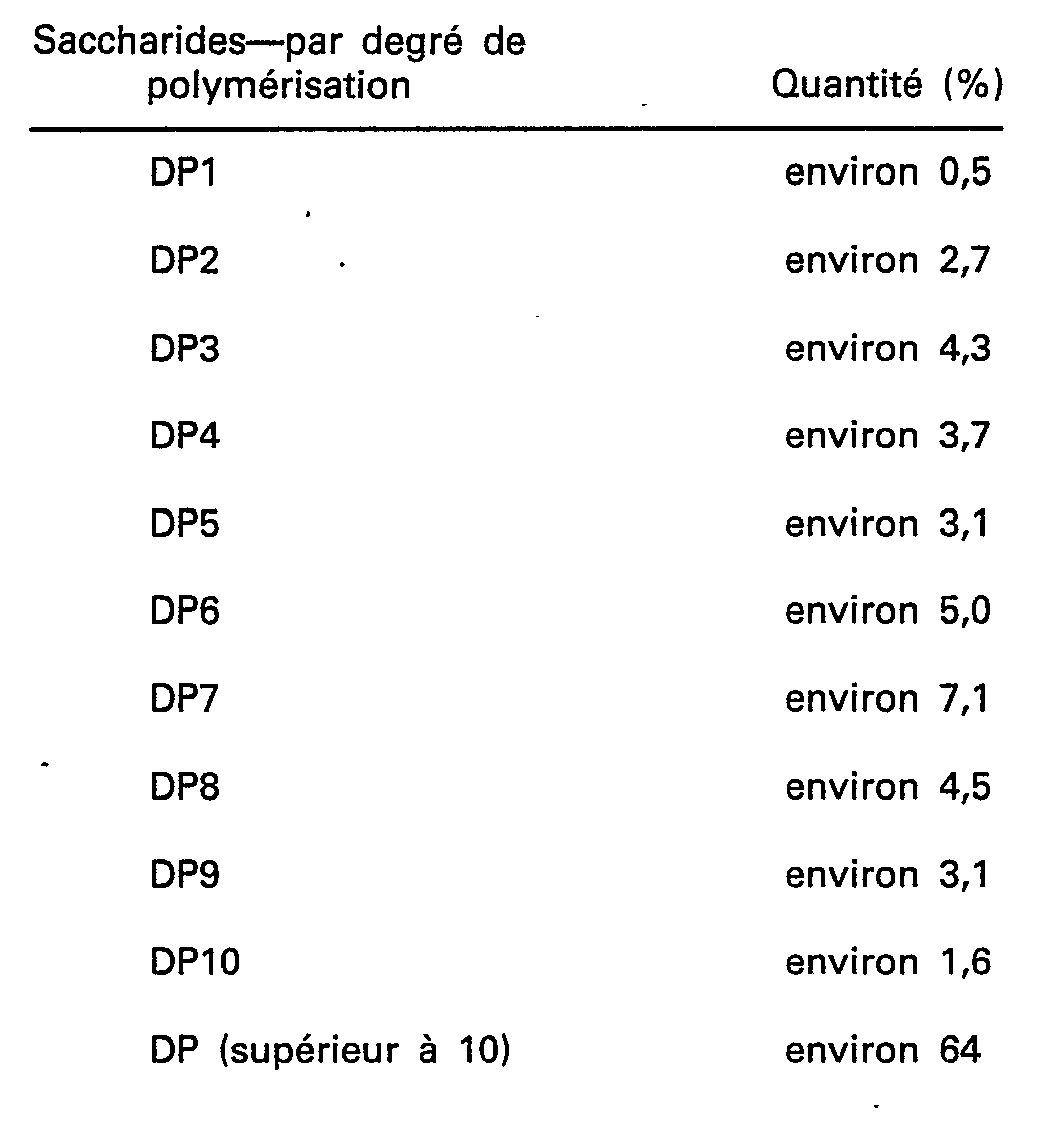
- the maltodextrin employed is preferably a water-soluble maltodextrin having at least a major portion (e.g., slightly more than 50%, preferably about 60% or more) of one or more polysaccharides having a D.P. (i.e., degree of polymerization) of at least 10. More preferably, the maltodextrin employed is additionally a starch hydrolyzate of low sweetness having a low dextrose equivalent value of from about 5 to about 20 more preferably about 5 to about 15 D.E. units, high water solubility with substantial freedom from haze and low hygroscopicity.
- M100 maltodextrin has a D.E. of about 9-12 D.E. units and a "Carbohydrate Composition, % (db)" as follows: dextrose (1.0), disaccharides (4.0), trisaccharides (6.0) and "tetrasaccharides & higher" (89.0).
- the M100 has a "Typical Carbohydrate Profile (dry basis) in % as follows: monosaccharides (1%), disaccharides (4%), trisaccharides (6%), tetrasaccharides (5%) and "pentasaccharides & above" (84%).
- M100 maltodextrin has the following "Typical carbohydrate profile"
- Maltodextrins suitable for use herein may be prepared, for example, in accordance with the methods disclosed in U.S. Patents 3,560,343; 3,663,369; 3,849,194; and 4,298,400. These patents are incorporated herein by reference.
- the salt substitutes may be prepared from raw material ingredients having any suitable particle sizes.
- Each component may have a single particle size or may have a particle-size distribution, i.e., a range of particle sizes.
- the particle size or particle-size distribution of each component is preferably selected such that the resulting admixture of components is homogeneous and substantially free of segregation under storage and handling conditions.
- the potassium chloride particles generally have larger weight-average size than the weight-average size of the particles of the maltodextrin component.
- particle includes extremely small pieces of matter and small agglomerates of clusters thereof.
- the particular size potassium chloride may be selected to meet any particular end use application.
- potassium chloride having a particle size greater than 35 mesh (500 ⁇ m) may be advantageously employed as the starting material.
- "shaker grade” i.e., minus 35 to plus 60 mesh, that is to say 250 to 500 ⁇ m
- potassium chloride having a particle size from minus 35 to plus 60 mesh i.e. 250 to 500 ⁇ m
- potassium chloride starting material may advantageously be employed as the potassium chloride starting material.
- the potassium chloride starting material may advantageously have a particle size of minus 60 mesh (i.e. less than 250 pm).
- a particle size of minus 60 mesh i.e. less than 250 pm.
- the salt substitutes of the present invention are preferably formulated as admixtures of very finely divided particles for use as all or part of the saltflavor-producing component of such snack foods as potato chips (potato crisps), corn chips (corn crisps), popcorn and others which commonly employ salt powder as such component.
- all particles included in such admixtures will pass a U.S. Sieve 40-mesh (425 ⁇ m-) screen and the potassium chloride particles will have larger weight-average size as set forth above.
- the salt substitutes of the present invention are preferably prepared by thoroughly admixing the components as substantially dry solids to form a uniform admixture.
- the as-produced salt substitutes may be used as is (with or without size classification) or, if desired, may be subjected to size reduction (e.g., crushing) prior to use.
- the taste panel results set forth in the examples resulted from the following taste test procedure.
- Each panelist touched his tongue sequentially to each taste sample, which was supported on a clean paper napkin, made his taste evaluation, and rinsed his mouth with water prior to so tasting each sample.
- Each panel included at least three panelists.
- the evaluation or rating system is set forth herein below.
- Maltodextrin M100 (Grain Processing Corporation) in five separate amounts from about 7 to about 37 parts ("MD” and potassium chloride (Code 6842-powder, Mallinckrodt, Inc.), in five separate corresponding amounts from about 93 to about 63 parts, were thoroughly admixed as substantially dry solids at about 20-25°C., thereby providing five particulate admixtures each of which was substantially uniform throughout. Typical particle-size distributions of these commercially available materials are set forth above.
- each admixture contained the approximate amounts of potassium chloride (KCI) and maltodextrin ("MD”) set forth therefor in Table I under the heading "(I) Invention".
- each admixture was found to be substantially free-flowing and substantially nonhygroscopic. Samples of each admixture composition were subjected to a taste test for evaluation thereof as a salt substitute. Samples of comparative materials were included in the test. Results of the test are set forth in Table I.
- each of the two component salt substitute admixtures of the present invention illustrated by Examples 1-5 has been found to closely approach the taste of common salt (sodium chloride) and more closely approach such taste than each of the other comparative materials set forth therein in at least one taste characteristic.
- a composition of this invention containing potassium chloride, maltodextrin and sodium chloride was prepared in this example.
- Maltodextrin M100 (Grain Processing Corporation) 20 parts ("MD”); potassium chloride (Code 6842-powder, Mallinckrodt, Inc.), 65 parts; and USP sodium chloride ("Popcorn Salt", Diamond Crystal Salt Co.), 15 parts, were thoroughly admixed as substantially dry solids at about 20-25°C., thereby providing a particulate admixture which was substantially uniform throughout. Typical particle size distributions of these commercially available materials are set forth above.
- the admixture contained about 65% KCI, about 20% maltodextrin ("MD”) and about 15% NaCI.
- the salt-substitute admixture of the present invention illustrated by Example 6 has been found to closely approach the taste of common salt (sodium chloride) and more closely approach such taste than each of the other comparative materials set forth therein in at least one taste characteristic.
- Example 6 The procedure of Example 6 was repeated in each of these examples except that the amounts of maltodextrin ("MD"), sodium chloride and potassium chloride were varied over the following ranges: 20-7.4 parts MD, 16-18.5 parts sodium chloride and 74.1-64 parts potassium chloride.
- MD maltodextrin
- Example 7 and 8 The results of visual inspection with respect to appearance relative to the appearance of sodium chloride were substantially the same for Examples 7 and 8 as for Example 6 above.
- the admixtures prepared in Example 7 and Example 8 were found to be substantially free-flowing and substantially non-hygroscopic.
- Samples of the compositions of Example 7 and Example 8 were subjected to a taste test for evaluation thereof as salt substitutes.
- Samples of comparative materials were included in the test.
- Taste panel itemized evaluations by taste category for Examples 7 and 8 appear in Table IV, along with evaluations for the comparative materials.
- the salt substitutes of the present invention illustrated by Examples 7 and 8 have been found to closely approach the taste of common salt (sodium chloride) and more closely approach such taste than the other comparative materials set forth therein in at least one taste characteristic.
- composition of this invention containing potassium chloride, maltodextrin ("MD”), sodium chloride and cream of tartar (“CT”) was prepared in this example.
- Maltodextrin M100 (Grain Processing Corporation) 20 parts ("MD”; potassium chloride (Code 6842-powder, Mallinckrodt, Inc.), 64.67 parts; USP sodium chloride ("Popcorn Salt”, Diamond Crystal Salt Co.), 15 parts; and cream of tartar (food grade, McCormick & Co.), 0.33 part, were thoroughly admixed as substantially dry solids at about 20-25°C., thereby providing a particulate admixture which was substantially uniform throughout. Typical particle-size distributions of these commercially available materials are set forth above.
- the admixture contained about 65% KCI, about 20% maltodextrin ("MD"), about 15% NaCI, and about 0.33% cream of tartar (“CT").
- Example 9 As shown by the taste panel results in Table V, the salt-substitute admixture of the present invention illustrated by Example 9 has been found to closely approach the taste of common salt (sodium chloride) and more closely approach such taste than each of the other comparative materials set forth therein at least one taste characteristic.
- Example 10-KCI 71.76 parts, NaCI (8 parts) and CT (0.24 part
- Example 11-KCI 71.64 parts
- NaCI 8 parts
- CT cream of tartar
- Example 12-KCI 75.62 parts
- each admixture showed that it was substantially identical in appearance to sodium chloride of like size. Each admixture was found to be substantially free-flowing and substantially nonhygroscopic. Each admixture composition was tasted and found to closely approach common salt in taste. The admixture of Example 10 was found to more closely approach common salt from the standpoint of saltiness than the admixture of Example 12. The admixture of Example 11 was found to more closely approach common salt from such standpoint than the admixture of Example 10.
- compositions of this invention not including cream of tartar (i.e. compositions containing potassium chloride, maltodextrin and sodium chloride, but not cream of tartar)
- the salt substitute set forth in Example 6 above is contemplated to be the best embodiment from the standpoint of overall taste appeal
- the salt substitute set forth below is contemplated to be the best sodium chloride containing three component embodiment from the standpoint of commercial attractiveness:
- compositions of this invention including cream of tartar (as usually preferred)
- salt substitutes set forth as "A” and "B” below are contemplated to be the best embodiment from the standpoint of overall taste appeal and the best embodiment from the standpoint of commercial attractiveness, respectively:
- Maltodextrin M100 (Grain Processing Corporation) in four separate amounts of 20 parts each ("MD”); potassium chloride (Code 6842-powder, Mallinckrodt, Inc.), in four separate amounts from about 79.85 to about 79.2 parts; and cream of tartar, food grade (McCormick & Co., Baltimore, Maryland), in four separate amounts from about 0.15 to about 0.8 part ("CT”), were thoroughly admixed as substantially dry solids at about 20-25°C., thereby providing four particulate admixtures, each of which was substantially uniform throughout. Typical particle-size distributions of these commercially available materials are set forth above.
- each admixture contained the approximate amounts of potassium chloride (KCI), maltodextrin ("MD”) and cream of tartar (“CT”) set forth therefor in Table VI under the heading "I Invention”.
- KCI potassium chloride
- MD maltodextrin
- CT cream of tartar
- each admixture was found to be substantially free-flowing and substantially nonhygroscopic. Samples of each admixture composition were subjected to a taste test for evaluation thereof as a salt substitute. Samples of comparative materials were included in the test. Results of the test are set forth in Table VI.
- each of the salt-substitute admixtures of the present invention illustrated by Examples 13-16 has been found to closely approach the taste of common salt (sodium chloride) and more closely approach such taste than each of the other comparative materials set forth therein in at least one taste characteristic.
- Example 17 and Example 18 The results of visual inspection with respect to appearance relative to the appearance of sodium chloride were substantially the same for Examples 17 and 18 as for Examples 13-16 above.
- the admixtures prepared in Example 17 and Example 18 were found to be substantially free-flowing and substantially non-hygroscopic. Samples of the compositions of Example 17 and Example 18 were subjected to a taste test for evaluation thereof as salt substitutes. Samples of comparative materials were included in the test. Results of the test are set forth in Table VII.
- the salt-substitute admixtures of the present invention illustrated by Examples 17 and 18 have been found to closely approach the taste of common salt (sodium chloride), as set forth in Table VI, and more closely approach such taste than the comparative KCI-dextrose-CT materials set forth in Table VII in at least one taste characteristic.
Landscapes
- Health & Medical Sciences (AREA)
- Nutrition Science (AREA)
- Life Sciences & Earth Sciences (AREA)
- Chemical & Material Sciences (AREA)
- Engineering & Computer Science (AREA)
- Food Science & Technology (AREA)
- Polymers & Plastics (AREA)
- Seasonings (AREA)
- Cosmetics (AREA)
Claims (36)
où l'équivalent en dextrose (ED) du mélange d'est pas supérieur à 10 unités ED.
dans laquelle l'équivalent en dextrose (ED) de la quantité combinée de chlorure de potassium et de maltodextrine n'est par supérieur à 10 unités ED et les composants sont présents les pourcentages indiqués:
les pourcentages étant en poids par rapport au poids combiné desdits composants.
dans laquelle l'équivalent en dextrose (ED) de la quantité combinée de chlorure de potassium, de maltodextrine et de chlorure de sodium n'est pas supérieur à 10 unités ED, et les composants sont présents en les pourcentages indiqués:
où les pourcentages sont en poids par rapport au poids combiné desdits composants.
dans laquelle l'équivalent en dextrose (ED) de la quantité combinée de chlorure de potassium, de maltodextrine, de chlorure de sodium et de crème de tartre n'est pas supérieur à 10 unités ED et dans laquelle les composants sont présents en les pourcentages indiqués:
ledit mélange étant dépourvu de chlorure de sodium, l'équivalent en dextrose (ED) de la quantité combinée du chlorure de potassium, de maltodextrine et de crème de tartre n'étant pas supérieur à 10 unités ED et les composants étant présents en les pourcentages indiqués:
les pourcentages étant en poids par rapport au poids combiné desdits composants.

Priority Applications (1)
| Application Number | Priority Date | Filing Date | Title |
|---|---|---|---|
| AT84304485T ATE29951T1 (de) | 1983-06-30 | 1984-06-29 | Salzersatzmischungen von kaliumchlorid und maltodextrin und verfahren zur zubereitung. |
Applications Claiming Priority (6)
| Application Number | Priority Date | Filing Date | Title |
|---|---|---|---|
| US06/509,845 US4556577A (en) | 1983-06-30 | 1983-06-30 | Admixture of potassium chloride and maltodextrin as salt substitute and method of preparation |
| US06/509,849 US4560574A (en) | 1983-06-30 | 1983-06-30 | Salt substitute containing potassium chloride, maltodextrin and sodium chloride and method of preparation |
| US06/509,847 US4556578A (en) | 1983-06-30 | 1983-06-30 | NaCl-Free salt substitute containing potassium chloride, maltodextrin and potassium bitartrate and method of preparation |
| US509849 | 1983-06-30 | ||
| US509845 | 1995-08-01 | ||
| US509847 | 1995-08-01 |
Publications (2)
| Publication Number | Publication Date |
|---|---|
| EP0130822A1 EP0130822A1 (fr) | 1985-01-09 |
| EP0130822B1 true EP0130822B1 (fr) | 1987-09-30 |
Family
ID=27414423
Family Applications (1)
| Application Number | Title | Priority Date | Filing Date |
|---|---|---|---|
| EP84304485A Expired EP0130822B1 (fr) | 1983-06-30 | 1984-06-29 | Mélanges de substitut de sel à partir de chlorure de potassium et de maltodextrine et méthode de préparation |
Country Status (2)
| Country | Link |
|---|---|
| EP (1) | EP0130822B1 (fr) |
| DE (1) | DE3466466D1 (fr) |
Families Citing this family (6)
| Publication number | Priority date | Publication date | Assignee | Title |
|---|---|---|---|---|
| FR2698524B1 (fr) * | 1992-11-27 | 1995-02-03 | Salines Cerebos | Sel alimentaire. |
| FR2771901B1 (fr) * | 1997-12-04 | 2000-05-19 | Solvay | Sel comprenant un additif vegetal et son procede de fabrication |
| WO2012093929A1 (fr) * | 2011-01-06 | 2012-07-12 | Holista Biotech Sdn. Bhd. | Composition à teneur réduite en sodium |
| WO2017123916A1 (fr) * | 2016-01-13 | 2017-07-20 | Wm. Wrigley Jr. Company | Mélanges pour confiseries à teneur en sel réduite |
| CN108719932A (zh) * | 2017-04-24 | 2018-11-02 | 罗成 | 一种功能性食用盐/低钠盐及其应用 |
| MX2020002891A (es) | 2017-09-18 | 2021-01-08 | S & P Ingredient Dev Llc | Sustituto de sal bajo en sodio con cloruro de potasio. |
Family Cites Families (3)
| Publication number | Priority date | Publication date | Assignee | Title |
|---|---|---|---|---|
| US3514296A (en) * | 1967-01-16 | 1970-05-26 | Morton Int Inc | Salt substitute |
| US3663369A (en) * | 1968-02-23 | 1972-05-16 | Grain Processing Corp | Hydrolysis of starch |
| US3860732A (en) * | 1970-03-30 | 1975-01-14 | Cumberland Packing Corp | Salt substitute |
-
1984
- 1984-06-29 EP EP84304485A patent/EP0130822B1/fr not_active Expired
- 1984-06-29 DE DE8484304485T patent/DE3466466D1/de not_active Expired
Also Published As
| Publication number | Publication date |
|---|---|
| EP0130822A1 (fr) | 1985-01-09 |
| DE3466466D1 (en) | 1987-11-05 |
Similar Documents
| Publication | Publication Date | Title |
|---|---|---|
| US4560574A (en) | Salt substitute containing potassium chloride, maltodextrin and sodium chloride and method of preparation | |
| US4556566A (en) | Salt substitute containing potassium chloride coated with a mixture of maltodextrin and sodium chloride and method of preparation | |
| US4556578A (en) | NaCl-Free salt substitute containing potassium chloride, maltodextrin and potassium bitartrate and method of preparation | |
| CA1217380A (fr) | Particules et revetement, exempts de chlorure de sodium, constitues de chlorure de potassium sous une couche de maltodextrine, produits de remplacement du sel; preparation | |
| US4910031A (en) | Topped savory snack foods | |
| AU633626B2 (en) | Low sodium salt composition | |
| JP2783764B2 (ja) | 低カロリー甘味製剤及びその製造方法 | |
| NZ210050A (en) | Dietary fibre food product and preparation thereof | |
| JPH0654660A (ja) | 甘味組成物 | |
| US4556568A (en) | Salt substitute containing potassium chloride coated with a mixture including maltodextrin and potassium bitartrate and method of preparation | |
| US4556577A (en) | Admixture of potassium chloride and maltodextrin as salt substitute and method of preparation | |
| DE3418644A1 (de) | Natriumarmes, als kochsalzsubstitut geeignetes salzgemisch | |
| EP0124254A1 (fr) | Composition de succédané de sel | |
| EP0130822A1 (fr) | Mélanges de substitut de sel à partir de chlorure de potassium et de maltodextrine et méthode de préparation | |
| EP0130821B1 (fr) | Substitut de sel à particule revêtue contenant du chlorure de potassium revêtu de maltodextrin et méthode pour sa préparation | |
| DE2424807A1 (de) | Trockenlebensmittelmischung und verfahren zu ihrer herstellung | |
| DE69519718T2 (de) | Nahrungsmittel mit zeitverzögerter energiefreisetzung | |
| EP0518507A1 (fr) | Procédé pour aromatiser des snacks | |
| CZ284820B6 (cs) | Jedlá sůl | |
| JP3243490B2 (ja) | カラ揚げ粉 | |
| US4414237A (en) | Process for preparing a sauce containing bread crumbs and product thereof | |
| JPH07163319A (ja) | 即席調理ソース | |
| JP2783762B2 (ja) | 低カロリーの甘味製剤及びその製造方法 | |
| JP3329567B2 (ja) | パン粉及びその製造方法 | |
| JP3145825B2 (ja) | カラ揚げ粉 |
Legal Events
| Date | Code | Title | Description |
|---|---|---|---|
| PUAI | Public reference made under article 153(3) epc to a published international application that has entered the european phase |
Free format text: ORIGINAL CODE: 0009012 |
|
| AK | Designated contracting states |
Designated state(s): AT BE CH DE FR GB IT LI LU NL SE |
|
| 17P | Request for examination filed |
Effective date: 19850329 |
|
| 17Q | First examination report despatched |
Effective date: 19860305 |
|
| RAP1 | Party data changed (applicant data changed or rights of an application transferred) |
Owner name: MALLINCKRODT, INC. (A DELAWARE CORPORATION) |
|
| GRAA | (expected) grant |
Free format text: ORIGINAL CODE: 0009210 |
|
| AK | Designated contracting states |
Kind code of ref document: B1 Designated state(s): AT BE CH DE FR GB IT LI LU NL SE |
|
| REF | Corresponds to: |
Ref document number: 29951 Country of ref document: AT Date of ref document: 19871015 Kind code of ref document: T |
|
| ITF | It: translation for a ep patent filed | ||
| REF | Corresponds to: |
Ref document number: 3466466 Country of ref document: DE Date of ref document: 19871105 |
|
| ET | Fr: translation filed | ||
| PLBE | No opposition filed within time limit |
Free format text: ORIGINAL CODE: 0009261 |
|
| STAA | Information on the status of an ep patent application or granted ep patent |
Free format text: STATUS: NO OPPOSITION FILED WITHIN TIME LIMIT |
|
| 26N | No opposition filed | ||
| ITTA | It: last paid annual fee | ||
| PGFP | Annual fee paid to national office [announced via postgrant information from national office to epo] |
Ref country code: FR Payment date: 19910523 Year of fee payment: 8 Ref country code: DE Payment date: 19910523 Year of fee payment: 8 Ref country code: CH Payment date: 19910523 Year of fee payment: 8 Ref country code: AT Payment date: 19910523 Year of fee payment: 8 |
|
| PGFP | Annual fee paid to national office [announced via postgrant information from national office to epo] |
Ref country code: SE Payment date: 19910527 Year of fee payment: 8 |
|
| PGFP | Annual fee paid to national office [announced via postgrant information from national office to epo] |
Ref country code: LU Payment date: 19910528 Year of fee payment: 8 |
|
| PGFP | Annual fee paid to national office [announced via postgrant information from national office to epo] |
Ref country code: BE Payment date: 19910530 Year of fee payment: 8 |
|
| PGFP | Annual fee paid to national office [announced via postgrant information from national office to epo] |
Ref country code: GB Payment date: 19910603 Year of fee payment: 8 |
|
| PGFP | Annual fee paid to national office [announced via postgrant information from national office to epo] |
Ref country code: NL Payment date: 19910630 Year of fee payment: 8 |
|
| EPTA | Lu: last paid annual fee | ||
| PG25 | Lapsed in a contracting state [announced via postgrant information from national office to epo] |
Ref country code: LU Free format text: LAPSE BECAUSE OF NON-PAYMENT OF DUE FEES Effective date: 19920629 Ref country code: GB Effective date: 19920629 Ref country code: AT Effective date: 19920629 |
|
| PG25 | Lapsed in a contracting state [announced via postgrant information from national office to epo] |
Ref country code: SE Effective date: 19920630 Ref country code: LI Effective date: 19920630 Ref country code: CH Effective date: 19920630 Ref country code: BE Effective date: 19920630 |
|
| BERE | Be: lapsed |
Owner name: MALLINCKRODT INC. (A DELAWARE CORP.) Effective date: 19920630 |
|
| PG25 | Lapsed in a contracting state [announced via postgrant information from national office to epo] |
Ref country code: NL Effective date: 19930101 |
|
| NLV4 | Nl: lapsed or anulled due to non-payment of the annual fee | ||
| GBPC | Gb: european patent ceased through non-payment of renewal fee |
Effective date: 19920629 |
|
| PG25 | Lapsed in a contracting state [announced via postgrant information from national office to epo] |
Ref country code: FR Effective date: 19930226 |
|
| REG | Reference to a national code |
Ref country code: CH Ref legal event code: PL |
|
| PG25 | Lapsed in a contracting state [announced via postgrant information from national office to epo] |
Ref country code: DE Effective date: 19930302 |
|
| REG | Reference to a national code |
Ref country code: FR Ref legal event code: ST |
|
| EUG | Se: european patent has lapsed |
Ref document number: 84304485.0 Effective date: 19930109 |