EP0130847A2 - Verfahren zur Herstellung einer Halbleiteranordnung - Google Patents
Verfahren zur Herstellung einer Halbleiteranordnung Download PDFInfo
- Publication number
- EP0130847A2 EP0130847A2 EP84304587A EP84304587A EP0130847A2 EP 0130847 A2 EP0130847 A2 EP 0130847A2 EP 84304587 A EP84304587 A EP 84304587A EP 84304587 A EP84304587 A EP 84304587A EP 0130847 A2 EP0130847 A2 EP 0130847A2
- Authority
- EP
- European Patent Office
- Prior art keywords
- laser beam
- conductive layer
- manufacturing
- sublimable
- wavelength
- Prior art date
- Legal status (The legal status is an assumption and is not a legal conclusion. Google has not performed a legal analysis and makes no representation as to the accuracy of the status listed.)
- Granted
Links
Images


Classifications
-
- H—ELECTRICITY
- H10—SEMICONDUCTOR DEVICES; ELECTRIC SOLID-STATE DEVICES NOT OTHERWISE PROVIDED FOR
- H10P—GENERIC PROCESSES OR APPARATUS FOR THE MANUFACTURE OR TREATMENT OF DEVICES COVERED BY CLASS H10
- H10P34/00—Irradiation with electromagnetic or particle radiation of wafers, substrates or parts of devices
- H10P34/40—Irradiation with electromagnetic or particle radiation of wafers, substrates or parts of devices with high-energy radiation
- H10P34/42—Irradiation with electromagnetic or particle radiation of wafers, substrates or parts of devices with high-energy radiation with electromagnetic radiation, e.g. laser annealing
-
- C—CHEMISTRY; METALLURGY
- C23—COATING METALLIC MATERIAL; COATING MATERIAL WITH METALLIC MATERIAL; CHEMICAL SURFACE TREATMENT; DIFFUSION TREATMENT OF METALLIC MATERIAL; COATING BY VACUUM EVAPORATION, BY SPUTTERING, BY ION IMPLANTATION OR BY CHEMICAL VAPOUR DEPOSITION, IN GENERAL; INHIBITING CORROSION OF METALLIC MATERIAL OR INCRUSTATION IN GENERAL
- C23C—COATING METALLIC MATERIAL; COATING MATERIAL WITH METALLIC MATERIAL; SURFACE TREATMENT OF METALLIC MATERIAL BY DIFFUSION INTO THE SURFACE, BY CHEMICAL CONVERSION OR SUBSTITUTION; COATING BY VACUUM EVAPORATION, BY SPUTTERING, BY ION IMPLANTATION OR BY CHEMICAL VAPOUR DEPOSITION, IN GENERAL
- C23C14/00—Coating by vacuum evaporation, by sputtering or by ion implantation of the coating forming material
- C23C14/04—Coating on selected surface areas, e.g. using masks
- C23C14/048—Coating on selected surface areas, e.g. using masks using irradiation by energy or particles
-
- H—ELECTRICITY
- H10—SEMICONDUCTOR DEVICES; ELECTRIC SOLID-STATE DEVICES NOT OTHERWISE PROVIDED FOR
- H10F—INORGANIC SEMICONDUCTOR DEVICES SENSITIVE TO INFRARED RADIATION, LIGHT, ELECTROMAGNETIC RADIATION OF SHORTER WAVELENGTH OR CORPUSCULAR RADIATION
- H10F19/00—Integrated devices, or assemblies of multiple devices, comprising at least one photovoltaic cell covered by group H10F10/00, e.g. photovoltaic modules
- H10F19/30—Integrated devices, or assemblies of multiple devices, comprising at least one photovoltaic cell covered by group H10F10/00, e.g. photovoltaic modules comprising thin-film photovoltaic cells
- H10F19/31—Integrated devices, or assemblies of multiple devices, comprising at least one photovoltaic cell covered by group H10F10/00, e.g. photovoltaic modules comprising thin-film photovoltaic cells having multiple laterally adjacent thin-film photovoltaic cells deposited on the same substrate
-
- H—ELECTRICITY
- H10—SEMICONDUCTOR DEVICES; ELECTRIC SOLID-STATE DEVICES NOT OTHERWISE PROVIDED FOR
- H10F—INORGANIC SEMICONDUCTOR DEVICES SENSITIVE TO INFRARED RADIATION, LIGHT, ELECTROMAGNETIC RADIATION OF SHORTER WAVELENGTH OR CORPUSCULAR RADIATION
- H10F19/00—Integrated devices, or assemblies of multiple devices, comprising at least one photovoltaic cell covered by group H10F10/00, e.g. photovoltaic modules
- H10F19/30—Integrated devices, or assemblies of multiple devices, comprising at least one photovoltaic cell covered by group H10F10/00, e.g. photovoltaic modules comprising thin-film photovoltaic cells
- H10F19/31—Integrated devices, or assemblies of multiple devices, comprising at least one photovoltaic cell covered by group H10F10/00, e.g. photovoltaic modules comprising thin-film photovoltaic cells having multiple laterally adjacent thin-film photovoltaic cells deposited on the same substrate
- H10F19/33—Patterning processes to connect the photovoltaic cells, e.g. laser cutting of conductive or active layers
-
- H—ELECTRICITY
- H10—SEMICONDUCTOR DEVICES; ELECTRIC SOLID-STATE DEVICES NOT OTHERWISE PROVIDED FOR
- H10F—INORGANIC SEMICONDUCTOR DEVICES SENSITIVE TO INFRARED RADIATION, LIGHT, ELECTROMAGNETIC RADIATION OF SHORTER WAVELENGTH OR CORPUSCULAR RADIATION
- H10F77/00—Constructional details of devices covered by this subclass
- H10F77/10—Semiconductor bodies
- H10F77/16—Material structures, e.g. crystalline structures, film structures or crystal plane orientations
- H10F77/169—Thin semiconductor films on metallic or insulating substrates
- H10F77/1692—Thin semiconductor films on metallic or insulating substrates the films including only Group IV materials
-
- H—ELECTRICITY
- H10—SEMICONDUCTOR DEVICES; ELECTRIC SOLID-STATE DEVICES NOT OTHERWISE PROVIDED FOR
- H10F—INORGANIC SEMICONDUCTOR DEVICES SENSITIVE TO INFRARED RADIATION, LIGHT, ELECTROMAGNETIC RADIATION OF SHORTER WAVELENGTH OR CORPUSCULAR RADIATION
- H10F77/00—Constructional details of devices covered by this subclass
- H10F77/20—Electrodes
- H10F77/206—Electrodes for devices having potential barriers
- H10F77/211—Electrodes for devices having potential barriers for photovoltaic cells
-
- H—ELECTRICITY
- H10—SEMICONDUCTOR DEVICES; ELECTRIC SOLID-STATE DEVICES NOT OTHERWISE PROVIDED FOR
- H10P—GENERIC PROCESSES OR APPARATUS FOR THE MANUFACTURE OR TREATMENT OF DEVICES COVERED BY CLASS H10
- H10P52/00—Grinding, lapping or polishing of wafers, substrates or parts of devices
-
- Y—GENERAL TAGGING OF NEW TECHNOLOGICAL DEVELOPMENTS; GENERAL TAGGING OF CROSS-SECTIONAL TECHNOLOGIES SPANNING OVER SEVERAL SECTIONS OF THE IPC; TECHNICAL SUBJECTS COVERED BY FORMER USPC CROSS-REFERENCE ART COLLECTIONS [XRACs] AND DIGESTS
- Y02—TECHNOLOGIES OR APPLICATIONS FOR MITIGATION OR ADAPTATION AGAINST CLIMATE CHANGE
- Y02E—REDUCTION OF GREENHOUSE GAS [GHG] EMISSIONS, RELATED TO ENERGY GENERATION, TRANSMISSION OR DISTRIBUTION
- Y02E10/00—Energy generation through renewable energy sources
- Y02E10/50—Photovoltaic [PV] energy
-
- Y—GENERAL TAGGING OF NEW TECHNOLOGICAL DEVELOPMENTS; GENERAL TAGGING OF CROSS-SECTIONAL TECHNOLOGIES SPANNING OVER SEVERAL SECTIONS OF THE IPC; TECHNICAL SUBJECTS COVERED BY FORMER USPC CROSS-REFERENCE ART COLLECTIONS [XRACs] AND DIGESTS
- Y10—TECHNICAL SUBJECTS COVERED BY FORMER USPC
- Y10S—TECHNICAL SUBJECTS COVERED BY FORMER USPC CROSS-REFERENCE ART COLLECTIONS [XRACs] AND DIGESTS
- Y10S438/00—Semiconductor device manufacturing: process
- Y10S438/94—Laser ablative material removal
Definitions
- the present invention relates to a method for the manufacture of a semiconductor device which has at least a non-single-crystal semiconductor layer, transparent or nontransparent conductive layer, or laminate member composed of transparent and nontransparent conductive layers, such as a semiconductor photoelectric conversion device, field effect transistor or the like, and more particularly to improvement in a semiconductor device manufacturing method which includes at least a step of forming a non-single-crystal semiconductor layer, transparent or nontransparent conductive layer, or laminate member composed of transparent and nontransparent conductive layers by patterning with a laser beam.
- a semiconductor device manufacturing method which includes at least a step of forming a non-single-crystal semiconductor layer, transparent or nontransparent conductive layer, or laminate member composed of transparent and nontransparent conductive layers by patterning with a laser beam.
- the abovesaid method excels in that the layer can be formed without any defects.
- the reason for this is that in the case of forming the layer by photolithography, a photoresist mask therefor is prone to pinholing or exfoliation at its marginal edges, which results in the formation of defects, whereas the method utilizing the patterning process with a laser beam has no such factors which cause defects.
- the absorption coefficient of the abovesaid layer for the laser beam of such a relatively long wavelength is extremely low.
- the absorption coefficient of a non-single-crystal silicon layer is 10 3 /cm or so.
- the laser beam enters very deeply into the non-single-crystal semiconductor layer, transparent or nontransparent concuctive layer, or laminate member.
- the penetration depth of such a laser beam into the non-single-crystal semiconductor layer is approximately 10 um at a depth where the light intensity is 1 /e (where e is nearly equal to 2.72) of the light intensity on the surface of the layer, and around 1000 ⁇ m at a depth where the light intensity is 1/100 of the light intensity on the layer surface.
- the non-single-crystal semiconductor layer, the transparent or nontransparent conductive layer, or laminate member is as thin as 1um or less, it is feared that a substrate and other layers underlying it is damaged or patterned. Also it is feared that the marginal edges of the non-single-crystal semiconductor layer, transparent or nontransparent conductive layer, or laminate member are swollen or exfoliated.
- the semiconductor device manufacturing method of the present invention includes at least a step of forming the non-single-crystal semiconductor layer, or transparent or nontransparent conductive layer, or laminate member by patterning with a laser beam as in the prior art manufacturing method.
- the manufacturing method of the present invention differs from the conventional method in using, for the patterning of the layer, a laser beam having a wavelength of 600 nm or less which is far shorter than the wavelength of the beam employed in the conventional method.
- the absorption coefficient of the non-single-crystal semiconductor, transparent or nontransparent conductive layer, or laminate member for the laser beam is far higher than the absorption coefficient for the laser beam having the long wavelength of about 1060 nm.
- the absorption coefficient of a non-single-crystal semiconductor layer is 10 5 /cm or more, which is more than 100 times larger than the absorption coefficient (approximately 10 3 /cm) for the laser beam of the 1060 nm or so wavelength used in the past.
- the penetration depth of the laser beam of such a short wavelength into the abovesaid layer is far smaller than in the case of the laser beam of the above-mentioned long wavelength.
- the penetration depth of the laser beam of the 600 nm or less wavelength into the non-single-crystal semiconductor layer is 700 ⁇ or less at a depth where the beam intensity is 1/e (where e is equal to 2.72) of the beam intensity on the layer surface, and 1 ⁇ m or less at a depth where the beam intensity is 1/100 of that on the layer surface. This is more than 1000 times smaller than the depth (10 ⁇ m or so) in the case of using the laser beam having the 1060 nm or so wavelength in the prior art manufacturing method.
- the semiconductor manufacturing method of the present invention even if the non-single-crystal semiconductor layer, transparent or nontransparent conductive layer, or laminate member to be patterned is as thin as 1 ⁇ m or less, there is no possibility of damaging or patterning the underlying substrate or other layers by the laser beam. Further, the method of the present invention is free from the fear of swelling or exfoliating the marginal edges of the layer as a result of the patterning thereof.
- the laser beam of the 600 nm or less wavelength can be easily reduced to such a minimum spot diameter as small as 1 00 um or less.
- they can be spaced apart such a small distance as 1 00 um or less. Accordingly, the manufacturing method of the present invention provides a smaller and more compact semiconductor device having a plurality of non-single-crystal semiconductor layers, transparent or nontransparent conductive layers, or laminate member than does the conventional method.
- the manufacture of the semiconductor photoelectric conversion device according to the present invention starts with the preparation of a substrate 1 (Fig. 1A).
- the substrate 1 has a surface 2 of an organic or inorganic insulator.
- a synthetic resin substrate can be used which is transparent or nontransparent. It is also possible to employ a ceramic substrate, a transparent glass substrate and a substrate which has an insulating film as of synthetic resin, a silicon oxide or the like, deposited on a stainless steel or metal plate.
- a conductive layer 3 is formed on the substrate 1, by means of a known evaporation method or CVD method (Fig. 1B).
- the conductive layer 3 has a thickness of 1 ⁇ m or less.
- the conductive layer 3 may be formed as a transparent conductive layer.
- the substrate 1 is transparent.
- the transparent conductive layer 3 is constituted principally of a sublimable metallic oxide such as Sn0 2 , In 2 0 3 or ITO (Indium-Tin oxide), or a sublimable matallic nonoxide such as a Si-Cr or Si-Ni alloy.
- the conductive layer 3 may also be formed as a nontransparent conductive layer.
- the substrate 1 need not be transparent.
- the nontransparent conductive layer 3 is constituted principally of a sublimable metal such as Cr, a Cr-Cu alloy (containing 0.1 to 50 Wt% of Cu), Cr-Ag alloy (containing 0.1 to 50 wt% of Ag) or Cr-N alloy (containing 0.1 to 50 wt% of N), or a nonsublimable metal such as At, Cu or Ag.
- the conductive layer 3 may also be a laminate member which comprises a transparent conductive layer constituted principally of the abovesaid sublimable metallic oxide or sublimable metallic nonoxide and a nontransparent conductive layer constituted principally of the abovesaid sublimable metal or nonsublimable metal.
- the nontransparent conductive layer is formed on the side of the substrate 1, and the substrate 1 need not be transparent.
- the conductive layer 3 is subjected to patterning by the use of a laser beam, forming a plurality of conductive layers 5 which are each isolated from adjacent ones of them by a groove 4 of a width substantially equal to the spot diameter of the laser beam (Fig. 1 C).
- the laser beam used in this case is a pulse laser beam that has a short wavelength of 600 nm or less, a spot diameter of 3 to 60 ⁇ m and width of 50 nano-second or less.
- a pulse laser beam of a 530 nm or so wavelength can be used which is obtainable with a YAG laser. It is also possible to employ a pulse laser beam of a 193 nm or so (ArF), 248 nm or so (KrF), 308 nm or so (XeCl) or 315 nm or so (XeF) wavelength which is obtainable with an excimer laser, a laser beam of a 514.5 nm or so, 488 nm or so, 458 nm or so, 363 nm or so or 351 nm or so wavelength which is obtainable with an argon laser, or a laser beam of a 337 nm or so wavelength which is obtainable with a nitrogen laser.
- a pulse laser beam of a 193 nm or so (ArF), 248 nm or so (KrF), 308 nm or so (XeCl) or 315 nm or so (XeF) wavelength which is
- the absorption coefficient of the conductive layer 3 for the laser beam is more than 100 times larger than the absorption coefficient for a laser beam having a long wavelength of about 1060 nm which is obtainable with a YAG laser. Accordingly, the conductive layer 3 is effectively heated by the laser beam locally at the position of its irradiation.
- the conductive layer 3 is as thin as 1 um or less, it does not unnecessarily transfer therethrough heat resulting from the irradiation by the laser beam, namely, the heat generated in the layer 3 does not unnecessarily escape therefrom to outside through the layer 3 itself.
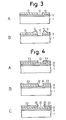
- the substrate 1 has the insulating surface, and hence it also prevents that the heat generated in the conductive layer 3 unnecessarily escape therefrom to the outside through the substrate 1. Accordingly, the material of the conductive layer 3 is effectively sublimed at the position of irradiation by the laser beam. As a result of this, conductive layers 5 are neatly formed, along with the grooves 4, as shown in Fig. 2A. In this case, there are no possiblities that the material of the conductive layers 5, molten by the laser beam irradiation, is deposited on the marginal edges of the conductive layers 5, as indicated by 6, in Fig. 2B.
- the laser beam is effectively absorbed by the conductive layer 3 because of its short wavelength, it would not inflict on the substrate unnecessary damages such as depressions and cracks as indicated by 7 and 8 in Figs. 2C and D.
- the effects described just above are prominent especially when the conductive layer 3 is a transparent conductive layer which is constituted principally of the aforementioned sublimable metallic oxide or sublimable metallic nonoxide, a nontransparent conductive layer which is constituted principally of the aforesaid sublimable metal, or a limanate member composed of such transparent and nontransparent conductive layers.
- the substrate 1 is not unnecessarily damaged bacause it has the surface of an insulator.
- a non-single-crystal semiconductor layer 11 is formed, by a known CVD, low-pressure CVD, prasma CVD or optical CVD method, on the substrate 1 so that it covers the conductive layers 5 and extend into the grooves 4 (Fig. 1D).
- the non-single-crystal semiconductor layer 11 also has a thickness of 1 ⁇ m or less.
- the non-single-crystal semiconductor layer 11 has such a PN junction stracture that a P-type non-single-crystal semiconductor layer and N-type non-single-crystal semiconductor layer are laminated one on the other in this order or in the reverse order, or such a PIN junction structure that a P-, I- and N-type non-single-crystal semiconductor layers are laminated one on another in this order or in the reverse order.
- the non-single-crystal semiconductor layer 11 is constituted mainly of a sublimable semiconductor such as Si, Si x Ge 1-4 (where 0 ⁇ x ⁇ 0.5), Si x C 1-x (where 0 ⁇ x ⁇ 1), Si 3 N n-x (where 0 ⁇ x ⁇ 2) or SiO 2-x (where 0 ⁇ x ⁇ 1), and the layer 11 has introduced therein hydrogen or a halogen as a dangling bond neutralizer.
- a sublimable semiconductor such as Si, Si x Ge 1-4 (where 0 ⁇ x ⁇ 0.5), Si x C 1-x (where 0 ⁇ x ⁇ 1), Si 3 N n-x (where 0 ⁇ x ⁇ 2) or SiO 2-x (where 0 ⁇ x ⁇ 1)
- the non-single-crystal semiconductor layer 11 is subjected to patterning by a laser beam, forming a plurality of non-single-crystal semiconductor layers 13 each isolated from adjacent ones of them by a groove 12 of a width nearly equal to the spot diameter of the laser beam (Fig. 1E).
- each non-single-crystal semiconductor layer 13 extends on one conductive layer 5 and into the groove 4 and further onto the adjoining conductive layer 5 slightly.
- the patterning of the non-single-crystal semiconductor layer 11 is effected through using the same laser beam as that for the formation of the conductive layers 5. Therefore, no detailed description will be repeated.
- the absorption coefficient of the non-single-crystal semiconductor layer 11 for the laser beam is also large as is the case with the aforementioned conductive layer 3, because the laser beam used has such a short wavelength as 600 nm or less. Therefore, the non-single-crystal semiconductor layer 11 is effectively heated at the position of irradiation by the laser beam as in the case of the aforementioned conductive layer 3. Further, since the non-single-crystal semiconductor layer 11 is as thin as 1 pmor less, it does not transfer laterally therethrough the heat generated therein preventing that the heat unnecessarily escapes from the layer 11 to the outside, as described previously.
- the non-single-crystal semiconductor layer 11 is constituted principally of the sublimable semiconductor, as referred to previously.
- This enables the non-single-crystal semiconductor layers 13 to be formed neatly, along with the grooves 12, as shown in Fig. 3A, and ensures to prevent that the material of each non-single-crystal semiconductor layer 13, molten by the laser beam irradiation, is deposited on its marginal edge, as indicated by 14 in Fig. 3B, and that the conductive layer 5 is hollowed, by the laser beam, to form therein a deep depression which may sometimes reach the substrate 1, as indicated by 15 in Fig. 3B.
- the conductive layer 21 also has a thickness of 1 ⁇ m or less.
- the conductive layer 21 may be formed as a transparent conductive layer which is constituted principally of the sublimable matallic oxide or sublimable metallic nonoxide mentioned previously with regard to the conductive layer 3. In this case, the substrate 1 need not be transparent.
- the conductive layer 21 may also be formed as a nontransparent conductive layer which is constituted principally of the aforesaid sublimable metal. In such a case, the substrate 1 is transparent.
- the conductive layer 21 may also be formed as a laminate member which composed of a transparent conductive layer constituted mainly of the aforesaid sublimable metallic oxide or sublimable metallic nonoxide and a nontransparent conductive layer which is constituted mainly of the aforementioned sublimable or nonsublimable metal.
- the transparent conductive layer is formed on the side of the non-single-crystal semiconductor layer 13, and the substrate 1 is transparent.
- the conductive layer 21 is subjected to patterning with a laser beam, forming a plurality of conductive layers 23 which are each isolated from adjacent ones of them by a groove 22 of a width nearly equal to the spot diameter of the laser beam.(Fig. 1G).
- each conductive layer 23 extends on one of the non-single-crystal semiconductor layers 13 and down into one of the grooves 12, wherein it is connected to the underlying conductive layer 5, and it further extends slightly onto the adjoining non-single-crystal semiconductor layer 13.
- the laser beam used for the patterning of the conductive layer 21 into the conductive layers 23 is the same as that for the formation of the conductive layers 5 and the non-single-crystal semiconductor layer 13. Therefore, no detailed description will be repeated.
- the absorption coefficient of the conductive layer 21 for such a laser beam is large as described previously in connection with the formation of the conductive layers 5 and the non-single-crystal semiconductor layers 13.
- the conductive layer 21 is thin and its portion on the side of the non-single-crystal semiconductor layer 13 is constituted mainly of the sublimable metallic oxide, sublimable metallic nonoxide or sublimable metal, so that the conductive layers 23 are neatly formed, along with the grooves 22. That is to say, there is no possibilities that the underlying non-single-crystal semiconductor layers 13 are hollowed, by the laser beam, to form therein deep depression which may sometime reach the underlying conductive layers 5, as indicated by 24 in Fig. 4B, and that the conductive layers 23 are exfoliated at their marginal edges, as indicated by 25 in Fig. 4C.
- a passivation film 31 as of silicon nitride which covers the conductive layers 23 and extends into the grooves 22, is formed by, for instance, a known plasma CVD method, and a protective film 32 of a synthetic resin is formed on the passivation film 31.
- a semiconductor photoelectric conversion device 42 is fabricated in which a plurality of semiconductor photoelectric transducers 41, each comprising the conductive layer 5, the non-single-crystal semiconductor layer 1 3 and the conductive layer 23, are connected in series through the portions of the conductive layers 23 extending into the grooves 12.
- the conductive layer 5, the non-single-crystal semiconductor layer 13 and the conductive layer 23, which make up each semiconductor photoelectric transducer 41, can be easily formed with high accuracy and finely, without damaging them or exfoliating their marginal edges and without cracking the substrate 1.
- each semiconductor photoelectric transducer 41 is isolated from the layers of the adjoining transducer 14 by a groove of a width substantially equal to the diameter of the laser beam, which is as small as 3 to 60 ⁇ m, so that a semiconductor photoelectric conversion device 42 can easily be manufactured in which a plurality of semiconductor photoelectric transducers 41 are arranged with a high density.
Landscapes
- Chemical & Material Sciences (AREA)
- Mechanical Engineering (AREA)
- Toxicology (AREA)
- Chemical Kinetics & Catalysis (AREA)
- Engineering & Computer Science (AREA)
- Materials Engineering (AREA)
- Health & Medical Sciences (AREA)
- Metallurgy (AREA)
- Organic Chemistry (AREA)
- Photovoltaic Devices (AREA)
- Light Receiving Elements (AREA)
- Formation Of Insulating Films (AREA)
- Drying Of Semiconductors (AREA)
Applications Claiming Priority (2)
| Application Number | Priority Date | Filing Date | Title |
|---|---|---|---|
| JP58121426A JPS6014441A (ja) | 1983-07-04 | 1983-07-04 | 半導体装置作製方法 |
| JP121426/83 | 1983-07-04 |
Publications (3)
| Publication Number | Publication Date |
|---|---|
| EP0130847A2 true EP0130847A2 (de) | 1985-01-09 |
| EP0130847A3 EP0130847A3 (en) | 1986-04-23 |
| EP0130847B1 EP0130847B1 (de) | 1991-05-02 |
Family
ID=14810849
Family Applications (1)
| Application Number | Title | Priority Date | Filing Date |
|---|---|---|---|
| EP84304587A Expired - Lifetime EP0130847B1 (de) | 1983-07-04 | 1984-07-04 | Verfahren zur Herstellung einer Halbleiteranordnung |
Country Status (4)
| Country | Link |
|---|---|
| US (1) | US4906491A (de) |
| EP (1) | EP0130847B1 (de) |
| JP (1) | JPS6014441A (de) |
| DE (1) | DE3484526D1 (de) |
Cited By (5)
| Publication number | Priority date | Publication date | Assignee | Title |
|---|---|---|---|---|
| FR2577716A1 (fr) * | 1985-02-15 | 1986-08-22 | Teijin Ltd | Piles solaires integrees et leur procede de fabrication |
| EP0203012A1 (de) * | 1985-05-24 | 1986-11-26 | Thomson-Csf | Fotoempfindliche Halbleitervorrichtung und Verfahren zu ihrer Herstellung |
| EP0179403A3 (de) * | 1984-10-17 | 1988-08-31 | Fuji Electric Corporate Research And Development Ltd. | Gerät zum Erzeugen eines photoelektrischen Dünnfilmwandlers |
| EP0364259A3 (de) * | 1988-10-13 | 1990-10-24 | Xerox Corporation | Verfahren zur thermischen Strukturierung von Halbleitersubstraten |
| CN106077965A (zh) * | 2011-06-15 | 2016-11-09 | 应用材料公司 | 多步骤和非对称塑形的激光束划线 |
Families Citing this family (7)
| Publication number | Priority date | Publication date | Assignee | Title |
|---|---|---|---|---|
| JPH0820638B2 (ja) * | 1986-08-08 | 1996-03-04 | 株式会社半導体エネルギ−研究所 | 液晶装置およびその作製方法 |
| US4943710A (en) * | 1987-06-25 | 1990-07-24 | Semiconductor Energy Laboratory Co., Ltd. | Image sensor and manufacturing method for the same |
| US5187601A (en) * | 1988-03-07 | 1993-02-16 | Semiconductor Energy Laboratory Co., Ltd. | Method for making a high contrast liquid crystal display including laser scribing opaque and transparent conductive strips simultaneously |
| JPH03203343A (ja) * | 1989-12-29 | 1991-09-05 | Tokyo Electron Ltd | 検査方法 |
| JPH06124913A (ja) | 1992-06-26 | 1994-05-06 | Semiconductor Energy Lab Co Ltd | レーザー処理方法 |
| US5384953A (en) * | 1993-07-21 | 1995-01-31 | International Business Machines Corporation | Structure and a method for repairing electrical lines |
| US7122489B2 (en) * | 2004-05-12 | 2006-10-17 | Matsushita Electric Industrial Co., Ltd. | Manufacturing method of composite sheet material using ultrafast laser pulses |
Family Cites Families (12)
| Publication number | Priority date | Publication date | Assignee | Title |
|---|---|---|---|---|
| DE1244346B (de) * | 1964-10-19 | 1967-07-13 | Menzel Gerhard Glasbearbeitung | Verfahren zum Schneiden von Glas |
| AT342232B (de) * | 1972-10-12 | 1978-03-28 | Glaverbel | Verfahren und vorrichtung zum trennen eines korpers aus einem glasartigen oder vitrokristallinen material |
| DE2439848C2 (de) * | 1973-08-20 | 1985-05-15 | Canon K.K., Tokio/Tokyo | Verfahren zum Aufzeichnen mittels eines Laserstrahls |
| JPS5331106A (en) * | 1976-09-03 | 1978-03-24 | Hitachi Ltd | Information recording member |
| US4181563A (en) * | 1977-03-31 | 1980-01-01 | Citizen Watch Company Limited | Process for forming electrode pattern on electro-optical display device |
| US4292092A (en) * | 1980-06-02 | 1981-09-29 | Rca Corporation | Laser processing technique for fabricating series-connected and tandem junction series-connected solar cells into a solar battery |
| US4315096A (en) * | 1980-07-25 | 1982-02-09 | Eastman Kodak Company | Integrated array of photovoltaic cells having minimized shorting losses |
| FR2503457B1 (fr) * | 1981-03-31 | 1987-01-23 | Rca Corp | Systeme de cellules solaires connectees en serie sur un substrat unique |
| US4473737A (en) * | 1981-09-28 | 1984-09-25 | General Electric Company | Reverse laser drilling |
| US4428110A (en) * | 1981-09-29 | 1984-01-31 | Rca Corporation | Method of making an array of series connected solar cells on a single substrate |
| US4472456A (en) * | 1982-11-18 | 1984-09-18 | Texas Instruments Incorporated | Absorption optimized laser annealing |
| JPS59193782A (ja) * | 1983-04-18 | 1984-11-02 | Semiconductor Energy Lab Co Ltd | レ−ザ加工機 |
-
1983
- 1983-07-04 JP JP58121426A patent/JPS6014441A/ja active Granted
-
1984
- 1984-07-04 DE DE8484304587T patent/DE3484526D1/de not_active Expired - Lifetime
- 1984-07-04 EP EP84304587A patent/EP0130847B1/de not_active Expired - Lifetime
-
1988
- 1988-04-25 US US07/186,745 patent/US4906491A/en not_active Expired - Fee Related
Cited By (7)
| Publication number | Priority date | Publication date | Assignee | Title |
|---|---|---|---|---|
| EP0179403A3 (de) * | 1984-10-17 | 1988-08-31 | Fuji Electric Corporate Research And Development Ltd. | Gerät zum Erzeugen eines photoelektrischen Dünnfilmwandlers |
| FR2577716A1 (fr) * | 1985-02-15 | 1986-08-22 | Teijin Ltd | Piles solaires integrees et leur procede de fabrication |
| EP0203012A1 (de) * | 1985-05-24 | 1986-11-26 | Thomson-Csf | Fotoempfindliche Halbleitervorrichtung und Verfahren zu ihrer Herstellung |
| FR2582446A1 (fr) * | 1985-05-24 | 1986-11-28 | Thomson Csf | Dispositif semi-conducteur photosensible et procede de fabrication d'un tel procede |
| US4780394A (en) * | 1985-05-24 | 1988-10-25 | Thomson-Csf | Photosensitive semiconductor device and a method of manufacturing such a device |
| EP0364259A3 (de) * | 1988-10-13 | 1990-10-24 | Xerox Corporation | Verfahren zur thermischen Strukturierung von Halbleitersubstraten |
| CN106077965A (zh) * | 2011-06-15 | 2016-11-09 | 应用材料公司 | 多步骤和非对称塑形的激光束划线 |
Also Published As
| Publication number | Publication date |
|---|---|
| EP0130847A3 (en) | 1986-04-23 |
| JPS6014441A (ja) | 1985-01-25 |
| DE3484526D1 (de) | 1991-06-06 |
| US4906491A (en) | 1990-03-06 |
| EP0130847B1 (de) | 1991-05-02 |
| JPH0572112B2 (de) | 1993-10-08 |
Similar Documents
| Publication | Publication Date | Title |
|---|---|---|
| US4713518A (en) | Electronic device manufacturing methods | |
| US4680855A (en) | Electronic device manufacturing methods | |
| US4594471A (en) | Photoelectric conversion device | |
| US4755475A (en) | Method of manufacturing photovoltaic device | |
| US4668840A (en) | Photovoltaic device | |
| US4906491A (en) | Semiconductor device manufacturing methods | |
| US4650524A (en) | Method for dividing semiconductor film formed on a substrate into plural regions by backside energy beam irradiation | |
| JPH05183177A (ja) | 薄膜太陽電池およびその作製方法 | |
| JPH1044139A (ja) | 基板分割方法およびその基板分割を用いた発光素子製 造方法 | |
| JPH0447466B2 (de) | ||
| CN1024341C (zh) | 在玻璃基底上产生薄膜图形的方法 | |
| US4780394A (en) | Photosensitive semiconductor device and a method of manufacturing such a device | |
| JPH11126916A (ja) | 集積形薄膜太陽電池及びその製造方法 | |
| JPS5651867A (en) | Manufacturing of semiconductor | |
| US5198881A (en) | Barrier layer device processing | |
| JPH0519991B2 (de) | ||
| JPS57145316A (en) | Manufacture of semicondcutor device | |
| JPS60261142A (ja) | 半導体装置作製方法 | |
| JPS57126184A (en) | Manufacture of upper electrode in josephson element | |
| JPH0473637B2 (de) | ||
| JPS5687390A (en) | Semiconductor laser | |
| JPH06314807A (ja) | 光起電力装置の製造方法 | |
| JPH053150B2 (de) | ||
| JPS5643734A (en) | Anneal method of polycrystalline silicon thin film | |
| JPS57157590A (en) | Manufacture of semiconductor laser device |
Legal Events
| Date | Code | Title | Description |
|---|---|---|---|
| PUAI | Public reference made under article 153(3) epc to a published international application that has entered the european phase |
Free format text: ORIGINAL CODE: 0009012 |
|
| AK | Designated contracting states |
Designated state(s): DE FR GB |
|
| PUAL | Search report despatched |
Free format text: ORIGINAL CODE: 0009013 |
|
| RHK1 | Main classification (correction) |
Ipc: H01L 21/268 |
|
| AK | Designated contracting states |
Kind code of ref document: A3 Designated state(s): DE FR GB |
|
| 17P | Request for examination filed |
Effective date: 19861018 |
|
| 17Q | First examination report despatched |
Effective date: 19880729 |
|
| GRAA | (expected) grant |
Free format text: ORIGINAL CODE: 0009210 |
|
| RAP1 | Party data changed (applicant data changed or rights of an application transferred) |
Owner name: SEMICONDUCTOR ENERGY LABORATORY CO., LTD. |
|
| AK | Designated contracting states |
Kind code of ref document: B1 Designated state(s): DE FR GB |
|
| REF | Corresponds to: |
Ref document number: 3484526 Country of ref document: DE Date of ref document: 19910606 |
|
| ET | Fr: translation filed | ||
| PLBE | No opposition filed within time limit |
Free format text: ORIGINAL CODE: 0009261 |
|
| STAA | Information on the status of an ep patent application or granted ep patent |
Free format text: STATUS: NO OPPOSITION FILED WITHIN TIME LIMIT |
|
| 26N | No opposition filed | ||
| REG | Reference to a national code |
Ref country code: GB Ref legal event code: IF02 |
|
| PGFP | Annual fee paid to national office [announced via postgrant information from national office to epo] |
Ref country code: GB Payment date: 20030702 Year of fee payment: 20 |
|
| PGFP | Annual fee paid to national office [announced via postgrant information from national office to epo] |
Ref country code: FR Payment date: 20030711 Year of fee payment: 20 |
|
| PGFP | Annual fee paid to national office [announced via postgrant information from national office to epo] |
Ref country code: DE Payment date: 20030717 Year of fee payment: 20 |
|
| PG25 | Lapsed in a contracting state [announced via postgrant information from national office to epo] |
Ref country code: GB Free format text: LAPSE BECAUSE OF EXPIRATION OF PROTECTION Effective date: 20040703 |
|
| REG | Reference to a national code |
Ref country code: GB Ref legal event code: PE20 |