EP0130917B1 - Procédé de fabrication d'acide phosphorique - Google Patents
Procédé de fabrication d'acide phosphorique Download PDFInfo
- Publication number
- EP0130917B1 EP0130917B1 EP84401388A EP84401388A EP0130917B1 EP 0130917 B1 EP0130917 B1 EP 0130917B1 EP 84401388 A EP84401388 A EP 84401388A EP 84401388 A EP84401388 A EP 84401388A EP 0130917 B1 EP0130917 B1 EP 0130917B1
- Authority
- EP
- European Patent Office
- Prior art keywords
- acid
- slurry
- phosphoric acid
- attack
- filtration
- Prior art date
- Legal status (The legal status is an assumption and is not a legal conclusion. Google has not performed a legal analysis and makes no representation as to the accuracy of the status listed.)
- Expired
Links
- NBIIXXVUZAFLBC-UHFFFAOYSA-N Phosphoric acid Chemical compound OP(O)(O)=O NBIIXXVUZAFLBC-UHFFFAOYSA-N 0.000 title claims abstract description 75
- 229910000147 aluminium phosphate Inorganic materials 0.000 title claims abstract description 37
- 238000000034 method Methods 0.000 title claims description 23
- 239000002253 acid Substances 0.000 claims abstract description 97
- 239000002002 slurry Substances 0.000 claims abstract description 37
- 238000001914 filtration Methods 0.000 claims abstract description 31
- 229910052731 fluorine Inorganic materials 0.000 claims abstract description 23
- 239000011737 fluorine Substances 0.000 claims abstract description 23
- 229910019142 PO4 Inorganic materials 0.000 claims abstract description 22
- 239000007787 solid Substances 0.000 claims abstract description 20
- NBIIXXVUZAFLBC-UHFFFAOYSA-K phosphate Chemical compound [O-]P([O-])([O-])=O NBIIXXVUZAFLBC-UHFFFAOYSA-K 0.000 claims abstract description 18
- 239000010452 phosphate Substances 0.000 claims abstract description 18
- VYPSYNLAJGMNEJ-UHFFFAOYSA-N Silicium dioxide Chemical compound O=[Si]=O VYPSYNLAJGMNEJ-UHFFFAOYSA-N 0.000 claims abstract description 12
- 150000001875 compounds Chemical class 0.000 claims abstract description 6
- 239000007788 liquid Substances 0.000 claims abstract description 6
- 238000011084 recovery Methods 0.000 claims abstract description 6
- 230000002745 absorbent Effects 0.000 claims abstract description 4
- 239000002250 absorbent Substances 0.000 claims abstract description 4
- 239000000377 silicon dioxide Substances 0.000 claims abstract 3
- 239000000203 mixture Substances 0.000 claims description 28
- YCKRFDGAMUMZLT-UHFFFAOYSA-N Fluorine atom Chemical compound [F] YCKRFDGAMUMZLT-UHFFFAOYSA-N 0.000 claims description 21
- 150000007513 acids Chemical class 0.000 claims description 13
- 238000005406 washing Methods 0.000 claims description 8
- QAOWNCQODCNURD-UHFFFAOYSA-N Sulfuric acid Chemical compound OS(O)(=O)=O QAOWNCQODCNURD-UHFFFAOYSA-N 0.000 claims description 7
- 238000004519 manufacturing process Methods 0.000 claims description 7
- 229910052782 aluminium Inorganic materials 0.000 claims description 5
- XAGFODPZIPBFFR-UHFFFAOYSA-N aluminium Chemical compound [Al] XAGFODPZIPBFFR-UHFFFAOYSA-N 0.000 claims description 5
- 239000012065 filter cake Substances 0.000 claims description 4
- 239000007791 liquid phase Substances 0.000 claims description 4
- 238000002156 mixing Methods 0.000 claims description 3
- 239000011541 reaction mixture Substances 0.000 claims description 3
- 239000004411 aluminium Substances 0.000 claims description 2
- 150000001768 cations Chemical class 0.000 claims description 2
- 238000009833 condensation Methods 0.000 claims description 2
- 230000005494 condensation Effects 0.000 claims description 2
- 229910003638 H2SiF6 Inorganic materials 0.000 claims 1
- 229910052783 alkali metal Inorganic materials 0.000 claims 1
- 150000001340 alkali metals Chemical class 0.000 claims 1
- 229910052925 anhydrite Inorganic materials 0.000 claims 1
- 239000001117 sulphuric acid Substances 0.000 claims 1
- 235000011149 sulphuric acid Nutrition 0.000 claims 1
- ZEFWRWWINDLIIV-UHFFFAOYSA-N tetrafluorosilane;dihydrofluoride Chemical compound F.F.F[Si](F)(F)F ZEFWRWWINDLIIV-UHFFFAOYSA-N 0.000 claims 1
- PXGOKWXKJXAPGV-UHFFFAOYSA-N Fluorine Chemical compound FF PXGOKWXKJXAPGV-UHFFFAOYSA-N 0.000 abstract 2
- 238000004064 recycling Methods 0.000 abstract 1
- 235000021317 phosphate Nutrition 0.000 description 14
- 238000010908 decantation Methods 0.000 description 5
- 229910018072 Al 2 O 3 Inorganic materials 0.000 description 4
- 230000015572 biosynthetic process Effects 0.000 description 3
- 230000008030 elimination Effects 0.000 description 3
- 238000003379 elimination reaction Methods 0.000 description 3
- 235000011389 fruit/vegetable juice Nutrition 0.000 description 3
- 150000003013 phosphoric acid derivatives Chemical class 0.000 description 3
- 229910004298 SiO 2 Inorganic materials 0.000 description 2
- PNEYBMLMFCGWSK-UHFFFAOYSA-N aluminium oxide Inorganic materials [O-2].[O-2].[O-2].[Al+3].[Al+3] PNEYBMLMFCGWSK-UHFFFAOYSA-N 0.000 description 2
- OSGAYBCDTDRGGQ-UHFFFAOYSA-L calcium sulfate Chemical compound [Ca+2].[O-]S([O-])(=O)=O OSGAYBCDTDRGGQ-UHFFFAOYSA-L 0.000 description 2
- 229910052593 corundum Inorganic materials 0.000 description 2
- 238000010586 diagram Methods 0.000 description 2
- 239000000839 emulsion Substances 0.000 description 2
- 150000002222 fluorine compounds Chemical class 0.000 description 2
- 239000010440 gypsum Substances 0.000 description 2
- 229910052602 gypsum Inorganic materials 0.000 description 2
- 239000002244 precipitate Substances 0.000 description 2
- 238000011282 treatment Methods 0.000 description 2
- XLYOFNOQVPJJNP-UHFFFAOYSA-N water Chemical compound O XLYOFNOQVPJJNP-UHFFFAOYSA-N 0.000 description 2
- 229910001845 yogo sapphire Inorganic materials 0.000 description 2
- 235000008733 Citrus aurantifolia Nutrition 0.000 description 1
- QAOWNCQODCNURD-UHFFFAOYSA-L Sulfate Chemical compound [O-]S([O-])(=O)=O QAOWNCQODCNURD-UHFFFAOYSA-L 0.000 description 1
- 235000011941 Tilia x europaea Nutrition 0.000 description 1
- 239000006096 absorbing agent Substances 0.000 description 1
- ILRRQNADMUWWFW-UHFFFAOYSA-K aluminium phosphate Chemical compound O1[Al]2OP1(=O)O2 ILRRQNADMUWWFW-UHFFFAOYSA-K 0.000 description 1
- WUKWITHWXAAZEY-UHFFFAOYSA-L calcium difluoride Chemical compound [F-].[F-].[Ca+2] WUKWITHWXAAZEY-UHFFFAOYSA-L 0.000 description 1
- 229910001634 calcium fluoride Inorganic materials 0.000 description 1
- 239000001175 calcium sulphate Substances 0.000 description 1
- 235000011132 calcium sulphate Nutrition 0.000 description 1
- 238000006243 chemical reaction Methods 0.000 description 1
- 239000013078 crystal Substances 0.000 description 1
- 230000000694 effects Effects 0.000 description 1
- 150000002221 fluorine Chemical class 0.000 description 1
- 239000012535 impurity Substances 0.000 description 1
- 239000004571 lime Substances 0.000 description 1
- 239000000463 material Substances 0.000 description 1
- 239000012071 phase Substances 0.000 description 1
- 239000012429 reaction media Substances 0.000 description 1
- 238000000926 separation method Methods 0.000 description 1
Images

Classifications
-
- C—CHEMISTRY; METALLURGY
- C01—INORGANIC CHEMISTRY
- C01B—NON-METALLIC ELEMENTS; COMPOUNDS THEREOF; METALLOIDS OR COMPOUNDS THEREOF NOT COVERED BY SUBCLASS C01C
- C01B25/00—Phosphorus; Compounds thereof
- C01B25/16—Oxyacids of phosphorus; Salts thereof
- C01B25/18—Phosphoric acid
- C01B25/22—Preparation by reacting phosphate-containing material with an acid, e.g. wet process
- C01B25/222—Preparation by reacting phosphate-containing material with an acid, e.g. wet process with sulfuric acid, a mixture of acids mainly consisting of sulfuric acid or a mixture of compounds forming it in situ, e.g. a mixture of sulfur dioxide, water and oxygen
- C01B25/232—Preparation by reacting phosphate containing material with concentrated sulfuric acid and subsequently lixiviating the obtained mass, e.g. clinker process
-
- C—CHEMISTRY; METALLURGY
- C01—INORGANIC CHEMISTRY
- C01B—NON-METALLIC ELEMENTS; COMPOUNDS THEREOF; METALLOIDS OR COMPOUNDS THEREOF NOT COVERED BY SUBCLASS C01C
- C01B25/00—Phosphorus; Compounds thereof
- C01B25/16—Oxyacids of phosphorus; Salts thereof
- C01B25/18—Phosphoric acid
- C01B25/22—Preparation by reacting phosphate-containing material with an acid, e.g. wet process
- C01B25/222—Preparation by reacting phosphate-containing material with an acid, e.g. wet process with sulfuric acid, a mixture of acids mainly consisting of sulfuric acid or a mixture of compounds forming it in situ, e.g. a mixture of sulfur dioxide, water and oxygen
- C01B25/223—Preparation by reacting phosphate-containing material with an acid, e.g. wet process with sulfuric acid, a mixture of acids mainly consisting of sulfuric acid or a mixture of compounds forming it in situ, e.g. a mixture of sulfur dioxide, water and oxygen only one form of calcium sulfate being formed
- C01B25/225—Dihydrate process
-
- C—CHEMISTRY; METALLURGY
- C01—INORGANIC CHEMISTRY
- C01B—NON-METALLIC ELEMENTS; COMPOUNDS THEREOF; METALLOIDS OR COMPOUNDS THEREOF NOT COVERED BY SUBCLASS C01C
- C01B25/00—Phosphorus; Compounds thereof
- C01B25/16—Oxyacids of phosphorus; Salts thereof
- C01B25/18—Phosphoric acid
- C01B25/22—Preparation by reacting phosphate-containing material with an acid, e.g. wet process
-
- C—CHEMISTRY; METALLURGY
- C01—INORGANIC CHEMISTRY
- C01B—NON-METALLIC ELEMENTS; COMPOUNDS THEREOF; METALLOIDS OR COMPOUNDS THEREOF NOT COVERED BY SUBCLASS C01C
- C01B25/00—Phosphorus; Compounds thereof
- C01B25/16—Oxyacids of phosphorus; Salts thereof
- C01B25/18—Phosphoric acid
- C01B25/22—Preparation by reacting phosphate-containing material with an acid, e.g. wet process
- C01B25/2208—Preparation by reacting phosphate-containing material with an acid, e.g. wet process with an acid or a mixture of acids other than sulfuric acid
Definitions
- the present invention relates to a process for the manufacture of phosphoric acid with recovery in solid form of the fluorine and silica compounds.
- the object of the present invention is therefore the treatment of this fluosilicic acid solution and its recovery in neutralized form.
- the process according to the invention is of the type comprising a first acid attack on a phosphate ore, whereby a first slurry is obtained, a filtration of this slurry so as to separate the phosphoric acid produced, a concentration acid with condensation of the vapors resulting from the concentration by contact with an absorbent liquid and recovery of a solution of fluosilicic acid; and this process is characterized in that phosphate ore is attacked with said fluosilicic acid solution and in the presence of a first part of the phosphoric acid obtained after filtration or of a part of the above-mentioned first slurry this whereby a second slurry is obtained, this second slurry is filtered and a solid is separated comprising fluorine and silica compounds, essentially in the form of chukhrovite, and a phosphoric acid which is combined, before concentration in the second part of the acid obtained after filtration of the first slurry or which is recycled at the first abovementioned attack.
- a part of the concentrated acid is mixed with the acids obtained by filtration of the first and second abovementioned slurry, the mixture obtained is filtered and the filtered acid obtained is sent to the concentration.
- the process of the invention is therefore particularly advantageous since it makes it possible to recycle in the phosphoric acid manufacturing process the solution of fluosilicic acid and to recover in neutralized form the fluorine and silica compounds of phosphoric acid .
- the process makes it possible to obtain an acid having a low content of impurities, in particular of H 2 S0 4 .
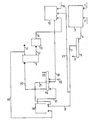
- Figure 2 is a diagram illustrating a second embodiment of the invention.
- the acid attack on the phosphate ore takes place under known conditions, in a single tank or possibly in several tanks.
- the invention applies particularly to the case where the attack acid is sulfuric acid and where the attack conditions lead to the formation of gypsum.
- the attack slurry is then filtered and a phosphoric acid is obtained having a concentration generally close to or 30% P 2 0 5 .
- This acid must therefore then be concentrated. Before the concentration step, it can, of course, be left to supersaturate and decant according to known conditions.
- the acid can be stored or sent directly to the concentration.
- the acid obtained after the main attack and which has optionally undergone the treatments which have just been described is, before concentration, divided into two parts.
- the first part is used for the fluosilicic attack which will be described in more detail below, the second part is for concentration.
- This concentration can be done according to any known process.
- the concentration is generally carried out so as to obtain an acid with a P 2 O 5 content usually between 45-55%.
- vapors are then emitted which contain in particular fluorides and these vapors are treated in an absorbent so as to obtain a solution of fluosilicic acid.
- the fluosilicic acid solution is recycled in the system.
- phosphate ore is attacked with this solution and in the presence of either an attack slurry coming from the main acid attack of the ore described above, or phosphoric acid obtained after this attack and after filtration and possibly after desaturation and decantation.
- the phosphoric acid used for this attack can have two origins. As described above, it can firstly be the strong filtration acid. Another possibility exists. It is known in fact that at the time of filtration, in addition to the strong acid coming from the direct filtration of the slurry, also weaker juices or filtration acids are collected from washing the cake. These juices are recycled on the attack. According to the invention it is possible to use as a source of phosphoric acid for the fluosilicic attack, part of these juices.
- the attack with fluosilicic acid takes place in conditions such that the fluorine and silica compounds are insolubilized essentially in the form of chukhrovite.
- the fluosilicic acid solution used in the attack has a concentration of between approximately 10% and approximately 25% and preferably between 20 and 25%, this in order to improve the water balance and obtain the highest possible P 2 0 5 content.
- the attack with fluosilicic acid must be carried out under conditions such that there is in the liquid phase of the reaction mixture a ratio M " + / P0 4 3- (where M denotes the alkaline and alkaline earth cations excluding CaS0 4 ) of approximately 0.1
- M denotes the alkaline and alkaline earth cations excluding CaS0 4
- This ratio may be slightly greater than 0.1
- the upper limit of this ratio is fixed so as to avoid the formation of an emulsion in the reaction medium which could prevent any separation subsequent phases, this emulsion being based on a mixture comprising calcium fluoride and phosphate salts.
- This ratio M n + PO4 3- being fixed, the operation is preferably carried out under conditions such that the fluorine content in the liquid phase expressed as H 2 SiF 6 is approximately 2% or more and that the concentration of P 2 0 5 is about 20 to 30% preferably between 27 and 30%.
- the upper limit of this concentration is not very critical because if the fluorine concentration is increased, the fluorinated compounds are precipitated less and less and therefore the fluorine is recycled in the process and it is not eliminated.
- the areas indicated above therefore correspond to the optimum concentrations which allow maximum elimination of the fluorinated compounds.
- the reaction temperature will preferably be between 60 ° C and 80 ° C.
- the residence time in the attack tank will vary depending on the desired attack rate of the phosphate.
- it is advantageous during the fluosilicon attack to add aluminum to the medium. Such an addition promotes the formation of chukhrovite.
- Aluminum can be added in any suitable form, in particular in the form of aluminum-rich phosphates.
- the second slurry resulting from this attack is sent to a filter with which the phosphoric acid produced and a solid comprising fluorine and silica compounds are separated essentially in the form of chukhrovite.
- the acid thus obtained can either be returned to the first attack, or mixed with the second part of the acid obtained after filtration on the first slurry. In the latter case, the mixture of acids is sent to the concentration.
- the phosphate ore and sulfuric acid are introduced by (1) and (2) respectively in an attack tank (3).
- By (4) comes out of this tank a slurry which is filtered on a filter (5).
- the gypsum formed is eliminated in (6).
- the filtered acid leaves the filter in (7).
- the phosphoric acid is divided into two parts. A part is brought by (8) to the concentrator (9), after passing through a tank (10).
- This acid can undergo, in a manner known per se, desaturation and / or decantation allowing, after filtration, additional elimination of fluorine salts with the calcium sulphate formed.
- the vapors from the concentrator (9) are brought by (12) into an absorber (13) from which a solution of fluosilicic acid is recovered by (14).
- This solution is then brought into a second attack tank (15) where it is in the presence of phosphate ore introduced by (16) and phosphoric acid brought by (17), this flow (17) constituting the second part. flow (17) from the filter (5).
- FIG. 2 illustrates a second preferred embodiment of the invention which allows easier implementation of the process in the elimination of fluorine.
- This variant essentially consists of remixing concentrated acid and the acids from the main and fluosilicate attacks to obtain a mixture of approximately 40% P 2 0 5 , which makes it possible to precipitate additional quantities of fluorine.
- the same references have been used to designate the apparatuses and the flows of materials identical to those of FIG. 1. The steps common to the two embodiments will therefore not be described.
- the acids (8) and (21) mixed in the tank (10) are not brought directly to the concentration. They are first mixed in the tank (10) with part of the concentrated acid supplied by (30). A precipitate of CaSo 4 and chukhrovite is then formed in the mixture.
- This acid mixture charged with precipitate is brought by (31) to the filter (19). During continuous filtration, it is filtered at the top so as to form a first filter cake and then the slurry (18) is filtered.
- the mixture of acids from the filtration of first cake or the first sector of the filter is then brought by (32) to the concentrator (9).
- compositions are given in% by weight unless otherwise indicated.
- This example illustrates the embodiment of FIG. 1.
- a slurry (18) is filtered, giving an acid having the following composition: P 2 O 5 : 26.85%; F: 4.02%; Si0 2 : 2.20%; CaO: 4.25%; A1 2 0 3 : 0.1%.
- a 375 g cake is obtained with a dry solid content at 120 ° C. of 36.7% and with 26.8% of F and 16.20% of SiO 2 relative to the dry solid at 120 ° C.
- the acid is mixed with phosphoric acid (8) and of the same composition as the acid (17) in the tank (10) and the mixture is stirred for one hour.
- the mixture is concentrated in (9) and an acid (11) is obtained which after desaturation in a tank stirred for 24 hours at 50 ° C. then filtration has the following composition:
- the ore and the acids have the same composition as in Example 1.
- the mass ratios of the flows (17) / (8) are identical.
- a phosphoric acid is obtained after concentration of composition P 2 0 5 : 52.35%; Si0 2 : 0.15%; F: 0.61%.
- This example illustrates the embodiment of FIG. 2.
- the streams (21) and (8) are mixed and give an acid of composition: P 2 0 5 : 27.0%; Si0 2 : 1.25%; F: 2.31%; A1 2 0 3 : 0.3%.
- This acid is mixed with an equivalent amount of an acid (30) concentrated at 55.8% enriched in solid with acid (11) 55.8% decanted.
- FIG. 2 The embodiment of FIG. 2 is also implemented.
- the attack (15) is carried out under the same conditions as in Example 2.
- Solid 20 has the same composition as given for Example 2.
- This acid is mixed with an equivalent amount of a 54.7% acid (30) enriched with the solid of the decanted acid (11).
- Acid (11) is obtained, which constitutes the production and which, after decantation, has the following composition: P 2 0 5 : 54.7%; Si0 2 : 0.04%; F: 0.27%; H 2 S0 4 / P 2 P 5 : 0.2%; Al 2 O 3 : 0.6%.
Landscapes
- Organic Chemistry (AREA)
- Chemical & Material Sciences (AREA)
- Inorganic Chemistry (AREA)
- Saccharide Compounds (AREA)
- Silicon Compounds (AREA)
- Preparation Of Compounds By Using Micro-Organisms (AREA)
- Compounds Of Alkaline-Earth Elements, Aluminum Or Rare-Earth Metals (AREA)
- Solid-Sorbent Or Filter-Aiding Compositions (AREA)
- Removal Of Specific Substances (AREA)
- Fuel Cell (AREA)
- Manufacture And Refinement Of Metals (AREA)
- Control Of El Displays (AREA)
- Investigating Or Analyzing Materials By The Use Of Ultrasonic Waves (AREA)
- Diaphragms For Electromechanical Transducers (AREA)
- Materials For Medical Uses (AREA)
- Fertilizers (AREA)
- Luminescent Compositions (AREA)
Description
- La présente invention concerne un procédé de fabrication d'acide phosphorique avec récupération sous forme solide des composés de fluor et de silice.
- Lors de la fabrication de l'acide phosphorique par voie humide on obtient après attaque acide du minerai de phosphate et filtration un acide phosphorique ayant une concentration en P205 de 25 à 30% environ. Or, cet acide est rarement mis en oeuvre à une telle concentration dans ses différentes utilisations ultérieures.
- Des concentrations de 40 à 54% environ sont généralement nécessaires. Ceci implique donc une étape de concentration de l'acide.
- Lors de cette concentration, des fluorures s'échappent avec la vapeur d'eau et comme il n'est pas possible de renvoyer dans l'atmosphère des vapeurs chargées en fluor, on traite ces vapeurs par un liquide absorbant les composés fluorés. On obtient des vapeurs purifiées en fluor et qui peuvent ainsi être rejectées et une solution d'acide fluosilicique. Or le problème se pose de l'utilisation de cette solution qui ne peut pas non plus être rejetée compte-tenu de sa teneur en fluor.
- L'objet de la présente invention est donc le traitement de cette solution d'acide fluosilicique et sa récupération sous forme neutralisée.
- Dans ce but, le procédé selon l'invention est du type comprenant une première attaque acide d'un minerai de phosphate ce par quoi on obtient une première bouillie, une filtration de cette bouillie de manière à séparer l'acide phosphorique produit, une concentration de l'acide avec condensation des vapeurs issues de la concentration par contact avec un liquide absorbant et récupération d'une solution d'acide fluosilicique; et ce procédé est caractérisé en ce qu'on attaque du minerai de phosphate avec ladite solution d'acide fluosilicique et en présence d'une première partie de l'acide phosphorique obtenu après la filtration ou d'une partie de la première bouillie précitée ce par quoi on obtient une seconde bouillie, on filtre cette seconde bouillie et on sépare un solide comprenant des composés de fluor et de silice, essentiellement sous la forme de chukhrovite, et un acide phosphorique que l'on réunit, avant concentration à la deuxième partie de l'acide obtenu après la filtration de la première bouillie ou que l'on recycle à la première attaque précitée.
- Selon une variante de l'invention, on mélange une partie de l'acide concentré avec les acides obtenus par filtration de la première et de la seconde bouillie précitée, on filtre le mélange obtenu et l'acide filtré obtenu est envoyé à la concentration.
- Le procédé de l'invention est donc particulièrement avantageux puisqu'il permet de recycler dans le processus de fabrication de l'acide phosphorique la solution d'acide fluosilicique et de récupérer sous forme neutralisée les composés de fluor et de silice de l'acide phosphorique.
- En outre, comme on le verra plus loin, le procédé permet d'obtenir un acide ayant une faible teneur en impuretés, notamment en H2S04.
- Enfin, il permet d'utiliser pour t'attaque acide du minerai une quantité d'acide, par exemple d'acide sulfurique moins importante.
- D'autres caractéristiqués et avantages de l'invention apparaîtront plus clairement à la lecture de la description que va suivre et faite en référence aux dessins annexés dans lesquels:
- la figure 1 est un schéma illustrant un premier mode de réalisation de l'invention;
- la figure 2 est un schéma illustrant un second mode de réalisation de l'invention.
- L'attaque acide du minerai de phosphate se fait dans des conditions connues, dans une cuve unique ou éventuellement dans plusieurs cuves. L'invention s'applique particulièrement au cas où l'acide d'attaque est l'acide sulfurique et où les conditions d'attaque conduisent à la formation de gypse.
- La bouillie d'attaque est ensuite filtrée et on obtient un acide phosphorique ayant une concentration généralement voisine ou de 30% en P205.
- Cet acide doit donc ensuite être concentré. Avant l'étape de concentration, on peut, bien entendu, le laisser desursaturer et décanter selon des conditions connues.
- Après la décantation, l'acide peut êtrre stocké ou envoyé directement à la concentration.
- Selon une variante de l'invention et dans le cas où l'attaque fluosilicique est réalisée en présence d'acide phosphorique, l'acide obtenu après l'attaque principale et qui a éventuellement subi les traitements qui viennent d'être décrits est, avant la concentration, divisé en deux parties. La première partie sert à l'attaque fluosilicique qui va être décrite plus en détail ci-dessous, la seconde partie va à la concentration.
- Cette concentration peut se faire selon tout procédé connu. La concentration est généralement conduite de manière à obtenir un acide à une teneur en P205 habituellement comprise entre 45-55%. On peut bien entendu laisser desursaturer puis décanter cet acide de manière à obtenir un acide clarifié qui constitue la productiton. Par ailleurs, lors de la concentration se dégage alors des vapeurs contenant notamment des fluorures et ces vapeurs sont traitées dans un absorber de manière à obtenir une solution d'acide fluosilicique.
- Selon l'invention, la solution d'acide fluosilicique est recyclée dans le système. Pour cela on attaque du minerai de phosphate avec cette solution et en présence soit d'une bouillie d'attaque provenant de l'attaque acide principale du minerai décrite plus haut soit de l'acide phosphorique obtenu après cette attaque et après filtration et éventuellement après désursaturation et décantation. Dans ce dernier cas l'acide phosphorique utilisé pour cette attaque peut avoir deux origines. Comme décrit plus haut, ce peut être tout d'abord l'acide fort de filtration. Une autre possibilité existe. On sait en effet qu'au moment de la filtration, outre l'acide fort provenant de la filtration directe de la bouillie, on recueille aussi des jus ou acides de filtration plus faibles provenant du lavage du gâteau. Ces jus sont recyclés à l'attaque. Selon l'invention il est possible d'utiliser comme source d'acide phosphorique pour l'attaque fluosilicique, une partie de ces jus.
- L'attaque par l'acide fluosilicique se fait dans des conditions telles que les composés du fluor et de la silice soient insolubilisés essentiellement sous la forme de chukhrovite.
- D'une manière générale, la solution d'acide fluosilicique utilisée à l'attaque présente une concentration comprise entre environ 10% et environ 25% et de préférence entre 20 et 25%, ceci en vue d'améliorer le bilan eau et d'obtenir une teneur en P205 la plus élevée possible.
- Par ailleurs, l'attaque avec l'acide fluosilicique doit se faire dans des conditions telles que l'on ait dans la phase liquide du mélange réactionnel un rapport M"+/P04 3- (où M désigne les cations alcalins et alcalino terreux hors CaS04) d'environ 0,1. Ce rapport peut être légèrement supéreur à 0,1. Cependant la limite supérieure de ce rapport est fixée de manière à éviter la formation d'une émulsion dans le milieu réactionnel qui pourrait empêcher toute séparation ultérieure des phases, cette émulsion étant à base d'un mélange comprenant du fluorure de calcium et des sels de phosphate.
- Ce même rapport Mn+PO43- est d'environ 0,1 dans le cas des phosphates habituels et il varie légèrement en fonction inverse de la concentration en P205. Il peut être inférieur à cette valeur mais dans ce cas on élimine moins le fluor.
- Ce rapport Mn+PO43- étant fixé, on opère de préférence dans des conditions telles que la teneur en fluor dans la phase liquide exprimée en H2SiF6 est d'environ 2% ou plus et que la concentration en P205 est d'environ 20 à 30% de preférence entre 27 et 30%.
- Ces conditions précitées sur la teneur en fluor sont déterminées de manière à faire précipiter le maximum de fluor.
- La limite supérieure de cette concentration n'est pas très critique car si l'on augmente la concentration en fluor, on précipite de moins en moins les composés fluorés et donc le fluor est recyclé dans le procédé et il n'est pas éliminé. Les domaines indiqués ci-dessus correspondent donc aux concentrations optimales qui permettent une élimination maximale des composés fluorés.
- La température de réaction sera de préférence comprise entre 60°C et 80°C. Le temps de séjour dans la cuve d'attaque variera selon le taux d'attaque voulu du phosphate. Par ailleurs, il est avantageux lors de l'attaque fluosilicique d'ajouter de l'aluminium au milieu. Un tel ajout favorise la formation de chukhrovite. L'aluminium pourra être ajouté sous toute forme convenable notamment sous forme de phosphates riches en aluminium.
- La seconde bouillie résultant de cette attaque est envoyée sur un filtre avec lequel on sépare l'acide phosphorique produit et un solide comprenant des composés de fluor et de silice essentiellement sous forme de chukhrovite.
- L'acide ainsi obtenu peut être soit renvoyé à la première attaque, soit mélangé à la deuxième partie de l'acide obtenu après la filtration le la première bouillie. Dans ce dernier cas, le mélange d'acides est envoyé à la concentration.
- Une description de modes de réalisation en continu de l'invention va maintenant être donnée en référence aux figures annexées.
- On notera que les exemples qui suivent décrivent seulement l'attaque fluosilicique en présence d'acide phosphorique mais pas le cas où cette attaque se ferait en présence d'une partie de bouillie de l'attaque principale. Cependant, il est évident que tout ce qui est décrit ci-dessous s'appliquerait de même à ce dernier cas.
- Selon le procédé illustré par la figure 1 le minerai de phosphate et l'acide sulfurique sont introduits par ( 1 ) et (2) respectivement dans une cuve d'attaque (3). Par (4) sort de cette cuve une bouillie qui est filtrée sur un filtre (5). On élimine en (6) la gypse formé. L'acide filtré sort du filtre en (7).
- Après avoir éventuellement desursaturé et décanté, l'acide phosphorique est divisé en deux parties. Une partie est amenée par (8) au concentrateur (9), après passage dans une cuve (10).
- Du concentrateur sort en (11) un acide concentré qui constitue la production.
- Cet acide peut subir d'une manière connue en soi une désursaturation et/ou une décantation permettant après filtration une élimination complémentaire de sels de fluor avec le sulfate de calcium formé. Les vapeurs issues du concentrateur (9) sont amenées par (12) dans un absorbeur (13) d'où l'on récupère par (14) une solution d'acide fluosilicique.
- Cette solution est alors amenée dans une seconde cuve d'attaque (15) où elle se trouve en présence de minerai de phosphate introduit par (16) et d'acide phosphorique amené par (17), ce flux (17) constituant la seconde partie du flux (17) issu du filtre (5).
- On obtient à la suite de cette seconde attaque une seconde bouillie qui est amenée par (18) sur un filtre (19) où l'on sépare un solide comportant essentiellement de la chukhrovite et du sulfate de chaux en (20) et de l'acide phosphorique (21) qui est envoyé dans la cuve (10) pour mélange avec l'acide (8).
- Par ailleurs, un lavage du gâteau de filtration est prévu par (22).
- La figure 2 illustre un second mode préféré de réalisation de l'invention qui permet une mise en oeuvre plus facile du procédé dans l'élimination du fluor. Cette variante consiste essentiellement à remélan- ger de l'acide concentré et les acides issus des attaques principale et fluosilicique pour obtenir un mélange d'environ 40% en P205, ce qui permet de précipiter des quantités complémentaires de fluor. Les mêmes références ont été utilisées pour désigner les appareillages et les circulations de matières identiques à ceux de la figure 1. Les étapes communes aux deux modes de réalisation ne seront donc pas décrites.
- A la différence du cas de la figure 1, les acides (8) et (21 ) mélangés dans la cuve (10) ne sont pas amenés directement à la concentration. Ils sont tout d'abord mélangés dans la cuve (10) avec une partie de l'acide concentré amené par (30). Il se forme alors dans le mélange un précipité de CaSo4 et de chukhrovite.
- Ce mélange d'acide chargé de précipité est amené par (31) sur le filtre (19). Lors de la filtration en continu, il est filtré en tête de manière à former un premier gâteau de filtration et on filtre ensuite la bouillie (18).
- Le mélange d'acides provenant de la filtration du premier gâteau ou du premier secteur du filtre est alors amené par (32) au concentrateur (9).
- On peut noter qu'il est possible de ne pas mélanger en même temps les acides obtenus par la filtration des deux bouillies et l'acide concentré mais que l'on peut d'abord effecteur un prémélange de l'acide de la première bouillie et de l'acide de la seconde. Ce prémélange peut d'ailleurs être stocké pendant un temps plus ou moins long de 1 heure à 24 heures avant d'être mis en présence avec l'acide concentré. Cette manière de procéder permet d'obtenir des cristaux plus facilement filtrables.
- Des exemples vont être donnés ci-dessous. Dans ces exemples les compositions sont données en % en poids sauf indications contraires.
- Cet exemple illustre le mode de réalisation de la figure 1.
- On réalise tout d'abord une attaque fluosilicique dans les conditions suivantes.
- On introduit dans la cuve d'attaque (15) 276 g/ heure d'un minerai de phosphate présentant la composition suivante:

- Ce minerai est mélangé avec 1722 g/heure d'acide phosphorique (17) provenant d'une attaque sulfurique et de composition ci-dessus [le rapport massique des flux (17)/(8) étant de 1/4]; P2O5: 27%; F: 1,9%; SiO: 1,1%; H2S04: 2,58; H2SO4/P2O5: 9,53%; Al2O3/P2O5: 1,15 et est attaqué par 510 g/heure d'un acide fluosilicique (14) de composition suivante: F: 15,3%; Si02: 7,9%.
- On filtre une bouillie (18) donnant un acide présentant la composition suivante: P2O5: 26,85%; F: 4,02%; Si02: 2,20%; CaO: 4,25%; A1203: 0,1%. On obtient après lavage un gateau de 375 g à une teneur en solide sec à 120°C de 36,7% et avec 26,8% de F et 16,20% de Si02 par rapport au solide sec à 120°C.
- Après filtration et lavage, on mélange l'acide avec de l'acide phosphorique (8) et de même composition que l'acide (17) dans le bac ( 10) et on agite pendant une heure. Le mélange est concentré en (9) et on obtient un acide (11) qui après desursaturation dans un bac agité pendant 24 heures à 50° C puis filtration présente la composition suivante:
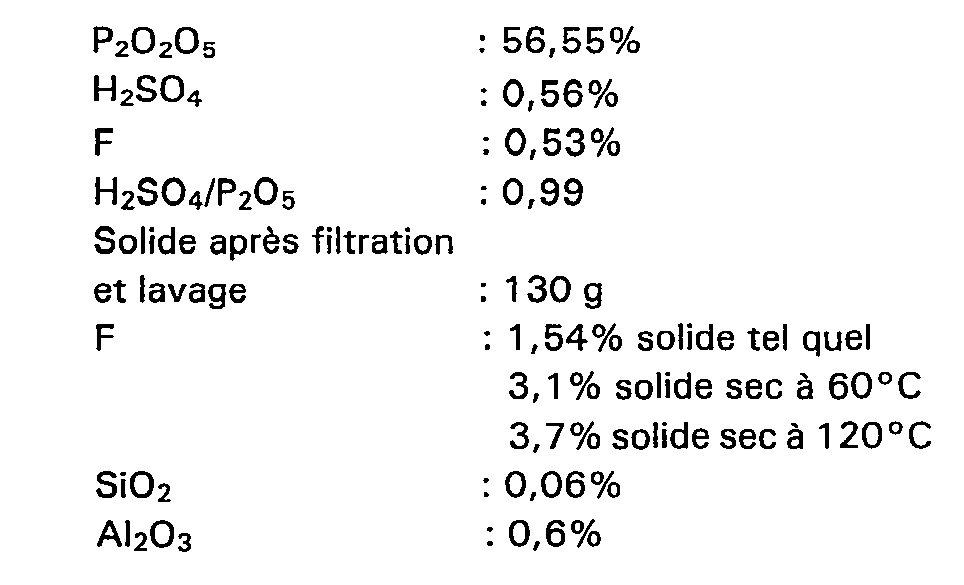
- On procède de la même manière que dans l'exemple 1.
- Attaque 15:
- 300 g/h d'un minerai de phosphate, 17 g de phosphate d'aluminium (à 35% d'Al2O3) 1722 g/h d'un acide phosphorique, 510 g/h d'un acide fluosilicique.
- Le minerai et les acides ont la même composition que dans l'exemple 1. Les rapports massiques des flux (17)/(8) sont identiques.
- Acide filtre: P205: 26,8%; F: 3,58%; Si02: 2,14%; CaO: 4,8%; A1203: 0,3%. On obtient après lavage un gateau de 345 g à une teneur en solide sec à 120°C de 40,2% et avec 27,39% de fluor et 16,75% de SiO2 par rapport au solide sec à 120°C.
- On mélange dans la cuve 10 les flux (21) et (8) dans les mêmes conditions que l'exemple 1.
- On obtient un acide phosphorique après concentration de composition P205: 52,35%; Si02: 0,15%; F: 0,61 %.
- Après desursaturation dans les mêmes conditions que l'exemple 1 puis filtration on obtient un acide de composition:

- Cet exemple illustre le mode de réalisation de la figure 2.
- On réalise une attaque (15) dans les mêmes conditions que dans l'exemple 1. Les rapports massiques des flux (17)/(8) étant de 1/4.
- Les flux (21) et (8) sont mélangés et donnent un acide de composition: P205: 27,0%; Si02: 1,25%; F: 2,31 %; A1203: 0,3%.
- Cet acide est mélangé avec une quantité équivalente d'une acide (30) concentré à 55,8% enrichi en solide de l'acide (11) 55,8% décanté.
- On obtient ainsi un acide (31 ) ayant une concentration en P205 de 43% qui est filtré. On obtient un solide après lavage de 80 g à teneur en F de 4,84% par rapport au solide humide, soit 12% par rapport au solide sec à 120 °C. Cet acide (32) est concentré. On obtient l'acide (11) qui constitue la production et qui présente après décantation la composition suivante:
- P2O5: 55,8%; Si02: 0,10%; F: 0,3%; H2S04/ P2O5: 0,95%; Al2O3: 0,5%.
- On met aussi en oeuvre le mode de réalisation de la figure 2.
- On réalise l'attaque (15) dans les mêmes conditions que dans l'exemple 2.
- Les rapports massiques de flux (17)/(8) sont dans le rapport 3/7. Le solide 20 a la même composition que donnée pour l'exemple 2.
- Les flux (21) et (8) mélangés donnent un acide de composition:
- P2Oε: 29,64%; Si02: 0,58%; F: 2,06%; A1203: 0,4%.
- Cet acide est mélangé avec une quantité équivalente d'un acide (30) à 54,7% enrichi du solide de l'acide (11) décanté.
- On obtient un acide (30) à 42,75% de P205 qui est filtré. On obtient un solide après lavage de 90 g présentant 6,2% en fluor soit 15% pour le solide sec à 120°C. L'acide filtré (32) est concentré. On obtient l'acide (11) qui constitue la production et qui présente après décantation la composition suivante: P205: 54,7%; Si02: 0,04%; F: 0,27%; H2S04/ P2P5: 0,2%; Al2O3: 0,6%.
- Bien entendu, l'invention n'est nullement limitée aux modes de réalisation décrits qui n'ont été donnés qu'à titre d'exemples.
Claims (10)
Priority Applications (1)
| Application Number | Priority Date | Filing Date | Title |
|---|---|---|---|
| AT84401388T ATE23141T1 (de) | 1983-07-05 | 1984-06-29 | Verfahren zur herstellung von phosphorsaeure. |
Applications Claiming Priority (2)
| Application Number | Priority Date | Filing Date | Title |
|---|---|---|---|
| FR8311140 | 1983-07-05 | ||
| FR8311140A FR2548653B1 (fr) | 1983-07-05 | 1983-07-05 | Procede de fabrication d'acide phosphorique |
Publications (2)
| Publication Number | Publication Date |
|---|---|
| EP0130917A1 EP0130917A1 (fr) | 1985-01-09 |
| EP0130917B1 true EP0130917B1 (fr) | 1986-10-29 |
Family
ID=9290511
Family Applications (1)
| Application Number | Title | Priority Date | Filing Date |
|---|---|---|---|
| EP84401388A Expired EP0130917B1 (fr) | 1983-07-05 | 1984-06-29 | Procédé de fabrication d'acide phosphorique |
Country Status (26)
| Country | Link |
|---|---|
| US (1) | US4557915A (fr) |
| EP (1) | EP0130917B1 (fr) |
| JP (1) | JPS6071505A (fr) |
| KR (1) | KR850001121A (fr) |
| AT (1) | ATE23141T1 (fr) |
| AU (1) | AU572165B2 (fr) |
| BR (1) | BR8403290A (fr) |
| CA (1) | CA1251617A (fr) |
| DE (1) | DE3461068D1 (fr) |
| DK (1) | DK326884A (fr) |
| EG (1) | EG16291A (fr) |
| ES (1) | ES533998A0 (fr) |
| FI (1) | FI74933C (fr) |
| FR (1) | FR2548653B1 (fr) |
| GR (1) | GR82174B (fr) |
| IL (1) | IL72273A (fr) |
| IN (1) | IN161532B (fr) |
| JO (1) | JO1382B1 (fr) |
| MA (1) | MA20162A1 (fr) |
| OA (2) | OA07738A (fr) |
| PH (1) | PH22150A (fr) |
| PT (1) | PT78846B (fr) |
| TR (1) | TR22014A (fr) |
| YU (1) | YU44173B (fr) |
| ZA (1) | ZA845114B (fr) |
| ZW (1) | ZW10584A1 (fr) |
Families Citing this family (10)
| Publication number | Priority date | Publication date | Assignee | Title |
|---|---|---|---|---|
| FR2598402B1 (fr) * | 1986-05-07 | 1990-06-01 | Rhone Poulenc Chimie | Procede de nettoyage de surfaces filtrantes |
| US5084261A (en) * | 1989-06-22 | 1992-01-28 | Occidental Chemical Corporation | Recovery and utilization of gypstack leachate in hemihydrate phosphoric acid process |
| US5531975A (en) * | 1990-12-31 | 1996-07-02 | Phosphate Engineering And Construction Co., Inc. | Process for the production of phosphoric acid and calcium fluoride |
| US5180569A (en) * | 1990-12-31 | 1993-01-19 | Phosphate Engineering And Construction Company | Process for the production of phosphoric acid and hydrogen fluoride from phosphate rock and fluosilicic acid |
| US6676914B1 (en) * | 2000-06-09 | 2004-01-13 | Hf Extraction, Llc | Phosphate acidulation utilizing HF acid |
| US20020072796A1 (en) * | 2000-12-11 | 2002-06-13 | Hoffmann Laurent G. | Iris fixated intraocular lenses |
| CN102755973A (zh) * | 2012-07-23 | 2012-10-31 | 瓮福(集团)有限责任公司 | 一种萃余酸生产晶体磷酸一铵的滤布清洗方法 |
| CN103754824A (zh) * | 2013-07-31 | 2014-04-30 | 山东博丰利众化工有限公司 | 利用磷肥副产氟硅酸制备氟化氢的方法 |
| CN113185160B (zh) * | 2021-04-21 | 2022-03-29 | 中国五环工程有限公司 | 控制半水石膏粗大结晶的方法 |
| CN113173566B (zh) * | 2021-04-21 | 2022-03-25 | 中国五环工程有限公司 | 一种高收率水合晶相重构湿法磷酸生产工艺 |
Family Cites Families (7)
| Publication number | Priority date | Publication date | Assignee | Title |
|---|---|---|---|---|
| US2636806A (en) * | 1950-05-19 | 1953-04-28 | Tennessee Corp | Acidulation of phosphate rock |
| GB966694A (en) * | 1959-08-10 | 1964-08-12 | Minnesota Mining & Mfg | The production of copies of graphic originals by successive exposures to light and to heat producing radiation |
| NL131991C (fr) * | 1962-11-09 | |||
| IT723814A (fr) * | 1964-08-03 | |||
| US3498746A (en) * | 1967-11-29 | 1970-03-03 | United States Steel Corp | Recovery of fluosilicic acid and p2o5 from recycle streams and pond water |
| IN154778B (fr) * | 1981-02-27 | 1984-12-15 | Dharamsi Morarji Chemical Comp | |
| DE3365775D1 (en) * | 1982-02-23 | 1986-10-09 | Dharamsi Morarji Chemical Comp | A process to manufacture commercially acceptable phosphoric acid and gypsum from rock phosphate |
-
1983
- 1983-07-05 FR FR8311140A patent/FR2548653B1/fr not_active Expired
-
1984
- 1984-06-22 JP JP59127660A patent/JPS6071505A/ja active Pending
- 1984-06-27 EG EG401/84A patent/EG16291A/xx active
- 1984-06-29 AT AT84401388T patent/ATE23141T1/de not_active IP Right Cessation
- 1984-06-29 DE DE8484401388T patent/DE3461068D1/de not_active Expired
- 1984-06-29 EP EP84401388A patent/EP0130917B1/fr not_active Expired
- 1984-07-01 IL IL72273A patent/IL72273A/xx unknown
- 1984-07-03 YU YU1160/84A patent/YU44173B/xx unknown
- 1984-07-03 BR BR8403290A patent/BR8403290A/pt unknown
- 1984-07-03 PH PH30912A patent/PH22150A/en unknown
- 1984-07-03 MA MA20386A patent/MA20162A1/fr unknown
- 1984-07-04 GR GR75189A patent/GR82174B/el unknown
- 1984-07-04 ES ES533998A patent/ES533998A0/es active Granted
- 1984-07-04 ZA ZA845114A patent/ZA845114B/xx unknown
- 1984-07-04 AU AU30250/84A patent/AU572165B2/en not_active Ceased
- 1984-07-04 FI FI842693A patent/FI74933C/fi not_active IP Right Cessation
- 1984-07-04 TR TR22014A patent/TR22014A/xx unknown
- 1984-07-04 IN IN485/MAS/84A patent/IN161532B/en unknown
- 1984-07-04 PT PT78846A patent/PT78846B/fr unknown
- 1984-07-04 ZW ZW105/84A patent/ZW10584A1/xx unknown
- 1984-07-04 CA CA000458065A patent/CA1251617A/fr not_active Expired
- 1984-07-04 DK DK326884A patent/DK326884A/da not_active Application Discontinuation
- 1984-07-04 OA OA58332A patent/OA07738A/xx unknown
- 1984-07-05 JO JO19841382A patent/JO1382B1/en active
- 1984-07-05 US US06/627,672 patent/US4557915A/en not_active Expired - Fee Related
- 1984-07-05 KR KR1019840003887A patent/KR850001121A/ko not_active Abandoned
- 1984-07-05 OA OA58334A patent/OA07740A/fr unknown
Also Published As
Similar Documents
| Publication | Publication Date | Title |
|---|---|---|
| EP0130917A1 (fr) | Procédé de fabrication d'acide phosphorique | |
| EP3286138B1 (fr) | Processus de preparation du fluorure de calcium a partir de l'acide fluosilicique | |
| SU664554A3 (ru) | Способ получени фтористого кальци | |
| FR2495598A1 (fr) | Procede de production de phosphate de monoammonium purifie | |
| WO1984003690A1 (fr) | Procede de preparation d'acide phosphorique et de sulfate de calcium | |
| KR900003648B1 (ko) | 안정화된 습식 인산의 제조방법 | |
| US5760078A (en) | Process for the fractioning and recovery of valuable compounds from vinasse produced in fermentations | |
| US4710366A (en) | Method for producing stabilized wet process phosphoric acid with low content of magnesium and aluminum | |
| FR2468552A1 (fr) | Procede pour la reduction de la concentration en substances organiques dans le cycle de fabrication de l'alumine selon le procede bayer | |
| EP0223687B1 (fr) | Perfectionnement à un procédé de production d'hydroxydes de terres rares par traitement de minerais contenant des phosphates de terres rares | |
| GB2100749A (en) | Treating molasses | |
| US2271882A (en) | Method of purifying used oils | |
| EP0086118A1 (fr) | Procédé de purification d'acide phosphorique de voie humide | |
| EP0871525A1 (fr) | Procede de purification par extraction d'un milieu liquide | |
| US4557873A (en) | Process for isolating paraffinsulfonates and sulfuric acid of low alkali metal sulfate content from parafinsulfoxidation reaction mixtures | |
| SU1813712A1 (ru) | Способ получения жидкого стекла 2 | |
| WO1986001792A1 (fr) | Procede de purification d'acide phosphorique par voie humide | |
| US3948874A (en) | Method for removing lignin from tall oil | |
| SU919984A1 (ru) | Способ очистки плавиковой кислоты | |
| FR2474472A1 (fr) | Procede de separation des matieres solides contenues dans l'acide phosphorique | |
| US2680703A (en) | Process of producing glycerine | |
| FR2458513A1 (fr) | Procede pour l'elimination des fluorures des effluents les contenant | |
| SU1033426A1 (ru) | Способ извлечени фосфора из шлама | |
| FR2549460A1 (fr) | Procede de fabrication d'acide phosphorique purifie, appareillage et produit obtenu | |
| SU1171433A1 (ru) | Способ извлечени фторида кальци из фтор- и фосфорсодержащих сточных вод |
Legal Events
| Date | Code | Title | Description |
|---|---|---|---|
| PUAI | Public reference made under article 153(3) epc to a published international application that has entered the european phase |
Free format text: ORIGINAL CODE: 0009012 |
|
| AK | Designated contracting states |
Designated state(s): AT BE DE FR GB IT NL SE |
|
| 17P | Request for examination filed |
Effective date: 19850306 |
|
| ITF | It: translation for a ep patent filed | ||
| GRAA | (expected) grant |
Free format text: ORIGINAL CODE: 0009210 |
|
| AK | Designated contracting states |
Kind code of ref document: B1 Designated state(s): AT BE DE FR GB IT NL SE |
|
| REF | Corresponds to: |
Ref document number: 23141 Country of ref document: AT Date of ref document: 19861115 Kind code of ref document: T |
|
| REF | Corresponds to: |
Ref document number: 3461068 Country of ref document: DE Date of ref document: 19861204 |
|
| BECN | Be: change of holder's name |
Effective date: 19861029 |
|
| PLBE | No opposition filed within time limit |
Free format text: ORIGINAL CODE: 0009261 |
|
| STAA | Information on the status of an ep patent application or granted ep patent |
Free format text: STATUS: NO OPPOSITION FILED WITHIN TIME LIMIT |
|
| RAP2 | Party data changed (patent owner data changed or rights of a patent transferred) |
Owner name: RHONE-POULENC CHIMIE |
|
| 26N | No opposition filed | ||
| NLT2 | Nl: modifications (of names), taken from the european patent patent bulletin |
Owner name: RHONE-POULENC CHIMIE TE COURBEVOIE, FRANKRIJK. |
|
| PGFP | Annual fee paid to national office [announced via postgrant information from national office to epo] |
Ref country code: AT Payment date: 19890627 Year of fee payment: 6 |
|
| PGFP | Annual fee paid to national office [announced via postgrant information from national office to epo] |
Ref country code: NL Payment date: 19890630 Year of fee payment: 6 Ref country code: GB Payment date: 19890630 Year of fee payment: 6 |
|
| PGFP | Annual fee paid to national office [announced via postgrant information from national office to epo] |
Ref country code: SE Payment date: 19900608 Year of fee payment: 7 |
|
| PGFP | Annual fee paid to national office [announced via postgrant information from national office to epo] |
Ref country code: FR Payment date: 19900611 Year of fee payment: 7 |
|
| PG25 | Lapsed in a contracting state [announced via postgrant information from national office to epo] |
Ref country code: GB Effective date: 19900629 Ref country code: AT Effective date: 19900629 |
|
| ITTA | It: last paid annual fee | ||
| PG25 | Lapsed in a contracting state [announced via postgrant information from national office to epo] |
Ref country code: SE Effective date: 19900630 |
|
| PGFP | Annual fee paid to national office [announced via postgrant information from national office to epo] |
Ref country code: DE Payment date: 19900731 Year of fee payment: 7 |
|
| PGFP | Annual fee paid to national office [announced via postgrant information from national office to epo] |
Ref country code: BE Payment date: 19900809 Year of fee payment: 7 |
|
| PG25 | Lapsed in a contracting state [announced via postgrant information from national office to epo] |
Ref country code: NL Effective date: 19910101 |
|
| NLV4 | Nl: lapsed or anulled due to non-payment of the annual fee | ||
| GBPC | Gb: european patent ceased through non-payment of renewal fee | ||
| PG25 | Lapsed in a contracting state [announced via postgrant information from national office to epo] |
Ref country code: BE Effective date: 19910630 |
|
| BERE | Be: lapsed |
Owner name: RHONE-POULENC CHIMIE Effective date: 19910630 |
|
| PG25 | Lapsed in a contracting state [announced via postgrant information from national office to epo] |
Ref country code: FR Effective date: 19920228 |
|
| PG25 | Lapsed in a contracting state [announced via postgrant information from national office to epo] |
Ref country code: DE Effective date: 19920401 |
|
| REG | Reference to a national code |
Ref country code: FR Ref legal event code: ST |
|
| EUG | Se: european patent has lapsed |
Ref document number: 84401388.8 Effective date: 19910206 |