EP0130938B1 - Verfahren zur Herstellung von 2-Arylbenzotriazolen - Google Patents
Verfahren zur Herstellung von 2-Arylbenzotriazolen Download PDFInfo
- Publication number
- EP0130938B1 EP0130938B1 EP84810259A EP84810259A EP0130938B1 EP 0130938 B1 EP0130938 B1 EP 0130938B1 EP 84810259 A EP84810259 A EP 84810259A EP 84810259 A EP84810259 A EP 84810259A EP 0130938 B1 EP0130938 B1 EP 0130938B1
- Authority
- EP
- European Patent Office
- Prior art keywords
- carbon atoms
- hydrogen
- alkyl
- process according
- alkoxy
- Prior art date
- Legal status (The legal status is an assumption and is not a legal conclusion. Google has not performed a legal analysis and makes no representation as to the accuracy of the status listed.)
- Expired
Links
- 238000000034 method Methods 0.000 title claims description 25
- 125000000217 alkyl group Chemical group 0.000 claims description 28
- 125000004432 carbon atom Chemical group C* 0.000 claims description 20
- 229910052739 hydrogen Inorganic materials 0.000 claims description 20
- 239000001257 hydrogen Substances 0.000 claims description 20
- 125000003545 alkoxy group Chemical group 0.000 claims description 14
- 229910052736 halogen Chemical group 0.000 claims description 14
- 150000002367 halogens Chemical group 0.000 claims description 14
- 125000003710 aryl alkyl group Chemical group 0.000 claims description 13
- 150000001875 compounds Chemical class 0.000 claims description 13
- ZAMOUSCENKQFHK-UHFFFAOYSA-N Chlorine atom Chemical group [Cl] ZAMOUSCENKQFHK-UHFFFAOYSA-N 0.000 claims description 12
- 125000000753 cycloalkyl group Chemical group 0.000 claims description 12
- LFQSCWFLJHTTHZ-UHFFFAOYSA-N Ethanol Chemical compound CCO LFQSCWFLJHTTHZ-UHFFFAOYSA-N 0.000 claims description 11
- 125000003118 aryl group Chemical group 0.000 claims description 10
- 239000003638 chemical reducing agent Substances 0.000 claims description 9
- 239000000460 chlorine Chemical group 0.000 claims description 8
- 229910052801 chlorine Chemical group 0.000 claims description 8
- BTANRVKWQNVYAZ-UHFFFAOYSA-N butan-2-ol Chemical compound CCC(C)O BTANRVKWQNVYAZ-UHFFFAOYSA-N 0.000 claims description 7
- 125000001997 phenyl group Chemical group [H]C1=C([H])C([H])=C(*)C([H])=C1[H] 0.000 claims description 7
- FJGQBLRYBUAASW-UHFFFAOYSA-N 2-(benzotriazol-2-yl)phenol Chemical class OC1=CC=CC=C1N1N=C2C=CC=CC2=N1 FJGQBLRYBUAASW-UHFFFAOYSA-N 0.000 claims description 6
- KFZMGEQAYNKOFK-UHFFFAOYSA-N Isopropanol Chemical compound CC(C)O KFZMGEQAYNKOFK-UHFFFAOYSA-N 0.000 claims description 6
- CIVLEPQUPHSEBS-UHFFFAOYSA-N 2-[(2-nitrophenyl)diazenyl]phenol Chemical class OC1=CC=CC=C1N=NC1=CC=CC=C1[N+]([O-])=O CIVLEPQUPHSEBS-UHFFFAOYSA-N 0.000 claims description 5
- 229930192627 Naphthoquinone Natural products 0.000 claims description 5
- 150000004054 benzoquinones Chemical class 0.000 claims description 5
- 150000002791 naphthoquinones Chemical class 0.000 claims description 5
- XLYOFNOQVPJJNP-UHFFFAOYSA-N water Substances O XLYOFNOQVPJJNP-UHFFFAOYSA-N 0.000 claims description 5
- 229910052783 alkali metal Inorganic materials 0.000 claims description 3
- 150000008044 alkali metal hydroxides Chemical class 0.000 claims description 3
- 150000001340 alkali metals Chemical class 0.000 claims description 3
- 229910052799 carbon Inorganic materials 0.000 claims description 3
- 150000001721 carbon Chemical group 0.000 claims description 3
- 239000000758 substrate Substances 0.000 claims description 3
- 239000007788 liquid Substances 0.000 claims description 2
- 125000004435 hydrogen atom Chemical group [H]* 0.000 claims 8
- 125000002252 acyl group Chemical group 0.000 claims 1
- 238000004519 manufacturing process Methods 0.000 claims 1
- -1 however Substances 0.000 description 16
- UFHFLCQGNIYNRP-UHFFFAOYSA-N Hydrogen Chemical compound [H][H] UFHFLCQGNIYNRP-UHFFFAOYSA-N 0.000 description 14
- HEMHJVSKTPXQMS-UHFFFAOYSA-M sodium hydroxide Inorganic materials [OH-].[Na+] HEMHJVSKTPXQMS-UHFFFAOYSA-M 0.000 description 11
- 150000002431 hydrogen Chemical class 0.000 description 10
- 125000004663 dialkyl amino group Chemical group 0.000 description 6
- 125000002887 hydroxy group Chemical group [H]O* 0.000 description 5
- 125000004573 morpholin-4-yl group Chemical group N1(CCOCC1)* 0.000 description 5
- 125000000587 piperidin-1-yl group Chemical group [H]C1([H])N(*)C([H])([H])C([H])([H])C([H])([H])C1([H])[H] 0.000 description 5
- 125000002496 methyl group Chemical group [H]C([H])([H])* 0.000 description 4
- NWZSZGALRFJKBT-KNIFDHDWSA-N (2s)-2,6-diaminohexanoic acid;(2s)-2-hydroxybutanedioic acid Chemical compound OC(=O)[C@@H](O)CC(O)=O.NCCCC[C@H](N)C(O)=O NWZSZGALRFJKBT-KNIFDHDWSA-N 0.000 description 3
- WVDDGKGOMKODPV-UHFFFAOYSA-N Benzyl alcohol Chemical compound OCC1=CC=CC=C1 WVDDGKGOMKODPV-UHFFFAOYSA-N 0.000 description 3
- DGAQECJNVWCQMB-PUAWFVPOSA-M Ilexoside XXIX Chemical compound C[C@@H]1CC[C@@]2(CC[C@@]3(C(=CC[C@H]4[C@]3(CC[C@@H]5[C@@]4(CC[C@@H](C5(C)C)OS(=O)(=O)[O-])C)C)[C@@H]2[C@]1(C)O)C)C(=O)O[C@H]6[C@@H]([C@H]([C@@H]([C@H](O6)CO)O)O)O.[Na+] DGAQECJNVWCQMB-PUAWFVPOSA-M 0.000 description 3
- KWYUFKZDYYNOTN-UHFFFAOYSA-M Potassium hydroxide Chemical compound [OH-].[K+] KWYUFKZDYYNOTN-UHFFFAOYSA-M 0.000 description 3
- HCHKCACWOHOZIP-UHFFFAOYSA-N Zinc Chemical compound [Zn] HCHKCACWOHOZIP-UHFFFAOYSA-N 0.000 description 3
- 239000003054 catalyst Substances 0.000 description 3
- 125000001495 ethyl group Chemical group [H]C([H])([H])C([H])([H])* 0.000 description 3
- LYCAIKOWRPUZTN-UHFFFAOYSA-N ethylene glycol Natural products OCCO LYCAIKOWRPUZTN-UHFFFAOYSA-N 0.000 description 3
- IKDUDTNKRLTJSI-UHFFFAOYSA-N hydrazine monohydrate Substances O.NN IKDUDTNKRLTJSI-UHFFFAOYSA-N 0.000 description 3
- 239000002904 solvent Substances 0.000 description 3
- 229910052725 zinc Inorganic materials 0.000 description 3
- 239000011701 zinc Substances 0.000 description 3
- 150000000191 1,4-naphthoquinones Chemical class 0.000 description 2
- KBPLFHHGFOOTCA-UHFFFAOYSA-N 1-Octanol Chemical compound CCCCCCCCO KBPLFHHGFOOTCA-UHFFFAOYSA-N 0.000 description 2
- SVPKNMBRVBMTLB-UHFFFAOYSA-N 2,3-dichloronaphthalene-1,4-dione Chemical compound C1=CC=C2C(=O)C(Cl)=C(Cl)C(=O)C2=C1 SVPKNMBRVBMTLB-UHFFFAOYSA-N 0.000 description 2
- RWSOTUBLDIXVET-UHFFFAOYSA-N Dihydrogen sulfide Chemical compound S RWSOTUBLDIXVET-UHFFFAOYSA-N 0.000 description 2
- VEXZGXHMUGYJMC-UHFFFAOYSA-N Hydrochloric acid Chemical compound Cl VEXZGXHMUGYJMC-UHFFFAOYSA-N 0.000 description 2
- LRHPLDYGYMQRHN-UHFFFAOYSA-N N-Butanol Chemical compound CCCCO LRHPLDYGYMQRHN-UHFFFAOYSA-N 0.000 description 2
- ISWSIDIOOBJBQZ-UHFFFAOYSA-N Phenol Chemical compound OC1=CC=CC=C1 ISWSIDIOOBJBQZ-UHFFFAOYSA-N 0.000 description 2
- NINIDFKCEFEMDL-UHFFFAOYSA-N Sulfur Chemical compound [S] NINIDFKCEFEMDL-UHFFFAOYSA-N 0.000 description 2
- UCKMPCXJQFINFW-UHFFFAOYSA-N Sulphide Chemical compound [S-2] UCKMPCXJQFINFW-UHFFFAOYSA-N 0.000 description 2
- 239000003513 alkali Substances 0.000 description 2
- WERYXYBDKMZEQL-UHFFFAOYSA-N butane-1,4-diol Chemical compound OCCCCO WERYXYBDKMZEQL-UHFFFAOYSA-N 0.000 description 2
- 150000002334 glycols Chemical class 0.000 description 2
- 229910000037 hydrogen sulfide Inorganic materials 0.000 description 2
- WGCNASOHLSPBMP-UHFFFAOYSA-N hydroxyacetaldehyde Natural products OCC=O WGCNASOHLSPBMP-UHFFFAOYSA-N 0.000 description 2
- 229910052751 metal Inorganic materials 0.000 description 2
- 239000002184 metal Substances 0.000 description 2
- 150000002739 metals Chemical class 0.000 description 2
- 239000000203 mixture Substances 0.000 description 2
- 125000004108 n-butyl group Chemical group [H]C([H])([H])C([H])([H])C([H])([H])C([H])([H])* 0.000 description 2
- BDERNNFJNOPAEC-UHFFFAOYSA-N propan-1-ol Chemical compound CCCO BDERNNFJNOPAEC-UHFFFAOYSA-N 0.000 description 2
- 125000002914 sec-butyl group Chemical group [H]C([H])([H])C([H])([H])C([H])(*)C([H])([H])[H] 0.000 description 2
- 229910052708 sodium Inorganic materials 0.000 description 2
- 239000011734 sodium Substances 0.000 description 2
- 238000006277 sulfonation reaction Methods 0.000 description 2
- 229910052717 sulfur Inorganic materials 0.000 description 2
- 239000011593 sulfur Substances 0.000 description 2
- 125000000999 tert-butyl group Chemical group [H]C([H])([H])C(*)(C([H])([H])[H])C([H])([H])[H] 0.000 description 2
- DNIAPMSPPWPWGF-VKHMYHEASA-N (+)-propylene glycol Chemical compound C[C@H](O)CO DNIAPMSPPWPWGF-VKHMYHEASA-N 0.000 description 1
- 150000004055 1,2-benzoquinones Chemical class 0.000 description 1
- 150000000181 1,2-naphthoquinones Chemical class 0.000 description 1
- YPFDHNVEDLHUCE-UHFFFAOYSA-N 1,3-propanediol Substances OCCCO YPFDHNVEDLHUCE-UHFFFAOYSA-N 0.000 description 1
- 150000004057 1,4-benzoquinones Chemical class 0.000 description 1
- FRASJONUBLZVQX-UHFFFAOYSA-N 1,4-naphthoquinone Chemical compound C1=CC=C2C(=O)C=CC(=O)C2=C1 FRASJONUBLZVQX-UHFFFAOYSA-N 0.000 description 1
- UMGUWLJFYCBJQW-UHFFFAOYSA-N 2,4-dibutyl-6-[(2-nitrophenyl)diazenyl]phenol Chemical compound C(CCC)C1=C(C(=CC(=C1)CCCC)N=NC1=C(C=CC=C1)[N+](=O)[O-])O UMGUWLJFYCBJQW-UHFFFAOYSA-N 0.000 description 1
- 150000000344 2,6-naphthoquinones Chemical class 0.000 description 1
- XNWFRZJHXBZDAG-UHFFFAOYSA-N 2-METHOXYETHANOL Chemical compound COCCO XNWFRZJHXBZDAG-UHFFFAOYSA-N 0.000 description 1
- POAOYUHQDCAZBD-UHFFFAOYSA-N 2-butoxyethanol Chemical compound CCCCOCCO POAOYUHQDCAZBD-UHFFFAOYSA-N 0.000 description 1
- CCTJHVLTAJTPBV-UHFFFAOYSA-N 2-chloro-1,4-naphthoquinone Chemical compound C1=CC=C2C(=O)C(Cl)=CC(=O)C2=C1 CCTJHVLTAJTPBV-UHFFFAOYSA-N 0.000 description 1
- QSLFQVQZSKRPHS-UHFFFAOYSA-N 2-chloro-3-(dimethylamino)naphthalene-1,4-dione Chemical compound C1=CC=C2C(=O)C(N(C)C)=C(Cl)C(=O)C2=C1 QSLFQVQZSKRPHS-UHFFFAOYSA-N 0.000 description 1
- ZNQVEEAIQZEUHB-UHFFFAOYSA-N 2-ethoxyethanol Chemical compound CCOCCO ZNQVEEAIQZEUHB-UHFFFAOYSA-N 0.000 description 1
- YQJYAIRFHCWDSC-UHFFFAOYSA-N 2-tert-butyl-6-[(4-chloro-5-methyl-2-nitrophenyl)diazenyl]phenol Chemical compound [N+](=O)([O-])C1=C(C=C(C(=C1)Cl)C)N=NC1=C(C(=CC=C1)C(C)(C)C)O YQJYAIRFHCWDSC-UHFFFAOYSA-N 0.000 description 1
- BGVCGTNXEKDVCB-UHFFFAOYSA-N 4-hydroxy-3-methylnaphthalene-1,2-dione Chemical compound C1=CC=C2C(=O)C(=O)C(C)=C(O)C2=C1 BGVCGTNXEKDVCB-UHFFFAOYSA-N 0.000 description 1
- ZLMJMSJWJFRBEC-UHFFFAOYSA-N Potassium Chemical compound [K] ZLMJMSJWJFRBEC-UHFFFAOYSA-N 0.000 description 1
- 230000001476 alcoholic effect Effects 0.000 description 1
- 150000001298 alcohols Chemical class 0.000 description 1
- HIVLDXAAFGCOFU-UHFFFAOYSA-N ammonium hydrosulfide Chemical compound [NH4+].[SH-] HIVLDXAAFGCOFU-UHFFFAOYSA-N 0.000 description 1
- UYJXRRSPUVSSMN-UHFFFAOYSA-P ammonium sulfide Chemical compound [NH4+].[NH4+].[S-2] UYJXRRSPUVSSMN-UHFFFAOYSA-P 0.000 description 1
- 239000008346 aqueous phase Substances 0.000 description 1
- 235000019445 benzyl alcohol Nutrition 0.000 description 1
- 125000001797 benzyl group Chemical group [H]C1=C([H])C([H])=C(C([H])=C1[H])C([H])([H])* 0.000 description 1
- 238000006243 chemical reaction Methods 0.000 description 1
- 239000007795 chemical reaction product Substances 0.000 description 1
- 239000013078 crystal Substances 0.000 description 1
- HPXRVTGHNJAIIH-UHFFFAOYSA-N cyclohexanol Chemical compound OC1CCCCC1 HPXRVTGHNJAIIH-UHFFFAOYSA-N 0.000 description 1
- 125000000113 cyclohexyl group Chemical group [H]C1([H])C([H])([H])C([H])([H])C([H])(*)C([H])([H])C1([H])[H] 0.000 description 1
- 125000000640 cyclooctyl group Chemical group [H]C1([H])C([H])([H])C([H])([H])C([H])([H])C([H])(*)C([H])([H])C([H])([H])C1([H])[H] 0.000 description 1
- 125000001511 cyclopentyl group Chemical group [H]C1([H])C([H])([H])C([H])([H])C([H])(*)C1([H])[H] 0.000 description 1
- 150000002009 diols Chemical class 0.000 description 1
- GRWZHXKQBITJKP-UHFFFAOYSA-L dithionite(2-) Chemical compound [O-]S(=O)S([O-])=O GRWZHXKQBITJKP-UHFFFAOYSA-L 0.000 description 1
- 231100000086 high toxicity Toxicity 0.000 description 1
- 239000012535 impurity Substances 0.000 description 1
- 125000001449 isopropyl group Chemical group [H]C([H])([H])C([H])(*)C([H])([H])[H] 0.000 description 1
- 125000006606 n-butoxy group Chemical group 0.000 description 1
- 125000000740 n-pentyl group Chemical group [H]C([H])([H])C([H])([H])C([H])([H])C([H])([H])C([H])([H])* 0.000 description 1
- 125000000449 nitro group Chemical group [O-][N+](*)=O 0.000 description 1
- SJWFXCIHNDVPSH-UHFFFAOYSA-N octan-2-ol Chemical compound CCCCCCC(C)O SJWFXCIHNDVPSH-UHFFFAOYSA-N 0.000 description 1
- 239000011368 organic material Substances 0.000 description 1
- 239000012074 organic phase Substances 0.000 description 1
- 229920000620 organic polymer Polymers 0.000 description 1
- 229920000166 polytrimethylene carbonate Polymers 0.000 description 1
- 229910052700 potassium Inorganic materials 0.000 description 1
- 239000011591 potassium Substances 0.000 description 1
- 230000003389 potentiating effect Effects 0.000 description 1
- 239000000047 product Substances 0.000 description 1
- 125000001436 propyl group Chemical group [H]C([*])([H])C([H])([H])C([H])([H])[H] 0.000 description 1
- 150000004053 quinones Chemical class 0.000 description 1
- 239000002994 raw material Substances 0.000 description 1
- 239000012429 reaction media Substances 0.000 description 1
- 238000000926 separation method Methods 0.000 description 1
- 239000003381 stabilizer Substances 0.000 description 1
- 239000007858 starting material Substances 0.000 description 1
- 239000002351 wastewater Substances 0.000 description 1
Classifications
-
- C—CHEMISTRY; METALLURGY
- C07—ORGANIC CHEMISTRY
- C07D—HETEROCYCLIC COMPOUNDS
- C07D249/00—Heterocyclic compounds containing five-membered rings having three nitrogen atoms as the only ring hetero atoms
- C07D249/16—Heterocyclic compounds containing five-membered rings having three nitrogen atoms as the only ring hetero atoms condensed with carbocyclic rings or ring systems
- C07D249/18—Benzotriazoles
- C07D249/20—Benzotriazoles with aryl radicals directly attached in position 2
Definitions
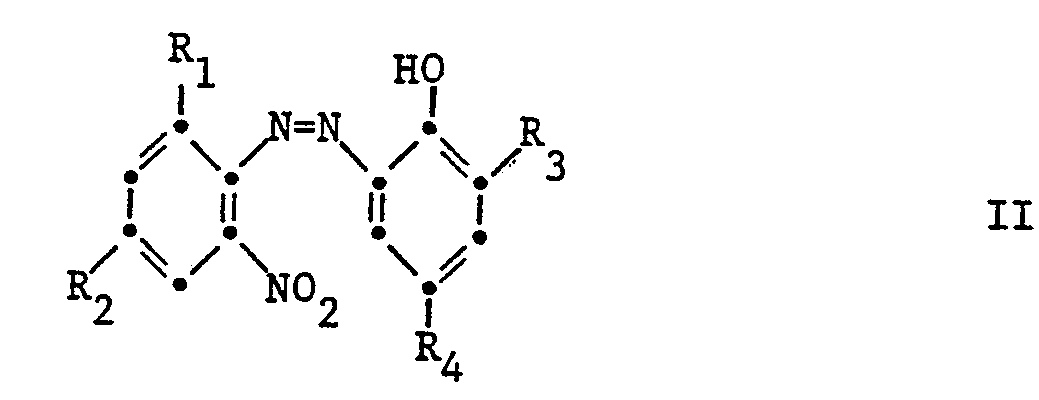
- the present invention relates to a process for the preparation of 2- (2'-hydroxyphenyl) benzotriazoles from 2-nitro-2'-hydroxyazobenzenes.
- the present invention thus relates to a process for the preparation of 2- (2'-hydroxyphenyl) benzotriazoles by reduction of 2-nitro-2'-hydroxyazobenzenes in a strongly basic medium and in the presence of aromatic benzodiols, naphthodiols, benzoquinones or naphthoquinones, thereby characterized in that the reduction is carried out with an alcohol which is liquid at room temperature and has more than one carbon atom without the use of a further reducing agent.
- the alcohol, where used had only a solvent function.
- a reducing agent had to be added each time.
- the alcohol used has a double function, ie. H. it acts as a solvent and reducing agent. This saves one raw material compared to the previous processes. Since, in addition, reducing agents such as zinc, sulfide, hydrogen sulfide, dithionite or hydrazine hydrate are no longer required, the disadvantages described with regard to labor, the environment and safety are also eliminated. Lengthy separation processes, especially in the case of metallic reducing agents, are no longer necessary. At the end of the process, the reaction product fails and can be easily isolated. The yields are high. The new process is therefore more economical and environmentally friendly.
- R 1 and R 2 can mean chlorine. If R 2 is an alkyl, it is, for example, methyl, ethyl, propyl, isopropyl, n-butyl, tert-butyl, amyl or tert-amyl.
- R 2 is an alkoxy, it can be, for example, methoxy, ethoxy or n-butoxy.
- R 3 or R 4 are alkyl, it is, for example, methyl, ethyl, sec-butyl, tert-butyl, tert-amyl, tert-octyl or n-dodecyl.
- R 3 or R 4 are cycloalkyl, it can be, for example, cyclopentyl, cyclohexyl or cyclooctyl.
- R 3 or R 4 are aralkyl, it is, for example, benzyl, a-methylbenzyl or a, a-dimethylbenzyl.
- R 3 or R 4 can be phenyl.
- R 4 is an alkoxy, it can be, for example, methoxy, ethoxy, propoxy, butoxy, pentyloxy, isobutoxy, octoxy or dodecyloxy.
- Primary alkanols, secondary alkanols, aralkanols, glycols and glycol monoalkyl ethers are particularly suitable for the process according to the invention.
- Preferred primary alkanols are, for example, ethanol, n-propanol, n-butanol or n-octyl alcohol.
- Preferred secondary alkanols are, for example, isopropanol, sec-butanol or sec-octanol.
- Preferred aralkanol is benzyl alcohol.
- Preferred glycols are, for example, 1,2-ethanediol, 1,3-propanediol or 1,4-butanediol.
- Preferred glycol monoalkyl ethers are, for example, ethylene glycol monomethyl ether, ethylene glycol monoethyl ether and ethylene glycol monobutyl ether.
- the secondary alkanols are particularly preferred. Isopropanol and sec-butanol are very particularly preferred.
- the strongly basic medium can be produced by adding an alkali metal hydroxide such as sodium or potassium hydroxide, preferably sodium hydroxide, or an alkali metal such as sodium or potassium, preferably sodium, to an alcohol as defined above.
- an alkali metal hydroxide such as sodium or potassium hydroxide, preferably sodium hydroxide, or an alkali metal such as sodium or potassium, preferably sodium
- the alkali metal hydroxides or alkali metals mentioned can be used in at least one, preferably two, molar equivalents with respect to the substrate to be reduced.
- Benzodiols, naphthodiols, benzoquinones or naphthoquinones act as catalysts in the process according to the invention.
- diols such.
- the aromatic nuclei can be unsubstituted or wholly or partly z.
- R 6 is alkyl, it is, for example, methyl, ethyl, n-butyl, sec-butyl, n-octyl or n-dodecyl.
- R 6 is dialkylamino, it can be z.
- 1,4-Naphtoquinone, 2,3-dichloronaphthoquinone, 2-chloronaphthoquinone, 2-hydroxy-3-methylnaphthoquinone or 2-chloro-3-dimethylaminonaphthoquinone are very particularly preferred in the process according to the invention.
- aromatic diols and quinones acting as catalysts can, based on the substrate to be reduced, be used, for example, in amounts of 1-20 mol-Mo, in particular 5-10 mol%.
- the inventive method can, for. B. at about 20 ° C to about 120 ° C, especially at about 40 ° C to about 100 ° C, and especially at about 50 ° C to about 80 ° C.
- the water content of the reaction medium should expediently be less than 15% by volume.
- the reduction is preferably carried out in an anhydrous medium.
- the compounds of the formula are known stabilizers for organic materials, such as, for example, for organic polymers.
- the compounds of formula II are known as starting materials.
- a 750 ml sulfonation flask is mixed with 220 g of sec-butanol, 34.7 g of 2-nitro-4-chloro-2'-hydroxy-3'-tert-butyl-5-methylazobenzene, 2.3 g of 2,3- Dichloronaphroquinone and 26 g of 50% by weight aqueous sodium hydroxide solution.
- the mixture is stirred at 40-45 ° C for two hours and at 70-75 ° C for three hours.
- 500 ml of water are added dropwise and the precipitated crystals are filtered off. It is washed with water and dried in vacuo at 60 - 70 ° C.
- 2-tert-Butyl-4-methyl-6- (4'-chloro-2'-benzotriazolyl) phenol is obtained in high yield.
- a 750 ml sulfonation flask is mixed with 300 g of cyclohexanol, 35.5 g of 2-nitro-2'-hydroxy-3 ', 5'-bis-butyl-azobenzene, 2.3 g of 2,3-dichloronaphthoquinone and 25. 6 g of sodium hydroxide are charged.
- the mixture is stirred for three hours at 70-75 ° C. and the pH of the solution is adjusted to 1.5 using 5% by volume aqueous hydrochloric acid.
- the aqueous phase is separated off and discarded.
- the organic phase is washed with water and cooled to -5 ° C. It crystallizes 2,4-di-tert-butyl-6- (2'-benzotriazolyl) phenol in high yield.
Landscapes
- Chemical & Material Sciences (AREA)
- Organic Chemistry (AREA)
- Organic Low-Molecular-Weight Compounds And Preparation Thereof (AREA)
- Low-Molecular Organic Synthesis Reactions Using Catalysts (AREA)
Description
- Die vorliegende Erfindung betrifft ein Verfahren zur Herstellung von 2-(2'-Hydroxyphenyl)-benztriazolen aus 2-Nitro-2'-hydroxyazobenzolen.
- Die Reduktion von 2-Nitro-2'-hydroxyazobenzolen zu 2-(2'-Hydroxyphenyl)-benztriazolen in basischalkoholischem Medium ist bekannt. Nebst einer aromatischen Dihydroxy- oder Dioxo-Verbindung als Katalysator werden aber Reduktionsmittel wie Zink, Ammoniumsulfid, Alkalisulfid, Ammoniumhydrogensulfid, Alkalihydrogensulfid, Alkalidithionit oder Hydrazinhydrat benötigt (JP-A-63379/78).
- Doch ist es aufwendig, die bei der Reduktion mit Metallen wie Zink anfallenden Oxide zu beseitigen und zudem zu verhindern, dass sie die Abwässer belasten. Die schwefelhaltigen Reduktionsmittel sind den Metallen unterlegen und hinterlassen in den Produkten schwer entfernbare Schwefelverunreinigungen. Hydrazinhydrat ist wohl ein potentes Reduktionsmittel, seine Handhabung stellt aber wegen der hohen Toxizität ein Sicherheitsrisiko dar.
- In den bisher beschriebenen Verfahren zur Reduktion von 2-Nitro-2'-hydroxyazobenzoten zu 2-(2'-Hydroxyphenyl)-benztriazolen wirkten Alkohole, soweit solche verwendet wurden, als Lösungsmittel. Zudem werden nach bisheriger allgemeiner Erfahrung Nitrogruppen von basischen Alkohol-Lösungen nicht angegriffen (siehe ORGANIKUM, VEB Deutscher Verlag der Wissenschaften, Berlin 1976, Seite 604). Auf der Suche nach einem wirtschaftlicheren und umweltfreundlicheren Verfahren wurden nun Reaktionsbedingungen gefunden, unter denen sich 2-Nitro-2'-hydroxyazobenzole mit basischen Alkohol-Lösungen, deren Alkohol mehr als ein Kohlenstoffatom hat zu 2-(2'-Hydroxyphenyl)-benztriazolen doch reduzieren lassen.
- Die vorliegende Erfindung betrifft somit ein Verfahren zur Herstellung von 2-(2'-Hydroxyphenyl)-benztriazolen durch Reduktion von 2-Nitro-2'-hydroxyazobenzolen in einem stark basischen Medium und in Gegenwart von aromatischen Benzodiolen, Naphthodiolen, Benzochinonen oder Naphthochinonen, dadurch gekennzeichnet, dass man die Reduktion mit einem bei Raumtemperatur flüssigen Alkohol mit mehr als einem Kohlenstoffatom ohne Mitverwendung eines weiteren Reduktionsmittels durchführt.
- Bevorzugt werden nach dem erfindungsgemässen Verfahren aus Verbindungen der Formel II Verbindungen der Formel 1 hergestellt,

- R1 Wasserstoff oder Halogen,
- R2 Wasserstoff, Alkyl, Alkoxy oder Halogen,
- R3 Wasserstoff, Alkyl, Cycloalkyl, Aralkyl oder Aryl,
- R4 Wasserstoff, Alkyl, Cycloalkyl, Aralkyl, Aryl oder Alkoxy bedeuten.
- In den früheren Verfahren hatte der Alkohol, wo solcher verwendet wurde, nur Lösungsmittelfunktion. Es musste jedesmal zusätzlich ein Reduktionsmittel zugegeben werden. Im erfindungsgemässen Verfahren dagegen übt der eingesetzte Alkohol eine Doppelfunktion aus, d. h. er wirkt als Lösungsmittel und Reduktionsmittel. Dadurch wird gegenüber den früheren Verfahren ein Rohstoff eingespart. Da zudem keine Reduktionsmittel mehr wie Zink, Sulfidm Hydrogensulfid, Dithionit oder Hydrazinhydrat benötigt werden, fallen auch die geschilderten Nachteile bezüglich Arbeitsaufwand, Umwelt und Sicherheit weg. Langwierige Trennprozesse, insbesondere im Fall der metallischen Reduktionsmittel, werden überflüssig. Am Ende des Prozesses fällt das Reaktionsprodukt jeweils aus und lässt sich leicht isolieren. Die Ausbeuten sind hoch. Das neue Verfahren ist somit wirtschaftlicher und umweltfreundlicher.
- Besonders bevorzugt werden nach dem erfindungsgemässen Verfahren aus Verbindungen der Formel II Verbindungen der Formel 1 hergestellt, in denen
- R1 Wasserstoff oder Chlor,
- R2 Wasserstoff, Alkyl mit 1 bis 5 Kohlenstoffatomen, Alkoxy mit 1 bis 4 Kohlenstoffatomen oder Chlor,
- R3 Wasserstoff, Alkyl mit 1 bis 12 Kohlenstoffatomen, Cycloalkyl mit 5 bis 8 Kohlenstoffatomen, Aralkyl mit 7 bis 9 Kohlenstoffatomen oder Phenyl,
- R4 Wasserstoff, Alkyl mit 1 bis 12 Kohlenstoffatomen, Cycloalkyl mit 5 bis 8 Kohlenstoffatomen, Aralkyl mit 7 bis 9 Kohlenstoffatomen, Phenyl oder Alkoxy mit 1 bis 12 Kohlenstoffatomen bedeuten.
- In der Bedeutung von Halogen können R1 und R2 Chlor bedeuten. Ist R2 ein Alkyl, so handelt es sich beispielsweise um Methyl, Äthyl, Propyl, Isopropyl, n-Butyl, tert.-Butyl, Amyl oder tert.-Amyl.
- Bedeutet R2 ein Alkoxy, so kann es sich zum Beispiel um Methoxy, Äthoxy oder n-Butoxy handeln.
- Sind R3 oder R4 Alkyl, so handelt es sich beispielsweise um Methyl, Äthyl, sek.-Butyl, tert.-Butyl, tert.-Amyl, tert.-Octyl oder n-Dodecyl.
- Bedeuten R3 oder R4 Cycloalkyl, so kann es sich zum Beispiel um Cyclopentyl, Cyclohexyl oder Cyclooctyl handeln.
- Sind R3 oder R4 Aralkyl, so handelt es sich beispielsweise um Benzyl, a-Methylbenzyl oder a,a-Dimethylbenzyl.
- In der Bedeutung von Aryl, können R3 oder R4 Phenyl sein.
- Ist R4 ein Alkoxy, so kann es sich zum Beispiel um Methoxy, Äthoxy, Propoxy, Butoxy, Pentyloxy, iso-Butoxy, Octoxy oder Dodecyloxy handeln.
- Typische Verbindungen der Formel I sind in den Beispielen dargestellt.
- Für das erfindungsgemässe Verfahren eignen sich insbesondere primäre Alkanole, sekundäre Alkanole, Aralkanole, Glykole und Glykolmonoalkyläther. Bevorzugte primäre Alkanole sind beispielsweise Äthanol, n-Propanol, n-Butanol oder n-Octylalkohol. Bevorzugte sekundäre Alkanole sind zum Beispiel Isopropanol, sek.-Butanol oder sek.-Octanol. Bevorzugtes Aralkanol ist Benzylalkohol. Bevorzugte Glykole sind zum Beispiel 1,2- Äthandiol, 1,3-Propandiol oder 1,4-Butandiol. Bevorzugte Glykolmonoalkyläther sind beispielsweise Äthylenglykolmonomethyläther, Äthylenglykolmonoäthyläther und Äthylenglykolmonobutyläther. Besonders bevorzugt werden die sekundären Alkanole. Ganz besonders bevorzugt sind Isopropanol und sek.-Butanol.
- Im erfindungsgemässen Verfahren kann das stark basische Medium durch Zugabe eines Alkalihydroxides wie Natrium- oder Kaliumhydroxid, vorzugsweise Natriumhydroxid, oder eines Alkalimetalles wie Natrium oder Kalium, vorzugweise Natrium, zu einem oben defininierten Alkohol erzeugt werden. Dabei können die erwähnten Alkalihydroxide bzw. Alkalimetalle in mindestens ein, vorzugsweise zwei Moläquivalenten bezüglich des zu reduzierenden Substrates eingesetzt werden.
- Als Katalysatoren wirken im erfindungsgemässen Verfahren Benzodiole, Naphthodiole, Benzochinone oder Naphthochinone. Als Diole kommen z. B. 1,2-Benzodiole und 1,4-Benzodiole oder 1,2-Naphthodiole, 1,4-Naphthodiole und 2,6-Naphthodiole in Frage. Die aromatischen Kerne können unsubstituiert oder ganz oder teilweise z. B. mit Alkyl oder Halogen substituiert sein. Bevorzugt sind unsubstituierte Benzodiole.
- Die Benzochinone können unsubstituiert oder ganz oder teilweise z. B. mit Alkyl, wie Methyl, oder Halogen wie Chlor, substituiert sein. Benzochinone sind z. B. 1,2-Benzochinone und 1,4-Benzochinone. Bevorzugt im erfindungsgemässen Verfahren werden unsubstituierte oder substituierte Naphthochinone, wie 1,2-Naphthochinone, 1,4-Naphthochinone oder 2,6-Naphthochinone eingesetzt. Sind die Kerne substituiert, so sind sie es z. B. mit Halogen, Hydroxyl, Alkyl, Dialkylamino, Piperidino oder Morpholino. Besonders bevorzugt sind 1,4-Naphthochinone der Formellll

- R5 Wasserstoff, Halogen oder Hydroxyl,
- R6 Wasserstoff, Halogen, Alkyl, Dialkylamino, Piperidino oder Morpholino bedeuten.
- Vor allem bevorzugt sind Verbindungen der Formel 111, in denen
- R5 Wasserstoff, Chlor oder Hydroxyl,
- R6 Wasserstoff, Chlor, Alkyl mit 1 bis 12 Kohlenstoffatomen, Dialkylamino mit 2 bis 24 Kohlenstoffatomen, Piperidino oder Morpholino bedeuten.
- Bedeutet R6 ein Alkyl, so handelt es sich beispielsweise um Methyl, Äthyl, n-Butyl, sek.-Butyl, n-Octyl oder n-Dodecyl.
- Bedeutet R6 Dialkylamino, so kann es sich z. B. um Dimethylamino, Diäthylamino, Dibutylamino, Dioctylamino oder Didodecylamino handeln.
- Ganz besonders bevorzugt im erfindungsgemässen Verfahren sind 1,4-Naphtochinon, 2,3-Dichlornaphtochinon, 2-Chlornaphtochinon, 2-Hydroxy-3-methylnaphtochinon oder 2-Chlor-3-dimethylaminonaphtochinon.
- Die als Katalysator wirkenden aromatischen Diole und Chinone können, bezogen auf das zu reduzierende Substrat, beispielsweise in Mengen von 1 - 20 Mol-Mo, insbesondere 5 - 10 Mol-% eingesetzt werden.
- Das erfindungsgemässe Verfahren kann z. B. bei etwa 20°C bis etwa 120°C, insbesondere bei etwa 40°C bis etwa 100°C, und vor allem bei etwa 50°C bis etwa 80°C durchgeführt werden.
- Im erfindungsgemässen Verfahren soll der Wassergehalt des Reaktionsmediums zweckmässigerweise kleiner als 15 Vol-% sein. Bevorzugt wird die Reduktion in einem wasserfreien Medium durchgeführt.
- Die Verbindungen der Formel sind bekannte Stabilisatoren für organische Materialien, wie zum Beispiel für organische Polymere. Die Verbindungen der Formel II sind als Ausgangsstoffe bekannt.
- In den folgenden Beispielen wird die Erfindung näher beschrieben.
- Ein 750 ml Sulfierkolben wird mit 220 g sek.-Butanol, 34,7 g 2-Nitro-4-chlor-2'-hydroxy-3'-tert.-butyl-5-methylazobenzol, 2,3 g 2,3-Dichlornaphrochinon und 26 g 50-gewichtsprozentiger wässeriger Natronlauge beschickt. Das Gemisch wird während zwei Stunden bei 40 - 45°C und während drei Stunden bei 70 - 75°C gerührt. Man tropft 500 ml Wasser zu und filtriert die ausgefallenen Kristalle ab. Man wäscht sie mit Wasser und trocknet sie im Vakuum bei 60 - 70°C. Man erhält 2-tert.-Butyl-4-methyl-6-(4'-chlor-2'-benztriazolyl)-phenol in hoher Ausbeute.
- Ein 750 ml Sulfierkolben wird mit 300 g Cyclohexanol, 35,5 g 2-Nitro-2'-hydroxy-3',5'-bis-tert.-butyl-azobenzol, 2,3 g 2,3-Dichlornaphtochinon und 25,6 g Natriumhydroxid beschickt. Man rührt das Gemisch während drei Stunden bei 70 - 75° C und stellt mit 5-volumen-prozentiger wässeriger Salzsäure den pH-Wert der Lösung auf 1,5. Die wässerige Phase wird abgetrennt und verworfen. Die organische Phase wäscht man mit Wasser und kühlt sie auf -5° C ab. Es kristallisiert 2,4-Di-tert.-butyl-6-(2'-benztriazolyl)-phenol in hoher Ausbeute aus.
Claims (7)


Applications Claiming Priority (2)
| Application Number | Priority Date | Filing Date | Title |
|---|---|---|---|
| CH298683 | 1983-06-01 | ||
| CH2986/83 | 1983-06-01 |
Publications (3)
| Publication Number | Publication Date |
|---|---|
| EP0130938A2 EP0130938A2 (de) | 1985-01-09 |
| EP0130938A3 EP0130938A3 (en) | 1985-11-21 |
| EP0130938B1 true EP0130938B1 (de) | 1989-02-15 |
Family
ID=4246084
Family Applications (1)
| Application Number | Title | Priority Date | Filing Date |
|---|---|---|---|
| EP84810259A Expired EP0130938B1 (de) | 1983-06-01 | 1984-05-25 | Verfahren zur Herstellung von 2-Arylbenzotriazolen |
Country Status (5)
| Country | Link |
|---|---|
| US (1) | US4642350A (de) |
| EP (1) | EP0130938B1 (de) |
| JP (1) | JPS606670A (de) |
| BR (1) | BR8402641A (de) |
| DE (1) | DE3476752D1 (de) |
Families Citing this family (14)
| Publication number | Priority date | Publication date | Assignee | Title |
|---|---|---|---|---|
| EP0257151B1 (de) * | 1986-08-22 | 1992-01-29 | Chemipro Kasei Kaisha, Ltd. | Methode zur Herstellung von 2-Phenylbenzotriazolen und von 2-Phenylbenzotriazol-N-oxiden |
| US4760148A (en) * | 1985-09-03 | 1988-07-26 | Ciba-Geigy Corporation | 5-aralkyl substituted 2H-benzotriazoles and stabilized compositions |
| JPH0517342Y2 (de) * | 1986-04-17 | 1993-05-10 | ||
| DE3684922D1 (de) * | 1986-09-16 | 1992-05-21 | Chemipro Kasei Kaisha Ltd | Verfahren zur herstellung von 2-phenylbenzotriazolen und 2-phenylbenzotriazol-n-oxyden. |
| US5096977A (en) * | 1987-08-12 | 1992-03-17 | Atochem North America, Inc. | Process for preparing polymer bound UV stabilizers |
| US4981914A (en) * | 1987-08-12 | 1991-01-01 | Atochem North America, Inc. | Polymer bound UV stabilizers |
| US5206378A (en) * | 1987-08-12 | 1993-04-27 | Elf Atochem North America, Inc. | Hydrazido functionalized 2-(2-hydroxyphenyl)-2h-benzotriazoles |
| US4859759A (en) * | 1988-04-14 | 1989-08-22 | Kimberly-Clark Corporation | Siloxane containing benzotriazolyl/tetraalkylpiperidyl substituent |
| EP0409840A4 (en) * | 1989-02-13 | 1991-09-04 | Atochem North America, Inc. | Benzotriazole and oxanilide uv absorber hydrazides |
| US5229521A (en) * | 1990-12-11 | 1993-07-20 | Ciba-Geigy Corporation | Process for the preparation of symmetrical 2,2-methylenebisbenzotriazolyl phenols |
| US5262541A (en) * | 1992-12-15 | 1993-11-16 | Fairmont Chemical Company, Inc. | Fluorenol catalyzed reduction of o-nitroazobenzenes and 2-aryl-2H-benzotriazole-N-oxides |
| US5675015A (en) * | 1996-03-07 | 1997-10-07 | Eastman Kodak Company | Process for the preparation of benzotriazole derivatives |
| KR100383919B1 (ko) | 2001-01-15 | 2003-05-14 | 주식회사 엘지화학 | 2-(2-히드록시페닐)-2h-벤조트리아졸의 제조방법 |
| US20060122293A1 (en) * | 2004-12-03 | 2006-06-08 | Rick Wilk | Ultraviolet light absorber stabilizer combination |
Citations (1)
| Publication number | Priority date | Publication date | Assignee | Title |
|---|---|---|---|---|
| JPS6337978A (ja) * | 1986-08-01 | 1988-02-18 | Canon Inc | 記録装置 |
Family Cites Families (13)
| Publication number | Priority date | Publication date | Assignee | Title |
|---|---|---|---|---|
| DE1110163B (de) * | 1958-10-04 | 1961-07-06 | Hoechst Ag | Ultraviolettabsorptionsmittel fuer Kunststoffe, Kunstharzmassen, Lacke und Farben |
| US3978074A (en) * | 1973-11-21 | 1976-08-31 | Uniroyal Inc. | Method of making hydroxyarylbenzotriazoles and their N-oxides |
| US4041044A (en) * | 1974-11-25 | 1977-08-09 | Ciba-Geigy Corporation | Process for the production of 2-aryl-2H-benzotriazoles |
| CA1073463A (en) * | 1975-05-14 | 1980-03-11 | Siegfried Kintopf | Process for the production of 2-aryl-2h-benzotriazoles |
| US4048157A (en) * | 1975-10-29 | 1977-09-13 | Eli Lilly And Company | 4(Formylthio)-azetidin-2-ones and ozonization process therefor |
| JPS5337667A (en) * | 1976-09-16 | 1978-04-06 | Mitsui Petrochem Ind Ltd | Preparation of 2-(2#-hydroxyaryl)-benzotriazoles |
| JPS5363379A (en) * | 1976-11-17 | 1978-06-06 | Nippon Kayaku Co Ltd | Preparation of 2-phenylbenzotriazoles or their n-oxides |
| CH633003A5 (de) * | 1977-08-17 | 1982-11-15 | Ciba Geigy Ag | Verfahren zur herstellung von benzotriazolen. |
| US4122092A (en) * | 1977-08-25 | 1978-10-24 | University Of Rochester | Total synthesis of (±)-picropodophyllone and (±)-4'-demethylpicropodophyllone |
| JPS5723347Y2 (de) * | 1978-02-27 | 1982-05-20 | ||
| JPS57167976A (en) * | 1981-04-09 | 1982-10-16 | Shipuro Kasei Kk | 2-phenylbenzotriazole-n-oxides and their preparations |
| JPS59170172A (ja) * | 1983-03-18 | 1984-09-26 | Shuichi Seino | 2−フエニルベンゾトリアゾ−ル類の製造方法 |
| JPS59172481A (ja) * | 1983-03-18 | 1984-09-29 | Shuichi Seino | 2−フエニルベンゾトリアゾ−ル−n−オキシド類の製造方法 |
-
1984
- 1984-05-25 DE DE8484810259T patent/DE3476752D1/de not_active Expired
- 1984-05-25 EP EP84810259A patent/EP0130938B1/de not_active Expired
- 1984-05-31 BR BR8402641A patent/BR8402641A/pt not_active IP Right Cessation
- 1984-06-01 JP JP59112888A patent/JPS606670A/ja active Pending
-
1985
- 1985-12-18 US US06/810,544 patent/US4642350A/en not_active Expired - Lifetime
Patent Citations (1)
| Publication number | Priority date | Publication date | Assignee | Title |
|---|---|---|---|---|
| JPS6337978A (ja) * | 1986-08-01 | 1988-02-18 | Canon Inc | 記録装置 |
Also Published As
| Publication number | Publication date |
|---|---|
| DE3476752D1 (en) | 1989-03-23 |
| BR8402641A (pt) | 1985-04-30 |
| JPS606670A (ja) | 1985-01-14 |
| EP0130938A2 (de) | 1985-01-09 |
| US4642350A (en) | 1987-02-10 |
| EP0130938A3 (en) | 1985-11-21 |
Similar Documents
| Publication | Publication Date | Title |
|---|---|---|
| EP0130938B1 (de) | Verfahren zur Herstellung von 2-Arylbenzotriazolen | |
| DE2551853A1 (de) | Verfahren zur herstellung von 2-aryl- 2h-benztriazolen | |
| US4230867A (en) | Process for the production of 2-aryl-2H-benzotriazoles | |
| EP0454624B1 (de) | Verfahren zur Herstellung von 1,3-Diketonen | |
| DE2733682A1 (de) | Verfahren zur herstellung von trifluormethylphenolen | |
| EP0038480B1 (de) | Verfahren zur Herstellung von 1-(4-Hydroxy-phenyl)-butan-3-on sowie neue Zwischenprodukte dieses Verfahrens | |
| DE3415385A1 (de) | Verfahren zur herstellung von pyrazolen | |
| CH660591A5 (en) | Process for the preparation of 2-(2'-hydroxyphenyl)benzo-triazoles | |
| EP0212301B1 (de) | Verfahren zur Herstellung von 2-Aminophenyl-thioethern | |
| DE2813340A1 (de) | Amidoxim-derivate, verfahren zu ihrer herstellung und ihre verwendung | |
| CH630944A5 (de) | Verfahren zur herstellung basischer oxazinfarbstoffe. | |
| EP0160246B1 (de) | Verfahren zur Herstellung von 2-Phenylbenztriazolen | |
| DE2123418A1 (de) | Neue Verbindungen mit Insektenjuvenilhormonwirksamkeit | |
| EP0137241B1 (de) | Verfahren zur Herstellung von Hydroxybenzylphosphoniumsalzen | |
| DE1125922B (de) | Verfahren zur Herstellung von neuen Phosphoranverbindungen | |
| EP0083010B1 (de) | Diether von m- oder p-Hydroxyphenolen und Verfahren zur Herstellung der Diether oder Monoether von m- oder p-Hydroxyphenolen | |
| JPS59172481A (ja) | 2−フエニルベンゾトリアゾ−ル−n−オキシド類の製造方法 | |
| DE4231606C2 (de) | Verfahren zur Herstellung von 3,3-Dialkoxy-5alpha-androstan-17-onen | |
| DE3343421A1 (de) | Verfahren zur herstellung von 5-oxethylsulfonyl-2-aminophenol(-ethern) | |
| DE955684C (de) | Verfahren zur Herstellung von 5-Amino-1, 2, 4-thiodiazolen | |
| CA1168655A (en) | 2-[2-HYDROXY-3,5-DI-(.alpha.,.alpha.-DI-METHYLBENZYL) PHENYL]- 2H-BENZOTRIAZOLES AND STABILIZED COMPOSITIONS | |
| JP2769178B2 (ja) | 2―フェニルベンゾトリアゾール類の製造法 | |
| DE3428170C2 (de) | ||
| CA1154779A (en) | Process for the production of 2-aryl-2h- benzotriazoles | |
| EP0191385A2 (de) | Verfahren zur Herstellung von Thiocyanatomethylthiobenzothiazolen |
Legal Events
| Date | Code | Title | Description |
|---|---|---|---|
| PUAI | Public reference made under article 153(3) epc to a published international application that has entered the european phase |
Free format text: ORIGINAL CODE: 0009012 |
|
| 17P | Request for examination filed |
Effective date: 19840528 |
|
| AK | Designated contracting states |
Designated state(s): DE FR GB IT |
|
| PUAL | Search report despatched |
Free format text: ORIGINAL CODE: 0009013 |
|
| AK | Designated contracting states |
Designated state(s): DE FR GB IT |
|
| 17Q | First examination report despatched |
Effective date: 19870310 |
|
| GRAA | (expected) grant |
Free format text: ORIGINAL CODE: 0009210 |
|
| AK | Designated contracting states |
Kind code of ref document: B1 Designated state(s): DE FR GB IT |
|
| REF | Corresponds to: |
Ref document number: 3476752 Country of ref document: DE Date of ref document: 19890323 |
|
| ITF | It: translation for a ep patent filed | ||
| GBT | Gb: translation of ep patent filed (gb section 77(6)(a)/1977) | ||
| ET | Fr: translation filed | ||
| PLBE | No opposition filed within time limit |
Free format text: ORIGINAL CODE: 0009261 |
|
| STAA | Information on the status of an ep patent application or granted ep patent |
Free format text: STATUS: NO OPPOSITION FILED WITHIN TIME LIMIT |
|
| 26N | No opposition filed | ||
| ITTA | It: last paid annual fee | ||
| REG | Reference to a national code |
Ref country code: GB Ref legal event code: 732E |
|
| REG | Reference to a national code |
Ref country code: FR Ref legal event code: TP |
|
| REG | Reference to a national code |
Ref country code: GB Ref legal event code: IF02 |
|
| PGFP | Annual fee paid to national office [announced via postgrant information from national office to epo] |
Ref country code: FR Payment date: 20020417 Year of fee payment: 19 |
|
| PGFP | Annual fee paid to national office [announced via postgrant information from national office to epo] |
Ref country code: DE Payment date: 20020422 Year of fee payment: 19 |
|
| PGFP | Annual fee paid to national office [announced via postgrant information from national office to epo] |
Ref country code: GB Payment date: 20020426 Year of fee payment: 19 |
|
| PG25 | Lapsed in a contracting state [announced via postgrant information from national office to epo] |
Ref country code: GB Free format text: LAPSE BECAUSE OF NON-PAYMENT OF DUE FEES Effective date: 20030525 |
|
| PG25 | Lapsed in a contracting state [announced via postgrant information from national office to epo] |
Ref country code: DE Free format text: LAPSE BECAUSE OF NON-PAYMENT OF DUE FEES Effective date: 20031202 |
|
| GBPC | Gb: european patent ceased through non-payment of renewal fee |
Effective date: 20030525 |
|
| PG25 | Lapsed in a contracting state [announced via postgrant information from national office to epo] |
Ref country code: FR Free format text: LAPSE BECAUSE OF NON-PAYMENT OF DUE FEES Effective date: 20040130 |
|
| REG | Reference to a national code |
Ref country code: FR Ref legal event code: ST |