EP0131002B1 - Element de construction et procede et systeme de production de cet element - Google Patents
Element de construction et procede et systeme de production de cet element Download PDFInfo
- Publication number
- EP0131002B1 EP0131002B1 EP84900042A EP84900042A EP0131002B1 EP 0131002 B1 EP0131002 B1 EP 0131002B1 EP 84900042 A EP84900042 A EP 84900042A EP 84900042 A EP84900042 A EP 84900042A EP 0131002 B1 EP0131002 B1 EP 0131002B1
- Authority
- EP
- European Patent Office
- Prior art keywords
- mould
- particles
- filler
- foam
- building element
- Prior art date
- Legal status (The legal status is an assumption and is not a legal conclusion. Google has not performed a legal analysis and makes no representation as to the accuracy of the status listed.)
- Expired
Links
- 238000004519 manufacturing process Methods 0.000 title claims abstract description 15
- 238000000034 method Methods 0.000 title claims description 17
- 239000002245 particle Substances 0.000 claims abstract description 40
- 239000000463 material Substances 0.000 claims abstract description 37
- 239000000945 filler Substances 0.000 claims abstract description 25
- 239000004033 plastic Substances 0.000 claims abstract description 16
- 229920003023 plastic Polymers 0.000 claims abstract description 16
- 239000004568 cement Substances 0.000 claims abstract description 5
- 239000006260 foam Substances 0.000 claims description 23
- 238000002156 mixing Methods 0.000 claims description 17
- 239000000203 mixture Substances 0.000 claims description 17
- 230000006835 compression Effects 0.000 claims description 14
- 238000007906 compression Methods 0.000 claims description 14
- 238000002347 injection Methods 0.000 claims description 8
- 239000007924 injection Substances 0.000 claims description 8
- 239000011230 binding agent Substances 0.000 claims description 5
- 239000002984 plastic foam Substances 0.000 claims description 5
- 229920002635 polyurethane Polymers 0.000 claims description 4
- 239000004814 polyurethane Substances 0.000 claims description 4
- 230000001427 coherent effect Effects 0.000 claims description 3
- 229920005830 Polyurethane Foam Polymers 0.000 claims description 2
- 238000007599 discharging Methods 0.000 claims description 2
- 239000004088 foaming agent Substances 0.000 claims description 2
- 239000007788 liquid Substances 0.000 claims description 2
- 238000002844 melting Methods 0.000 claims description 2
- 230000008018 melting Effects 0.000 claims description 2
- 239000011236 particulate material Substances 0.000 claims description 2
- 239000011496 polyurethane foam Substances 0.000 claims description 2
- 238000005507 spraying Methods 0.000 claims 2
- 239000004927 clay Substances 0.000 claims 1
- 230000009970 fire resistant effect Effects 0.000 claims 1
- 238000005187 foaming Methods 0.000 abstract description 13
- 239000006261 foam material Substances 0.000 abstract description 4
- 239000007787 solid Substances 0.000 abstract description 3
- 239000004566 building material Substances 0.000 description 7
- 238000009826 distribution Methods 0.000 description 4
- 230000002787 reinforcement Effects 0.000 description 4
- 239000004793 Polystyrene Substances 0.000 description 3
- 230000015572 biosynthetic process Effects 0.000 description 3
- 238000005266 casting Methods 0.000 description 3
- 239000011248 coating agent Substances 0.000 description 3
- 238000000576 coating method Methods 0.000 description 3
- 239000011521 glass Substances 0.000 description 3
- 238000003825 pressing Methods 0.000 description 3
- 239000011347 resin Substances 0.000 description 3
- 229920005989 resin Polymers 0.000 description 3
- 239000004411 aluminium Substances 0.000 description 2
- XAGFODPZIPBFFR-UHFFFAOYSA-N aluminium Chemical compound [Al] XAGFODPZIPBFFR-UHFFFAOYSA-N 0.000 description 2
- 229910052782 aluminium Inorganic materials 0.000 description 2
- 239000003795 chemical substances by application Substances 0.000 description 2
- 238000004140 cleaning Methods 0.000 description 2
- 239000000835 fiber Substances 0.000 description 2
- 229920002223 polystyrene Polymers 0.000 description 2
- 239000004743 Polypropylene Substances 0.000 description 1
- 229910000831 Steel Inorganic materials 0.000 description 1
- 238000010521 absorption reaction Methods 0.000 description 1
- 238000009435 building construction Methods 0.000 description 1
- 239000003054 catalyst Substances 0.000 description 1
- 239000011093 chipboard Substances 0.000 description 1
- 150000001875 compounds Chemical class 0.000 description 1
- 239000004567 concrete Substances 0.000 description 1
- 238000009749 continuous casting Methods 0.000 description 1
- 230000008602 contraction Effects 0.000 description 1
- 230000002939 deleterious effect Effects 0.000 description 1
- 230000001419 dependent effect Effects 0.000 description 1
- 230000000694 effects Effects 0.000 description 1
- 230000002349 favourable effect Effects 0.000 description 1
- 238000005189 flocculation Methods 0.000 description 1
- 230000016615 flocculation Effects 0.000 description 1
- 239000003365 glass fiber Substances 0.000 description 1
- 230000005484 gravity Effects 0.000 description 1
- 238000010438 heat treatment Methods 0.000 description 1
- 239000011256 inorganic filler Substances 0.000 description 1
- 229910003475 inorganic filler Inorganic materials 0.000 description 1
- 239000011810 insulating material Substances 0.000 description 1
- 239000002557 mineral fiber Substances 0.000 description 1
- 238000000465 moulding Methods 0.000 description 1
- -1 polypropylene Polymers 0.000 description 1
- 229920001155 polypropylene Polymers 0.000 description 1
- 230000001737 promoting effect Effects 0.000 description 1
- 239000011150 reinforced concrete Substances 0.000 description 1
- 238000007789 sealing Methods 0.000 description 1
- 238000005245 sintering Methods 0.000 description 1
- 230000000087 stabilizing effect Effects 0.000 description 1
- 239000010959 steel Substances 0.000 description 1
- 239000000126 substance Substances 0.000 description 1
- 239000000725 suspension Substances 0.000 description 1
- 239000012815 thermoplastic material Substances 0.000 description 1
- 238000009423 ventilation Methods 0.000 description 1
Images
Classifications
-
- E—FIXED CONSTRUCTIONS
- E04—BUILDING
- E04C—STRUCTURAL ELEMENTS; BUILDING MATERIALS
- E04C2/00—Building elements of relatively thin form for the construction of parts of buildings, e.g. sheet materials, slabs, or panels
- E04C2/02—Building elements of relatively thin form for the construction of parts of buildings, e.g. sheet materials, slabs, or panels characterised by specified materials
- E04C2/10—Building elements of relatively thin form for the construction of parts of buildings, e.g. sheet materials, slabs, or panels characterised by specified materials of wood, fibres, chips, vegetable stems, or the like; of plastics; of foamed products
-
- B—PERFORMING OPERATIONS; TRANSPORTING
- B29—WORKING OF PLASTICS; WORKING OF SUBSTANCES IN A PLASTIC STATE IN GENERAL
- B29C—SHAPING OR JOINING OF PLASTICS; SHAPING OF MATERIAL IN A PLASTIC STATE, NOT OTHERWISE PROVIDED FOR; AFTER-TREATMENT OF THE SHAPED PRODUCTS, e.g. REPAIRING
- B29C44/00—Shaping by internal pressure generated in the material, e.g. swelling or foaming ; Producing porous or cellular expanded plastics articles
- B29C44/20—Shaping by internal pressure generated in the material, e.g. swelling or foaming ; Producing porous or cellular expanded plastics articles for articles of indefinite length
- B29C44/30—Expanding the moulding material between endless belts or rollers
-
- B—PERFORMING OPERATIONS; TRANSPORTING
- B29—WORKING OF PLASTICS; WORKING OF SUBSTANCES IN A PLASTIC STATE IN GENERAL
- B29C—SHAPING OR JOINING OF PLASTICS; SHAPING OF MATERIAL IN A PLASTIC STATE, NOT OTHERWISE PROVIDED FOR; AFTER-TREATMENT OF THE SHAPED PRODUCTS, e.g. REPAIRING
- B29C44/00—Shaping by internal pressure generated in the material, e.g. swelling or foaming ; Producing porous or cellular expanded plastics articles
- B29C44/34—Auxiliary operations
- B29C44/3442—Mixing, kneading or conveying the foamable material
-
- B—PERFORMING OPERATIONS; TRANSPORTING
- B29—WORKING OF PLASTICS; WORKING OF SUBSTANCES IN A PLASTIC STATE IN GENERAL
- B29K—INDEXING SCHEME ASSOCIATED WITH SUBCLASSES B29B, B29C OR B29D, RELATING TO MOULDING MATERIALS OR TO MATERIALS FOR MOULDS, REINFORCEMENTS, FILLERS OR PREFORMED PARTS, e.g. INSERTS
- B29K2075/00—Use of PU, i.e. polyureas or polyurethanes or derivatives thereof, as moulding material
-
- B—PERFORMING OPERATIONS; TRANSPORTING
- B29—WORKING OF PLASTICS; WORKING OF SUBSTANCES IN A PLASTIC STATE IN GENERAL
- B29K—INDEXING SCHEME ASSOCIATED WITH SUBCLASSES B29B, B29C OR B29D, RELATING TO MOULDING MATERIALS OR TO MATERIALS FOR MOULDS, REINFORCEMENTS, FILLERS OR PREFORMED PARTS, e.g. INSERTS
- B29K2105/00—Condition, form or state of moulded material or of the material to be shaped
- B29K2105/06—Condition, form or state of moulded material or of the material to be shaped containing reinforcements, fillers or inserts
- B29K2105/16—Fillers
-
- B—PERFORMING OPERATIONS; TRANSPORTING
- B29—WORKING OF PLASTICS; WORKING OF SUBSTANCES IN A PLASTIC STATE IN GENERAL
- B29L—INDEXING SCHEME ASSOCIATED WITH SUBCLASS B29C, RELATING TO PARTICULAR ARTICLES
- B29L2031/00—Other particular articles
- B29L2031/10—Building elements, e.g. bricks, blocks, tiles, panels, posts, beams
-
- Y—GENERAL TAGGING OF NEW TECHNOLOGICAL DEVELOPMENTS; GENERAL TAGGING OF CROSS-SECTIONAL TECHNOLOGIES SPANNING OVER SEVERAL SECTIONS OF THE IPC; TECHNICAL SUBJECTS COVERED BY FORMER USPC CROSS-REFERENCE ART COLLECTIONS [XRACs] AND DIGESTS
- Y10—TECHNICAL SUBJECTS COVERED BY FORMER USPC
- Y10S—TECHNICAL SUBJECTS COVERED BY FORMER USPC CROSS-REFERENCE ART COLLECTIONS [XRACs] AND DIGESTS
- Y10S264/00—Plastic and nonmetallic article shaping or treating: processes
- Y10S264/07—Binding and molding cellular particles
-
- Y—GENERAL TAGGING OF NEW TECHNOLOGICAL DEVELOPMENTS; GENERAL TAGGING OF CROSS-SECTIONAL TECHNOLOGIES SPANNING OVER SEVERAL SECTIONS OF THE IPC; TECHNICAL SUBJECTS COVERED BY FORMER USPC CROSS-REFERENCE ART COLLECTIONS [XRACs] AND DIGESTS
- Y10—TECHNICAL SUBJECTS COVERED BY FORMER USPC
- Y10S—TECHNICAL SUBJECTS COVERED BY FORMER USPC CROSS-REFERENCE ART COLLECTIONS [XRACs] AND DIGESTS
- Y10S521/00—Synthetic resins or natural rubbers -- part of the class 520 series
- Y10S521/917—Specialized mixing apparatus utilized in cell forming process
Definitions
- the present invention relates to a building element in the shape of a plate, block, beam or column and consisting of a hard, particle-shaped filler, the particles of which are held together by a foam plastic material.
- Lightweight building elements of foam plastic containing as admixture and economizing means a filler in the shape of hard particles, are generally known. In manufacturing these known building materials it is attempted to achieve a distribution of the particles of maximum uniformity, and a complete embedment of each particle in a surrounding mass of foam plastic.
- a prior art building element of this kind may be produced, e.g. as described in the German Published Patent Application No. 2056063, where a mixture of particles and Perlit and polyurethane foam is compressed in a mould by the upper portion of the mould being pressed down into the lower portion thereof at the same time while the foaming is taking place. The compression, however, is not stronger than that the frothing agent is deposited between the particles in a way described as "a kind of mesh formation of the frothing agent in the Perlit-filling".
- US-PS 3,025,202 (Morgan) describes a method of manufacturing a product consisting of mineral fibers and foamed material in such a manner that an even distribution of the fibers in the foam is obtained.
- the filler material is cemented together by the foam plastic material.
- the product is relatively soft and flexible and suitable for laminates.
- the manufacture of a harder product, e.g. an insulating material, requires a heat treatment of thermoplastic material.
- the patent specification describes several methods of obtaining an appropriate mixture of glass fibers and foam but it does not suggest to add fibers to a mixture of foam components and hard filler particles and does not suggest at all to compress filler particles.
- the building material according to the invention is characteristic by the hard particles of the filler being so firmly compressed that they form a coherent supporting skeleton of abutting particles bound together by a plastic foam in only an amount sufficient to fill the cavities between the firmly compressed particles for cementing the particles together.
- the filler is compressed so firmly in the mould that after the foaming the grains will still touch each other. This is the condition of obtaining high compression strengths, and this condition is not obtained by the known methods mentioned above where the foam has a mesh-like formation and is not only acting as a binder between abutting particles.
- Such a building material comprises a great number of favourable qualities; which it has not been possible to combine in any hitherto known homogenous building material.
- the self-supporting framework and the limitation of the foam material to the natural cavities therein cause the building material to combine a high strength and stability against contraction and shrinkage with excellent fire-restraining qualities and highly satisfactory surface qualities.
- the material is in fact self-extinguishing, and the relatively great amount of particles (e.g. 85-90% leca and the corresponding small amount of foam plastic (e.g.
- 10-15% polyurethane moreover have the effect that the problems generally occurring in connection with casting of thick elements of foam material owing to developed heat destroying the foam, are eliminated in consequence of the reduced generation of heat from the foam and the absorption by the particles of the surplus heat.
- the tensile strength of the material is furthermore easily improved by embedding fibres or inserting reinforcement, e.g. of aluminium.
- inorganic fibres will in case of fire have a stabilizing effect, as when melting they cooperate to cement the inorganic filler together so that this will not disintegrate when the foam plastic material carbonizes. This results in a sintering of the material which acts as a heat shield preventing a further intrusion of fire.
- the material is easily workable, it will hold nails and can be glued.
- the surface which, besides, is walkproof can be given a smooth surface which is well suited to be painted.
- the production rate for this material which is a few minutes, makes it particularly suited for a continuous manufacture of elements.
- the building material is easily produced by a method in which foaming agents in a liquid state are amalgamated with the filler before said filler is introduced into a mould, the material thereafter being compressed in said mould, and this method is characteristic in that a hard particulate material and a foamable binder is premixed in a mixing nozzle under the influence of compressed air, discharging through a nozzle the mixture so produced while injecting the same under compressed air pressure into a mould, and compressing the mixture sufficiently to cause said particles to contact each other during curing of said foamable binder.
- the nozzle according to the invention owing to the stream of particles and the compressed air will be self- cleaning so that it can be started and switched off without being cleaned.
- the casting of building elements may be performed in a mould caused to move in an axial direction, and according to the invention the mixture is injected through a nozzle disposed in the direction of movement of the mould and at a position where the compression of the filler is initiated.
- This permits an even distribution of the material in the mould during continuous casting, whether the mould is stationary and the casting machine is moving along said mould, or vice versa the mould is moving in the longitudinal direction, e.g. on a conveyor belt or a roller conveyor.
- additional chemicals or admixtures e.g. fibres of glass or polypropylene may easily be added by being injected into the mixture, thereby achieving an even addition of the fibres which are distributed homogenously in the product without flocculation.
- the building element according to the invention or possibly several successive building elements according to the invention may be produced in a system of the kind referred to in the opening of claim 10, said system being characteristic by what is stated in the characterizing clause of claim 10.
- the injection of the mixture of particles and foaming components from the common mixing nozzle through the nozzle injection tubes extending in the longitudinal direction of the mould ensures an even distribution of a homogeneous, continuously manufactured material which is thereafter compressed.
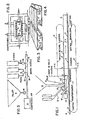
- the system comprises a roller conveyor 1 supporting mould bottoms 2 which are carried through the system in continuation of each other. Also, the system comprises a roller conveyor 3 having rollers pressing against the top side of the top wall 4 of the moulds, and roller conveyors 5 having rollers pressing against the opposed side walls 6, 7 of the moulds.
- the mould bottoms 2 are introduced into the system at A to the left in Figure 1 where, if desired, they can be provided with a reinforcement or a coating forming the outer side of the finished building element.
- the mould bottom passes into a firm guide section 8 which is supplied with particle-shaped filler from a silo 9 after the mould bottom 2 having been assembled with the side walls 6, 7.
- a foam plastic preferably polyurethane with added foaming means, is injected through one or more nozzle tubes 12.
- the material is compressed by means of a piston mechanism 10 or screw conveyor-possibly during simultaneous vibration-and the top walls 4 of the moulds are placed thereon before the moulds pass under the roller conveyor 3 and between the roller conveyors 5.
- a sheet of film 11 may be drawn along under the top wall 4 of the mould which is open at both ends, in order that the top wall will easily release the material during the demoulding and possibly in order to form a sealing in the mould.
- the side walls 6 and 7 may be adjusted'in lateral direction by side roller conveyors 5 for adjustment of the width of the finished element.
- the roller conveyors 5 may be so adapted that they press the side walls 6 and 7 inwards towards each other immediately after the mould having passed the mouth of the guide section 8.
- the foam plastic is injected into the mould under such a pressure and in such an amount that it fills the cavities between the particles and cements them together to a firm monolithic compound during the foaming and hardening of the foam plastic.
- the flow of material is demoulded, and at G it is cut in required lengths.
- the mould bottoms and walls are carried back to the filling station, possibly after having been cleaned.
- the mould bottoms may be replaced by pre-fabricated plates, such as chip boards, plates of asbestos-cement, or other plates which remain on the manufactured objects, forming a surface coating.
- Bars of aluminium or steel for reinforcement of supporting structures may be inserted through the guide section 8 through arbitrarily chosen holes. Electric tubes or tubes for other purposes may be inserted in the same way.
- the moulds may simply be formed as shown in cross-section in Figure 3.
- Figure 4 shows a cross-section through a mould having an adjustable width. This mould is adapted for compression of the material by pressing the side walls together under the influence of outer roller conveyors.
- Figure 5 shows schematically an apparatus for mixing and injecting the material into the moulds.
- the apparatus comprises a silo 9 for particle-shaped filler which is injected by means of a blower 14 into a mixing nozzle 13 which is adapted to receive as well, premixed plastic foam from a sprayer 15. From the nozzle 13 the ready mixture is injected into moulds as shown, or possibly in stationary moulds having compression devices which are known from the manufacture of concrete.
- Blown-in fibres 17 or other admixtures may furthermore be supplied in the mixing nozzle 13.
- Compressed-air nozzles 16 increasing the turbulent flow and promoting the mixing process may be inserted in the mixing nozzle 13. These nozzles may also be important to the cleaning of the mixing nozzle.
- Dosing devices 18 of known adjustable types are situated at the places where the material is supplied.
Landscapes
- Engineering & Computer Science (AREA)
- Architecture (AREA)
- Life Sciences & Earth Sciences (AREA)
- Wood Science & Technology (AREA)
- Civil Engineering (AREA)
- Structural Engineering (AREA)
- Casting Or Compression Moulding Of Plastics Or The Like (AREA)
- Curing Cements, Concrete, And Artificial Stone (AREA)
- Laminated Bodies (AREA)
- Porous Artificial Stone Or Porous Ceramic Products (AREA)
Abstract
Claims (11)
Priority Applications (1)
| Application Number | Priority Date | Filing Date | Title |
|---|---|---|---|
| AT84900042T ATE34121T1 (de) | 1982-12-22 | 1983-12-21 | Bauelement und verfahren und system zu dessen herstellung. |
Applications Claiming Priority (2)
| Application Number | Priority Date | Filing Date | Title |
|---|---|---|---|
| DK5685/82 | 1982-12-22 | ||
| DK568582A DK157908C (da) | 1982-12-22 | 1982-12-22 | Byggemateriale til byggeelementer samt fremgangsmaade og anlaeg til fremstilling heraf. |
Publications (2)
| Publication Number | Publication Date |
|---|---|
| EP0131002A1 EP0131002A1 (fr) | 1985-01-16 |
| EP0131002B1 true EP0131002B1 (fr) | 1988-05-11 |
Family
ID=8144476
Family Applications (1)
| Application Number | Title | Priority Date | Filing Date |
|---|---|---|---|
| EP84900042A Expired EP0131002B1 (fr) | 1982-12-22 | 1983-12-21 | Element de construction et procede et systeme de production de cet element |
Country Status (7)
| Country | Link |
|---|---|
| US (1) | US4607061A (fr) |
| EP (1) | EP0131002B1 (fr) |
| AU (1) | AU570426B2 (fr) |
| DE (1) | DE3376538D1 (fr) |
| DK (1) | DK157908C (fr) |
| FI (1) | FI83943C (fr) |
| WO (1) | WO1984002489A1 (fr) |
Families Citing this family (20)
| Publication number | Priority date | Publication date | Assignee | Title |
|---|---|---|---|---|
| US4562829A (en) * | 1983-02-28 | 1986-01-07 | E. R. Squibb & Sons, Inc. | Strontium-rubidium infusion system |
| WO1985004164A1 (fr) * | 1984-03-21 | 1985-09-26 | Harry Holm | Blocs, poutres, tuyaux et elements de construction pouvant etre scies et cloues |
| US5089189A (en) * | 1988-04-08 | 1992-02-18 | Centrite Corp. | Process for reinforced polymeric composites |
| DE3825603C1 (en) * | 1988-07-28 | 1989-08-10 | Bayer Ag, 5090 Leverkusen, De | Process and double transporting belt for continuously producing foam webs or sheets laminated with outer layers |
| DK208091A (da) * | 1991-12-30 | 1993-07-01 | Brasilpar Investimentos E Part | Fremgangsmaade og anlaeg til fremstilling af byggeelement samt byggeelement |
| US5424014A (en) * | 1992-09-18 | 1995-06-13 | Apache Products Company | Method for extruding foamable polymer material |
| US5723506A (en) * | 1992-09-18 | 1998-03-03 | Apache Products Company | Extruded polymer foam with filler particles and method |
| USRE37095E1 (en) | 1992-09-18 | 2001-03-13 | Apache Products Company | Extruded polymer foam with filler particles and method |
| IT1308878B1 (it) * | 1999-04-28 | 2002-01-11 | De Fatis Stefano Tabarelli | Procedimento per ottenere manufatti solidi di schiuma di argilla daimpiegare nell'edilizia, e prodotti relativi. |
| DE102005009270B4 (de) * | 2005-02-14 | 2007-03-08 | Lignolith Gmbh | Verfahren zur Herstellung eines Baustoffes und Baustoff |
| BRPI0607914A2 (pt) | 2005-02-25 | 2010-03-23 | Nova Chem Inc | painel de edificaÇço compàsito, mÉtodo para construir uma edificaÇço, edificaÇço, mÉtodo para fazer negàcio entre um fabricante de painel de edificaÇço compàsito e um cliente, e, caibro de armaÇço |
| MX2007009959A (es) * | 2005-02-25 | 2007-09-26 | Nova Chem Inc | Composiciones de peso ligero y articulos que contienen las mismas. |
| US8752348B2 (en) * | 2005-02-25 | 2014-06-17 | Syntheon Inc. | Composite pre-formed construction articles |
| MX2007011640A (es) | 2005-03-22 | 2008-01-18 | Nova Chem Inc | Composiciones de concreto de peso ligero. |
| US7677009B2 (en) * | 2007-02-02 | 2010-03-16 | Nova Chemicals Inc. | Roof truss system |
| ITMI20071281A1 (it) * | 2007-06-26 | 2008-12-27 | Gilanberry Trading Ltd | Apparecchiatura e metodo per la formatura in continuo di un elemento continuo di materia plastica espansa, impianto comprendente detta apparecchiatura ed elemento costruttivo di materia plastica espansa |
| US8048219B2 (en) * | 2007-09-20 | 2011-11-01 | Nova Chemicals Inc. | Method of placing concrete |
| US20090078161A1 (en) * | 2007-09-20 | 2009-03-26 | Nova Chemicals Inc. | Methods of minimizing concrete cracking and shrinkage |
| US20090133361A1 (en) * | 2007-11-27 | 2009-05-28 | Southern Cross Building Products, Llc | High-performance environmentally friendly building panel and related manufacturing methods |
| NO333332B1 (no) | 2010-09-08 | 2013-05-06 | Compbuoy As | Et trykkbestandig materiale og en fremgangsmate for a fremstille et slikt materiale |
Family Cites Families (15)
| Publication number | Priority date | Publication date | Assignee | Title |
|---|---|---|---|---|
| USRE25564E (en) | 1964-04-28 | Lightweight structural unit | ||
| US25564A (en) * | 1859-09-27 | Improvement in the mode of coloring woolen hats | ||
| US3025202A (en) * | 1957-04-24 | 1962-03-13 | Owens Corning Fiberglass Corp | Method of manufacturing a fibrous product |
| SE227673C1 (sv) * | 1961-07-24 | 1970-07-07 | Siporex Int Ab | Plastbetong innhallande korn av poröst mineraliskt material |
| SE334466B (fr) * | 1964-03-14 | 1971-04-26 | Trelleborgplast Ab | |
| DK107445C (da) * | 1965-04-29 | 1967-05-29 | Kaj Balling-Engelsen | Plade, især bygningsplade. |
| US3560599A (en) * | 1968-08-05 | 1971-02-02 | Tenneco Chem | Method of regulating the upper surface contour of polyurethane foam |
| DE2017548A1 (de) * | 1970-04-13 | 1971-10-28 | Collo Rheincollodium Koeln Gmb | Verfahren und Vorrichtung zum kontinuierlichen, dosierten Einbringen von Füllstoffen in Schaumstoffmassen |
| DE2056063A1 (en) * | 1970-11-14 | 1972-07-20 | Fa. Kurt Lautenschlager, 2800 Bremen | Lightweight foam panel - esp polyurethane,with expanded perlite filler |
| CH542703A (de) * | 1971-07-07 | 1973-10-15 | Contraves Ag | Verfahren zum Herstellen von Bauelementen durch Verkleben von Feststoffpartikeln mit Kunstharz |
| JPS5165461A (en) * | 1974-12-04 | 1976-06-07 | Ig Gijutsu Kenkyusho Kk | Taika tainetsuseigoseijushidannetsuzai |
| US4072788A (en) * | 1975-10-03 | 1978-02-07 | Bayer Aktiengesellschaft | Insulating elements for walls and ceilings |
| US4011183A (en) * | 1976-07-22 | 1977-03-08 | Grefco Inc. | Building board products and process for producing same |
| FR2454491A1 (fr) * | 1979-04-18 | 1980-11-14 | Saunier Jean Pierre | Procede de fabrication de plaques ou de panneaux et plaques ou panneaux obtenus selon ledit procede |
| AU8273082A (en) * | 1981-04-03 | 1982-10-19 | Beamech Group Limited | Production of blocks, bricks and tiles |
-
1982
- 1982-12-22 DK DK568582A patent/DK157908C/da not_active IP Right Cessation
-
1983
- 1983-12-21 US US06/643,966 patent/US4607061A/en not_active Expired - Fee Related
- 1983-12-21 AU AU24146/84A patent/AU570426B2/en not_active Ceased
- 1983-12-21 WO PCT/DK1983/000126 patent/WO1984002489A1/fr not_active Ceased
- 1983-12-21 DE DE8484900042T patent/DE3376538D1/de not_active Expired
- 1983-12-21 EP EP84900042A patent/EP0131002B1/fr not_active Expired
-
1984
- 1984-08-22 FI FI843306A patent/FI83943C/fi not_active IP Right Cessation
Also Published As
| Publication number | Publication date |
|---|---|
| DE3376538D1 (en) | 1988-06-16 |
| AU570426B2 (en) | 1988-03-17 |
| WO1984002489A1 (fr) | 1984-07-05 |
| EP0131002A1 (fr) | 1985-01-16 |
| US4607061A (en) | 1986-08-19 |
| DK157908C (da) | 1990-09-03 |
| FI843306A0 (fi) | 1984-08-22 |
| FI843306A7 (fi) | 1984-08-22 |
| FI83943C (fi) | 1991-09-25 |
| AU2414684A (en) | 1984-07-17 |
| FI83943B (fi) | 1991-06-14 |
| DK568582A (da) | 1984-06-23 |
| DK157908B (da) | 1990-03-05 |
Similar Documents
| Publication | Publication Date | Title |
|---|---|---|
| US4607061A (en) | Building material for building elements, and a method and a system for manufacturing said elements | |
| CA1089667A (fr) | Elements de construction prefabriques de materiaux expanses et de beton et procede de fabrication | |
| US4522772A (en) | Moulding of articles | |
| USRE32673E (en) | Process for the production of calcium silicate-containing stone blanks useful in constructing building walls | |
| JPH0777762B2 (ja) | 軽量の押出した構造的輪郭材の製造方法 | |
| JP2001524889A (ja) | 有機性廃棄物を利用した連続的押出法 | |
| JPH10502308A (ja) | 粒状材料を押出成型するための方法および装置 | |
| EP0029430B1 (fr) | Moulage de produits de construction | |
| US4133859A (en) | Process and apparatus for making a plurality of building modules | |
| CA1221799A (fr) | Materiau pour elements de batiments, et methode et installation de fabrication desdits elements | |
| RU2704399C2 (ru) | Способ отливки сборных бетонных изделий и соответствующее устройство | |
| US3922125A (en) | Apparatus for forming continuous lengths of construction elements | |
| US3909168A (en) | Injection tube assembly and concrete panel form | |
| DE19729484C2 (de) | Verfahren zum Gießen von Gußkörpern, insbesondere von Zierelementen aus Gips oder Beton und Vorrichtung zur Durchführung des Verfahrens | |
| CA1162038A (fr) | Moulage d'elements de construction | |
| GB2222981A (en) | Manufacture of concrete products | |
| NO166069B (no) | Byggeelement samt fremgangsmaate og anordning for fremstilling av slikt element. | |
| GB2045150A (en) | Improvements in wetting of moulding mixes | |
| SU1299809A1 (ru) | Способ формовани трубчатых изделий из бетонных смесей | |
| JPH0622805B2 (ja) | 複合コンクリート製品の製造装置 | |
| JP3286060B2 (ja) | 無機製擬竹の製造方法 | |
| CA1079034A (fr) | Machine de prefabrication d'elements de construction | |
| KR100223612B1 (ko) | 인조석 판재 조성물 정량 공급장치 | |
| JPS637907A (ja) | 短繊維補強遠心成型コンクリ−ト構造部材の製造方法 | |
| JPH0760733A (ja) | 補強芯を有する押出セメント板型枠及び補強芯入り押出セメント板の製造方法 |
Legal Events
| Date | Code | Title | Description |
|---|---|---|---|
| PUAI | Public reference made under article 153(3) epc to a published international application that has entered the european phase |
Free format text: ORIGINAL CODE: 0009012 |
|
| AK | Designated contracting states |
Designated state(s): AT BE CH DE FR GB LI NL SE |
|
| 17P | Request for examination filed |
Effective date: 19841130 |
|
| 17Q | First examination report despatched |
Effective date: 19860725 |
|
| GRAA | (expected) grant |
Free format text: ORIGINAL CODE: 0009210 |
|
| AK | Designated contracting states |
Kind code of ref document: B1 Designated state(s): AT BE CH DE FR GB LI NL SE |
|
| REF | Corresponds to: |
Ref document number: 34121 Country of ref document: AT Date of ref document: 19880515 Kind code of ref document: T |
|
| REF | Corresponds to: |
Ref document number: 3376538 Country of ref document: DE Date of ref document: 19880616 |
|
| ET | Fr: translation filed | ||
| PLBE | No opposition filed within time limit |
Free format text: ORIGINAL CODE: 0009261 |
|
| STAA | Information on the status of an ep patent application or granted ep patent |
Free format text: STATUS: NO OPPOSITION FILED WITHIN TIME LIMIT |
|
| 26N | No opposition filed | ||
| BERE | Be: lapsed |
Owner name: SCHMIDT JOHN Effective date: 19891231 |
|
| PGFP | Annual fee paid to national office [announced via postgrant information from national office to epo] |
Ref country code: BE Payment date: 19920624 Year of fee payment: 9 |
|
| PG25 | Lapsed in a contracting state [announced via postgrant information from national office to epo] |
Ref country code: BE Effective date: 19921231 |
|
| PGFP | Annual fee paid to national office [announced via postgrant information from national office to epo] |
Ref country code: NL Payment date: 19921231 Year of fee payment: 10 |
|
| PGFP | Annual fee paid to national office [announced via postgrant information from national office to epo] |
Ref country code: FR Payment date: 19930618 Year of fee payment: 10 |
|
| PGFP | Annual fee paid to national office [announced via postgrant information from national office to epo] |
Ref country code: SE Payment date: 19930621 Year of fee payment: 10 Ref country code: CH Payment date: 19930621 Year of fee payment: 10 |
|
| BERE | Be: lapsed |
Owner name: SCHMIDT JOHN Effective date: 19921231 |
|
| PGFP | Annual fee paid to national office [announced via postgrant information from national office to epo] |
Ref country code: AT Payment date: 19930630 Year of fee payment: 10 |
|
| PG25 | Lapsed in a contracting state [announced via postgrant information from national office to epo] |
Ref country code: AT Effective date: 19931221 |
|
| PG25 | Lapsed in a contracting state [announced via postgrant information from national office to epo] |
Ref country code: SE Effective date: 19931222 |
|
| PG25 | Lapsed in a contracting state [announced via postgrant information from national office to epo] |
Ref country code: LI Effective date: 19931231 Ref country code: CH Effective date: 19931231 |
|
| PG25 | Lapsed in a contracting state [announced via postgrant information from national office to epo] |
Ref country code: NL Effective date: 19940701 |
|
| NLV4 | Nl: lapsed or anulled due to non-payment of the annual fee | ||
| PG25 | Lapsed in a contracting state [announced via postgrant information from national office to epo] |
Ref country code: FR Effective date: 19940831 |
|
| REG | Reference to a national code |
Ref country code: CH Ref legal event code: PL |
|
| REG | Reference to a national code |
Ref country code: FR Ref legal event code: ST |
|
| EUG | Se: european patent has lapsed |
Ref document number: 84900042.7 Effective date: 19940710 |
|
| PGFP | Annual fee paid to national office [announced via postgrant information from national office to epo] |
Ref country code: GB Payment date: 19960610 Year of fee payment: 13 |
|
| PGFP | Annual fee paid to national office [announced via postgrant information from national office to epo] |
Ref country code: DE Payment date: 19960816 Year of fee payment: 13 |
|
| PG25 | Lapsed in a contracting state [announced via postgrant information from national office to epo] |
Ref country code: GB Effective date: 19961221 |
|
| GBPC | Gb: european patent ceased through non-payment of renewal fee |
Effective date: 19961221 |
|
| PG25 | Lapsed in a contracting state [announced via postgrant information from national office to epo] |
Ref country code: DE Effective date: 19970902 |