EP0131360A2 - Strickfaden zum Zurückhalten des Zahnfleisches - Google Patents
Strickfaden zum Zurückhalten des Zahnfleisches Download PDFInfo
- Publication number
- EP0131360A2 EP0131360A2 EP84303422A EP84303422A EP0131360A2 EP 0131360 A2 EP0131360 A2 EP 0131360A2 EP 84303422 A EP84303422 A EP 84303422A EP 84303422 A EP84303422 A EP 84303422A EP 0131360 A2 EP0131360 A2 EP 0131360A2
- Authority
- EP
- European Patent Office
- Prior art keywords
- cord
- gingival
- retraction
- retraction cord
- knitted
- Prior art date
- Legal status (The legal status is an assumption and is not a legal conclusion. Google has not performed a legal analysis and makes no representation as to the accuracy of the status listed.)
- Granted
Links
- 238000012856 packing Methods 0.000 claims description 23
- 239000000835 fiber Substances 0.000 claims description 14
- 239000000463 material Substances 0.000 claims description 8
- 230000002745 absorbent Effects 0.000 claims 1
- 239000002250 absorbent Substances 0.000 claims 1
- 238000000034 method Methods 0.000 abstract description 11
- 238000009940 knitting Methods 0.000 abstract description 10
- 239000013043 chemical agent Substances 0.000 description 10
- 239000003795 chemical substances by application Substances 0.000 description 9
- 239000000126 substance Substances 0.000 description 9
- 208000032843 Hemorrhage Diseases 0.000 description 7
- 230000006378 damage Effects 0.000 description 7
- 229940030225 antihemorrhagics Drugs 0.000 description 6
- 239000002874 hemostatic agent Substances 0.000 description 6
- 238000010276 construction Methods 0.000 description 5
- 230000002439 hemostatic effect Effects 0.000 description 5
- 238000013459 approach Methods 0.000 description 4
- 230000009286 beneficial effect Effects 0.000 description 4
- 230000000740 bleeding effect Effects 0.000 description 4
- 238000006073 displacement reaction Methods 0.000 description 4
- 238000002791 soaking Methods 0.000 description 4
- 102000008186 Collagen Human genes 0.000 description 3
- 108010035532 Collagen Proteins 0.000 description 3
- 229920000742 Cotton Polymers 0.000 description 3
- 229920001436 collagen Polymers 0.000 description 3
- RUTXIHLAWFEWGM-UHFFFAOYSA-H iron(3+) sulfate Chemical compound [Fe+3].[Fe+3].[O-]S([O-])(=O)=O.[O-]S([O-])(=O)=O.[O-]S([O-])(=O)=O RUTXIHLAWFEWGM-UHFFFAOYSA-H 0.000 description 3
- 229910000360 iron(III) sulfate Inorganic materials 0.000 description 3
- 238000007493 shaping process Methods 0.000 description 3
- VSCWAEJMTAWNJL-UHFFFAOYSA-K aluminium trichloride Chemical compound Cl[Al](Cl)Cl VSCWAEJMTAWNJL-UHFFFAOYSA-K 0.000 description 2
- 239000008280 blood Substances 0.000 description 2
- 210000004369 blood Anatomy 0.000 description 2
- 239000007788 liquid Substances 0.000 description 2
- 230000002028 premature Effects 0.000 description 2
- 206010016654 Fibrosis Diseases 0.000 description 1
- 239000004677 Nylon Substances 0.000 description 1
- 208000027418 Wounds and injury Diseases 0.000 description 1
- 229940037003 alum Drugs 0.000 description 1
- DIZPMCHEQGEION-UHFFFAOYSA-H aluminium sulfate (anhydrous) Chemical compound [Al+3].[Al+3].[O-]S([O-])(=O)=O.[O-]S([O-])(=O)=O.[O-]S([O-])(=O)=O DIZPMCHEQGEION-UHFFFAOYSA-H 0.000 description 1
- 230000003466 anti-cipated effect Effects 0.000 description 1
- 230000003190 augmentative effect Effects 0.000 description 1
- 239000002585 base Substances 0.000 description 1
- 230000015572 biosynthetic process Effects 0.000 description 1
- 230000017531 blood circulation Effects 0.000 description 1
- 210000004204 blood vessel Anatomy 0.000 description 1
- 238000004140 cleaning Methods 0.000 description 1
- 230000008602 contraction Effects 0.000 description 1
- 238000005520 cutting process Methods 0.000 description 1
- 230000003247 decreasing effect Effects 0.000 description 1
- 230000001419 dependent effect Effects 0.000 description 1
- 238000013461 design Methods 0.000 description 1
- 230000001627 detrimental effect Effects 0.000 description 1
- 238000001035 drying Methods 0.000 description 1
- 230000009977 dual effect Effects 0.000 description 1
- 230000000694 effects Effects 0.000 description 1
- 230000004761 fibrosis Effects 0.000 description 1
- PCHJSUWPFVWCPO-UHFFFAOYSA-N gold Chemical compound [Au] PCHJSUWPFVWCPO-UHFFFAOYSA-N 0.000 description 1
- 239000010931 gold Substances 0.000 description 1
- 229910052737 gold Inorganic materials 0.000 description 1
- 230000023597 hemostasis Effects 0.000 description 1
- 208000014674 injury Diseases 0.000 description 1
- 238000004519 manufacturing process Methods 0.000 description 1
- 229920001778 nylon Polymers 0.000 description 1
- 229910052573 porcelain Inorganic materials 0.000 description 1
- 239000011148 porous material Substances 0.000 description 1
- 238000002360 preparation method Methods 0.000 description 1
- 230000004044 response Effects 0.000 description 1
- 238000012552 review Methods 0.000 description 1
- 231100000241 scar Toxicity 0.000 description 1
- 238000009941 weaving Methods 0.000 description 1
Images


Classifications
-
- A—HUMAN NECESSITIES
- A61—MEDICAL OR VETERINARY SCIENCE; HYGIENE
- A61C—DENTISTRY; APPARATUS OR METHODS FOR ORAL OR DENTAL HYGIENE
- A61C9/00—Impression cups, i.e. impression trays; Impression methods
- A61C9/0033—Gingival retraction appliances
Definitions
- the present invention relates to methods and apparatus utilized in gingival tissue management during the preparation of artificial crowns and bridges. More particularly, the present invention is directed to construction and use of gingival retraction cord for retracting gingival tissue preparatory to making an impression of a tooth that has been prepared for fitting of an artificial crown.
- the present invention is useful in preparing a well-fitting artificial crown.
- it is helpful to 'first review the process involved in fitting an artificial crown, as well as several prior art types of retraction cord presently used in the state of the art.
- Figure 1 illustrates a normal tooth 20 requiring restoration by use of an artificial crown. Tooth 20 is surrounded by gingival tissue 22 and 24 (gingival tissue is commonly referred to as the "gums").
- the dental practitioner first prepares the tooth to receive an artificial crown by removing portions of the tooth (shown by the broken line outline at 21) with a high-speed drill 26, as indicated in Figure 2.
- the junction at which the uncut lower portion and the cut upper portion of the tooth meet is referred to as the "margin" 28. It has been found that in order to construct artificial crowns capable of remaining secured to the tooth in a physiologically sound condition for an extended period of time, it is critical to make an accurate impression in the area of margin 28. Failure to do so can result in decay around the area of the margin, or other physiological problems. Thus, premature failure of a crown is almost always due to poor marginal detail in the impression used to fabricate the crown.
- Gingival supporting tissue 22, 24 is comprised largely of collagen fibers. Because these collagen fibers are highly elastic, the gingival cuff will begin to constrict around the margin 28 of the cut tooth almost immediately after the tooth has been shaped to receive a crown (see Fig. 3). This prevents adequate amounts of impression material from being placed around the margin 28 of the tooth 20.
- damage to the gingival tissue 22, 24 during cutting of the tooth 20 results in bleeding around the periphery of the tooth into the space formed between the gingival tissue 22, 24 and the tooth 20, this space generally being referred to in the art as the "gingival sulcus" 23, which is shown in Figures 2 and 3. This bleeding further interferes with the taking of a good impression because extravasated blood tends to prevent adequate cleaning and drying of the marginal area of the tooth prior to taking an impression and tends to displace the impression material before it can set.
- the gingival cuff must be horizontally retracted from around the marginal area of the tooth sufficient to permit an adequate bulk of impression material to be placed around the margin of the tooth.
- a second, and related requirement for the taking of an adequate impression is to displace the gingival tissue vertically in order to expose a portion of the tooth below the margin so that the impression will clearly indicate the location of the margin and will give good marginal detail.
- all hemorrhage must be arrested prior to taking the impression, and fourth, the area where the impression is to be taken must be thoroughly cleaned and dried.
- retraction cord 30 The most common method for providing horizontal and vertical retraction is by use of retraction cord.
- a length of retraction cord 30 is packed between gingival tissue 22 and the margin 28 of tooth 20 by use of an appropriate dental instrument 32.
- FIG 5 illustrates two possible approaches for utilizing multiple lengths of retraction cord.
- cord 34 causes vertical displacement of the gingival tissue in a direction toward the root of the tooth ("apical" displacement). This permits an accurate determination of the location of the margin 28.
- Cords 36 and 38 are then packed side-by-side over cord 34 and margin 28 so as to cause horizontal displacement of the gingival tissue.
- the result of the use of retraction cord is illustrated in Figure 8; the margin 28 of the tooth is exposed sufficiently so that it is possible to make an impression having excellent marginal detail.
- gingival supporting tissue is comprised largely of flexible collagen fibers.
- a chemical retracting agent that reduces the tendency of the gingival tissue to contract over the margin after the retraction cord is removed. This is conveniently accomplished by soaking the retraction cord in a solution containing the chemical agent prior to packing the cord into the sulcus, or by pre-impregnating the cord with a suitable chemical agent.
- a suitable retracting agent and retraction cord are used, it is possible to maintain the gingival displacement illustrated in Figure 8 for a period of time sufficient to permit the dental practitioner to make an impression.
- a substitute to the use of twisted cotton cord is disclosed in United States Patent No. 4,321,038 wherein the use of a braided retraction cord is described.
- the weaving process used in the construction of this braided cord insures that the cord maintains its structural integrity so as not to unravel; a plurality of longitudinally disposed warp strands are tightly weaved together with a plurality of transversely disposed filling strands. Because of this structural integrity, there is no tendency for the dental instrument to slip between the various fibers used in construction of the cord and the cord will maintain its shape when packed into the gingival sulcus rather than flattening out in the manner of twisted-strand retraction cord.
- braided retraction cord also suffers from a number of disadvantages inherent in its design since the very properties that cause it to retain its shape also have undesirable side effects.
- braided retraction cord has very little "give" (i.e., is not very resilient in either the longitudinal or transverse dimensions).
- the braided cord 28 prevents the tip of instrument 32 from slipping between the braided-strands (not shown), and since there is relatively little give in response to the radially or downwardly directed pressure exerted on the cord 30 by instrument 32, there is a tendency for the dental packing instrument 32 to slip off the cord 30 during packing. When this happens it is not uncommon for the tip of instrument 32 to impact the gingival tissue 22 or the base of the tooth 20 in a harmful manner.
- Another disadvantage when utilizing a braided cord is that when the various fibers are weaved together closely enough and tightly enough to prevent a dental packing instrument from slipping between the fibers, the spaces between fibers are quite small and the cord has a rather small capacity for soaking up and retaining liquids. This limits the amount of liquid chemical hemostatic and/or retractive agent that can be carried into the sulcus by the braided retraction cord, which in turn reduces the effectiveness of the retraction cord in effecting retraction and in arresting hemorrhage.
- braided retraction cord is encountered when packing the cord around anterior or front teeth where the gingival tissue is thinner and more easily damaged on the labial (lip) side of the tooth.
- a braided cord that will adequately retract the sulcus on the lingual (tongue) side because of its lack of elasticity in the transverse dimension, may overstretch the sulcus on the lip side of the tooth, thereby causing unacceptable damage to the sensitive gingival tissues.
- use of braided cord in connection with the front teeth becomes very difficult and cumbersome as several cords must be packed into some portions of the sulcus, while only one or two cords are packed into other portions of the sulcus.
- a gingival retraction cord comprises at least one strand formed into a plurality of interlocking loops so as to form a knitted retraction cord for use in retracting gingival tissue preparatory to making an impression of a tooth that has been prepared for fitting of an artificial crown.
- Use of a knitting technique provides a retraction cord that will maintain its structural integrity (i.e. will not unravel or permit the packing instrument to slip between the strands of the cord) during packing, yet has characteristics of elasticity and resilience that avoid the tendency of packed cord to dislodge as additional portions of the cord are packed around a tooth.
- a knitted cord is also capable of carrying relatively large amounts of chemical agent into the sulcus to aid in hemostasis and retraction of gingival tissues.
- said cord is elastic in its longitudinal dimension so as to be able to be stretched and such that said cord is resilient in its transverse dimension so as to be able to be compressed and conformed to the contour and shape of a gingival sulcus when packing said cord into said gingival sulcus.
- the cord can be easily stretched so that the cord can be made thinner when necessary, as in the case where a smaller diameter cord is needed to pack the sulcus around the lip side of front teeth.
- the cord is sufficiently elastic and resilient'that it can advantageously conform to various radial dimensions, thus permitting a single cord to be used to accomplish both vertical and horizontal retraction of gingival tissue in the area of the margin of the tooth.
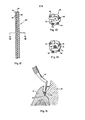
- Figures 9-11 schematically illustrate two alternatives to the basic structure of the knitted retraction cord of the present invention.
- knitting is defined as a process of using one or more separate strands to form a series of interlocking loops.
- a "strand” may comprise one or, alternatively, two or three threads (not shown) or yarns which are twisted together.
- one common type of loop that may be used to knit the retraction cord of the present invention is an "open" loop.
- the "open” loop is formed using a first loop 50a that is interlocked with an adjacent loop 49a such that the ends 46a and 47a of loop 50a do not cross one another.
- Figure 10 illustrates what is generally known as a "closed” loop because the end 46b bends back over and crosses in a manner that closes off the loop 50b.
- Figure lla schematically illustrates two rows (generally designated at 43a-44a) of interlocked loops constructed utilizing the open-loop configuration of Figure 9.
- row 43a comprises loops 50a, which are interlocked with the loops 49a of adjacent row 44a.
- Figure lla illustrates "weft" knitting, which is made from one loop to the next in the same course or row of loops, and which can be done using a single strand 56a.
- Figure llb schematically illustrates three rows (generally designated at 43b-45b) of interlocked loops constructed utilizing the closed-loop configuration of Figure 10.
- row 43b comprises loops 50b, which are interlocked with the loops 49b of adjacent row 44b.
- Loops 49b of row 44b are in turn interlocked with the loops 51b of adjacent row 45b, and so on.
- Figure llb illustrates "warp" knitting, in which several strands 52b-55b are connected such that the interlocking loops of each strand connect from one row to the next.
- Figure 12 illustrates a typical knitted retraction cord 60 utilizing four strands of yarn 61-64 which are knitted together (see also Figure 3) using the closed-loop pattern illustrated in Figures 10 and llb.
- the knitted retraction cord 60 is characteristically highly elastic and resilient in both the longitudinal and transverse dimensions.
- cord 60 can be easily stretched along its length, and it can also be easily squeezed or compressed radially as hereinafter more fully described. This is so because in a knitted cord the strand or strands are oriented so that a portion of each strand- runs transversely, or at approximately right angles to the longitudinal axis of the cord, thus making the cord more compressible and also more stretchable along its length.
- a twisted-strand or braided type cord has very little elasticity.
- longitudinal elasticity or the ability to stretch the cord lengthwise, is extremely beneficial because it avoids the tendency for packed cord to be dislodged as additional cord is pushed into the sulcus around the margin of the tooth; as the cord is packed, the "stretch" in the knitted cord permits stress to be placed on the cord without causing already packed portions of the cord to be pulled out of the sulcus.
- Transverse resiliency which can be characterized by the ability to radially compress and/or bend the cord 60, is also beneficial when packing the retraction cord into the gingival sulcus. Even if the loops of the knitted retraction cord are left rather loose, because of the intricate interlocking network, there is no tendency for the dental packing instrument to slip through the knitted cord. Rather, the compressibility of knitted cord 60 causes the cord 60 to "dimple" around the edges --of the dental packing instrument 32 in the manner illustrated in Figure 15. Comparing Figures 4 and 15, it will be appreciated that the dental packing instrument 32 will be much more likely to slip off the braided, nonresilient retraction cord 30 of Figure 4 than it would be to slip off of the compressible, knitted cord 60 of Figure 15.
- knitted retraction cord Another advantage of knitted retraction cord is its tendency to return to its original uncompressed shape because of its resilience. Thus, when a knitted retraction cord is packed into the sulcus, it is compressed, and the "memory" in the retraction cord causes the cord to gently push outward against the gingival tissue. By selecting an appropriate diameter of knitted retraction cord, this outward pushing can significantly increase the ability of the knitted cord to retract gingival tissues over conventional retraction cord. In order to take advantage of this property, it is anticipated that when substituting knitted retraction cord for conventional twisted-strand or braided cord, the diameter of the knitted cord will be larger than the diameter of the conventional cord being replaced. Thus, whereas conventional retraction cord comes in sizes having a diameter in the range of about 0.4 to about 1.0 millimeters, it is expected that knitted retraction cord will have a diameter in the range of about 0.75 to about 1.75 millimeters.
- the lingual gingival tissue can be adequately retracted with the knitted retraction cord only slightly compressed, and by virtue of its compressability and its ability to stretch and become thinner, the same cord can be packed into the sulcus on the labial side of an anterior tooth without over-retracting the gingival tissue. The cord then exerts a gentle, steady force on the tissue, which is desireable.
- the knitted retraction cord may have a hollow core 70.
- the strand 72 fills some of the space present in hollow core 70. Increasing or decreasing the diameter of central strand 72 can permit the transverse elasticity and longitudinal resilience to be easily controlled without adjusting the specifications of the knitted cord.
- Choice of an appropriate material for strand 72, e.g. wire, nylon, or yarn, etc., will also be useful in controlling the resilience of the knitted retraction cord.
- knitted retraction cord 60 Another beneficial result of the knitted retraction cord 60 is that the interlocking loops result in a substantially increased interstitial volume that is capable of carrying relatively large amounts of chemical retracting and hemostatic agent. Additionally, the ability of knitted retraction cord to effectively deliver the chemical retracting and hemostatic solution to the gingival tissue is greatly augmented by the fact that the knitted retraction cord is compressed when packed into the sulcus; thus, the cord actually expresses the hemostatic agent into the small capillaries of the tissue when it is compressed, thereby forcing the chemical agent into the bleeding pores to stop hemorrhage.
- knitted retraction cord is relatively easy to manufacture. It has been found that a knitting machine utilizing only a few strands of yarn (from 1 to 6) is capable of producing knitted retraction cord. Also, it is relatively easy to produce knitted cord having a circular cross section. This is advantageous because the desired amount of retraction will then be obtained regardless of the orientation of the cord in the sulcus.
- the manner of using the retraction cord of the present invention will be readily apparent to those of skill in the art.
- knitted retraction cord that has been soaked in an appropriate chemical solution containing a retraction agent and a hemostatic agent is packed into the sulcus.
- the knitted retraction cord may be pre-impregnated with a suitable chemical agent rather than soaking it prior to placement.
- the knitted retraction cord may be left in place for up to twenty minutes (depending on the retracting agent used) without causing injury to sensitive gingival tissue, a much shorter period of 'time is generally sufficient to achieve the desired retraction illustrated in Figure 8 when utilizing an appropriate chemical agent.
- chemical agents such as aluminum chloride, or aluminum sulfate (alum) are used, impression material is usually injected into the sulcus concurrently with removal of the cord before blood from hemorrhaging tissues has an opportunity to seep into the sulcus.
- the use of knitted retraction cord is extremely advantageous when utilizing these solutions.
- ferric sulfate such as that sold under the trademark ASTRINGEDENT by Ultradent Products Inc., Salt Lake City, Utah
- ferric sulfate solution is then applied directly to any tissue that is still bleeding in order to arrest all hemorrhaging, such as by use of the applicator sold under the trademark DENTO-INFUSOR, by Ultradent Products Inc.
- the tooth and sulcus are then. washed and dried to insure that no foreign material will interfere with the taking of an accurate impression.
- the impression material is injected into the now clean, dry and retracted gingival sulcus. Since suitable retraction of the gingival tissues will be maintained for in excess of thirty minutes when utilizing this technique, there is no need for haste throughout this procedure, and the dental practitioner can take the time needed to insure that a good impression is made.
- the knitted retraction cord in accordance with the present invention offers significant advantages over conventional twisted-strand or braided-strand retraction cord.
- the stretch and bendability obtainable in knitted retraction cord avoids the tendency for packed cord to pop out as additional portions are packed around a tooth.
- the compressibility of knitted retraction cord prevents the dental packing instrument from slipping off the cord because of the tendency for knitted retraction cord to "dimple" under pressure from the packing instrument.
- Compressibility has also been found extremely advantageous because it assists in retraction of the gingival tissues by gently pushing against the tissue, and because it can be stretched and compressed so as to more readily conform to difficult areas such as the sulcus on the labial side of anterior teeth.
- Knitted retraction cord also has the ability to carry relatively large amounts of chemical solution containing hemostatic and/or retracting agent. Coupled with the compressibility of knitted retraction cord, this feature greatly augments the ability of knitted retraction cord to effectively deliver retracting and hemostatic agents to the gingival tissues.
Landscapes
- Health & Medical Sciences (AREA)
- General Health & Medical Sciences (AREA)
- Dentistry (AREA)
- Epidemiology (AREA)
- Life Sciences & Earth Sciences (AREA)
- Animal Behavior & Ethology (AREA)
- Oral & Maxillofacial Surgery (AREA)
- Public Health (AREA)
- Veterinary Medicine (AREA)
- Dental Tools And Instruments Or Auxiliary Dental Instruments (AREA)
- Prostheses (AREA)
- Socks And Pantyhose (AREA)
- Materials For Medical Uses (AREA)
- Knitting Of Fabric (AREA)
Priority Applications (1)
| Application Number | Priority Date | Filing Date | Title |
|---|---|---|---|
| AT84303422T ATE31476T1 (de) | 1983-07-07 | 1984-05-21 | Strickfaden zum zurueckhalten des zahnfleisches. |
Applications Claiming Priority (2)
| Application Number | Priority Date | Filing Date | Title |
|---|---|---|---|
| US511779 | 1983-07-07 | ||
| US06/511,779 US4522593A (en) | 1983-07-07 | 1983-07-07 | Knitted gingival retraction cord |
Publications (3)
| Publication Number | Publication Date |
|---|---|
| EP0131360A2 true EP0131360A2 (de) | 1985-01-16 |
| EP0131360A3 EP0131360A3 (en) | 1985-10-30 |
| EP0131360B1 EP0131360B1 (de) | 1987-12-23 |
Family
ID=24036409
Family Applications (1)
| Application Number | Title | Priority Date | Filing Date |
|---|---|---|---|
| EP84303422A Expired EP0131360B1 (de) | 1983-07-07 | 1984-05-21 | Strickfaden zum Zurückhalten des Zahnfleisches |
Country Status (6)
| Country | Link |
|---|---|
| US (1) | US4522593A (de) |
| EP (1) | EP0131360B1 (de) |
| JP (1) | JPS6036045A (de) |
| AT (1) | ATE31476T1 (de) |
| CA (1) | CA1256720A (de) |
| DE (2) | DE3468165D1 (de) |
Cited By (3)
| Publication number | Priority date | Publication date | Assignee | Title |
|---|---|---|---|---|
| EP0317690A1 (de) * | 1986-05-26 | 1989-05-31 | Leif Hagne | Ein Verfahren und ein Retraktionsfaden zum Freilegen und zur Drainage der Grenzlinie von präparierten Zähnen |
| GB2278280A (en) * | 1993-05-27 | 1994-11-30 | Melis Makris | Dental instrument for opening the sulcus |
| WO2023102426A1 (en) * | 2021-12-03 | 2023-06-08 | Alexander Shor | Gingival retraction devices |
Families Citing this family (51)
| Publication number | Priority date | Publication date | Assignee | Title |
|---|---|---|---|---|
| US4895517A (en) * | 1987-04-14 | 1990-01-23 | Ultradent Products, Inc. | Methods for performing vital dental pulpotomy |
| US4997371A (en) * | 1988-06-22 | 1991-03-05 | Honda Giken Kogyo Kabushiki Kaisha | Dental agent applicator |
| US5104317A (en) * | 1990-09-06 | 1992-04-14 | The Hygenic Corporation | Elastomeric cord for retaining a dental dam, cord dispenser and related combinations and methods |
| US5269684A (en) * | 1992-08-31 | 1993-12-14 | Ultradent Products, Inc. | Adjustable brush delivery tip with secondary flow path |
| US5246371A (en) * | 1992-08-31 | 1993-09-21 | Ultradent Products, Inc. | Method and apparatus for delivery of highly filled, thixotropic sealant to teeth |
| US6282013B1 (en) | 1997-04-30 | 2001-08-28 | Lasermed, Inc. | System for curing polymeric materials, such as those used in dentistry, and for tailoring the post-cure properties of polymeric materials through the use of light source power modulation |
| US6008264A (en) | 1997-04-30 | 1999-12-28 | Laser Med, Inc. | Method for curing polymeric materials, such as those used in dentistry, and for tailoring the post-cure properties of polymeric materials through the use of light source power modulation |
| US6096328A (en) * | 1997-06-06 | 2000-08-01 | The Procter & Gamble Company | Delivery system for an oral care substance using a strip of material having low flexural stiffness |
| US20020018754A1 (en) * | 1999-03-15 | 2002-02-14 | Paul Albert Sagel | Shapes for tooth whitening strips |
| US6602074B1 (en) | 1997-10-29 | 2003-08-05 | Bisco, Inc. | Dental composite light curing system |
| US6116900A (en) * | 1997-11-17 | 2000-09-12 | Lumachem, Inc. | Binary energizer and peroxide delivery system for dental bleaching |
| US6200134B1 (en) | 1998-01-20 | 2001-03-13 | Kerr Corporation | Apparatus and method for curing materials with radiation |
| US5899694A (en) * | 1998-02-20 | 1999-05-04 | Summer; John | Gingival retraction apparatus and method |
| US6540514B1 (en) * | 1998-02-26 | 2003-04-01 | Theodore S. Falk | Method for isolating a dental implant |
| US6106286A (en) * | 1999-01-22 | 2000-08-22 | Gupta; Subhash | Method and device for administering medicine to the periodontium |
| US6157661A (en) * | 1999-05-12 | 2000-12-05 | Laserphysics, Inc. | System for producing a pulsed, varied and modulated laser output |
| US6375461B1 (en) | 2000-09-18 | 2002-04-23 | Ultradent Products, Inc. | Gingival retraction cords incorporating propylhexedrine |
| US6974320B2 (en) * | 2002-04-03 | 2005-12-13 | Christiansen Bart G | Tools and methods for measuring tooth reduction |
| US8524200B2 (en) | 2002-09-11 | 2013-09-03 | The Procter & Gamble Company | Tooth whitening products |
| US7033317B2 (en) * | 2003-06-05 | 2006-04-25 | Hydrocision, Inc. | Disposable endoscope and method of making a disposable endoscope |
| US7168951B2 (en) * | 2004-06-09 | 2007-01-30 | Ultradent Products, Inc. | Reinforced gingival retraction cord |
| US7121828B2 (en) * | 2004-06-09 | 2006-10-17 | Ultradent Products, Inc. | Reinforced gingival retraction cord |
| TWI259075B (en) * | 2004-06-29 | 2006-08-01 | Biotech One Inc | Gingival retraction material |
| DE102004032099A1 (de) * | 2004-07-01 | 2006-01-26 | Coltène/Whaledent GmbH + Co. KG | Retraktionsfaden mit verbesserter Saugfähigkeit |
| US20080003538A1 (en) * | 2004-12-30 | 2008-01-03 | Dux Industries, Inc. | Gingival retraction cord with wetting agent |
| EP1839618A1 (de) | 2006-03-31 | 2007-10-03 | 3M Innovative Properties Company | Zahnfleischretraktionsvorrichtung, Verfahren zur Herstellung und zur Benutzung derselben |
| WO2007115063A2 (en) * | 2006-03-31 | 2007-10-11 | 3M Innovative Properties Company | Dental retraction device, method of production and use thereof |
| EP1886659A1 (de) * | 2006-08-08 | 2008-02-13 | 3M Innovative Properties Company | Aushärtbare dentale Retraktion-Zusammensetzung, Verfahren zur Herstellung und Verwendung |
| US20090017420A1 (en) * | 2006-10-04 | 2009-01-15 | Saadallah Jabri | Gingival Cord Applicator for Dental Crown Preparation |
| US7901208B2 (en) | 2006-10-20 | 2011-03-08 | Ultradent Products, Inc. | Chemically impregnated absorbent gingival retraction cord comprising silk |
| US20080220050A1 (en) * | 2007-03-08 | 2008-09-11 | Kerr Corporation | Compositions For Gingival Retraction And Other Methods |
| US20090042170A1 (en) * | 2007-08-07 | 2009-02-12 | Kerr Corporation | Gingival retraction with light curable composition |
| US20100248190A1 (en) * | 2007-08-07 | 2010-09-30 | Kerr Corporation | Method of using dental composition |
| EP2036533A1 (de) * | 2007-09-14 | 2009-03-18 | 3M Innovative Properties Company | Härtbare dentale Rückführungszusammensetzung, Herstellungsverfahren dafür und Verwendung davon |
| EP2070505A1 (de) | 2007-12-10 | 2009-06-17 | 3M Innovative Properties Company | Zahnfleischretraktionszusammensetzung, ihre Herstellung und die Verwendung einer Pulverstrahlvorrichtung zur Zahnfleischretraktion |
| US7922487B2 (en) | 2008-06-09 | 2011-04-12 | Ultradent Products, Inc. | Chemically pre-impregnated silk retraction cords having increased strength |
| EP2172167A1 (de) * | 2008-10-02 | 2010-04-07 | 3M Innovative Properties Company | Zahnfleischretraktionsvorrichtung und Verfahren zur seiner Herstellung |
| DE102009004978B4 (de) * | 2009-01-14 | 2012-12-06 | Hans Peter Schepperheyn | Retraktionshilfe für den zahnärztlichen Gebrauch |
| US9072572B2 (en) | 2009-04-02 | 2015-07-07 | Kerr Corporation | Dental light device |
| US9066777B2 (en) * | 2009-04-02 | 2015-06-30 | Kerr Corporation | Curing light device |
| EP2255748A1 (de) | 2009-05-29 | 2010-12-01 | 3M Innovative Properties Company | Zahnfleischretraktionszusammensetzung, Herstellungsverfahren dafür und Verwendung davon |
| US20110097686A1 (en) * | 2009-10-28 | 2011-04-28 | Don Ross | Gingival retraction system |
| US20140087330A1 (en) * | 2012-09-25 | 2014-03-27 | John J. Discko | Dental retraction cord facilitating absorption and blood clotting |
| PL2908798T3 (pl) | 2012-10-17 | 2019-02-28 | Procter & Gamble | Pasek do wprowadzania środka aktywującego higienę jamy ustnej i sposoby stosowania środków aktywujących higienę jamy ustnej |
| KR101675867B1 (ko) | 2014-12-17 | 2016-11-23 | 주식회사 아모그린텍 | 나노섬유 복합사를 이용한 치과용 코드 및 그의 제조방법 |
| US10327871B2 (en) * | 2016-08-26 | 2019-06-25 | King Abdulaziz University | Reinforced gingival retraction cord |
| EP3534867B1 (de) | 2016-11-07 | 2025-06-04 | Solventum Intellectual Properties Company | Medizinische zusammensetzung mit guanidinyl-haltigem(n) polymer(en) und carrageenan(en) |
| EP3534866B1 (de) | 2016-11-07 | 2025-05-28 | Solventum Intellectual Properties Company | Zahnfleischretraktionsmethode mit zusammensetzung mit guanidinyl-haltigem polymer |
| US10842593B1 (en) | 2019-12-31 | 2020-11-24 | King Saud University | Sulcular guard and method of use |
| US20240024205A1 (en) | 2020-12-11 | 2024-01-25 | 3M Innovative Properties Company | Dental retraction composition |
| KR102775854B1 (ko) * | 2024-07-10 | 2025-03-06 | 안준환 | 라이오셀필라멘트사를 이용한 치은수축용 코드 |
Family Cites Families (8)
| Publication number | Priority date | Publication date | Assignee | Title |
|---|---|---|---|---|
| US3124136A (en) * | 1964-03-10 | Method of repairing body tissue | ||
| US1287926A (en) * | 1914-03-28 | 1918-12-17 | Frederic Ecaubert | Dental cleaning device. |
| US3108357A (en) * | 1962-06-20 | 1963-10-29 | William J Liebig | Compound absorbable prosthetic implants, fabrics and yarns therefor |
| US3463158A (en) * | 1963-10-31 | 1969-08-26 | American Cyanamid Co | Polyglycolic acid prosthetic devices |
| US3540452A (en) * | 1968-02-28 | 1970-11-17 | Dow Chemical Co | Suture |
| US4137921A (en) * | 1977-06-24 | 1979-02-06 | Ethicon, Inc. | Addition copolymers of lactide and glycolide and method of preparation |
| FR2432060A1 (fr) * | 1978-07-25 | 1980-02-22 | Gonon Jean | Cordon tricote notamment pour ruban fronceur et procede pour sa fabrication |
| US4321038A (en) * | 1980-07-18 | 1982-03-23 | Van R Dental Products, Inc. | Braided gingival retraction cord |
-
1983
- 1983-07-07 US US06/511,779 patent/US4522593A/en not_active Expired - Lifetime
-
1984
- 1984-05-17 CA CA000454622A patent/CA1256720A/en not_active Expired
- 1984-05-21 DE DE8484303422T patent/DE3468165D1/de not_active Expired
- 1984-05-21 EP EP84303422A patent/EP0131360B1/de not_active Expired
- 1984-05-21 AT AT84303422T patent/ATE31476T1/de not_active IP Right Cessation
- 1984-05-21 DE DE198484303422T patent/DE131360T1/de active Pending
- 1984-07-07 JP JP59141287A patent/JPS6036045A/ja active Granted
Cited By (4)
| Publication number | Priority date | Publication date | Assignee | Title |
|---|---|---|---|---|
| EP0317690A1 (de) * | 1986-05-26 | 1989-05-31 | Leif Hagne | Ein Verfahren und ein Retraktionsfaden zum Freilegen und zur Drainage der Grenzlinie von präparierten Zähnen |
| GB2278280A (en) * | 1993-05-27 | 1994-11-30 | Melis Makris | Dental instrument for opening the sulcus |
| GB2278280B (en) * | 1993-05-27 | 1997-03-05 | Melis Makris | Instrument for opening the sulcus of a tooth |
| WO2023102426A1 (en) * | 2021-12-03 | 2023-06-08 | Alexander Shor | Gingival retraction devices |
Also Published As
| Publication number | Publication date |
|---|---|
| US4522593A (en) | 1985-06-11 |
| DE3468165D1 (en) | 1988-02-04 |
| EP0131360A3 (en) | 1985-10-30 |
| JPH0252504B2 (de) | 1990-11-13 |
| CA1256720A (en) | 1989-07-04 |
| ATE31476T1 (de) | 1988-01-15 |
| JPS6036045A (ja) | 1985-02-25 |
| EP0131360B1 (de) | 1987-12-23 |
| DE131360T1 (de) | 1987-05-21 |
Similar Documents
| Publication | Publication Date | Title |
|---|---|---|
| EP0131360B1 (de) | Strickfaden zum Zurückhalten des Zahnfleisches | |
| US4832063A (en) | Flossing device | |
| US6375461B1 (en) | Gingival retraction cords incorporating propylhexedrine | |
| US7168951B2 (en) | Reinforced gingival retraction cord | |
| US4465462A (en) | Gingival retraction cord | |
| US5063948A (en) | Bristled dental floss | |
| US4878890A (en) | Perihepatic prosthesis | |
| US4321038A (en) | Braided gingival retraction cord | |
| US4265258A (en) | Dental floss | |
| US5540588A (en) | Teflon-coated intraoral tissue retraction cord | |
| Butcher et al. | The vascularity of the incisor pulp of the monkey and its alteration by tooth retraction | |
| EP2921132B1 (de) | Chemisch imprägnierter, absorbierender zahnfleischretraktionsfaden mit seide | |
| US7033173B2 (en) | Gingival retraction device and method | |
| US5094255A (en) | Acrylic dental floss and method for manufacture | |
| US7121828B2 (en) | Reinforced gingival retraction cord | |
| GB2024630A (en) | Tooth cleaner | |
| US3091856A (en) | Elastic thread ligature | |
| US3929144A (en) | Device for inserting dental floss through interproximal areas and method of using same | |
| US20080003538A1 (en) | Gingival retraction cord with wetting agent | |
| US6612839B2 (en) | Gingival retractor | |
| US4092739A (en) | Method of replacing hair | |
| FR2509169A1 (fr) | Bande de contention elastique en tout sens | |
| US6155831A (en) | Non-surgically retrievable guided tissue regeneration membrane | |
| US2623284A (en) | Means for isolating teeth from moisture during dental operations | |
| WO2007078298A2 (en) | Gingival retraction cord with wetting agent |
Legal Events
| Date | Code | Title | Description |
|---|---|---|---|
| PUAI | Public reference made under article 153(3) epc to a published international application that has entered the european phase |
Free format text: ORIGINAL CODE: 0009012 |
|
| AK | Designated contracting states |
Designated state(s): AT BE CH DE FR GB IT LI LU NL SE |
|
| PUAL | Search report despatched |
Free format text: ORIGINAL CODE: 0009013 |
|
| AK | Designated contracting states |
Designated state(s): AT BE CH DE FR GB IT LI LU NL SE |
|
| 17P | Request for examination filed |
Effective date: 19851204 |
|
| 17Q | First examination report despatched |
Effective date: 19861124 |
|
| EL | Fr: translation of claims filed | ||
| DET | De: translation of patent claims | ||
| RAP1 | Party data changed (applicant data changed or rights of an application transferred) |
Owner name: ULTRADENT PRODUCTS, INC. |
|
| RIN1 | Information on inventor provided before grant (corrected) |
Inventor name: FISCHER, DAN E. |
|
| GRAA | (expected) grant |
Free format text: ORIGINAL CODE: 0009210 |
|
| AK | Designated contracting states |
Kind code of ref document: B1 Designated state(s): AT BE CH DE FR GB IT LI LU NL SE |
|
| REF | Corresponds to: |
Ref document number: 31476 Country of ref document: AT Date of ref document: 19880115 Kind code of ref document: T |
|
| REF | Corresponds to: |
Ref document number: 3468165 Country of ref document: DE Date of ref document: 19880204 |
|
| ET | Fr: translation filed | ||
| ITF | It: translation for a ep patent filed | ||
| PLBE | No opposition filed within time limit |
Free format text: ORIGINAL CODE: 0009261 |
|
| STAA | Information on the status of an ep patent application or granted ep patent |
Free format text: STATUS: NO OPPOSITION FILED WITHIN TIME LIMIT |
|
| 26N | No opposition filed | ||
| ITTA | It: last paid annual fee | ||
| EPTA | Lu: last paid annual fee | ||
| EAL | Se: european patent in force in sweden |
Ref document number: 84303422.4 |
|
| PGFP | Annual fee paid to national office [announced via postgrant information from national office to epo] |
Ref country code: LU Payment date: 20000518 Year of fee payment: 17 |
|
| PGFP | Annual fee paid to national office [announced via postgrant information from national office to epo] |
Ref country code: AT Payment date: 20010504 Year of fee payment: 18 |
|
| PG25 | Lapsed in a contracting state [announced via postgrant information from national office to epo] |
Ref country code: LU Free format text: LAPSE BECAUSE OF NON-PAYMENT OF DUE FEES Effective date: 20010521 |
|
| REG | Reference to a national code |
Ref country code: GB Ref legal event code: IF02 |
|
| PG25 | Lapsed in a contracting state [announced via postgrant information from national office to epo] |
Ref country code: AT Free format text: LAPSE BECAUSE OF NON-PAYMENT OF DUE FEES Effective date: 20020521 |
|
| PGFP | Annual fee paid to national office [announced via postgrant information from national office to epo] |
Ref country code: BE Payment date: 20020606 Year of fee payment: 19 |
|
| PGFP | Annual fee paid to national office [announced via postgrant information from national office to epo] |
Ref country code: NL Payment date: 20030513 Year of fee payment: 20 |
|
| PGFP | Annual fee paid to national office [announced via postgrant information from national office to epo] |
Ref country code: GB Payment date: 20030514 Year of fee payment: 20 |
|
| PGFP | Annual fee paid to national office [announced via postgrant information from national office to epo] |
Ref country code: FR Payment date: 20030520 Year of fee payment: 20 |
|
| PGFP | Annual fee paid to national office [announced via postgrant information from national office to epo] |
Ref country code: SE Payment date: 20030521 Year of fee payment: 20 |
|
| PGFP | Annual fee paid to national office [announced via postgrant information from national office to epo] |
Ref country code: CH Payment date: 20030522 Year of fee payment: 20 |
|
| PG25 | Lapsed in a contracting state [announced via postgrant information from national office to epo] |
Ref country code: BE Free format text: LAPSE BECAUSE OF NON-PAYMENT OF DUE FEES Effective date: 20030531 |
|
| PGFP | Annual fee paid to national office [announced via postgrant information from national office to epo] |
Ref country code: DE Payment date: 20030626 Year of fee payment: 20 |
|
| BERE | Be: lapsed |
Owner name: *ULTRADENT PRODUCTS INC. Effective date: 20030531 |
|
| PG25 | Lapsed in a contracting state [announced via postgrant information from national office to epo] |
Ref country code: LI Free format text: LAPSE BECAUSE OF EXPIRATION OF PROTECTION Effective date: 20040520 Ref country code: GB Free format text: LAPSE BECAUSE OF EXPIRATION OF PROTECTION Effective date: 20040520 Ref country code: CH Free format text: LAPSE BECAUSE OF EXPIRATION OF PROTECTION Effective date: 20040520 |
|
| PG25 | Lapsed in a contracting state [announced via postgrant information from national office to epo] |
Ref country code: NL Free format text: LAPSE BECAUSE OF EXPIRATION OF PROTECTION Effective date: 20040521 |
|
| REG | Reference to a national code |
Ref country code: GB Ref legal event code: PE20 |
|
| REG | Reference to a national code |
Ref country code: CH Ref legal event code: PL |
|
| EUG | Se: european patent has lapsed | ||
| NLV7 | Nl: ceased due to reaching the maximum lifetime of a patent |
Effective date: 20040521 |