EP0131850A2 - Conducteur pour câble sous-marin d'énergie et procédé de fabrication d'un tel conducteur - Google Patents
Conducteur pour câble sous-marin d'énergie et procédé de fabrication d'un tel conducteur Download PDFInfo
- Publication number
- EP0131850A2 EP0131850A2 EP84107811A EP84107811A EP0131850A2 EP 0131850 A2 EP0131850 A2 EP 0131850A2 EP 84107811 A EP84107811 A EP 84107811A EP 84107811 A EP84107811 A EP 84107811A EP 0131850 A2 EP0131850 A2 EP 0131850A2
- Authority
- EP
- European Patent Office
- Prior art keywords
- conductor
- angle
- manufacturing
- wires
- speed
- Prior art date
- Legal status (The legal status is an assumption and is not a legal conclusion. Google has not performed a legal analysis and makes no representation as to the accuracy of the status listed.)
- Granted
Links
- 239000004020 conductor Substances 0.000 title claims abstract description 25
- 238000004519 manufacturing process Methods 0.000 title claims description 6
- 230000000737 periodic effect Effects 0.000 claims description 6
- 239000002184 metal Substances 0.000 claims description 2
- 238000000034 method Methods 0.000 description 6
- 229910000831 Steel Inorganic materials 0.000 description 2
- 230000005540 biological transmission Effects 0.000 description 2
- 239000010959 steel Substances 0.000 description 2
- 238000004804 winding Methods 0.000 description 2
- 241000287107 Passer Species 0.000 description 1
- 239000004698 Polyethylene Substances 0.000 description 1
- 229920003020 cross-linked polyethylene Polymers 0.000 description 1
- 239000004703 cross-linked polyethylene Substances 0.000 description 1
- 238000009434 installation Methods 0.000 description 1
- 210000000056 organ Anatomy 0.000 description 1
- -1 polyethylene Polymers 0.000 description 1
- 229920000573 polyethylene Polymers 0.000 description 1
- 239000004065 semiconductor Substances 0.000 description 1
Images

Classifications
-
- H—ELECTRICITY
- H01—ELECTRIC ELEMENTS
- H01B—CABLES; CONDUCTORS; INSULATORS; SELECTION OF MATERIALS FOR THEIR CONDUCTIVE, INSULATING OR DIELECTRIC PROPERTIES
- H01B13/00—Apparatus or processes specially adapted for manufacturing conductors or cables
- H01B13/02—Stranding-up
- H01B13/0214—Stranding-up by a twisting pay-off device
-
- H—ELECTRICITY
- H01—ELECTRIC ELEMENTS
- H01B—CABLES; CONDUCTORS; INSULATORS; SELECTION OF MATERIALS FOR THEIR CONDUCTIVE, INSULATING OR DIELECTRIC PROPERTIES
- H01B13/00—Apparatus or processes specially adapted for manufacturing conductors or cables
- H01B13/22—Sheathing; Armouring; Screening; Applying other protective layers
- H01B13/26—Sheathing; Armouring; Screening; Applying other protective layers by winding, braiding or longitudinal lapping
Definitions
- the present invention relates to a conductor for a submarine energy cable, as well as to a method for manufacturing such a conductor.
- a submarine energy cable is essentially made up of one to three conductors wired at constant pitch and insulated, the whole being surrounded by armor made of steel wires laid in a helix.
- the purpose of this armor is to protect the insulating layers and to increase the tensile strength of the cable.
- the object of the invention is to obtain a lower tensile modulus than that obtained by helical wiring with constant pitch to reduce the force F 1 supported by the conductor.
- the subject of the present invention is a conductor for an underwater energy cable, consisting of at least one layer of wired metal wires, characterized in that all the wires are wired in the same direction and at a periodically variable angle.
- each conductor wire can follow this elongation by modifying its geometrical position by approaching the mean helix without elongation of the wire itself.
- the pitch of the ripple generated by the periodically variable angle is less than twice the average pitch of wiring.
- the peak-peak amplitude of the undulation of the wires is less than 0.1 times the pitch of the undulation.
- the present invention also relates to a manufacturing process characterized in that a periodic variation of the angle of commettage.
- the periodic variation of the angle of commetting is obtained by modulating the speed of rotation of the wiring grid through which said wires pass.
- the periodic variation of the angle of commetting is obtained by modulating the speed of the capstan which receives said wires.
- the cage 1 is driven in rotation from the main shaft 5 by means of a transmission comprising a gearbox 6.
- a drawing capstan 7 is also driven from the main shaft through a gearbox 8.
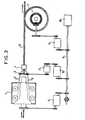
- FIG. 2 shows the stranding machine equipped with a speed variation system w of the distribution grid.
- a grid 9 is mounted which is driven independently of the cage by means of a transmission equipped with a gearbox 10 having ratios identical to those of the gearbox 6 of the cage.
- a speed modulator 11 is added to the kinematic chain.
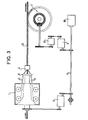
- FIG. 3 shows the stranding machine equipped with a speed variation system v for drawing the capstan 7.
- a speed modulator 12 is added.
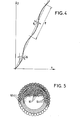
- the pitch of the wire ripple is p and the value of its peak-peak ripple is ⁇ .
- the value of p is preferably less than twice the average wiring pitch.
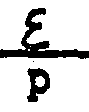
- the value of is chosen between 3% and 7%, which corresponds to a geometric elongation of the wires from 0.2% to 1%.
- FIG. 5 shows an underwater energy cable comprising a single conductor composed of wires 50 according to the invention.
- This conductor is surrounded by several insulating layers 51 which may be made of paper impregnated with oil, or of polyethylene or crosslinked polyethylene.
- the layer 51 directly in contact with the conductor can be semiconductor to ensure a better distribution of the potential.
- a weave 52 of steel wires surrounds the assembly.
Landscapes
- Engineering & Computer Science (AREA)
- Manufacturing & Machinery (AREA)
- Insulated Conductors (AREA)
- Non-Insulated Conductors (AREA)
- Processes Specially Adapted For Manufacturing Cables (AREA)
- Manufacturing Of Electric Cables (AREA)
- Ropes Or Cables (AREA)
Abstract
Description
- La présente invention concerne un conducteur pour câble sous-marin d'énergie, ainsi qu'un procédé de fabrication d'un tel conducteur.
- Un câble sous-marin d'énergie est constitué essentiellement par un à trois conducteurs oâblés à pas constant et isolés, l'ensemble étant entouré par une armure en fils d'acier posés en hélice. Cette armure a pour but de protéger les couches isolantes et d'accroître la résistance du câble à la traction.
- Au cours de la pose le câble est soumis à une force de traction F provoquée par son propre poids. Il en résulte, un allongement du câble généralement inférieur à 1%, une force F dans le conducteur et une force F2 dans l'armure avec F = F + F2* Mais par suite du module de traction élevé d'un conducteur câblé à pas constant on a souvent F supérieure à F2 et l'armure ne joue pas pleinement son rôle de porteur, ce qui est particulièrement important pour les câbles immergés à grande profondeur.
- L'invention a pour but d'obtenir un module de traction plus faible que celui obtenu par un câblage hélicoïdal à pas constant pour diminuer la force F1 supportée par le conducteur.
- La présente invention a pour objet un conducteur pour câble sous-marin d'énergie, constitué par au moins une couche de fils métalliques câblés, caractérisé par le fait que toul les fils sont câblés dans un même sens et suivant un angle périodiquement variable.
- Il en résulte que tous les fils serpentent de part et d'autre d'une hélice moyenne d'enroulement. Ainsi, lors d'un allongement du conducteur, chaque fil du conducteur pourra suivre cet allongement par modification de sa position géométrique en se rapprochant de l'hélice moyenne sans allongement du fil lui-même.
- De préférence, le pas de l'ondulation engendrée par l'angle périodiquement variable est inférieur à deux fois le pas moyen de câblage.
- Avantageusement l'amplitude crête-crête de l'ondulation des fils est inférieure à 0,1 fois le pas de l'ondulation.
- La présente invention a également pour objet un procédé de fabrication caractérisé en ce que l'on effectue une variation périodique de l'angle de commettage.
- Selon un premier mode de mise en oeuvre de ce procédé, on obtient la variation périodique de l'angle de commettage par la modulation de la vitesse de rotation de la grille de câblage à travers laquelle passent lesdits fils.
- Selon un second mode de mise en oeuvre de ce procédé, on obtient la variation périodique de l'angle de commettage par la modulation de la vitesse du cabestan qui reçoit lesdits fils.
- D'autres caractéristiques et avantages de la présente invention apparaîtront au cours de la description suivante de modes de réalisation donnés à titre illustratif mais nullement limitatif. Dans le dessin annexé :
- - la figure 1 montre très schématiquement les éléments essentiels d'une câbleuse,
- - la figure 2 montre une première variante de la câbleuse de la figure 1 permettant la mise en oeuvre du procédé selon l'invention,
- - la figure 3 montre une seconde variante de la câbleuse de la figure 1 permettant la mise en oeuvre du procédé selon l'invention,
- - la figure 4 est la développée d'un fil appartenant à un conducteur câblé selon le procédé de l'invention,
- - la figure 5 est une coupe schématique d'un câble sous-marin d'énergie comportant un conducteur selon l'invention.
- La figure 1 montre la disposition schématique des organes principaux d'une câbleuse :
- Celle-ci se compose d'une ou de plusieurs cages 1 portant chacune plusieurs bobines de fils 2. Ces fils traversent une grille de répartition 3 solidaire de la cage 1, avant de converger sur la filière de câblage 4 d'où sort un conducteur 21. Un moteur 20 entraîne un arbre principal 5 en rotation.
- La cage 1 est entraînée en rotation à partir de l'arbre principal 5 au moyen d'une transmission comportant une boîte de vitesse 6. Un cabestan de tirage 7 est lui aussi entraîné à partir de l'arbre principal à travers une boîte de vitesse 8.
- Si UU est la vitesse de rotation instantanée de la cage et de sa grille de répartition et v la vitesse de tirage instantanée du cabestan, pour un rayon d'enroulement r au niveau du conducteur, l'angle de commettage est :

- a/ par modulation de la vitesse de rotation uV de la grille de répartition
- b/ par modulation de la vitesse de tirage v (qui est en fait une modulation de la vitesse de rotation ω' du cabestan)
- La figure 2 montre la câbleuse équipée d'un système de variation de vitesse w de la grille de répartition. A la place de la grille 3 de la figure 1, on monte une grille 9 entraînée indépendamment de la cage au moyen d'une transmission équipée d'une boîte de vitesse 10 possédant des rapports identiques à ceux de la boite de vitesse 6 de la cage. On ajoute en plus dans la chaîne cinématique un modulateur de vitesse 11.
- La figure 3 montre la câbleuse équipée d'un système de variation de vitesse v de tirage du cabestan 7. Dans la chaîne cinématique de commande du cabestan on ajoute un modulateur de vitesse 12.
- Divers dispositifs mécaniques ou électriques connus permettent d'obtenir une vitesse de rotation périodiquement variables. A titre d'exemple on en cite quatre du domaine de la mécanique :
- 1 - L'utilisation d'une boîte de vitesse à trains planétaires à deux. vitesses. On peut passer d'une vitesse à l'autre par simple freinage des planétaires. On obtient ainsi ω≃ ω1 ou ω ≃ ω2
- 2 - L'utilisation d'un ou de plusieurs joints de cardan. La vitesse de sortie d'un tel joint varie avec l'angle θ du joint suivant la relation ω = ωo (1 + θ2 sin 2 ωot) pour & petit.
- 3 - L'utilisation d'engrenages à rapport non constant. Ce sont des engrenages non de révolution tels que par exemple les engrenages elliptiques. Leur rapport moyen est en général l'unité.
- 4 - L'utilisation d'un différentiel permettant de superposer à la rotation uniforme de l'arbre moteur, un mouvement oscillant produit par ailleurs.
- Tous les moyens précités permettent d'obtenir un conducteur dont les fils sont câblés avec un angle de oommettage périodiquement variable.
- On voit sur la figure 4, dans un système de coordonnées (Ox, Oy) la développée d'un fil de ce conducteur, posé avec un angle de commettage α variable.
- Le pas de l'ondulation du fil est p et la valeur de son ondulation crête-crête est ε. La valeur de p est de préférence inférieure à deux fois le pas de câblage moyen. La valeur de
- On voit sur la figure 5 un câble sous-marin d'énergie comportant un seul conducteur composé de fils 50 selon l'invention. Ce conducteur est entouré de plusieurs couches isolantes 51 pouvant être en papier imprégné d'huile, ou en polyéthylène ou en polyéthylène réticulé. La couche 51 directement en contact avec le conducteur peut être semiconductrice pour assurer une meilleure répartition du potentiel. Une armure 52 de fils d'acier entoure l'ensemble.
Claims (6)
Applications Claiming Priority (2)
| Application Number | Priority Date | Filing Date | Title |
|---|---|---|---|
| FR8311523 | 1983-07-11 | ||
| FR8311523A FR2549278B1 (fr) | 1983-07-11 | 1983-07-11 | Procede de fabrication d'un conducteur pour cable sous-marin d'energie, conducteur issu de ce procede et cable en faisant application |
Publications (3)
| Publication Number | Publication Date |
|---|---|
| EP0131850A2 true EP0131850A2 (fr) | 1985-01-23 |
| EP0131850A3 EP0131850A3 (en) | 1985-03-06 |
| EP0131850B1 EP0131850B1 (fr) | 1987-09-16 |
Family
ID=9290710
Family Applications (1)
| Application Number | Title | Priority Date | Filing Date |
|---|---|---|---|
| EP84107811A Expired EP0131850B1 (fr) | 1983-07-11 | 1984-07-05 | Conducteur pour câble sous-marin d'énergie et procédé de fabrication d'un tel conducteur |
Country Status (6)
| Country | Link |
|---|---|
| US (1) | US4584432A (fr) |
| EP (1) | EP0131850B1 (fr) |
| JP (1) | JPS6054107A (fr) |
| DE (1) | DE3466312D1 (fr) |
| FR (1) | FR2549278B1 (fr) |
| NO (1) | NO164564C (fr) |
Families Citing this family (3)
| Publication number | Priority date | Publication date | Assignee | Title |
|---|---|---|---|---|
| US9472320B2 (en) * | 2012-03-16 | 2016-10-18 | Wpfy, Inc. | Metal sheathed cable assembly with non-linear bonding/grounding conductor |
| CN102982912A (zh) * | 2012-11-26 | 2013-03-20 | 晶锋集团股份有限公司 | 一种可生产多种特种线缆的成缆机 |
| AU2017410328B2 (en) * | 2017-04-21 | 2022-08-18 | Prysmian S.P.A. | Method and armoured cable for transporting high voltage alternate current |
Family Cites Families (16)
| Publication number | Priority date | Publication date | Assignee | Title |
|---|---|---|---|---|
| US1626776A (en) * | 1924-06-25 | 1927-05-03 | Ohio Brass Co | Electrical conductor with reenforcing core |
| NL29407C (fr) * | 1928-09-06 | |||
| GB330944A (en) * | 1929-03-20 | 1930-06-20 | Oliver Ellsworth Buckley | Improvements in submarine signalling cables |
| US2163235A (en) * | 1935-10-02 | 1939-06-20 | Clyde L Chatham | Electric cable |
| US2128410A (en) * | 1936-05-02 | 1938-08-30 | Bell Telephone Labor Inc | Multiconductor signaling cable |
| US2203232A (en) * | 1937-05-27 | 1940-06-04 | Callenders Cable & Const Co | Means for protecting sheaths of electric cables, pipes, and other metal articles agaist corrosion |
| US2197544A (en) * | 1938-08-05 | 1940-04-16 | Gen Cable Corp | Electric cable |
| FR1170046A (fr) * | 1957-03-26 | 1959-01-08 | Geoffroy Delore | Procédé et dispositif de moulinage à multiple torsion |
| US3061997A (en) * | 1957-03-26 | 1962-11-06 | Delore Sa Geoffroy | Method and apparatus for producing improved conductor cables |
| GB990691A (en) * | 1961-10-12 | 1965-04-28 | Anaconda Wire & Cable Co | Improvements in electric cable, method and apparatus for stranding same |
| DE1515852C3 (de) * | 1965-11-20 | 1974-08-15 | Kabel- Und Metallwerke Gutehoffnungshuette Ag, 3000 Hannover | Kabel mit konzentrischem Schutz- bzw. Nulleiter |
| DE2528970A1 (de) * | 1975-06-28 | 1977-01-13 | Felten & Guilleaume Carlswerk | Selbsttragendes fernmeldeluftkabel |
| DK147720C (da) * | 1977-02-11 | 1985-05-20 | Kabelmetal Electro Gmbh | Fremgangsmaade til fremstilling af et traadlag paa kabler og ledninger og et apparat til udoevelse af fremgangsmaaden |
| FR2473080A1 (fr) * | 1979-12-21 | 1981-07-10 | Kanai Hiroyuki | Cable d'acier |
| US4446689A (en) * | 1981-02-02 | 1984-05-08 | At&T Technologies, Inc. | Telecommunication cables |
| SU1010169A1 (ru) * | 1981-08-28 | 1983-04-07 | Всесоюзный научно-исследовательский институт метизной промышленности | Проволочный канат |
-
1983
- 1983-07-11 FR FR8311523A patent/FR2549278B1/fr not_active Expired
-
1984
- 1984-07-05 DE DE8484107811T patent/DE3466312D1/de not_active Expired
- 1984-07-05 EP EP84107811A patent/EP0131850B1/fr not_active Expired
- 1984-07-09 NO NO842797A patent/NO164564C/no unknown
- 1984-07-09 US US06/629,293 patent/US4584432A/en not_active Expired - Fee Related
- 1984-07-09 JP JP59142089A patent/JPS6054107A/ja active Granted
Also Published As
| Publication number | Publication date |
|---|---|
| JPH0427643B2 (fr) | 1992-05-12 |
| FR2549278B1 (fr) | 1986-02-21 |
| DE3466312D1 (en) | 1987-10-22 |
| EP0131850B1 (fr) | 1987-09-16 |
| NO842797L (no) | 1985-01-14 |
| FR2549278A1 (fr) | 1985-01-18 |
| EP0131850A3 (en) | 1985-03-06 |
| NO164564C (no) | 1990-10-17 |
| NO164564B (no) | 1990-07-09 |
| JPS6054107A (ja) | 1985-03-28 |
| US4584432A (en) | 1986-04-22 |
Similar Documents
| Publication | Publication Date | Title |
|---|---|---|
| JP5947286B2 (ja) | ドライブ装置 | |
| CA2280935C (fr) | Eolienne a attaque directe basse vitesse | |
| US20110139055A1 (en) | Steerable paravane system for towed seismic streamer arrays | |
| FR2628404A1 (fr) | Systeme de suspension a cables pour un ascenseur | |
| EP0131850B1 (fr) | Conducteur pour câble sous-marin d'énergie et procédé de fabrication d'un tel conducteur | |
| US20220355909A1 (en) | Lifting assembly with a boat lift transmission device | |
| US8251351B2 (en) | Traction winch | |
| US3789415A (en) | Apparatus for wrapping cables or the like and a rotatable antenna utilizing the same | |
| US6471188B2 (en) | Apparatus and a method for use in handling a load | |
| FI82434C (fi) | Hissmaskineri. | |
| GB2062113A (en) | Apparatus for Harnessing the Hydraulic Power of the Sea | |
| DE19811130A1 (de) | Trommelmotor mit Getriebe | |
| US4285196A (en) | Wave power generator | |
| JPH0979334A (ja) | ベルト式無段変速機 | |
| GB191403691A (en) | Improvements in Wave Motors. | |
| AU2012203615B2 (en) | Steerable paravane method for towed seismic streamer arrays | |
| JPS6359705A (ja) | 架空地線への線状体らせん巻付け方法 | |
| GB2101798A (en) | Electric cable | |
| KR20190128861A (ko) | 발전장치 | |
| SU1695438A2 (ru) | Устройство дл кабельной св зи с подвижным объектом | |
| SU717268A1 (ru) | Подающий механизм бурового станка | |
| FR2610065A2 (fr) | Dispositif de transformation de mouvement, en particulier reducteur de vitesse | |
| CN2271640Y (zh) | 差异负荷器 | |
| FR2612593A2 (fr) | Dispositif de transformation de mouvement, en particulier reducteur de vitesse | |
| WO2023105250A1 (fr) | Centrale houlomotrice dotée d'un moufle d'accélération |
Legal Events
| Date | Code | Title | Description |
|---|---|---|---|
| PUAI | Public reference made under article 153(3) epc to a published international application that has entered the european phase |
Free format text: ORIGINAL CODE: 0009012 |
|
| PUAL | Search report despatched |
Free format text: ORIGINAL CODE: 0009013 |
|
| AK | Designated contracting states |
Designated state(s): DE FR GB IT |
|
| AK | Designated contracting states |
Designated state(s): DE FR GB IT |
|
| 17P | Request for examination filed |
Effective date: 19850827 |
|
| 17Q | First examination report despatched |
Effective date: 19860424 |
|
| GRAA | (expected) grant |
Free format text: ORIGINAL CODE: 0009210 |
|
| AK | Designated contracting states |
Kind code of ref document: B1 Designated state(s): DE FR GB IT |
|
| REF | Corresponds to: |
Ref document number: 3466312 Country of ref document: DE Date of ref document: 19871022 |
|
| GBT | Gb: translation of ep patent filed (gb section 77(6)(a)/1977) | ||
| ITF | It: translation for a ep patent filed | ||
| PLBE | No opposition filed within time limit |
Free format text: ORIGINAL CODE: 0009261 |
|
| STAA | Information on the status of an ep patent application or granted ep patent |
Free format text: STATUS: NO OPPOSITION FILED WITHIN TIME LIMIT |
|
| 26N | No opposition filed | ||
| PGFP | Annual fee paid to national office [announced via postgrant information from national office to epo] |
Ref country code: FR Payment date: 19920527 Year of fee payment: 9 |
|
| PGFP | Annual fee paid to national office [announced via postgrant information from national office to epo] |
Ref country code: DE Payment date: 19920615 Year of fee payment: 9 |
|
| PGFP | Annual fee paid to national office [announced via postgrant information from national office to epo] |
Ref country code: GB Payment date: 19920625 Year of fee payment: 9 |
|
| ITTA | It: last paid annual fee | ||
| PG25 | Lapsed in a contracting state [announced via postgrant information from national office to epo] |
Ref country code: GB Effective date: 19930705 |
|
| GBPC | Gb: european patent ceased through non-payment of renewal fee |
Effective date: 19930705 |
|
| PG25 | Lapsed in a contracting state [announced via postgrant information from national office to epo] |
Ref country code: FR Effective date: 19940331 |
|
| PG25 | Lapsed in a contracting state [announced via postgrant information from national office to epo] |
Ref country code: DE Effective date: 19940401 |
|
| REG | Reference to a national code |
Ref country code: FR Ref legal event code: ST |