EP0132230A2 - Verfahren zur Herstellung von Sulfonylharnstoffen - Google Patents
Verfahren zur Herstellung von Sulfonylharnstoffen Download PDFInfo
- Publication number
- EP0132230A2 EP0132230A2 EP84810346A EP84810346A EP0132230A2 EP 0132230 A2 EP0132230 A2 EP 0132230A2 EP 84810346 A EP84810346 A EP 84810346A EP 84810346 A EP84810346 A EP 84810346A EP 0132230 A2 EP0132230 A2 EP 0132230A2
- Authority
- EP
- European Patent Office
- Prior art keywords
- halogen
- alkyl
- alkoxy
- formula
- benzenesulfonamide
- Prior art date
- Legal status (The legal status is an assumption and is not a legal conclusion. Google has not performed a legal analysis and makes no representation as to the accuracy of the status listed.)
- Granted
Links
- 0 C*(C)*[C@](C)N Chemical compound C*(C)*[C@](C)N 0.000 description 3
Classifications
-
- C—CHEMISTRY; METALLURGY
- C07—ORGANIC CHEMISTRY
- C07D—HETEROCYCLIC COMPOUNDS
- C07D521/00—Heterocyclic compounds containing unspecified hetero rings
Definitions
- Sulfonylureas of the formula I have an excellent herbicidal action and can therefore be used advantageously as herbicidal agents.
- Sulfonylureas of the formula I their preparation and use are described, for example, in US Pat. Nos. 4,127,405, 4,169,719, 4,238,621, in EP-A 83810005.5 and in South African Patent No. 4874/81.
- p-toluenesulfonyl-butylurea can be prepared from p-toluenesulfonyl-phenylcarbamate and butylamine [Jap. Patent Application No .: 33-13484, C.A. 1962/1 7218 g].
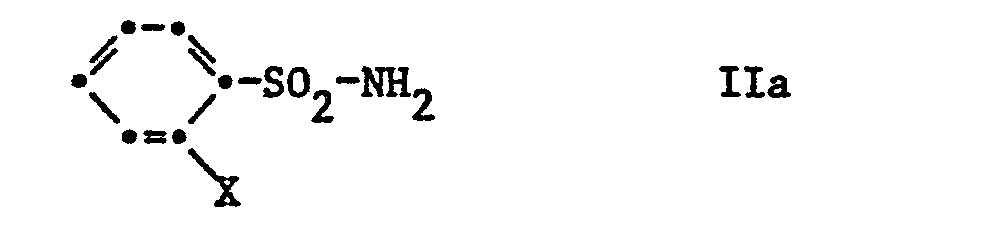
- the process of the invention preferably uses sulfonamides of the formula IIa used in which X has the meaning given above.
- the sulfonamide of the formula II is first mixed with the equivalent amount of a base in an alkali salt, e.g. Sodium or potassium salt or converted into a salt of a suitable tertiary amine.
- an alkali salt e.g. Sodium or potassium salt
- the subsequent workup of the reaction mixture is designed so that the resulting salt is finally present as a solution or as a suspension in an aprotic solvent with the exclusion of water.
- Suitable aprotic solvents are e.g. Acetonitrile, tetrahydrofuran, dioxane, 1,2-dimethoxyethane, dimethylformamide, N, N-dimethyl-acetamide, N-methylpyrrolidone or mixtures thereof. Acetonitrile is particularly suitable as the solvent.
- the sulfonamide of formula II can first be treated with an alkali hydroxide in a solvent, e.g. Alcohol, the resulting alkali salt can be added after the addition of a second solvent such as e.g. Toluene and after evaporation of the solvent can be obtained as an anhydrous residue. If necessary, this can be dried in a vacuum.
- a solvent e.g. Alcohol
- a second solvent such as e.g. Toluene
- evaporation of the solvent can be obtained as an anhydrous residue. If necessary, this can be dried in a vacuum.
- Sodium or potassium hydroxide are suitable as alkali metal hydroxides.
- the potassium hydroxide is preferred as the alkali hydroxide.
- the sodium or potassium salt of the sulfonamide of the formula II can also be obtained analogously by reacting the free sulfonamide with a sodium or potassium alcoholate in alcoholic solution.
- the resulting alkali salt of sulfonamide of the general formula II is then suspended in an aprotic solvent after any drying.
- the tertiary ammonium salts of the sulfonamides of the general form. mel II can be prepared as anhydrous solutions by mixing equivalent amounts of the sulfonamide and a suitable tertiary amine in an aprotic solvent and used immediately.
- the tertiary amines must have a basicity sufficient for salt formation with the sulfonamide.
- Suitable tertiary amines for salt formation are e.g. the 1,8-diazabicyclo (5,4,0) -undec-7-ene or the 1,5-diazabicyclo (4,3,0) non-5-ene. These salt-forming tertiary amines are commercially available and can be recovered after the reaction.
- the suspension or solution of the alkali metal or tertiary ammonium salt of the sulfonamide thus prepared can be converted into the corresponding sulfonylurea by several methods using the process according to the invention.
- the salt suspended or dissolved in an aprotic solvent is mixed with an equivalent amount of diphenyl carbonate and stirred for 1 to 12 hours at a temperature of 0-30.degree. C., the desired reaction to give the sulfocarbamate salt.
- the total amount of sulfocarbamate is obtained therefrom by adding an equivalent amount of a suitable anhydrous acid, e.g.
- Methanesulfonic acid or hydrogen chloride optionally dissolved, released at 0 - 30 ° C.
- Methanesulfonic acid is preferred as the anhydrous acid.
- the resulting sulfocarbamate solution is reacted with an equivalent amount of the heterocyclic amine to give the sulfonylurea, the temperature of the reaction mixture being increased from initially 20 ° C. to the boiling point of the solvent, but not more than 150 ° C.
- the acid and the heterocyclic amine can also be added simultaneously.
- the heterocyclic amine is converted into its corresponding salt in an aprotic solvent by adding acid in a second reaction vessel and used as such.
- the suspended or dissolved sulfocarbamate salt is then added to the suspended or dissolved amine salt between room temperature and the boiling point of the solvent. After the addition of the sulfocarbamate has ended, the reaction mixture is heated as described above to complete the reaction.
- the tert used for salt formation with the sulfonamide is tert.
- Amine with the exclusion of water, added dropwise to a mixture consisting of the sulfonamide, diphenyl carbonate and the aprotic solvent, and the phenyl carbamate salt was formed.
- This intermediate product can be processed further using one of the methods described above.
- the reaction product is obtained in pure form after filtering, washing and drying.
- the solvent, the phenol formed as a by-product and the salt-forming amine which may be used can be separated off in pure form. If the crystallization of the sulfonylurea takes place only to an unsatisfactory extent or not at all, the solvent can first be evaporated, then the phenol formed as a by-product can optionally be distilled off under reduced pressure and the distillation residue can be distilled with water and with a water-immiscible solvent, e.g.
- Toluene or cyclohexane are taken up warm, whereupon the sulfonylurea crystallizes out of the solvent layer separated in the heat on cooling.
- the product is filtered, washed and dried.
- both solvents, the phenol formed as a by-product, and the salt-forming amine which may be used can be isolated in pure form.
- the yield based on the sulfonamide used is 50-80% of theory over the two stages.
- the process according to the invention is advantageous compared to the prior art because it enables the hydrolysis-sensitive sulfonylphenyl carbamates to be prepared with improved yield in the absence of water and the entire reaction sequence to be carried out in one reaction vessel.
- the tert. Amine added to a mixture of sulfonamide, diphenyl carbonate and the solvent can be converted into the corresponding sulfonylureas by sensitive groups-substituted sulfonamides of the formula II which do not provide a desired product under the conditions of other process variants.
- Such sulfonamides are 2-C 1 -C 4 -alkylsulfonyloxy, unsubstituted phenylsulfonyloxy or mono- or optionally multiple C 1-4- alkyl-substituted phenylsulfonyloxybenzenesulfonamides and 2 (2-halo-C 1 -C 4 alkoxy) -benzenesulfonamides.
- the suspension of the K salt of phenyl carbamate described above is added at the same temperature for 30 minutes.
- the reaction mixture is kept at the reflux temperature for a further 30 minutes and then the dioxane is distilled off under normal pressure and the phenol is distilled off in vacuo.
- the residue consisting of solid KC1 and an oily organic part is diluted with 25 g of toluene at 60 °, the KC1 is dissolved with 20 g of water and layers at 60 ° C are separated.
Landscapes
- Chemical & Material Sciences (AREA)
- Organic Chemistry (AREA)
- Organic Low-Molecular-Weight Compounds And Preparation Thereof (AREA)
Abstract


- E = N- oder =CH-,
- R3 Niederalkyl, Niederalkoxy, Halogen,
- R. Niederalkyl, Cycloalkyl, Niederalkoxy, Halogen, Niederalkoxyniederalkyl, Halogen-niederalkyl, halogenniederalkoxy,
- R. H oder Niederalkyl bedeutet,
- T einen substituierten Phenylrest


- Y H oder Halogen bedeutet,
- X H, Halogen, Niederalkyl, Halogen-niederalkyl, Niederalkenyl, Halogenniederalkenyl, Niederalkinyl, Niederalkoxy, Halogenniederalkoxy, Niederalkylthio, Niederalkylsulfinyl, Niederalkylsulfonyl, Halogenniederalkylthio, Niederalkylsulfonyloxy, Phenylsulfonyloxy, ein- oder mehrfach niederalkylsubstituiertes Phenylsulfonyloxy oder Diniederalkylsulfamoyl bedeutet und
- A für ein gegebenenfalls substituiertes 3- oder 4-atomiges Brückenglied steht, das 1 oder 2 Heteroatome enthält undzusammen mit den es bindenden Kohlenstoffatomen einen nichtaromatischen 5- bis 6-gliedrigen Heterocyclus bildet, wobei zwei Sauerstoffatome durch mindestens ein Kohlenstoffatom getrennt sind und Sauerstoff und Schwefelatome nur dann miteinander verbunden sind, wenn der Schwefel als -SO- oder -SO2-Gruppe vorliegt. durch Unsetzung eines Sulfonamids der Formel



Description
- Gegenstand der vorliegenden Erfindung ist ein Verfahren zur Herstellung von Sulfonylharnstoffen der allgemeinen Formel I

- R 1 H, C1-C4 Alkyl R 2


- E =N- oder =CH-,
- R3 C1-C4-Alkyl, C1-C4-Alkoxy oder Halogen,
- R4 C1-C4-Alkyl, C3-C6-Cycloalkyl, C1-C4-Alkoxy, Halogen, C1-C4-Alkoxy-C1-C4-alkyl, Halogen-C1-C4-alkyl oder Halogen-C1-C4-alkoxy,
- R5 H oder C1-C4-Alkyl
- T einen substituierten Phenylrest


- Y H oder Halogen
- X H, Halogen, Nitro, C1-C4-Alkyl, Halogen-C1-C4-alkyl, C2-C4-Alkenyl, Halogen-C2-C4-alkenyl, C2-c4-Alkinyl, C1-C4-Alkoxy, Halogen-C1-C4- alkoxy, C1-C4-Alkoxy-C1-C4-alkoxy, C1-C4-Alkylthio, C1-C4-Alkylsulfinyl, C1-C4-Alkylsulfonyl, Halogen-C1-C4-alkylthio, C1-C4-Alkyl- sulfonyloxy, Phenyl, unsubstituiertes Phenylsulfonyloxy oder ein-oder gegebenenfalls mehrfach C1-C4-alkylsubstituiertes Phenylsulfonyloxy oder C1-C4-Dialkylsulfamoyl bedeuten und
- A für ein gegebenenfalls substituierte 3- oder 4 atomiges Brückenglied steht, das 1 oder 2 Heteroatome enthält und zusammen mit den es bindenden Kohlenstoffatomen einen nichtaromatischen 5- bis 6-gliedrigen Heterocyclus bildet, wobei zwei Sauerstoffatome durch mindestens ein Kohlenstoffatom getrennt sind und Sauerstoff und Schwefelatome nur dann miteinander verbunden sind, wenn der Schwefel als -SO- oder -S02-Gruppe vorliegt, durch Umsetzung eines Sulfonamids der Formel II


- Sulfonylharnstoffe der Formel I besitzen eine ausgezeichnete herbizide Wirkung und können daher vorteilhaft als herbizide Mittel verwendet werden. Sulfonylharnstoffe der Formel I, ihre Herstellung und Verwendung sind beispielsweise in den US-Patentschriften Nr. 4 127 405, 4 169 719, 4 238 621, in der EP-A 83810005.5 und in der südafrikanischen Patentschrift Nr. 4874/81 beschrieben.
- Es ist bekannt, dass der p-Toluolsulfonyl-butylharnstoff aus p-Toluolsulfonyl-phenylcarbamat und Butylamin herzustellen ist [Jap. Patent Application No.: 33-13484, C.A. 1962/1 7218 g].
- Es ist ferner bekannt, dass aus dem Natriumsalz von p-Toluolsulfonamid und Diphenylcarbonat das Natriumsalz von p-Toluolsulfonylphenylcarbamat entsteht, aus welchem das N-p-Toluolsulfonylphenylcarbamat durch Säurezusatz freigesetzt und isoliert werden kann. [Jap. Patent Application No.: 33-13483, C.A. 1962/I 7218 f].
- Die Herstellung des hydrolyseempfindlichen Sulfonylphenylcarbamats als Zwischenprodukt wird nach diesem Verfahren nach einem umständlichen Aufarbeitungsverfahren (Extraktion mit Aether) in Anwesenheit von Wasser isoliert. Die Ausbeute an Phenyl-p-toluolsulfonylcarbamat beträgt nur 50 % d.Th. Die Ausbeute am Endprodukt 1-(p-Toluolsulfonyl)-3-butylharnstoff beträgt 47 % d.Th., bezogen auf das eingesetzte p-Toluolsulfonamid.
- Die Herstellung von Sulfonylharnstoffen der Formel I erweist sich nach dieser Methode wegen der angeführten Nachteile als technisch uninteressant.
- Nach dem erfindungsgemässen Verfahren werden bevorzugt Sulfonamide der Formel IIa
- Geeignete Ausgangsprodukte zur Durchführung des Verfahrens sind beispielsweise folgende Sulfonamide der Formel II
- 2-F luor-benzol sulfonamid
- 2-Chlor-benzolsulfonamid
- 2-Nitrobenzolsulfonamid
- 2-Methyl-benzolsulfonamid
- 2-Trifluormethyl-benzolsulfonamid
- 2-Methoxy-benzolsulfonamid
- 2-Difluormethoxy-benzolsulfonamid
- 2-(2'-Chloraethoxy)-benzolsulfonamid
- 2-(2'-Methoxy-aethoxy)-benzolsulfonamid
- 2-n-propylthio-benzolsulfonamid
- 2-Methylsulfonyl-benzolsulfonamid
- 2-n-Propylsulfonyl-benzolsulfonamid
- 2-Methylsulfonyloxy-benzylsulfonamid
- 2-n-Propylsulfonyloxy-benzolsulfonamid
- 2-Dimethylsulfamoyl-benzolsulfonamid
- 2,3-Dihydro-benzfuran-7-yl-sulfonamid.
- Als Amine der Formel IV werden nach dem erfindungsgemässen Verfahren
- 2-Amino-4-methyl-6-methoxy-s-triazin
- 2-Amino-4-methyl-6-methoxy-pyrimidin
- 2-Amino-4-methyl-6-difluormethoxy-pyrimidin
- 2-Amino-4,6-dimethoxy-pyrimidin
- 2-Amino-4,6-dimethoxy-s-triazin
- 2-Amino-4,6-dimethyl-pyrimidin
- 2-Amino-4-methoxy-6-äthoxy-s-triazin
- 2-Amino-4-dimethylamino-6-methoxy-s-triazin
- 2-Amino-4-cyclopropyl-6-methoxy-s-triazin
- 2-Amino-4-methoxy-6-methoxy-methyl-pyrimidin
- 2-Amino-4-methoxy-6-chlorpyrimidin
- 2-Amino-4-methoxy-6-chlormethyl-pyrimidin
- 3-Amino-1,5-dimethyl-1,2,4-triazol und
- 3-Amino-5-methoxy-1-methyl-1,2,4-triazol bevorzugt, wenn beim eingesetzten Arylsulfonamid der Formel II Y Wasserstoff ist.
- Zur Durchführung des erfindungsgemässen Verfahrens bestehen mehrere Varianten. Nach der ersten Variante wird das Sulfonamid der Formel II zunächst mit der äquivalenten Menge einer Base in ein Alkalisalz, wie z.B. Natrium- oder Kaliumsalz oder in ein Salz eines geeigneten tertiären Amins übergeführt.Die anschliessende Aufarbeitung des Reaktionsgutes wird so gestaltet, dass das resultierende Salz zum Schluss als Lösung oder als Suspension in einem aprotischen Lösungsmittel unter Ausschluss von Wasser vorliegt.
- Die folgenden Umsetzungen nach dem erfindungsgemässen Verfahren werden dann in einem aprotischen Lösungsmittel in Abwesenheit von Wasser durchgeführt.
- Als aprotische Lösungsmittel eignen sich z.B. Acetonitril, Tetrahydrofuran, Dioxan, 1,2-Dimethoxyäthan, Dimethylformamid, N,N-Dimethyl-acetamid, N-Methylpyrrolidon oder auch Gemische derselben. Als Lösungsmittel eignet sich insbesondere Acetonitril.
- Zur Ueberführung des Sulfonamids der Formel II in sein Salz stehen mehrere Möglichkeiten zur Verfügung.
- Zur Herstellung der Alkalisalze kann das Sulfonamid der Formel II zunächst mit einem Alkalihydroxyd in einem Lösungsmittel, z.B. Alkohol umgesetzt werden, das resultierende Alkalisalz kann nach Zugabe von einem zweiten Lösungsmittel wie z.B. Toluol und nach Verdampfen der Lösungsmittel als wasserfreier Rückstand gewonnen werden. Dieser kann gegebenenfalls im Vakuum nachgetrocknet werden.
- Als Alkalihydroxyde eignen sich Natrium- oder Kaliumhydroxyd. Das Kaliumhydroxyd ist als Alkalihydroxyd bevorzugt.
- Das Natrium- oder Kaliumsalz des Sulfonamids der Formel II kann auch durch Umsetzung des freien Sulfonamids mit einem Natrium-oder Kaliumalkoholat in alkoholischer Lösung analog erhalten werden. Das resultierende Alkalisalz des Sulfonamids der allgemeinen Formel II wird nach allfälliger Trocknung anschliessend in einem aprotischen Lösungsmittel suspendiert.
- Die tertiären Ammoniumsalze der Sulfonamide der allgemeinen For- . mel II können als wasserfreie Lösungen durch Vermischung äquivalenter Mengen des Sulfonamids und eines geeigneten tertiären Amins in einem aprotischen Lösungsmittel hergestellt und unmittelbar weiterverwendet werden. Die tertiären Amine müssen hierzu eine zur Salzbildung mit dem Sulfonamid ausreichende Basizität aufweisen. Als tertiäre Amine eignen sich zur Salzbildung z.B. das 1,8-Diazabicyclo(5,4,0)-undec-7-en oder das 1,5-Diazabicyclo(4,3,0)non-5-en. Diese salzbildenden tertiären Amine sind käuflich und können nach der Umsetzung wiedergewonnen werden.
- Die so hergestellte Suspension oder Lösung des Alkali- oder tertiären Ammoniumsalzes des Sulfonamids kann nach dem erfindungsmässigen Verfahren nach mehreren Methoden in den entsprechenden Sulfonylharnstoff übergeführt werden. Nach einer bevorzugten, in einem einzigen Reaktionsgefäss durchführbaren Methode wird das in einem aprotischen Lösungsmittel suspendierte oder gelöste Salz mit äquivalenter Menge Diphenylcarbcnat vermischt und 1 bis 12 Stunden lang bei 0 - 30°C Temperatur gerührt, wobei die erwünschte Reaktion zum Sulfocarbamat-Salz abläuft. Die Gesamtmenge des Sulfocarbamats wird daraus durch Zugabe von äquivalenter Menge einer geeigneten wasserfreien Säure, wie z.B. Methansulfonsäure oder Chlorwasserstoff, gegebenenfalls gelöst, bei 0 - 30°C freigesetzt. Methansulfonsäure ist als wasserfreie Säure bevorzugt. Der Einsatz von Chlorwasserstoff, gelöst in Acetonitril, gilt ebenfalls als bevorzugt. Die resultierende Sulfocarbamat-Lösung wird mit äquivalenter Menge des heterocyclischen Amins zum Sulfonylharnstoff umgesetzt, wobei die Temperatur des Reaktionsguts von anfangs 20°C bis zum Kochpunkt des Lösungsmittels, jedoch maximal 150°C erhöht wird. Die Zugabe der Säure und des heterocyclischen Amins kann dabei auch gleichzeitig erfolgen. Nach einer anderen Methode, wird das heterocyclische Amin -in einem zweiten'Reaktionsgefäss, in einem aprotischen Lösungsmittel durch Säurezugabe in sein entsprechendes Salz übergeführt und als solches eingesetzt. Das suspendierte oder gelöste Sulfocarbamatsalz wird dann zum suspendierten oder gelösten Aminsalz zwischen Raumtemperatur und Kochpunktdes Lösungsmittels gegeben. Nach beendeter Zugabe des Sulfocarbamats wird das Reaktionsgut zur Vervollkommnung der Umsetzung wie vorhin beschrieben, erwärmt.
- Nach einer zweiten, besonders bevorzugten Variante zur Durchführung des erfindungsgemässen Verfahrens wird das zur Salzbildung mit dem Sulfonamid eingesetzte tert. Amin unter Ausschluss von Wasser in ein vorgelegtes,aus dem Sulfonamid, aus Diphenylcarbonat und aus dem aprotischen Lösungsmittel bestehendes Gemisch getropft und das Phenylcarbamat-Salz gebildet. Die Weiterverarbeitung dieses Zwischenproduktes kann nach einer der vorhin beschriebenen Methoden erfolgen.
- Die Aufarbeitung des Reaktionsgutes erfolgt am einfachsten, wenn der resultierende Sulfonylharnstoff beim Abkühlen auf 0 bis 20°C rein auskristallisiert. Das Reaktionsprodukt wird in diesem Fall nach Filtrieren, Nachwaschen und Trocknen rein erhalten. Nach Aufarbeitung der Mutterlauge können das Lösungsmittel, das als Nebenprodukt entstandene Phenol sowie das gegebenenfalls eingesetzte salzbildende Amin in reiner Form abgetrennt werden. Wenn die Kristallisation des Sulfonylharnstoffs nur im unbefriedigenden Masse oder gar nicht stattfindet, kann zunächst das Lösungsmittel verdampft, dann gegebenenfalls das als Nebenprodukt entstandene Phenol unter vermindertem Druck abdestilliert werden und der Destillationsrückstand mit Wasser und mit einem mit Wasser nicht mischbaren Lösungsmittel, wie z.B. Toluol oder Cyclohexan, warm aufgenommen werden, worauf der Sulfonylharnstoff aus der in der Wärme abgetrennten Lösungsmittelschicht beim Abkühlen auskristallisiert. Das Produkt wird filtriert, nachgewaschen und getrocknet. Durch destillative Aufarbeitung der Mutterlauge, sowie der abgetrennten wässrigen Schicht können beide Lösungsmittel, das als Nebenprodukt entstandene Phenol, sowie das gegebenenfalls verwendete salzbildende Amin in reiner Form isoliert werden. Die auf das eingesetzte Sulfonamid bezogene Ausbeute beträgt 50 - 80 % d.Th. über die beiden Stufen.
- Das erfindungsgemässe Verfahren ist gegenüber dem Stand der Technik vorteilhaft, weil es ermöglicht, die hydrolyseempfindlichen Sulfonylphenylcarbamate unter Ausschluss von Wasser mit verbesserter Ausbeute herzustellen und die gesamte Reaktionsfolge in einem Reaktionsgefäss durchzuführen.
- Nach der besonders bevorzugten Variante des erfindungsgemässen Verfahrens, nach welcher das tert. Amin in ein vorgelegtes, aus dem Sulfonamid, aus Diphenylcarbonat und aus dem Lösungsmittel bestehende Gemisch gegeben wird, können durch empfindliche Gruppen substituierte Sulfonamide der Formel II, welche unter den Bedingungen anderer Verfahrensvarianten kein erwünschtes Produkt liefern, in die entsprechenden Sulfonylharnstoffe übergeführt werden. Als solche Sulfonamide gelten die 2-C1-C4-Alkylsulfonyloxy, unsubstituierte Phenylsulfonyloxy oder ein- oder gegebenenfalls mehrfach C1-4-alkylsubstituierte Phenylsulfonyloxybenzolsulfonamide und die 2(2-Halogen-C1-C4 alkoxy)-benzolsulfonamide. Durch Anwendung dieser besonders vorteilhaften Verfahrensvariante werden allgemein noch höhere Ausbeuten an Sulfonylharnstoffen erzielt, als nach der anderen Verfahrensvariante.
- 26,4 g 2-(N,N-Dimethyl-sulfamoyl)-benzolsulfonamid (0,1 Mol) werden in 100 ml Acetonitril suspendiert, 15,7 g l,8-Diazabicyclo(5,4,0)-undec-7-en DBU (0,1 Mol) zugegeben und 1 Stunde bei Raumtemperatur gerührt. 21,4 g Diphenylcarbonat (0,1 Mol) werden hinzugefügt und 1 Stunde gerührt. Nach 15 Stunden Stehen werden 9,7 g Methansulfonsäure (0,1 Mol) in der Kälte zugetropft. Danach werden 17,3 g 2-Amino-4-chlormethyl-6-methoxypyrimidin (0,1 Mol) zugegeben und die Suspension 1 Stunde unter Rückfluss erhitzt. Dabei entsteht zunächst eine Lösung aus der sich nach kurzer Zeit das Produkt kristallin abscheidet. Das Reaktionsgut wird abgekühlt und das Produkt abgenutscht. Es wird 32 g leichtgelbliches Produkt vom Fp. 214 - 216° (Zers.) erhalten. Ausbeute 70 % d.Th.
- 11,3 g (0,05 Mol) 2-Trifluormethyl-benzolsulfonamid,30 g Methanol und 5,8 g (0,05 Mol) K-tert.-Butylat werden in einem Rührkolben vermischt und das Lösungsmittelgemisch wird im Vakuum verdampft. Der Rückstand von 13,0 g, das K-Salz des Sulfonamids, wird in 20 g Dioxan suspendiert, unter Rühren mit 10,8 g (0,05 Mol) Diphenylcarbonat versetzt und 12 Stunden bei Raumtemperatur gerührt. Dabei entsteht eine Suspension des Kalium-Salzes vom Phenylcarbamat. 1,8 g (0,05 Mol) HC1-Gas wird in die kalte Lösung von 8,5 g (0,05 Mol) 2-Amino-4-methoxy-6-methoxymethyl-pyrimidin in 25 g Dioxan unter Rühren eingeleitet, wobei das Hydrochlorid des Amins als Suspension entsteht.
- Hierzu wird bei derselben Temperatur während 30 Minuten die vorher beschriebene Suspension des K-Salzes vom Phenylcarbamat gegeben. Das Reaktionsgut wird weitere 30 Minuten bei Rückflusstemperatur gehalten und anschliessend wird das Dioxan bei Normaldruck und das Phenol in Vakuum abdestilliert. Der aus festem KC1 und aus einem öligen organischen Teil bestehende Rückstand wird mit 25 g Toluol bei 60° verdünnt, das KC1 mit 20 g Wasser gelöst und Schichten bei 60°C werden getrennt.
- Aus der toluolischen Schicht in der Kälte umkristallisierte Produkt wird abfiltiert, nachgewaschen und getrocknet. Ausbeute 15 g, 71 % d.Th.
- 25,1 g 2-Methylsulfonyloxy-benzolsulfonamid (0,1 Mol), 21,4 g Diphenylcarbonat (0,1 Mol) und 50 ml Acetonitril werden verrührt. Zu diesem vorgelegten Gemisch werden bei 0-5°C 15,7 g 1,8-Diazabicyclo-(5,4,0)-undec-7-en DBU (0,1 Mol) während 10 Minuten, unter Rühren zugestopft. Die resultierende Lösung wird 15 Stunden lang bei Raumtemperatur stehen gelassen. Zu der abgekühlten Lösung werden 9,7 g Methansulfonsäure (0,1 Mol) bei 0-5°C während 10 Minuten unter Rühren zugetropft. Anschliessend werden noch 17,3 g 2-Amino-4-chlormethyl-6-methoxy-pyrimidin (0,1 Mol) zugegeben und die resultierende Suspension wird eine Stunde lang unter Rückfluss gekocht, wobei eine klare Lösung entsteht. Diese wird abgekühlt, das dabei auskristallisierende Produkt wird abgenutscht. Es wird 29,5 g Produkt vom Fp. 177-179°C erhalten. Ausbeute 65 % d.Th.
Claims (20)


dadurch gekennzeichnet, daas man die Umsetzung des Sulfonamids der Formel II mit dem Diphenylcarbonat unter Ausschluss von Wasser in einem aprotischen Lösungsmittel bei 0 - 30°C durchführt und ohne Isolierung eines Zwischenprodukts anschliessend aus dem gebildeten Salz eines Phenylcarbamates der Formel III durch Zugabe einer wasserfreien Säure das Phenylcarbamat der Formel IIIa freisetzt und durch Umsetzung mit einem Amin der Formel IV bei 20 - 150°C in einen Sulfonylharnstoff der Formel I überführt.


Priority Applications (1)
| Application Number | Priority Date | Filing Date | Title |
|---|---|---|---|
| AT84810346T ATE37715T1 (de) | 1983-07-18 | 1984-07-13 | Verfahren zur herstellung von sulfonylharnstoffen. |
Applications Claiming Priority (4)
| Application Number | Priority Date | Filing Date | Title |
|---|---|---|---|
| CH3928/83 | 1983-07-18 | ||
| CH392883 | 1983-07-18 | ||
| CH180484 | 1984-04-10 | ||
| CH1804/84 | 1984-04-10 |
Publications (3)
| Publication Number | Publication Date |
|---|---|
| EP0132230A2 true EP0132230A2 (de) | 1985-01-23 |
| EP0132230A3 EP0132230A3 (en) | 1985-08-07 |
| EP0132230B1 EP0132230B1 (de) | 1988-10-05 |
Family
ID=25688715
Family Applications (1)
| Application Number | Title | Priority Date | Filing Date |
|---|---|---|---|
| EP84810346A Expired EP0132230B1 (de) | 1983-07-18 | 1984-07-13 | Verfahren zur Herstellung von Sulfonylharnstoffen |
Country Status (4)
| Country | Link |
|---|---|
| EP (1) | EP0132230B1 (de) |
| BR (1) | BR8403564A (de) |
| DE (1) | DE3474447D1 (de) |
| IL (1) | IL72419A (de) |
Cited By (7)
| Publication number | Priority date | Publication date | Assignee | Title |
|---|---|---|---|---|
| US4609398A (en) * | 1984-06-29 | 1986-09-02 | E. I. Du Pont De Nemours And Company | Herbicidal fluoroethoxy triazines |
| EP0206995A1 (de) * | 1985-06-18 | 1986-12-30 | Ciba-Geigy Ag | N-Heterocyclosulfonyl-N'-pyrimidinyl-, N'-triazolyl- und N'-triazinyl-harnstoffe |
| EP0184385A3 (en) * | 1984-12-06 | 1987-09-30 | Ishihara Sangyo Kaisha Ltd. | N-û(4,6-dimethoxypyrimidin-2-yl)aminocarbonyl¨-3-trifluoromethylpyridine-2-sulfonamide or salts thereof, herbicidal composition containing the same, and processs for the production of the compound |
| US4786313A (en) * | 1984-12-11 | 1988-11-22 | E. I. Du Pont De Nemours And Company | Herbicidal sulfonamides |
| EP0393999A1 (de) * | 1989-04-20 | 1990-10-24 | Ici Australia Limited | Herbizide Sulfonamid-Derivate |
| EP0187489B1 (de) * | 1984-12-11 | 1990-12-12 | E.I. Du Pont De Nemours And Company | Herbizid-wirkende Sulfonamide |
| EP2110019A1 (de) | 2008-04-19 | 2009-10-21 | Bayer CropScience AG | Herbizide Verbindungen auf Basis von N-Azinyl-N'-phenylsulfonylharnstoffen |
Family Cites Families (3)
| Publication number | Priority date | Publication date | Assignee | Title |
|---|---|---|---|---|
| CA1330438C (en) * | 1980-07-17 | 1994-06-28 | Willy Meyer | N-phenylsulfonyl-n'-pyrimidinyl-and-triazinylureas |
| US4443243A (en) * | 1981-07-16 | 1984-04-17 | Ciba-Geigy Corporation | N-Phenylsulfonyl-N-triazinylureas |
| BR8302396A (pt) * | 1982-05-12 | 1984-01-10 | Du Pont | Composto;composicao e processo adequados para controlar o crescimento de vegetacao indesejada |
-
1984
- 1984-07-13 DE DE8484810346T patent/DE3474447D1/de not_active Expired
- 1984-07-13 EP EP84810346A patent/EP0132230B1/de not_active Expired
- 1984-07-16 IL IL72419A patent/IL72419A/xx unknown
- 1984-07-17 BR BR8403564A patent/BR8403564A/pt unknown
Cited By (9)
| Publication number | Priority date | Publication date | Assignee | Title |
|---|---|---|---|---|
| US4609398A (en) * | 1984-06-29 | 1986-09-02 | E. I. Du Pont De Nemours And Company | Herbicidal fluoroethoxy triazines |
| EP0184385A3 (en) * | 1984-12-06 | 1987-09-30 | Ishihara Sangyo Kaisha Ltd. | N-û(4,6-dimethoxypyrimidin-2-yl)aminocarbonyl¨-3-trifluoromethylpyridine-2-sulfonamide or salts thereof, herbicidal composition containing the same, and processs for the production of the compound |
| US4744814A (en) * | 1984-12-06 | 1988-05-17 | Ishihara Sangyo Kaisha | N-[(4,6-dimethoxypyrimidin-2-yl)aminocarbonyl]-3-trifluoromethylpyridine-2-sulfonamide or salts thereof, herbicidal composition containing the same |
| US4786313A (en) * | 1984-12-11 | 1988-11-22 | E. I. Du Pont De Nemours And Company | Herbicidal sulfonamides |
| EP0187489B1 (de) * | 1984-12-11 | 1990-12-12 | E.I. Du Pont De Nemours And Company | Herbizid-wirkende Sulfonamide |
| EP0206995A1 (de) * | 1985-06-18 | 1986-12-30 | Ciba-Geigy Ag | N-Heterocyclosulfonyl-N'-pyrimidinyl-, N'-triazolyl- und N'-triazinyl-harnstoffe |
| US4759791A (en) * | 1985-06-18 | 1988-07-26 | Ciba-Geigy Corporation | N-heterocyclosulfonyl-N'-pyrimidinylureas |
| EP0393999A1 (de) * | 1989-04-20 | 1990-10-24 | Ici Australia Limited | Herbizide Sulfonamid-Derivate |
| EP2110019A1 (de) | 2008-04-19 | 2009-10-21 | Bayer CropScience AG | Herbizide Verbindungen auf Basis von N-Azinyl-N'-phenylsulfonylharnstoffen |
Also Published As
| Publication number | Publication date |
|---|---|
| EP0132230A3 (en) | 1985-08-07 |
| IL72419A (en) | 1988-02-29 |
| EP0132230B1 (de) | 1988-10-05 |
| IL72419A0 (en) | 1984-11-30 |
| BR8403564A (pt) | 1985-06-25 |
| DE3474447D1 (en) | 1988-11-10 |
Similar Documents
| Publication | Publication Date | Title |
|---|---|---|
| EP0107624B1 (de) | Verfahren zur Herstellung von herbizid wirksamen und den Pflanzenwuchs regulierenden Sulfonylharnstoffen | |
| EP0132230B1 (de) | Verfahren zur Herstellung von Sulfonylharnstoffen | |
| DE2826452A1 (de) | Verfahren zur herstellung von substituierten guanidinen | |
| DE1518874A1 (de) | Benzolsulfonylharnstoffe und Verfahren zu ihrer Herstellung | |
| DE2326358B2 (de) | 6-Amino-s-triazin-2,4 (lH,3H)-dione und deren Thioanaloge, Verfahren zu ihrer Herstellung und ihre Verwendung zur Bekämpfung unerwünschter Vegetation | |
| EP0907638B1 (de) | 4-jod-2- n-(n-alkyl-aminocarbonyl)-aminosulfonyl]-benzoesäuremethylester und -derivate und verfahren zu deren herstellung | |
| EP0109575A2 (de) | Benzoesäurederivate, Verfahren und Mittel zu deren Herstellung | |
| DE1795344B2 (de) | Verfahren zur herstellung von 3-aminoisothiazolen | |
| US4656273A (en) | Process for producing sulfonylureas | |
| DE974062C (de) | Verfahren zur Herstellung von neuen Benzolsulfonylharnstoffen | |
| DE1003716B (de) | Verfahren zur Herstellung von neuen Benzolsulfonylharnstoffen | |
| DE2514937C2 (de) | ||
| DE1110152B (de) | Verfahren zur Herstellung von Sulfonamiden | |
| DE19833007A1 (de) | Verfahren zur Herstellung von 4,6-disubstituierten 2-Isocyanatopyrimidinen und ihre Verwendung als Zwischenprodukte für Wirkstoffsynthesen | |
| CH407096A (de) | Verfahren zur Herstellung von aromatischen Diisothiocyanaten | |
| WO2001023368A2 (de) | Verfahren zur herstellung substituierter phenylsulfonylharnstoffe aus sulfohalogeniden | |
| DE2901334A1 (de) | Neue harnstoffderivate | |
| EP0088346B1 (de) | 2-Aminomethyl-phenol-Derivate, Verfahren zu ihrer Herstellung, ihre Verwendung sowie pharmazeutische Präparate auf Basis dieser Verbindungen | |
| DE743661C (de) | Verfahren zur Herstellung von N-Substituierten Aminocarbonsaeuren | |
| EP0507093A2 (de) | Verfahren zur Herstellung von Sulfonylharnstoffen | |
| DE2529648A1 (de) | Carbamidsaeureester der gallussaeure, verfahren zu ihrer herstellung und ihre verwendung als fungizide | |
| CH353348A (de) | Verfahren zur Herstellung von oral wirksamen Antidiabetika | |
| CH363335A (de) | Verfahren zur Herstellung von Sulfonylharnstoffen | |
| DE1024074B (de) | Verfahren zur Herstellung von Sulfonylharnstoffen | |
| DE1087125B (de) | Verfahren zur Herstellung blutzuckersenkender Sulfonylharnstoffe |
Legal Events
| Date | Code | Title | Description |
|---|---|---|---|
| PUAI | Public reference made under article 153(3) epc to a published international application that has entered the european phase |
Free format text: ORIGINAL CODE: 0009012 |
|
| 17P | Request for examination filed |
Effective date: 19840713 |
|
| AK | Designated contracting states |
Designated state(s): AT BE CH DE FR GB IT LI NL SE |
|
| PUAL | Search report despatched |
Free format text: ORIGINAL CODE: 0009013 |
|
| AK | Designated contracting states |
Designated state(s): AT BE CH DE FR GB IT LI NL SE |
|
| 17Q | First examination report despatched |
Effective date: 19870219 |
|
| GRAA | (expected) grant |
Free format text: ORIGINAL CODE: 0009210 |
|
| AK | Designated contracting states |
Kind code of ref document: B1 Designated state(s): AT BE CH DE FR GB IT LI NL SE |
|
| REF | Corresponds to: |
Ref document number: 37715 Country of ref document: AT Date of ref document: 19881015 Kind code of ref document: T |
|
| REF | Corresponds to: |
Ref document number: 3474447 Country of ref document: DE Date of ref document: 19881110 |
|
| ITF | It: translation for a ep patent filed | ||
| ET | Fr: translation filed | ||
| GBT | Gb: translation of ep patent filed (gb section 77(6)(a)/1977) | ||
| PLBE | No opposition filed within time limit |
Free format text: ORIGINAL CODE: 0009261 |
|
| STAA | Information on the status of an ep patent application or granted ep patent |
Free format text: STATUS: NO OPPOSITION FILED WITHIN TIME LIMIT |
|
| 26N | No opposition filed | ||
| PGFP | Annual fee paid to national office [announced via postgrant information from national office to epo] |
Ref country code: FR Payment date: 19910522 Year of fee payment: 8 |
|
| PGFP | Annual fee paid to national office [announced via postgrant information from national office to epo] |
Ref country code: DE Payment date: 19910605 Year of fee payment: 8 |
|
| PGFP | Annual fee paid to national office [announced via postgrant information from national office to epo] |
Ref country code: AT Payment date: 19910617 Year of fee payment: 8 |
|
| PGFP | Annual fee paid to national office [announced via postgrant information from national office to epo] |
Ref country code: GB Payment date: 19910619 Year of fee payment: 8 |
|
| PGFP | Annual fee paid to national office [announced via postgrant information from national office to epo] |
Ref country code: CH Payment date: 19910627 Year of fee payment: 8 |
|
| PGFP | Annual fee paid to national office [announced via postgrant information from national office to epo] |
Ref country code: SE Payment date: 19910722 Year of fee payment: 8 |
|
| ITTA | It: last paid annual fee | ||
| PGFP | Annual fee paid to national office [announced via postgrant information from national office to epo] |
Ref country code: BE Payment date: 19910731 Year of fee payment: 8 Ref country code: NL Payment date: 19910731 Year of fee payment: 8 |
|
| PG25 | Lapsed in a contracting state [announced via postgrant information from national office to epo] |
Ref country code: GB Effective date: 19920713 Ref country code: AT Effective date: 19920713 |
|
| PG25 | Lapsed in a contracting state [announced via postgrant information from national office to epo] |
Ref country code: SE Effective date: 19920714 |
|
| PG25 | Lapsed in a contracting state [announced via postgrant information from national office to epo] |
Ref country code: LI Effective date: 19920731 Ref country code: CH Effective date: 19920731 Ref country code: BE Effective date: 19920731 |
|
| BERE | Be: lapsed |
Owner name: CIBA-GEIGY A.G. Effective date: 19920731 |
|
| PG25 | Lapsed in a contracting state [announced via postgrant information from national office to epo] |
Ref country code: NL Effective date: 19930201 |
|
| GBPC | Gb: european patent ceased through non-payment of renewal fee |
Effective date: 19920713 |
|
| NLV4 | Nl: lapsed or anulled due to non-payment of the annual fee | ||
| REG | Reference to a national code |
Ref country code: CH Ref legal event code: PL |
|
| PG25 | Lapsed in a contracting state [announced via postgrant information from national office to epo] |
Ref country code: DE Effective date: 19930401 |
|
| EUG | Se: european patent has lapsed |
Ref document number: 84810346.1 Effective date: 19930204 |
|
| PG25 | Lapsed in a contracting state [announced via postgrant information from national office to epo] |
Ref country code: FR Effective date: 19950630 |
|
| REG | Reference to a national code |
Ref country code: FR Ref legal event code: ST |
|
| PG25 | Lapsed in a contracting state [announced via postgrant information from national office to epo] |
Ref country code: FR Effective date: 19920731 |